


 Скачать презентацию Nanophotonics and Optical Control of Single Nanoparticles
04ea9b32ff823e3b36fb56c68e16125b.ppt
- Количество слайдов: 14
 “Nanophotonics and Optical Control of Single Nanoparticles” Keonwoo Nam Supervisor: Professor A. A. Fedyanin Lomonosov Moscow State University, Faculty of Physics Moscow 2012
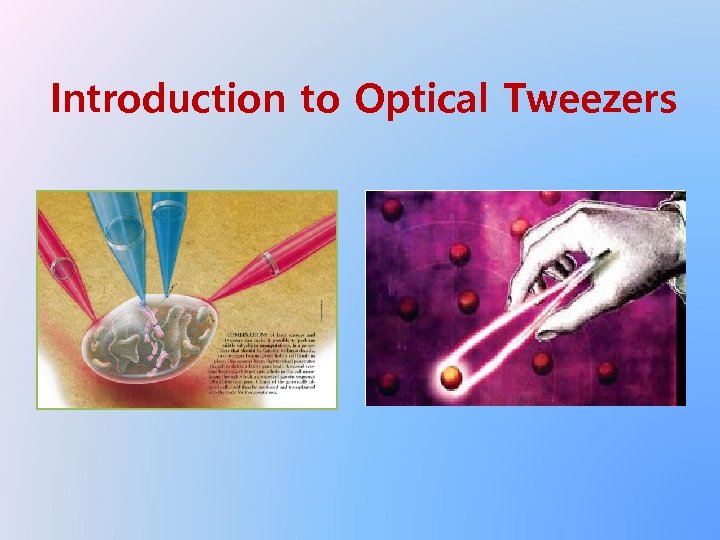 Introduction to Optical Tweezers
 OUTLINE v Brief History of Optical Tweezers v Principles of Optical Tweezers v Optical Trapping Forces v The Optical Tweezers Set up & The Experimental Method v Research Areas and Possible uses
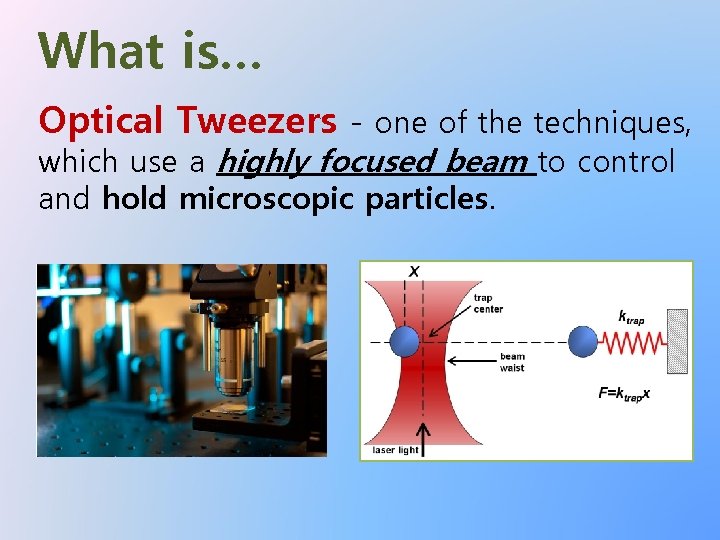 What is… Optical Tweezers - one of the techniques, which use a highly focused beam to control and hold microscopic particles.
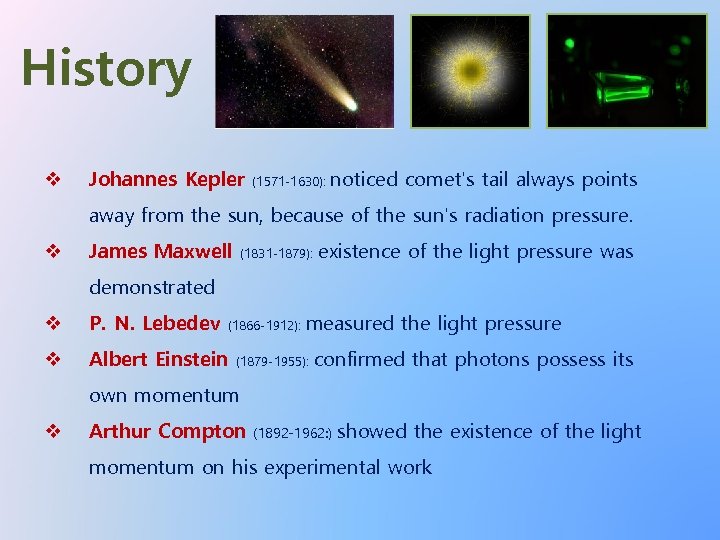 History v Johannes Kepler (1571 -1630): noticed comet's tail always points away from the sun, because of the sun's radiation pressure. v James Maxwell (1831 -1879): existence of the light pressure was demonstrated v P. N. Lebedev v Albert Einstein (1866 -1912): measured the light pressure (1879 -1955): confirmed that photons possess its own momentum v Arthur Compton (1892 -1962: ) showed the existence of the light momentum on his experimental work
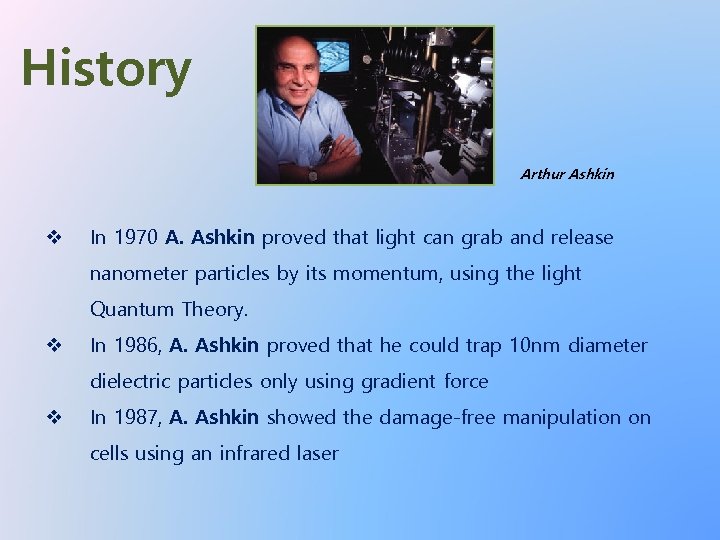 History Arthur Ashkin v In 1970 A. Ashkin proved that light can grab and release nanometer particles by its momentum, using the light Quantum Theory. v In 1986, A. Ashkin proved that he could trap 10 nm diameter dielectric particles only using gradient force v In 1987, A. Ashkin showed the damage-free manipulation on cells using an infrared laser
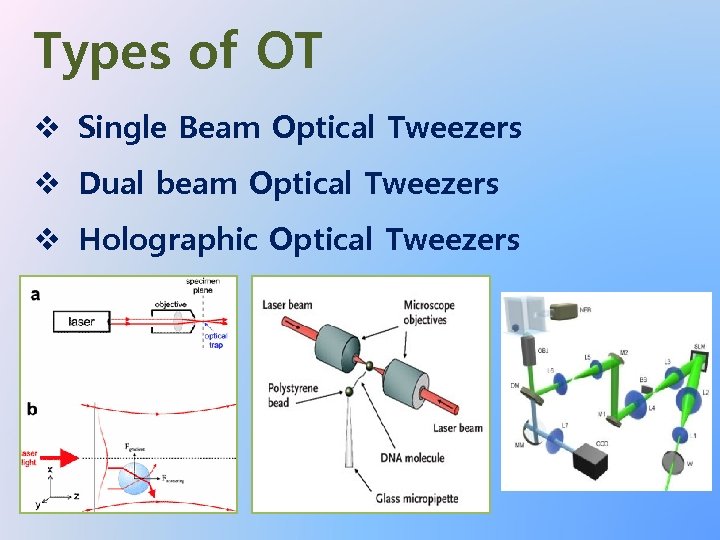 Types of OT v Single Beam Optical Tweezers v Dual beam Optical Tweezers v Holographic Optical Tweezers
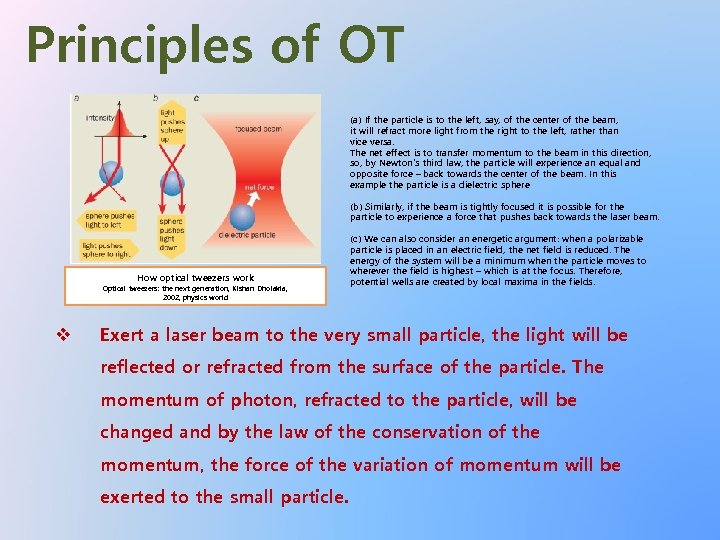 Principles of OT How optical tweezers work Optical tweezers: the next generation, Kishan Dholakia, 2002, physics world v (a) If the particle is to the left, say, of the center of the beam, it will refract more light from the right to the left, rather than vice versa. The net effect is to transfer momentum to the beam in this direction, so, by Newton’s third law, the particle will experience an equal and opposite force – back towards the center of the beam. In this example the particle is a dielectric sphere (b) Similarly, if the beam is tightly focused it is possible for the particle to experience a force that pushes back towards the laser beam. (c) We can also consider an energetic argument: when a polarizable particle is placed in an electric field, the net field is reduced. The energy of the system will be a minimum when the particle moves to wherever the field is highest – which is at the focus. Therefore, potential wells are created by local maxima in the fields. Exert a laser beam to the very small particle, the light will be reflected or refracted from the surface of the particle. The momentum of photon, refracted to the particle, will be changed and by the law of the conservation of the momentum, the force of the variation of momentum will be exerted to the small particle.
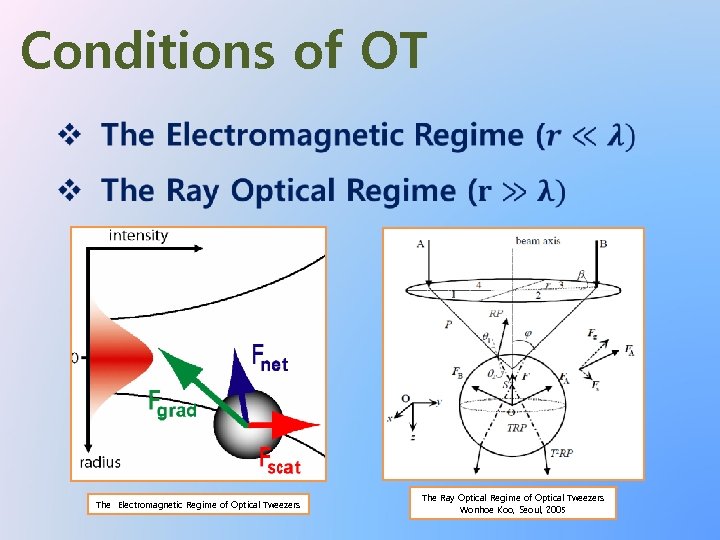 Conditions of OT The Electromagnetic Regime of Optical Tweezers The Ray Optical Regime of Optical Tweezers Wonhoe Koo, Seoul, 2005
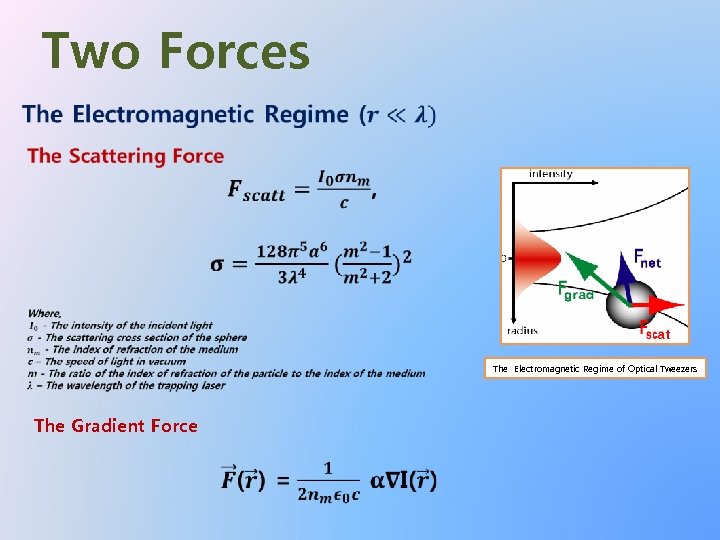 Two Forces The Electromagnetic Regime of Optical Tweezers The Gradient Force
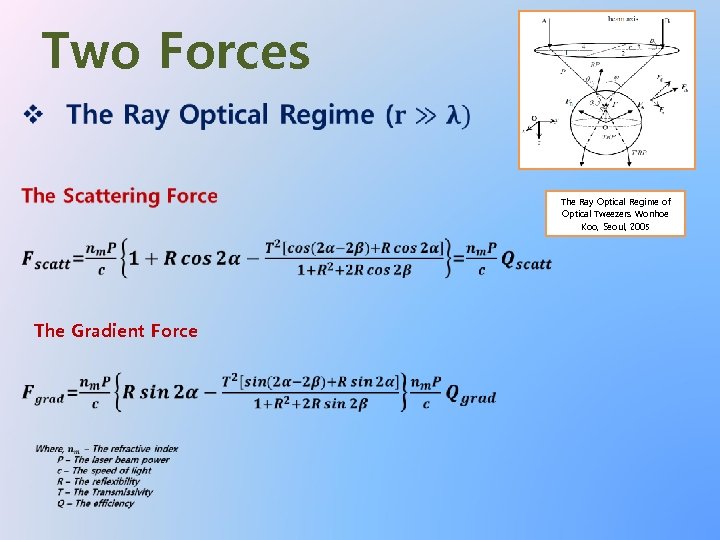 Two Forces The Ray Optical Regime of Optical Tweezers Wonhoe Koo, Seoul, 2005 The Gradient Force
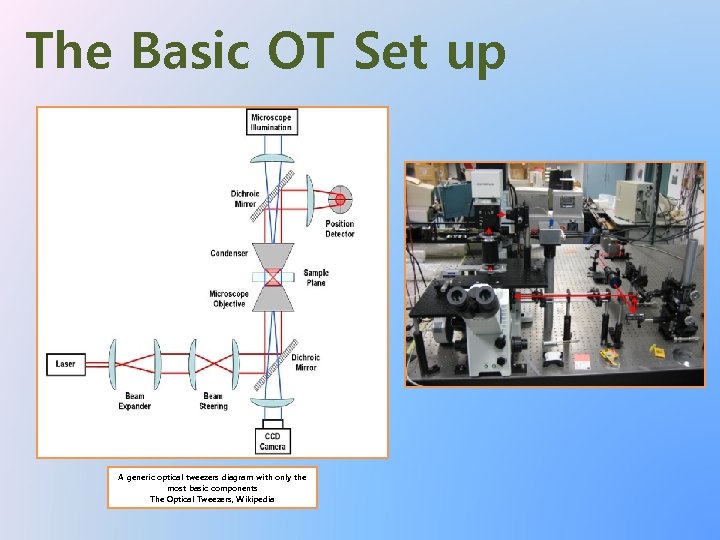 The Basic OT Set up A generic optical tweezers diagram with only the most basic components The Optical Tweezers, Wikipedia
 Research areas v Study and manipulate particles such as atoms, molecules and small dielectric spheres (in range from mm to nm). v Force measurements of biological objects in piconewton range. v Biological investigations involving cells v Cutting and ablating biological objects (Cell fusion and DNA cutting) v Force measurements of cell structures and DNA coiling v Elasticity measurements of DNA
 Thank you ^-^ Keonwoo Nam