


 Скачать презентацию NANOG Panel Discussion Are Transit Exchanges and Peering
71e9396daea5ddab7c7cb2c737d0939f.ppt
- Количество слайдов: 9
 NANOG Panel Discussion: Are “Transit Exchanges” and “Peering Exchanges” Self-Differentiating? Toronto June, 2002
 Keith Mitchell Chief Technical Officer Xchange. Point Philip Smith Chair, APNIC Internet Exchange SIG Bill Woodcock Research Director Packet Clearing House
 Background white-papers for this discussion: www. pch. net/documents/papers/transit-exch-peering-exch …/NANOG-02. 06 -peering-trans. html …/nanog-asia-ix. ppt www. xchangepoint. net/info/Xchange-Nanog 25. ppt
 Assumptions & Observations Old belief: All exchanges are functionally similar, differing principally qualitatively. Old belief: People go to exchanges to peer, but buy transit at their own location or within a colocation facility. However: Some exchanges are vastly more expensive than others, and provide services which are economically unsupportable within a peering economy. And: Many parties buy and sell transit within exchange facilities, either over crossconnects or through the switch fabric.
 Hypothesis There actually two poles toward which exchanges can be optimized: peering or transit, and they pose very different economic and provisioning requirements. It may not be possible to meet both requirements with maximal success within the context of a single exchange.
 Exchange Points and Aggregated Risk Redundancy is never necessary on a peering path. Full aggregation benefit may be extracted from it without danger, since the redundant transit path provides a “safety net. ” Transit contains full routes, including those not learned through peering, and constitutes a sole means of reaching most destinations. It thus requires redundancy and reliability. Aggregation benefits cannot be fully realized on a transit link.
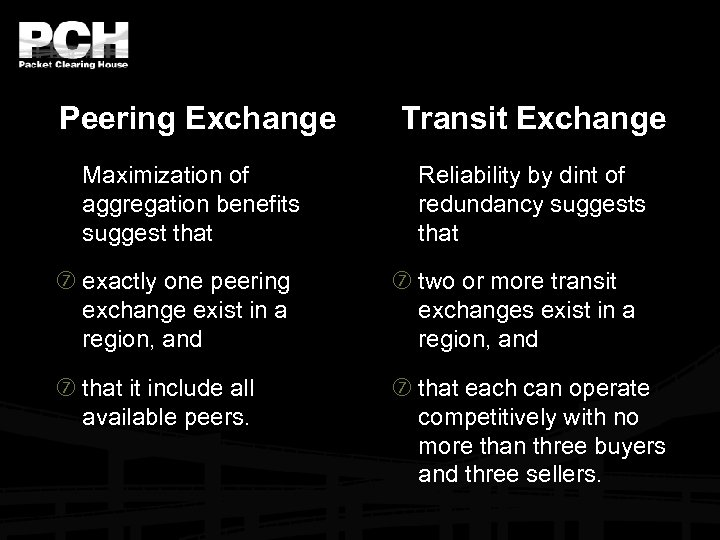 Peering Exchange Transit Exchange Maximization of aggregation benefits suggest that Reliability by dint of redundancy suggests that exactly one peering exchange exist in a region, and two or more transit exchanges exist in a region, and that it include all available peers. that each can operate competitively with no more than three buyers and three sellers.
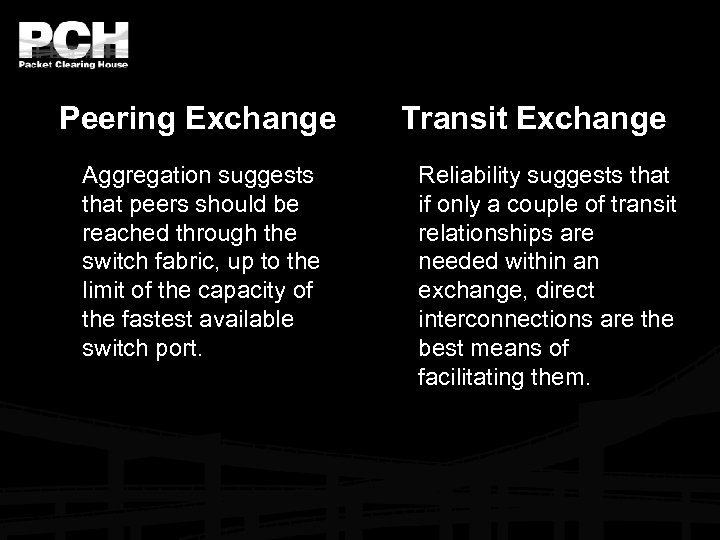 Peering Exchange Aggregation suggests that peers should be reached through the switch fabric, up to the limit of the capacity of the fastest available switch port. Transit Exchange Reliability suggests that if only a couple of transit relationships are needed within an exchange, direct interconnections are the best means of facilitating them.
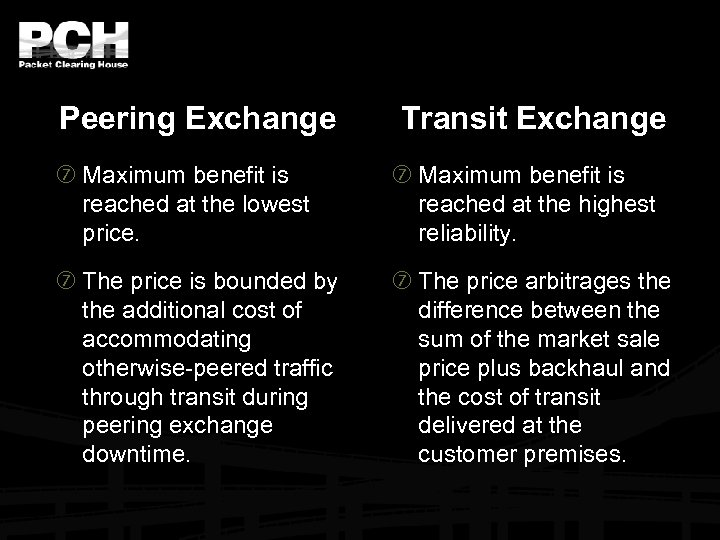 Peering Exchange Transit Exchange Maximum benefit is reached at the lowest price. Maximum benefit is reached at the highest reliability. The price is bounded by the additional cost of accommodating otherwise-peered traffic through transit during peering exchange downtime. The price arbitrages the difference between the sum of the market sale price plus backhaul and the cost of transit delivered at the customer premises.