


 Скачать презентацию Nano Mechanics and Materials Theory Multiscale Methods and
5125eaa68324045f72b0d8e92830e1ef.ppt
- Количество слайдов: 35
 Nano Mechanics and Materials: Theory, Multiscale Methods and Applications by Wing Kam Liu, Eduard G. Karpov, Harold S. Park
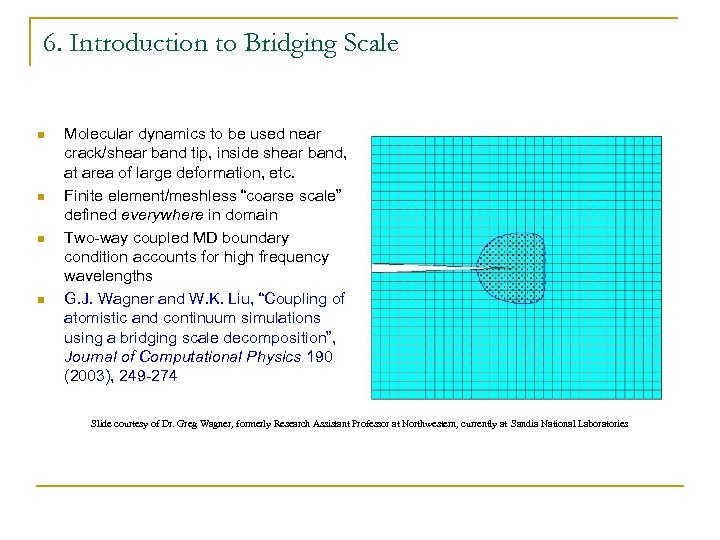 6. Introduction to Bridging Scale n n Molecular dynamics to be used near crack/shear band tip, inside shear band, at area of large deformation, etc. Finite element/meshless “coarse scale” defined everywhere in domain Two-way coupled MD boundary condition accounts for high frequency wavelengths G. J. Wagner and W. K. Liu, “Coupling of atomistic and continuum simulations using a bridging scale decomposition”, Journal of Computational Physics 190 (2003), 249 -274 Slide courtesy of Dr. Greg Wagner, formerly Research Assistant Professor at Northwestern, currently at Sandia National Laboratories
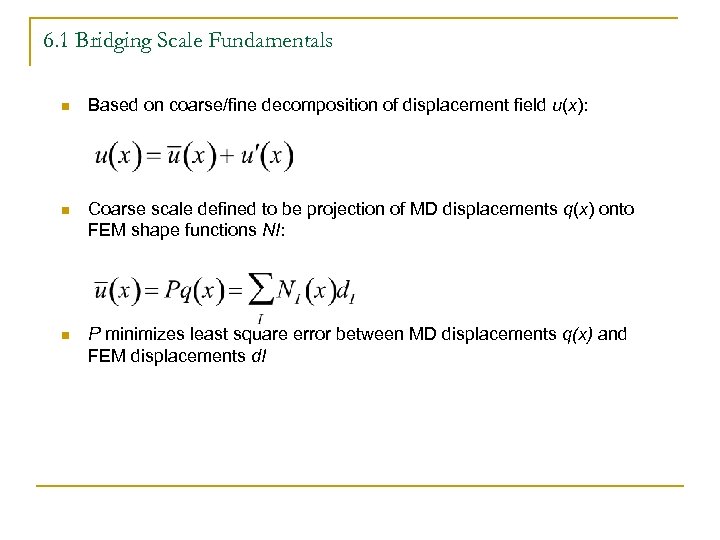 6. 1 Bridging Scale Fundamentals n Based on coarse/fine decomposition of displacement field u(x): n Coarse scale defined to be projection of MD displacements q(x) onto FEM shape functions NI: n P minimizes least square error between MD displacements q(x) and FEM displacements d. I
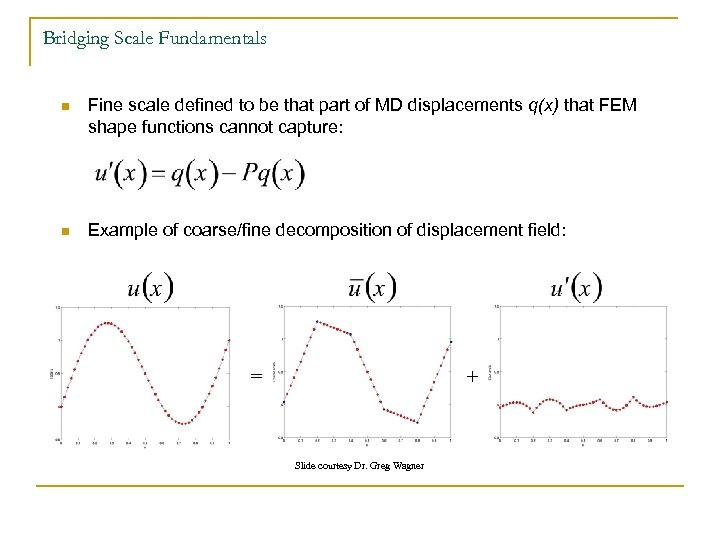 Bridging Scale Fundamentals n Fine scale defined to be that part of MD displacements q(x) that FEM shape functions cannot capture: n Example of coarse/fine decomposition of displacement field: = + Slide courtesy Dr. Greg Wagner
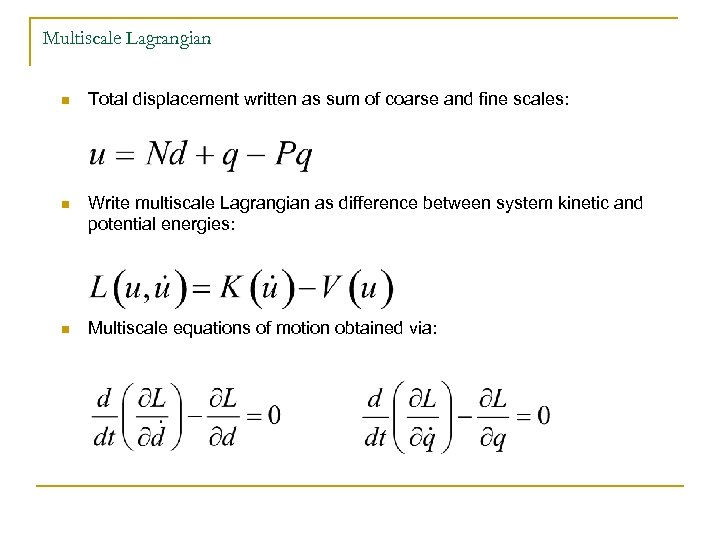 Multiscale Lagrangian n Total displacement written as sum of coarse and fine scales: n Write multiscale Lagrangian as difference between system kinetic and potential energies: n Multiscale equations of motion obtained via:
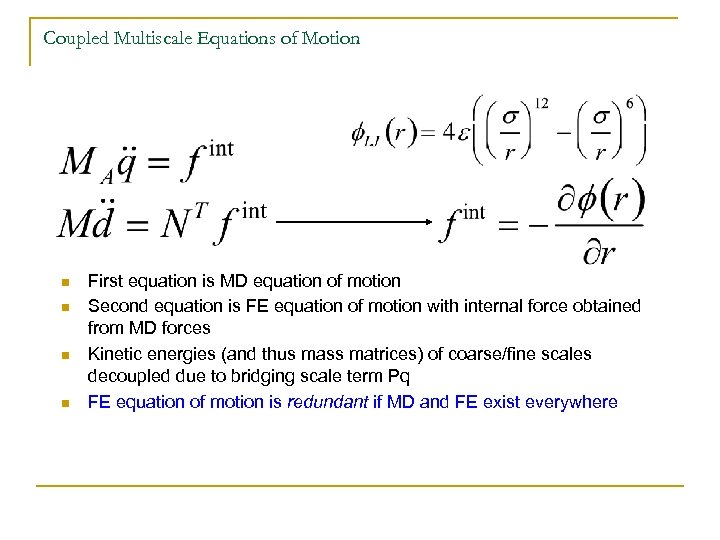 Coupled Multiscale Equations of Motion n n First equation is MD equation of motion Second equation is FE equation of motion with internal force obtained from MD forces Kinetic energies (and thus mass matrices) of coarse/fine scales decoupled due to bridging scale term Pq FE equation of motion is redundant if MD and FE exist everywhere
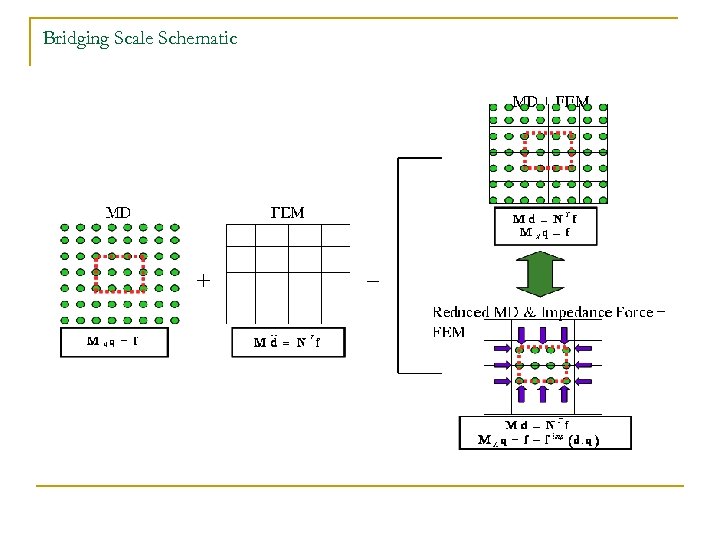 Bridging Scale Schematic
 MD Boundary Condition Approaches n Generalized Langevin Equation (GLE) q S. A. Adelman and J. D. Doll, Journal of Chemical Physics 64, 1976. q Limited to one-dimensional cases n Minimizing boundary reflections q W. Cai, M. de Koning, V. V. Bulatov and S. Yip, Physical Review Letters 85, 2000. q Size of time history kernel related to number of boundary atoms n Matching conditions q W. E. , B. Engquist and Z. Huang, Physical Review B 67, 2003. q Geometry of lattice must be explicitly modeled n Still lacking consistently derived MD boundary condition that is valid for arbitrary lattice structures, interatomic potentials
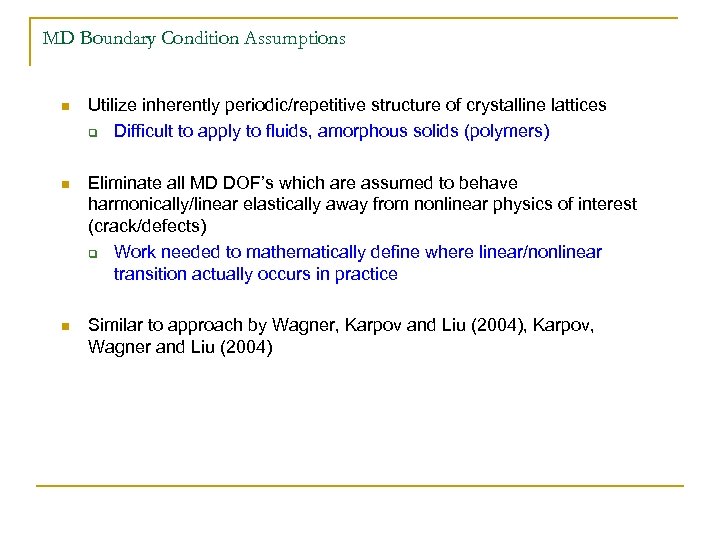 MD Boundary Condition Assumptions n Utilize inherently periodic/repetitive structure of crystalline lattices q Difficult to apply to fluids, amorphous solids (polymers) n Eliminate all MD DOF’s which are assumed to behave harmonically/linear elastically away from nonlinear physics of interest (crack/defects) q Work needed to mathematically define where linear/nonlinear transition actually occurs in practice n Similar to approach by Wagner, Karpov and Liu (2004), Karpov, Wagner and Liu (2004)
 Transformation of Effective Information into Heat Due to reflective boundaries, the wave packages/signals gradually transforms into heat (chaotic motion): Important information about physics of the process can be lost. It is required that wave packages propagate to the coarse scale without reflection at the fine/coarse interface. The successive tracking of wave packages is unnecessary.
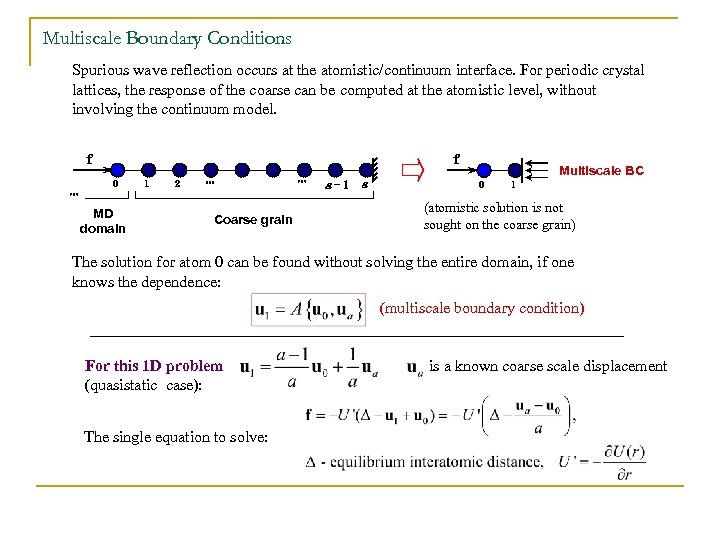 Multiscale Boundary Conditions Spurious wave reflection occurs at the atomistic/continuum interface. For periodic crystal lattices, the response of the coarse can be computed at the atomistic level, without involving the continuum model. f f 0 1 2 … … MD domain Coarse grain … a– 1 a Multiscale BC 0 1 (atomistic solution is not sought on the coarse grain) The solution for atom 0 can be found without solving the entire domain, if one knows the dependence: (multiscale boundary condition) For this 1 D problem (quasistatic case): The single equation to solve: is a known coarse scale displacement
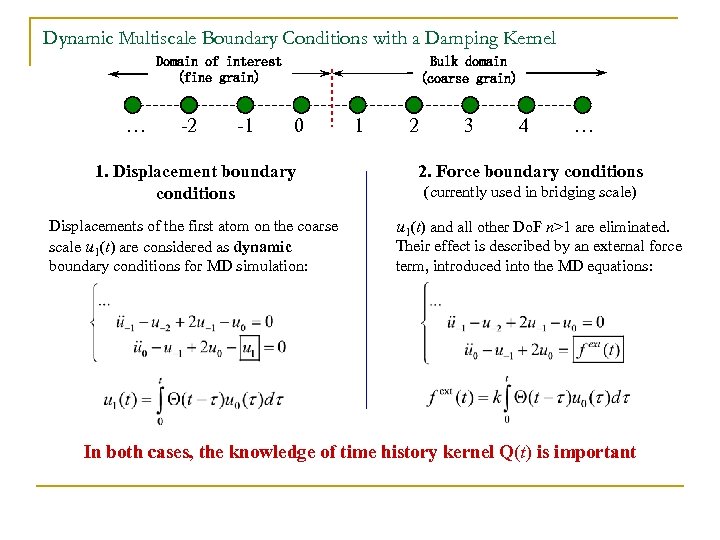 Dynamic Multiscale Boundary Conditions with a Damping Kernel Domain of interest (fine grain) … -2 -1 Bulk domain (coarse grain) 0 1 2 3 4 … 1. Displacement boundary conditions 2. Force boundary conditions Displacements of the first atom on the coarse scale u 1(t) are considered as dynamic boundary conditions for MD simulation: u 1(t) and all other Do. F n>1 are eliminated. (currently used in bridging scale) Their effect is described by an external force term, introduced into the MD equations: In both cases, the knowledge of time history kernel Q(t) is important
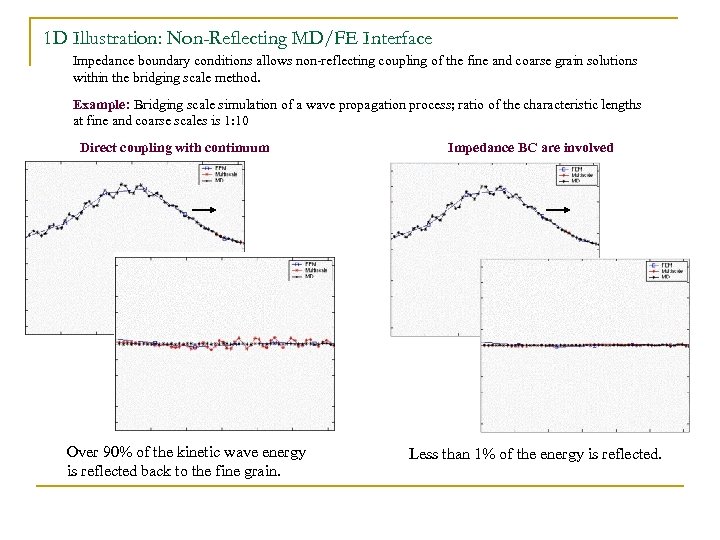 1 D Illustration: Non-Reflecting MD/FE Interface Impedance boundary conditions allows non-reflecting coupling of the fine and coarse grain solutions within the bridging scale method. Example: Bridging scale simulation of a wave propagation process; ratio of the characteristic lengths at fine and coarse scales is 1: 10 Direct coupling with continuum Over 90% of the kinetic wave energy is reflected back to the fine grain. Impedance BC are involved Less than 1% of the energy is reflected.
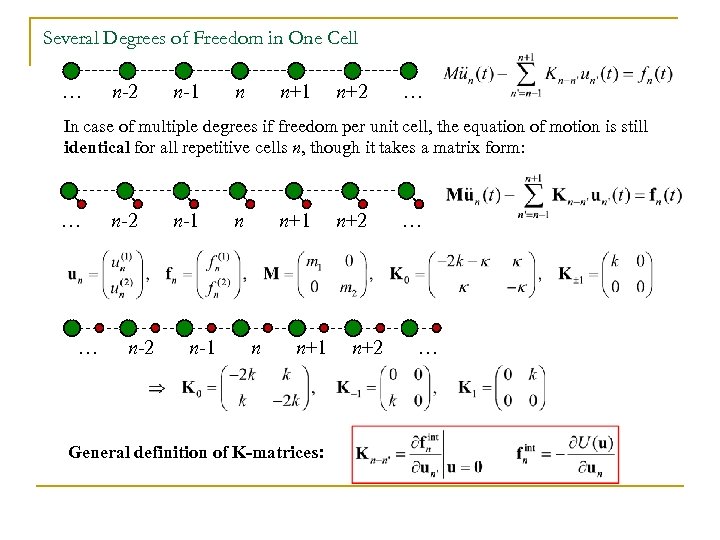 Several Degrees of Freedom in One Cell … n-2 n-1 n n+1 n+2 … In case of multiple degrees if freedom per unit cell, the equation of motion is still identical for all repetitive cells n, though it takes a matrix form: … … n-2 n-1 n n+1 General definition of K-matrices: n+2 … …
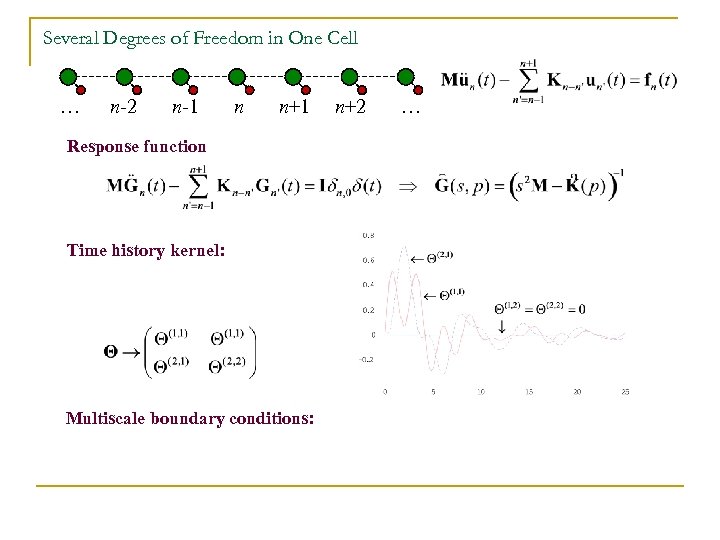 Several Degrees of Freedom in One Cell … n-2 n-1 n n+1 Response function Time history kernel: Multiscale boundary conditions: n+2 …
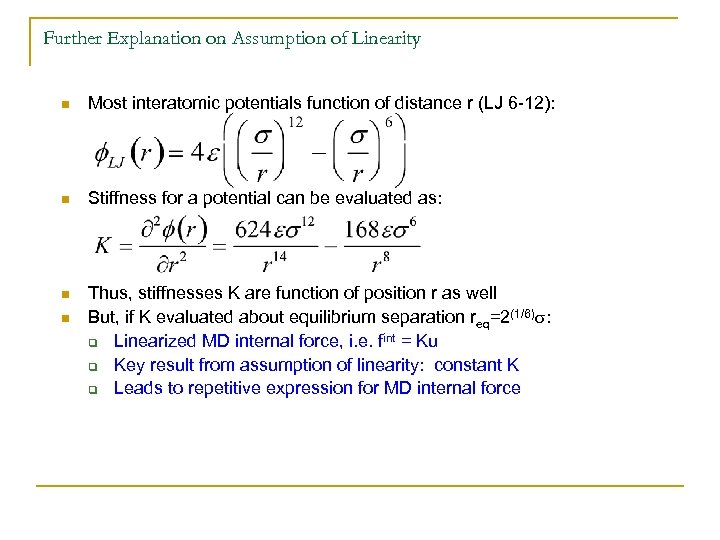 Further Explanation on Assumption of Linearity n Most interatomic potentials function of distance r (LJ 6 -12): n Stiffness for a potential can be evaluated as: n Thus, stiffnesses K are function of position r as well But, if K evaluated about equilibrium separation req=2(1/6) : q Linearized MD internal force, i. e. fint = Ku q Key result from assumption of linearity: constant K q Leads to repetitive expression for MD internal force n
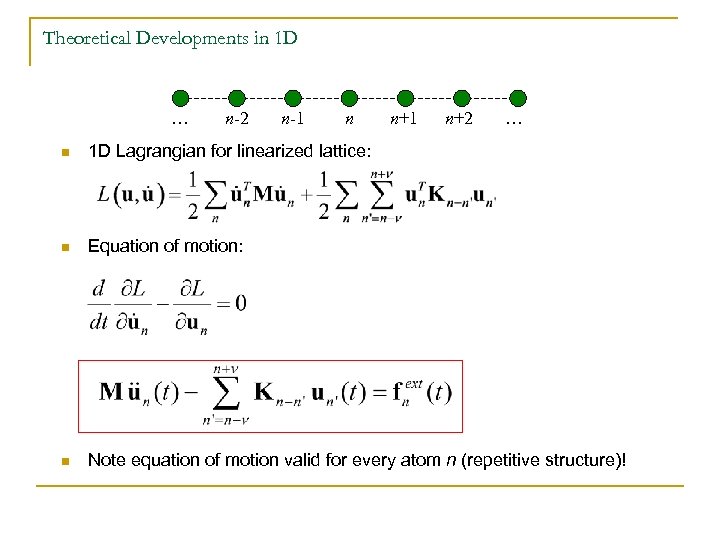 Theoretical Developments in 1 D … n-2 n-1 n n+1 n+2 … n 1 D Lagrangian for linearized lattice: n Equation of motion: n Note equation of motion valid for every atom n (repetitive structure)!
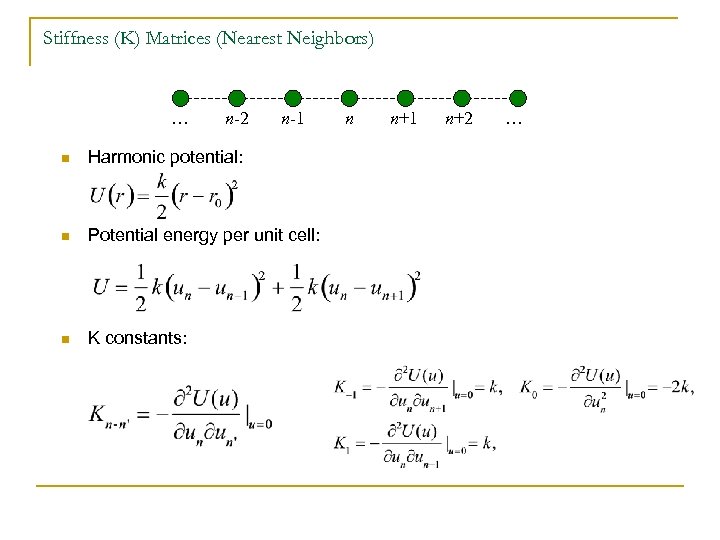 Stiffness (K) Matrices (Nearest Neighbors) … n-2 n-1 n Harmonic potential: n Potential energy per unit cell: n K constants: n n+1 n+2 …
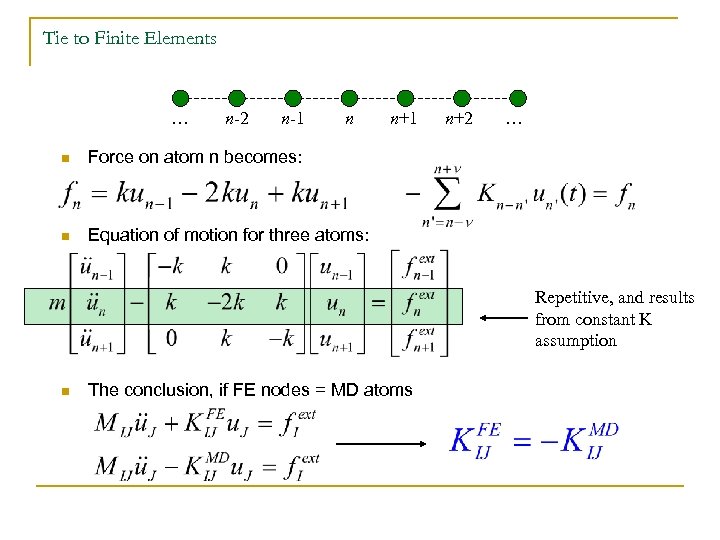 Tie to Finite Elements … n-2 n-1 n n n+2 … Force on atom n becomes: n n+1 Equation of motion for three atoms: Repetitive, and results from constant K assumption n The conclusion, if FE nodes = MD atoms
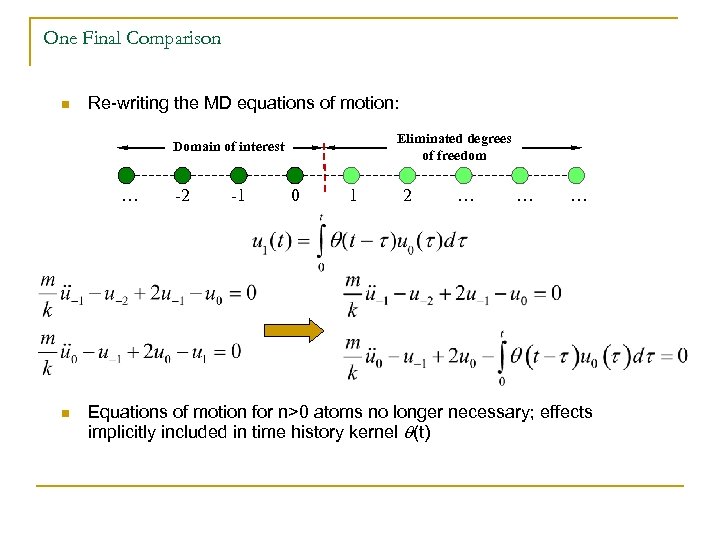 One Final Comparison n Re-writing the MD equations of motion: Eliminated degrees of freedom Domain of interest … n -2 -1 0 1 2 … … … Equations of motion for n>0 atoms no longer necessary; effects implicitly included in time history kernel (t)
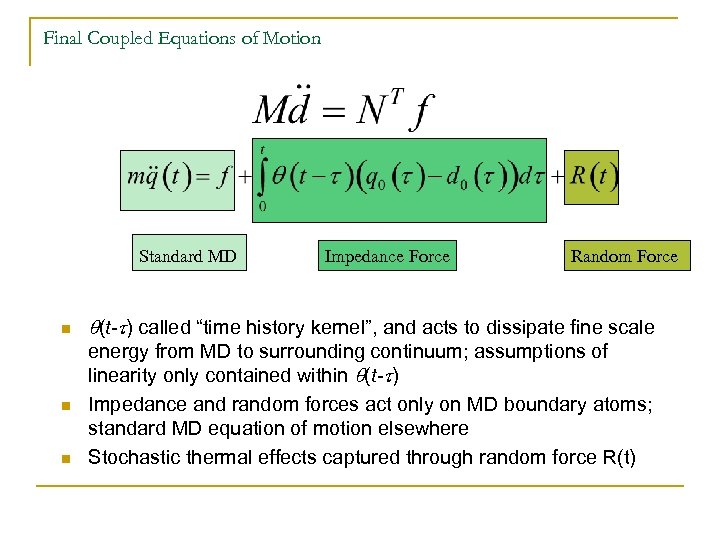 Final Coupled Equations of Motion Standard MD Impedance Force Random Force n (t- ) called “time history kernel”, and acts to dissipate fine scale n energy from MD to surrounding continuum; assumptions of linearity only contained within (t- ) Impedance and random forces act only on MD boundary atoms; standard MD equation of motion elsewhere Stochastic thermal effects captured through random force R(t) n
 Features of MD Boundary Condition n n MD equation of motion is two-way coupled with coarse scale: q If information begins in the continuum, can be transferred naturally to MD as boundary condition has dimensions of minimum number of degrees of freedom in each unit cell, and is re-used for every boundary atom: q Size of remains constant as size of structure grows - leads to computational scalability for any lattice structure Automated numerical procedure to calculate time history kernel for a given multi-dimensional lattice structure and potential q Standard numerical Laplace and Fourier transform techniques derived consistently using lattice dynamics principles q No ad hoc damping used to eliminate high frequency waves Ease of implementation: q Only additional external force required for MD boundary atoms
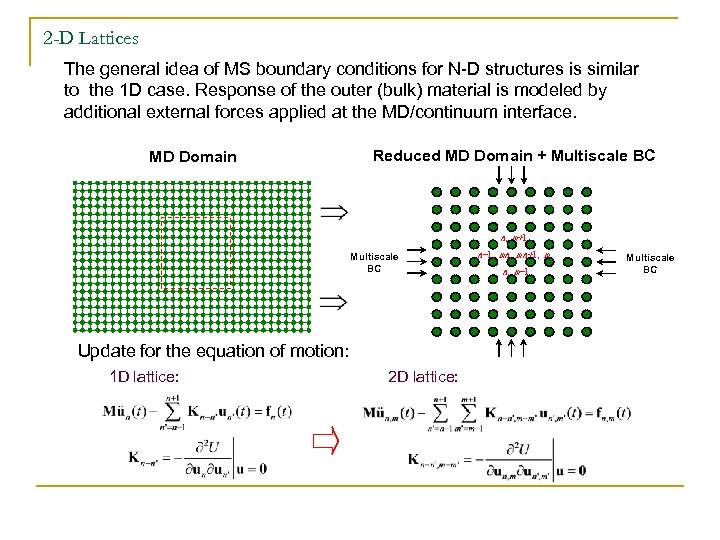 2 -D Lattices The general idea of MS boundary conditions for N-D structures is similar to the 1 D case. Response of the outer (bulk) material is modeled by additional external forces applied at the MD/continuum interface. MD Domain Reduced MD Domain + Multiscale BC n, m+1 Multiscale BC Update for the equation of motion: 1 D lattice: 2 D lattice: n-1, mn, m n+1, m n, m-1 Multiscale BC
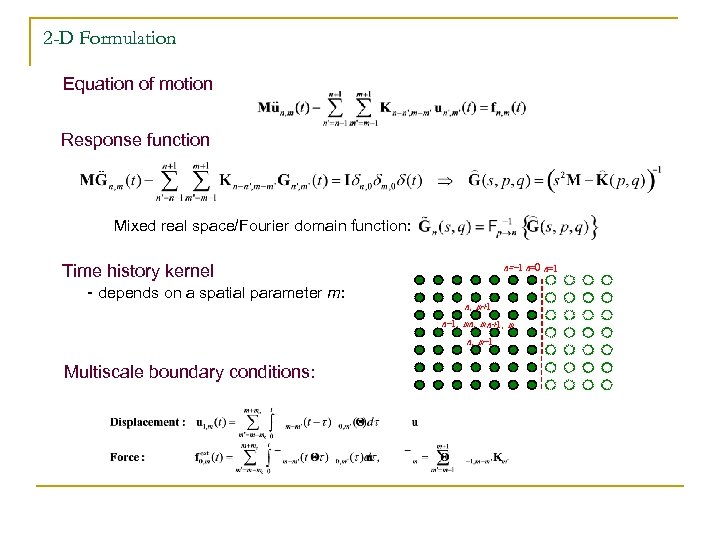 2 -D Formulation Equation of motion Response function Mixed real space/Fourier domain function: Time history kernel - depends on a spatial parameter m: n=-1 n=0 n=1 n, m+1 n-1, mn, m n+1, m n, m-1 Multiscale boundary conditions:
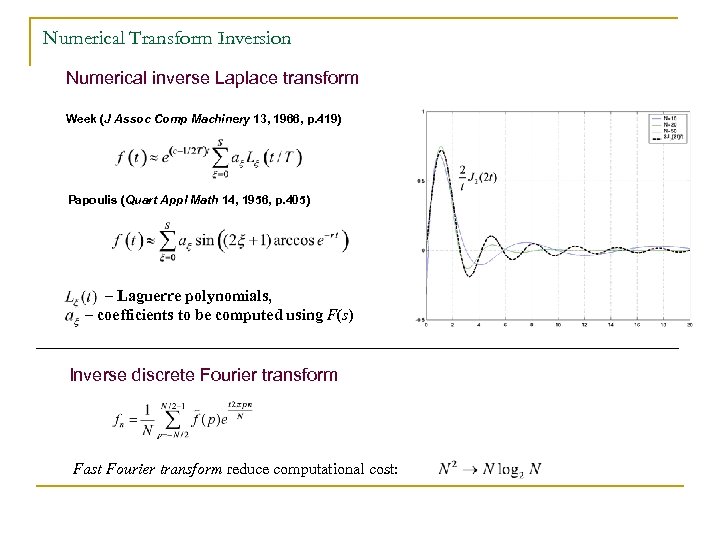 Numerical Transform Inversion Numerical inverse Laplace transform Week (J Assoc Comp Machinery 13, 1966, p. 419) Papoulis (Quart Appl Math 14, 1956, p. 405) – Laguerre polynomials, – coefficients to be computed using F(s) Inverse discrete Fourier transform Fast Fourier transform reduce computational cost:
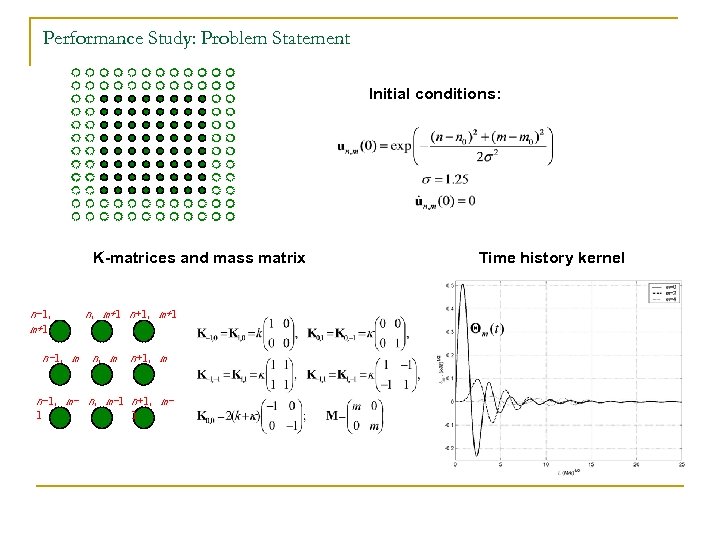 Performance Study: Problem Statement Initial conditions: K-matrices and mass matrix n-1, m+1 n-1, m n, m+1 n+1, m+1 n, m n+1, m n-1, m- n, m-1 n+1, m 1 1 Time history kernel
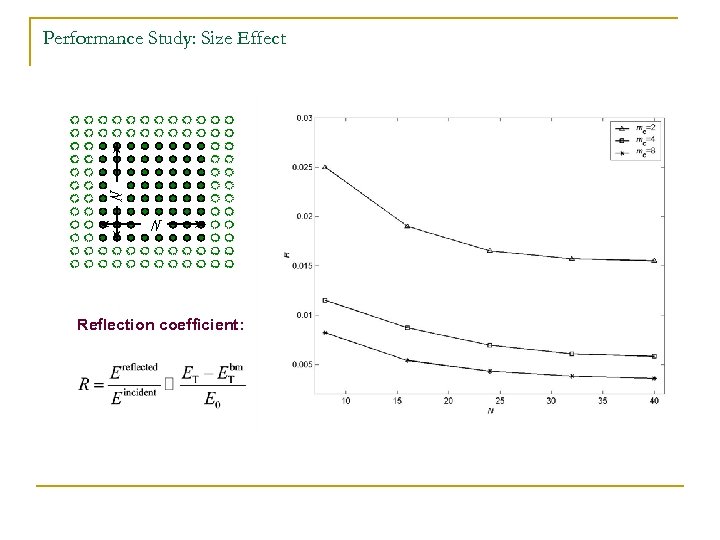 Performance Study: Size Effect N N Reflection coefficient:
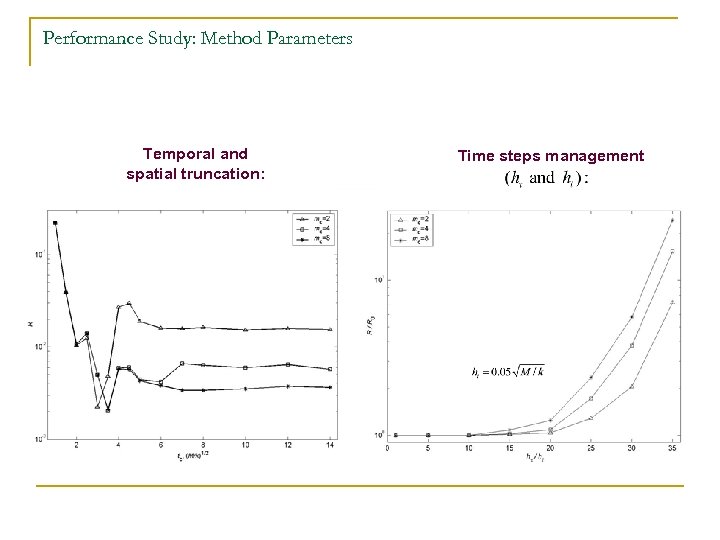 Performance Study: Method Parameters Temporal and spatial truncation: Time steps management
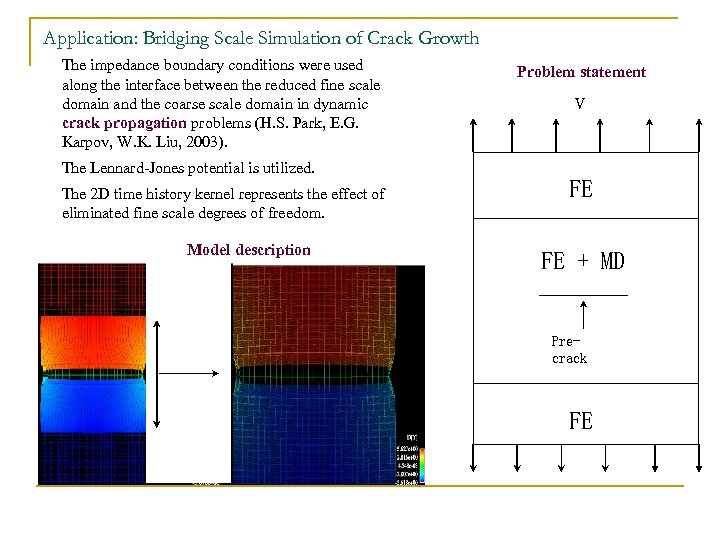 Application: Bridging Scale Simulation of Crack Growth The impedance boundary conditions were used along the interface between the reduced fine scale domain and the coarse scale domain in dynamic crack propagation problems (H. S. Park, E. G. Karpov, W. K. Liu, 2003). The Lennard-Jones potential is utilized. The 2 D time history kernel represents the effect of eliminated fine scale degrees of freedom. Model description Problem statement v FE FE + MD Precrack FE
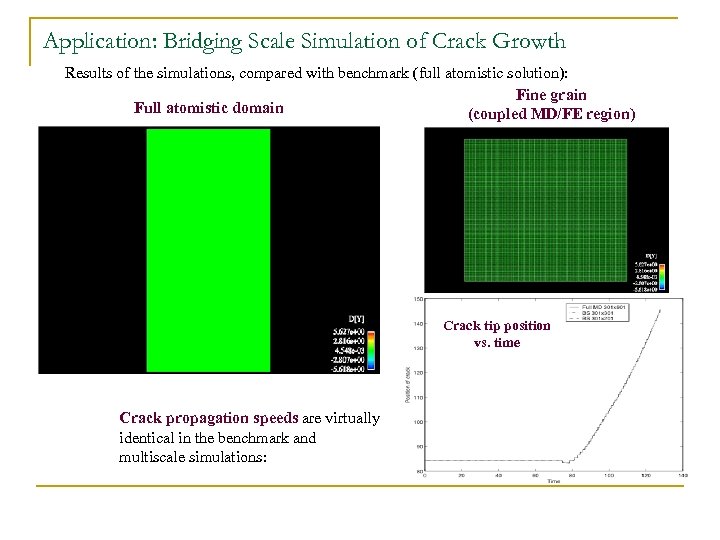 Application: Bridging Scale Simulation of Crack Growth Results of the simulations, compared with benchmark (full atomistic solution): Fine grain Full atomistic domain (coupled MD/FE region) Crack tip position vs. time Crack propagation speeds are virtually identical in the benchmark and multiscale simulations:
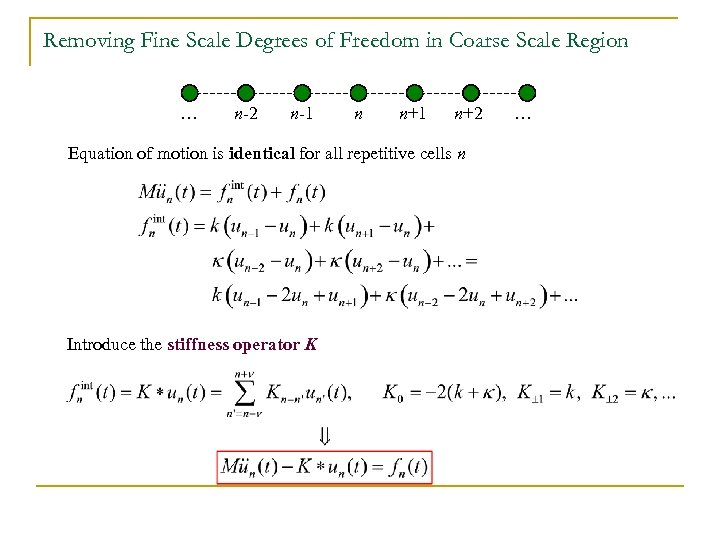 Removing Fine Scale Degrees of Freedom in Coarse Scale Region … n-2 n-1 n n+1 n+2 Equation of motion is identical for all repetitive cells n Introduce the stiffness operator K …
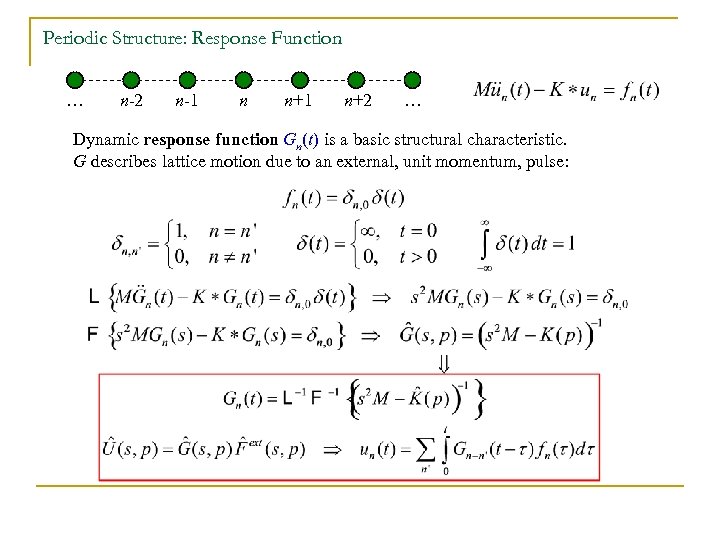 Periodic Structure: Response Function … n-2 n-1 n n+1 n+2 … Dynamic response function Gn(t) is a basic structural characteristic. G describes lattice motion due to an external, unit momentum, pulse:
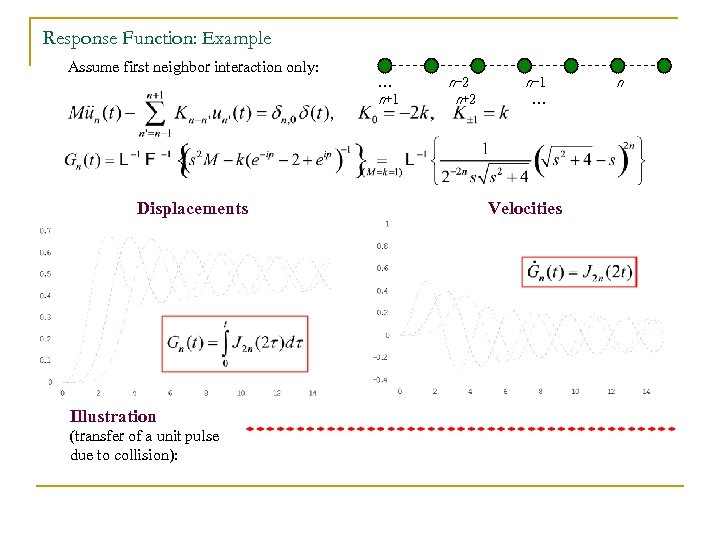 Response Function: Example Assume first neighbor interaction only: Displacements Illustration (transfer of a unit pulse due to collision): … n+1 n-2 n+2 n-1 … Velocities n
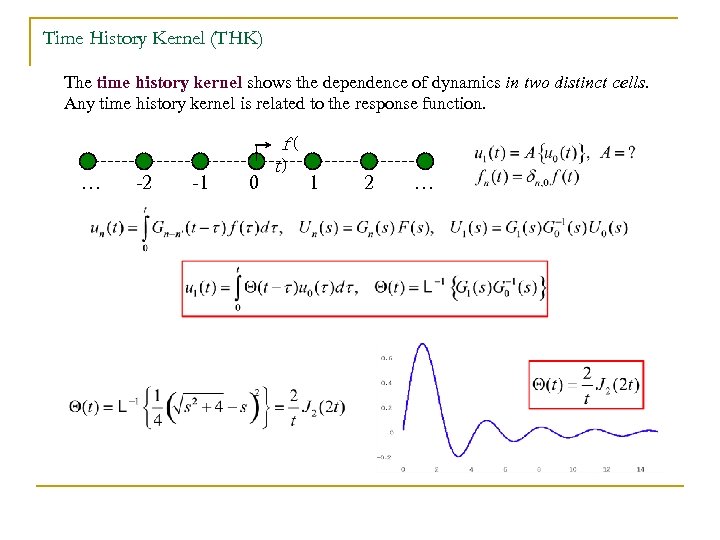 Time History Kernel (THK) The time history kernel shows the dependence of dynamics in two distinct cells. Any time history kernel is related to the response function. f( … -2 -1 0 t) 1 2 …
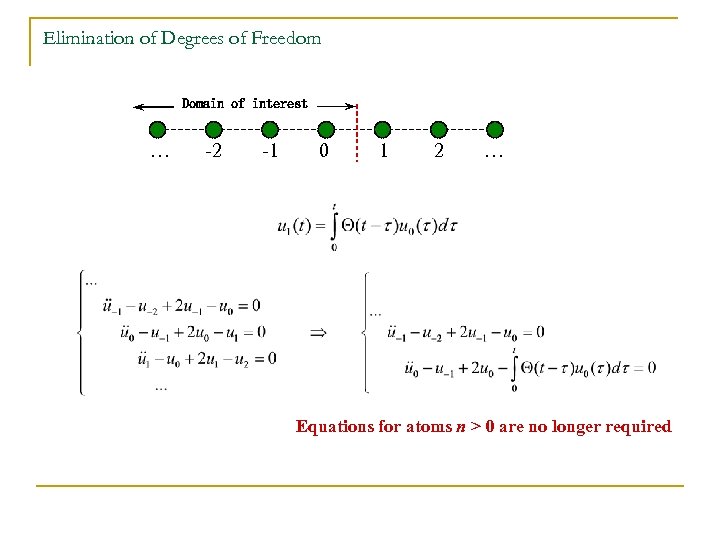 Elimination of Degrees of Freedom Domain of interest … -2 -1 0 1 2 … Equations for atoms n > 0 are no longer required