


 Скачать презентацию NANO KOREA 2006 2006 International Nanotech Symposium
d5d1978a54c3a64549324e8b5018362b.ppt
- Количество слайдов: 16
 NANO KOREA 2006 “ 2006” International Nanotech Symposium & Exhibition In Korea Magnetite nanoparticles encapsulated with β-glucan for biomedical application Sang Gil Ko 1, Jun Hee Cho 1, Yang Kyu Ahn 1*, Eun Hee Kim 2, Ki Chang Song 3, Eun Jung Choi 4 1 Department 2 Pharmaceutical of Nanochemistry & Biochemistry, Konyang University Examination Div. , The Korean Intellectual Property Office 3 Department of Chemical Engineering, Konyang University 4 Department of Othalmic Optics, Konyang University ykahn@konyang. ac. kr Tel : +82 -41 -730 -5224
 Abstract Embolotherapy, the process in which a blood vessel or organ is obstructed by the lodgment of a material mass, has been used in cancer treatment as well as artery bleeding or malformation. However, most embolic materials such as polyvinyl alcohol(PVA) could not be detected by an MRI, so it was difficult to locate injected embolic materials in a body. Superparamagnetic nanoparticles have an advantage of producing an enhanced proton relaxation in MRI and the Superparamagnetic nanoparticlescan be incorporated into embolic materials to enable MRI detection and thus find a practical application in embolotherapy. Therefore, we would like to develop a novel embolic material capable of MRI contrast enhancement. The Superparamagnetic nanoparticles synthesized by the sonochemistry spherical. Considering their uniform size and shape, these Superparamagnetic nanoparticles were suitable to use for medical applications. These magnetic nanoparticles were encapsulated with beta-glucan which is known as a safe material to an human body, then we obtained spherical microspheres having an average diameter of 501000㎛. Also, we could controlled the size distribution of the microspheres as well as selected the microspheres of 100 -300 ㎛ in diameter that is suitable to be injected through the blood vessel via angiographic catheters. These selected microspheres were nearly spherical and maintained their shape in water for more than 30 days. Then, in order to optimize the concentration of magnetic materials in beta-glucan, various concentration of microspheres were prepared and obtained magnetic resonance images by 4. 7 T MRI.
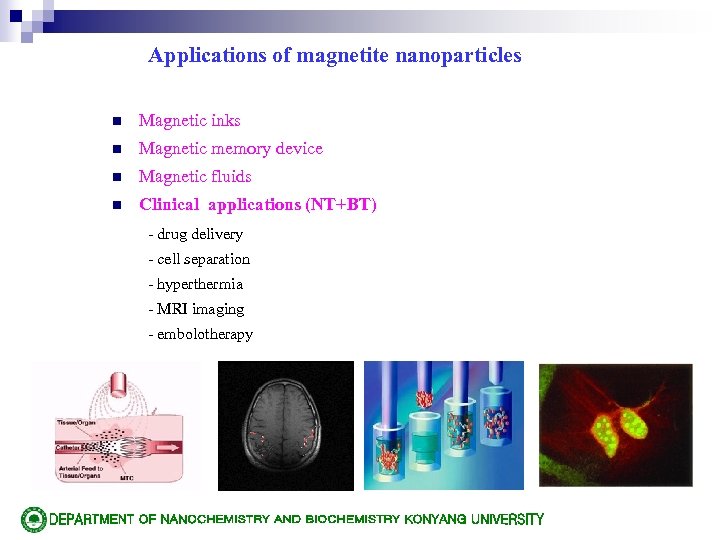 Applications of magnetite nanoparticles n Magnetic inks n Magnetic memory device n Magnetic fluids n Clinical applications (NT+BT) - drug delivery - cell separation - hyperthermia - MRI imaging - embolotherapy
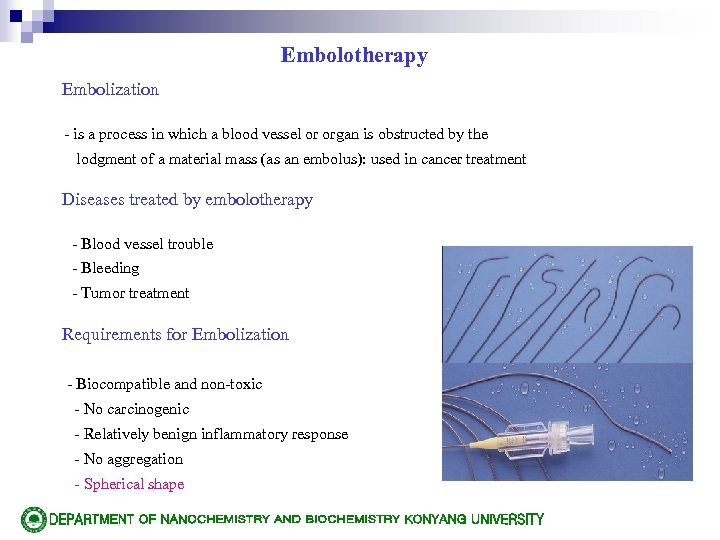 Embolotherapy Embolization - is a process in which a blood vessel or organ is obstructed by the lodgment of a material mass (as an embolus): used in cancer treatment Diseases treated by embolotherapy - Blood vessel trouble - Bleeding - Tumor treatment Requirements for Embolization - Biocompatible and non-toxic - No carcinogenic - Relatively benign inflammatory response - No aggregation - Spherical shape
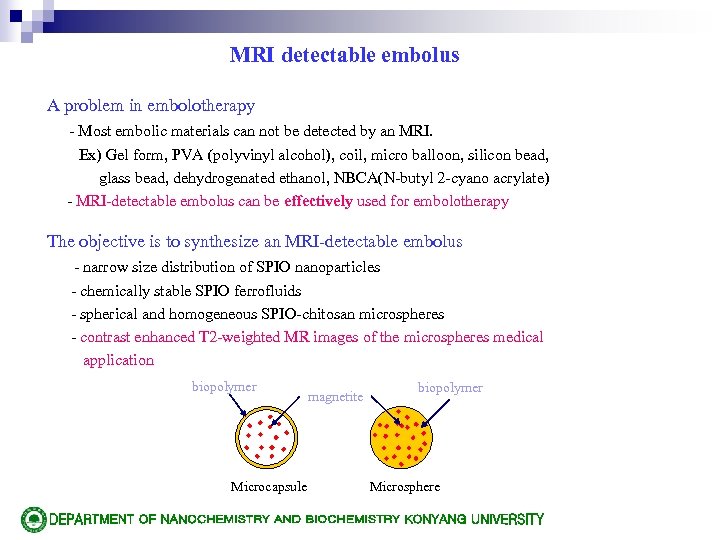 MRI detectable embolus A problem in embolotherapy - Most embolic materials can not be detected by an MRI. Ex) Gel form, PVA (polyvinyl alcohol), coil, micro balloon, silicon bead, glass bead, dehydrogenated ethanol, NBCA(N-butyl 2 -cyano acrylate) - MRI-detectable embolus can be effectively used for embolotherapy The objective is to synthesize an MRI-detectable embolus - narrow size distribution of SPIO nanoparticles - chemically stable SPIO ferrofluids - spherical and homogeneous SPIO-chitosan microspheres - contrast enhanced T 2 -weighted MR images of the microspheres medical application biopolymer Microcapsule magnetite biopolymer Microsphere
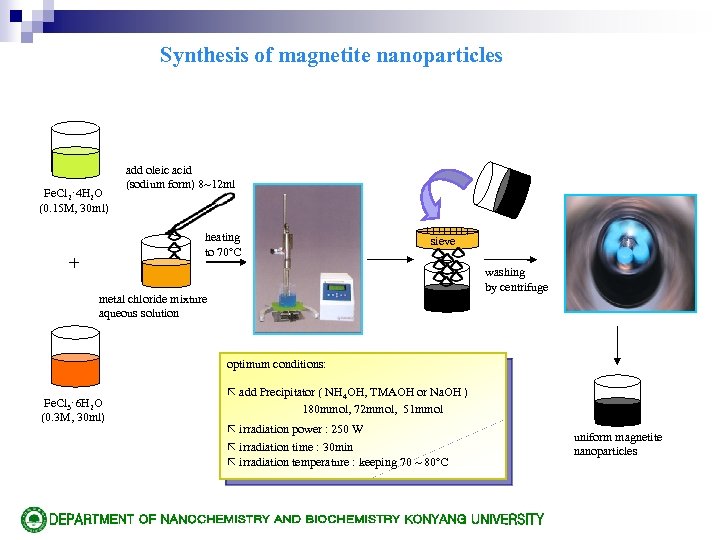 Synthesis of magnetite nanoparticles Fe. Cl 2· 4 H 2 O (0. 15 M, 30 ml) add oleic acid (sodium form) 8~12 ml heating to 70℃ + sieve washing by centrifuge metal chloride mixture aqueous solution optimum conditions: Fe. Cl 3· 6 H 2 O (0. 3 M, 30 ml) add Precipitator ( NH 4 OH, TMAOH or Na. OH ) 180 mmol, 72 mmol, 51 mmol irradiation power : 250 W irradiation time : 30 min irradiation temperature : keeping 70 ~ 80℃ uniform magnetite nanoparticles
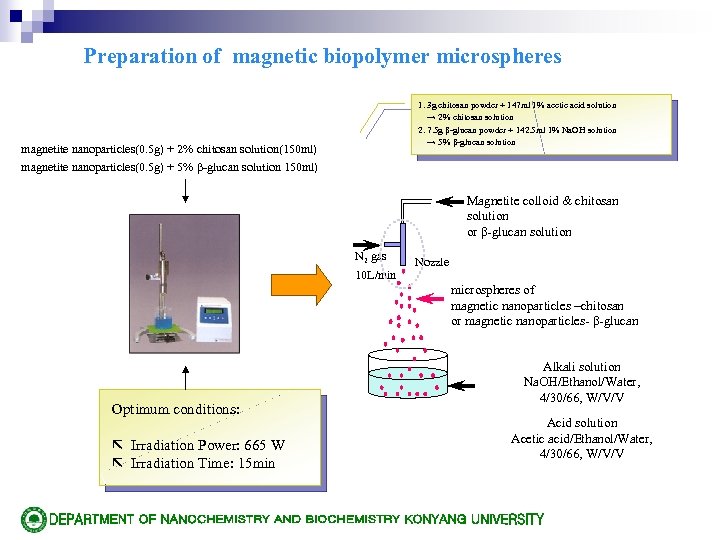 Preparation of magnetic biopolymer microspheres 1. 3 g chitosan powder + 147 ml 1% acetic acid solution → 2% chitosan solution 2. 7. 5 g β-glucan powder + 142. 5 ml 1% Na. OH solution → 5% β-glucan solution magnetite nanoparticles(0. 5 g) + 2% chitosan solution(150 ml) magnetite nanoparticles(0. 5 g) + 5% β-glucan solution 150 ml) Magnetite colloid & chitosan solution or β-glucan solution N 2 gas Nozzle 10 L/min microspheres of magnetic nanoparticles –chitosan or magnetic nanoparticles- β-glucan Optimum conditions: Irradiation Power: 665 W Irradiation Time: 15 min Alkali solution Na. OH/Ethanol/Water, 4/30/66, W/V/V Acid solution Acetic acid/Ethanol/Water, 4/30/66, W/V/V
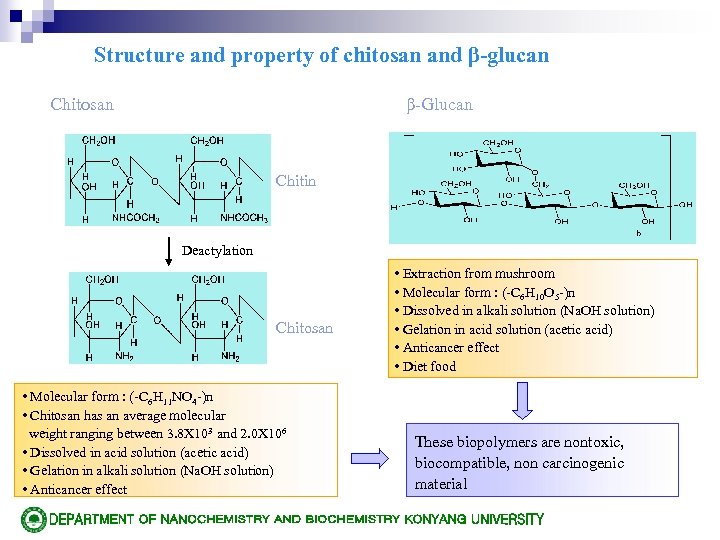 Structure and property of chitosan and β-glucan Chitosan β-Glucan Chitin Deactylation Chitosan • Molecular form : (-C 6 H 11 NO 4 -)n • Chitosan has an average molecular weight ranging between 3. 8 X 10³ and 2. 0 X 106 • Dissolved in acid solution (acetic acid) • Gelation in alkali solution (Na. OH solution) • Anticancer effect • Extraction from mushroom • Molecular form : (-C 6 H 10 O 5 -)n • Dissolved in alkali solution (Na. OH solution) • Gelation in acid solution (acetic acid) • Anticancer effect • Diet food These biopolymers are nontoxic, biocompatible, non carcinogenic material
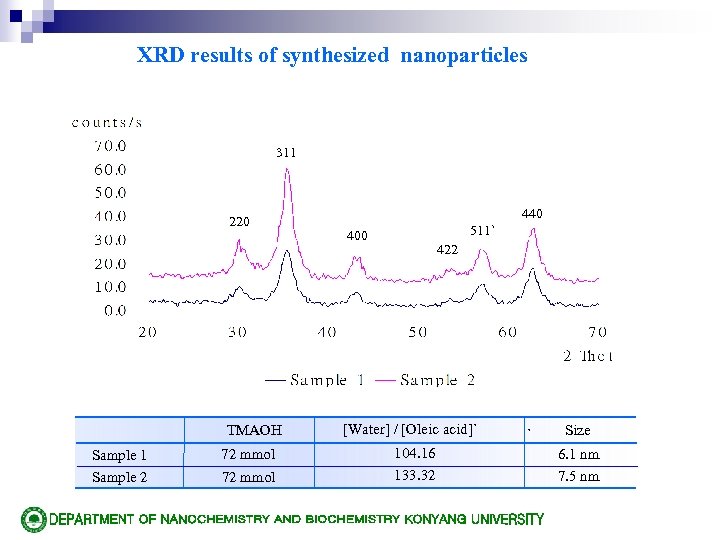 XRD results of synthesized nanoparticles 311 220 TMAOH Sample 1 72 mmol Sample 2 72 mmol 440 511` 400 422 [Water] / [Oleic acid]` 104. 16 133. 32 ` Size 6. 1 nm 7. 5 nm
![Size distributions of magnetite nanoparticles (a) (b) (c) (d) [Water]/ [Oleic acid] Particle size](https://present5.com/presentation/d5d1978a54c3a64549324e8b5018362b/image-10.jpg "Size distributions of magnetite nanoparticles (a) (b) (c) (d) [Water]/ [Oleic acid] Particle size") Size distributions of magnetite nanoparticles (a) (b) (c) (d) [Water]/ [Oleic acid] Particle size (nm) S. Dev (nm/%) (a) 95. 23 2. 0 0. 3/13. 3 (b) 104. 16 3. 7 0. 4/11. 2 (c) 114. 83 5. 4 0. 5/9. 8 (d) 133. 32` 7. 4 0. 8/10. 8
Size distributions of magnetite nanoparticles (a) (b) (c) (d) [Water]/ [Oleic acid] Particle size (nm) S. Dev (nm/%) (a) 95. 23 2. 0 0. 3/13. 3 (b) 104. 16 3. 7 0. 4/11. 2 (c) 114. 83 5. 4 0. 5/9. 8 (d) 133. 32` 7. 4 0. 8/10. 8
![AFM images of magnetite nanoparticles Magnetite 1 Magnetite 2 ` TMAOH [Water] / [Oleic](https://present5.com/presentation/d5d1978a54c3a64549324e8b5018362b/image-11.jpg "AFM images of magnetite nanoparticles Magnetite 1 Magnetite 2 ` TMAOH [Water] / [Oleic") AFM images of magnetite nanoparticles Magnetite 1 Magnetite 2 ` TMAOH [Water] / [Oleic acid] Mean sizes Magnetite 1 72 mmol 95 3. 5 nm Magnetite 2 72 mmol 133 6. 4 nm
AFM images of magnetite nanoparticles Magnetite 1 Magnetite 2 ` TMAOH [Water] / [Oleic acid] Mean sizes Magnetite 1 72 mmol 95 3. 5 nm Magnetite 2 72 mmol 133 6. 4 nm
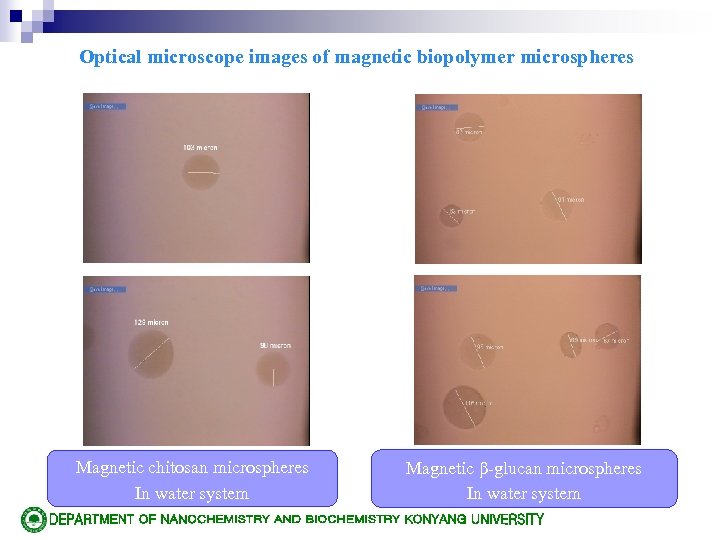 Optical microscope images of magnetic biopolymer microspheres Magnetic chitosan microspheres In water system Magnetic β-glucan microspheres In water system
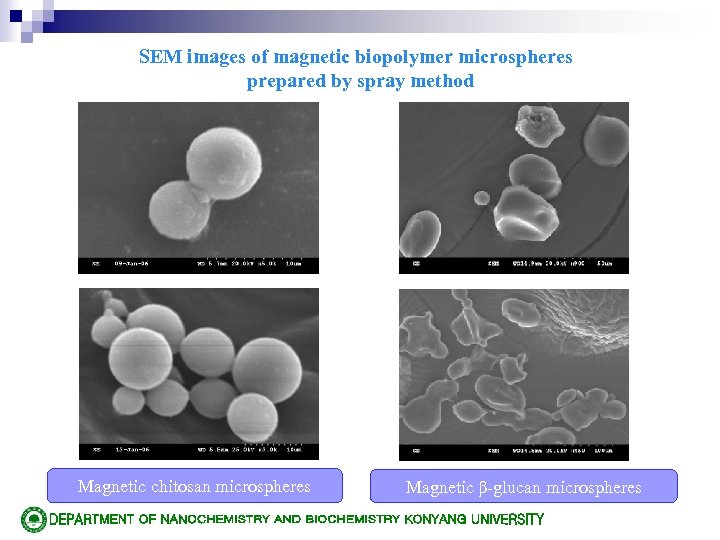 SEM images of magnetic biopolymer microspheres prepared by spray method Magnetic chitosan microspheres Magnetic β-glucan microspheres
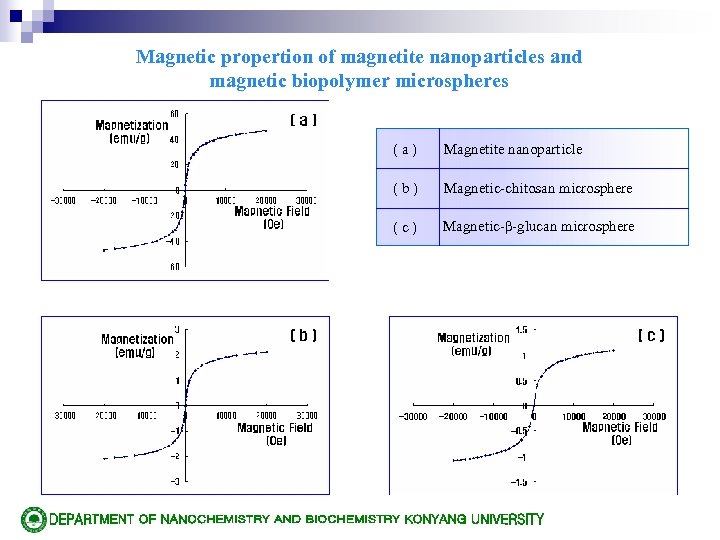 Magnetic propertion of magnetite nanoparticles and magnetic biopolymer microspheres (a) Magnetite nanoparticle (b) Magnetic-chitosan microsphere (c) Magnetic-β-glucan microsphere
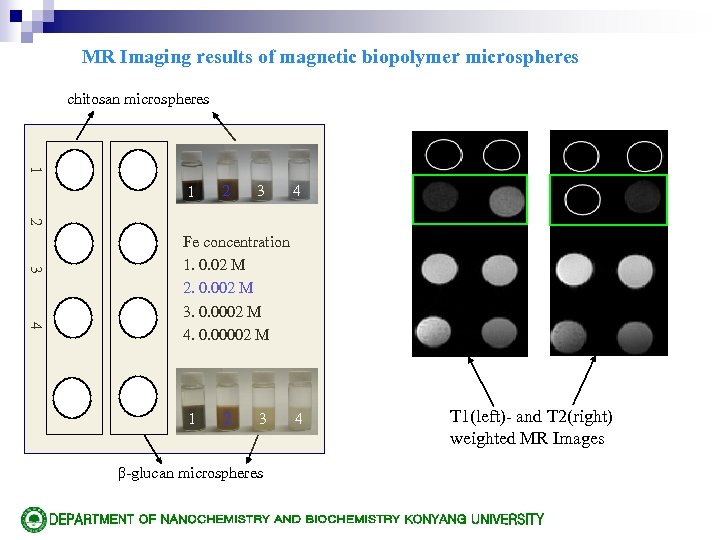 MR Imaging results of magnetic biopolymer microspheres chitosan microspheres 1 1 2 3 4 Fe concentration 1. 0. 02 M 2. 0. 002 M 3. 0. 0002 M 4. 0. 00002 M 1 2 3 β-glucan microspheres 4 T 1(left)- and T 2(right) weighted MR Images
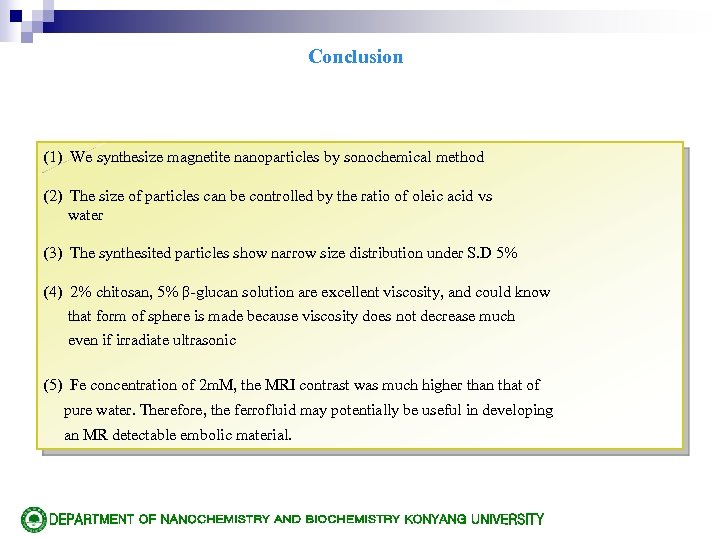 Conclusion (1) We synthesize magnetite nanoparticles by sonochemical method (2) The size of particles can be controlled by the ratio of oleic acid vs water (3) The synthesited particles show narrow size distribution under S. D 5% (4) 2% chitosan, 5% β-glucan solution are excellent viscosity, and could know that form of sphere is made because viscosity does not decrease much even if irradiate ultrasonic (5) Fe concentration of 2 m. M, the MRI contrast was much higher than that of pure water. Therefore, the ferrofluid may potentially be useful in developing an MR detectable embolic material.