


 Скачать презентацию Nancy Clark M Ed Director of Medical Informatics
742b1ef97dc42ba1e1cc943ca5b7673f.ppt
- Количество слайдов: 30
 Nancy Clark, M. Ed. Director of Medical Informatics Education ACCESSING ELECTRONIC MEDICAL INFORMATION QUICKLY: A REVIEW http: //www. med. fsu. edu/informatics Spring 2009 1
 Objectives Students will improve their ability to Quickly locate current disease information Answer clinical questions in small group cases, preceptors Using library subscription resources Using their PDA Using reliable, free resources Spring 2009 2
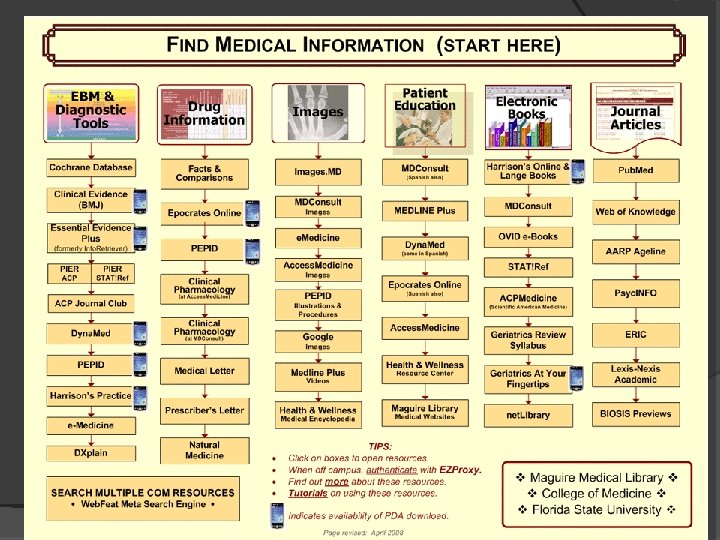
 PPT and Handouts Accessing Medical Information Quickly (PPT) on Informatics web site under Medical References Finding Clinical Information Quickly Handout Decision Support Handout Drug References Handout (on BB) Spring 2009 3
 Spring 2009 4
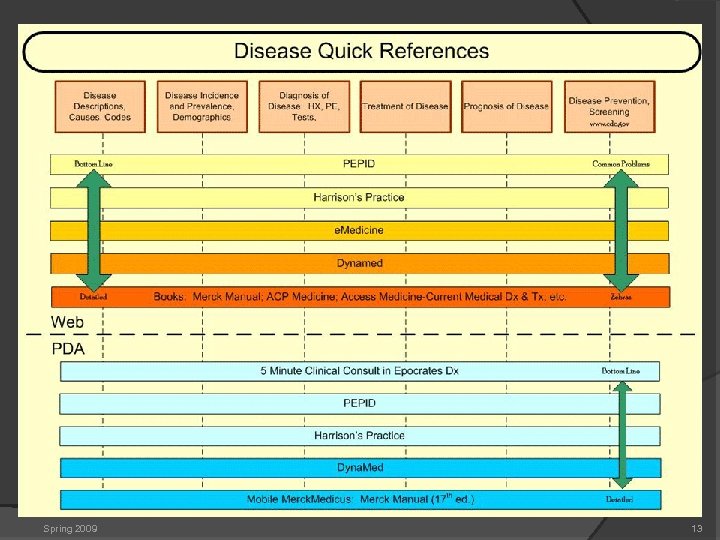
 When to Use Which Resource? Diagnosis versus list of complaints/symptoms Zebras versus common problems Detailed information/explanations versus bottom line Lots of time versus short on time Internet connection versus PDA only Spring 2009 5
 Types of Clinical Questions Definition of a term (Stedman’s in PEPID, e. Medicine) Drug question DDx (Dx. Plain and Epocrates Sx) Question about a known disease or condition Lab test question Spring 2009 6
 Disease Quick References DISEASE/CONDITION QUESTIONS Spring 2009 7
 Types of Disease Questions BACKGROUND Questions: Description Cause/etiology Incidence and prevalence/Epidemiology ICD-9 codes Risk Factors Signs and Symptoms Associated Conditions History and physical Spring 2009 8
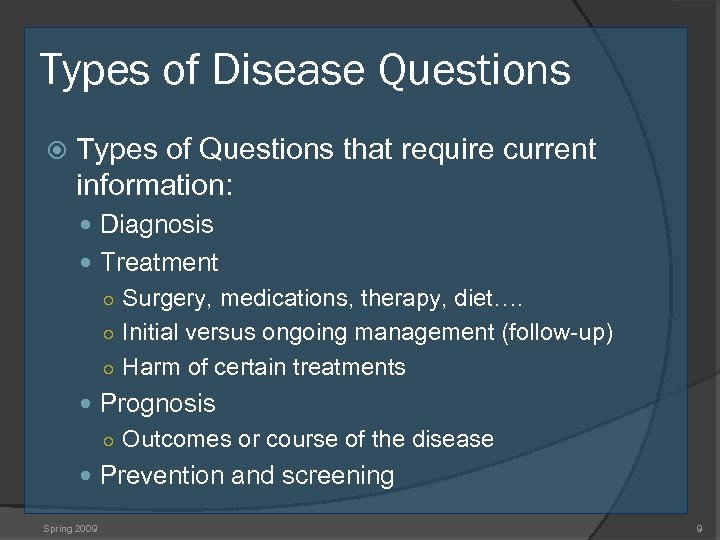 Types of Disease Questions Types of Questions that require current information: Diagnosis Treatment ○ Surgery, medications, therapy, diet…. ○ Initial versus ongoing management (follow-up) ○ Harm of certain treatments Prognosis ○ Outcomes or course of the disease Prevention and screening Spring 2009 9
 Knowing type of question makes using resources more efficient Bottom line Spring 2009 10
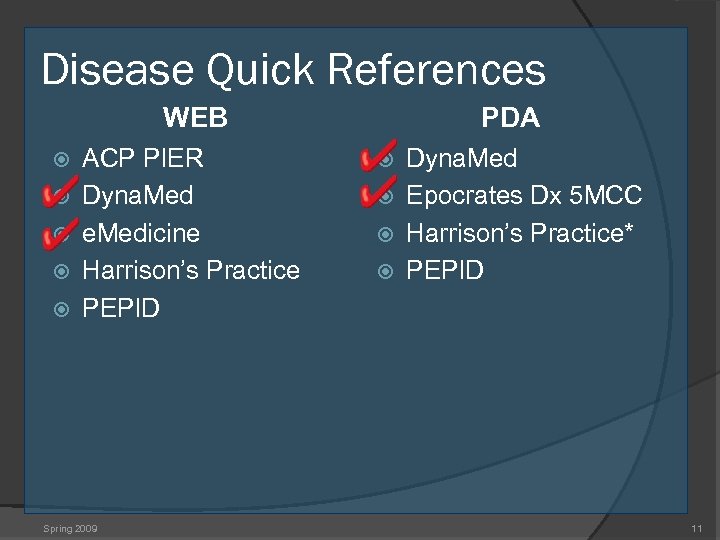 Disease Quick References WEB ACP PIER Dyna. Med e. Medicine Harrison’s Practice PEPID Spring 2009 PDA Dyna. Med Epocrates Dx 5 MCC Harrison’s Practice* PEPID 11
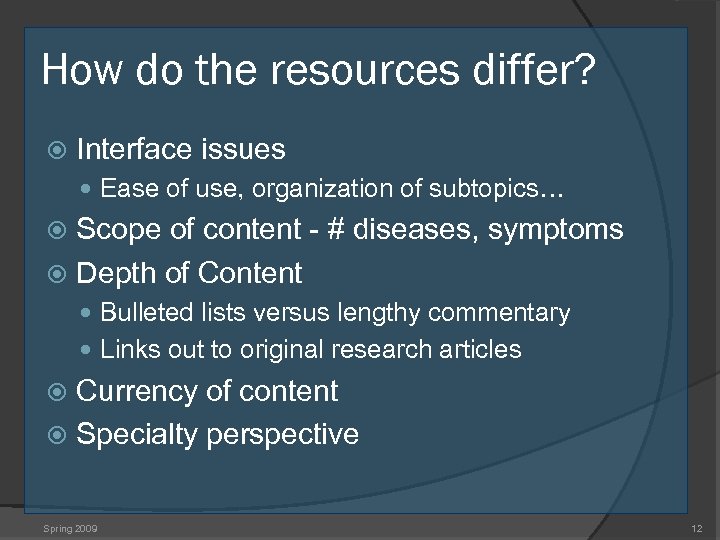 How do the resources differ? Interface issues Ease of use, organization of subtopics… Scope of content - # diseases, symptoms Depth of Content Bulleted lists versus lengthy commentary Links out to original research articles Currency of content Specialty perspective Spring 2009 12
 Spring 2009 13
 PEPID Contains disease information with images (check out Diverticular Disease) Bottom line bulleted lists Very little background information geared to 3 rd year students or higher Links within to drugs, diagnostic tests, associated conditions, evidence based summaries On Web and PDA Spring 2009 15
 Harrison’s Practice Internal Medicine focus Background information Signs and symptoms as well as diagnoses Moderate depth, scope is growing Linked to Access Medicine content Has drug information from Gold. Standard Can be downloaded to PDA Spring 2009 16
 e. Medicine Moderate amount of detail and information Several monographs on one topic by different specialties One long page (CTRL-F) Background information good Stedman’s is built in Navigation variable between monographs Google searches it Spring 2009 17
 Dynamed Highly evidence based resource Contains signs and symptoms as well as diagnosis Very in-depth, thorough Background information as well On PDA as well Spring 2009 18
 Epocrates Dx on PDA 5 Minute Clinical Consult Content depth light Bottom line resource with background No signs or symptoms Popular- updated annually Scope: 800 diseases Spring 2009 20
 Compare Resources Background: What is the incidence and prevalence of acute pancreatitis? Diagnosis: What tests should you order with Gilberts Disease to confirm diagnosis? Treatment: What are the general treatment methods for acute otitis media (AOM)? Prognosis: What is the 5 year survival rate for someone with Stage II adenocarcinoma of the lung? Spring 2009 21
 Books Merck Manual available online and free on PDA in Mobile Merck. Medicus Access wirelessly on IE: Merck Manual, Harrison’s Practice, Pocket Guide to Diagnostic Tests, Reuter’s Medical News Free to all practicing physicians and medical students ACPMedicine – Scientific American Medicine online Spring 2009 22
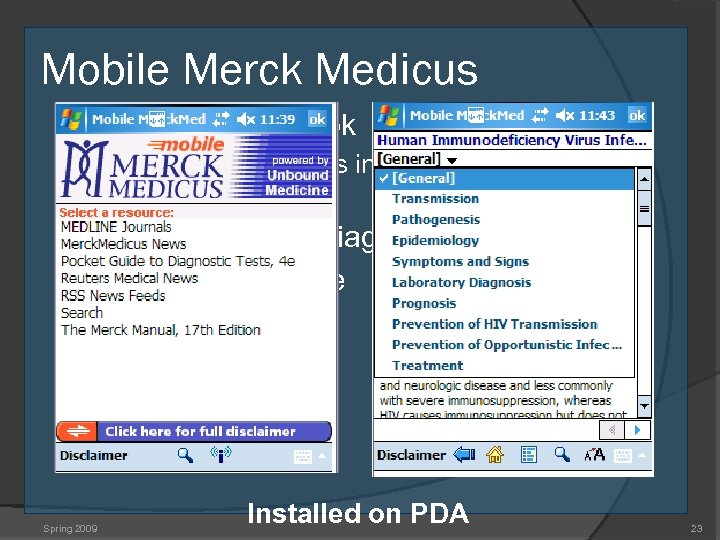 Mobile Merck Medicus Merck Manual book Rich, but categories inconsistent between topics Pocket Guide to Diagnostic Tests Harrison’s Practice Spring 2009 Installed on PDA 23
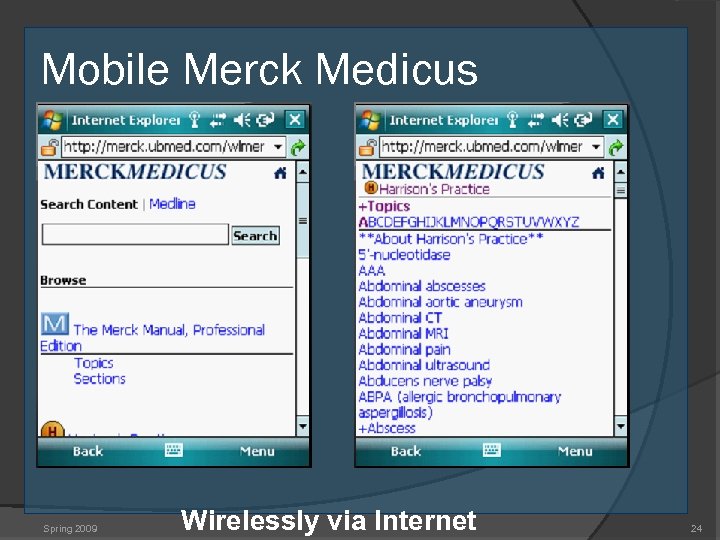 Mobile Merck Medicus Spring 2009 Wirelessly via Internet 24
 LAB RESOURCES Spring 2009 25
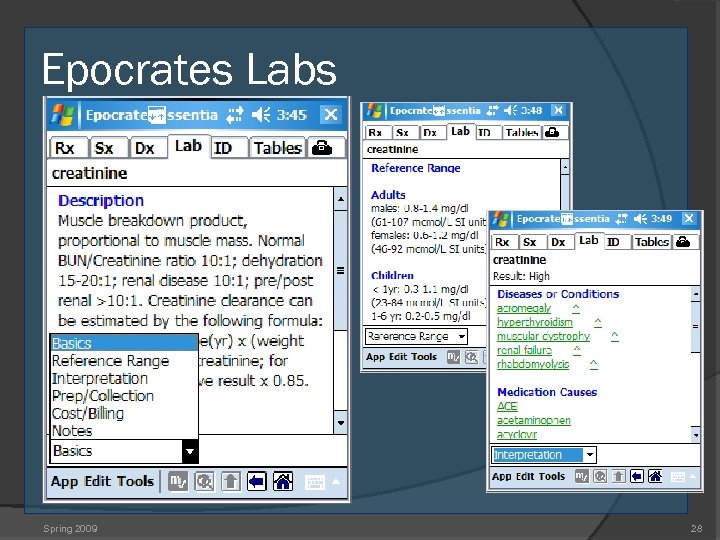
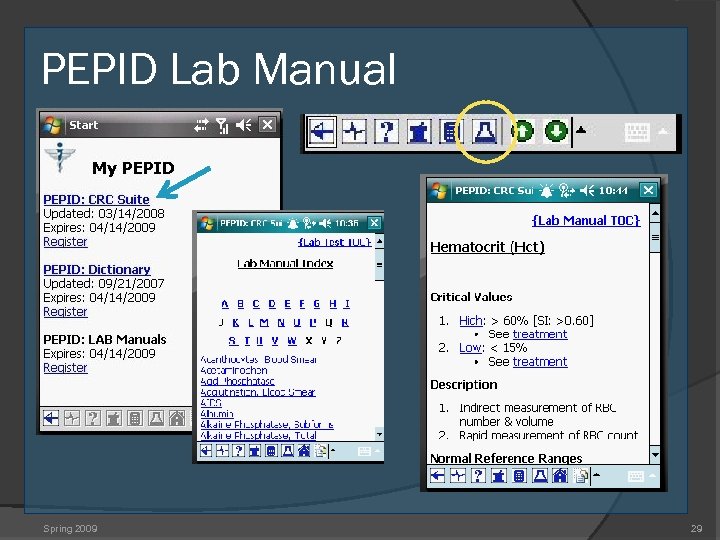
 LAB Resources Epocrates Essentials Labs PDA Laboratory tests only PEPID Lab Manual – online and PDA Pocket Guide to Diagnostic Tests Laboratory, imaging, and microbiology tests Online at Access Medicine and Merck. Medicus PDA in Mobile Merck. Medicus Spring 2009 26
 Interpretation of diagnostic tests What are normal lab values? What diseases could cause these findings? What medications could cause these findings? Spring 2009 27
 Epocrates Labs Spring 2009 28
 PEPID Lab Manual Spring 2009 29
 Lab tab in Access Medicine Contains Diagnostic imaging Cultures laboratory Spring 2009 30
 Lab Questions A basic metabolic panel reveals that a 30 year old man suffering from bipolar disorder has a serum calcium level of 10. 9 mg/d. L. Is this normal, high or low? 2. A 32 Yr old female patient complaining of fatigue and weight gain is evaluated for hypothyroidism. Her TSH (thyroid stimulating hormone) comes back 0. 1 m. IU/L. Is this high, low or normal? 1. Spring 2009 31
 Bottom Line Pick your favorites that match your taste in depth of information Learn which resource to use to answer certain types of questions. Resources should be current, accurate, evidence based, respected. Resources should be easy to use. Practice… this Spring 2009 is lifelong learning 32