


 Скачать презентацию Naïve Ontology for Concepts of Time and Space
abcd687b872cc403c816af07740ed287.ppt
- Количество слайдов: 33
 Naïve Ontology for Concepts of Time and Space for Searching and Learning ISIC 2006 University of Technology, Sydney Makiko Miwa (National Institute of Multimedia Education) Noriko Kando (National Institute of Informatics)
 Outline • • Introduction Related Work Conceptual Framework Method Results Implications Conclusion Future Research
 Introduction Goal: Develop naïve ontology that may help domain novice to quickly build their domain knowledge Means: Explore searching & learning processes to identify knowledge modification of novice searchers
 Research Questions 1. How are the concepts of time and space held by domain novice structured? 2. How are the domain novice’s concepts of time and space modified during searching & learning processes? => Use context of history and geography as instances of domain
 Conceptual Framework Definition Information Access Interface (IAI) – Interface between information resources and users including metadata, Q&A system, navigation system, virtual agents, etc. Naïve Ontology – Ontology = An explicit structure that describes patterns of associations among concepts of the domain – Naïve ontology = a type of IAI that allows domain novice to refine their knowledge interactively (navigation tool to support searching & learning process of domain novice)
 Methodological Assumption Unit of Analysis in Browsing • Human need categorizing ability to function in physical and intellectual world (Lakoff 1987) • Visual perception isolate input data from all other data to see only those determined by the input identification (Bertin, 1967) • A view = what person articulate as seeing at one time = span of attention = unit of analysis in browsing (Kwasnik, 1992)
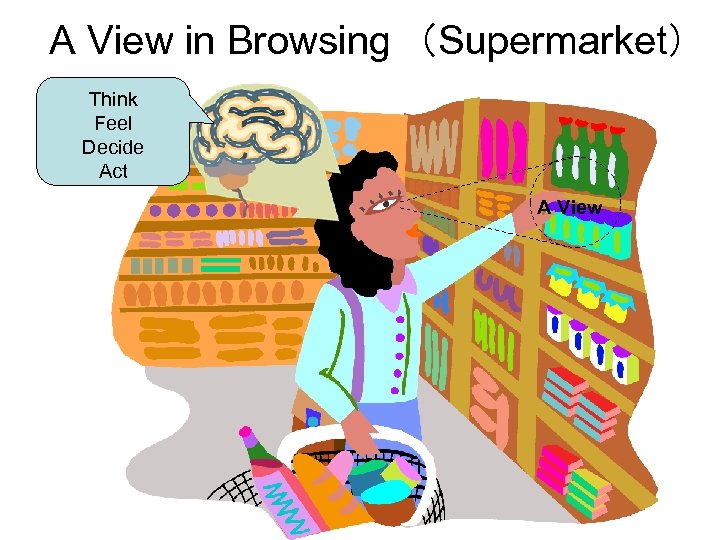 A View in Browsing (Supermarket) Think Feel Decide Act A View
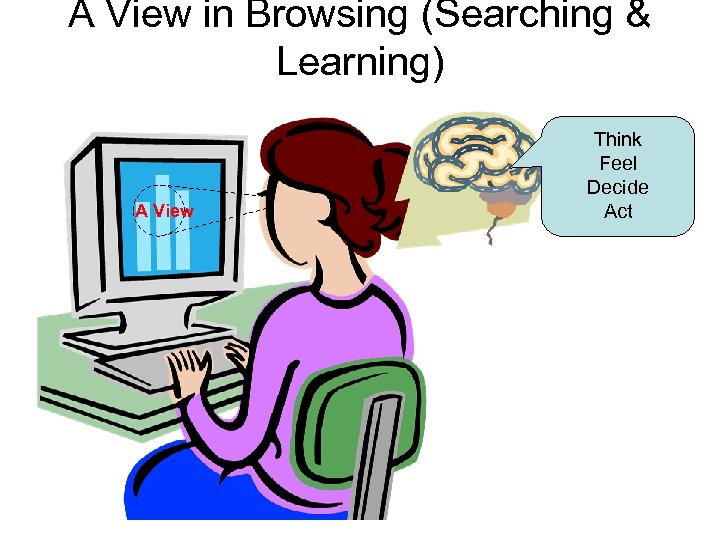 A View in Browsing (Searching & Learning) A View Think Feel Decide Act
 Method • Use theoretical sampling to recruit seven participants (female college students) • Conducted a series of experiments – September 2005 (three participants) – December 2005 (tow pairs of four participants)
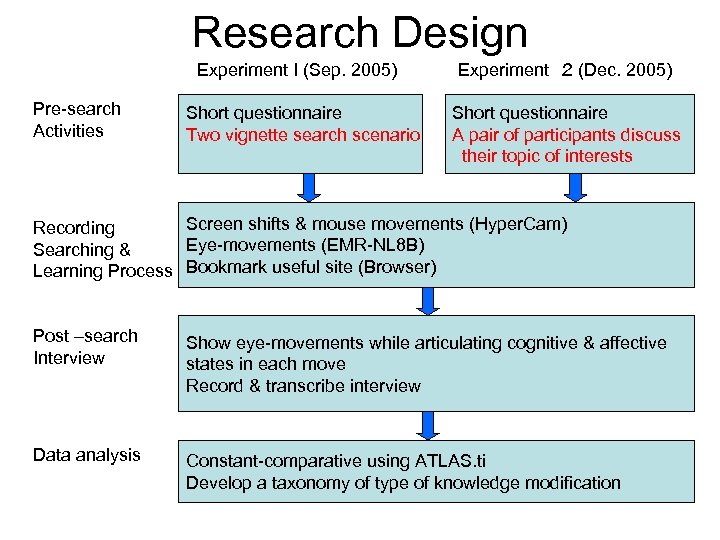 Research Design Experiment I (Sep. 2005) Pre-search Activities Short questionnaire Two vignette search scenario Experiment 2 (Dec. 2005) Short questionnaire A pair of participants discuss their topic of interests Screen shifts & mouse movements (Hyper. Cam) Recording Eye-movements (EMR-NL 8 B) Searching & Learning Process Bookmark useful site (Browser) Post –search Interview Show eye-movements while articulating cognitive & affective states in each move Record & transcribe interview Data analysis Constant-comparative using ATLAS. ti Develop a taxonomy of type of knowledge modification
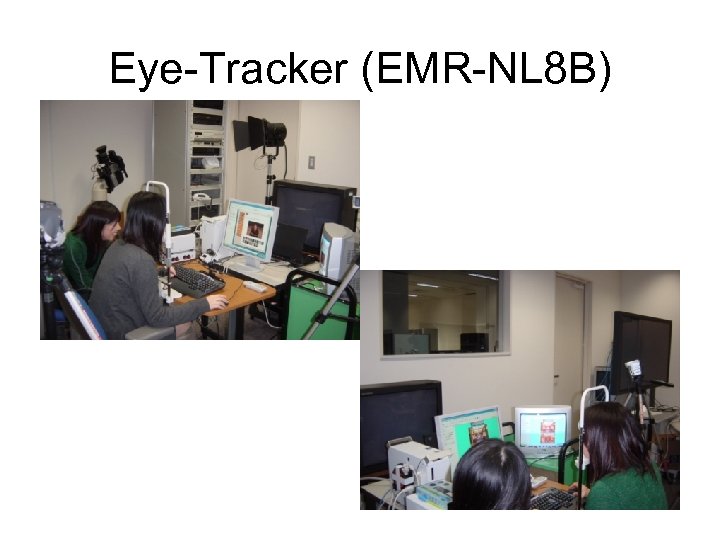 Eye-Tracker (EMR-NL 8 B)
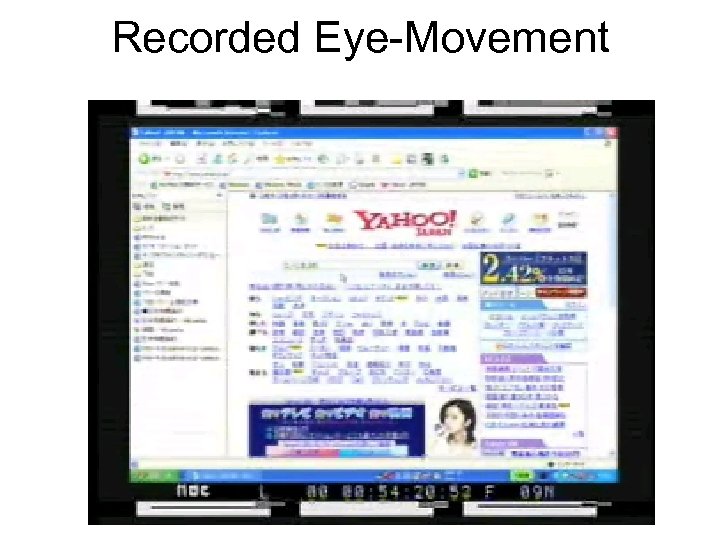 Recorded Eye-Movement
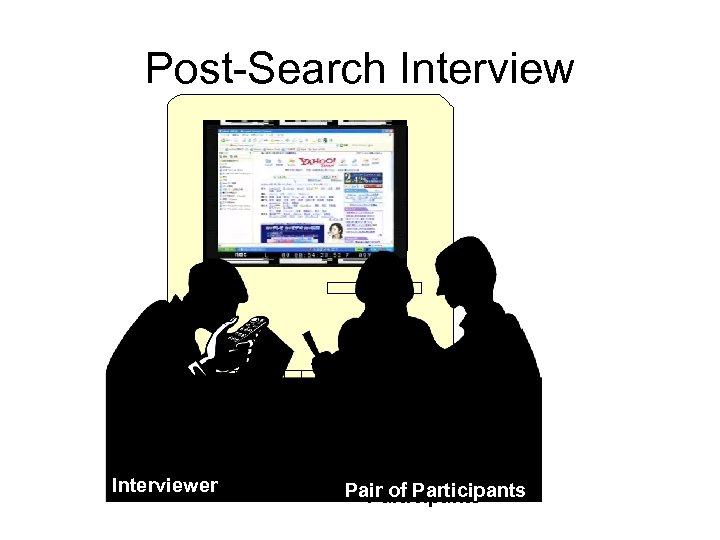 Post-Search Interviewer Pair of Participants
 Result Six Types of Knowledge Modification in Time & Space • • • Adding Correcting Limiting Relating Specifying Transforming
 Adding Definition: Acquire novel information to increase knowledge Example: - あー、これ、死海が発見されたクムランの洞窟ってと ころなんで、あすごいって感心して、よくこんなところ に隠したなって思って、見てました。 - I found a picture of Qumran in which the Dead Sea Scrolls were hidden. I was surprised how they could hide it in a place like this.
 Correcting Definition: Clear up a misunderstanding Example: 松尾芭蕉は…日本全国だと思っていたんですけど、主 に東北らへんを回って… The area he traveled was not all over Japan [that I thought, ] but in the north-eastern region.
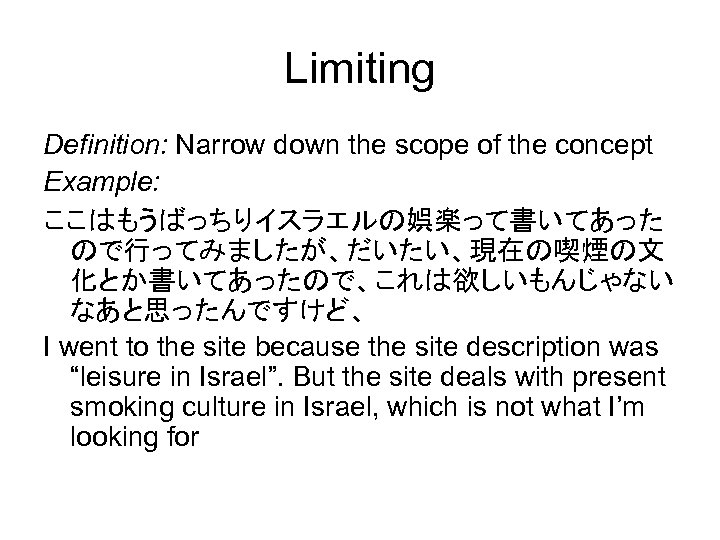 Limiting Definition: Narrow down the scope of the concept Example: ここはもうばっちりイスラエルの娯楽って書いてあった ので行ってみましたが、だいたい、現在の喫煙の文 化とか書いてあったので、これは欲しいもんじゃない なあと思ったんですけど、 I went to the site because the site description was “leisure in Israel”. But the site deals with present smoking culture in Israel, which is not what I’m looking for
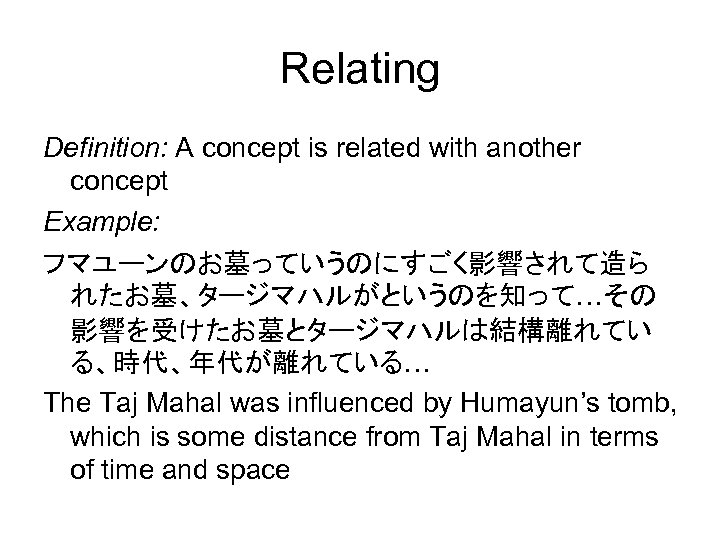 Relating Definition: A concept is related with another concept Example: フマユーンのお墓っていうのにすごく影響されて造ら れたお墓、タージマハルがというのを知って…その 影響を受けたお墓とタージマハルは結構離れてい る、時代、年代が離れている… The Taj Mahal was influenced by Humayun’s tomb, which is some distance from Taj Mahal in terms of time and space
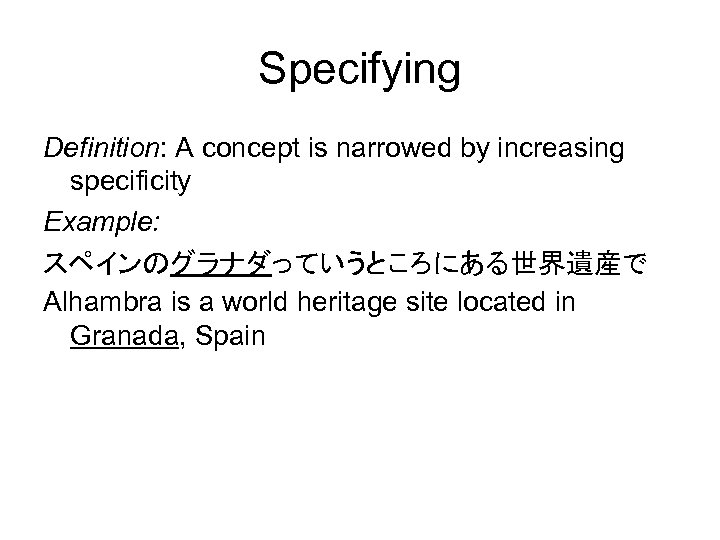 Specifying Definition: A concept is narrowed by increasing specificity Example: スペインのグラナダっていうところにある世界遺産で Alhambra is a world heritage site located in Granada, Spain
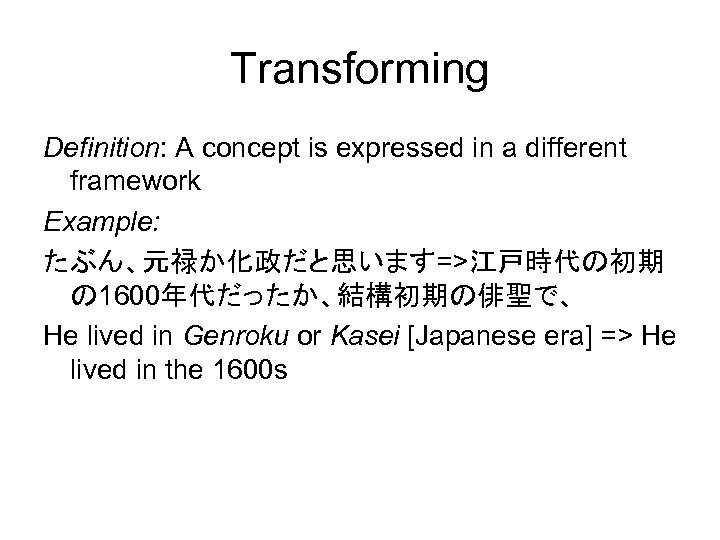 Transforming Definition: A concept is expressed in a different framework Example: たぶん、元禄か化政だと思います=>江戸時代の初期 の 1600年代だったか、結構初期の俳聖で、 He lived in Genroku or Kasei [Japanese era] => He lived in the 1600 s
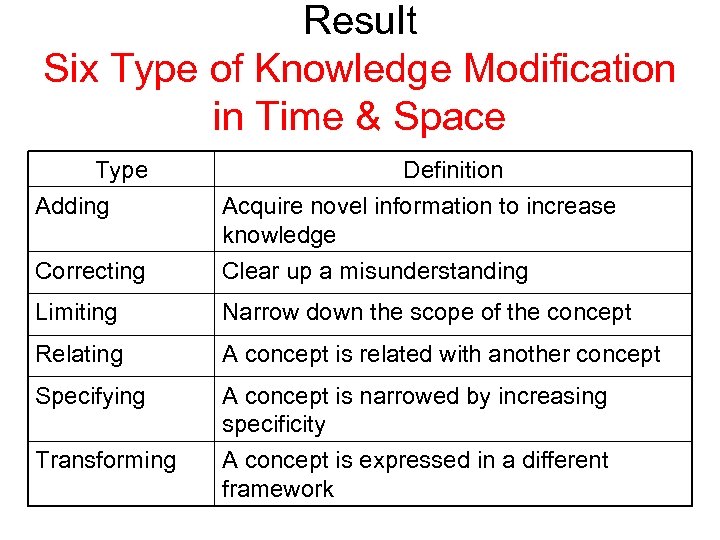 Result Six Type of Knowledge Modification in Time & Space Type Adding Definition Acquire novel information to increase knowledge Correcting Clear up a misunderstanding Limiting Narrow down the scope of the concept Relating A concept is related with another concept Specifying A concept is narrowed by increasing specificity A concept is expressed in a different framework Transforming
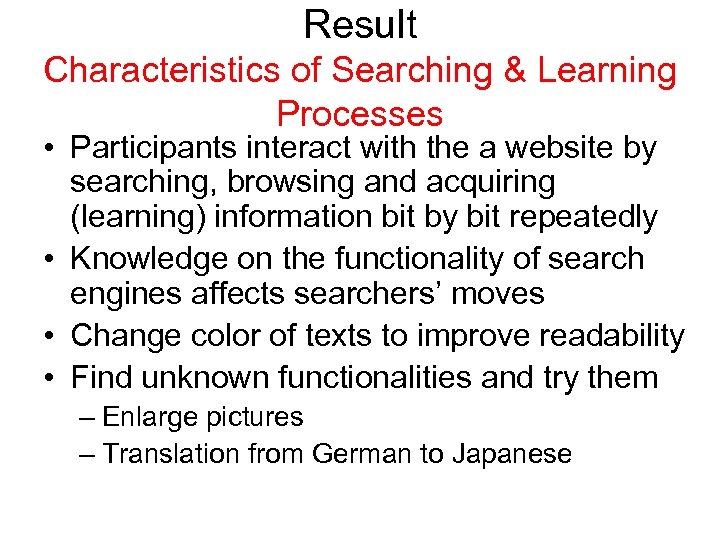 Result Characteristics of Searching & Learning Processes • Participants interact with the a website by searching, browsing and acquiring (learning) information bit by bit repeatedly • Knowledge on the functionality of search engines affects searchers’ moves • Change color of texts to improve readability • Find unknown functionalities and try them – Enlarge pictures – Translation from German to Japanese
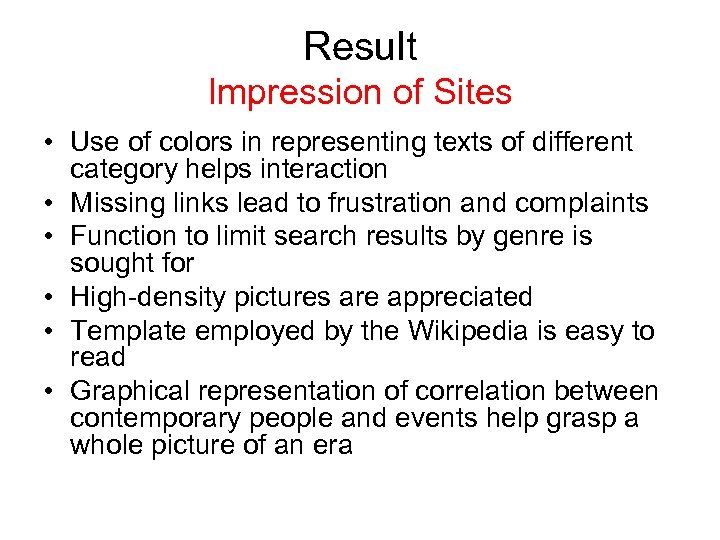 Result Impression of Sites • Use of colors in representing texts of different category helps interaction • Missing links lead to frustration and complaints • Function to limit search results by genre is sought for • High-density pictures are appreciated • Template employed by the Wikipedia is easy to read • Graphical representation of correlation between contemporary people and events help grasp a whole picture of an era
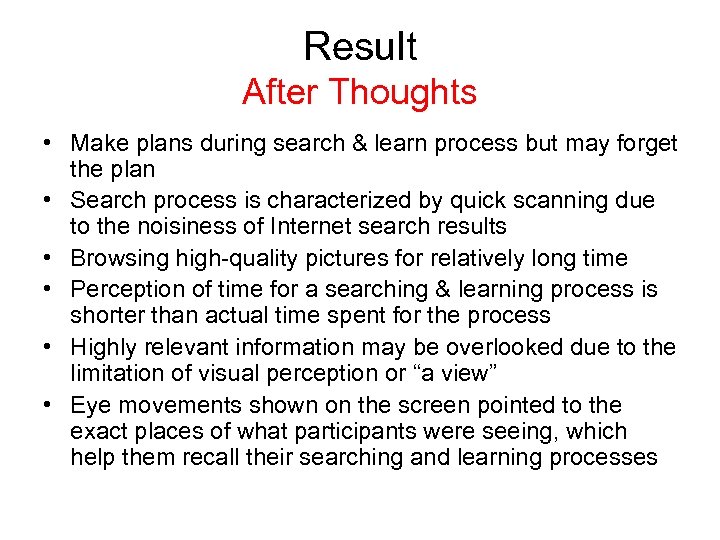 Result After Thoughts • Make plans during search & learn process but may forget the plan • Search process is characterized by quick scanning due to the noisiness of Internet search results • Browsing high-quality pictures for relatively long time • Perception of time for a searching & learning process is shorter than actual time spent for the process • Highly relevant information may be overlooked due to the limitation of visual perception or “a view” • Eye movements shown on the screen pointed to the exact places of what participants were seeing, which help them recall their searching and learning processes
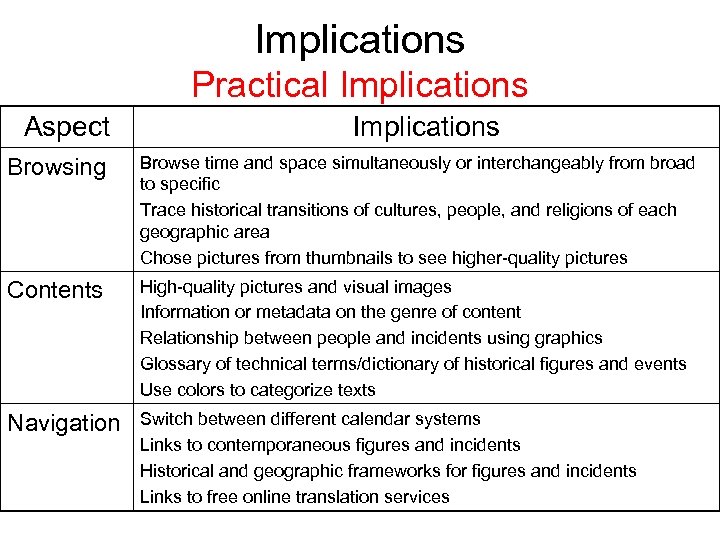 Implications Practical Implications Aspect Implications Browsing Browse time and space simultaneously or interchangeably from broad to specific Trace historical transitions of cultures, people, and religions of each geographic area Chose pictures from thumbnails to see higher-quality pictures Contents High-quality pictures and visual images Information or metadata on the genre of content Relationship between people and incidents using graphics Glossary of technical terms/dictionary of historical figures and events Use colors to categorize texts Navigation Switch between different calendar systems Links to contemporaneous figures and incidents Historical and geographic frameworks for figures and incidents Links to free online translation services
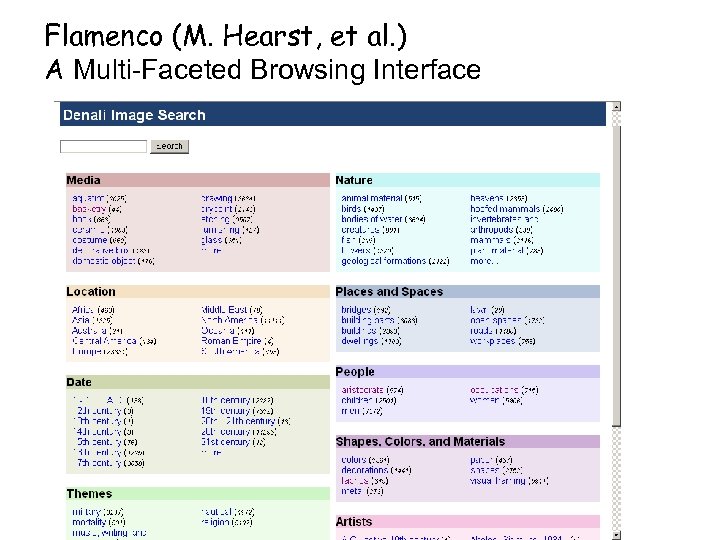 Flamenco (M. Hearst, et al. ) A Multi-Faceted Browsing Interface
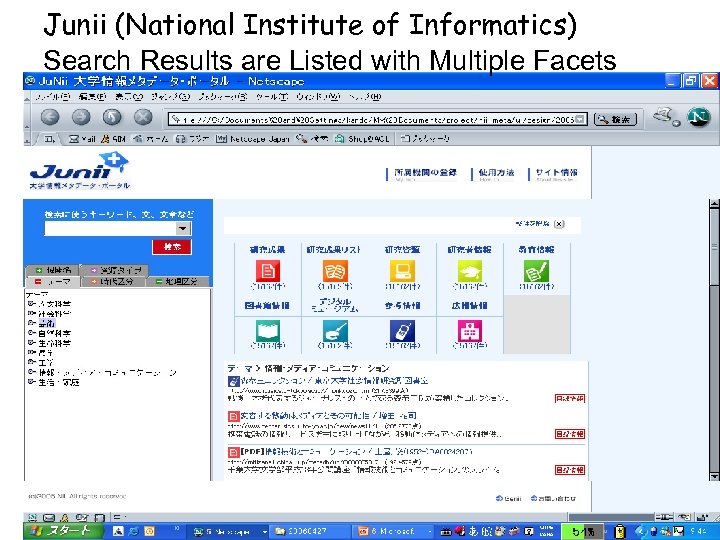 Junii (National Institute of Informatics) Search Results are Listed with Multiple Facets
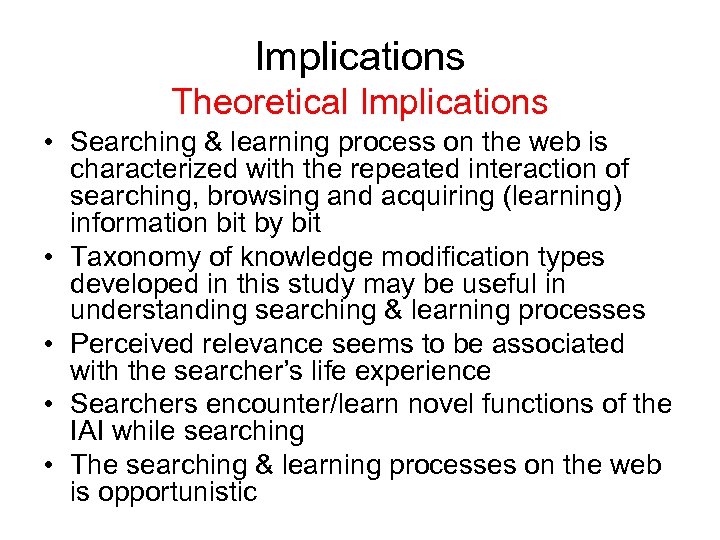 Implications Theoretical Implications • Searching & learning process on the web is characterized with the repeated interaction of searching, browsing and acquiring (learning) information bit by bit • Taxonomy of knowledge modification types developed in this study may be useful in understanding searching & learning processes • Perceived relevance seems to be associated with the searcher’s life experience • Searchers encounter/learn novel functions of the IAI while searching • The searching & learning processes on the web is opportunistic
 Implications Methodological Implications • The concept of “view” as a unit of analysis in browsing is adequate in capturing the dynamically changing knowledge structure of searchers during their searching & learning processes (increase reliability) • Use of paring in collecting searching & learning process data helped participants to articulate their thought, feeling, and reasoning. • The use of vignette scenario with imposed goals may lead to incomplete processes
 Conclusion • Obtained implications for design of naïve ontology as the bases for designing IAI for domain novices in history and geography • Added evidences to theoretical framework for information seeking – Relation between life experience and perceived relevance – Searching & learning processes expand domain knowledge as well as search skills – Searching & learning processes are opportunistic • Obtained a better methodology in capturing searching & learning information seeking behaviour on the web – Capturing eye-movement and show it on the screen to improve participants’ recall – Using a pair of participants to facilitate articulation of their searching & learning processes
 Future Research • Continue similar experiments to verify and enrich our findings • Recruit domain experts to compare naïve ontology and expert ontology in the domain of history and geography • Conduct a similar research in a different context (job hunting, health, etc. )
 Acknowledgement • This research has been funded by the National Institute of Informatics joint research grant. • We wish to than Dr. Barbara Kwasnik for her suggestions in the methodological aspects including the notion of “view” which was incorporated in the unit of analysis of the study. • We are grateful to anonymous reviewers for their helpful suggestions.
 Thank You ありがとうございました