


 Скачать презентацию NAIP 3 Year Cycle Presentation to FSA State
f6013a37b75021cf4a0f831171e164c3.ppt
- Количество слайдов: 23
 NAIP 3 Year Cycle Presentation to FSA State GIS Specialists June 24, 2008 Kent Williams, APFO
 Main Topics • • Background 3 Year Cycle Parameters Cost Share Partnerships Questions and Answers
 NAIP 2002 -2007 • Annual coverage – 2 meter resolution – CLU coverage only • Base replacement on 5 year cycle – 1 meter resolution – Full state coverage
 NAIP 2002 -2007 • Inconsistent funding – Full funding only happened once - 2006. • Inconsistent policy – If it was flown too early or too late, or delivered too late, imagery couldn't be used for compliance – 2 meter couldn't be used for base replacement • Change in compliance methods
 NAIP 2009 -2011 2008 is a transition year • Base imagery on a 3 year cycle – Build in more stability and consistency – 1 meter – Based on CLU coverage – Continually Improve quality – Transition to better accuracy specification
 NAIP Partnerships • Partnering is a good thing – FSA benefits • Partners buy-up to full state coverage • Partners buy-up to 4 band • Full state coverage is good for FSA – Consistency across state – Several programs require non-CLU coverage • More likely agencies may be sharing the same base imagery – NRCS – Other feds – States – Partner Benefits • Full state coverage at a great price • 4 Band – Highly encouraged by OMB
 Partnership Details • Buy-up to full state coverage – Partners pay 100% of Non-CLU coverage • Buy-up to 4 band – Partners pay 100% of costs • Buy up “out of cycle” coverage – Partners pay 100% of costs – Can be partial coverage of states, subject to approval – States out of cycle will maintain 3 year cycle
 Partnership Details Cost Share Amounts • Minimum cost share amount applies to partners at the state level – 10% of FSA costs (for individual state CLU coverage) or $21, 500 whichever is higher • Federal partners encouraged to come in at the national level.
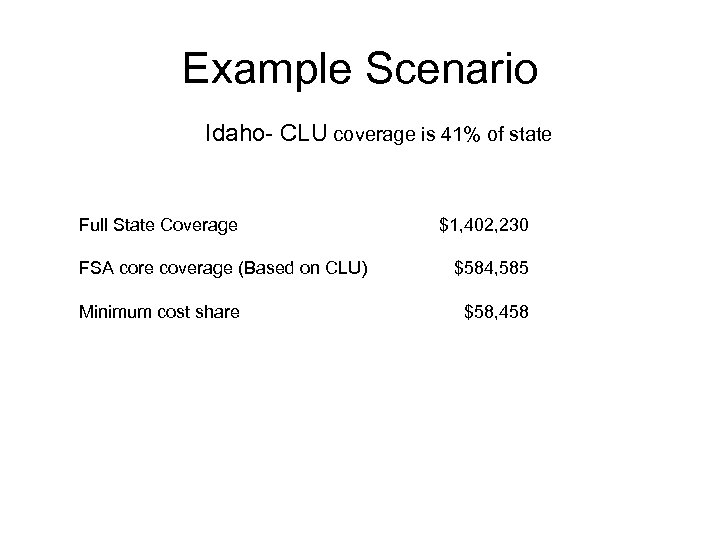 Example Scenario Idaho- CLU coverage is 41% of state Full State Coverage FSA core coverage (Based on CLU) Minimum cost share $1, 402, 230 $584, 585 $58, 458
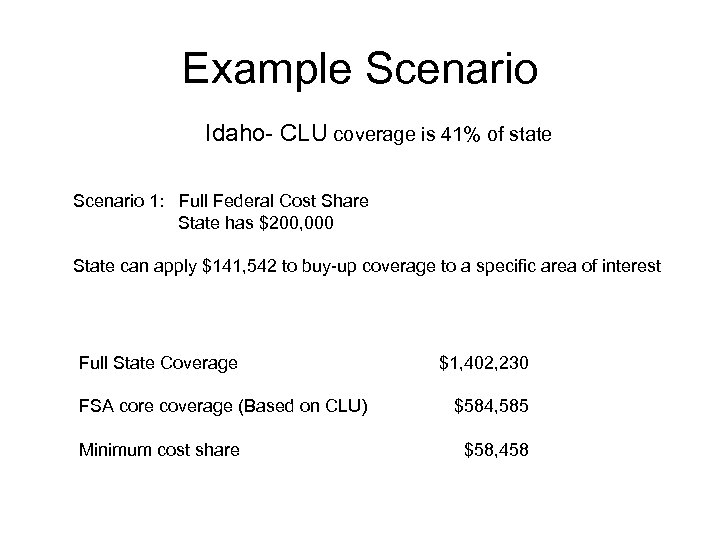 Example Scenario Idaho- CLU coverage is 41% of state Scenario 1: Full Federal Cost Share State has $200, 000 State can apply $141, 542 to buy-up coverage to a specific area of interest Full State Coverage FSA core coverage (Based on CLU) Minimum cost share $1, 402, 230 $584, 585 $58, 458
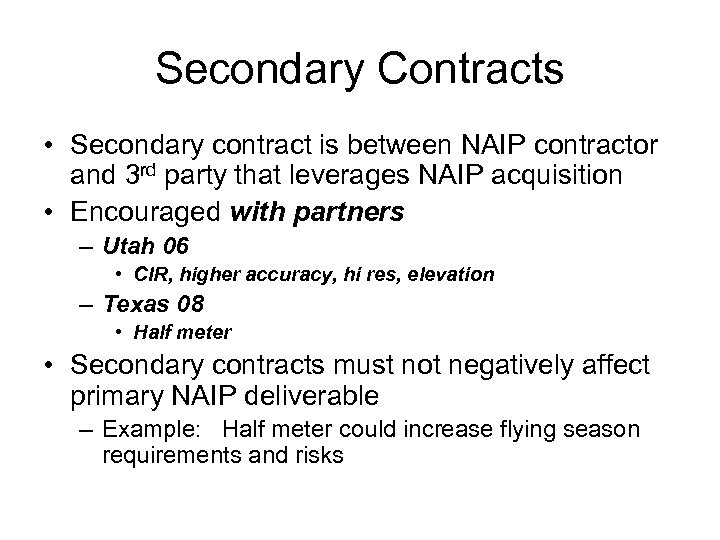 Secondary Contracts • Secondary contract is between NAIP contractor and 3 rd party that leverages NAIP acquisition • Encouraged with partners – Utah 06 • CIR, higher accuracy, hi res, elevation – Texas 08 • Half meter • Secondary contracts must not negatively affect primary NAIP deliverable – Example: Half meter could increase flying season requirements and risks
 Cost Share Estimates • Estimates – Many variables • Federal agency budgets • Contractor bids • See link for estimates http: //www. fsa. usda. gov/FSA/apfoapp? area=home&subject=docs&topic=landing
 Incentives for partners • Full State Coverage • Prioritized delivery at no additional cost – CCMs when delivered from contractor – Quarter Quads when through QA • Custom Area of Interest (AOI) within state – If total cost share is insufficient for full state coverage – Minimum cost share must be met first
 Questions and Answers • Question: What happens if a state makes the minimum cost share and there are no additional partners? (not enough funding for full state coverage) • Answer: FSA will fund CLU coverage only if only the minimum is met. Cost share agreements can be canceled.
 Questions and Answers • Question: What are the incentives for partners to cost share in high ag states? (where larger majority of area will be flown anyway). • Answer: Complete full state coverage (important to most states even if only a few QQs short); deliverables when available at no cost; ability to buy-up to 4 band; ability to enter into secondary contracts.
 Questions and Answers • Question: Will FSA contribute to offcycle contracts by partners? • Answer: No. Since annual budget estimates are for specific states, contributions to states that are out of cycle would lead to a funding shortfall for in-cycle states.
 Questions and Answers • Question: Can partners fund less than full state coverage? • Answer: Yes, subject to conditions.
 Questions and Answers • Question: Is NAIP the official imagery for USDA or just FSA • Answer: Just FSA.
 Questions and Answers • Question: Can NAIP be the standard base imagery for both FSA and NRCS? • Answer: No. But it has perennially been discussed. It will help to get states on a 3 year cycle of full state coverage so that state won’t be tempted or need to use “non-standard” ortho.
 Questions and Answers • Question: Can 4 Band buy-up be applied to AOIs (less than full state)? • Answer: No. We can’t have multiple products for a single state project.
 Questions and Answers • Question: Can coverage buy-up be applied to AOIs (less than full state)? • Answer: Yes, but flight planning rules will apply – no isolated QQs.
 Questions and Answers • Question: Are buy-ups directly through the NAIP contract? • Answer: Yes. This means that buy ups will be standard NAIP and will be readily available for FSA
 Questions and Answers • Question: Would partner consortiums for buy-ups, including feds, need to go through a single POC at the state? • Answer: yes