


 Скачать презентацию Nail that Rail all you need to know to
f19eb4c036df5424a622530c17837766.ppt
- Количество слайдов: 53
 Nail that Rail!…all you need to know to to become an ‘approved assessor' for basic housing modifications Presented by Angela Vanderpoel Community Occupational Therapist 28. 09. 10 15. 11. 10
 Objective To provide Occupational Therapists with the knowledge & confidence to become ‘approved assessors’ to carry out basic housing modifications.
 Overview: l Becoming an approved EMS assessor l Basic housing modifications l Clinical reasoning l Handrails l Threshold ramps l Internal doorway widening l Lever taps l Sketching
 How can I become an approved assessor? l EMS core module (online) l ‘Making EMS Applications’ l ‘Role of the EMS assessor’ l Certificate l ‘Application for Accreditation form’ ü Housing (basic) l APC l Is it difficult? No! Especially if you are here today…
 What is a “basic” housing modification? l A modification which is: ü non-structural ü low cost ü requires minor works ü does not require a building consent
 Basic modifications include: l Handrails ( internal and/or external) l Threshold ramps (up to 450 mm long) l Internal door widening (standard hinged doors with no electrical works) l Lever taps providing…. .
 providing…. …. it is determined that the housing modifications are essential to enable the person to: l Move in and around their home l Return to, or remain in, their home l Be the main carer of a dependent person
 Exclusions l Cost less than $200 incl gst l Reimbursement of work completed l Short term needs l Social or personal health needs l ACC related need l Purpose built properties
 Clinical reasoning Why is a modification needed? Consider the l the person l the environment before jumping to l the solution
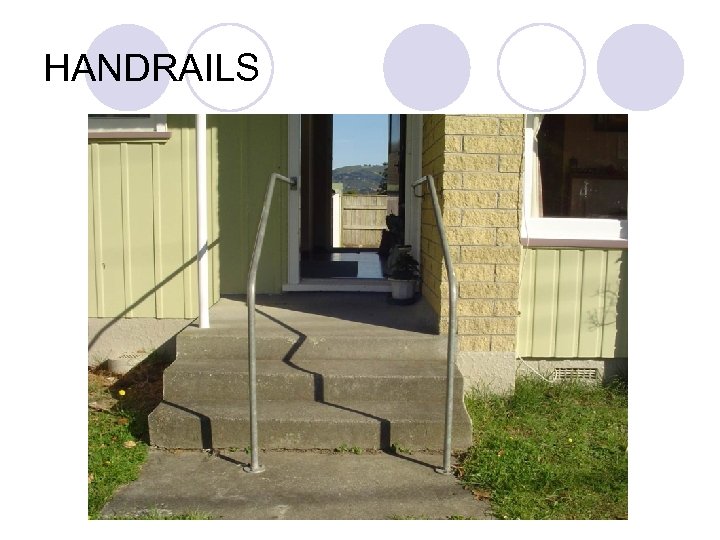 HANDRAILS
 Indicators for rails l Increase functional ability l Independence l Safety - reduce falls risk & incidence l Increase confidence l Long term need l Assist carer to help person l Essential need - no other options
 Considerations for rails l When selecting & positioning a rail consider: l Environment where it will be installed l Intended purpose of the rail l Functional capacity & needs of user l Relevant standards & legislation
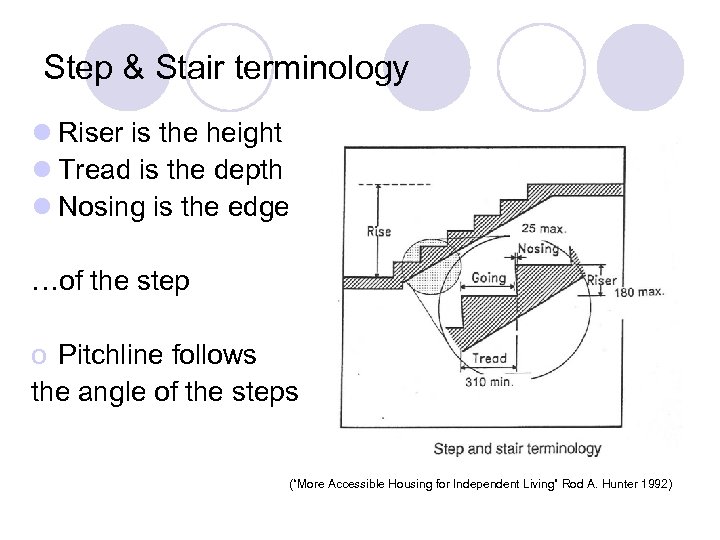 Step & Stair terminology l Riser is the height l Tread is the depth l Nosing is the edge …of the step o Pitchline follows the angle of the steps (“More Accessible Housing for Independent Living” Rod A. Hunter 1992)
 NZ standards for steps & stairs NZS 4121: 2001 l Riser & treads should be uniform l Total rise in one flight should be < 2500 mm l Maximum rise of each step should be 180 mm l Minimum tread of each step should be 310 mm l Nosings should be rounded & <25 mm l No open risers
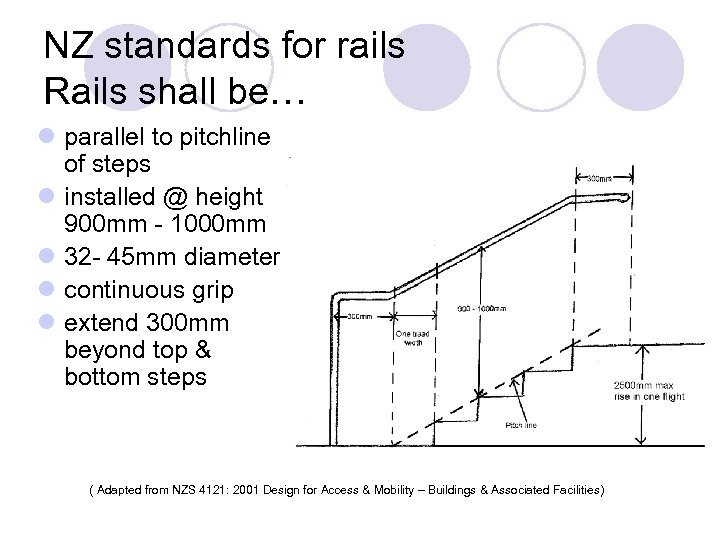 NZ standards for rails Rails shall be… l parallel to pitchline of steps l installed @ height 900 mm - 1000 mm l 32 - 45 mm diameter l continuous grip l extend 300 mm beyond top & bottom steps ( Adapted from NZS 4121: 2001 Design for Access & Mobility – Buildings & Associated Facilities)
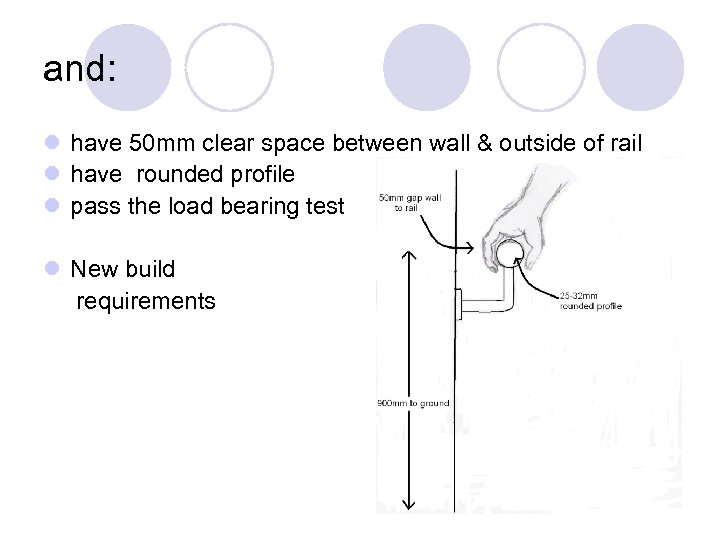 and: l have 50 mm clear space between wall & outside of rail l have rounded profile l pass the load bearing test l New build requirements
 What type of rail is best? l Standard rail l Materials l Finish l Diameter l Length l Clamp-on rails l Suction rails
 Up, down or sideways? l Horizontal l Vertical l L shaped l Diagonal l Hinged l U shaped l Other
 Getting it right l l Needs of the individual Standard reach Comfortable forward reach How to know it’s the best place
 Fixing into studs & dwangs l Why do we need to know? l The stud is… l The dwang is… l Rails MUST be securely fixed l What is behind the wall?
 Hot tips for finding studs! l Measure in from corner in 18” intervals (or 600 mm intervals in newer houses) l Knock & listen l Visual clues l Check fixtures in place l Other useful places where rails can be put
 Determine solution – external rails o o o o Location Position & height Type & fixing Length Add-ons Other requirements Mock-up to check it will work
 Funding considerations external rails REMEMBER! l One entrance l One property l No fix-it jobs!
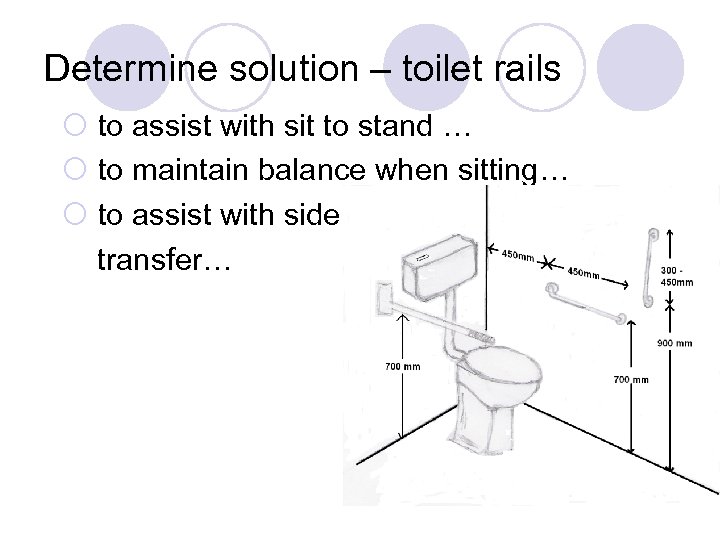 Determine solution – toilet rails ¡ to assist with sit to stand … ¡ to maintain balance when sitting… ¡ to assist with side transfer…
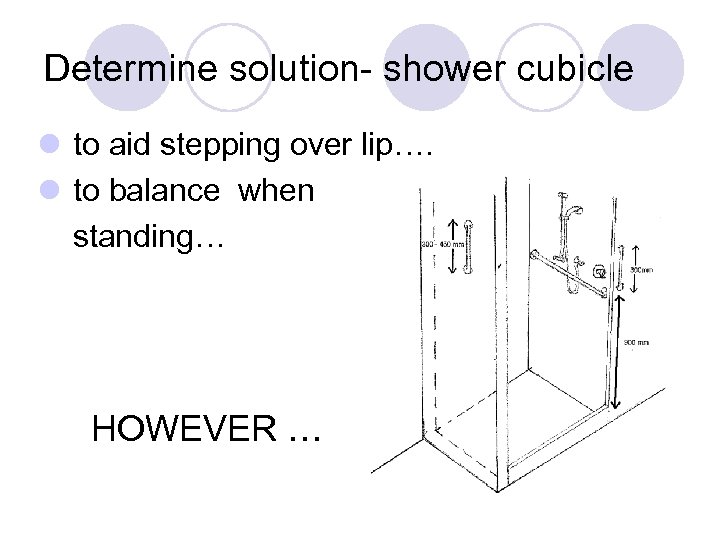 Determine solution- shower cubicle l to aid stepping over lip…. l to balance when standing… HOWEVER …
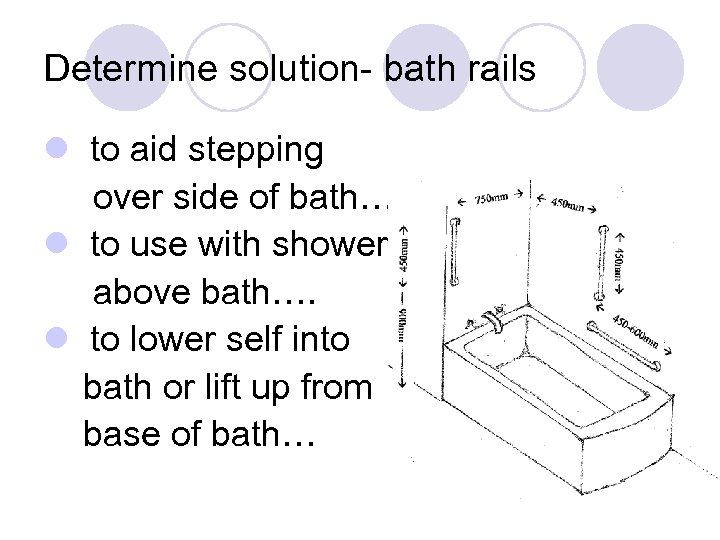 Determine solution- bath rails l to aid stepping over side of bath… l to use with shower above bath…. l to lower self into bath or lift up from base of bath…
 All internal rails: o Consider other requirements o Mock-up to check it will work o Ensure expectations are realistic o $$$
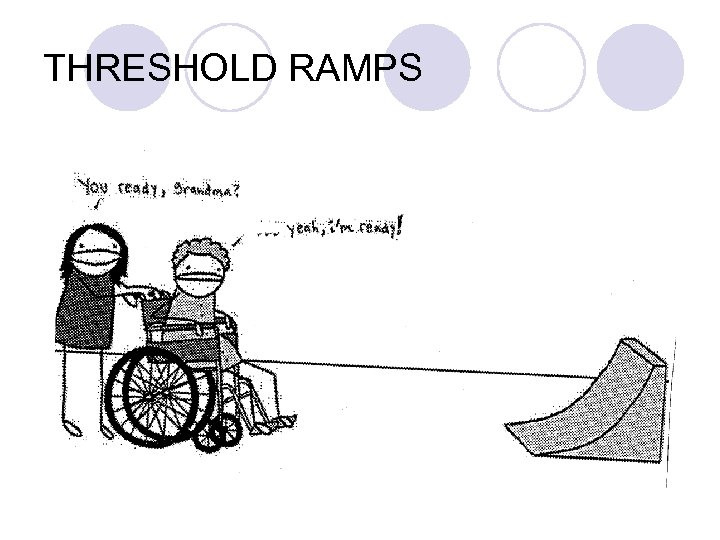 THRESHOLD RAMPS
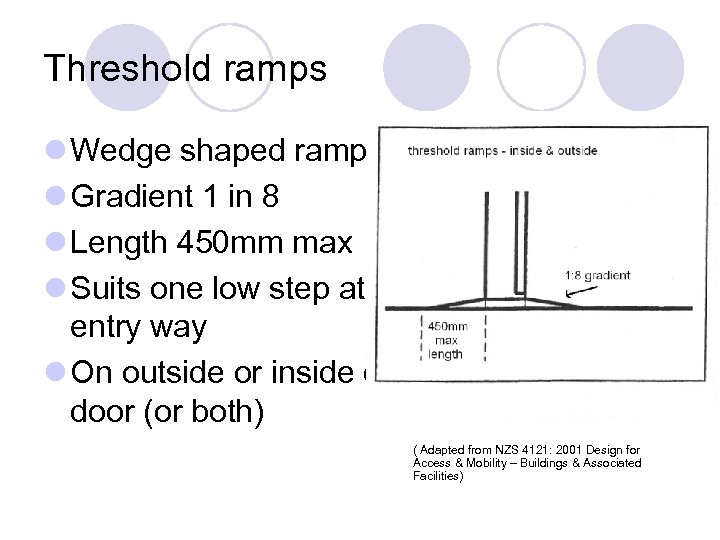 Threshold ramps l Wedge shaped ramp l Gradient 1 in 8 l Length 450 mm max l Suits one low step at entry way l On outside or inside of door (or both) ( Adapted from NZS 4121: 2001 Design for Access & Mobility – Buildings & Associated Facilities)
 What are NZ standards for thresholds? l When the change in level at a stepped threshold is 20 mm or less, no ramp is required l If the change in level is greater than 20 mm a ramp is required which shall have a gradient not steeper than 1 in 8 & a length of no more than 450 mm
 Indicators for threshold ramps l Wheelchair users who • can self propel up short steep incline or • are pushed by a fit carer or • use a power chair and can stop on a slope to use a door l Sometimes instead of a level platform at doorstep
 Key points threshold ramps l Gradient is steeper than regular ramp l Maximum length permitted is less than footprint of wheelchair l Unsuitable for threshold step > 56 mm l Must have non slip surface l No rails l No kerbs
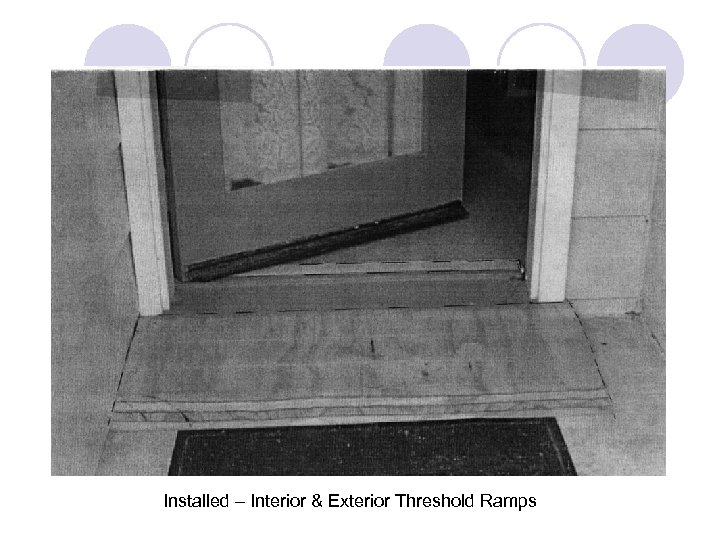 Installed – Interior & Exterior Threshold Ramps
 Think about options l Equipment – suppliers in NZ l $$$ -self funding l Complex modification • regular ramp • lift
 Determine solution – threshold ramp l Location l Measure height - check <56 mm l Design l width l length l splayed l non slip surface l Construction l installation
 DOORWAY WIDENING l Internal doors only l Standard hinged doors with no electrical works l Indicators l change in mobility aid l upsize of chair l change to wheelchair resulting in > footprint l tight 90’ turn into doorway
 NZ Standards for doorways l Minimum clear width of a doorway shall be 760 mm when the door is open l Can be achieved with an 810 mm sidehung door
 Key points for doorways l Reach. Grasp. Twist. Pull to open. Back up. Release. Go through. Turn. Reach. Grasp. Twist. Push to close. Turn. l Door sizes l Clear opening l Arc of widened door
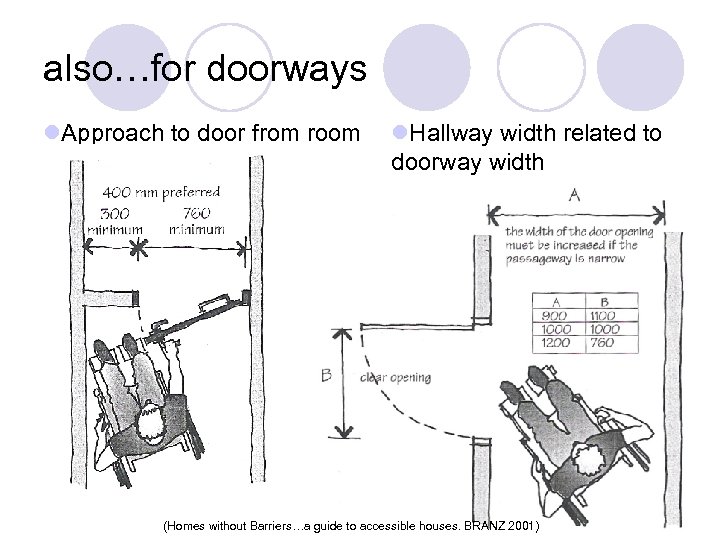 also…for doorways l. Approach to door from room l. Hallway width related to doorway width (Homes without Barriers…a guide to accessible houses. BRANZ 2001)
 Think about options l Technique for manoeuvring l Remove rims from wheelchair l Use shower commode chair for bathroom l Power wheelchair options l Remove door l Rehang door l Fold back hinges
 Determine solution – doorway widening l Location – internal only l Position in relation to space available l Size required (bigger is not necessarily better) l Handles & locks l Door construction
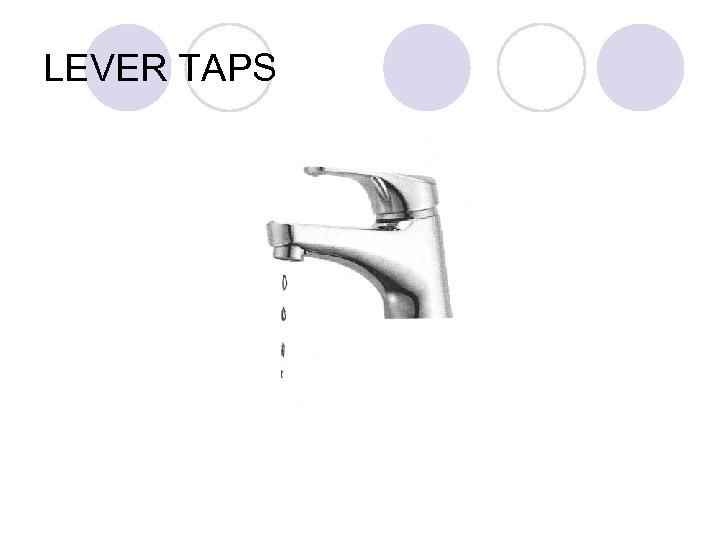 LEVER TAPS
 Key points lever taps l Indicators l Methven range (see handout) l Think about options l. Ensure taps are functioning well l. Equipment - tap turners
 Funding options basic modifications l Self funding l HNZ l Other organisations eg Veterans Affairs l WINZ l LTSCHC via NASC l EMS funding
 Sketching is for… l therapist l the client l the Mo. H provider l the contractor …so it’s worth getting it right!
 Take…. l measurements l time to sketch carefully l a photo…if it helps you to remember
 Helpful hints l How to measure height of steps l How to measure length of step rail l Use pencil & different coloured pens l Use templates for steps, bathrooms l Use grid paper & scale wheelchair
 Sketching practice Next…. l Translate what you can see into a birds eye view & a side on view l Freehand draw existing & proposed on the same sketch
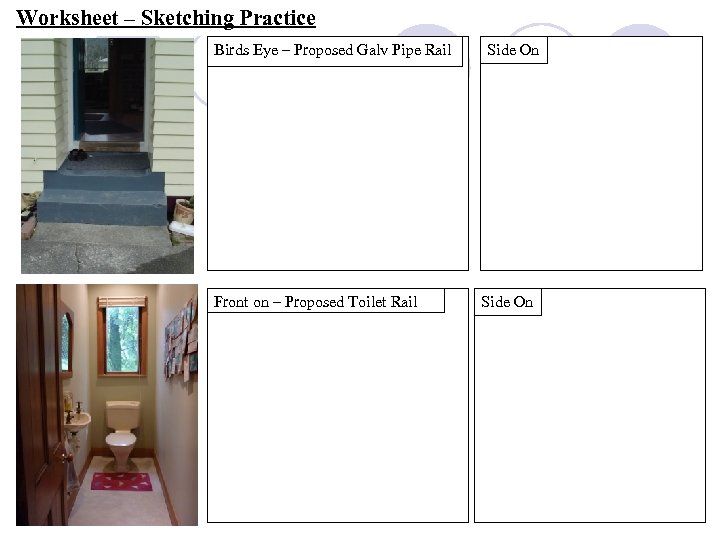 Worksheet – Sketching Practice Birds Eye – Proposed Galv Pipe Rail Front on – Proposed Toilet Rail Side On
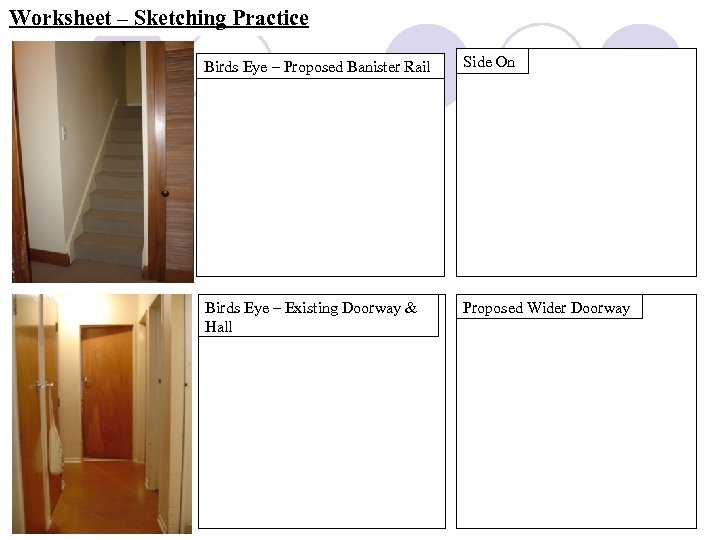 Worksheet – Sketching Practice Birds Eye – Proposed Banister Rail Side On Birds Eye – Existing Doorway & Hall Proposed Wider Doorway
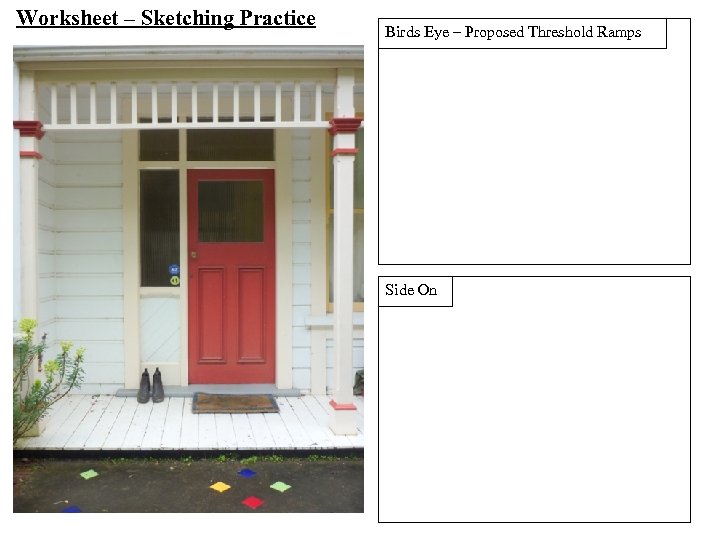 Worksheet – Sketching Practice Birds Eye – Proposed Threshold Ramps Side On
 Resources l Information sheets for EMS assessors ¡ Rails, steps, easy steps & stairs ¡ Ramps ¡ Doors, doorways, walls http: //disabilityservices. hiirc. org. nz l NZS 4121: 2001 Design for Access & Mobility – Buildings & Associated Facilities l “More Accessible Housing for Independent Living” Rod A. Hunter 1992 l Homes without Barriers…a guide to accessible houses. BRANZ 2001 l Grab rails information sheet. SA Disability Information service www. disability. sa. gov. au
 Nail that Rail!…all you need to know to to become an ‘approved assessor' for basic housing modifications Presented by Angela Vanderpoel Community Occupational Therapist 28. 09. 10 15. 11. 10