 Скачать презентацию NAICU February 2008 Major Trends Factors That
dc11db64ce05fde3c4afe7a68bcc42a0.ppt
- Количество слайдов: 71



NAICU – February 2008 Major Trends Factors That Will Impact Your Ability to Recruit Students, Raise Dollars, and Market Your Institution Presented by: Dr. Robert A. Sevier Senior Vice President, Strategy bob. sevier@stamats. com 800 -553 -8878, ext. 5100
The Perfect Storm • A confluence of three gales: – Changing demography – Rising cost to attend – Increased competition for students and donated dollars • Add to the confluence: – Colleges and universities increasingly unable (unwilling) to make the tough decisions that will truly differentiate themselves from their competitors © 2008 Stamats, Inc. - 2 2
The Marketplace © 2008 Stamats, Inc. - 3 3
The marketplace – continued • U. S. population: 303, 162, 042 – One birth every. . . . . 8 seconds – One death every. . . . 11 seconds – One immigrant every………………. . 30 seconds – Net gain of one person every. . . 13 seconds – Number of Americans who turn 60 each day………………. …. . . 6, 500 – Number of high school students who drop out each day……. . . 2, 100 (+/-) • States with the greatest growth in the next 10 years: – – California North Carolina Florida Washington – Georgia – Arizona – Texas © 2008 Stamats, Inc. - 4 4
Key Demographic Realities • Half the U. S. lives in 10 states: CA, TX, NY, FL, IL, PA, OH, MI, NJ, and GA • CA, FL, and TX will have half the increase traditional-age students (California enrolls 13. 6% of all college students) • One-third lives in nine metro areas: NY, LA, Chicago, Wash DC, SF, Philly, Boston, Detroit, Dallas • The youth population of IN, MA, MI, OH, MO, and PA will continue to decrease until about 2010 • The Third Great American Migration: – By 2025, 50 million people who now live in the North will move South • Dramatic increase in average of people in the South • Significant strain on infrastructure in the South • Loss of tax base in the North • Decline in real estate value in the North (3: 1 tipping point by state) © 2008 Stamats, Inc. - 5 5
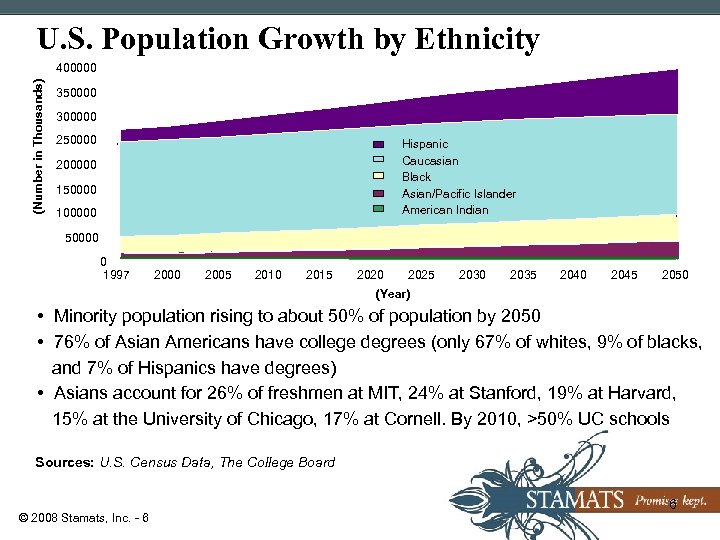
U. S. Population Growth by Ethnicity (Number in Thousands) 400000 350000 300000 250000 Hispanic Caucasian Black Asian/Pacific Islander American Indian 200000 150000 100000 50000 0 1997 2000 2005 2010 2015 2020 2025 2030 2035 2040 2045 2050 (Year) • Minority population rising to about 50% of population by 2050 • 76% of Asian Americans have college degrees (only 67% of whites, 9% of blacks, and 7% of Hispanics have degrees) • Asians account for 26% of freshmen at MIT, 24% at Stanford, 19% at Harvard, 15% at the University of Chicago, 17% at Cornell. By 2010, >50% UC schools Sources: U. S. Census Data, The College Board © 2008 Stamats, Inc. - 6 6
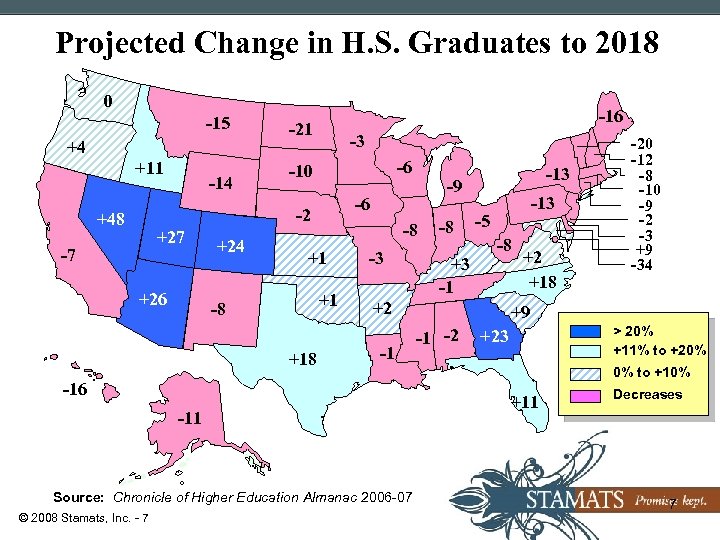
Projected Change in H. S. Graduates to 2018 0 -15 +4 +11 -14 -16 -21 -3 -6 -10 -6 -2 +48 +27 -7 +26 +24 -8 +1 +1 -8 +18 -3 -8 +3 -1 -13 -5 -8 +2 -1 +2 +18 +9 -1 -2 -16 -11 Source: Chronicle of Higher Education Almanac 2006 -07 © 2008 Stamats, Inc. - 7 -13 -9 -20 -12 -8 -10 -9 -2 -3 +9 -34 > 20% +11% to +20% +23 0% to +10% +11 Decreases 7
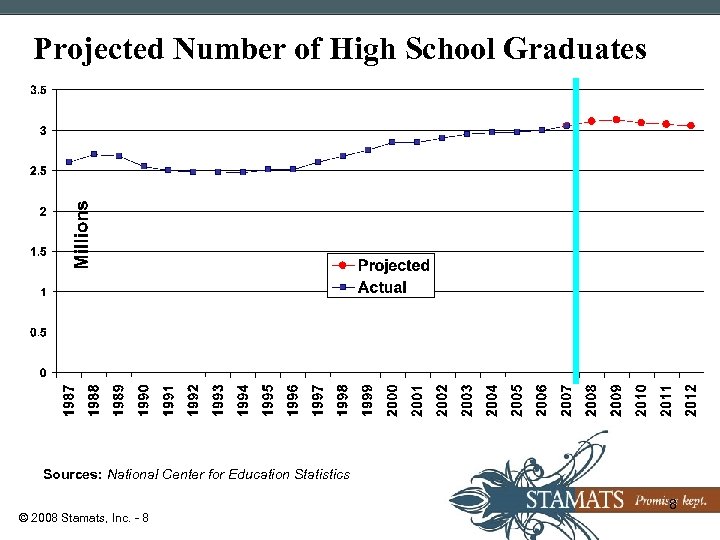
Projected Number of High School Graduates Sources: National Center for Education Statistics © 2008 Stamats, Inc. - 8 8
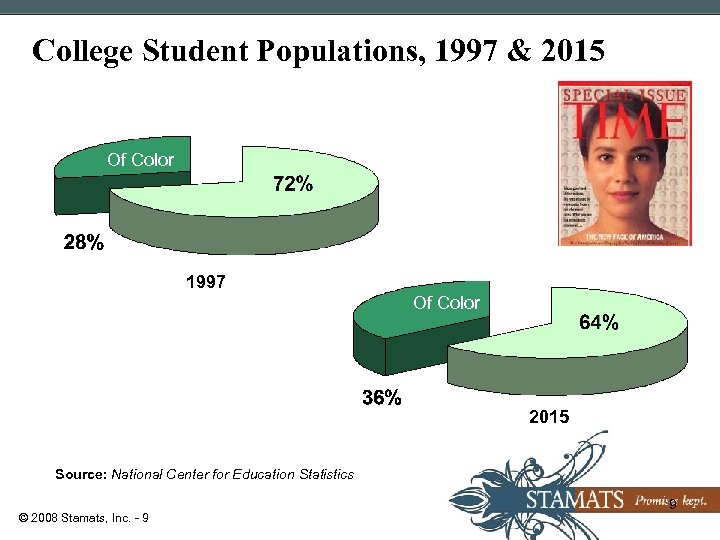
College Student Populations, 1997 & 2015 Of Color 1997 Of Color 2015 Source: National Center for Education Statistics © 2008 Stamats, Inc. - 9 9
Fastest Growing Occupations • 2008 – 2014: – Network systems and data communications analyst – Physician’s assistant – Computer software engineer – Computer systems engineer – Database administrator – Physical therapist – Medical researcher – Occupational therapist – Network and computer systems administrator – College instructor Sources: Business 2. 0 © 2008 Stamats, Inc. - 10 10
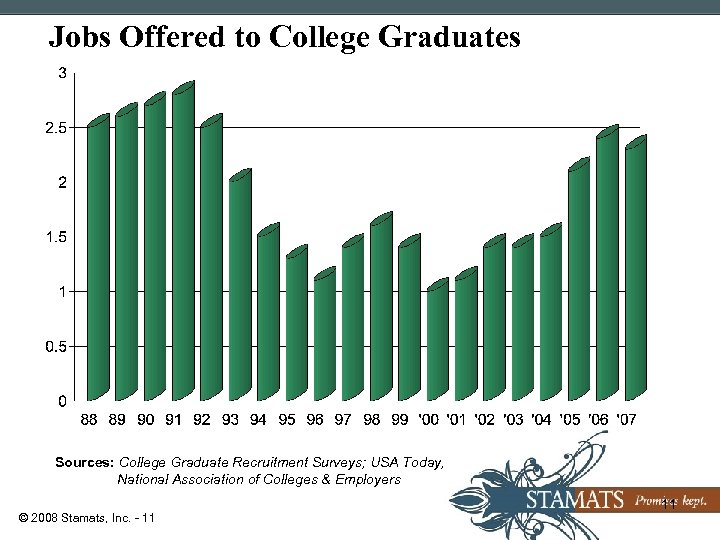
Jobs Offered to College Graduates Sources: College Graduate Recruitment Surveys; USA Today, National Association of Colleges & Employers © 2008 Stamats, Inc. - 11 11
Stamats’ Prediction • There are six growth markets in higher education: 1. Students of color 2. Adult students, including seniors 3. Commuter students 4. Part-time students 5. Women (of almost all ages) 6. International students • The market for full-time residential students is declining and will continue to decline for at least a generation © 2008 Stamats, Inc. - 12 12
The Publics • Publics: – De facto privitization because of low public funding • More and more publics receive fewer and fewer public dollars – Dramatic increase in fundraising – Increasingly use terms historically used by privates – Effectively leverage athletics – Have large affinity groups – Compete more effectively on quality; already winning on price • Rise in honors programs/honors experience – Segment, especially high academics and honors – Make significant marketing expenditures § In 2006, Stamats received three brand marketing RFPs from publics for each one we received from a private • Two-year institutions increasingly offer 2+2 and college transfer © 2008 Stamats, Inc. - 13 13
Globalization of Higher Education • Shanghai’s ranking of world’s top 100 institutions includes 45 non-U. S. schools (U. S. percentage is declining slowly) • EU is streamlining education system and offering more and more programs in English, expanding commitment to the 3 -year BA • Great Britain, Australia, and New Zealand (as well as Taiwan, Hong Kong, and India) are aggressively recruiting foreign students – In 2006, the number of international students enrolled in Australia increased by 5. 2% to 172, 297 – 14, 755 Americans enrolled in British institutions; 50% increase since 1997 • • China: In 2006, 61, 869 students from 169 countries studied in China – China’s transformation of 100 universities into world-class research institutions is a national priority Drop in exceptional students from China and India studying in the U. S. © 2008 Stamats, Inc. - 14 14
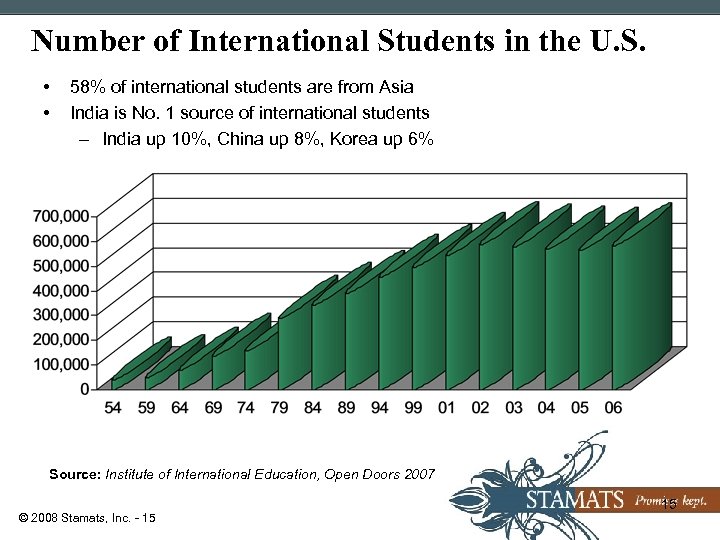
Number of International Students in the U. S. • • 58% of international students are from Asia India is No. 1 source of international students – India up 10%, China up 8%, Korea up 6% Source: Institute of International Education, Open Doors 2007 © 2008 Stamats, Inc. - 15 15
International Students in the U. S. • Top 10 places in U. S. foreign students: – – – – – • • USC Columbia NYU U Illinois – Champaign Purdue (main campus) UM – Ann Arbor U Texas – Austin UCLA Harvard Boston U 7, 115 5, 937 5, 827 5, 685 5, 581 5, 429 5, 303 4, 704 4, 514 4, 484 • Top 12 countries of origin: – – – India China Republic of Korea Japan Taiwan Canada Mexico Turkey Thailand Germany UK USC is the top host university; California top – Saudi Arabia host state In 2005/2006 the net contribution to the U. S. economy by foreign students and their families was $14. 4 billion Source: Institute of International Education (Open Doors 2007) © 2008 Stamats, Inc. - 16
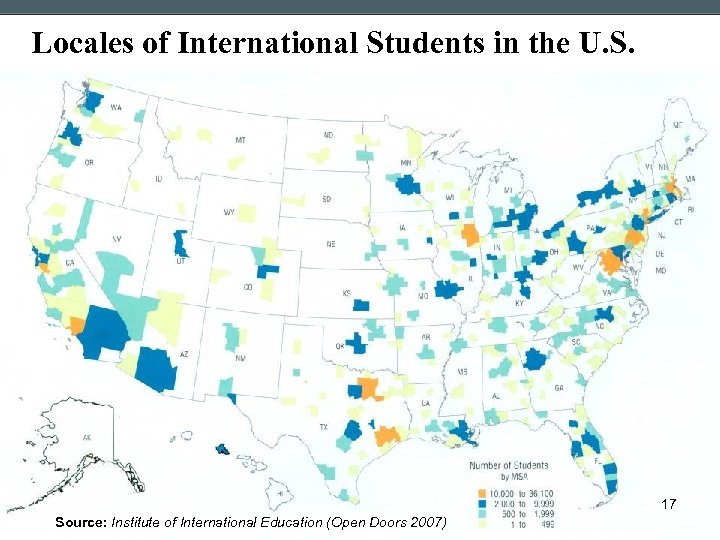
Locales of International Students in the U. S. © 2008 Stamats, Inc. - 17 of International Education (Open Doors 2007) Source: Institute 17
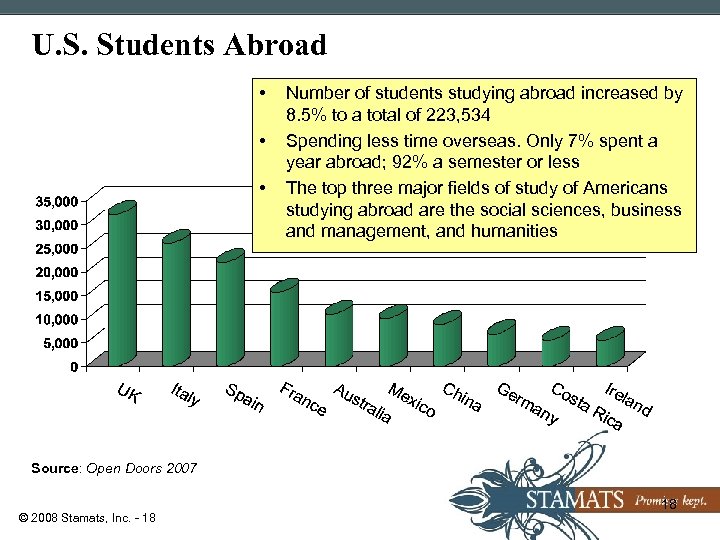
U. S. Students Abroad • • • Number of students studying abroad increased by 8. 5% to a total of 223, 534 Spending less time overseas. Only 7% spent a year abroad; 92% a semester or less The top three major fields of study of Americans studying abroad are the social sciences, business and management, and humanities Source: Open Doors 2007 © 2008 Stamats, Inc. - 18 18
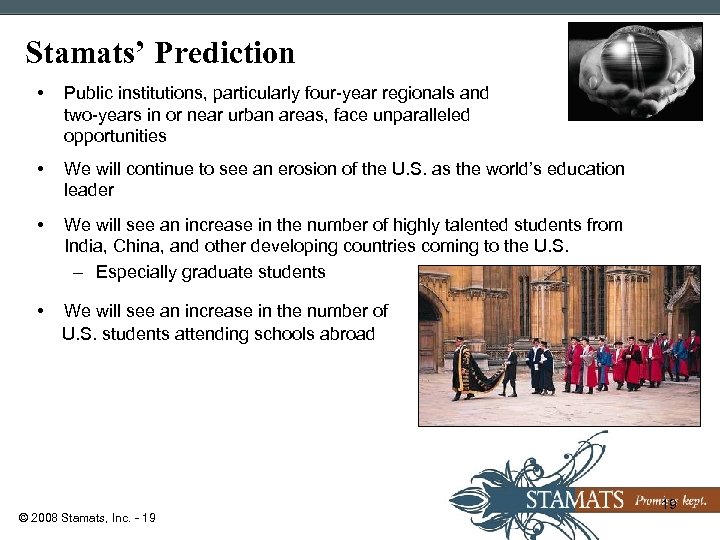
Stamats’ Prediction • Public institutions, particularly four-year regionals and two-years in or near urban areas, face unparalleled opportunities • We will continue to see an erosion of the U. S. as the world’s education leader • We will see an increase in the number of highly talented students from India, China, and other developing countries coming to the U. S. – Especially graduate students • We will see an increase in the number of U. S. students attending schools abroad © 2008 Stamats, Inc. - 19 19
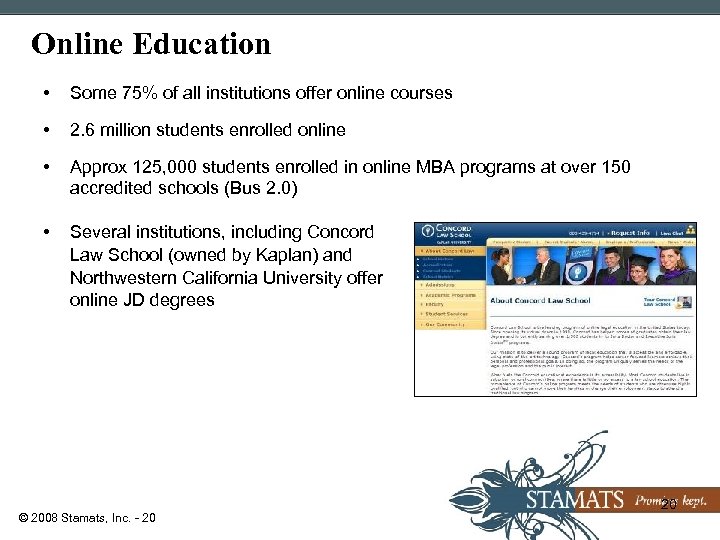
Online Education • Some 75% of all institutions offer online courses • 2. 6 million students enrolled online • Approx 125, 000 students enrolled in online MBA programs at over 150 accredited schools (Bus 2. 0) • Several institutions, including Concord Law School (owned by Kaplan) and Northwestern California University offer online JD degrees © 2008 Stamats, Inc. - 20 20
For-Profit Institutions • Attend for-profit institutions – 9% of four-year students – 22% of two-year students • U of Phoenix is America’s biggest college • Stock increases over 2006: – ITT stock up 78% – De. Vry up 55% – Apollo Group 13% Source: Eduventures © 2008 Stamats, Inc. - 21 21
Apollo/The University of Phoenix (www. phoenix. edu) • More than 235, 000 students – Average = 35 – 30% of new students are 18 -20 – 54% women – 36% enrolled in business-related programs – 64% are undergraduates – 56% attend classes on campus (44% online) • 219 campuses and learning centers in 39 states, Puerto Rico, and Canada – Average class size = 15 • More than 12, 000 adjuncts and about 250 full-time faculty (all who hold MA/S or Ph. D. s) [1, 022] • Phoenix offers associate’s, bachelor’s, and master’s degrees in business, information technology, health care, and education • Accredited by the North Central since 1978 © 2008 Stamats, Inc. - 22 22
Stamats’ Prediction • From a students’ perspective, there is a growing blur between publics, privates, and for-profits – Students increasingly see colleges as a commodity (especially since so many colleges/universities look and sound alike) • The home-school movement is leading to a home-college movement • Aside from “pure” liberal arts colleges, most colleges/universities will blend brick and click • Many proprietary (tax-paying) institutions are legitimate players and will exert more influence in the HE community • Institutions that serve only full-time residential undergraduates will face an extremely difficult future unless they are well-branded and/or wellendowed © 2008 Stamats, Inc. - 23 23
Students of Today…and Tomorrow © 2008 Stamats, Inc. - 24 24
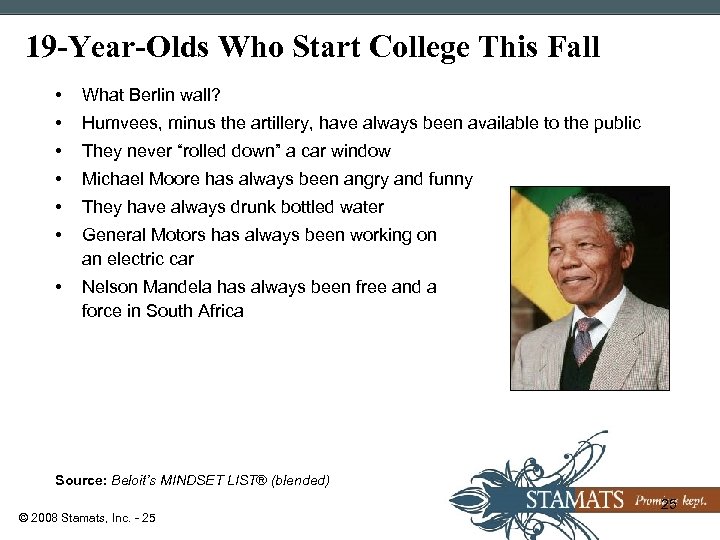
19 -Year-Olds Who Start College This Fall • What Berlin wall? • Humvees, minus the artillery, have always been available to the public • They never “rolled down” a car window • Michael Moore has always been angry and funny • They have always drunk bottled water • General Motors has always been working on an electric car • Nelson Mandela has always been free and a force in South Africa Source: Beloit’s MINDSET LIST® (blended) © 2008 Stamats, Inc. - 25 25
Students – continued • • • 65% of H. S. graduates go to college 1 in 3 attend community colleges Only 1 in 4 community college students complete a bachelor’s degree 13 million students working on bachelor’s degrees – 57. 4% are women; 30. 9% are of color 20% have one foreign-born parent 11% speak another language besides English at home 50% begin their education at two-year institutions 60% attend more than one institution; 35% attend three or more before they graduate 48% of freshmen drop/stop out of college at least once 17. 3% of UG 24 or older; 41% go part-time 40% of UG travel across state lines to earn a degree 84% work part-time while attending college; 34% work full-time Sources: The College Board and 2006 -07 Chronicle of Higher Education Almanac © 2008 Stamats, Inc. - 26 26
High School Hopes and Dreams • 10 th graders expecting to get a four-year degree: – 1990 • – 2004 80% Percentage of students graduating from high school and entering college – 1990 • 59% 60% – 2004 64% By the time a student is 24: – One in three students from household with incomes of $85, 000 or above will have a degree – 1 in 17 from households with income below $35, 377 • 1 of 5 high school students in 2004 took at least one AP exam • 1 of 20, or 813, 000, high school students took college courses © 2008 Stamats, Inc. - 27 27
Today’s High School Students • • • Strengths Multitasking Goal orientation Positive attitude Technically savvy Collaboration Weaknesses Distaste for menial work Lack of skills for dealing with difficult people Impatient; want it “now” Poorly prepared Unrealistic expectations for near-term earnings Immature © 2008 Stamats, Inc. - 28 28
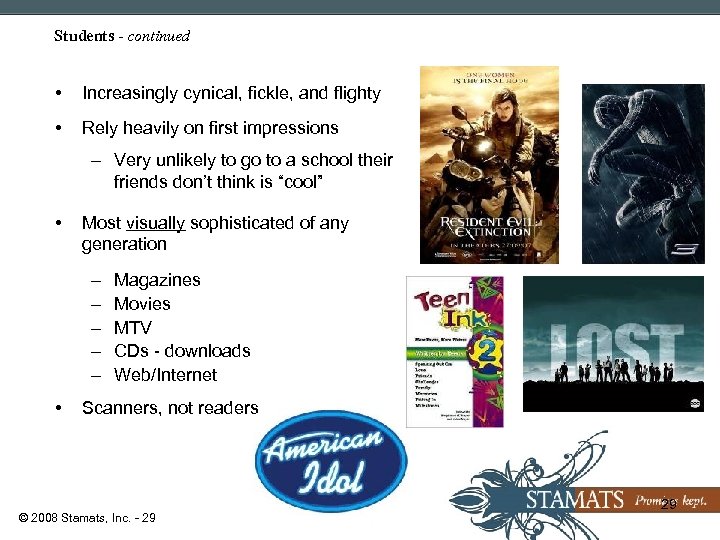
Students - continued • Increasingly cynical, fickle, and flighty • Rely heavily on first impressions – Very unlikely to go to a school their friends don’t think is “cool” • Most visually sophisticated of any generation – – – • Magazines Movies MTV CDs - downloads Web/Internet Scanners, not readers © 2008 Stamats, Inc. - 29 29
Reasons for Going to College M W • To learn more about things that interest me 72. 1% 80. 6% • To get training for a specific career 64. 8% 72. 7% • To be able to get a better job 70. 4% • To be able to make more money 71. 9% 66. 6% • Gain a general education/appreciate ideas 57. 8% 69. 9% Reasons for Selecting a Specific School • • • College has a good academic reputation Graduates get good jobs A visit to campus Wanted to go to a school about this size Offered financial assistance 52. 45% 61. 4% 46. 1% 51. 8% 32. 2% 43. 2% 31. 2% 45. 1% 30. 7% 37. 2% Source: Chronicle of Higher Education Almanac 2006 -07 © 2008 Stamats, Inc. - 30 30
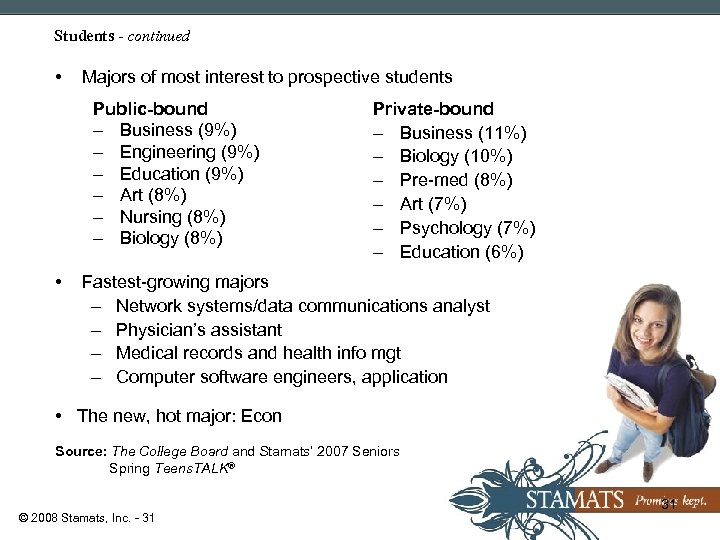
Students - continued • Majors of most interest to prospective students Public-bound – Business (9%) – Engineering (9%) – Education (9%) – Art (8%) – Nursing (8%) – Biology (8%) Private-bound – Business (11%) – Biology (10%) – Pre-med (8%) – Art (7%) – Psychology (7%) – Education (6%) • Fastest-growing majors – Network systems/data communications analyst – Physician’s assistant – Medical records and health info mgt – Computer software engineers, application • The new, hot major: Econ Source: The College Board and Stamats’ 2007 Seniors Spring Teens. TALK® © 2008 Stamats, Inc. - 31 31
Students – continued • Significant physical and emotional health issues – 1 in 5 colleges in U. S. has at least one suicide each year – Chronic fatigue and increasingly complex health problems – 25% of college students have little/no health insurance • Galloping psychology of entitlement Rise of narcissism • 49% (3. 8 million) of full-time college students binge drink – 156, 000 college students drop out each year because of alcohol issues – 1. 8 million full-time college students (22. 9% meet criteria for substance abuse) 85% of all crime problems are directly related to alcohol • • 19. 2% of college students do not drink alcohol • 3 in 10 college students are clinically obese • 1 in 10 college students has long-term gambling debt Source: Council for Substance Abuse and Addiction © 2008 Stamats, Inc. - 32 32
Their Connected World • • • Technology is like a knife and fork to teens Cell phones (69% have) —not just for talking, but delivering content; 39% say could not live without cell – Games, video, advertising, mobile Internet Text messaging up, email down 93% of youth and 94% of parents are online 64% of online teenagers ages 12 to 17 engaging in at least one type of content creation (girls dominate) Some 35% of all teen girls blog, compared with 20% of online boys 27% maintain their own personal Web page, up from 22% in 2004 i. Pod: The most perfectly named product in 25 years i. Tunes U (Stanford, Berkeley, and others) “Most plugged in, but least connected” INFOMania – multitasking drops IQ by 10 points © 2008 Stamats, Inc. - 33 33
Parents’ Role in College Choice • Today’s parents are better informed about the college-choice process and have higher expectations (especially true for moms) • Look at themselves as “partners” with their children • Very interested in issues related to academic quality, access to faculty and facilities, and outcome data • Safety is of keen, but often undefined, interest • Concerned about cost, but cost is seldom the “deal breaker” • Plan to stay highly involved in their child’s college experience • Look at choosing a college as a competitive sport • Expect colleges to keep their promises Source: Stamats’ 2006 Parents. TALK® © 2008 Stamats, Inc. - 34 34
What Parents Want to Know Most About You Top choices from a list of 26 items • Faculty are good teachers/mentors • Program of interest to child is available • Safe campus • High academic quality • Graduates get good jobs • Known for its academics • Availability of financial aid • Availability of scholarships • Value (high quality/good price) • Reasonable cost tied with good technology resources Source: Stamats 2006 Parents. TALK® © 2008 Stamats, Inc. - 35 35
Stamats’ Prediction • This is the age of the never-satisfied student (and parent) • We can expect the parents’ role in decision on where to go and whether to stay to increase (parents as advocates) • More students will transfer more often – Start out at less expensive institutions and transfer to better-known institutions [35% go to three or more colleges/universities before they graduate (swirl)] • Technology is the fabric of a teen’s social network and they expect a similar relationship with their college/university © 2008 Stamats, Inc. - 36 36
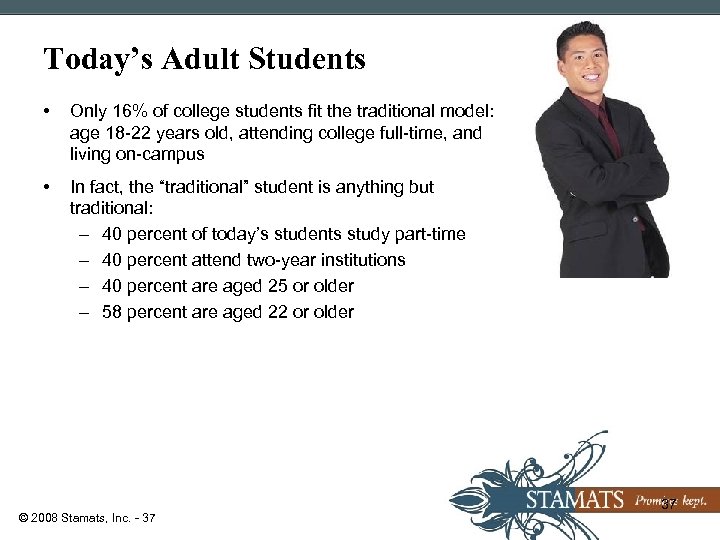
Today’s Adult Students • Only 16% of college students fit the traditional model: age 18 -22 years old, attending college full-time, and living on-campus • In fact, the “traditional” student is anything but traditional: – 40 percent of today’s students study part-time – 40 percent attend two-year institutions – 40 percent are aged 25 or older – 58 percent are aged 22 or older © 2008 Stamats, Inc. - 37 37
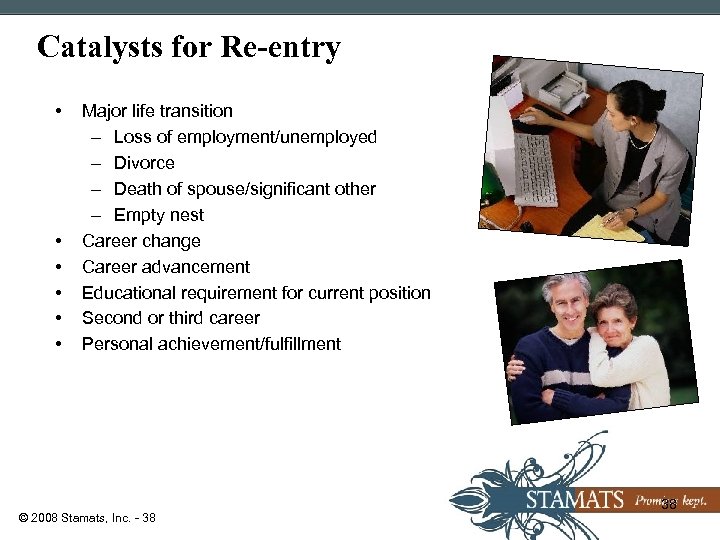
Catalysts for Re-entry • • • Major life transition – Loss of employment/unemployed – Divorce – Death of spouse/significant other – Empty nest Career change Career advancement Educational requirement for current position Second or third career Personal achievement/fulfillment © 2008 Stamats, Inc. - 38 38
What Adult Students Seek • Flexibility —“On my schedule, not just when you want to teach. ” • Convenience —“In and out parking; one-stop shop. ” • Credit for life experience — “Acknowledge what I have already learned through my professional experience. ” • Accelerated completion — “Time is money. ” • Valid learning experience — “I’m not here for the social life. ” • Multiple learning alternatives — “I’m open to online options. ” © 2008 Stamats, Inc. - 39 39
Student Recruiting © 2008 Stamats, Inc. - 40 40
Student recruiting – continued • Privates spend about $2, 073 to recruit a student; publics about $455 • Search saturation as more and more C/U “go national”; dramatic increase in size in inquiry pool • Students applying to more schools than ever; range from 5 to 7 applications Sources: N-L, • 96% of colleges showed an increase in applications of 16 -20%; greatest increase among publics • More “out of the blue” apps coming from the Web NACAC, Greentree Gazette – 57% of all college apps received online; source codes increasingly untrackable • C/U cutting back on high school and home visits • Because of declining yield rates, many C/U are accepting more students who are less prepared academically – Publics: Only about 22% of inquiring students applied – Privates: 10. 5% of inquiring students applied Most sought-after: The 20% who will go full-time, can pay at least a portion of their tuition, and plan to live in a dorm (declines about. 1% a year) • © 2008 Stamats, Inc. - 41 41
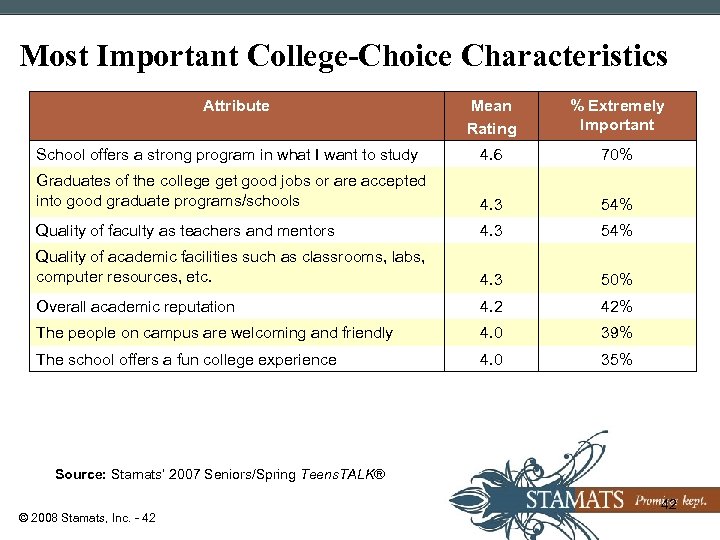
Most Important College-Choice Characteristics Attribute Mean Rating % Extremely Important School offers a strong program in what I want to study 4. 6 70% Graduates of the college get good jobs or are accepted into good graduate programs/schools 4. 3 54% Quality of faculty as teachers and mentors 4. 3 54% Quality of academic facilities such as classrooms, labs, computer resources, etc. 4. 3 50% Overall academic reputation 4. 2 42% The people on campus are welcoming and friendly 4. 0 39% The school offers a fun college experience 4. 0 35% Source: Stamats’ 2007 Seniors/Spring Teens. TALK® © 2008 Stamats, Inc. - 42 42
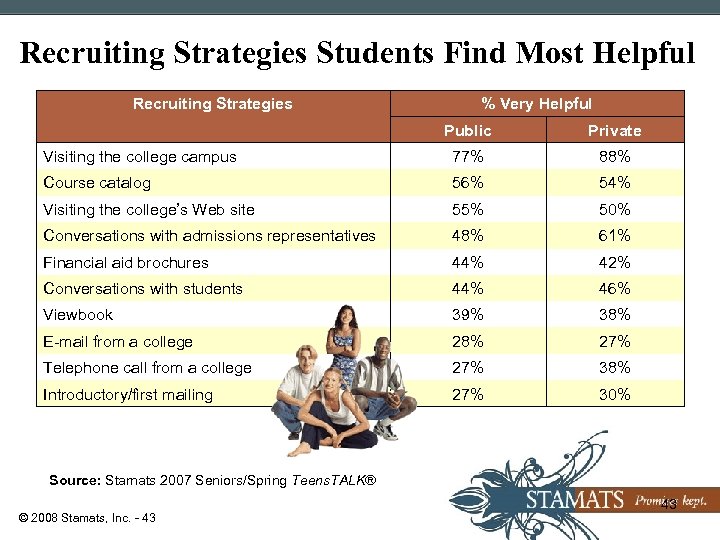
Recruiting Strategies Students Find Most Helpful Recruiting Strategies % Very Helpful Public Private Visiting the college campus 77% 88% Course catalog 56% 54% Visiting the college’s Web site 55% 50% Conversations with admissions representatives 48% 61% Financial aid brochures 44% 42% Conversations with students 44% 46% Viewbook 39% 38% E-mail from a college 28% 27% Telephone call from a college 27% 38% Introductory/first mailing 27% 30% Source: Stamats 2007 Seniors/Spring Teens. TALK® © 2008 Stamats, Inc. - 43 43
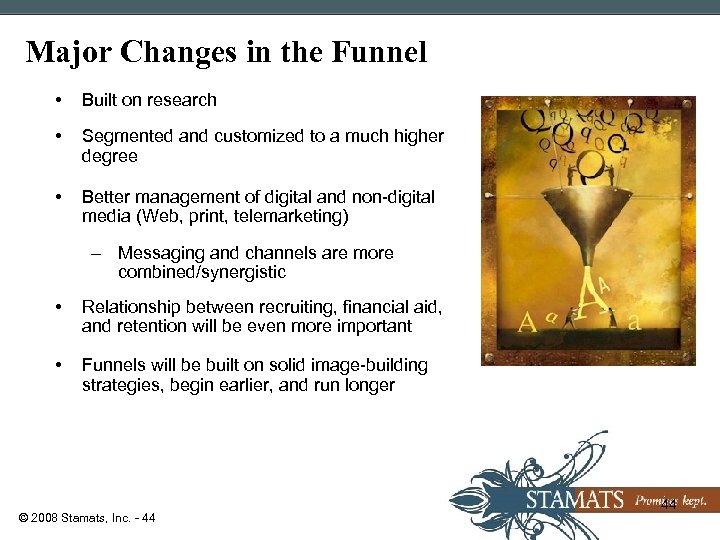
Major Changes in the Funnel • Built on research • Segmented and customized to a much higher degree • Better management of digital and non-digital media (Web, print, telemarketing) – Messaging and channels are more combined/synergistic • Relationship between recruiting, financial aid, and retention will be even more important • Funnels will be built on solid image-building strategies, begin earlier, and run longer © 2008 Stamats, Inc. - 44 44
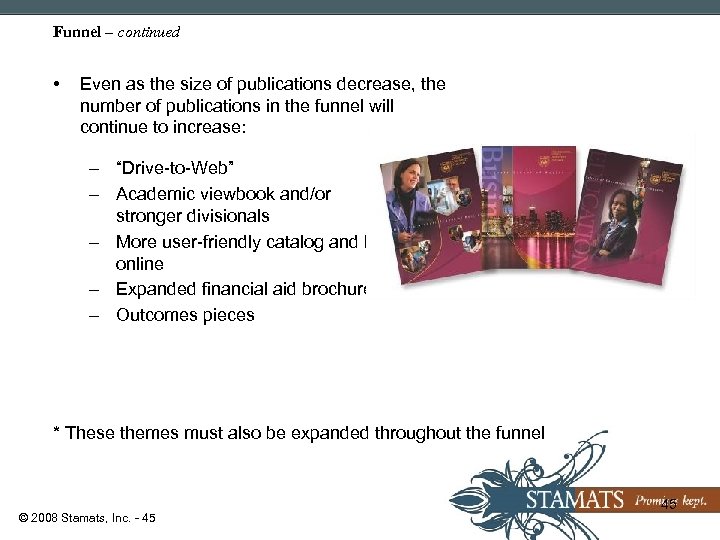
Funnel – continued • Even as the size of publications decrease, the number of publications in the funnel will continue to increase: – “Drive-to-Web” – Academic viewbook and/or stronger divisionals – More user-friendly catalog and likely online – Expanded financial aid brochure* – Outcomes pieces * These themes must also be expanded throughout the funnel © 2008 Stamats, Inc. - 45 45
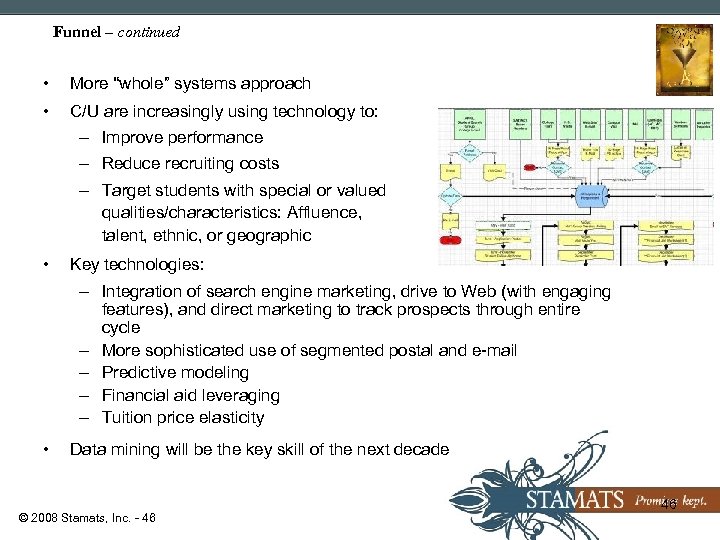
Funnel – continued • More “whole” systems approach • C/U are increasingly using technology to: – Improve performance – Reduce recruiting costs – Target students with special or valued qualities/characteristics: Affluence, academic talent, ethnic, or geographic diversity • Key technologies: – Integration of search engine marketing, drive to Web (with engaging features), and direct marketing to track prospects through entire cycle – More sophisticated use of segmented postal and e-mail – Predictive modeling – Financial aid leveraging – Tuition price elasticity • Data mining will be the key skill of the next decade © 2008 Stamats, Inc. - 46 46
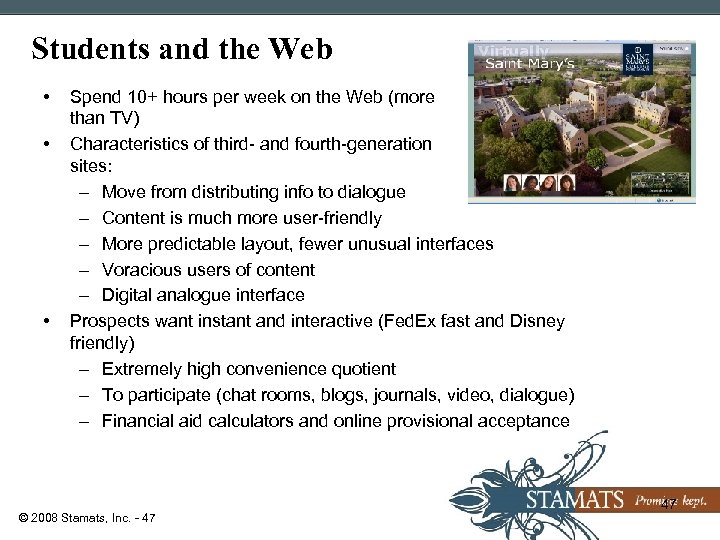
Students and the Web • • • Spend 10+ hours per week on the Web (more than TV) Characteristics of third- and fourth-generation sites: – Move from distributing info to dialogue – Content is much more user-friendly – More predictable layout, fewer unusual interfaces – Voracious users of content – Digital analogue interface Prospects want instant and interactive (Fed. Ex fast and Disney friendly) – Extremely high convenience quotient – To participate (chat rooms, blogs, journals, video, dialogue) – Financial aid calculators and online provisional acceptance © 2008 Stamats, Inc. - 47 47
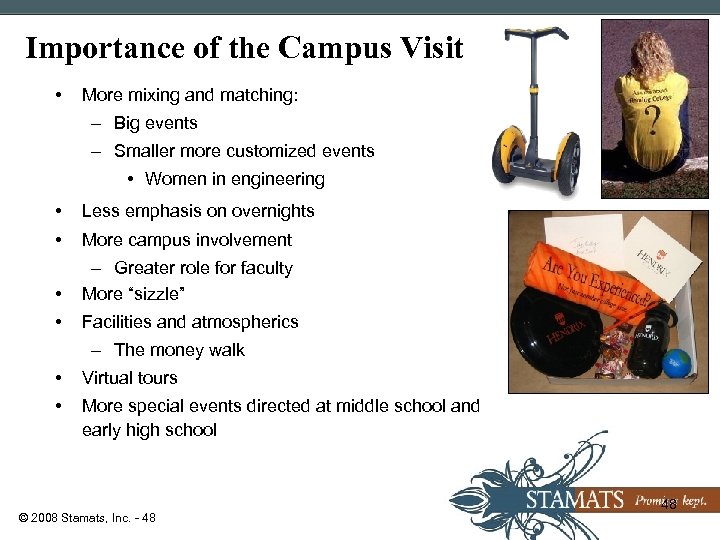
Importance of the Campus Visit • More mixing and matching: – Big events – Smaller more customized events • Women in engineering • Less emphasis on overnights • More campus involvement • • – Greater role for faculty More “sizzle” Facilities and atmospherics – The money walk • Virtual tours • More special events directed at middle school and early high school © 2008 Stamats, Inc. - 48 48
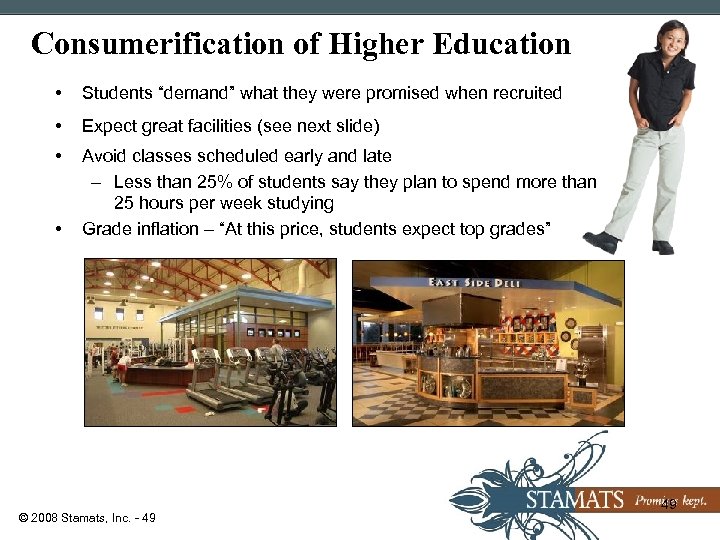
Consumerification of Higher Education • Students “demand” what they were promised when recruited • Expect great facilities (see next slide) • Avoid classes scheduled early and late – Less than 25% of students say they plan to spend more than 25 hours per week studying Grade inflation – “At this price, students expect top grades” • © 2008 Stamats, Inc. - 49 49
Role of Facilities in College Choice • A study by the Association for Higher Education Facilities Officers indicates that certain facilities appear to have a clear impact on students’ decisions on where to attend college: – Students very/most interested in (top 5): 1. Facilities related to their major (73. 6%) 2. Library (56. 6%) [as a study hall and portal, not repository] 3. Sophisticated technology (50. 9%) [often defined as “wireless”] 4. Classrooms (49. 8%) 5. Residence halls (42. 2%) – Contrary to popular wisdom that places wellness centers and dining complexes at the top of the list, these facilities ranked lower Source: Chronicle of Higher Education, June 9, 2006 © 2008 Stamats, Inc. - 50 50
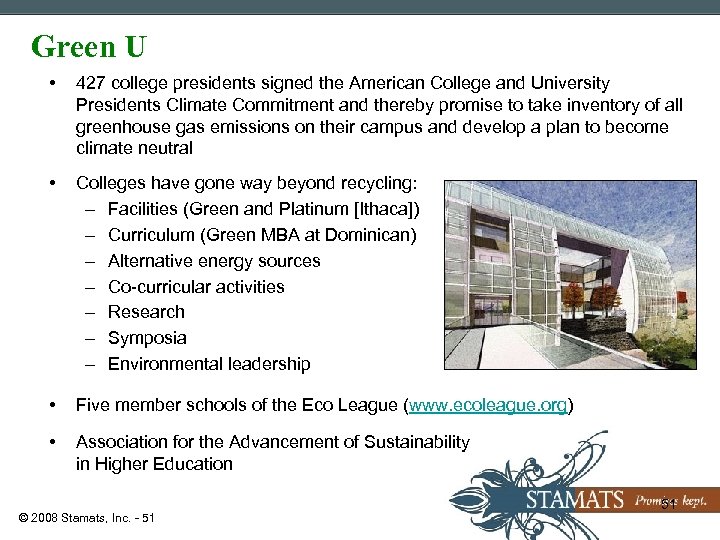
Green U • 427 college presidents signed the American College and University Presidents Climate Commitment and thereby promise to take inventory of all greenhouse gas emissions on their campus and develop a plan to become climate neutral • Colleges have gone way beyond recycling: – Facilities (Green and Platinum [Ithaca]) – Curriculum (Green MBA at Dominican) – Alternative energy sources – Co-curricular activities – Research – Symposia – Environmental leadership • Five member schools of the Eco League (www. ecoleague. org) • Association for the Advancement of Sustainability in Higher Education © 2008 Stamats, Inc. - 51 51
Stamats’ Prediction • • Recruiting will become even more technical Aid (both merit and need) will be even more important in the future • The schools best able to recruit students will be those that: – – – • Are near or in an urban area (edge cities) Have a strong brand or are commodity buys Have a price point in the middle of the perceived competitor set Able to serve multiple types of students Significant endowment Differentiated and valued curriculum Institutions at risk: – Rural – Less well-known with uncertain value – More expensive without strong brand – Few cash reserves © 2008 Stamats, Inc. - 52 52
Cost and Financial Aid © 2008 Stamats, Inc. - 53 53
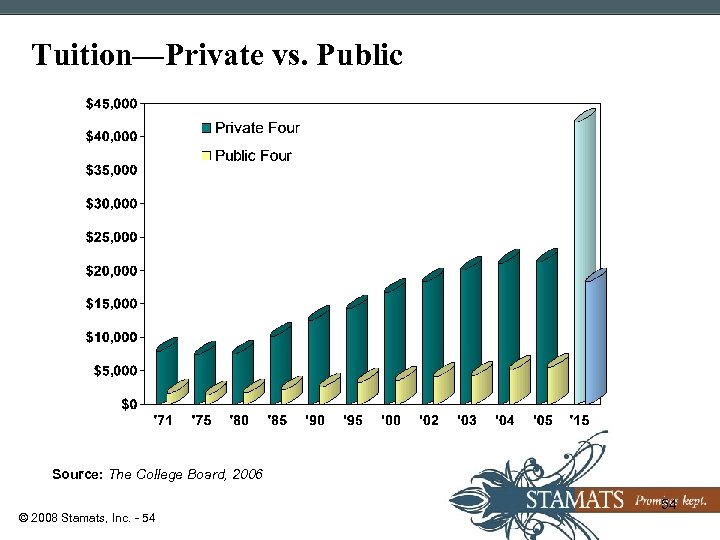
Tuition—Private vs. Public Source: The College Board, 2006 © 2008 Stamats, Inc. - 54 54
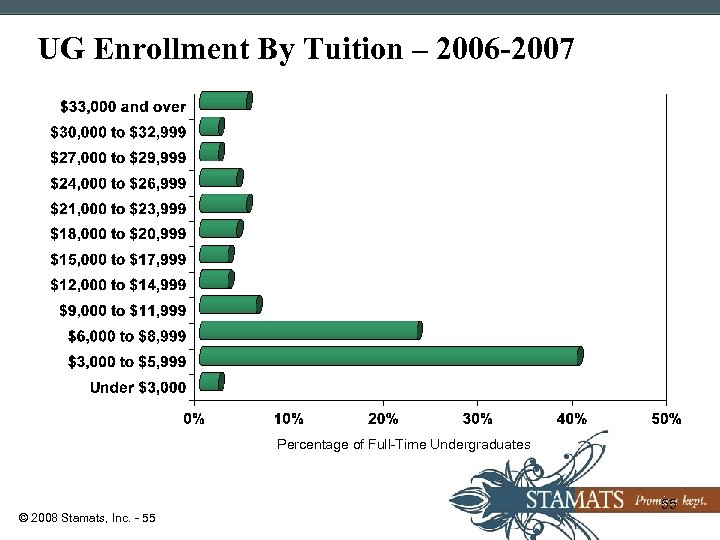
UG Enrollment By Tuition – 2006 -2007 Percentage of Full-Time Undergraduates © 2008 Stamats, Inc. - 55 55
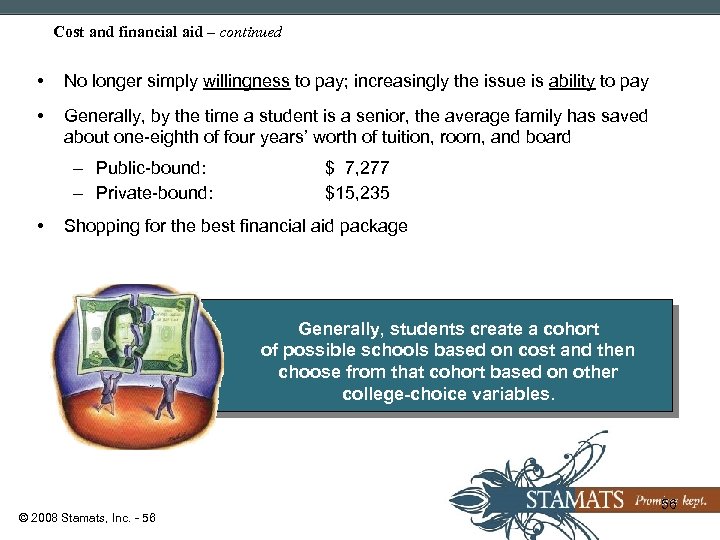
Cost and financial aid – continued • No longer simply willingness to pay; increasingly the issue is ability to pay • Generally, by the time a student is a senior, the average family has saved about one-eighth of four years’ worth of tuition, room, and board – Public-bound: – Private-bound: • $ 7, 277 $15, 235 Shopping for the best financial aid package Generally, students create a cohort of possible schools based on cost and then choose from that cohort based on other college-choice variables. © 2008 Stamats, Inc. - 56 56
Tuition Discount Rates - 2006 • N-L estimated average discount rate: 33. 4% – N-L says: From 1998 -2005, the discount rate for C/U has fluctuated only 1. 4% over the past five years • NACUBO (unweighted, unfunded) – 2005 30. 9% – 2006 33. 1% Source: Noel-Levitz, NACUBO, Lapovsky, CCCU © 2008 Stamats, Inc. - 57 57
Repayment of Loans • When asked how long it would take them to pay off their college loans, many students are taking the long view: – – – 5% 15% 20% 21% 23% 16% 1 year or less 2 -3 years 4 -7 years 8 -10 years 11 to 20 years More than 20 years Source: Alliance. Bernstein Investments College Debt Crunch Survey © 2008 Stamats, Inc. - 58 58
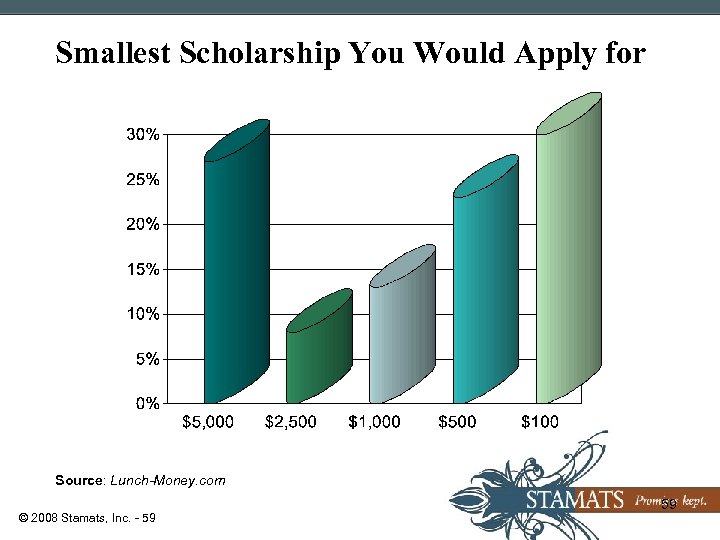
Smallest Scholarship You Would Apply for Source: Lunch-Money. com © 2008 Stamats, Inc. - 59 59
Graduates’ Debt Load • Over the past decade, debt levels for undergrads have increased from $9, 250 to $19, 200 (a 108% increase) – 25% of graduates had debt greater than $30, 000 – 62. 4% public grads and 73. 9% of private grads had debt • 88. 5% of Pell grant recipients also had student loans • More than 66% of college students will take out one or more student loans • Graduates of professional schools owe an average of $93, 000 • Increased college debt impacts: – Time to degree and graduation rates – Relationship of alumni to institution – 40% of students who elect not to pursue graduate education blame debt – Post-graduation decisions involving decision to enter work force, marry, buy a home, and size of family Source: The Project on Student Debt © 2008 Stamats, Inc. - 60 60
Credit Card Debt • College students hold an average of three separate credit cards • Average student owes $2, 200 in credit card debt. That figure jumps to $5, 800 for graduate students • 31% carry a balance of $3, 000 to $7, 000; about 10% owed more than $7, 000 • 25% of students rely on credit cards to help finance their education • 30% of college students give their parents a “D” or “F” for college financial planning Source: Young Money; Partnership for Public Service © 2008 Stamats, Inc. - 61 61
Raising Money © 2008 Stamats, Inc. - 62 62
Raising money – continued • Middle-class asked to give more than 100 times a year • Gifts to HE amounted to $40. 98 billion in 2006, up 9. 8% • Some $3 trillion will pass to the next generation over the next two decades – 464 billionaires and 9. 3 millionaires in the U. S. • In 2007, more than 30 institutions involved in billion+ capital campaigns including UW, Florida, RPI, Brown, Michigan State, NYU • University of Chicago has a fundraising staff of 250; Harvard has a staff of 620 • Alumni give 27. 6% of all donated dollars to an institution – Size of alumni gifts are up – Number of alumni giving is down Sources: Business. Week; Council for Aid to Education; Fortune © 2008 Stamats, Inc. - 63 63
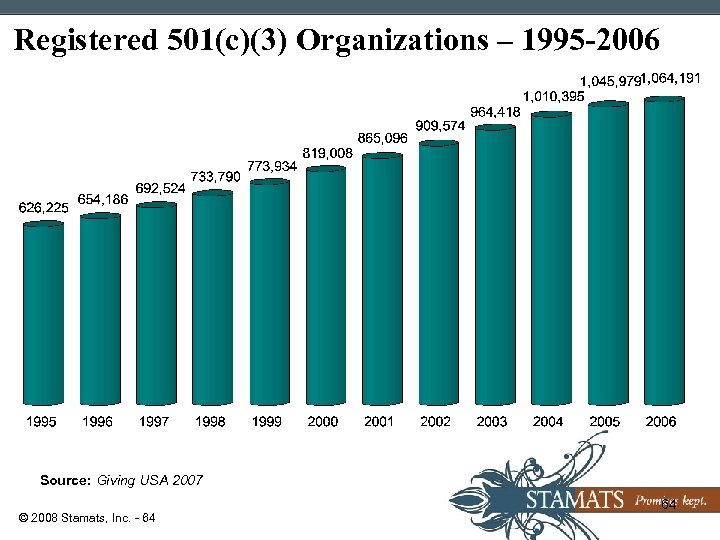
Registered 501(c)(3) Organizations – 1995 -2006 Source: Giving USA 2007 © 2008 Stamats, Inc. - 64 64
Stamats’ Prediction • This is an unprecedented time to raise money • No. 1 reason for not giving: “Reason wasn’t compelling” (no longer “I wasn’t asked”) • Top 25 university in the middle of a $2 billion+ campaign and is using more than 200 different case statements • More customized “receiving” opportunities than ever before: 1. 2. 3. 4. Identify Interview Customize proposal Ask © 2008 Stamats, Inc. - 65 65
Tight Budgets © 2008 Stamats, Inc. - 66 66
Budget – continued • Administrators’ views of major problems facing their colleges Item Finances Faculty: • Recruiting • Tenure • Governance Enrollment Fundraising Increasing diversity % view as critical concern 52% 36% 27% 24% • On too many campuses there are simply no unallocated dollars – Tuition revenue is flat – Discount rates are high – State support is flat – Fundraising is increasingly restricted © 2008 Stamats, Inc. - 67 67
The Rise of the Lobbyist • 336 private colleges spent $34. 7 million in 2005, up from $29. 4 million that 267 such institutions spent in 2004 • 265 public four-year C/U spent $35. 7 million in 2005, up from $31. 7 million that 233 such institutions spent in 2004 • 80 community colleges spent $4. 3 million in 2005, with 12 of them reporting expenditures of at least $100, 000 • Some expenditures: – Johns Hopkins University led the way with $1, 020, 000, up from the $620, 000 it reported spending in 2004 – Boston University followed with $920, 000 in reported spending – The University of California system spent $980, 000 and the State University of New York System spent $870, 000 (plus more for some of its individual campuses) Sources: Inside Higher Ed © 2008 Stamats, Inc. - 68 68
Enlarged Role for Marketing • Marketing is increasingly tied to strategic planning • More interest in brand/reputation building • Integration of marketing across multiple departments • Rise of the marketing professional VPs for marketing – Coming from commercial world – Expect a seat on the cabinet – Centralized marketing functions and (bigger) budgets to support: • Brand building • Student recruiting • Fundraising • More data-oriented and more interested in m. ROI – Outcomes vs. output – Tuition price elasticity – Academic program marketability © 2008 Stamats, Inc. - 69 69
Final Comments • HE faces unparalleled challenges … and opportunities • To be successful you must have: – An engaging vision – A realistic, funded, strategic plan • A high degree of accountability – A keen understanding of and respect for the marketplace – A valid point of differentiation – A willingness to make the tough decisions – A senior team that is committed to working together – Focus © 2008 Stamats, Inc. - 70 70
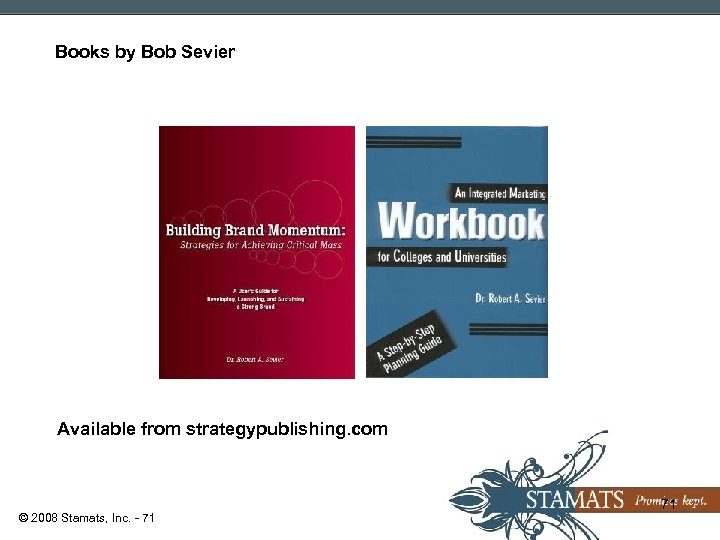
Books by Bob Sevier Available from strategypublishing. com © 2008 Stamats, Inc. - 71 71
Скачать презентацию NAICU February 2008 Major Trends Factors That
dc11db64ce05fde3c4afe7a68bcc42a0.ppt