


 Скачать презентацию NAEFS and the North American Week 2 Forecast
048d73f82dc9d8c257bb413349af298b.ppt
- Количество слайдов: 23
 NAEFS and the North American Week 2 Forecast • Edward O’Lenic 1 and Zoltan Toth 2 • NOAA-NWS-1 Climate Prediction Center • 2 Environmental Modeling Center • Camp Springs, Maryland • ed. olenic@noaa. gov • 301 -763 -8000, ext 7528 • 1
 Overview of the North American Ensemble Forecast System (NAEFS) Prepared by Zoltan Toth Environmental Modeling Center NOAA/NWS/NCEP USA June 24, 2005 Acknowledgements: Louis Lefaivre, MSC, Canada http: //wwwt. emc. ncep. noaa. gov/gmb/ens/index. html 2
 OUTLINE • PARTICIPANTS • PROJECT DESCRIPTION • TIMELINE • IMPLEMENTATION SCHEDULE • CONCEPT OF OPERATIONS • BASIC PRODUCTS • END PRODUCTS • • JOINT NCEP-MSC WEEK 2 FORECAST 3
 NAEFS ORGANIZATION Meteorological Service of Canada , MSC National Weather Service, USA, NWS National Meteorological Service of Mexico NMSM PROJECT OVERSIGHT Michel Beland, Director, ACSD Jean-Guy Desmarais, Director, AEPD Gilbert Brunet, MRB Louis Uccellini (Director, NCEP/NWS) Greg Mandt (Director, OST/NWS) Steve Lord, EMC PROJECT CO-LEADERS Louis Lefaivre (Implementation) - Zoltan Toth (Science) JOINT TEAM MEMBERS Meteorological Research Branch MRB Peter Houtekamer, Herschel Mitchell, Lawrence Wilson Canadian Meteorological Center CMC Yves Pelletier, Gerard Pellerin, Richard Verret, Alain Patoine, Manon Lajoie Environmental Modeling Center EMC Bo Cui, Richard Wobus, Yuejian Zhu NCEP Central Operations NCO: David Michaud / Brent Gordon / Scott Jacobs Climate Prediction Center CPC Ed O’Lenic, David Unger NWS Richard Grumm, Fred Branski 4
 NAEFS is an international project to produce operational multi-center ensemble products • Combines global ensemble forecasts from Canada & USA – 80+ members per cycle, 2 cycles per day from MSC & NWS • 6 -hourly output frequency (instead of current 12 -hourly) • Replaces current 56 (16 MSC, 40 NCEP) members once a day setup • Generates products for – Intermediate users • e. g. , weather forecasters at NCEP Service Centers (US NWS) – Specialized users • e. g. , hydrologic applications in all three countries – End users • e. g. , forecasts for public distribution in Canada (MSC) and Mexico (NMSM) • Prototype ensemble component of THORpex Global Interactive Forecast System (GIFS) – Operational outlet for THORpex research using THORpex Interactive Grand Global Ensemble (TIGGE) archive 5
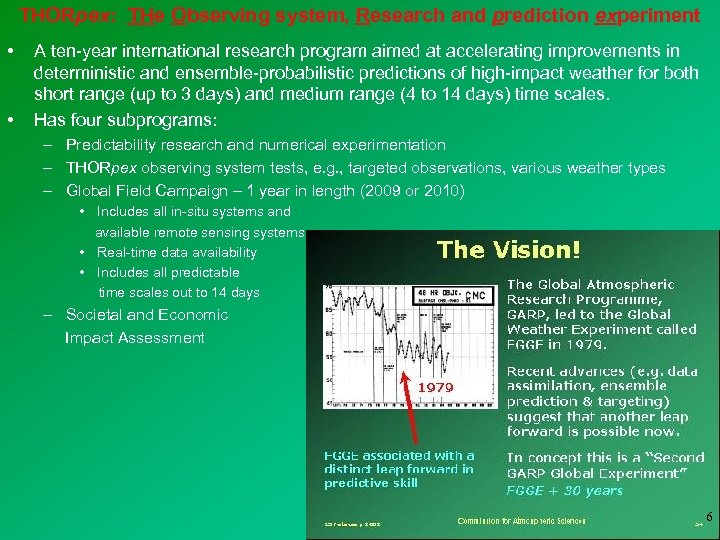 THORpex: THe Observing system, Research and prediction experiment • • A ten-year international research program aimed at accelerating improvements in deterministic and ensemble-probabilistic predictions of high-impact weather for both short range (up to 3 days) and medium range (4 to 14 days) time scales. Has four subprograms: – Predictability research and numerical experimentation – THORpex observing system tests, e. g. , targeted observations, various weather types – Global Field Campaign – 1 year in length (2009 or 2010) • Includes all in-situ systems and available remote sensing systems • Real-time data availability • Includes all predictable time scales out to 14 days – Societal and Economic Impact Assessment 6
 ANTICIPATED BENEFITS • Improved probabilistic forecast performance – Earlier warnings for severe weather • Lower detection threshold due to more ensemble members • Uncertainty better captured via analysis/model/ensemble diversity • A seamless suite of forecasts across – International boundaries • Canada, Mexico, USA – Different time ranges (1 -14 days) • Development cost savings through – Sharing scientific algorithms, codes, scripts • Accelerated implementation schedule • Low-cost diversity via multi-center analysis/model/ensemble methods – Exchanging complementary application tools • MSC focus on end users (public) • NWS focus on intermediate user (forecaster) • Production cost savings through – Leveraging computational resources • Each center needs to run only fraction of total ensemble members – Providing back-up for operations in case of emergencies • Use nearly identical operational procedures at both centers to provide basic products • Offers as default basic products based on unaffected center’s ensemble 7
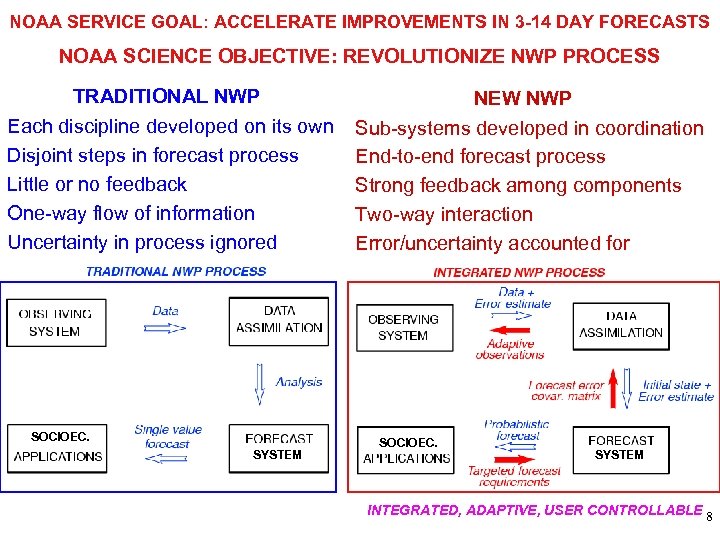 NOAA SERVICE GOAL: ACCELERATE IMPROVEMENTS IN 3 -14 DAY FORECASTS NOAA SCIENCE OBJECTIVE: REVOLUTIONIZE NWP PROCESS TRADITIONAL NWP Each discipline developed on its own Disjoint steps in forecast process Little or no feedback One-way flow of information Uncertainty in process ignored SOCIOEC. SYSTEM NEW NWP Sub-systems developed in coordination End-to-end forecast process Strong feedback among components Two-way interaction Error/uncertainty accounted for SOCIOEC. SYSTEM INTEGRATED, ADAPTIVE, USER CONTROLLABLE 8
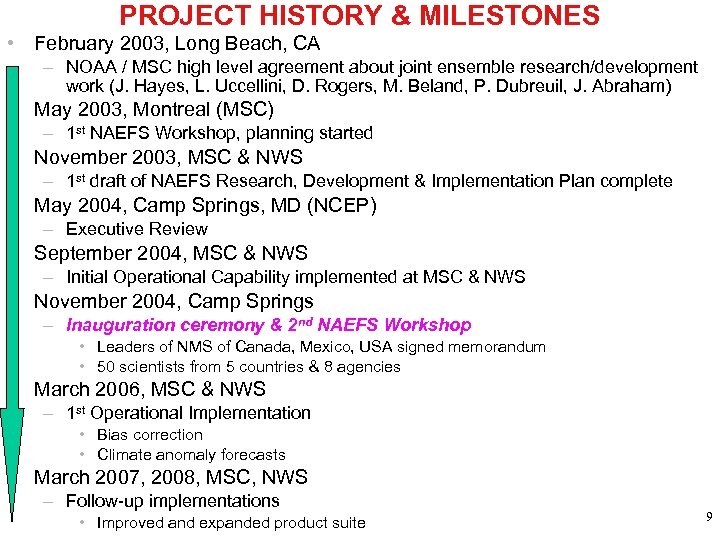 PROJECT HISTORY & MILESTONES • February 2003, Long Beach, CA – NOAA / MSC high level agreement about joint ensemble research/development work (J. Hayes, L. Uccellini, D. Rogers, M. Beland, P. Dubreuil, J. Abraham) • May 2003, Montreal (MSC) – 1 st NAEFS Workshop, planning started • November 2003, MSC & NWS – 1 st draft of NAEFS Research, Development & Implementation Plan complete • May 2004, Camp Springs, MD (NCEP) – Executive Review • September 2004, MSC & NWS – Initial Operational Capability implemented at MSC & NWS • November 2004, Camp Springs – Inauguration ceremony & 2 nd NAEFS Workshop • Leaders of NMS of Canada, Mexico, USA signed memorandum • 50 scientists from 5 countries & 8 agencies • March 2006, MSC & NWS – 1 st Operational Implementation • Bias correction • Climate anomaly forecasts • March 2007, 2008, MSC, NWS – Follow-up implementations • Improved and expanded product suite 9
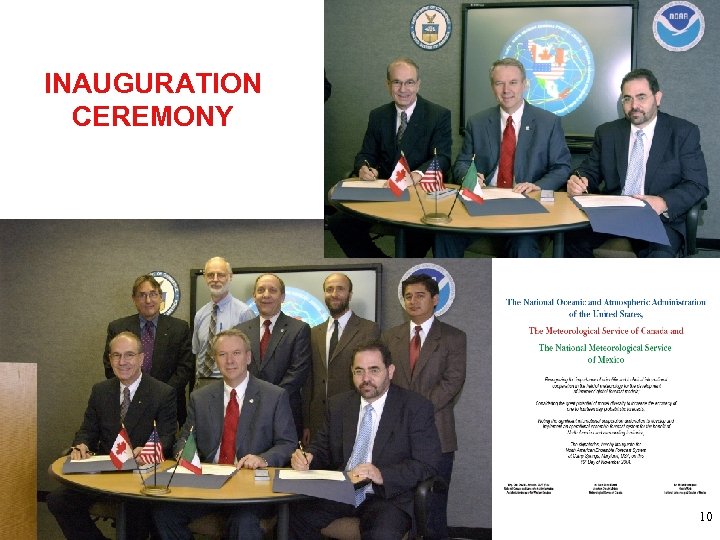 INAUGURATION CEREMONY 10
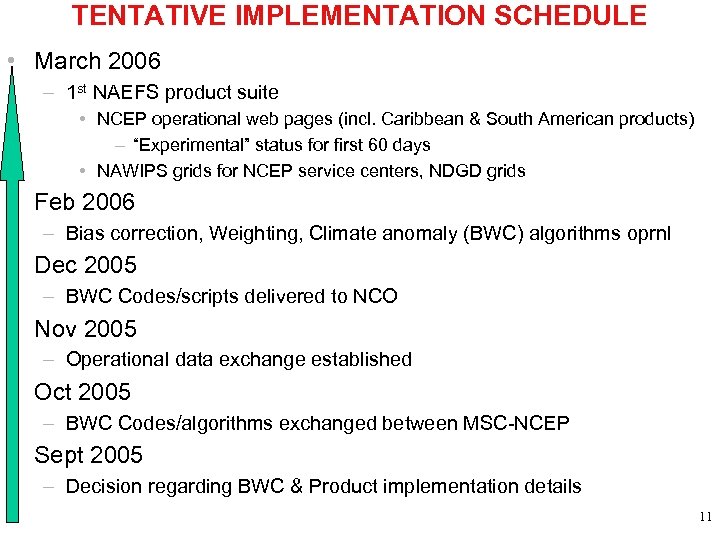 TENTATIVE IMPLEMENTATION SCHEDULE • March 2006 – 1 st NAEFS product suite • NCEP operational web pages (incl. Caribbean & South American products) – “Experimental” status for first 60 days • NAWIPS grids for NCEP service centers, NDGD grids • Feb 2006 – Bias correction, Weighting, Climate anomaly (BWC) algorithms oprnl • Dec 2005 – BWC Codes/scripts delivered to NCO • Nov 2005 – Operational data exchange established • Oct 2005 – BWC Codes/algorithms exchanged between MSC-NCEP • Sept 2005 – Decision regarding BWC & Product implementation details 11
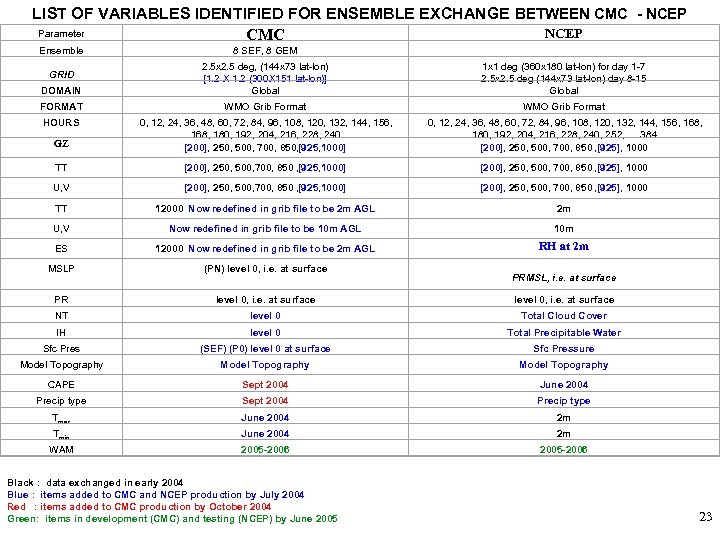
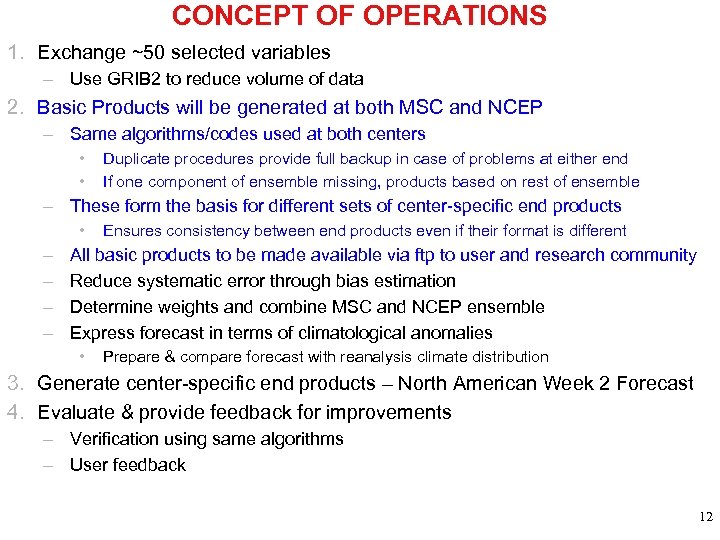 CONCEPT OF OPERATIONS 1. Exchange ~50 selected variables – Use GRIB 2 to reduce volume of data 2. Basic Products will be generated at both MSC and NCEP – Same algorithms/codes used at both centers • • Duplicate procedures provide full backup in case of problems at either end If one component of ensemble missing, products based on rest of ensemble – These form the basis for different sets of center-specific end products • – – Ensures consistency between end products even if their format is different All basic products to be made available via ftp to user and research community Reduce systematic error through bias estimation Determine weights and combine MSC and NCEP ensemble Express forecast in terms of climatological anomalies • Prepare & compare forecast with reanalysis climate distribution 3. Generate center-specific end products – North American Week 2 Forecast 4. Evaluate & provide feedback for improvements – Verification using same algorithms – User feedback 12
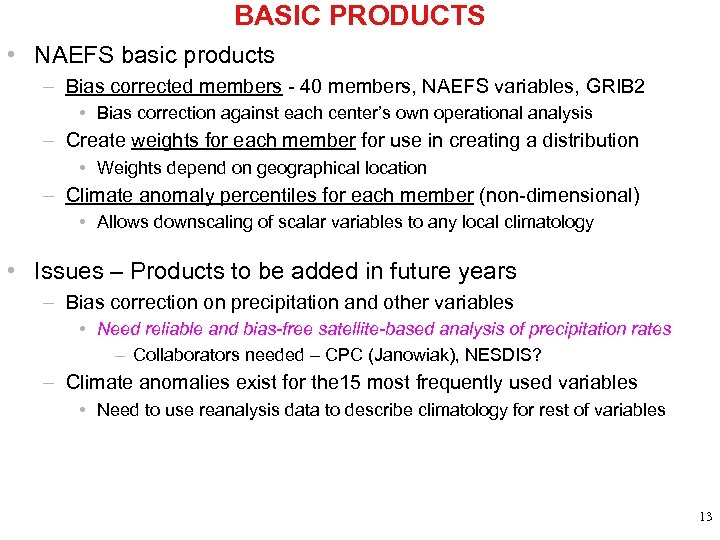 BASIC PRODUCTS • NAEFS basic products – Bias corrected members - 40 members, NAEFS variables, GRIB 2 • Bias correction against each center’s own operational analysis – Create weights for each member for use in creating a distribution • Weights depend on geographical location – Climate anomaly percentiles for each member (non-dimensional) • Allows downscaling of scalar variables to any local climatology • Issues – Products to be added in future years – Bias correction on precipitation and other variables • Need reliable and bias-free satellite-based analysis of precipitation rates – Collaborators needed – CPC (Janowiak), NESDIS? – Climate anomalies exist for the 15 most frequently used variables • Need to use reanalysis data to describe climatology for rest of variables 13
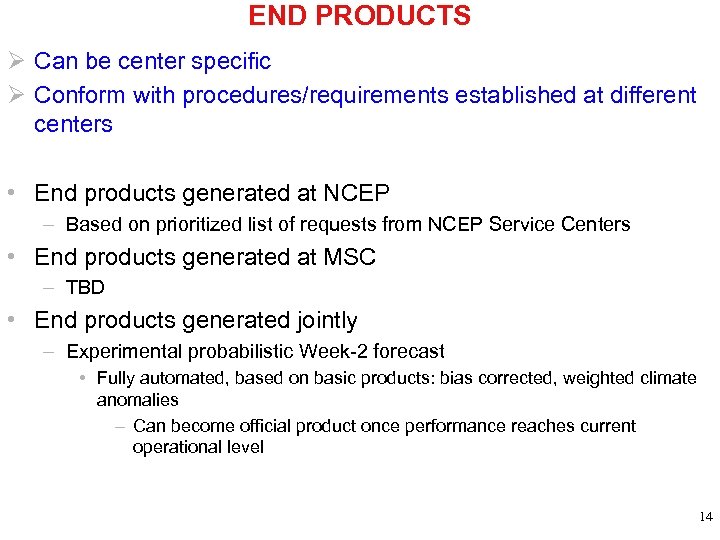 END PRODUCTS Ø Can be center specific Ø Conform with procedures/requirements established at different centers • End products generated at NCEP – Based on prioritized list of requests from NCEP Service Centers • End products generated at MSC – TBD • End products generated jointly – Experimental probabilistic Week-2 forecast • Fully automated, based on basic products: bias corrected, weighted climate anomalies – Can become official product once performance reaches current operational level 14
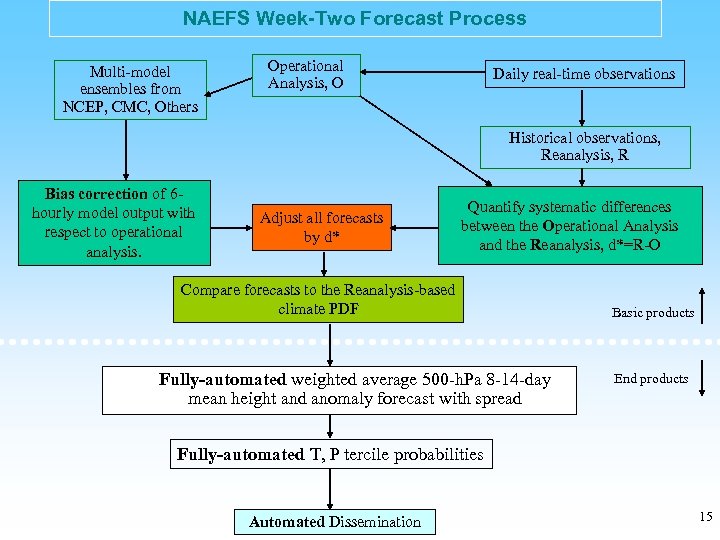 NAEFS Week-Two Forecast Process Multi-model ensembles from NCEP, CMC, Others Operational Analysis, O Daily real-time observations Historical observations, Reanalysis, R Bias correction of 6 hourly model output with respect to operational analysis. Adjust all forecasts by d* Quantify systematic differences between the Operational Analysis and the Reanalysis, d*=R-O Compare forecasts to the Reanalysis-based climate PDF Fully-automated weighted average 500 -h. Pa 8 -14 -day mean height and anomaly forecast with spread Basic products End products Fully-automated T, P tercile probabilities Automated Dissemination 15
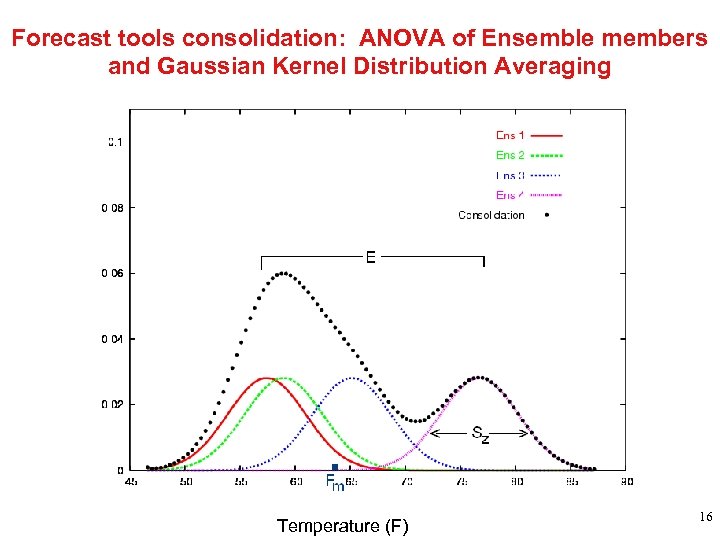 Forecast tools consolidation: ANOVA of Ensemble members and Gaussian Kernel Distribution Averaging Temperature (F) 16
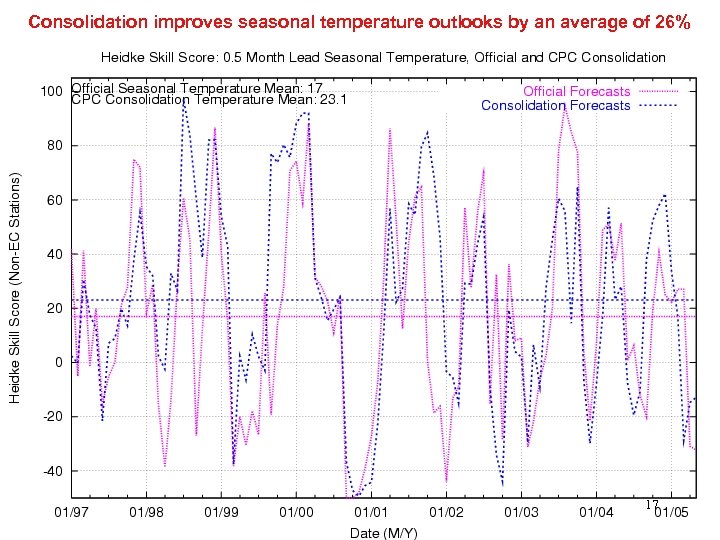 Consolidation improves seasonal temperature outlooks by an average of 26% 17
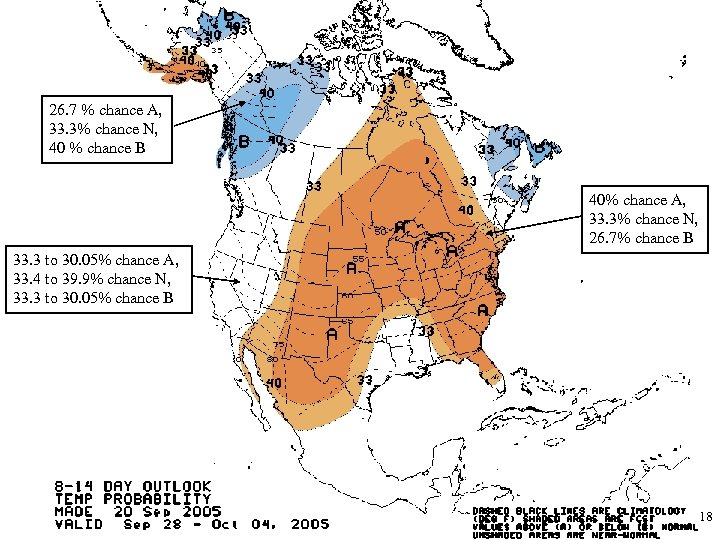 North American 8 -14 -day Forecast T 26. 7 % chance A, 33. 3% chance N, 40 % chance B 40% chance A, 33. 3% chance N, 26. 7% chance B 33. 3 to 30. 05% chance A, 33. 4 to 39. 9% chance N, 33. 3 to 30. 05% chance B 18
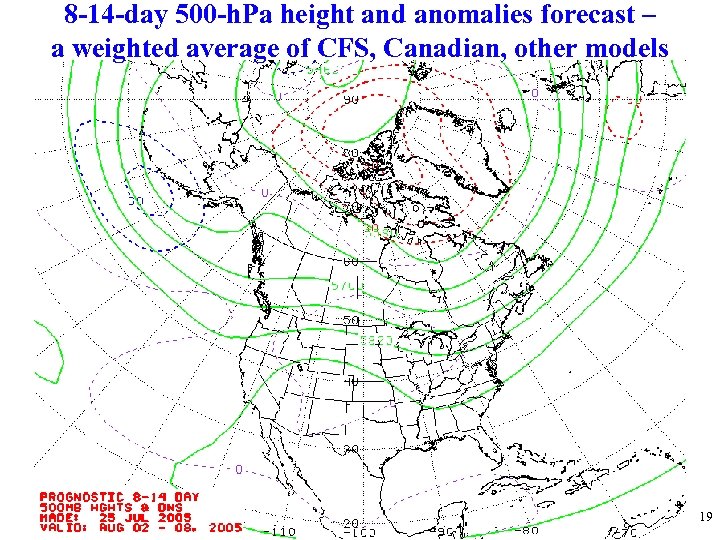 8 -14 -day 500 -h. Pa height and anomalies forecast – a weighted average of CFS, Canadian, other models 19
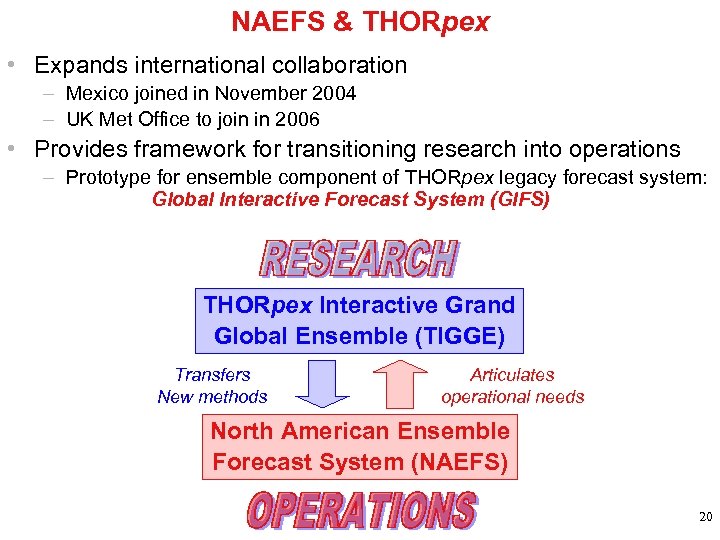 NAEFS & THORpex • Expands international collaboration – Mexico joined in November 2004 – UK Met Office to join in 2006 • Provides framework for transitioning research into operations – Prototype for ensemble component of THORpex legacy forecast system: Global Interactive Forecast System (GIFS) THORpex Interactive Grand Global Ensemble (TIGGE) Transfers New methods Articulates operational needs North American Ensemble Forecast System (NAEFS) 20
 21
21
 EXPANSION OF NAEFS • Discussions with other centers for expansion of NAEFS – Experimental status - March 2006 – Operational status – 2007 -2008 • UKMet – Agreement • FNMOC, AFWA – Expert discussions – Need to formalize, use operational centers’ forum (COPC) – Product distribution – Issues • Name change from NAEFS to Global Ensemble Prediction Center • Disc space requirements will grow • Other centers that expressed interest in learning more about NAEFS – ECMWF, NCMRWF, JMA, KMA • Link with THORPEX Interactive Grand Global Ensemble (TIGGE) – THORPEX research organized in 4 science Working Groups • TIGGE data base supports ensemble-related research – NAEFS – GEPS provides • Testing in and transition to operational use • Real time forecast data for demonstration projects 22
 LIST OF VARIABLES IDENTIFIED FOR ENSEMBLE EXCHANGE BETWEEN CMC - NCEP Parameter NCEP CMC Ensemble 8 SEF, 8 GEM GRID DOMAIN 2. 5 x 2. 5 deg, (144 x 73 lat-lon) [1. 2 X 1. 2 (300 X 151 lat-lon)] Global 1 x 1 deg (360 x 180 lat-lon) for day 1 -7 2. 5 x 2. 5 deg (144 x 73 lat-lon) day 8 -15 Global FORMAT WMO Grib Format HOURS GZ 0, 12, 24, 36, 48, 60, 72, 84, 96, 108, 120, 132, 144, 156, 168, 180, 192, 204, 216, 228, 240 [200], 250, 500, 700, 850, [925, 1000] 0, 12, 24, 36, 48, 60, 72, 84, 96, 108, 120, 132, 144, 156, 168, 180, 192, 204, 216, 228, 240, 252, … 384 [200], 250, 500, 700, 850 , [925], 1000 TT [200], 250, 500, 700, 850 , [925, 1000] [200], 250, 500, 700, 850 , [925], 1000 U, V [200], 250, 500, 700, 850 , [925, 1000] [200], 250, 500, 700, 850 , [925], 1000 TT 12000 Now redefined in grib file to be 2 m AGL 2 m U, V Now redefined in grib file to be 10 m AGL 10 m ES 12000 Now redefined in grib file to be 2 m AGL RH at 2 m MSLP (PN) level 0, i. e. at surface PR level 0, i. e. at surface NT level 0 Total Cloud Cover IH level 0 Total Precipitable Water Sfc Pres (SEF) (P 0) level 0 at surface Sfc Pressure Model Topography CAPE Sept 2004 June 2004 Precip type Sept 2004 Precip type Tmax June 2004 2 m Tmin June 2004 2 m WAM 2005 -2006 Black : data exchanged in early 2004 Blue : items added to CMC and NCEP production by July 2004 Red : items added to CMC production by October 2004 Green: items in development (CMC) and testing (NCEP) by June 2005 PRMSL, i. e. at surface 23