


 Скачать презентацию NA 5 Optimization of data processing Aldo Amodeo
86265f7a2db5c3cd151deeb3796c093f.ppt
- Количество слайдов: 65
 NA 5 Optimization of data processing Aldo Amodeo, Ina Mattis, Christine Böckmann, Giuseppe D’Amico, Detlef Müller, Lukas Osterloh, Anatoli Chaikowsky Geneva, 20 -23 September 2010 EARLINET-ASOS Symposium Second GALION Workshop
 NA 5 Optimization of data processing Main objective To provide all partners with a common processing chain for the evaluation of their data, from raw signals to final products. TASKS NA 5. 1 Optimisation of data processing to retrieve aerosol optical properties. (IFT) NA 5. 2 Optimisation of data processing to retrieve aerosol microphysical properties. (UP) NA 5. 3 Implementation of a single chain data processing procedure for the automatic retrieval of aerosol properties. (CNR-IMAA) Geneva, 20 -23 September 2010 EARLINET-ASOS Symposium Second GALION Workshop
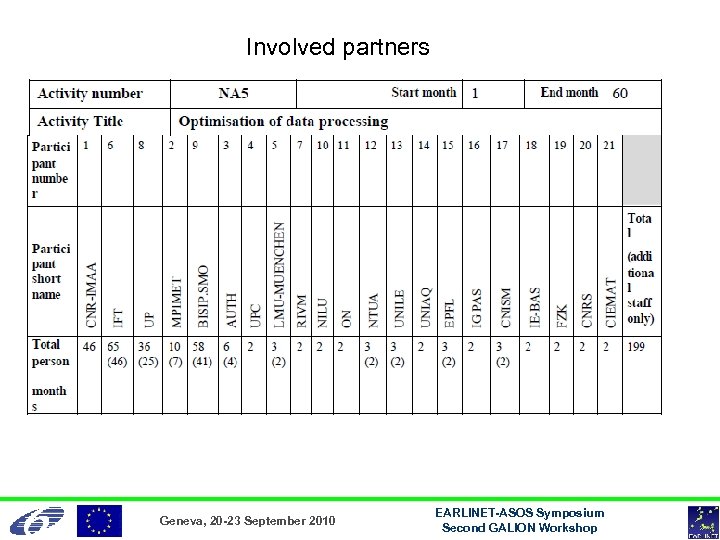 Involved partners Geneva, 20 -23 September 2010 EARLINET-ASOS Symposium Second GALION Workshop
 Specific goals: - the compilation of an optimised algorithm to retrieve, in an automatic way and without the need for operator interaction, aerosol optical properties, such as extinction and backscatter coefficients, lidar ratio, optical depth, Angstrom coefficient using Raman lidar signals, or backscatter and Angstrom coefficients using elastic lidar signals only (when no Raman signal is available); - the implementation of the capability of constraining the solutions using sunphotometer measurements at several wavelengths; Geneva, 20 -23 September 2010 EARLINET-ASOS Symposium Second GALION Workshop
 Specific goals: - the compilation of an optimised software package to retrieve aerosol microphysical properties: particle size, surface and volume concentrations, and refractive index from multi-spectral lidar measurements; - the compilation of a software package to derive the microphysical properties of particles in the vertical column starting from combined lidar/photometer data, as far as possible; - the implementation of a single data processing chain starting from raw lidar data, to include system-dependent pre-processing, and providing optical aerosol properties as final products. Geneva, 20 -23 September 2010 EARLINET-ASOS Symposium Second GALION Workshop
 Impact: This will have a strong impact on the scientific community because data with homogeneous well characterized quality and characteristics will be made available in nearly real time, allowing studies of important events in a timely way and permitting comparative studies between different regions. Transport phenomena Satellite products validation Geneva, 20 -23 September 2010 EARLINET-ASOS Symposium Second GALION Workshop
 Difficulties: - the instruments used by the individual groups are different and not standardized (differences exist for the wavelengths used, acquisition mode (analog and/or photoncounting), space resolution, detection systems ) - the algorithms used by the several groups are different and the algorithm to be implemented in the processing chain has to be optimized for the data provided by the partners. Geneva, 20 -23 September 2010 EARLINET-ASOS Symposium Second GALION Workshop
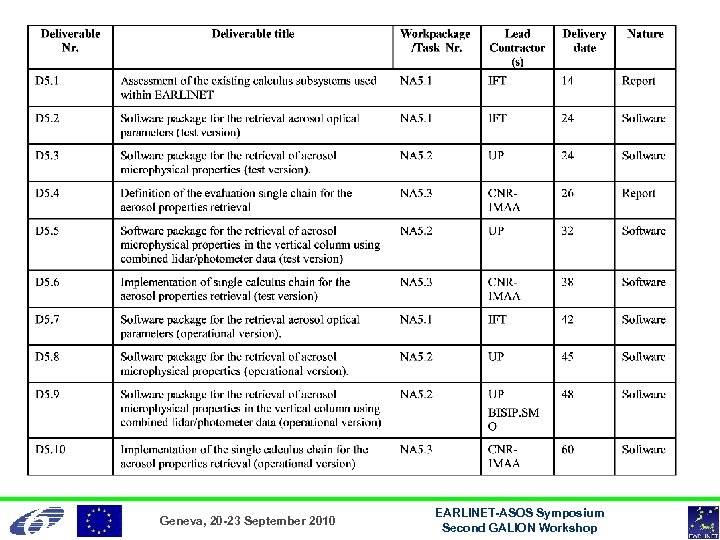
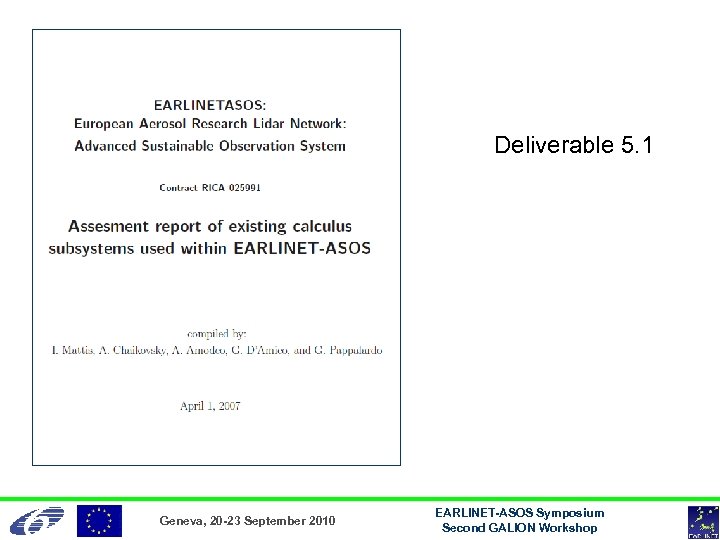
 Milestones M 5. 1: Full documentation of existing algorithms available. Month 9 (November 2006) M 5. 2: Application of the software package (test version) for the retrieval aerosol optical parameters to EARLINET-ASOS lidar data. Month 26 (April 2008) M 5. 3: Application of the software package for the retrieval of aerosol microphysical properties (test version) to EARLINETASOS data. Month 28 (June 2008) M 5. 4: Application of the software package for the retrieval of aerosol microphysical properties in the vertical column to combined lidar/photometer data (test version) from the EARLINETASOS data base. Month 34 (December 2008) M 5. 5: Pre-processing of raw lidar data from all EARLINET-ASOS lidar stations. Month 36 (February 2009) Geneva, 20 -23 September 2010 EARLINET-ASOS Symposium Second GALION Workshop
 Geneva, 20 -23 September 2010 EARLINET-ASOS Symposium Second GALION Workshop
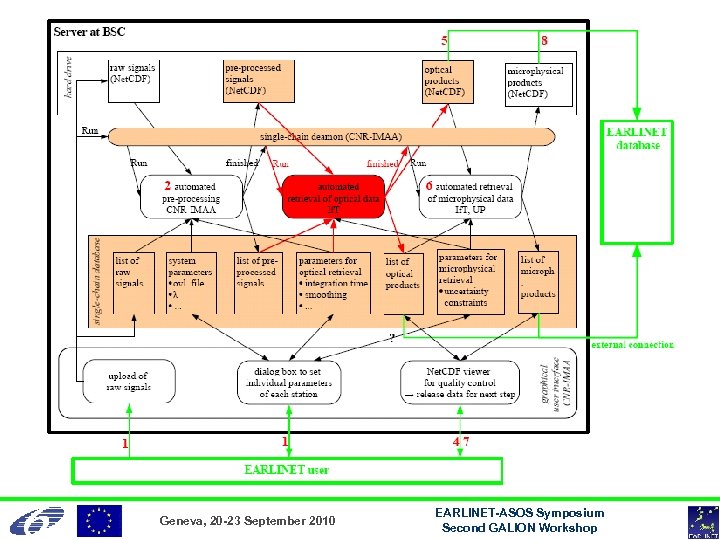
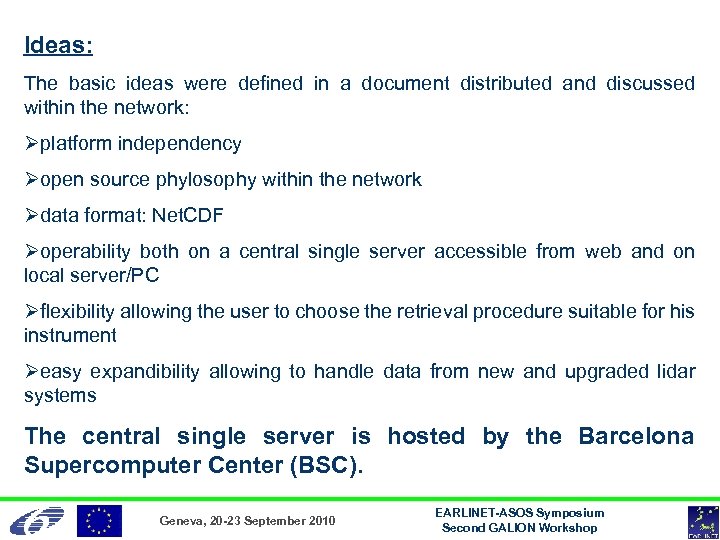 Ideas: The basic ideas were defined in a document distributed and discussed within the network: Øplatform independency Øopen source phylosophy within the network Ødata format: Net. CDF Øoperability both on a central single server accessible from web and on local server/PC Øflexibility allowing the user to choose the retrieval procedure suitable for his instrument Øeasy expandibility allowing to handle data from new and upgraded lidar systems The central single server is hosted by the Barcelona Supercomputer Center (BSC). Geneva, 20 -23 September 2010 EARLINET-ASOS Symposium Second GALION Workshop
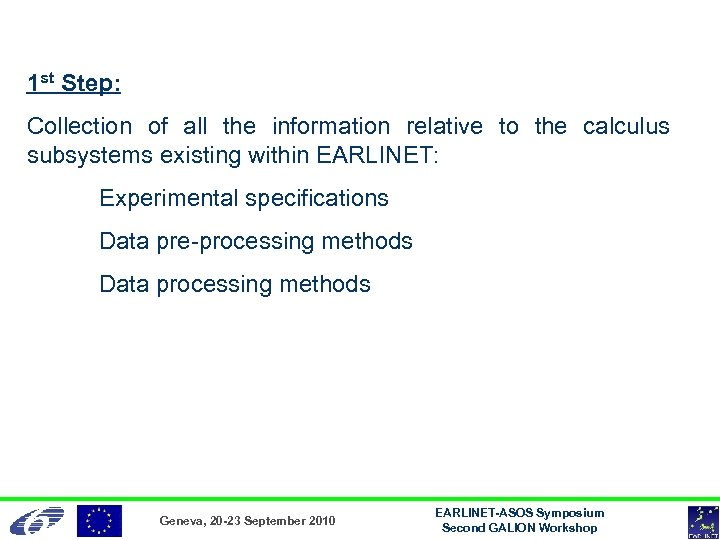 1 st Step: Collection of all the information relative to the calculus subsystems existing within EARLINET: Experimental specifications Data pre-processing methods Data processing methods Geneva, 20 -23 September 2010 EARLINET-ASOS Symposium Second GALION Workshop
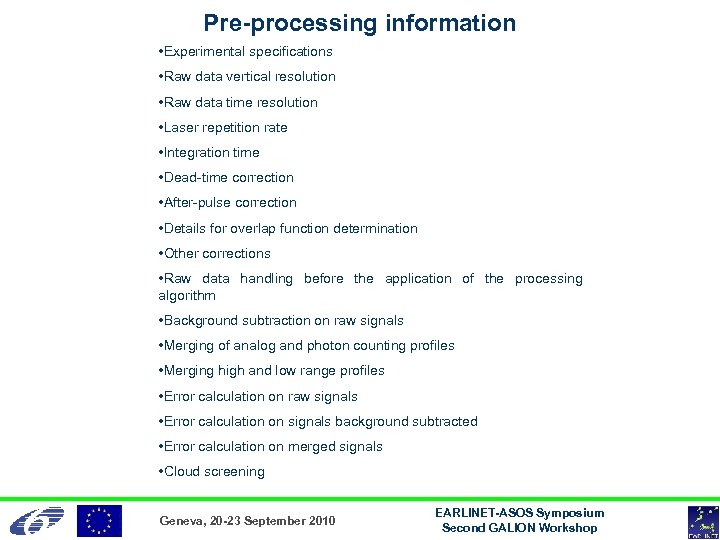 Pre-processing information • Experimental specifications • Raw data vertical resolution • Raw data time resolution • Laser repetition rate • Integration time • Dead-time correction • After-pulse correction • Details for overlap function determination • Other corrections • Raw data handling before the application of the processing algorithm • Background subtraction on raw signals • Merging of analog and photon counting profiles • Merging high and low range profiles • Error calculation on raw signals • Error calculation on signals background subtracted • Error calculation on merged signals • Cloud screening Geneva, 20 -23 September 2010 EARLINET-ASOS Symposium Second GALION Workshop
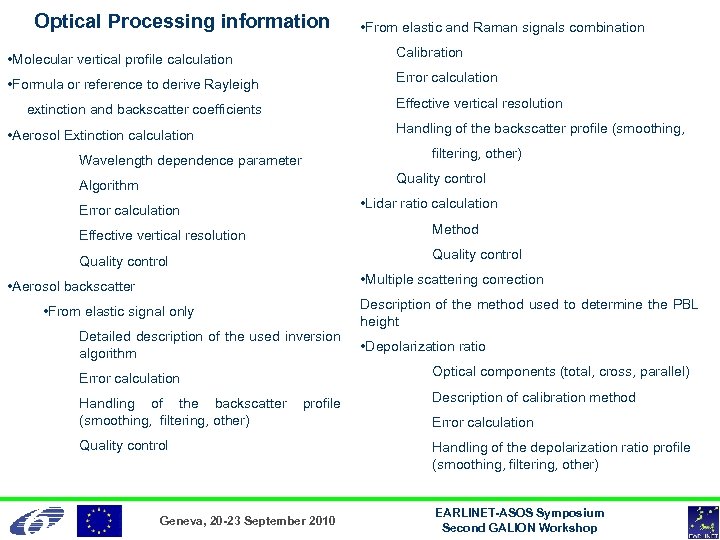 Optical Processing information • From elastic and Raman signals combination • Molecular vertical profile calculation Calibration • Formula or reference to derive Rayleigh Error calculation Effective vertical resolution extinction and backscatter coefficients Handling of the backscatter profile (smoothing, • Aerosol Extinction calculation filtering, other) Wavelength dependence parameter Quality control Algorithm • Lidar ratio calculation Error calculation Effective vertical resolution Method Quality control • Multiple scattering correction • Aerosol backscatter • From elastic signal only Detailed description of the used inversion algorithm • Depolarization ratio Optical components (total, cross, parallel) Error calculation Handling of the backscatter (smoothing, filtering, other) Description of the method used to determine the PBL height profile Quality control Geneva, 20 -23 September 2010 Description of calibration method Error calculation Handling of the depolarization ratio profile (smoothing, filtering, other) EARLINET-ASOS Symposium Second GALION Workshop
 Deliverable 5. 1 Geneva, 20 -23 September 2010 EARLINET-ASOS Symposium Second GALION Workshop
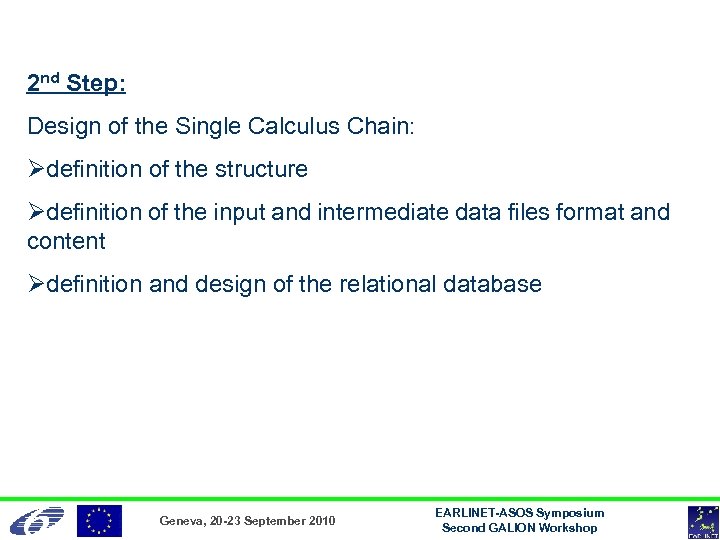 2 nd Step: Design of the Single Calculus Chain: Ødefinition of the structure Ødefinition of the input and intermediate data files format and content Ødefinition and design of the relational database Geneva, 20 -23 September 2010 EARLINET-ASOS Symposium Second GALION Workshop
 Geneva, 20 -23 September 2010 EARLINET-ASOS Symposium Second GALION Workshop
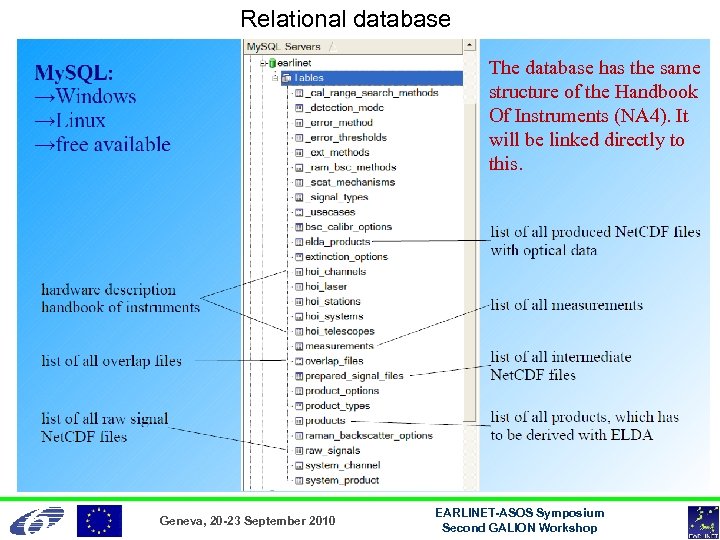 Relational database The database has the same structure of the Handbook Of Instruments (NA 4). It will be linked directly to this. Geneva, 20 -23 September 2010 EARLINET-ASOS Symposium Second GALION Workshop
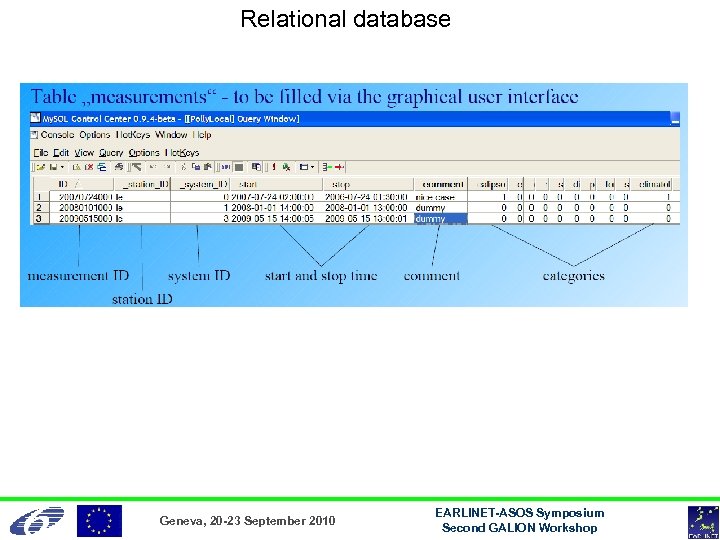 Relational database Geneva, 20 -23 September 2010 EARLINET-ASOS Symposium Second GALION Workshop
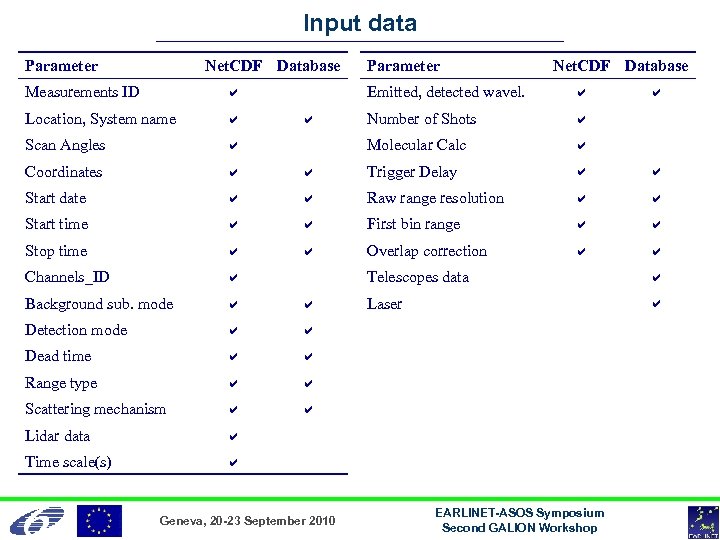 Input data Parameter Net. CDF Database Emitted, detected wavel. Number of Shots Molecular Calc Trigger Delay Raw range resolution Start time First bin range Stop time Overlap correction Channels_ID Background sub. mode Detection mode Dead time Range type Scattering mechanism Lidar data Time scale(s) Measurements ID Location, System name Scan Angles Coordinates Start date Telescopes data Geneva, 20 -23 September 2010 Laser EARLINET-ASOS Symposium Second GALION Workshop
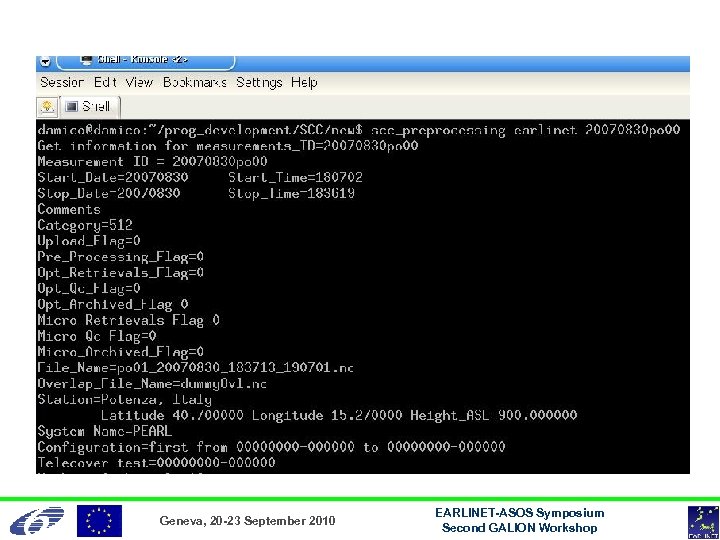
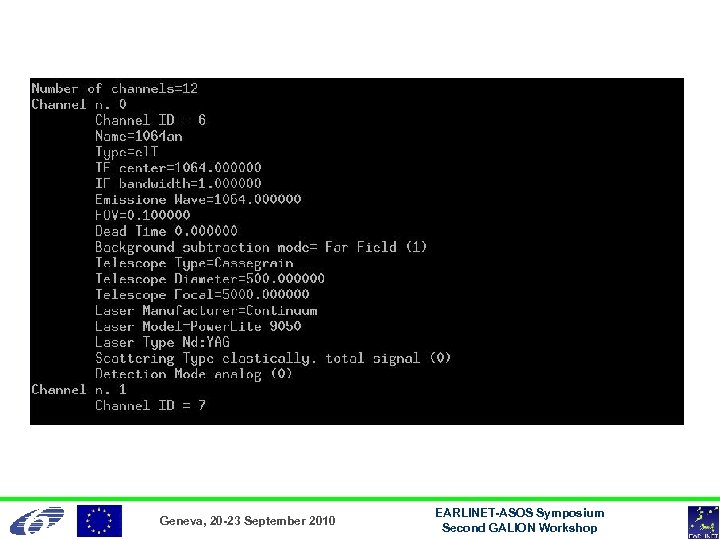
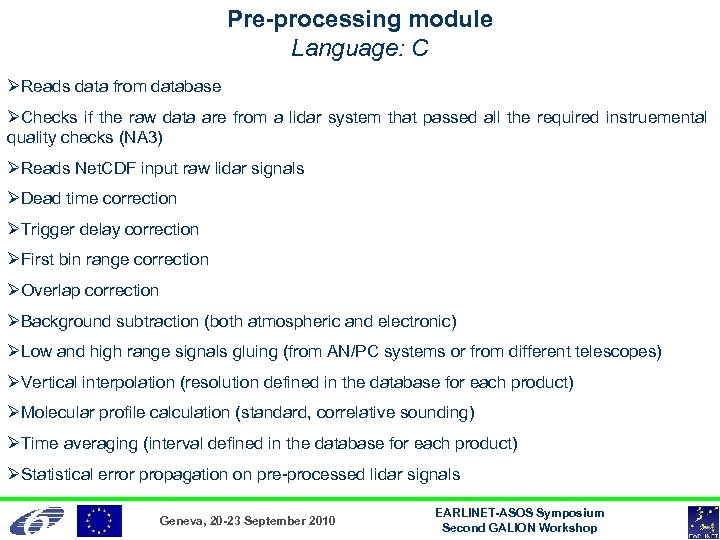 Pre-processing module Language: C ØReads data from database ØChecks if the raw data are from a lidar system that passed all the required instruemental quality checks (NA 3) ØReads Net. CDF input raw lidar signals ØDead time correction ØTrigger delay correction ØFirst bin range correction ØOverlap correction ØBackground subtraction (both atmospheric and electronic) ØLow and high range signals gluing (from AN/PC systems or from different telescopes) ØVertical interpolation (resolution defined in the database for each product) ØMolecular profile calculation (standard, correlative sounding) ØTime averaging (interval defined in the database for each product) ØStatistical error propagation on pre-processed lidar signals Geneva, 20 -23 September 2010 EARLINET-ASOS Symposium Second GALION Workshop
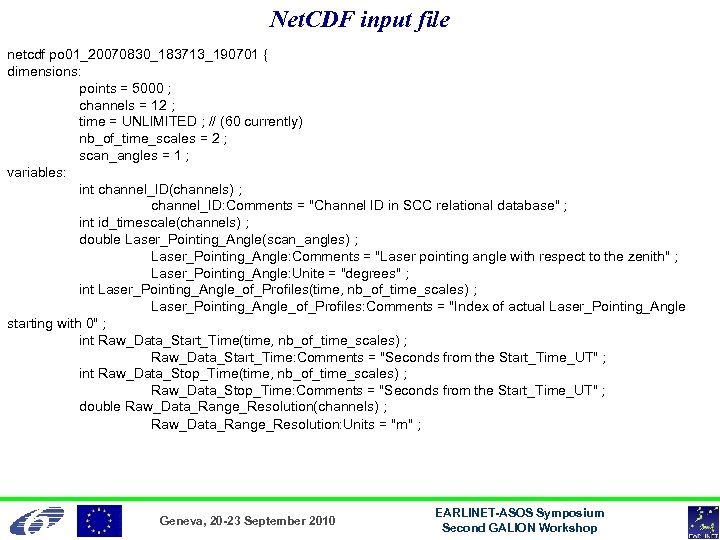 Net. CDF input file netcdf po 01_20070830_183713_190701 { dimensions: points = 5000 ; channels = 12 ; time = UNLIMITED ; // (60 currently) nb_of_time_scales = 2 ; scan_angles = 1 ; variables: int channel_ID(channels) ; channel_ID: Comments = "Channel ID in SCC relational database" ; int id_timescale(channels) ; double Laser_Pointing_Angle(scan_angles) ; Laser_Pointing_Angle: Comments = "Laser pointing angle with respect to the zenith" ; Laser_Pointing_Angle: Unite = "degrees" ; int Laser_Pointing_Angle_of_Profiles(time, nb_of_time_scales) ; Laser_Pointing_Angle_of_Profiles: Comments = "Index of actual Laser_Pointing_Angle starting with 0" ; int Raw_Data_Start_Time(time, nb_of_time_scales) ; Raw_Data_Start_Time: Comments = "Seconds from the Start_Time_UT" ; int Raw_Data_Stop_Time(time, nb_of_time_scales) ; Raw_Data_Stop_Time: Comments = "Seconds from the Start_Time_UT" ; double Raw_Data_Range_Resolution(channels) ; Raw_Data_Range_Resolution: Units = "m" ; Geneva, 20 -23 September 2010 EARLINET-ASOS Symposium Second GALION Workshop
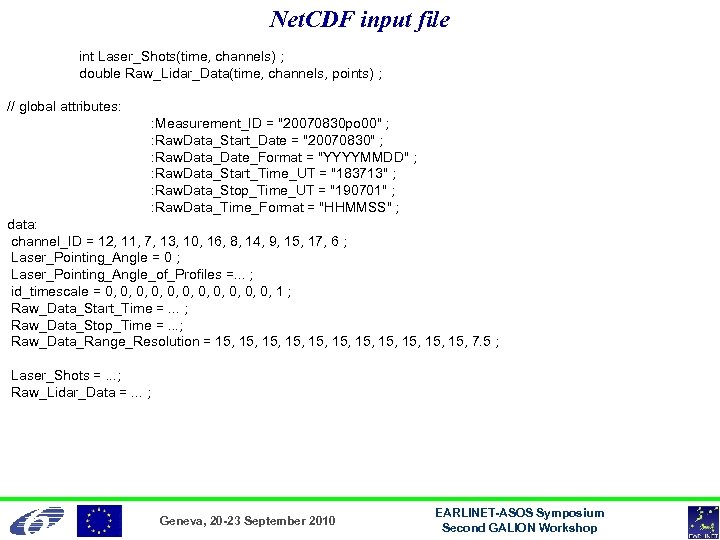 Net. CDF input file int Laser_Shots(time, channels) ; double Raw_Lidar_Data(time, channels, points) ; // global attributes: : Measurement_ID = "20070830 po 00" ; : Raw. Data_Start_Date = "20070830" ; : Raw. Data_Date_Format = "YYYYMMDD" ; : Raw. Data_Start_Time_UT = "183713" ; : Raw. Data_Stop_Time_UT = "190701" ; : Raw. Data_Time_Format = "HHMMSS" ; data: channel_ID = 12, 11, 7, 13, 10, 16, 8, 14, 9, 15, 17, 6 ; Laser_Pointing_Angle = 0 ; Laser_Pointing_Angle_of_Profiles =. . . ; id_timescale = 0, 0, 0, 1 ; Raw_Data_Start_Time =. . . ; Raw_Data_Stop_Time =. . . ; Raw_Data_Range_Resolution = 15, 15, 15, 7. 5 ; Laser_Shots =. . . ; Raw_Lidar_Data =. . . ; Geneva, 20 -23 September 2010 EARLINET-ASOS Symposium Second GALION Workshop
 Geneva, 20 -23 September 2010 EARLINET-ASOS Symposium Second GALION Workshop
 Geneva, 20 -23 September 2010 EARLINET-ASOS Symposium Second GALION Workshop
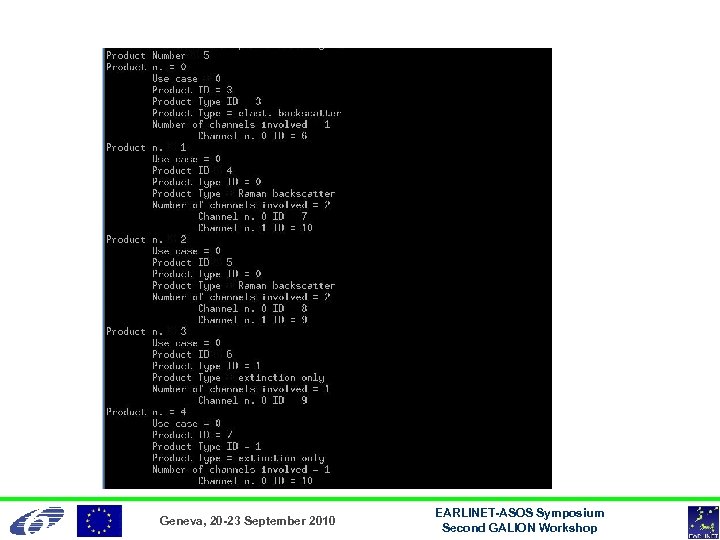 Geneva, 20 -23 September 2010 EARLINET-ASOS Symposium Second GALION Workshop
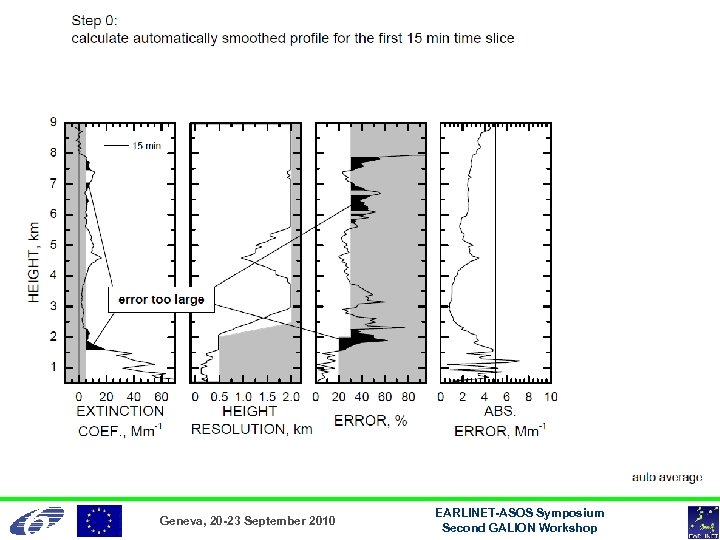
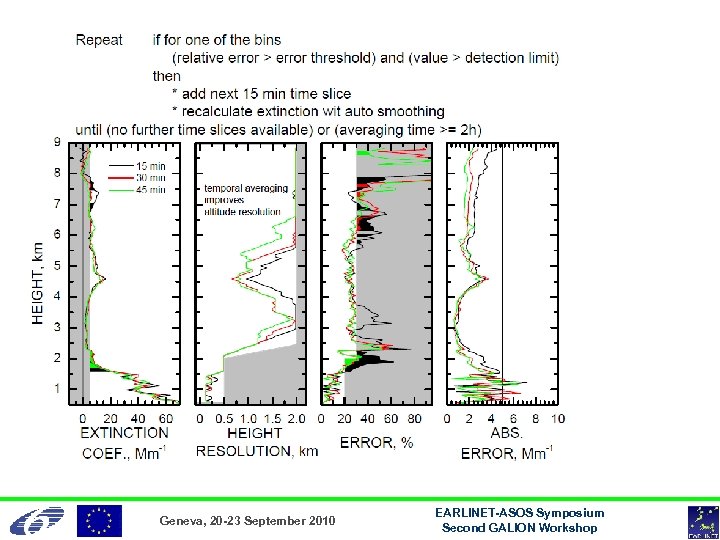
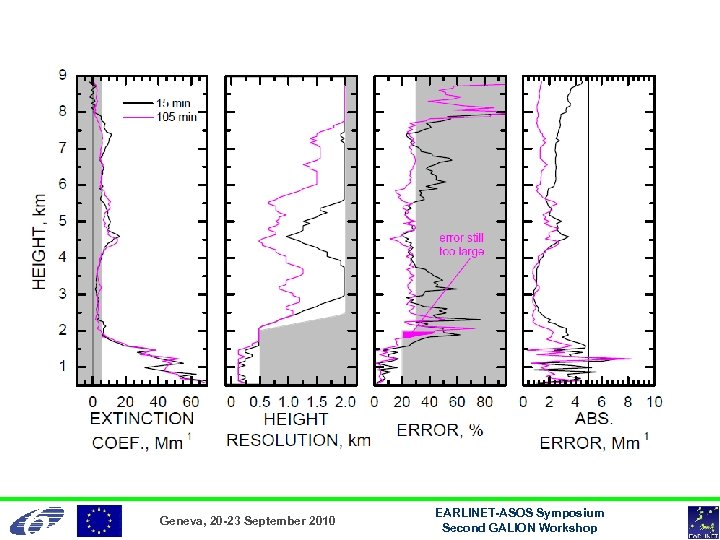
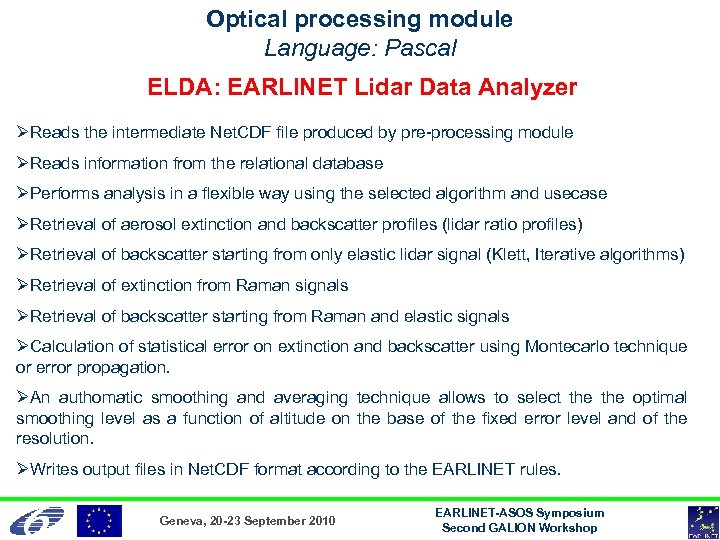 Optical processing module Language: Pascal ELDA: EARLINET Lidar Data Analyzer ØReads the intermediate Net. CDF file produced by pre-processing module ØReads information from the relational database ØPerforms analysis in a flexible way using the selected algorithm and usecase ØRetrieval of aerosol extinction and backscatter profiles (lidar ratio profiles) ØRetrieval of backscatter starting from only elastic lidar signal (Klett, Iterative algorithms) ØRetrieval of extinction from Raman signals ØRetrieval of backscatter starting from Raman and elastic signals ØCalculation of statistical error on extinction and backscatter using Montecarlo technique or error propagation. ØAn authomatic smoothing and averaging technique allows to select the optimal smoothing level as a function of altitude on the base of the fixed error level and of the resolution. ØWrites output files in Net. CDF format according to the EARLINET rules. Geneva, 20 -23 September 2010 EARLINET-ASOS Symposium Second GALION Workshop
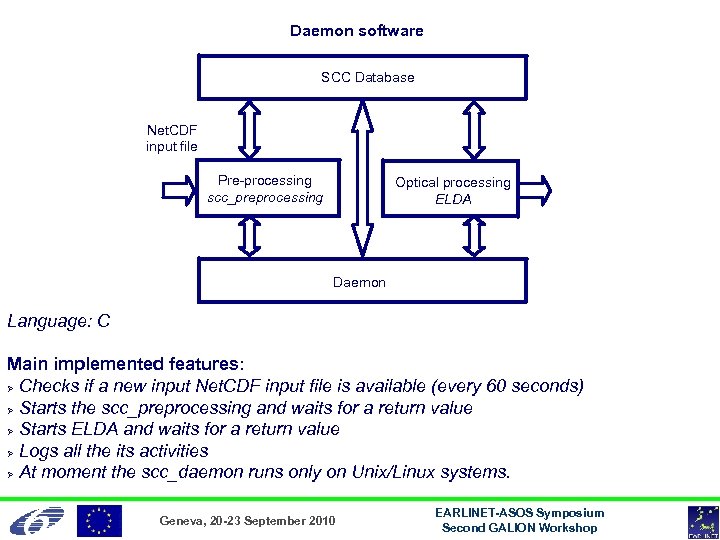 Daemon software SCC Database Net. CDF input file Pre-processing scc_preprocessing Optical processing ELDA Daemon Language: C Main implemented features: Ø Checks if a new input Net. CDF input file is available (every 60 seconds) Ø Starts the scc_preprocessing and waits for a return value Ø Starts ELDA and waits for a return value Ø Logs all the its activities Ø At moment the scc_daemon runs only on Unix/Linux systems. Geneva, 20 -23 September 2010 EARLINET-ASOS Symposium Second GALION Workshop
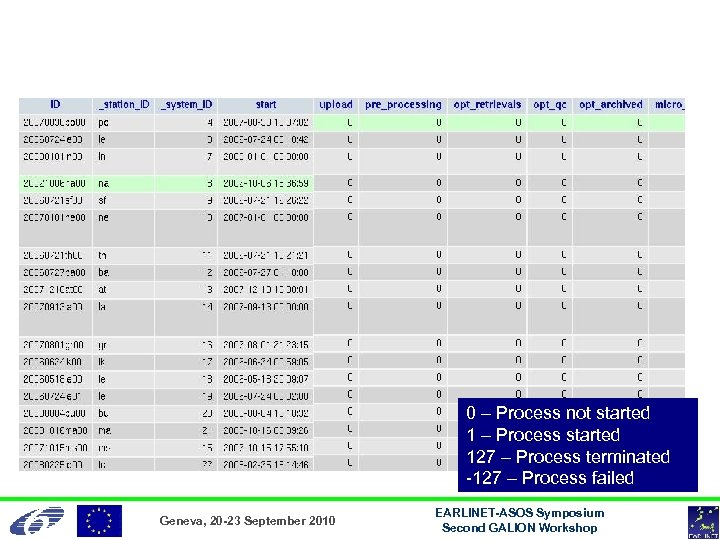 0 – Process not started 1 – Process started 127 – Process terminated -127 – Process failed Geneva, 20 -23 September 2010 EARLINET-ASOS Symposium Second GALION Workshop
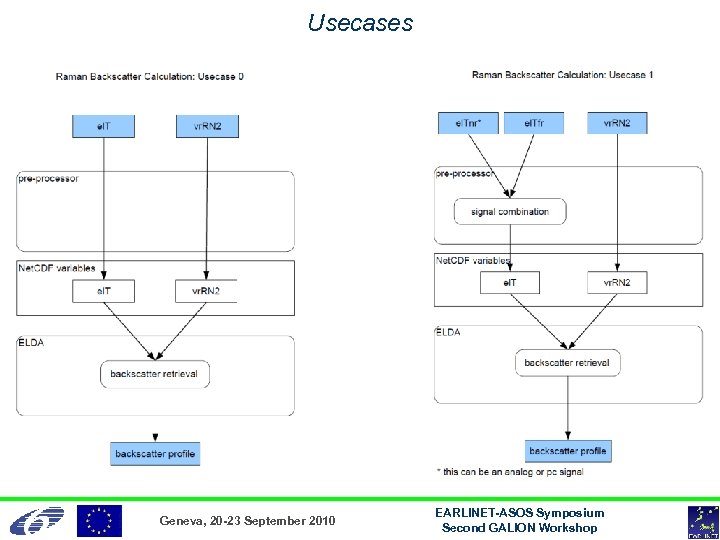 Usecases Geneva, 20 -23 September 2010 EARLINET-ASOS Symposium Second GALION Workshop
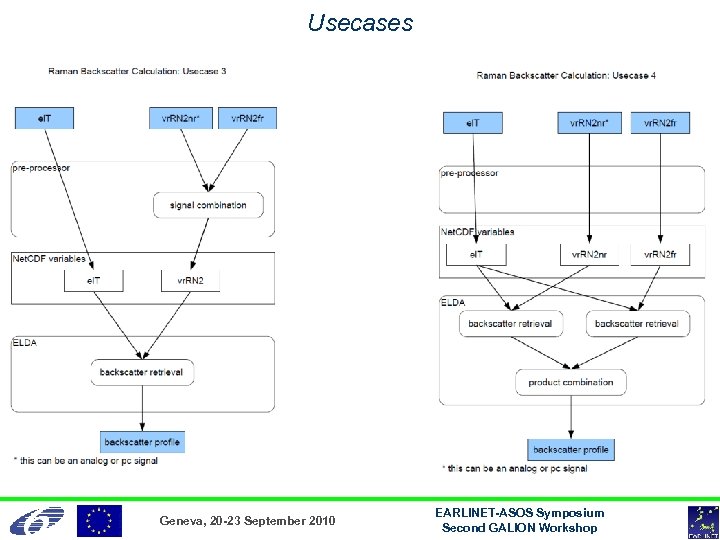 Usecases Geneva, 20 -23 September 2010 EARLINET-ASOS Symposium Second GALION Workshop
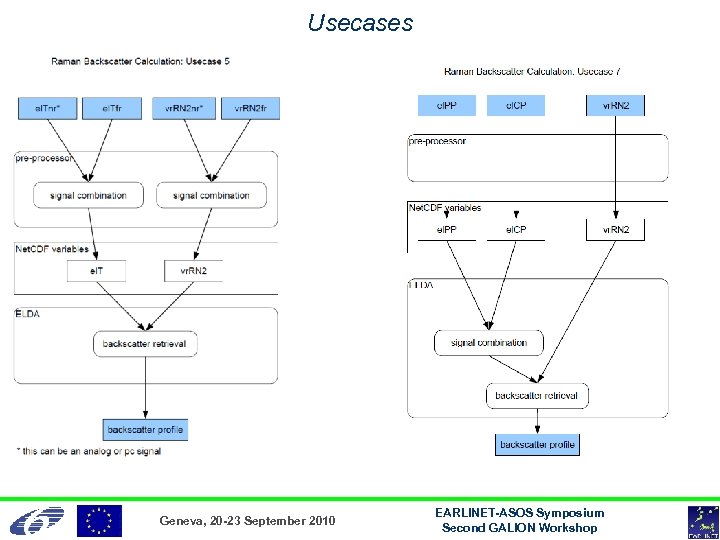 Usecases Geneva, 20 -23 September 2010 EARLINET-ASOS Symposium Second GALION Workshop
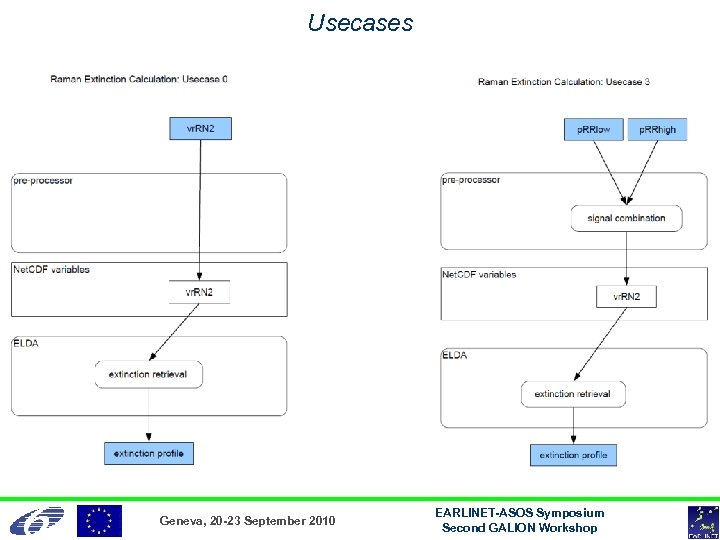 Usecases Geneva, 20 -23 September 2010 EARLINET-ASOS Symposium Second GALION Workshop
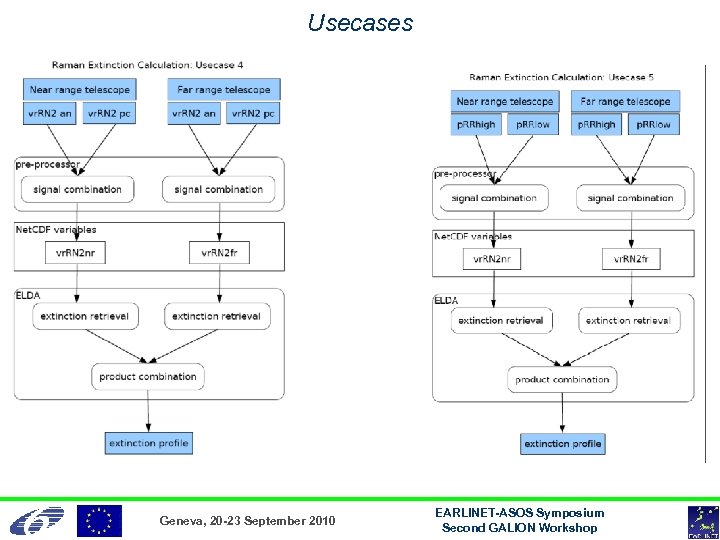 Usecases Geneva, 20 -23 September 2010 EARLINET-ASOS Symposium Second GALION Workshop
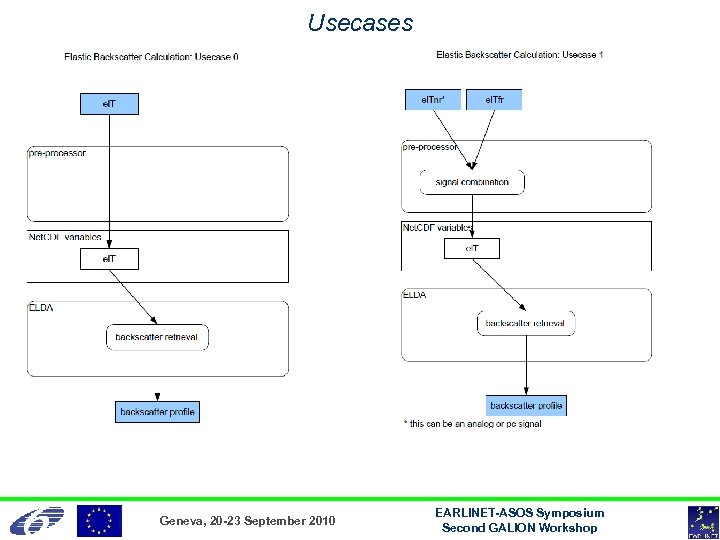 Usecases Geneva, 20 -23 September 2010 EARLINET-ASOS Symposium Second GALION Workshop
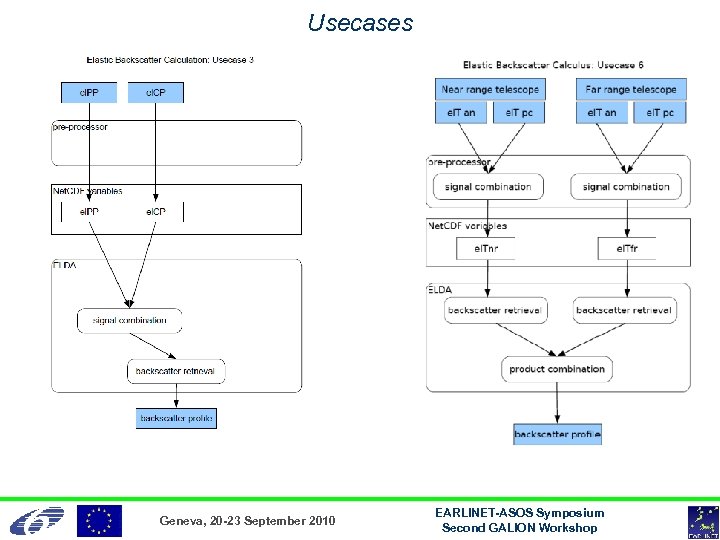 Usecases Geneva, 20 -23 September 2010 EARLINET-ASOS Symposium Second GALION Workshop
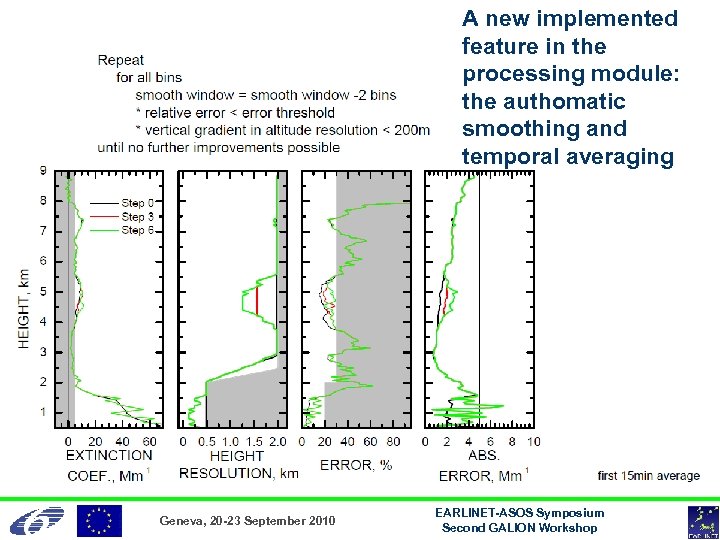 A new implemented feature in the processing module: the authomatic smoothing and temporal averaging Geneva, 20 -23 September 2010 EARLINET-ASOS Symposium Second GALION Workshop
 Geneva, 20 -23 September 2010 EARLINET-ASOS Symposium Second GALION Workshop
 Geneva, 20 -23 September 2010 EARLINET-ASOS Symposium Second GALION Workshop
 Geneva, 20 -23 September 2010 EARLINET-ASOS Symposium Second GALION Workshop
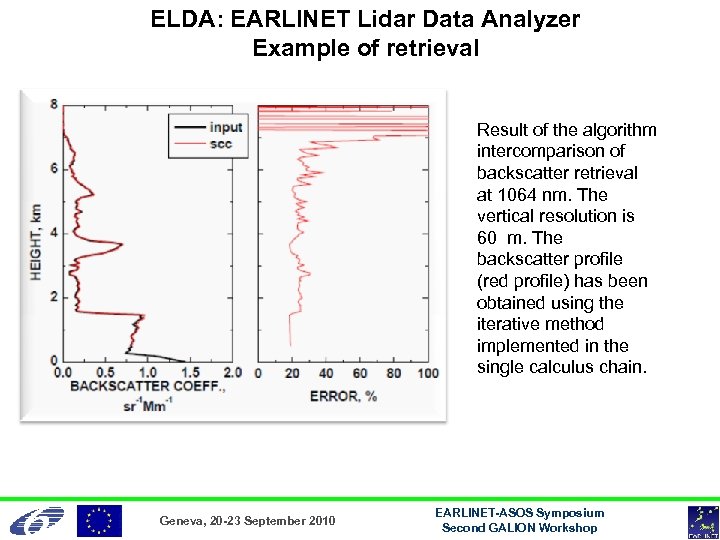 ELDA: EARLINET Lidar Data Analyzer Example of retrieval Result of the algorithm intercomparison of backscatter retrieval at 1064 nm. The vertical resolution is 60 m. The backscatter profile (red profile) has been obtained using the iterative method implemented in the single calculus chain. Geneva, 20 -23 September 2010 EARLINET-ASOS Symposium Second GALION Workshop
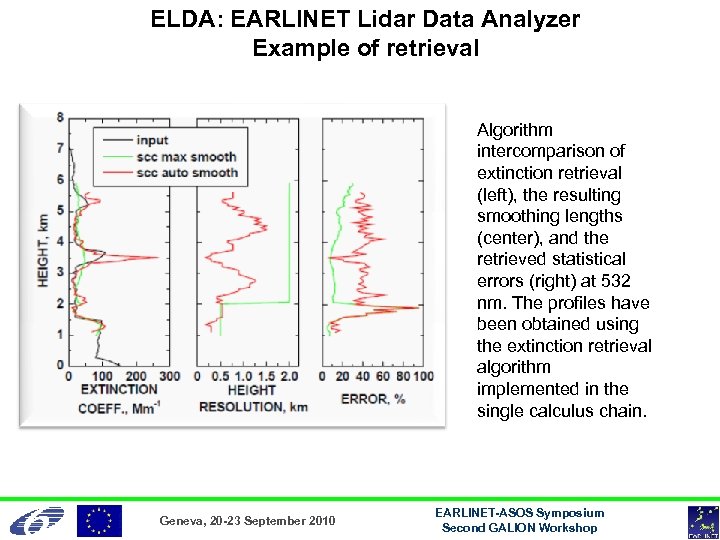 ELDA: EARLINET Lidar Data Analyzer Example of retrieval Algorithm intercomparison of extinction retrieval (left), the resulting smoothing lengths (center), and the retrieved statistical errors (right) at 532 nm. The profiles have been obtained using the extinction retrieval algorithm implemented in the single calculus chain. Geneva, 20 -23 September 2010 EARLINET-ASOS Symposium Second GALION Workshop
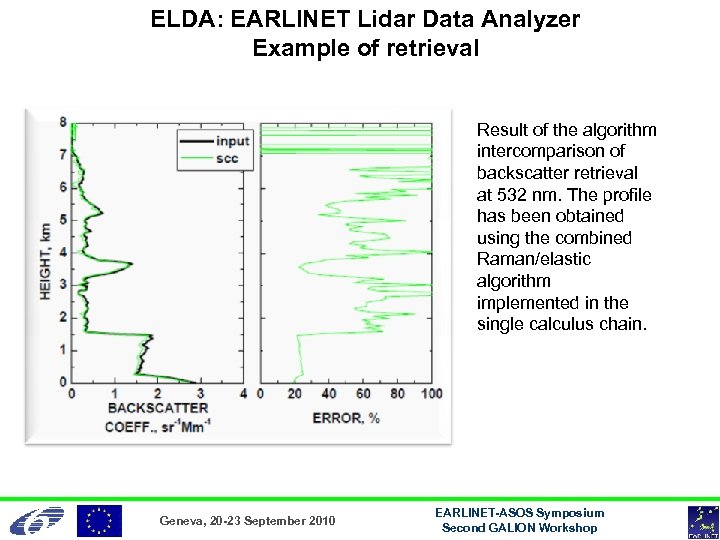 ELDA: EARLINET Lidar Data Analyzer Example of retrieval Result of the algorithm intercomparison of backscatter retrieval at 532 nm. The profile has been obtained using the combined Raman/elastic algorithm implemented in the single calculus chain. Geneva, 20 -23 September 2010 EARLINET-ASOS Symposium Second GALION Workshop
 The Single Calculus Chain has been used during the EARLINET -ASOS intercomparison campaign (EARLI 09) held in Leipzig (Germany) in May 2009. All the data were successfully pre-processed. Geneva, 20 -23 September 2010 EARLINET-ASOS Symposium Second GALION Workshop
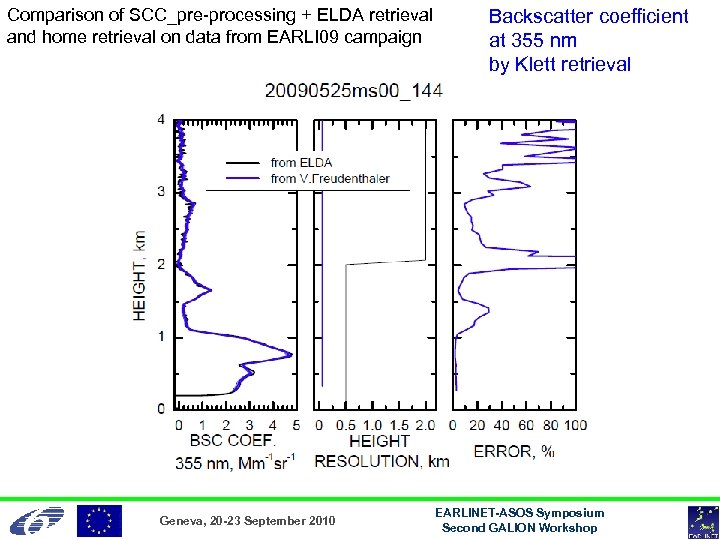 Comparison of SCC_pre-processing + ELDA retrieval and home retrieval on data from EARLI 09 campaign Geneva, 20 -23 September 2010 Backscatter coefficient at 355 nm by Klett retrieval EARLINET-ASOS Symposium Second GALION Workshop
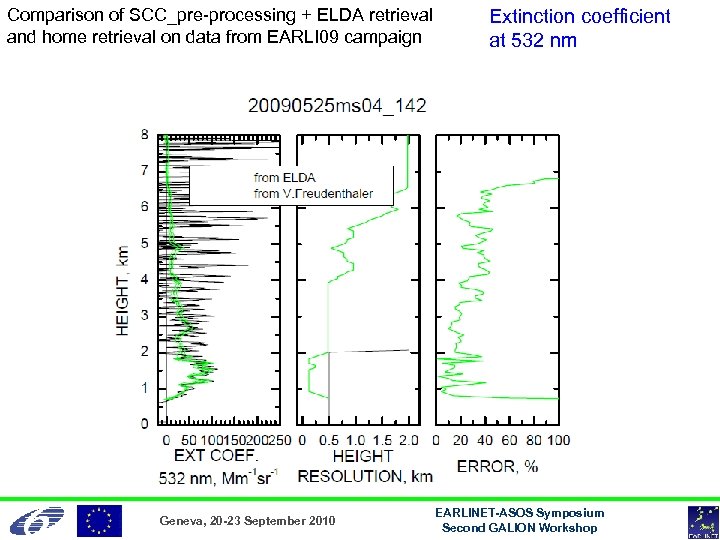 Comparison of SCC_pre-processing + ELDA retrieval and home retrieval on data from EARLI 09 campaign Geneva, 20 -23 September 2010 Extinction coefficient at 532 nm EARLINET-ASOS Symposium Second GALION Workshop
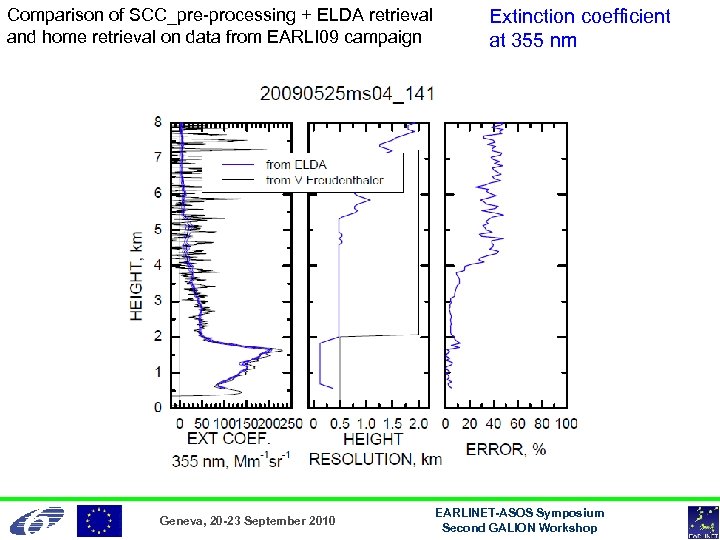 Comparison of SCC_pre-processing + ELDA retrieval and home retrieval on data from EARLI 09 campaign Geneva, 20 -23 September 2010 Extinction coefficient at 355 nm EARLINET-ASOS Symposium Second GALION Workshop
 Microphysical properties retrieval module Two modules developed independently by If. T and UP Geneva, 20 -23 September 2010 EARLINET-ASOS Symposium Second GALION Workshop
 Microphysical properties retrieval module (UP) Improvement of the algorithms and mathematical model ØThe new Padé algorithm delivers substantially better results ØBase points number and position are adapted for more precision ØThe search space could be drastically reduced Platform indepedence ØThe new algorithm software works well in Linux and Windows ØThe UI has been decoupled and implemented in QT Canonization of input and output ØConfiguration of the algorithm is done via human-readable XML ØThe tool can directly evaluate EARLINET Net. CDF files ØDistribution results can be saved either in binary or XML Geneva, 20 -23 September 2010 EARLINET-ASOS Symposium Second GALION Workshop
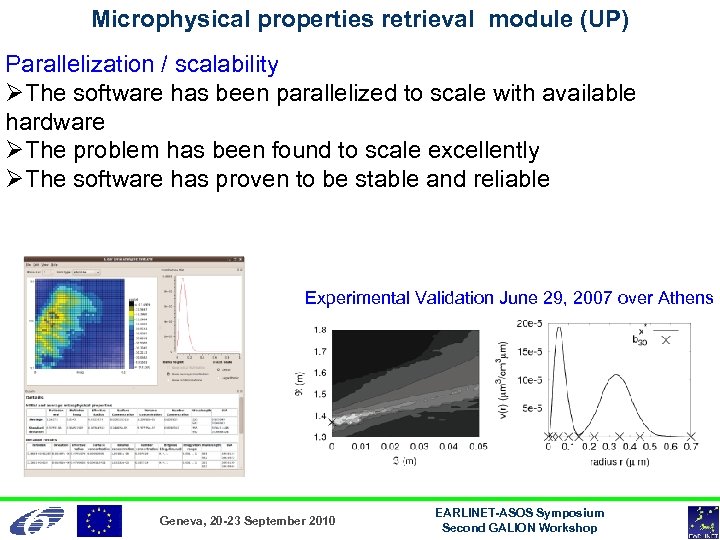 Microphysical properties retrieval module (UP) Parallelization / scalability ØThe software has been parallelized to scale with available hardware ØThe problem has been found to scale excellently ØThe software has proven to be stable and reliable Experimental Validation June 29, 2007 over Athens Geneva, 20 -23 September 2010 EARLINET-ASOS Symposium Second GALION Workshop
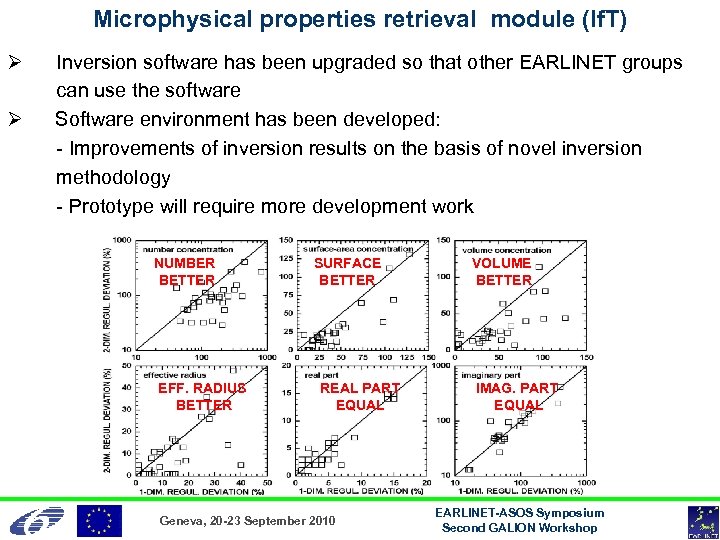 Microphysical properties retrieval module (If. T) Ø Ø Inversion software has been upgraded so that other EARLINET groups can use the software Software environment has been developed: - Improvements of inversion results on the basis of novel inversion methodology - Prototype will require more development work NUMBER BETTER EFF. RADIUS BETTER SURFACE BETTER REAL PART EQUAL Geneva, 20 -23 September 2010 VOLUME BETTER IMAG. PART EQUAL EARLINET-ASOS Symposium Second GALION Workshop
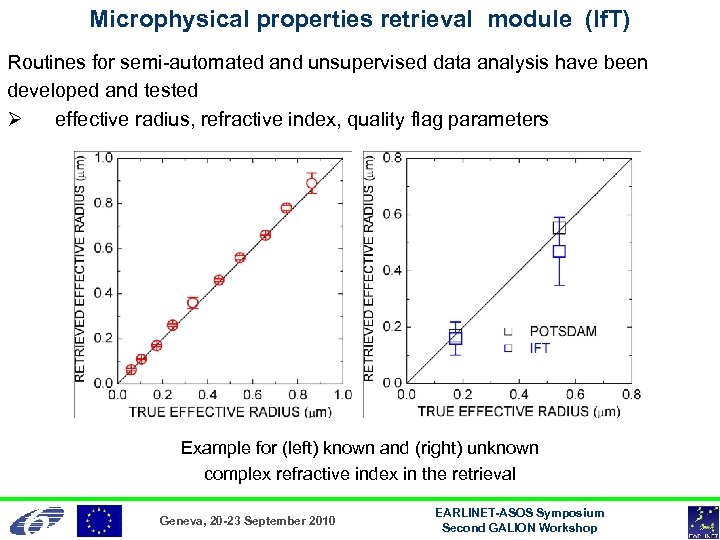 Microphysical properties retrieval module (If. T) Routines for semi-automated and unsupervised data analysis have been developed and tested Ø effective radius, refractive index, quality flag parameters Example for (left) known and (right) unknown complex refractive index in the retrieval Geneva, 20 -23 September 2010 EARLINET-ASOS Symposium Second GALION Workshop
 Microphysical properties retrieval module Comparison between IFT and UP algorithms. ØIFT algorithm shows a processing speed higher than UP, but UP algorithm uses high-speed data processing schemes, not yet implemented into the If. T algorithm, e. g. , parallel processing. ØIFT algorithm delivers better results of some of the investigated microphysical parameters (e. g. complex refractive index), while the UP algorithm performs better for a different set of the investigated parameters (e. g. size parameters). A future synthesis of both algorithms will further improve performance of data inversion. Geneva, 20 -23 September 2010 EARLINET-ASOS Symposium Second GALION Workshop
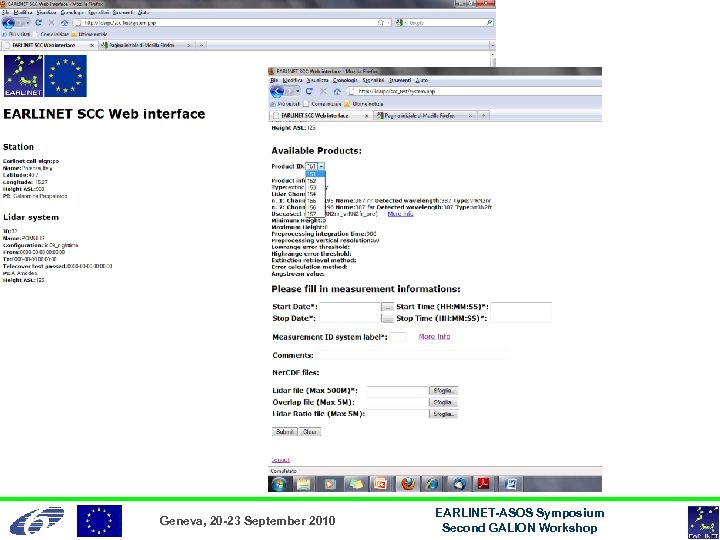
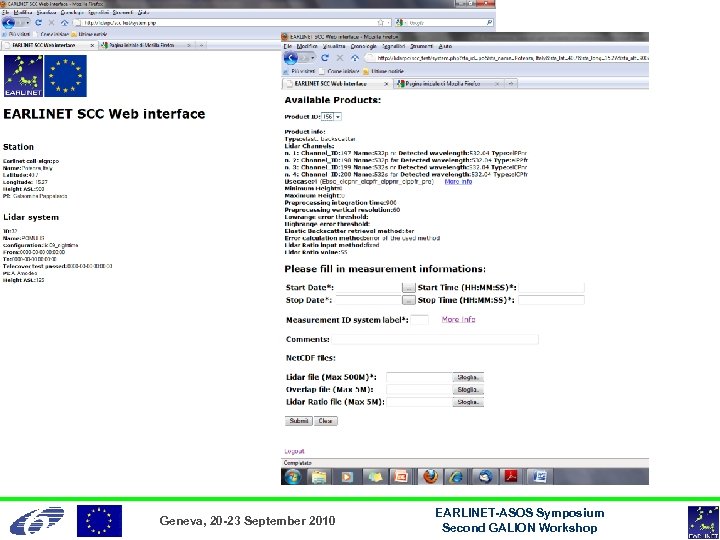
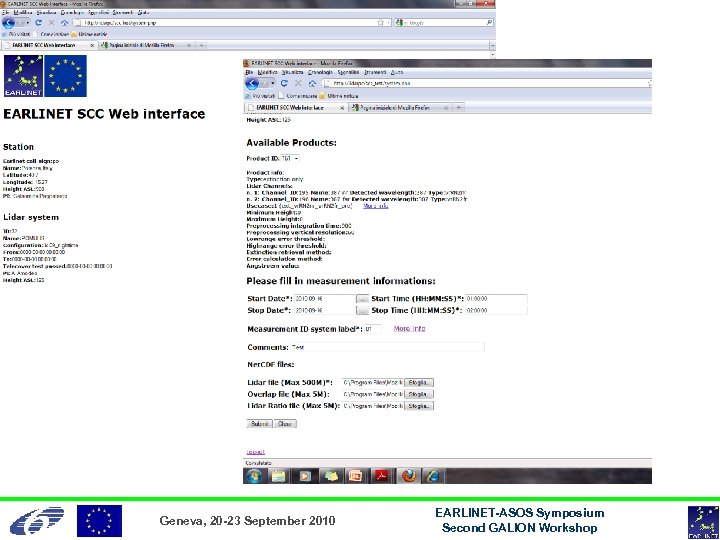
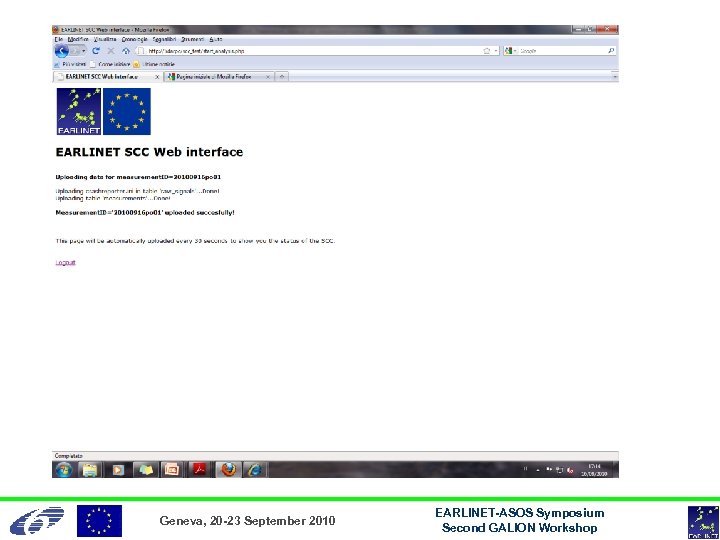
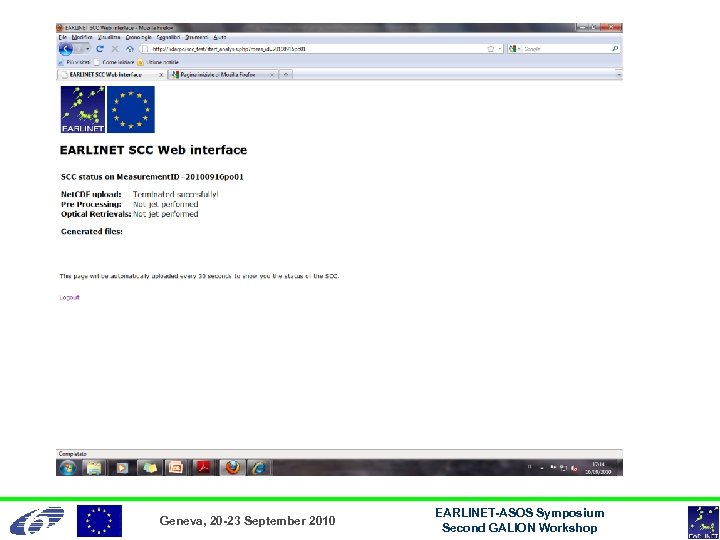
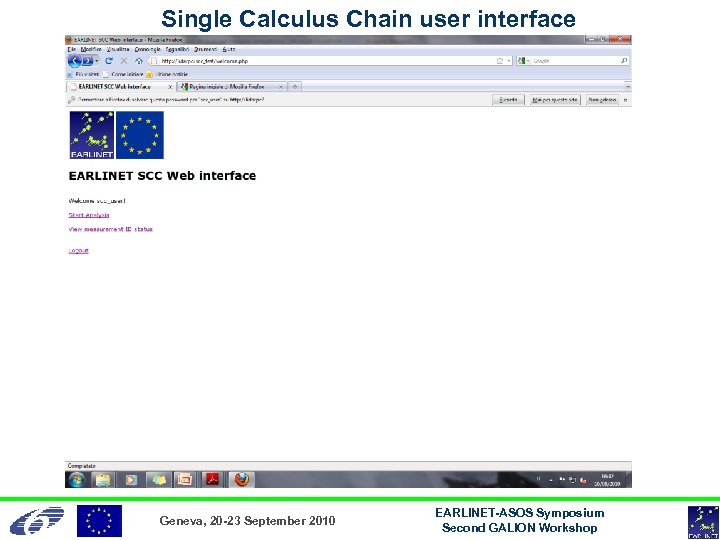
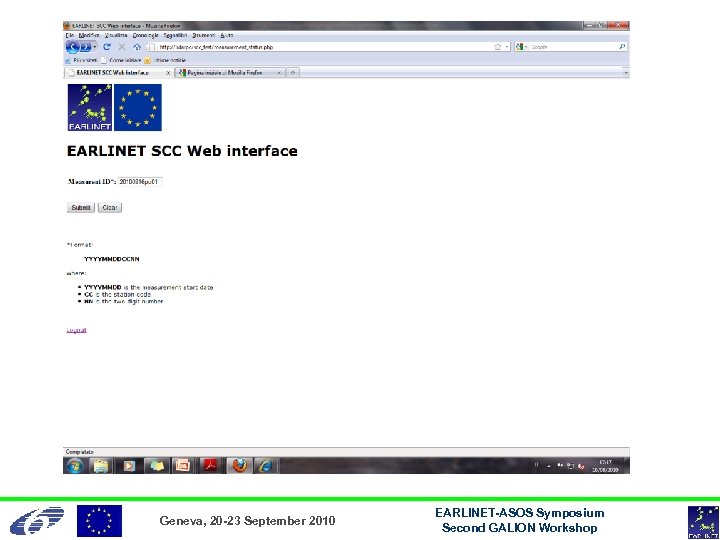
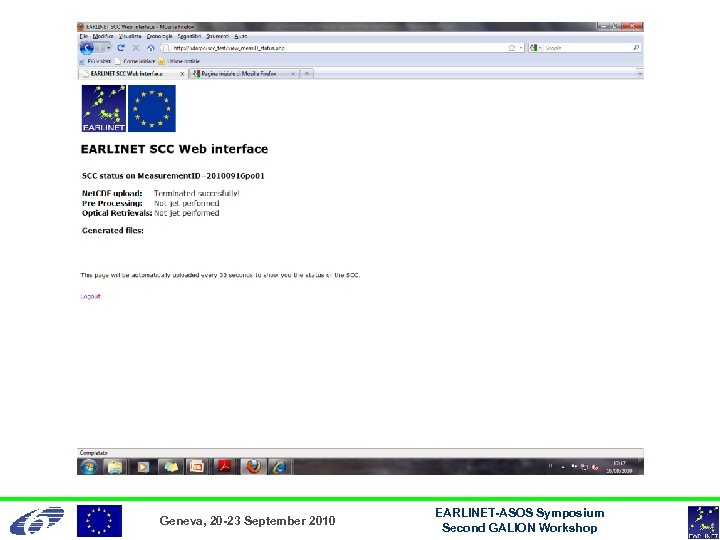
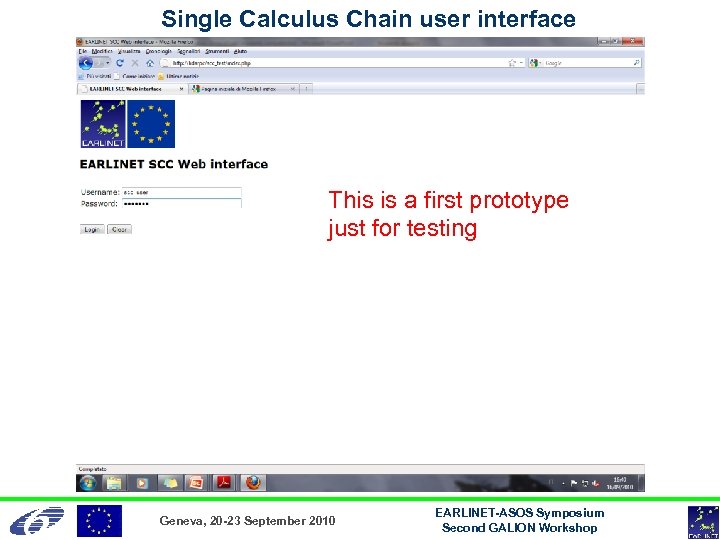 Single Calculus Chain user interface This is a first prototype just for testing Geneva, 20 -23 September 2010 EARLINET-ASOS Symposium Second GALION Workshop
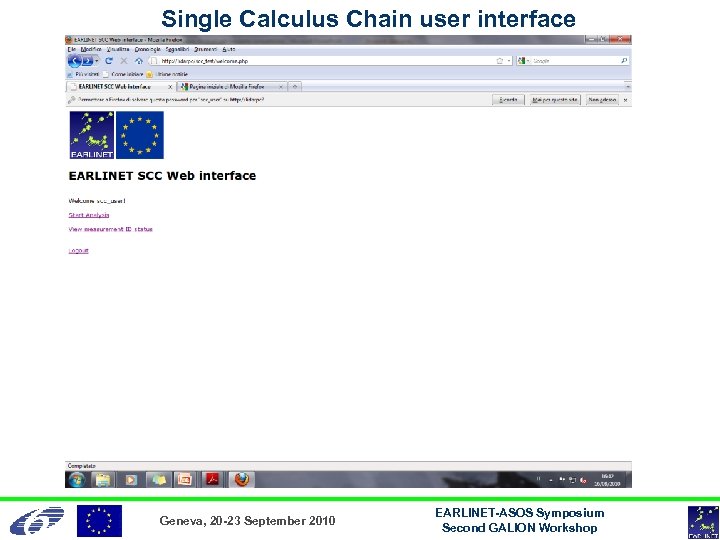 Single Calculus Chain user interface Geneva, 20 -23 September 2010 EARLINET-ASOS Symposium Second GALION Workshop
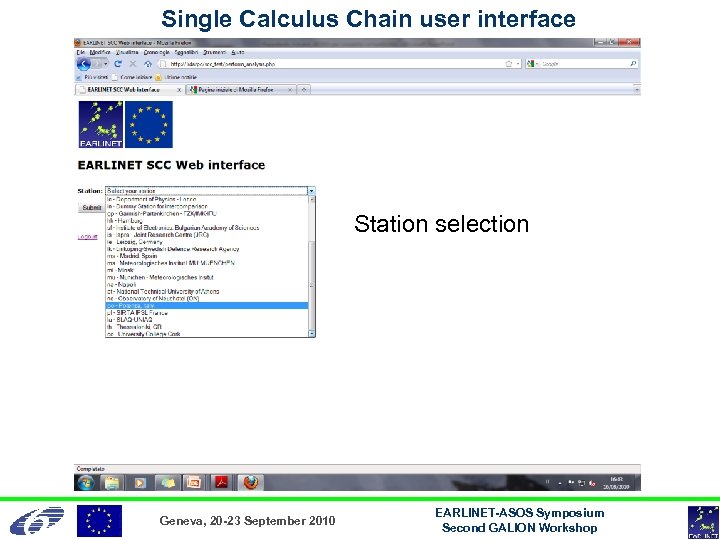 Single Calculus Chain user interface Station selection Geneva, 20 -23 September 2010 EARLINET-ASOS Symposium Second GALION Workshop
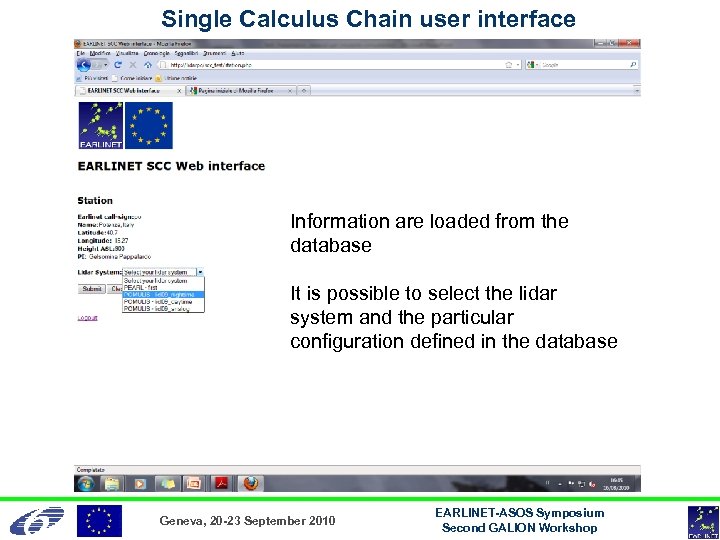 Single Calculus Chain user interface Information are loaded from the database It is possible to select the lidar system and the particular configuration defined in the database Geneva, 20 -23 September 2010 EARLINET-ASOS Symposium Second GALION Workshop
 Geneva, 20 -23 September 2010 EARLINET-ASOS Symposium Second GALION Workshop
 Geneva, 20 -23 September 2010 EARLINET-ASOS Symposium Second GALION Workshop
 Geneva, 20 -23 September 2010 EARLINET-ASOS Symposium Second GALION Workshop
 Geneva, 20 -23 September 2010 EARLINET-ASOS Symposium Second GALION Workshop
 Geneva, 20 -23 September 2010 EARLINET-ASOS Symposium Second GALION Workshop
 Single Calculus Chain user interface Geneva, 20 -23 September 2010 EARLINET-ASOS Symposium Second GALION Workshop
 Geneva, 20 -23 September 2010 EARLINET-ASOS Symposium Second GALION Workshop
 Geneva, 20 -23 September 2010 EARLINET-ASOS Symposium Second GALION Workshop
 Acknowledgements EARLINET-ASOS project funded by the European Commission (EC) under grant RICA-025991 Geneva, 20 -23 September 2010 EARLINET-ASOS Symposium Second GALION Workshop