


 Скачать презентацию n n Lecture 11 -12 Ways of protection
лек 11-12 экология.ppt
- Количество слайдов: 15
 n n Lecture 11 -12 Ways of protection of atmospheric air from pollution. Harmful substances polluting the atmosphere Pollution and reasons of the atmosphere of Kazakhstan. Structure and formation stages of modern research directions.
 n Air pollution is the introduction of particulates, biological molecules, or other harmful materials into Earth's atmosphere, causing diseases, allergies, death to humans, damage to other living organisms such as animals and food crops, or the natural or built environment. Air pollution may come from anthropogenic or natural sources. The atmosphere is a complex natural gaseous system that is essential to support life on planet Earth.
 n An air pollutant is a substance in the air that can have adverse effects on humans and the ecosystem. The substance can be solid particles, liquid droplets, or gases. A pollutant can be of natural origin or manmade. Pollutants are classified as primary or secondary. Primary pollutants are usually produced from a process, such as ash from a volcanic eruption. Other examples include carbon monoxide as from motor vehicle exhaust, or the sulfur dioxide released from factories. Secondary pollutants are not emitted directly.
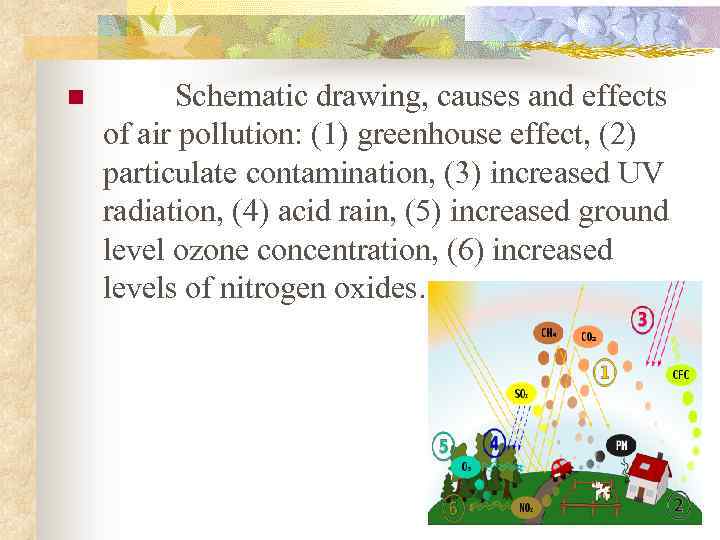 n Schematic drawing, causes and effects of air pollution: (1) greenhouse effect, (2) particulate contamination, (3) increased UV radiation, (4) acid rain, (5) increased ground level ozone concentration, (6) increased levels of nitrogen oxides.
 n n Major primary pollutants produced by human activity include: Sulfur oxides (SOx) - particularly sulfur dioxide, a chemical compound with the formula SO 2 is produced by volcanoes and in various industrial processes. Coal and petroleum often contain sulfur compounds, and their combustion generates sulfur dioxide.
 n Nitrogen oxides (NOx) - Nitrogen oxides, particularly nitrogen dioxide, are expelled from high temperature combustion, and are also produced during thunderstorms by electric discharge. They can be seen as a brown haze dome above or a plume downwind of cities. Nitrogen dioxide is a chemical compound with the formula NO 2. It is one of several nitrogen oxides. One of the most prominent air pollutants, this reddish-brown toxic gas has a characteristic sharp, biting odor.
 n n Carbon monoxide (CO) - CO is a colorless, odorless, toxic yet non-irritating gas. It is a product by incomplete combustion of fuel such as natural gas, coal or wood. Vehicular exhaust is a major source of carbon monoxide. Volatile organic compounds (VOC) - VOCs are a well-known outdoor air pollutant. They are categorized as either methane (CH 4) or non-methane (NMVOCs). Methane is an extremely efficient greenhouse gas which contributes to enhanced global warming. Persistent free radicals connected to airborne fine particles are linked to cardiopulmonary disease. Toxic metals, such as lead and mercury, especially their compounds.
 n An air pollutant is a substance in the air that can cause harm to humans and the environment. Indoor air pollution and urban air quality are listed as two of the world"s worst pollution problems in the 2008. Pollutants can be classified as primary or secondary. Usually, primary pollutants are directly emitted from a process, such as ash from a volcanic eruption, the carbon monoxide gas from a motor vehicle exhaust or sulfur dioxide released from factories. Secondary pollutants are not emitted directly. One example is ground-level ozone.
 The transport sector has become one of the main emitters of polluting compounds in the world and one of the main causes of the greenhouse effect. Air pollution is especially a problem in urban areas, where there is a lot of traffic. Some pollutants however can travel long distances and may accumulate in suburban or rural areas because of weather conditions such as wind or low pressure.
 n n n Air pollution is a major environmental risk to health. Numerous scientific studies have linked air pollution to health effects including: - harm to the respiratory system, leading to the development or aggravation of respiratory diseases, decreased lung function, increased frequency and severity of respiratory symptoms such as coughing and difficulty breathing, or increased susceptibility to respiratory infections; - harm to the cardiovascular system; -harm to the nervous system, affecting learning, memory and behaviour; -harm to the reproductive system; -cancer
 n Air pollution comes from both natural and human-made (anthropogenic) sources. However, globally human-made pollutants from combustion, construction, mining, agriculture and warfare increasingly significant in the air pollution equation.
 Environmental pollution, especially atmospheric pollution, is another urgent problem in Kazakhstan. In some big cities and industrial centers concentrations of some toxic substances, such as heavy metal dust, sulfur dioxide, carbon oxide, and some others, are greater by tens of time than maximum permissible concentrations (MPC). The most acute situation is typical of the cities Taraz, Temirtau, Almaty, Oskemen, Leninogor, Shymkent, Balkash, and some others
 Atmospheric air is significantly polluted in the regions, where mineral resources are exploited. Air pollution results also from spaceships launching at the Baikonur space center. Apart from air pollution there is also pollution of surface waters and other components of the biosphere in the industrially developed regions. For example, 35 to 40 % of the Syrdarya run-off are formed by industrial and communal waste waters as well as drainage waters.
 Vocabulary n n n ecology–экология relationship - Addressing contemporary conservation biology-биологии охраны природы Agroforestry-агролесомелиорации, fisheries -рыболовство agriculture-сельское хозяйство, city planning-городское планирование forestry-лесное хозяйство agroecology-агроэкологии, urban ecology-қала экологиясы moderate processes -умеренные процессы
 Thank you for your attention End