


 Скачать презентацию n m p MICE The International Muon Ionization
6f440c6ab404d2cea34a57aba6a4f456.ppt
- Количество слайдов: 26
 n m p MICE The International Muon Ionization Cooling Experiment MICE beam line review 16 -11 -2007 Alain Blondel 1
 MICE Overview 1. Why, what and how? 2. requirements on the beam line 3. other desirable features of the beam line 3. Conclusions MICE beam line review 16 -11 -2007 Alain Blondel 2
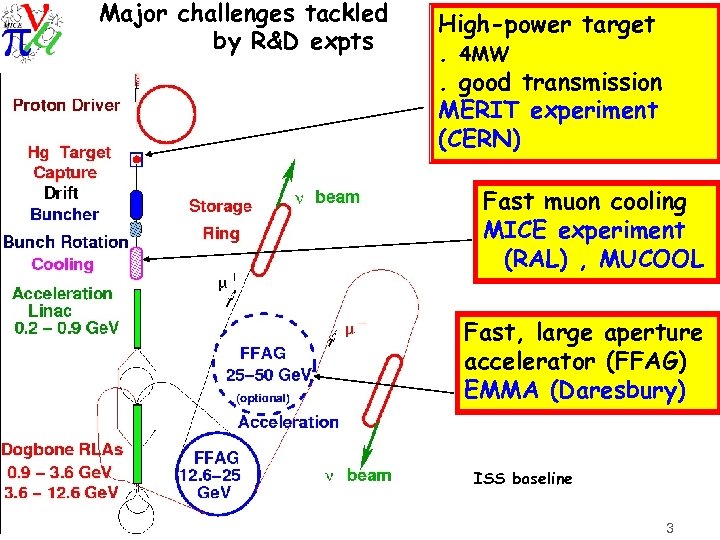 Major challenges tackled by R&D expts High-power target. 4 MW. good transmission MERIT experiment (CERN) Fast muon cooling MICE experiment (RAL) , MUCOOL Fast, large aperture accelerator (FFAG) EMMA (Daresbury) ISS baseline MICE beam line review 16 -11 -2007 Alain Blondel 3
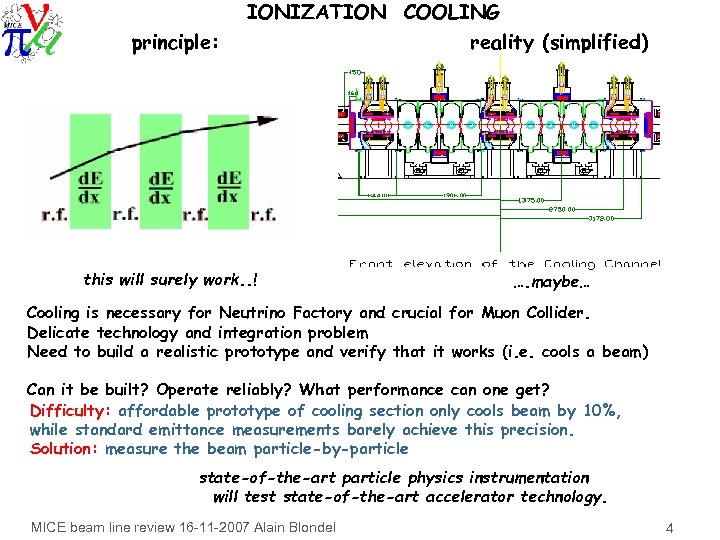 IONIZATION COOLING principle: this will surely work. . ! reality (simplified) …. maybe… Cooling is necessary for Neutrino Factory and crucial for Muon Collider. Delicate technology and integration problem Need to build a realistic prototype and verify that it works (i. e. cools a beam) Can it be built? Operate reliably? What performance can one get? Difficulty: affordable prototype of cooling section only cools beam by 10%, while standard emittance measurements barely achieve this precision. Solution: measure the beam particle-by-particle state-of-the-art particle physics instrumentation will test state-of-the-art accelerator technology. MICE beam line review 16 -11 -2007 Alain Blondel 4
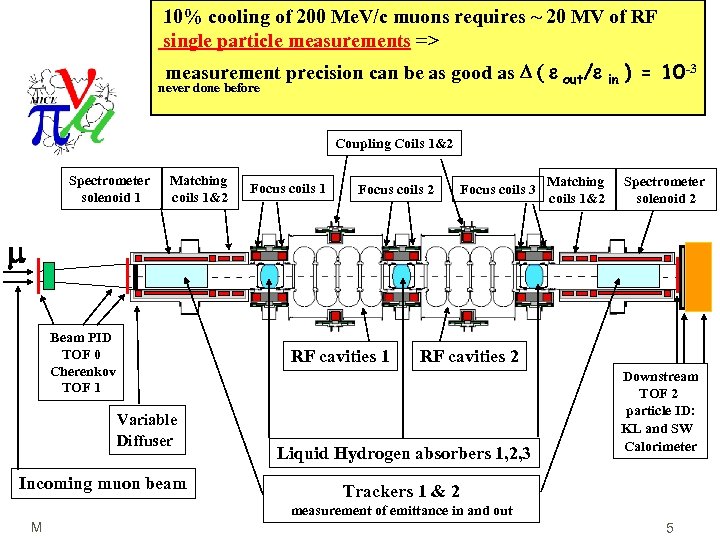 10% cooling of 200 Me. V/c muons requires ~ 20 MV of RF single particle measurements => measurement precision can be as good as D ( e out/e in ) = 10 -3 never done before Coupling Coils 1&2 Spectrometer solenoid 1 Matching coils 1&2 Focus coils 1 Focus coils 2 Focus coils 3 Matching coils 1&2 Spectrometer solenoid 2 m Beam PID TOF 0 Cherenkov TOF 1 RF cavities 1 Variable Diffuser Incoming muon beam RF cavities 2 Liquid Hydrogen absorbers 1, 2, 3 Downstream TOF 2 particle ID: KL and SW Calorimeter Trackers 1 & 2 measurement of emittance in and out MICE beam line review 16 -11 -2007 Alain Blondel 5
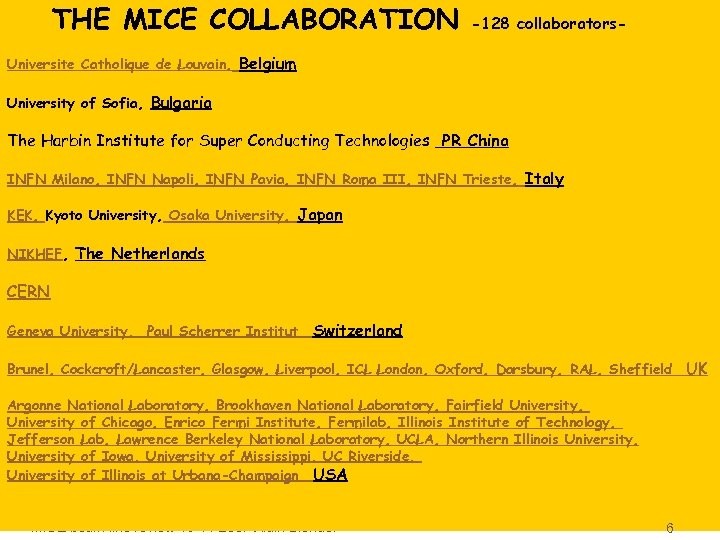 THE MICE COLLABORATION -128 collaborators- Universite Catholique de Louvain, Belgium University of Sofia, Bulgaria The Harbin Institute for Super Conducting Technologies PR China INFN Milano, INFN Napoli, INFN Pavia, INFN Roma III, INFN Trieste, Italy KEK, Kyoto University, Osaka University, Japan NIKHEF, The Netherlands CERN Geneva University, Paul Scherrer Institut Switzerland Brunel, Cockcroft/Lancaster, Glasgow, Liverpool, ICL London, Oxford, Darsbury, RAL, Sheffield UK Argonne National Laboratory, Brookhaven National Laboratory, Fairfield University, University of Chicago, Enrico Fermi Institute, Fermilab, Illinois Institute of Technology, Jefferson Lab, Lawrence Berkeley National Laboratory, UCLA, Northern Illinois University, University of Iowa, University of Mississippi, UC Riverside, University of Illinois at Urbana-Champaign USA MICE beam line review 16 -11 -2007 Alain Blondel 6
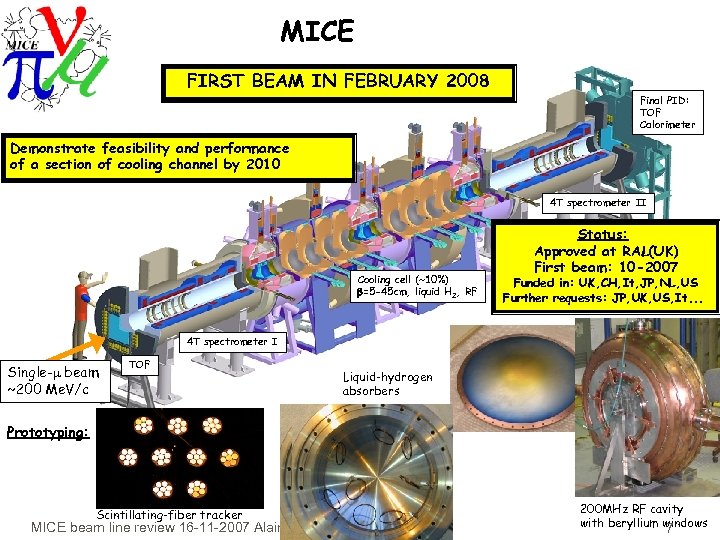 MICE FIRST BEAM IN FEBRUARY 2008 Final PID: TOF Calorimeter Demonstrate feasibility and performance of a section of cooling channel by 2010 4 T spectrometer II Cooling cell (~10%) =5 -45 cm, liquid H 2, RF Status: Approved at RAL(UK) First beam: 10 -2007 Funded in: UK, CH, It, JP, NL, US Further requests: JP, UK, US, It. . . 4 T spectrometer I Single-m beam ~200 Me. V/c TOF Liquid-hydrogen absorbers Prototyping: Scintillating-fiber tracker MICE beam line review 16 -11 -2007 Alain Blondel 200 MHz RF cavity with beryllium windows 7
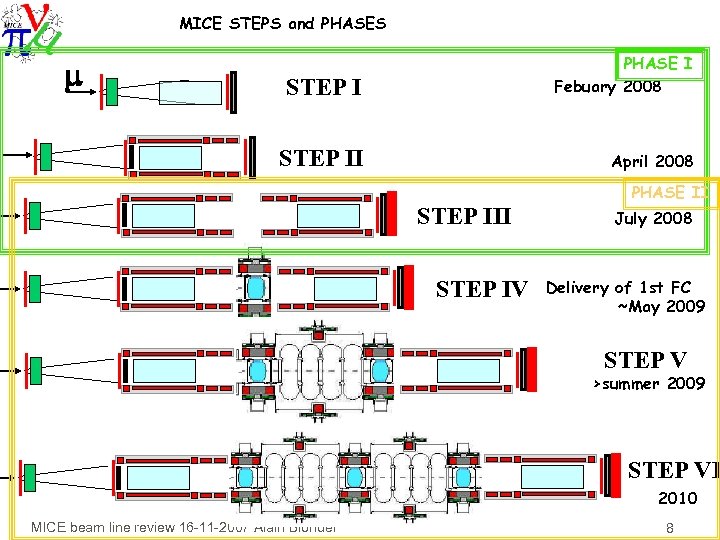 MICE STEPS and PHASES STEP II m PHASE I Febuary 2008 April 2008 PHASE II STEP IV July 2008 Delivery of 1 st FC ~May 2009 STEP V >summer 2009 STEP VI 2010 MICE beam line review 16 -11 -2007 Alain Blondel 8
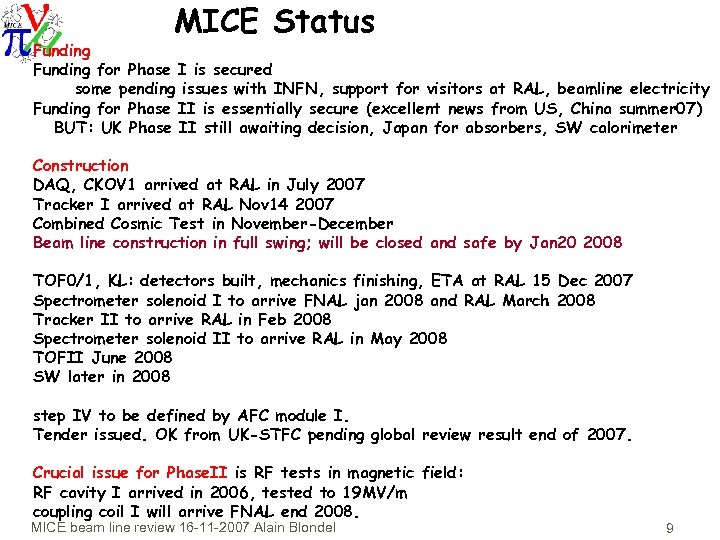 MICE Status Funding for Phase I is secured some pending issues with INFN, support for visitors at RAL, beamline electricity Funding for Phase II is essentially secure (excellent news from US, China summer 07) BUT: UK Phase II still awaiting decision, Japan for absorbers, SW calorimeter Construction DAQ, CKOV 1 arrived at RAL in July 2007 Tracker I arrived at RAL Nov 14 2007 Combined Cosmic Test in November-December Beam line construction in full swing; will be closed and safe by Jan 20 2008 TOF 0/1, KL: detectors built, mechanics finishing, ETA at RAL 15 Dec 2007 Spectrometer solenoid I to arrive FNAL jan 2008 and RAL March 2008 Tracker II to arrive RAL in Feb 2008 Spectrometer solenoid II to arrive RAL in May 2008 TOFII June 2008 SW later in 2008 step IV to be defined by AFC module I. Tender issued. OK from UK-STFC pending global review result end of 2007. Crucial issue for Phase. II is RF tests in magnetic field: RF cavity I arrived in 2006, tested to 19 MV/m coupling coil I will arrive FNAL end 2008. MICE beam line review 16 -11 -2007 Alain Blondel 9
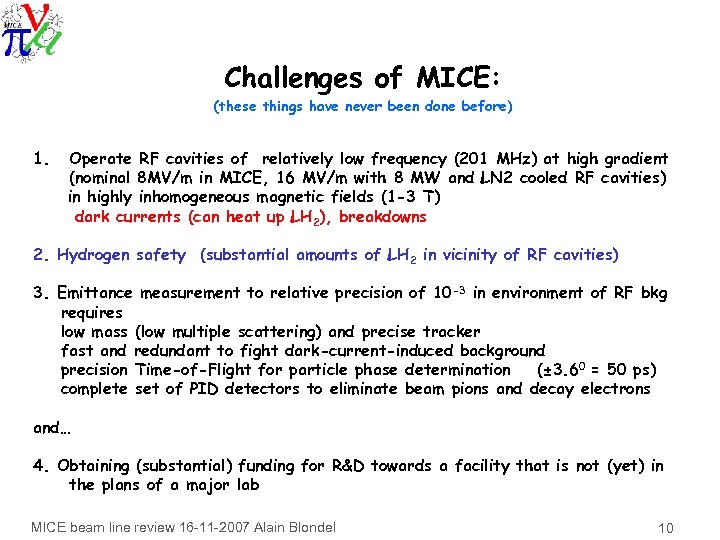 Challenges of MICE: (these things have never been done before) 1. Operate RF cavities of relatively low frequency (201 MHz) at high gradient (nominal 8 MV/m in MICE, 16 MV/m with 8 MW and LN 2 cooled RF cavities) in highly inhomogeneous magnetic fields (1 -3 T) dark currents (can heat up LH 2), breakdowns 2. Hydrogen safety (substantial amounts of LH 2 in vicinity of RF cavities) 3. Emittance measurement to relative precision of 10 -3 in environment of RF bkg requires low mass (low multiple scattering) and precise tracker fast and redundant to fight dark-current-induced background precision Time-of-Flight for particle phase determination (± 3. 60 = 50 ps) complete set of PID detectors to eliminate beam pions and decay electrons and… 4. Obtaining (substantial) funding for R&D towards a facility that is not (yet) in the plans of a major lab MICE beam line review 16 -11 -2007 Alain Blondel 10
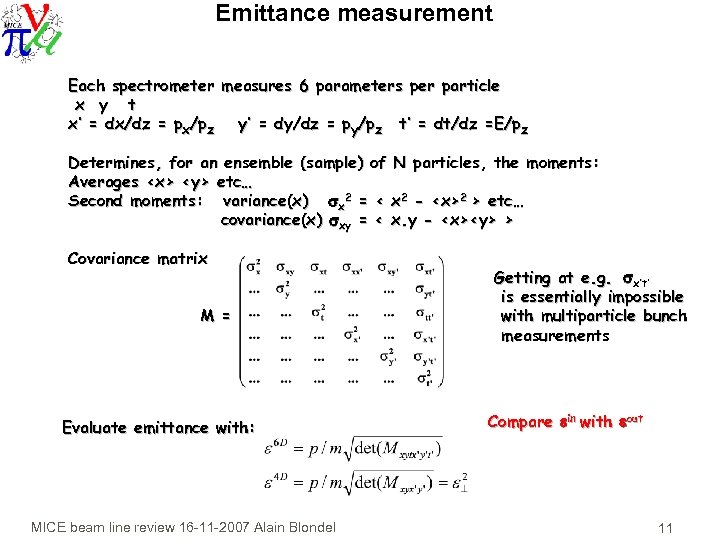 Emittance measurement Each spectrometer measures 6 parameters per particle x y t x’ = dx/dz = px/pz y’ = dy/dz = py/pz t’ = dt/dz =E/pz Determines, for an ensemble (sample) of N particles, the moments: Averages
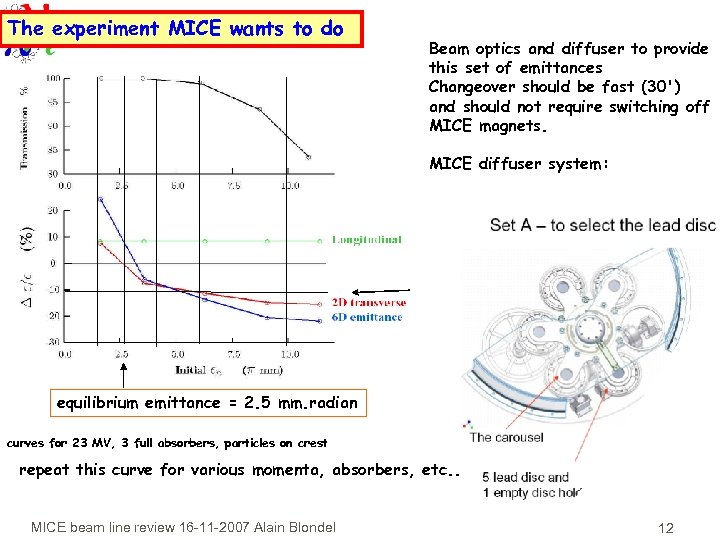 The experiment MICE wants to do Beam optics and diffuser to provide this set of emittances Changeover should be fast (30') and should not require switching off MICE magnets. MICE diffuser system: equilibrium emittance = 2. 5 mm. radian curves for 23 MV, 3 full absorbers, particles on crest repeat this curve for various momenta, absorbers, etc. . MICE beam line review 16 -11 -2007 Alain Blondel 12
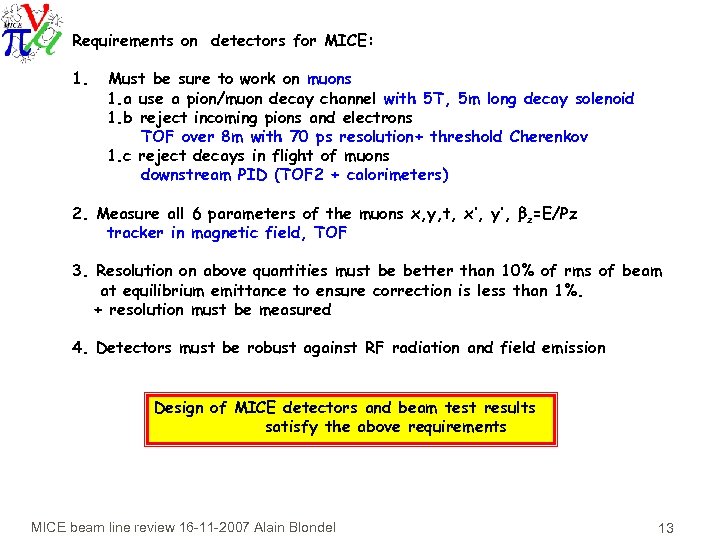 Requirements on detectors for MICE: 1. Must be sure to work on muons 1. a use a pion/muon decay channel with 5 T, 5 m long decay solenoid 1. b reject incoming pions and electrons TOF over 8 m with 70 ps resolution+ threshold Cherenkov 1. c reject decays in flight of muons downstream PID (TOF 2 + calorimeters) 2. Measure all 6 parameters of the muons x, y, t, x’, y’, z=E/Pz tracker in magnetic field, TOF 3. Resolution on above quantities must be better than 10% of rms of beam at equilibrium emittance to ensure correction is less than 1%. + resolution must be measured 4. Detectors must be robust against RF radiation and field emission Design of MICE detectors and beam test results satisfy the above requirements MICE beam line review 16 -11 -2007 Alain Blondel 13
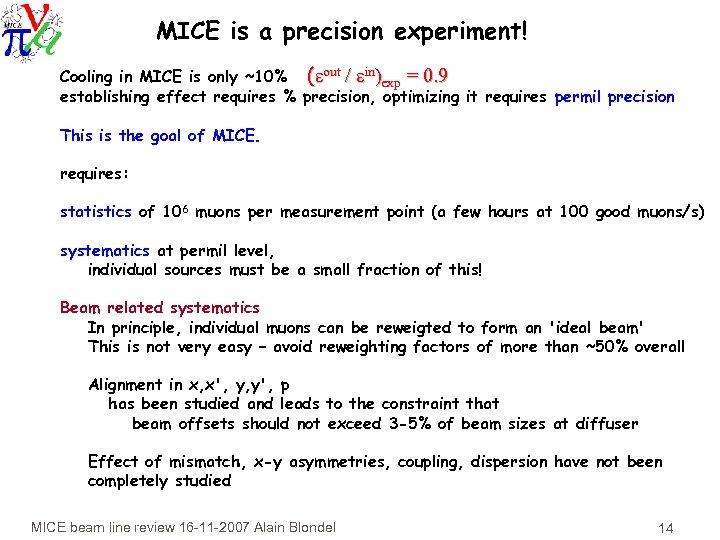 MICE is a precision experiment! Cooling in MICE is only ~10% (eout / ein)exp = 0. 9 establishing effect requires % precision, optimizing it requires permil precision This is the goal of MICE. requires: statistics of 106 muons per measurement point (a few hours at 100 good muons/s) systematics at permil level, individual sources must be a small fraction of this! Beam related systematics In principle, individual muons can be reweigted to form an 'ideal beam' This is not very easy – avoid reweighting factors of more than ~50% overall Alignment in x, x', y, y', p has been studied and leads to the constraint that beam offsets should not exceed 3 -5% of beam sizes at diffuser Effect of mismatch, x-y asymmetries, coupling, dispersion have not been completely studied MICE beam line review 16 -11 -2007 Alain Blondel 14
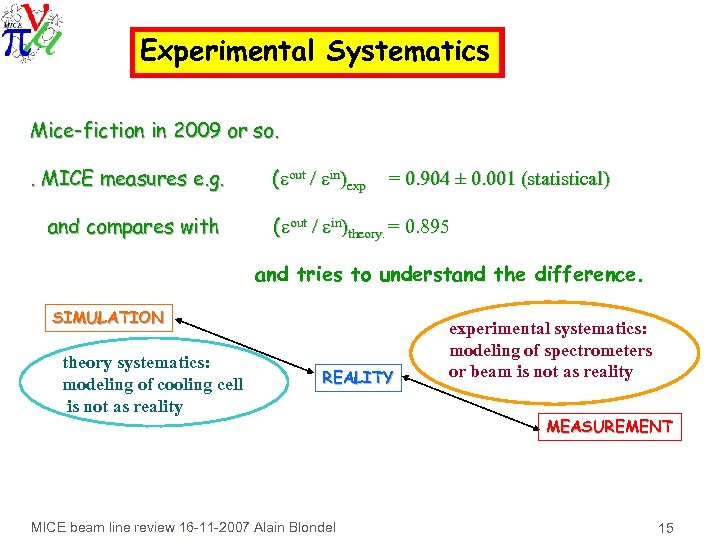 Experimental Systematics Mice-fiction in 2009 or so. . MICE measures e. g. and compares with (eout / ein)exp = 0. 904 ± 0. 001 (statistical) (eout / ein)theory. = 0. 895 and tries to understand the difference. SIMULATION theory systematics: modeling of cooling cell is not as reality REALITY MICE beam line review 16 -11 -2007 Alain Blondel experimental systematics: modeling of spectrometers or beam is not as reality MEASUREMENT 15
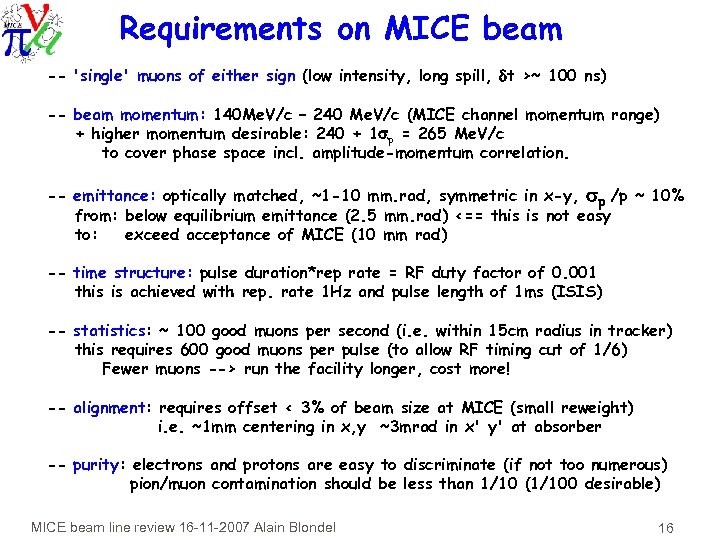 Requirements on MICE beam -- 'single' muons of either sign (low intensity, long spill, dt >~ 100 ns) -- beam momentum: 140 Me. V/c – 240 Me. V/c (MICE channel momentum range) + higher momentum desirable: 240 + 1 sp = 265 Me. V/c to cover phase space incl. amplitude-momentum correlation. -- emittance: optically matched, ~1 -10 mm. rad, symmetric in x-y, sp /p ~ 10% from: below equilibrium emittance (2. 5 mm. rad) <== this is not easy to: exceed acceptance of MICE (10 mm rad) -- time structure: pulse duration*rep rate = RF duty factor of 0. 001 this is achieved with rep. rate 1 Hz and pulse length of 1 ms (ISIS) -- statistics: ~ 100 good muons per second (i. e. within 15 cm radius in tracker) this requires 600 good muons per pulse (to allow RF timing cut of 1/6) Fewer muons --> run the facility longer, cost more! -- alignment: requires offset < 3% of beam size at MICE (small reweight) i. e. ~1 mm centering in x, y ~3 mrad in x' y' at absorber -- purity: electrons and protons are easy to discriminate (if not too numerous) pion/muon contamination should be less than 1/10 (1/100 desirable) MICE beam line review 16 -11 -2007 Alain Blondel 16
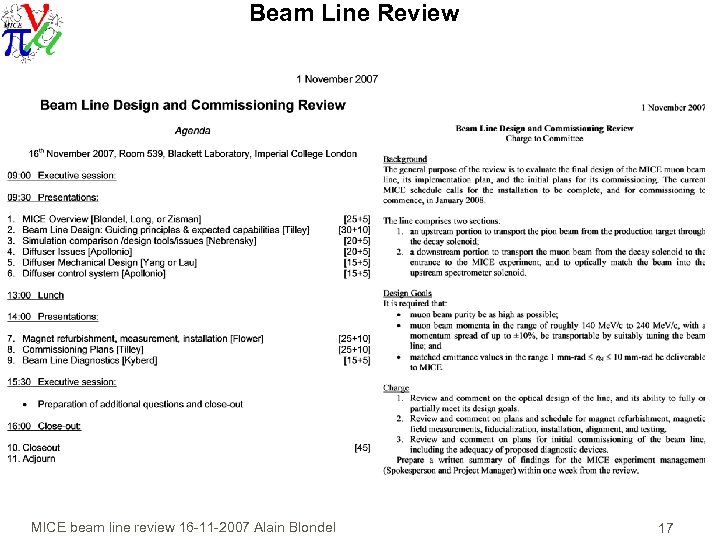 Beam Line Review MICE beam line review 16 -11 -2007 Alain Blondel 17
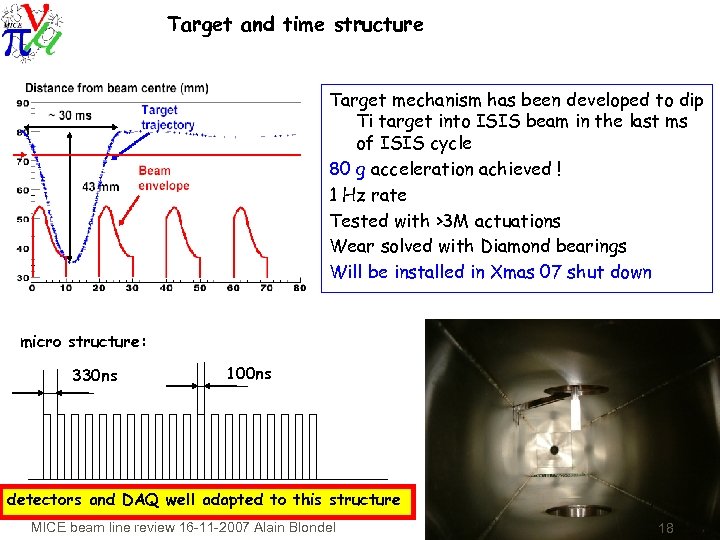 Target and time structure Target mechanism has been developed to dip Ti target into ISIS beam in the last ms of ISIS cycle 80 g acceleration achieved ! 1 Hz rate Tested with >3 M actuations Wear solved with Diamond bearings Will be installed in Xmas 07 shut down micro structure: 330 ns 100 ns detectors and DAQ well adapted to this structure MICE beam line review 16 -11 -2007 Alain Blondel 18
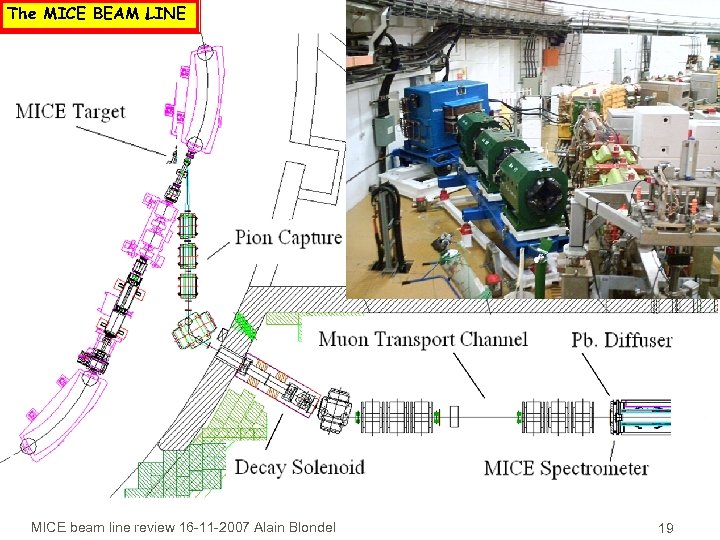 The MICE BEAM LINE MICE beam line review 16 -11 -2007 Alain Blondel 19
 MICE beam line review 16 -11 -2007 Alain Blondel 20
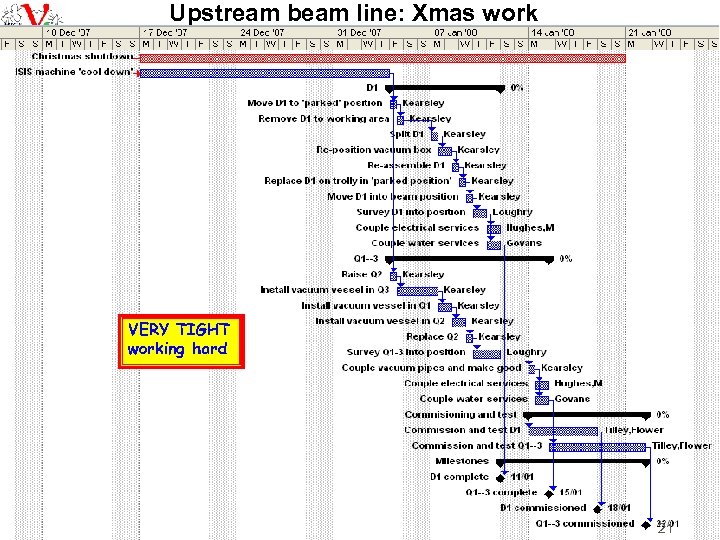 Upstream beam line: Xmas work VERY TIGHT working hard MICE beam line review 16 -11 -2007 Alain Blondel 21
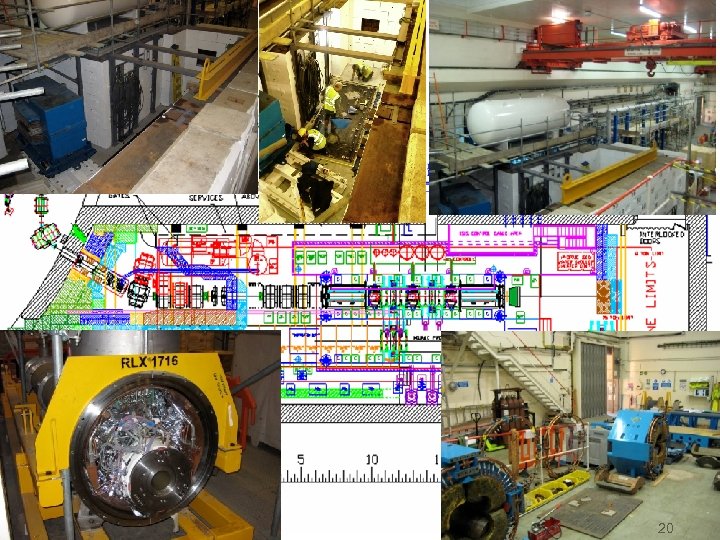
 Beam line -- Construction at RAL is in full swing main issues: -- target just in time. . now authorized! to be installed over X-mas -- repairing the PSI solenoid and cold check -- original misalignment of assumed point of target impact on beam by 2 cm. . . being fixed -- Q 4 -6 refurbishment finished; Q 7 -9 still ongoing tight schedule -- schedule of Xmas shut down is very tight! -- beam monitors and TOF 0 are all somewhat late risk: delays in startup At this point the beam line does not include: -- collimators (maybe needed for small emittance beam) -- alignment correctors there is a couple schemes possible, but not completely worked out correcting dipoles or trim coils on quadrupoles risk: loss of performance and practicality -- ratio of particle production to beam loss monitors not completely understood risk: considerable loss of performance. MICE beam line review 16 -11 -2007 Alain Blondel 22
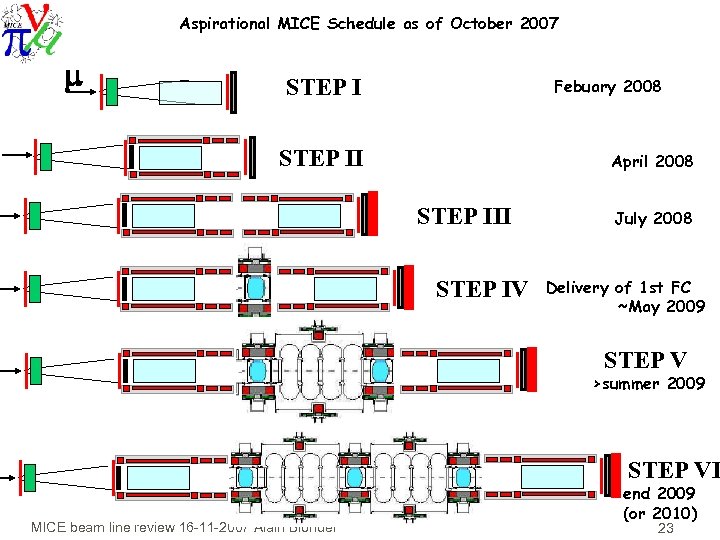 Aspirational MICE Schedule as of October 2007 m STEP I Febuary 2008 STEP II April 2008 STEP III STEP IV July 2008 Delivery of 1 st FC ~May 2009 STEP V >summer 2009 STEP VI MICE beam line review 16 -11 -2007 Alain Blondel end 2009 (or 2010) 23
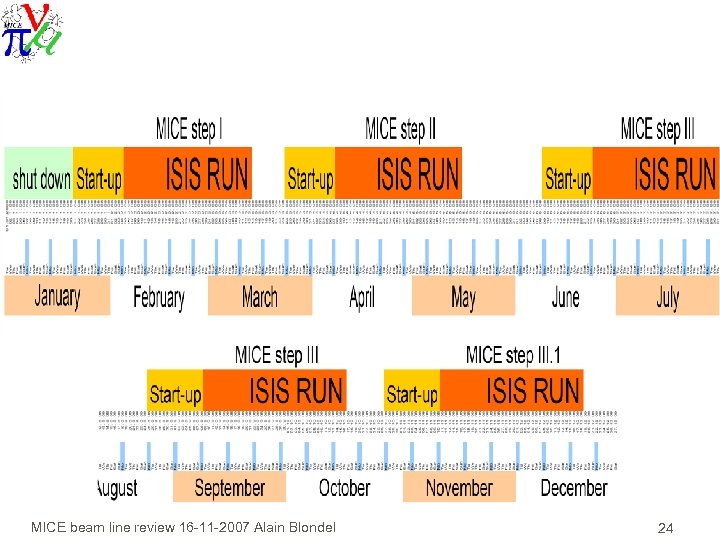 MICE beam line review 16 -11 -2007 Alain Blondel 24
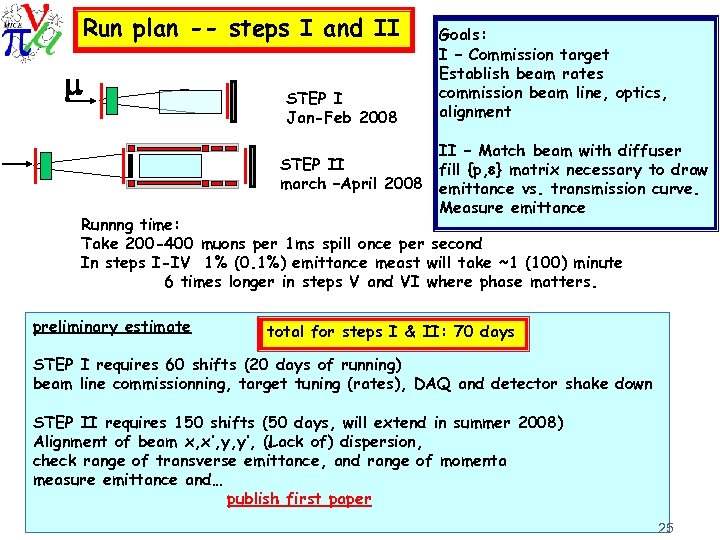 Run plan -- steps I and II m STEP I Jan-Feb 2008 STEP II march –April 2008 Goals: I – Commission target Establish beam rates commission beam line, optics, alignment II – Match beam with diffuser fill {p, e} matrix necessary to draw emittance vs. transmission curve. Measure emittance Runnng time: Take 200 -400 muons per 1 ms spill once per second In steps I-IV 1% (0. 1%) emittance meast will take ~1 (100) minute 6 times longer in steps V and VI where phase matters. preliminary estimate total for steps I & II: 70 days STEP I requires 60 shifts (20 days of running) beam line commissionning, target tuning (rates), DAQ and detector shake down STEP II requires 150 shifts (50 days, will extend in summer 2008) Alignment of beam x, x’, y, y’, (Lack of) dispersion, check range of transverse emittance, and range of momenta measure emittance and… publish first paper MICE beam line review 16 -11 -2007 Alain Blondel 25
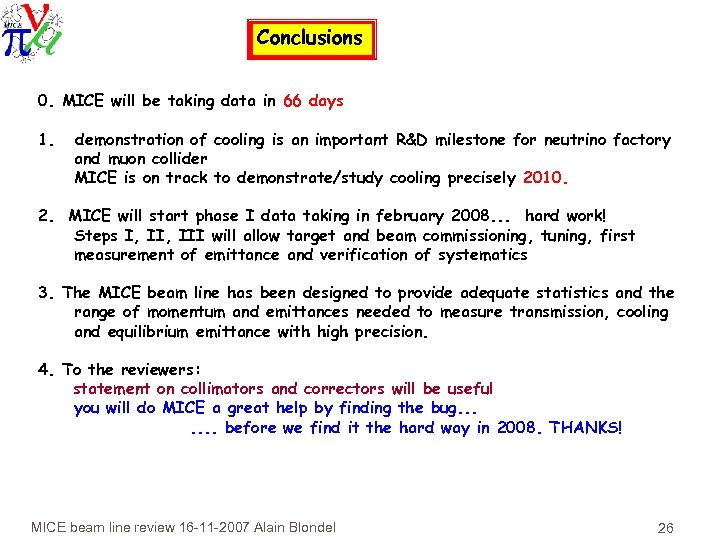 Conclusions 0. MICE will be taking data in 66 days 1. demonstration of cooling is an important R&D milestone for neutrino factory and muon collider MICE is on track to demonstrate/study cooling precisely 2010. 2. MICE will start phase I data taking in february 2008. . . hard work! Steps I, III will allow target and beam commissioning, tuning, first measurement of emittance and verification of systematics 3. The MICE beam line has been designed to provide adequate statistics and the range of momentum and emittances needed to measure transmission, cooling and equilibrium emittance with high precision. 4. To the reviewers: statement on collimators and correctors will be useful you will do MICE a great help by finding the bug. . . . before we find it the hard way in 2008. THANKS! MICE beam line review 16 -11 -2007 Alain Blondel 26