


 Скачать презентацию N Gregory Mankiw Macroeconomics Sixth Edition Chapter 3
75b04cdd7a728e62d46fa2ed6bf4d486.ppt
- Количество слайдов: 65
 N. Gregory Mankiw Macroeconomics Sixth Edition Chapter 3: National Income: Where it Comes From and Where it Goes CHAPTER 3 National Income Econ 4020/Chatterjee slide 0
 In this chapter, you will learn… § How an economy’s total output/income is produced § How the prices of the factors of production are determined § How total income is distributed § What determines the demand for goods and services (how is total income spent? ) § How equilibrium in the goods market is achieved CHAPTER 3 National Income slide 1
 Outline of model A closed economy, market-clearing model Economic Agents § Households § Firms § Government Markets where these agents interact § Market for Goods and Services § Factor Markets § Financial Markets The interaction between agents in the context of markets determines an economy’s resource allocation and progress CHAPTER 3 National Income slide 2
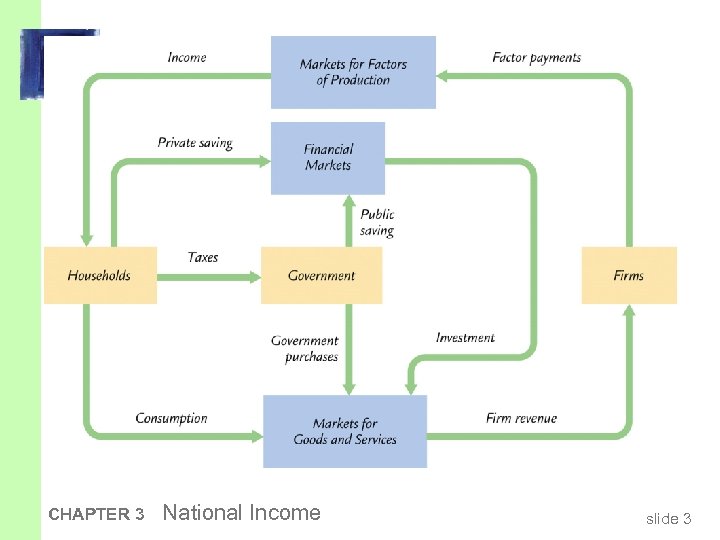 CHAPTER 3 National Income slide 3
 Who Produces Output? Factors of production K = capital: tools, machines, and structures used in production L = labor: the physical and mental efforts of workers AND TECHNOLOGY CHAPTER 3 National Income slide 4
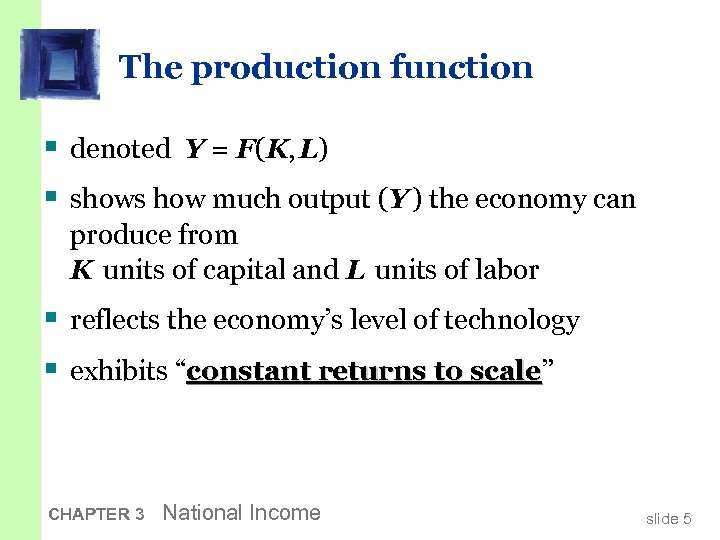 The production function § denoted Y = F(K, L) § shows how much output (Y ) the economy can produce from K units of capital and L units of labor § reflects the economy’s level of technology § exhibits “constant returns to scale” scale CHAPTER 3 National Income slide 5
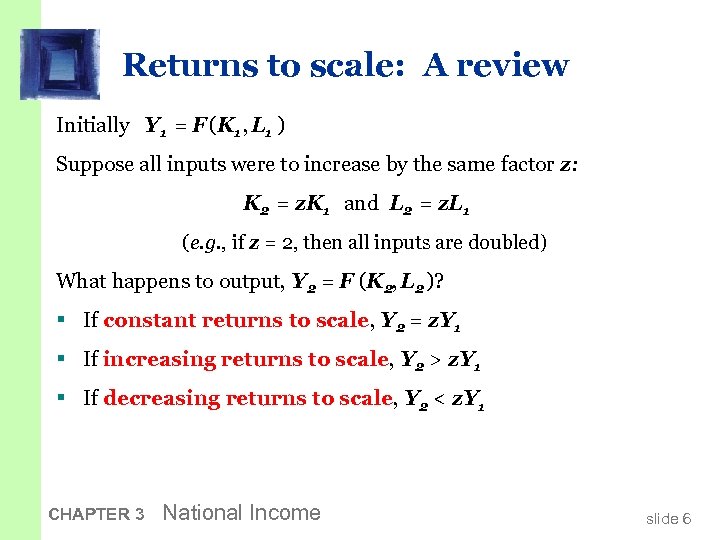 Returns to scale: A review Initially Y 1 = F (K 1 , L 1 ) Suppose all inputs were to increase by the same factor z: K 2 = z. K 1 and L 2 = z. L 1 (e. g. , if z = 2, then all inputs are doubled) What happens to output, Y 2 = F (K 2, L 2 )? § If constant returns to scale, Y 2 = z. Y 1 § If increasing returns to scale, Y 2 > z. Y 1 § If decreasing returns to scale, Y 2 < z. Y 1 CHAPTER 3 National Income slide 6
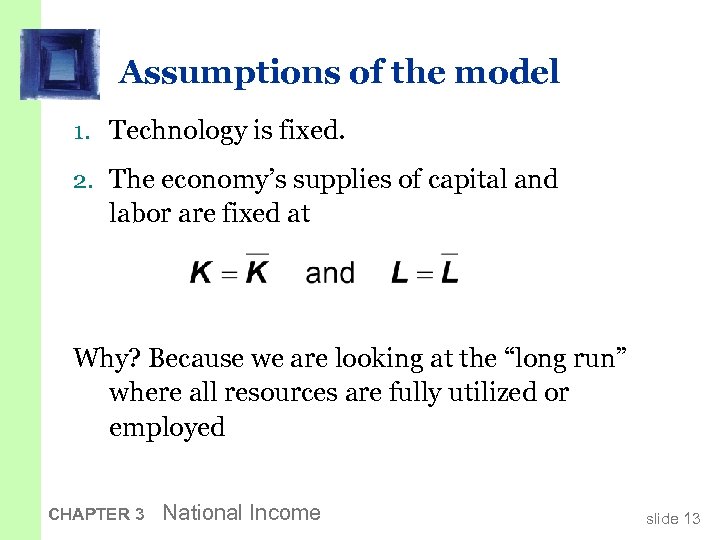 Assumptions of the model 1. Technology is fixed. 2. The economy’s supplies of capital and labor are fixed at Why? Because we are looking at the “long run” where all resources are fully utilized or employed CHAPTER 3 National Income slide 13
 Determining GDP Output is determined by the fixed factor supplies and the fixed state of technology: CHAPTER 3 National Income slide 14
 The distribution of national income § determined by factor prices, the prices per unit that firms pay for the factors of production § wage = price of L § rental rate = price of K CHAPTER 3 National Income slide 15
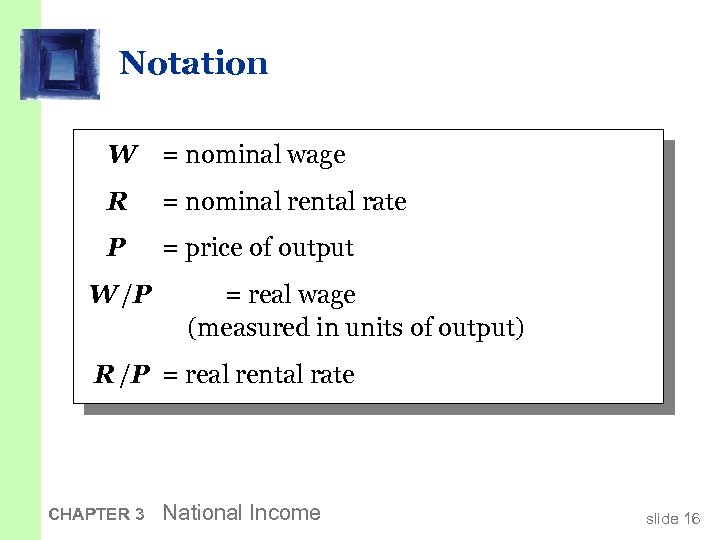 Notation W = nominal wage R = nominal rental rate P = price of output W /P = real wage (measured in units of output) R /P = real rental rate CHAPTER 3 National Income slide 16
 How factor prices are determined § Factor prices are determined by supply and demand in factor markets. § Recall: Supply of each factor is fixed. § What about demand? CHAPTER 3 National Income slide 17
 Demand for labor § Assume markets are competitive: each firm takes W, R, and P as given. § Basic idea: A firm hires each unit of labor if the cost does not exceed the benefit. § cost = real wage § benefit = marginal product of labor CHAPTER 3 National Income slide 18
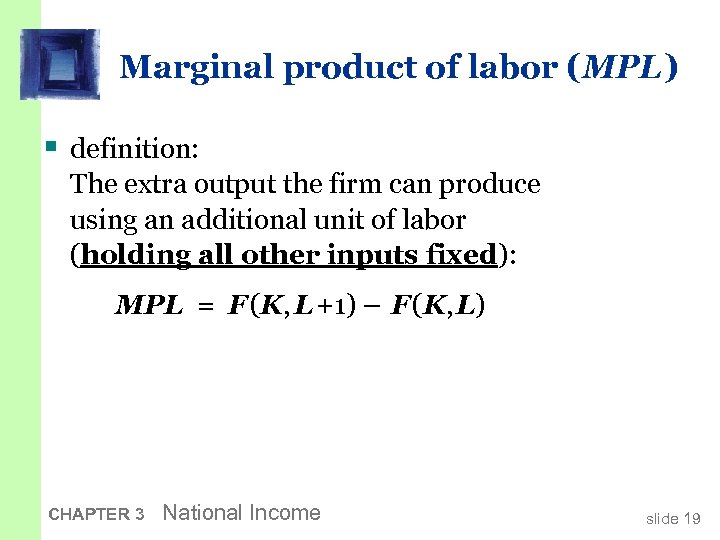 Marginal product of labor (MPL ) § definition: The extra output the firm can produce using an additional unit of labor (holding all other inputs fixed): MPL = F (K, L +1) – F (K, L) CHAPTER 3 National Income slide 19
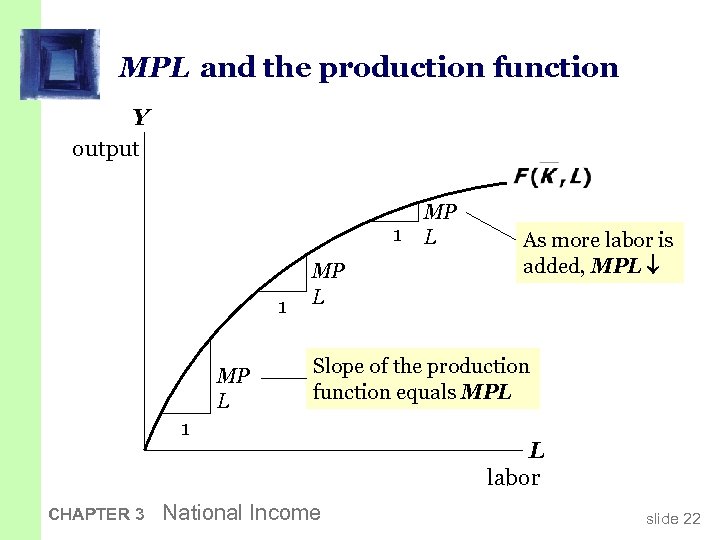 MPL and the production function Y output 1 1 MP L As more labor is added, MPL Slope of the production function equals MPL 1 CHAPTER 3 MP L National Income L labor slide 22
 Diminishing marginal returns § As a factor input is increased, its marginal product falls (other things equal). § Intuition: Suppose L while holding K fixed fewer machines per worker lower worker productivity CHAPTER 3 National Income slide 23
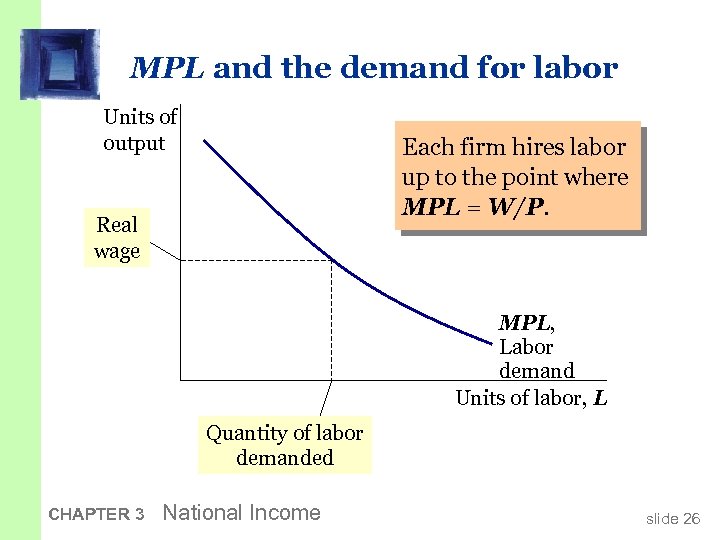 MPL and the demand for labor Units of output Each firm hires labor up to the point where MPL = W/P. Real wage MPL, Labor demand Units of labor, L Quantity of labor demanded CHAPTER 3 National Income slide 26
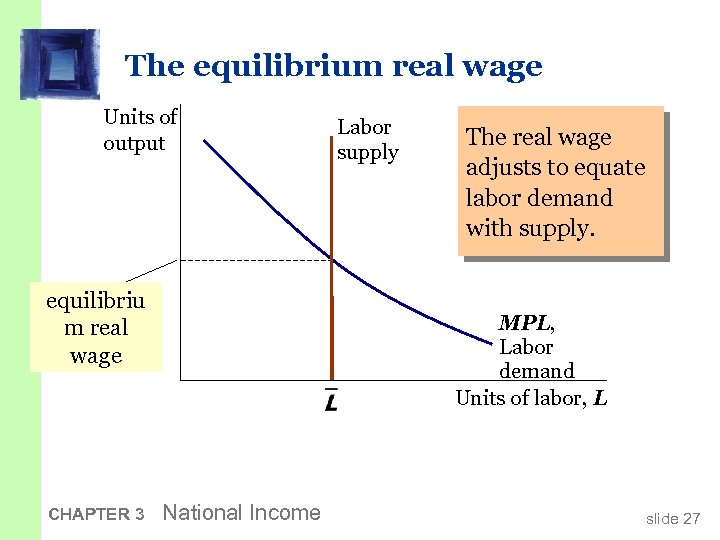 The equilibrium real wage Units of output equilibriu m real wage CHAPTER 3 Labor supply The real wage adjusts to equate labor demand with supply. MPL, Labor demand Units of labor, L National Income slide 27
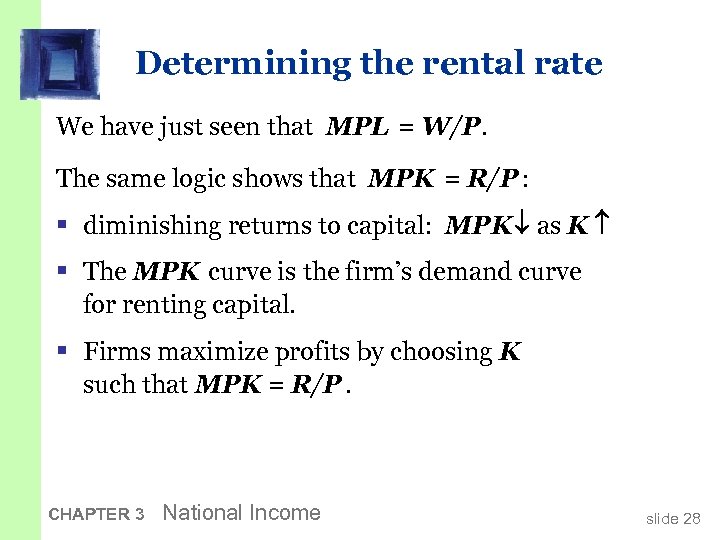 Determining the rental rate We have just seen that MPL = W/P. The same logic shows that MPK = R/P : § diminishing returns to capital: MPK as K § The MPK curve is the firm’s demand curve for renting capital. § Firms maximize profits by choosing K such that MPK = R/P. CHAPTER 3 National Income slide 28
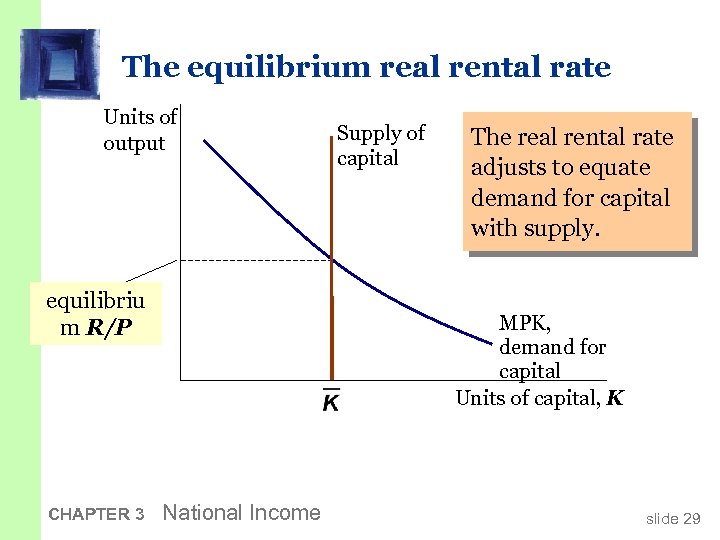 The equilibrium real rental rate Units of output equilibriu m R/P CHAPTER 3 Supply of capital The real rental rate adjusts to equate demand for capital with supply. MPK, demand for capital Units of capital, K National Income slide 29
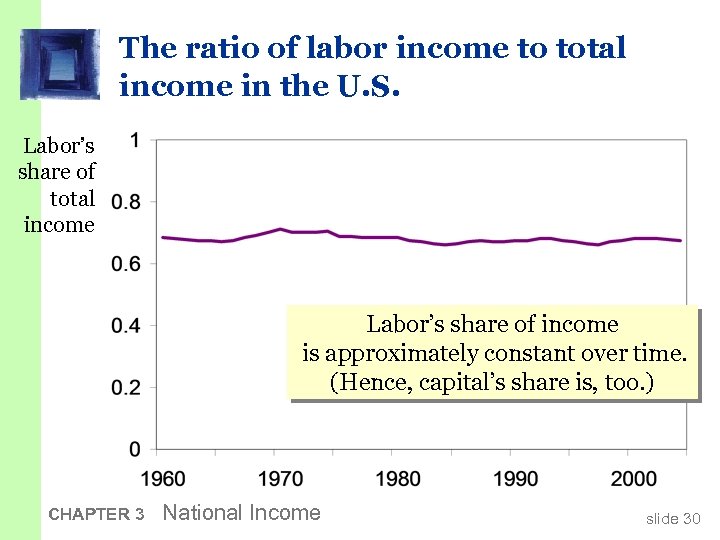 The ratio of labor income to total income in the U. S. Labor’s share of total income Labor’s share of income is approximately constant over time. (Hence, capital’s share is, too. ) CHAPTER 3 National Income slide 30
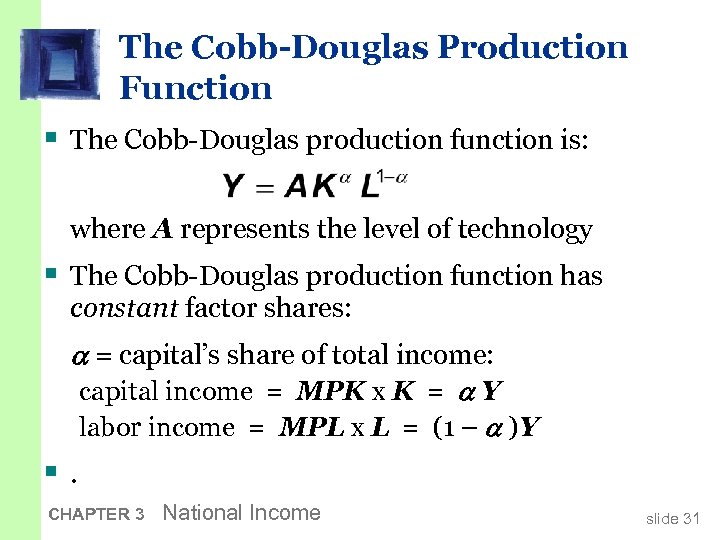 The Cobb-Douglas Production Function § The Cobb-Douglas production function is: where A represents the level of technology § The Cobb-Douglas production function has constant factor shares: = capital’s share of total income: capital income = MPK x K = Y labor income = MPL x L = (1 – )Y §. CHAPTER 3 National Income slide 31
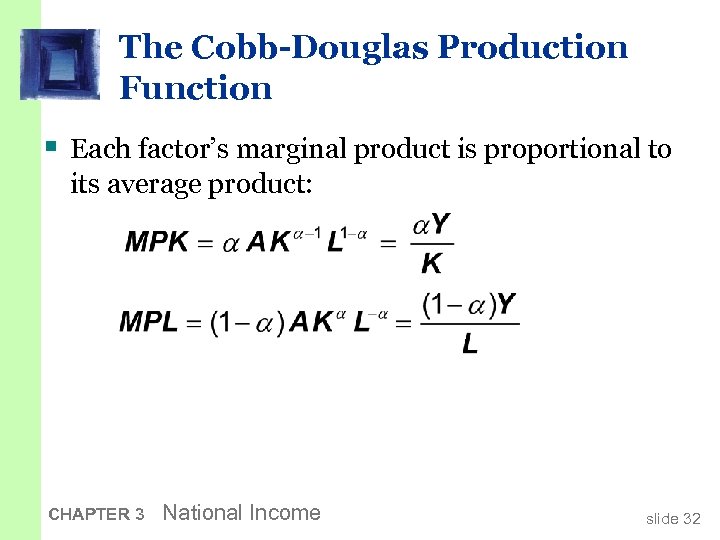 The Cobb-Douglas Production Function § Each factor’s marginal product is proportional to its average product: CHAPTER 3 National Income slide 32
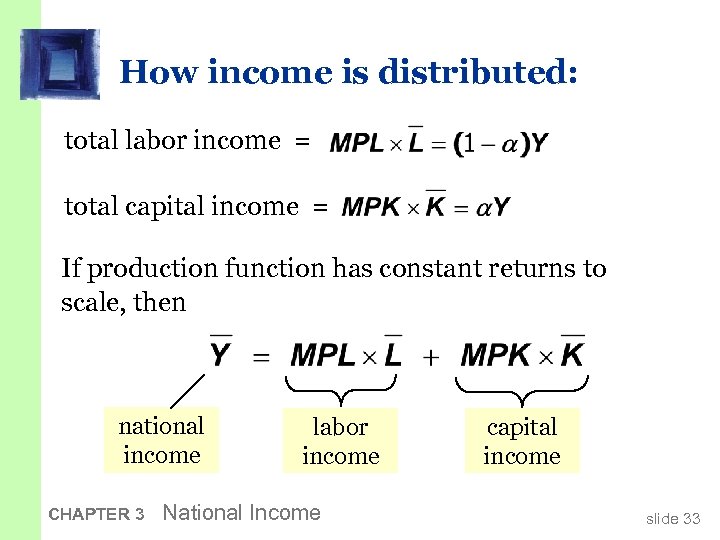 How income is distributed: total labor income = total capital income = If production function has constant returns to scale, then national income CHAPTER 3 labor income National Income capital income slide 33
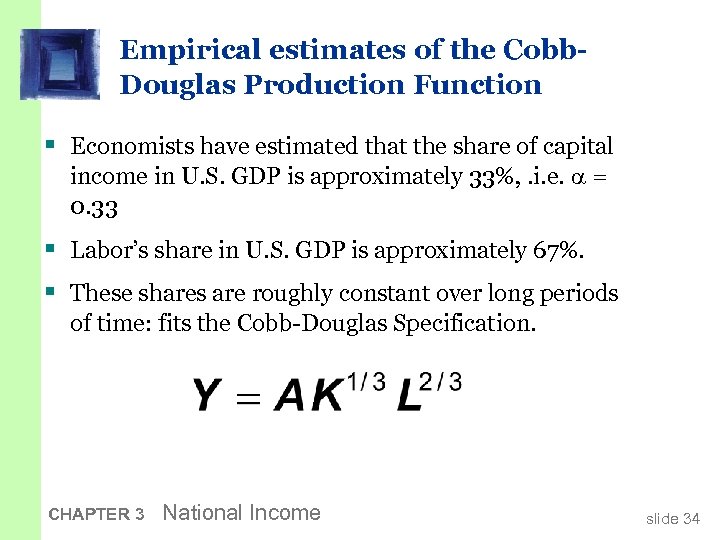 Empirical estimates of the Cobb. Douglas Production Function § Economists have estimated that the share of capital income in U. S. GDP is approximately 33%, . i. e. = 0. 33 § Labor’s share in U. S. GDP is approximately 67%. § These shares are roughly constant over long periods of time: fits the Cobb-Douglas Specification. CHAPTER 3 National Income slide 34
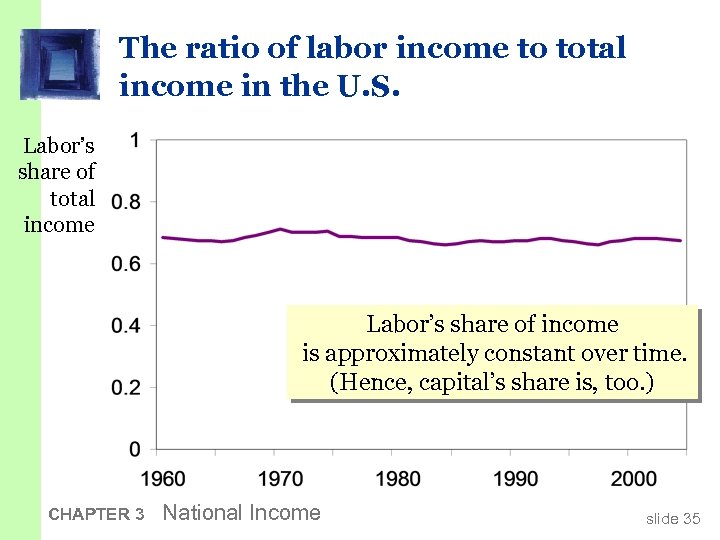 The ratio of labor income to total income in the U. S. Labor’s share of total income Labor’s share of income is approximately constant over time. (Hence, capital’s share is, too. ) CHAPTER 3 National Income slide 35
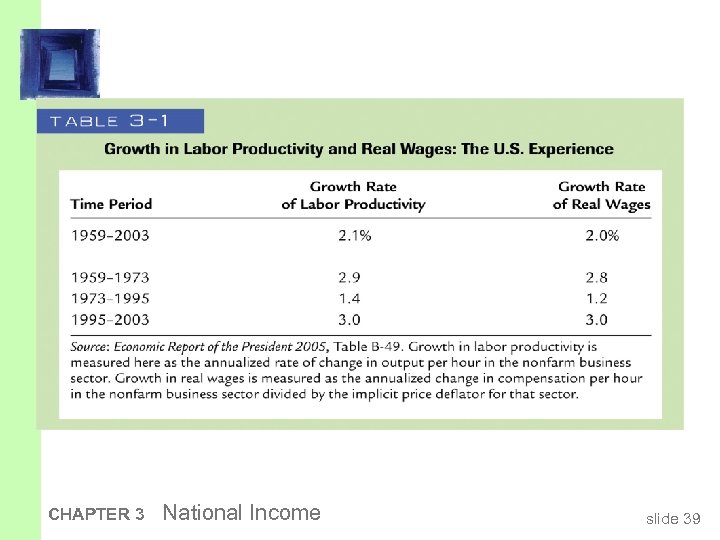
 The Neoclassical Theory of Distribution § Each factor of production is paid its marginal product § In equilibrium, MPL = W/P (real wage) MPK = r/P (real rental rate) § Characterized by the Law of Diminishing Returns § Growth in factor productivity should be tracked by the growth in real factor income. CHAPTER 3 National Income slide 36
 The Neoclassical Theory in Action… Black Death and Factor Prices § Outbreak of bubonic plague in Europe or The Black Death in the year 1348 § The population of Europe was reduced by a third § Real wages doubled and peasants enjoyed economic prosperity § Real rents on land fell by nearly 50 percent and the landowner class suffered significant reductions in their incomes CHAPTER 3 National Income slide 37
 The Neoclassical Theory in Action… The Abolition of Slavery Act, U. K. (1833) § Former slaves in the Caribbean colonies demanded higher wages and compensation § Plantations in the Caribbean Islands became less profitable as labor costs rose § British response: IMPORT labor from colonies in Asia and Africa § What happened to wage rates in the Caribbean? CHAPTER 3 National Income slide 38
 CHAPTER 3 National Income slide 39
 Outline of model A closed economy, market-clearing model Supply side DONE q factor markets (supply, demand, price) DONE q determination of output/income Demand side Next q determinants of C, I, and G Equilibrium q goods market q loanable funds market CHAPTER 3 National Income slide 40
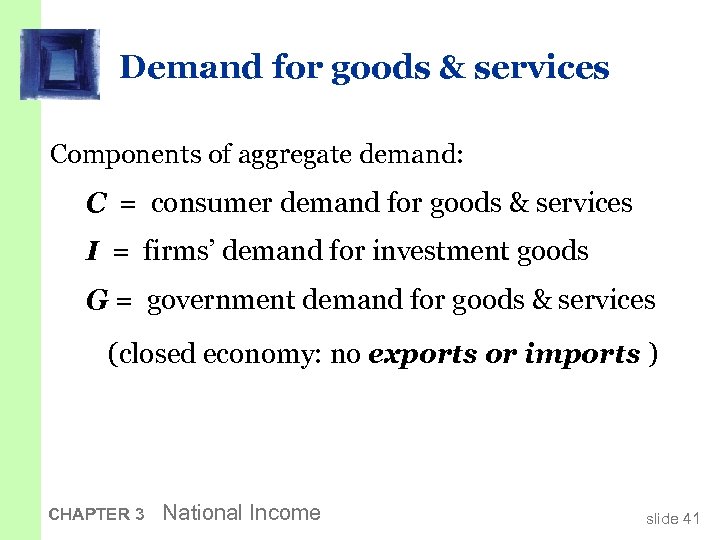 Demand for goods & services Components of aggregate demand: C = consumer demand for goods & services I = firms’ demand for investment goods G = government demand for goods & services (closed economy: no exports or imports ) CHAPTER 3 National Income slide 41
![Gross Domestic Product, USA [Billions of dollars] Seasonally adjusted at annual rates Source: Bureau](https://present5.com/presentation/75b04cdd7a728e62d46fa2ed6bf4d486/image-33.jpg "Gross Domestic Product, USA [Billions of dollars] Seasonally adjusted at annual rates Source: Bureau") Gross Domestic Product, USA [Billions of dollars] Seasonally adjusted at annual rates Source: Bureau of Economic Analysis CHAPTER 3 National Income slide 42
Gross Domestic Product, USA [Billions of dollars] Seasonally adjusted at annual rates Source: Bureau of Economic Analysis CHAPTER 3 National Income slide 42
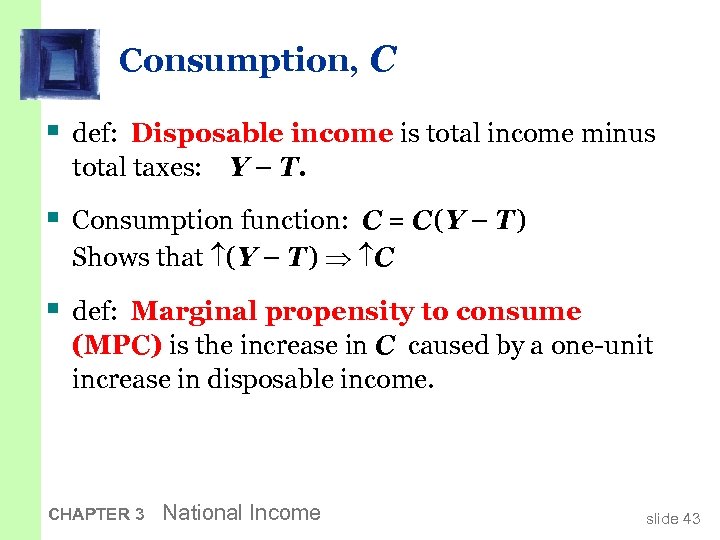 Consumption, C § def: Disposable income is total income minus total taxes: Y – T. § Consumption function: C = C (Y – T ) Shows that (Y – T ) C § def: Marginal propensity to consume (MPC) is the increase in C caused by a one-unit increase in disposable income. CHAPTER 3 National Income slide 43
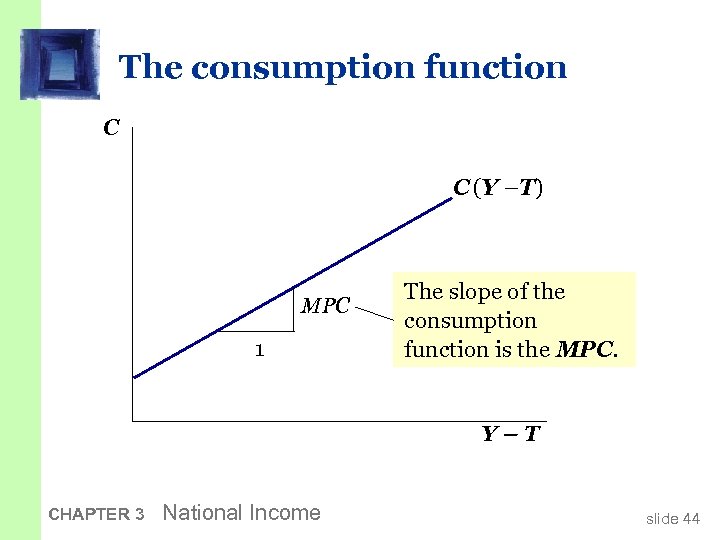 The consumption function C C (Y –T) MPC 1 The slope of the consumption function is the MPC. Y–T CHAPTER 3 National Income slide 44
 Investment, I § The investment function is I = I (r ), where r denotes the real interest rate, the nominal interest rate corrected for inflation. § The real interest rate is § the cost of borrowing § the opportunity cost of using one’s own funds to finance investment spending. So, r I CHAPTER 3 National Income slide 45
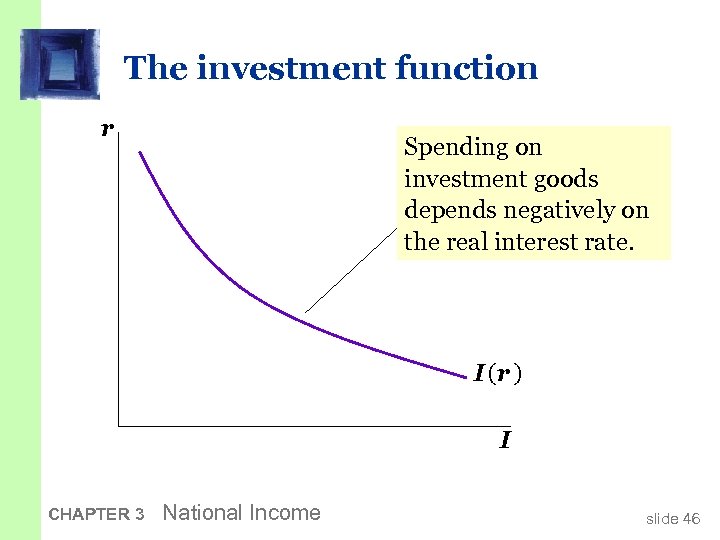 The investment function r Spending on investment goods depends negatively on the real interest rate. I (r ) I CHAPTER 3 National Income slide 46
 Government spending, G § G = govt spending on goods and services. § Assume government spending and total taxes are exogenous: CHAPTER 3 National Income slide 47
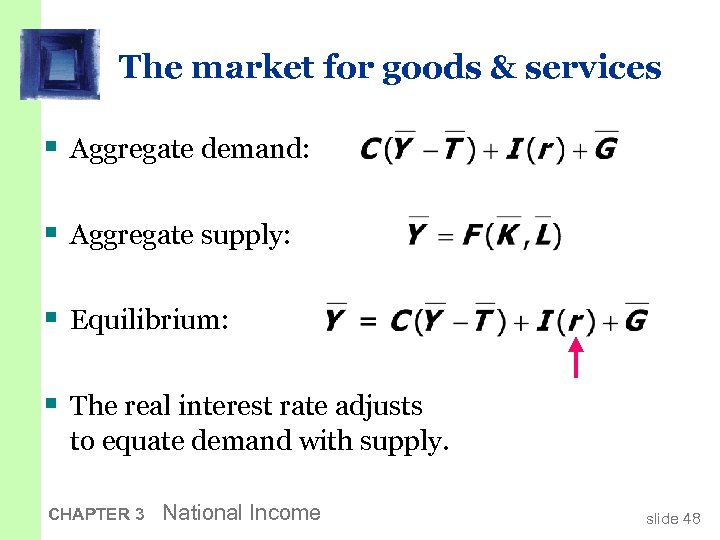 The market for goods & services § Aggregate demand: § Aggregate supply: § Equilibrium: § The real interest rate adjusts to equate demand with supply. CHAPTER 3 National Income slide 48
 The loanable funds market § A simple supply-demand model of the financial system. § One asset: “loanable funds” § demand for funds: investment § supply of funds: saving § “price” of funds: real interest rate CHAPTER 3 National Income slide 49
 Demand for funds: Investment The demand for loanable funds… § comes from investment: Firms borrow to finance spending on plant & equipment, new office buildings, etc. Consumers borrow to buy new houses. § depends negatively on r, the “price” of loanable funds (cost of borrowing). CHAPTER 3 National Income slide 50
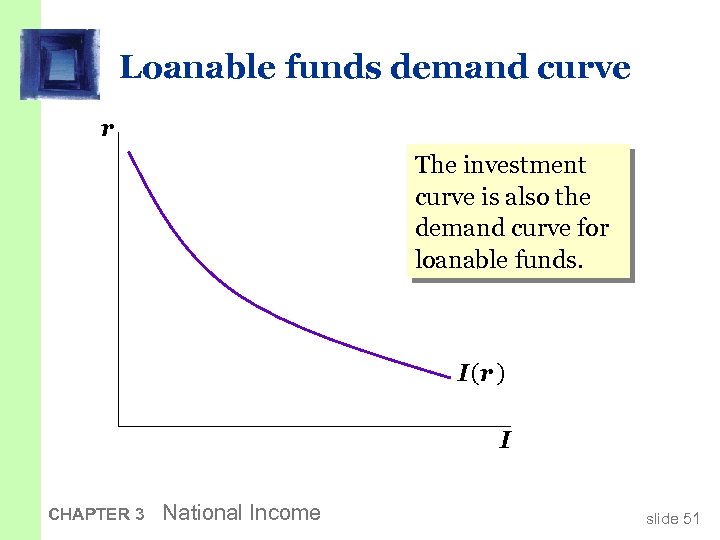 Loanable funds demand curve r The investment curve is also the demand curve for loanable funds. I (r ) I CHAPTER 3 National Income slide 51
 Supply of funds: Saving § The supply of loanable funds comes from saving: § Households use their saving to make bank deposits, purchase bonds and other assets. These funds become available to firms to borrow to finance investment spending. § The government may also contribute to saving if it does not spend all the tax revenue it receives. CHAPTER 3 National Income slide 52
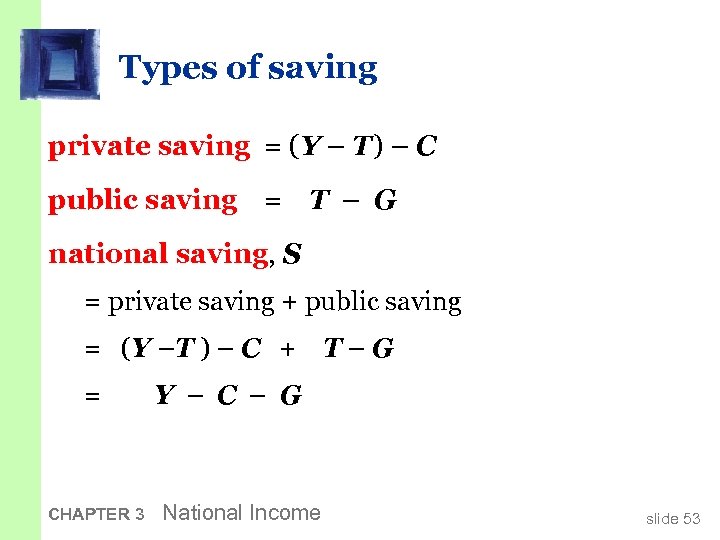 Types of saving private saving = (Y – T ) – C public saving = T – G national saving, S = private saving + public saving = (Y –T ) – C + T – G = CHAPTER 3 Y – C – G National Income slide 53
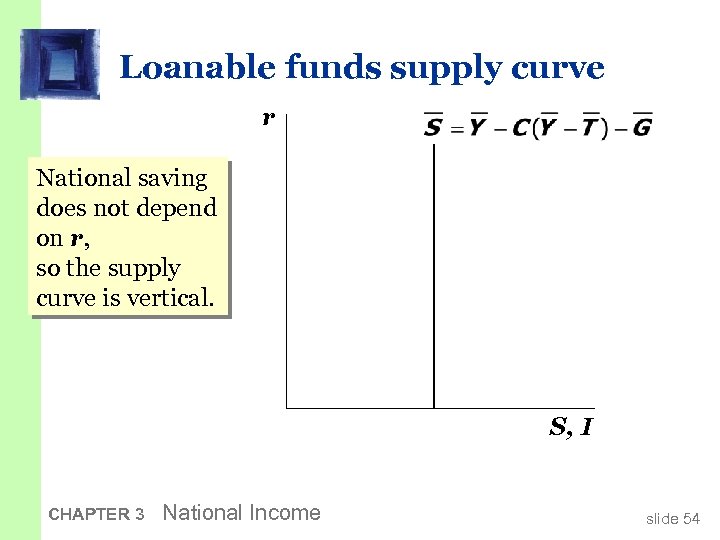 Loanable funds supply curve r National saving does not depend on r, so the supply curve is vertical. S, I CHAPTER 3 National Income slide 54
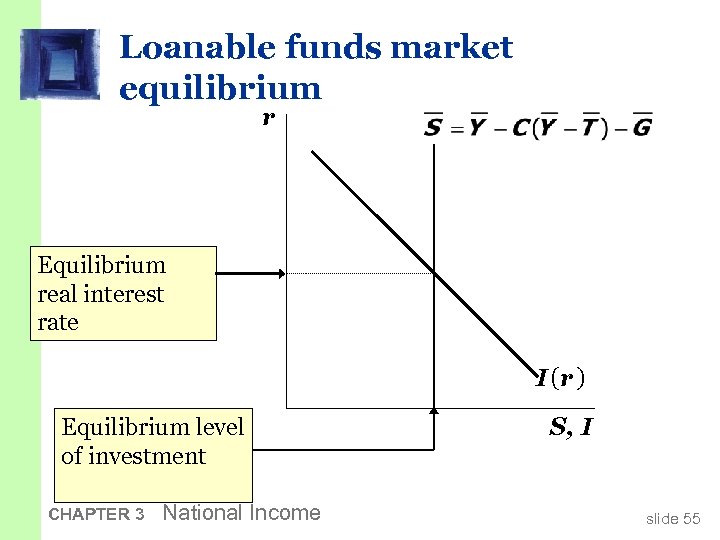 Loanable funds market equilibrium r Equilibrium real interest rate I (r ) Equilibrium level of investment CHAPTER 3 National Income S, I slide 55
 Budget surpluses and deficits § If T > G, budget surplus = (T – G ) = public saving. § If T < G, budget deficit = (G – T ) and public saving is negative. § If T = G , “balanced budget, ” public saving = 0. § The U. S. government finances its deficit by issuing Treasury bonds – i. e. , borrowing. CHAPTER 3 National Income slide 59
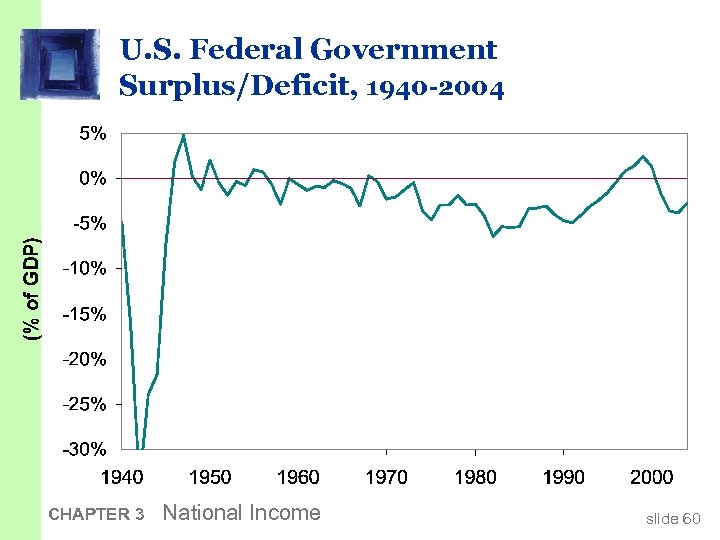 U. S. Federal Government Surplus/Deficit, 1940 -2004 CHAPTER 3 National Income slide 60
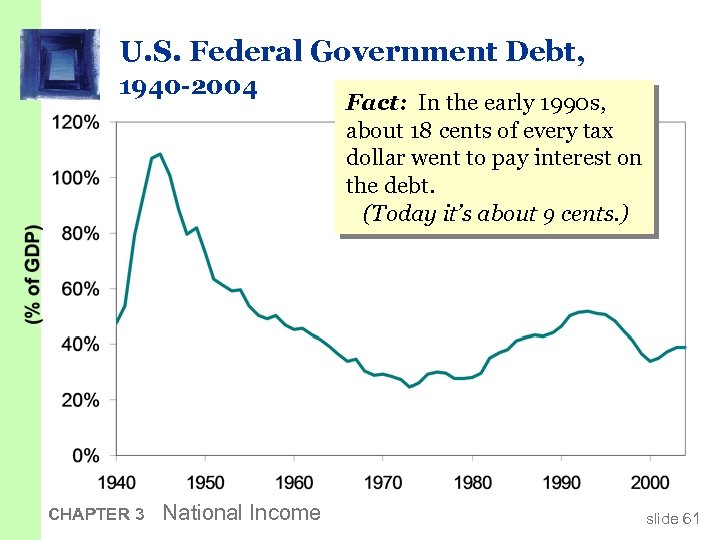 U. S. Federal Government Debt, 1940 -2004 CHAPTER 3 National Income Fact: In the early 1990 s, about 18 cents of every tax dollar went to pay interest on the debt. (Today it’s about 9 cents. ) slide 61
 The U. S. Budget Deficit: Where is it Headed? Year Actual or Projected (USD, billions) 2002 157 2004 412 2006 248 2007 158* 2008 244* 2011 400* CHAPTER 3 National Income slide 62
 "Over the long term, the budget remains on an unsustainable path" -Congressional Budget Office Report, 2007 § Continued military operations in Iraq and Afghanistan § Extension of temporary tax cuts enacted in President Bush's first term § Rising health-care and social security costs and the retirement of the “baby-boom” generation § Longer-term outlook is bleak. CHAPTER 3 National Income slide 63
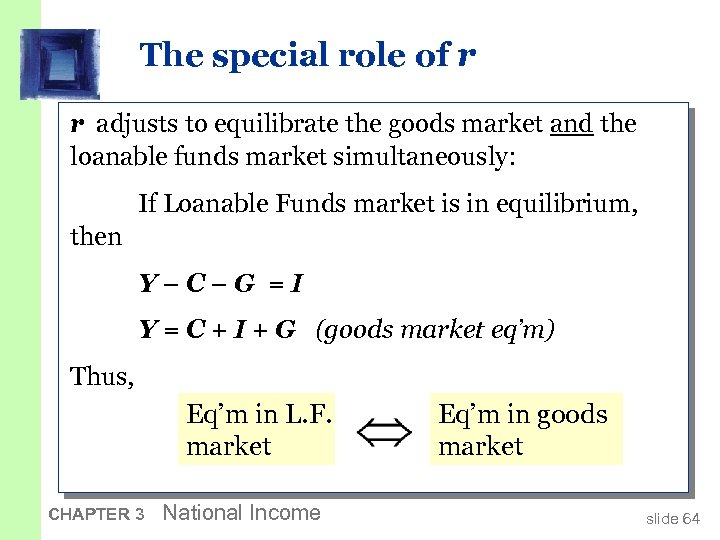 The special role of r r adjusts to equilibrate the goods market and the loanable funds market simultaneously: If Loanable Funds market is in equilibrium, then Y–C–G =I Y = C + I + G (goods market eq’m) Thus, Eq’m in L. F. market CHAPTER 3 National Income Eq’m in goods market slide 64
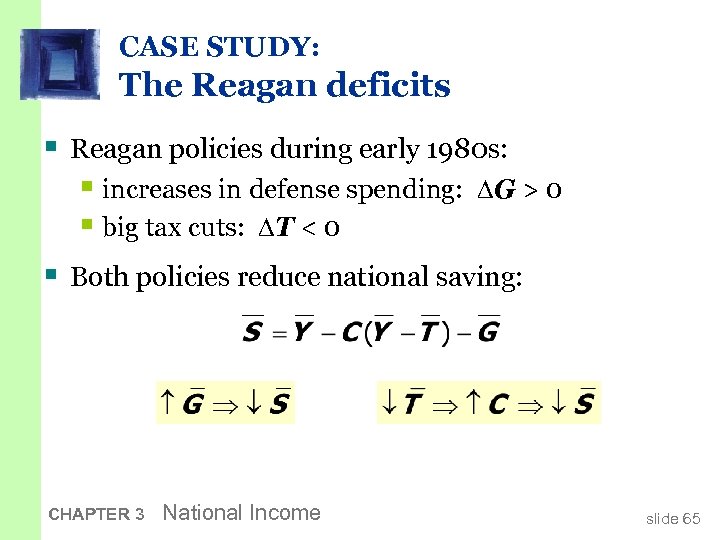 CASE STUDY: The Reagan deficits § Reagan policies during early 1980 s: § increases in defense spending: G > 0 § big tax cuts: T < 0 § Both policies reduce national saving: CHAPTER 3 National Income slide 65
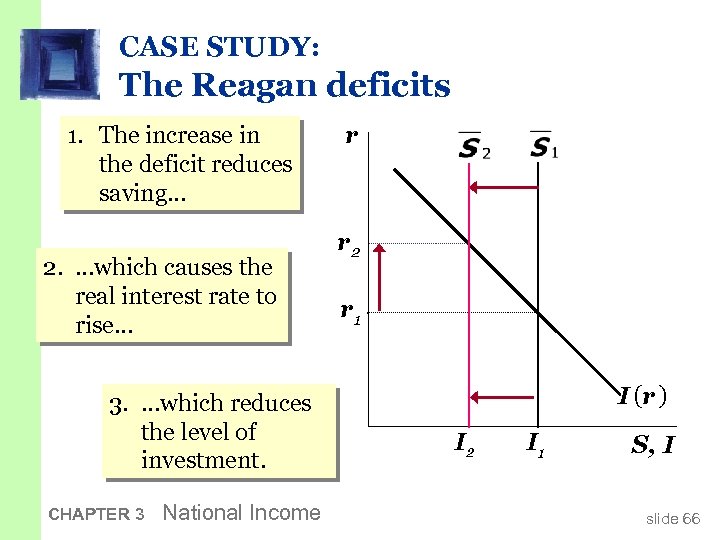 CASE STUDY: The Reagan deficits 1. The increase in the deficit reduces saving… 2. …which causes the real interest rate to rise… 3. …which reduces the level of investment. CHAPTER 3 National Income r r 2 r 1 I (r ) I 2 I 1 S, I slide 66
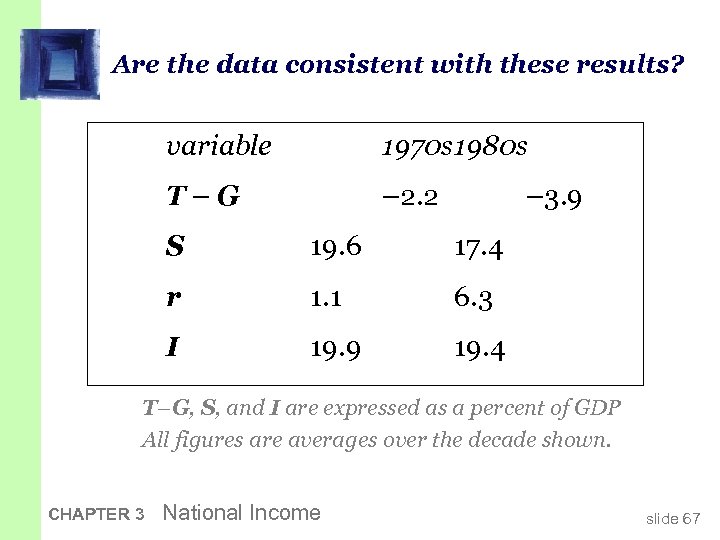 Are the data consistent with these results? variable 1970 s 1980 s T–G – 2. 2 – 3. 9 S 19. 6 17. 4 r 1. 1 6. 3 I 19. 9 19. 4 T–G, S, and I are expressed as a percent of GDP All figures are averages over the decade shown. CHAPTER 3 National Income slide 67
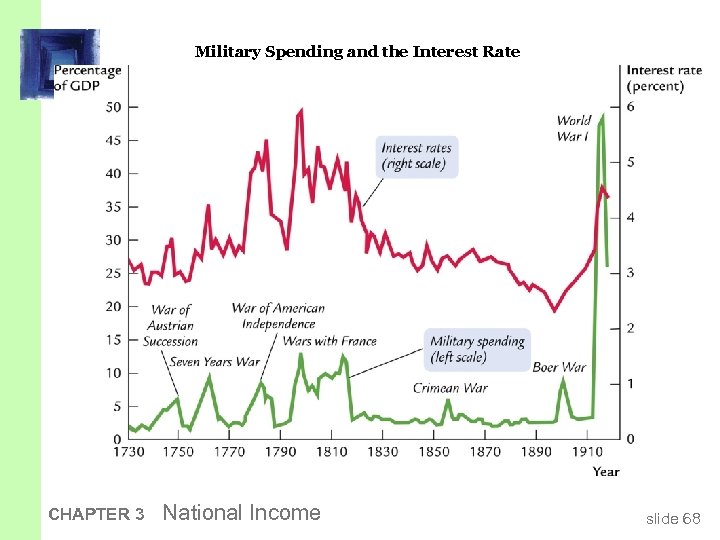 Military Spending and the Interest Rate in the United Kingdom: 1730 -1920 CHAPTER 3 National Income slide 68
 Digression: Mastering models To master a model, be sure to know: 1. Which of its variables are endogenous and which are exogenous. 2. For each curve in the diagram, know a. definition b. intuition for slope c. all the things that can shift the curve 3. Use the model to analyze the effects of each item in 2 c. CHAPTER 3 National Income slide 69
 Mastering the loanable funds model Things that shift the saving curve § public saving § fiscal policy: changes in G or T § private saving § preferences § tax laws that affect saving – 401(k) – IRA – replace income tax with consumption tax CHAPTER 3 National Income slide 70
 Mastering the loanable funds model, continued Things that shift the investment curve § some technological innovations § to take advantage of the innovation, firms must buy new investment goods § tax laws that affect investment § investment tax credit CHAPTER 3 National Income slide 72
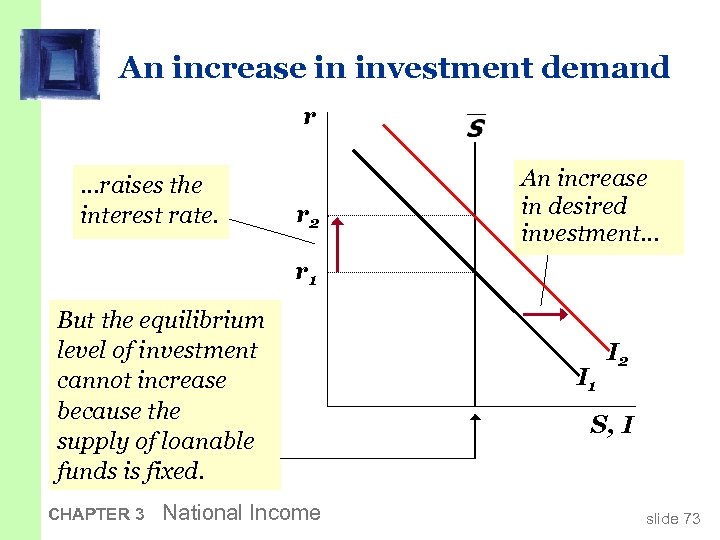 An increase in investment demand r …raises the interest rate. r 2 An increase in desired investment… r 1 But the equilibrium level of investment cannot increase because the supply of loanable funds is fixed. CHAPTER 3 National Income I 1 I 2 S, I slide 73
 Saving and the interest rate § Why might saving depend on r ? § How would the results of an increase in investment demand be different? § Would r rise as much? § Would the equilibrium value of I change? CHAPTER 3 National Income slide 74
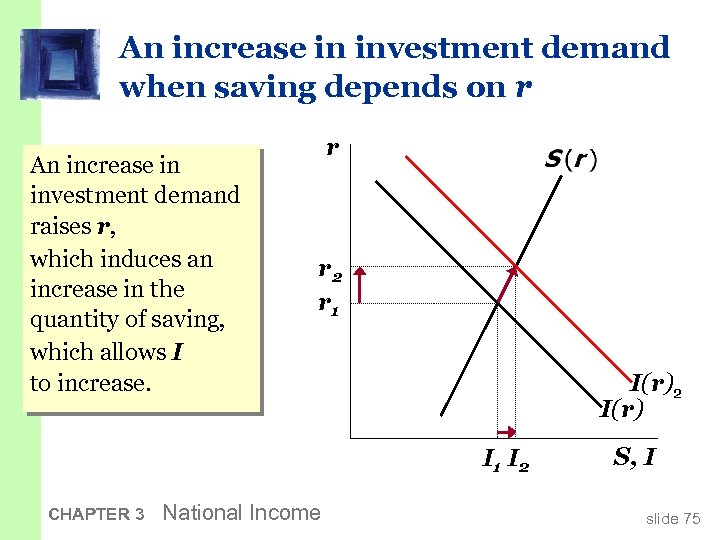 An increase in investment demand when saving depends on r An increase in investment demand raises r, which induces an increase in the quantity of saving, which allows I to increase. r r 2 r 1 I(r)2 I(r) I 1 I 2 CHAPTER 3 National Income S, I slide 75
 Chapter Summary § Total output is determined by § the economy’s quantities of capital and labor § the level of technology § Competitive firms hire each factor until its marginal product equals its price. § If the production function has constant returns to scale, then labor income plus capital income equals total income (output). CHAPTER 33 CHAPTER National Income slide 76
 Chapter Summary § A closed economy’s output is used for § consumption § investment § government spending § The real interest rate adjusts to equate the demand for and supply of § goods and services § loanable funds CHAPTER 33 CHAPTER National Income slide 77
 Chapter Summary § A decrease in national saving causes the interest rate to rise and investment to fall. § An increase in investment demand causes the interest rate to rise, but does not affect the equilibrium level of investment if the supply of loanable funds is fixed. CHAPTER 33 CHAPTER National Income slide 78