


 Скачать презентацию N American English European Settlement of N
330e5dfa1aca48a20b5058c69cd06b25.ppt
- Количество слайдов: 34
 N. American English
 European Settlement of N. America • Early Modern English – Shakespeare
 Early Modern English – a reminder • 1. 2. 3. Use of do as an auxiliary affirmative: I do think interrogative: do you think? negative: I do not think
 Early Modern English – a reminder • Use of do as an auxiliary 1. affirmative: v. common 1500 -1700; died out in prose in 18 th century She ded call after hym ryght pyteousli (Caxton 1489)
 Early Modern English – a reminder • Use of do as an auxiliary 1. affirmative: to avoid inversion There did I see that low-spirited Swaine (Shakespeare) Not a single word did Peggotty speak (Dickens) Well do I remember the scene
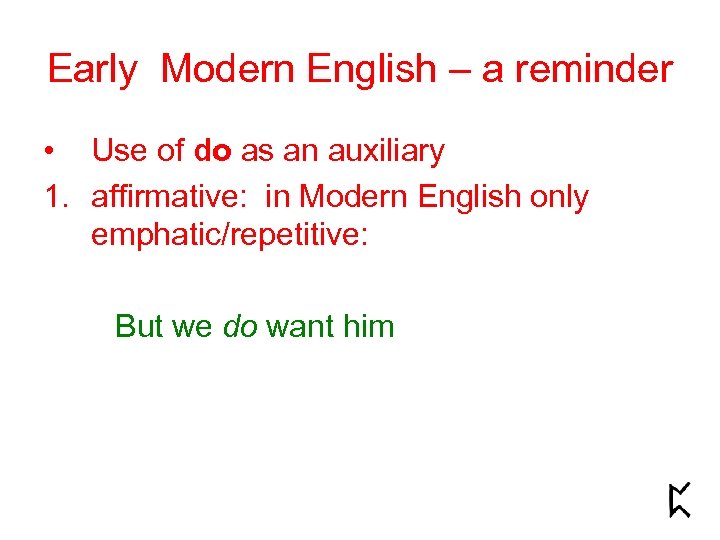 Early Modern English – a reminder • Use of do as an auxiliary 1. affirmative: in Modern English only emphatic/repetitive: But we do want him
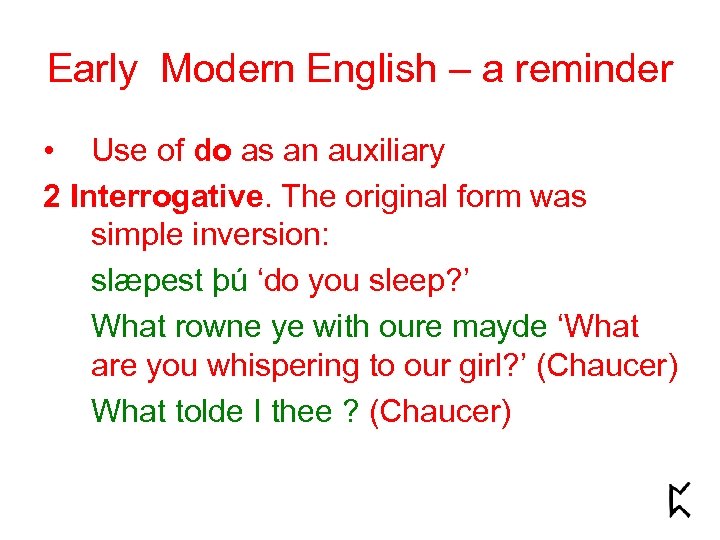 Early Modern English – a reminder • Use of do as an auxiliary 2 Interrogative. The original form was simple inversion: slæpest þú ‘do you sleep? ’ What rowne ye with oure mayde ‘What are you whispering to our girl? ’ (Chaucer) What tolde I thee ? (Chaucer)
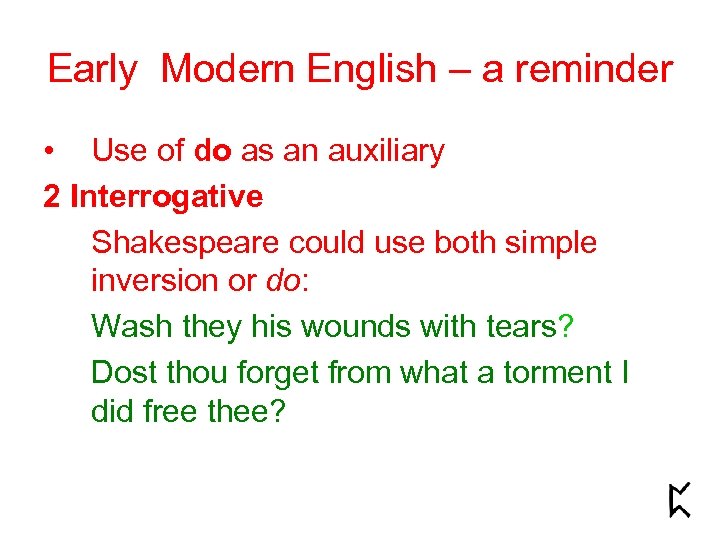 Early Modern English – a reminder • Use of do as an auxiliary 2 Interrogative Shakespeare could use both simple inversion or do: Wash they his wounds with tears? Dost thou forget from what a torment I did free thee?
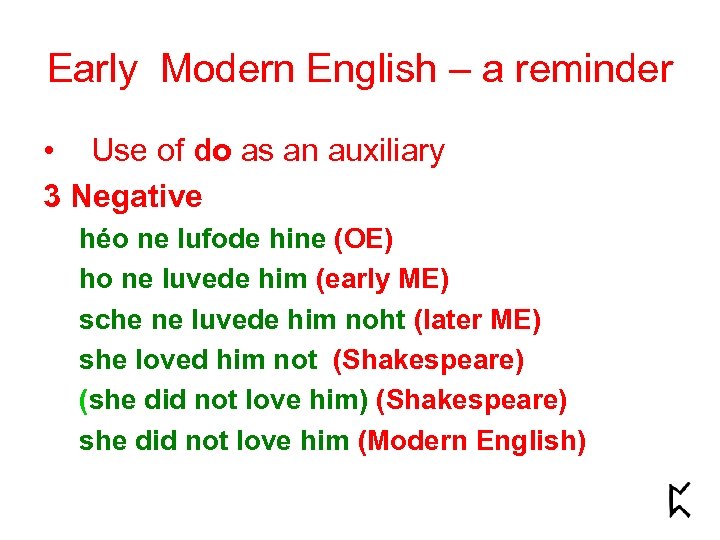 Early Modern English – a reminder • Use of do as an auxiliary 3 Negative héo ne lufode hine (OE) ho ne luvede him (early ME) sche ne luvede him noht (later ME) she loved him not (Shakespeare) (she did not love him) (Shakespeare) she did not love him (Modern English)
 Early Modern English – a reminder • Use of do as an auxiliary 3 Negative Some verbs can still use simple “not”: I know not, it matters not, I think not won’t aren’t ain't
 Early Modern English – a reminder • 2 nd-person forms of address OE: singular þú þé þín plural gé éower There was also a dual: git incer ME: singular þou þe þíne plural ye your Late ME: ye your came to be used as a polite form. Shakespeare had thou, thee, thine in singular; ye your in the plural and the polite form. Only your remain today.
 Early Modern English – a reminder • Fully rhotic farmer, Shakespeare, horse, heart, China • No FOOT-STRUT Split butcher, cut, love, brother • No BATH-TRAP Split fancy, dancing, laugh, ask, demand • Great Vowel Shift without later Diphthonging → → →
 • Great Vowel Shift without later Diphthonging
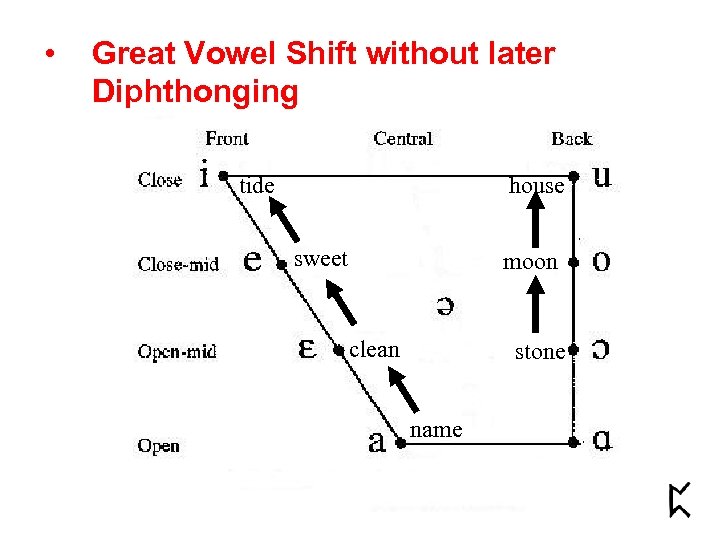 • Great Vowel Shift without later Diphthonging tide house sweet moon clean stone name
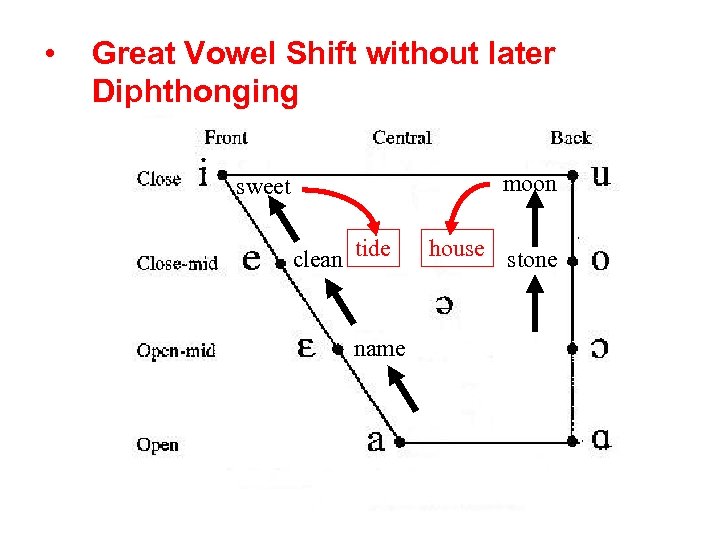 • Great Vowel Shift without later Diphthonging moon sweet clean tide name house stone
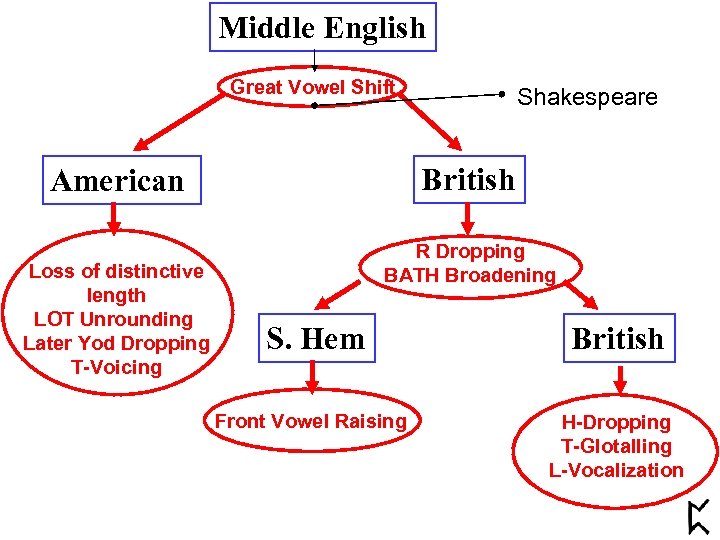 Middle English Great Vowel Shift British American Loss of distinctive length LOT Unrounding Later Yod Dropping T-Voicing Shakespeare R Dropping BATH Broadening S. Hem British Front Vowel Raising H-Dropping T-Glotalling L-Vocalization
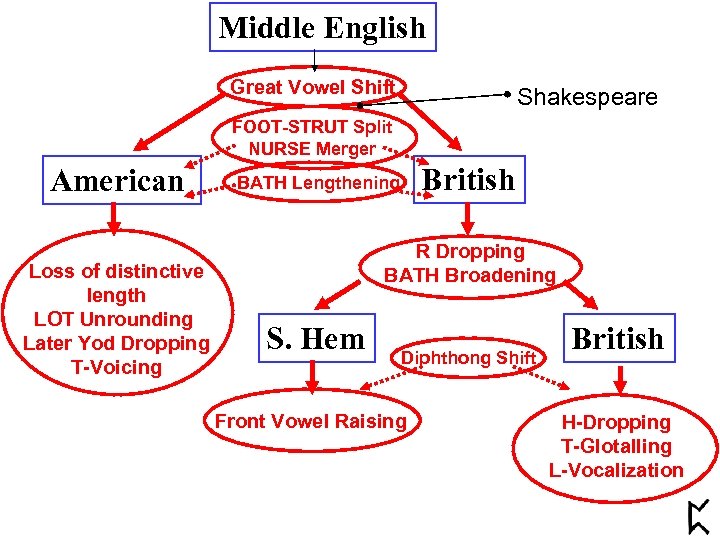 Middle English Great Vowel Shift Shakespeare FOOT-STRUT Split NURSE Merger American Loss of distinctive length LOT Unrounding Later Yod Dropping T-Voicing British BATH Lengthening R Dropping BATH Broadening S. Hem Diphthong Shift Front Vowel Raising British H-Dropping T-Glotalling L-Vocalization
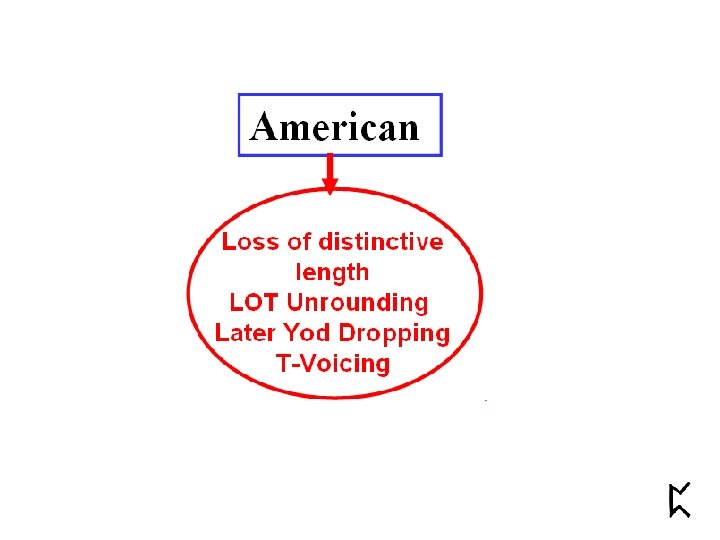
 American English • • Loss of distinctive length LOT Unrounding Later Yod Dropping T-Voicing
 American English • Loss of distinctive length – Effects BATH and CLOTH – BATH Lengthening disappears – CLOTH-LOT Split is no longer a length split • It may be that the CLOTH-LOT Split in America (“hot dog split”) and the CLOTH-LOT Split in England (now practically defunct) are 2 independent developments
 American English • BATH • bath=trap in Gen. Am • bath=palm=start in RP
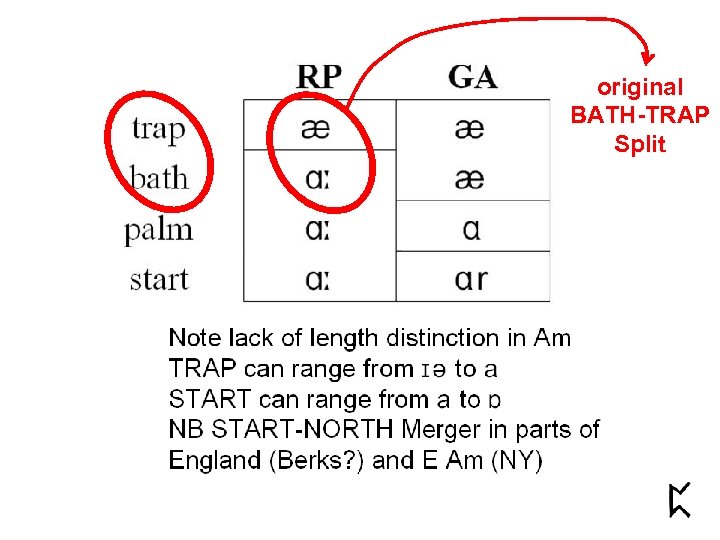 original BATH-TRAP Split
 American English LOT Unrounding (Also in SW England Ireland – independent? Or does Irish have an effect on American? )
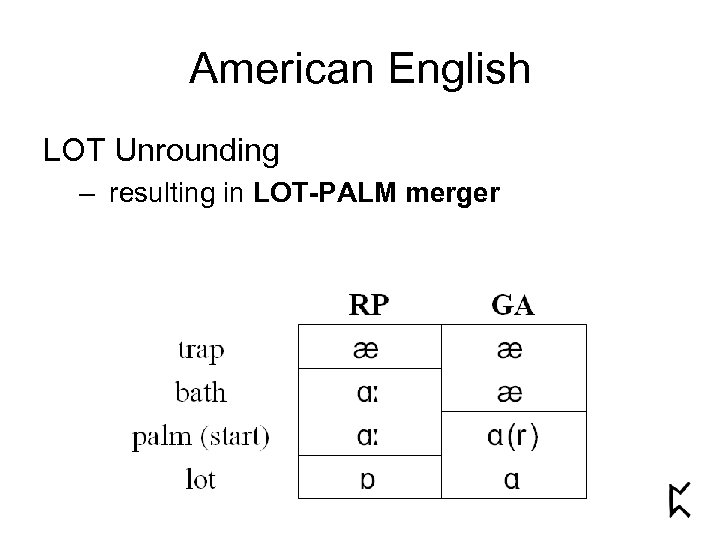 American English LOT Unrounding – resulting in LOT-PALM merger
 American English • • Loss of distinctive length LOT Unrounding – LOT-PALM Merger – LOT-THOUGHT Merger
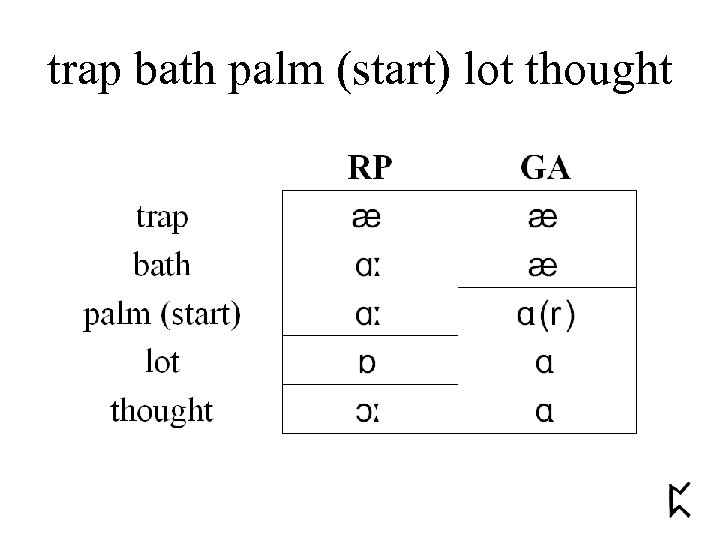 trap bath palm (start) lot thought
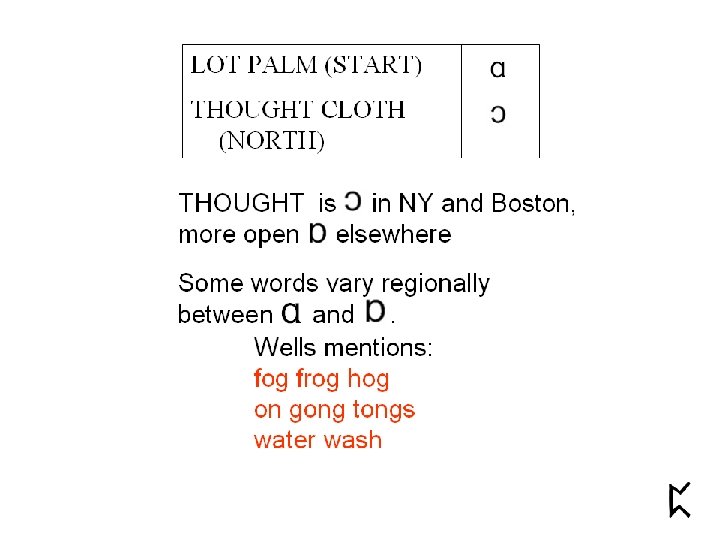
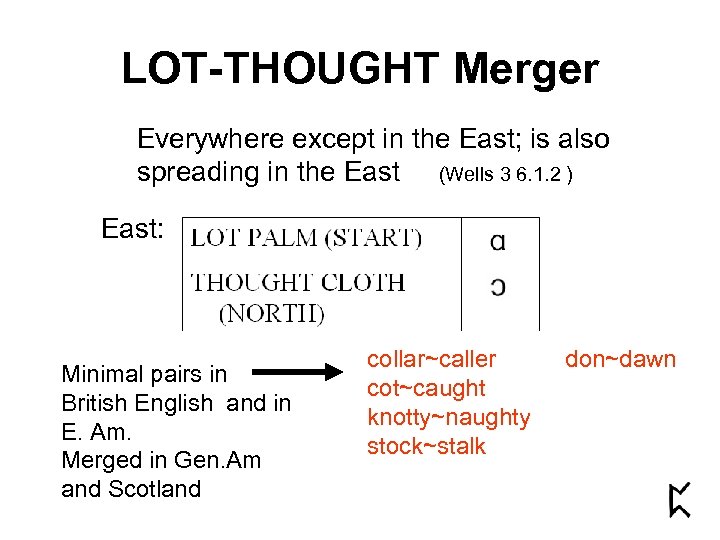 LOT-THOUGHT Merger Everywhere except in the East; is also spreading in the East (Wells 3 6. 1. 2 ) East: Minimal pairs in British English and in E. Am. Merged in Gen. Am and Scotland collar~caller cot~caught knotty~naughty stock~stalk don~dawn
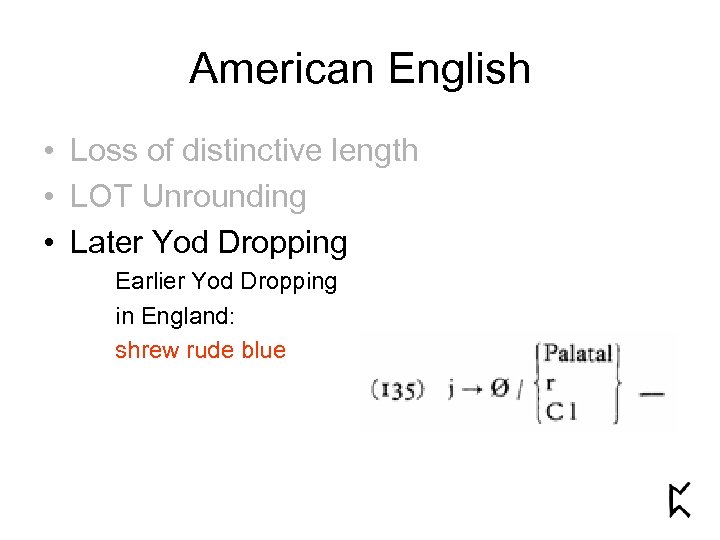 American English • Loss of distinctive length • LOT Unrounding • Later Yod Dropping Earlier Yod Dropping in England: shrew rude blue
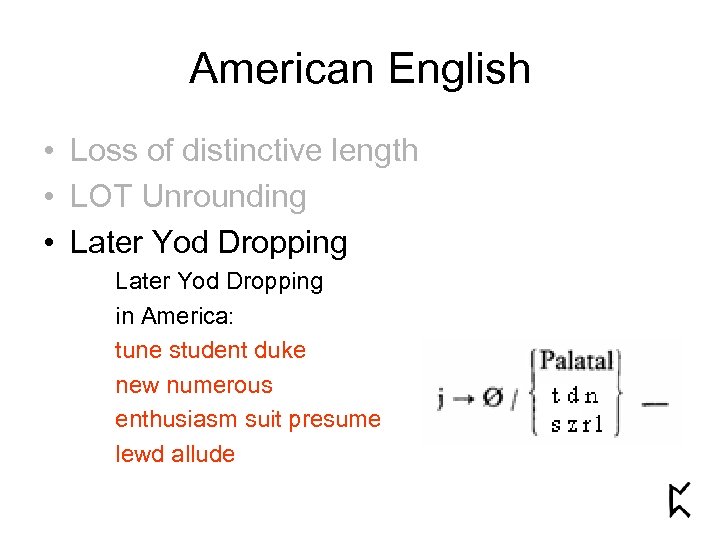 American English • Loss of distinctive length • LOT Unrounding • Later Yod Dropping in America: tune student duke new numerous enthusiasm suit presume lewd allude
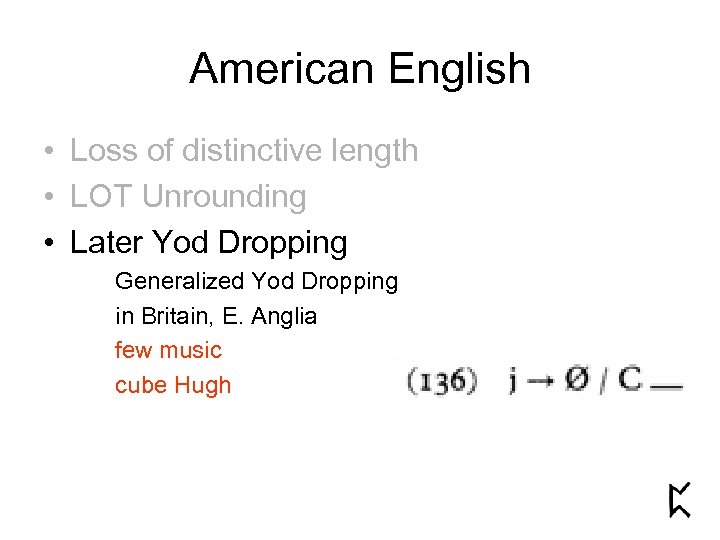 American English • Loss of distinctive length • LOT Unrounding • Later Yod Dropping Generalized Yod Dropping in Britain, E. Anglia few music cube Hugh
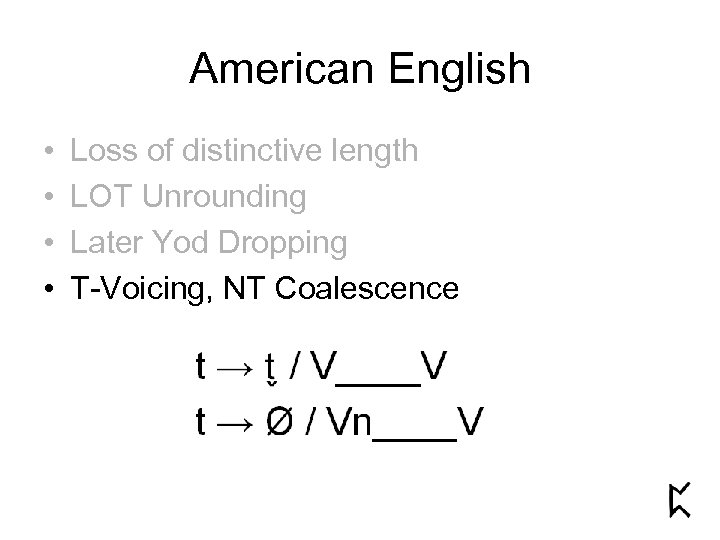 American English • • Loss of distinctive length LOT Unrounding Later Yod Dropping T-Voicing, NT Coalescence
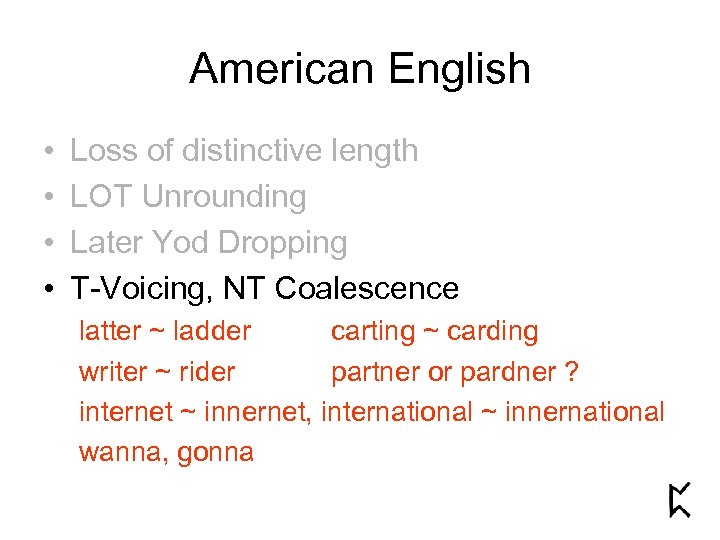 American English • • Loss of distinctive length LOT Unrounding Later Yod Dropping T-Voicing, NT Coalescence latter ~ ladder carting ~ carding writer ~ rider partner or pardner ? internet ~ innernet, international ~ innernational wanna, gonna
 - end -