


 Скачать презентацию Myers PSYCHOLOGY Chapter 9 Memory What is
e9898bd2233281b2a399802a45c78b3b.ppt
- Количество слайдов: 89
 Myers’ PSYCHOLOGY Chapter 9 Memory
 What is Memory? § Memory § Your mind’s storehouse § Ability to store and retrieve information § persistence of learning over time § Capacity of memory is most apparent in recall of unique or highly emotional moments § Called “flashbulb memories”
 Building of Memory § Building of a memory § § § Similar to how you write an essay First, research and sources of information Gathering of information Organizing the information Then you write drawing from your research that you organized and what you already knew about the subject
 Information Processing § Memory as Information Processing § similar to a computer § write to file § save to disk § read from disk § From a computer to our brains § Get information to our brains is encoding § Retain the information is storage § Get the information back out is retrieval
 3 -Stage Processing Model § Atkinson and Shiffrin (1968) § We form memories through 3 stages § Sensory short-term long-term § Sensory Memory § the immediate, initial recording of sensory information in the memory system § Where we first record “to-be-remembered” information § Fleeting
 3 -Stage Processing Model § Short-Term Memory § A bin where sensory memories are processed into § activated memory that holds a few items briefly § look up a phone number, then quickly dial before the information is forgotten § Can be rehearsed for encoding into longterm memory
 3 -Stage Processing Model § Long-Term Memory § the relatively permanent and limitless storehouse of the memory system § Later retrieval § Flawless? § Not even close! § For example, something can skip the first 2 steps and immediately enter long-term memory (without our awareness)
 Shining the Light z. We are bombarded with sensory information all the time z. We have to shine a light (focus our attention) on what is important (what we want to know) z. Incoming stimuli with information we retrieve from our long-term memory becomes a conscious short-term memories in a temporary construction zone y. Here we rehearse and manipulate the information y“Working memory” y. Fades unless we keep on using it or rehearsing it
 Working Memory z. Includes auditory and visual-spatial elements y. What we hear and see z. These are coordinated by a central executive processor z. The central executive allows each subsystem (auditory and visual-spatial) to process simultaneously y. Why we can talk while driving
 Working Memory’s Limitations z. Working memory has limitations z. Why we can’t easily remember the melody of one song while listening to another
 Lobes! z. Just of side note… z. Scans show… y. Frontal lobes are active when the central executive focuses on complex thinking y. Parietal and temporal lobes are active when processing auditory and visual information
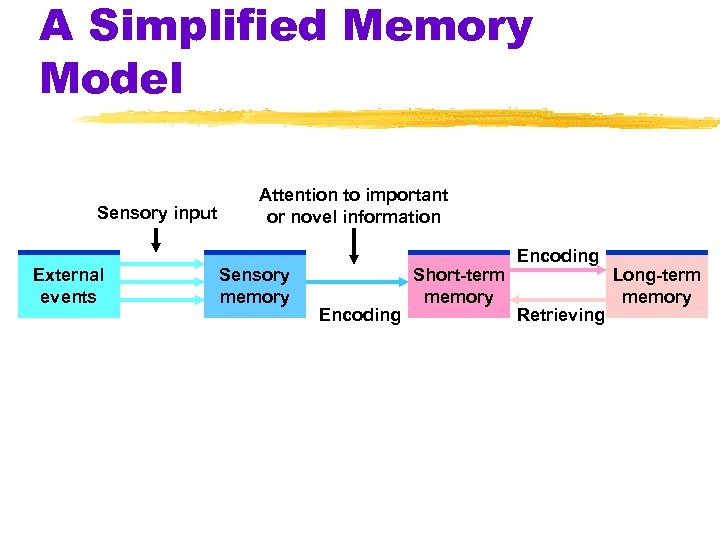 A Simplified Memory Model Sensory input External events Attention to important or novel information Sensory memory Encoding Short-term memory Encoding Retrieving Long-term memory
 End Day 1
 Encoding – Getting Information In z. Once sensory information is registered it must get encoded and transferred into the memory system z. Two ways: y. Automatic y. Effortful
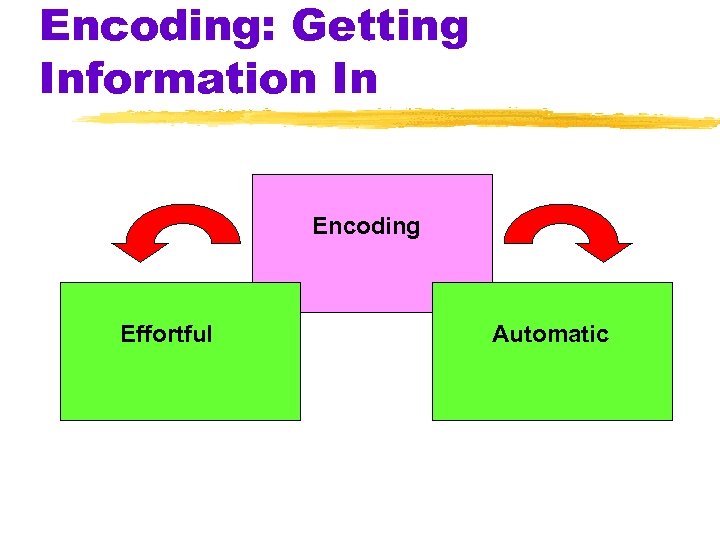 Encoding: Getting Information In Encoding Effortful Automatic
 Automatic Processing § With little or no effort or without conscious effort § Possible thanks to parallel processing § Such as: § Space § Remember seeing something somewhere when you are later looking for it – you can visualize where you saw it § Time § Retracing your steps to find something based on what you were doing at certain times § Frequency § How many times things happen
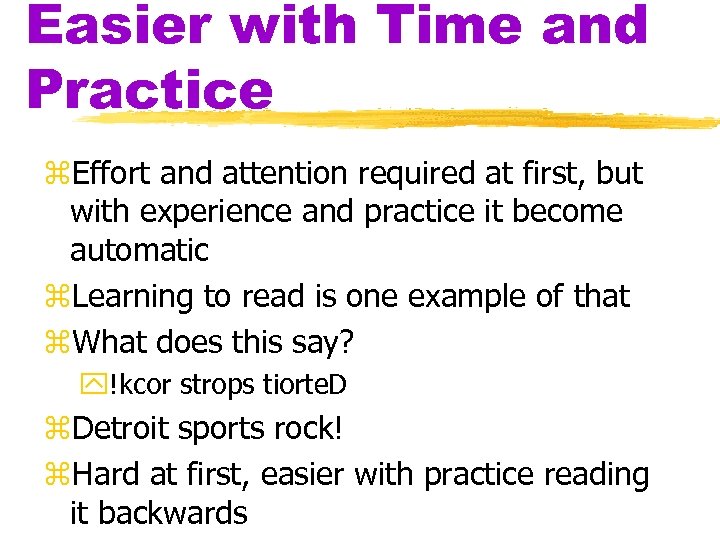 Easier with Time and Practice z. Effort and attention required at first, but with experience and practice it become automatic z. Learning to read is one example of that z. What does this say? y!kcor strops tiorte. D z. Detroit sports rock! z. Hard at first, easier with practice reading it backwards
 Effortful Processing § Requires attention and conscious effort § Such as what you are learning right now § Learn through rehearsal/conscious repetition § Hermann Ebbinghaus is to the study of memory as Pavlov was to classical conditioning § Amount learned depends on time spent learning it § Overlearning increases retention, so…no such things as studying too much…sorry!
 Encoding § Ebbinghaus used nonsensical syllables § TUV ZOF GEK WAV § the more times practiced on Day 1, the fewer repetitions to relearn on Day 2 § Interesting phenomena: § Next-in-line effect § Before sleep § Spacing Effect
 Next-in-Line z. Every stand up – come to front and stand in circle. z. Starting with me, we are going to name our favorite meal! z. Try to remember what everyone says z. Who’s answers do you remember best? y. NOT the person next to you! y. Why? x. You were thinking about what you were going to say and not paying attention to what he/she was saying
 Sleep! z. You do not remember information that was presented in the seconds before sleep y. Consciousness is fading z. But – you do remember information presented in the hour before sleep y. You will see why later! x(Teeheehee)
 Spacing Effect z. We retain information better when our rehearsal is distributed over time z. Increase the time between each rehearsal and the retention get’s better z. Lesson here: Don’t cram for exams!
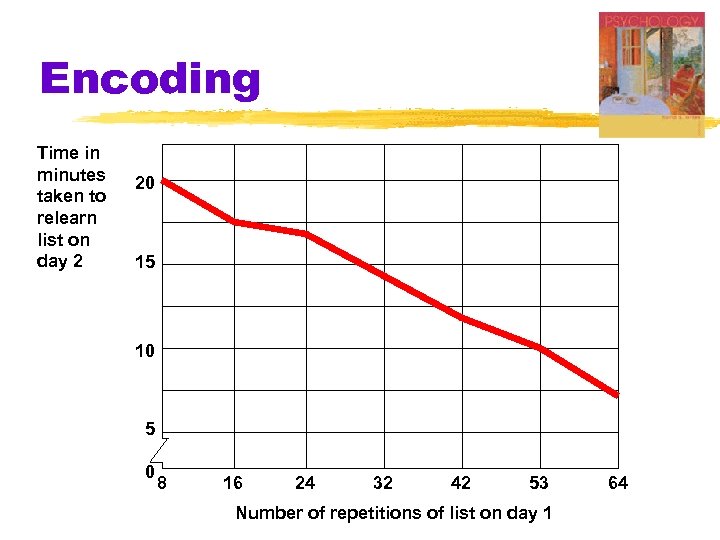 Encoding Time in minutes taken to relearn list on day 2 20 15 10 5 0 8 16 24 32 42 53 Number of repetitions of list on day 1 64
 Serial Positioning z. Remember that list we did where you remembered the words at the beginning and the end better than the ones in the middle? z. That is serial positioning z. Last ones are in working memory z. Shift attention and can remember the first ones
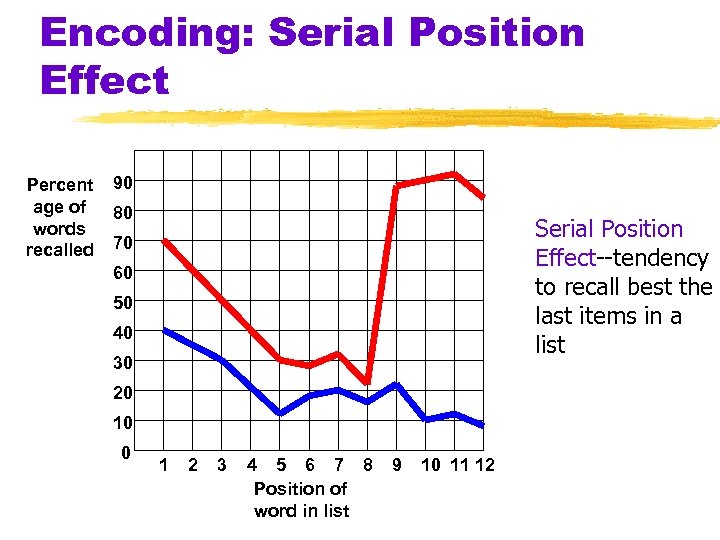 Encoding: Serial Position Effect Percent age of words recalled 90 80 Serial Position Effect--tendency to recall best the last items in a list 70 60 50 40 30 20 10 0 1 2 3 4 5 6 7 8 Position of word in list 9 10 11 12
 End Day 2 z. Homework. z. You will receive a handout. z. On your handout are your instructions. Follow them exactly! z. Do NOT do your homework with anyone – this is an INDIVIDUAL assignment and needs you INDIVIDUAL attention.
 What Do We Encode? § Verbal information must be given a meaning § We do this by associating it with something we already know or imagine § Working memory interacts with long-term memory § Semantic Encoding § encoding of meaning of words § Acoustic Encoding § encoding of sound (especially sound of words) § Visual Encoding § encoding of picture images
 Best? z Which type of encoding works best? z Each has it’s own brain system z So, each works best in their own unique ways y. Acoustic enhances memorability y. Rhyming – “if the glove doesn’t fit, you must acquit” z Experiments have been done to measure which works best z Semantic relies on deeper meaning and therefore aided better recall later y. Rephrasing is also important. If you don’t get it one way, putting it other words you will get will help z Better recall when we can relate it to ourselves
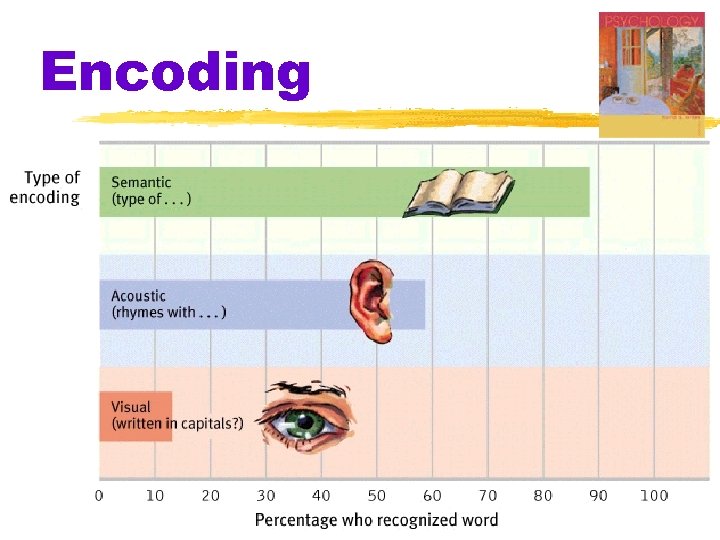 Encoding
 Visual Encoding § Greater ease of remembering mental pictures § Earliest memories (age 3 -5) are likely visual memories § We often recall memories with mental snapshots § Rosy retrospection – we recall events as better than they actually were because we remember high points and forget the average -to-low points (i. e. think about vacations)
 Mnemonics § “Tricks” used to remember things § Can be visual or create imagery in our heads § Mnemonics § memory aids § especially those techniques that use vivid imagery and organizational devices Please Excuse My Dear Aunt Sally. Order of operations Super Man Helps Every One. Great Lakes Every Good Boy Deserves Fudge. Musical notes on scale My Very Educated Mother Just Served Us Noodles. Planets (yep – poor Pluto is gone ) M, I, crooked letter, I, humpback, hump-back, I Mississippi
 Encoding § Meaning and imagery help memory by helping us organize the information § Chunking § organizing items into familiar, manageable units § Happens naturally § Reading is an example – we chunk letters together to form words that we recognize § Best remember things when we can organize the information into PERSONALLY meaningful arrangements or chunks § 1492177618122001 § Meaningless set of numbers, but you can remember by breaking it into 1492, 1776, 1812, and 2001 § use of acronyms § HOMES--Huron, Ontario, Michigan, Erie, Superior § ARITHMETIC--A Rat In Tom’s House Might Eat Tom’s Ice Cream
 Hierarchy § Hierarchies § Chunking is clustering information into meaningful and manageable units § Hierarchies is dividing information into logical levels, beginning with general and moving to specific § complex information broken down into broad concepts and further subdivided into categories and subcategories § I. E. taking notes in outline format or organizing what you are studying or using a chapter’s organization to help you better remember it’s content
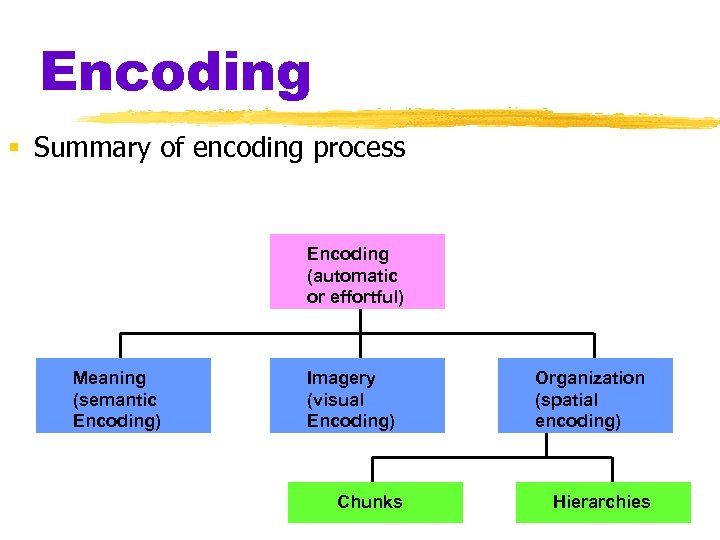 Encoding § Summary of encoding process Encoding (automatic or effortful) Meaning (semantic Encoding) Imagery (visual Encoding) Chunks Organization (spatial encoding) Hierarchies
 End Day 3 z Homework! z You are to review what we have covered in AP Psych so far and create an organizational tool to help you remember a concept or idea z It can be based in chunking, mnemonics, or hierarchy. z It needs to be written large on a blank sheet of white paper z There needs to be an explanation on the back. What it is, what does it mean, what does it help you to remember, what type of encoding does it rely on (acoustic, semantic, or visual) and then identify what type of organizational tool is it (chunking, mnemonic, hierarchy). z I will compile these and put them in a packet to share with each other!
 Memory z. E - encoding z. S - storage z. R - retrieval
 Storage z. If you can later recall something – then at some point you encoded it and stored it z. If in long-term memory it must be reconstructed by a cue z. Must look at temporary and long-term memory store capacity
 Storage: Sensory Memory § If 9 letters are flashed before you and removed at lightning speed you will be able to recall 9 – if even for just a few moments (Sperling) § Iconic Memory - visual § a fleeting photographic memory § lasts no more that a few tenths of a second § Echoic Memory - auditory § momentary sensory memory of auditory stimuli § 3 -4 seconds
 Short Term/Working Memory z. Of all the sensory information we illuminate some with the flashlight z. Trip from calculator to paper to write the number z. Disappears quickly without rehearsal z. Limited in capacity and duration z. Can store seven (+/-2) bits of info at a time (Miller)
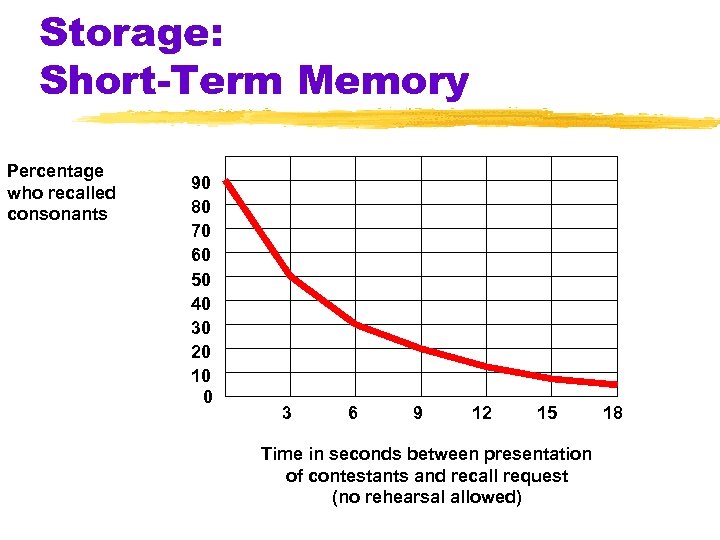 Storage: Short-Term Memory Percentage who recalled consonants 90 80 70 60 50 40 30 20 10 0 3 6 9 12 15 Time in seconds between presentation of contestants and recall request (no rehearsal allowed) 18
 Short Term: Interesting Facts z. Better with random digits than letters z. Better with what we hear than what we see z 4 chunks at a time z. Recall is generally limited to how many words we can speak in 2 seconds z. When they added area code to phone numbers, people started to complain. y. Could remember 7 digits, but not 10! y. Magical number 7 (+/- 2)
 Long Term Memory z. Capacity for long term memory is limitless z. We do not get rid of old memories to make room for new ones z. One man memorized all of Shakespeare’s works. All. How? z. We have to look at the biology
 In the Brain z. Despite initial experiments, memories are NOT stored in certain places in the brain z. Lashley had rats memorize a maze then cut out parts of their brains, no matter what part he cut out – they still knew the maze (at least partially) z. New experiences can interfere with our retrieval of old
 Memory Trace z. Based in electrical activity of the brain? z. Nope? Disconnect the battery, create a blackout, turn the power back on and we still remember z. So…we turn to synapses z. Memories begin as impulses zooming through brain circuits z. What is they leave a permanent neural trace? z. Neural change likely at the synapses
 Synapses z. In experiment with snails, Kandel and Schwartz were able to pinpoint that when learning occurs, more of the neurotransmitters serotonin is released and the synapses then became more efficient in transmitting signals z. More synaptic efficiency = more efficient neural circuits z. Sending neuron now needs less prompting to release the neurotransmitter
 Storage: Long-Term Memory § Amnesia--the loss of memory § Explicit Memory § memory of facts and experiences that one can consciously know and declare § also called declarative memory § hippocampus--neural center in limbic system that helps process explicit memories for storage § Implicit Memory § retention independent of conscious recollection § also called procedural memory
 LTP z. Long-term potentiation z. Prolonged strengthening of potential neural firing z. Neural basis for learning and remembering associations z. Drugs that block LTP interfere with learning
 CREB z. A protein that can turn genes on and off y. Genes code the production of protein z. With repeated neural firing, a nerve cell’s genes produce synapses-strengthening proteins z. This enables long-term memories to form z. Increase CREB, increase long-term memory? z. Just one example of how science is trying to boost memory
 Memory Consolidation z. We must have time to consolidate (turn short-term into long-term) z. If that does not occur then the memory will not be encoded into long-term memory z. Being knocked unconscious – can’t remember what happened right before z. Explains why we can’t remember what we experience right before we fall asleep
 Stress Hormones z. Stress hormones make more glucose available to fuel brain activity z. The amygdala also boost activity in the brain’s memory forming areas z. The result is that stronger memories are formed z. Prolonged exposure to stress (combat or abuse) can act like an acid that corrodes the hippocampus and new memories are not formed.
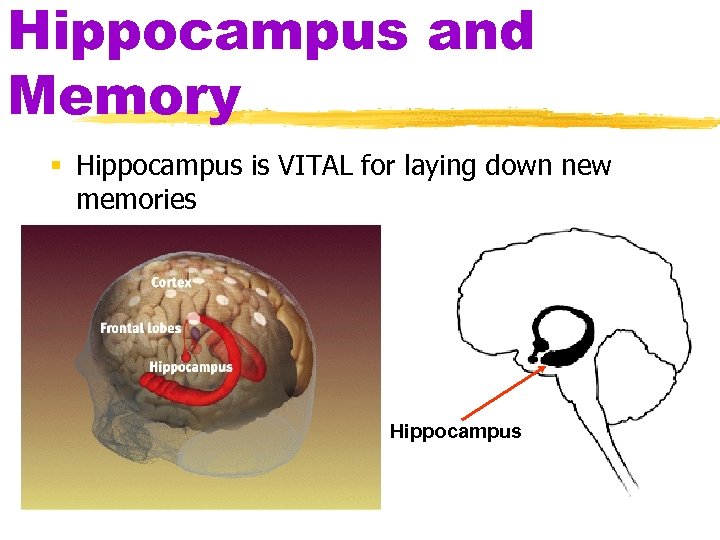 Hippocampus and Memory § Hippocampus is VITAL for laying down new memories Hippocampus
 Amnesia z. Loss of memory or inability to form new memories z. They can learn still z. But they have no awareness of having learned new things z. We can have unconscious recognition z. We seem to have 2 memory systems working at the same time z. Implicit and Explicit
 Explicit v. Implicit Memories z. Implicit memory is procedural y. Learning how to do something z. Explicit is declarative y. What we know that we know and can declare z. For people with amnesia they can read a story and read it faster the second time (implicit memory), but they will tell you that they do not know the story and have never read it before (no explicit – they cannot declare it)
 Hippocampus’ Role z. Explicit memories are laid down in the hippocampus z. Hippocampus lights up on a PET when people recall words (explicit or implicit? ) z. Hippocampus is lateralized (2 sides) and damage to one side or the other changes the results z. Left=verbal decline, visual fine; right is vice versa z. Damage also causes us to lose more recent memories (last few months)
 Hippocampus Continued z. It is a loading dock for long-term memory z. It registers and temporarily stores the elements of a remembered episode z. Then the memory goes elsewhere z. It is active during slow-wave sleep, which might indicates that are processing and filing memories y. Perhaps evidence for information-processing dream theory?
 Hippocampus Regions z. Further, it appears that different areas of the hippocampus are involved in different memories z. One part is engaged when learning faces, another when learning mnemonics, and the rear area seems to process spatial memory y. Rear region actually grew bigger the longer cab drivers drove London streets
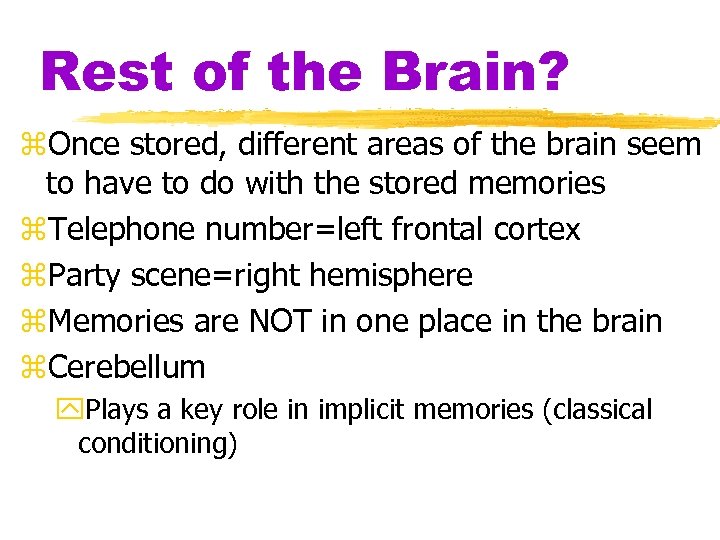 Rest of the Brain? z. Once stored, different areas of the brain seem to have to do with the stored memories z. Telephone number=left frontal cortex z. Party scene=right hemisphere z. Memories are NOT in one place in the brain z. Cerebellum y. Plays a key role in implicit memories (classical conditioning)
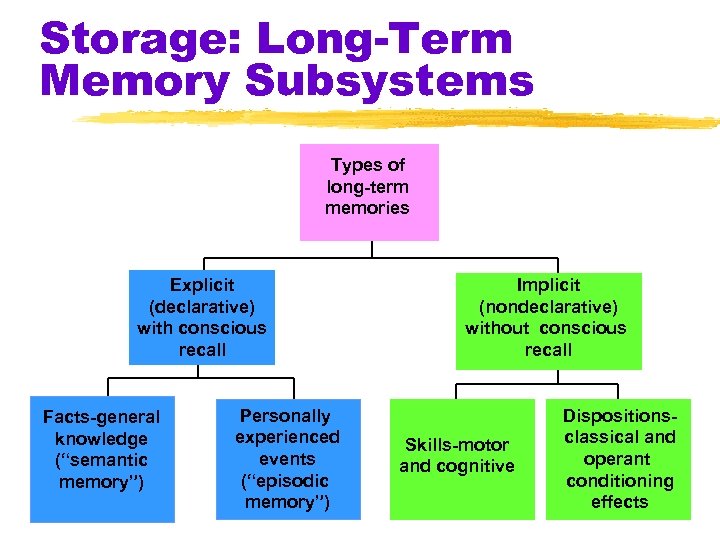 Storage: Long-Term Memory Subsystems Types of long-term memories Explicit (declarative) with conscious recall Facts-general knowledge (“semantic memory”) Personally experienced events (“episodic memory”) Implicit (nondeclarative) without conscious recall Skills-motor and cognitive Dispositionsclassical and operant conditioning effects
 End of Day 4 Challenge z. So…you can’t recall everything that happened to you before the age of 3 -5. z. Why? z. Explain! z 1 paragraph z. Hint – has to do with explicit and implicit
 Memory z. E - encoding z. S - storage z. R - retrieval
 Retrieval: Getting Information Out § Once we encode and store, we must get the information out – this is retrieval. § Recall § What most people think of as memory § Retrieve information learned earlier § As on a fill-in-the blank test § Remember people from high school § Recognition § Identify items previously learned § Multiple-choice test § Recognize people in yearbook from high school
 Relearning § memory measure that assesses the amount of time saved when learning material a second time § Usually learn it faster the second time § Things come back to us when we study for a final exam because we already learned and we are “relearning” it
 Retrieval Cues z. Hints that help us remember what we already know. z. Memories are held in “storage” by a web of associations z. When you encode it, you leave hints (breadcrumbs) to remembering it and then you later use those to help you retrieve the information y. For example, you may associate it with other things you know y. Visual pictures, key words, mnemonic devices all serve as retrieval cues
 Priming z. Unconscious activation of a particular association in memory, like this… y. How do you pronounce the work s-h-o-p? y. What do you do when you get to a green light? y. Aha! If you said stop to the second question, it was because of priming from the first question z. James referred to priming as the “wakening of associations”
 Context Effects z. If you go back to where something happened, you can often remember it – you are putting it back in context z. Great example from the book! y. You are studying and you need to sharpen your pencil – so you walk to other room where the pencil sharpener is and you cannot remember why the heck you went in there. You give up and go back to your book and as soon as you get there…you remember the darn pencil and why you went to the other room!
 Retrieval Cues § Deja Vu (French)--already seen § cues from the current situation may subconsciously trigger retrieval of an earlier similar experience § "I've experienced this before. " § Mood-congruent Memory § tendency to recall experiences that are consistent with one’s current mood § memory, emotions, or moods serve as retrieval cues § State-dependent Memory § what is learned in one state (while one is high, drunk, or depressed) can more easily be remembered when in same state
 Forg…. Ah heck, what was I going to say? z. Forgetting! z. We must forget some things because they are now useless to us. y. I. E. Where I parked my car a week ago last Tuesday z. Memory is quirky. y. At times we cannot remember for the life of us what we need to remember and that we know y. At other times we are suddenly thinking about something useless from out of the blue
 7 Sins of Memory z. Schacter (1999) z 3 sins of forgetting y. Absent-mindedness – inattention to details=encoding failure y. Transience – storage decay over time (unused info fades) y. Blocking – can’t access stored info=retrieval failure z 3 sins of distortion y. Misattribution – confusing the source of info
 7 Sins Continued… y. Suggestibility – lingering effects of misinformation (plant a seed for something not true) y. Bias – belief-colored recollections z 1 sin of intrusion y. Persistence – unwanted memories, being haunted by things you want to forget
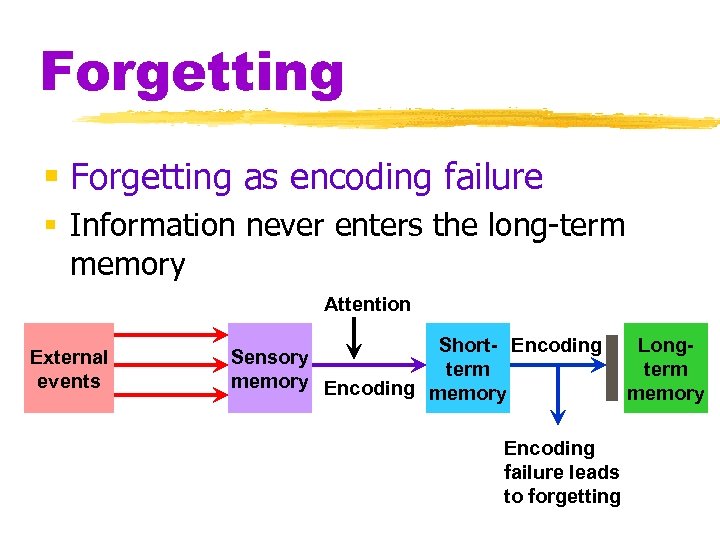 Forgetting § Forgetting as encoding failure § Information never enters the long-term memory Attention External events Short- Encoding Sensory term memory Encoding failure leads to forgetting Longterm memory
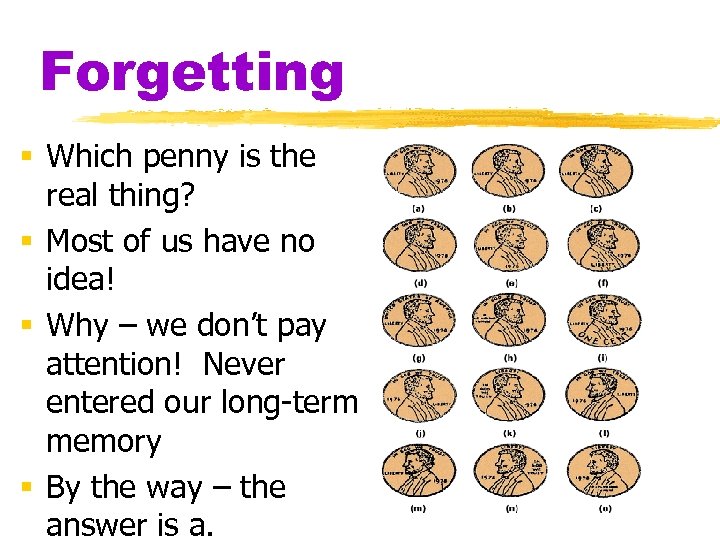 Forgetting § Which penny is the real thing? § Most of us have no idea! § Why – we don’t pay attention! Never entered our long-term memory § By the way – the answer is a.
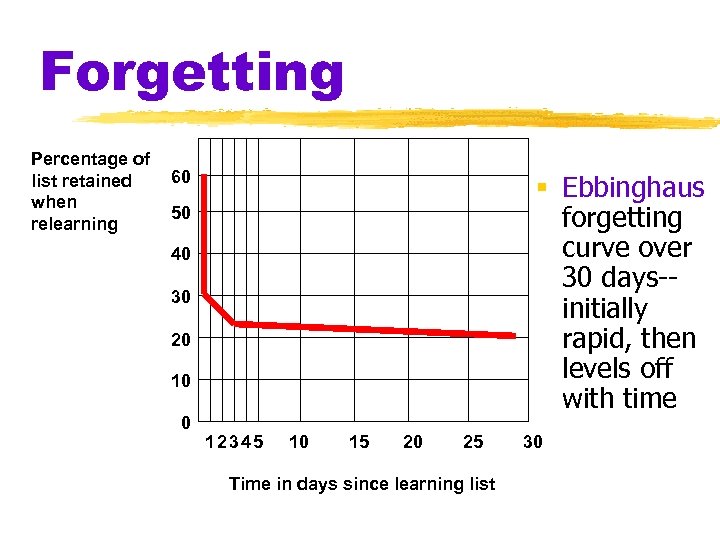 Forgetting Percentage of list retained when relearning 60 § Ebbinghaus forgetting curve over 30 days-initially rapid, then levels off with time 50 40 30 20 10 0 12345 10 15 20 25 Time in days since learning list 30
 Storage Decay z. Even if we encode it well, we may later forget z. Forgetting curve (Ebbinghaus, 1885) y. Much of what we learn we quickly forget y. Levels off with time y. Example – learn Spanish in school x. Will forget a lot of it in 3 years x. But, what you know in 3 years will likely be the same as what you remember in 4 years
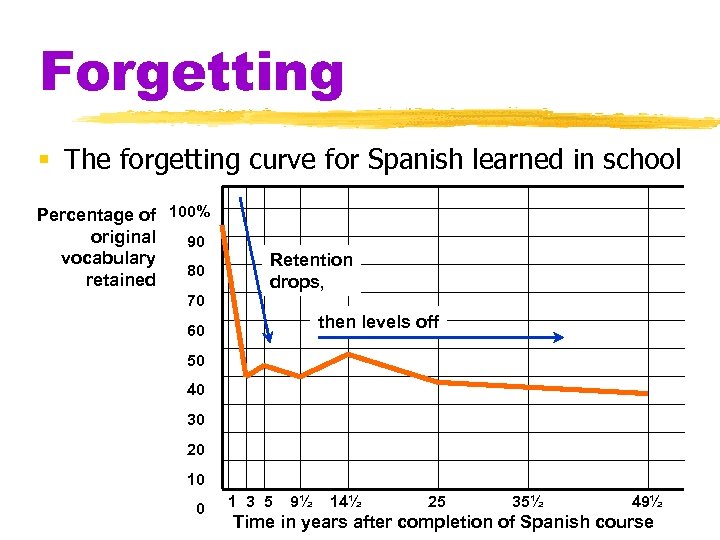 Forgetting § The forgetting curve for Spanish learned in school Percentage of 100% original 90 vocabulary 80 retained Retention drops, 70 then levels off 60 50 40 30 20 10 0 1 3 5 9½ 14½ 25 35½ 49½ Time in years after completion of Spanish course
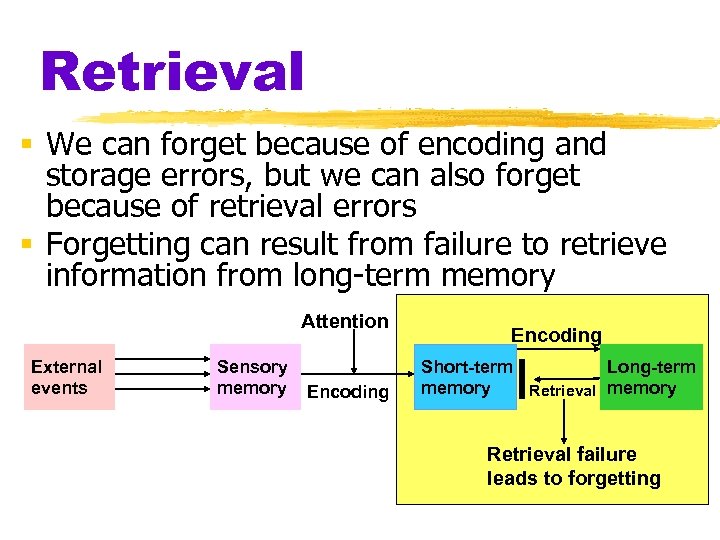 Retrieval § We can forget because of encoding and storage errors, but we can also forget because of retrieval errors § Forgetting can result from failure to retrieve information from long-term memory Attention External events Sensory memory Encoding Short-term Long-term memory Retrieval failure leads to forgetting
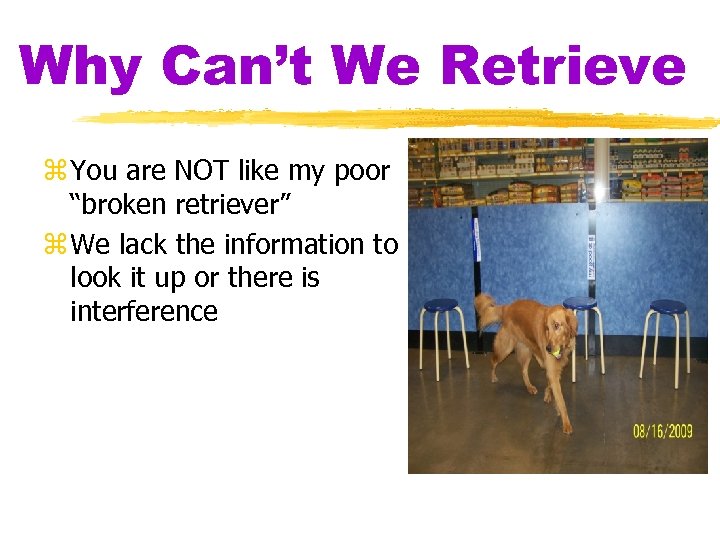 Why Can’t We Retrieve z You are NOT like my poor “broken retriever” z We lack the information to look it up or there is interference
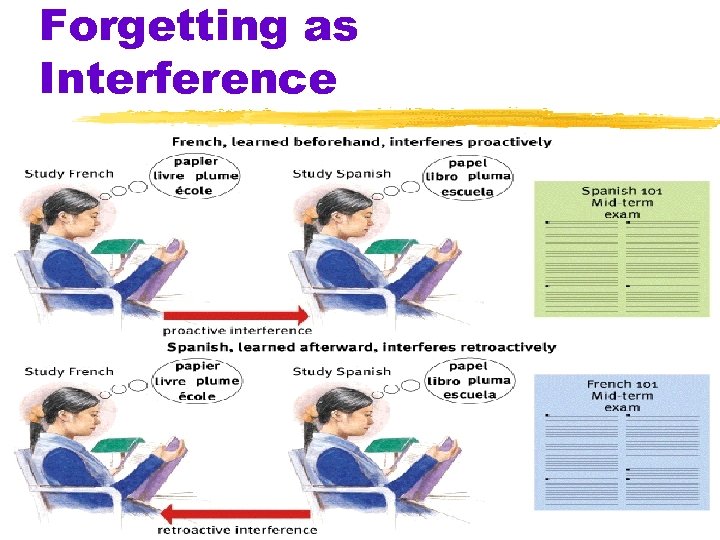
 Forgetting due to Interference § Learning some items may disrupt retrieval of other information § Especially when they are similar § Proactive (forward acting) Interference § disruptive effect of prior learning on recall of new information § Retroactive (backwards acting) Interference § disruptive effect of new learning on recall of old information
 Forgetting as Interference
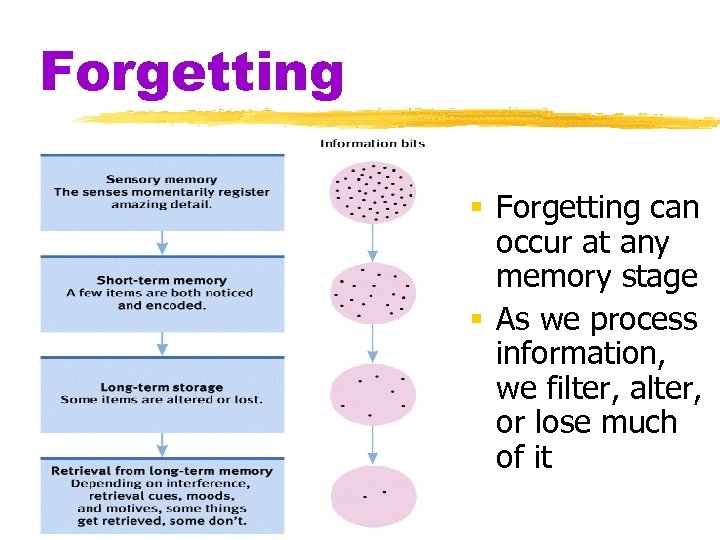 Forgetting § Forgetting can occur at any memory stage § As we process information, we filter, alter, or lose much of it
 Forgetting- Interference § Motivated Forgetting § We revise our own histories § Especially when memory fails us § Repression § Freud § Theory that states that it is a defense mechanism § Banishes from consciousness anxietyarousing thoughts, feelings, and memories
 But… z. We learned that stress hormones strengthen memories z. So…how can that and Freud be true? z. Stay tuned!
 Memory Construction § We construct our memories as we encode them and we tend to filter information and fill in missing pieces § Misinformation Effect § Once we are exposed to subtle misinformation about an event our recollection of it will change § Why power of suggestion in court and police investigations can be detrimental § Source Amnesia § attributing to the wrong source an event that we experienced, heard about, read about, or imagined (misattribution)
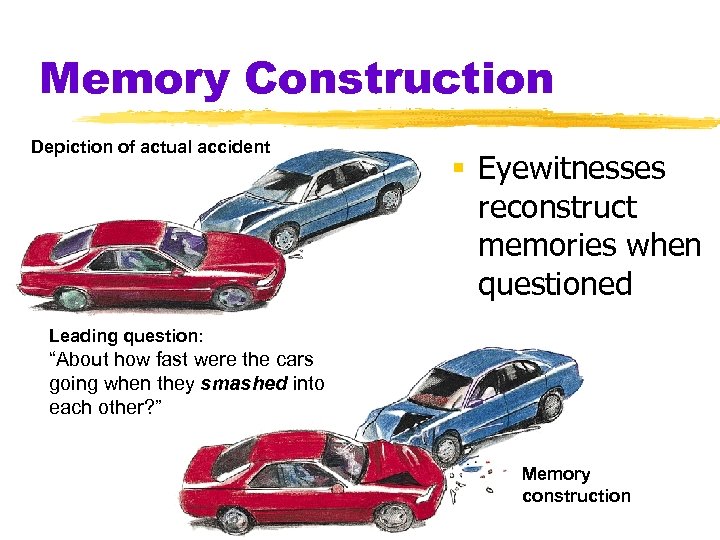 Memory Construction Depiction of actual accident § Eyewitnesses reconstruct memories when questioned Leading question: “About how fast were the cars going when they smashed into each other? ” Memory construction
 True or False? ? ? § Unreal memories can feel like real memories § Memories are a lot like perceptions – perceptions of the past § Cannot judge reality by persistence § But real memories tend to have more details than imagined experiences § More easily remember the gist of something than the specifics § Remember – you can plant false memories with leading questions
 Kids and Memory § Testimony of kids is being questioned § Can be led by questions to create memories that are not real § They have more suggestibility § But when not led they have accurate recall
 Repressed Memories? § Memories of Abuse § Repressed or Constructed? § Child sexual abuse does occur § Some adults do actually forget such episodes § But evidence shows that if memories are “recovered” after a long period of “amnesia” they are more often not accurate
 APA Statement § Most people can agree on the following: Injustice happens Incest happens Forgetting happens Recovered memories are commonplace Memories recovered under hypnosis or drugs are especially unreliable § Memories of things happening before age 3 are unreliable § Memories, whether false or real, are upsetting § § §
 Improve Your Memory § Study repeatedly to boost recall § Spend more time rehearsing or actively thinking about the material § Make material personally meaningful § Use mnemonic devices § associate with peg words--something already stored § make up story § chunk--acronyms
 Improve Your Memory § Activate retrieval cues--mentally recreate situation and mood § Recall events while they are fresh-- before you encounter misinformation § Minimize interference § Test your own knowledge § rehearse § determine what you do not yet know