



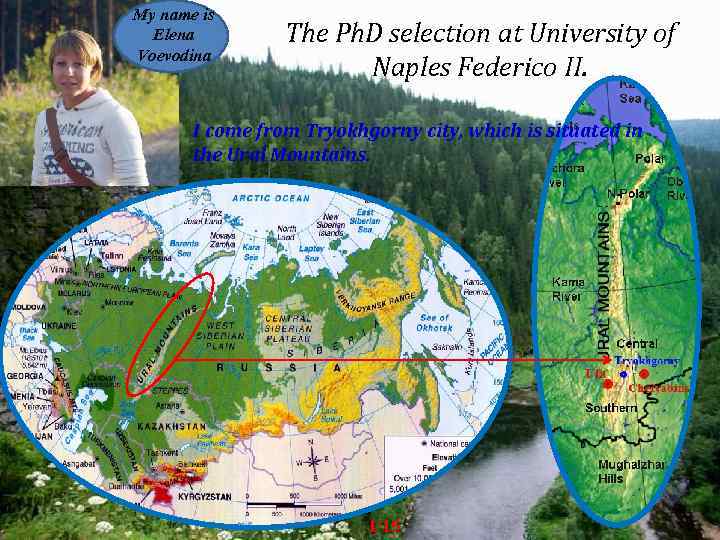
 My name is Elena Voevodina The Ph. D selection at University of Naples Federico II. I come from Tryokhgorny city, which is situated in the Ural Mountains. 1/15
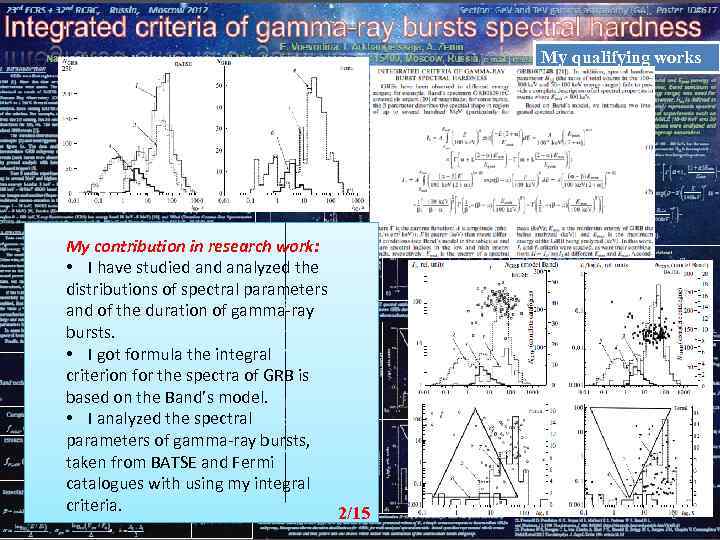 My qualifying works My contribution in research work: • I have studied analyzed the distributions of spectral parameters and of the duration of gamma-ray bursts. • I got formula the integral criterion for the spectra of GRB is based on the Band’s model. • I analyzed the spectral parameters of gamma-ray bursts, taken from BATSE and Fermi catalogues with using my integral criteria. 2/15 2
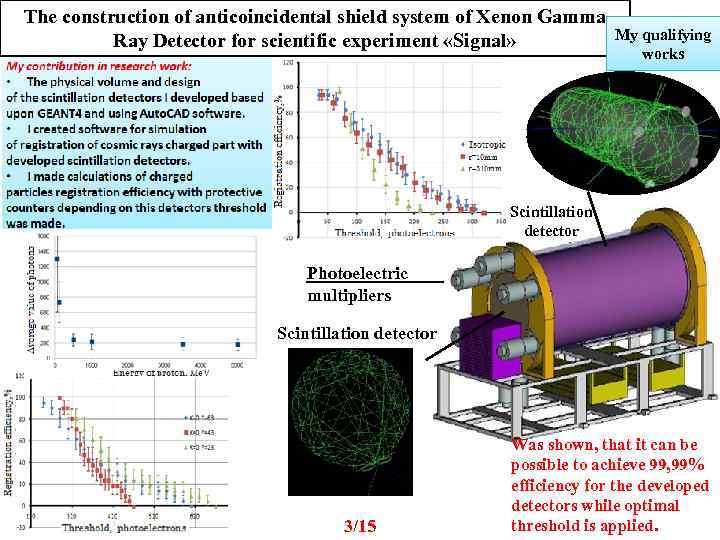 The construction of anticoincidental shield system of Xenon Gamma My qualifying Ray Detector for scientific experiment «Signal» works Scintillation detector Photoelectric multipliers Scintillation detector 3/15 Was shown, that it can be possible to achieve 99, 99% efficiency for the developed detectors while optimal threshold is applied.
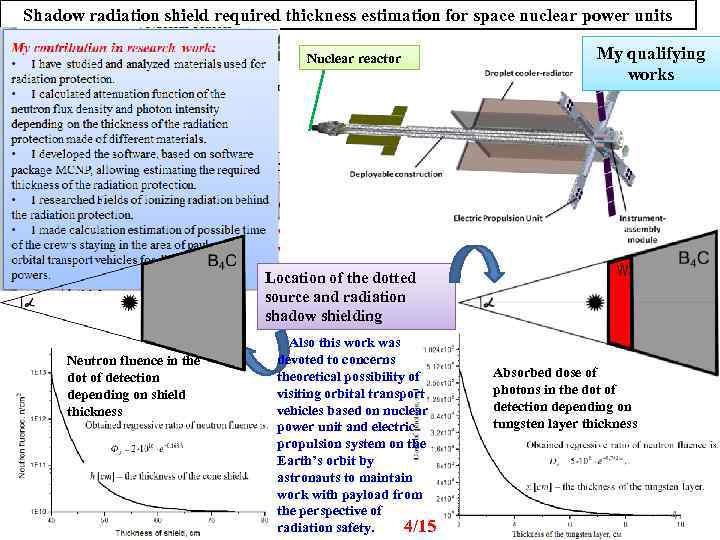 Shadow radiation shield required thickness estimation for space nuclear power units Nuclear reactor My qualifying works Location of the dotted source and radiation shadow shielding Neutron fluence in the dot of detection depending on shield thickness Also this work was devoted to concerns theoretical possibility of visiting orbital transport vehicles based on nuclear power unit and electric propulsion system on the Earth’s orbit by astronauts to maintain work with payload from the perspective of radiation safety. 4/15 Absorbed dose of photons in the dot of detection depending on tungsten layer thickness 4
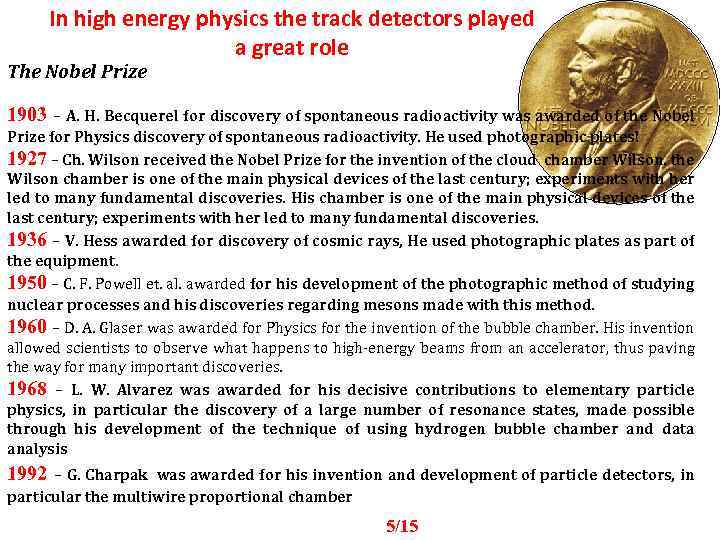 In high energy physics the track detectors played a great role The Nobel Prize 1903 – A. H. Becquerel for discovery of spontaneous radioactivity was awarded of the Nobel Prize for Physics discovery of spontaneous radioactivity. He used photographic plates! 1927 – Ch. Wilson received the Nobel Prize for the invention of the cloud chamber Wilson. the Wilson chamber is one of the main physical devices of the last century; experiments with her led to many fundamental discoveries. His chamber is one of the main physical devices of the last century; experiments with her led to many fundamental discoveries. 1936 – V. Hess awarded for discovery of cosmic rays, He used photographic plates as part of the equipment. 1950 – C. F. Powell et. al. awarded for his development of the photographic method of studying nuclear processes and his discoveries regarding mesons made with this method. 1960 – D. A. Glaser was awarded for Physics for the invention of the bubble chamber. His invention allowed scientists to observe what happens to high-energy beams from an accelerator, thus paving the way for many important discoveries. 1968 – L. W. Alvarez was awarded for his decisive contributions to elementary particle physics, in particular the discovery of a large number of resonance states, made possible through his development of the technique of using hydrogen bubble chamber and data analysis 1992 – G. Charpak was awarded for his invention and development of particle detectors, in particular the multiwire proportional chamber 5/15
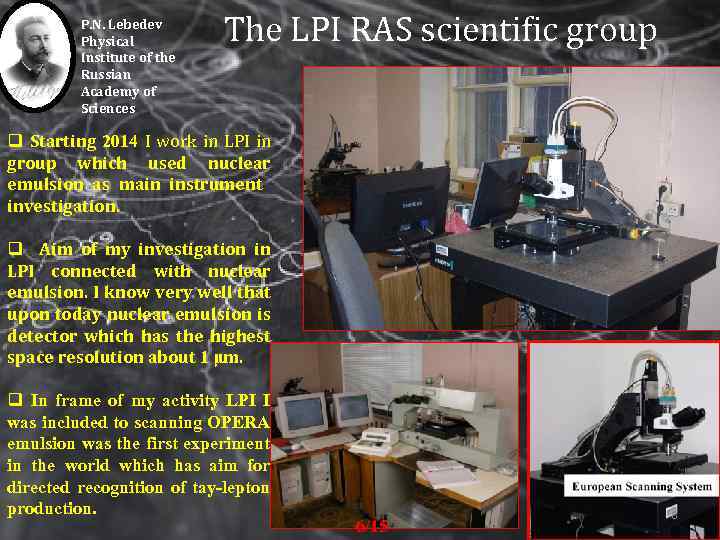 P. N. Lebedev Physical Institute of the Russian Academy of Sciences The LPI RAS scientific group q Starting 2014 I work in LPI in group which used nuclear emulsion as main instrument investigation. q Aim of my investigation in LPI connected with nuclear emulsion. I know very well that upon today nuclear emulsion is detector which has the highest space resolution about 1 µm. q In frame of my activity LPI I was included to scanning OPERA emulsion was the first experiment in the world which has aim for directed recognition of tay-lepton production. 6/15 6
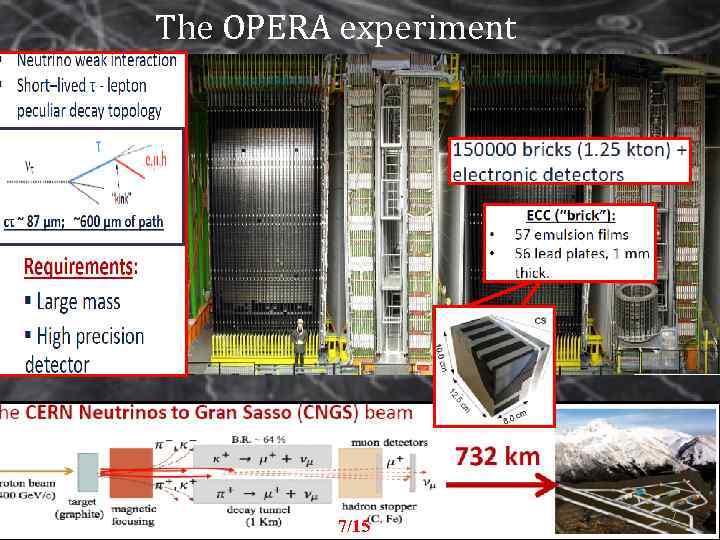 The OPERA experiment 7/15 7
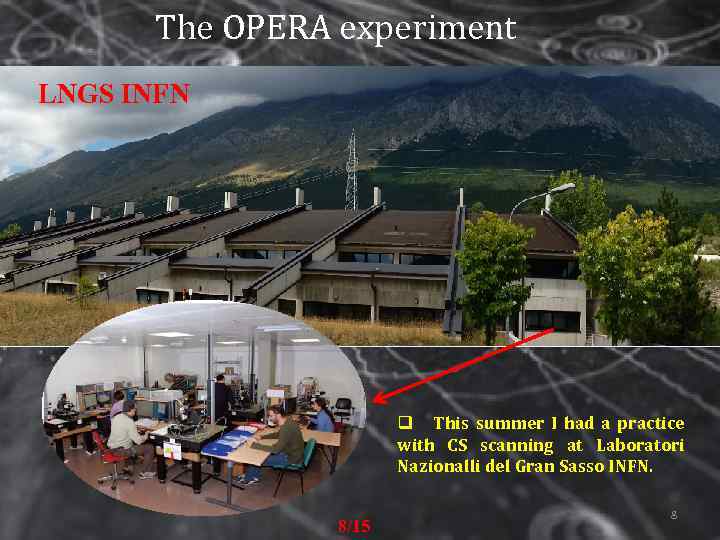 The OPERA experiment LNGS INFN q This summer I had a practice with CS scanning at Laboratori Nazionalli del Gran Sasso INFN. 8/15 8
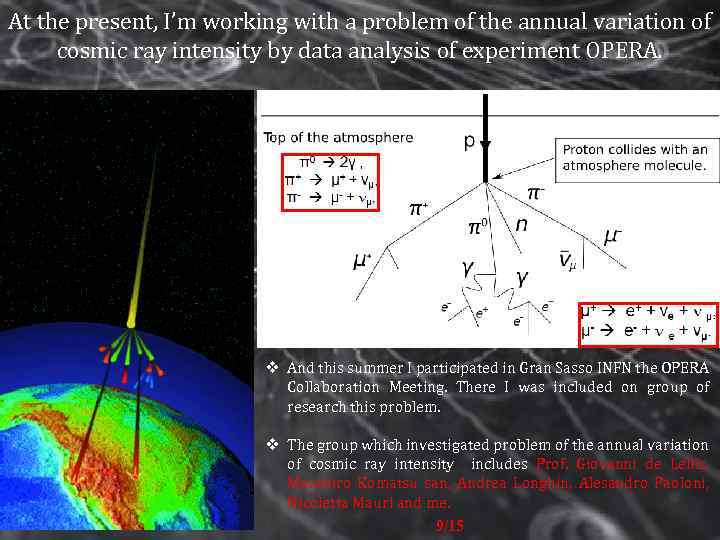 At the present, I’m working with a problem of the annual variation of cosmic ray intensity by data analysis of experiment OPERA. v And this summer I participated in Gran Sasso INFN the OPERA Collaboration Meeting. There I was included on group of research this problem. v The group which investigated problem of the annual variation of cosmic ray intensity includes Prof. Giovanni de Lellis, Masahiro Komatsu san, Andrea Longhin, Alesandro Paoloni, Nicoletta Mauri and me. 9/15
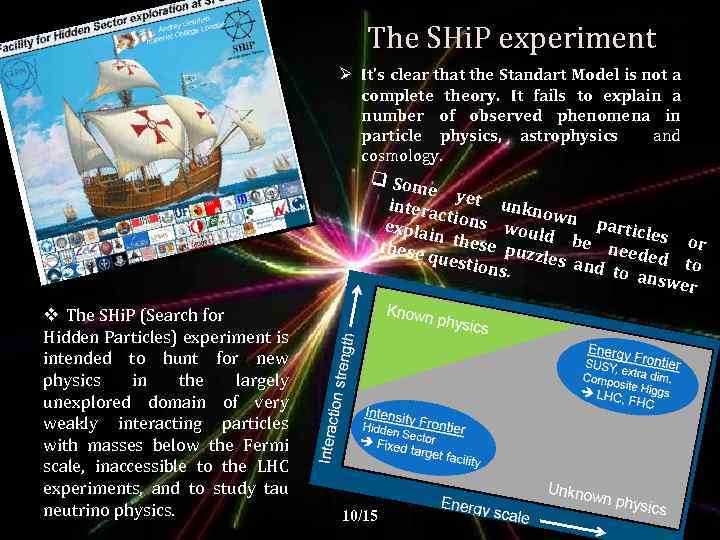 The SHi. P experiment Ø It’s clear that the Standart Model is not a complete theory. It fails to explain a number of observed phenomena in particle physics, astrophysics and cosmology. q Som e ye t u intera ctions nknown pa explai n the would be rticles or se these questi puzzles a needed to nd to ons. answe r v The SHi. P (Search for Hidden Particles) experiment is intended to hunt for new physics in the largely unexplored domain of very weakly interacting particles with masses below the Fermi scale, inaccessible to the LHC experiments, and to study tau neutrino physics. 10/15
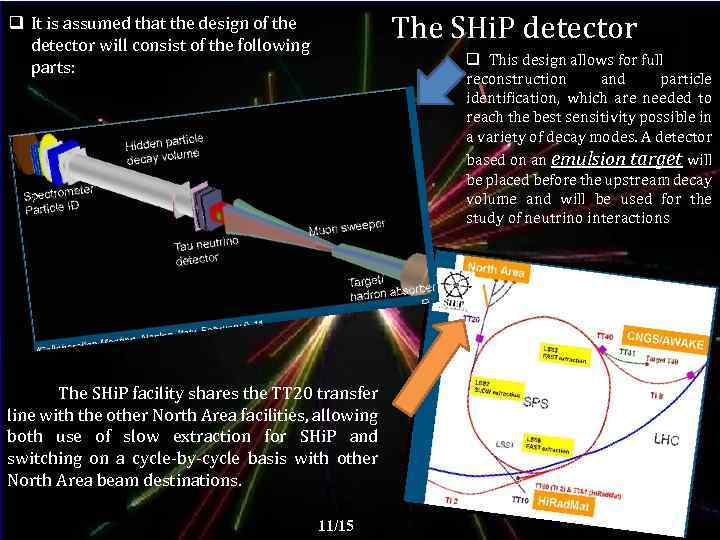 The SHi. P detector q It is assumed that the design of the detector will consist of the following parts: q This design allows for full Beam particle reconstruction. SHi. Pand identification, which are needed to reach the best sensitivity possible in a variety of decay modes. A detector based on an emulsion target will be placed before the upstream decay volume and will be used for the study of neutrino interactions The SHi. P facility shares the TT 20 transfer line with the other North Area facilities, allowing both use of slow extraction for SHi. P and switching on a cycle-by-cycle basis with other North Area beam destinations. 11/15
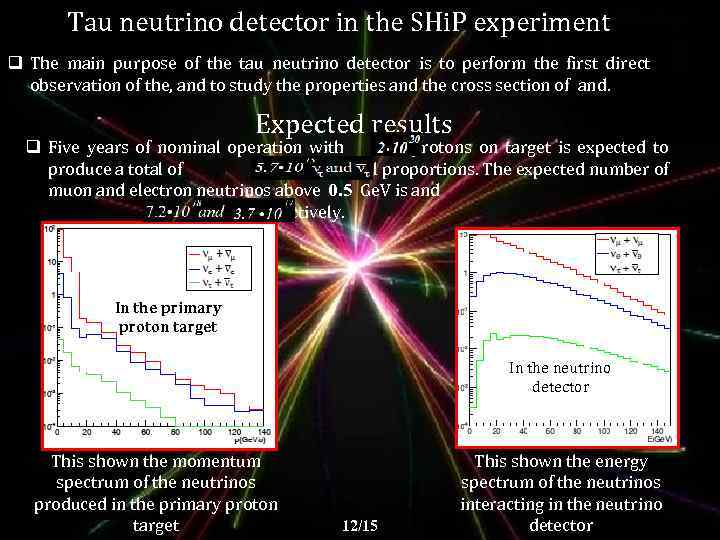 Tau neutrino detector in the SHi. P experiment q The main purpose of the tau neutrino detector is to perform the first direct observation of the, and to study the properties and the cross section of and. Expected results q Five years of nominal operation with protons on target is expected to produce a total of in about equal proportions. The expected number of muon and electron neutrinos above 0. 5 Ge. V is and respectively. In the primary proton target In the neutrino detector This shown the momentum spectrum of the neutrinos produced in the primary proton target 12/15 This shown the energy spectrum of the neutrinos interacting in the neutrino detector
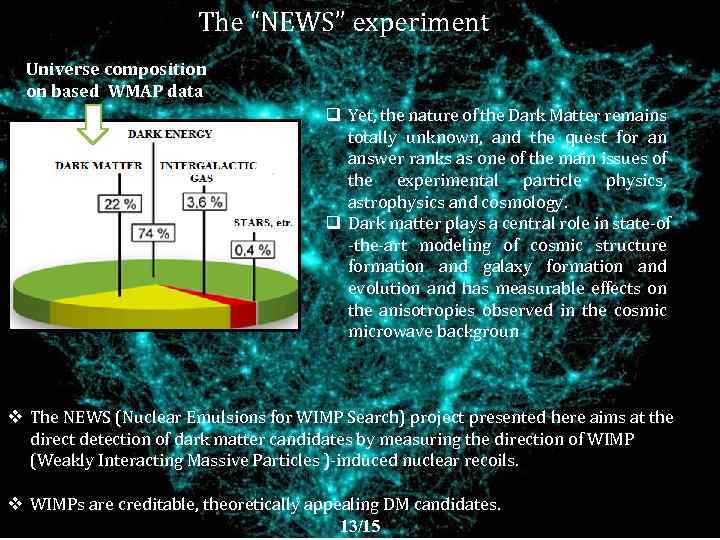 The “NEWS” experiment Universe composition on based WMAP data q Yet, the nature of the Dark Matter remains totally unknown, and the quest for an answer ranks as one of the main issues of the experimental particle physics, astrophysics and cosmology. q Dark matter plays a central role in state-of -the-art modeling of cosmic structure formation and galaxy formation and evolution and has measurable effects on the anisotropies observed in the cosmic microwave backgroun v The NEWS (Nuclear Emulsions for WIMP Search) project presented here aims at the direct detection of dark matter candidates by measuring the direction of WIMP (Weakly Interacting Massive Particles )-induced nuclear recoils. v WIMPs are creditable, theoretically appealing DM candidates. 13/15
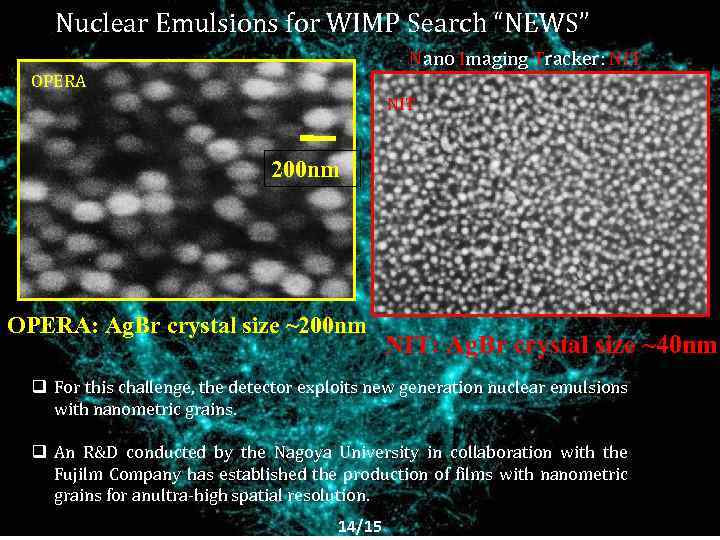 Nuclear Emulsions for WIMP Search “NEWS” Nano Imaging Tracker: NIT OPERA NIT 200 nm OPERA: Ag. Br crystal size ~200 nm NIT: Ag. Br crystal size ~40 nm q For this challenge, the detector exploits new generation nuclear emulsions with nanometric grains. q An R&D conducted by the Nagoya University in collaboration with the Fujilm Company has established the production of films with nanometric grains for anultra-high spatial resolution. 14/15
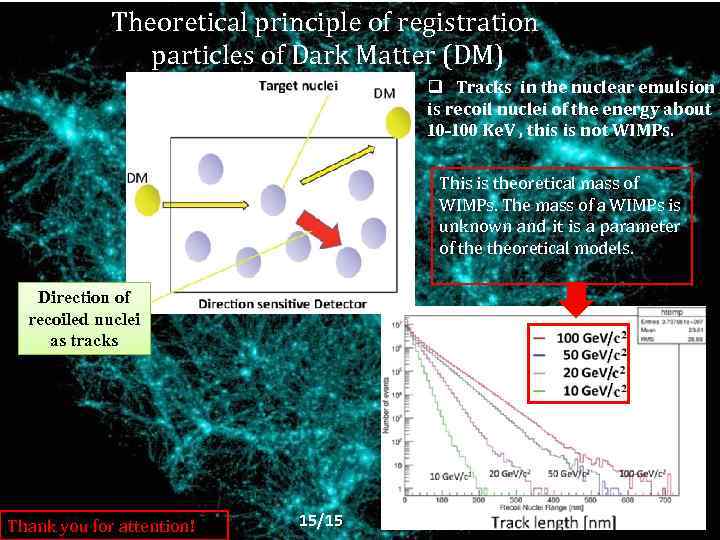 Theoretical principle of registration particles of Dark Matter (DM) q Tracks in the nuclear emulsion is recoil nuclei of the energy about 10 -100 Ke. V , this is not WIMPs. This is theoretical mass of WIMPs. The mass of a WIMPs is unknown and it is a parameter of theoretical models. Direction of recoiled nuclei as tracks Thank you for attention! 15/15