 Скачать презентацию Mutual Funds Basics Types Costs Performance Recent Developments
d03bde29c2c2614adfe7d06574b907c1.ppt
- Количество слайдов: 38



Mutual Funds Basics Types Costs Performance Recent Developments
Basics q What is a Mutual Fund? Ø q Financial intermediaries that invest on behalf of individual investors Why Mutual Fund? Ø Diversification and divisibility q Ø Professional management q Ø Portfolio managers and security analysts Lower transaction costs q Ø Fractional shares yet many different securities Large block trade, reduced commissions and fees Record keeping and administration q Investments 6 Status report about distribution, dividends, etc. 2
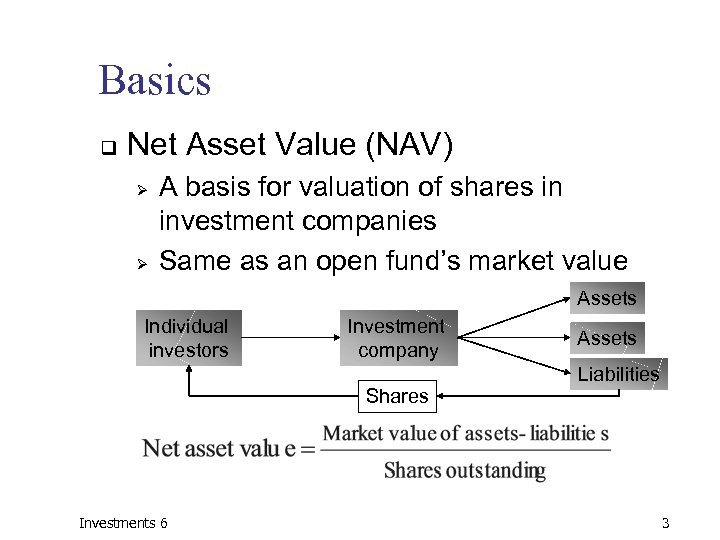
Basics q Net Asset Value (NAV) Ø Ø A basis for valuation of shares in investment companies Same as an open fund’s market value Assets Individual investors Investment company Shares Investments 6 Assets Liabilities 3
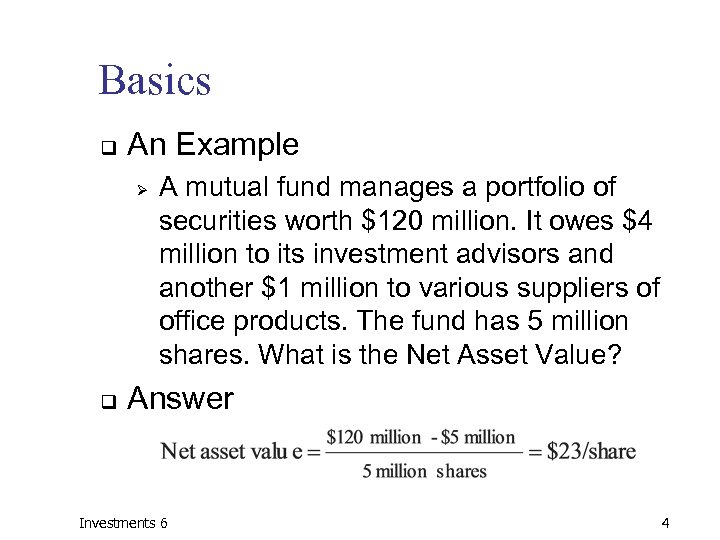
Basics q An Example Ø q A mutual fund manages a portfolio of securities worth $120 million. It owes $4 million to its investment advisors and another $1 million to various suppliers of office products. The fund has 5 million shares. What is the Net Asset Value? Answer Investments 6 4
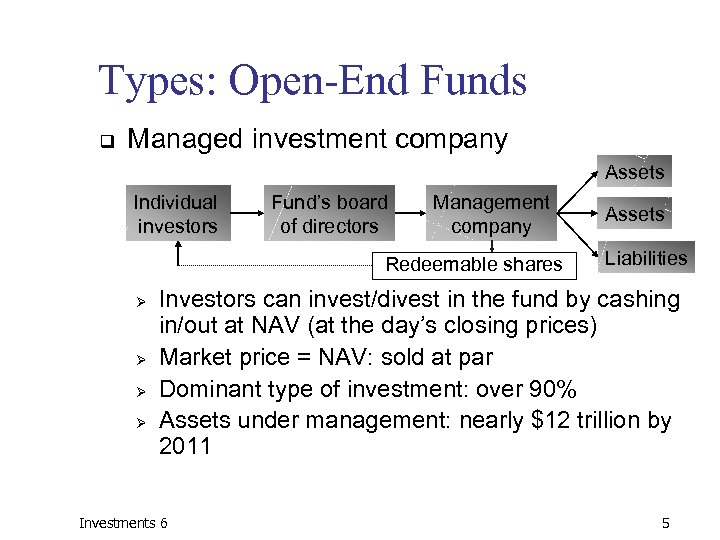
Types: Open-End Funds q Managed investment company Assets Individual investors Fund’s board of directors Management company Redeemable shares Ø Ø Assets Liabilities Investors can invest/divest in the fund by cashing in/out at NAV (at the day’s closing prices) Market price = NAV: sold at par Dominant type of investment: over 90% Assets under management: nearly $12 trillion by 2011 Investments 6 5
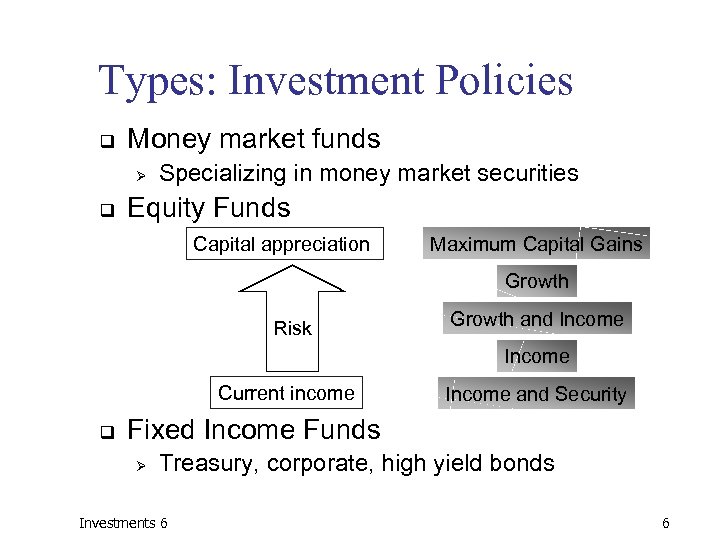
Types: Investment Policies q Money market funds Ø q Specializing in money market securities Equity Funds Capital appreciation Maximum Capital Gains Growth Risk Growth and Income Current income q Income and Security Fixed Income Funds Ø Treasury, corporate, high yield bonds Investments 6 6
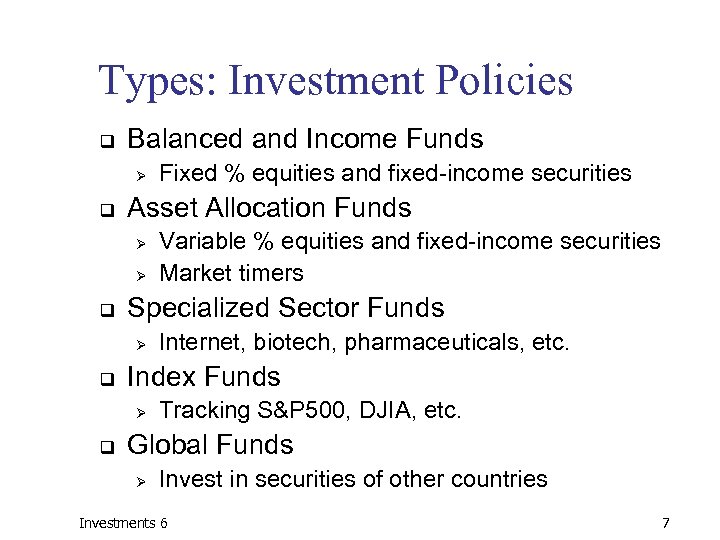
Types: Investment Policies q Balanced and Income Funds Ø q Asset Allocation Funds Ø Ø q Internet, biotech, pharmaceuticals, etc. Index Funds Ø q Variable % equities and fixed-income securities Market timers Specialized Sector Funds Ø q Fixed % equities and fixed-income securities Tracking S&P 500, DJIA, etc. Global Funds Ø Invest in securities of other countries Investments 6 7
Open-End Funds – Strategies q q q Can not use leverage Can not use short sales Can not use fast turnover Ø q Must receive less than 30% of the gross income from the sale of securities held less than 3 months What can they do? Investments 6 8
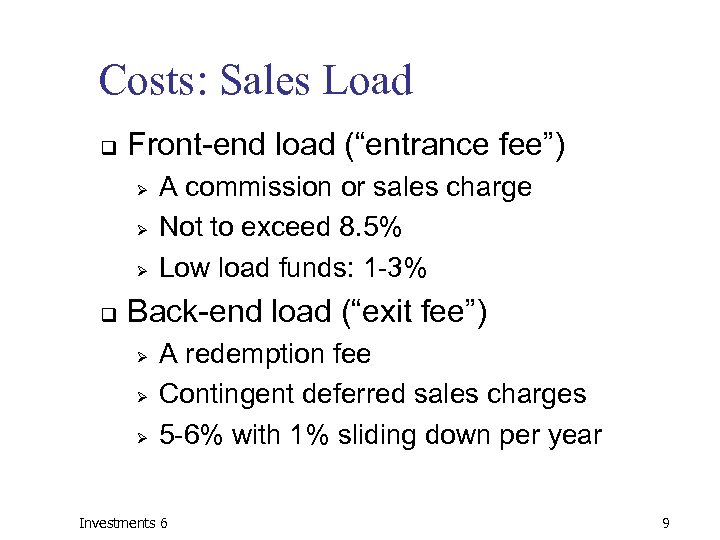
Costs: Sales Load q Front-end load (“entrance fee”) Ø Ø Ø q A commission or sales charge Not to exceed 8. 5% Low load funds: 1 -3% Back-end load (“exit fee”) Ø Ø Ø A redemption fee Contingent deferred sales charges 5 -6% with 1% sliding down per year Investments 6 9
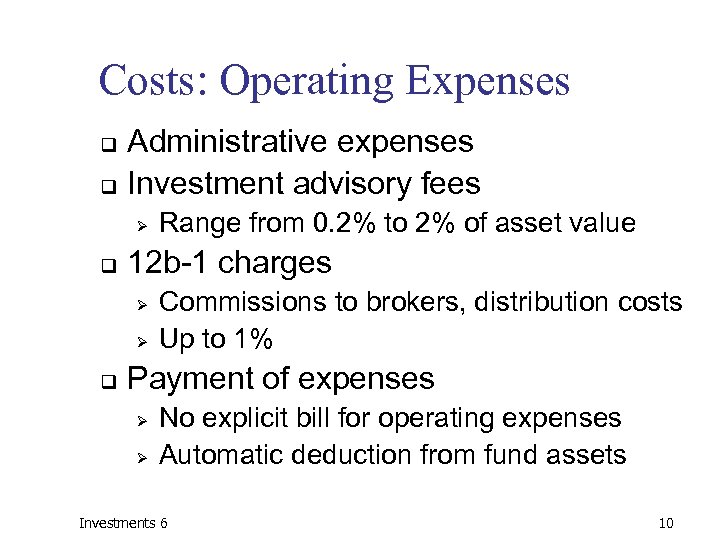
Costs: Operating Expenses Administrative expenses q Investment advisory fees q Ø q 12 b-1 charges Ø Ø q Range from 0. 2% to 2% of asset value Commissions to brokers, distribution costs Up to 1% Payment of expenses Ø Ø No explicit bill for operating expenses Automatic deduction from fund assets Investments 6 10
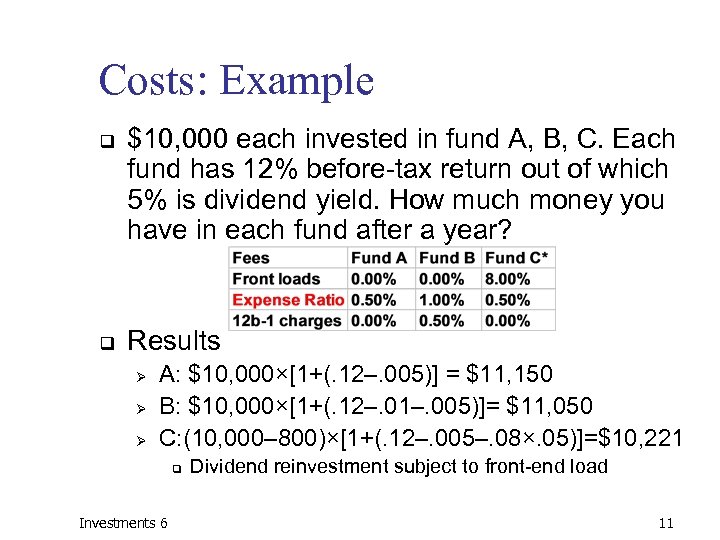
Costs: Example q q $10, 000 each invested in fund A, B, C. Each fund has 12% before-tax return out of which 5% is dividend yield. How much money you have in each fund after a year? Results Ø Ø Ø A: $10, 000×[1+(. 12–. 005)] = $11, 150 B: $10, 000×[1+(. 12–. 01–. 005)]= $11, 050 C: (10, 000– 800)×[1+(. 12–. 005–. 08×. 05)]=$10, 221 q Investments 6 Dividend reinvestment subject to front-end load 11
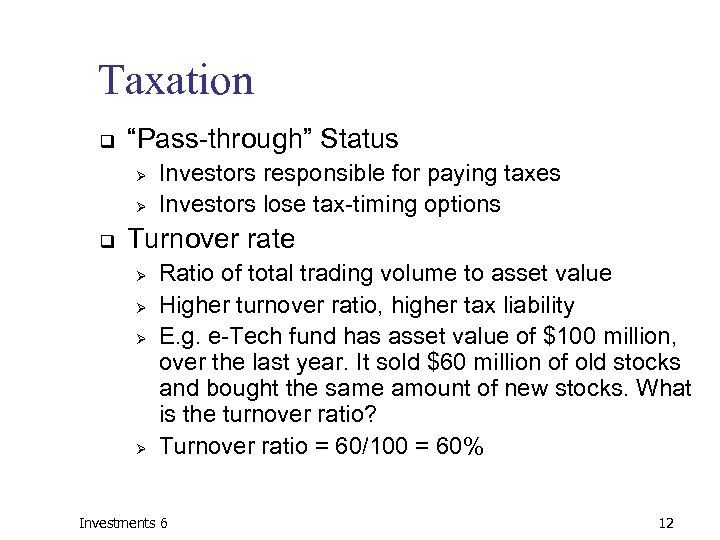
Taxation q “Pass-through” Status Ø Ø q Investors responsible for paying taxes Investors lose tax-timing options Turnover rate Ø Ø Ratio of total trading volume to asset value Higher turnover ratio, higher tax liability E. g. e-Tech fund has asset value of $100 million, over the last year. It sold $60 million of old stocks and bought the same amount of new stocks. What is the turnover ratio? Turnover ratio = 60/100 = 60% Investments 6 12
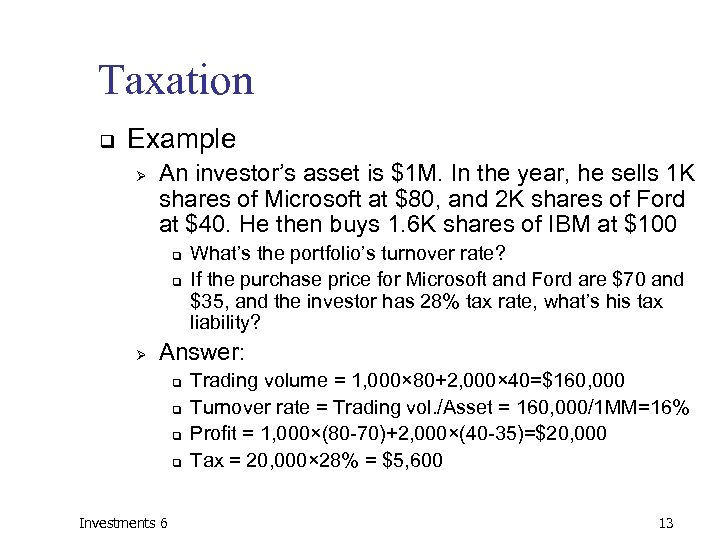
Taxation q Example Ø An investor’s asset is $1 M. In the year, he sells 1 K shares of Microsoft at $80, and 2 K shares of Ford at $40. He then buys 1. 6 K shares of IBM at $100 q q Ø What’s the portfolio’s turnover rate? If the purchase price for Microsoft and Ford are $70 and $35, and the investor has 28% tax rate, what’s his tax liability? Answer: q q Investments 6 Trading volume = 1, 000× 80+2, 000× 40=$160, 000 Turnover rate = Trading vol. /Asset = 160, 000/1 MM=16% Profit = 1, 000×(80 -70)+2, 000×(40 -35)=$20, 000 Tax = 20, 000× 28% = $5, 600 13
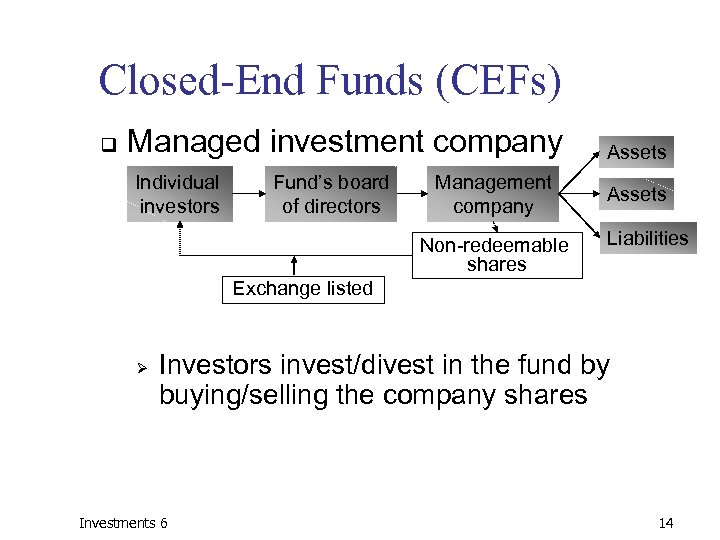
Closed-End Funds (CEFs) q Managed investment company Individual investors Fund’s board of directors Management company Non-redeemable shares Assets Liabilities Exchange listed Ø Investors invest/divest in the fund by buying/selling the company shares Investments 6 14
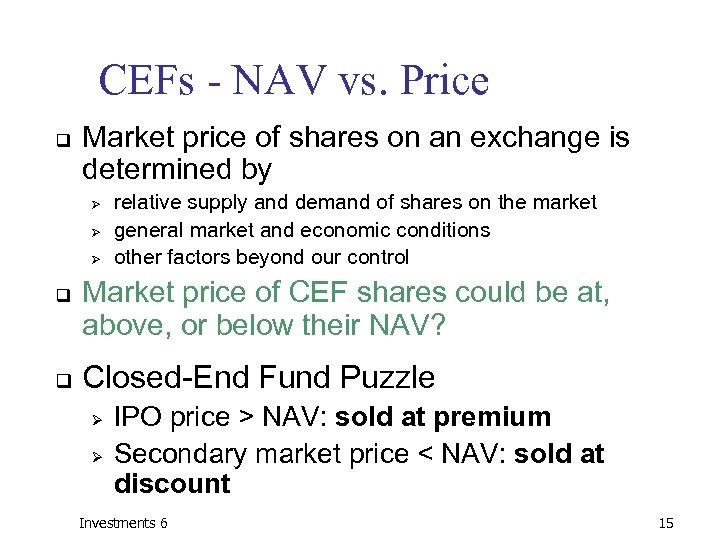
CEFs - NAV vs. Price q Market price of shares on an exchange is determined by Ø Ø Ø q q relative supply and demand of shares on the market general market and economic conditions other factors beyond our control Market price of CEF shares could be at, above, or below their NAV? Closed-End Fund Puzzle Ø Ø IPO price > NAV: sold at premium Secondary market price < NAV: sold at discount Investments 6 15
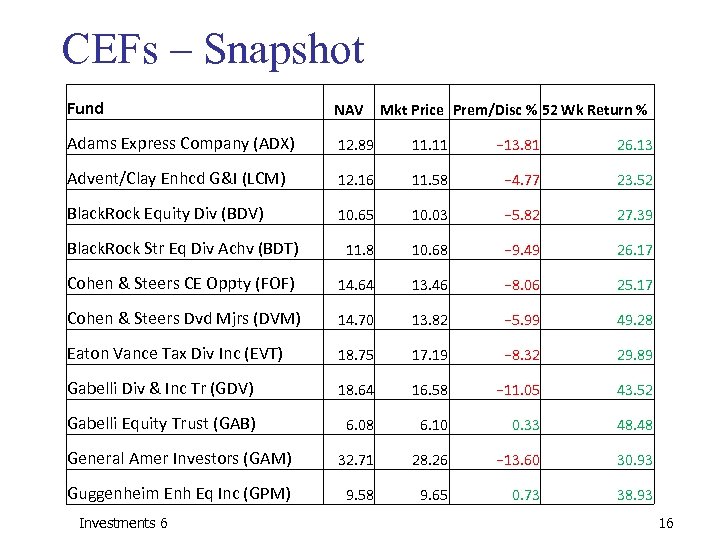
CEFs – Snapshot Fund NAV Adams Express Company (ADX) 12. 89 11. 11 − 13. 81 26. 13 Advent/Clay Enhcd G&I (LCM) 12. 16 11. 58 − 4. 77 23. 52 Black. Rock Equity Div (BDV) 10. 65 10. 03 − 5. 82 27. 39 Black. Rock Str Eq Div Achv (BDT) 11. 8 10. 68 − 9. 49 26. 17 Cohen & Steers CE Oppty (FOF) 14. 64 13. 46 − 8. 06 25. 17 Cohen & Steers Dvd Mjrs (DVM) 14. 70 13. 82 − 5. 99 49. 28 Eaton Vance Tax Div Inc (EVT) 18. 75 17. 19 − 8. 32 29. 89 Gabelli Div & Inc Tr (GDV) 18. 64 16. 58 − 11. 05 43. 52 Gabelli Equity Trust (GAB) 6. 08 6. 10 0. 33 48. 48 General Amer Investors (GAM) 32. 71 28. 26 − 13. 60 30. 93 Guggenheim Enh Eq Inc (GPM) 9. 58 9. 65 0. 73 38. 93 Investments 6 Mkt Price Prem/Disc % 52 Wk Return % 16
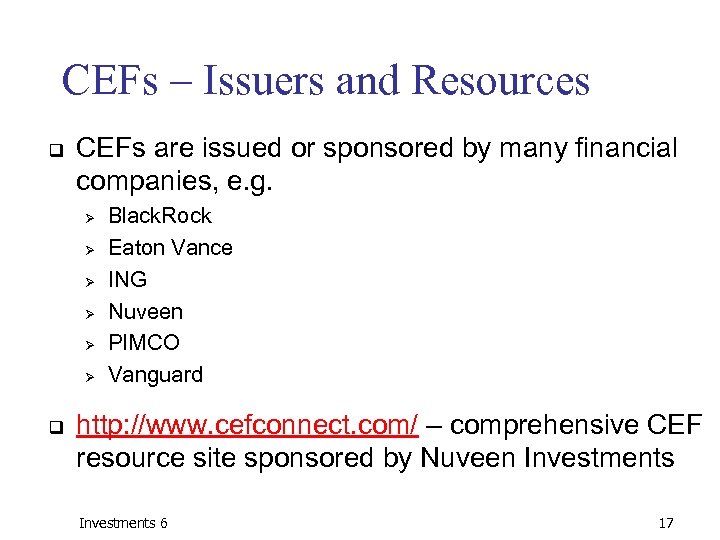
CEFs – Issuers and Resources q CEFs are issued or sponsored by many financial companies, e. g. Ø Ø Ø q Black. Rock Eaton Vance ING Nuveen PIMCO Vanguard http: //www. cefconnect. com/ – comprehensive CEF resource site sponsored by Nuveen Investments 6 17
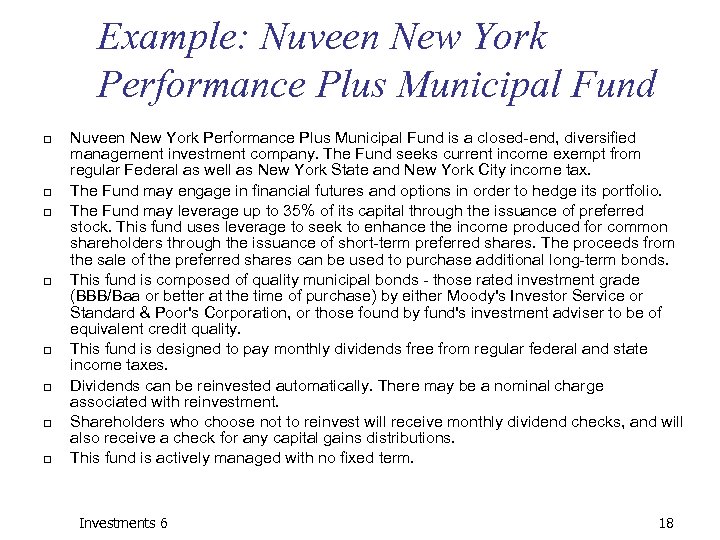
Example: Nuveen New York Performance Plus Municipal Fund q q q q Nuveen New York Performance Plus Municipal Fund is a closed-end, diversified management investment company. The Fund seeks current income exempt from regular Federal as well as New York State and New York City income tax. The Fund may engage in financial futures and options in order to hedge its portfolio. The Fund may leverage up to 35% of its capital through the issuance of preferred stock. This fund uses leverage to seek to enhance the income produced for common shareholders through the issuance of short-term preferred shares. The proceeds from the sale of the preferred shares can be used to purchase additional long-term bonds. This fund is composed of quality municipal bonds - those rated investment grade (BBB/Baa or better at the time of purchase) by either Moody's Investor Service or Standard & Poor's Corporation, or those found by fund's investment adviser to be of equivalent credit quality. This fund is designed to pay monthly dividends free from regular federal and state income taxes. Dividends can be reinvested automatically. There may be a nominal charge associated with reinvestment. Shareholders who choose not to reinvest will receive monthly dividend checks, and will also receive a check for any capital gains distributions. This fund is actively managed with no fixed term. Investments 6 18
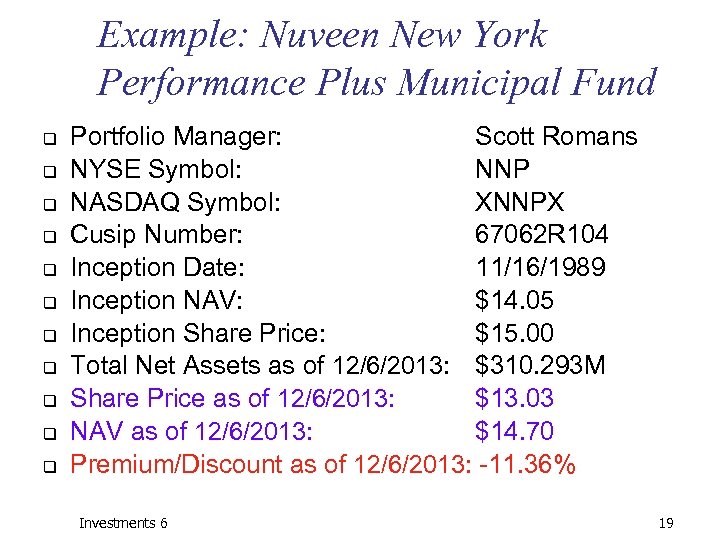
Example: Nuveen New York Performance Plus Municipal Fund q q q Portfolio Manager: Scott Romans NYSE Symbol: NNP NASDAQ Symbol: XNNPX Cusip Number: 67062 R 104 Inception Date: 11/16/1989 Inception NAV: $14. 05 Inception Share Price: $15. 00 Total Net Assets as of 12/6/2013: $310. 293 M Share Price as of 12/6/2013: $13. 03 NAV as of 12/6/2013: $14. 70 Premium/Discount as of 12/6/2013: -11. 36% Investments 6 19
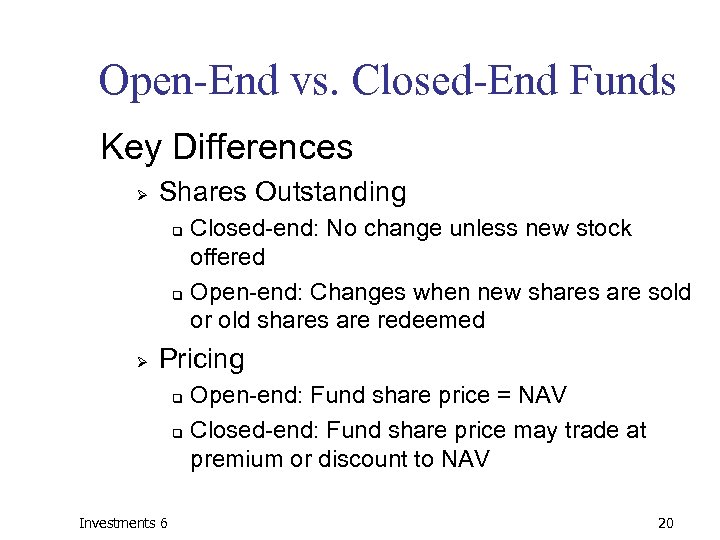
Open-End vs. Closed-End Funds Key Differences Ø Shares Outstanding Closed-end: No change unless new stock offered q Open-end: Changes when new shares are sold or old shares are redeemed q Ø Pricing Open-end: Fund share price = NAV q Closed-end: Fund share price may trade at premium or discount to NAV q Investments 6 20
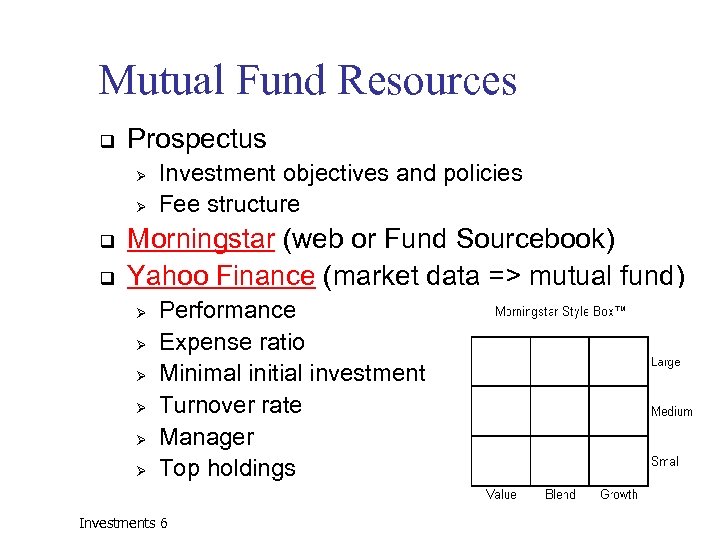
Mutual Fund Resources q Prospectus Ø Ø q q Investment objectives and policies Fee structure Morningstar (web or Fund Sourcebook) Yahoo Finance (market data => mutual fund) Ø Ø Ø Performance Expense ratio Minimal initial investment Turnover rate Manager Top holdings Investments 6 21
Performance q How well mutual funds fare? Ø Evidence q Ø Benchmark: Wilshire 5000, S&P 500, etc q q Ø On average, equity fund outperforms money market as compensation for investment risk. You can buy and hold index at very low cost (~18 bp) Vanguard S&P 500 or Total stock market fund Risk adjustment: beta risk, factor risk, etc q Investments 6 Higher return does not mean a fund is better, risk has to be factored in to evaluate a fund performance. 22
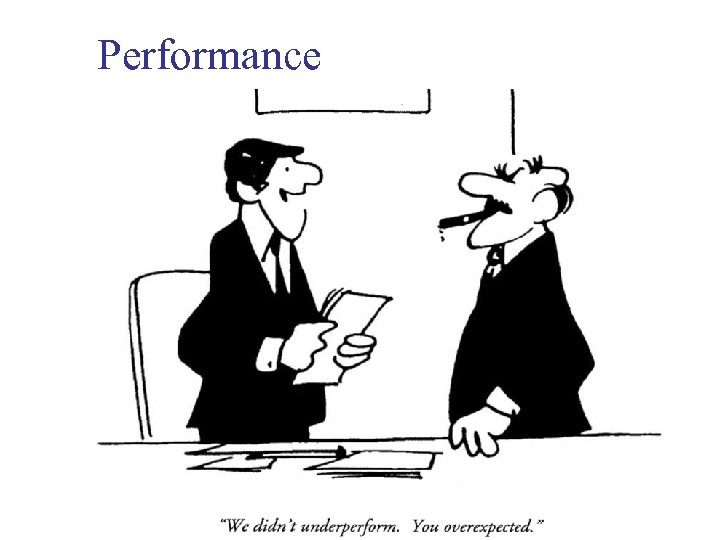
Performance q Historical comparison (1980 - 2005)* Ø Ø q Historical comparison (1971 - 2009)** Ø Ø q S&P 500 – 12. 3% average yearly return Average Mutual Fund - 10% average yearly return Wilshire 5000 – 11. 9 % average yearly return Average Mutual Fund return was more than 1% lower than Wilshire 5000 Consensus: passive equity fund (indexed) outperforms active managed funds * The Economist, Feb 28, 2008 Investments 6 ** BKM, 9 th ed. 23
Performance Investments 6 24
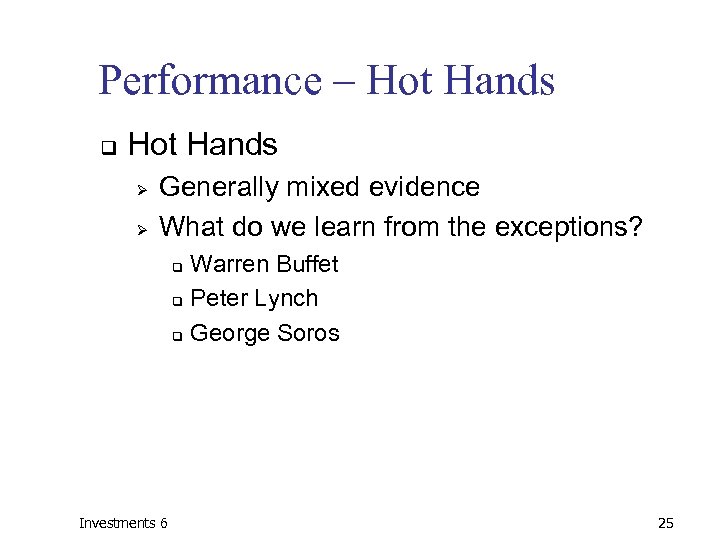
Performance – Hot Hands q Hot Hands Ø Ø Generally mixed evidence What do we learn from the exceptions? Warren Buffet q Peter Lynch q George Soros q Investments 6 25
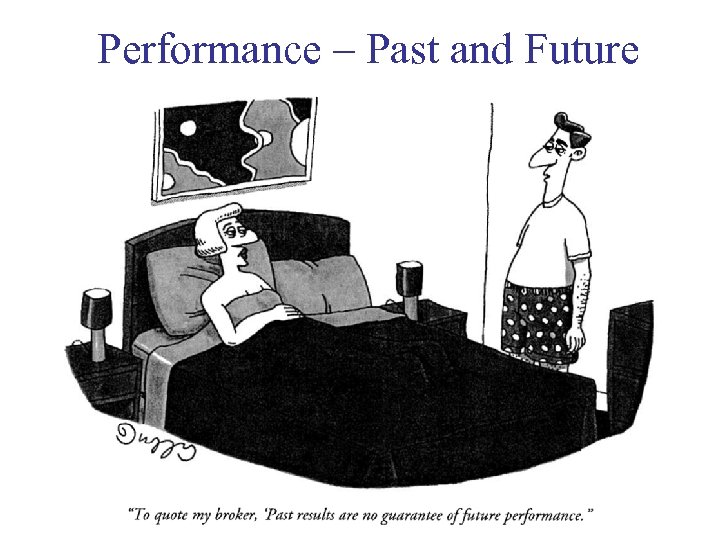
Performance – Past and Future Investments 6 26
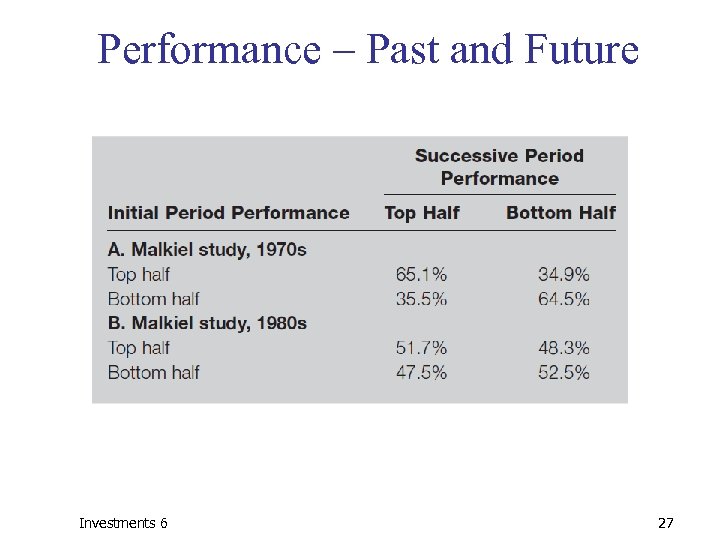
Performance – Past and Future Investments 6 27
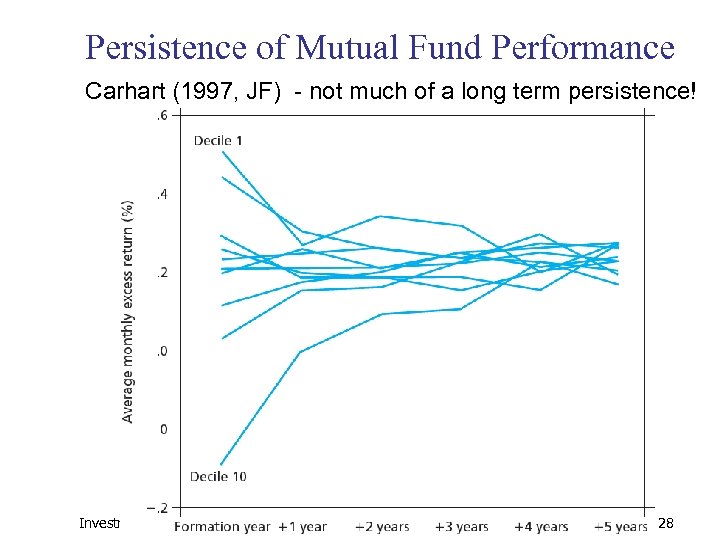
Persistence of Mutual Fund Performance Carhart (1997, JF) - not much of a long term persistence! Investments 13 28
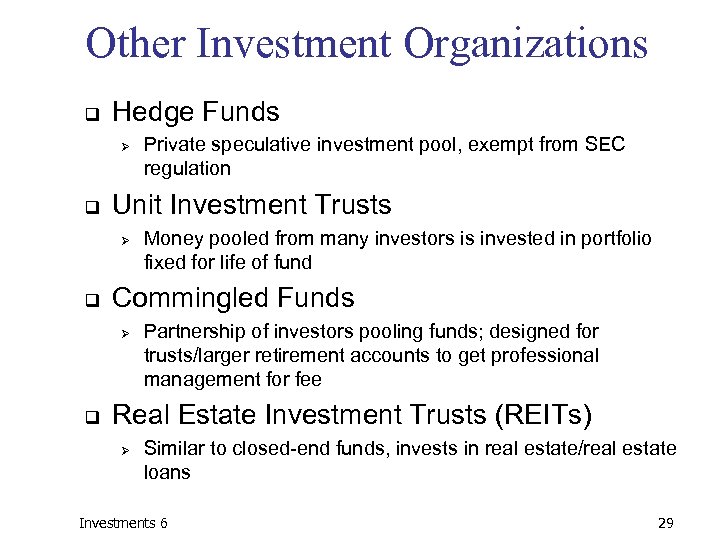
Other Investment Organizations q Hedge Funds Ø q Unit Investment Trusts Ø q Money pooled from many investors is invested in portfolio fixed for life of fund Commingled Funds Ø q Private speculative investment pool, exempt from SEC regulation Partnership of investors pooling funds; designed for trusts/larger retirement accounts to get professional management for fee Real Estate Investment Trusts (REITs) Ø Similar to closed-end funds, invests in real estate/real estate loans Investments 6 29
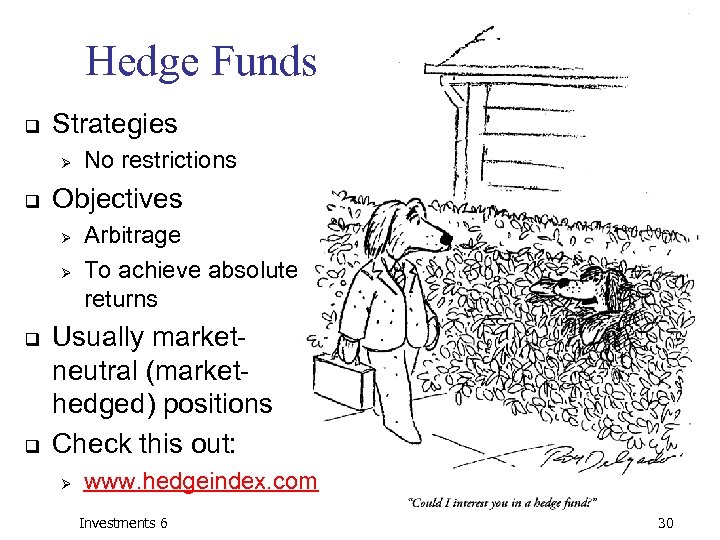
Hedge Funds q Strategies Ø q Objectives Ø Ø q q No restrictions Arbitrage To achieve absolute returns Usually marketneutral (markethedged) positions Check this out: Ø www. hedgeindex. com Investments 6 30
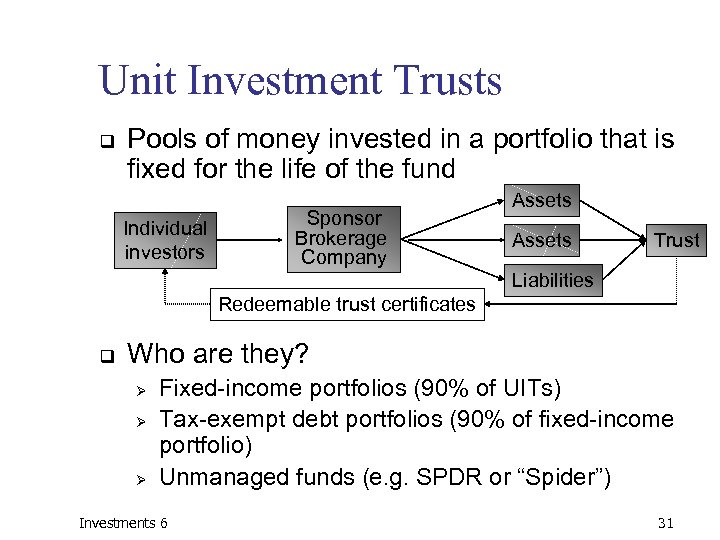
Unit Investment Trusts q Pools of money invested in a portfolio that is fixed for the life of the fund Individual investors Sponsor Brokerage Company Assets Trust Liabilities Redeemable trust certificates q Who are they? Ø Ø Ø Fixed-income portfolios (90% of UITs) Tax-exempt debt portfolios (90% of fixed-income portfolio) Unmanaged funds (e. g. SPDR or “Spider”) Investments 6 31
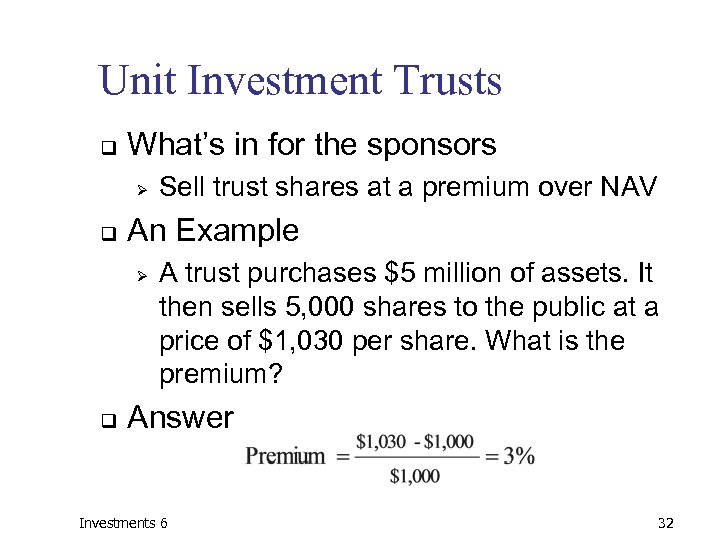
Unit Investment Trusts q What’s in for the sponsors Ø q An Example Ø q Sell trust shares at a premium over NAV A trust purchases $5 million of assets. It then sells 5, 000 shares to the public at a price of $1, 030 per share. What is the premium? Answer Investments 6 32
Recent Developments - ETFs q Exchange-Traded Funds (ETFs) Ø q Funds that allow investors to trade index portfolios Examples: Ø Ø “Spiders, ” “Diamonds, ” and “Cubes” Spiders - the first index ETF started in 1993 i. Shares by Black. Rock Market Vectors by Van Eck Global Investments 6 33
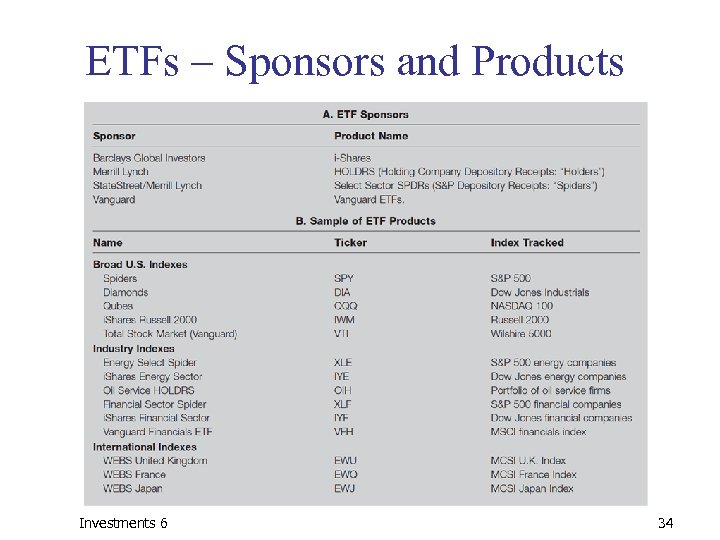
ETFs – Sponsors and Products Investments 6 34
ETFs – Pros and Cons q Potential Advantages Ø Ø q Trade continuously throughout day like stocks Can be sold short or purchased on margin Lower costs (no marketing, lower fund expenses) Potentially lower tax rates Potential Disadvantages Ø Ø Small deviations from NAV possible Brokerage commission to buy ETF Investments 6 35
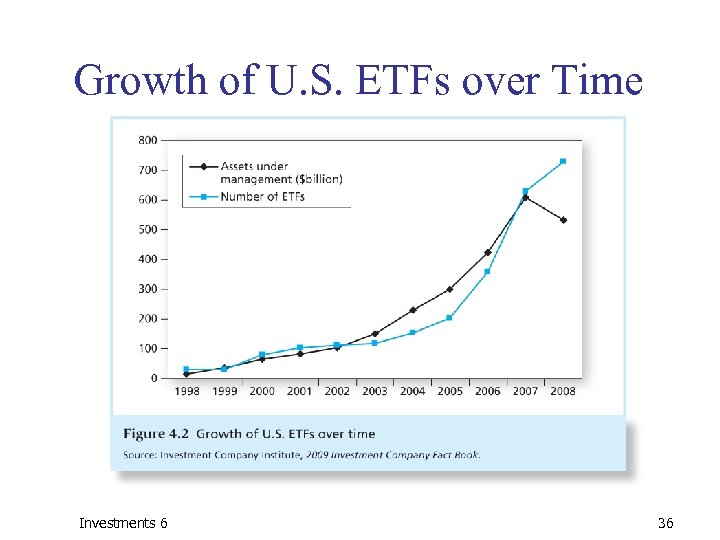
Growth of U. S. ETFs over Time Investments 6 36
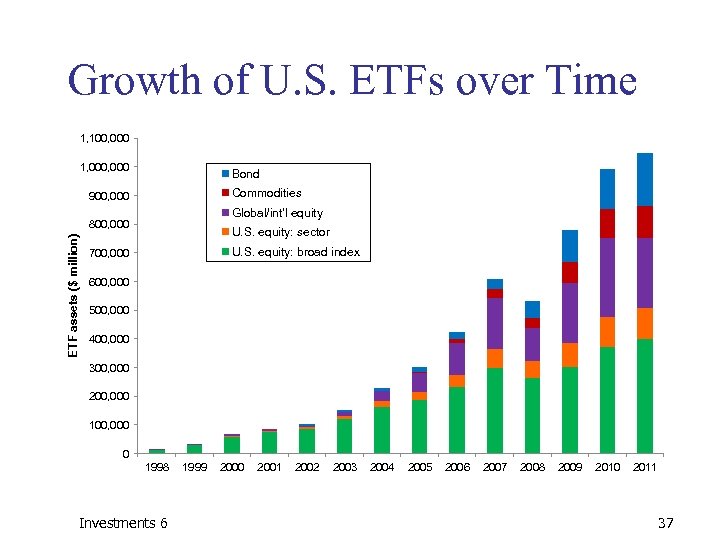
Growth of U. S. ETFs over Time 1, 100, 000 1, 000 Bond Commodities 900, 000 Global/int'l equity ETF assets ($ million) 800, 000 U. S. equity: sector U. S. equity: broad index 700, 000 600, 000 500, 000 400, 000 300, 000 200, 000 100, 000 0 1998 Investments 6 1999 2000 2001 2002 2003 2004 2005 2006 2007 2008 2009 2010 2011 37
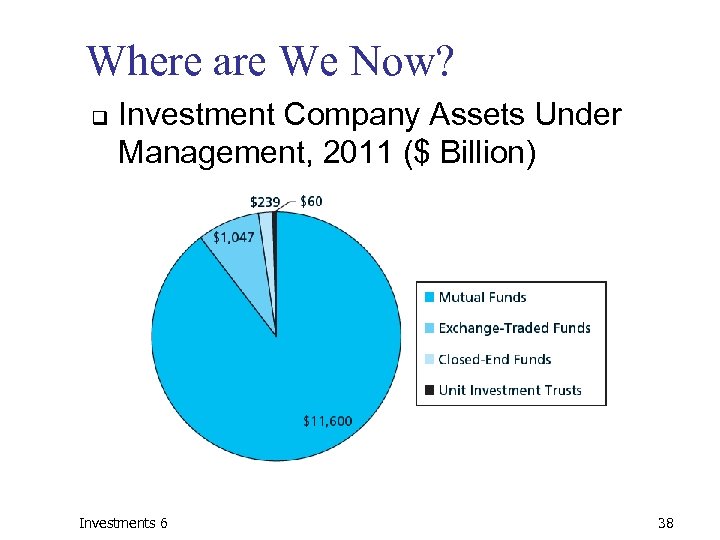
Where are We Now? q Investment Company Assets Under Management, 2011 ($ Billion) Investments 6 38
Скачать презентацию Mutual Funds Basics Types Costs Performance Recent Developments
d03bde29c2c2614adfe7d06574b907c1.ppt