


 Скачать презентацию Mutual Acceptance of Conformity Assessment Results — Japan s
7ca1236fb032a15aaf375e36559603be.ppt
- Количество слайдов: 18
 Mutual Acceptance of Conformity Assessment Results - Japan’s Experience and Observation 16 March 2006 Shinji FUJINO Director International Standards & MRA Policy Office Ministry of Economy, Trade and Industry (METI) JAPAN 1
 Mutual Recognition Referred in TBT Agreement (1) n Article 6. 1 …… Members shall ensure, whenever possible, that results of conformity assessment procedures in other Members are accepted, even when those procedures differ from their own, provided they are satisfied that those procedures offer an assurance of conformity with applicable technical regulations or standards equivalent to their own procedures. …… 2
 Mutual Recognition Referred in TBT Agreement (2) n Article 6. 3 Members are encouraged, at the request of other Members, to be willing to enter into negotiations for the conclusion of agreements for the mutual recognition of results of each other’s conformity assessment procedures. Members may require that such agreements fulfil the criteria of paragraph 1 and give mutual satisfaction regarding their potential for facilitating trade in the products concerned. 3
![Traditional Mutual Recognition [JPN-EU/SGP] Government A Designation in accordance with the technical Regulations and](https://present5.com/presentation/7ca1236fb032a15aaf375e36559603be/image-4.jpg "Traditional Mutual Recognition [JPN-EU/SGP] Government A Designation in accordance with the technical Regulations and") Traditional Mutual Recognition [JPN-EU/SGP] Government A Designation in accordance with the technical Regulations and procedure of country B Conformity Assessment in accordance with the technical Regulations of country B Acceptance Certificate CABs in Country A Government B Certificate Designation in accordance with the technical Regulations and procedure of country A CABs in Country B < Equivalent > Conformity Assessment in accordance with the technical Regulations of country A 4
Traditional Mutual Recognition [JPN-EU/SGP] Government A Designation in accordance with the technical Regulations and procedure of country B Conformity Assessment in accordance with the technical Regulations of country B Acceptance Certificate CABs in Country A Government B Certificate Designation in accordance with the technical Regulations and procedure of country A CABs in Country B < Equivalent > Conformity Assessment in accordance with the technical Regulations of country A 4
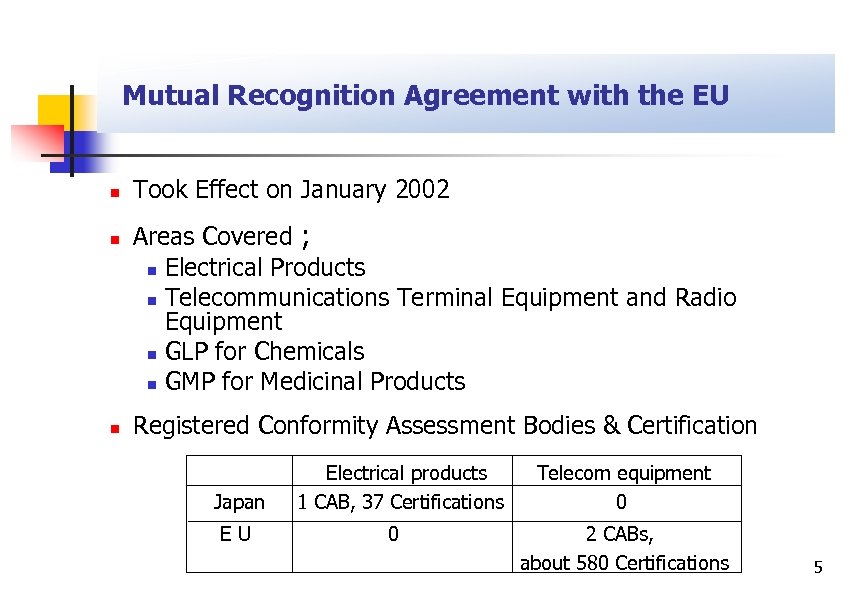 Mutual Recognition Agreement with the EU n n n Took Effect on January 2002 Areas Covered ; n Electrical Products n Telecommunications Terminal Equipment and Radio Equipment n GLP for Chemicals n GMP for Medicinal Products Registered Conformity Assessment Bodies & Certification Japan EU Electrical products 1 CAB, 37 Certifications 0 Telecom equipment 0 2 CABs, about 580 Certifications 5
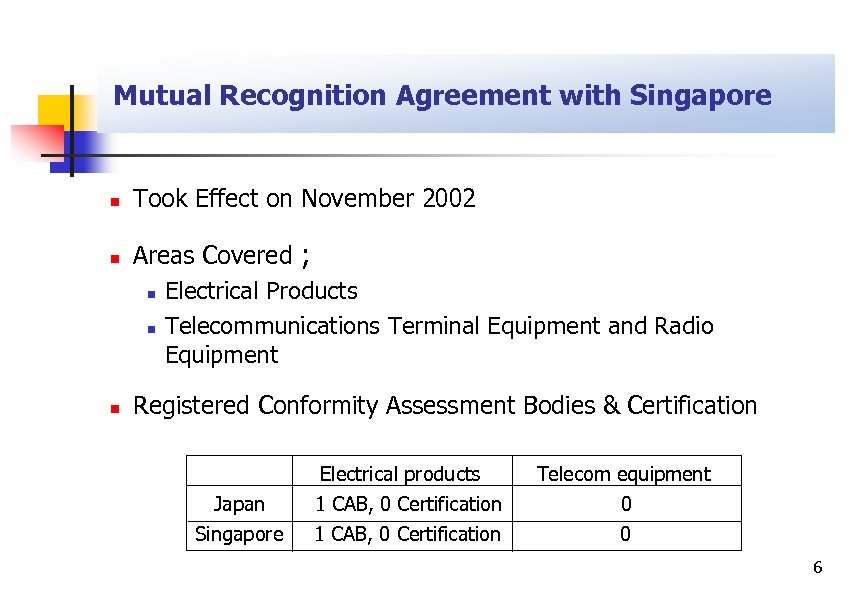 Mutual Recognition Agreement with Singapore n n n Took Effect on November 2002 Areas Covered ; n Electrical Products n Telecommunications Terminal Equipment and Radio Equipment Registered Conformity Assessment Bodies & Certification Japan Singapore Electrical products 1 CAB, 0 Certification Telecom equipment 0 0 6
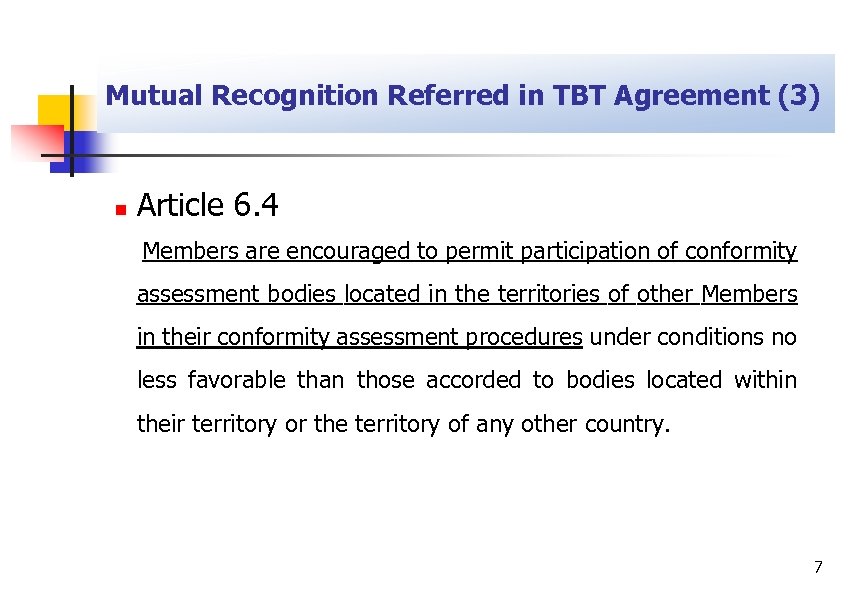 Mutual Recognition Referred in TBT Agreement (3) n Article 6. 4 Members are encouraged to permit participation of conformity assessment bodies located in the territories of other Members in their conformity assessment procedures under conditions no less favorable than those accorded to bodies located within their territory or the territory of any other country. 7
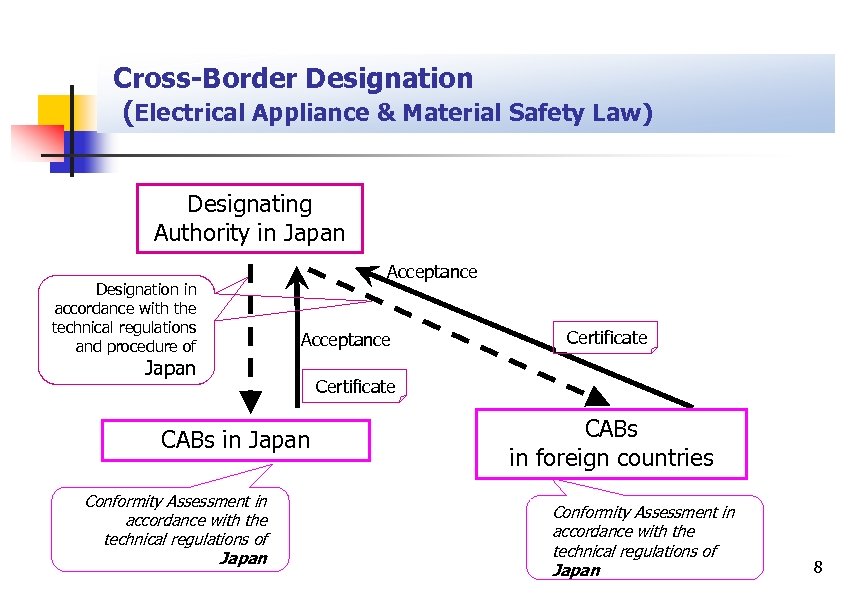 Cross-Border Designation (Electrical Appliance & Material Safety Law) Designating Authority in Japan Designation in accordance with the technical regulations and procedure of Acceptance Japan CABs in Japan Conformity Assessment in accordance with the technical regulations of Japan Certificate CABs in foreign countries Conformity Assessment in accordance with the technical regulations of Japan 8
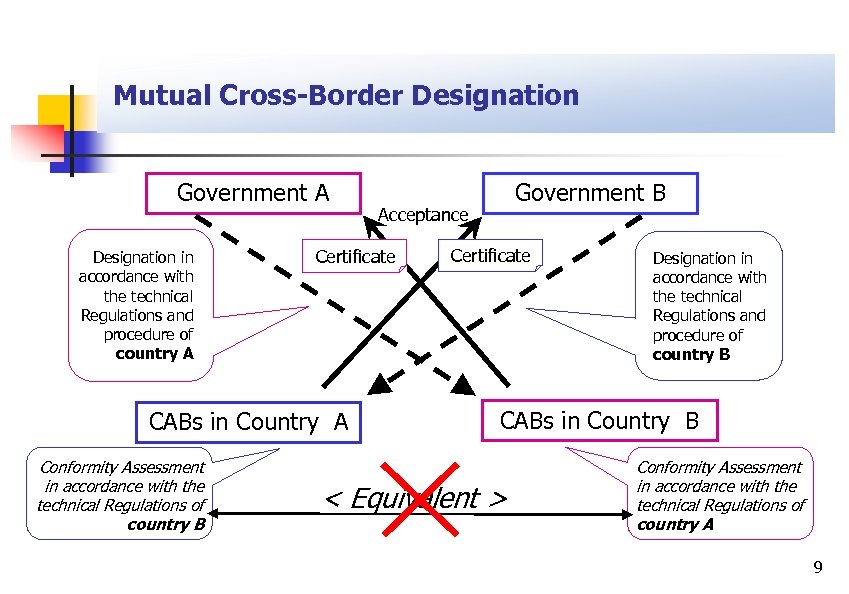 Mutual Cross-Border Designation Government A Designation in accordance with the technical Regulations and procedure of country A Conformity Assessment in accordance with the technical Regulations of country B Acceptance Certificate CABs in Country A Government B Certificate Designation in accordance with the technical Regulations and procedure of country B CABs in Country B < Equivalent > Conformity Assessment in accordance with the technical Regulations of country A 9
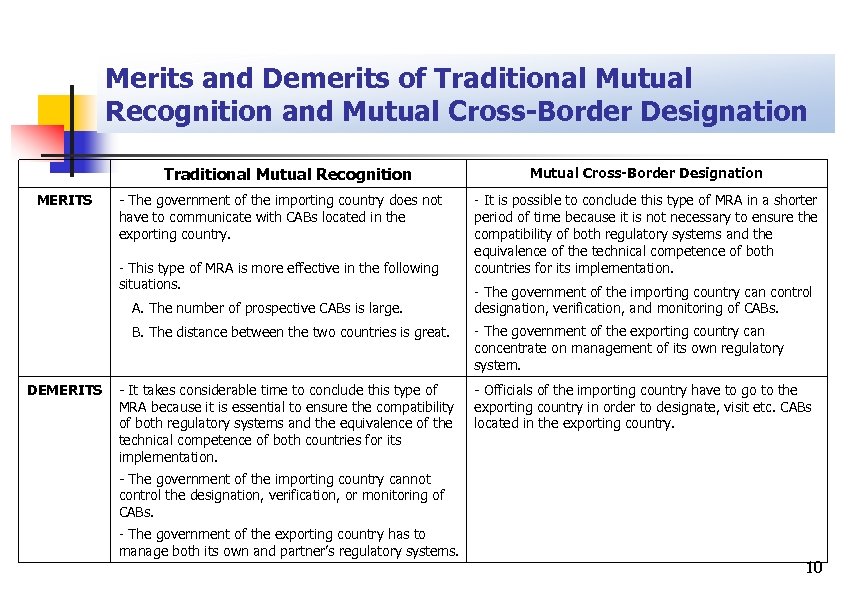 Merits and Demerits of Traditional Mutual Recognition and Mutual Cross-Border Designation Traditional Mutual Recognition MERITS - The government of the importing country does not have to communicate with CABs located in the exporting country. - This type of MRA is more effective in the following situations. A. The number of prospective CABs is large. B. The distance between the two countries is great. DEMERITS - It takes considerable time to conclude this type of MRA because it is essential to ensure the compatibility of both regulatory systems and the equivalence of the technical competence of both countries for its implementation. - The government of the importing country cannot control the designation, verification, or monitoring of CABs. - The government of the exporting country has to manage both its own and partner’s regulatory systems. Mutual Cross-Border Designation - It is possible to conclude this type of MRA in a shorter period of time because it is not necessary to ensure the compatibility of both regulatory systems and the equivalence of the technical competence of both countries for its implementation. - The government of the importing country can control designation, verification, and monitoring of CABs. - The government of the exporting country can concentrate on management of its own regulatory system. - Officials of the importing country have to go to the exporting country in order to designate, visit etc. CABs located in the exporting country. 10
 Comparison between Traditional Mutual Recognition and Mutual Cross-Border Designation n For Industries: In terms of reducing technical burden to trade, the merits of the two types are the same, since both types make it possible for manufacturers/exporters to take conformity assessment procedures in the exporting country. n For Government: n Negotiation Cost It needs a long time and much human resources to conclude Traditional Mutual Recognition, since this type of MRA requires compatibility of regulatory systems, and equivalence of the technical competence between both countries. n Implementation Cost Case by Case ? 11
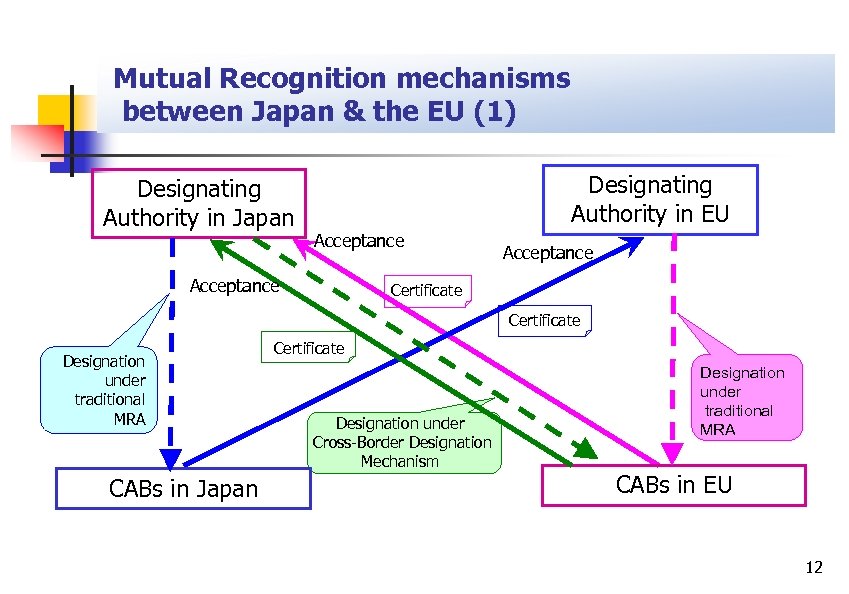 Mutual Recognition mechanisms between Japan & the EU (1) Designating Authority in Japan Designating Authority in EU Acceptance Certificate Designation under traditional MRA CABs in Japan Certificate Designation under Cross-Border Designation Mechanism Designation under traditional MRA CABs in EU 12
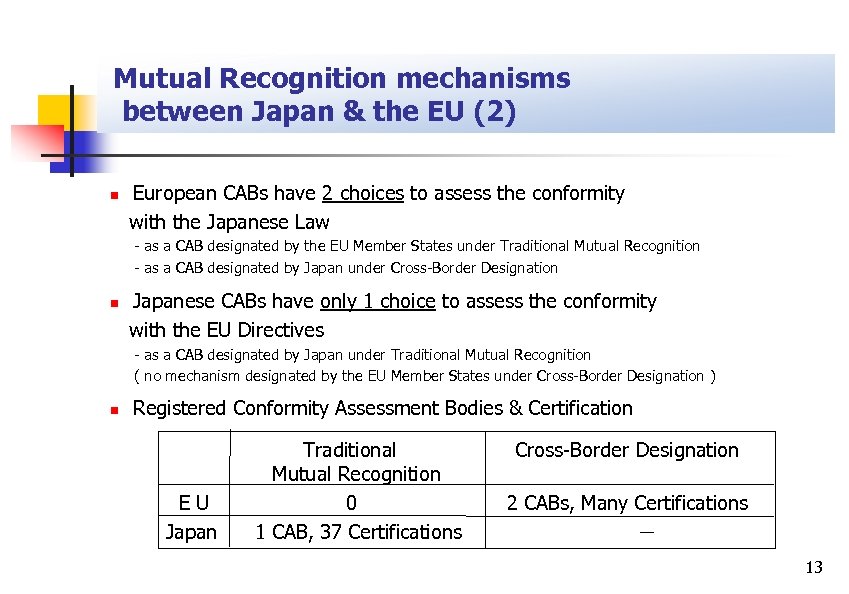 Mutual Recognition mechanisms between Japan & the EU (2) n European CABs have 2 choices to assess the conformity with the Japanese Law - as a CAB designated by the EU Member States under Traditional Mutual Recognition - as a CAB designated by Japan under Cross-Border Designation n Japanese CABs have only 1 choice to assess the conformity with the EU Directives - as a CAB designated by Japan under Traditional Mutual Recognition ( no mechanism designated by the EU Member States under Cross-Border Designation ) n Registered Conformity Assessment Bodies & Certification EU Japan Traditional Mutual Recognition 0 1 CAB, 37 Certifications Cross-Border Designation 2 CABs, Many Certifications - 13
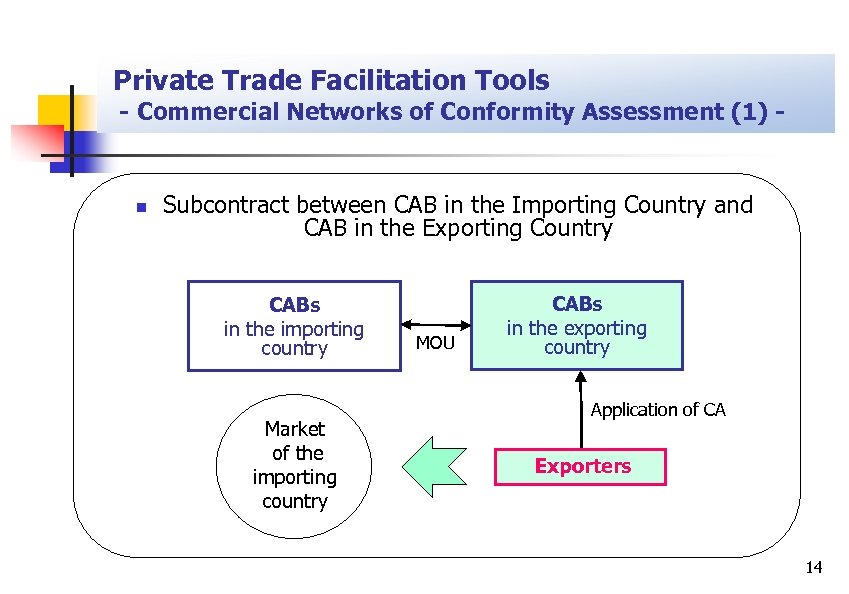 Private Trade Facilitation Tools - Commercial Networks of Conformity Assessment (1) - n Subcontract between CAB in the Importing Country and CAB in the Exporting Country CABs in the importing country Market of the importing country MOU CABs in the exporting country Application of CA Exporters 14
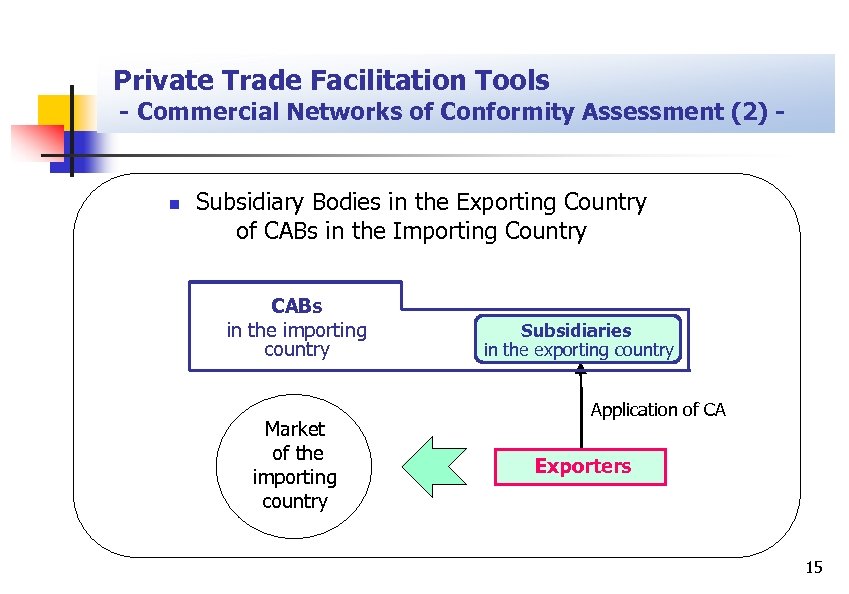 Private Trade Facilitation Tools - Commercial Networks of Conformity Assessment (2) - n Subsidiary Bodies in the Exporting Country of CABs in the Importing Country CABs in the importing country Market of the importing country Subsidiaries in the exporting country Application of CA Exporters 15
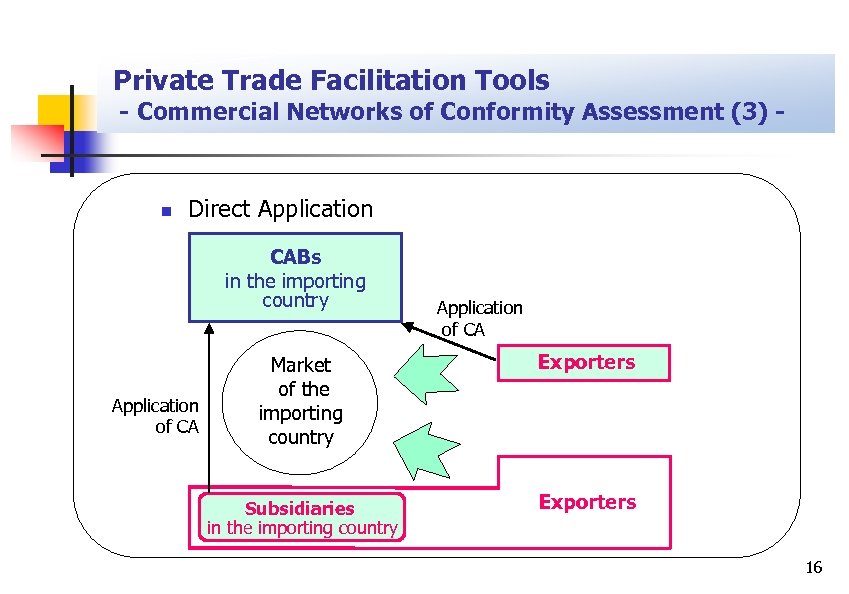 Private Trade Facilitation Tools - Commercial Networks of Conformity Assessment (3) - n Direct Application CABs in the importing country Application of CA Market of the importing country Exporters Subsidiaries in the importing country Exporters 16
 Private Trade Facilitation Tools - Multilateral Recognition Mechanism - n Multilateral Recognition Mechanism IEC/EE CB Scheme In the Electric Safety/EMC Area n One Stop Testing among National Certification Bodies n > Is there any possibility of similar mechanisms in other product areas ? 17
 Summary n n Effective Utilization of Private Facilitation Tools - Commercial Networks in Private Sectors - Multilateral Recognition Mechanism like IEC/EE CB Scheme Possibility of Cross-Border Designation Mechanism referred in Article 6. 4 of the TBT Agreement - Cost-effectiveness in comparison with Traditional Mutual Recognition 18