


 Скачать презентацию Music History Lecture Notes Twentieth Century Art Music
2e782056b13a379b0d20aa6b6199685c.ppt
- Количество слайдов: 66
 Music History Lecture Notes Twentieth Century Art Music 1900 - 2000 This presentation is intended for the use of current students in Mr. Duckworth’s Music History course as a study aid. Any other use is strictly forbidden. Copyright, Ryan Duckworth 2010 Images used for educational purposes under the TEACH Act (Technology, Education and Copyright Harmonization Act of 2002). All copyrights belong to their respective copyright holders,
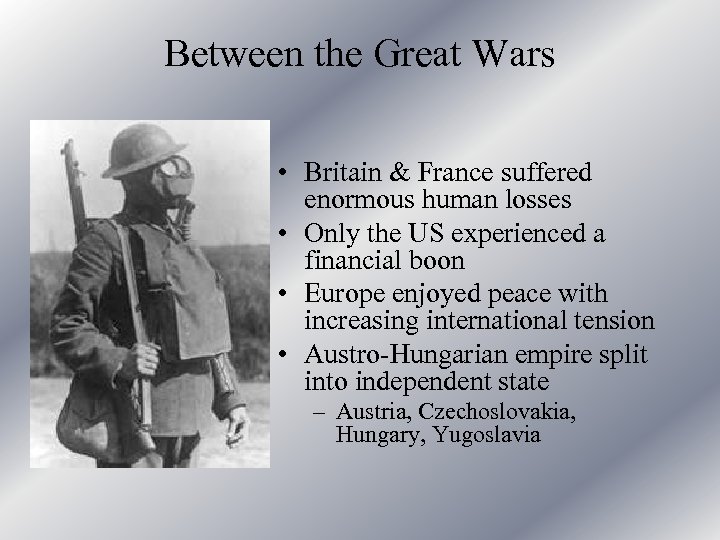 Between the Great Wars • Britain & France suffered enormous human losses • Only the US experienced a financial boon • Europe enjoyed peace with increasing international tension • Austro-Hungarian empire split into independent state – Austria, Czechoslovakia, Hungary, Yugoslavia
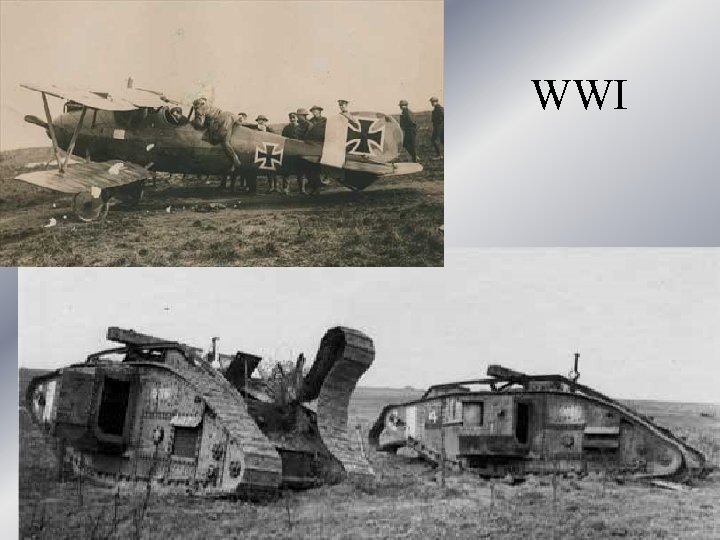 WWI
WWI
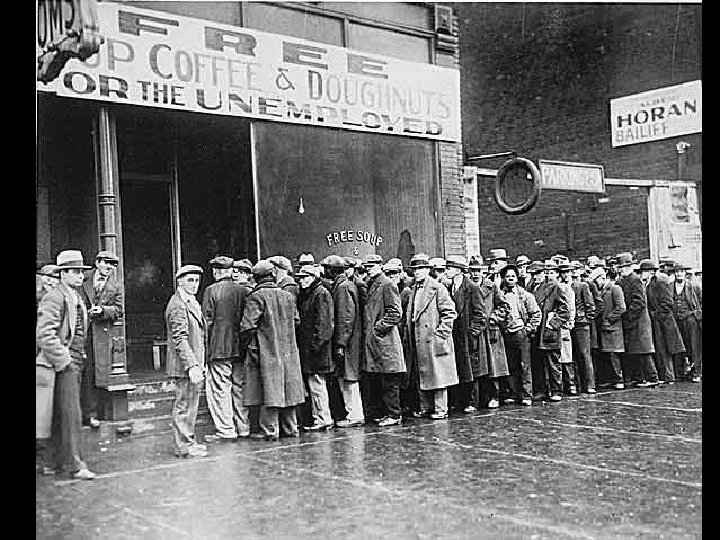
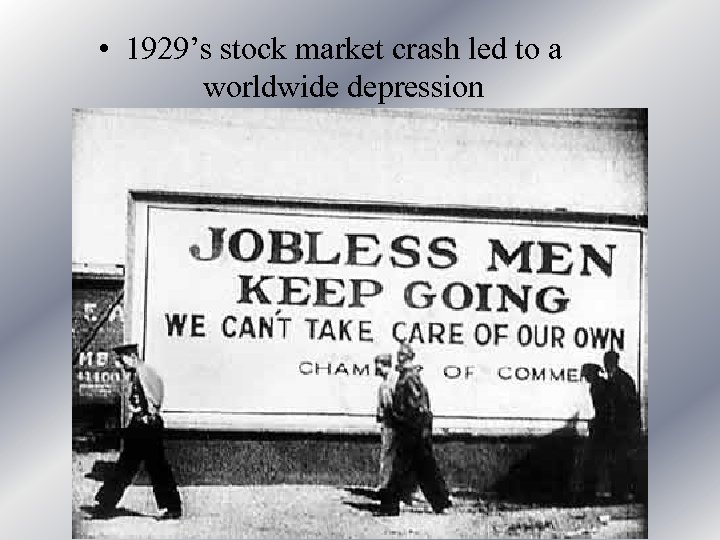 • 1929’s stock market crash led to a worldwide depression
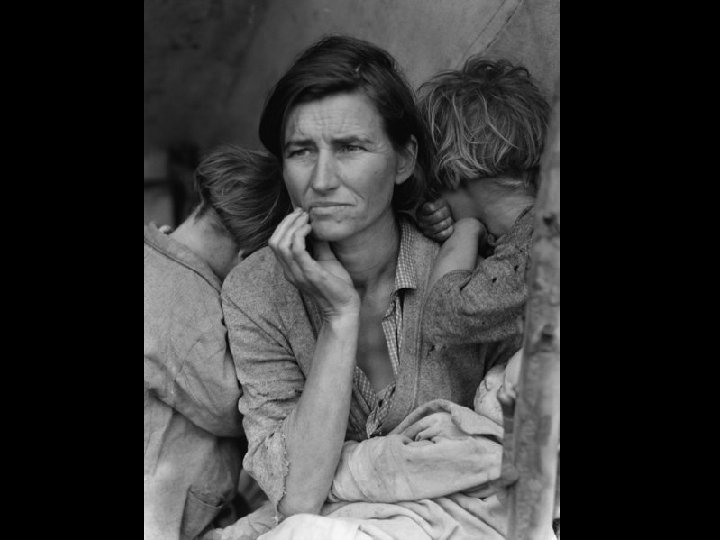
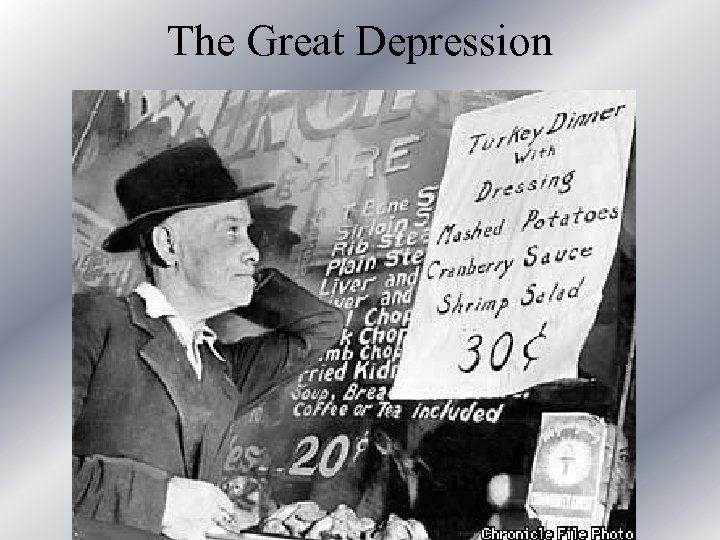 The Great Depression
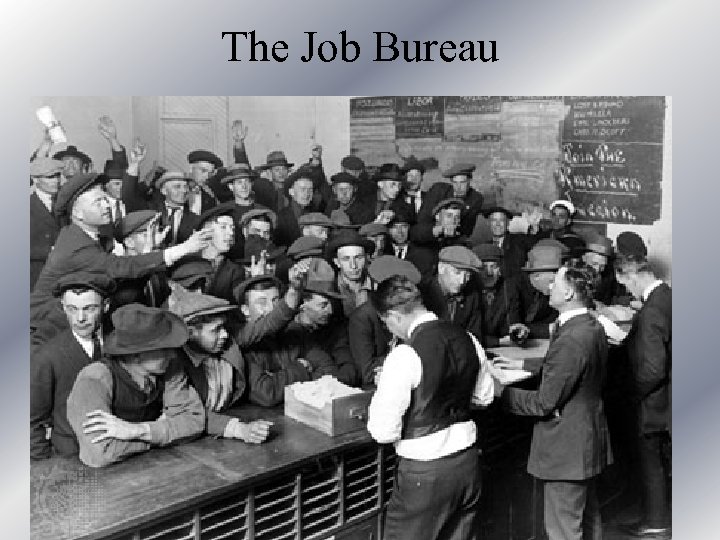 The Job Bureau
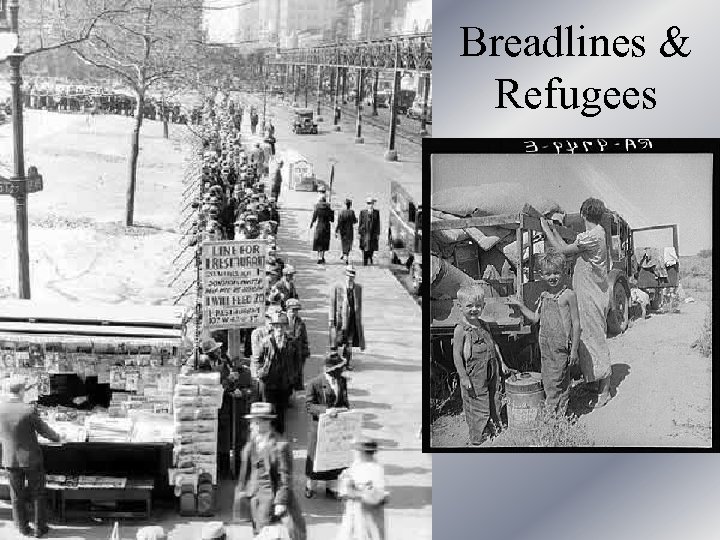 Breadlines & Refugees
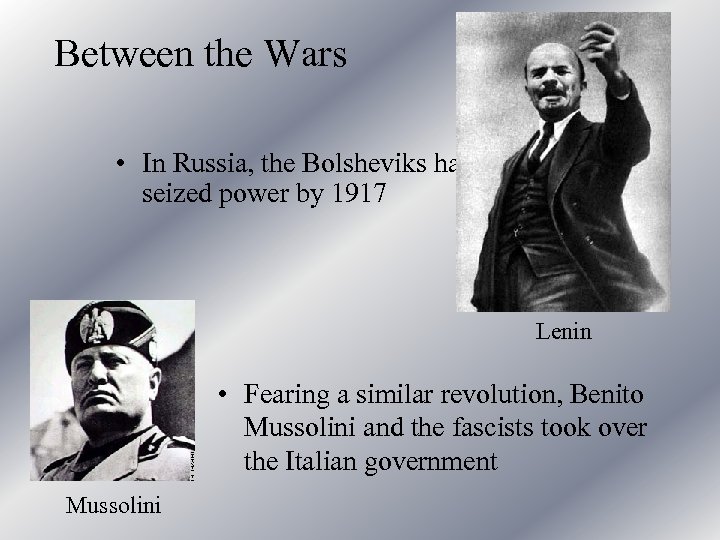 Between the Wars • In Russia, the Bolsheviks had seized power by 1917 Lenin • Fearing a similar revolution, Benito Mussolini and the fascists took over the Italian government Mussolini
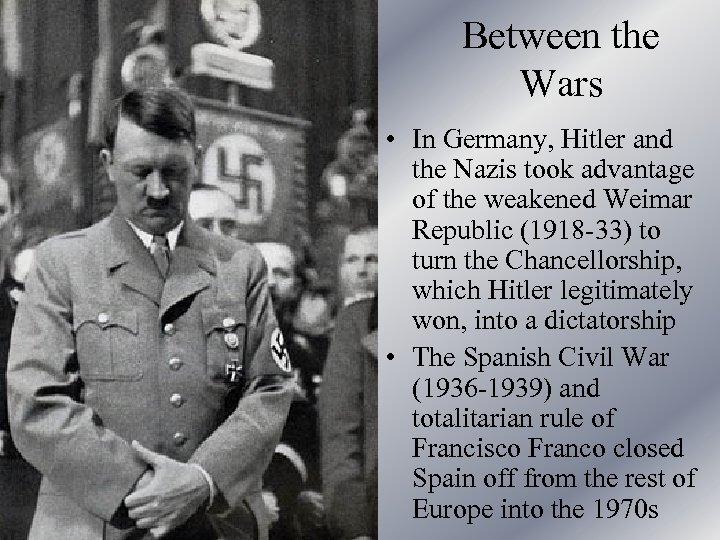 Between the Wars • In Germany, Hitler and the Nazis took advantage of the weakened Weimar Republic (1918 -33) to turn the Chancellorship, which Hitler legitimately won, into a dictatorship • The Spanish Civil War (1936 -1939) and totalitarian rule of Francisco Franco closed Spain off from the rest of Europe into the 1970 s
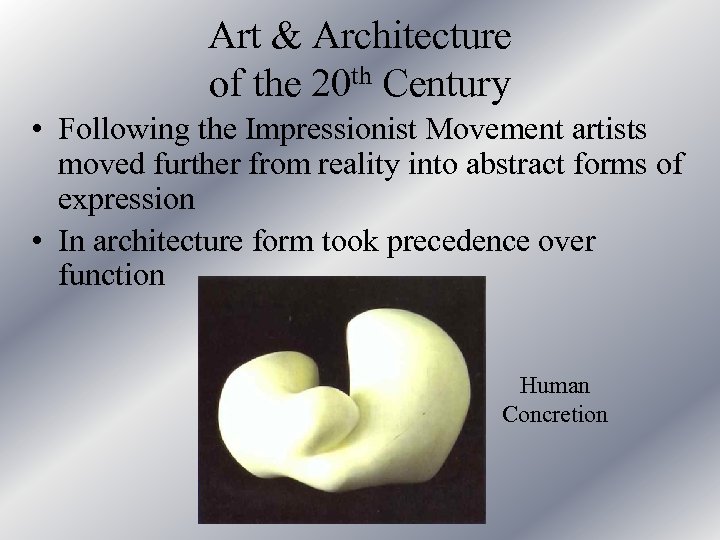 Art & Architecture of the 20 th Century • Following the Impressionist Movement artists moved further from reality into abstract forms of expression • In architecture form took precedence over function Human Concretion
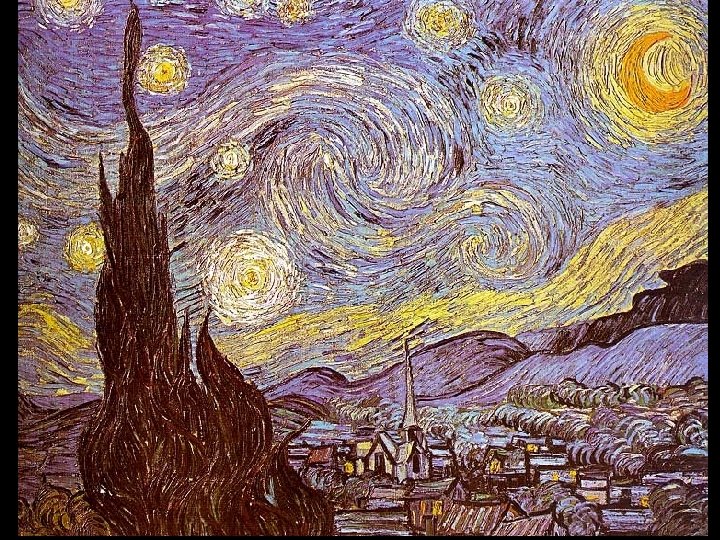
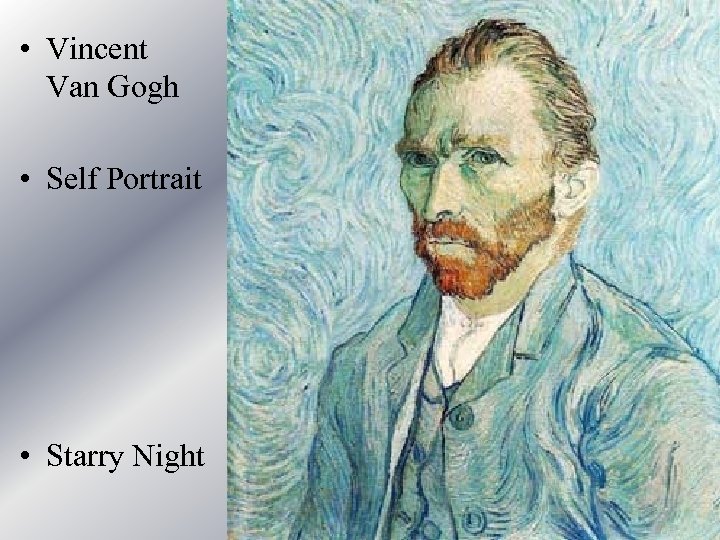 • Vincent Van Gogh • Self Portrait • Starry Night
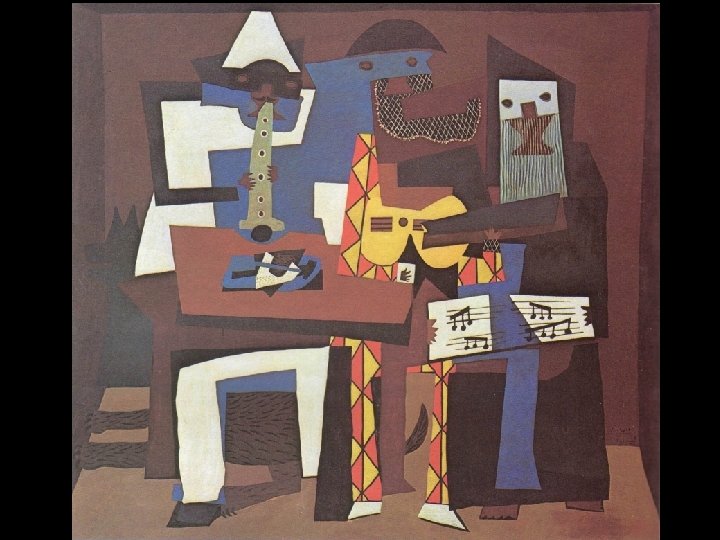
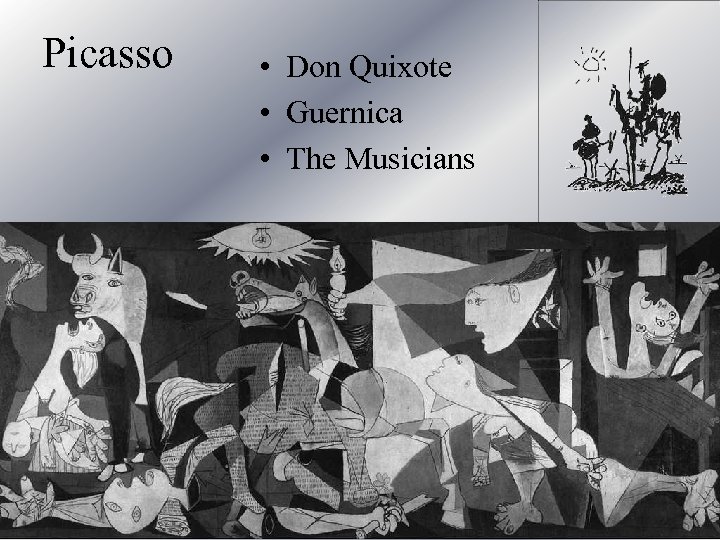 Picasso • Don Quixote • Guernica • The Musicians
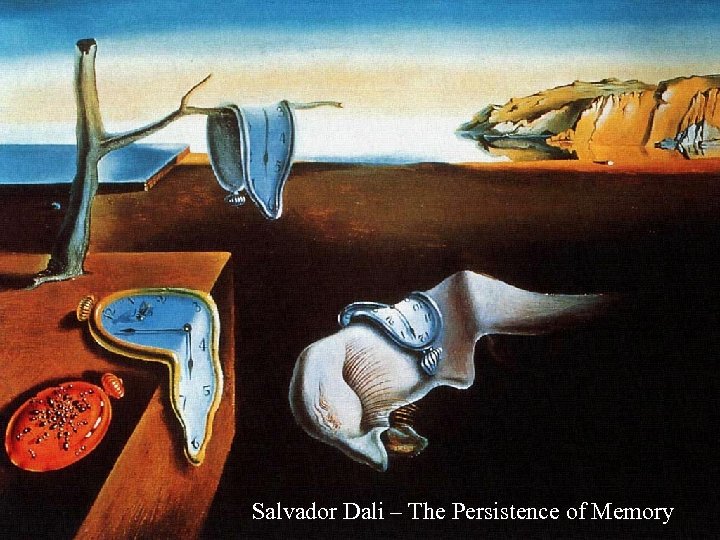 Salvador Dali – The Persistence of Memory
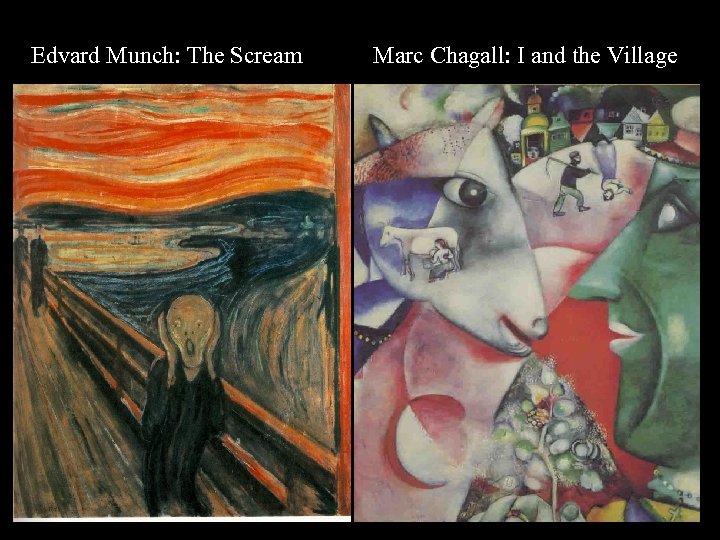 Edvard Munch: The Scream Marc Chagall: I and the Village
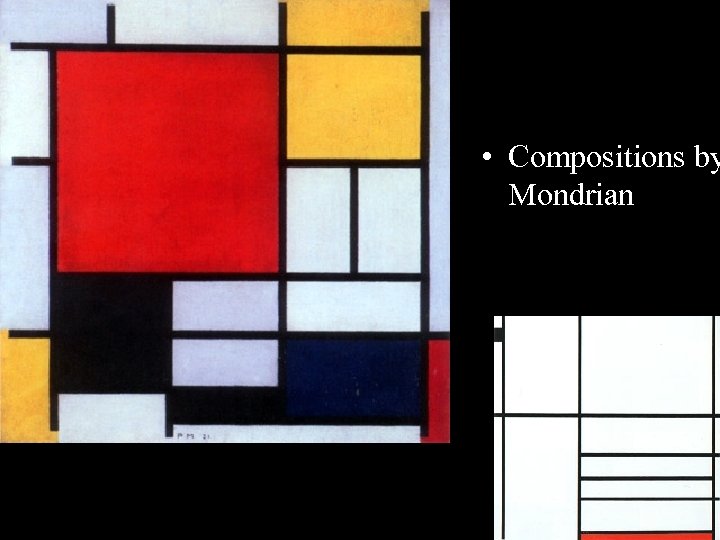 • Compositions by Mondrian
 • Current by Riley
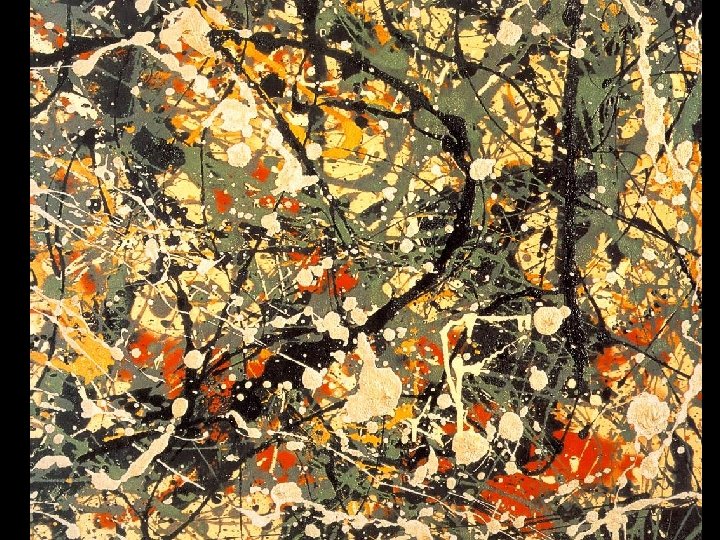
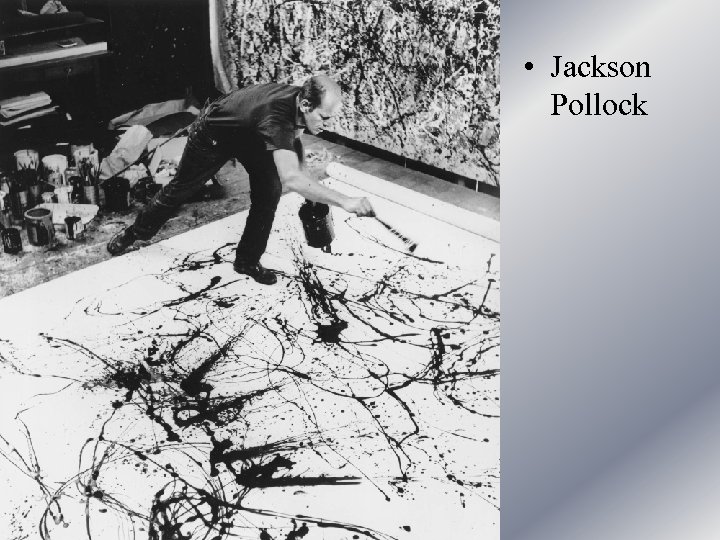 • Jackson Pollock
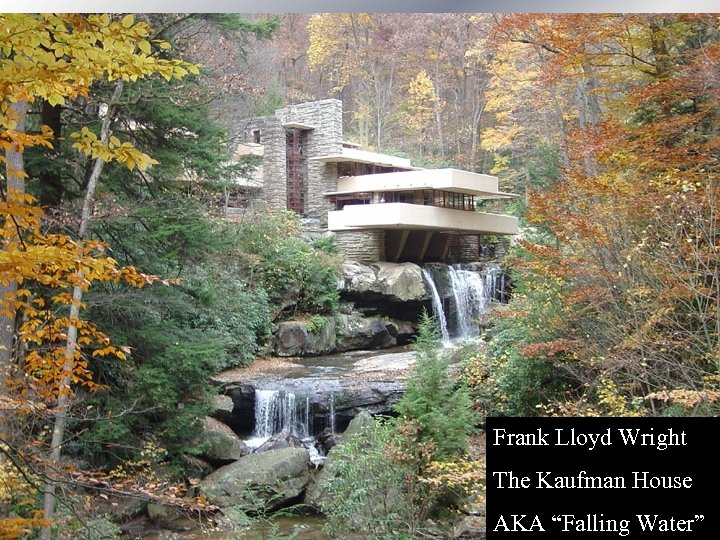 Frank Lloyd Wright The Kaufman House AKA “Falling Water”
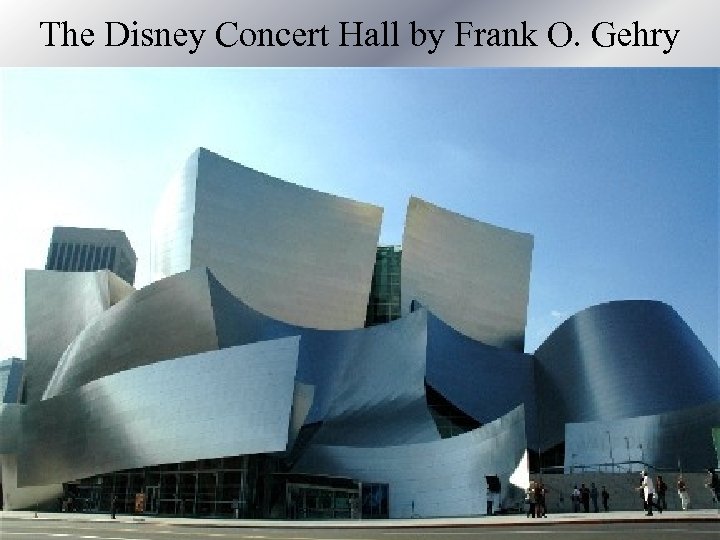 The Disney Concert Hall by Frank O. Gehry
 Music Between The Wars • Music reflected the movement and events of history, isolating neighboring areas from each other • By 1907 Arnold Schoenberg had given up tonality and the suppression of harmonic progressions • Non western influences and eastern European folk musicoffered new resources – Exotic scales that lacked leading tones (whole tone, pentatonic) – Performance-oriented music of Indonesia with no clear beginning or end
 Music for the People • Widening gap between “new music” and the responsiveness of listeners • Music between the wars made special efforts to get contemporary music closer to the people – Leading composers provided music for films, theater and dance – Music written especially for schools and amateur groups
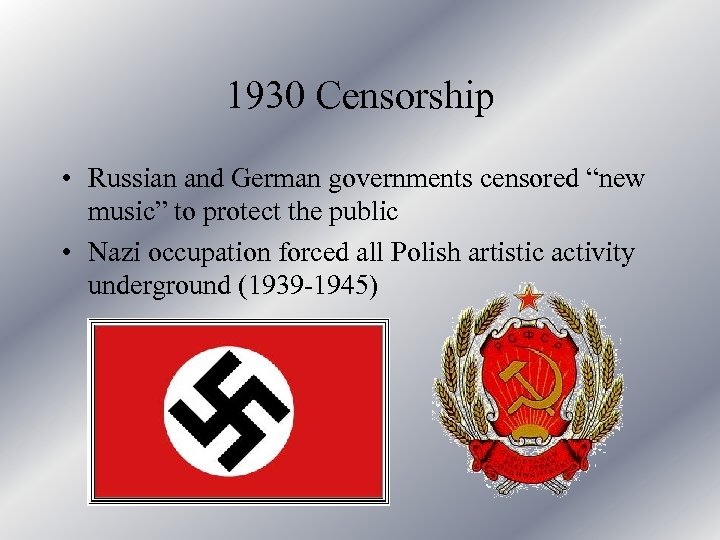 1930 Censorship • Russian and German governments censored “new music” to protect the public • Nazi occupation forced all Polish artistic activity underground (1939 -1945)
 Music after 1950 • Widening gulf between the concert-going public’s tolerance and the output of avante garde composers (audiences didn’t like the new music) • Aleatoric music - composers left decisions of pitch and rhythm to the performers • Serial music - highly organized on an intellectual level, but sounds chaotic • 1970 -1990 radical composers tended to become more moderate and young composers found an alternative idiom in touch with trends in popular music
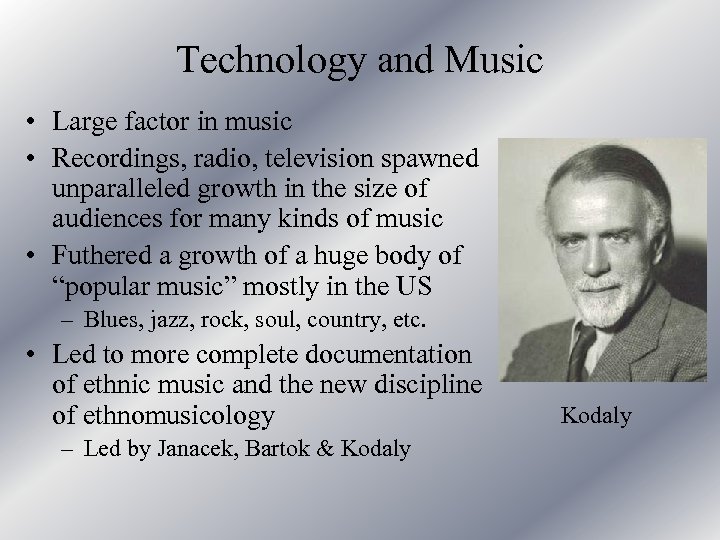 Technology and Music • Large factor in music • Recordings, radio, television spawned unparalleled growth in the size of audiences for many kinds of music • Futhered a growth of a huge body of “popular music” mostly in the US – Blues, jazz, rock, soul, country, etc. • Led to more complete documentation of ethnic music and the new discipline of ethnomusicology – Led by Janacek, Bartok & Kodaly
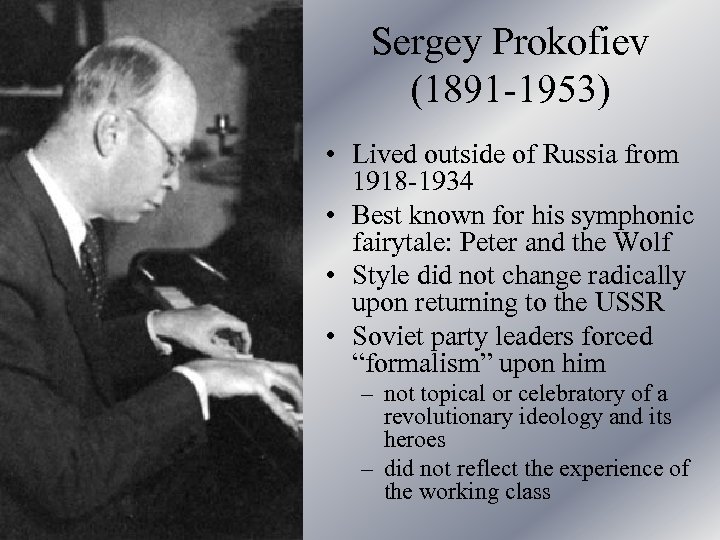 Sergey Prokofiev (1891 -1953) • Lived outside of Russia from 1918 -1934 • Best known for his symphonic fairytale: Peter and the Wolf • Style did not change radically upon returning to the USSR • Soviet party leaders forced “formalism” upon him – not topical or celebratory of a revolutionary ideology and its heroes – did not reflect the experience of the working class
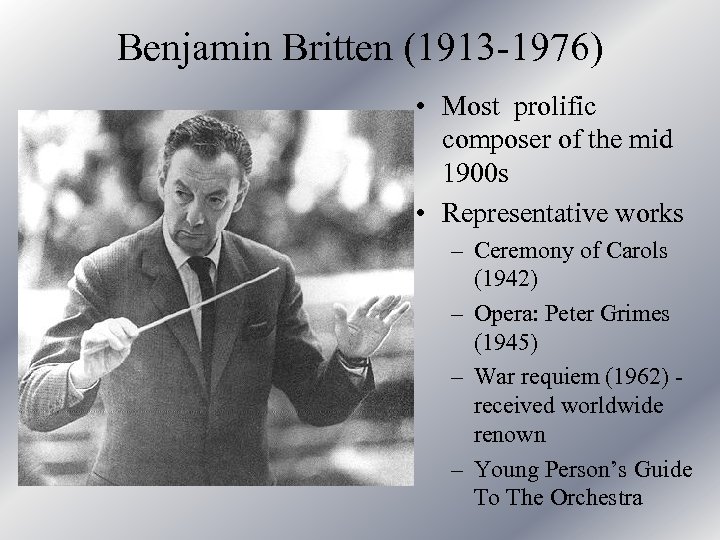 Benjamin Britten (1913 -1976) • Most prolific composer of the mid 1900 s • Representative works – Ceremony of Carols (1942) – Opera: Peter Grimes (1945) – War requiem (1962) received worldwide renown – Young Person’s Guide To The Orchestra
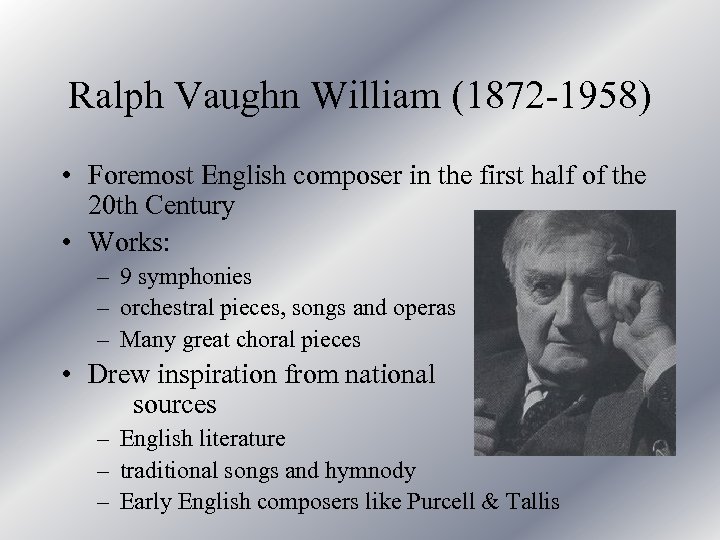 Ralph Vaughn William (1872 -1958) • Foremost English composer in the first half of the 20 th Century • Works: – 9 symphonies – orchestral pieces, songs and operas – Many great choral pieces • Drew inspiration from national sources – English literature – traditional songs and hymnody – Early English composers like Purcell & Tallis
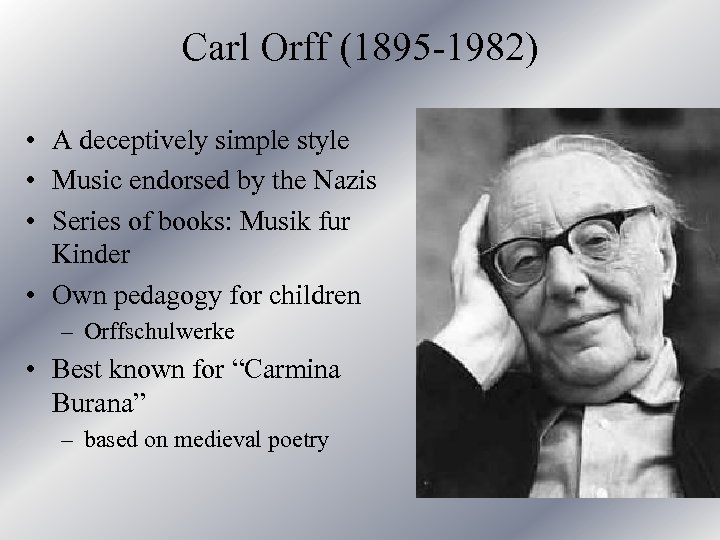 Carl Orff (1895 -1982) • A deceptively simple style • Music endorsed by the Nazis • Series of books: Musik fur Kinder • Own pedagogy for children – Orffschulwerke • Best known for “Carmina Burana” – based on medieval poetry
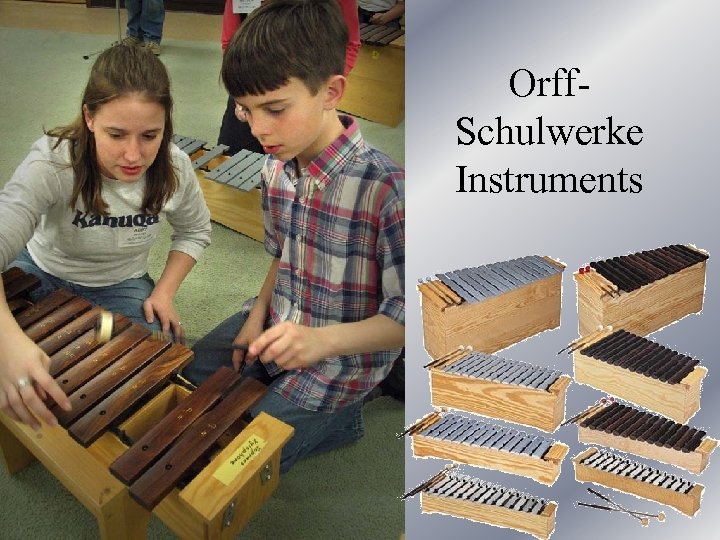 Orff. Schulwerke Instruments
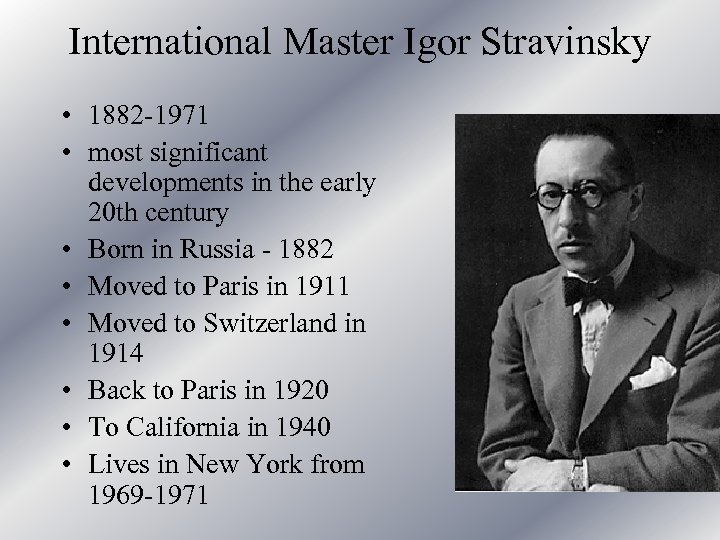 International Master Igor Stravinsky • 1882 -1971 • most significant developments in the early 20 th century • Born in Russia - 1882 • Moved to Paris in 1911 • Moved to Switzerland in 1914 • Back to Paris in 1920 • To California in 1940 • Lives in New York from 1969 -1971
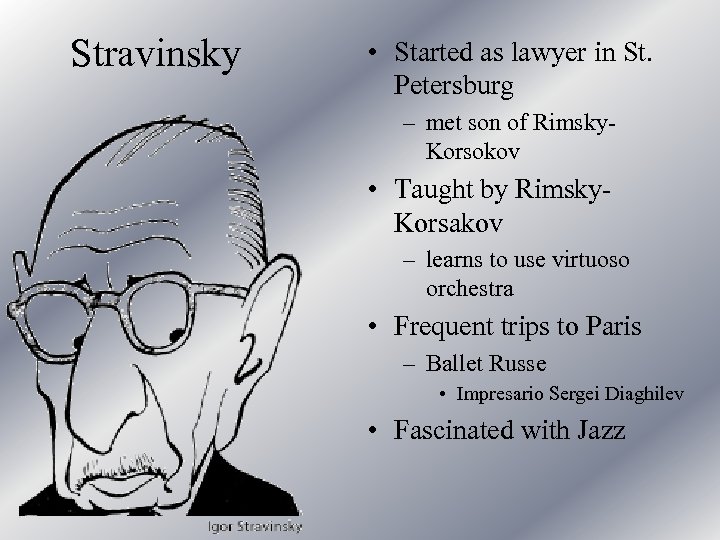 Stravinsky • Started as lawyer in St. Petersburg – met son of Rimsky. Korsokov • Taught by Rimsky. Korsakov – learns to use virtuoso orchestra • Frequent trips to Paris – Ballet Russe • Impresario Sergei Diaghilev • Fascinated with Jazz
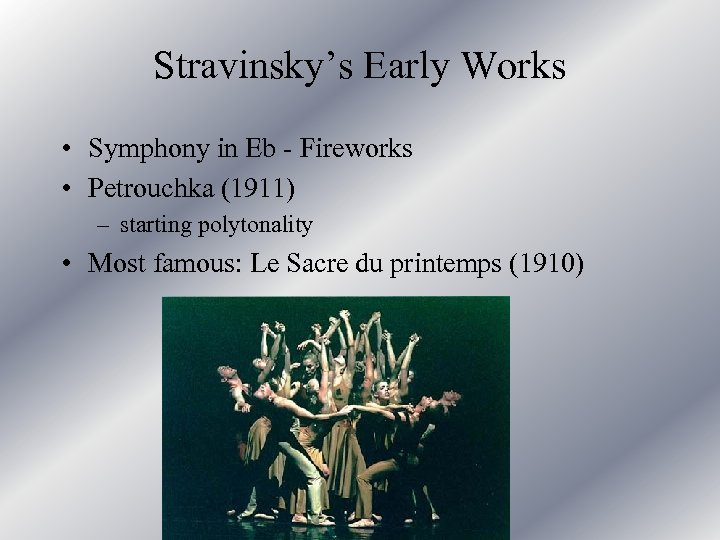 Stravinsky’s Early Works • Symphony in Eb - Fireworks • Petrouchka (1911) – starting polytonality • Most famous: Le Sacre du printemps (1910)
 Rite of Spring • Commisionsed by Diaghilev • primitivism - a pastorale of the prehistoric world (Russia) • calls for an adolescent girl who has been chosen for sacrifice to dance herself to death • caused a riot at its premiere in Paris (May 29, 1913) – Saint-Saens walked out – People cat called • Emancipates rhythms: 5/2 7/8 5/16 3/16 etc. – Eighth note groupings 9+2+6+3+4+5+3 – disorients the listener but allows dancers to maintain 8 measure phrases • Lots of percussion
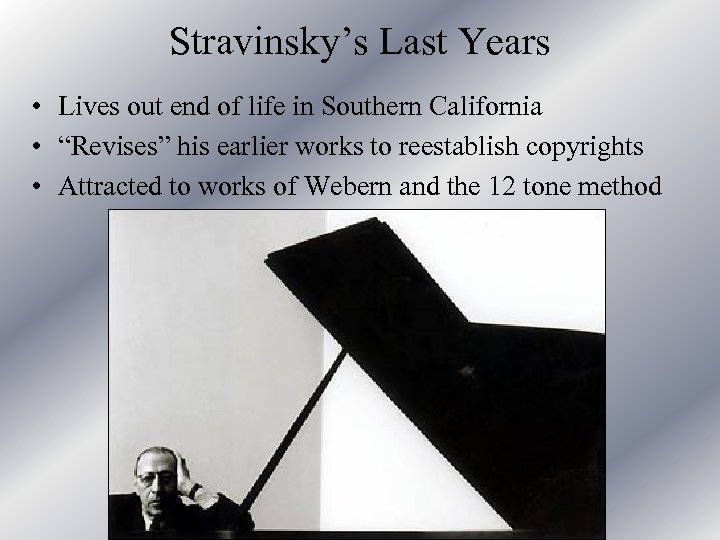 Stravinsky’s Last Years • Lives out end of life in Southern California • “Revises” his earlier works to reestablish copyrights • Attracted to works of Webern and the 12 tone method
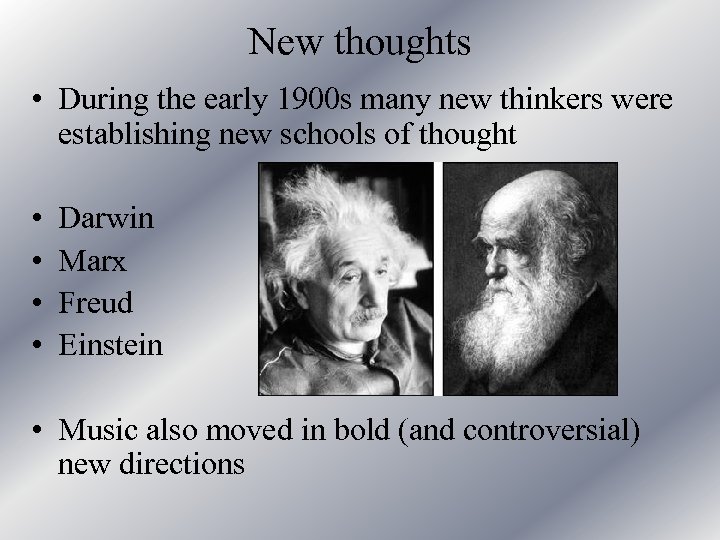 New thoughts • During the early 1900 s many new thinkers were establishing new schools of thought • • Darwin Marx Freud Einstein • Music also moved in bold (and controversial) new directions
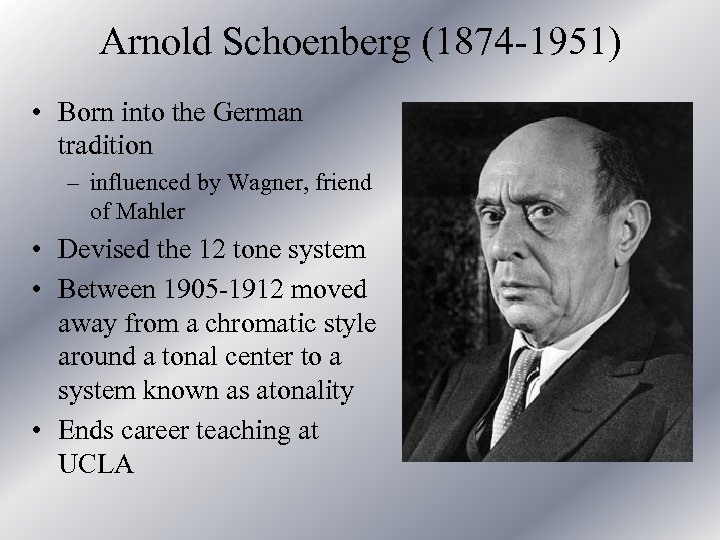 Arnold Schoenberg (1874 -1951) • Born into the German tradition – influenced by Wagner, friend of Mahler • Devised the 12 tone system • Between 1905 -1912 moved away from a chromatic style around a tonal center to a system known as atonality • Ends career teaching at UCLA
 Atonality • Music not based on harmonic and melodic relationships revolving around a key center • 12 tone music gives equal importance to each chromatic pitch – 12 tone music need not be atonal • In atonal music harmonies cease to have their conventional functions • Any combination of tones can constitute a chord not requiring resolution – Schoenberg: “The emancipation of the dissonance” • Sprechstimme – speech voice or speech song – approximates pitches but keeps close to notated rhythm
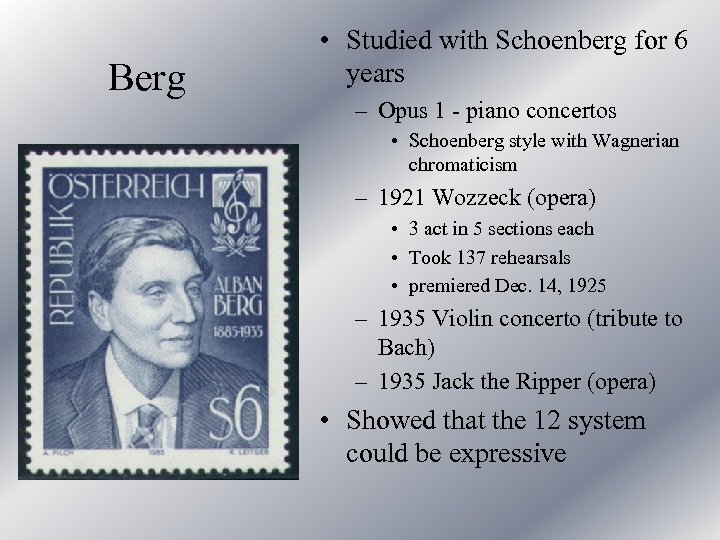 Berg • Studied with Schoenberg for 6 years – Opus 1 - piano concertos • Schoenberg style with Wagnerian chromaticism – 1921 Wozzeck (opera) • 3 act in 5 sections each • Took 137 rehearsals • premiered Dec. 14, 1925 – 1935 Violin concerto (tribute to Bach) – 1935 Jack the Ripper (opera) • Showed that the 12 system could be expressive
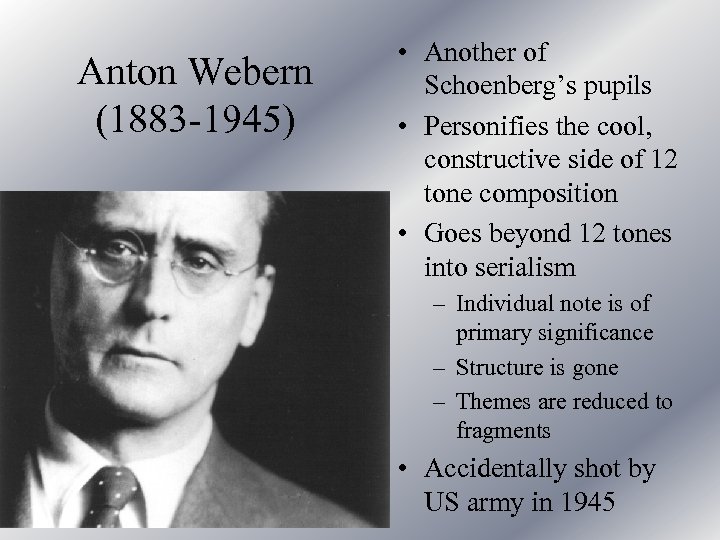 Anton Webern (1883 -1945) • Another of Schoenberg’s pupils • Personifies the cool, constructive side of 12 tone composition • Goes beyond 12 tones into serialism – Individual note is of primary significance – Structure is gone – Themes are reduced to fragments • Accidentally shot by US army in 1945
 Electronic Resources • Greatest new factor in music after 1950 • musique concrete (late 1940 s) consisted on recorded tones or natural sounds transformed through mechanical and electronic means and played back on tape • Freed composers from dependence on human performers – have complete control over the sound of their composition – few performers had the time or training to perform new works appropriately
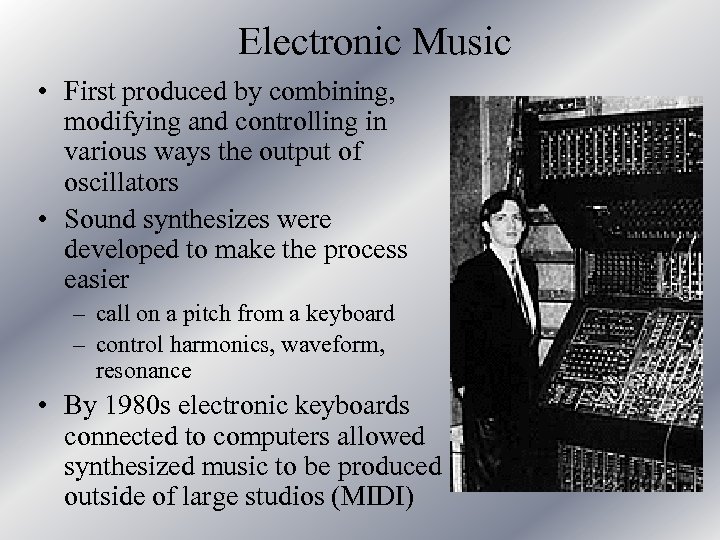 Electronic Music • First produced by combining, modifying and controlling in various ways the output of oscillators • Sound synthesizes were developed to make the process easier – call on a pitch from a keyboard – control harmonics, waveform, resonance • By 1980 s electronic keyboards connected to computers allowed synthesized music to be produced outside of large studios (MIDI)
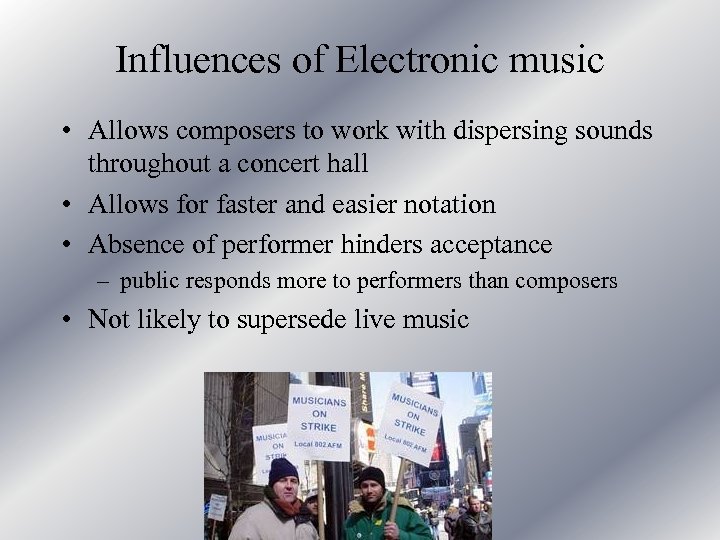 Influences of Electronic music • Allows composers to work with dispersing sounds throughout a concert hall • Allows for faster and easier notation • Absence of performer hinders acceptance – public responds more to performers than composers • Not likely to supersede live music
 Indeterminacy • Throughout music there has been a continual interaction between composer and performer – specified notation and interpretation • Composer can choose to give more choice to the performer • Performances are seldom the same • A recording of such a work can only capture that one performance
 America’s 20 th Century • US led the production of new music in the late 20 th century • Largely an expansion of European music – Many Europeans moved or traveled in the US • Bartok, Hindemith, Stravinsky, Schoenberg, Weill, Milhaud
 Immigration and Music • Diverse immigrant music brought with them elements of their music • German immigration after 1848 crop failure – many musicians and teachers come to America • African spirituals – Had pre-civil war history but not published until after war – Slave songs of the United States (1867) • Made popular by the polished and enthusiastic performances of the Fisk jubilee Singers from Fisk University in Nashville, Tennessee
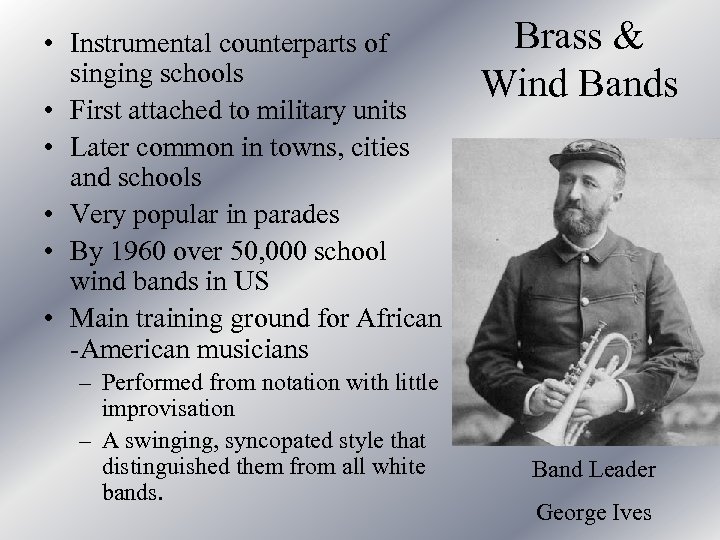 • Instrumental counterparts of singing schools • First attached to military units • Later common in towns, cities and schools • Very popular in parades • By 1960 over 50, 000 school wind bands in US • Main training ground for African -American musicians – Performed from notation with little improvisation – A swinging, syncopated style that distinguished them from all white bands. Brass & Wind Bands Band Leader George Ives
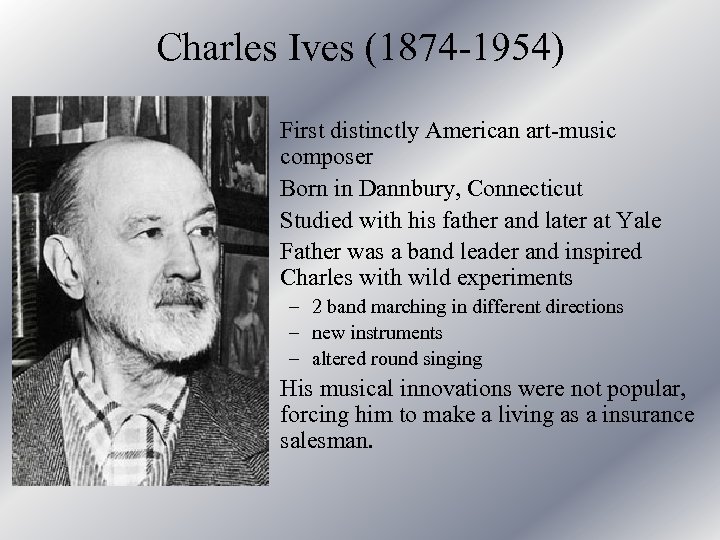 Charles Ives (1874 -1954) • First distinctly American art-music composer • Born in Dannbury, Connecticut • Studied with his father and later at Yale • Father was a band leader and inspired Charles with wild experiments – 2 band marching in different directions – new instruments – altered round singing • His musical innovations were not popular, forcing him to make a living as a insurance salesman.
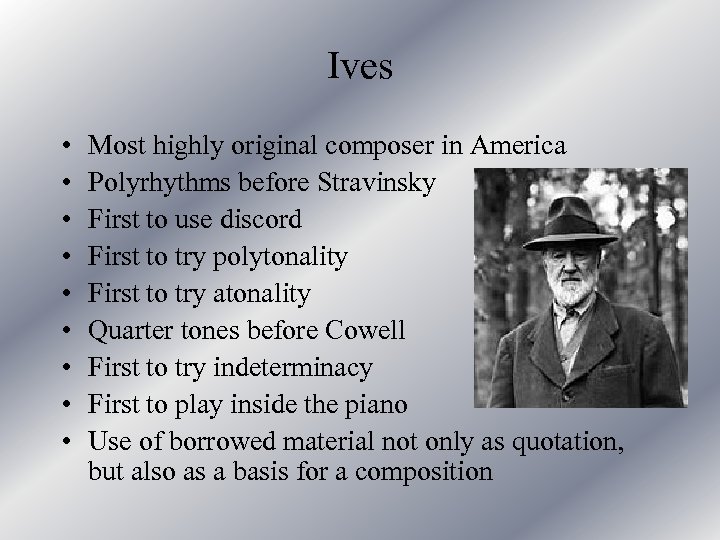 Ives • • • Most highly original composer in America Polyrhythms before Stravinsky First to use discord First to try polytonality First to try atonality Quarter tones before Cowell First to try indeterminacy First to play inside the piano Use of borrowed material not only as quotation, but also as a basis for a composition
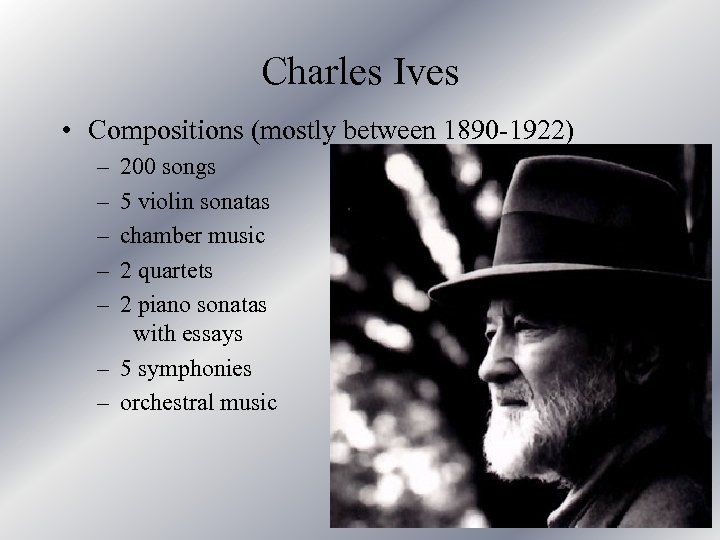 Charles Ives • Compositions (mostly between 1890 -1922) – – – 200 songs 5 violin sonatas chamber music 2 quartets 2 piano sonatas with essays – 5 symphonies – orchestral music
 Ive’s Thoughts • “Beauty in music is too often confused with something that lets the ears lie back in an easy chair” - Ives • many works are un-performable – Un-singable – Out of range • Wrote songs as “they wanted to be written”
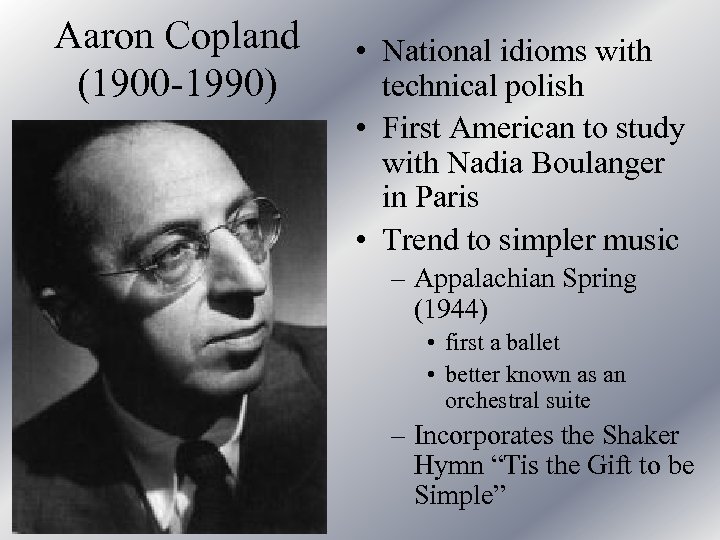 Aaron Copland (1900 -1990) • National idioms with technical polish • First American to study with Nadia Boulanger in Paris • Trend to simpler music – Appalachian Spring (1944) • first a ballet • better known as an orchestral suite – Incorporates the Shaker Hymn “Tis the Gift to be Simple”
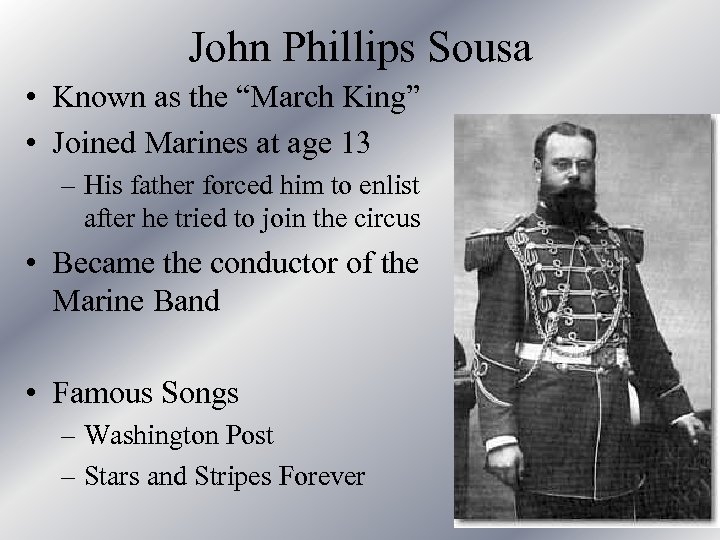 John Phillips Sousa • Known as the “March King” • Joined Marines at age 13 – His father forced him to enlist after he tried to join the circus • Became the conductor of the Marine Band • Famous Songs – Washington Post – Stars and Stripes Forever
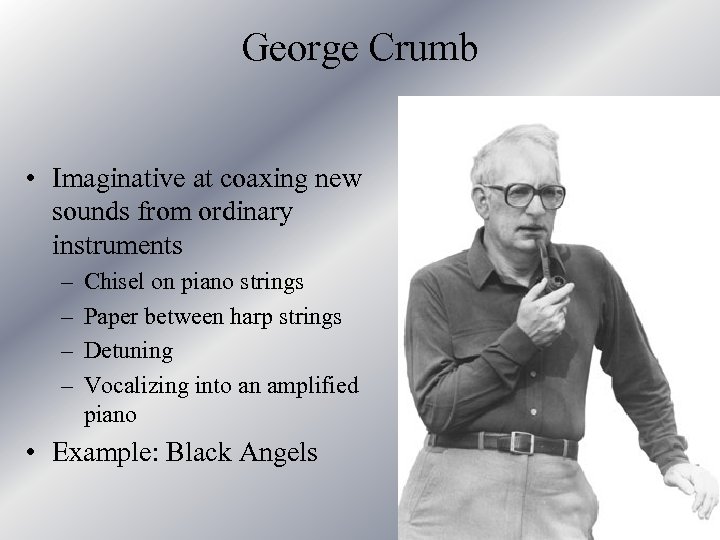 George Crumb • Imaginative at coaxing new sounds from ordinary instruments – – Chisel on piano strings Paper between harp strings Detuning Vocalizing into an amplified piano • Example: Black Angels
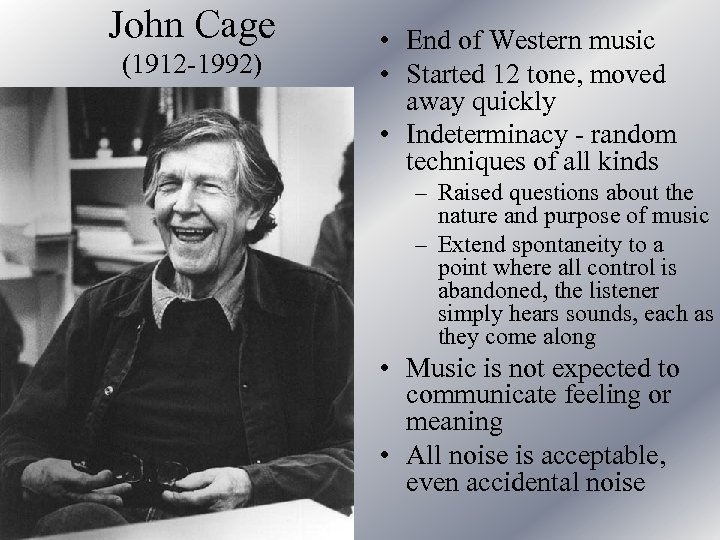 John Cage (1912 -1992) • End of Western music • Started 12 tone, moved away quickly • Indeterminacy - random techniques of all kinds – Raised questions about the nature and purpose of music – Extend spontaneity to a point where all control is abandoned, the listener simply hears sounds, each as they come along • Music is not expected to communicate feeling or meaning • All noise is acceptable, even accidental noise
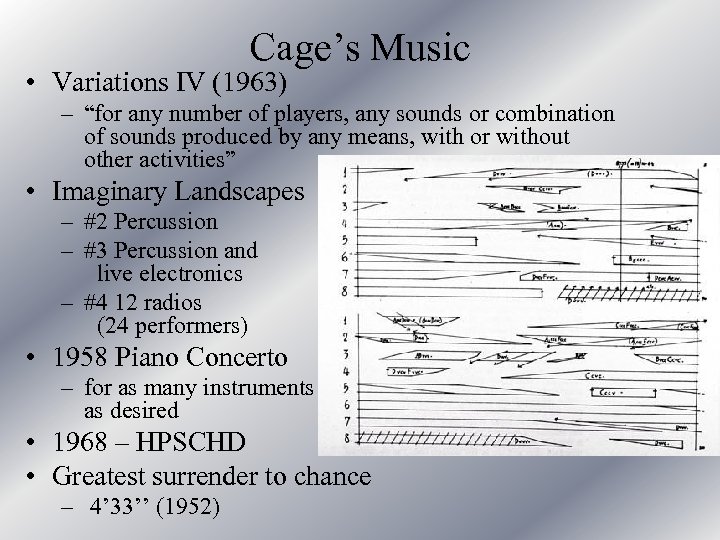 Cage’s Music • Variations IV (1963) – “for any number of players, any sounds or combination of sounds produced by any means, with or without other activities” • Imaginary Landscapes – #2 Percussion – #3 Percussion and live electronics – #4 12 radios (24 performers) • 1958 Piano Concerto – for as many instruments as desired • 1968 – HPSCHD • Greatest surrender to chance – 4’ 33’’ (1952)
 Redefining Music • Nothing more than sound organized in time under human direction
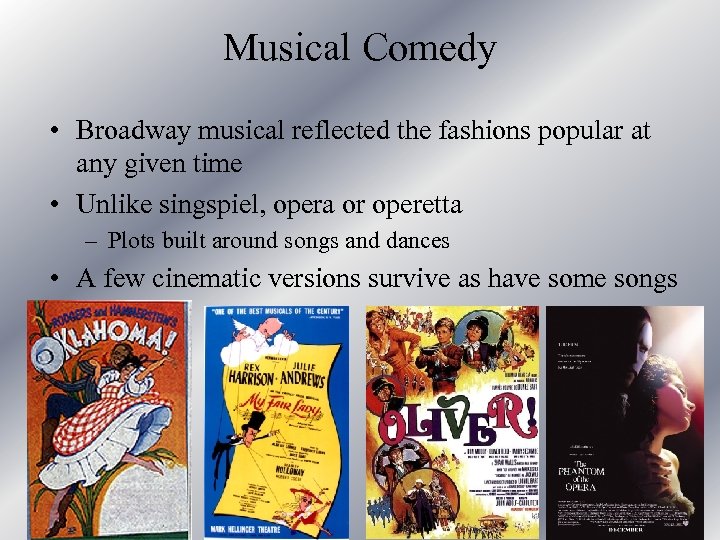 Musical Comedy • Broadway musical reflected the fashions popular at any given time • Unlike singspiel, opera or operetta – Plots built around songs and dances • A few cinematic versions survive as have some songs
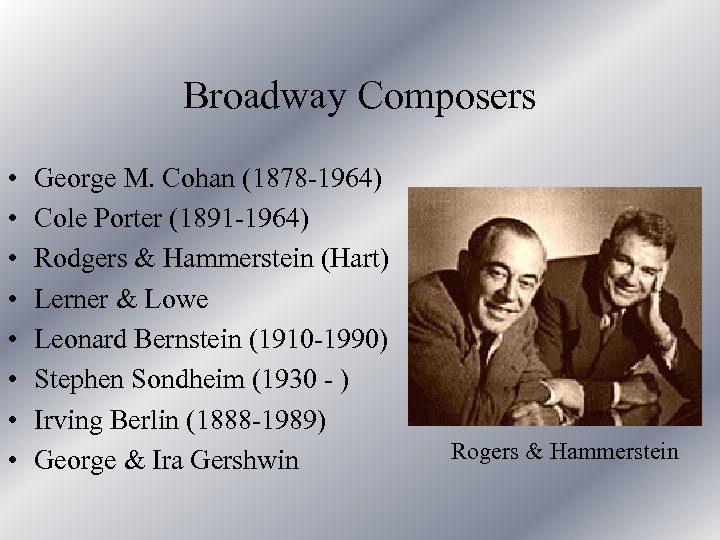 Broadway Composers • • George M. Cohan (1878 -1964) Cole Porter (1891 -1964) Rodgers & Hammerstein (Hart) Lerner & Lowe Leonard Bernstein (1910 -1990) Stephen Sondheim (1930 - ) Irving Berlin (1888 -1989) George & Ira Gershwin Rogers & Hammerstein
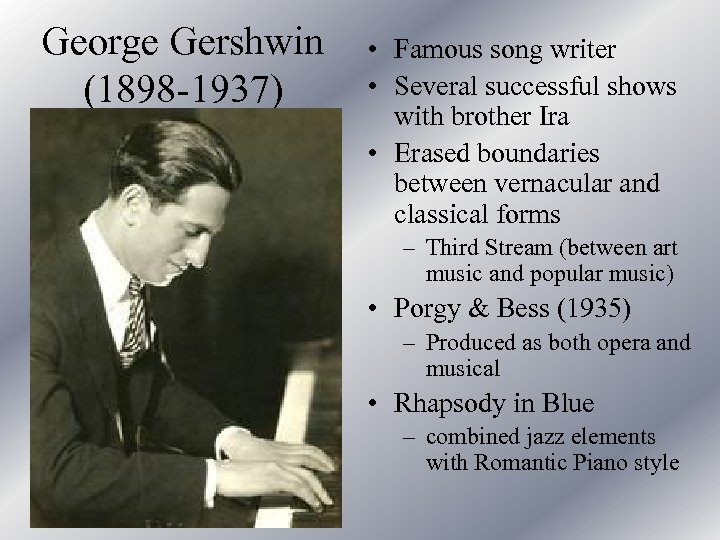 George Gershwin (1898 -1937) • Famous song writer • Several successful shows with brother Ira • Erased boundaries between vernacular and classical forms – Third Stream (between art music and popular music) • Porgy & Bess (1935) – Produced as both opera and musical • Rhapsody in Blue – combined jazz elements with Romantic Piano style
 Conclusions • Four basic components of Western Music as early as 11 th century – Composition • performance & controlled improvisation • Performer not only a mediator between composer and audience, but a participant – Notation – Principles of order – Polyphony • “serious” music requires some effort to understand • Audience has always been a small fraction of the populations
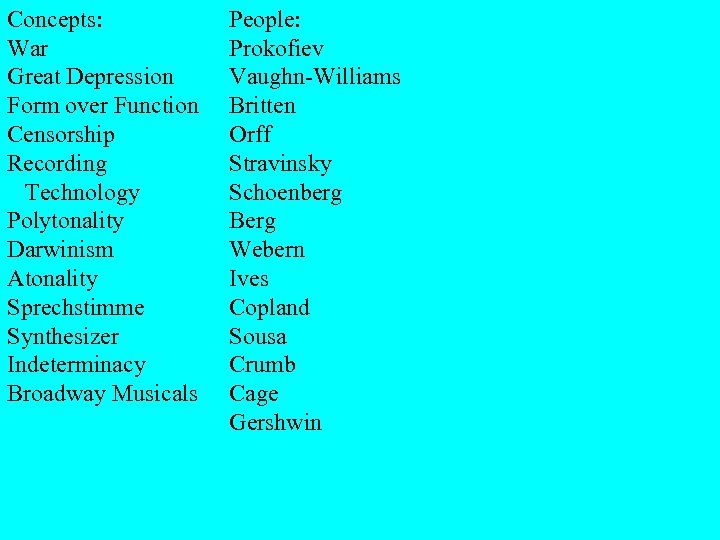 Concepts: War Great Depression Form over Function Censorship Recording Technology Polytonality Darwinism Atonality Sprechstimme Synthesizer Indeterminacy Broadway Musicals People: Prokofiev Vaughn-Williams Britten Orff Stravinsky Schoenberg Berg Webern Ives Copland Sousa Crumb Cage Gershwin