 Скачать презентацию Music An Appreciation 10 th Edition by Roger
58d0a2c5d2da3e485489747f2aa3e1e8.ppt
- Количество слайдов: 35



Music: An Appreciation 10 th Edition by Roger Kamien Part IV The Baroque Period 1600 -1750 2011 © Mc. Graw-Hill Higher Education
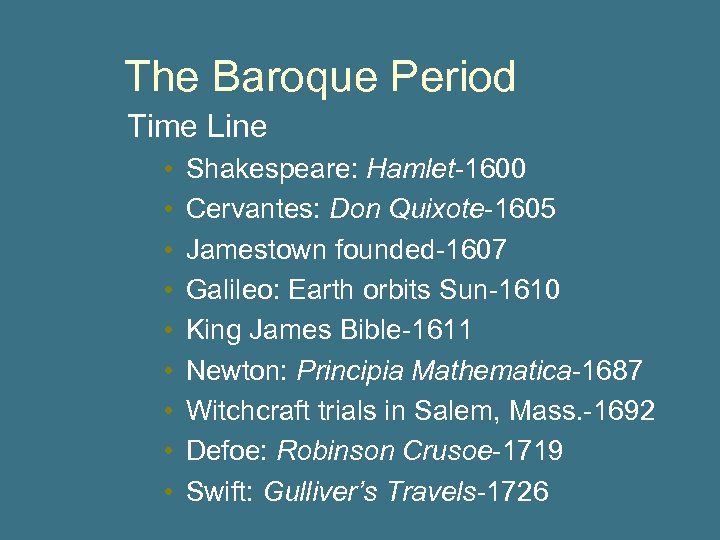
The Baroque Period Time Line • • • Shakespeare: Hamlet-1600 Cervantes: Don Quixote-1605 Jamestown founded-1607 Galileo: Earth orbits Sun-1610 King James Bible-1611 Newton: Principia Mathematica-1687 Witchcraft trials in Salem, Mass. -1692 Defoe: Robinson Crusoe-1719 Swift: Gulliver’s Travels-1726
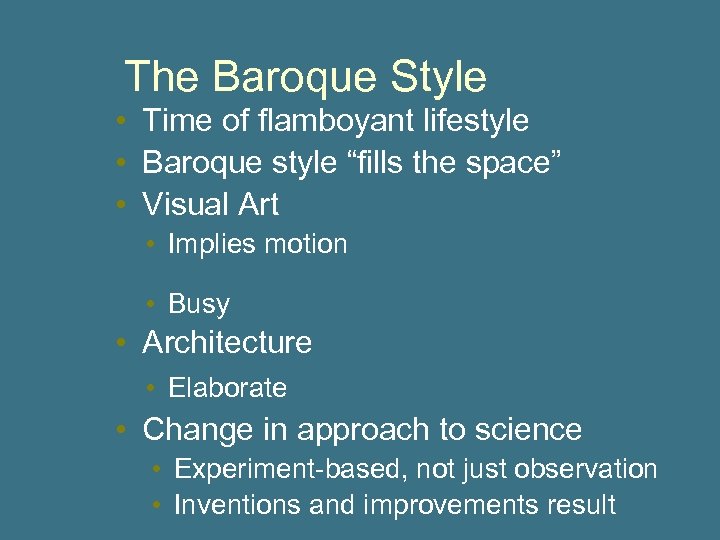
The Baroque Style • Time of flamboyant lifestyle • Baroque style “fills the space” • Visual Art • Implies motion • Busy • Architecture • Elaborate • Change in approach to science • Experiment-based, not just observation • Inventions and improvements result
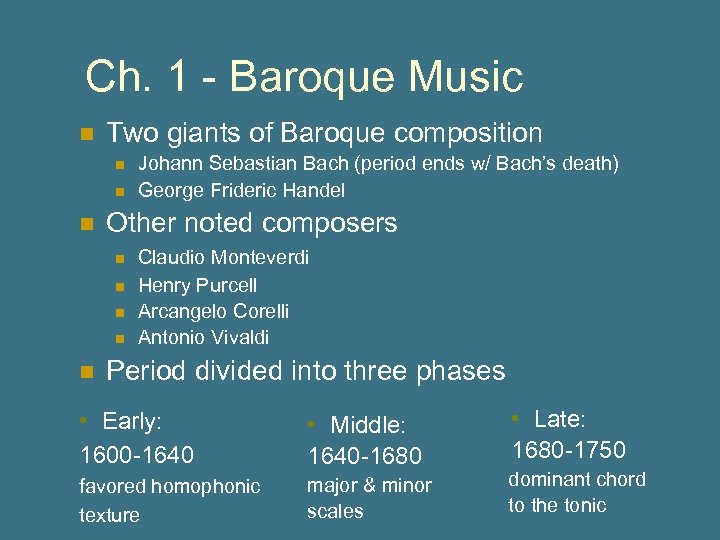
Ch. 1 - Baroque Music n Two giants of Baroque composition n Other noted composers n n n Johann Sebastian Bach (period ends w/ Bach’s death) George Frideric Handel Claudio Monteverdi Henry Purcell Arcangelo Corelli Antonio Vivaldi Period divided into three phases • Early: 1600 -1640 • Middle: 1640 -1680 favored homophonic texture major & minor scales • Late: 1680 -1750 dominant chord to the tonic
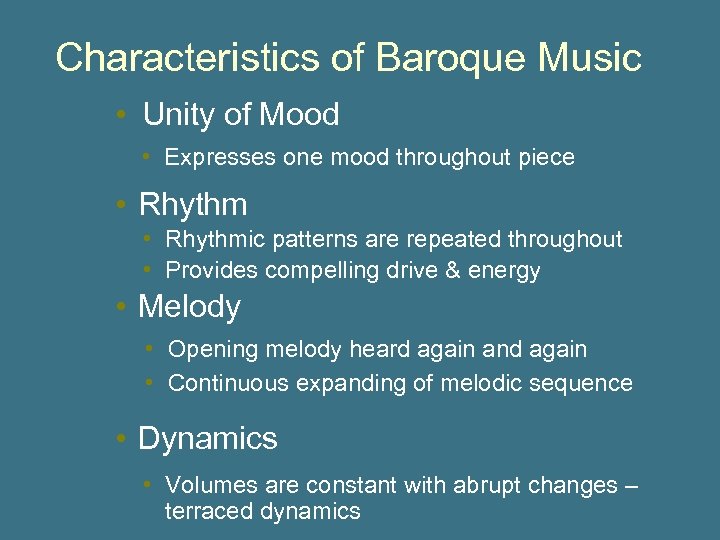
Characteristics of Baroque Music • Unity of Mood • Expresses one mood throughout piece • Rhythmic patterns are repeated throughout • Provides compelling drive & energy • Melody • Opening melody heard again and again • Continuous expanding of melodic sequence • Dynamics • Volumes are constant with abrupt changes – terraced dynamics
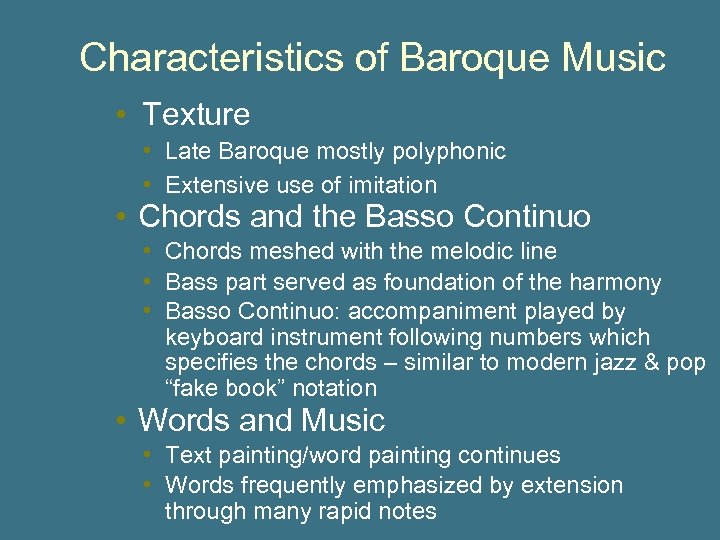
Characteristics of Baroque Music • Texture • Late Baroque mostly polyphonic • Extensive use of imitation • Chords and the Basso Continuo • Chords meshed with the melodic line • Bass part served as foundation of the harmony • Basso Continuo: accompaniment played by keyboard instrument following numbers which specifies the chords – similar to modern jazz & pop “fake book” notation • Words and Music • Text painting/word painting continues • Words frequently emphasized by extension through many rapid notes
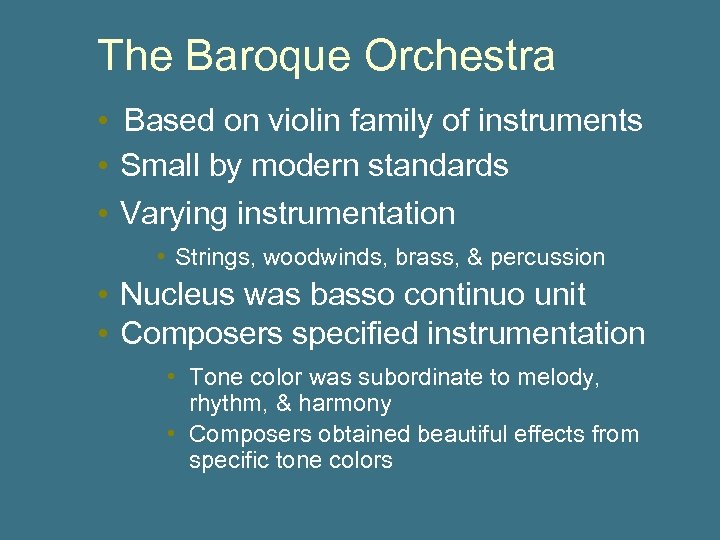
The Baroque Orchestra • Based on violin family of instruments • Small by modern standards • Varying instrumentation • Strings, woodwinds, brass, & percussion • Nucleus was basso continuo unit • Composers specified instrumentation • Tone color was subordinate to melody, rhythm, & harmony • Composers obtained beautiful effects from specific tone colors
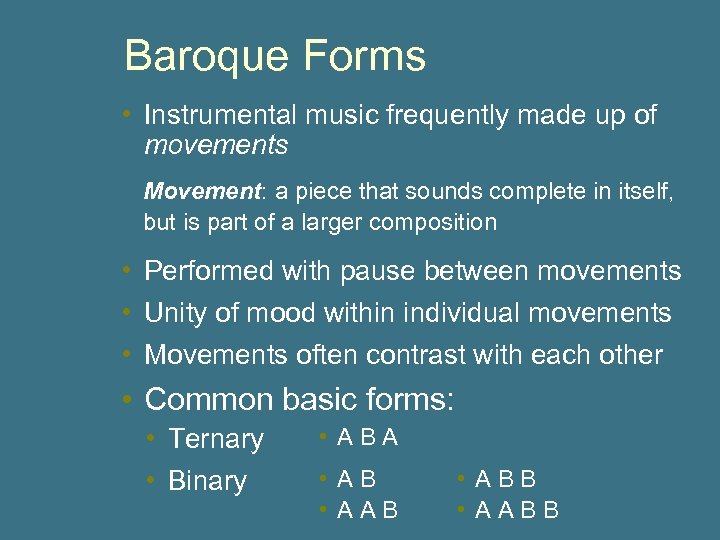
Baroque Forms • Instrumental music frequently made up of movements Movement: a piece that sounds complete in itself, but is part of a larger composition • Performed with pause between movements • Unity of mood within individual movements • Movements often contrast with each other • Common basic forms: • Ternary • Binary • ABA • AB • AAB • ABB • AABB
Ch. 2 - Music in Baroque Society • Music written to order • New music, not old-fashioned, was desired • Courts: • Music indicated affluence • Court Music Director • Good prestige, pay, and other benefits • Still considered a skilled servant
• Some aristocrats were musicians • Church music was very elaborate • Most people heard music only in church • Some, though few, public opera houses • Music careers taught by apprenticeship • Orphanages taught music as a trade
Ch. 3 - The Concerto Grosso and Ritornello Form Concerto Grosso • For small group of soloists and orchestra • Multi-movement work • Usually 3 movements • Fast • Slow (usually quieter) • Fast (sometimes dance-like)
Ritornello • Frequently used in 1 st & last movements of concerto grosso • Theme repeatedly presented in fragments • Contrast between solo sections and tutti
Listening Brandenberg Concerto No. 5 in D major by Johann Sebastian Bach For string orchestra and group of soloists Soloists: flute, violin, and harpsichord First movement Ritornello form Listening Outline: p. 129 Basic Set, CD 2: 4 Brief Set, CD 2: 1
Ch. 4 - The Fugue • Cornerstone of Baroque music • Polyphonic composition based on one main theme • Vocal or instrumental • Subject • Main theme • Presented initially in imitation • Each voice enters after previous voice has completed presenting the subject
Listening Organ Fugue in G Minor by J. S. Bach Note individual voice entry on same melody (subject) Listening Outline: p. 133 Basic Set, CD 2: 17 Brief Set, CD 2: 06
Ch. 5 - The Elements of Opera • Drama sung to orchestral accompaniment • Text in opera is called libretto • Music is written by a composer • Libretto is written by a librettist • Opera can be serious, comic, or both • Two primary types of solo songs: • Recitative: presents plot material • Aria: expresses emotion—usually a “show-off” vehicle for the singer • Other types: duet, trio, quartet, quintet, etc. • Three or more singers make up an ensemble
• Chorus: groups of actors playing crowd parts • The prompter—gives cues to singers • The orchestra pit – sunken area in front of stage • Prelude or overture - instrumentals that open opera acts • Modern questions concerning text in opera • Translation of text and effects upon text painting • Supertitles-projection of text above the stage
Ch. 6 - Opera in the Baroque Era • Result of musical discussions of the Camerata in Florence • 1 st known opera: Euridice (Peri-1600) • Orfeo (Monteverdi-1607) • 1 st large scale (great) opera • Opera composed for court ceremonies • Display of magnificence and grandeur • Patrons compared to ancient heroes • 1 st public opera house 1637 in Venice • Rise of virtuoso singer—chief was castrato • Secco vs accompanied recitative
Ch. 7 - Claudio Monteverdi • Italian, early Baroque composer • Wrote first great operatic work, Orfeo • Worked last 30 years at St. Mark’s in Venice • Composed both sacred music and secular music for the aristocracy • Only 3 of his 12 operas still exist
Listening Tu se’ morta from Orfeo by Monteverdi Note: Homophonic texture Use of text painting Vocal Music Guide: p. 142 Basic Set, CD 2: 20 Brief Set, CD 2: 09
Ch. 8 - Henry Purcell • English composer (1659 -1695) • Highly regarded, held court positions • Buried beneath the organ in Westminster Abbey • Dido and Aeneas Ground Bass • Repeated musical idea in bass • Variation form—melodies above change • Also called basso ostinato
Listening Dido’s Lament from Dido and Aeneas by Purcell Note: Recitative followed by aria Aria makes use of ground bass Vocal Music Guide: p. 144 Basic Set, CD 2: 21 Brief Set, CD 2: 10
Ch. 9 - The Baroque Sonata • Instrumental work • Multi-movement piece for one to eight instruments • Trio sonata • Three melodic lines: basso continuo and two above • Written as three parts, but performed by four players • Sonata da chiesa—church sonata (dignified) • Sonata du camera—chamber sonata (more dance-like, intended for court performance)
Ch. 10 - Arcangelo Corelli Trio Sonata in A Minor, Op. 3 No. 10 by Arcangelo Corelli For 2 violins and basso continuo Basic Set, CD 2: 23 and 2: 24 - p. 146 Note: Polyphonic texture Multi movement work Contrast between movements
Ch. 11 - Antonio Vivaldi • Late Baroque Italian composer • Il prete rosso (the red priest) • Taught music at girls orphanage in Venice • Girls performed at mass hidden behind screen • Wrote sacred and secular vocal and instrumental music • Famous as a virtuoso violinist & composer
Listening La Primavera (Spring), Op. 8, No. 1, from The Four Seasons (1725) by Vivaldi Listening Outline: p. 148 Basic Set, CD 2: 25 Brief Set, CD 2: 12 Concerto for violin and string orchestra Note: Polyphonic texture & ritornello form Baroque program music Descriptive effects (trills for bird songs, string tremolos for thunder)
Ch. 12 - Johann Sebastian Bach • German, late Baroque composer • Organist and violinist • Deeply religious (Lutheran) • Worked in sacred and secular positions • Weimar/Cothen/Leipzig • Large family • Known during lifetime as keyboardist • Wrote in every form except opera • Recognized for technical mastery • Highpoint of polyphony combined w/ harmony • All music majors study Bach’s compositions • He is the model for learning to write music
Listening Prelude and Fugue in C Minor, from The Well. Tempered Clavier, Book I by Bach Listening Outline: p. 154 Basic Set: CD 2: 33 Ornamental passage in the style of improvisation Concludes with bright C major harmony Pedal point
Ch. 13 - The Baroque Suite • Instrumental, multi-movement work • Written for listening, but based upon dance • Movements usually in binary form—AABB • Often began with a non-dance overture • French overture— 2 sections • 1 st slow, dignified • 2 nd faster, often beginning as a fugue • Forerunner of forms used in the next period
Listening Suite No. 3 in D Major (~1730) by J. S. Bach, 2 nd, 4 th, & 5 th mvts. Basic Set, CD 2: 41 Brief Set, CD 2: 21 Listening Outline p. 161 Note: Extensive polyphony Contrast of dance forms and tempo in various movements
Ch. 14 - The Chorale and Church Cantata • Lutheran church service was social event of the week • Lasted 4 hours with 1 hour sermon • Music was major part of worship service • Congregation participated in singing chorales • Chorale: hymn tune w/ German text • Cantata • Multi-movement church work for chorus, soloists, and orchestra • Vernacular religious text • Resembled opera in its use of choruses, recitatives, arias, and duets
Listening Wachet auf, ruft uns die Stimme (Awake, A Voice Is Calling Us) by J. S. Bach (1731), Movements 1, 4, & 7 Vocal Music Guides: pp. 164 - 168 Basic Set, CD 2: 47 Brief Set, CD 2: 23 Note: Vernacular (German) text Chorale tune basis Polyphonic until chorale in movement 7 Movement 7—provides for congregation to join in
Ch. 15 - The Oratorio • Like opera: • Large-scale work for chorus, soloists, and orchestra • Contains arias, recitatives, ensembles • Unlike opera: • No acting, scenery, or costumes • Based upon biblical stories • Not intended for religious services • Commonly performed today in both churches and concert halls
Ch. 16 - George Frederic Handel • Born in Germany—same year as Bach • Not from musical family • Father wanted him to be a lawyer • Studied music in Germany, then to Italy to study opera, finally England to work • Became England’s most important composer • Wrote many operas in London • Had own opera company • Worked as composer, performer, & impresario • Buried in Westminster Abbey
Listening From The Messiah by G. F. Handel (1741) Ev’ry Valley Shall Be Exalted Vocal Music Guide: p. 174 Basic Set, CD 305 Brief Set, CD 2: 27 For unto Us a Child Is Born Vocal Music Guide: p. 175 Basic Set, CD 3: 06 Hallelujah Chorus Vocal Music Guide: p. 177 Basic Set, CD 3: 09 Brief Set, CD 2: 39
Скачать презентацию Music An Appreciation 10 th Edition by Roger
58d0a2c5d2da3e485489747f2aa3e1e8.ppt