


 Скачать презентацию Muons Inc Dielectric-Filled RF Cavities Milorad Popovic FNAL
13b535efadcc6ea53b5c01ac1c9f3bc3.ppt
- Количество слайдов: 27
 Muons, Inc. Dielectric-Filled RF Cavities Milorad Popovic FNAL 07/07/2009 Mu. Cool RF Workshop-Fermilab 1
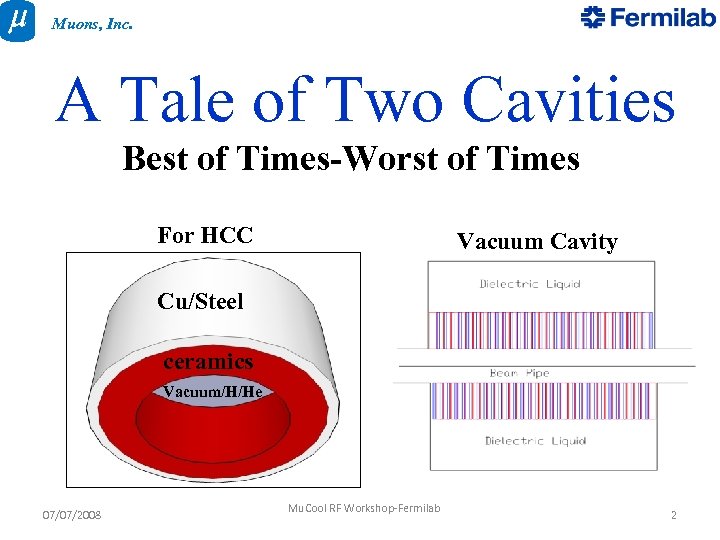 Muons, Inc. A Tale of Two Cavities Best of Times-Worst of Times For HCC Vacuum Cavity Cu/Steel ceramics Vacuum/H/He 07/07/2008 Mu. Cool RF Workshop-Fermilab 2
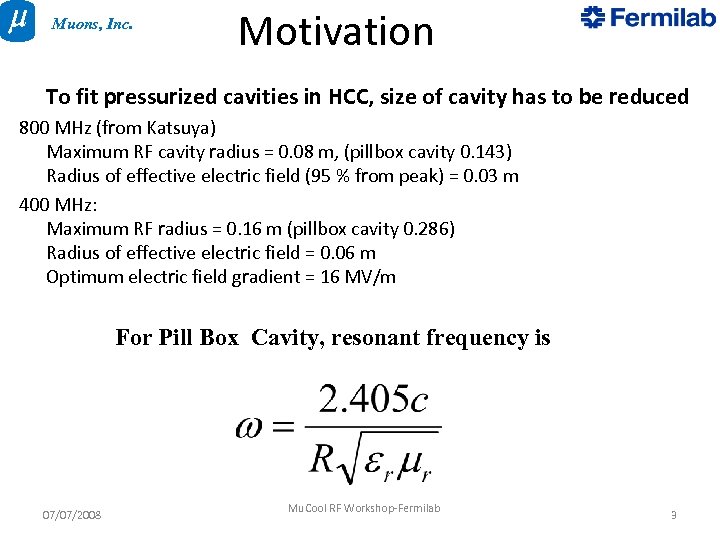 Muons, Inc. Motivation To fit pressurized cavities in HCC, size of cavity has to be reduced 800 MHz (from Katsuya) Maximum RF cavity radius = 0. 08 m, (pillbox cavity 0. 143) Radius of effective electric field (95 % from peak) = 0. 03 m 400 MHz: Maximum RF radius = 0. 16 m (pillbox cavity 0. 286) Radius of effective electric field = 0. 06 m Optimum electric field gradient = 16 MV/m For Pill Box Cavity, resonant frequency is 07/07/2008 Mu. Cool RF Workshop-Fermilab 3
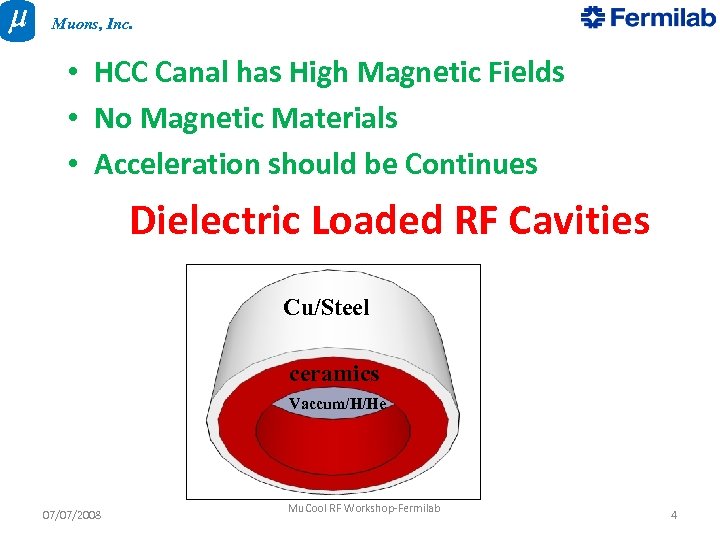 Muons, Inc. • HCC Canal has High Magnetic Fields • No Magnetic Materials • Acceleration should be Continues Dielectric Loaded RF Cavities Cu/Steel ceramics Vaccum/H/He 07/07/2008 Mu. Cool RF Workshop-Fermilab 4
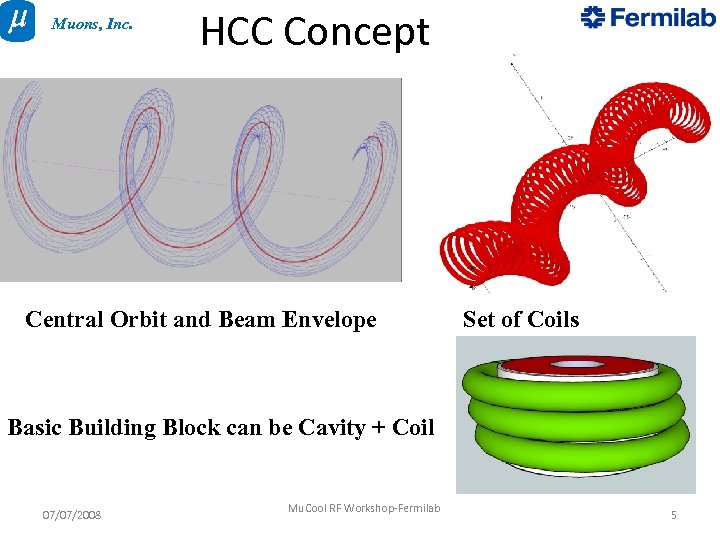 Muons, Inc. HCC Concept Central Orbit and Beam Envelope Set of Coils Basic Building Block can be Cavity + Coil 07/07/2008 Mu. Cool RF Workshop-Fermilab 5
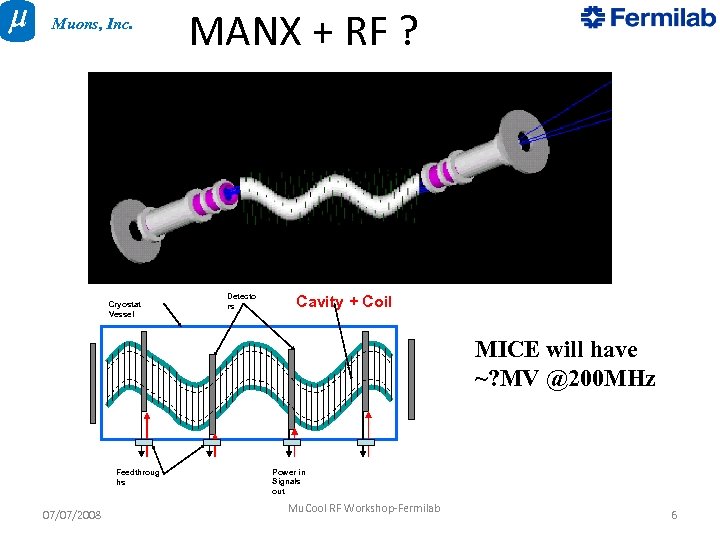 Muons, Inc. Cryostat Vessel MANX + RF ? Detecto rs Cavity + Coil MICE will have ~? MV @200 MHz Feedthroug hs 07/07/2008 Power in Signals out Mu. Cool RF Workshop-Fermilab 6
 Muons, Inc. • Ceramics can play additional role, making volume of Hydrogen smaller and making cavity stronger so the walls do not have to be as thick as without ceramics. • RF power can be fed using loop between two rings. • Cavities can be put next each other so the side wall can be made thin We should do experiments in the MTA 201 MHz (with solenoid? ) 805 MHz with solenoid! 07/07/2008 Mu. Cool RF Workshop-Fermilab 7
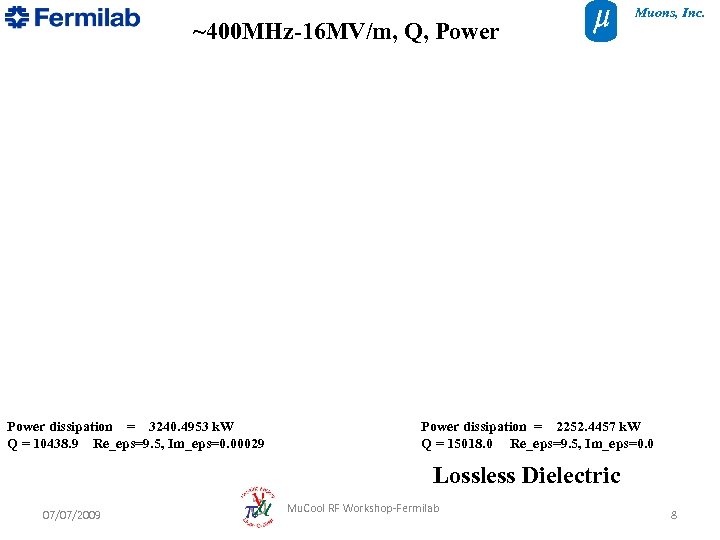 ~400 MHz-16 MV/m, Q, Power dissipation = 3240. 4953 k. W Q = 10438. 9 Re_eps=9. 5, Im_eps=0. 00029 Muons, Inc. Power dissipation = 2252. 4457 k. W Q = 15018. 0 Re_eps=9. 5, Im_eps=0. 0 Lossless Dielectric 07/07/2009 Mu. Cool RF Workshop-Fermilab 8
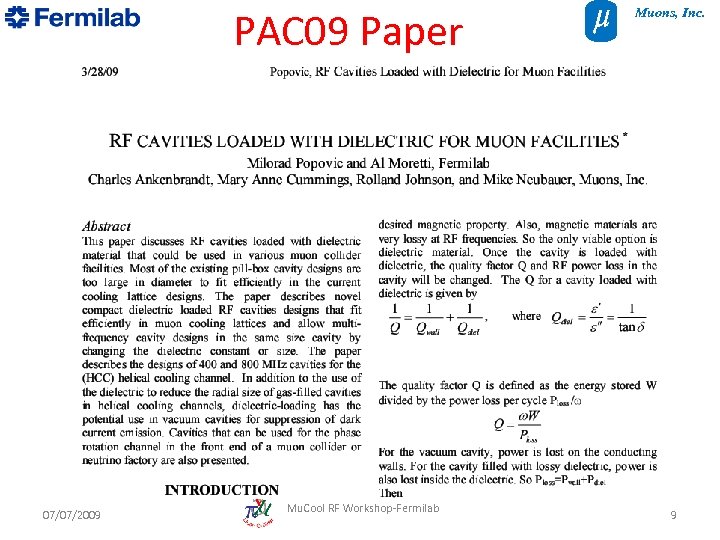 PAC 09 Paper 07/07/2009 Mu. Cool RF Workshop-Fermilab Muons, Inc. 9
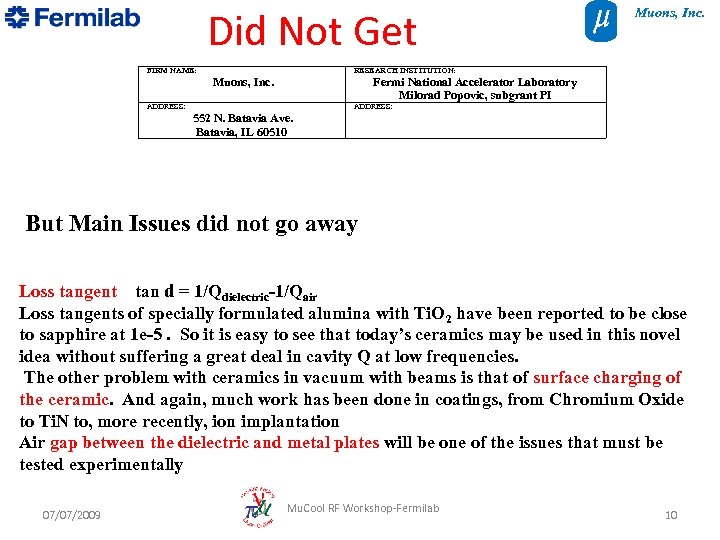 Did Not Get FIRM NAME: Muons, Inc. RESEARCH INSTITUTION: Muons, Inc. Fermi National Accelerator Laboratory Milorad Popovic, subgrant PI ADDRESS: 552 N. Batavia Ave. Batavia, IL 60510 But Main Issues did not go away Loss tangent tan d = 1/Qdielectric-1/Qair Loss tangents of specially formulated alumina with Ti. O 2 have been reported to be close to sapphire at 1 e-5. So it is easy to see that today’s ceramics may be used in this novel idea without suffering a great deal in cavity Q at low frequencies. The other problem with ceramics in vacuum with beams is that of surface charging of the ceramic. And again, much work has been done in coatings, from Chromium Oxide to Ti. N to, more recently, ion implantation Air gap between the dielectric and metal plates will be one of the issues that must be tested experimentally 07/07/2009 Mu. Cool RF Workshop-Fermilab 10
 Main Issues Muons, Inc. • Ceramics, Loss Tangent • Surface coating • Dielectric Cooling/Tuning Liquid • Geometric/Power Optimization • RF and Mechanical Engineering ~50 k$ + 1 FTE to Start 07/07/2009 Mu. Cool RF Workshop-Fermilab 11
 Muons, Inc. Other Applications (Vacuum Cavities) May be we can use this type of cavity for Neuffer’s Phase Rotation Canal. This was Cary Yoshikawa suggestion. The canal needs many cavities in range from ~300 to 200 MHz. We can use, let say two sizes of Pill Box Cavity (same size different dielectric!) and adjust frequency in between using different iner radius, re-entrant nose cones! 07/07/2009 Mu. Cool RF Workshop-Fermilab 12
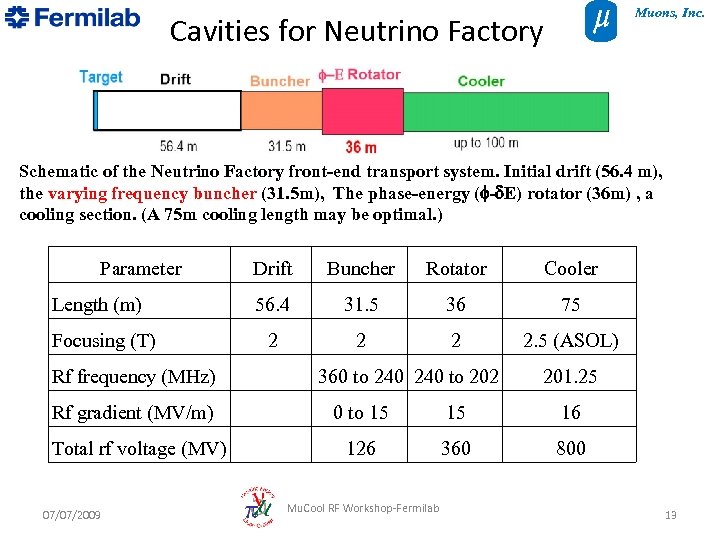 Muons, Inc. Cavities for Neutrino Factory Schematic of the Neutrino Factory front-end transport system. Initial drift (56. 4 m), the varying frequency buncher (31. 5 m), The phase-energy ( - E) rotator (36 m) , a cooling section. (A 75 m cooling length may be optimal. ) Parameter Length (m) Focusing (T) Rf frequency (MHz) Rf gradient (MV/m) Total rf voltage (MV) 07/07/2009 Drift Buncher Rotator Cooler 56. 4 31. 5 36 75 2 2. 5 (ASOL) 360 to 240 to 202 201. 25 0 to 15 15 16 126 360 800 Mu. Cool RF Workshop-Fermilab 13
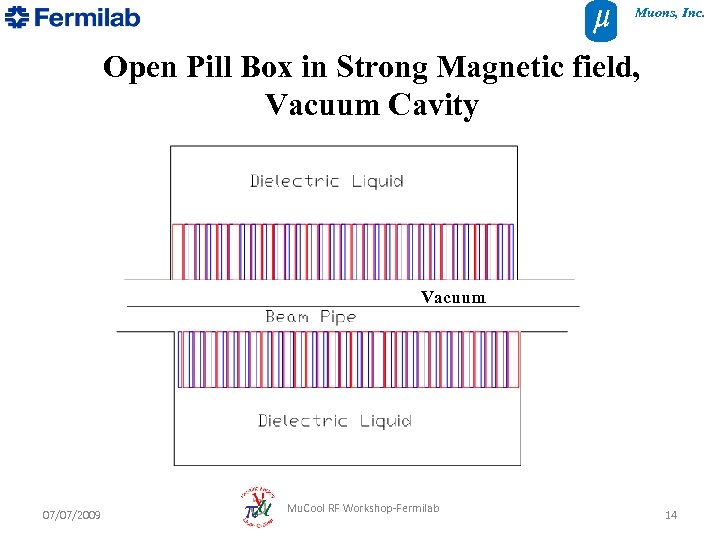 Muons, Inc. Open Pill Box in Strong Magnetic field, Vacuum Cavity Vacuum 07/07/2009 Mu. Cool RF Workshop-Fermilab 14
 Muons, Inc. 07/07/2009 Mu. Cool RF Workshop-Fermilab 15
 Muons, Inc. 07/07/2009 Mu. Cool RF Workshop-Fermilab 16
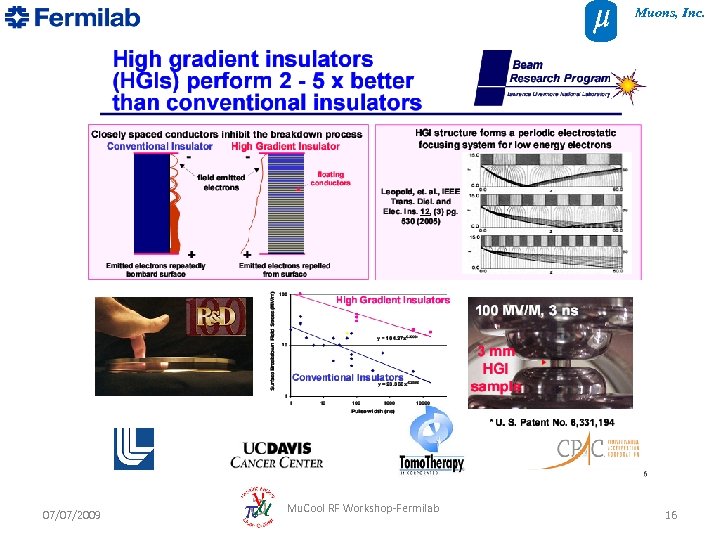
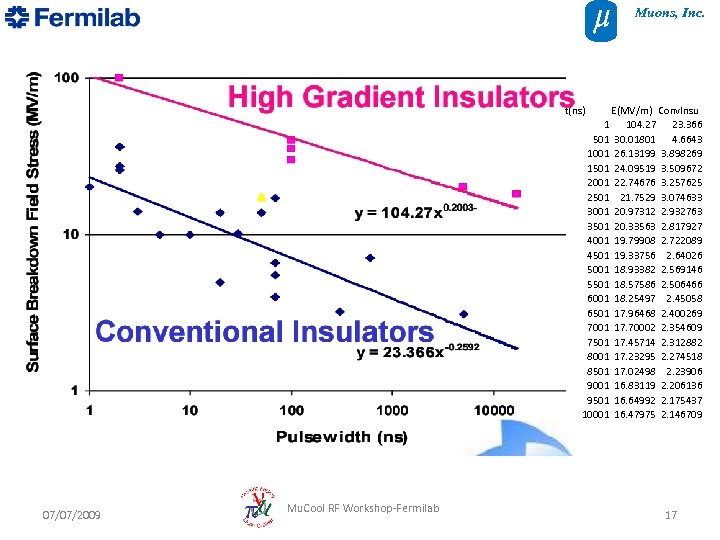 Muons, Inc. t(ns) E(MV/m) Conv. Insu 1 104. 27 23. 366 501 30. 01801 4. 6643 1001 26. 13199 3. 898269 1501 24. 09519 3. 509672 2001 22. 74676 3. 257625 2501 21. 7529 3. 074633 3001 20. 97312 2. 932763 3501 20. 33563 2. 817927 4001 19. 79908 2. 722089 4501 19. 33756 2. 64026 5001 18. 93382 2. 569146 5501 18. 57586 2. 506466 6001 18. 25497 2. 45058 6501 17. 96468 2. 400269 7001 17. 70002 2. 354609 7501 17. 45714 2. 312882 8001 17. 23295 2. 274518 8501 17. 02498 2. 23906 9001 16. 83119 2. 206136 9501 16. 64992 2. 175437 10001 16. 47975 2. 146709 07/07/2009 Mu. Cool RF Workshop-Fermilab 17
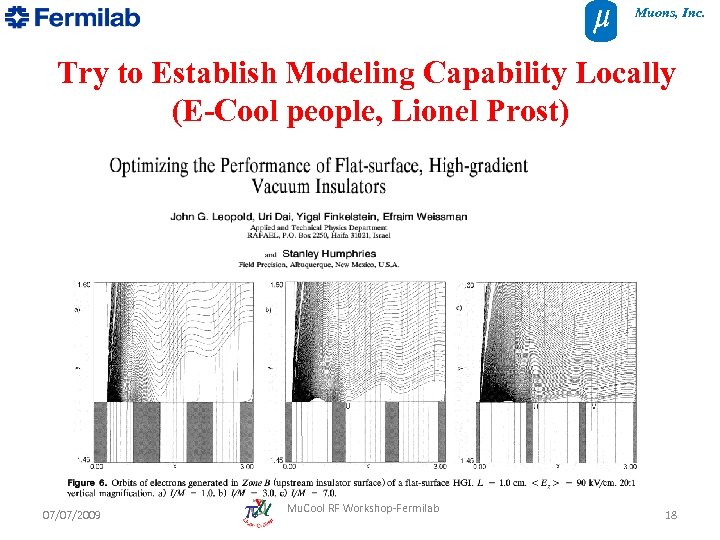 Muons, Inc. Try to Establish Modeling Capability Locally (E-Cool people, Lionel Prost) 07/07/2009 Mu. Cool RF Workshop-Fermilab 18
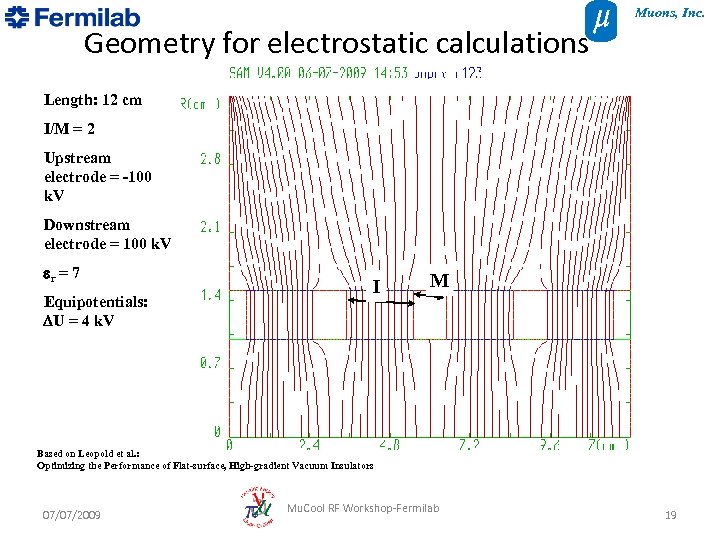 Muons, Inc. Geometry for electrostatic calculations Length: 12 cm I/M = 2 Upstream electrode = -100 k. V Downstream electrode = 100 k. V er = 7 Equipotentials: DU = 4 k. V I M Based on Leopold et al. : Optimizing the Performance of Flat-surface, High-gradient Vacuum Insulators 07/07/2009 Mu. Cool RF Workshop-Fermilab 19
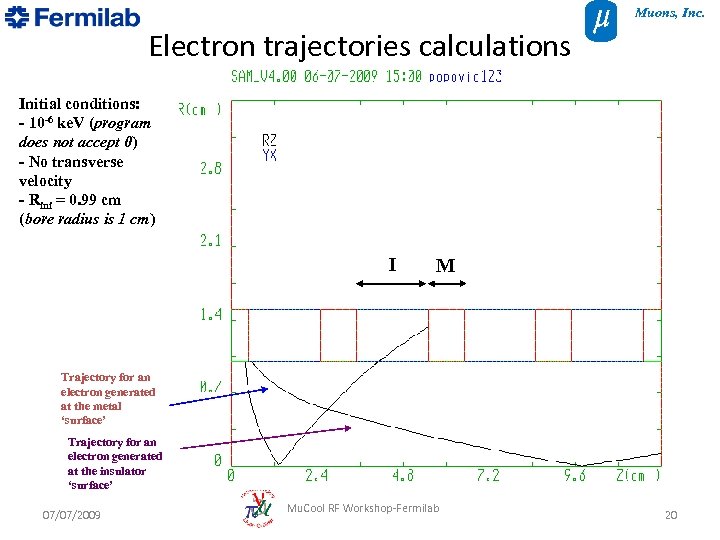 Muons, Inc. Electron trajectories calculations Initial conditions: - 10 -6 ke. V (program does not accept 0) - No transverse velocity - Rini = 0. 99 cm (bore radius is 1 cm) I M Trajectory for an electron generated at the metal ‘surface’ Trajectory for an electron generated at the insulator ‘surface’ 07/07/2009 Mu. Cool RF Workshop-Fermilab 20
 Muons, Inc. Super. Fish 07/07/2009 Mu. Cool RF Workshop-Fermilab 21
 Main Issues Muons, Inc. • Ceramics, Loss Tangent • Vacuum Surface Coating • Dielectric Cooling/Tuning Liquid • Geometric/Power Optimization • Design, I/M Ratio • RF and Mechanical Engineering ~50 k$ + 1 FTE to Start 07/07/2009 Mu. Cool RF Workshop-Fermilab 22
 What is Next, 5 -Years Plan Muons, Inc. The projected funding for the 5 -year program proposed here. . …We will also accomplish sufficient hardware R&D (RF, magnets, and cooling section prototyping) to guide, and give confidence in, our simulation studies. In order to produce a practical helical cooling channel, several technical issues need to be addressed, including: magnetic matching sections for downstream and upstream of the HCC a complete set of functional and interface specifications covering field quality and tunability, the interface with rf structures, and heat load limits (requiring knowledge of the power lead requirements) To prepare the way for an HCC test section we would: Develop, with accelerator designers, functional specifications for the magnet systems of a helical cooling channel, including magnet apertures to accommodate the required rf systems, section lengths, helical periods, field components, field quality, alignment tolerances, and cryogenic and power requirements. The specification will also consider the needs of any required matching sections. Perform conceptual design studies of helical solenoids that meet our specifications, including a joint rf and magnet study to decide how to incorporate rf into the helical solenoid bore, corrector coils, matching sections, etc. 07/07/2009 Mu. Cool RF Workshop-Fermilab 23
 (near)FUTURE Muons, Inc. (Vacuum Cavity) o. In week or two I hope, DC results with existing dielectric o. Nu. Fact 09 -This Summer I hope, RF(low power) results with low loss dielectric 07/07/2009 Mu. Cool RF Workshop-Fermilab 24
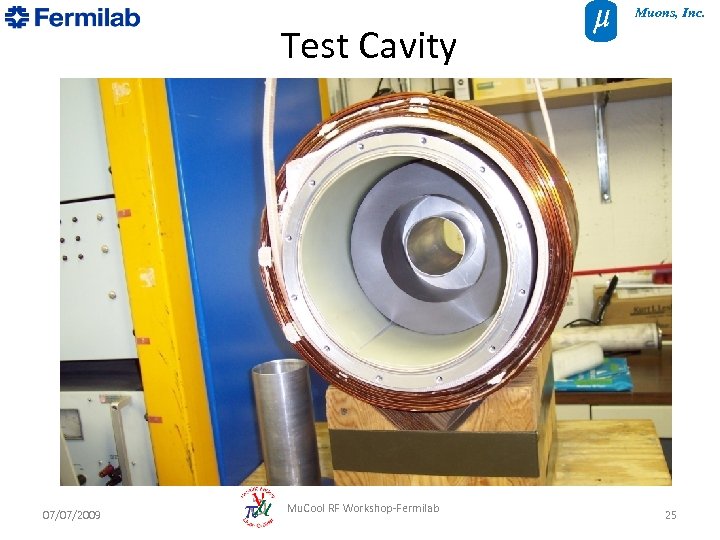 Muons, Inc. Test Cavity 07/07/2009 Mu. Cool RF Workshop-Fermilab 25
 Muons, Inc. 07/07/2009 Mu. Cool RF Workshop-Fermilab 26
 Muons, Inc. 07/07/2009 Mu. Cool RF Workshop-Fermilab 27