


 Скачать презентацию Municipal strategic planning and implementation Municipal income and
10b997e510eb78e6c574b3e0dfde02ef.ppt
- Количество слайдов: 128
 Municipal strategic planning and implementation Municipal income and expenses in a multiyear
 Chapter 1 – Municipal Income and expenditure management Outcome • Understand explain a revenue and expenditure system in a municipality
 Background • Conceptual framework: Municipal finance white paper on local government – 1998 – Developmental role – Proposed new system to address root causes of financial problems – Empower municipalities to fulfill constitutional mandate – Balance poverty eradication & strategies to enhance growth, job creation, competitiveness
 Structured system of municipality finance Seven basic policy principles • Revenue adequacy and certainty • Sustainability • Effective and efficient use of resource • Accountability, transparency and good governance • Equity and redistribution • Development and investment • Micro-economic management
 Municipal Finance Management Act • Policy principles now converted to law • Focuses on: – Sound outcomes – Rules and procedures – Long term strategic planning – Culture of performance and regular reporting
 Introduction S 214 of Constitution: - “LG’s equitable share must ensure that municipalities are able to provide basic services and fulfill their functions, and it must take account of fiscal capacity and efficiency”
 Constitutional obligation • Generate own revenue – Scarce resource – Total amount of money received for goods sold or services rendered – Includes interest, exchange of assets, net sales – Calculated before expenses are subtracted • Rely on inter-governmental fiscal transfers
 Municipality revenue • MFMA – S 64(1) – Accounting officers legally responsible for revenue management • In practice – delegated to CFO
 Responsibilities of AO MFMA – S 64(2): • Effective revenue collection systems – consistent with S 95 of MSA – Credit and debt policies • Revenue due calculated monthly • Accounts for tax and charges prepared monthly • All monies received promptly deposited in bank accounts
 Responsibilities of AO –cont’d MFMA – S 64(2): • Maintains management, accounting and information system which – Recognises revenue when it is earned – Account for debtors – Account for receipt of debtors • Maintain a system of internal control re debtors and revenue • Charges interest on arrears • Weekly reconciliations of all revenue collected
 Internal sources of revenue • Land based sources - property taxes • Non-land based sources: – Fees – vehicle licensing – Tax – provision of goods and services – Fines – License feesUser charges for water, electricity, refuse removal – Administration fees
 External sources of revenue • Equitable share • Conditional grants • Municipal borrowing from retail/ development banks • Private capital markets - bonds • Interest from investment
 Municipal expenditure • MFMA S 65: - AO should take reasonable steps to ensure: – Effective system of expenditure control – approval, authorisation, withdrawal, payment of funds – Management, accounting and information system to recognise revenue and expenses on accrual basis
 History – expense management • • • Uncollectible debts Mismanagement of resources Unethical practices Corrupt officials Poorly managed projects Unsound revenue and expense management
 Definition of revenue and expenditure GRAP • “ Revenue is the gross inflow of economic benefits or services potential during the reporting period when those inflows result in an increase in net assets, other than increases relating to contributions from owners”
 Excluded from the definition • Revenue is the gross inflow of economic benefits or services potential on its own account • Amounts to be collected on behalf of principle – license fees – Dept of Transport – do not flow to entity, no increase in asset or decrease in liabilities – not income
 Measurement of revenue • Fair value of consideration received/ receivable • Typical transactions – – – – Rendering of services Sales of goods Rates Service charges Fines Government grants Donations Levies
 GRAP - definition of expenses • Decrease in economic benefits • Consumption of assets • Incurrence of liabilities results in decrease in net assets
 Definition of Losses • Encompass losses • Includes expenses that arise in operating activities of municipality.
 Expenses that arise in entity • • Cost of sales Cost of services rendered Wages Depreciation In form of an outflow/depletion of assets • Cash Equivalents, • Inventory, • Property, etc.
 Requirements of the Municipality • Present analysis of expenses using classification • Based on nature of expenses or their functions.
 Different types of expenditure in municipality • Capital expenditure – Capital assets, e. g. Vehicles. • Current expenditure – Expenditure incurred in a year, e. g. Office stationary. • Losses – May/May not arise in operating activities, incl. • Losses resulting in disasters • Disposal of non–current assets
 Revenue and expense items • All items of revenue and expenditure recognised in a period to be included in determination of surplus and deficit. • Unless GRAP requires otherwise. • If significant - nature and amount disclosed separately
 Importance of municipal revenue • AO can only manage revenue/expenses which can be measured by using GRAP. • MFMA S 64 and S 65: Once finances are allocated through budgetary process, service delivery activities move into operational phase. • Continues for whole fiscal year – in year management
 In–year management of resources • Overseeing, monitoring, evaluation, reporting on all aspects of budget and finance. • Ensuring compliance with MFMA regulations. • Create administrative procedures to manage inflow/outflow liquid resources. • Make funds available funds for implementation of SDBIP. • Overseeing monitoring use of funds using: • Approved multi-year budgets • Monthly outcome of those budgets • Submission of in-year reports • Overseeing preparation of monthly, quarterly biannual and annual consolidated reports on state of budget • Assist building financial management capacity and sound financial systems.
 Municipal Revenue Management System • Utilise all possible means available to ensure revenue management system operates – Effectively – Efficiently • Operating, monitoring and safeguarding are important activities in revenue and expense management
 Revenue & Expenditure management • Guided by following principles: – Expenses incurred as authorized and in line with budget – Expenditure supported by forecasted revenue and cash collections – Expenditure are in line with SDBIP – Continues adherence to regulations that guide • Spending • Revenue collection • Safeguarding – Proper and timely reporting of revenue and expenditure – System of internal controls in place to prevent • Fraud • Wasteful and fruitless expenditure.
 Implementation of indigent policy • Develop indigent policy – Implemented/managed on ongoing basis. • Impacts revenue base • Understand definition indigent: Lacking necessity of life. • Following goods and services necessity for survival: – – – – Sufficient water Basic sanitation Refuse removal of denser settlement Environmental health Basic energy Health care Housing Food and clothing
 Indigent • Necessities require resource commitments supported by sustainable revenue base. • Explicitly exclude household income condition. • Partly due to difficulties of measuring income. • Condition of indigent: – lacking goods and services, – cost of services – distribution in different locations.
 Access to adequate sources and revenue Own resources & intergovernmental fiscal transfers – Enable to deliver service to residents – Encouraged to fully exploit sources of revenue – Meet developmental objectives – Achieve reasonable certainty of revenue – Allow realistic planning
 Financial sustainability • Operate with balanced budgets • Service provide at levels that are affordable • Recover costs of service delivery • Scarce resources economiccaly utilised • Maximize benefit for local communities
 Chapter summary • Terms defined in context of municipal revenue and expenditure management • Reference of MFMA S 64 and S 65. • Rely on own revenues and intergovernmental transfers • Understanding the principles required to operate revenue and expenditure management system
 Internal and external revenue • Importance of information types • Perform effectively revenue and management functions • Demonstrated in class discussion exercises • Underpinned by financial management principles
 Chapter 2 – Approach to manage revenue in sustainable manner Outcome • Apply criteria for assessing tax instruments and user charges • Provide recommendations for achieving sustainability • Exlain tax incidence of revenue, levying collection legislation • Estimate incentive effects of municipal tarrifs and user charges.
 Independence of municipalities • MFMA – local sphere of government is distinctive & independent • Power to determine its own budget and policies • Critical to generate own revenue in addition to grants received • Revenue determine expenditure priorities for the year • Expenditure need = minimum amount of resources needed to provide basic service level
 Expenditure needs vary between municipalities • MFMA S 11(3) (i) – Muni exercise legislative/executive authority by: • Imposing/recovering rates, taxes, duties, service fees • Debt collection policies
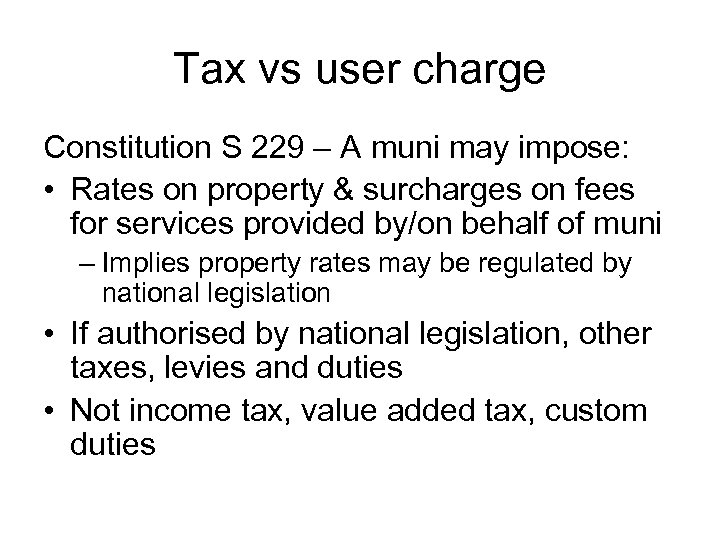 Tax vs user charge Constitution S 229 – A muni may impose: • Rates on property & surcharges on fees for services provided by/on behalf of muni – Implies property rates may be regulated by national legislation • If authorised by national legislation, other taxes, levies and duties • Not income tax, value added tax, custom duties
 Taxes
Taxes
 User charges
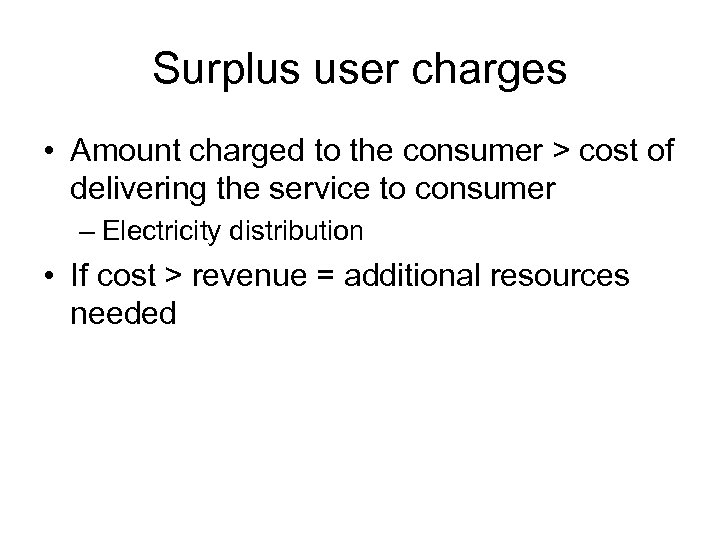 Surplus user charges • Amount charged to the consumer > cost of delivering the service to consumer – Electricity distribution • If cost > revenue = additional resources needed
 Tax instruments & property tax • Tax base for taxing property = capital value = reflect the ability of the owner to pay – Use market value of land improvements – Valuation and rating practices – single valuation roll • LG Property Act – legal mandate – Important source of revenue • District muni’s – no property taxes
 User charges • Charges directly related to provision of services – Water services – Electricity • Contribute significantly to the growth of revenue
 Important principles • Adequacy – Conscientiously increased – Consultative process • Benefit principle – Vertical equity • Elasticity of demand • Response of consumers to demands • High elasticity – demand will drop dramatically if price increases slightly • Lead to poor quality subsidized goods
 Important principles (cont’d) • Administrative feasibility – Easier to collect – Only get services what you pay for – Technical difficulties • • Measuring consumption Calculating amounts due Implementing sanctions Remedies for non-payment (attachment of property)
 Important principles (cont’d) • Politically acceptable – User charges politically acceptable, level of tariff sensitive – Services normally essential – highly visible • Allocative efficiency – – User charges less distorting than taxes IF prices determined by market forces Competitive prices – correct signal – relative value of service Consumers can make judgments about quantity of services to consume – But – muni’s monopolistic • User charges = effective as possible – Subsidies drive a wedge between real cost and service price – Subsidies should be transparent
 Important principles (cont’d) • Productive inefficiency – Wedge between competitively set prices & prices actually charged – Transparency of prices – enhance provider accountability – downward pressure on production costs
 Incentive effect – tariff/user charges • Muni’s s/be provided with appropriate incentives to extend municipal revenue – Example of Municipality A • Equitable share = 100% • Service needs = 20% • If infrastructure is extended, maintenance cost rise, less money, less services • Incentive not to spend • Financial incentive to limit spending on operations and maintenance < political pressure to extend services • Value for money – Equitable share = 100% – Service needs = 20% – Excess funding thus inefficient spending
 Sustainability of municipal revenue • Certainty about revenue – Sources of revenue – How much – By what date • Budgets should be balanced – – – Services at levels that are affordable Munis able to recover costs of service delivery No bailout to muni who overspends on budget Realistic budgets Need for subsidization of poor households - FBS
 Cost recovery mechanisms • Essential part of sustainable revenue • Muni’s cannot meet all costs associated with backlogs of infrastructure delivery – Capital grant package – meet capital cost of bulk and connector services – Aimed at subsidising indigent and low-income households • Effective recovery = ability to measure consumption by individual household accurately and collect payments
 Cost recovery mechanisms (cont’d) • Effective administration – Good postal/payment system – Punitive threats to persuade/force paying of bills • • Cut services Legal action Attachment of assets Eviction – Expensive and politically sensitive
 Cost recovery mechanisms • Pre-paid meters – Measures exact amounts of consumption ( marginal cost pricing) – Purchase in advance – Reduce cost of service delivery • • • Meter reading Bill processing Dispatch of invoices Cash collection Credit control – Ultimate cost-recovery mechanism • Advanced collection, earning interest • No default = no punitive measures
 Appropriate tariffs, user charges, subsidies • Cost recovery presupposes munis can measure costs of services delivered • Measurement requires: – Clear understanding of basic standard of delivery • Ventilated pit latrines vs water-borne sewerage systems – Implication = cost recovery measures must first assess cost of rendering the right basic level of service – nature of technology – Range of service packages with future upgrading – Understand the capital costs and operating costs – In line with household incomes - affordability – Understand subsidies available – Consumers must understand the costs
 Affordability issues • Critical issue – National government - sustainable subsidy levels – Municipal level – infrastructure program must be within means of municipality – capital and recurrent costs – Household level – able to afford to pay charges for services • Ability to finance recurrent costs crucial – Capital easily available – solid financial statements – Infrastructure development programs failing – nonrecovery of recurrent costs
 Tax incidence – revenue levying collection • Definition - economic incidence – Final distribution of economic burden under different financing schemes • Consumer buys less of taxed product/service – rather pay less for products and services • Production decisions depend on demand • Influences input prices
 Tax incidence – revenue levying collection Constitution S 155 – province entitled to an equitable share of revenue collected nationally – determined by: – – – – National interest Different fiscal capacities Fiscal performances Efficiency of utilisation of revenue Needs Economic disparities Developmental needs Any local tax – Coherent and transparent tax system – Take into account consequences on the productive economy
 Tax incidence – revenue levying collection (cont’d) • Financial planning – Investigate financing options – Fiscal feasibility of funding – Detailed financial analysis • Capacity • Ability to undertake collection program
 Tax incidence – revenue levying collection (cont’d) • Number of service delivery improvements that muni’s can finance depends on: – Level of recurring future expenses – Cost recovery element for individual projects – Potential for public investment to be revenue generating – Availability of cost sharing by different tiers of government – Debt structure and instruments – debt carrying capacity
 Sustainability assessment • Measurement of sustainability of electricity requires: – Complete knowledge of electricity consumption statistics broken down into • Residential • Commercial • Industrial – Presently fragmented – demand > supply – Muni should assess supply from Escom and demand from consumers – assist with maximizing revenue
 Sustainability assessment • Water – Revenue generation – Water service – income will reduce = FBS – Muni’s compelled to bring water tariffs in line with government guidelines – Not all residential properties have water meters • Sanitation/refuse removal – No surpluses – Recovering full costs the target – Condition – accurate measures of costs for different basic service standards
 Summary • Constitutional powers regarding revenue collection, borrowing and taxation • Major expenditure responsibilities assigned to improve service delivery • Various sources of income • Sustainability
 Chapter 3 – Subsidy framework for Municipal Rates and Tariffs Outcome • Identify the needs for subsidies at municipal level • Develop indigent policy – legislative compliant and specific to municipalities • Calculate socio-economic impact of subsidy framework • Design and apply range of subsidy frameworks and control instruments for subsidy leakages
 Responsibility of muni’s • Offer effective and efficient services to the community • Ability to pay and afford certain services that varies across: – Communities – Individuals • Muni should: – – design a rates and tariff policy incorporating a subsidy framework to address needs of indigent people Assist them accessing basic municipal services
 Poverty • Addressed by giving poor people access to package of basic services • Don’t pay full economic cost of services • Two methods – Directly to consumer to afford goods – Provide goods at reduces price
 Subsidies at muni level • MSA S 97(1) – muni must provide in its debt collection and credit control policy for debtors that are consistent with its rates and tariff policies on indigents. • Root causes: – Poverty – Unempolyment • Service include: – Housing – Water – Electricity • Levels s/be precisely designed • Decision informed by resources available for targeted subsidies
 Poverty • Definition – lack of physical necessities, assets and income • Loss of assets precipitates poverty • Assets include: – Tangible • Savings, goods, resources – Intangible • Claims made for assistance when in need • Muni must understand: – Who is poor – Why they are poor – Where they are located – Movement and mobility patterns – Sources of survival – Multiple points of access • Requires ethnographic research, observation and engagement
 Poverty levels • Variables used to assess poverty in muni’s: – – – – – Living in formal housing Access to electricity for lighting Tap water inside the dwelling Flush/chemical toilet Telephone in dwelling/cellular phone Refuse removal once per week Level of education of head of household Monthly household expenses Unemployment rate Average household size, children under 5 years old
 One solution to poverty • Subsidy for services – not paying full economic cost – Given directly to the user – Reduced prices for goods and services • No collection of income – other sources – Pool of resources earned – Equitable share • Scarce resources – thus valuable
 Negative consequences of no subsidy • Restricts creation of equal opportunity for: – Self-advancement – Improvement of own circumstances • Contravention of Constitution – not having services • Indigents – not able to pay, thus credit control measures to minimise consumption • Increase in loss or wastage of services placing households into further debt
 Indigent policy • FBS – electricity and water • FBE – assistance from national and provincial government – linked to RED’s • Provincial government required to monitor performance of muni’s • FWP –linked to DWAF • Subsidies on rates and specified service charges – annual budget process
 FWP • Understand consumers and consumption – residential and industrial • Assess technical options – communal taps or prepaid house connections • Assess links to sanitation – 6 kl not enough for waterborne sanitation • Establish institutional framework – local government • Understand costs – to be covered by revenue • Review of municipal revenue sources • Selection of poverty relief options – next slide • Finalisation of water pricing policy – MSA subsidy options • Establish financial arrangements • Establish management arrangements – monitoring and customer relations
 FWP poverty relief options • Rising block tariffs – 6 kl of water free – No monthly charge • Targeted credit – Credit on water account • Service level targeting – Below 6 kl no charge – Higher service levels – pay normal tariffs
 Indigent support policy • Objective - FBS
 Who qualifies for indigent support? DPLG guidelines • Different criteria by muni’s • Indigent must be registered via annual registration program • Registration must be accepted and registered • Registered indigent - full time occupant of property concerned • If not the owner of the property, may not own any other property
 Setting criteria for indigents • Starting point – national criteria – specified income per household • Consider application and registration steps – – – Forms to be completes Information supplied When registration will take place Who manages registration Verification of data Frequency • Programmatical process – Levels of consumption – Rateable value of property – Can people apply even if they don’t qualify
 Application of policy • • • Intended relief for registered indigents Reviewable annually Full-time legal occupant of property? Owner and full-time occupant? Ownership of more than one property – disqualification • Period for relief
 Indigent database management • Set of rules – ans sanctions for those cheating • Municipal manager to report monthly on: – By municipal ward • • Number of households registered as indigents Monetary value of actual subsidies/rebates Budgeted value of subsidies/rebates Cumulative values for financial year to date • Executive committee shall quarterly report to council and ward committees
 Socio-economic impact • Balance fiscal, social, economic and environmental goals • Balance between new developments and day-today quality of life • Socio-economic impact – Assist communities to make decisions • • Promote long-term sustainability Economic prosperity Healthy community Social well-being
 Effect on economic conditions • FBS – well regocnised socio-economic benefits – FBS – electricity - woman and children carrying wood – Need for fossil-based energy sources reduced
 Effect on uptake/consumption of services • Self-selection – provides a service at subsidised rates to everybody claiming it – Communal taps – only those without water will use it • Where no direct screening - always risks that non-qualifiers will claim it
 Effects on employment • Performance based contracts – creating employment from subsidies – First two or three reporting levels – Improves accountability – Induce a focus on outputs • Employment contracts – Specify job outputs – Performance standards • Renewable contracts – Assess performance against specified standards – Fair labour practice
 Public-private-community-based organisation • Muni – Provides funding and project management capacity • Private sector – Provides access to equipment and training • Community – Provides recruitment, management of local labour and community liaison • Benefits – – Transfer of skills Creates employment Effective service without draining municipal capacity Target the poor and destitute
 Financial effect of subsidy • Funding subsidies entails opportunity costs • Two contradictory factors: – Amount of resources available for subsidies – Cost of service provision plus cost of administering the subsidies
 Level of access • What level of service is desirable to subsidise – Comparing financial costs against social benefits – difficult to measure financially – Social benefits normally high – preventing spreading of diseases
 Divert revenue • Expenditure on subsidies – implications on short/long term financial position • Value to high – drain operating accounts in short term – lead to deterioration of services – weakening of revenue streams • Investing in subsidies rather than extension of services – muni’s forego the user charge in short to middle term • Expenditure on subsidies will not generate financial return in long term
 Subsidy design • Design parameters – Method of transference – Degree of choice in using the subsidy • What services the subsidy can be used for • What rate it can be used at – Level of transparency
 Design possibilities/controls • Cost versus potential leakage – Cash – Vouchers/coupons – Accounting/billing – Self-selection • • Hidden value Education program to create transparency Admin costs are low Chances of leakage
 Management of effective subsidy framework • Three broad options – Municipal selection using statistical data – Self-selection – Registration of targeted group
 Municipal selection • Select target group based on set of criteria • Set of indicators – What information should be used? • • Information expensive to obtain What is available Census/Stats SA Own info relating to: – levels of service – Consumptions and payment for service – Value of fixed property in the area – What indicators are appropriate?
 Type of indicators • Attributes of services access – Degree to which a certain household is able to access a certain level of service – Minimum = basic level of service • Reason indicators – why can households not get a certain service – Lack of access to income – below a specific minimum – Strictness of the application of the threshold • Phasing out subsidies as level of income increases – Social reasons • • Gender Age Foreignness disability
 Self selection • Provide a subsidised rate t all who claims it – Communal taps – Cheating – insignificant minority – Stigma
 Registration • Application for a benefit – Information obtained – Written questionnaires • Accepted/rejected – Based on indicators – Accuracy of information • Compare with official information • Household inspections • Once accepted - registered
 Summary • • • Importance of indigent policy Framework to collect data Understand socio-economic indicators Process cheap to administer High leakages Internal control system to implement and monitor
 Chapter 4 – Forecasting of Medium Term Revenue and Expenditure Outcome • Develop information sets forecasting income and expenditure over medium term • Identify programme cycles in municipal context • Forecast social, institutional, economic, environmental, technical influences on revenue over the medium term • Interpret indicators relating to income and expenditure
 Introduction • Budget proposal for MTREF – informed by IDP – Objectives – Outputs – Targets • Better budgeting enhances service delivery – Integrated planning, budgeting, monitoring of service delivery strengthens the link between services provided and benefits/costs of these services • Performance management system = improved transparency/accountability for use of resources
 Policy framework • Optimise good Municipal Finance Management • Empower municipalities to fulfill constitutional mandate • Create sustainable living environment • Challenges – – – Rural areas – no access to adequate tax base Poor planning Lack of forecasting revenue Inadequate financial management Financing options
 Information – forecast revenue and expenses • Benchmark procedures – Use resources in effective, economical, accountable, transparent manner – Structure manage administration – Budget/planning processes – Clear objectives – Regular monitor and assess performance – Integrated development and financial plan – Report to comminity
 Key principles • Planning for financial sustainability – Limited resources to satisfy unlimited needs – Planning tool to manage change – Financial plan • Forecasting income and expenditure
 Financial plan • Medium term projection of capital and operating expenditure • Revenue allocations done on medium term basis – – Objectives Financial strategy Target dates Project management to prepare and implement financial plan • • • Planning Strategising Preparing Tabling Approving Finalising
 Key drivers of financial planning • • • Needs of residents Continuous monitoring Improvement over time Corrective action Informs the plan for the next period
 Financial planning objectives • Require requests for funding for projects – support implementation of IDP • Set priorities for project/program accomplishments • Revenue not fluctuate substantially
 Legislative requirements • MFMA S 17: – Prepare budgets + supporting documents • Draft resolutions approving budget, imposing revenue generation measure • Measure performance objectives for revenue sources • Cash flow projection by revenue source • Proposed amendments to IDP – MFMA S 34 – – Estimate of revenue by source Operating and capital expenditure Proposals for financing deficits Indications of intent to borrow
 Financial planning process • Diagram on page 58 • Six steps of municipal budget process • Key factors – Economic – Debt – Financial – Administrative
 Forecasting – data sets • Political data sets – Strengthening link between political priorities and spending plans – enhancing political oversight of budget process • Political executive responsible for policy and budget planning and prioritisation • Policy priorities linked to departmental spending plans/ delivery of services
 Forecasting – data sets • Cost driver data sets – Pit latrines/septic tanks – areas with less population – Difference in quantity and inputs to supply services – Variations in costs of services
 Forecasting – data sets • Traditional cost accounting – Arbitrarily allocate costs to cost objects – Total overheads allocated to products and services based on volume-based measure • • Labour hours Number of employees Number of telephone calls Machine hours – Cost allocation varies directly with the volume of service units attended to
 Forecasting – data sets • Activity based costing – Identify activities responsible for generating costs • • • Land facility management Communit planning Recreation Library Protection and emergency services Utilities and public works – Use cause and effect cost allocations – Service delivery requires certain activities to be performed – Activities consume resources, cost money
 ACBM • Identify major activities • Assign costs to cost centres • Determine the cost drivers – Any factor that causes a change in the cost of an activity • Transaction drivers • Duration drivers • Intensity drivers
 Cost drivers • Rates easily updated if changed – Changes in prices of resources supplied affect cost per time unit of supplying capacity • Increase in HR costs • Machines added to process • New technology – electronic billing differs from manual billing – Shift in the efficiency of activity • • Quality programs Continuous improvement Introduction of new technology Reengineering
 Impact on service costs • Unit costs differs between ABC costing and traditional costing – Some operational costs excluded from service costs under ABC • Idle capacity – Some non-operational costs are included under ABC • Diagram on page 64 – Cost drivers employed to allocate support costs to external service delivery units
 Buffalo Municipality • Example P 64 - 72
 MFMA S 17 (3) • Budget = projection of future revenues and expenditures • Control financial transactions • Management and planning tool • Indicates service delivery targets and performance indicators
 Variables in budgetary process • • • Local government legislative requirements Intergovernmental fiscal transfers Government structure Regional en national economies Nature of service provided Personalities of principle actors
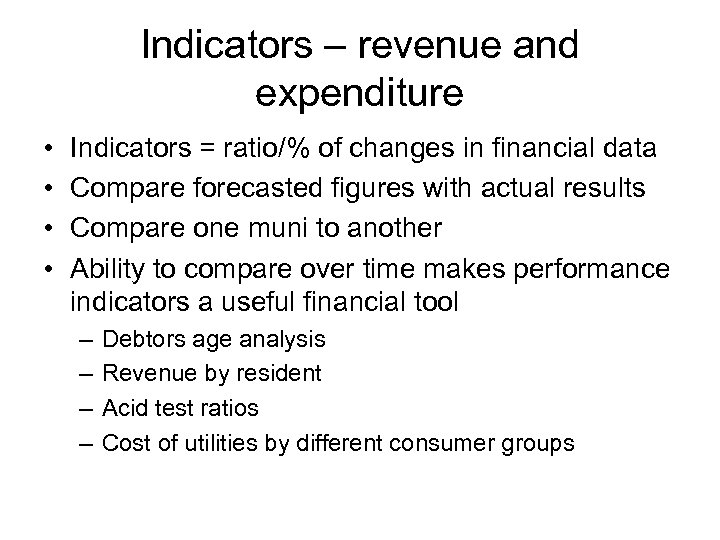 Indicators – revenue and expenditure • • Indicators = ratio/% of changes in financial data Compare forecasted figures with actual results Compare one muni to another Ability to compare over time makes performance indicators a useful financial tool – – Debtors age analysis Revenue by resident Acid test ratios Cost of utilities by different consumer groups
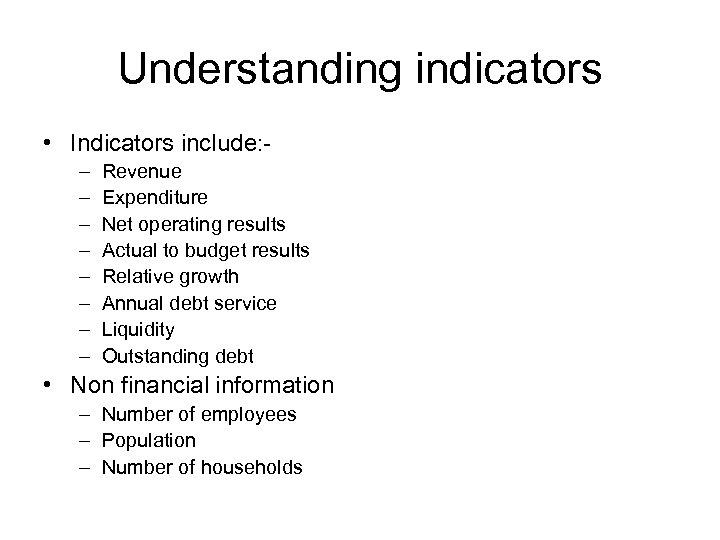 Understanding indicators • Indicators include: – – – – Revenue Expenditure Net operating results Actual to budget results Relative growth Annual debt service Liquidity Outstanding debt • Non financial information – Number of employees – Population – Number of households
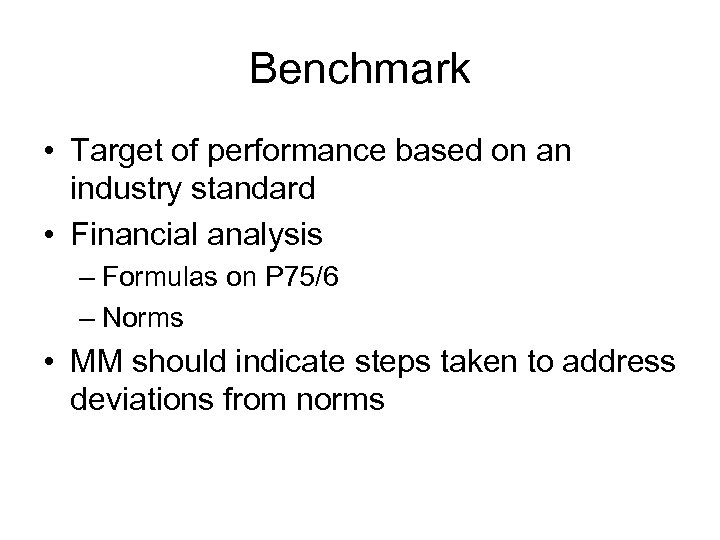 Benchmark • Target of performance based on an industry standard • Financial analysis – Formulas on P 75/6 – Norms • MM should indicate steps taken to address deviations from norms
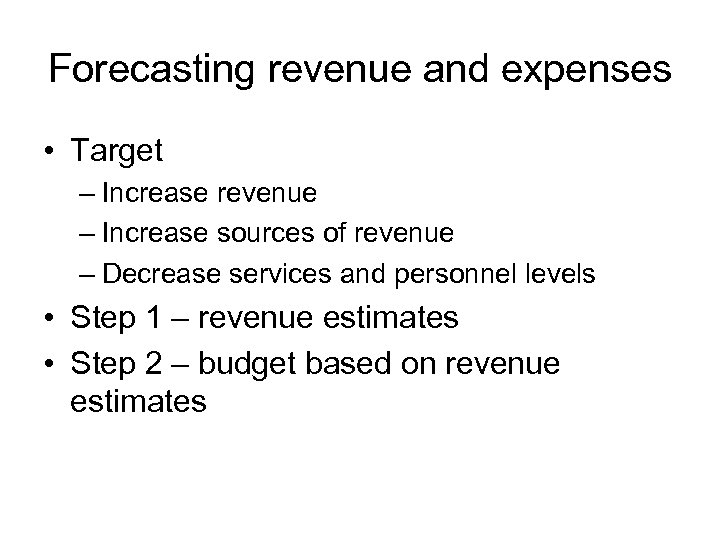 Forecasting revenue and expenses • Target – Increase revenue – Increase sources of revenue – Decrease services and personnel levels • Step 1 – revenue estimates • Step 2 – budget based on revenue estimates
 Local economy • Revenue depends on local economy • Drivers need to be understood – Tourism – Mining • Information sources on local economy – Bankers – Business men – Residents
 Critical questions • Next financial year – economic climate – improve or shrink • Economic conditions in nearby cities/countries? • Outlook for employment and growth • Increase in salaries • Increase in population – age brackets • Changes in residential and commercial development • Construction industry • Past/current rate of inflation • Trends in property values
 Ending balance for current f/y • Budget for next f/y must show: – Projected revenues and expenses for current year – Available cash at end of current fiscal year – Formula P 79 • Reliability and integrity of information – Accurate – Complete – Timely
 Estimation of known expenses • Include: – Interest and principal repayments on debt/leases – Financial impact - newly completed municiapl facilities – Cost of extra-ordinary maintenance requirements – Changes in legislation – new financial requirements – Payroll cost for the year – Reductions in cost – discontinued programs – Increases in expenses due to grants, donations – Cost of legal judgments against municipality
 Estimating revenue • • • Reliability and integrity of information Tax and revenue sources identified Inter-governmental transfers Do. RA Historical revenue trends – 5 year historical record • Revenue sources
 Property taxes • • Annual tax assessed on value of property Delinquent taxes Penalties and interest Interest revenue based on unused cash balances • Current assets versus 90 day fixed deposit accounts – Example Pretoria bank • Other sources – Water, electricity, wastage
 Trend analysis • Simplistic, or – Trend analysis – historical data to predict the future • Complicated econometric models
 Budget assumptions • Key assumptions – Review external factors – population, migration, employment, health, development of business – Inflation outlook – Credit rating – Rates, tariffs, timing of revenue collections – Growth/decline in tax base – Collection rates – Price movements of specific goods and services – Impact on provincial/national policies – Ability to spend and deliver on programs – Trends in demands – Average wage increases – Industrial relations situation – Restructering
 Summary • Financial management skills – effectively and efficiently • Skills – Technical – Financial – Strategic management skills • MFMA compliance • Reliability of information
 Chapter 5 – Implication of Medium Term Revenue and Expenditure Outcome
 Chapter 6 – Design Rates, Tariffs/ User Charges in Municipality Outcome
 Chapter 7 – Credit Control and Debt Collection Policy Outcome