


 Скачать презентацию MUNICIPAL INFRASTRUCTURE SUPPORT AGENT MISA PRESENTATION TO THE
9898a7635864b257a459f137a5ab9e0f.ppt
- Количество слайдов: 16
 MUNICIPAL INFRASTRUCTURE SUPPORT AGENT (MISA) PRESENTATION TO THE SELECT COMMITTEE ON APPROPRIATIONS PROGRESS REPORT ON MISA 29 AUGUST 2012
 OUTLINE OF THE PRESENTATION 1. Purpose 2. Background 3. Diagnosis 4. List of Municipalities 5. Key Findings 6. Lessons Learnt 7. Interim Arrangements 8. Conclusion 2
 PURPOSE OF THE PRESENTATION The purpose of this presentation is to report on progress regarding the establishment of MISA 3
 Background MISA is one of the Local Government Turnaround Strategy (LGTAS) targets meant to introduce a turnaround mechanism in dealing with the provisioning, refurbishment and maintenance of municipal infrastructure; It was officially proclaimed as a government component on the 11 th of May 2012, with Co. GTA as its principal department thereby operating within the department’s broader policy positions. Prior to its proclamation, Co. GTA piloted the implementation of MISA and its programmes through a Unit within the Department of Cooperative Governance, called the Special Purpose Vehicle for Infrastructure Development Unit. MISA becomes the direct successor in responsibility to the support programme that the DBSA was providing through the Siyenza Manje project. 4
 Background…continued § Siyenza Manje (SM) was established in 2006 and focused on providing hands on capacity building support to municipalities on engineering, project management and financial management. The programme was managed by the Development Bank of Southern Africa on behalf of government. A total amount of R 1. 4 bn was spent by DBSA during the 5 years of SM’s existence with 70% of the amount coming from National Treasury (NT) and 30% being DBSA’s own contribution. In 2011, government took a decision to unbundle Siyenza Manje with the infrastructure component transferred to Co. GTA and financial management component transferred to NT. Both the Siyenza Manje Evaluation Report and the Submission by the Financial and Fiscal Commission to the Select Committee on Finance identify a number of lessons to be learned from the implementation of SM MISA’s new model for supporting municipalities has taken these lessons 5 into account and has identified the following 5 key strategic focus areas:
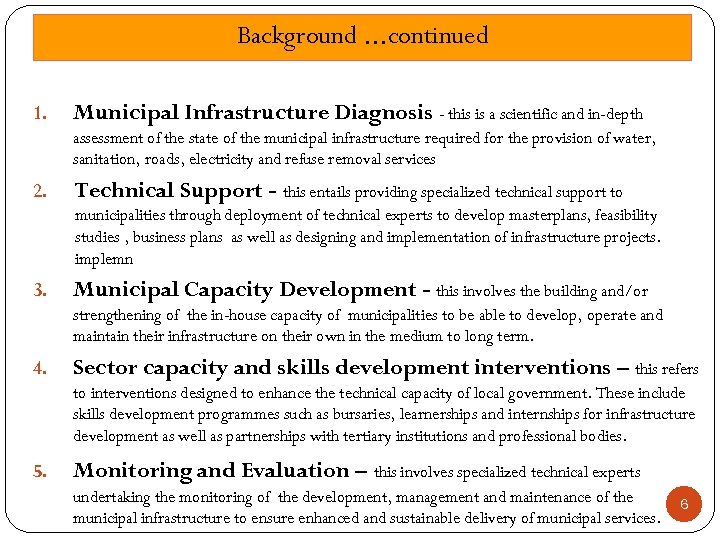 Background. . . continued 1. Municipal Infrastructure Diagnosis - this is a scientific and in-depth assessment of the state of the municipal infrastructure required for the provision of water, sanitation, roads, electricity and refuse removal services 2. Technical Support - this entails providing specialized technical support to municipalities through deployment of technical experts to develop masterplans, feasibility studies , business plans as well as designing and implementation of infrastructure projects. implemn 3. Municipal Capacity Development - this involves the building and/or strengthening of the in-house capacity of municipalities to be able to develop, operate and maintain their infrastructure on their own in the medium to long term. 4. Sector capacity and skills development interventions – this refers to interventions designed to enhance the technical capacity of local government. These include skills development programmes such as bursaries, learnerships and internships for infrastructure development as well as partnerships with tertiary institutions and professional bodies. 5. Monitoring and Evaluation – this involves specialized technical experts undertaking the monitoring of the development, management and maintenance of the municipal infrastructure to ensure enhanced and sustainable delivery of municipal services. 6
 Diagnosis A total of 88 municipalities have been put under a diagnosis to evaluate their municipal infrastructure provisioning. These municipalities were identified in conjunction with provincial governments using the following criteria as a basis for prioritisation: - high infrastructure and basic services backlogs - low technical capacity - high vulnerability - low economic base and/or inability to collect revenue 7
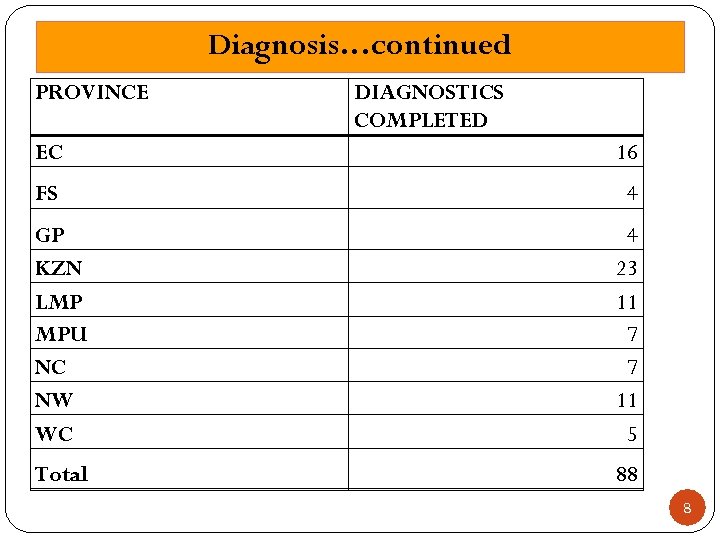 Diagnosis…continued PROVINCE DIAGNOSTICS COMPLETED EC 16 FS 4 GP KZN LMP MPU NC NW WC 4 23 11 7 7 11 5 Total 88 8
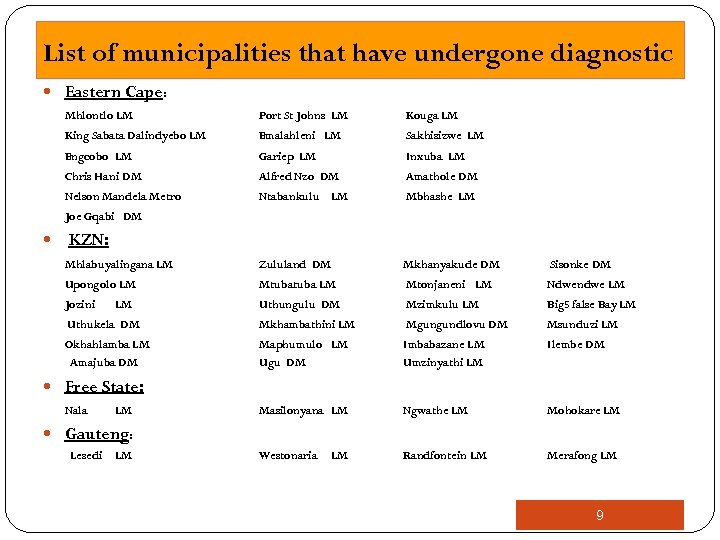 List of municipalities that have undergone diagnostic Eastern Cape: Mhlontlo LM Port St Johns LM Kouga LM King Sabata Dalindyebo LM Emalahleni LM Sakhisizwe LM Engcobo LM Gariep LM Inxuba LM Chris Hani DM Alfred Nzo DM Amathole DM Nelson Mandela Metro Ntabankulu LM Mbhashe LM Mhlabuyalingana LM Zululand DM Mkhanyakude DM Sisonke DM Upongolo LM Mtuba LM Mtonjaneni LM Ndwendwe LM Jozini Uthungulu DM Mzimkulu LM Big 5 false Bay LM Uthukela DM Mkhambathini LM Mgungundlovu DM Msunduzi LM Okhahlamba LM Maphumulo LM Imbabazane LM Ilembe DM Ugu DM Umzinyathi LM Masilonyana LM Ngwathe LM Mohokare LM Westonaria Randfontein LM Merafong LM Joe Gqabi DM KZN: LM Amajuba DM Free State: Nala LM Gauteng: Lesedi LM LM 9
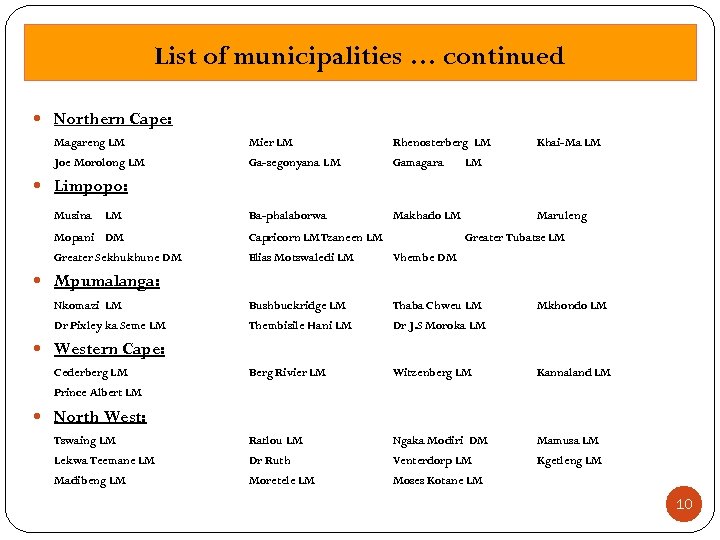 List of municipalities … continued Northern Cape: Magareng LM Mier LM Rhenosterberg LM Joe Morolong LM Ga-segonyana LM Gamagara Ba-phalaborwa Makhado LM Khai-Ma LM LM Limpopo: Musina LM Maruleng Mopani DM Capricorn LMTzaneen LM Greater Tubatse LM Greater Sekhukhune DM Elias Motswaledi LM Vhembe DM Nkomazi LM Bushbuckridge LM Thaba Chweu LM Dr Pixley ka Seme LM Thembisile Hani LM Dr J. S Moroka LM Berg Rivier LM Witzenberg LM Kannaland LM Tswaing LM Ratlou LM Ngaka Modiri DM Mamusa LM Lekwa Teemane LM Dr Ruth Venterdorp LM Kgetleng LM Madibeng LM Moretele LM Moses Kotane LM Mpumalanga: Mkhondo LM Western Cape: Cederberg LM Prince Albert LM North West: 10
 HIGHLIGHT OF KEY FINDINGS FROM THE DIAGNOSIS PROCESS - whilst findings differ from municipality to municipality and from province to province, the following reflects the common findings 11
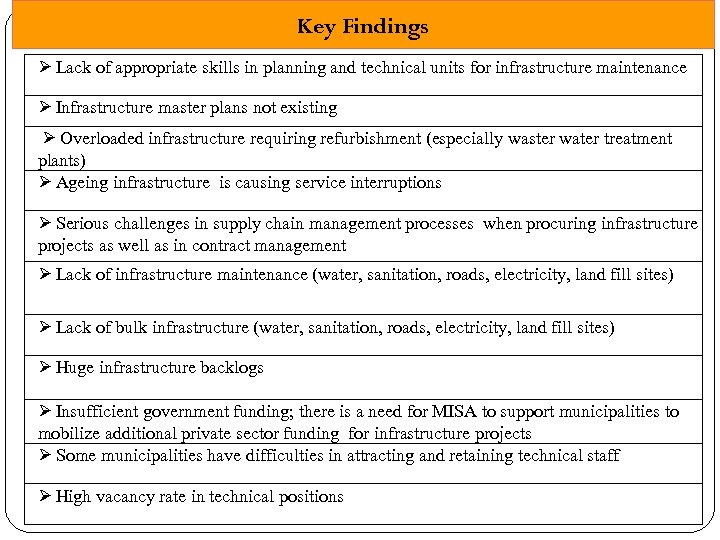 Key Findings Ø Lack of appropriate skills in planning and technical units for infrastructure maintenance Ø Infrastructure master plans not existing Ø Overloaded infrastructure requiring refurbishment (especially waster water treatment plants) Ø Ageing infrastructure is causing service interruptions Ø Serious challenges in supply chain management processes when procuring infrastructure projects as well as in contract management Ø Lack of infrastructure maintenance (water, sanitation, roads, electricity, land fill sites) Ø Lack of bulk infrastructure (water, sanitation, roads, electricity, land fill sites) Ø Huge infrastructure backlogs Ø Insufficient government funding; there is a need for MISA to support municipalities to mobilize additional private sector funding for infrastructure projects Ø Some municipalities have difficulties in attracting and retaining technical staff Ø High vacancy rate in technical positions
 Lessons Learnt There is a need for a central and effective coordination of support for the programme to succeed. Multi-year planning is a key instrument for infrastructure delivery MISA’s programmes must focus on the sustainability of the infrastructure and the municipality. All MISA’s interventions must recognize the central role of skills development and capacity building All MISA’s support programmes must have clear deliverables and milestones and there must be consequences for non-delivery. 13
 Interim Arrangements MISA is currently staffed on short-term transferees and employees of the DBSA with contracts ending by the end of September 2012 except for the Acting CEO who is directly appointed employee of MISA and two senior officials who are seconded from COGTA; Included in the DBSA transferees is 81 technical experts in the fields of engineering and planning; This was so with a view of allowing MISA to finalize its organizational development as well as operational policies; All this has been accomplished and full implementation is targeted for the 7 th of September 2012; The 2012 Medium Term Expenditure Framework provides a total amount of R 613 million for the Municipal Infrastructure Support Agent, distributed as follows: - R 197 million (2012/13), R 202 million (13/14), R 214 million (14/15) 14
 Conclusion In light of the many challenges facing local government relating to infrastructure and service delivery, we believe that sustainable turnaround of our municipalities requires effective coordination, intensive support and alignment of efforts by all stakeholders. MISA is designed as the mechanism to facilitate this. 15
 THANK YOU!!! 16