 Скачать презентацию Municipal budget educational institution Secondary School with advanced
Радиационный фон.ppt
- Количество слайдов: 40



Municipal budget educational institution Secondary School with advanced study of specific subjects № 29 Georgievsk Environmental project • Topic: "Investigation of Georgievsk and CMW • Fulfilled: a student 10 Form "A" Velykanova Daria • Supervisor: • Tatiana Simonova 2013 г
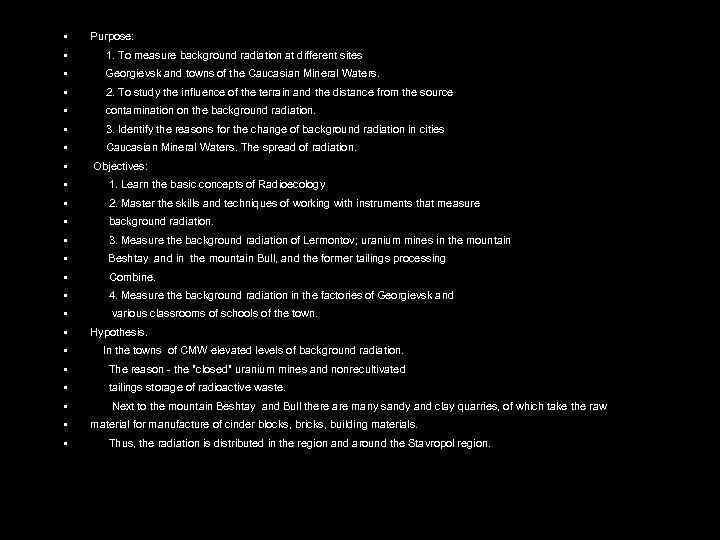
• Purpose: • 1. To measure background radiation at different sites • Georgievsk and towns of the Caucasian Mineral Waters. • 2. To study the influence of the terrain and the distance from the source • contamination on the background radiation. • 3. Identify the reasons for the change of background radiation in cities • Caucasian Mineral Waters. The spread of radiation. • Objectives: • 1. Learn the basic concepts of Radioecology • 2. Master the skills and techniques of working with instruments that measure • background radiation. • 3. Measure the background radiation of Lermontov; uranium mines in the mountain • Beshtay and in the mountain Bull, and the former tailings processing • Combine. • 4. Measure the background radiation in the factories of Georgievsk and • various classrooms of schools of the town. • Hypothesis. • In the towns of CMW elevated levels of background radiation. • The reason - the "closed" uranium mines and nonrecultivated • tailings storage of radioactive waste. • Next to the mountain Beshtay and Bull there are many sandy and clay quarries, of which take the raw • material for manufacture of cinder blocks, bricks, building materials. • Thus, the radiation is distributed in the region and around the Stavropol region.
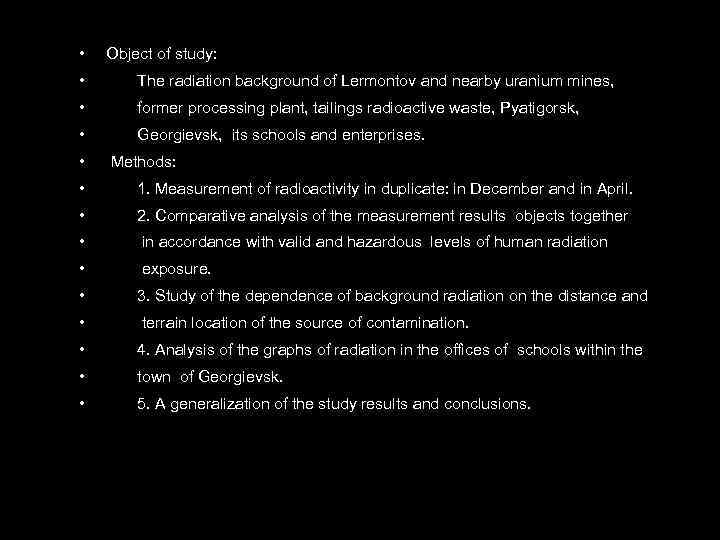
• Object of study: • The radiation background of Lermontov and nearby uranium mines, • former processing plant, tailings radioactive waste, Pyatigorsk, • Georgievsk, its schools and enterprises. • Methods: • 1. Measurement of radioactivity in duplicate: in December and in April. • 2. Comparative analysis of the measurement results objects together • in accordance with valid and hazardous levels of human radiation • exposure. • 3. Study of the dependence of background radiation on the distance and • terrain location of the source of contamination. • 4. Analysis of the graphs of radiation in the offices of schools within the • town of Georgievsk. • 5. A generalization of the study results and conclusions.
The relevance of the work • The region Caucasian Mineral Waters has the status of federal resort. From a speech at a • meeting of the Governor A. L. Chernogorov at the commission for the improvement of the socio- • economic provisions of the SFD (Moscow 23. 10. 2006. ) • "Many times we raised the problem of urgent measures to ensure radiation safety • in the Caucasus Mineral Waters, specially protected eco-resort region of the Russian • Federation, namely: - to maintain a safe the state of conservation of the former • uranium production; • - Recultivation of tailings radioactive waste, rehabilitation of the mine № 1 on the • mountain Beshtay, and the mine № 2 on the mountain bull (at least 30 million) "
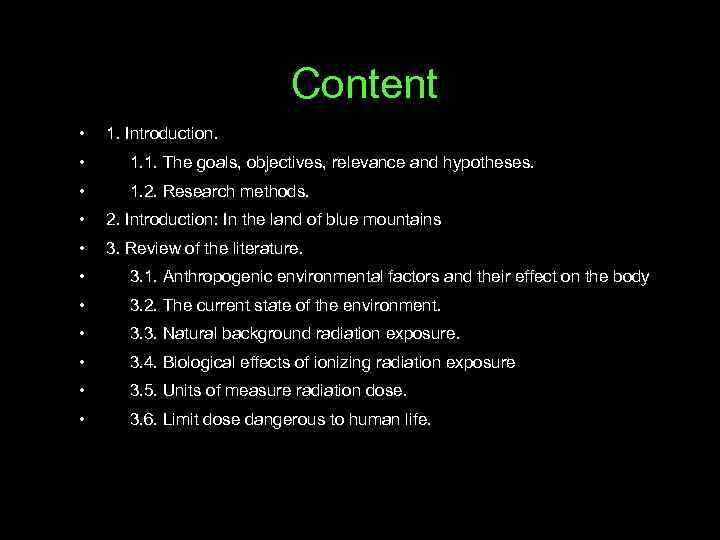
Content • 1. Introduction. • 1. 1. The goals, objectives, relevance and hypotheses. • 1. 2. Research methods. • 2. Introduction: In the land of blue mountains • 3. Review of the literature. • 3. 1. Anthropogenic environmental factors and their effect on the body • 3. 2. The current state of the environment. • 3. 3. Natural background radiation exposure. • 3. 4. Biological effects of ionizing radiation exposure • 3. 5. Units of measure radiation dose. • 3. 6. Limit dose dangerous to human life.
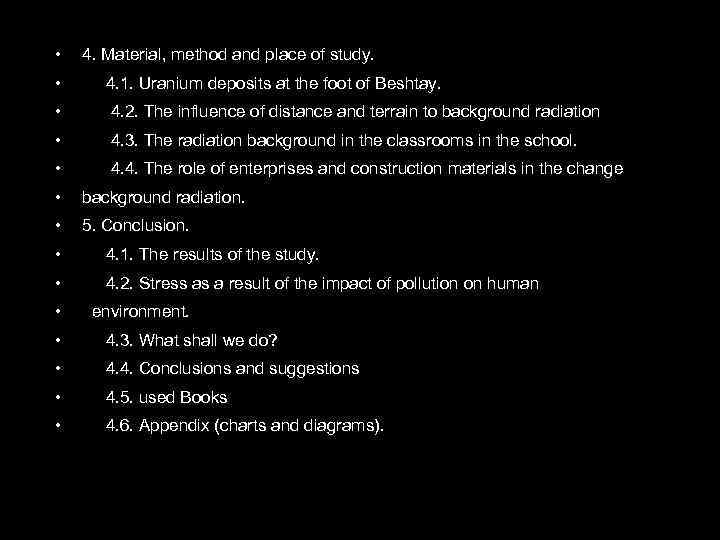
• 4. Material, method and place of study. • 4. 1. Uranium deposits at the foot of Beshtay. • 4. 2. The influence of distance and terrain to background radiation • 4. 3. The radiation background in the classrooms in the school. • 4. 4. The role of enterprises and construction materials in the change • background radiation. • 5. Conclusion. • 4. 1. The results of the study. • 4. 2. Stress as a result of the impact of pollution on human • environment. • 4. 3. What shall we do? • 4. 4. Conclusions and suggestions • 4. 5. used Books • 4. 6. Appendix (charts and diagrams).
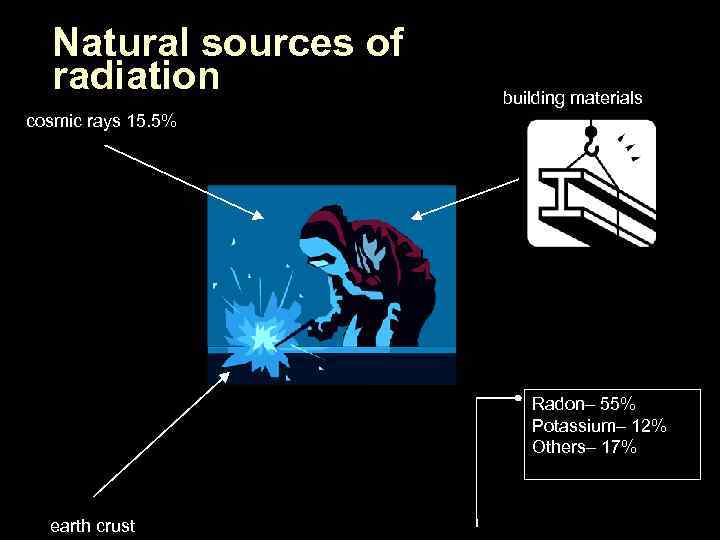
Natural sources of radiation building materials cosmic rays 15. 5% Radon– 55% Potassium– 12% Others– 17% earth crust
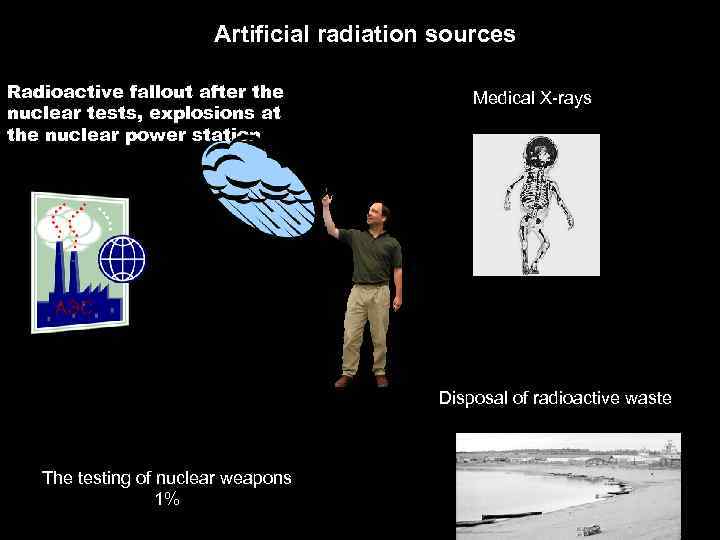
Artificial radiation sources Radioactive fallout after the nuclear tests, explosions at the nuclear power station Medical X-rays АЭС Disposal of radioactive waste The testing of nuclear weapons 1%
The main task of of the project -To measure background radiation -To study the influence on it of the terrain and the distance from the source of contamination
n n n n n The material for this research was collected from April 2010 to January 2013, in the towns of C. M. W. by the student of school № 29 of the town Georgievsk Velikanova Daria. While working some methods were used: Measurement of background radiation with a power meter dose (rentgenmetr) DP-5 V in units of mr / h, the scale is designed to 5 mr / h in 2 repeated measurements. At each point in the study were five-time measurement. Comparative analysis, the study of objects among themselves and in relation to the acceptable and dangerous levels of human exposure. The maximum permissible dose for people in the villages is 5 m 3 v/year (or 0. 5 rem year). For those work is directly related to these sources of radiation dose is much higher, ie, 50 m 3 v/year (5 rem / year) (SV Alekseev "Ecology" S. -P. 2000) Conversion of units. 1000 m 3 v =13 v = 1 Gy = 100 R.
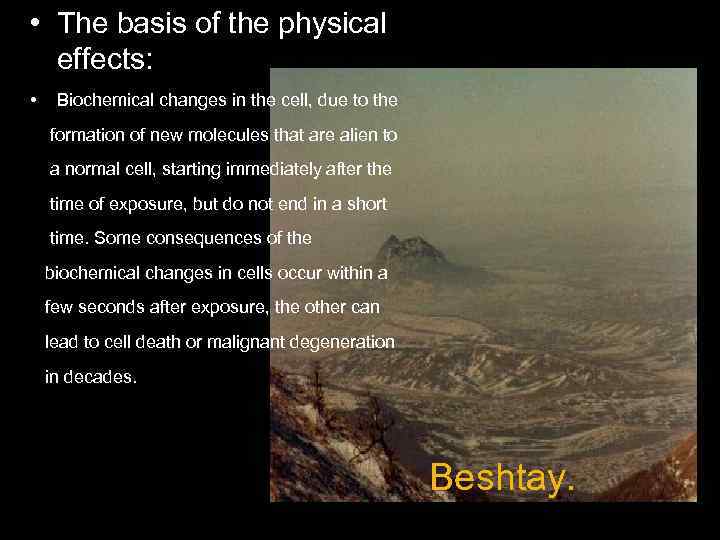
• The basis of the physical effects: • Biochemical changes in the cell, due to the formation of new molecules that are alien to a normal cell, starting immediately after the time of exposure, but do not end in a short time. Some consequences of the biochemical changes in cells occur within a few seconds after exposure, the other can lead to cell death or malignant degeneration in decades. Beshtay.
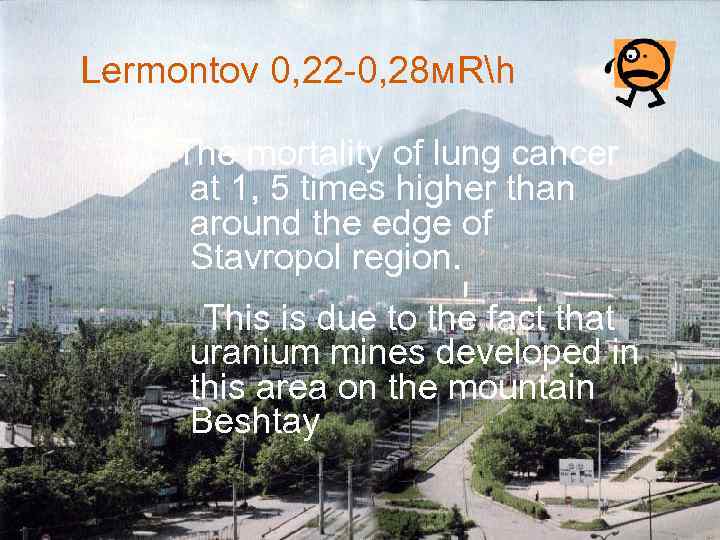
Lermontov 0, 22 -0, 28 м. Rh The mortality of lung cancer at 1, 5 times higher than around the edge of Stavropol region. This is due to the fact that uranium mines developed in this area on the mountain Beshtay
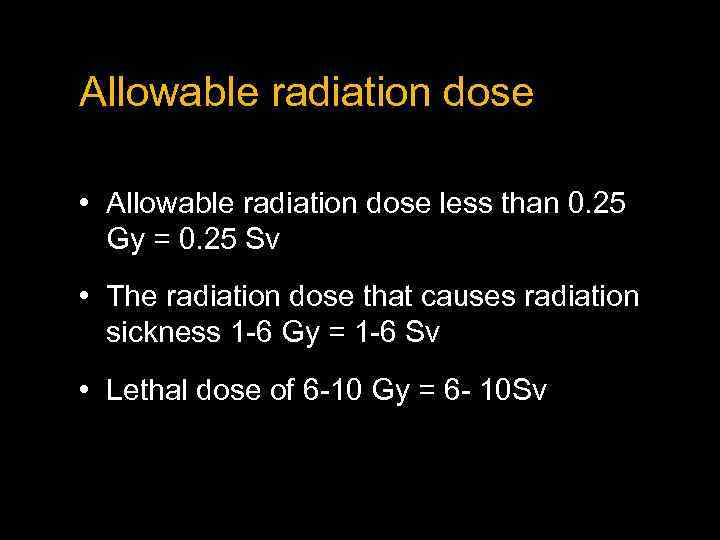
Allowable radiation dose • Allowable radiation dose less than 0. 25 Gy = 0. 25 Sv • The radiation dose that causes radiation sickness 1 -6 Gy = 1 -6 Sv • Lethal dose of 6 -10 Gy = 6 - 10 Sv
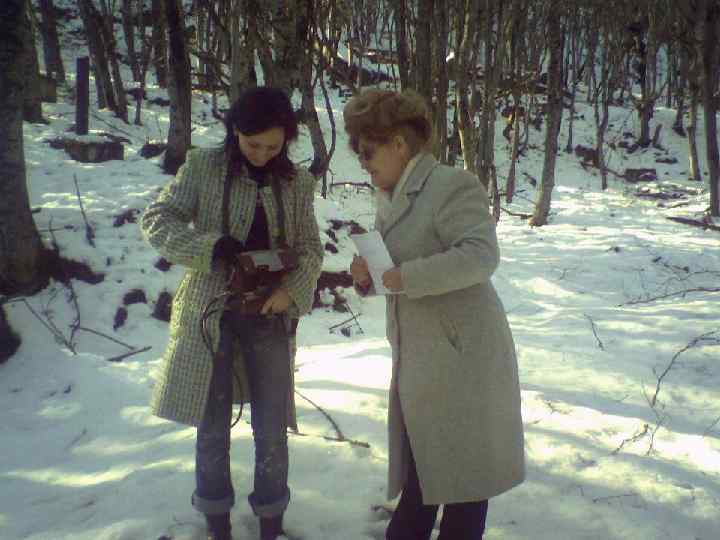
• Our research has shown that the mine entrance number 1 is closed, but no one is protected, and you can always get into the mine. • Indications of roentgenometr (0. 25, 0. 3, 0. 25, 0. 27). The average value of 0. 254 m. R / h.
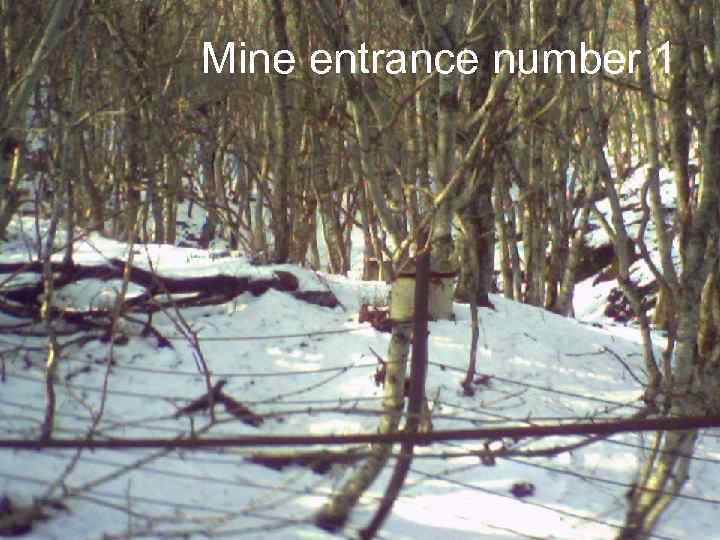
Mine entrance number 1
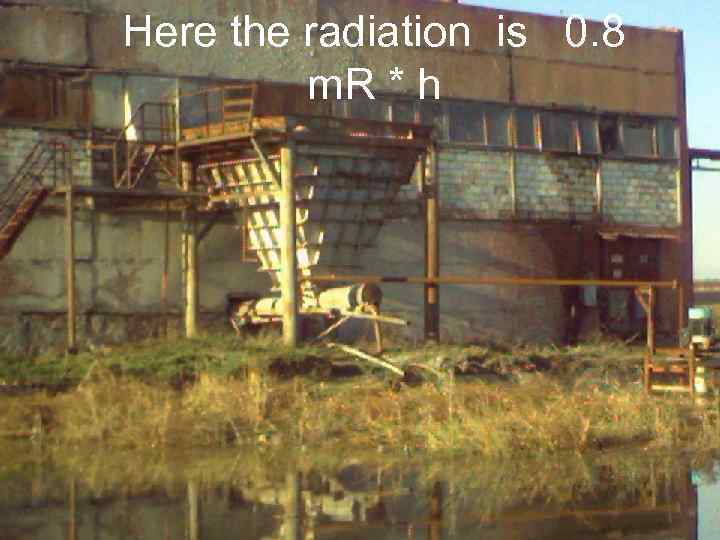
Here the radiation is 0. 8 m. R * h
This former car wash, where wash their cars after uranium ore. It would seem that septic tanks do not work for a long time, but in the near sump average reading of 0. 26 m. R / h, and at the far (0. 75, 0. 72, 0. 8, 0. 75). The average value of 0. 744 m. R / h These rates are many times higher than the average background in Europe 0. 1 m. R / hr and permissible sanitary norms adopted in the Northern Caucasus 0. 6 m. R / h. But the workers are working near it. We are sure that they are not paid for the harm and they have no work experience of grace.
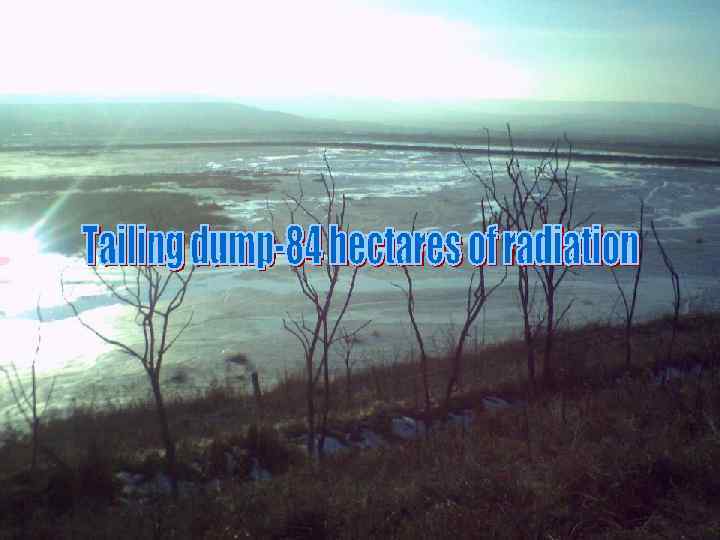
Tailing dump is 3 huge black lakes, which waste dumps went to hydrometallurgical plant. Their area is 84 hectares, they left all the radium, polonium-250, lead-206, solid radioactive waste.
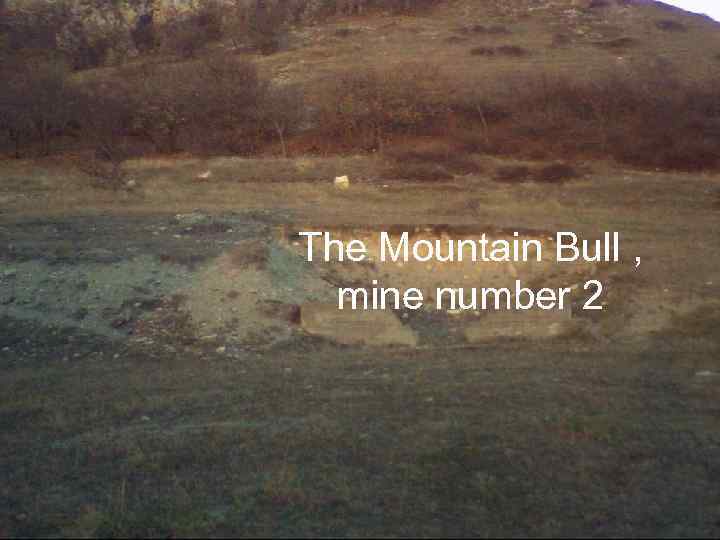
The Mountain Bull , mine number 2
• The aim of our research in this area is mine number 2 on the Mount Taurus. • The mine is not protected and vent pipe can be seen everywhere. Rentgenmetr showed up to 0. 4 m. R / h
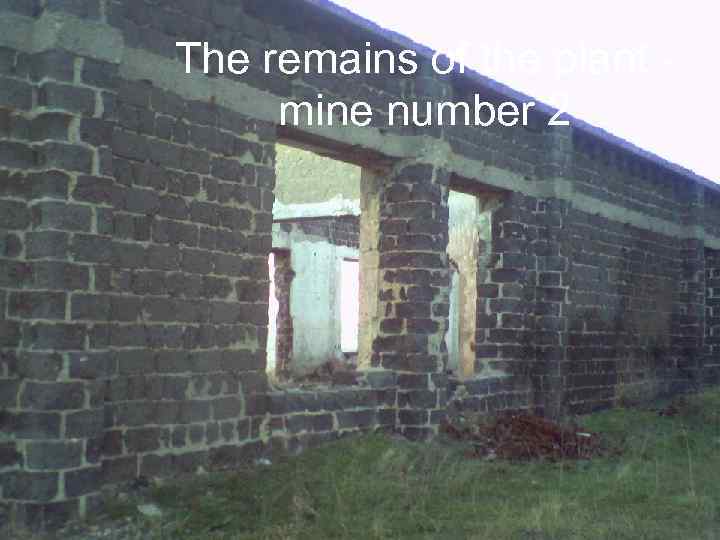
The remains of the plant mine number 2
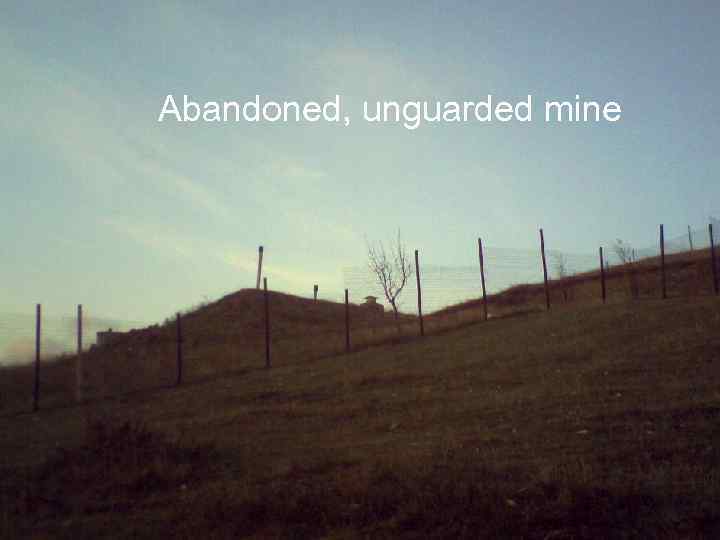
Abandoned, unguarded mine
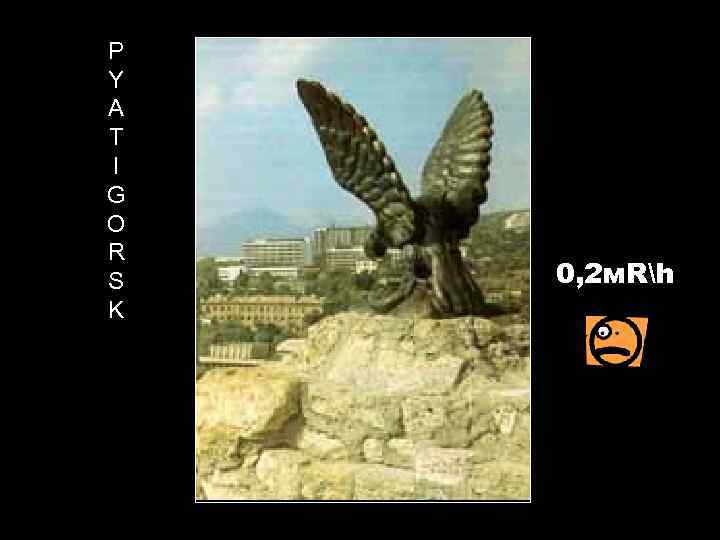
P Y A T I G O R S K 0, 2 м. Rh
u. Pyatigorsk
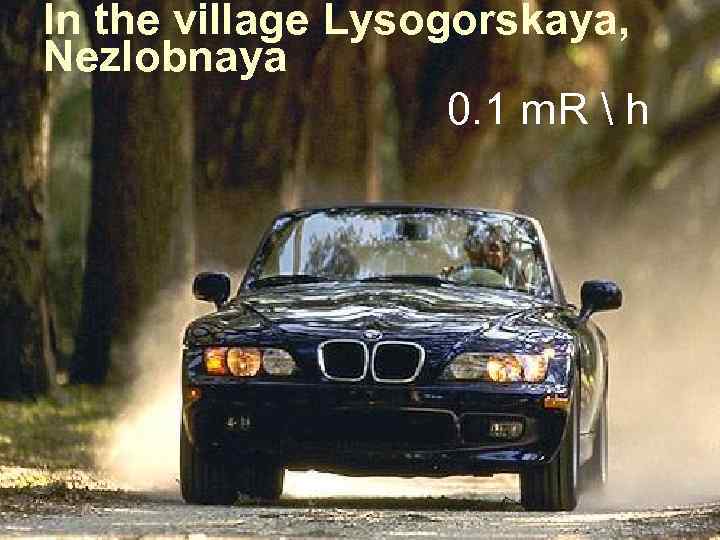
In the village Lysogorskaya, Nezlobnaya 0. 1 m. R h
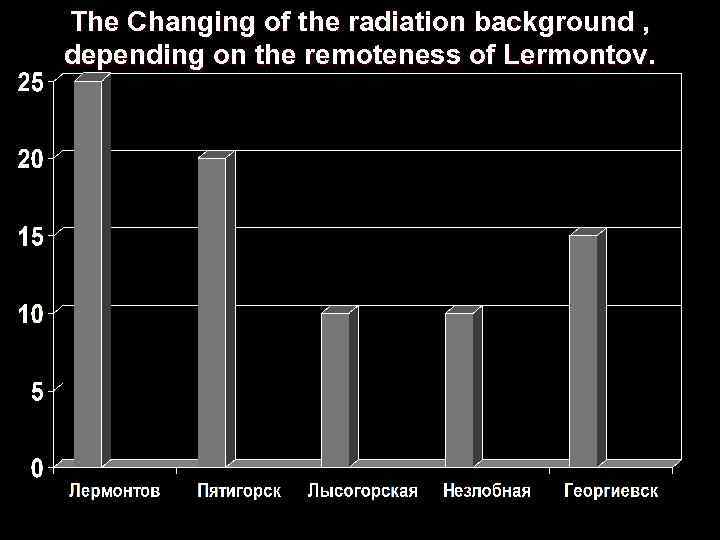
The Changing of the radiation background , depending on the remoteness of Lermontov.

G E O R G I E V S K 0, 15 м. Rh
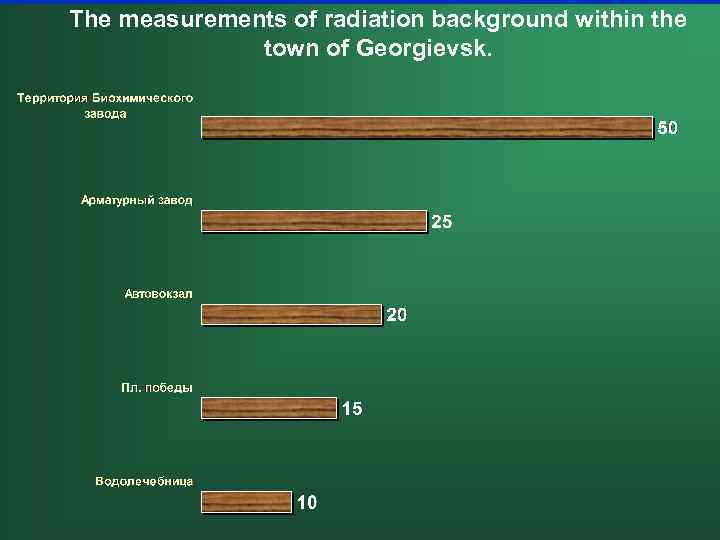
The measurements of radiation background within the town of Georgievsk.

Schools of the town Georgievsk № 1 № 29
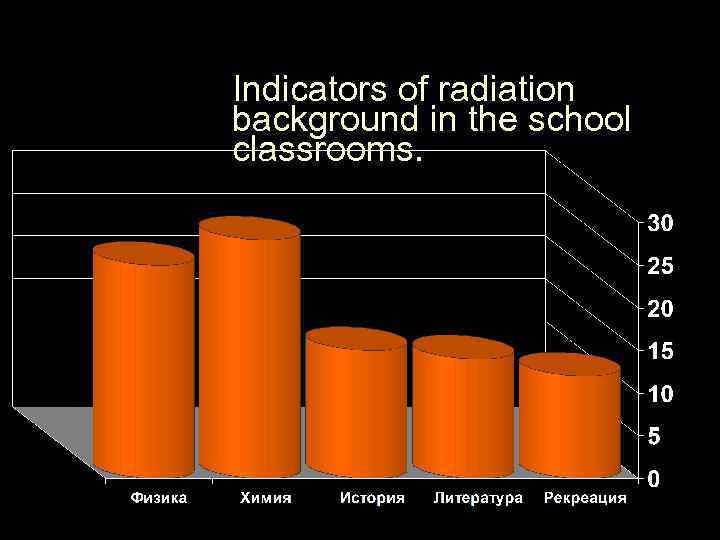
Indicators of radiation background in the school classrooms.

Proposals n 1 To apply ventilation systems for reducing concentration of radon indoors. n 2. To do wet cleaning and ventilate the classrooms at schools, especially in physics and chemistry. n
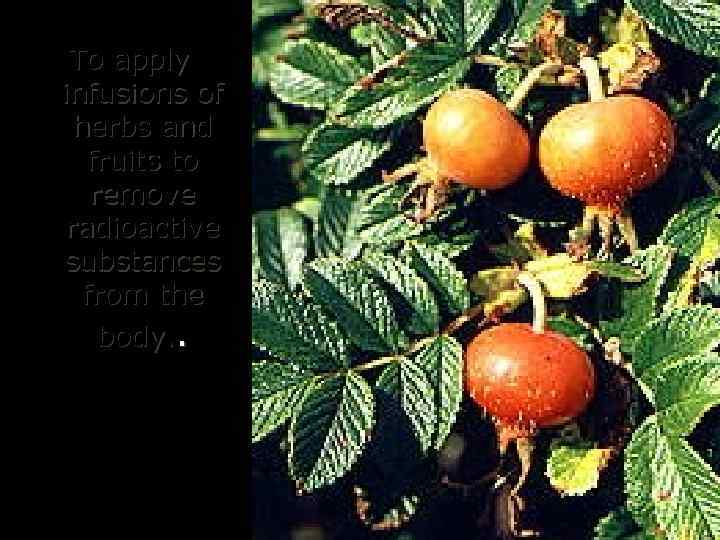
To apply infusions of herbs and fruits to remove radioactive substances from the body. .
Results and conclusions n n Results of the study were sent to the Governor of the Stavropol region Chernogorov A. L. and deputy of the State Duma Ishchenko A. A. The question is rising at the level of the State Duma of Stavropol region, and at the meeting of the commission on improving the socio-economic situation in the Southern Federal District under the President of Russia.

Literature n n n n Kislovodsk. Photo album. M. Planet 1982 Pyatigorsk. Photo album. Planet M. 1986. Red Book of the Stavropol region. Stavropol. Polygraph servis. 2002 g. Panpipes. Magazine. № March 1999, № 10 2000, № December 2001 Selegey P. E. In the land of blue mountains. album Gubareva L. I. Environmental stress. Spb. : Publishing “Lan", Stavropolservisshkola, 2001. Aghajanyan N. A, Torshin VI The Ecology of man. M. : Krug. 1994 Zalikhanov M. C. H. Environmental problems. What's going on, who's to blame and what to do. M. MNEPU. 1997 AV Baranov The problems of human ecology. M. Nauka. 1986 Baturin VA, Karagaltsev VI, LV Nelupeiko Environmental pollution of Stavropol. Bushtueva K. A, Sluchaiko I. S. Methods and criteria for evaluating the health status of the population due to pollution of the environment. M. Meditsina. 1979 Environmental Passport Stavropol. 1995 Hasanov NN The study of fatigue among students of classes 8. 9 when working with computers. Proc. 4 All Union conference. 1990
Скачать презентацию Municipal budget educational institution Secondary School with advanced
Радиационный фон.ppt