


 Скачать презентацию Multivariate Data Analysis with TMVA Andreas Hoecker CERN
c51b094c11ac98d9209a28d58e8daf4d.ppt
- Количество слайдов: 67
 Multivariate Data Analysis with TMVA Andreas Hoecker(*) (CERN) Seminar at Edinburgh, Scotland, Dec 5, 2008 (*) On behalf of the present core developer team: A. Hoecker, P. Speckmayer, J. Stelzer, H. Voss And the contributors: Tancredi Carli (CERN, Switzerland), Asen Christov (Universität Freiburg, Germany), Krzysztof Danielowski (IFJ and AGH/UJ, Krakow, Poland), Dominik Dannheim (CERN, Switzerland), Sophie Henrot-Versille (LAL Orsay, France), Matthew Jachowski (Stanford University, USA), Kamil Kraszewski (IFJ and AGH/UJ, Krakow, Poland), Attila Krasznahorkay Jr. (CERN, Switzerland, and Manchester U. , UK), Maciej Kruk (IFJ and AGH/UJ, Krakow, Poland), Yair Mahalalel (Tel Aviv University, Israel), Rustem Ospanov (University of Texas, USA), Xavier Prudent (LAPP Annecy, France), Arnaud Robert (LPNHE Paris, France), Doug Schouten (S. Fraser University, Canada), Fredrik Tegenfeldt (Iowa University, USA, until Aug 2007), Jan Therhaag (Universität Bonn, Germany), Alexander Voigt (CERN, Switzerland), Kai Voss (University of Victoria, Canada), Marcin Wolter (IFJ PAN Krakow, Poland), Andrzej Zemla (IFJ PAN Krakow, Poland). See acknowledgments on page 43 On the web: http: //tmva. sf. net/ (home), https: //twiki. cern. ch/twiki/bin/view/TMVA/Web. Home (tutorial)
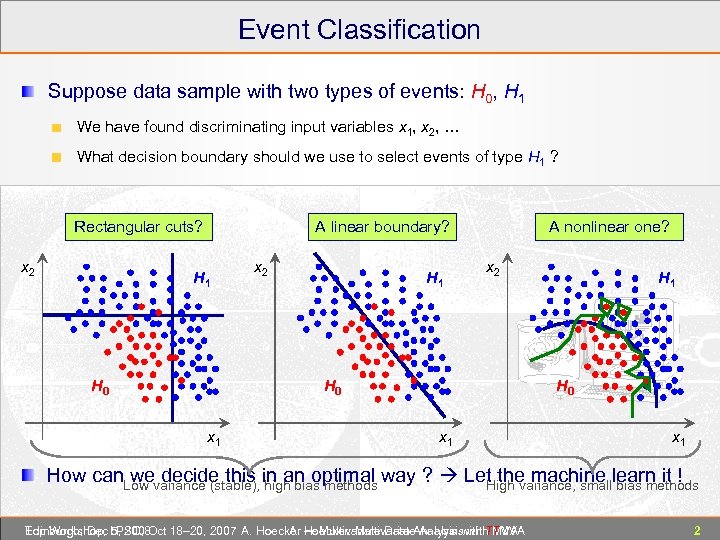 Event Classification Suppose data sample with two types of events: H 0, H 1 We have found discriminating input variables x 1, x 2, … What decision boundary should we use to select events of type H 1 ? Rectangular cuts? x 2 A linear boundary? H 1 H 0 x 2 H 1 A nonlinear one? x 2 H 0 x 1 How can we decide this in an optimal way ? Let the machine learn it ! Low variance (stable), high bias methods High variance, small bias methods Edinburgh, Dec 5, 2008 Top Workshop, LPSC, Oct 18– 20, 2007 A. Hoecker ― Multivariate Data Analysis with TMVA A. Hoecker: Multivariate Analysis with TMVA 2
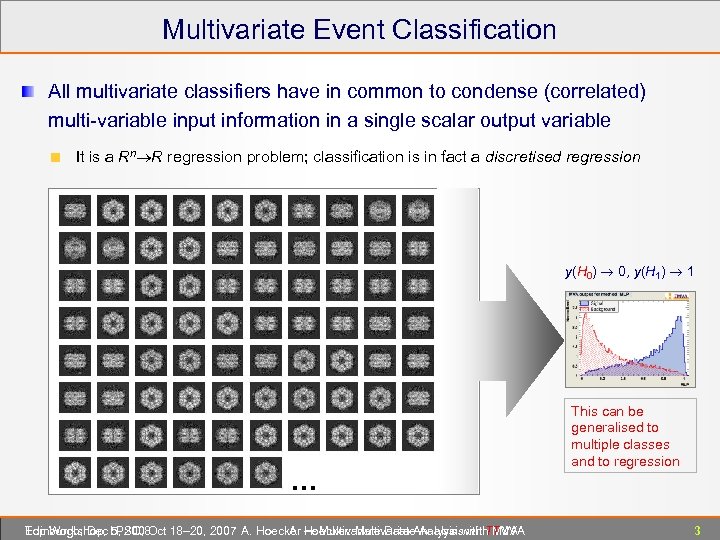 Multivariate Event Classification All multivariate classifiers have in common to condense (correlated) multi-variable input information in a single scalar output variable It is a Rn R regression problem; classification is in fact a discretised regression y(H 0) 0, y(H 1) 1 … Edinburgh, Dec 5, 2008 Top Workshop, LPSC, Oct 18– 20, 2007 A. Hoecker ― Multivariate Data Analysis with TMVA A. Hoecker: Multivariate Analysis with TMVA This can be generalised to multiple classes and to regression 3
 T M V A Outline of this presentation: The TMVA project Overview of available classifiers and processing steps Evaluation tools (Toy) examples Edinburgh, Dec 5, 2008 Top Workshop, LPSC, Oct 18– 20, 2007 A. Hoecker ― Multivariate Data Analysis with TMVA A. Hoecker: Multivariate Analysis with TMVA 4
 What is TMVA ROOT: is the analysis framework used by most (HEP)-physicists Idea: rather than just implementing new MVA techniques and making them available in ROOT (i. e. , like TMulit. Layer. Percetron does): Have one common platform / interface for high-end multivariate classifiers Have common data pre-processing capabilities Train and test all classifiers on same data sample and evaluate consistently Provide common analysis (ROOT scripts) and application framework Provide access with and without ROOT, through macros, C++ executables or python Edinburgh, Dec 5, 2008 Top Workshop, LPSC, Oct 18– 20, 2007 A. Hoecker ― Multivariate Data Analysis with TMVA A. Hoecker: Multivariate Analysis with TMVA 5
 TMVA Development and Distribution TMVA is a sourceforge (SF) package for world-wide access Home page ………………. http: //tmva. sf. net/ SF project page …………. http: //sf. net/projects/tmva View CVS …………………http: //tmva. cvs. sf. net/tmva/TMVA/ Mailing list. ………………. . http: //sf. net/mail/? group_id=152074 Tutorial TWiki ……………. https: //twiki. cern. ch/twiki/bin/view/TMVA/Web. Home Active project fast response time on feature requests Currently 4 core developers, and 25 contributors >3500 downloads since March 2006 (not accounting CVS checkouts and ROOT users) Written in C++, relying on core ROOT functionality Integrated and distributed with ROOT since ROOT v 5. 11/03 Edinburgh, Dec 5, 2008 Top Workshop, LPSC, Oct 18– 20, 2007 A. Hoecker ― Multivariate Data Analysis with TMVA A. Hoecker: Multivariate Analysis with TMVA 6
 Limitations of TMVA Development started beginning of 2006 – a mature but not a final package Known limitations / missing features Performs classification only, and only in binary mode: signal versus background Supervised learning only (no unsupervised “bump hunting”) Relatively stiff design – not easy to mix methods, not easy to setup categories Cross-validation not yet generalised for use by all classifiers Optimisation of classifier architectures still requires tuning “by hand” Work ongoing in most of these areas see outlook to TMVA 4 Edinburgh, Dec 5, 2008 Top Workshop, LPSC, Oct 18– 20, 2007 A. Hoecker ― Multivariate Data Analysis with TMVA A. Hoecker: Multivariate Analysis with TMVA 7
 T M V A C o n t e n t Currently implemented classifiers – Rectangular cut optimisation – Projective and multidimensional likelihood estimator – k-Nearest Neighbor algorithm – Fisher and H-Matrix discriminants – Function discriminant – Artificial neural networks (3 multilayer perceptron implementations) – Boosted/bagged decision trees – Rule. Fit – Support Vector Machine Currently implemented data preprocessing stages: – Decorrelation – Principal Value Decomposition – Transformation to uniform and Gaussian distributions Edinburgh, Dec 5, 2008 Top Workshop, LPSC, Oct 18– 20, 2007 A. Hoecker ― Multivariate Data Analysis with TMVA A. Hoecker: Multivariate Analysis with TMVA 8
 D a t a P r e p r o c e s s i n g Edinburgh, Dec 5, 2008 Top Workshop, LPSC, Oct 18– 20, 2007 A. Hoecker ― Multivariate Data Analysis with TMVA A. Hoecker: Multivariate Analysis with TMVA 9
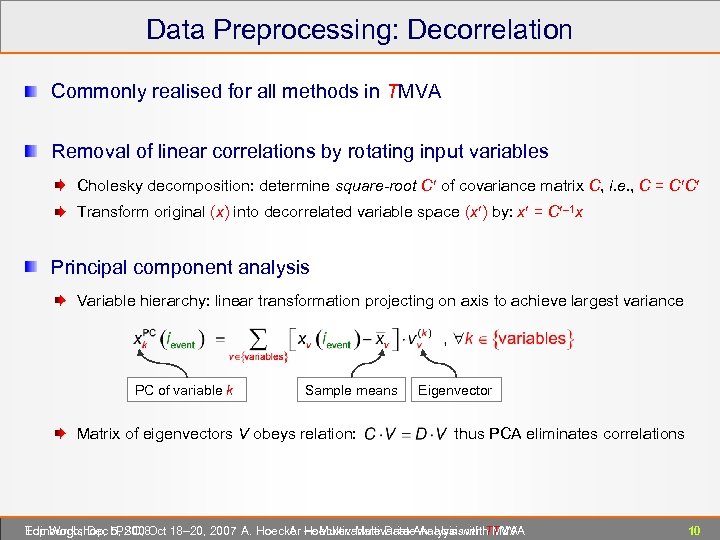 Data Preprocessing: Decorrelation Commonly realised for all methods in TMVA Removal of linear correlations by rotating input variables Cholesky decomposition: determine square-root C of covariance matrix C, i. e. , C = C C Transform original (x) into decorrelated variable space (x ) by: x = C 1 x Principal component analysis Variable hierarchy: linear transformation projecting on axis to achieve largest variance PC of variable k Sample means Eigenvector Matrix of eigenvectors V obeys relation: thus PCA eliminates correlations Edinburgh, Dec 5, 2008 Top Workshop, LPSC, Oct 18– 20, 2007 A. Hoecker ― Multivariate Data Analysis with TMVA A. Hoecker: Multivariate Analysis with TMVA 10
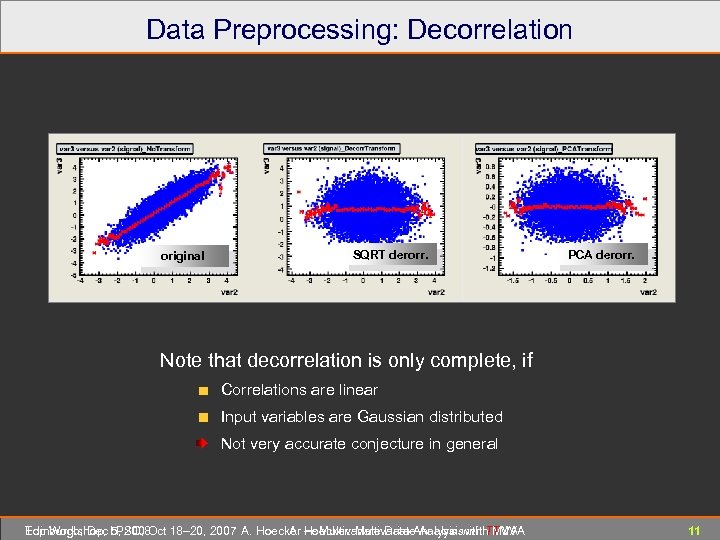 Data Preprocessing: Decorrelation original SQRT derorr. PCA derorr. Note that decorrelation is only complete, if Correlations are linear Input variables are Gaussian distributed Not very accurate conjecture in general Edinburgh, Dec 5, 2008 Top Workshop, LPSC, Oct 18– 20, 2007 A. Hoecker ― Multivariate Data Analysis with TMVA A. Hoecker: Multivariate Analysis with TMVA 11
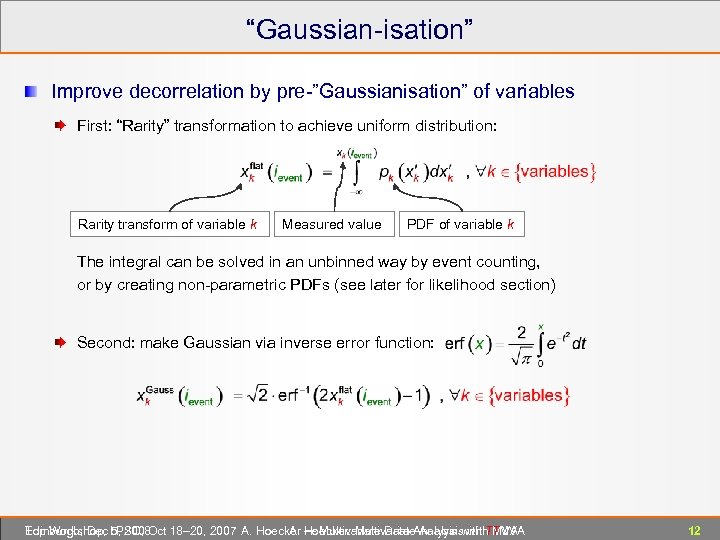 “Gaussian-isation” Improve decorrelation by pre-”Gaussianisation” of variables First: “Rarity” transformation to achieve uniform distribution: Rarity transform of variable k Measured value PDF of variable k The integral can be solved in an unbinned way by event counting, or by creating non-parametric PDFs (see later for likelihood section) Second: make Gaussian via inverse error function: Edinburgh, Dec 5, 2008 Top Workshop, LPSC, Oct 18– 20, 2007 A. Hoecker ― Multivariate Data Analysis with TMVA A. Hoecker: Multivariate Analysis with TMVA 12
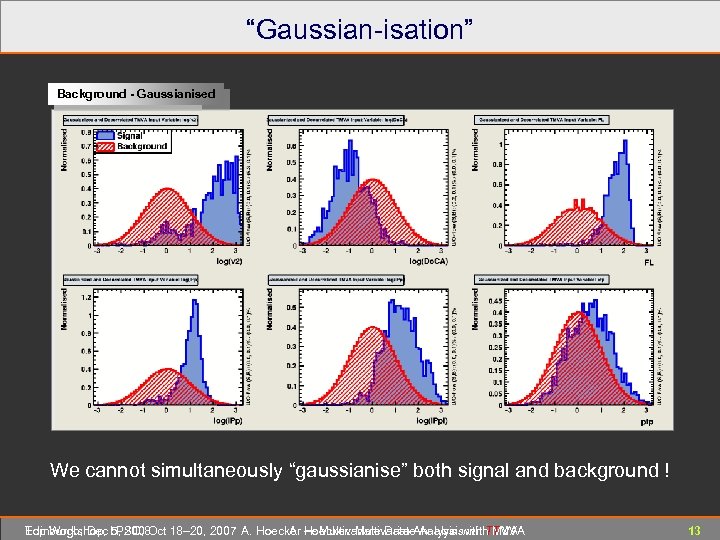 “Gaussian-isation” Background - Gaussianised Signal - Gaussianised Original We cannot simultaneously “gaussianise” both signal and background ! Edinburgh, Dec 5, 2008 Top Workshop, LPSC, Oct 18– 20, 2007 A. Hoecker ― Multivariate Data Analysis with TMVA A. Hoecker: Multivariate Analysis with TMVA 13
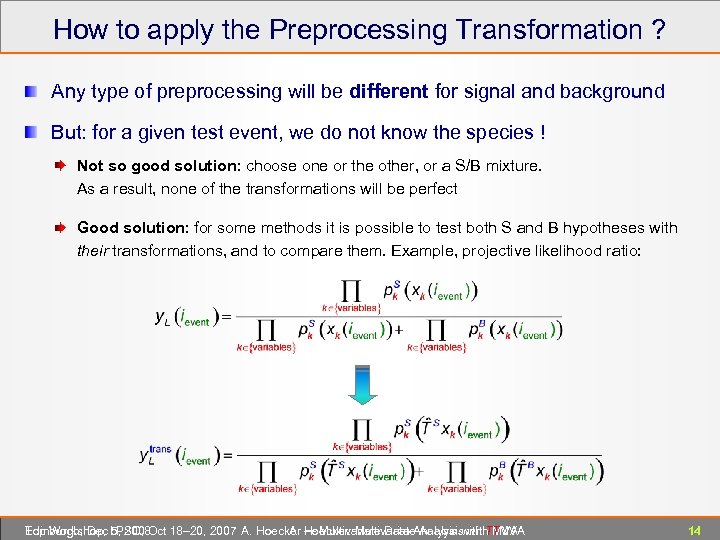 How to apply the Preprocessing Transformation ? Any type of preprocessing will be different for signal and background But: for a given test event, we do not know the species ! Not so good solution: choose one or the other, or a S/B mixture. As a result, none of the transformations will be perfect Good solution: for some methods it is possible to test both S and B hypotheses with their transformations, and to compare them. Example, projective likelihood ratio: Edinburgh, Dec 5, 2008 Top Workshop, LPSC, Oct 18– 20, 2007 A. Hoecker ― Multivariate Data Analysis with TMVA A. Hoecker: Multivariate Analysis with TMVA 14
 T h e C l a s s i f i e r s Edinburgh, Dec 5, 2008 Top Workshop, LPSC, Oct 18– 20, 2007 A. Hoecker ― Multivariate Data Analysis with TMVA A. Hoecker: Multivariate Analysis with TMVA 15
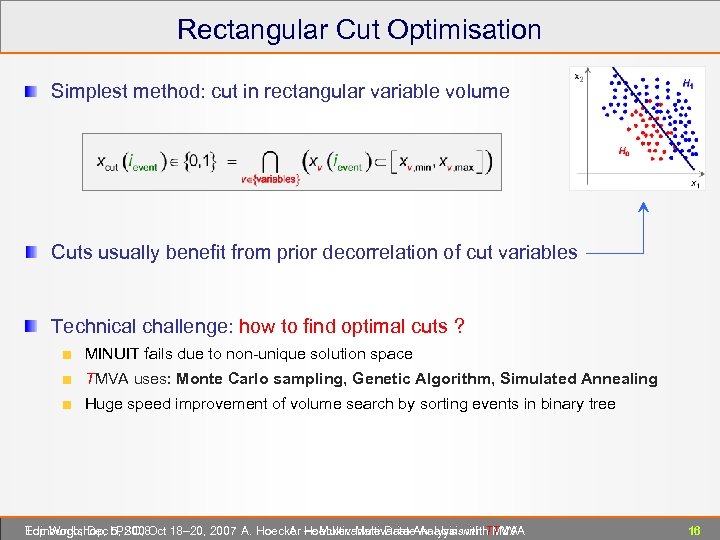 Rectangular Cut Optimisation Simplest method: cut in rectangular variable volume Cuts usually benefit from prior decorrelation of cut variables Technical challenge: how to find optimal cuts ? MINUIT fails due to non-unique solution space TMVA uses: Monte Carlo sampling, Genetic Algorithm, Simulated Annealing Huge speed improvement of volume search by sorting events in binary tree Edinburgh, Dec 5, 2008 Top Workshop, LPSC, Oct 18– 20, 2007 A. Hoecker ― Multivariate Data Analysis with TMVA A. Hoecker: Multivariate Analysis with TMVA 16
 digression Minimisation techniques in TMVA Binary tree sorting Edinburgh, Dec 5, 2008 Top Workshop, LPSC, Oct 18– 20, 2007 A. Hoecker ― Multivariate Data Analysis with TMVA A. Hoecker: Multivariate Analysis with TMVA ( 17
 Minimisation Robust global minimum finder needed at various places in TMVA Brute force method: Monte Carlo Sampling Sample entire solution space, and chose solution providing minimum estimator Good global minimum finder, but poor accuracy Default solution in HEP: (T)Minuit/Migrad [ How much longer do we need to suffer …. ? ] Gradient-driven search, using variable metric, can use quadratic Newton-type solution Poor global minimum finder, gets quickly stuck in presence of local minima Specific global optimisers implemented in TMVA: Genetic Algorithm: biology-inspired optimisation algorithm Simulated Annealing: slow “cooling” of system to avoid “freezing” in local solution TMVA allows to chain minimisers For example, one can use MC sampling to detect the vicinity of a global minimum, and then use Minuit to accurately converge to it. Edinburgh, Dec 5, 2008 Top Workshop, LPSC, Oct 18– 20, 2007 A. Hoecker ― Multivariate Data Analysis with TMVA A. Hoecker: Multivariate Analysis with TMVA 18
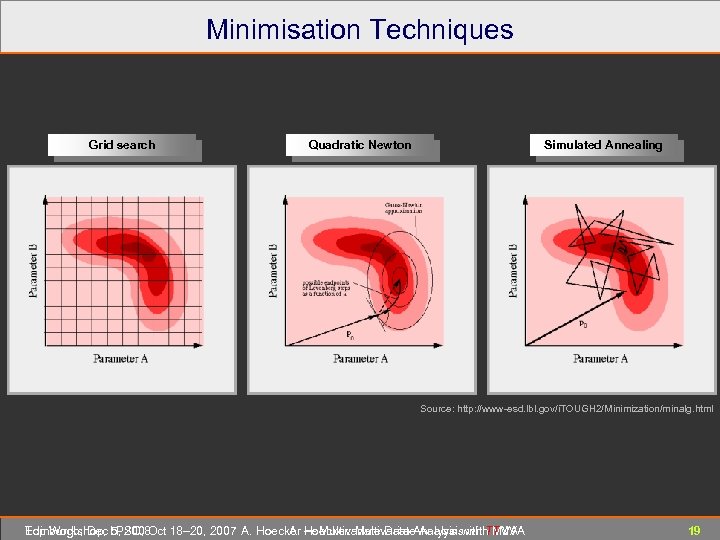 Minimisation Techniques Grid search Quadratic Newton Simulated Annealing Source: http: //www-esd. lbl. gov/i. TOUGH 2/Minimization/minalg. html Edinburgh, Dec 5, 2008 Top Workshop, LPSC, Oct 18– 20, 2007 A. Hoecker ― Multivariate Data Analysis with TMVA A. Hoecker: Multivariate Analysis with TMVA 19
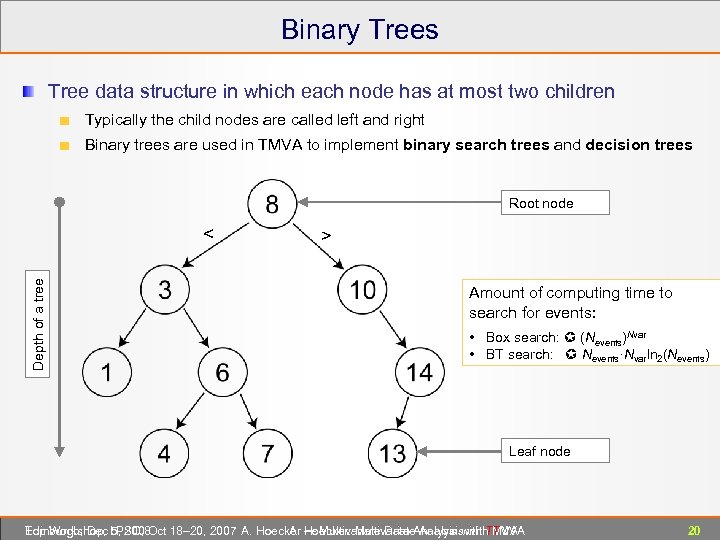 Binary Trees Tree data structure in which each node has at most two children Typically the child nodes are called left and right Binary trees are used in TMVA to implement binary search trees and decision trees Root node Depth of a tree < > Amount of computing time to search for events: • Box search: (Nevents)Nvar • BT search: Nevents·Nvarln 2(Nevents) Leaf node Edinburgh, Dec 5, 2008 Top Workshop, LPSC, Oct 18– 20, 2007 A. Hoecker ― Multivariate Data Analysis with TMVA A. Hoecker: Multivariate Analysis with TMVA 20
 ) Edinburgh, Dec 5, 2008 Top Workshop, LPSC, Oct 18– 20, 2007 A. Hoecker ― Multivariate Data Analysis with TMVA A. Hoecker: Multivariate Analysis with TMVA 21
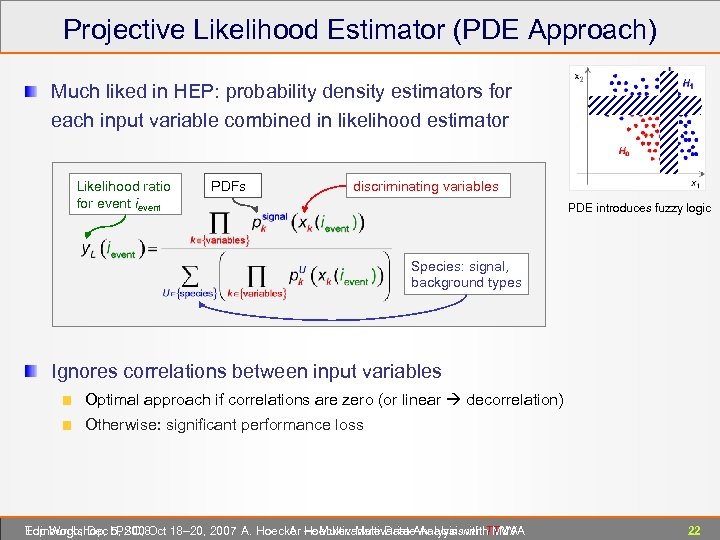 Projective Likelihood Estimator (PDE Approach) Much liked in HEP: probability density estimators for each input variable combined in likelihood estimator Likelihood ratio for event ievent PDFs discriminating variables PDE introduces fuzzy logic Species: signal, background types Ignores correlations between input variables Optimal approach if correlations are zero (or linear decorrelation) Otherwise: significant performance loss Edinburgh, Dec 5, 2008 Top Workshop, LPSC, Oct 18– 20, 2007 A. Hoecker ― Multivariate Data Analysis with TMVA A. Hoecker: Multivariate Analysis with TMVA 22
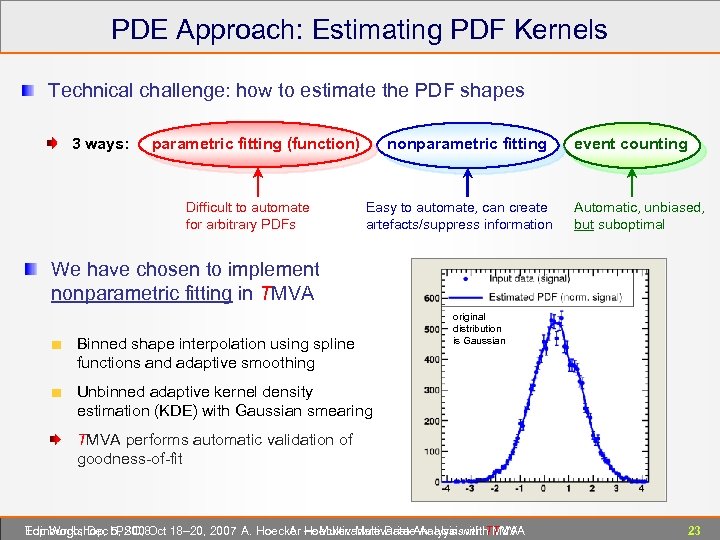 PDE Approach: Estimating PDF Kernels Technical challenge: how to estimate the PDF shapes 3 ways: parametric fitting (function) Difficult to automate for arbitrary PDFs nonparametric fitting Easy to automate, can create artefacts/suppress information event counting Automatic, unbiased, but suboptimal We have chosen to implement nonparametric fitting in TMVA Binned shape interpolation using spline functions and adaptive smoothing original distribution is Gaussian Unbinned adaptive kernel density estimation (KDE) with Gaussian smearing TMVA performs automatic validation of goodness-of-fit Edinburgh, Dec 5, 2008 Top Workshop, LPSC, Oct 18– 20, 2007 A. Hoecker ― Multivariate Data Analysis with TMVA A. Hoecker: Multivariate Analysis with TMVA 23
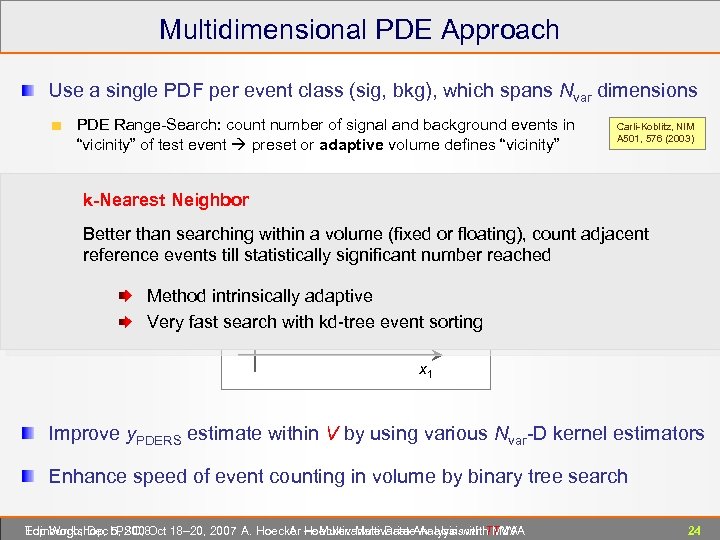 Multidimensional PDE Approach Use a single PDF per event class (sig, bkg), which spans Nvar dimensions PDE Range-Search: count number of signal and background events in “vicinity” of test event preset or adaptive volume defines “vicinity” x 2 k-Nearest Neighbor Carli-Koblitz, NIM A 501, 576 (2003) H 1 Better than searching within a volume (fixed or floating), count adjacent reference events till statistically significant number reached test event Method intrinsically adaptive H 0 Very fast search with kd-tree event sorting x 1 Improve y. PDERS estimate within V by using various Nvar-D kernel estimators Enhance speed of event counting in volume by binary tree search Edinburgh, Dec 5, 2008 Top Workshop, LPSC, Oct 18– 20, 2007 A. Hoecker ― Multivariate Data Analysis with TMVA A. Hoecker: Multivariate Analysis with TMVA 24
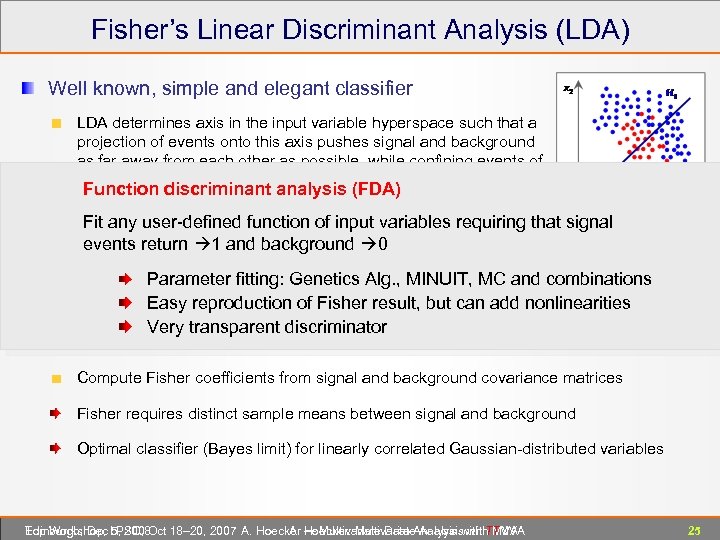 Fisher’s Linear Discriminant Analysis (LDA) Well known, simple and elegant classifier LDA determines axis in the input variable hyperspace such that a projection of events onto this axis pushes signal and background as far away from each other as possible, while confining events of same class in close vicinity to each other Function discriminant analysis (FDA) Fit any user-defined function of input variables requiring that signal Classifier response couldn’t be simpler: events return 1 and background 0 “Bias” “Fisher coefficients” Parameter fitting: Genetics Alg. , MINUIT, MC and combinations Easy reproduction of Fisher result, but can add nonlinearities Very transparent discriminator Compute Fisher coefficients from signal and background covariance matrices Fisher requires distinct sample means between signal and background Optimal classifier (Bayes limit) for linearly correlated Gaussian-distributed variables Edinburgh, Dec 5, 2008 Top Workshop, LPSC, Oct 18– 20, 2007 A. Hoecker ― Multivariate Data Analysis with TMVA A. Hoecker: Multivariate Analysis with TMVA 25
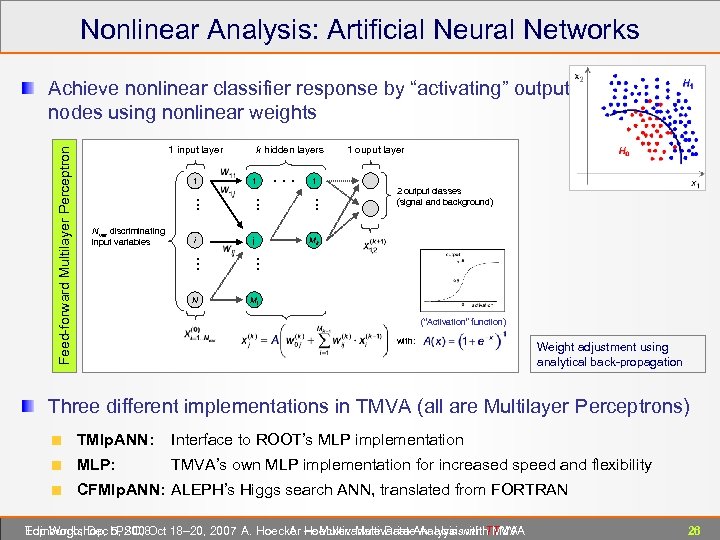 Nonlinear Analysis: Artificial Neural Networks Feed-forward Multilayer Perceptron Achieve nonlinear classifier response by “activating” output nodes using nonlinear weights 1 input layer 1 . . . Nvar discriminating input variables k hidden layers 1 . . . i j N . . . 1 ouput layer 1 . . . 2 output classes (signal and background) M 1 . . . Mk (“Activation” function) with: Weight adjustment using analytical back-propagation Three different implementations in TMVA (all are Multilayer Perceptrons) TMlp. ANN: Interface to ROOT’s MLP implementation MLP: TMVA’s own MLP implementation for increased speed and flexibility CFMlp. ANN: ALEPH’s Higgs search ANN, translated from FORTRAN Edinburgh, Dec 5, 2008 Top Workshop, LPSC, Oct 18– 20, 2007 A. Hoecker ― Multivariate Data Analysis with TMVA A. Hoecker: Multivariate Analysis with TMVA 26
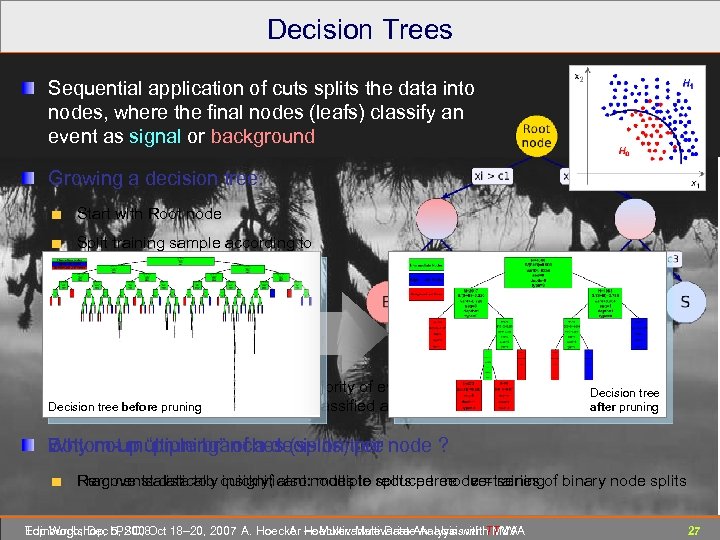 Decision Trees Sequential application of cuts splits the data into nodes, where the final nodes (leafs) classify an event as signal or background Growing a decision tree: Start with Root node Split training sample according to cut on best variable at this node Splitting criterion: e. g. , maximum “Gini-index”: purity (1– purity) Continue splitting until min. number of events or max. purity reached Classify leaf node according to majority of events, or give Decision tree before pruning weight; unknown test events are classified accordingly Decision tree after pruning Why not multiple branches (splits) per node ? Bottom-up “pruning” of a decision tree Fragments data too quickly; also: multiple splits per node = series of binary node splits Remove statistically insignificant nodes to reduce tree overtraining Edinburgh, Dec 5, 2008 Top Workshop, LPSC, Oct 18– 20, 2007 A. Hoecker ― Multivariate Data Analysis with TMVA A. Hoecker: Multivariate Analysis with TMVA 27
 Boosted Decision Trees (BDT) Data mining with decision trees is popular in science (so far mostly outside of HEP) Advantages: Independent of monotonous variable transformations, immune against outliers Weak variables are ignored (and don’t (much) deteriorate performance) Shortcomings: Instability: small changes in training sample can dramatically alter the tree structure Sensitivity to overtraining ( requires pruning) Boosted decision trees: combine forest of decision trees, with differently weighted events in each tree (trees can also be weighted), by majority vote e. g. , “Ada. Boost”: incorrectly classified events receive larger weight in next decision tree “Bagging” (instead of boosting): random event weights, resampling with replacement Boosting or bagging are means to create set of “basis functions”: the final classifier is linear combination (expansion) of these functions improves stability ! Edinburgh, Dec 5, 2008 Top Workshop, LPSC, Oct 18– 20, 2007 A. Hoecker ― Multivariate Data Analysis with TMVA A. Hoecker: Multivariate Analysis with TMVA 28
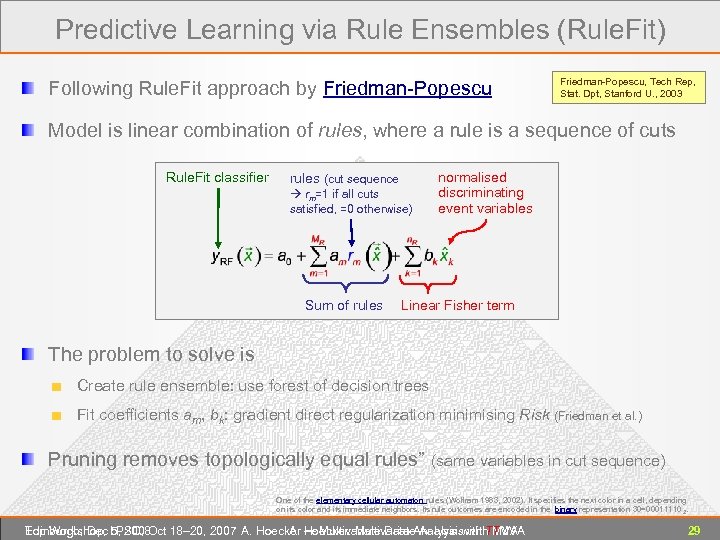 Predictive Learning via Rule Ensembles (Rule. Fit) Following Rule. Fit approach by Friedman-Popescu, Tech Rep, Stat. Dpt, Stanford U. , 2003 Model is linear combination of rules, where a rule is a sequence of cuts Rule. Fit classifier rules (cut sequence rm=1 if all cuts satisfied, =0 otherwise) Sum of rules normalised discriminating event variables Linear Fisher term The problem to solve is Create rule ensemble: use forest of decision trees Fit coefficients am, bk: gradient direct regularization minimising Risk (Friedman et al. ) Pruning removes topologically equal rules” (same variables in cut sequence) One of the elementary cellular automaton rules (Wolfram 1983, 2002). It specifies the next color in a cell, depending on its color and its immediate neighbors. Its rule outcomes are encoded in the binary representation 30=00011110 2. Edinburgh, Dec 5, 2008 Top Workshop, LPSC, Oct 18– 20, 2007 A. Hoecker ― Multivariate Data Analysis with TMVA A. Hoecker: Multivariate Analysis with TMVA 29
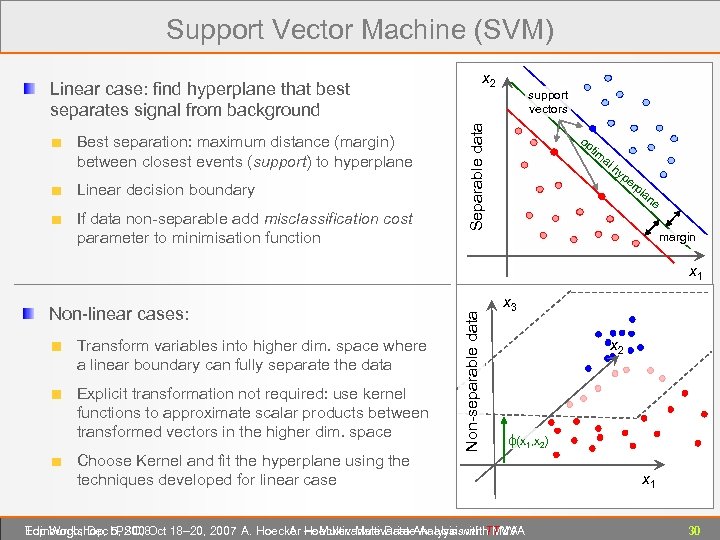 Support Vector Machine (SVM) x 2 Best separation: maximum distance (margin) between closest events (support) to hyperplane Linear decision boundary If data non-separable add misclassification cost parameter to minimisation function support vectors Separable data Linear case: find hyperplane that best separates signal from background op tim al h y pe rp la ne margin Non-linear cases: Transform variables into higher dim. space where a linear boundary can fully separate the data Explicit transformation not required: use kernel functions to approximate scalar products between transformed vectors in the higher dim. space Choose Kernel and fit the hyperplane using the techniques developed for linear case Non-separable data x 1 x 3 x 2 (x 1, x 2) Edinburgh, Dec 5, 2008 Top Workshop, LPSC, Oct 18– 20, 2007 A. Hoecker ― Multivariate Data Analysis with TMVA A. Hoecker: Multivariate Analysis with TMVA x 1 30
 U s i n g T M V A A typical TMVA analysis consists of two main steps: 1. Training phase: training, testing and evaluation of classifiers using data samples with known signal and background composition 2. Application phase: using selected trained classifiers to classify unknown data samples Illustration of these steps with toy data samples T MVA tutorial Edinburgh, Dec 5, 2008 Top Workshop, LPSC, Oct 18– 20, 2007 A. Hoecker ― Multivariate Data Analysis with TMVA A. Hoecker: Multivariate Analysis with TMVA 31
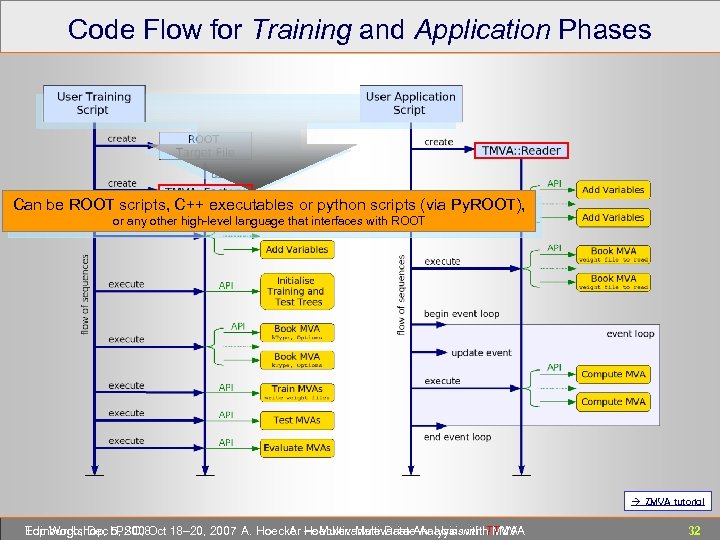 Code Flow for Training and Application Phases Can be ROOT scripts, C++ executables or python scripts (via Py. ROOT), or any other high-level language that interfaces with ROOT T MVA tutorial Edinburgh, Dec 5, 2008 Top Workshop, LPSC, Oct 18– 20, 2007 A. Hoecker ― Multivariate Data Analysis with TMVA A. Hoecker: Multivariate Analysis with TMVA 32
 Data Preparation Data input format: ROOT TTree or ASCII Supports selection of any subset or combination or function of available variables Supports application of pre-selection cuts (possibly independent for signal and bkg) Supports global event weights for signal or background input files Supports use of any input variable as individual event weight Supports various methods for splitting into training and test samples: Block wise Randomly Periodically (i. e. periodically 3 testing ev. , 2 training ev. , 3 testing ev, 2 training ev. …. ) User defined training and test trees Preprocessing of input variables (e. g. , decorrelation) Edinburgh, Dec 5, 2008 Top Workshop, LPSC, Oct 18– 20, 2007 A. Hoecker ― Multivariate Data Analysis with TMVA A. Hoecker: Multivariate Analysis with TMVA 33
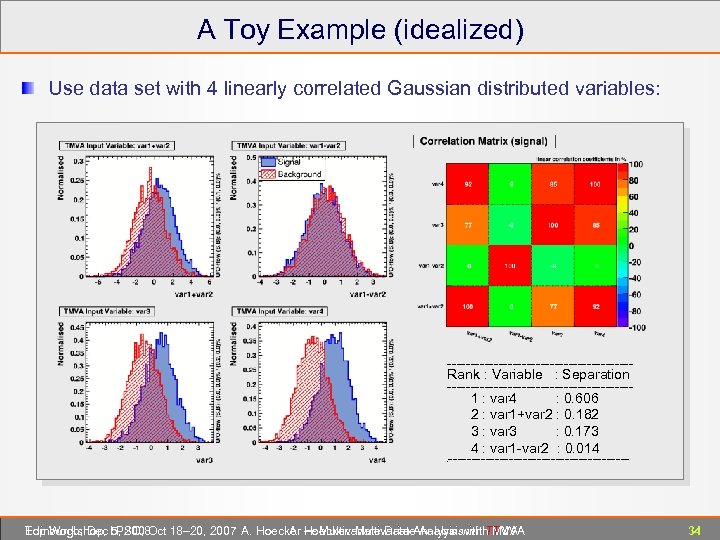 A Toy Example (idealized) Use data set with 4 linearly correlated Gaussian distributed variables: -------------------- Rank : Variable : Separation -------------------- 1 : var 4 : 0. 606 2 : var 1+var 2 : 0. 182 3 : var 3 : 0. 173 4 : var 1 -var 2 : 0. 014 ------------------- - Edinburgh, Dec 5, 2008 Top Workshop, LPSC, Oct 18– 20, 2007 A. Hoecker ― Multivariate Data Analysis with TMVA A. Hoecker: Multivariate Analysis with TMVA 34
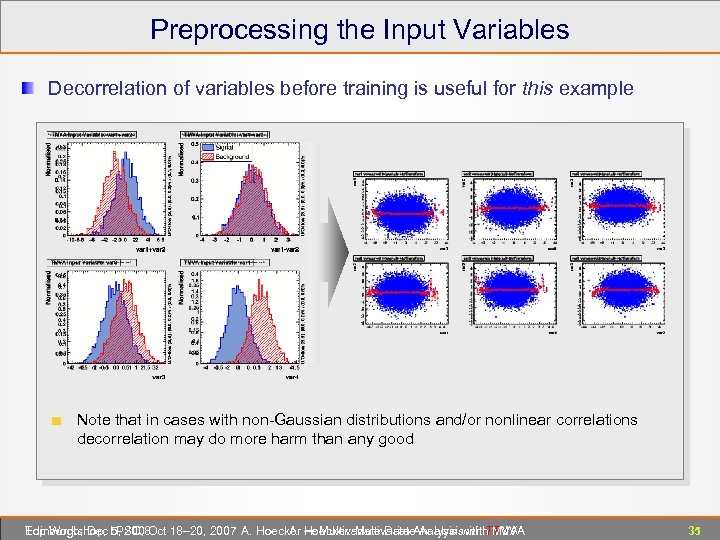 Preprocessing the Input Variables Decorrelation of variables before training is useful for this example Note that in cases with non-Gaussian distributions and/or nonlinear correlations decorrelation may do more harm than any good Edinburgh, Dec 5, 2008 Top Workshop, LPSC, Oct 18– 20, 2007 A. Hoecker ― Multivariate Data Analysis with TMVA A. Hoecker: Multivariate Analysis with TMVA 35
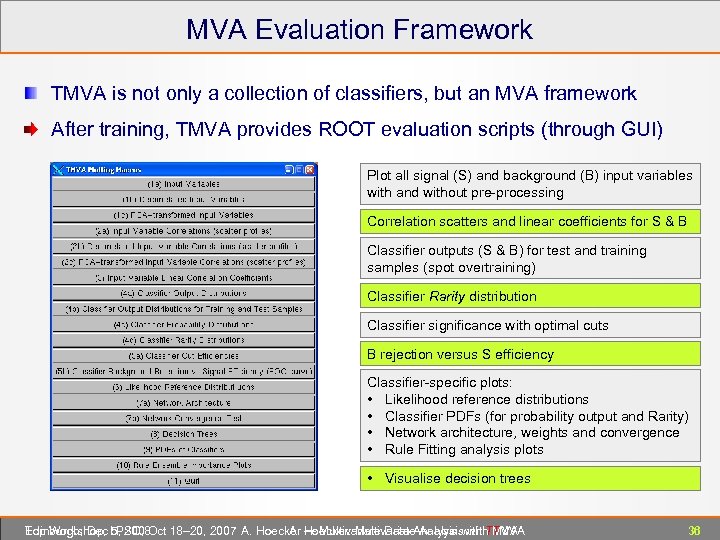 MVA Evaluation Framework TMVA is not only a collection of classifiers, but an MVA framework After training, TMVA provides ROOT evaluation scripts (through GUI) Plot all signal (S) and background (B) input variables with and without pre-processing Correlation scatters and linear coefficients for S & B Classifier outputs (S & B) for test and training samples (spot overtraining) Classifier Rarity distribution Classifier significance with optimal cuts B rejection versus S efficiency Classifier-specific plots: • Likelihood reference distributions • Classifier PDFs (for probability output and Rarity) • Network architecture, weights and convergence • Rule Fitting analysis plots • Visualise decision trees Edinburgh, Dec 5, 2008 Top Workshop, LPSC, Oct 18– 20, 2007 A. Hoecker ― Multivariate Data Analysis with TMVA A. Hoecker: Multivariate Analysis with TMVA 36
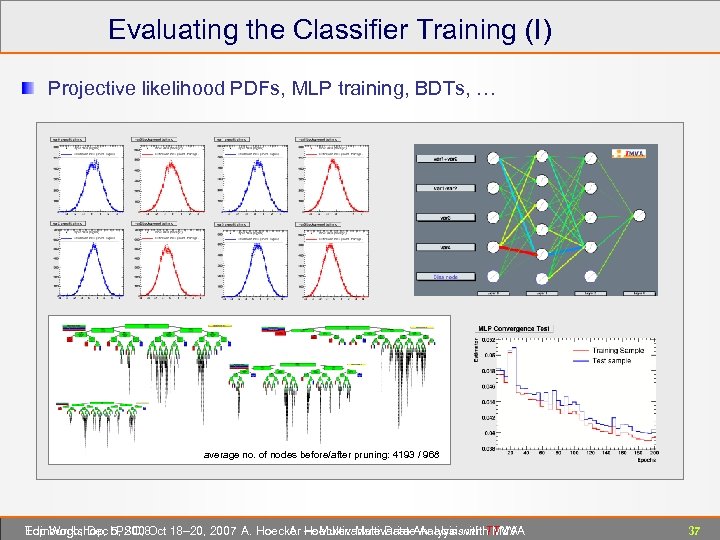 Evaluating the Classifier Training (I) Projective likelihood PDFs, MLP training, BDTs, … average no. of nodes before/after pruning: 4193 / 968 Edinburgh, Dec 5, 2008 Top Workshop, LPSC, Oct 18– 20, 2007 A. Hoecker ― Multivariate Data Analysis with TMVA A. Hoecker: Multivariate Analysis with TMVA 37
 Testing the Classifiers Classifier output distributions for independent test sample: Edinburgh, Dec 5, 2008 Top Workshop, LPSC, Oct 18– 20, 2007 A. Hoecker ― Multivariate Data Analysis with TMVA A. Hoecker: Multivariate Analysis with TMVA 38
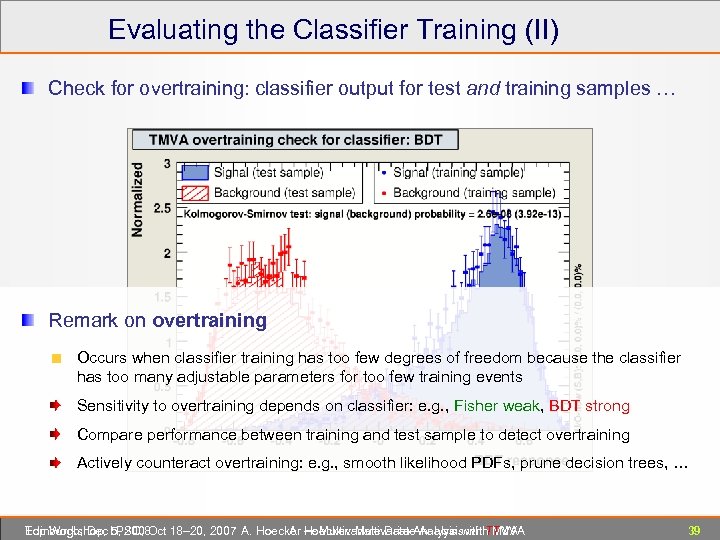 Evaluating the Classifier Training (II) Check for overtraining: classifier output for test and training samples … Remark on overtraining Occurs when classifier training has too few degrees of freedom because the classifier has too many adjustable parameters for too few training events Sensitivity to overtraining depends on classifier: e. g. , Fisher weak, BDT strong Compare performance between training and test sample to detect overtraining Actively counteract overtraining: e. g. , smooth likelihood PDFs, prune decision trees, … Edinburgh, Dec 5, 2008 Top Workshop, LPSC, Oct 18– 20, 2007 A. Hoecker ― Multivariate Data Analysis with TMVA A. Hoecker: Multivariate Analysis with TMVA 39
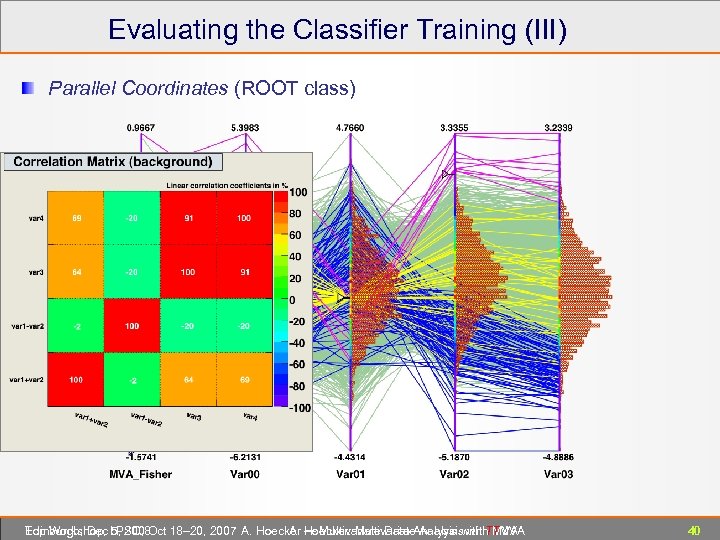 Evaluating the Classifier Training (III) Parallel Coordinates (ROOT class) Edinburgh, Dec 5, 2008 Top Workshop, LPSC, Oct 18– 20, 2007 A. Hoecker ― Multivariate Data Analysis with TMVA A. Hoecker: Multivariate Analysis with TMVA 40
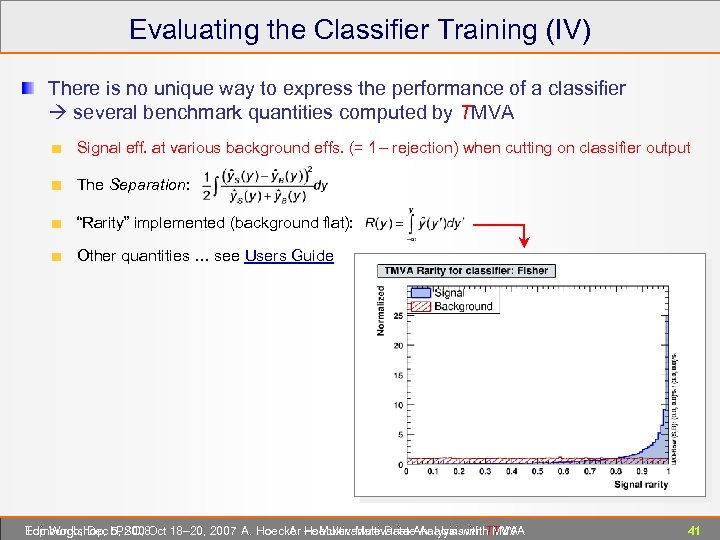 Evaluating the Classifier Training (IV) There is no unique way to express the performance of a classifier several benchmark quantities computed by TMVA Signal eff. at various background effs. (= 1 – rejection) when cutting on classifier output The Separation: “Rarity” implemented (background flat): Other quantities … see Users Guide Edinburgh, Dec 5, 2008 Top Workshop, LPSC, Oct 18– 20, 2007 A. Hoecker ― Multivariate Data Analysis with TMVA A. Hoecker: Multivariate Analysis with TMVA 41
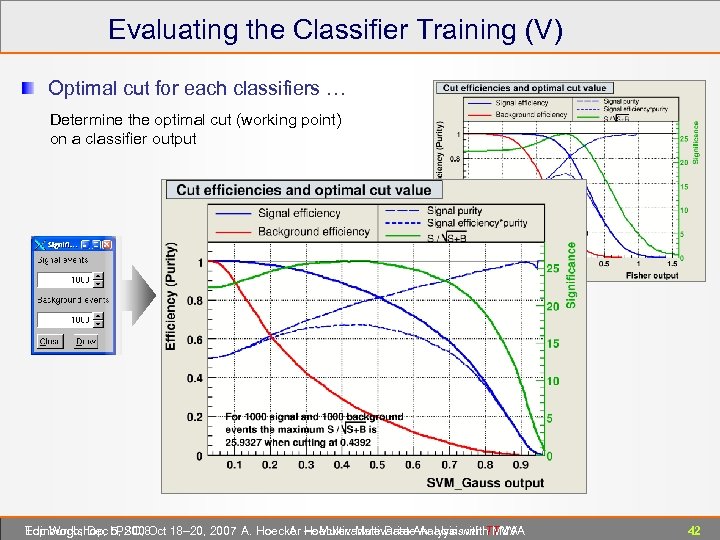 Evaluating the Classifier Training (V) Optimal cut for each classifiers … Determine the optimal cut (working point) on a classifier output Edinburgh, Dec 5, 2008 Top Workshop, LPSC, Oct 18– 20, 2007 A. Hoecker ― Multivariate Data Analysis with TMVA A. Hoecker: Multivariate Analysis with TMVA 42
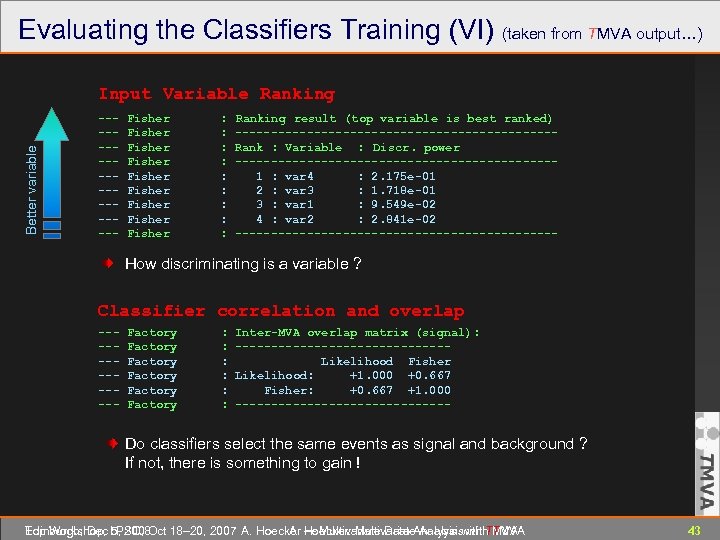 Evaluating the Classifiers Training (VI) (taken from TMVA output…) Better variable Input Variable Ranking ---------- Fisher Fisher Fisher : : : : : Ranking result (top variable is best ranked) ----------------------Rank : Variable : Discr. power ----------------------1 : var 4 : 2. 175 e-01 2 : var 3 : 1. 718 e-01 3 : var 1 : 9. 549 e-02 4 : var 2 : 2. 841 e-02 ----------------------- How discriminating is a variable ? Classifier correlation and overlap ------- Factory Factory : : : Inter-MVA overlap matrix (signal): ---------------Likelihood Fisher Likelihood: +1. 000 +0. 667 Fisher: +0. 667 +1. 000 --------------- Do classifiers select the same events as signal and background ? If not, there is something to gain ! Edinburgh, Dec 5, 2008 Top Workshop, LPSC, Oct 18– 20, 2007 A. Hoecker ― Multivariate Data Analysis with TMVA A. Hoecker: Multivariate Analysis with TMVA 43
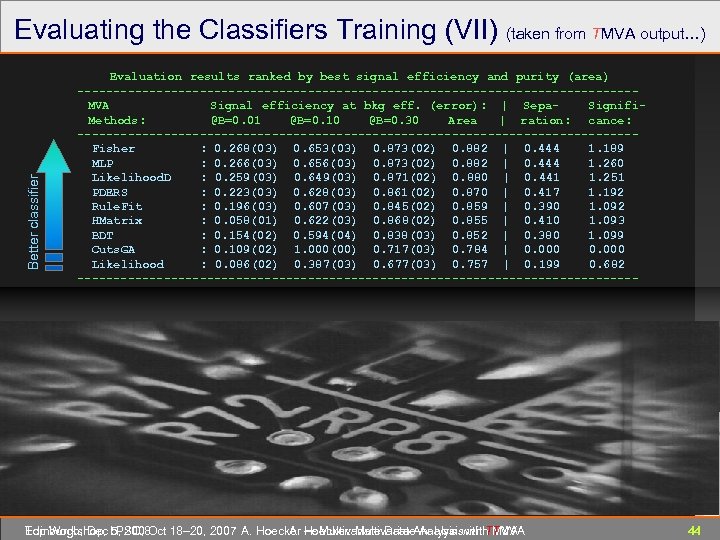 Evaluating the Classifiers Training (VII) (taken from TMVA output…) Better classifier Evaluation results ranked by best signal efficiency and purity (area) ---------------------------------------MVA Signal efficiency at bkg eff. (error): | Sepa. Signifi. Methods: @B=0. 01 @B=0. 10 @B=0. 30 Area | ration: cance: ---------------------------------------Fisher : 0. 268(03) 0. 653(03) 0. 873(02) 0. 882 | 0. 444 1. 189 MLP : 0. 266(03) 0. 656(03) 0. 873(02) 0. 882 | 0. 444 1. 260 Likelihood. D : 0. 259(03) 0. 649(03) 0. 871(02) 0. 880 | 0. 441 1. 251 PDERS : 0. 223(03) 0. 628(03) 0. 861(02) 0. 870 | 0. 417 1. 192 Rule. Fit : 0. 196(03) 0. 607(03) 0. 845(02) 0. 859 | 0. 390 1. 092 HMatrix : 0. 058(01) 0. 622(03) 0. 868(02) 0. 855 | 0. 410 1. 093 BDT : 0. 154(02) 0. 594(04) 0. 838(03) 0. 852 | 0. 380 1. 099 Cuts. GA : 0. 109(02) 1. 000(00) 0. 717(03) 0. 784 | 0. 000 Likelihood : 0. 086(02) 0. 387(03) 0. 677(03) 0. 757 | 0. 199 0. 682 ---------------------------------------Testing efficiency compared to training efficiency (overtraining check) ---------------------------------------MVA Signal efficiency: from test sample (from traing sample) Methods: @B=0. 01 @B=0. 10 @B=0. 30 ---------------------------------------Fisher : 0. 268 (0. 275) 0. 653 (0. 658) 0. 873 (0. 873) MLP : 0. 266 (0. 278) 0. 656 (0. 658) 0. 873 (0. 873) Likelihood. D : 0. 259 (0. 273) 0. 649 (0. 657) 0. 871 (0. 872) Check PDERS : 0. 223 (0. 389) 0. 628 (0. 691) 0. 861 (0. 881) Rule. Fit : 0. 196 (0. 198) 0. 607 (0. 616) 0. 845 (0. 848) for over. HMatrix : 0. 058 (0. 060) 0. 622 (0. 623) 0. 868 (0. 868) training BDT : 0. 154 (0. 268) 0. 594 (0. 736) 0. 838 (0. 911) Cuts. GA : 0. 109 (0. 123) 1. 000 (0. 424) 0. 717 (0. 715) Likelihood : 0. 086 (0. 092) 0. 387 (0. 379) 0. 677 (0. 677) --------------------------------------Edinburgh, Dec 5, 2008 Top Workshop, LPSC, Oct 18– 20, 2007 A. Hoecker ― Multivariate Data Analysis with TMVA A. Hoecker: Multivariate Analysis with TMVA 44
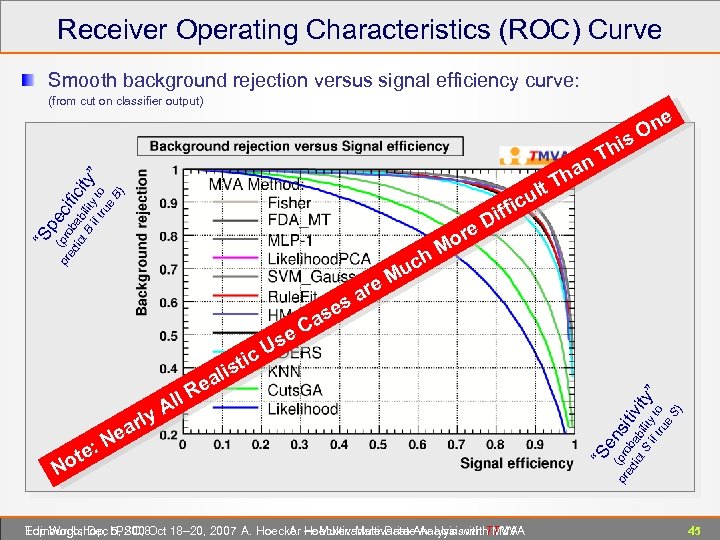 Receiver Operating Characteristics (ROC) Curve Smooth background rejection versus signal efficiency curve: (from cut on classifier output) Th n e On s i pr (pro ec ed b ifi ict ab ci B ilit ty if y t ” tru o e B) a h t. T l u “S p ore c iffi D h. M c Mu e r a es N Edinburgh, Dec 5, 2008 Top Workshop, LPSC, Oct 18– 20, 2007 A. Hoecker ― Multivariate Data Analysis with TMVA A. Hoecker: Multivariate Analysis with TMVA e N pr (pro ns ed b iti ict ab vi S ilit ty if y t ” tru o e S) te: o y arl e Re All “S Us c sti ali s Ca e 45
 M o r e T o y E x a m p l e s Edinburgh, Dec 5, 2008 Top Workshop, LPSC, Oct 18– 20, 2007 A. Hoecker ― Multivariate Data Analysis with TMVA A. Hoecker: Multivariate Analysis with TMVA 46
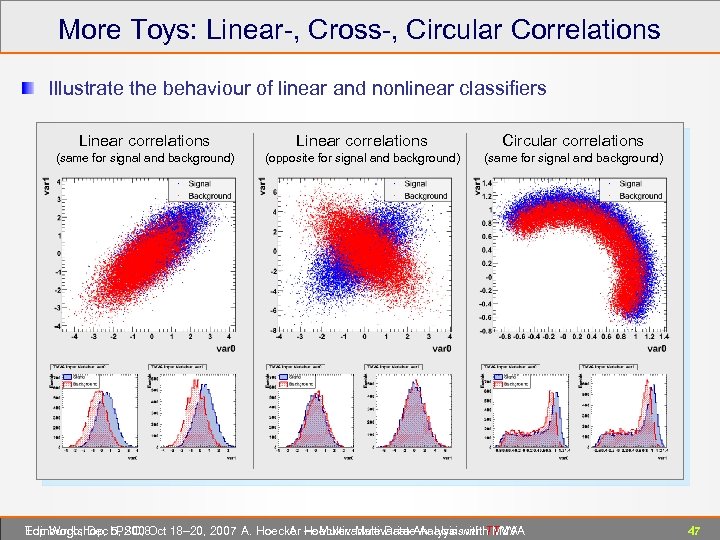 More Toys: Linear-, Cross-, Circular Correlations Illustrate the behaviour of linear and nonlinear classifiers Linear correlations Circular correlations (same for signal and background) (opposite for signal and background) (same for signal and background) Edinburgh, Dec 5, 2008 Top Workshop, LPSC, Oct 18– 20, 2007 A. Hoecker ― Multivariate Data Analysis with TMVA A. Hoecker: Multivariate Analysis with TMVA 47
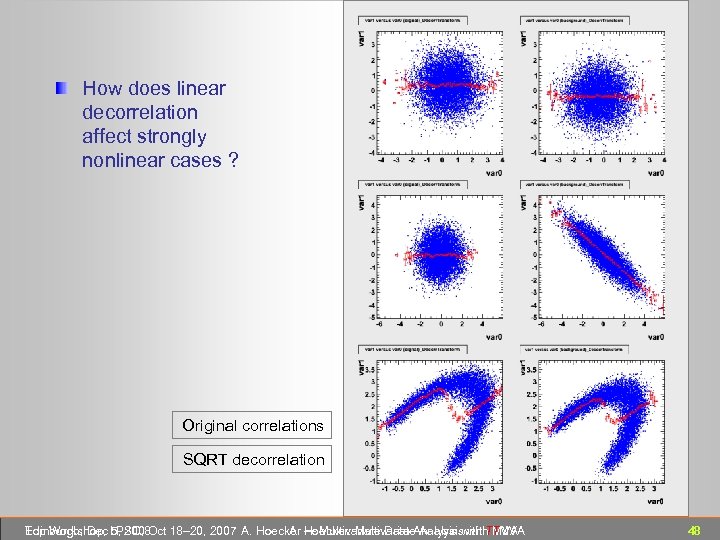 How does linear decorrelation affect strongly nonlinear cases ? Original correlations SQRT decorrelation Edinburgh, Dec 5, 2008 Top Workshop, LPSC, Oct 18– 20, 2007 A. Hoecker ― Multivariate Data Analysis with TMVA A. Hoecker: Multivariate Analysis with TMVA 48
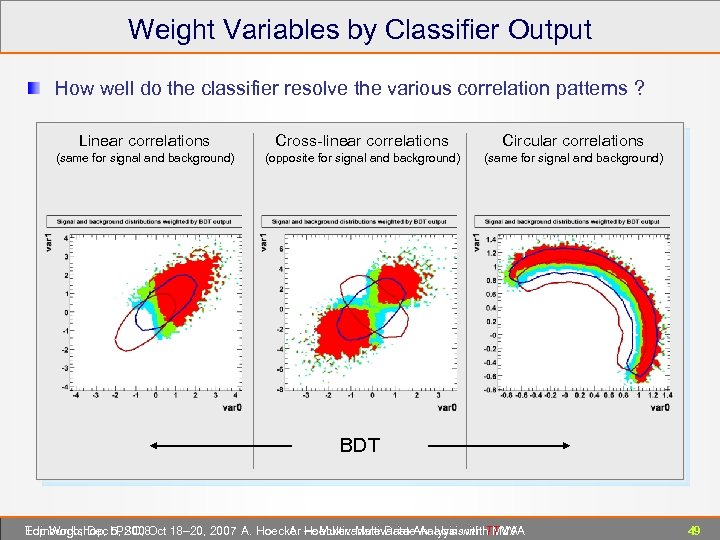 Weight Variables by Classifier Output How well do the classifier resolve the various correlation patterns ? Linear correlations Cross-linear correlations Circular correlations (same for signal and background) (opposite for signal and background) (same for signal and background) Likelihood - D Likelihood PDERS Fisher MLP BDT Edinburgh, Dec 5, 2008 Top Workshop, LPSC, Oct 18– 20, 2007 A. Hoecker ― Multivariate Data Analysis with TMVA A. Hoecker: Multivariate Analysis with TMVA 49
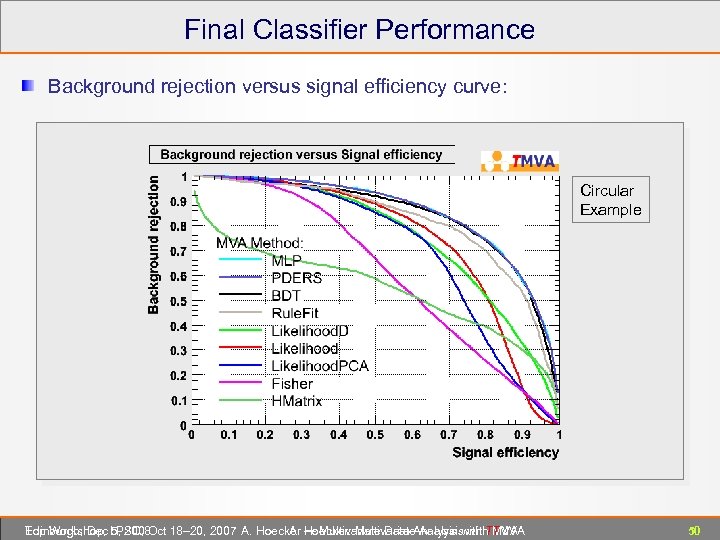 Final Classifier Performance Background rejection versus signal efficiency curve: Linear Circular Cross Example Edinburgh, Dec 5, 2008 Top Workshop, LPSC, Oct 18– 20, 2007 A. Hoecker ― Multivariate Data Analysis with TMVA A. Hoecker: Multivariate Analysis with TMVA 50
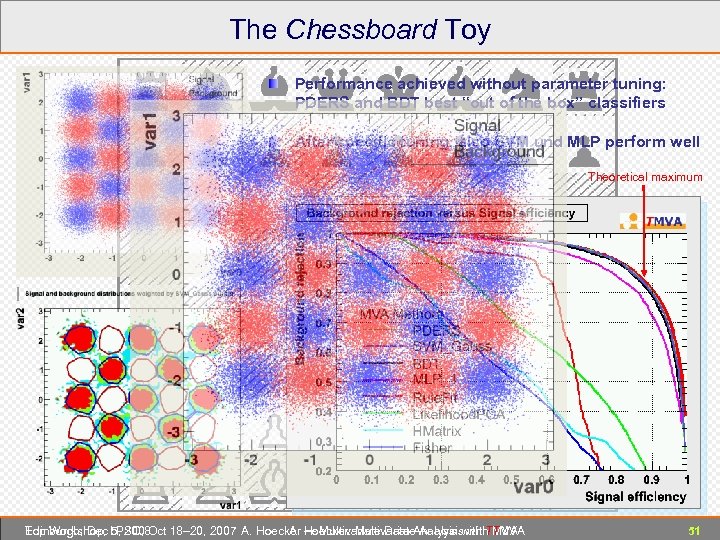 The Chessboard Toy Performance achieved without parameter tuning: PDERS and BDT best “out of the box” classifiers After specific tuning, also SVM und MLP perform well Theoretical maximum Edinburgh, Dec 5, 2008 Top Workshop, LPSC, Oct 18– 20, 2007 A. Hoecker ― Multivariate Data Analysis with TMVA A. Hoecker: Multivariate Analysis with TMVA 51
 S u m m a r y Edinburgh, Dec 5, 2008 Top Workshop, LPSC, Oct 18– 20, 2007 A. Hoecker ― Multivariate Data Analysis with TMVA A. Hoecker: Multivariate Analysis with TMVA 52
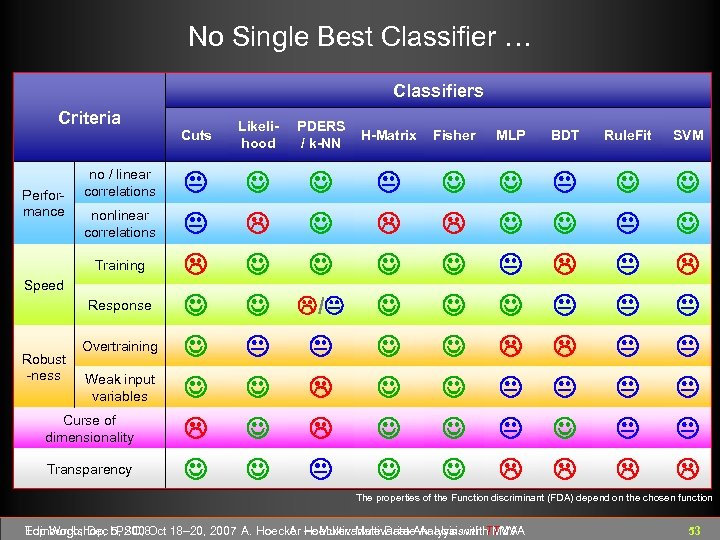 No Single Best Classifier … Classifiers Criteria Performance no / linear correlations nonlinear correlations Training Speed Response Robust -ness Overtraining Weak input variables Curse of dimensionality Transparency Cuts Likelihood PDERS / k-NN / H-Matrix Fisher MLP BDT Rule. Fit SVM The properties of the Function discriminant (FDA) depend on the chosen function Edinburgh, Dec 5, 2008 Top Workshop, LPSC, Oct 18– 20, 2007 A. Hoecker ― Multivariate Data Analysis with TMVA A. Hoecker: Multivariate Analysis with TMVA 53
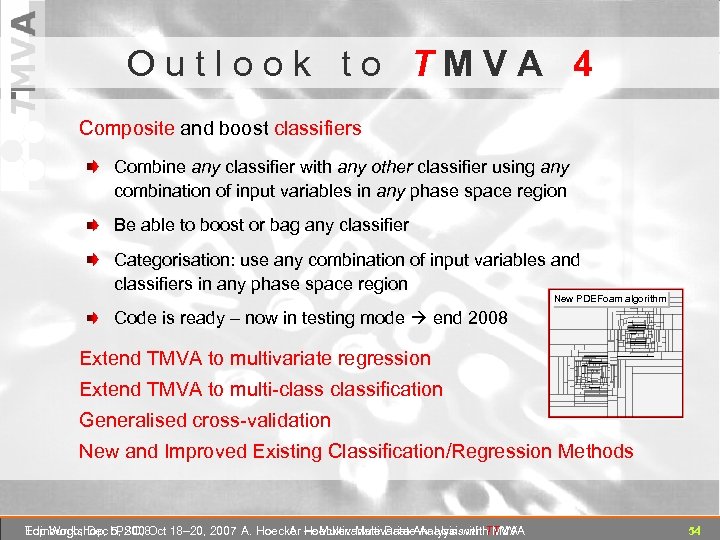 O u t l o o k t o T M V A 4 Composite and boost classifiers Combine any classifier with any other classifier using any combination of input variables in any phase space region Be able to boost or bag any classifier Categorisation: use any combination of input variables and classifiers in any phase space region New PDEFoam algorithm Code is ready – now in testing mode end 2008 Extend TMVA to multivariate regression Extend TMVA to multi-classification Generalised cross-validation New and Improved Existing Classification/Regression Methods Edinburgh, Dec 5, 2008 Top Workshop, LPSC, Oct 18– 20, 2007 A. Hoecker ― Multivariate Data Analysis with TMVA A. Hoecker: Multivariate Analysis with TMVA 54
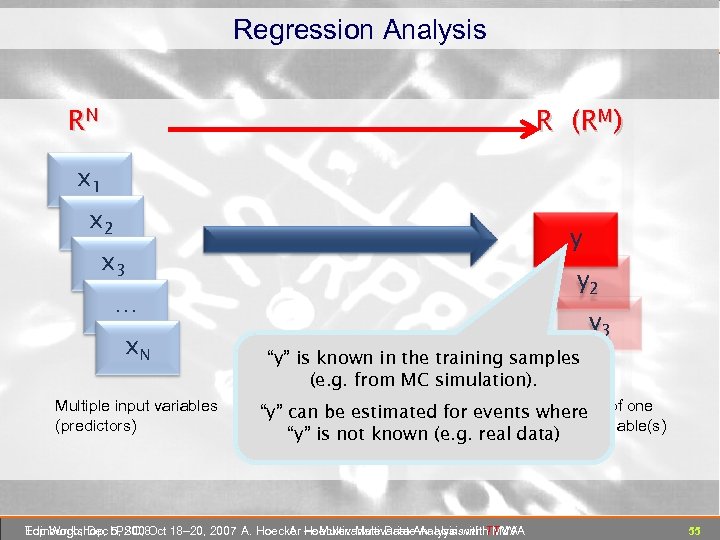 Regression Analysis RN R (RM) x 1 x 2 y x 3 y 2 … x. N Multiple input variables (predictors) y 3 “y” is known in the training samples (e. g. from MC simulation). Use their information “y” can be estimated To predict the outcome of one for events where (or more) dependent variable(s) (multivariate training) “y” is not known (e. g. real data) (target) Edinburgh, Dec 5, 2008 Top Workshop, LPSC, Oct 18– 20, 2007 A. Hoecker ― Multivariate Data Analysis with TMVA A. Hoecker: Multivariate Analysis with TMVA 55
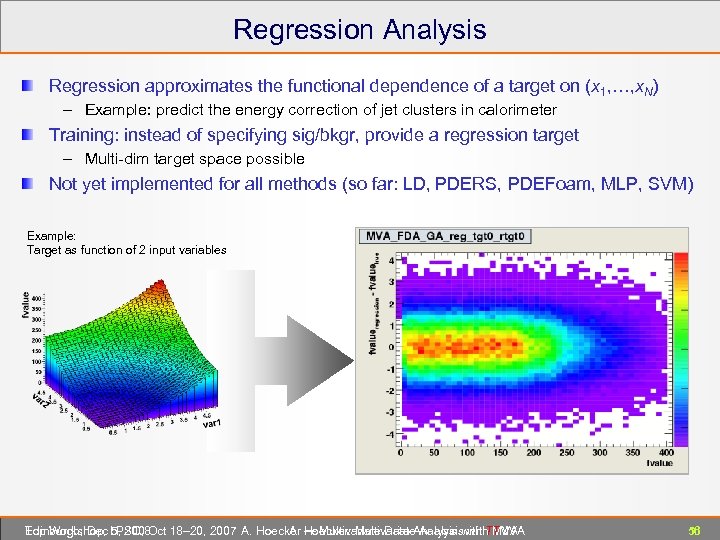 Regression Analysis Regression approximates the functional dependence of a target on (x 1, …, x. N) – Example: predict the energy correction of jet clusters in calorimeter Training: instead of specifying sig/bkgr, provide a regression target – Multi-dim target space possible Not yet implemented for all methods (so far: LD, PDERS, PDEFoam, MLP, SVM) Example: Target as function of 2 input variables Edinburgh, Dec 5, 2008 Top Workshop, LPSC, Oct 18– 20, 2007 A. Hoecker ― Multivariate Data Analysis with TMVA A. Hoecker: Multivariate Analysis with TMVA 56
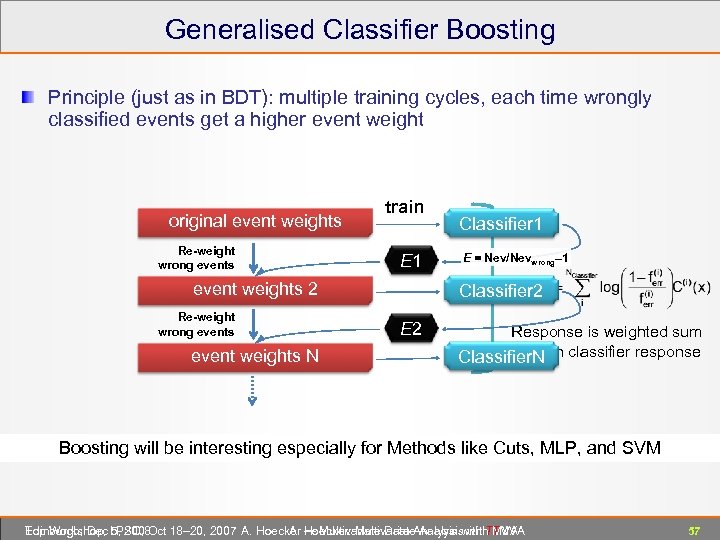 Generalised Classifier Boosting Principle (just as in BDT): multiple training cycles, each time wrongly classified events get a higher event weight original event weights Re-weight wrong events train E 1 event weights 2 Re-weight wrong events event weights N Classifier 1 E = Nev/Nevwrong– 1 Classifier 2 E 2 Response is weighted sum of each classifier response Classifier. N Boosting will be interesting especially for Methods like Cuts, MLP, and SVM Edinburgh, Dec 5, 2008 Top Workshop, LPSC, Oct 18– 20, 2007 A. Hoecker ― Multivariate Data Analysis with TMVA A. Hoecker: Multivariate Analysis with TMVA 57
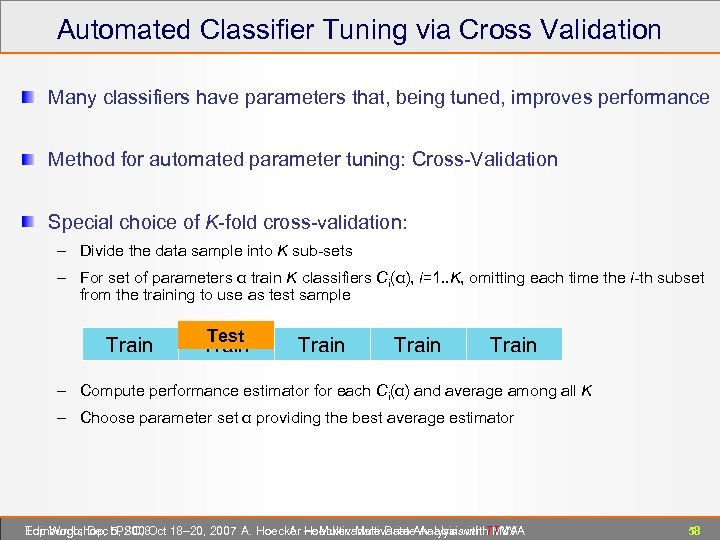 Automated Classifier Tuning via Cross Validation Many classifiers have parameters that, being tuned, improves performance Method for automated parameter tuning: Cross-Validation Special choice of K-fold cross-validation: – Divide the data sample into K sub-sets – For set of parameters α train K classifiers Ci(α), i=1. . K, omitting each time the i-th subset from the training to use as test sample Train Test Train – Compute performance estimator for each Ci(α) and average among all K – Choose parameter set α providing the best average estimator Edinburgh, Dec 5, 2008 Top Workshop, LPSC, Oct 18– 20, 2007 A. Hoecker ― Multivariate Data Analysis with TMVA A. Hoecker: Multivariate Analysis with TMVA 58
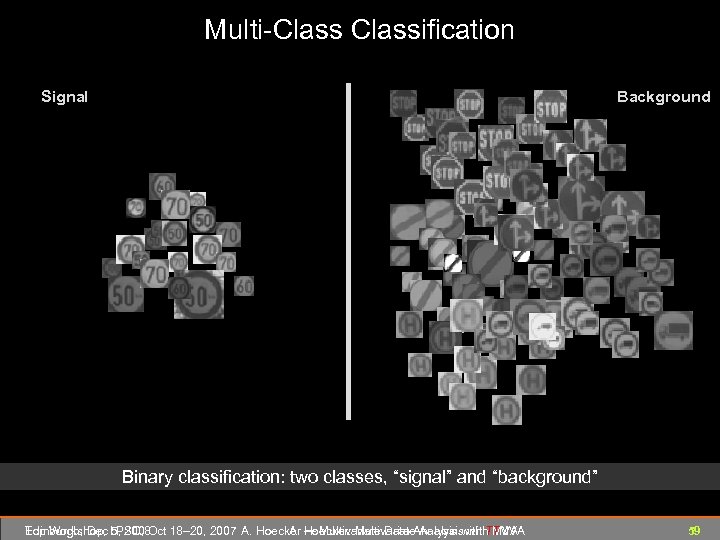 Multi-Classification Signal Background Binary classification: two classes, “signal” and “background” Edinburgh, Dec 5, 2008 Top Workshop, LPSC, Oct 18– 20, 2007 A. Hoecker ― Multivariate Data Analysis with TMVA A. Hoecker: Multivariate Analysis with TMVA 59
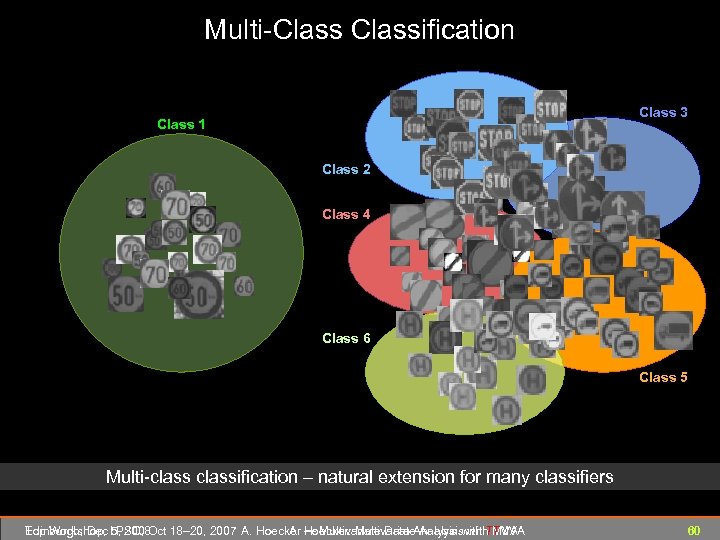 Multi-Classification Class 3 Class 1 Class 2 Class 4 Class 6 Class 5 Multi-classification – natural extension for many classifiers Edinburgh, Dec 5, 2008 Top Workshop, LPSC, Oct 18– 20, 2007 A. Hoecker ― Multivariate Data Analysis with TMVA A. Hoecker: Multivariate Analysis with TMVA 60
 T M V A 4 Current stable TMVA version 3. 9. 6 for ROOT 5. 22 (midst of December), Moving to TMVA 4. Target for first release: end of 2008 – Not everything at once: 1) 2) 3) 4) – New framework (done) Regression (PDE, LD, MLP, SVN) and generic classifier boosting (done) Multi-classification, automatic classifier tuning (being prepared) Composite classifiers (not done) Multi-core some time along the way (being prepared) Edinburgh, Dec 5, 2008 Top Workshop, LPSC, Oct 18– 20, 2007 A. Hoecker ― Multivariate Data Analysis with TMVA A. Hoecker: Multivariate Analysis with TMVA 61
 C o p y r i g h t s & C r e d i t s TMVA is open source software Use & redistribution of source permitted according to terms in BSD license Several similar data mining efforts with rising importance in most fields of science and industry Important for HEP: Parallelised MVA training and evaluation pioneered by Cornelius package (BABAR) Also frequently used: Stat. Pattern. Recognition package by I. Narsky (Cal Tech) Many implementations of individual classifiers exist Acknowledgments: The fast development of TMVA would not have been possible without the contribution and feedback from many developers and users to whom we are indebted. We thank in particular the CERN Summer students Matt Jachowski (Stanford) for the implementation of TMVA's new MLP neural network, Yair Mahalalel (Tel Aviv) and three genius Krakow mathematics students for significant improvements of PDERS, the Krakow student Andrzej Zemla and his supervisor Marcin Wolter for programming a powerful Support Vector Machine, as well as Rustem Ospanov for the development of a fast k-NN algorithm. We thank Doug Schouten (S. Fraser U) for improving the BDT, Jan Therhaag (Bonn) for a reimplementation of LD including regression, and Eckhard v. Toerne (Bonn) for improving the Cuts evaluation. Many thanks to Dominik Dannheim, Alexander Voigt and Tancredi Carli (CERN) for the implementation of the PDEFoam approach. We are grateful to Doug Applegate, Kregg Arms, René Brun and the ROOT team, Zhiyi Liu, Elzbieta Richter-Was, Vincent Tisserand Alexei Volk for helpful conversations. Edinburgh, Dec 5, 2008 Top Workshop, LPSC, Oct 18– 20, 2007 A. Hoecker ― Multivariate Data Analysis with TMVA A. Hoecker: Multivariate Analysis with TMVA 62
 A ( b r i e f ) W o r d o n S y s t e m a t i c s & I r r e l e v a n t I n p u t V a r i a b l e s Edinburgh, Dec 5, 2008 Top Workshop, LPSC, Oct 18– 20, 2007 A. Hoecker ― Multivariate Data Analysis with TMVA A. Hoecker: Multivariate Analysis with TMVA 63
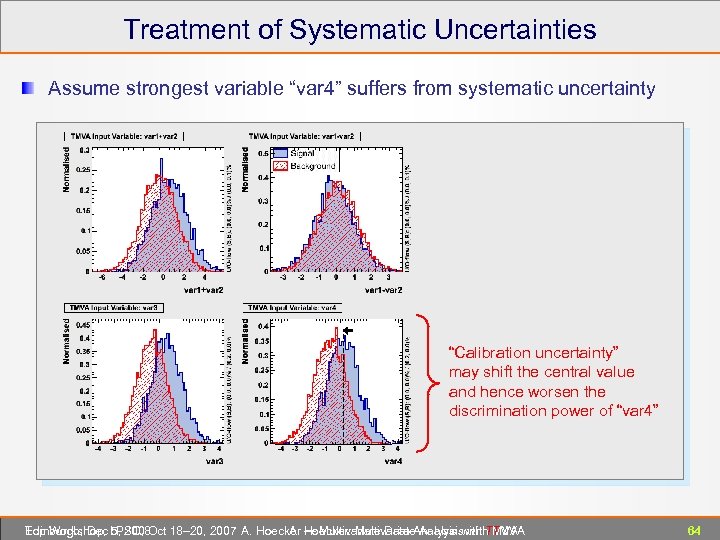 Treatment of Systematic Uncertainties Assume strongest variable “var 4” suffers from systematic uncertainty “Calibration uncertainty” may shift the central value and hence worsen the discrimination power of “var 4” Edinburgh, Dec 5, 2008 Top Workshop, LPSC, Oct 18– 20, 2007 A. Hoecker ― Multivariate Data Analysis with TMVA A. Hoecker: Multivariate Analysis with TMVA 64
 Treatment of Systematic Uncertainties Assume strongest variable “var 4” suffers from systematic uncertainty (at least) Two ways to deal with it: 1. Ignore the systematic in the training, and evaluate systematic error on classifier output Drawbacks: “var 4” appears stronger in training than it might be suboptimal performance Classifier response will strongly depend on “var 4” 2. Train with shifted (= weakened) “var 4”, and evaluate systematic error on classifier output Cures previous drawbacks If classifier output distributions can be validated with data control samples, the second drawback is mitigated, but not the first one (the performance loss) ! Edinburgh, Dec 5, 2008 Top Workshop, LPSC, Oct 18– 20, 2007 A. Hoecker ― Multivariate Data Analysis with TMVA A. Hoecker: Multivariate Analysis with TMVA 65
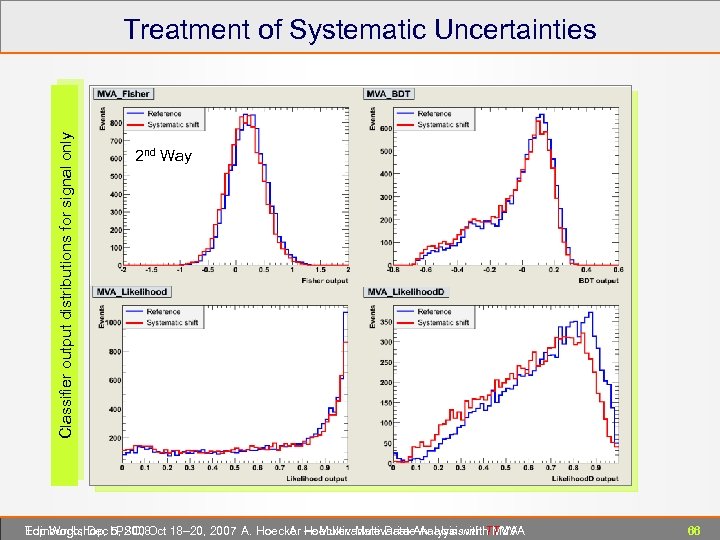 Classifier output distributions for signal only Treatment of Systematic Uncertainties 2 nd Way 1 st Edinburgh, Dec 5, 2008 Top Workshop, LPSC, Oct 18– 20, 2007 A. Hoecker ― Multivariate Data Analysis with TMVA A. Hoecker: Multivariate Analysis with TMVA 66
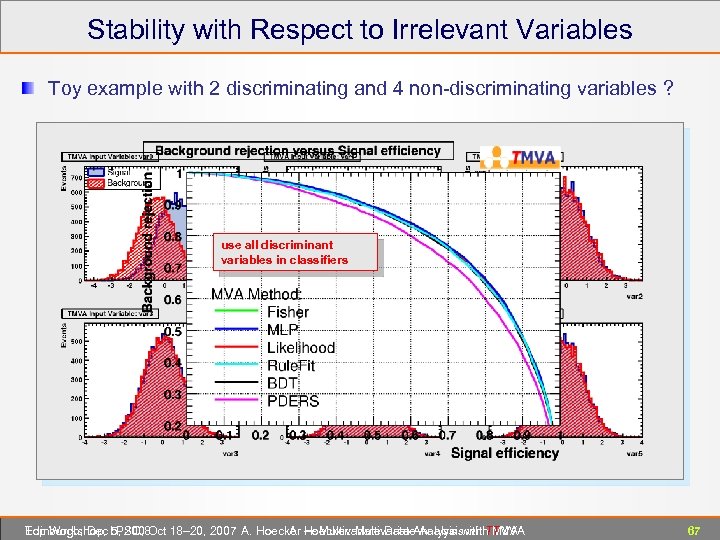 Stability with Respect to Irrelevant Variables Toy example with 2 discriminating and 4 non-discriminating variables ? use only two discriminant all discriminant variables in classifiers Edinburgh, Dec 5, 2008 Top Workshop, LPSC, Oct 18– 20, 2007 A. Hoecker ― Multivariate Data Analysis with TMVA A. Hoecker: Multivariate Analysis with TMVA 67