


 Скачать презентацию Multiple Points of Light Grounds for Optimism in
5847b2148f8f3ba85b7925585b87914f.ppt
- Количество слайдов: 18
 Multiple Points of Light Grounds for Optimism in the Situation of First Nations in Canada
 Purposes • Not ‘public relations’ for DIAND. Rather: • To offer encouragement to - students - practitioners (incl. public servants) - educators - the public • So as to counter despair, pessimism, fatalistic resignation, “compassion fatigue”, and the selffulfilling prophecies that arise from them.
 Focus • Positive developments in the over one third of a century since the 1969 White Paper • On- and off- reserve First Nation population • Not exhaustive • No attempt to provide balance or an overall assessment of the net effect or probable net outcome of the interplay between positive developments and countervailing forces
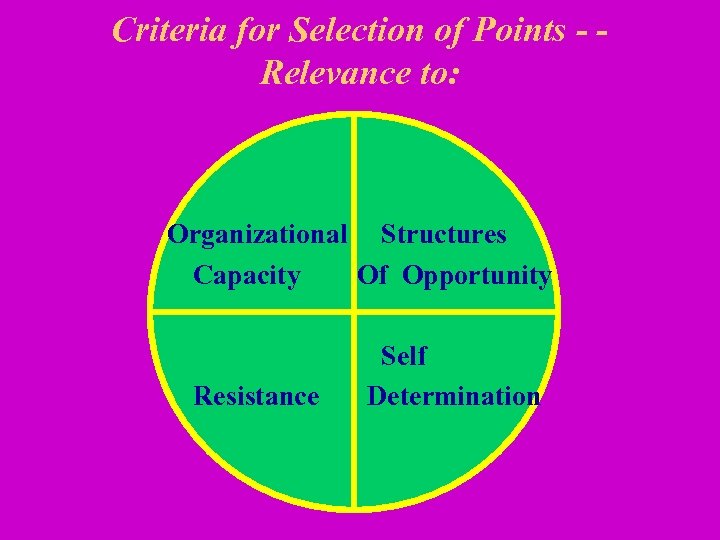 Criteria for Selection of Points - Relevance to: Organizational Structures Capacity Of Opportunity Resistance Self Determination
 Demographics: I. Births and Deaths • Infant mortality rate has plummeted • Life expectancy gap has narrowed • Demographic transition is largely complete low birth rates = increased access to opportunity for women • Rectangularization of population pyramid declining youth dependency ratio permits increased standard of living • Size: some economic & political ‘clout’
 Demographics: II. Migration and Population Growth • Inaccuracy of Stereotype of Transience - only the off-reserve pop. is in a state of flux - only 2% of R. I. pop. reported more than 1 change of residence in 12 months prior to 1991 A. P. S. • Stemming of Pop. Loss: Net inflow to the reserves – contributes to critical mass needed for increasing institutional completeness, economies of scale, and on -reserve entrepreneurial activity – contributes to cultural preservation (Incubator Effect)
 Human Capital Development: I. Education • Drop-out / push-out rate: dramatic decline • Post-secondary Participation Rate: - pronounced increase (25, 800 enrolled in 2001 -02) • Educational Attainment - Degree holders (2001): 8% of pop. aged 25 -64 (increases about 1200 -1400 persons per year) - Post-Baccalaureate Degrees: about 190 per yr - Greater dispersion among disciplines - Penetration of professions - Emergence of a new middle class
 Human Capital Development: II. Healing • Healing Funds: $350 million + • Federal Statement of Regret • Empowering Examples: publicized by RCAP • Breaking the Silence re: Abuse - residential schools - family violence • Increase in Self-Esteem, Personal Pride, and Cultural Pride • Residential Schools: Acknowledgement, Validation, Vindication & Moving on
 Human Capital Development: III. Cultural Revitalization • Language preservation and language training • Repatriation of artifacts from museums • Reclaiming of traditional songs, dances, stories, and drumming • Spiritual development and re-discovery • Flourishing of First Nation authors and artists -#-
 Economic and Employment Development • Kamloops Amendment (1988) • Creation of First Nation banking institutions • Economic Development provisions of land claim settlements • Burgeoning professions and entrepreneurship • Cultural tourism and eco-tourism • Employment Equity Act • Locational advantages
 Responsibility and Trust • Exhortations from leaders to “buy into” an ethic of personal responsibility - e. g. , Monture-Angus, Crowfoot, Alfred • Grassroots challenges to nepotism and fiscal mismanagement • Reassertion of agency by FN women (taking on added responsibilities, incl. chief pos’n) • Erosion of some factors creating distrust • Tribal Councils: Extending trust beyond the boundaries of family and nation
 Politics and Policy: I. Policy and Legislation • Constitutional Recognition of Aboriginal Rights, 1982 vs termination policy of 1969 white paper • Comprehensive Land Claims Policy & Settlements • Institutional Accommodation e. g. , Employment Equity Act, Aboriginal fishery on Fraser River, sentencing circles • Devolution of Administrative Powers e. g. , Indian control of Indian educ’n; child welfare • Statement of Reconciliation, 1998 • Kelowna Accord (and political will behind it)
 Principles in Supreme Court Decisions • Treaties cannot be unilaterally extinguished. • The honour of the Crown is at stake. • Treaties must be liberally construed and ambiguities resolved in favour of the Indians. • The fiduciary relationship is still in effect. • Unextinguished title carries aboriginal rights. • Even eighteenth century treaties are still valid. -#-
 Politics and Policy: II. Supreme Court Decisions • • • Marshall, 1999 Delgamuuk’w, 1997 Sioui, 1990 Guerin (Musqueam), 1984 and Calder (Nisga’a) 1973 -#-
 Public Opinion • Now more supportive than in mid-1980 s e. g. - majority support for Nisga’a Treaty (even in B. C. ), ‘apology’, healing fund, special cultural protection, & compensation in comprehensive claims - improving views on the capability of aboriginal leaders and governments • Only about 10 -15% of Cdns are hard-core opponents of aboriginal people. • Sensitivity to aboriginal peoples’ special relationship with the land
 Resistance • Numerous Examples: e. g. , Anicinabe Park, blockades, Lubicons, Elijah Harper, Oka, Old Man River Dam, hunger strike, James Bay Crees, Burnt Church, Jay Treaty, www • Effects: - constrained fed. govt’s use of power (e. g. , smuggling) - created political will for change among non-Native politicians (concern re: radicalization of youth) • Resistance to Local Corruption (Actual or Perceived) • Resistance to Paternalism & Family Violence e. g. , Native Women’s Assoc’n re: accountability of chiefs and councils under self-government
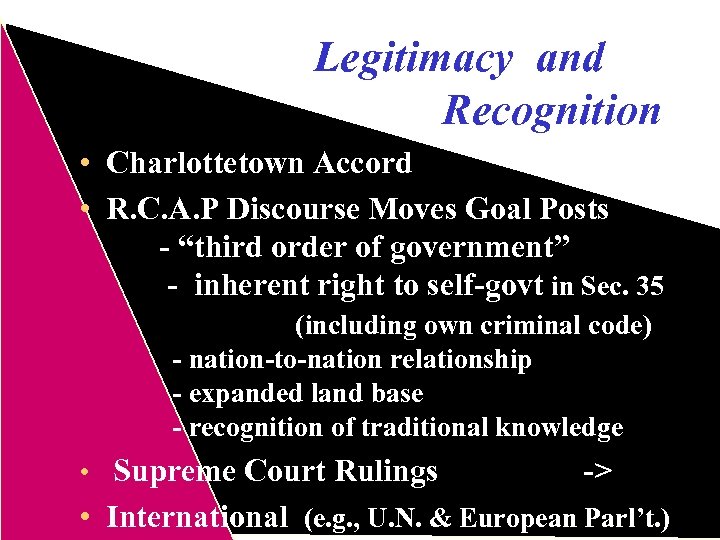 Legitimacy and Recognition • Charlottetown Accord • R. C. A. P Discourse Moves Goal Posts - “third order of government” - inherent right to self-govt in Sec. 35 (including own criminal code) - nation-to-nation relationship - expanded land base - recognition of traditional knowledge • Supreme Court Rulings -> • International (e. g. , U. N. & European Parl’t. )
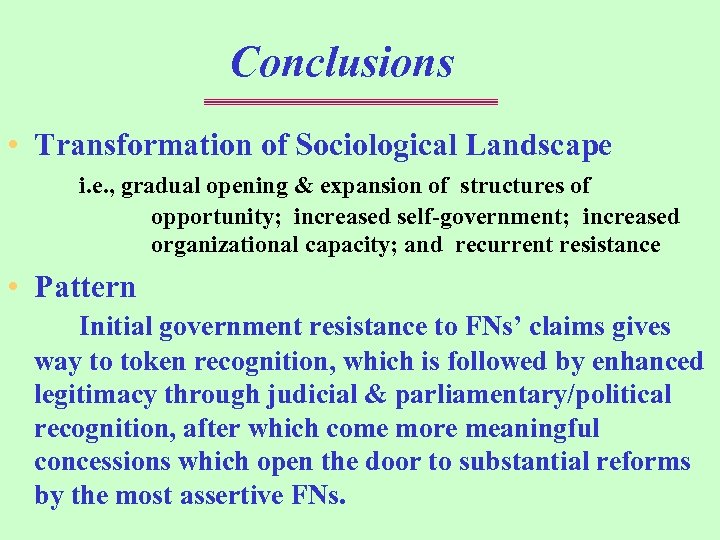 Conclusions • Transformation of Sociological Landscape i. e. , gradual opening & expansion of structures of opportunity; increased self-government; increased organizational capacity; and recurrent resistance • Pattern Initial government resistance to FNs’ claims gives way to token recognition, which is followed by enhanced legitimacy through judicial & parliamentary/political recognition, after which come more meaningful concessions which open the door to substantial reforms by the most assertive FNs.