


 Скачать презентацию Multiple Coordination Recursion and the Syntax-Semantics Interface Yoad
0c3e2bdba998557e64d319defd99c70b.ppt
- Количество слайдов: 28
 Multiple Coordination: Recursion and the Syntax-Semantics Interface Yoad Winter Technion/NIAS/Utrecht University August 5, 2007 – Formal Grammar, Dublin Paper draft downloadable at: www. cs. technion. ac. il/~winter 1
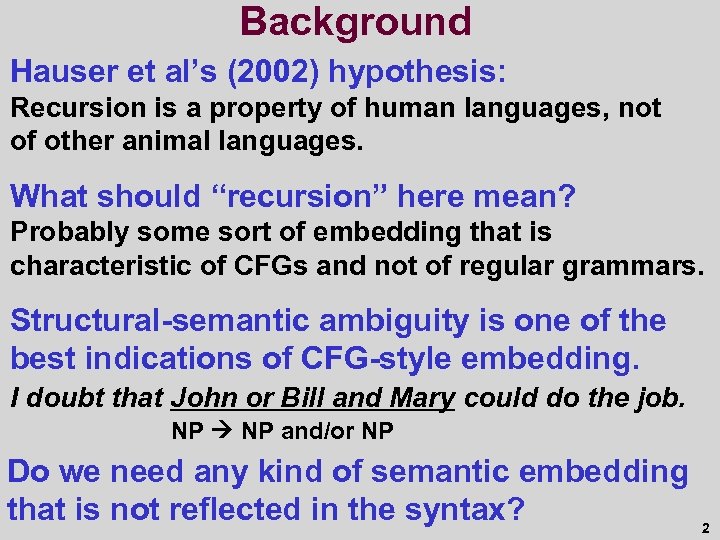 Background Hauser et al’s (2002) hypothesis: Recursion is a property of human languages, not of other animal languages. What should “recursion” here mean? Probably some sort of embedding that is characteristic of CFGs and not of regular grammars. Structural-semantic ambiguity is one of the best indications of CFG-style embedding. I doubt that John or Bill and Mary could do the job. NP and/or NP Do we need any kind of semantic embedding that is not reflected in the syntax? 2
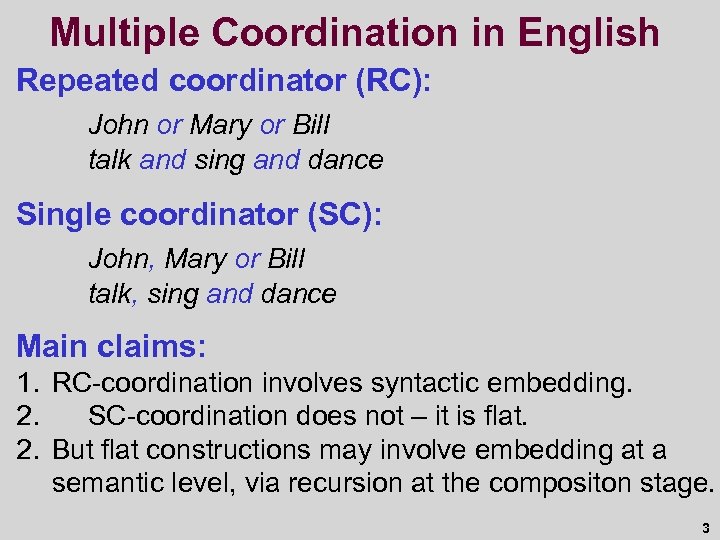 Multiple Coordination in English Repeated coordinator (RC): John or Mary or Bill talk and sing and dance Single coordinator (SC): John, Mary or Bill talk, sing and dance Main claims: 1. RC-coordination involves syntactic embedding. 2. SC-coordination does not – it is flat. 2. But flat constructions may involve embedding at a semantic level, via recursion at the compositon stage. 3
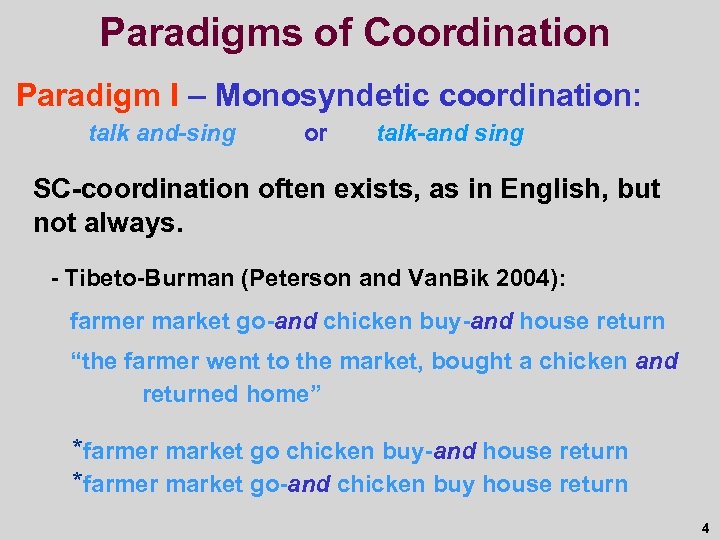 Paradigms of Coordination Paradigm I – Monosyndetic coordination: talk and-sing or talk-and sing SC-coordination often exists, as in English, but not always. - Tibeto-Burman (Peterson and Van. Bik 2004): farmer market go-and chicken buy-and house return “the farmer went to the market, bought a chicken and returned home” *farmer market go chicken buy-and house return *farmer market go-and chicken buy house return 4
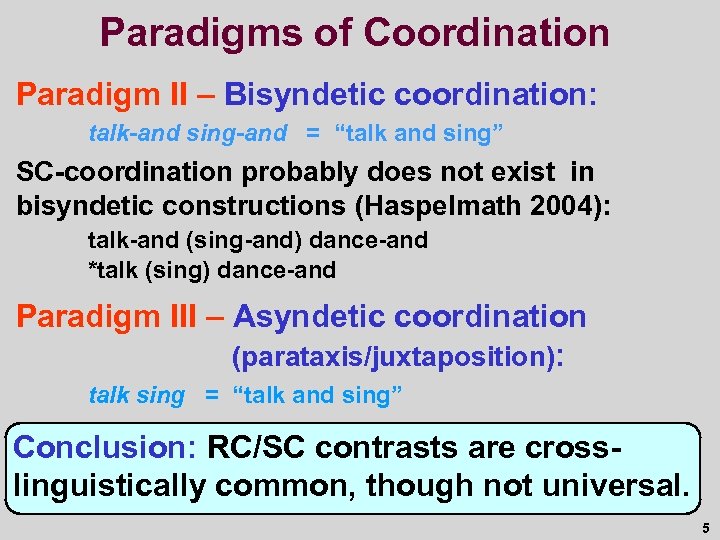 Paradigms of Coordination Paradigm II – Bisyndetic coordination: talk-and sing-and = “talk and sing” SC-coordination probably does not exist in bisyndetic constructions (Haspelmath 2004): talk-and (sing-and) dance-and *talk (sing) dance-and Paradigm III – Asyndetic coordination (parataxis/juxtaposition): talk sing = “talk and sing” Conclusion: RC/SC contrasts are crosslinguistically common, though not universal. 5
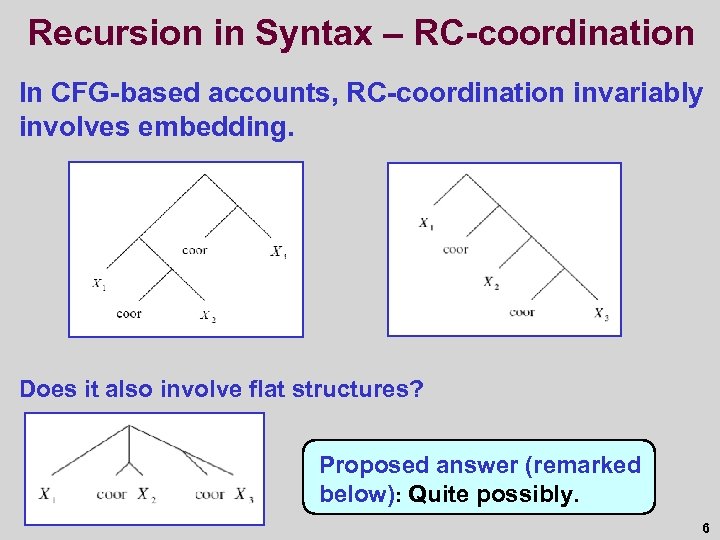 Recursion in Syntax – RC-coordination In CFG-based accounts, RC-coordination invariably involves embedding. Does it also involve flat structures? Proposed answer (remarked below): Quite possibly. 6
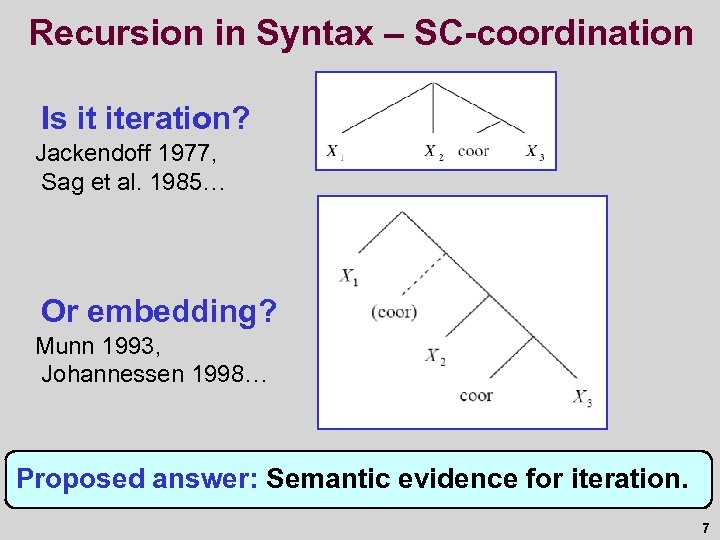 Recursion in Syntax – SC-coordination Is it iteration? Jackendoff 1977, Sag et al. 1985… Or embedding? Munn 1993, Johannessen 1998… Proposed answer: Semantic evidence for iteration. 7
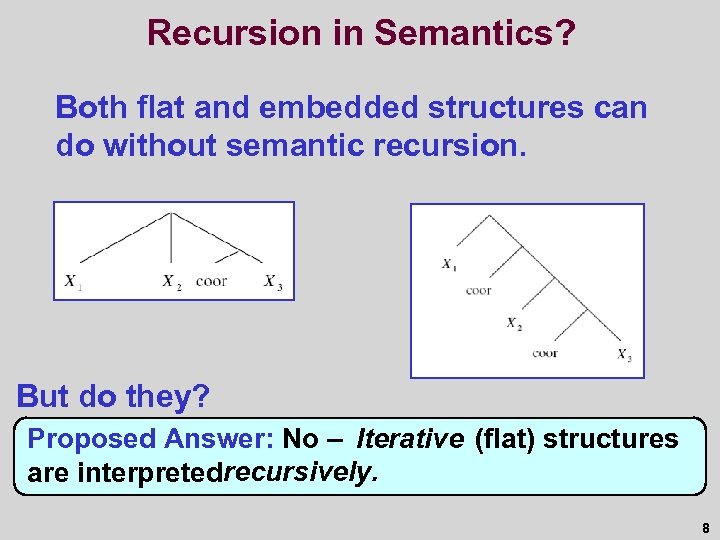 Recursion in Semantics? Both flat and embedded structures can do without semantic recursion. But do they? Proposed Answer: No – Iterative (flat) structures are interpretedrecursively. 8
 Syntax-Semantics of SC-coordination Talk Plan 1. SC-coordination needs flat syntaxsemantics interface. 2. But embedding is sometimes useful. 3. Solution: Syntax Semantics – – iterative recursive (flat) (embedded) 9
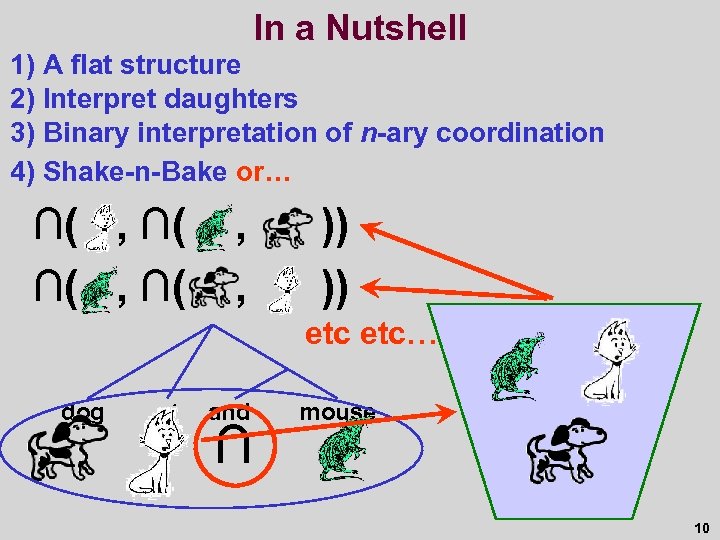 In a Nutshell 1) A flat structure 2) Interpret daughters 3) Binary interpretation of n-ary coordination 4) Shake-n-Bake or… ∩( , , )) )) etc… dog cat and ∩ mouse 10
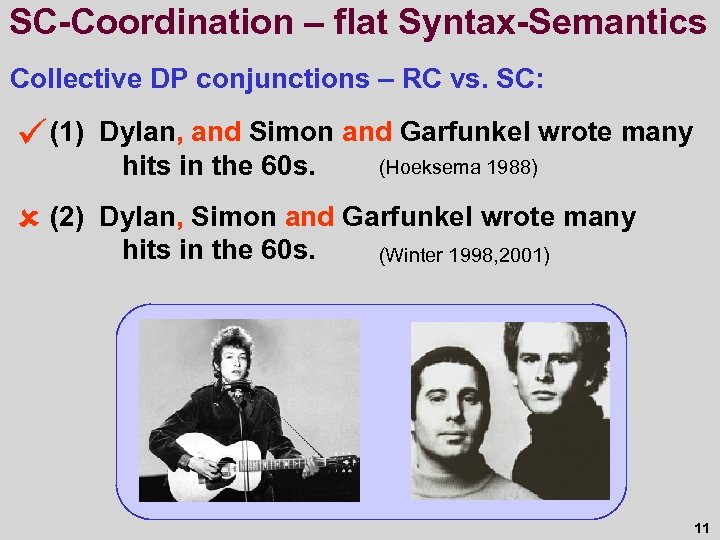 SC-Coordination – flat Syntax-Semantics Collective DP conjunctions – RC vs. SC: ü (1) Dylan, and Simon and Garfunkel wrote many (Hoeksema 1988) hits in the 60 s. û (2) Dylan, Simon and Garfunkel wrote many hits in the 60 s. (Winter 1998, 2001) 11
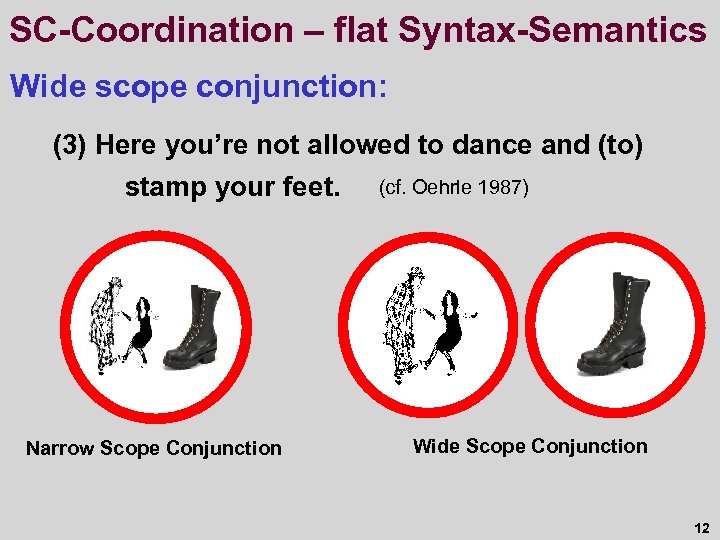 SC-Coordination – flat Syntax-Semantics Wide scope conjunction: (3) Here you’re not allowed to dance and (to) stamp your feet. Narrow Scope Conjunction (cf. Oehrle 1987) Wide Scope Conjunction 12
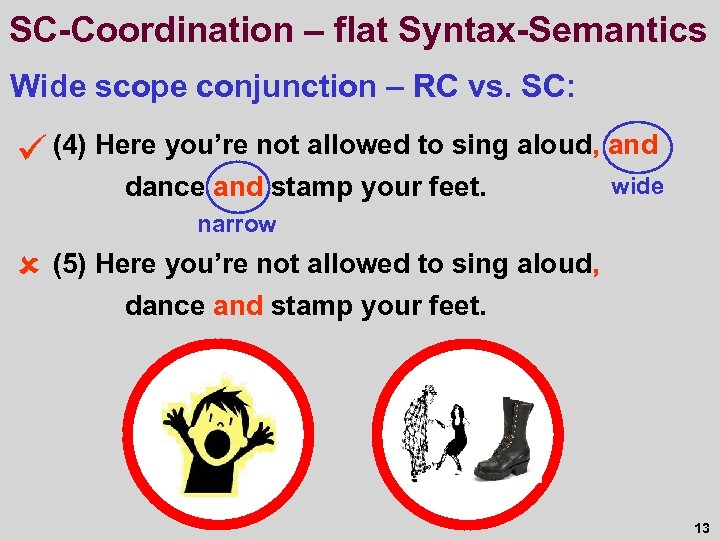 SC-Coordination – flat Syntax-Semantics Wide scope conjunction – RC vs. SC: ü (4) Here you’re not allowed to sing aloud, and dance and stamp your feet. wide narrow û (5) Here you’re not allowed to sing aloud, dance and stamp your feet. 13
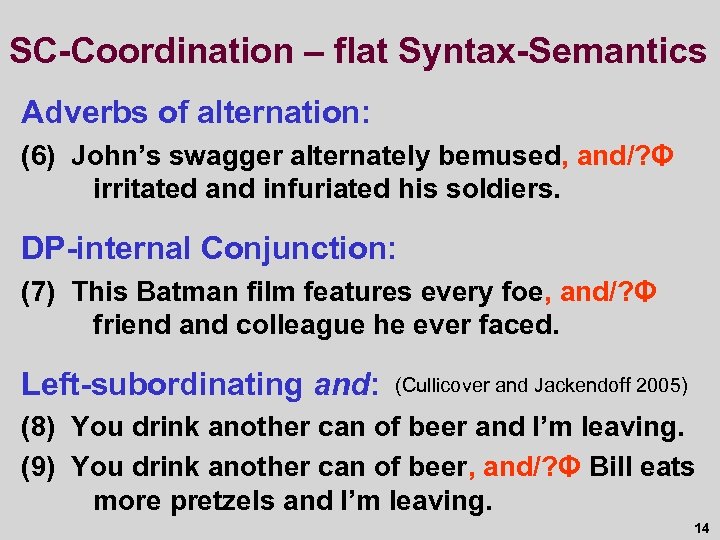 SC-Coordination – flat Syntax-Semantics Adverbs of alternation: (6) John’s swagger alternately bemused, and/? Φ irritated and infuriated his soldiers. DP-internal Conjunction: (7) This Batman film features every foe, and/? Φ friend and colleague he ever faced. Left-subordinating and: (Cullicover and Jackendoff 2005) (8) You drink another can of beer and I’m leaving. (9) You drink another can of beer, and/? Φ Bill eats more pretzels and I’m leaving. 14
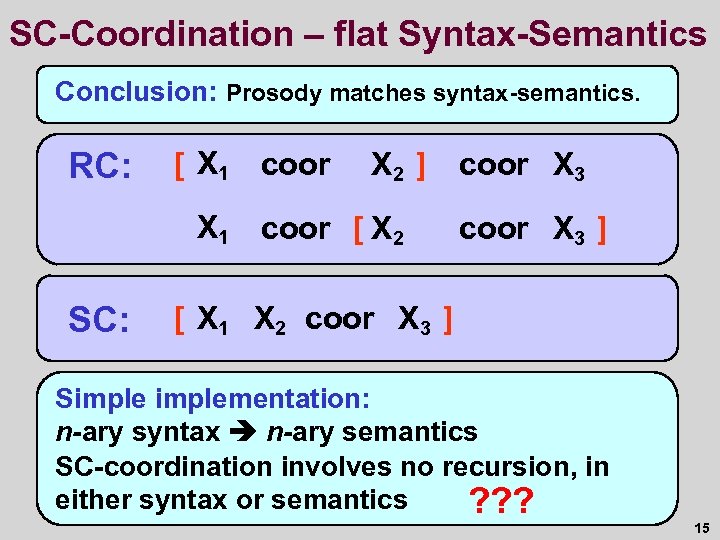 SC-Coordination – flat Syntax-Semantics Conclusion: Prosody matches syntax-semantics. RC: [ X 1 coor X 2 ] X 1 coor [ X 2 SC: coor X 3 ] [ X 1 X 2 coor X 3 ] Simplementation: n-ary syntax n-ary semantics SC-coordination involves no recursion, in either syntax or semantics ? ? ? 15
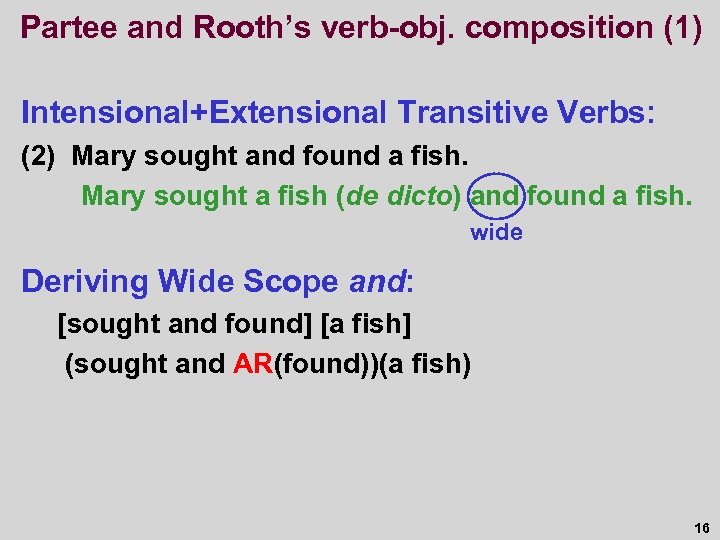 Partee and Rooth’s verb-obj. composition (1) Intensional+Extensional Transitive Verbs: (2) Mary sought and found a fish. Mary sought a fish (de dicto) and found a fish. wide Deriving Wide Scope and: [sought and found] [a fish] (sought and AR(found))(a fish) 16
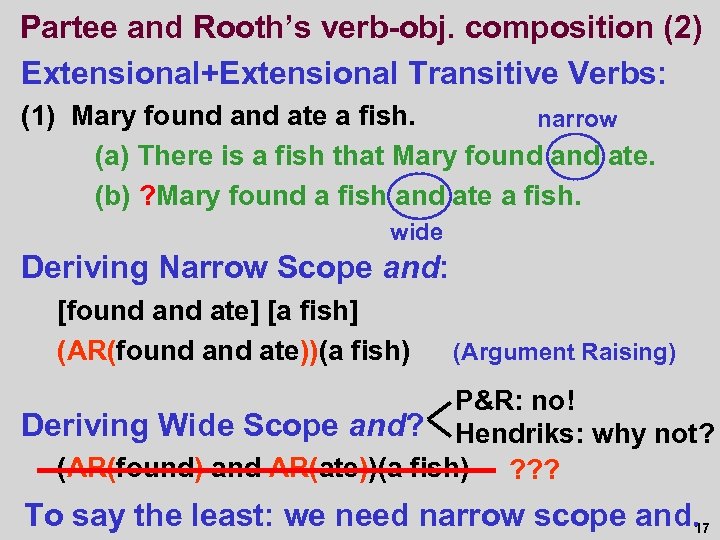 Partee and Rooth’s verb-obj. composition (2) Extensional+Extensional Transitive Verbs: (1) Mary found ate a fish. narrow (a) There is a fish that Mary found ate. (b) ? Mary found a fish and ate a fish. wide Deriving Narrow Scope and: [found ate] [a fish] (AR(found ate))(a fish) (Argument Raising) P&R: no! Deriving Wide Scope and? Hendriks: why not? (AR(found) and AR(ate))(a fish) ? ? ? To say the least: we need narrow scope and. 17
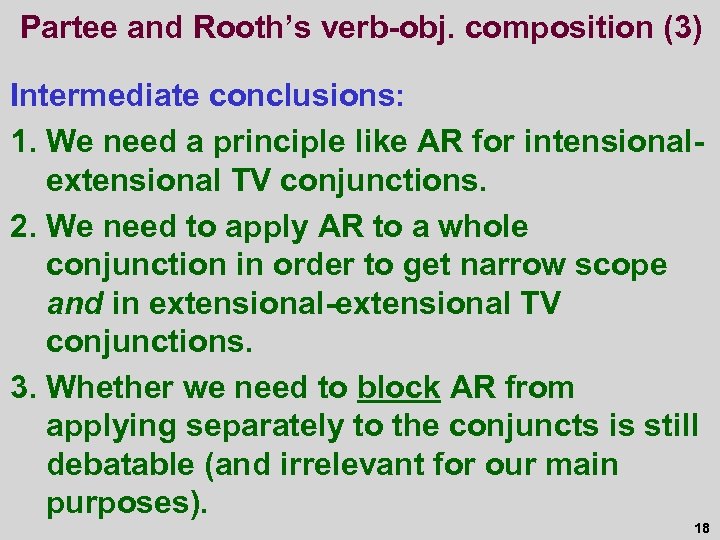 Partee and Rooth’s verb-obj. composition (3) Intermediate conclusions: 1. We need a principle like AR for intensionalextensional TV conjunctions. 2. We need to apply AR to a whole conjunction in order to get narrow scope and in extensional-extensional TV conjunctions. 3. Whether we need to block AR from applying separately to the conjuncts is still debatable (and irrelevant for our main purposes). 18
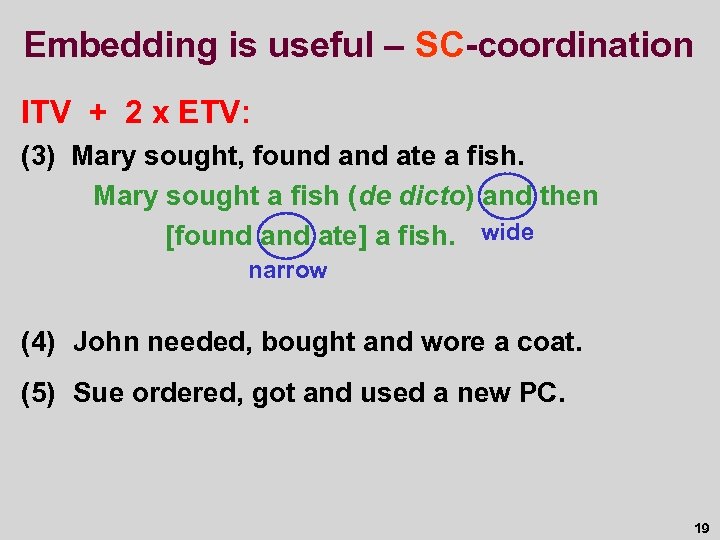 Embedding is useful – SC-coordination ITV + 2 x ETV: (3) Mary sought, found ate a fish. Mary sought a fish (de dicto) and then [found ate] a fish. wide narrow (4) John needed, bought and wore a coat. (5) Sue ordered, got and used a new PC. 19
![Embedding is useful – n-ary semantics fails [sought, found ate] N-ary analysis: and 3](https://present5.com/presentation/0c3e2bdba998557e64d319defd99c70b/image-20.jpg "Embedding is useful – n-ary semantics fails [sought, found ate] N-ary analysis: and 3") Embedding is useful – n-ary semantics fails [sought, found ate] N-ary analysis: and 3 (sought, AR(found), AR(ate)) = sought a fish, found a fish and ate a fish Back to P&R’s problem But a binary analysis would work fine: (sought and AR(found ate)) = sought a fish, [and found a fish and ate it] How can we get a binary interpretation in a trinary structure? 20
Embedding is useful – n-ary semantics fails [sought, found ate] N-ary analysis: and 3 (sought, AR(found), AR(ate)) = sought a fish, found a fish and ate a fish Back to P&R’s problem But a binary analysis would work fine: (sought and AR(found ate)) = sought a fish, [and found a fish and ate it] How can we get a binary interpretation in a trinary structure? 20
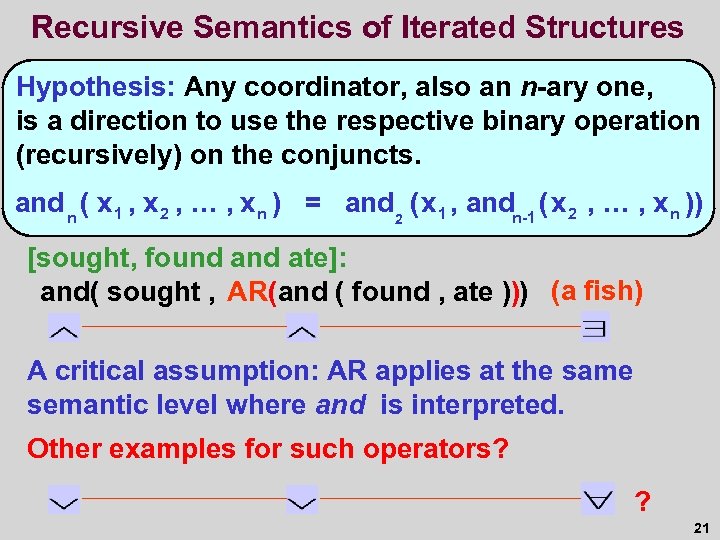 Recursive Semantics of Iterated Structures Hypothesis: Any coordinator, also an n-ary one, is a direction to use the respective binary operation (recursively) on the conjuncts. and n ( x 1 , x 2 , … , x n ) = and 2 ( x 1 , andn-1 ( x 2 , … , x n )) [sought, found ate]: and( sought , AR(and ( found , ate ))) (a fish) A critical assumption: AR applies at the same semantic level where and is interpreted. Other examples for such operators? ? 21
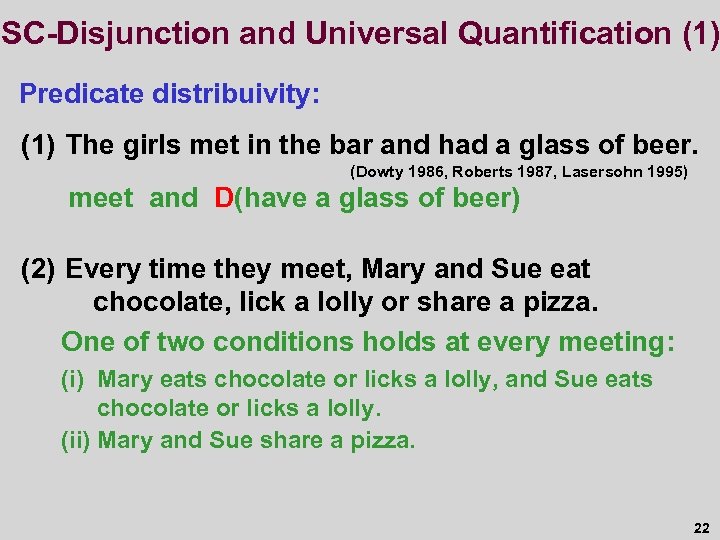 SC-Disjunction and Universal Quantification (1) Predicate distribuivity: (1) The girls met in the bar and had a glass of beer. (Dowty 1986, Roberts 1987, Lasersohn 1995) meet and D(have a glass of beer) (2) Every time they meet, Mary and Sue eat chocolate, lick a lolly or share a pizza. One of two conditions holds at every meeting: (i) Mary eats chocolate or licks a lolly, and Sue eats chocolate or licks a lolly. (ii) Mary and Sue share a pizza. 22
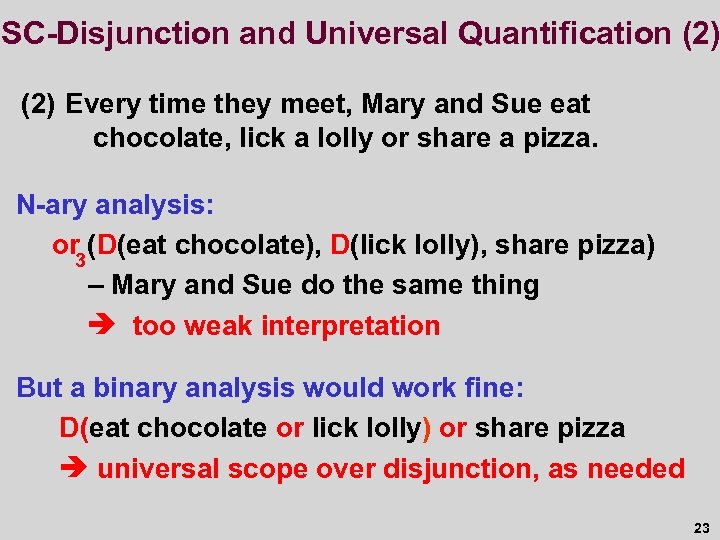 SC-Disjunction and Universal Quantification (2) Every time they meet, Mary and Sue eat chocolate, lick a lolly or share a pizza. N-ary analysis: or 3 (D(eat chocolate), D(lick lolly), share pizza) – Mary and Sue do the same thing too weak interpretation But a binary analysis would work fine: D(eat chocolate or lick lolly) or share pizza universal scope over disjunction, as needed 23
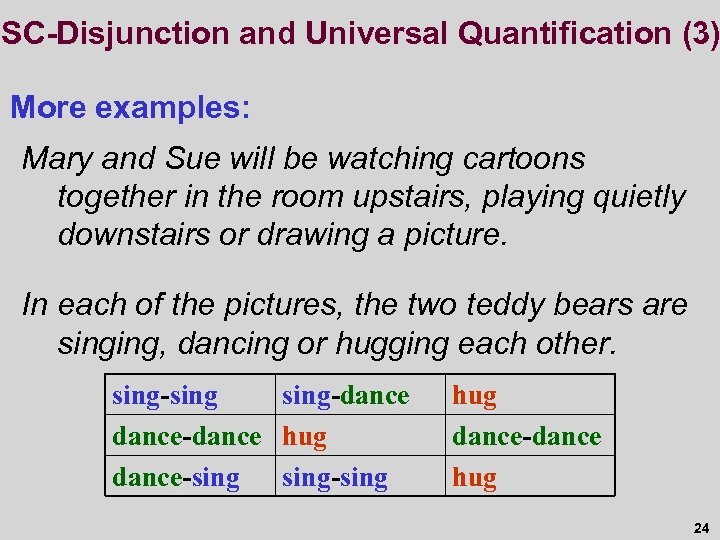 SC-Disjunction and Universal Quantification (3) More examples: Mary and Sue will be watching cartoons together in the room upstairs, playing quietly downstairs or drawing a picture. In each of the pictures, the two teddy bears are singing, dancing or hugging each other. sing-sing-dance-dance hug dance-sing-sing hug dance-dance hug 24
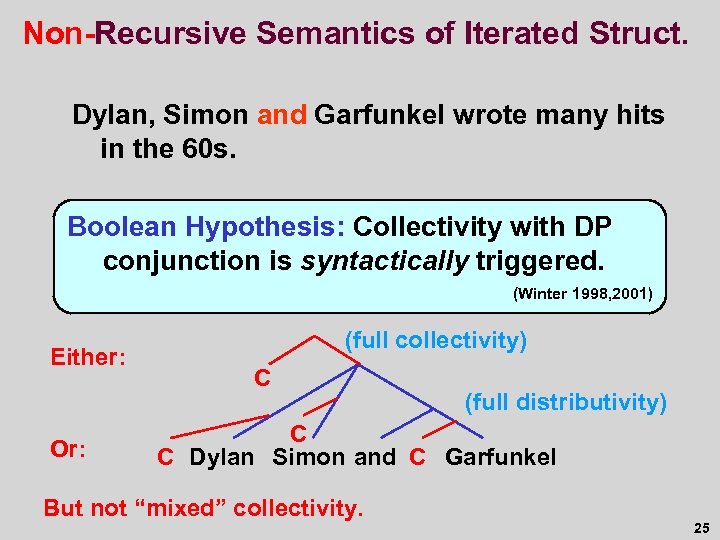 Non-Recursive Semantics of Iterated Struct. Dylan, Simon and Garfunkel wrote many hits in the 60 s. Boolean Hypothesis: Collectivity with DP conjunction is syntactically triggered. (Winter 1998, 2001) Either: Or: (full collectivity) C (full distributivity) C C Dylan Simon and C Garfunkel But not “mixed” collectivity. 25
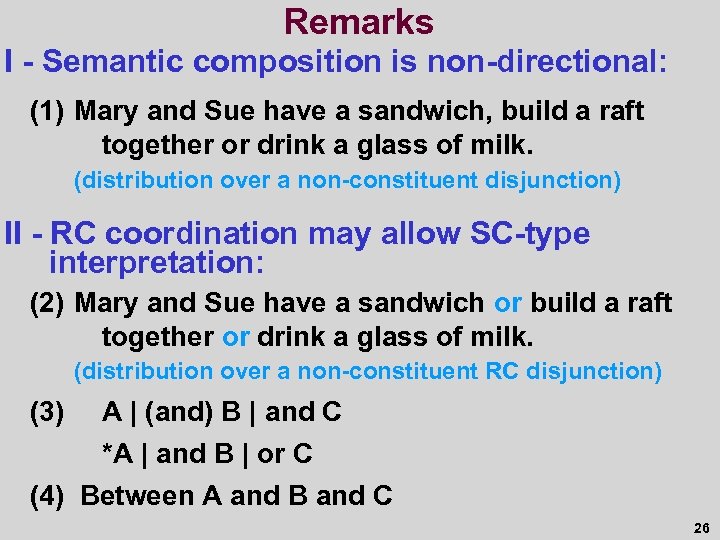 Remarks I - Semantic composition is non-directional: (1) Mary and Sue have a sandwich, build a raft together or drink a glass of milk. (distribution over a non-constituent disjunction) II - RC coordination may allow SC-type interpretation: (2) Mary and Sue have a sandwich or build a raft together or drink a glass of milk. (distribution over a non-constituent RC disjunction) (3) A | (and) B | and C *A | and B | or C (4) Between A and B and C 26
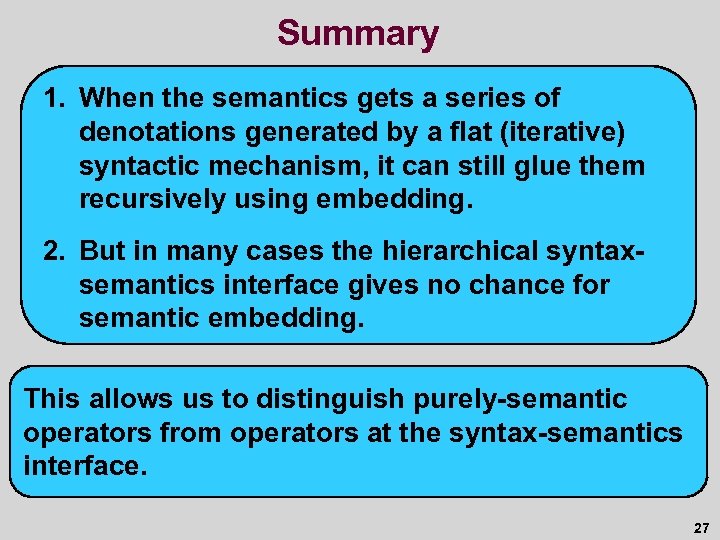 Summary 1. When the semantics gets a series of denotations generated by a flat (iterative) syntactic mechanism, it can still glue them recursively using embedding. 2. But in many cases the hierarchical syntaxsemantics interface gives no chance for semantic embedding. This allows us to distinguish purely-semantic operators from operators at the syntax-semantics interface. 27
 References Culicover, P. W. and Jackendoff, R. (2005). Simpler Syntax. Oxford University Press, Oxford. Dowty, D. (1986). Collective predicates, distributive predicates and all. In Proceedings of the Eastern States Conference on Linguistics, ESCOL 3. Cascadilla Press. Haspelmath, M. (2004). Coordinating constructions: an overview. In M. Haspelmath, editor, Coordinating Constructions. John Benjamins Publishing Company, Amsterdam/Philadelphia. Hauser, M. D. , N. Chomsky and W. T. Fitch (2002). The faculty of language: what is it, who has it, and how did it evolve? Science 298: 1569 -1579. Hendriks, H. (1993). Studied Flexibility: categories and types in syntax and semantics. Ph. D thesis, University of Amsterdam. Hoeksema, J. (1988). The semantics of non-boolean and. Journal of Semantics 6: 19 -40. Jackendoff, R. (1977). Xbar-Syntax: A study of phrase structure. MIT Press, Cambridge, Massachusetts. Johannessen, J. B. (1998). Coordination. Oxford University Press, New York/Oxford. Lasersohn, P. (1995). Plurality, Conjunction and Events. Kluwer, Dordrecht. Munn, A. (1993). Topics in the Syntax and Semantics of Coordinate Structures. Ph. D thesis, U. of Maryland. Oehrle, R. T. (1987). Boolean properties in the analysis of gapping. In G. J. Huck and A. E. Ojeda, editors, Syntax and Semantics (vol. 20) – Discontinuous Constituency. Academic Press, Orlando. Partee, B. and Rooth, M. (1983). Generalized conjunction and type ambiguity. In R. Bauerle et al, editors, Meaning, Use and Interpretation of Language. De Gruyter, Berlin. Peterson, D. A. and Van. Bik, K. (2004). Coordination in Hakha Lai (Tibeto-Burman). In M. Haspelmath, editor, Coordinating Constructions. John Benjamins Publishing Company, Amsterdam/Philadelphia. Roberts, C. (1987). Modal Subordination, Anaphora, and Distributivity. Ph. D thesis, UMass. Sag, I. , Gazdar, G. , Wasow, T. , and Weisler, S. (1985). Coordination and how to distinguish categories. Natural Language and Linguistic Theory 3: 117. 171. Winter, Y. (1998). Flexible Boolean Semantics: coordination, plurality and scope in natural language. Ph. D thesis, Utrecht University. Winter, Y. (2001). Flexibility Principles in Boolean Semantics: coordination, plurality and scope in 28 natural language. MIT Press, Cambridge, Massachusetts.