


 Скачать презентацию Multimedia content growth From IP networks to Medianets
f404502a07597a24f01af0a981187224.ppt
- Количество слайдов: 12
 Multimedia content growth: From IP networks to Medianets Cisco-IEEE Com. Soc Webinar. Sept. 23, 2009 Presented by: Alexandre Gerber AT&T Labs © 2009 AT&T Intellectual Property. All rights reserved.
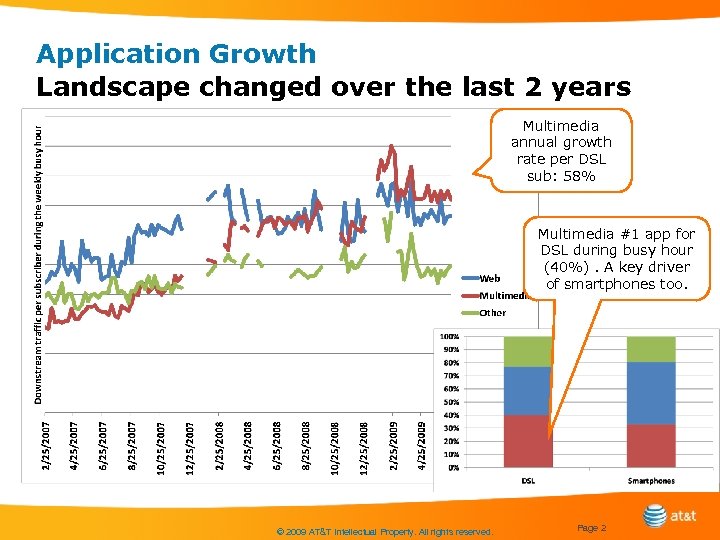 Application Growth Landscape changed over the last 2 years Multimedia annual growth rate per DSL sub: 58% Multimedia #1 app for DSL during busy hour (40%). A key driver of smartphones too. © 2009 AT&T Intellectual Property. All rights reserved. Page 2
 Medianet challenges • Demand Growth: How will networks evolve to handle the explosive growth in digital content? – IPTV/Vo. D vs. OTT content distribution path will impact solution – • Robustness and Operational Complexity: How to move from Network Management to Application Aware Network Management? – How to reconcile network performance and end user experience? – • Creating a seamless end user experience: – Video anywhere, anytime (TV/Internet/Wireless) Let’s focus on one of these questions: How will networks evolve to handle the explosive growth in multimedia content? © 2009 AT&T Intellectual Property. All rights reserved. Page 3
 Dealing with Multimedia Content Growth: Three Observations • Users don’t care where the server is Expect the return of hierarchical caching – Expect joint optimization of network and application layer: – • E. g. Anycast CDN Same observation driving Cloud Computing Video viewing will increasingly be “on demand” Expect “switched video” delivery rather than broadcast – Expect solutions that exploit multiple delivery techniques at network and application layer – • Opportunities for any solution that helps users manage information – What can the network do to support information dissemination and retrieval? © 2009 AT&T Intellectual Property. All rights reserved. Page 4
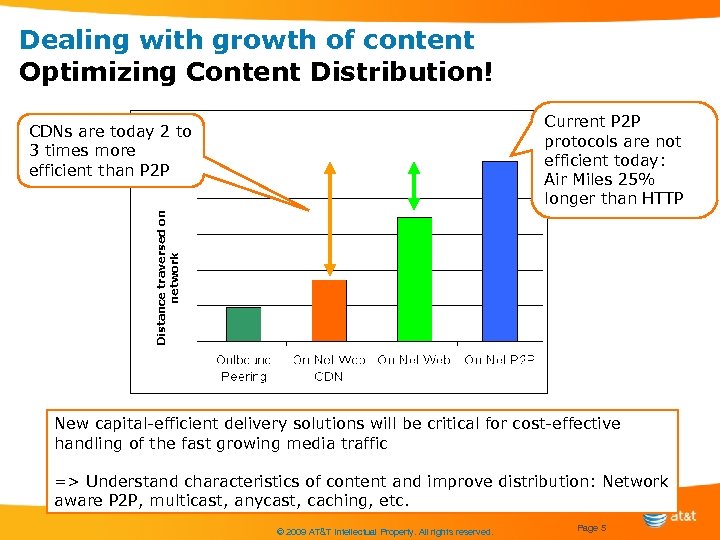 Dealing with growth of content Optimizing Content Distribution! Current P 2 P protocols are not efficient today: Air Miles 25% longer than HTTP Distance traversed on network CDNs are today 2 to 3 times more efficient than P 2 P New capital-efficient delivery solutions will be critical for cost-effective handling of the fast growing media traffic => Understand characteristics of content and improve distribution: Network aware P 2 P, multicast, anycast, caching, etc. © 2009 AT&T Intellectual Property. All rights reserved. Page 5
 Exploiting Multiple Delivery Mechanisms Unicast of requested content works well in certain situations • Low demand, sufficient resources • Requests for rare content • Unicast can provide quick response to user request – Can adapt quality to individual user’s bandwidth availability Multicast to large number of consumers can be very resourceefficient • Works well for popular content, especially with bursty and/or live requests • Inefficient for less popular content, requests spread out over time Peer-to-peer between user devices • Works well for download & view, without tight start-up latency • Good if upload bandwidth from user is large All of these mechanisms should be able to work cooperatively to achieve content distribution in an efficient and scalable manner © 2009 AT&T Intellectual Property. All rights reserved. Page 6
 The Next Generation Network as an Information Aggregator Multimedia content distribution: going one step further! • Users want information of interest to them • Publishers want to distribute information to interested parties • What can the network do to help? Tell the network to deliver “information” of interest (pub/sub) – Ask the network to find “information” of interest (query) – Ask the network what “information” I might be interested in (recommendation) – Manage micropayments, advertising, etc. – • Challenges – – – Scale: large number of producers and consumers Coverage: distributed, rather than “centralized” search engine Timeliness: users want some information NOW Opportunity for new overlay network for content routing. Network can become that key Information Aggregator! © 2009 AT&T Intellectual Property. All rights reserved. Page 7
 Application Aware Network Management Always an after thought… Medianet requires ISPs to move from Network Management to Application Aware Network Management. What does it mean? • The bottom line is the end user experience Need to convert network metrics into application performance • Networks need to provide these metrics • Need to isolate application performance issues Identify relevant information in the ocean of network measurements End to end approach from the servers to the network to the end device (e. g. STB) © 2009 AT&T Intellectual Property. All rights reserved. Page 8
 Conclusion • Multimedia Content growth is driving network evolution • Content hybrid delivery solutions will take advantage of information across layer boundaries Network-aware applications – Application-aware networks – • The network will have the opportunity to become the information aggregator – • Scalable solution to the problem of “who to tell” and “who to ask” Medianets should not forget Media. Network. Management! © 2009 AT&T Intellectual Property. All rights reserved. Page 9
 Backup © 2009 AT&T Intellectual Property. All rights reserved. Page
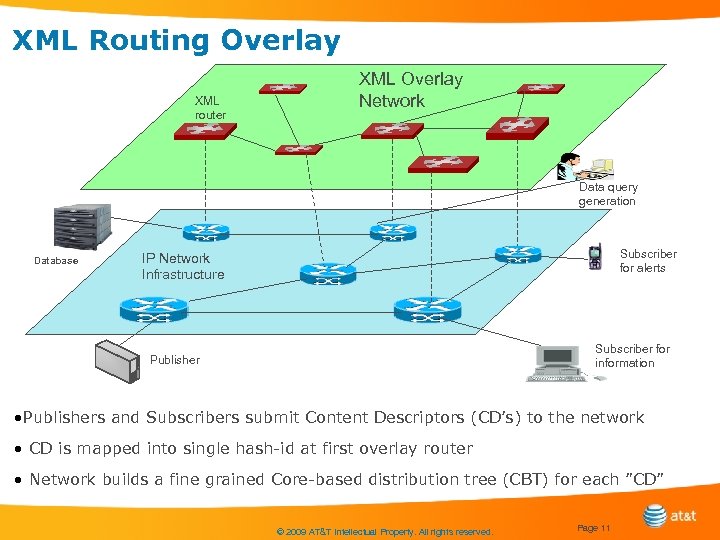 XML Routing Overlay XML router XML Overlay Network Data query generation Database Subscriber for alerts IP Network Infrastructure Subscriber for information Publisher • Publishers and Subscribers submit Content Descriptors (CD’s) to the network • CD is mapped into single hash-id at first overlay router • Network builds a fine grained Core-based distribution tree (CBT) for each ”CD” © 2009 AT&T Intellectual Property. All rights reserved. Page 11
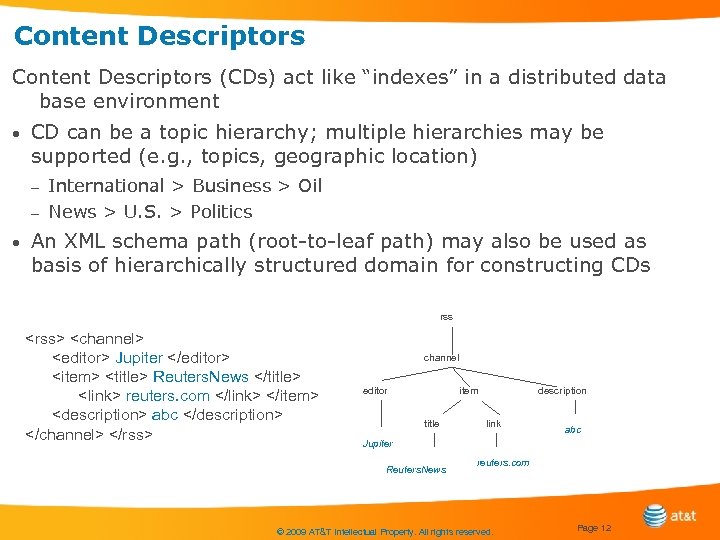 Content Descriptors (CDs) act like “indexes” in a distributed data base environment • CD can be a topic hierarchy; multiple hierarchies may be supported (e. g. , topics, geographic location) International > Business > Oil – News > U. S. > Politics – • An XML schema path (root-to-leaf path) may also be used as basis of hierarchically structured domain for constructing CDs rss