


 Скачать презентацию Multilingualism and Optimal Language Policy in the EU
3ae4c33b7e3bb3286892a326d54bd34e.ppt
- Количество слайдов: 88
 Multilingualism and Optimal Language Policy in the EU Jan Fidrmuc Brunel University
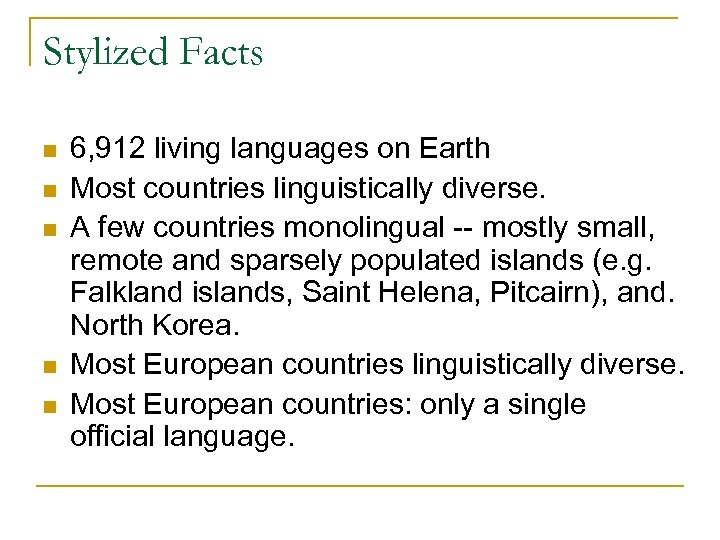 Stylized Facts n n n 6, 912 living languages on Earth Most countries linguistically diverse. A few countries monolingual -- mostly small, remote and sparsely populated islands (e. g. Falkland islands, Saint Helena, Pitcairn), and. North Korea. Most European countries linguistically diverse. Most European countries: only a single official language.
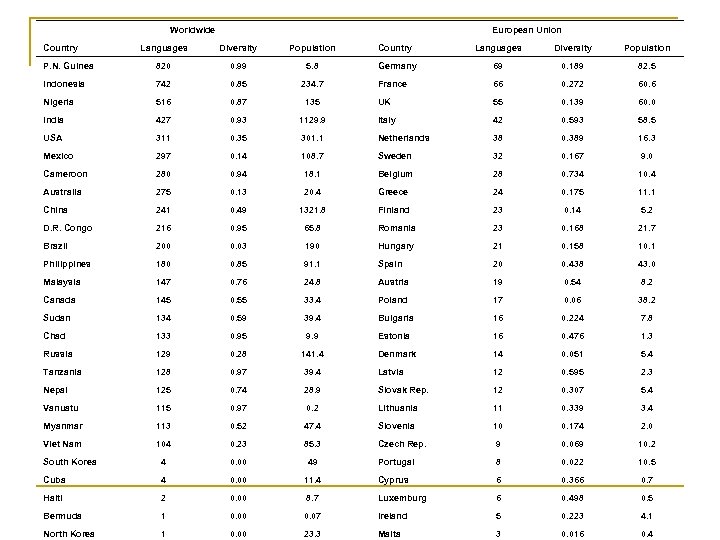 Worldwide Country European Union Languages Diversity Population Country Languages Diversity Population P. N. Guinea 820 0. 99 5. 8 Germany 69 0. 189 82. 5 Indonesia 742 0. 85 234. 7 France 66 0. 272 60. 6 Nigeria 516 0. 87 135 UK 55 0. 139 60. 0 India 427 0. 93 1129. 9 Italy 42 0. 593 58. 5 USA 311 0. 35 301. 1 Netherlands 38 0. 389 16. 3 Mexico 297 0. 14 108. 7 Sweden 32 0. 167 9. 0 Cameroon 280 0. 94 18. 1 Belgium 28 0. 734 10. 4 Australia 275 0. 13 20. 4 Greece 24 0. 175 11. 1 China 241 0. 49 1321. 8 Finland 23 0. 14 5. 2 D. R. Congo 216 0. 95 65. 8 Romania 23 0. 168 21. 7 Brazil 200 0. 03 190 Hungary 21 0. 158 10. 1 Philippines 180 0. 85 91. 1 Spain 20 0. 438 43. 0 Malaysia 147 0. 76 24. 8 Austria 19 0. 54 8. 2 Canada 145 0. 55 33. 4 Poland 17 0. 06 38. 2 Sudan 134 0. 59 39. 4 Bulgaria 16 0. 224 7. 8 Chad 133 0. 95 9. 9 Estonia 16 0. 476 1. 3 Russia 129 0. 28 141. 4 Denmark 14 0. 051 5. 4 Tanzania 128 0. 97 39. 4 Latvia 12 0. 595 2. 3 Nepal 125 0. 74 28. 9 Slovak Rep. 12 0. 307 5. 4 Vanuatu 115 0. 97 0. 2 Lithuania 11 0. 339 3. 4 Myanmar 113 0. 52 47. 4 Slovenia 10 0. 174 2. 0 Viet Nam 104 0. 23 85. 3 Czech Rep. 9 0. 069 10. 2 South Korea 4 0. 00 49 Portugal 8 0. 022 10. 5 Cuba 4 0. 00 11. 4 Cyprus 6 0. 366 0. 7 Haiti 2 0. 00 8. 7 Luxemburg 6 0. 498 0. 5 Bermuda 1 0. 00 0. 07 Ireland 5 0. 223 4. 1 North Korea 1 0. 00 23. 3 Malta 3 0. 016 0. 4
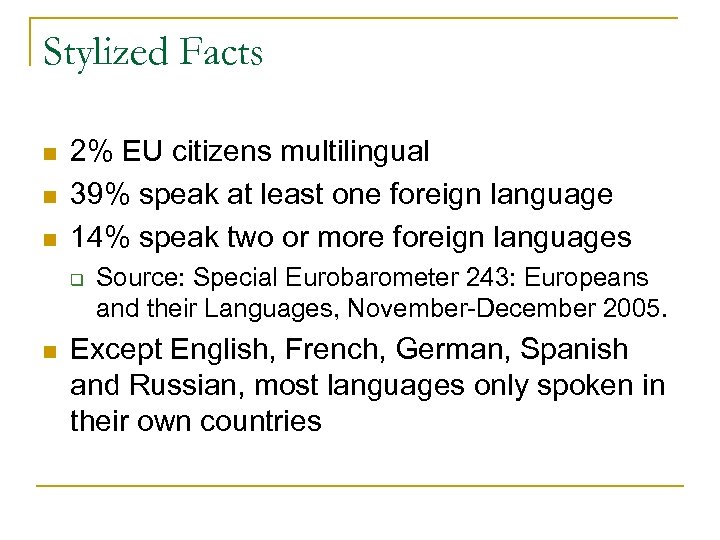 Stylized Facts n n n 2% EU citizens multilingual 39% speak at least one foreign language 14% speak two or more foreign languages q n Source: Special Eurobarometer 243: Europeans and their Languages, November-December 2005. Except English, French, German, Spanish and Russian, most languages only spoken in their own countries
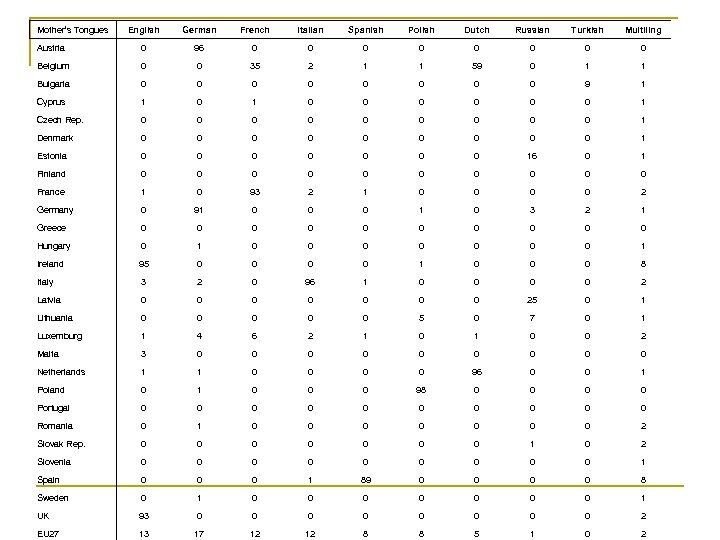 Mother’s Tongues English German French Italian Spanish Polish Dutch Russian Turkish Multiling Austria 0 96 0 0 0 0 Belgium 0 0 35 2 1 1 59 0 1 1 Bulgaria 0 0 0 0 9 1 Cyprus 1 0 0 0 0 1 Czech Rep. 0 0 0 0 0 1 Denmark 0 0 0 0 0 1 Estonia 0 0 0 0 16 0 1 Finland 0 0 0 0 0 France 1 0 93 2 1 0 0 2 Germany 0 91 0 0 0 1 0 3 2 1 Greece 0 0 0 0 0 Hungary 0 1 0 0 0 0 1 Ireland 95 0 0 1 0 0 0 8 Italy 3 2 0 96 1 0 0 2 Latvia 0 0 0 0 25 0 1 Lithuania 0 0 0 5 0 7 0 1 Luxemburg 1 4 6 2 1 0 0 2 Malta 3 0 0 0 0 0 Netherlands 1 1 0 0 96 0 0 1 Poland 0 1 0 0 0 98 0 0 Portugal 0 0 0 0 0 Romania 0 1 0 0 0 0 2 Slovak Rep. 0 0 0 0 1 0 2 Slovenia 0 0 0 0 0 1 Spain 0 0 0 1 89 0 0 8 Sweden 0 1 0 0 0 0 1 UK 93 0 0 0 0 2 EU 27 13 17 12 12 8 8 5 1 0 2
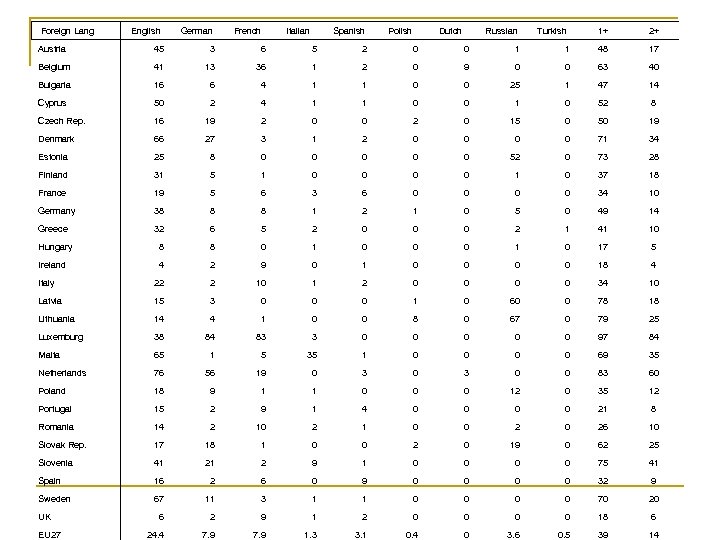 Foreign Lang English German French Italian Spanish Polish Dutch Russian Turkish 1+ 2+ Austria 45 3 6 5 2 0 0 1 1 48 17 Belgium 41 13 36 1 2 0 9 0 0 63 40 Bulgaria 16 6 4 1 1 0 0 25 1 47 14 Cyprus 50 2 4 1 1 0 0 1 0 52 8 Czech Rep. 16 19 2 0 0 2 0 15 0 50 19 Denmark 66 27 3 1 2 0 0 71 34 Estonia 25 8 0 0 0 52 0 73 28 Finland 31 5 1 0 0 1 0 37 18 France 19 5 6 3 6 0 0 34 10 Germany 38 8 8 1 2 1 0 5 0 49 14 Greece 32 6 5 2 0 0 0 2 1 41 10 Hungary 8 8 0 1 0 0 0 17 5 Ireland 4 2 9 0 1 0 0 18 4 Italy 22 2 10 1 2 0 0 34 10 Latvia 15 3 0 0 0 1 0 60 0 78 18 Lithuania 14 4 1 0 0 8 0 67 0 79 25 Luxemburg 38 84 83 3 0 0 0 97 84 Malta 65 1 5 35 1 0 0 69 35 Netherlands 76 56 19 0 3 0 0 83 60 Poland 18 9 1 1 0 0 0 12 0 35 12 Portugal 15 2 9 1 4 0 0 21 8 Romania 14 2 10 2 1 0 0 26 10 Slovak Rep. 17 18 1 0 0 2 0 19 0 62 25 Slovenia 41 21 2 9 1 0 0 75 41 Spain 16 2 6 0 9 0 0 32 9 Sweden 67 11 3 1 1 0 0 70 20 6 2 9 1 2 0 0 18 6 24. 4 7. 9 1. 3 3. 1 0. 4 0 3. 6 0. 5 39 14 UK EU 27
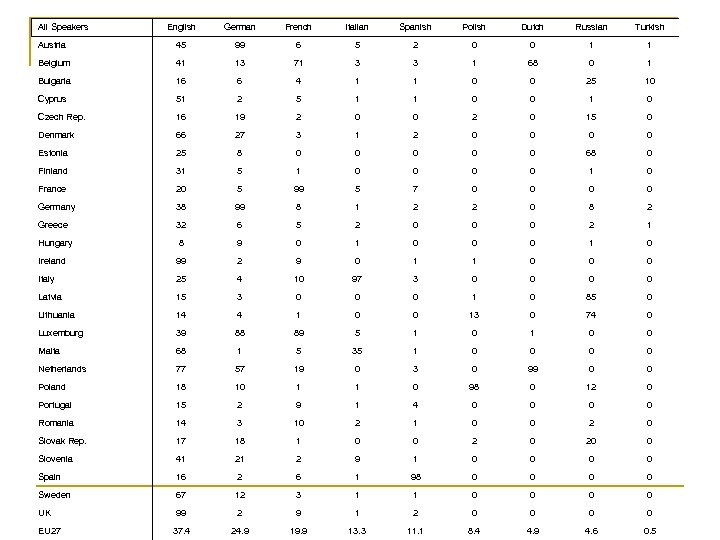 All Speakers English German French Italian Spanish Polish Dutch Russian Turkish Austria 45 99 6 5 2 0 0 1 1 Belgium 41 13 71 3 3 1 68 0 1 Bulgaria 16 6 4 1 1 0 0 25 10 Cyprus 51 2 5 1 1 0 0 1 0 Czech Rep. 16 19 2 0 0 2 0 15 0 Denmark 66 27 3 1 2 0 0 Estonia 25 8 0 0 0 68 0 Finland 31 5 1 0 0 1 0 France 20 5 99 5 7 0 0 Germany 38 99 8 1 2 2 0 8 2 Greece 32 6 5 2 0 0 0 2 1 Hungary 8 9 0 1 0 0 0 1 0 Ireland 99 2 9 0 1 1 0 0 0 Italy 25 4 10 97 3 0 0 Latvia 15 3 0 0 0 1 0 85 0 Lithuania 14 4 1 0 0 13 0 74 0 Luxemburg 39 88 89 5 1 0 0 Malta 68 1 5 35 1 0 0 Netherlands 77 57 19 0 3 0 99 0 0 Poland 18 10 1 1 0 98 0 12 0 Portugal 15 2 9 1 4 0 0 Romania 14 3 10 2 1 0 0 2 0 Slovak Rep. 17 18 1 0 0 20 0 Slovenia 41 21 2 9 1 0 0 Spain 16 2 6 1 98 0 0 Sweden 67 12 3 1 1 0 0 UK 99 2 9 1 2 0 0 37. 4 24. 9 19. 9 13. 3 11. 1 8. 4 4. 9 4. 6 0. 5 EU 27
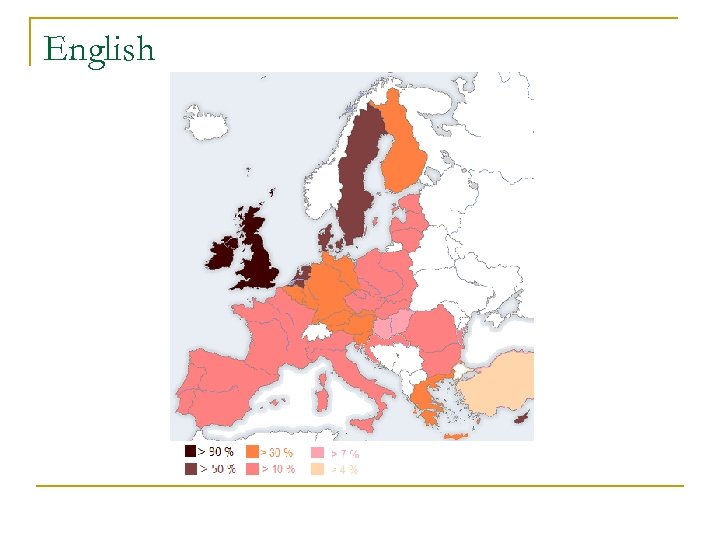 English
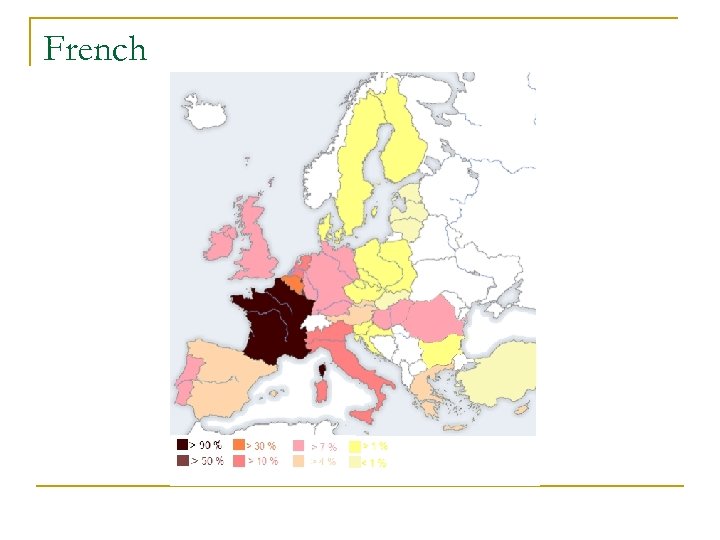 French
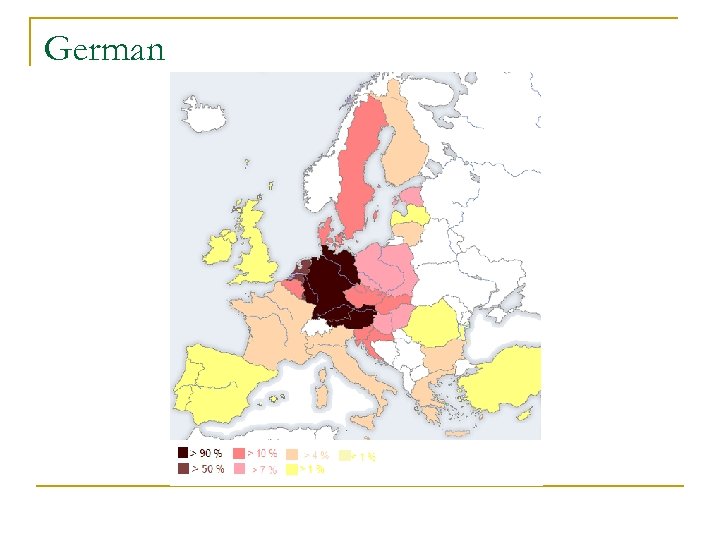 German
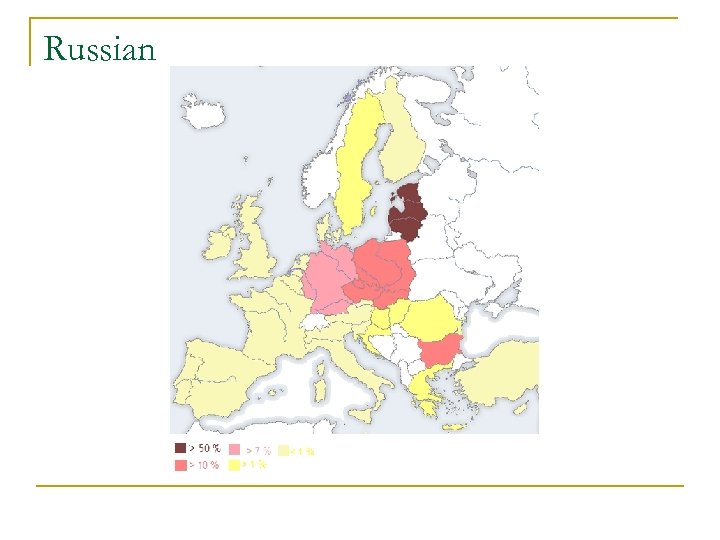 Russian
 Stylized Facts n n Large differences across age cohorts Only English seems to improve its relative standing over time
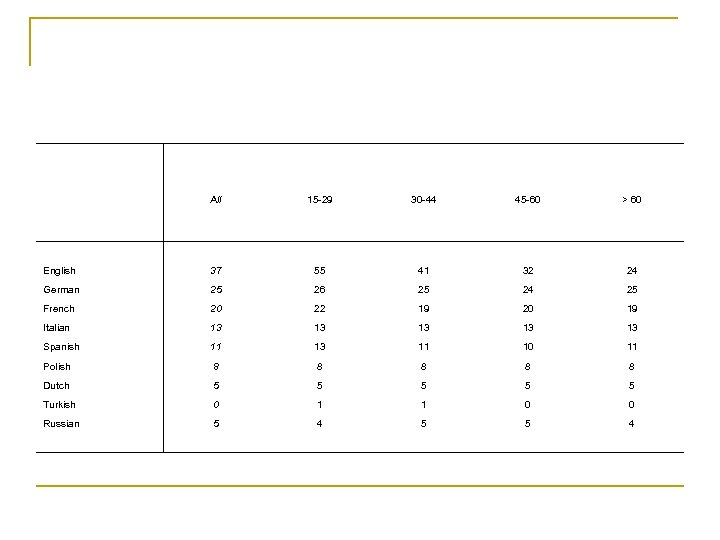 All 15 -29 30 -44 45 -60 > 60 English 37 55 41 32 24 German 25 26 25 24 25 French 20 22 19 20 19 Italian 13 13 13 Spanish 11 13 11 10 11 Polish 8 8 8 Dutch 5 5 5 Turkish 0 1 1 0 0 Russian 5 4 5 5 4
 Stylized Facts: Attitudes n 67% Europeans think English is a useful language for one's personal development and career q q n 22 -25% think so of German or French 10% think no language is useful The opinions on which languages children should learn are very similar q 2% think children should learn no foreign language
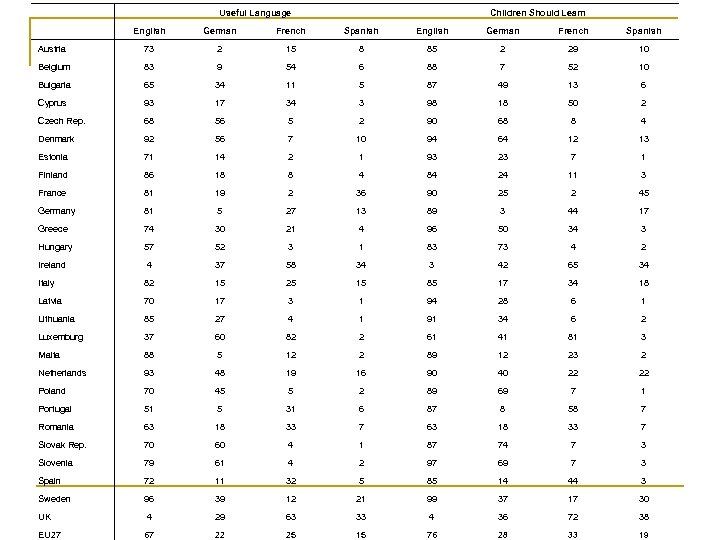 Useful Language Children Should Learn English German French Spanish Austria 73 2 15 8 85 2 29 10 Belgium 83 9 54 6 88 7 52 10 Bulgaria 65 34 11 5 87 49 13 6 Cyprus 93 17 34 3 98 18 50 2 Czech Rep. 68 56 5 2 90 68 8 4 Denmark 92 56 7 10 94 64 12 13 Estonia 71 14 2 1 93 23 7 1 Finland 86 18 8 4 84 24 11 3 France 81 19 2 36 90 25 2 45 Germany 81 5 27 13 89 3 44 17 Greece 74 30 21 4 96 50 34 3 Hungary 57 52 3 1 83 73 4 2 Ireland 4 37 58 34 3 42 65 34 Italy 82 15 25 15 85 17 34 18 Latvia 70 17 3 1 94 28 6 1 Lithuania 85 27 4 1 91 34 6 2 Luxemburg 37 60 82 2 61 41 81 3 Malta 88 5 12 2 89 12 23 2 Netherlands 93 48 19 16 90 40 22 22 Poland 70 45 5 2 89 69 7 1 Portugal 51 5 31 6 87 8 58 7 Romania 63 18 33 7 Slovak Rep. 70 60 4 1 87 74 7 3 Slovenia 79 61 4 2 97 69 7 3 Spain 72 11 32 5 85 14 44 3 Sweden 96 39 12 21 99 37 17 30 UK 4 29 63 33 4 36 72 38 EU 27 67 22 25 15 76 28 33 19

 EU Multilingualism and Optimal Language Policy n 1. 2. 3. 4. 5. Outline Multilingualism in the EU Simple model of linguistic-policy choice Cost per language person: average cost vs cost per disenfranchised person Optimal sequence of official languages Political economy of a linguistic reform
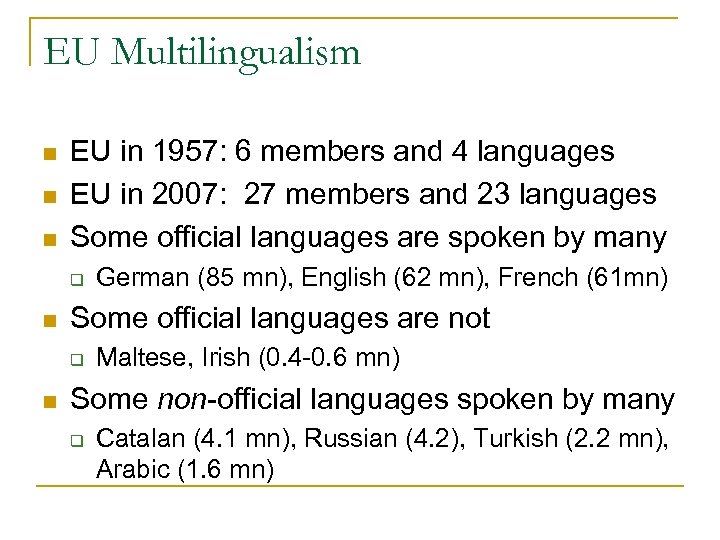 EU Multilingualism n n n EU in 1957: 6 members and 4 languages EU in 2007: 27 members and 23 languages Some official languages are spoken by many q n Some official languages are not q n German (85 mn), English (62 mn), French (61 mn) Maltese, Irish (0. 4 -0. 6 mn) Some non-official languages spoken by many q Catalan (4. 1 mn), Russian (4. 2), Turkish (2. 2 mn), Arabic (1. 6 mn)
 EU Multilingualism: Implications n n n EU treaties, regulations and decisions must be translated into all official languages Most documents are prepared in English (62%), French (26%) or German (3%) Translation: 1. 3 million pages per year (2002) q n 2710 translators and additional 1900 other staff Interpretation: 50 -60 meetings per day with 160 interpreters per meeting q 962 interpreters, plus 200 other staff

 EU Multilingualism: Implications n n n Long backlog of documents to be translated Relay translations increasingly used MEPs are asked to use simple sentences and to avoid making jokes
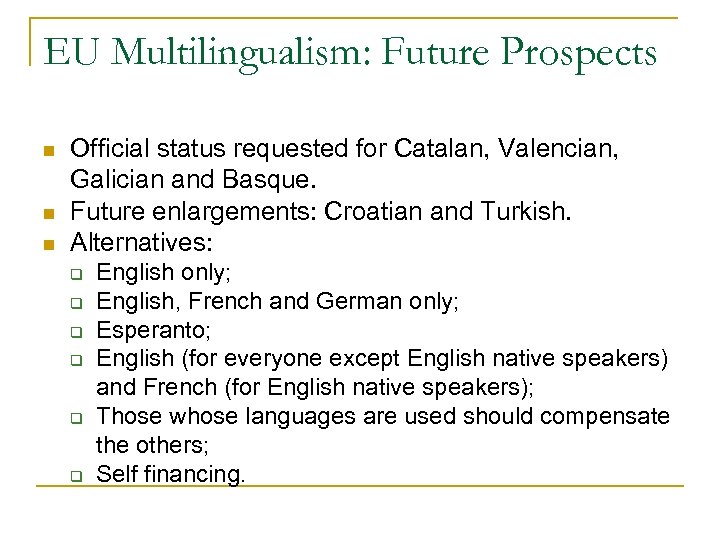 EU Multilingualism: Future Prospects n n n Official status requested for Catalan, Valencian, Galician and Basque. Future enlargements: Croatian and Turkish. Alternatives: q q q English only; English, French and German only; Esperanto; English (for everyone except English native speakers) and French (for English native speakers); Those whose languages are used should compensate the others; Self financing.
 EU Multilingualism n n n Language policy should facilitate communication effectively and efficiently Most nation-states implement restrictive language policy: single language typical EU: extensive multilingualism This is effective but is it also efficient? Costs and benefits need to be considered
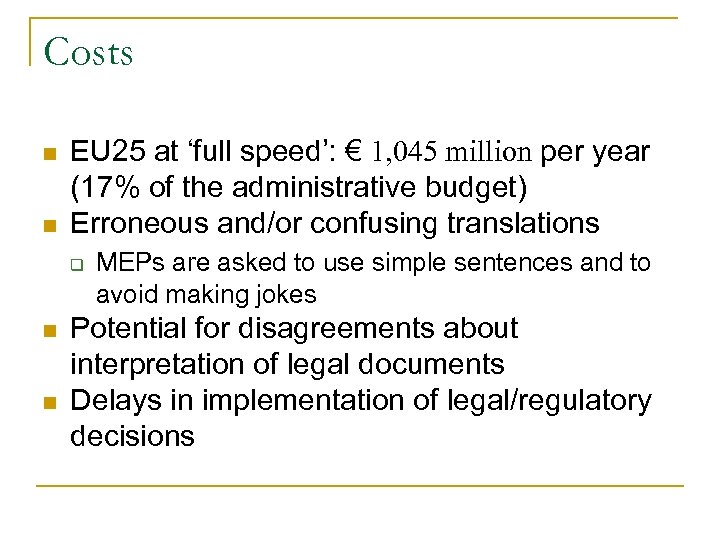 Costs n n EU 25 at ‘full speed’: € 1, 045 million per year (17% of the administrative budget) Erroneous and/or confusing translations q n n MEPs are asked to use simple sentences and to avoid making jokes Potential for disagreements about interpretation of legal documents Delays in implementation of legal/regulatory decisions
 Benefits: Preventing Linguistic Disenfranchisement n n A person is linguistically disenfranchised (excluded) if the EU does not use a language that they understand Not all languages are equal: some are more popular than others q n Special Eurobaromenter 255: Europeans and their Languages, 2005 Optimal language policy needs to reflect this
 Model of Language Policy Choice n Union with n linguistic groups q q n Public good q q q n n Language-dependent Provided in a core language Subsequently translated into other languages. Translation can be full or partial q n Population of group j is Nj Population of the union is N= Nj. j ranges between 0 and 1 Utility from receiving in one’s own language: U( j), U’( j)>0 and U’’( j)<0 Translation is costly: Cj=c j, c>0
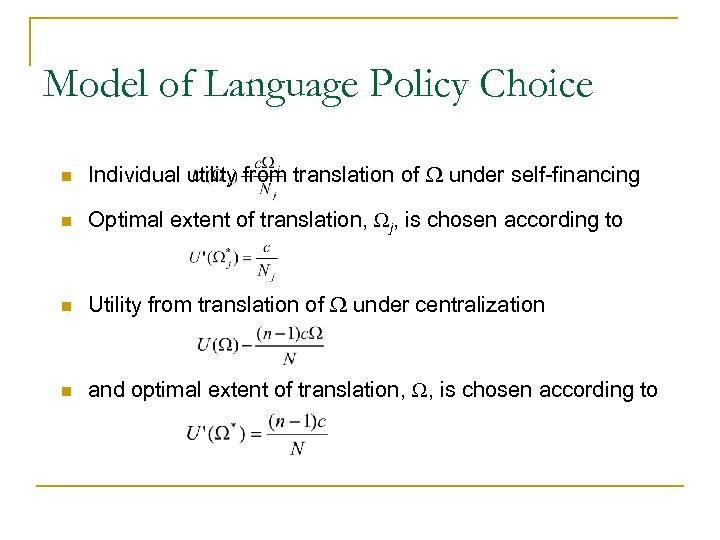 Model of Language Policy Choice n Individual utility from translation of under self-financing n Optimal extent of translation, j, is chosen according to n Utility from translation of under centralization n and optimal extent of translation, , is chosen according to
 Model of Language Policy Choice 1. If all groups are equally sized, full sharing is preferred by all (except the core-language group): 2. Optimal extent of translation regime depends on group size: full sharing results in over-provision of translation for small groups and under-provision for large groups. 3. Groups of below-average size prefer full-sharing while above-average ones prefer self-financing.
 Data on Language Proficiency n n n Eurobaromenter 54: Special survey on languages, 2000. Candidate Countries Eurobarometer, 2001. Special Eurobaromenter 255: Europeans and their Languages, 2005 Respondents asked about mother’s tongue and other languages that they speak well Nationally representative surveys q we can extrapolate to get the number of speakers of different languages in EU countries
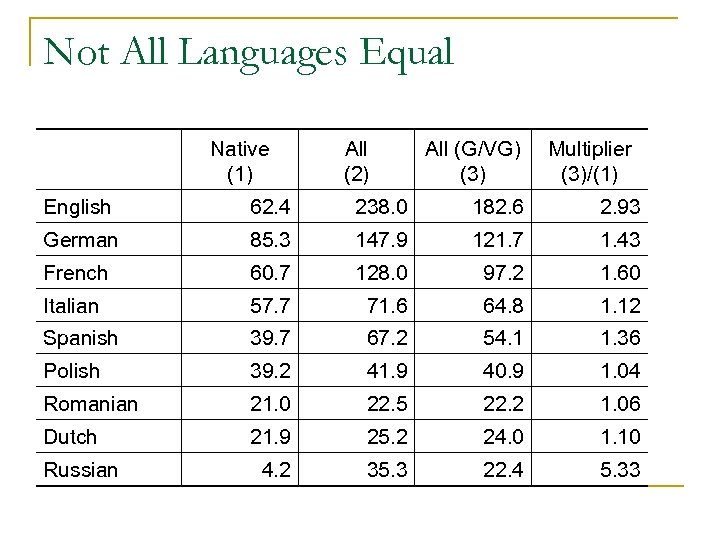 Not All Languages Equal Native (1) All (2) All (G/VG) (3) Multiplier (3)/(1) English 62. 4 238. 0 182. 6 2. 93 German 85. 3 147. 9 121. 7 1. 43 French 60. 7 128. 0 97. 2 1. 60 Italian 57. 7 71. 6 64. 8 1. 12 Spanish 39. 7 67. 2 54. 1 1. 36 Polish 39. 2 41. 9 40. 9 1. 04 Romanian 21. 0 22. 5 22. 2 1. 06 Dutch 21. 9 25. 2 24. 0 1. 10 4. 2 35. 3 22. 4 5. 33 Russian
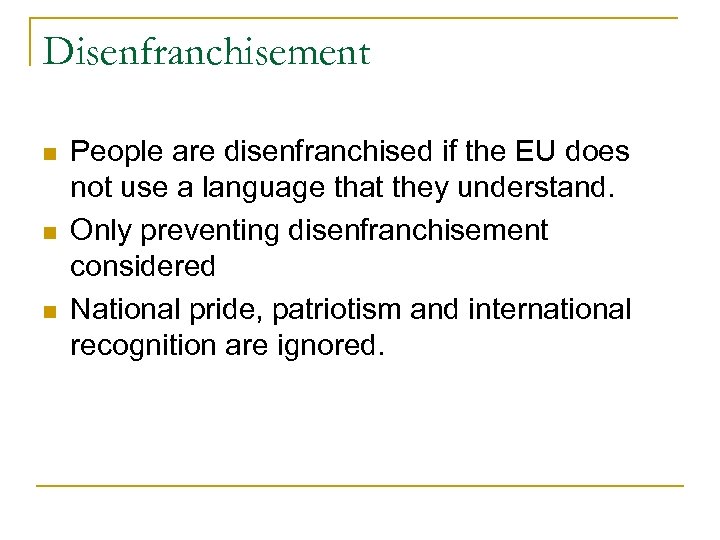 Disenfranchisement n n n People are disenfranchised if the EU does not use a language that they understand. Only preventing disenfranchisement considered National pride, patriotism and international recognition are ignored.
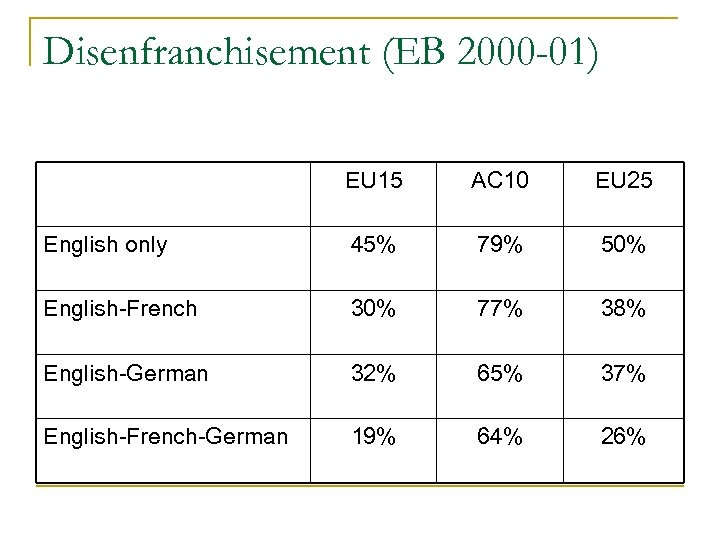 Disenfranchisement (EB 2000 -01) EU 15 AC 10 EU 25 English only 45% 79% 50% English-French 30% 77% 38% English-German 32% 65% 37% English-French-German 19% 64% 26%
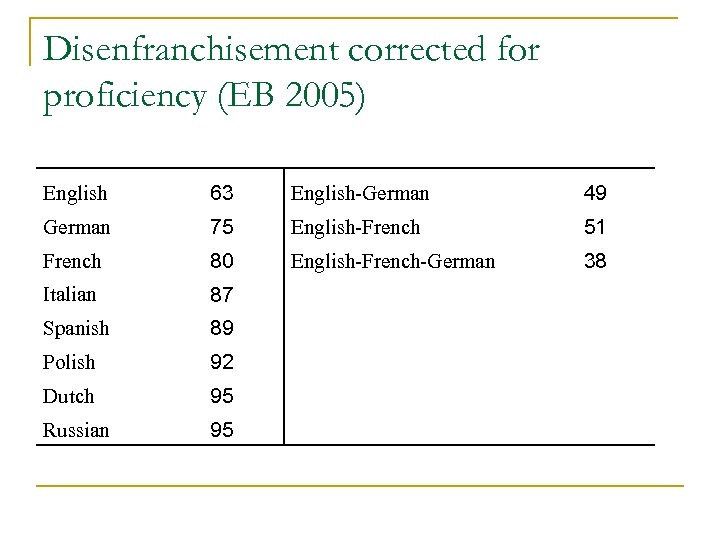 Disenfranchisement corrected for proficiency (EB 2005) English 63 English-German 49 German 75 English-French 51 French 80 English-French-German 38 Italian 87 Spanish 89 Polish 92 Dutch 95 Russian 95
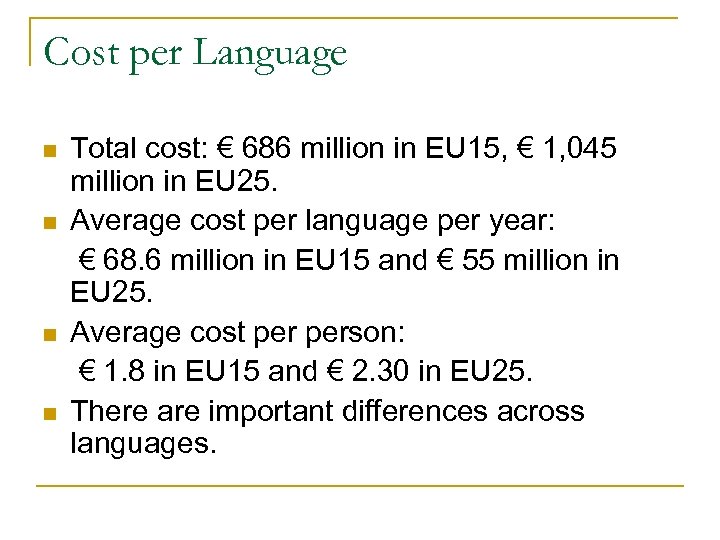 Cost per Language n n Total cost: € 686 million in EU 15, € 1, 045 million in EU 25. Average cost per language per year: € 68. 6 million in EU 15 and € 55 million in EU 25. Average cost person: € 1. 8 in EU 15 and € 2. 30 in EU 25. There are important differences across languages.
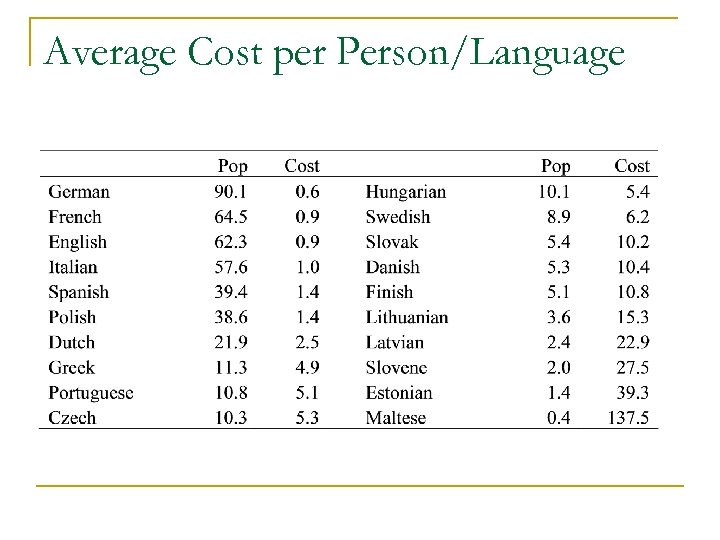 Average Cost per Person/Language
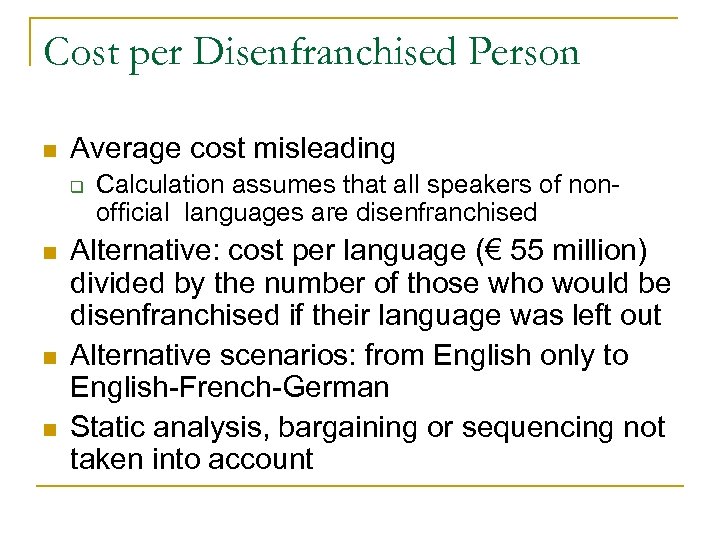 Cost per Disenfranchised Person n Average cost misleading q n n n Calculation assumes that all speakers of nonofficial languages are disenfranchised Alternative: cost per language (€ 55 million) divided by the number of those who would be disenfranchised if their language was left out Alternative scenarios: from English only to English-French-German Static analysis, bargaining or sequencing not taken into account
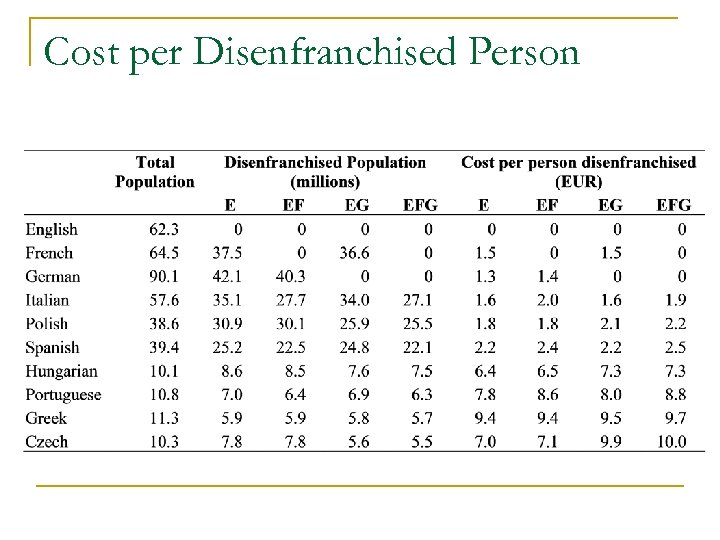 Cost per Disenfranchised Person
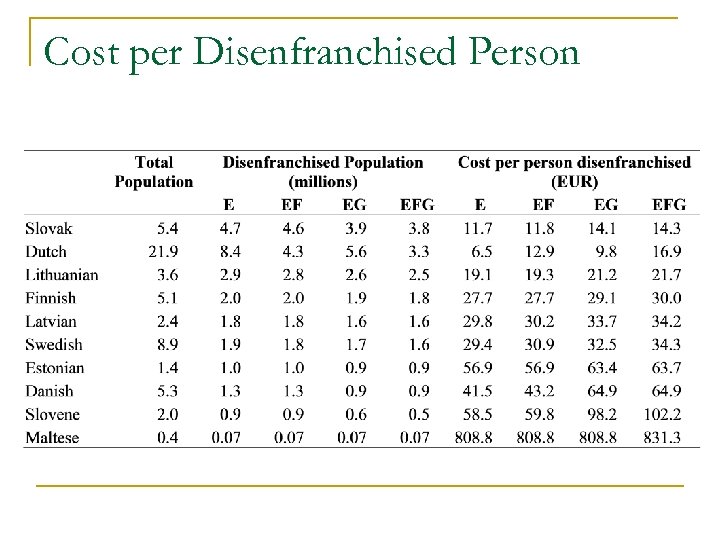 Cost per Disenfranchised Person
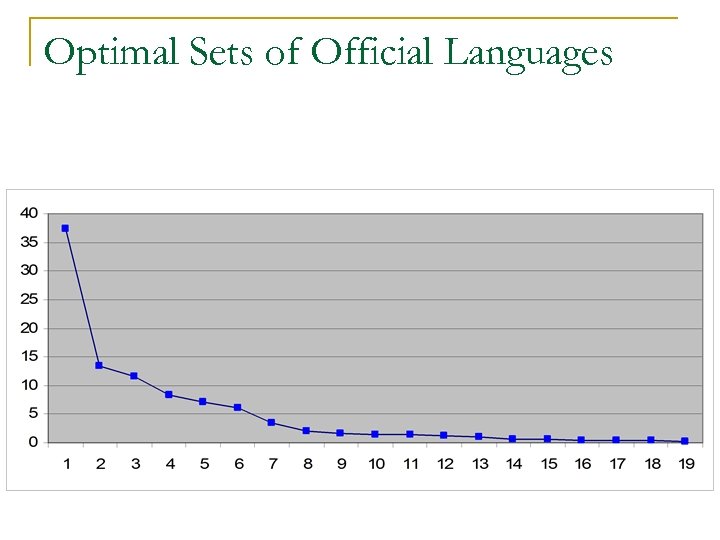
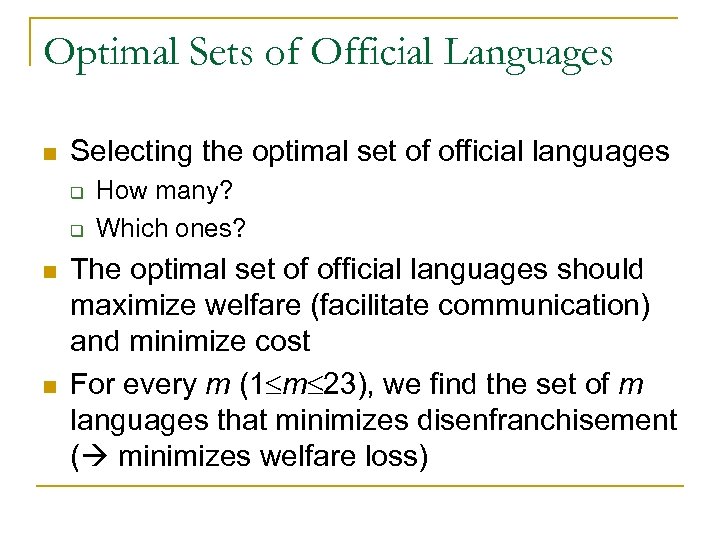 Optimal Sets of Official Languages n Selecting the optimal set of official languages q q n n How many? Which ones? The optimal set of official languages should maximize welfare (facilitate communication) and minimize cost For every m (1 m 23), we find the set of m languages that minimizes disenfranchisement ( minimizes welfare loss)
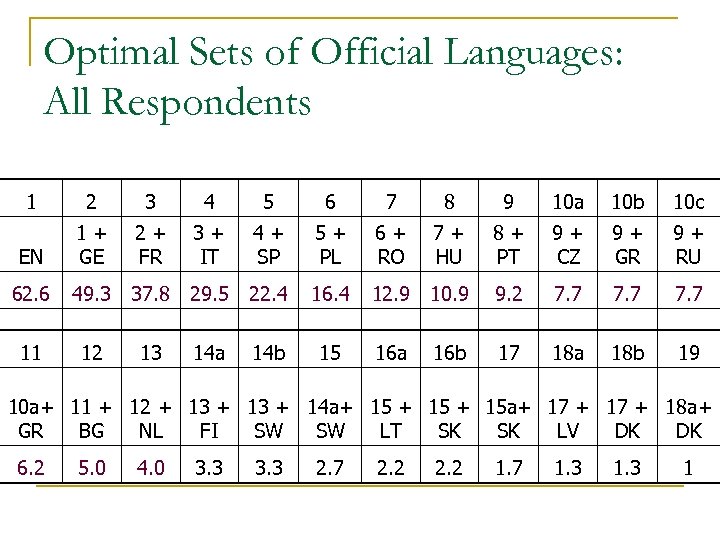 Optimal Sets of Official Languages: All Respondents 1 2 3 4 5 6 7 8 9 10 a 10 b 10 c EN 1+ GE 2+ FR 3+ IT 4+ SP 5+ PL 6+ RO 7+ HU 8+ PT 9+ CZ 9+ GR 9+ RU 62. 6 49. 3 37. 8 29. 5 22. 4 16. 4 12. 9 10. 9 9. 2 7. 7 11 12 14 b 15 16 a 17 18 a 18 b 19 13 14 a 16 b 10 a+ 11 + 12 + 13 + 14 a+ 15 a+ 17 + 18 a+ GR BG NL FI SW SW LT SK SK LV DK DK 6. 2 5. 0 4. 0 3. 3 2. 7 2. 2 1. 7 1. 3 1
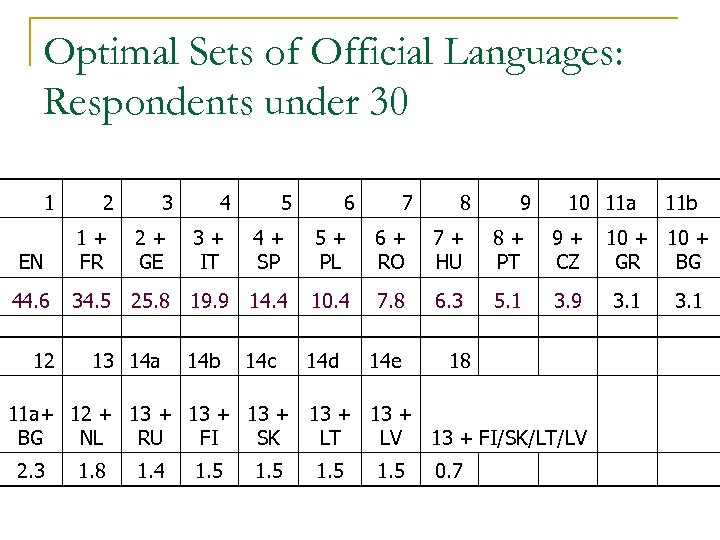 Optimal Sets of Official Languages: Respondents under 30 1 2 3 4 5 6 7 8 9 10 11 a EN 1+ FR 2+ GE 3+ IT 4+ SP 5+ PL 6+ RO 7+ HU 8+ PT 9+ CZ 44. 6 34. 5 25. 8 19. 9 14. 4 10. 4 7. 8 6. 3 5. 1 3. 9 14 c 14 d 12 13 14 a 14 b 14 e 18 11 a+ 12 + 13 + 13 + BG NL RU FI SK LT LV 13 + FI/SK/LT/LV 2. 3 1. 8 1. 4 1. 5 0. 7 11 b 10 + GR BG 3. 1
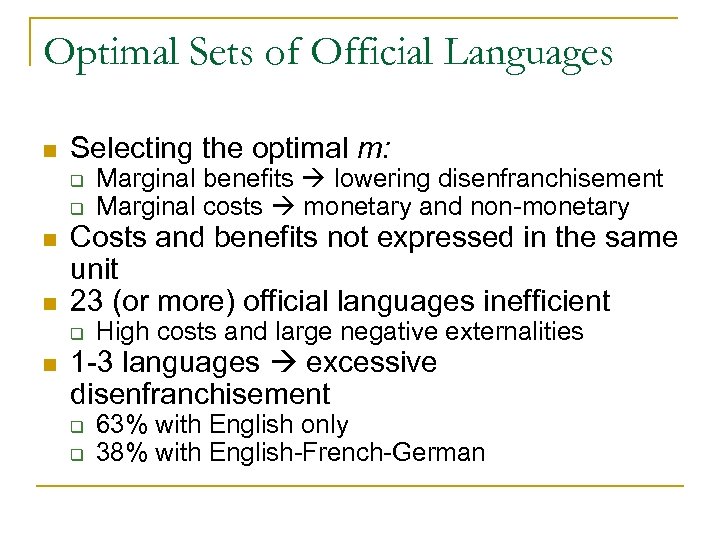 Optimal Sets of Official Languages n Selecting the optimal m: q q n n Costs and benefits not expressed in the same unit 23 (or more) official languages inefficient q n Marginal benefits lowering disenfranchisement Marginal costs monetary and non-monetary High costs and large negative externalities 1 -3 languages excessive disenfranchisement q q 63% with English only 38% with English-French-German
 Optimal Sets of Official Languages
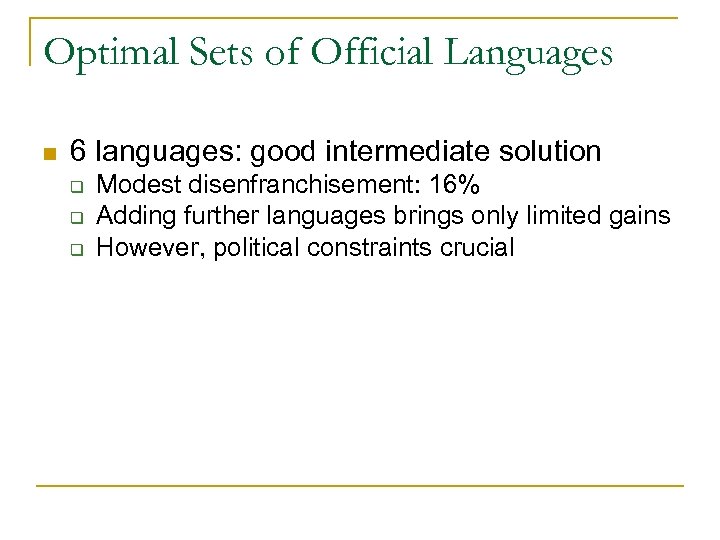 Optimal Sets of Official Languages n 6 languages: good intermediate solution q q q Modest disenfranchisement: 16% Adding further languages brings only limited gains However, political constraints crucial
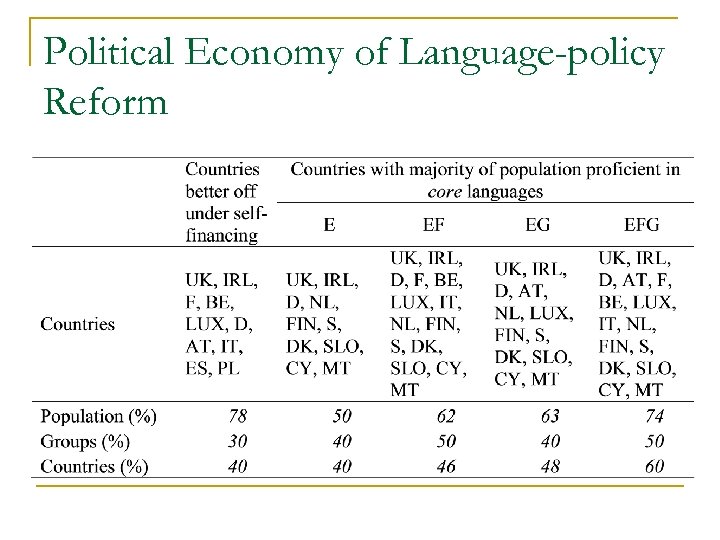
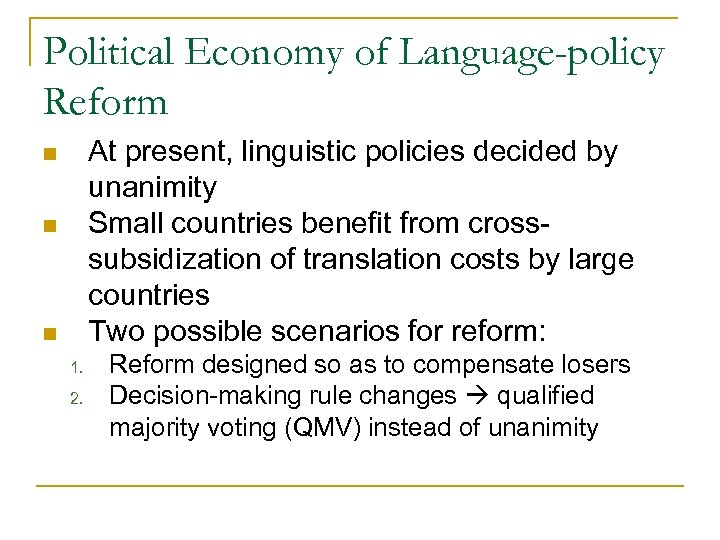 Political Economy of Language-policy Reform At present, linguistic policies decided by unanimity Small countries benefit from crosssubsidization of translation costs by large countries Two possible scenarios for reform: n n n 1. 2. Reform designed so as to compensate losers Decision-making rule changes qualified majority voting (QMV) instead of unanimity
 Political Economy of Language-policy Reform n Centralization: q q n n n Under-provision of translation for large countries Over-provision for small countries Majority of EU population would benefit from moving from centralization to self-financing Majority of EU countries would oppose such reform Reducing the number of official languages: similar case
 Political Economy of Language-policy Reform
 Language-policy Reform with Compensation of Losers n n Decentralization: countries get control over funds earmarked for linguistic services Giving countries discretion makes them internalize the costs of the linguistic regime EU budget unchanged but funds spent in a way that maximizes aggregate welfare Countries can keep the rents that they are currently enjoying politically feasible
 Language-policy Reform under QMV n 1. 2. Alternative QMV scenarios: Nice Treaty (min 14 states, 255/345 votes, 62% of EU population) Lisbon Treaty (55% states, 65% pop)
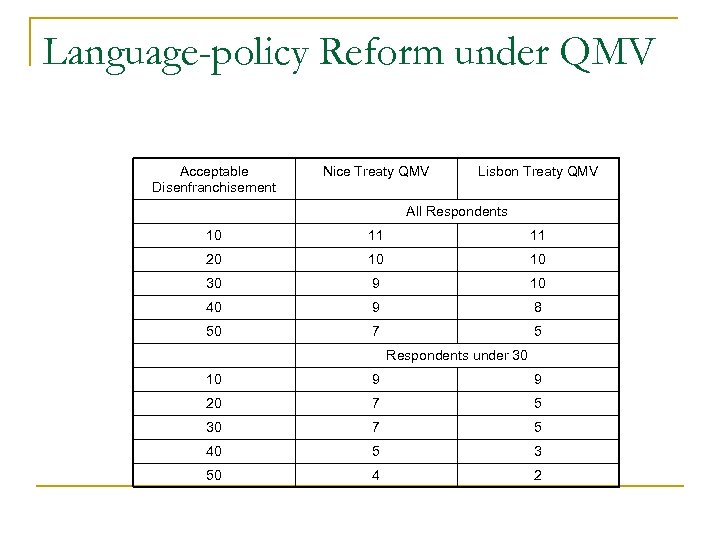 Language-policy Reform under QMV Acceptable Disenfranchisement Nice Treaty QMV Lisbon Treaty QMV All Respondents 10 11 11 20 10 10 30 9 10 40 9 8 50 7 5 Respondents under 30 10 9 9 20 7 5 30 7 5 40 5 3 50 4 2
 Language-policy Reform under QMV n Six-language scenario not possible at present and under present (NT) rules q n Not even when assuming that relatively high disenfranchisement rate is tolerable May be feasible in the future or if QMV rules change
 Conclusions n n Six-language scenario (EGFISP): 16% disenfranchisement (10% for under 30 s) The same set results if we only consider native speakers (i. e. if only pride is being considered) q n Includes languages of all ‘large countries’ Adding more languages : gains small and typically limited to a single country
 Conclusions n n n Political constraints likely to be crucial In a generation of two (or if voting procedures change), linguistic regime with 3 -6 official languages will be possible Linguistic reform will change incentives for acquiring linguistic skills. q q n If reform undertaken, adjustment will be temporary Linguistic dynamics will be influenced by today’s choice Challenge of future enlargements (especially Turkish)
 Further Questions 1 Which languages should be used where? q EP, EU institutions, legal texts Different rules may be necessary for different areas or institutions 2 What happens to the remaining languages? n Savings up to € 55 mn per language n Kept by the EU? n …or transferred to member countries as compensation? n
 Language and Communicative Benefits Language serves three functions: n 1. 2. 3. Medium of exchange (communicate with others) Store of value (to store useful information in written/recorded form) Tool of discrimination (exclude others by using a language that they do not understand) Economics of Languages literature focuses mainly on the first two functions: n q Communicative/economic benefits of speaking a language
 Communicative Benefits Communicative benefits of languages similar to other aspects of human capital Costly investment n n q Monetary cost, time & effort, foregone earnings Positive return n q Ability to communicate and engage in economic transactions with others Spillover: n q Return accrues also to the other party who has not learned your language
 Communicative Benefits Formal modelling: Selten and Pool (1991) n 1. q q Seminal contribution Multiple languages, including artificial languages Communicative benefits depend on the number of people with whom one can communicate Costs vary across individuals and langauges Gabszewicz, Ginsburgh and Weber (2005) 2. q Simpler model: two languages/countries only
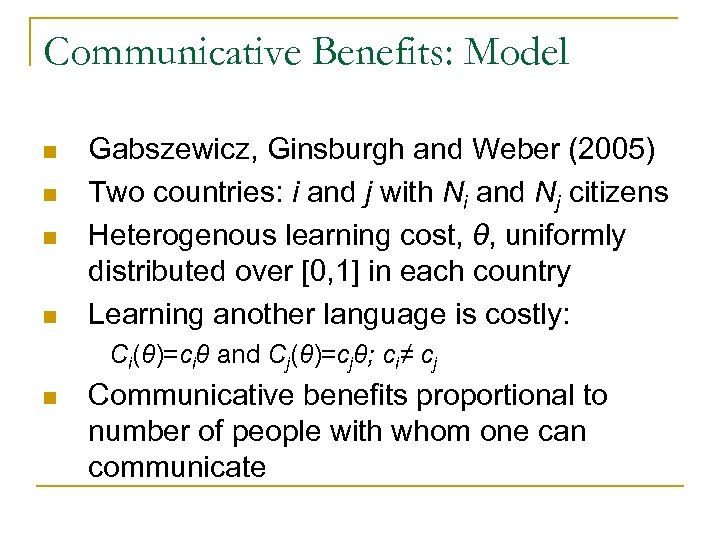 Communicative Benefits: Model n n Gabszewicz, Ginsburgh and Weber (2005) Two countries: i and j with Ni and Nj citizens Heterogenous learning cost, θ, uniformly distributed over [0, 1] in each country Learning another language is costly: Ci(θ)=ciθ and Cj(θ)=cjθ; ci≠ cj n Communicative benefits proportional to number of people with whom one can communicate
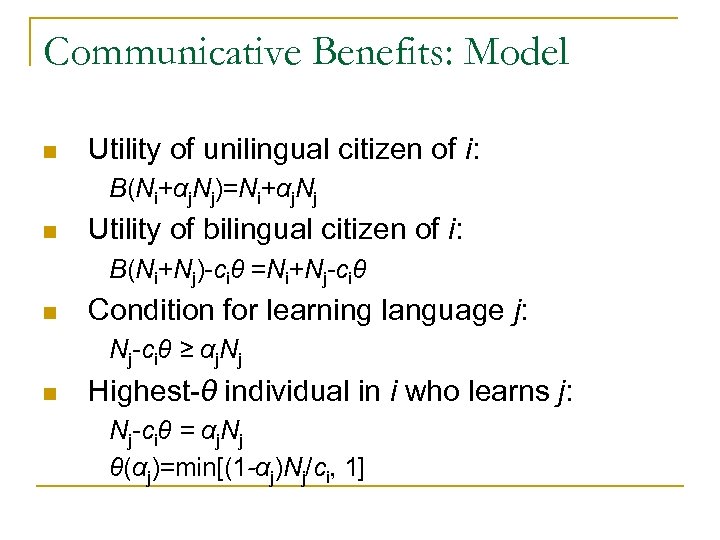 Communicative Benefits: Model n Utility of unilingual citizen of i: B(Ni+αj. Nj)=Ni+αj. Nj n Utility of bilingual citizen of i: B(Ni+Nj)-ciθ =Ni+Nj-ciθ n Condition for learning language j: Nj-ciθ ≥ αj. Nj n Highest-θ individual in i who learns j: Nj-ciθ = αj. Nj θ(αj)=min[(1 -αj)Nj/ci, 1]
![Communicative Benefits: Model n θ is uniformly distributed over [0, 1] share of country](https://present5.com/presentation/3ae4c33b7e3bb3286892a326d54bd34e/image-62.jpg "Communicative Benefits: Model n θ is uniformly distributed over [0, 1] share of country") Communicative Benefits: Model n θ is uniformly distributed over [0, 1] share of country i population who learn language j: θ(αj)=αi n For country j θ(αi)=αj n n Define cost-adjusted communicative benefit of country i citizen from learning j: bij = Nj/ci Equilibrium given by: αi = min[(1 -αj)bij, 1] αj = min[(1 - αi)bji, 1]
Communicative Benefits: Model n θ is uniformly distributed over [0, 1] share of country i population who learn language j: θ(αj)=αi n For country j θ(αi)=αj n n Define cost-adjusted communicative benefit of country i citizen from learning j: bij = Nj/ci Equilibrium given by: αi = min[(1 -αj)bij, 1] αj = min[(1 - αi)bji, 1]
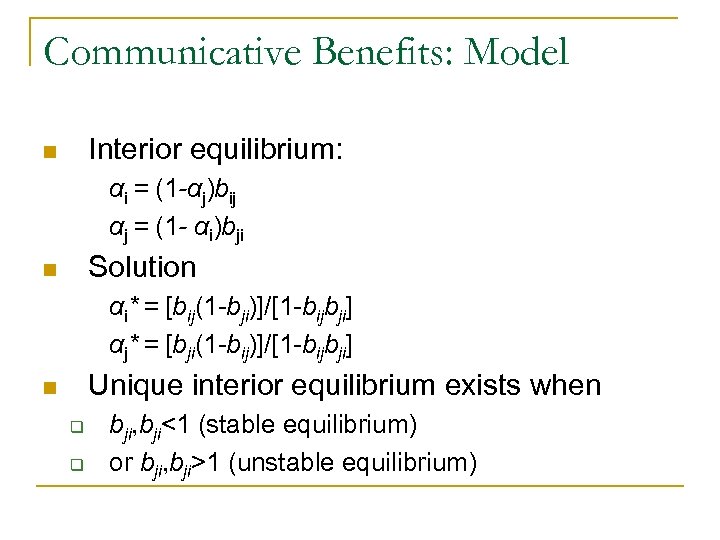 Communicative Benefits: Model Interior equilibrium: n αi = (1 -αj)bij αj = (1 - αi)bji Solution n αi* = [bij(1 -bji)]/[1 -bijbji] αj* = [bji(1 -bij)]/[1 -bijbji] Unique interior equilibrium exists when n q q bji, bji<1 (stable equilibrium) or bji, bji>1 (unstable equilibrium)
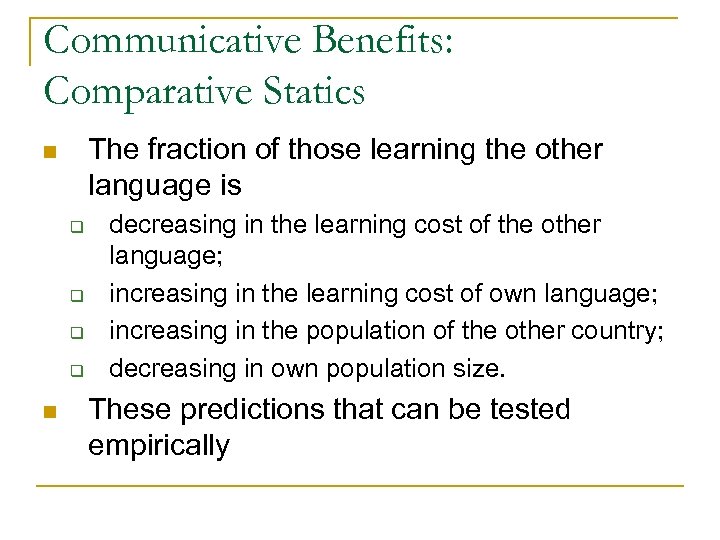 Communicative Benefits: Comparative Statics The fraction of those learning the other language is n q q n decreasing in the learning cost of the other language; increasing in the learning cost of own language; increasing in the population of the other country; decreasing in own population size. These predictions that can be tested empirically
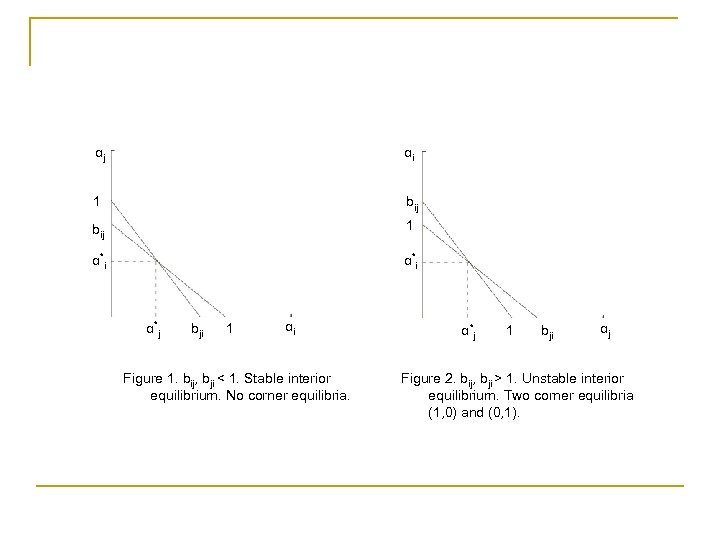 αj αi 1 bij 1 α*i α* i α*j bji 1 αi Figure 1. bij, bji < 1. Stable interior equilibrium. No corner equilibria. α*j 1 bji αj Figure 2. bij, bji > 1. Unstable interior equilibrium. Two corner equilibria (1, 0) and (0, 1).
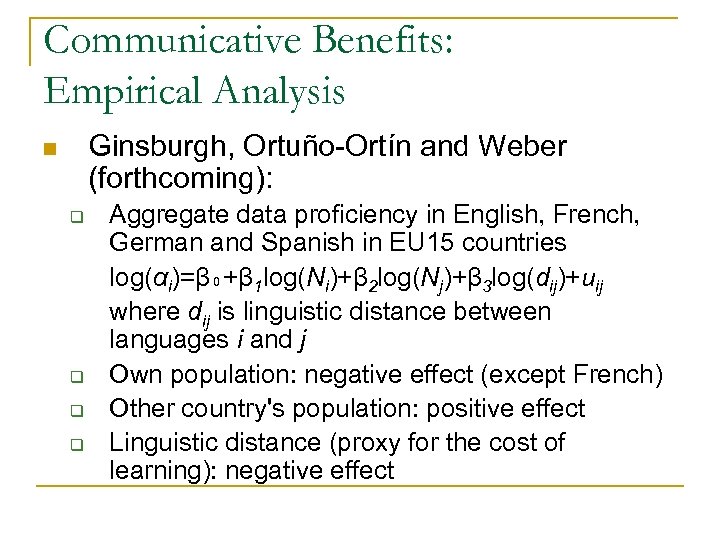 Communicative Benefits: Empirical Analysis Ginsburgh, Ortuño-Ortín and Weber (forthcoming): n q q Aggregate data proficiency in English, French, German and Spanish in EU 15 countries log(αi)=β₀+β 1 log(Ni)+β 2 log(Nj)+β 3 log(dij)+uij where dij is linguistic distance between languages i and j Own population: negative effect (except French) Other country's population: positive effect Linguistic distance (proxy for the cost of learning): negative effect
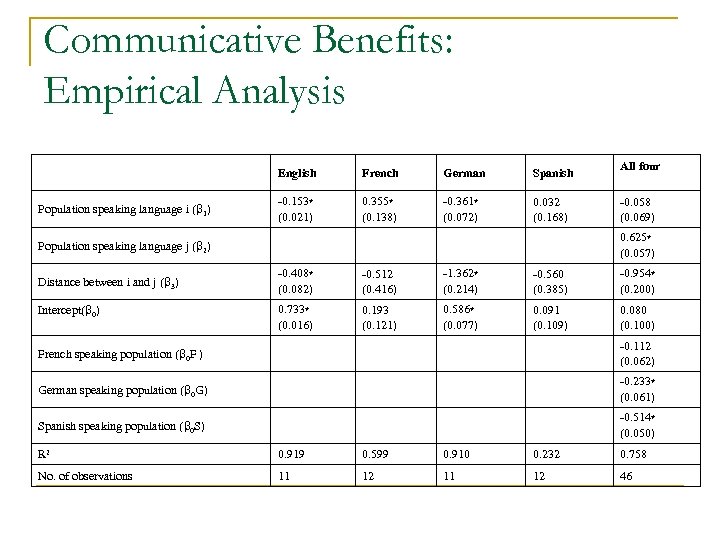 Communicative Benefits: Empirical Analysis English Population speaking language i (β 1) French German Spanish -0. 153∗ (0. 021) 0. 355∗ (0. 138) -0. 361∗ (0. 072) 0. 032 (0. 168) All four -0. 058 (0. 069) 0. 625∗ (0. 057) Population speaking language j (β 2) Distance between i and j (β 3) -0. 408∗ (0. 082) -0. 512 (0. 416) -1. 362∗ (0. 214) -0. 560 (0. 385) -0. 954∗ (0. 200) Intercept(β 0) 0. 733∗ (0. 016) 0. 193 (0. 121) 0. 586∗ (0. 077) 0. 091 (0. 109) 0. 080 (0. 100) French speaking population (β 0 F ) -0. 112 (0. 062) German speaking population (β 0 G) -0. 233∗ (0. 061) Spanish speaking population (β 0 S) -0. 514∗ (0. 050) R 2 0. 919 0. 599 0. 910 0. 232 0. 758 No. of observations 11 12 46
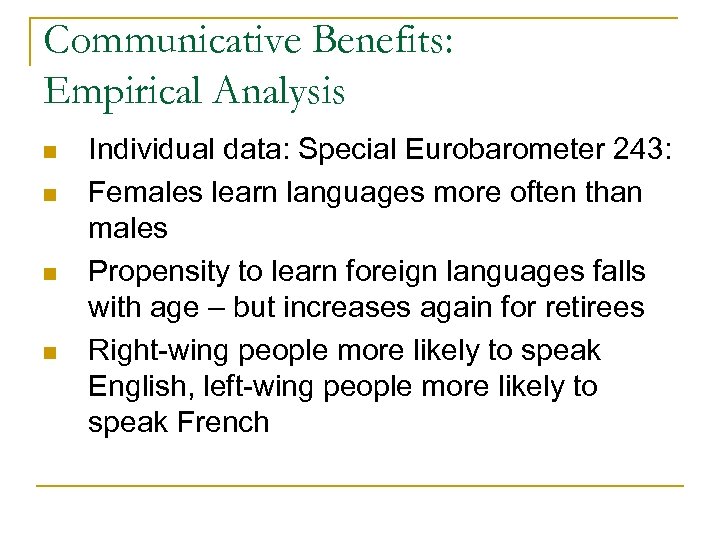 Communicative Benefits: Empirical Analysis n n Individual data: Special Eurobarometer 243: Females learn languages more often than males Propensity to learn foreign languages falls with age – but increases again for retirees Right-wing people more likely to speak English, left-wing people more likely to speak French
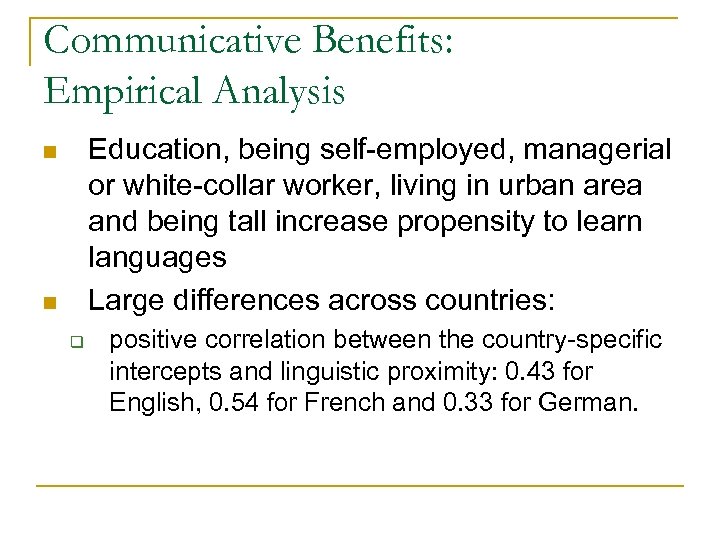 Communicative Benefits: Empirical Analysis Education, being self-employed, managerial or white-collar worker, living in urban area and being tall increase propensity to learn languages Large differences across countries: n n q positive correlation between the country-specific intercepts and linguistic proximity: 0. 43 for English, 0. 54 for French and 0. 33 for German.
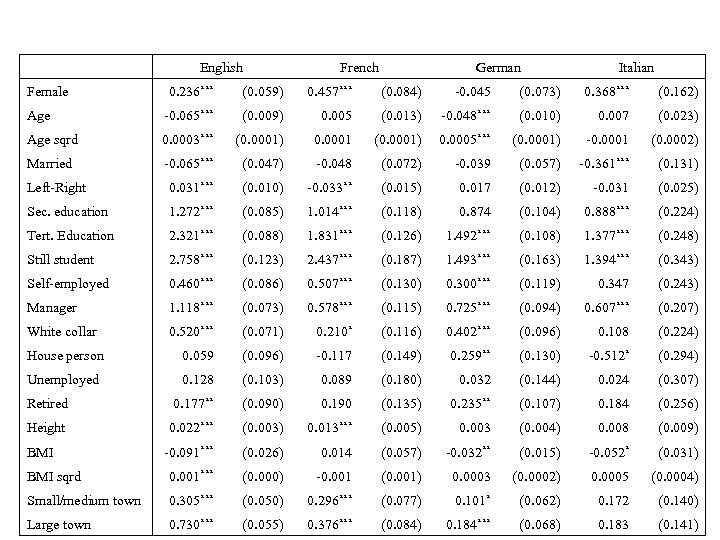 English Female French German Italian 0. 236*** (0. 059) 0. 457*** (0. 084) -0. 045 (0. 073) 0. 368*** (0. 162) Age -0. 065*** (0. 009) 0. 005 (0. 013) -0. 048*** (0. 010) 0. 007 (0. 023) Age sqrd 0. 0003*** (0. 0001) 0. 0001 (0. 0001) 0. 0005*** (0. 0001) -0. 0001 (0. 0002) Married -0. 065*** (0. 047) -0. 048 (0. 072) -0. 039 (0. 057) -0. 361*** (0. 131) Left-Right 0. 031*** (0. 010) -0. 033** (0. 015) 0. 017 (0. 012) -0. 031 (0. 025) Sec. education 1. 272*** (0. 085) 1. 014*** (0. 118) 0. 874 (0. 104) 0. 888*** (0. 224) Tert. Education 2. 321*** (0. 088) 1. 831*** (0. 126) 1. 492*** (0. 108) 1. 377*** (0. 248) Still student 2. 758*** (0. 123) 2. 437*** (0. 187) 1. 493*** (0. 163) 1. 394*** (0. 343) Self-employed 0. 460*** (0. 086) 0. 507*** (0. 130) 0. 300*** (0. 119) 0. 347 (0. 243) Manager 1. 118*** (0. 073) 0. 578*** (0. 115) 0. 725*** (0. 094) 0. 607*** (0. 207) White collar 0. 520*** (0. 071) 0. 210* (0. 116) 0. 402*** (0. 096) 0. 108 (0. 224) House person 0. 059 (0. 096) -0. 117 (0. 149) 0. 259** (0. 130) -0. 512* (0. 294) Unemployed 0. 128 (0. 103) 0. 089 (0. 180) 0. 032 (0. 144) 0. 024 (0. 307) Retired 0. 177** (0. 090) 0. 190 (0. 135) 0. 235** (0. 107) 0. 184 (0. 256) Height 0. 022*** (0. 003) 0. 013*** (0. 005) 0. 003 (0. 004) 0. 008 (0. 009) -0. 091*** (0. 026) 0. 014 (0. 057) -0. 032** (0. 015) -0. 052* (0. 031) BMI sqrd 0. 001*** (0. 000) -0. 001 (0. 001) 0. 0003 (0. 0002) 0. 0005 (0. 0004) Small/medium town 0. 305*** (0. 050) 0. 296*** (0. 077) 0. 101* (0. 062) 0. 172 (0. 140) Large town 0. 730*** (0. 055) 0. 376*** (0. 084) 0. 184*** (0. 068) 0. 183 (0. 141) BMI
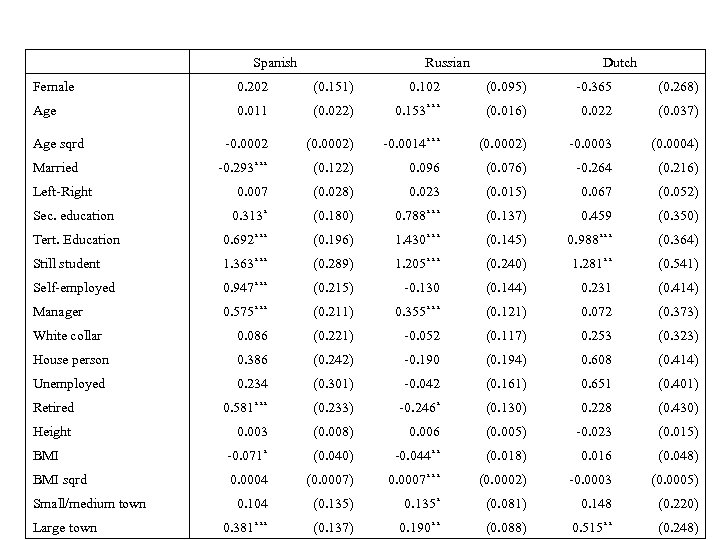 Spanish Russian Dutch Female 0. 202 (0. 151) 0. 102 (0. 095) -0. 365 (0. 268) Age 0. 011 (0. 022) 0. 153*** (0. 016) 0. 022 (0. 037) Age sqrd -0. 0002 (0. 0002) -0. 0014*** (0. 0002) -0. 0003 (0. 0004) Married -0. 293*** (0. 122) 0. 096 (0. 076) -0. 264 (0. 216) 0. 007 (0. 028) 0. 023 (0. 015) 0. 067 (0. 052) 0. 313* (0. 180) 0. 788*** (0. 137) 0. 459 (0. 350) Tert. Education 0. 692*** (0. 196) 1. 430*** (0. 145) 0. 988*** (0. 364) Still student 1. 363*** (0. 289) 1. 205*** (0. 240) 1. 281** (0. 541) Self-employed 0. 947*** (0. 215) -0. 130 (0. 144) 0. 231 (0. 414) Manager 0. 575*** (0. 211) 0. 355*** (0. 121) 0. 072 (0. 373) White collar 0. 086 (0. 221) -0. 052 (0. 117) 0. 253 (0. 323) House person 0. 386 (0. 242) -0. 190 (0. 194) 0. 608 (0. 414) Unemployed 0. 234 (0. 301) -0. 042 (0. 161) 0. 651 (0. 401) Retired 0. 581*** (0. 233) -0. 246* (0. 130) 0. 228 (0. 430) Height 0. 003 (0. 008) 0. 006 (0. 005) -0. 023 (0. 015) BMI -0. 071* (0. 040) -0. 044** (0. 018) 0. 016 (0. 048) BMI sqrd 0. 0004 (0. 0007) 0. 0007*** (0. 0002) -0. 0003 (0. 0005) 0. 104 (0. 135) 0. 135* (0. 081) 0. 148 (0. 220) 0. 381*** (0. 137) 0. 190** (0. 088) 0. 515** (0. 248) Left-Right Sec. education Small/medium town Large town
 Languages and Discrimination Speakers of foreign languages are excluded from communication n q Example: Cockney rhyming slang Can be recognized by their speech/accent Can be subject to discrimination n n q q q Bigotry: taste for discrimination Price discrimination: eg foreigners pay higher prices than locals Cost-motivated discrimination
 Languages and Discrimination Lang (1986): model of wage discrimination based on language n q q White employers White or black workers who speak different languages Employer who hires blacks them needs to be compensated for the cost of learning blacks’ language or for hiring bilingual supervisors Wage discrimination occurs without bigotry or employers having a taste for discrimination
 Languages and Discrimination Puzzle: different languages/dialects persist despite strong incentives for harmonization Akerlof and Kranton (2000): model of identity n n q q People behavior shaped by identity-specific social norms (race, ethnicity, gender) Deviation are punished by social sanctions
 Languages and Discrimination Berman (2000): model of religious sect membership (Ultra-Othodox Jews) n q q Costly observable behavior demonstrates commitment This eliminates free-riding on club goods (eg community support networks and insurance) Native language skills group identification n q q q Favorable treatment from group members Avoidance of discrimination or predation Language skills acquired easily in childhood and costly in adult life free-riding difficult
 Returns to Linguistic Skills Linguistic skills make transactions easier and less costly Implications for labor-market returns, trade flows, investment, migration, growth, etc. Alesina and La Ferrara (2005 JEL): linguistically diverse countries grow more slowly n n n q q Exception: developed countries Slower growth may be due to inter-ethnic conflict rather than linguistic diversity
 Labor Market Returns Similar to return to other aspects of human capital such as education Most studies consider immigrants n n q Immigrants who speak the destination-country language earn up to 20% more than immigrants who do not (Chiswick and Miller, 2002, JPop. E; Chiswick and Miller, 2007, IZA DP 2664)
 Labor Market Returns Ginsburgh and Prieto-Rodriguez (2006): returns to language use for European workers (not immigrants) n q n n 2001 wave of the European Community Household Panel (ECHP) Survey asked about languages that respondents use at their workplace (up to 2) Returns to English, French, German, Italian and Spanish in A, DK, FIN, F, D, GR, IT, P, ES
 Labor Market Returns Relative scarcity of languages: linguistic disenfranchisement rate n q q q 0 if the respondent does not use the language at work Labor-market return dependent on how many other people speak the language in the same country instrumented with lagged disenfranchisement rate (2000)
 Labor Market Returns Return to speaking English n q q n n Lowest: 5% in Denmark Highest: 39% in Spain Return to speaking French: up to 49% (in Spain) Return to speaking German up to 60% (also in Spain)
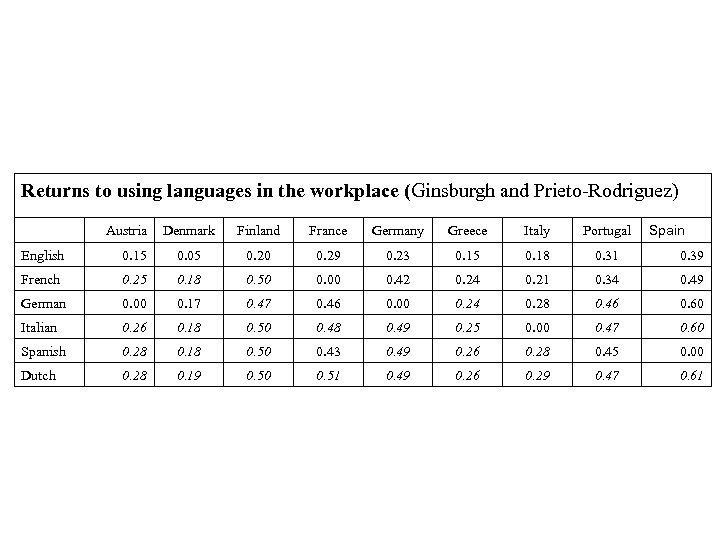 Returns to using languages in the workplace (Ginsburgh and Prieto-Rodriguez) Austria Denmark Finland France Germany Greece Italy Portugal Spain English 0. 15 0. 05 0. 20 0. 29 0. 23 0. 15 0. 18 0. 31 0. 39 French 0. 25 0. 18 0. 50 0. 00 0. 42 0. 24 0. 21 0. 34 0. 49 German 0. 00 0. 17 0. 46 0. 00 0. 24 0. 28 0. 46 0. 60 Italian 0. 26 0. 18 0. 50 0. 48 0. 49 0. 25 0. 00 0. 47 0. 60 Spanish 0. 28 0. 18 0. 50 0. 43 0. 49 0. 26 0. 28 0. 45 0. 00 Dutch 0. 28 0. 19 0. 50 0. 51 0. 49 0. 26 0. 29 0. 47 0. 61
 Languages and Migration n Parsons, Skeldon, Walmsley and Winters (2007, World Bank Policy Research Paper 4165): data on migration flow Over half of global migration flows is between countries sharing a common language (Arabic, Chinese, English, French, Portuguese or Spanish) Over a quarter of global migration flows is between English-speaking countries
 Languages and Trade n n n Fidrmuc and Fidrmuc (2009): Gravity-model of trade flows Control for probability that two randomly chosen people from two different countries are able to communicate in the same language Both native and non-native speakers considered Effect on trade strongly significant and large
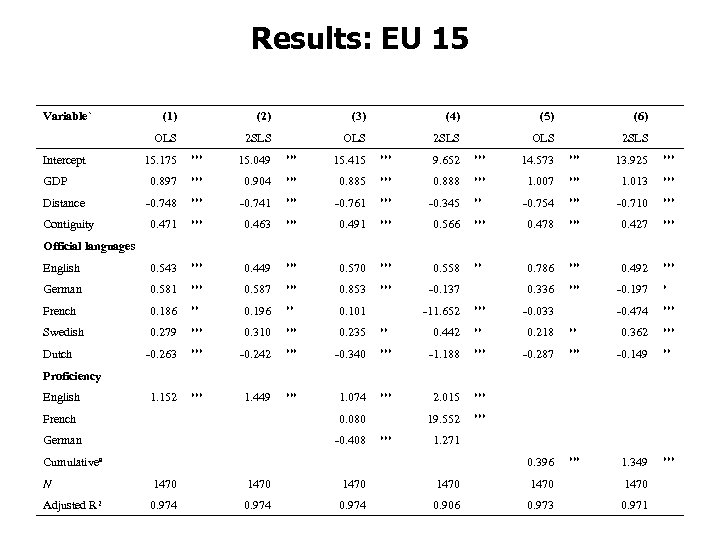 Results: EU 15 Variable` (2) (3) (4) (5) (6) OLS Intercept (1) 2 SLS OLS 2 SLS 15. 175 *** 15. 049 *** 15. 415 *** 9. 652 *** 14. 573 *** 13. 925 *** 0. 897 *** 0. 904 *** 0. 885 *** 0. 888 *** 1. 007 *** 1. 013 *** -0. 748 *** -0. 741 *** -0. 761 *** -0. 345 ** -0. 754 *** -0. 710 *** 0. 471 *** 0. 463 *** 0. 491 *** 0. 566 *** 0. 478 *** 0. 427 *** English 0. 543 *** 0. 449 *** 0. 570 *** 0. 558 ** 0. 786 *** 0. 492 *** German 0. 581 *** 0. 587 *** 0. 853 *** -0. 137 0. 336 *** -0. 197 * French 0. 186 ** 0. 196 ** 0. 101 -0. 474 *** Swedish 0. 279 *** 0. 310 *** 0. 235 ** -0. 263 *** -0. 242 *** -0. 340 1. 152 *** 1. 449 *** 1. 074 GDP Distance Contiguity Official languages Dutch -11. 652 *** -0. 033 0. 442 ** 0. 218 ** 0. 362 *** -1. 188 *** -0. 287 *** -0. 149 ** *** 2. 015 *** 19. 552 *** 0. 396 *** 1. 349 *** Proficiency English French 0. 080 German -0. 408 *** 1. 271 Cumulativea N 1470 1470 Adjusted R 2 0. 974 0. 906 0. 973 0. 971
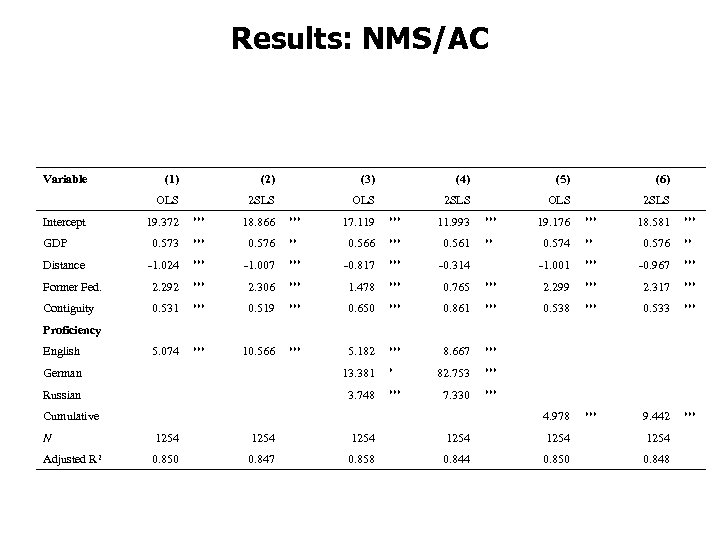 Results: NMS/AC Variable (2) (3) (4) (5) (6) OLS Intercept (1) 2 SLS OLS 2 SLS 19. 372 *** 18. 866 0. 573 *** 0. 576 -1. 024 *** Former Fed. 2. 292 Contiguity GDP Distance 17. 119 *** 11. 993 ** 0. 566 *** 0. 561 -1. 007 *** -0. 817 *** -0. 314 *** 2. 306 *** 1. 478 *** 0. 765 0. 531 *** 0. 519 *** 0. 650 *** 5. 074 *** 10. 566 *** 5. 182 *** *** 19. 176 *** 18. 581 *** 0. 574 ** 0. 576 ** -1. 001 *** -0. 967 *** 2. 299 *** 2. 317 *** 0. 861 *** 0. 538 *** 0. 533 *** 8. 667 *** 82. 753 *** 7. 330 *** 4. 978 *** 9. 442 *** ** Proficiency English German 13. 381 Russian 3. 748 * *** Cumulative N 1254 1254 Adjusted R 2 0. 850 0. 847 0. 858 0. 844 0. 850 0. 848
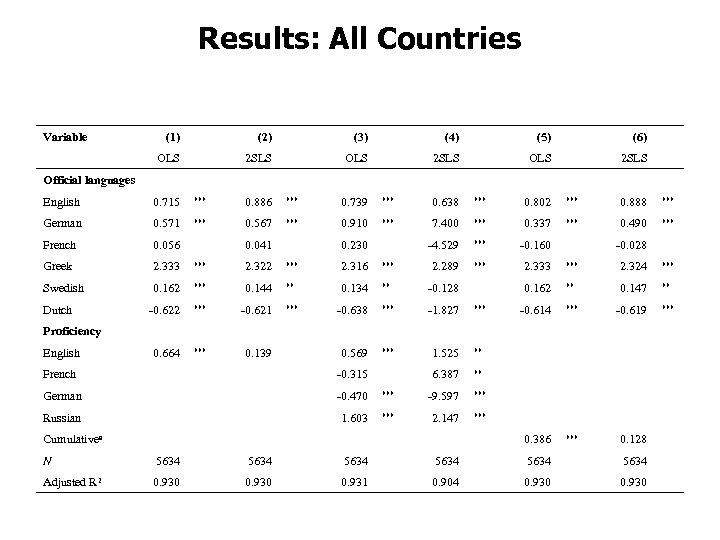 Results: All Countries Variable (1) (2) (3) (4) (5) (6) OLS 2 SLS Official languages English 0. 715 *** 0. 886 *** 0. 739 *** 0. 638 *** 0. 802 *** 0. 888 *** German 0. 571 *** 0. 567 *** 0. 910 *** 7. 400 *** 0. 337 *** 0. 490 *** French 0. 056 -4. 529 *** -0. 160 Greek 2. 333 *** 2. 322 *** 2. 316 *** 2. 289 *** 2. 333 *** 2. 324 *** Swedish 0. 162 *** 0. 144 ** 0. 134 ** -0. 128 0. 162 ** 0. 147 ** -0. 622 *** -0. 621 *** -0. 638 *** -1. 827 *** -0. 614 *** -0. 619 *** 0. 664 *** 0. 139 0. 569 *** 1. 525 ** 6. 387 ** 0. 386 *** 0. 128 Dutch 0. 041 0. 230 -0. 028 Proficiency English French -0. 315 German -0. 470 *** -9. 597 *** Russian 1. 603 *** 2. 147 *** Cumulativea N 5634 5634 Adjusted R 2 0. 930 0. 931 0. 904 0. 930
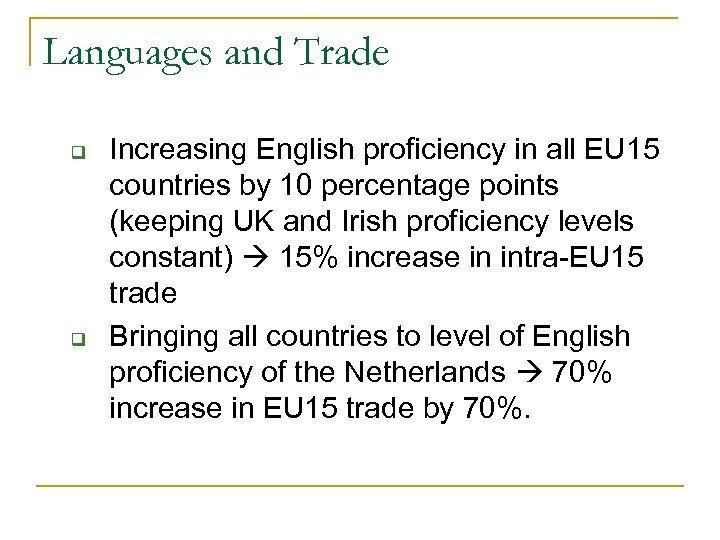 Languages and Trade q q Increasing English proficiency in all EU 15 countries by 10 percentage points (keeping UK and Irish proficiency levels constant) 15% increase in intra-EU 15 trade Bringing all countries to level of English proficiency of the Netherlands 70% increase in EU 15 trade by 70%.
 Conclusions q q q Communicative benefits an important determinant of language learning Choice to learn another language reflects rational consideration (costs and benefits) Language skills have positive returns n n q Individual level (labor-market returns) Aggregate level (trade) Social returns: language helps shape ethnic identity