 Скачать презентацию Multilateral Development Banks Carbon Fund Managers Carbon Buyers
1f71a61d8f5b01815eb6eb77caeb425c.ppt
- Количество слайдов: 11



Multilateral Development Banks: Carbon Fund Managers, Carbon Buyers or CDM-JI Facilitators? CDM-JI Workshop Vancouver March 28, 2006 John Balint, Director 100 Queen Street, Suite 1350. Ottawa. Ontario. K 1 P 1 J 9. Canada tel: 1. 613. 742. 7829 fax: 1. 613. 742. 7099 www. g-capitaladvisors. com info@g-capitaladvisors. com
2 MDBs Roles are Evolving p p p Multilateral Development Banks have an important, if not critical, role in the CDM-JI market. The origins of their involvement was as early carbon buyers through their carbon funds. New roles are being considered, particularly in light of the Gleneagles G 8 communiqué, urging them to establish an investment framework for CDM.
3 Multilateral Carbon Funds p p The World Bank now manages numerous buyer funds with a variety of investors. Other MDBs have been examining their role. A study was undertaken by International Financial Consulting (of which GCA is a subsidiary) in summer 2005 to examine investment options for the Government of Canada, focusing primarily on what the MDBs were doing in this area, as well as a few private funds. At the time, two MDB funds were seeking additional investment capital: the World Bank’s CDCF and the EBRD’s MCCF.
World Bank Community Development Carbon Fund p p p CDCF supports small scale projects in poorer regions in order to obtain ERs and promote sustainable development The fund will consider purchasing VERs in any small scale GHG reduction project. Minimum contribution to the fund is US$1. 0 million. Participants are significantly involved in the fund governance via annual meetings, approving business plans, etc. CDCF benefits from the World Bank’s capacity to identify eligible projects, assess risks, and negotiate emission reduction purchase agreements (ERPAs). CDCF also capitalizes indirectly on the World Bank’s preferred creditor status and strategic market positioning. 4
EBRD Multilateral Carbon Credit Fund p p p Fund development process currently is on hold pending further efforts by EBRD to obtain commitments from potential investors. Fund would acquire ERs originating from projects financed or to be financed by EBRD. It would purchase CERs and ERUs and facilitate some AAU transactions. Fund size in the range of € 100 m (minimum € 50 m, maximum € 200 m). Participants must be EBRD member countries and the minimum initial amount of commitment is € 2 million. Significant participant involvement in fund activities, including approval of individual carbon credit transactions, and the option of not participating in particular ERPAs. EBRD would engage one or more arm’s length fund managers to operate the MCCF. 5
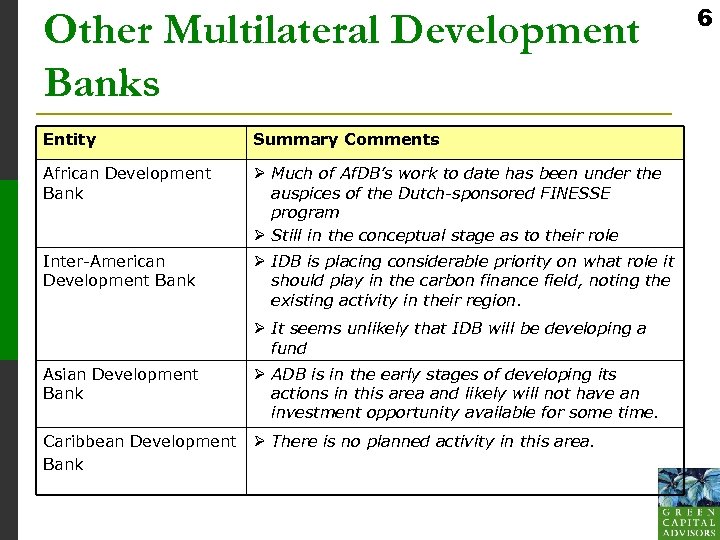
Other Multilateral Development Banks Entity Summary Comments African Development Bank Ø Much of Af. DB’s work to date has been under the auspices of the Dutch-sponsored FINESSE program Ø Still in the conceptual stage as to their role Inter-American Development Bank Ø IDB is placing considerable priority on what role it should play in the carbon finance field, noting the existing activity in their region. Ø It seems unlikely that IDB will be developing a fund Asian Development Bank Ø ADB is in the early stages of developing its actions in this area and likely will not have an investment opportunity available for some time. Caribbean Development Bank Ø There is no planned activity in this area. 6
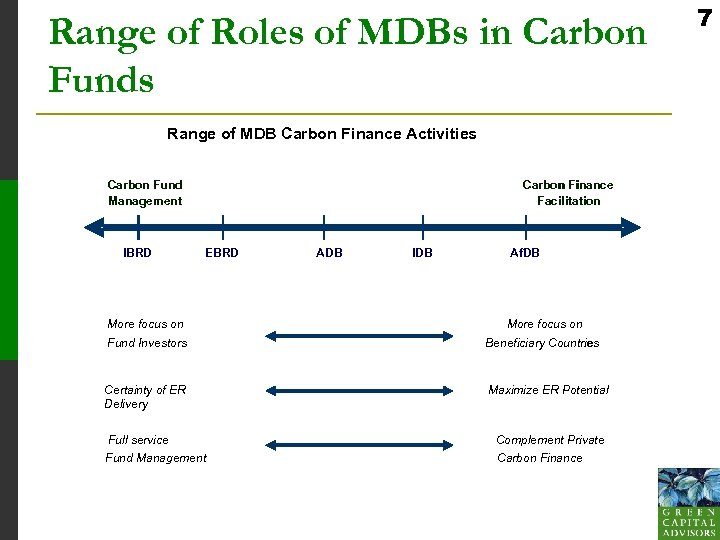
Range of Roles of MDBs in Carbon Funds Range of MDB Carbon Finance Activities Carbon Fund Management IBRD Carbon Finance Facilitation EBRD ADB IDB Af. DB More focus on Fund Investors Beneficiary Countries Certainty of ER Delivery Maximize ER Potential Full service Fund Management Complement Private Carbon Finance 7
8 Changing Role for MDBs p p p Shift away from fund sponsorship and management models and toward more facilitative roles to fill niches between beneficiary countries and existing market players. Mainly a function of timing and market development. Increasingly, the private sector is stepping up to fill former MDB roles of carbon fund manager and ER arranger/advisor, even in some developing and transition countries. Also a function of the MDBs themselves. Smaller, regional MDBs have limited in-house carbon finance expertise, and have limited time left before the Kyoto compliance period in 2008. As a result, they are seeking to define roles which preserve their market leadership function while complementing existing market expertise and capacity.
9 MDB’s Evolving Objectives p To strike the right balance between optimizing the objectives and capitalizing on market opportunities. p Many regional MDBs are still in the formative stages of defining their carbon finance role and activities. p Requires decisions regarding the MDB support mechanisms best suited to achieve different types of goals. p The international carbon fund market is quickly becoming more complex in nature and more sophisticated in approach. p Driven by niche opportunities (sector, region, etc. ) and specific project needs, such as using ERs to collateralize upfront financing.
10 MDB’s Evolving Objectives which should guide the MDBs carbon strategy are: p More focus on beneficiary country needs n Project Development Costs n Public and Private Sector Capacity Building p Maximize ER Potential to CDM-JI Projects p Maximize Sustainable Development Benefits p Complement Private Sector Carbon Funds n Risk Management Programs and Tools With such a focus, DNAs and host countries stand to enjoy more benefits in terms of sustainable development and carbon credit revenues

QUESTIONS? Thank You John Balint: JBalint@g-capitaladvisors. com +1 -613 -742 -7829 100 Queen Street, Suite 1350. Ottawa. Ontario. K 1 P 1 J 9. Canada tel: 1. 613. 742. 7829 fax: 1. 613. 742. 7099 www. g-capitaladvisors. com info@g-capitaladvisors. com
Скачать презентацию Multilateral Development Banks Carbon Fund Managers Carbon Buyers
1f71a61d8f5b01815eb6eb77caeb425c.ppt