 Скачать презентацию Multihoming Performance Benefits An Experimental Evaluation of Practical
888fd566917ca404fb5f71c1083b07af.ppt
- Количество слайдов: 28




Multihoming Performance Benefits: An Experimental Evaluation of Practical Enterprise Strategies Aditya Akella, CMU Srinivasan Seshan, CMU Anees Shaikh, IBM Research USENIX 2004 Boston, MA Aditya Akella, CMU
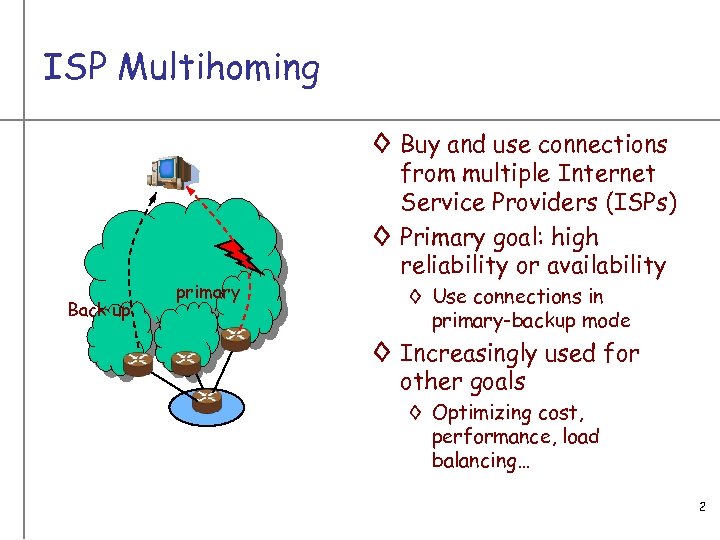
ISP Multihoming Back up primary ◊ Buy and use connections from multiple Internet Service Providers (ISPs) ◊ Primary goal: high reliability or availability ◊ Use connections in primary-backup mode ◊ Increasingly used for other goals ◊ Optimizing cost, performance, load balancing… 2
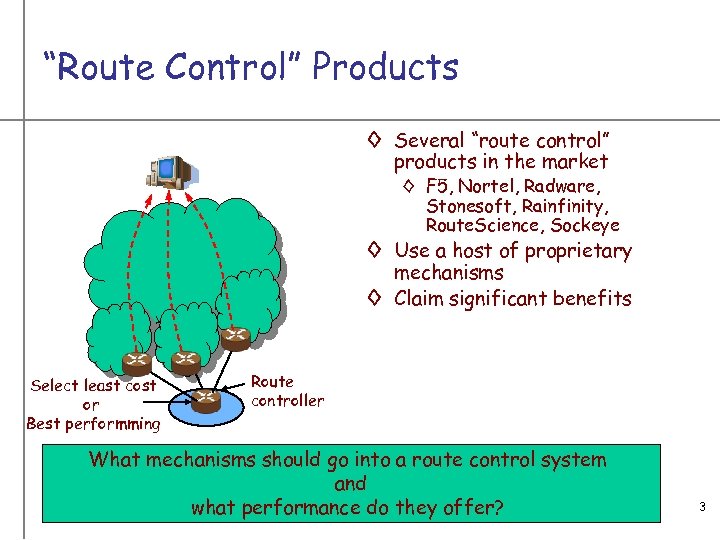
“Route Control” Products ◊ Several “route control” products in the market ◊ F 5, Nortel, Radware, Stonesoft, Rainfinity, Route. Science, Sockeye ◊ Use a host of proprietary mechanisms ◊ Claim significant benefits Select least cost or Best performming Route controller What mechanisms should go into a route control system and what performance do they offer? 3
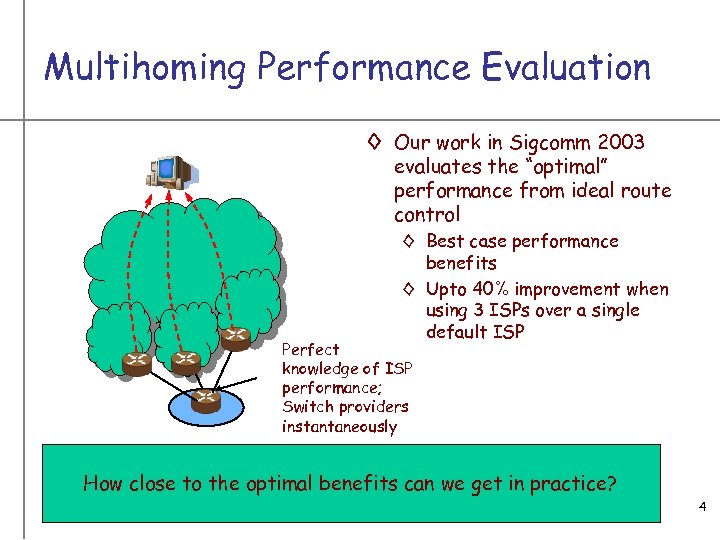
Multihoming Performance Evaluation ◊ Our work in Sigcomm 2003 evaluates the “optimal” performance from ideal route control ◊ Best case performance benefits ◊ Upto 40% improvement when using 3 ISPs over a single default ISP Perfect knowledge of ISP performance; Switch providers instantaneously How close to the optimal benefits can we get in practice? 4
Our Work ◊ Discussion and design of simple, practical route control mechanisms for optimizing web performance ◊ Experimental study of the performance and design tradeoffs ◊ Focus on multihomed enterprises ◊ Primarily sink data from the Internet 5
Outline ◊ Route Control components ◊ Experimental Evaluation ◊ Open issues ◊ Conclusion 6
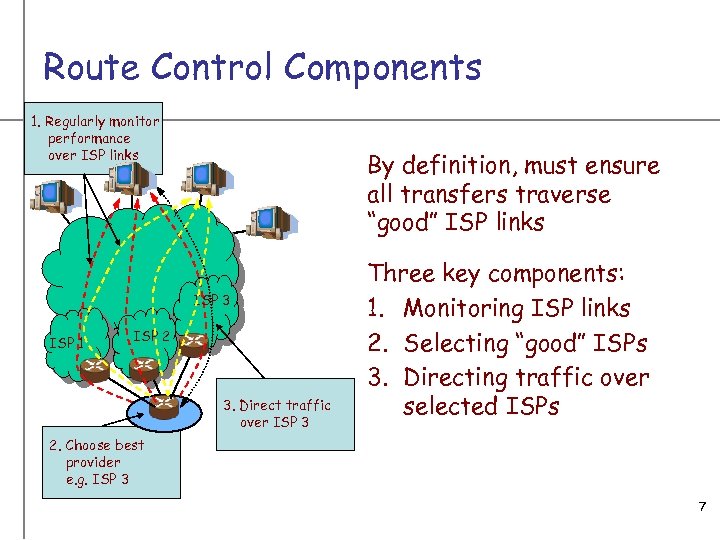
Route Control Components 1. Regularly monitor performance over ISP links By definition, must ensure all transfers traverse “good” ISP links ISP 3 ISP 1 ISP 2 3. Direct traffic over ISP 3 Three key components: 1. Monitoring ISP links 2. Selecting “good” ISPs 3. Directing traffic over selected ISPs 2. Choose best provider e. g. ISP 3 7
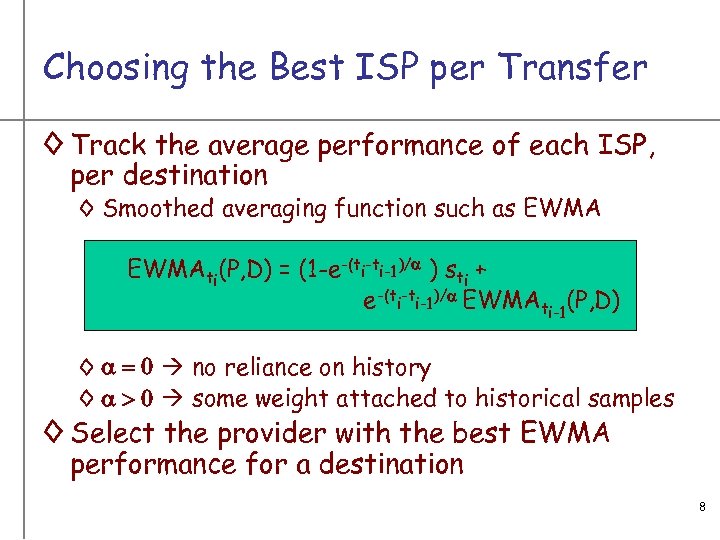
Choosing the Best ISP per Transfer ◊ Track the average performance of each ISP, per destination ◊ Smoothed averaging function such as EWMAti(P, D) = (1 -e-(ti-ti-1)/a ) sti + e-(ti-ti-1)/a EWMAti-1(P, D) ◊ a = 0 no reliance on history ◊ a > 0 some weight attached to historical samples ◊ Select the provider with the best EWMA performance for a destination 8
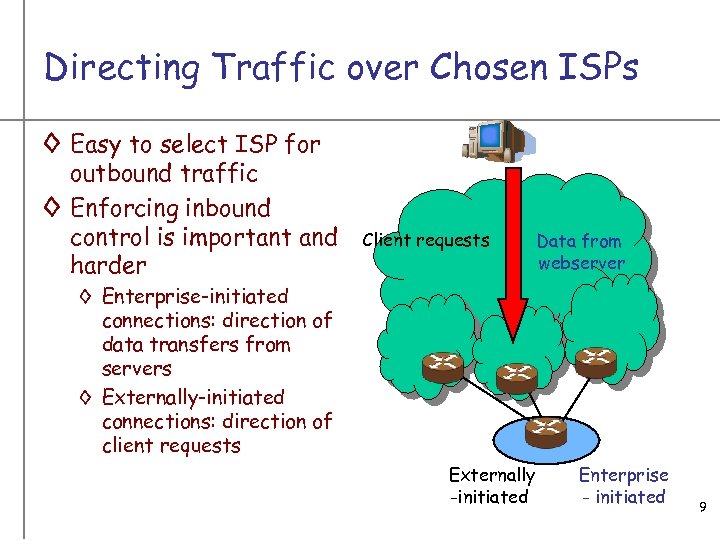
Directing Traffic over Chosen ISPs ◊ Easy to select ISP for outbound traffic ◊ Enforcing inbound control is important and harder Client requests Data from webserver ◊ Enterprise-initiated connections: direction of data transfers from servers ◊ Externally-initiated connections: direction of client requests Externally -initiated Enterprise - initiated 9
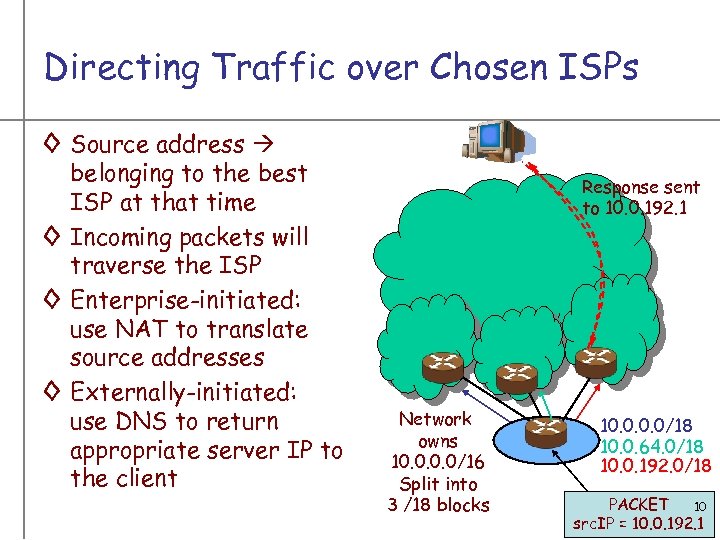
Directing Traffic over Chosen ISPs ◊ Source address belonging to the best ISP at that time ◊ Incoming packets will traverse the ISP ◊ Enterprise-initiated: use NAT to translate source addresses ◊ Externally-initiated: use DNS to return appropriate server IP to the client Response sent to 10. 0. 192. 1 Network owns 10. 0/16 Split into 3 /18 blocks 10. 0/18 10. 0. 64. 0/18 10. 0. 192. 0/18 PACKET 10 src. IP = 10. 0. 192. 1
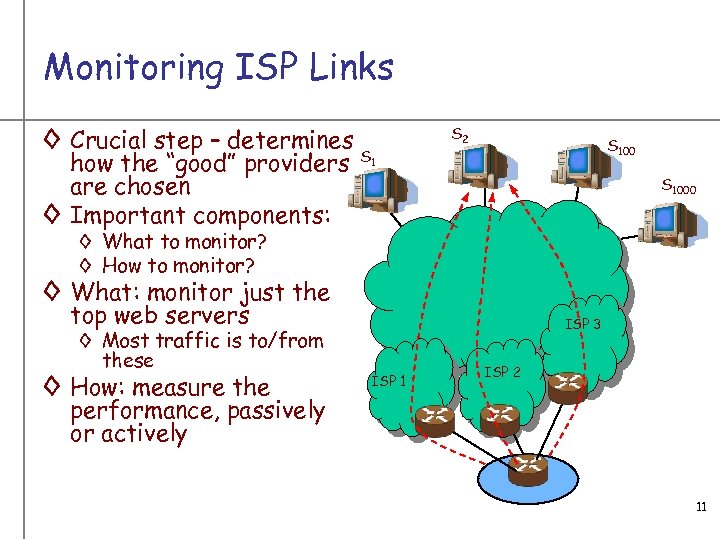
Monitoring ISP Links ◊ Crucial step – determines how the “good” providers S 1 are chosen ◊ Important components: S 2 S 1000 ◊ What to monitor? ◊ How to monitor? ◊ What: monitor just the top web servers ISP 3 ◊ Most traffic is to/from these ◊ How: measure the performance, passively or actively ISP 1 ISP 2 11
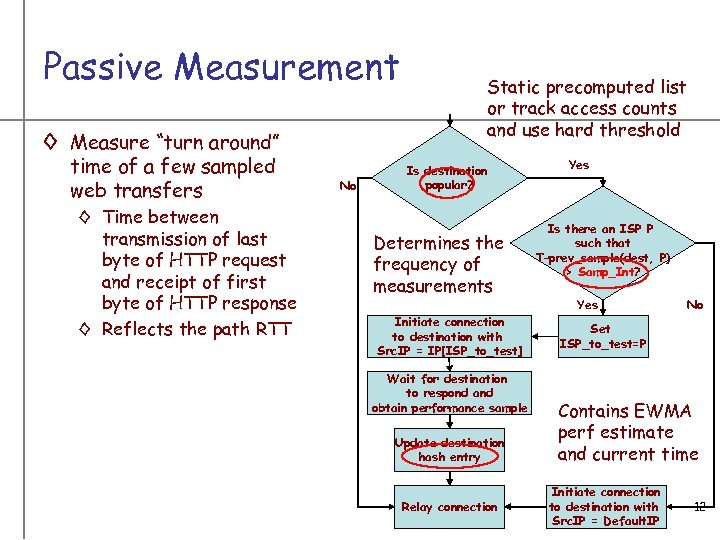
Passive Measurement ◊ Measure “turn around” time of a few sampled web transfers No Static precomputed list or track access counts and use hard threshold Is destination popular? ◊ Time between transmission of last byte of HTTP request and receipt of first byte of HTTP response ◊ Reflects the path RTT Determines the frequency of measurements Initiate connection to destination with Src. IP = IP[ISP_to_test] Wait for destination to respond and obtain performance sample Update destination hash entry Relay connection Yes Is there an ISP P such that T–prev_sample(dest, P) > Samp_Int? Yes No Set ISP_to_test=P Contains EWMA perf estimate and current time Initiate connection to destination with Src. IP = Default. IP 12
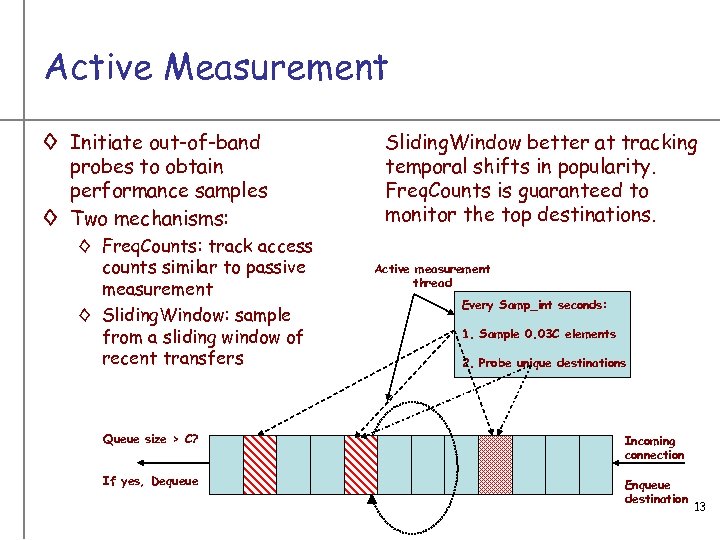
Active Measurement ◊ Initiate out-of-band probes to obtain performance samples ◊ Two mechanisms: Sliding. Window better at tracking temporal shifts in popularity. Freq. Counts is guaranteed to monitor the top destinations. ◊ Freq. Counts: track access counts similar to passive measurement ◊ Sliding. Window: sample from a sliding window of recent transfers Active measurement thread Every Samp_int seconds: 1. Sample 0. 03 C elements 2. Probe unique destinations Queue size > C? Incoming connection If yes, Dequeue Enqueue destination 13
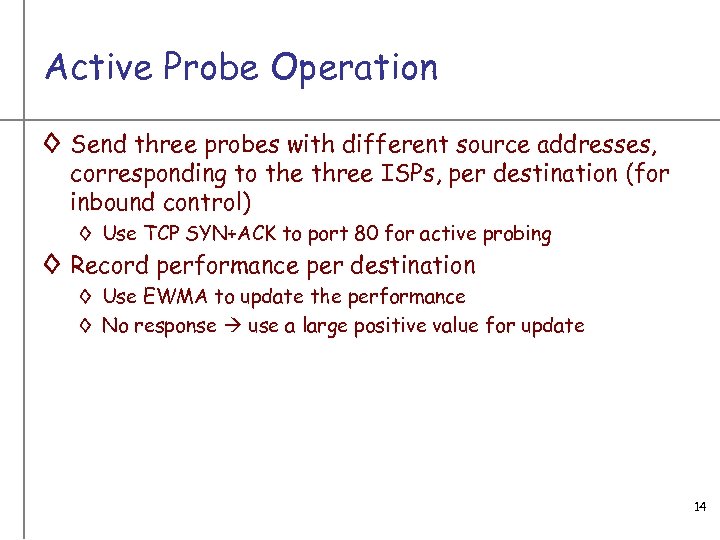
Active Probe Operation ◊ Send three probes with different source addresses, corresponding to the three ISPs, per destination (for inbound control) ◊ Use TCP SYN+ACK to port 80 for active probing ◊ Record performance per destination ◊ Use EWMA to update the performance ◊ No response use a large positive value for update 14
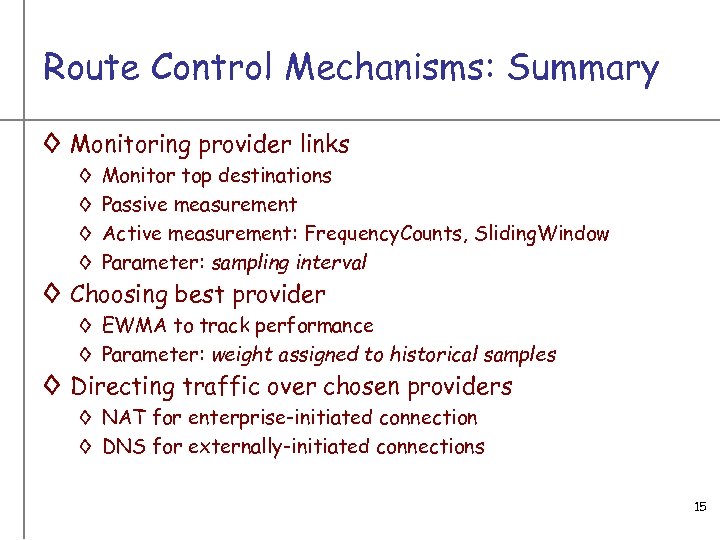
Route Control Mechanisms: Summary ◊ Monitoring provider links ◊ Monitor top destinations ◊ Passive measurement ◊ Active measurement: Frequency. Counts, Sliding. Window ◊ Parameter: sampling interval ◊ Choosing best provider ◊ EWMA to track performance ◊ Parameter: weight assigned to historical samples ◊ Directing traffic over chosen providers ◊ NAT for enterprise-initiated connection ◊ DNS for externally-initiated connections 15
Outline ◊ Route Control components ◊ Experimental Evaluation ◊ Open issues ◊ Conclusion 16
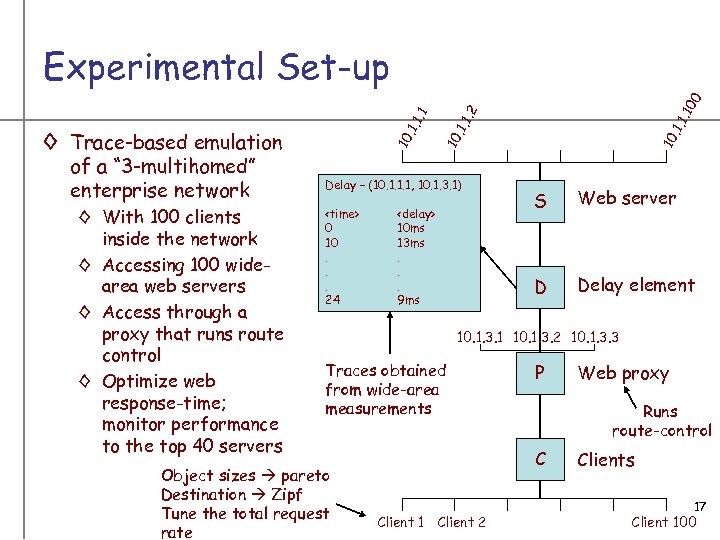
◊ With 100 clients inside the network ◊ Accessing 100 widearea web servers ◊ Access through a proxy that runs route control ◊ Optimize web response-time; monitor performance to the top 40 servers Delay – (10. 1. 1. 1, 10. 1. 3. 1) <time> 0 10. . . 24 00. 1. 1 . 1. 2 10. 1 ◊ Trace-based emulation of a “ 3 -multihomed” enterprise network . 1. 1 Experimental Set-up Web server D <delay> 10 ms 13 ms. . . 9 ms S Delay element 10. 1. 3. 1 10. 1. 3. 2 10. 1. 3. 3 Traces obtained from wide-area measurements Object sizes pareto Destination Zipf Tune the total request rate P Runs route-control C Client 1 Client 2 Web proxy Clients 17 Client 100
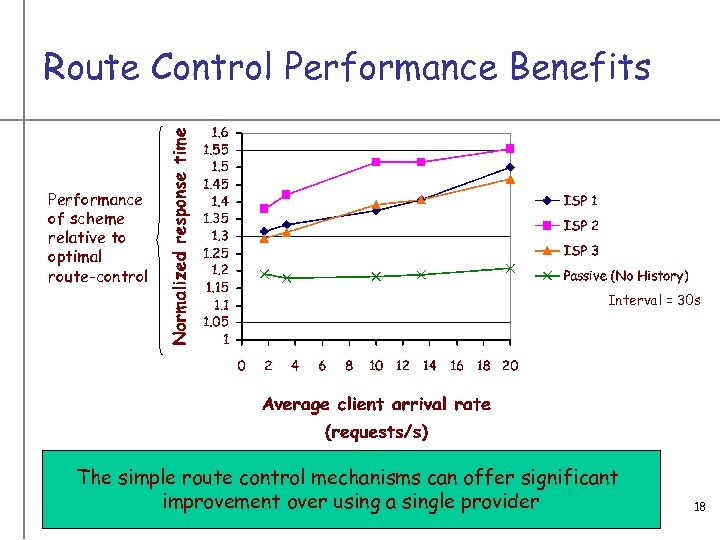
Route Control Performance Benefits Performance of scheme relative to optimal route-control Interval = 30 s The simple route control mechanisms can offer significant improvement over using a single provider 18
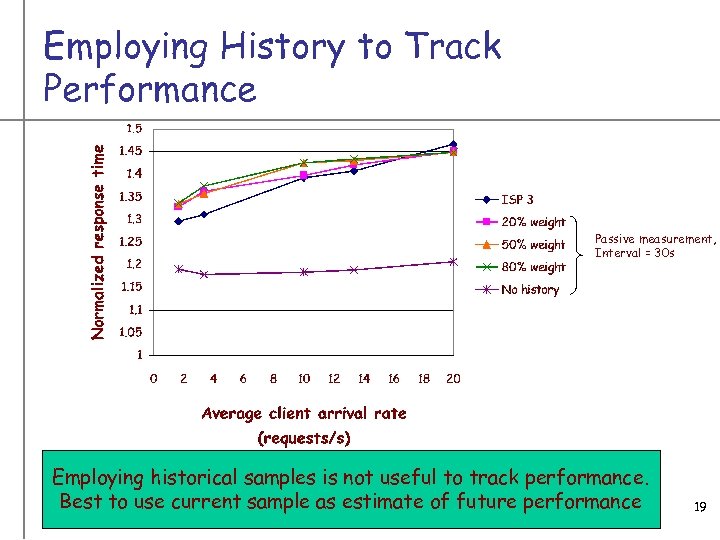
Employing History to Track Performance Passive measurement, Interval = 30 s Employing historical samples is not useful to track performance. Best to use current sample as estimate of future performance 19
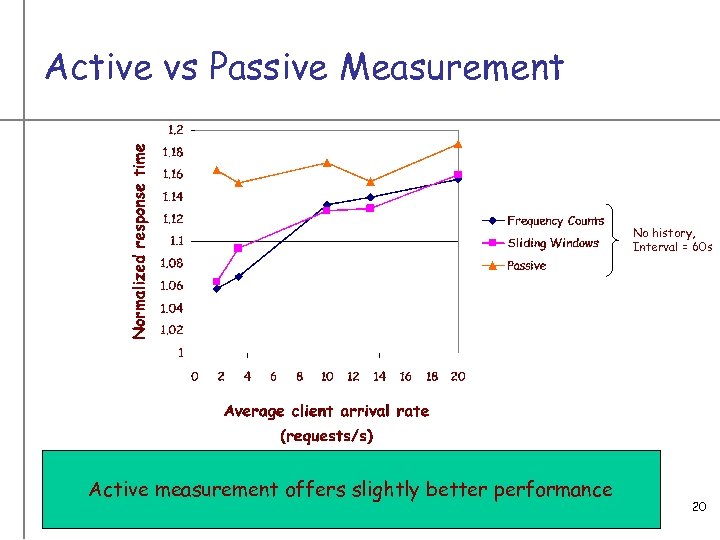
Active vs Passive Measurement No history, Interval = 60 s Active measurement offers slightly better performance 20
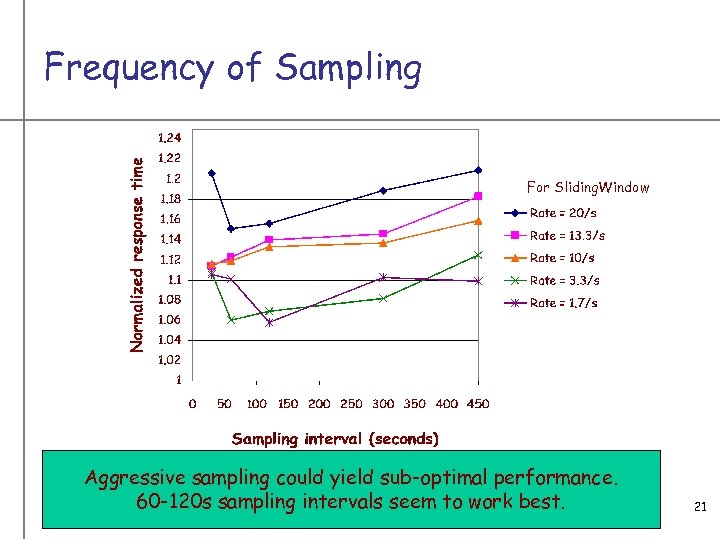
Frequency of Sampling For Sliding. Window Aggressive sampling could yield sub-optimal performance. 60 -120 s sampling intervals seem to work best. 21
Outline ◊ Route Control components ◊ Experimental Evaluation ◊ Open issues ◊ Conclusion 22
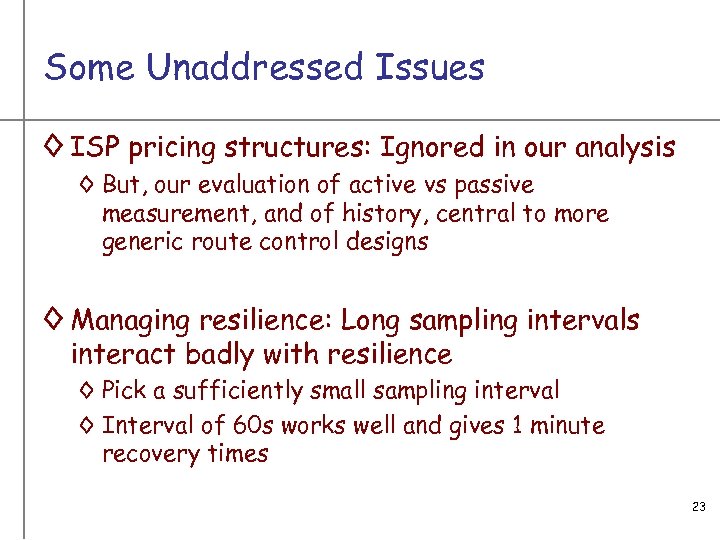
Some Unaddressed Issues ◊ ISP pricing structures: Ignored in our analysis ◊ But, our evaluation of active vs passive measurement, and of history, central to more generic route control designs ◊ Managing resilience: Long sampling intervals interact badly with resilience ◊ Pick a sufficiently small sampling interval ◊ Interval of 60 s works well and gives 1 minute recovery times 23
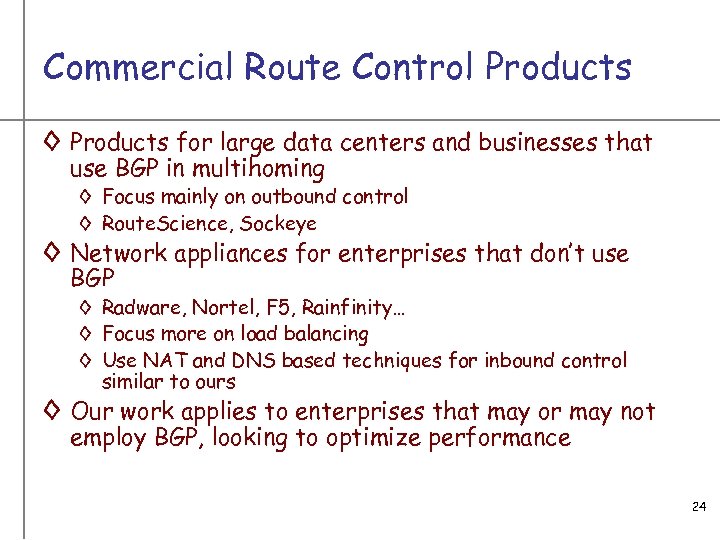
Commercial Route Control Products ◊ Products for large data centers and businesses that use BGP in multihoming ◊ Focus mainly on outbound control ◊ Route. Science, Sockeye ◊ Network appliances for enterprises that don’t use BGP ◊ Radware, Nortel, F 5, Rainfinity… ◊ Focus more on load balancing ◊ Use NAT and DNS based techniques for inbound control similar to ours ◊ Our work applies to enterprises that may or may not employ BGP, looking to optimize performance 24
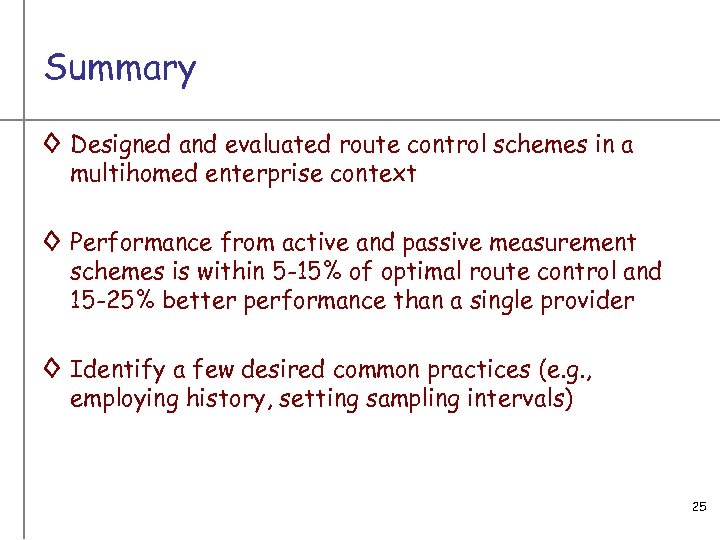
Summary ◊ Designed and evaluated route control schemes in a multihomed enterprise context ◊ Performance from active and passive measurement schemes is within 5 -15% of optimal route control and 15 -25% better performance than a single provider ◊ Identify a few desired common practices (e. g. , employing history, setting sampling intervals) 25
Backup Slides ◊ Backup 26
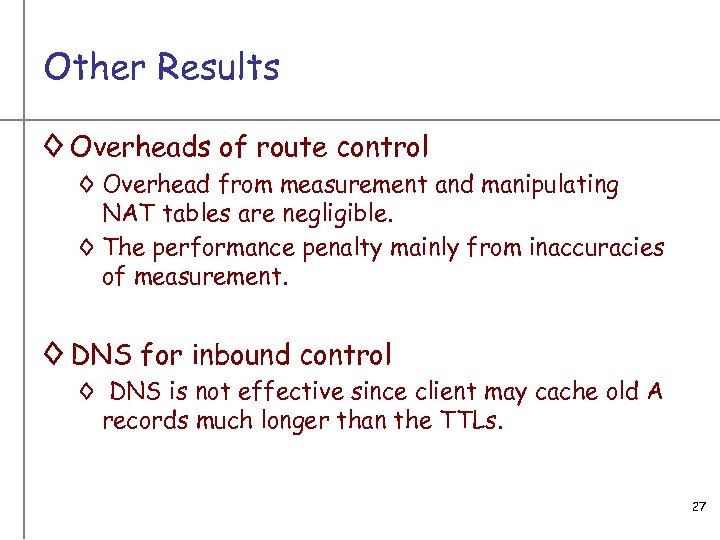
Other Results ◊ Overheads of route control ◊ Overhead from measurement and manipulating NAT tables are negligible. ◊ The performance penalty mainly from inaccuracies of measurement. ◊ DNS for inbound control ◊ DNS is not effective since client may cache old A records much longer than the TTLs. 27
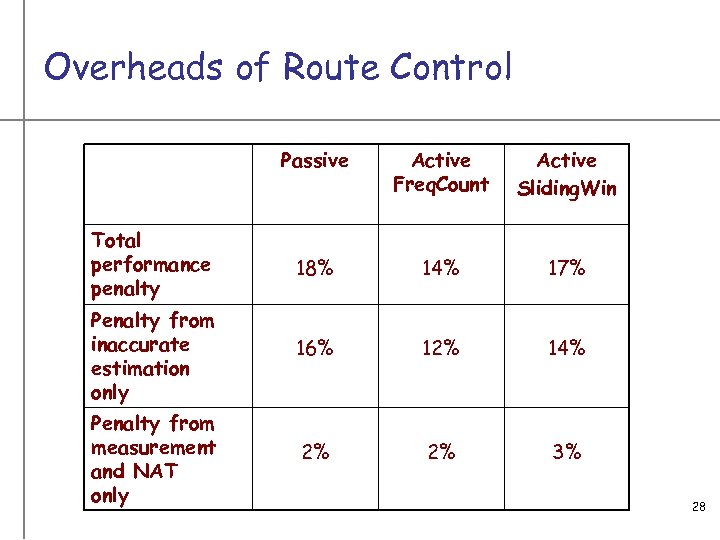
Overheads of Route Control Passive Active Freq. Count Active Sliding. Win Total performance penalty 18% 14% 17% Penalty from inaccurate estimation only 16% 12% 14% Penalty from measurement and NAT only 2% 2% 3% 28
Скачать презентацию Multihoming Performance Benefits An Experimental Evaluation of Practical
888fd566917ca404fb5f71c1083b07af.ppt