


 Скачать презентацию Multi-Stage Modelling of Nonlinear Economic Processes Gustav Feichtinger
4aa837c0f1c2864b0b60ace7c613d62b.ppt
- Количество слайдов: 50
 Multi-Stage Modelling of Nonlinear Economic Processes Gustav Feichtinger Institute for Mathematical Methods in Economics Vienna University of Technology or@server. eos. tuwien. ac. at http: //www. eos. tuwien. ac. at/OR/
 Roadmap • Multi-stage Modelling • Optimal Wine Consumption • Firms in Recession – Conspicuous Goods • Optimal Retirement • Counter-terror strategies – “water” and “fire” • Discussion & Extensions 2
 http: //www. springer. com/economics/game+theory/book/ 978 -3 -540 -77646 -8 http: //www. eos. tuwien. ac. at/OR/OCMat/ 3
 Multi-Stage Modelling Market disruptions: oil shocks, Australian heroin drought R & D: innovation, technological breakthrough Financial crisis, recession periods How should policy respond to a disruption? How to cope with recession periods? MSM: different objectives or/and system dynamics at different stages 4
 Tomiyama (1985), Tomiyama & Rossana (1989), Makris (2001), Saglam (2002), Boucekkine et al. (2004), Grass et al. (2009) Cooperation Tilburg, Vienna, CMU Pittsburgh Many applications (harm reduction, luxury goods/services in recession periods), various extensions (e. g. stochastic models) Exogenous switching vs endogenous (optimal) change of regimes 5
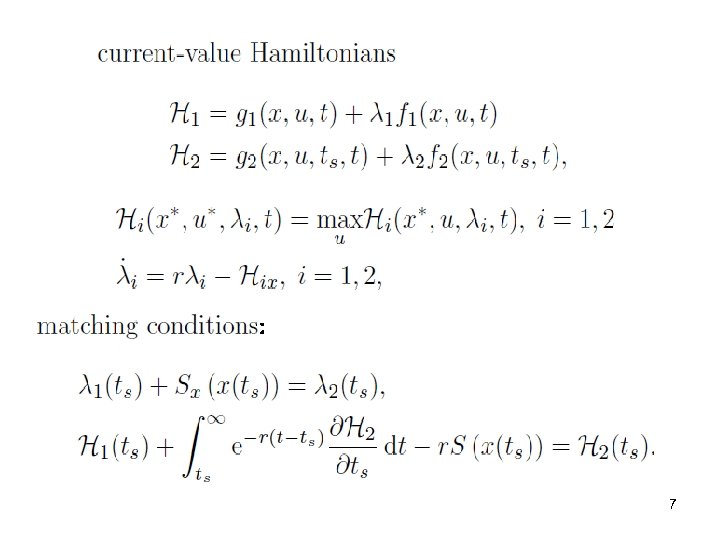
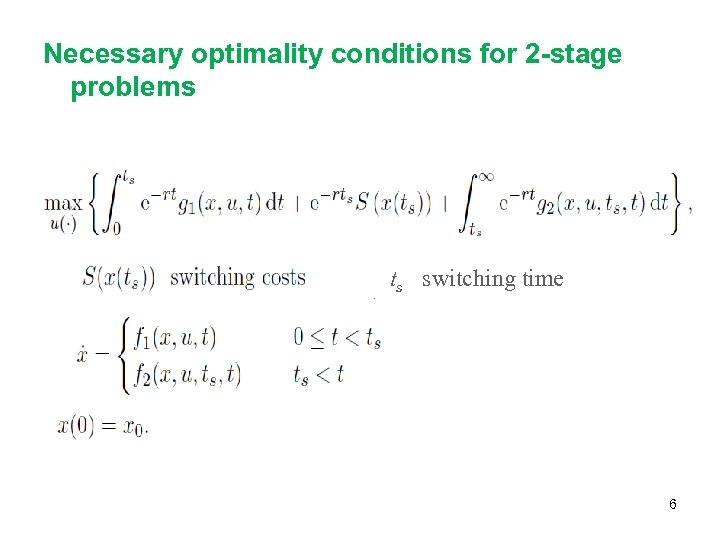 Necessary optimality conditions for 2 -stage problems ts switching time 6
 7
7
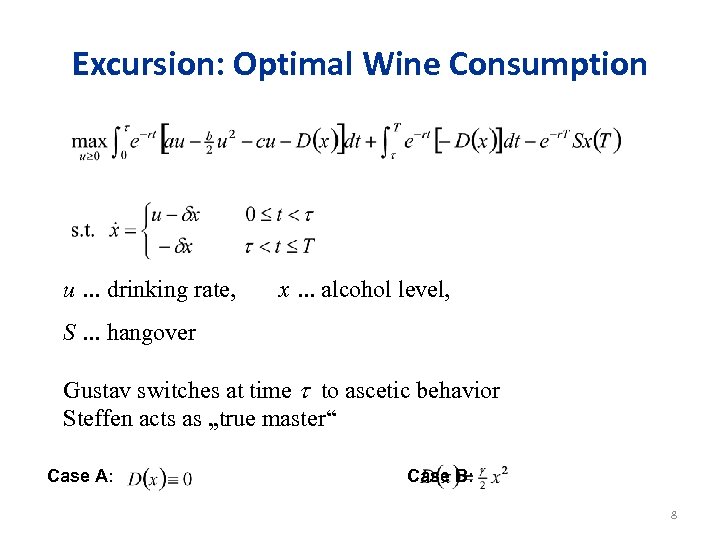 Excursion: Optimal Wine Consumption u … drinking rate, x … alcohol level, S … hangover Gustav switches at time to ascetic behavior Steffen acts as „true master“ Case A: Case B: 8
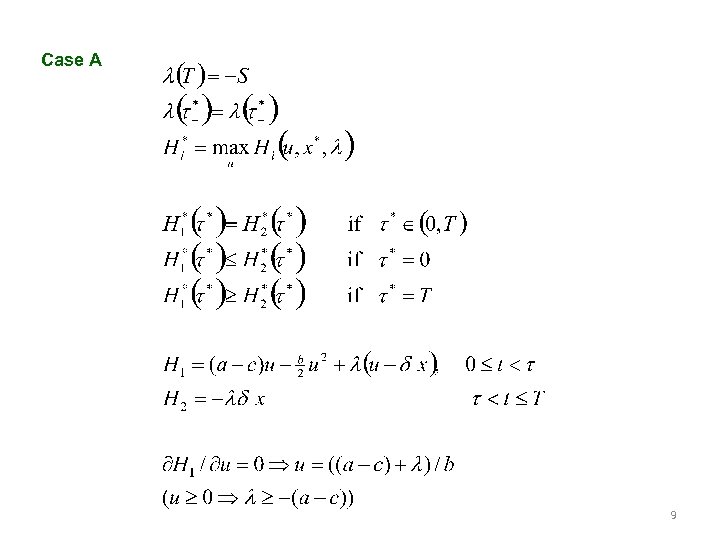 Case A 9
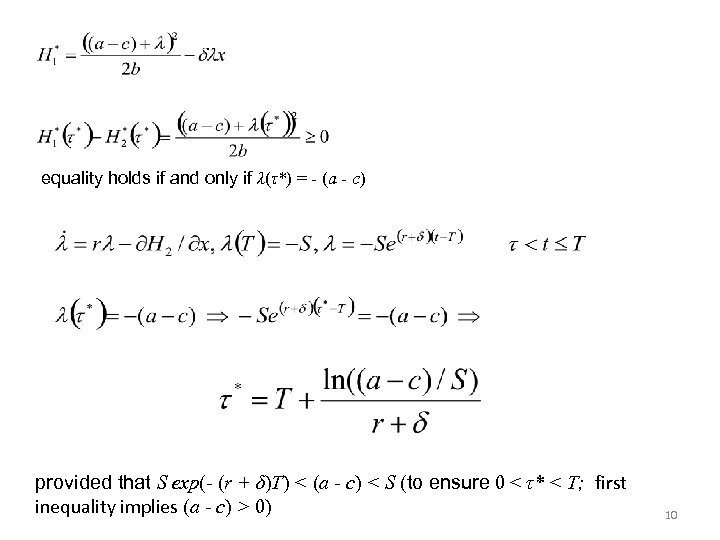 equality holds if and only if λ(τ*) = - (a - c) provided that S exp(- (r + δ)T) < (a - c) < S (to ensure 0 < τ* < T; first inequality implies (a - c) > 0) 10
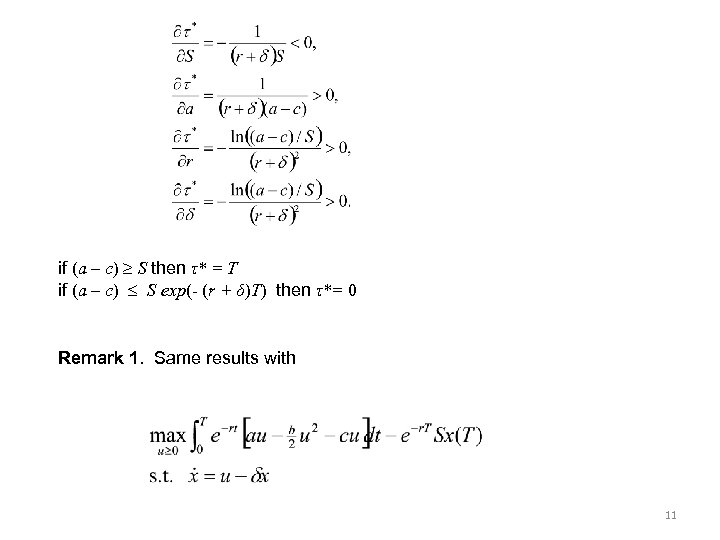 if (a – c) S then τ* = T if (a – c) S exp(- (r + δ)T) then τ*= 0 Remark 1. Same results with 11
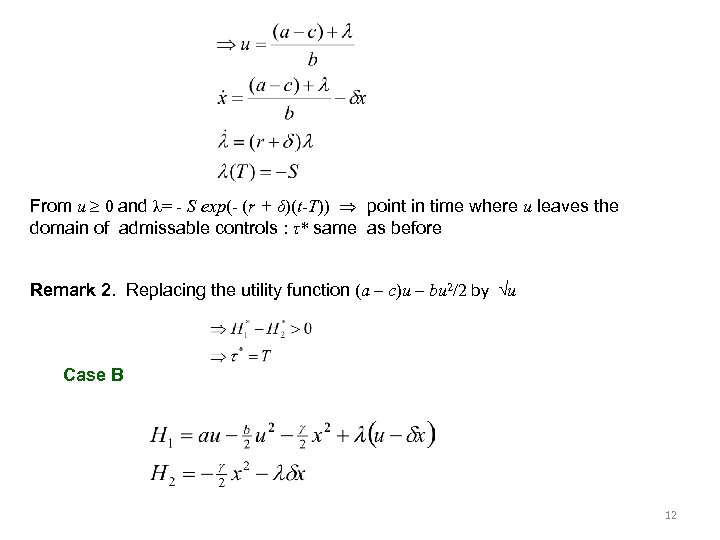 From u 0 and λ= - S exp(- (r + δ)(t-T)) point in time where u leaves the domain of admissable controls : τ* same as before Remark 2. Replacing the utility function (a – c)u – bu 2/2 by u Case B 12
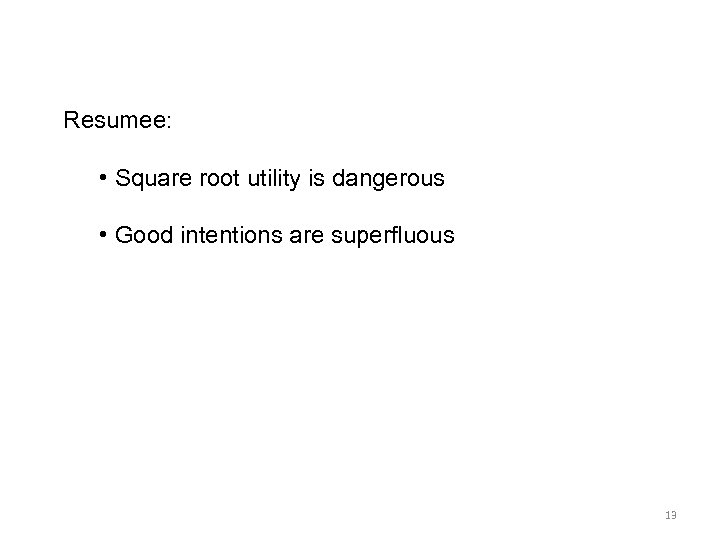 Resumee: • Square root utility is dangerous • Good intentions are superfluous 13
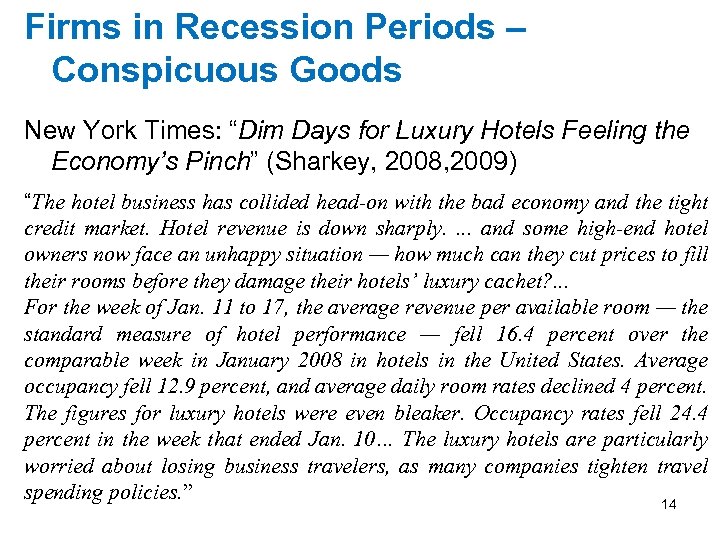 Firms in Recession Periods – Conspicuous Goods New York Times: “Dim Days for Luxury Hotels Feeling the Economy’s Pinch” (Sharkey, 2008, 2009) “The hotel business has collided head-on with the bad economy and the tight credit market. Hotel revenue is down sharply. . and some high-end hotel owners now face an unhappy situation — how much can they cut prices to fill their rooms before they damage their hotels’ luxury cachet? . . . For the week of Jan. 11 to 17, the average revenue per available room — the standard measure of hotel performance — fell 16. 4 percent over the comparable week in January 2008 in hotels in the United States. Average occupancy fell 12. 9 percent, and average daily room rates declined 4 percent. The figures for luxury hotels were even bleaker. Occupancy rates fell 24. 4 percent in the week that ended Jan. 10… The luxury hotels are particularly worried about losing business travelers, as many companies tighten travel spending policies. ” 14
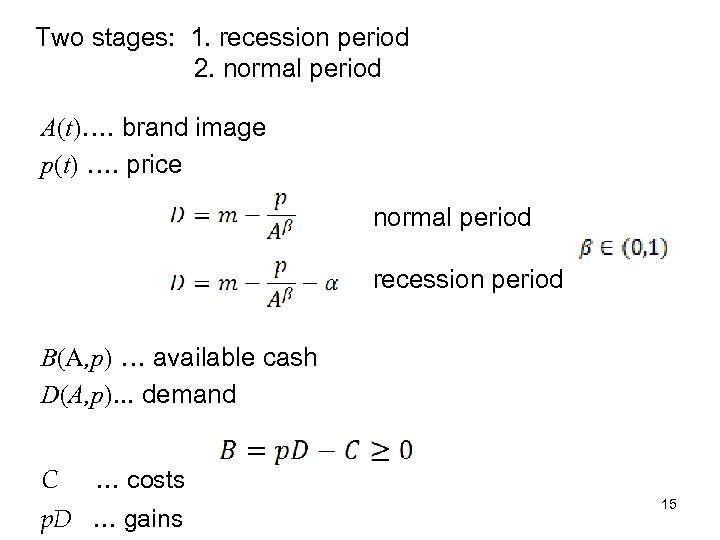 Two stages: 1. recession period 2. normal period A(t)…. brand image p(t) …. price normal period recession period B(A, p) … available cash D(A, p)… demand C … costs p. D … gains 15
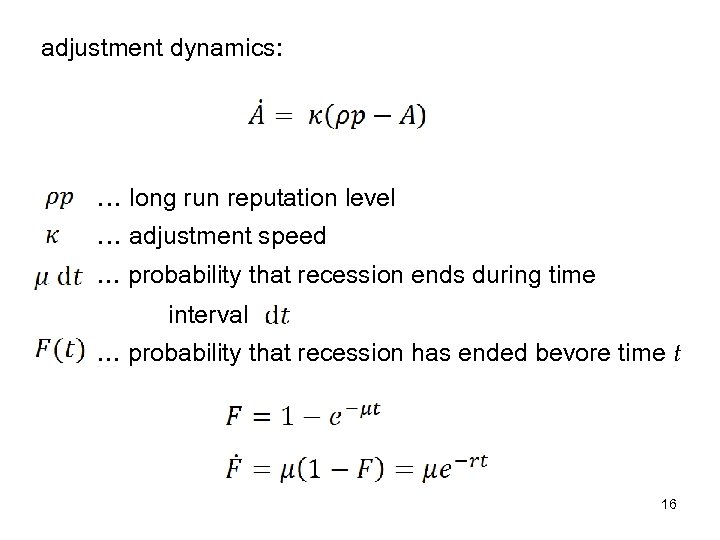 adjustment dynamics: … long run reputation level … adjustment speed … probability that recession ends during time interval … probability that recession has ended bevore time t 16
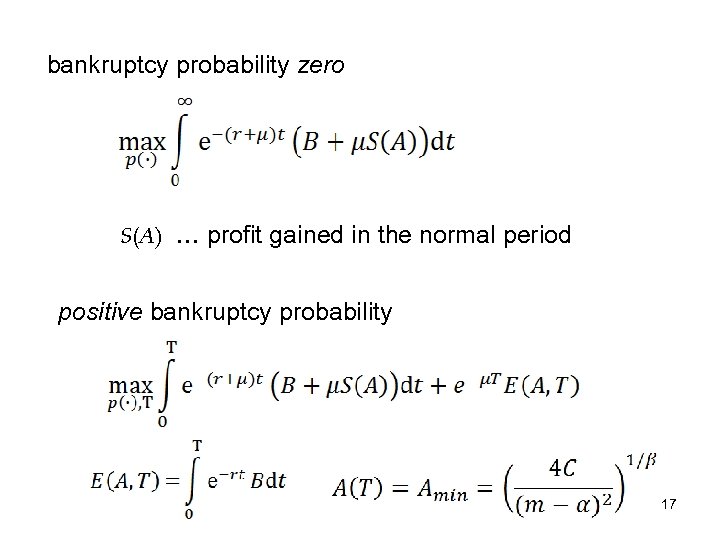 bankruptcy probability zero S(A) … profit gained in the normal period positive bankruptcy probability 17
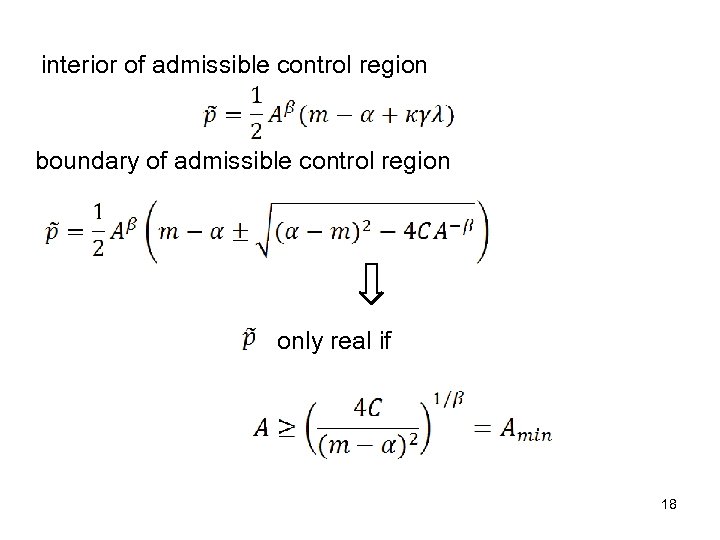 interior of admissible control region boundary of admissible control region only real if 18
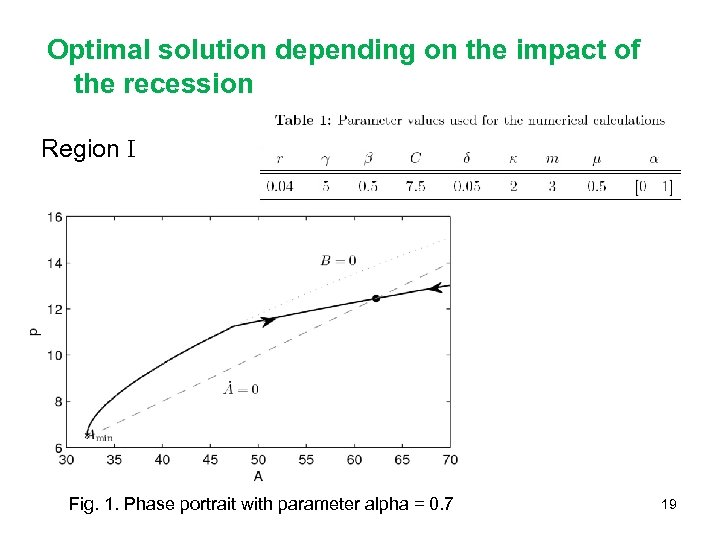 Optimal solution depending on the impact of the recession Region I Fig. 1. Phase portrait with parameter alpha = 0. 7 19
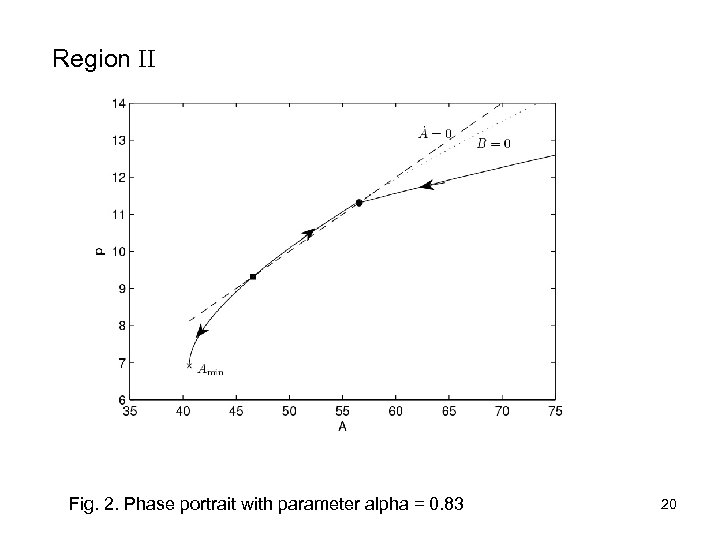 Region II Fig. 2. Phase portrait with parameter alpha = 0. 83 20
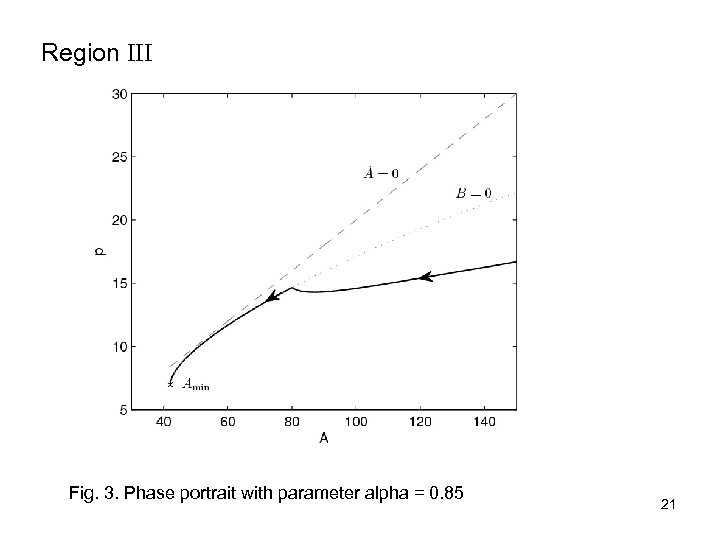 Region III Fig. 3. Phase portrait with parameter alpha = 0. 85 21
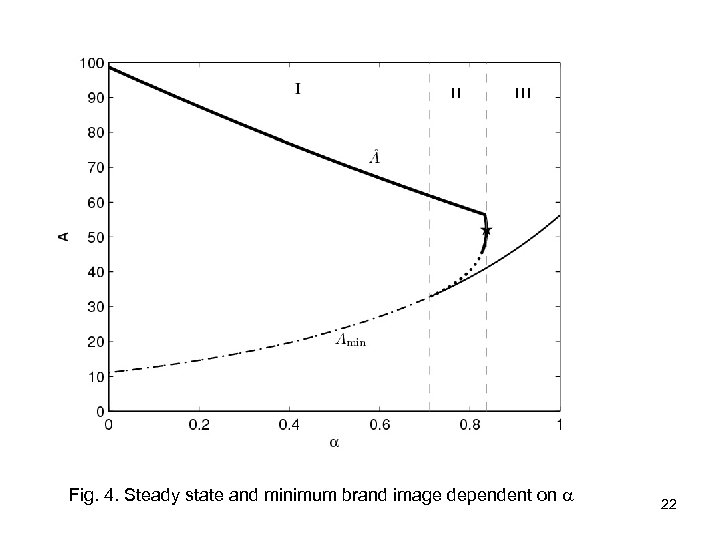 Fig. 4. Steady state and minimum brand image dependent on 22
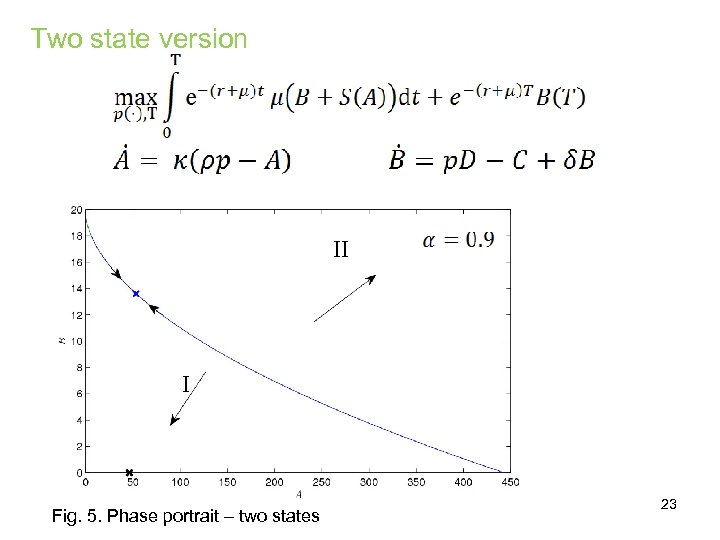 Two state version II I Fig. 5. Phase portrait – two states 23
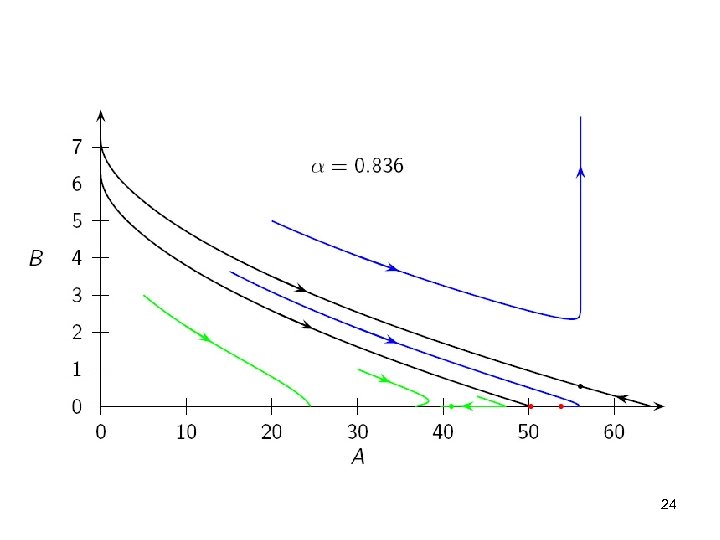 24
24
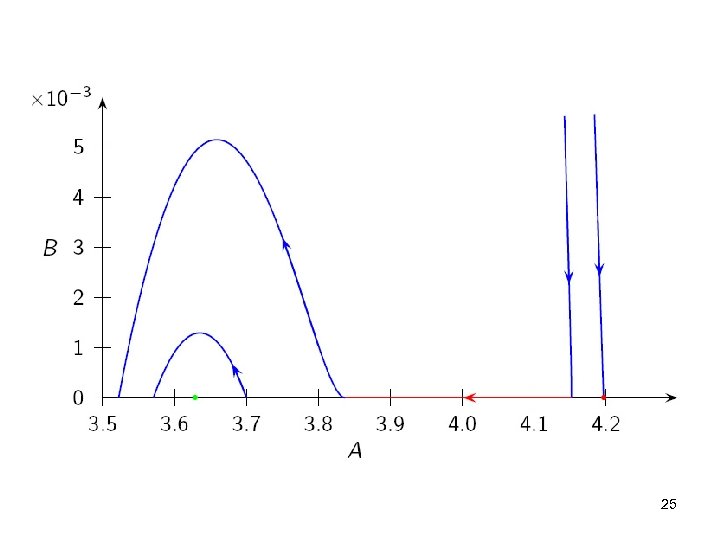 25
25
 existence of a DNSS curve seperating two optimal policies: „bankruptcy“ „liquidity“ „almost“ invariant sets for Markov diffusion processes (Colonius et al. , 2008, Billings & Schwartz, 2008) 26
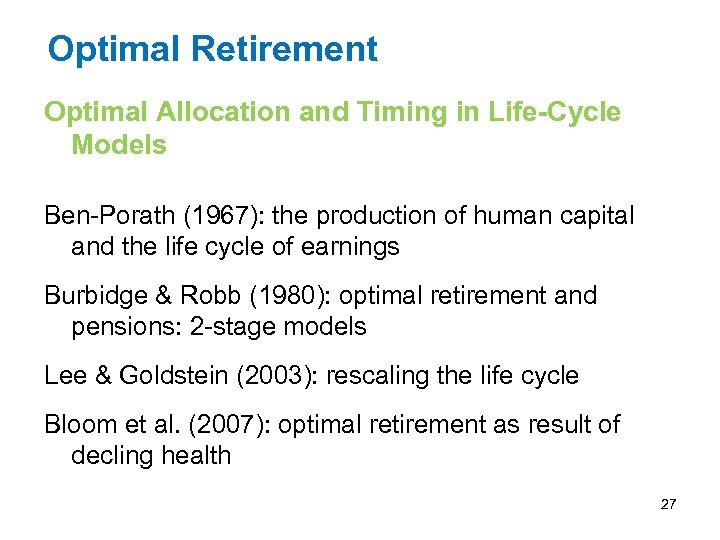 Optimal Retirement Optimal Allocation and Timing in Life-Cycle Models Ben-Porath (1967): the production of human capital and the life cycle of earnings Burbidge & Robb (1980): optimal retirement and pensions: 2 -stage models Lee & Goldstein (2003): rescaling the life cycle Bloom et al. (2007): optimal retirement as result of decling health 27
 References Kuhn et al. (2007): demand for health and the value of statistical life Baudisch (2008): optimal allocation between growth and reproduction in life-history models Kageyama (2008): evolutionary demography Interdependence of micro and macro models (individual life cycle and social policy) 28
 29
29
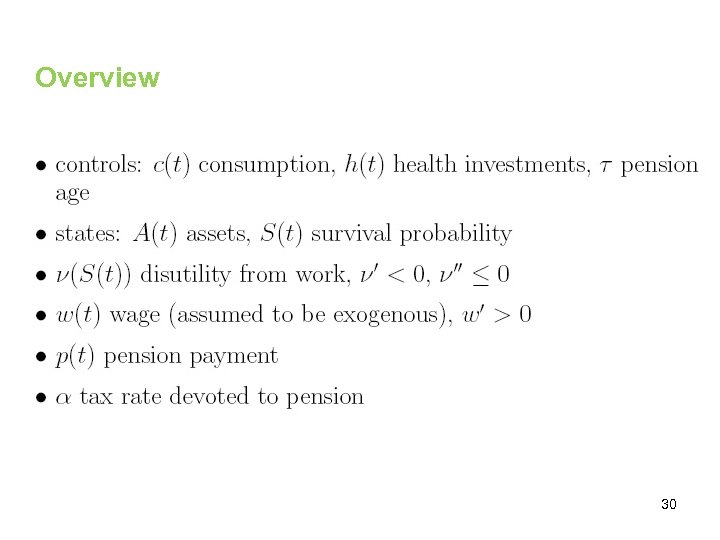 Overview 30
 31
31
 Model 32
 33
33
 34
34
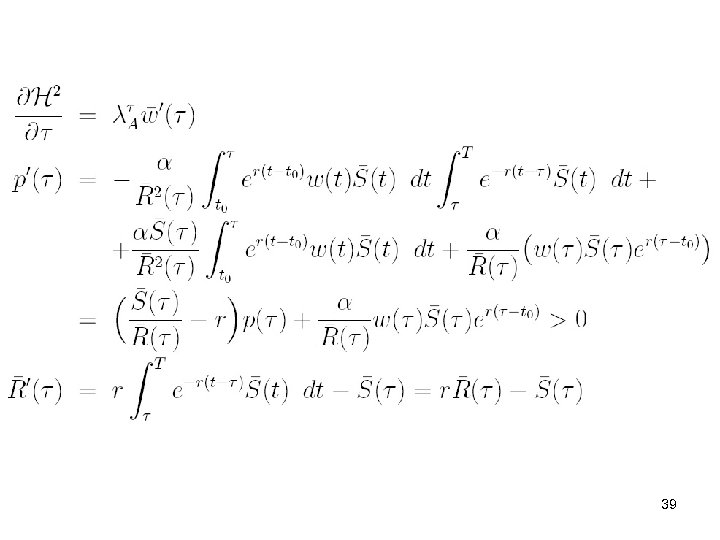
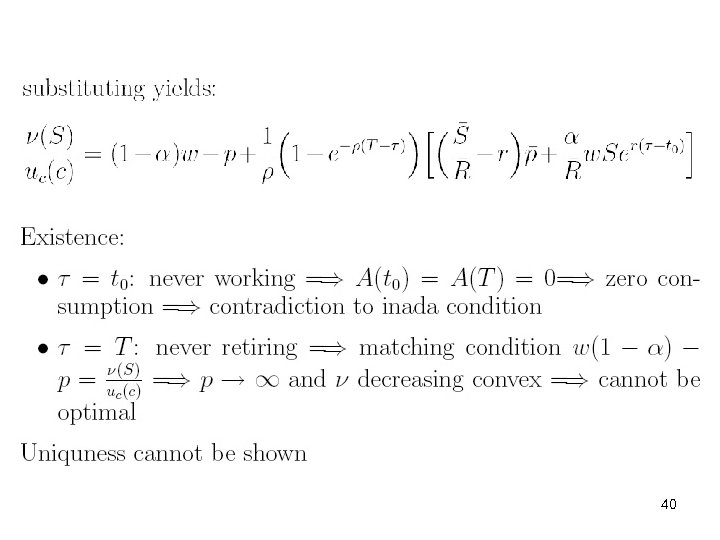
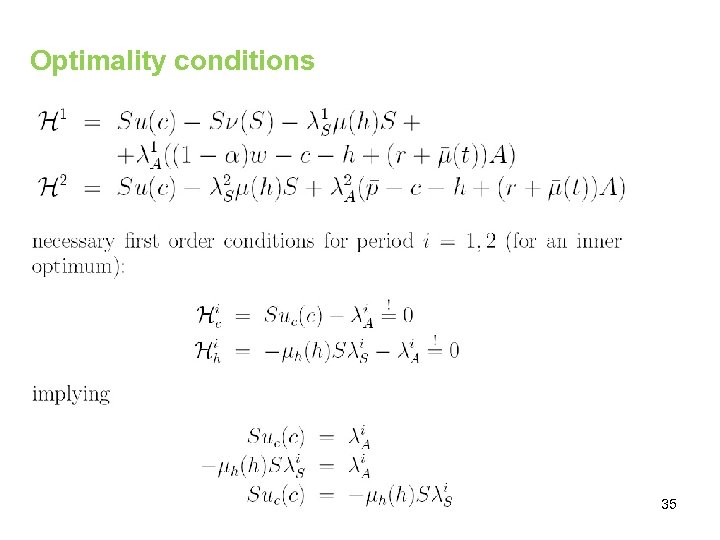 Optimality conditions 35
 36
36
 37
37
 38
38
 39
39
 40
40
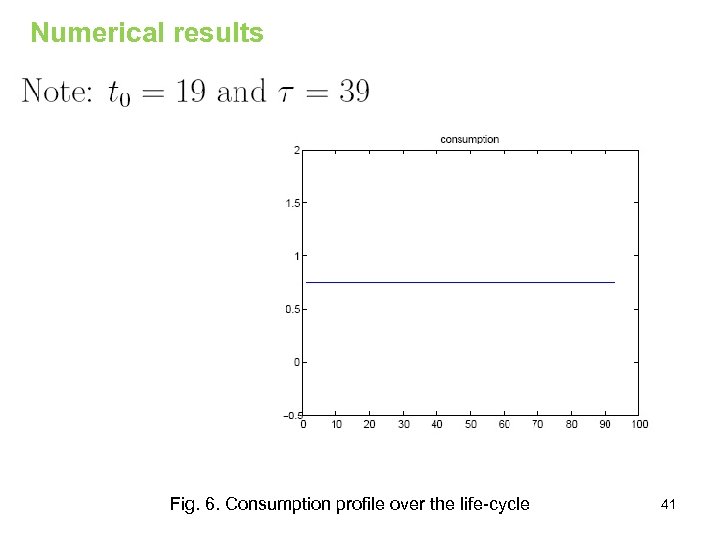 Numerical results Fig. 6. Consumption profile over the life-cycle 41
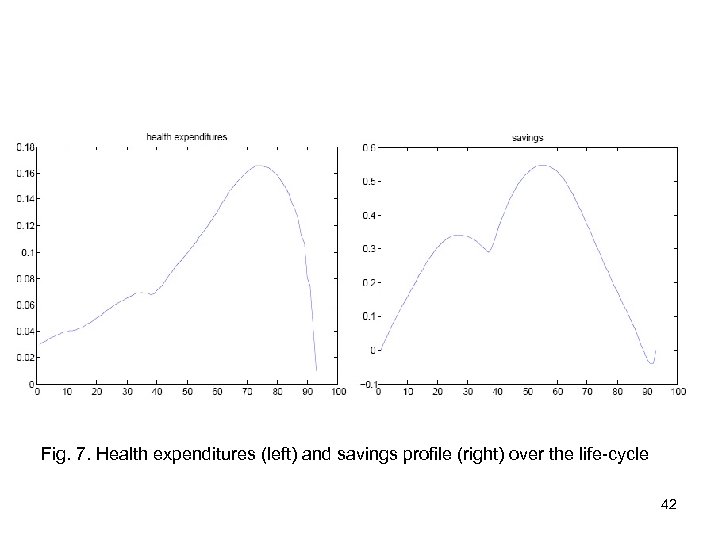 Fig. 7. Health expenditures (left) and savings profile (right) over the life-cycle 42
 Extensions 43
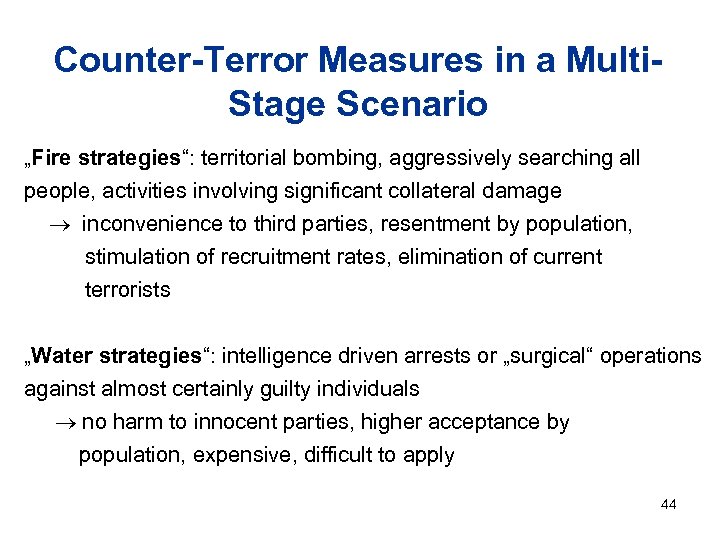 Counter-Terror Measures in a Multi. Stage Scenario „Fire strategies“: territorial bombing, aggressively searching all people, activities involving significant collateral damage inconvenience to third parties, resentment by population, stimulation of recruitment rates, elimination of current terrorists „Water strategies“: intelligence driven arrests or „surgical“ operations against almost certainly guilty individuals no harm to innocent parties, higher acceptance by population, expensive, difficult to apply 44
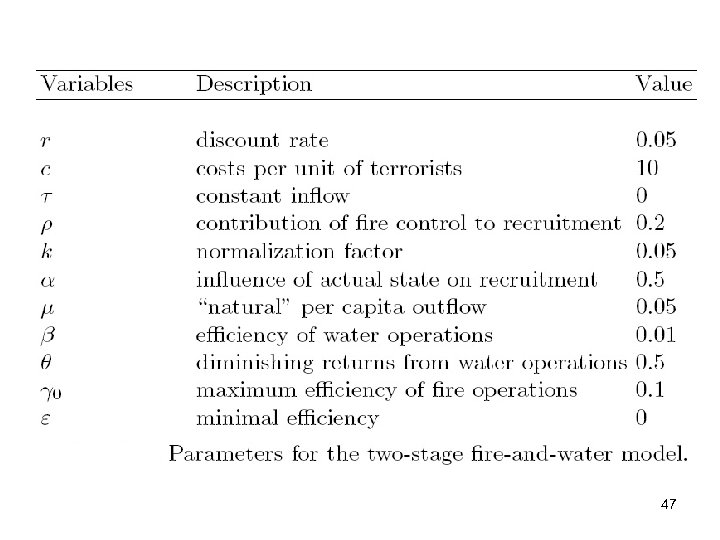
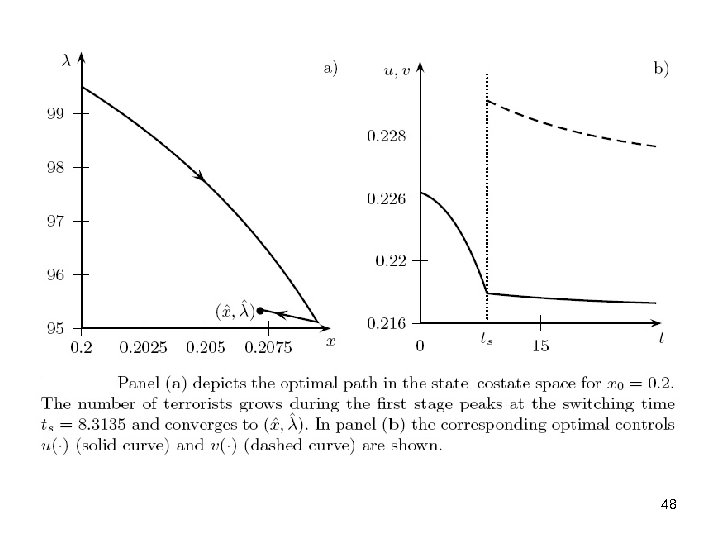
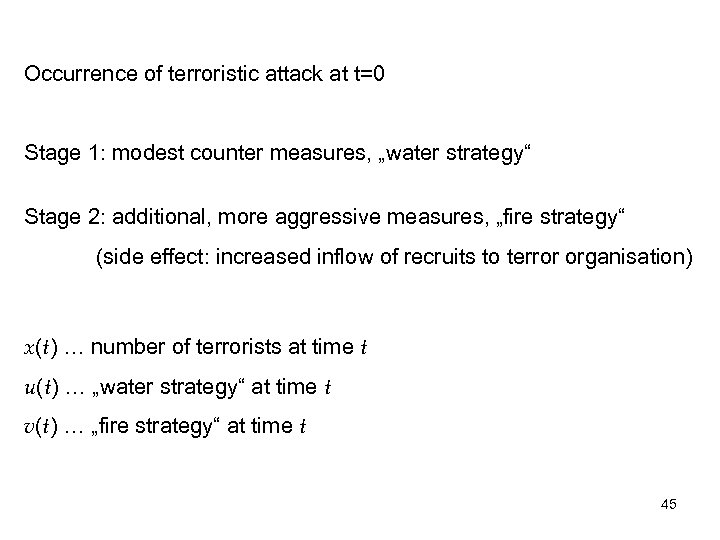 Occurrence of terroristic attack at t=0 Stage 1: modest counter measures, „water strategy“ Stage 2: additional, more aggressive measures, „fire strategy“ (side effect: increased inflow of recruits to terror organisation) x(t) … number of terrorists at time t u(t) … „water strategy“ at time t v(t) … „fire strategy“ at time t 45
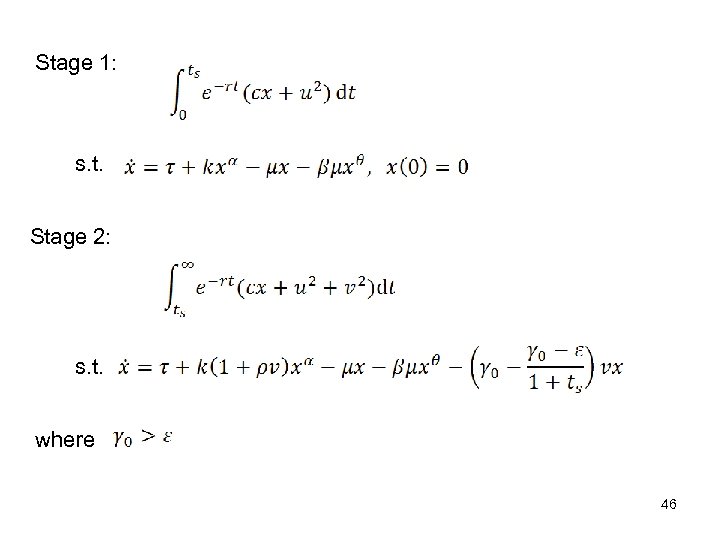 Stage 1: s. t. Stage 2: s. t. where 46
 47
47
 48
48
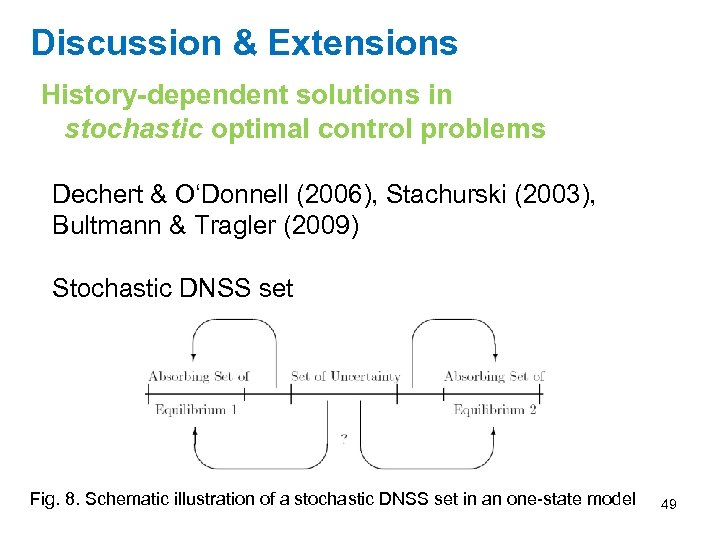 Discussion & Extensions History-dependent solutions in stochastic optimal control problems Dechert & O‘Donnell (2006), Stachurski (2003), Bultmann & Tragler (2009) Stochastic DNSS set Fig. 8. Schematic illustration of a stochastic DNSS set in an one-state model 49
 Two-stage differential games duopoly of firms terrorism games Multi-stage vintage models cohort- and period-specific switching in non-stationary situations examples in epidemiology and technology adoption 50