 Скачать презентацию Multi-Layer Arctic Mixed-Phase Clouds Simulated by a Cloud-Resolving
d64c80e9253160d58524f0c4ee83c572.ppt
- Количество слайдов: 38



Multi-Layer Arctic Mixed-Phase Clouds Simulated by a Cloud-Resolving Model: Comparison with ARM Observations and Sensitivity Experiments Yali Luo State Key Lab of Severe Weather (La. SW) Chinese Academy of Meteorological Sciences Co-authors: Kuan-Man Xu (La. RC), Hugh Morrison (NCAR), Greg Mc. Farquhar (U Illinois), Zhien Wang (U Wyoming), Gong Zhang (U Illinois) Polar Cloud Working Group Breakout Session II, 4 th Pan-GCSS Meeting June 4 th 2008; Toulouse, France
Outline 1. Introduction 2. Large-scale background and observations 3. Model and simulations 4. Comparing Baseline results with observations 5. Results from sensitivity experiments 2
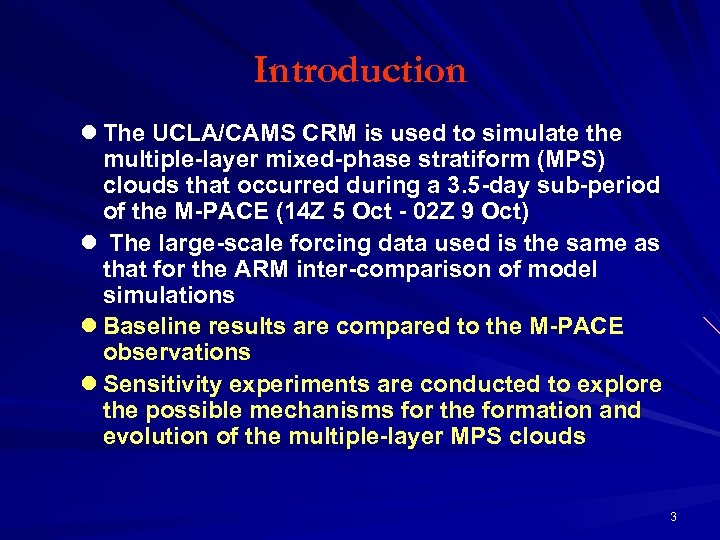
Introduction l The UCLA/CAMS CRM is used to simulate the multiple-layer mixed-phase stratiform (MPS) clouds that occurred during a 3. 5 -day sub-period of the M-PACE (14 Z 5 Oct - 02 Z 9 Oct) l The large-scale forcing data used is the same as that for the ARM inter-comparison of model simulations l Baseline results are compared to the M-PACE observations l Sensitivity experiments are conducted to explore the possible mechanisms for the formation and evolution of the multiple-layer MPS clouds 3
Outline 1. Introduction 2. Large-scale background and observations 3. Model and simulations 4. Comparing Baseline results with observations 5. Results from sensitivity experiments 6. Conclusions 4
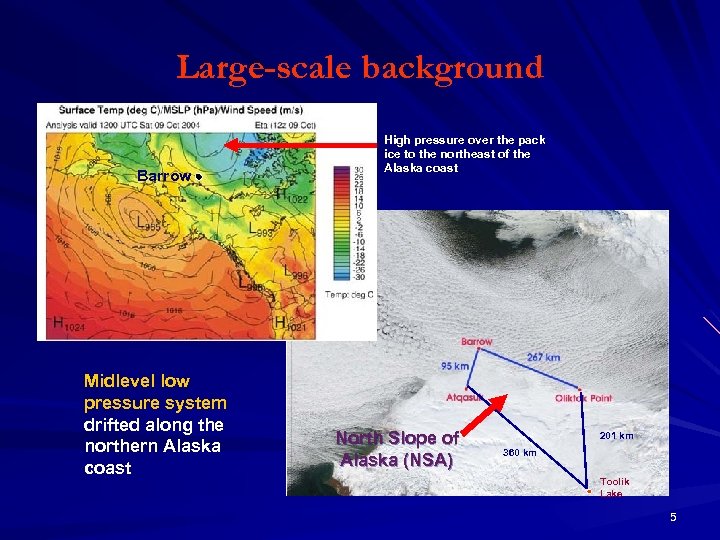
Large-scale background Barrow Midlevel low pressure system drifted along the northern Alaska coast High pressure over the pack ice to the northeast of the Alaska coast North Slope of Alaska (NSA) 201 km 360 km Toolik Lake 5
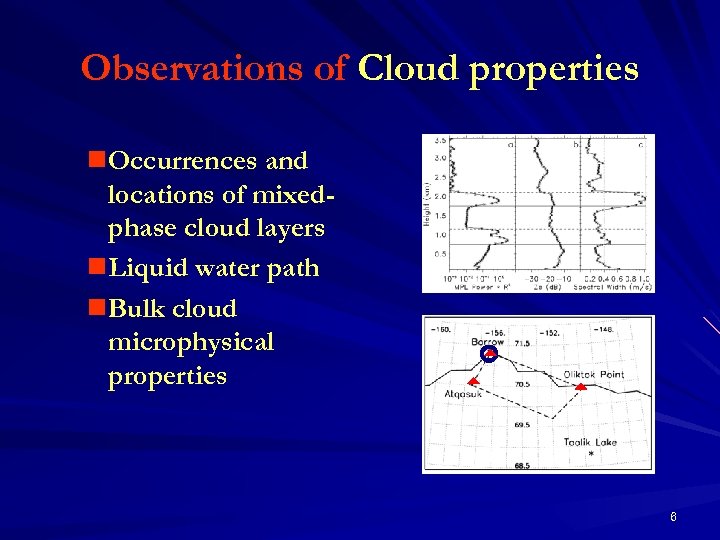
Observations of Cloud properties n Occurrences and locations of mixedphase cloud layers n Liquid water path n Bulk cloud microphysical properties 6
Other observations used n Aerosol properties (for microphysics calculation) n Surface precipitation rate, temperature, moisture (for model evaluation; produced by the ARM analysis) 7
Outline 1. Introduction 2. Large-scale background and observations 3. Model and simulations 4. Comparing Baseline results with observations 5. Results from sensitivity experiments 6. Conclusions 8
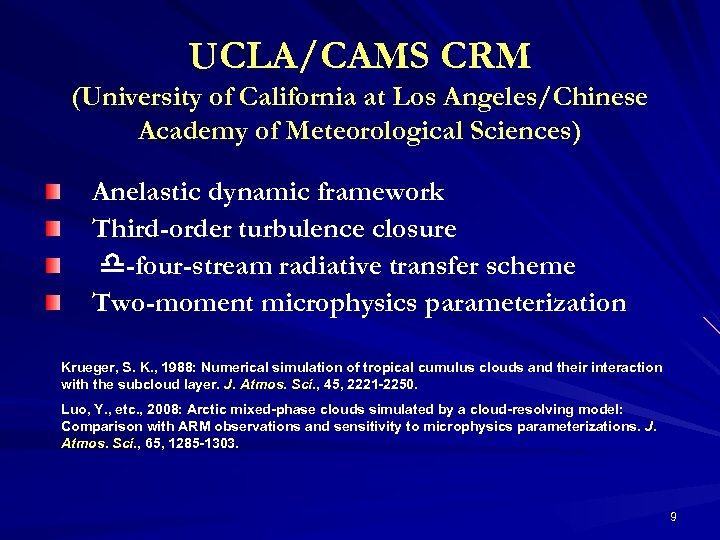
UCLA/CAMS CRM (University of California at Los Angeles/Chinese Academy of Meteorological Sciences) Anelastic dynamic framework Third-order turbulence closure d-four-stream radiative transfer scheme Two-moment microphysics parameterization Krueger, S. K. , 1988: Numerical simulation of tropical cumulus clouds and their interaction with the subcloud layer. J. Atmos. Sci. , 45, 2221 -2250. Luo, Y. , etc. , 2008: Arctic mixed-phase clouds simulated by a cloud-resolving model: Comparison with ARM observations and sensitivity to microphysics parameterizations. J. Atmos. Sci. , 65, 1285 -1303. 9
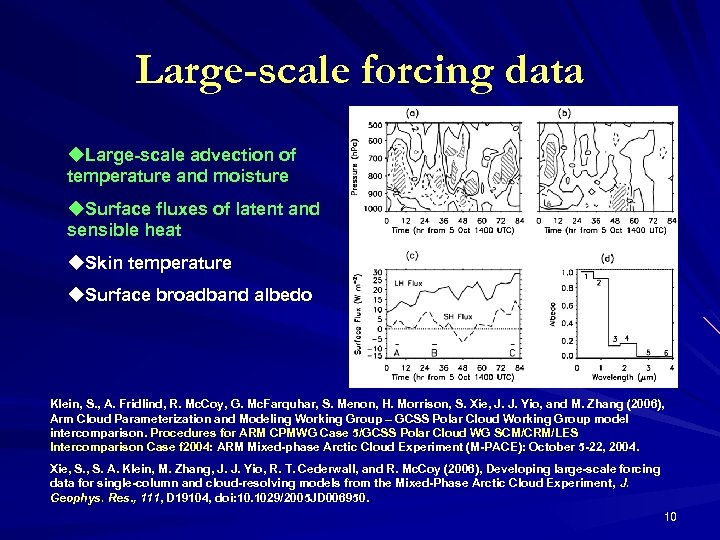
Large-scale forcing data u. Large-scale advection of temperature and moisture u. Surface fluxes of latent and sensible heat u. Skin temperature u. Surface broadband albedo Klein, S. , A. Fridlind, R. Mc. Coy, G. Mc. Farquhar, S. Menon, H. Morrison, S. Xie, J. J. Yio, and M. Zhang (2006), Arm Cloud Parameterization and Modeling Working Group – GCSS Polar Cloud Working Group model intercomparison. Procedures for ARM CPMWG Case 5/GCSS Polar Cloud WG SCM/CRM/LES Intercomparison Case f 2004: ARM Mixed-phase Arctic Cloud Experiment (M-PACE): October 5 -22, 2004. Xie, S. A. Klein, M. Zhang, J. J. Yio, R. T. Cederwall, and R. Mc. Coy (2006), Developing large-scale forcing data for single-column and cloud-resolving models from the Mixed-Phase Arctic Cloud Experiment, J. Geophys. Res. , 111, D 19104, doi: 10. 1029/2005 JD 006950. 10
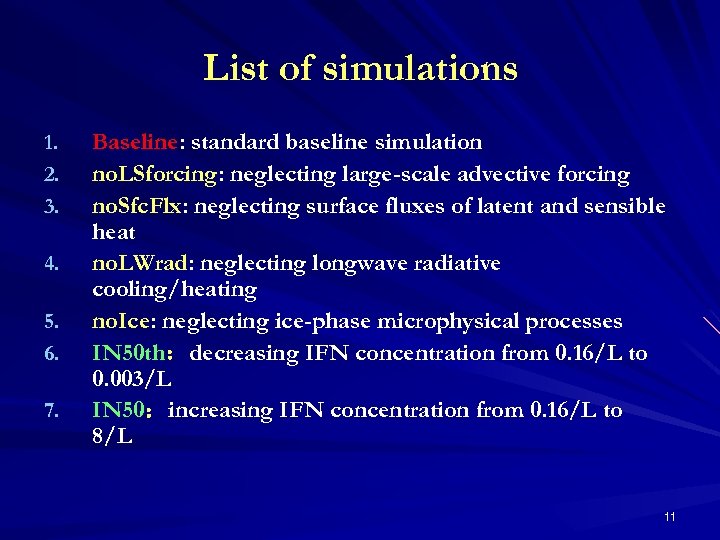
List of simulations 1. 2. 3. 4. 5. 6. 7. Baseline: standard baseline simulation no. LSforcing: neglecting large-scale advective forcing no. Sfc. Flx: neglecting surface fluxes of latent and sensible heat no. LWrad: neglecting longwave radiative cooling/heating no. Ice: neglecting ice-phase microphysical processes IN 50 th:decreasing IFN concentration from 0. 16/L to 0. 003/L IN 50:increasing IFN concentration from 0. 16/L to 8/L 11
Outline 1. Introduction 2. Large-scale background and observations 3. Model and simulations 4. Comparing Baseline results with observations 5. Results from sensitivity experiments 6. Conclusions 12
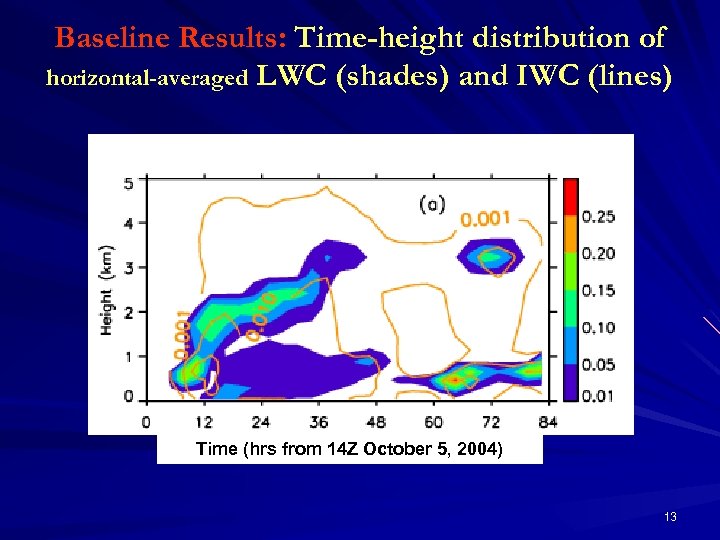
Baseline Results: Time-height distribution of horizontal-averaged LWC (shades) and IWC (lines) Time (hrs from 14 Z October 5, 2004) 13
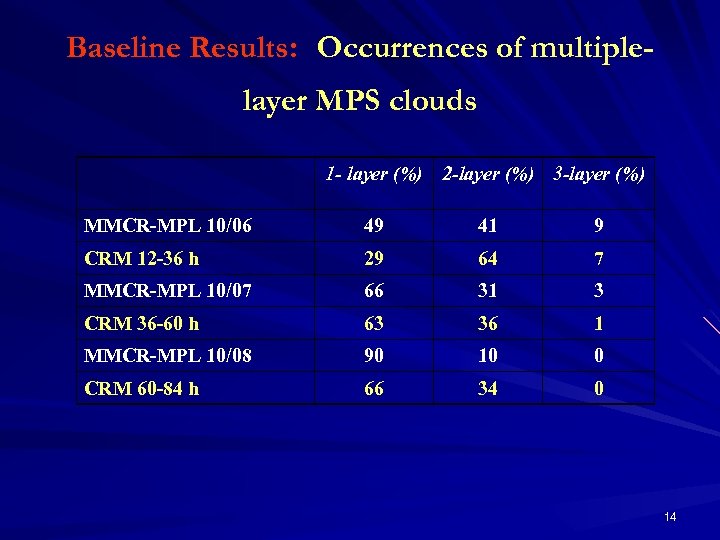
Baseline Results: Occurrences of multiplelayer MPS clouds 1 - layer (%) 2 -layer (%) 3 -layer (%) MMCR-MPL 10/06 49 41 9 CRM 12 -36 h 29 64 7 MMCR-MPL 10/07 66 31 3 CRM 36 -60 h 63 36 1 MMCR-MPL 10/08 90 10 0 CRM 60 -84 h 66 34 0 14
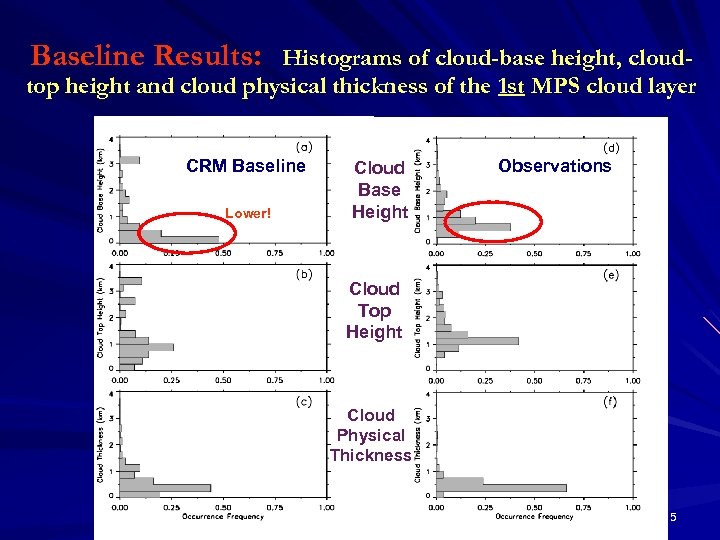
Baseline Results: Histograms of cloud-base height, cloudtop height and cloud physical thickness of the 1 st MPS cloud layer CRM Baseline Lower! Cloud Base Height Observations Cloud Top Height Cloud Physical Thickness 15
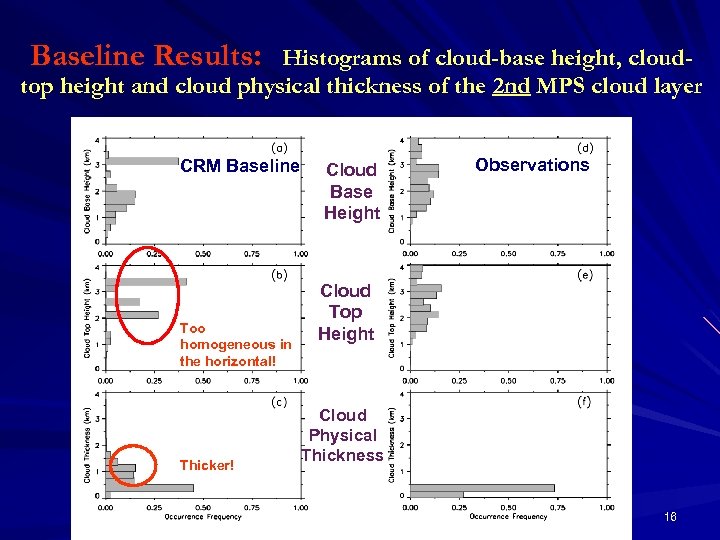
Baseline Results: Histograms of cloud-base height, cloudtop height and cloud physical thickness of the 2 nd MPS cloud layer CRM Baseline Too homogeneous in the horizontal! Thicker! Cloud Base Height Observations Cloud Top Height Cloud Physical Thickness 16
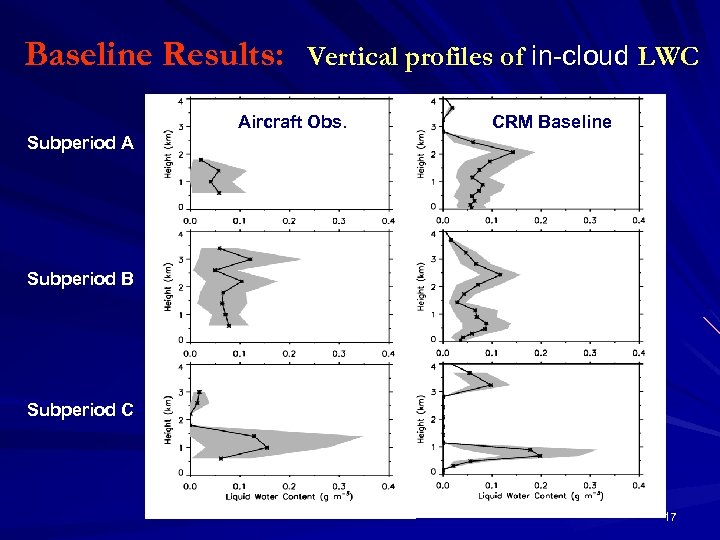
Baseline Results: Vertical profiles of in-cloud LWC Aircraft Obs. CRM Baseline Subperiod A Subperiod B Subperiod C 17
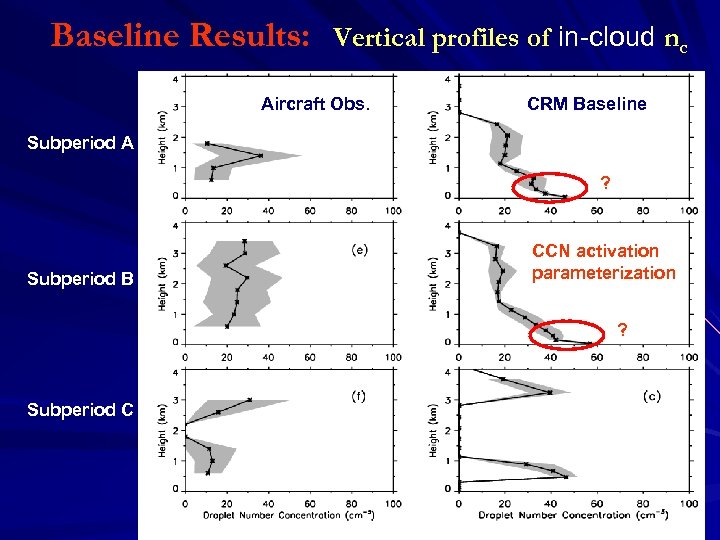
Baseline Results: Vertical profiles of in-cloud nc Aircraft Obs. CRM Baseline Subperiod A ? Subperiod B CCN activation parameterization ? Subperiod C 18
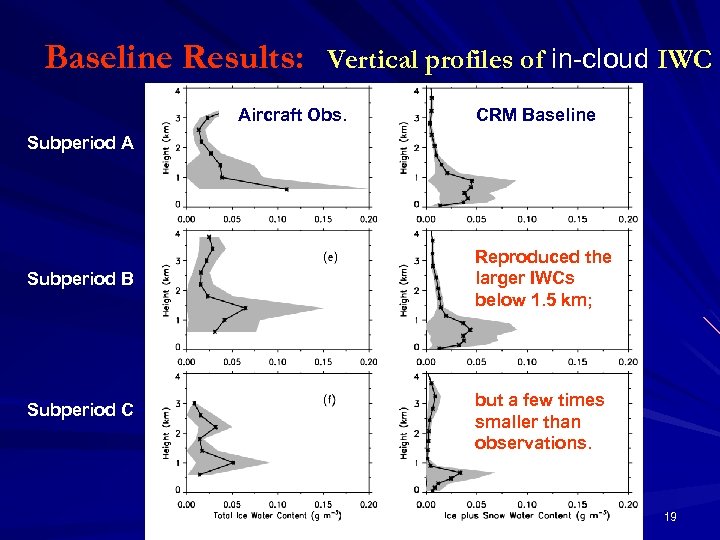
Baseline Results: Vertical profiles of in-cloud IWC Aircraft Obs. CRM Baseline Subperiod A Subperiod B Subperiod C Reproduced the larger IWCs below 1. 5 km; but a few times smaller than observations. 19
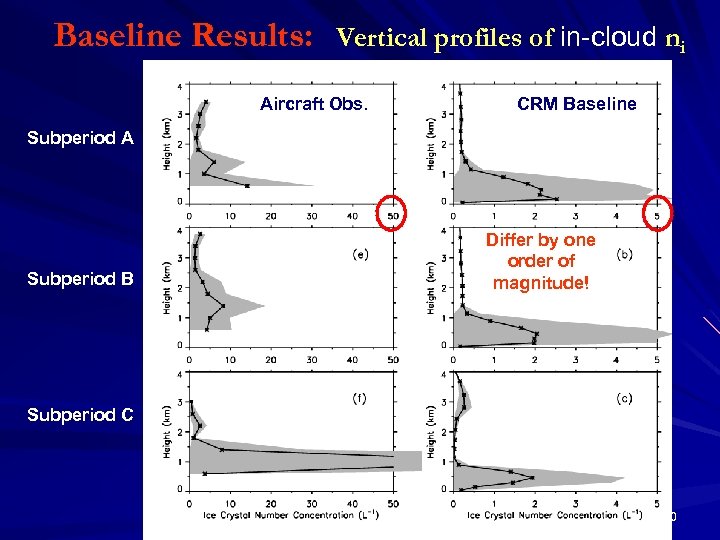
Baseline Results: Vertical profiles of in-cloud ni Aircraft Obs. CRM Baseline Subperiod A Subperiod B Differ by one order of magnitude! Subperiod C 20
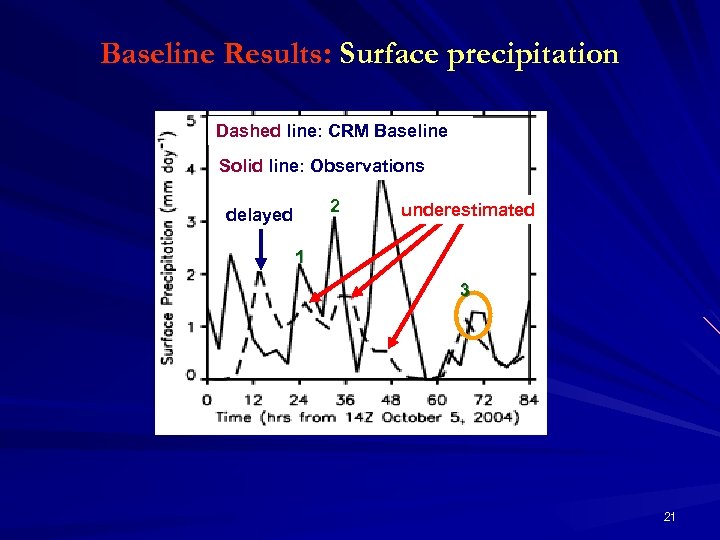
Baseline Results: Surface precipitation Dashed line: CRM Baseline Solid line: Observations 2 delayed underestimated 1 3 21
Summary of baseline results The Baseline simulation reproduces the dominance of singleand double-layer MPS clouds revealed by the MMCR-MPL observations and qualitatively captures the major characteristics in the vertical distributions of LWC, nc, ISWC and nis and their interperiod differences suggested by the aircraft observations. However, ü The simulated first MPS cloud layer is too low and nc within the lower layer decreases with height, in contrast to the relatively constant nc revealed by the observations. These could be due to uncertainties associated with the parameterizations (e. g. , turbulence, droplet activation, radiation), and the forcing data. ü The simulated second cloud layer is too thick with too large LWC, causing too strong LW cooling and negative biases in temperature. ü Both simulated cloud layers contain too few ice crystal numbers and too small ice crystal masses, indicating missing of ice enhancement mechanisms in the microphysics scheme and resulting in the underestimate of surface precipitation rates. 22
Outline 1. Introduction 2. Large-scale background and observations 3. Model and simulations 4. Comparing Baseline results with observations 5. Results from sensitivity experiments 23
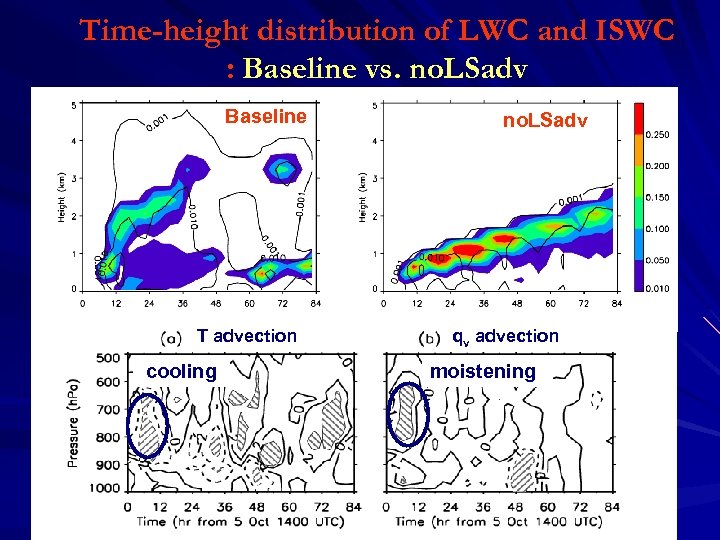
Time-height distribution of LWC and ISWC : Baseline vs. no. LSadv Baseline no. Sfc. Flx T advection cooling no. LSadv qv advection moistening 24
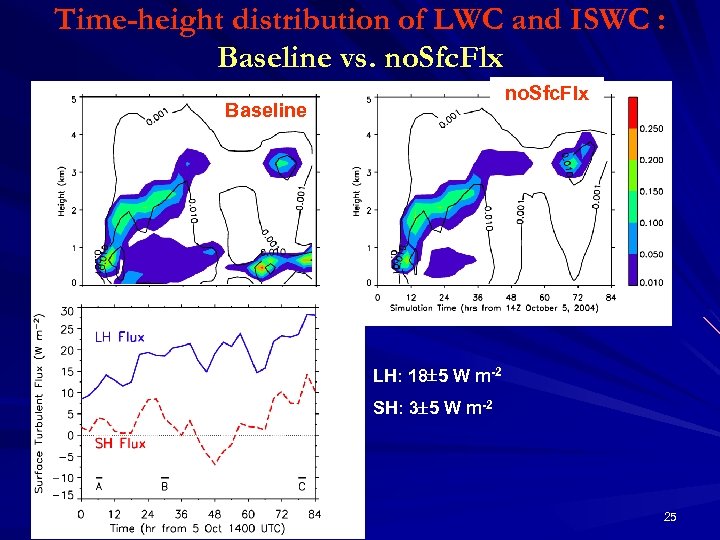
Time-height distribution of LWC and ISWC : Baseline vs. no. Sfc. Flx Baseline LH: 18 5 W m-2 SH: 3 5 W m-2 25
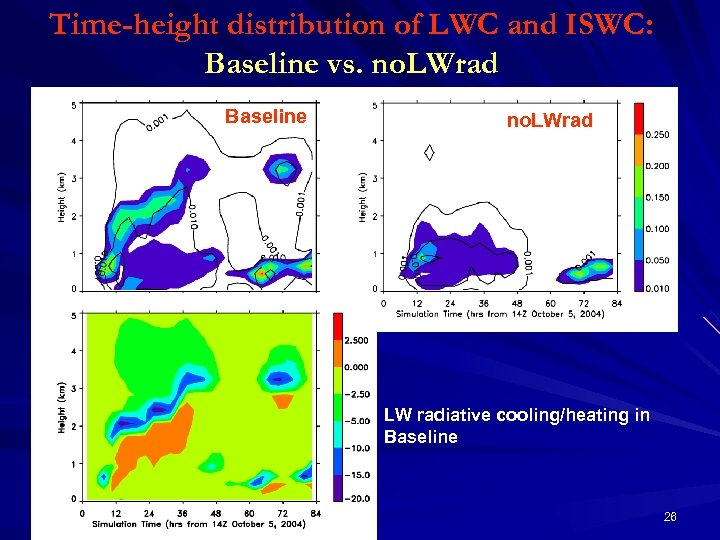
Time-height distribution of LWC and ISWC: Baseline vs. no. LWrad Baseline no. LWrad LW radiative cooling/heating in Baseline 26
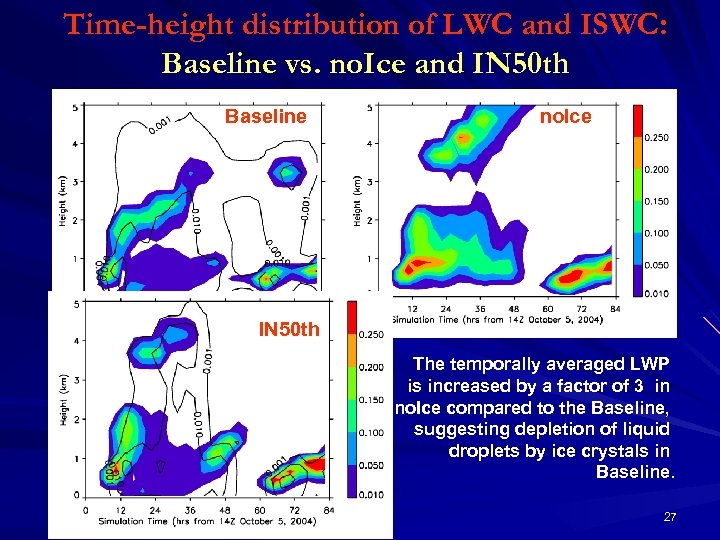
Time-height distribution of LWC and ISWC: Baseline vs. no. Ice and IN 50 th Baseline no. Ice IN 50 th The temporally averaged LWP is increased by a factor of 3 in no. Ice compared to the Baseline, suggesting depletion of liquid droplets by ice crystals in Baseline. 27
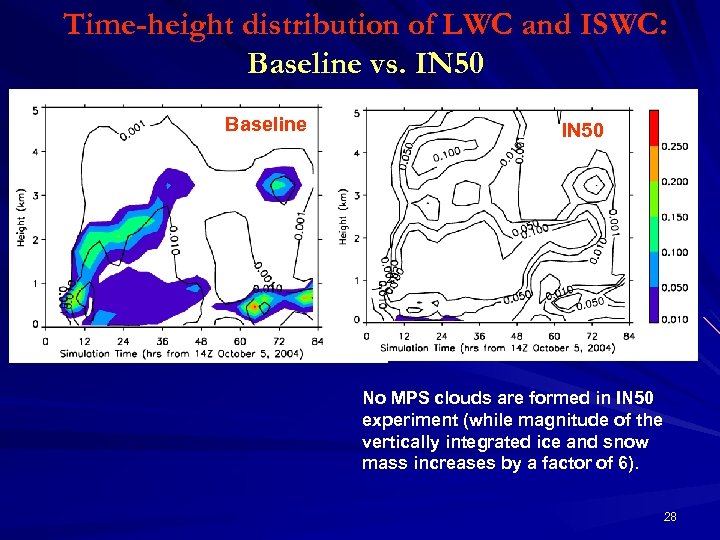
Time-height distribution of LWC and ISWC: Baseline vs. IN 50 Baseline IN 50 No MPS clouds are formed in IN 50 experiment (while magnitude of the vertically integrated ice and snow mass increases by a factor of 6). 28
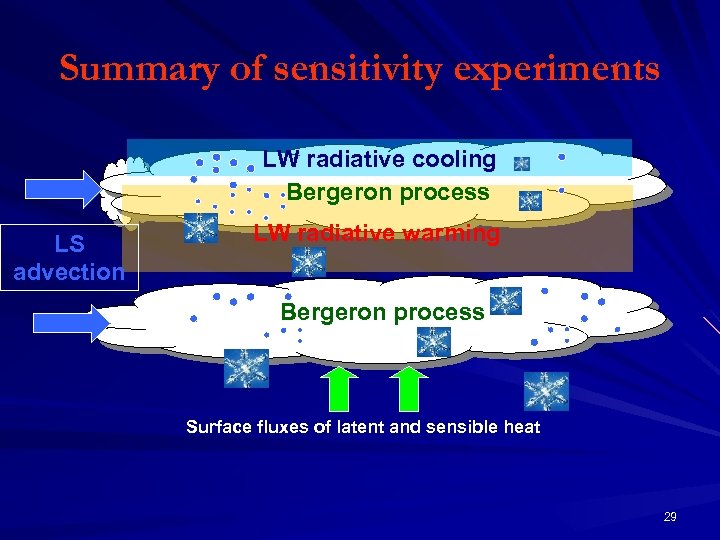
Summary of sensitivity experiments LW radiative cooling Bergeron process LS advection LW radiative warming Bergeron process Surface fluxes of latent and sensible heat 29

End. Thanks for your attention! 30
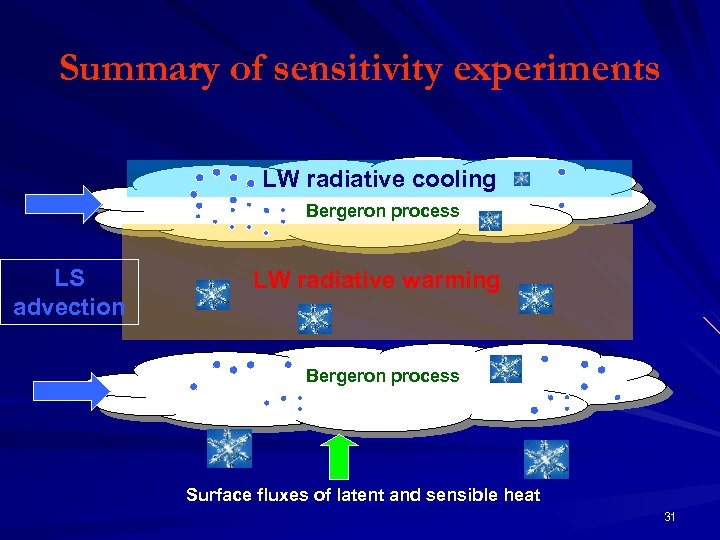
Summary of sensitivity experiments LW radiative cooling Bergeron process LS advection LW radiative warming Bergeron process Surface fluxes of latent and sensible heat 31
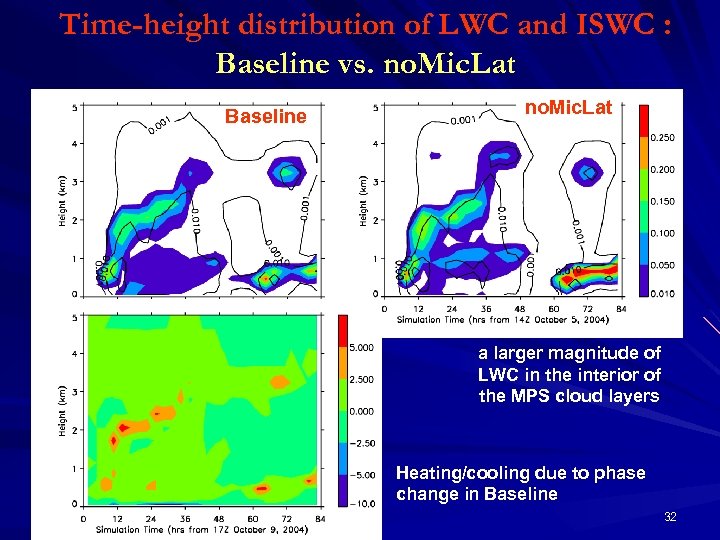
Time-height distribution of LWC and ISWC : Baseline vs. no. Mic. Lat Baseline no. Mic. Lat a larger magnitude of LWC in the interior of the MPS cloud layers Heating/cooling due to phase change in Baseline 32
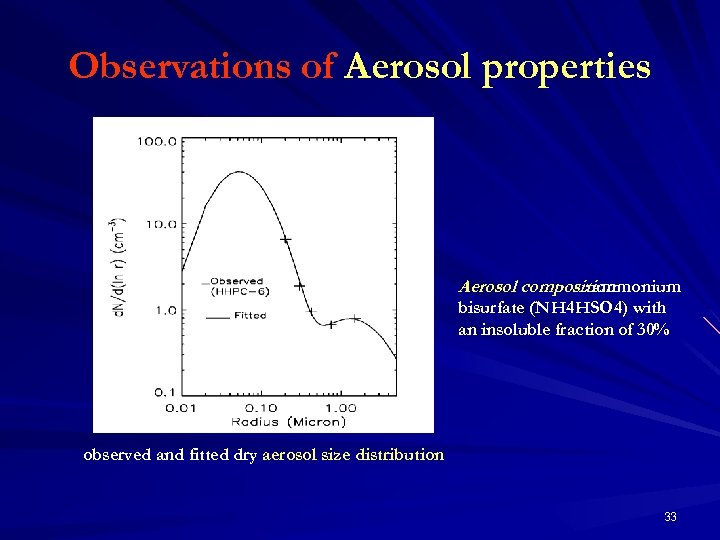
Observations of Aerosol properties Aerosol composition : ammonium bisurfate (NH 4 HSO 4) with an insoluble fraction of 30% observed and fitted dry aerosol size distribution 33
Observations of Ice nulcei (IN) number concentration n Active IN acting in deposition, condensationfreezing, and immersion-freezing modes: a mean of 0. 16 L-1 n Contact-freezing IN: a function of temperature (Meyers et al. , 1992) 34
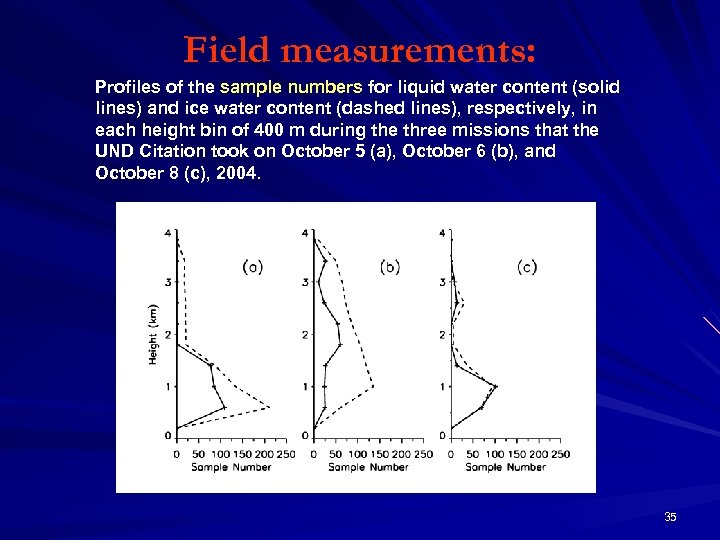
Field measurements: Profiles of the sample numbers for liquid water content (solid lines) and ice water content (dashed lines), respectively, in each height bin of 400 m during the three missions that the UND Citation took on October 5 (a), October 6 (b), and October 8 (c), 2004. 35
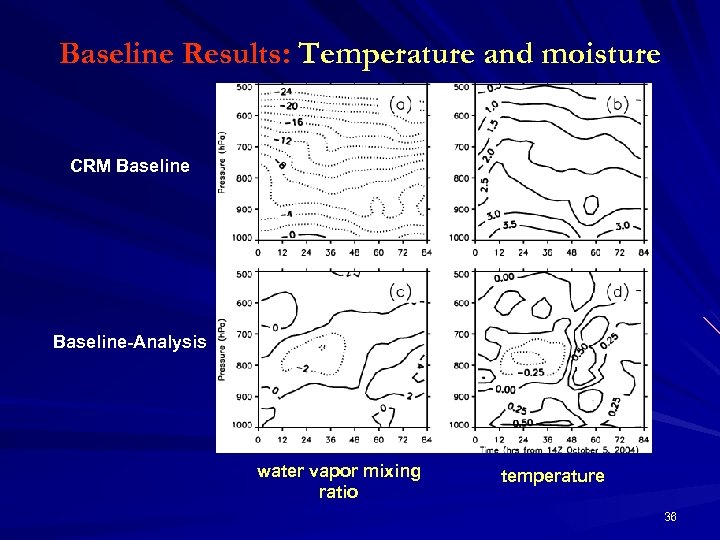
Baseline Results: Temperature and moisture CRM Baseline-Analysis water vapor mixing ratio temperature 36
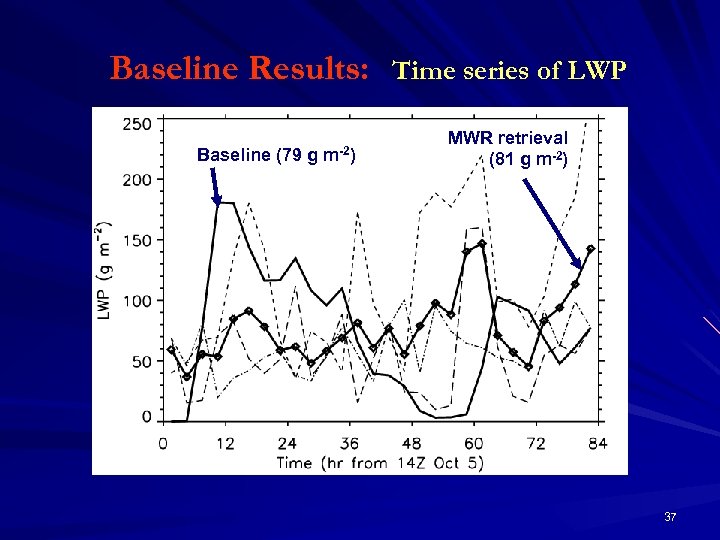
Baseline Results: Baseline (79 g m-2) Time series of LWP MWR retrieval (81 g m-2) 37
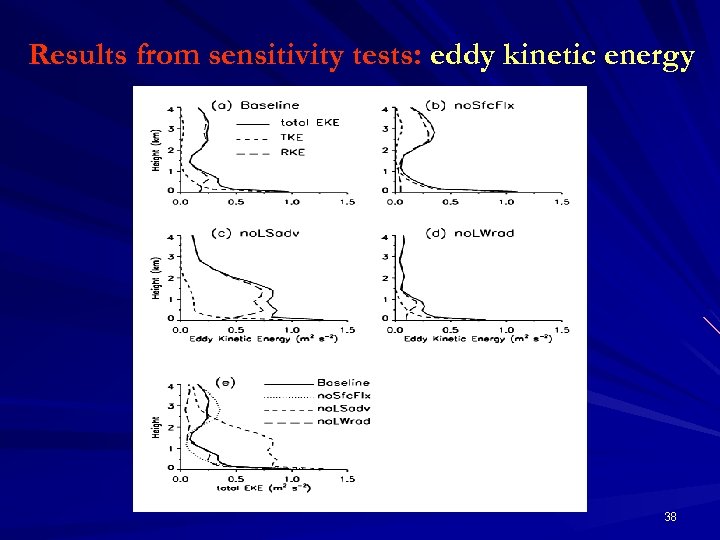
Results from sensitivity tests: eddy kinetic energy 38
Скачать презентацию Multi-Layer Arctic Mixed-Phase Clouds Simulated by a Cloud-Resolving
d64c80e9253160d58524f0c4ee83c572.ppt