


 Скачать презентацию Multi-dimensional Sequential Pattern Mining Helen Pinto Jiawei Han
3b36a579e6cdfa1e19a2a28250dd88db.ppt
- Количество слайдов: 24
 Multi-dimensional Sequential Pattern Mining Helen Pinto, Jiawei Han, Jian Pei, Ke Wang, Qiming Chen, Umeshwar Dayal 1
 Outline n n n Why multidimensional sequential pattern mining? Problem definition Algorithms Experimental results Conclusions 2
 Why Sequential Pattern Mining? n n Sequential pattern mining: Finding time-related frequent patterns (frequent subsequences) Many data and applications are time-related n Customer shopping patterns, telephone calling patterns n n n E. g. , first buy computer, then CD-ROMS, software, within 3 mos. Natural disasters (e. g. , earthquake, hurricane) Disease and treatment Stock market fluctuation Weblog click stream analysis DNA sequence analysis 3
 Motivating Example n Sequential patterns are useful n n n Marketing, product design & development Problems: lack of focus n n “free internet access buy package 1 upgrade to package 2” Various groups of customers may have different patterns MD-sequential pattern mining: integrate multidimensional analysis and sequential pattern mining 4
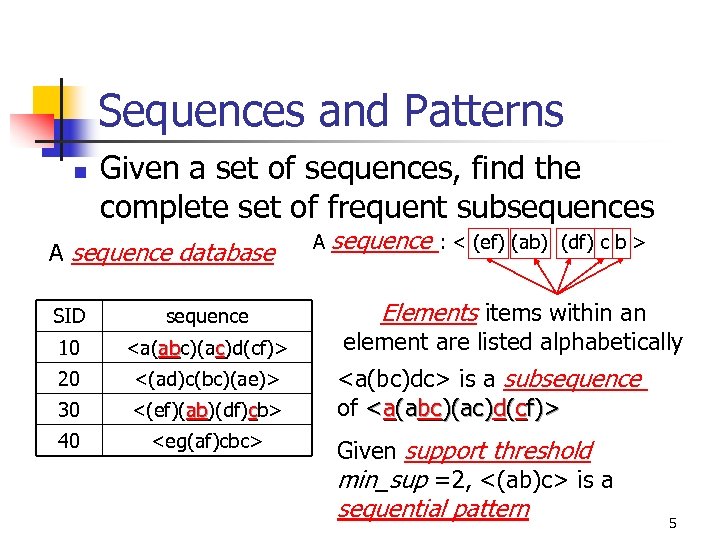 Sequences and Patterns n Given a set of sequences, find the complete set of frequent subsequences A sequence database SID sequence 10
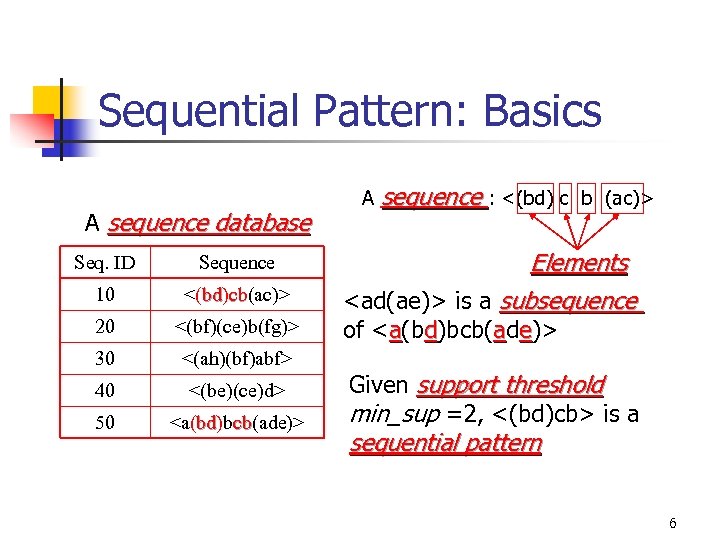 Sequential Pattern: Basics A sequence database Seq. ID Sequence 10 <(bd)cb(ac)> bd cb 20 <(bf)(ce)b(fg)> 30 <(ah)(bf)abf> 40 <(be)(ce)d> 50
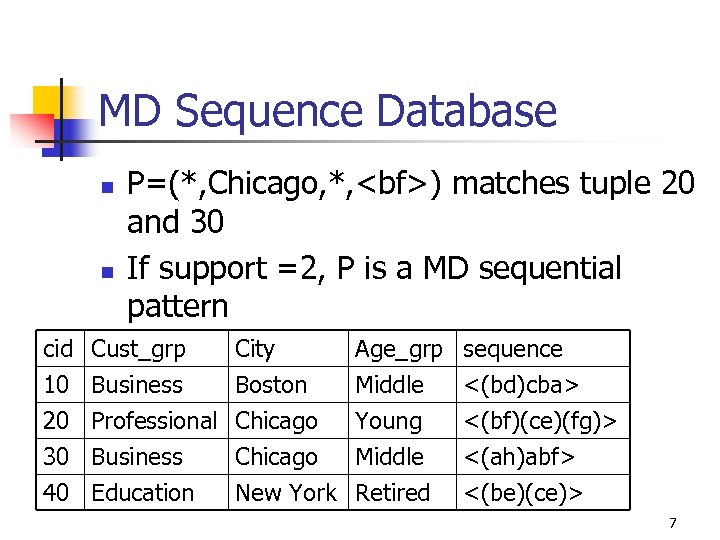 MD Sequence Database n n cid 10 20 30 P=(*, Chicago, *,
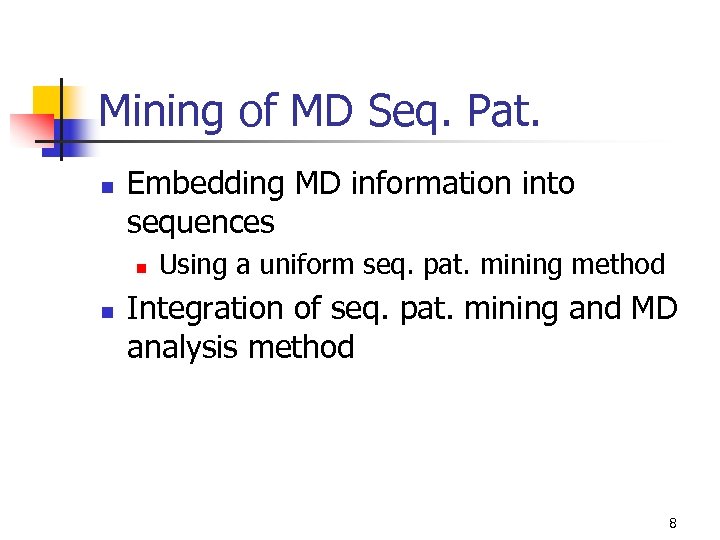 Mining of MD Seq. Pat. n Embedding MD information into sequences n n Using a uniform seq. pat. mining method Integration of seq. pat. mining and MD analysis method 8
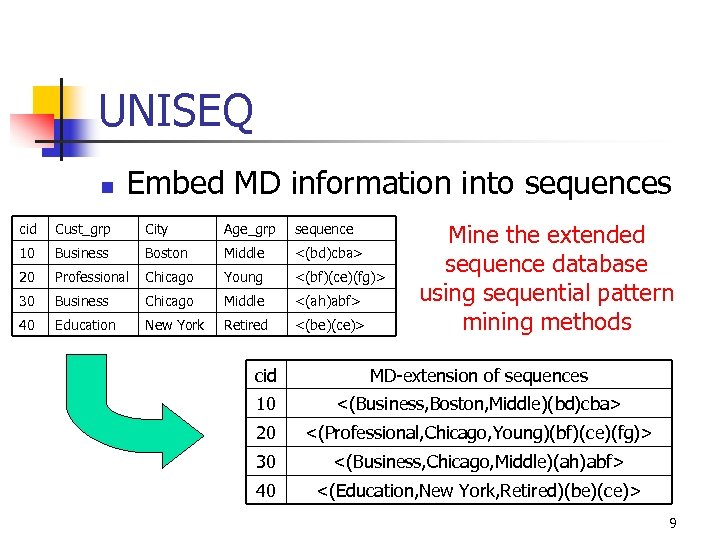 UNISEQ n Embed MD information into sequences cid Cust_grp City Age_grp sequence 10 Business Boston Middle <(bd)cba> 20 Professional Chicago Young <(bf)(ce)(fg)> 30 Business Chicago Middle <(ah)abf> 40 Education New York Retired <(be)(ce)> Mine the extended sequence database using sequential pattern mining methods cid MD-extension of sequences 10 <(Business, Boston, Middle)(bd)cba> 20 <(Professional, Chicago, Young)(bf)(ce)(fg)> 30 <(Business, Chicago, Middle)(ah)abf> 40 <(Education, New York, Retired)(be)(ce)> 9
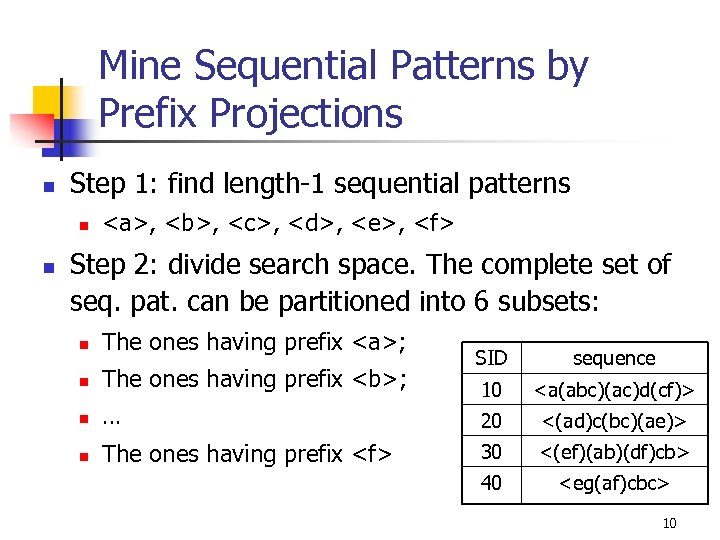 Mine Sequential Patterns by Prefix Projections n Step 1: find length-1 sequential patterns n n , ,
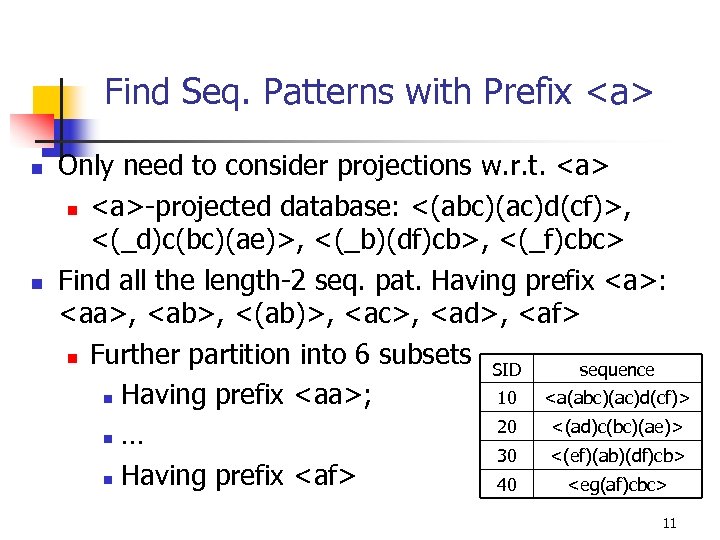 Find Seq. Patterns with Prefix n n Only need to consider projections w. r. t. n -projected database: <(abc)(ac)d(cf)>, <(_d)c(bc)(ae)>, <(_b)(df)cb>, <(_f)cbc> Find all the length-2 seq. pat. Having prefix :
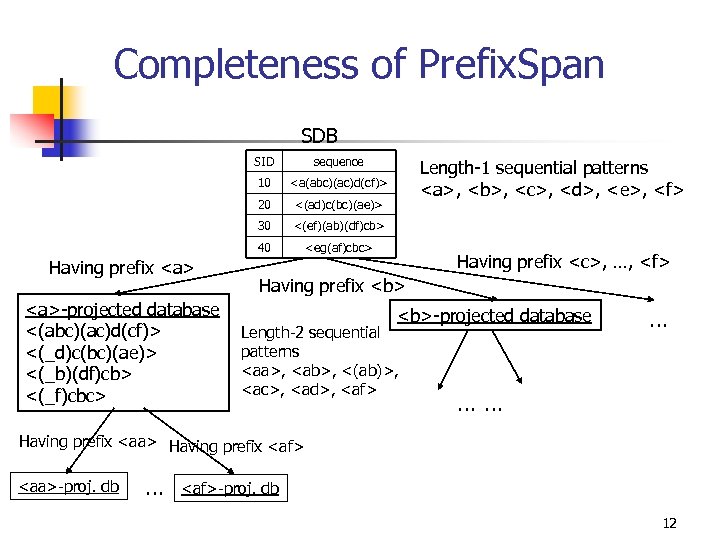 Completeness of Prefix. Span SDB SID 10 <(ad)c(bc)(ae)> 30 <(ef)(ab)(df)cb> 40 -projected database <(abc)(ac)d(cf)> <(_d)c(bc)(ae)> <(_b)(df)cb> <(_f)cbc>
 Efficiency of Prefix. Span n No candidate sequence needs to be generated n Projected databases keep shrinking n Major cost of Prefix. Span: constructing projected databases n Can be improved by bi-level projections 13
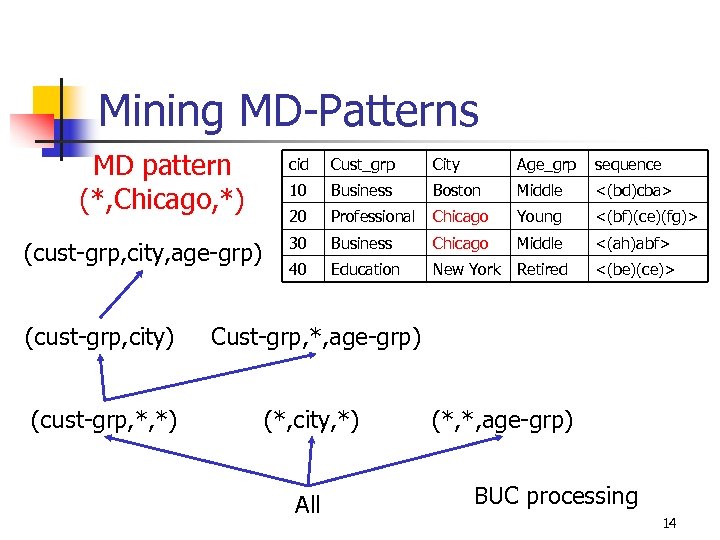 Mining MD-Patterns MD pattern (*, Chicago, *) (cust-grp, city, age-grp) cid Cust_grp City Age_grp sequence 10 Business Boston Middle <(bd)cba> 20 Professional Chicago Young <(bf)(ce)(fg)> 30 Business Chicago Middle <(ah)abf> 40 Education New York Retired <(be)(ce)> (cust-grp, city) Cust-grp, *, age-grp) (cust-grp, *, *) (*, city, *) All (*, *, age-grp) BUC processing 14
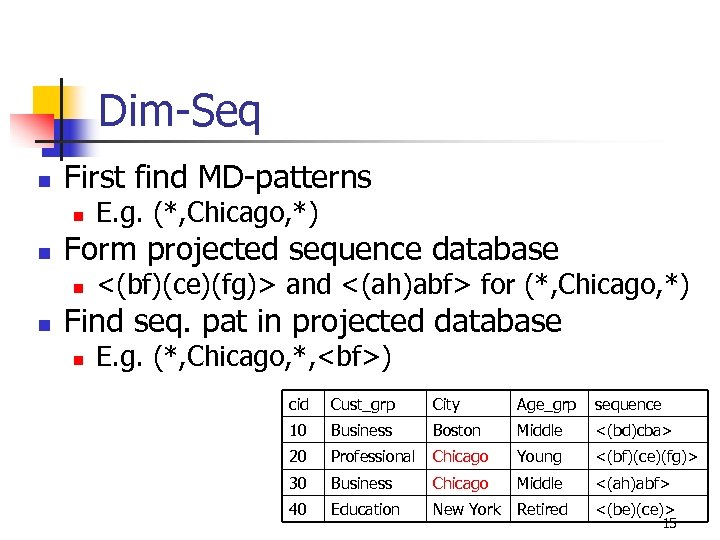 Dim-Seq n First find MD-patterns n n Form projected sequence database n n E. g. (*, Chicago, *) <(bf)(ce)(fg)> and <(ah)abf> for (*, Chicago, *) Find seq. pat in projected database n E. g. (*, Chicago, *,
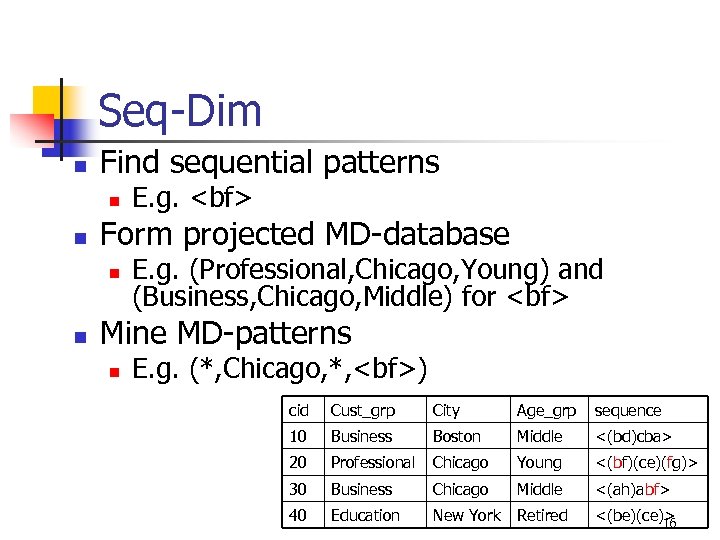 Seq-Dim n Find sequential patterns n n Form projected MD-database n n E. g.
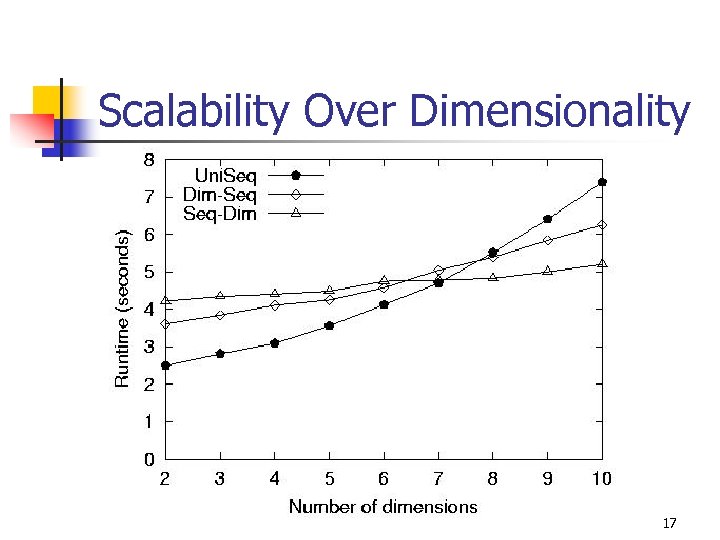 Scalability Over Dimensionality 17
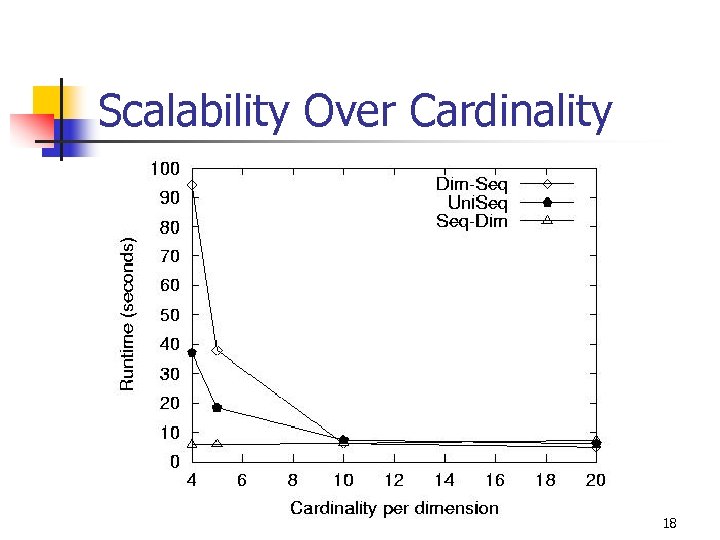 Scalability Over Cardinality 18
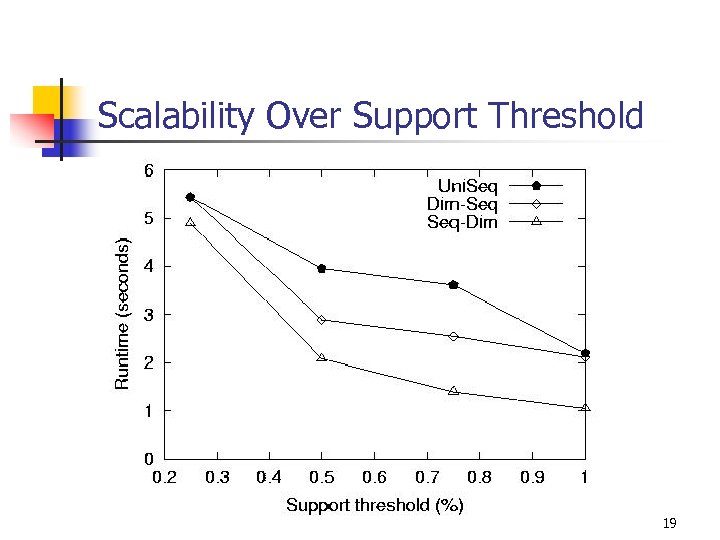 Scalability Over Support Threshold 19
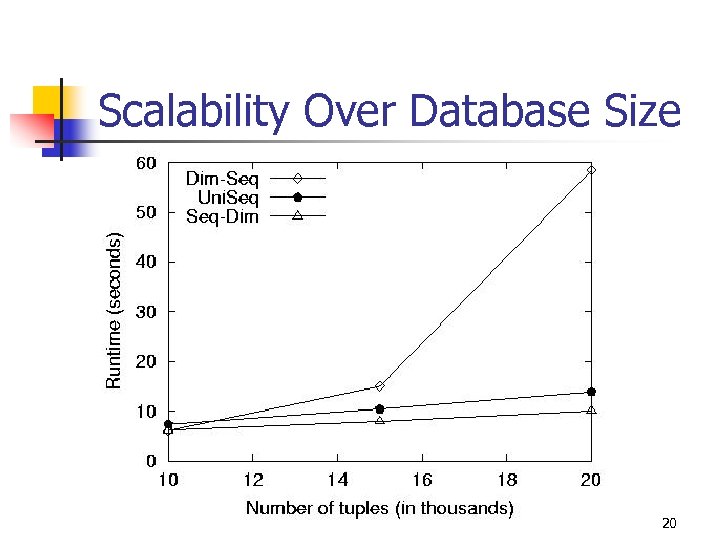 Scalability Over Database Size 20
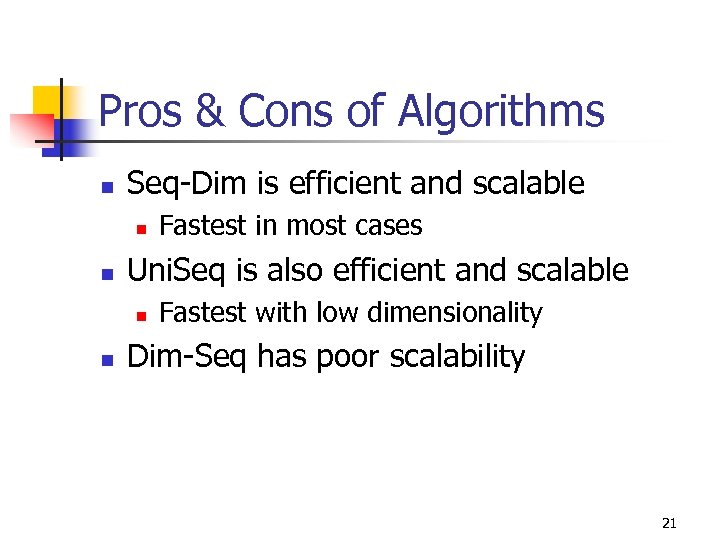 Pros & Cons of Algorithms n Seq-Dim is efficient and scalable n n Uni. Seq is also efficient and scalable n n Fastest in most cases Fastest with low dimensionality Dim-Seq has poor scalability 21
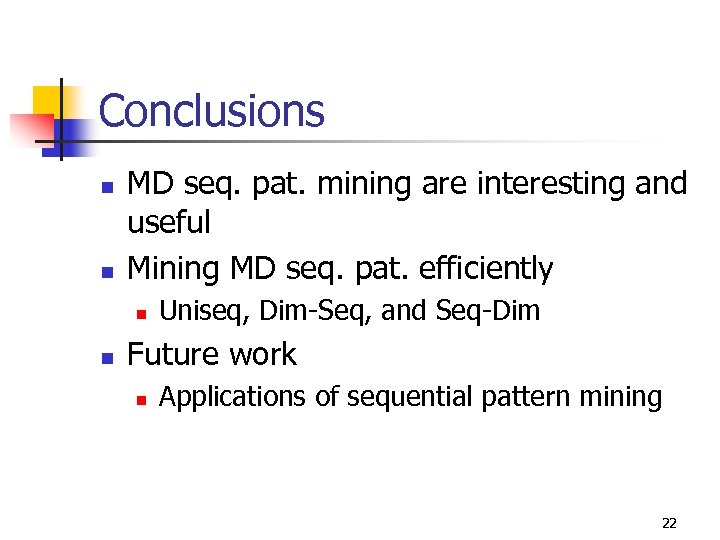 Conclusions n n MD seq. pat. mining are interesting and useful Mining MD seq. pat. efficiently n n Uniseq, Dim-Seq, and Seq-Dim Future work n Applications of sequential pattern mining 22
 References (1) n n n R. Agrawal and R. Srikant. Fast algorithms for mining association rules. VLDB'94, pages 487 -499. R. Agrawal and R. Srikant. Mining sequential patterns. ICDE'95, pages 314. C. Bettini, X. S. Wang, and S. Jajodia. Mining temporal relationships with multiple granularities in time sequences. Data Engineering Bulletin, 21: 32 -38, 1998. M. Garofalakis, R. Rastogi, and K. Shim. Spirit: Sequential pattern mining with regular expression constraints. VLDB'99, pages 223 -234. J. Han, G. Dong, and Y. Yin. Efficient mining of partial periodic patterns in time series database. ICDE'99, pages 106 -115. J. Han, J. Pei, B. Mortazavi-Asl, Q. Chen, U. Dayal, and M. -C. Hsu. Free. Span: Frequent pattern-projected sequential pattern mining. KDD'00, pages 355 -359. 23
 References (2) n n n J. Han, J. Pei, and Y. Yin. Mining frequent patterns without candidate generation. SIGMOD'00, pages 1 -12. H. Lu, J. Han, and L. Feng. Stock movement and n-dimensional intertransaction association rules. DMKD'98, pages 12: 1 -12: 7. H. Mannila, H. Toivonen, and A. I. Verkamo. Discovery of frequent episodes in event sequences. Data Mining and Knowledge Discovery, 1: 259 -289, 1997. B. "Ozden, S. Ramaswamy, and A. Silberschatz. Cyclic association rules. ICDE'98, pages 412 -421. J. Pei, J. Han, B. Mortazavi-Asl, H. Pinto, Q. Chen, U. Dayal, and M. -C. Hsu. Prefix. Span: Mining sequential patterns efficiently by prefixprojected pattern growth. ICDE'01, pages 215 -224. R. Srikant and R. Agrawal. Mining sequential patterns: Generalizations and performance improvements. EDBT'96, pages 3 -17. 24