


 Скачать презентацию Multi-Choice Models 1 Introduction In this
fedc3a88ecf0cdcd1da4bab0ef1e7f97.ppt
- Количество слайдов: 77
 Multi-Choice Models 1
 Introduction • In this section, we examine models with more than 2 possible choices • Examples – How to get to work (bus, car, subway, walk) – How you treat a particular condition (bypass, heart cath. , drugs, nothing) – Living arrangement (single, married, living with someone) 2
 • In these examples, the choices reflect tradeoffs the consumer must face – Transportation: More flexibility usually requires more cost – Health: more invasive procedures may be more effective • In contrast to ordered probit, no natural ordering of choices 3
 Modeling choices • Model is designed to estimate what cofactors predict choice of 1 from the other J-1 alternatives • Motivated from the same decision/theoretic perspective used in logit/probit modes – Just have expanded the choice set 4
 Some model specifics • j indexes choices (J of them) – No need to assume equal choices • i indexes people (N of them) • Yij=1 if person i selects option j, =0 otherwise • Uij is the utility or net benefit of person ”i” if they select option “j” • Suppose they select option 1 5
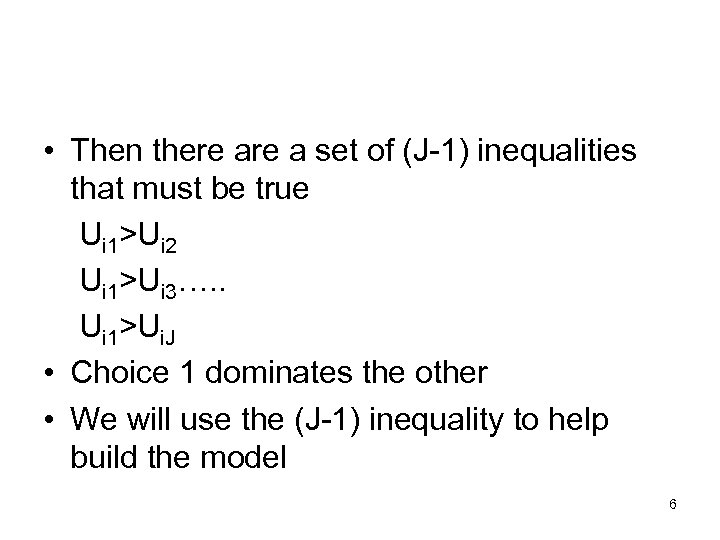 • Then there a set of (J-1) inequalities that must be true Ui 1>Ui 2 Ui 1>Ui 3…. . Ui 1>Ui. J • Choice 1 dominates the other • We will use the (J-1) inequality to help build the model 6
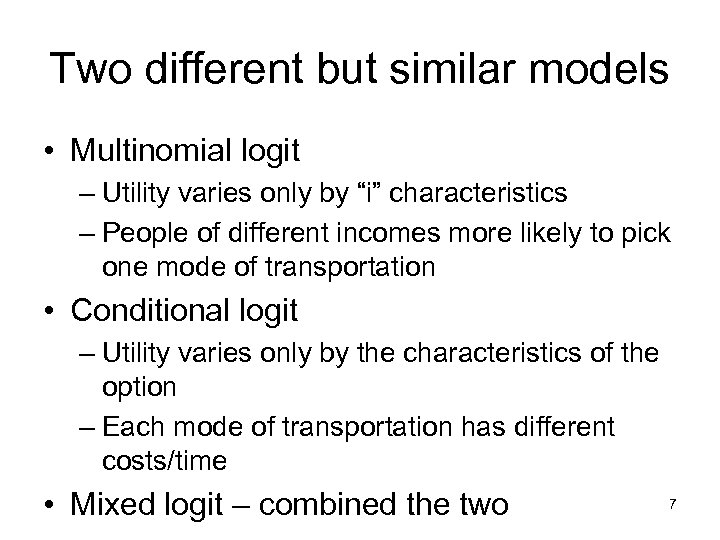 Two different but similar models • Multinomial logit – Utility varies only by “i” characteristics – People of different incomes more likely to pick one mode of transportation • Conditional logit – Utility varies only by the characteristics of the option – Each mode of transportation has different costs/time • Mixed logit – combined the two 7
 Multinomial Logit • Utility is determined by two parts: observed and unobserved characteristics (just like logit) • However, measured components only vary at the individual level • Therefore, the model measures what characteristics predict choice – Are people of different income levels more/less likely to take one mode of transportation to work 8
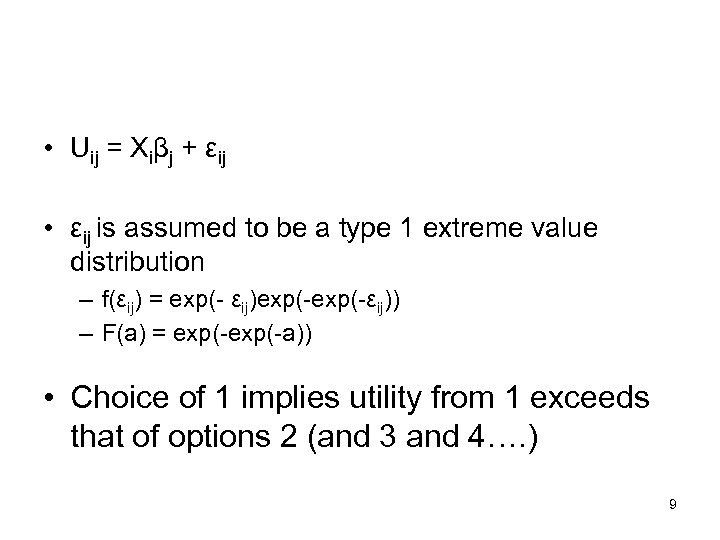 • Uij = Xiβj + εij • εij is assumed to be a type 1 extreme value distribution – f(εij) = exp(- εij)exp(-εij)) – F(a) = exp(-a)) • Choice of 1 implies utility from 1 exceeds that of options 2 (and 3 and 4…. ) 9
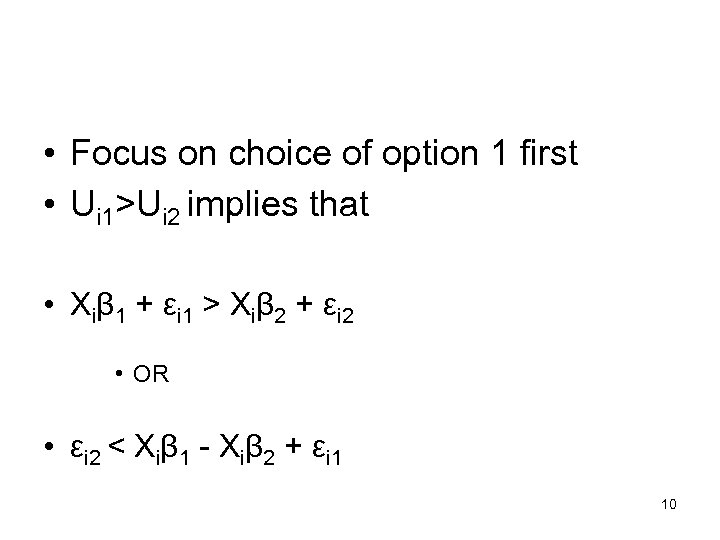 • Focus on choice of option 1 first • Ui 1>Ui 2 implies that • Xiβ 1 + εi 1 > Xiβ 2 + εi 2 • OR • εi 2 < Xiβ 1 - Xiβ 2 + εi 1 10
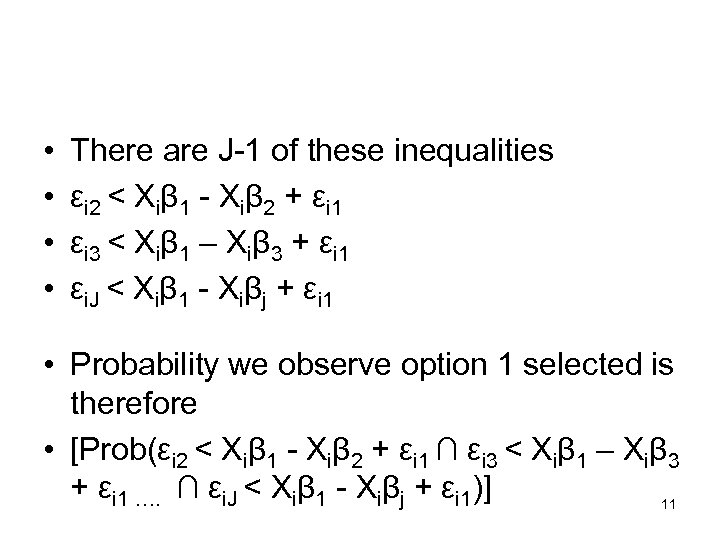 • • There are J-1 of these inequalities εi 2 < Xiβ 1 - Xiβ 2 + εi 1 εi 3 < Xiβ 1 – Xiβ 3 + εi 1 εi. J < Xiβ 1 - Xiβj + εi 1 • Probability we observe option 1 selected is therefore • [Prob(εi 2 < Xiβ 1 - Xiβ 2 + εi 1 ∩ εi 3 < Xiβ 1 – Xiβ 3 + εi 1 …. ∩ εi. J < Xiβ 1 - Xiβj + εi 1)] 11
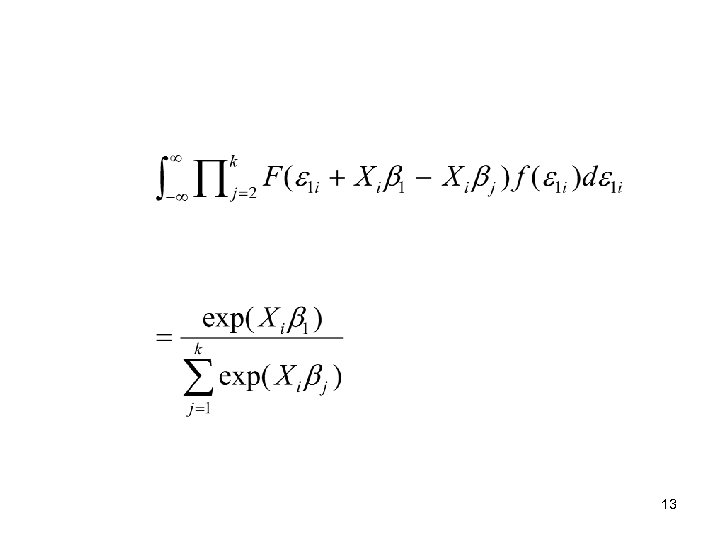
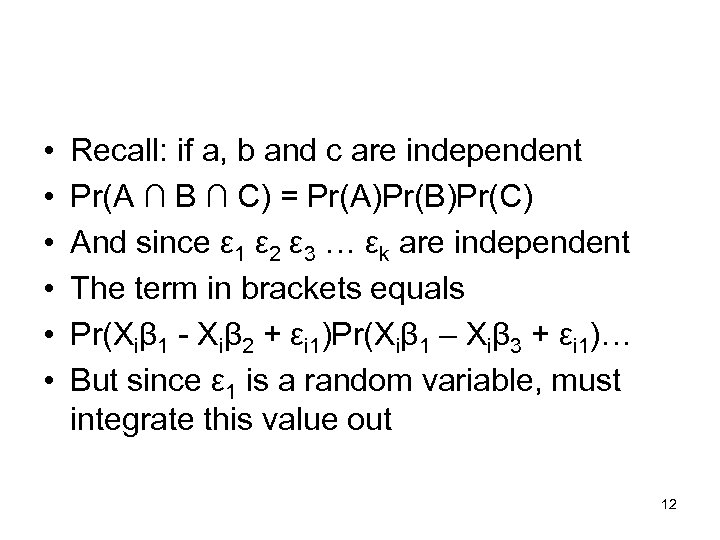 • • • Recall: if a, b and c are independent Pr(A ∩ B ∩ C) = Pr(A)Pr(B)Pr(C) And since ε 1 ε 2 ε 3 … εk are independent The term in brackets equals Pr(Xiβ 1 - Xiβ 2 + εi 1)Pr(Xiβ 1 – Xiβ 3 + εi 1)… But since ε 1 is a random variable, must integrate this value out 12
 13
13
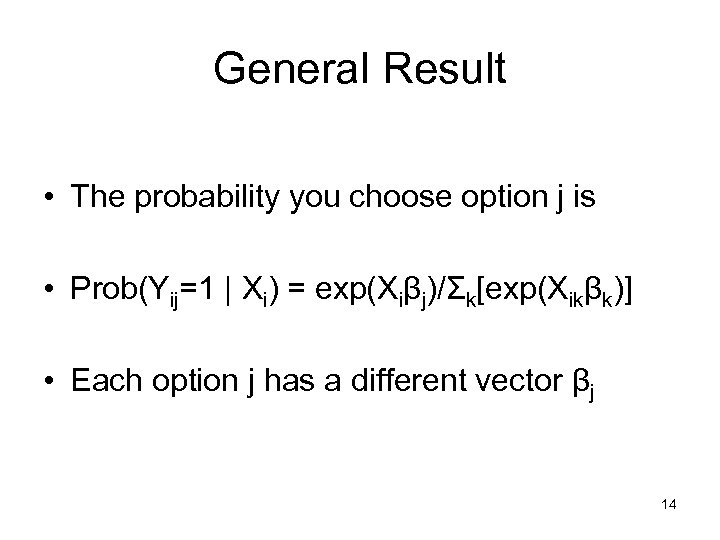 General Result • The probability you choose option j is • Prob(Yij=1 | Xi) = exp(Xiβj)/Σk[exp(Xikβk)] • Each option j has a different vector βj 14
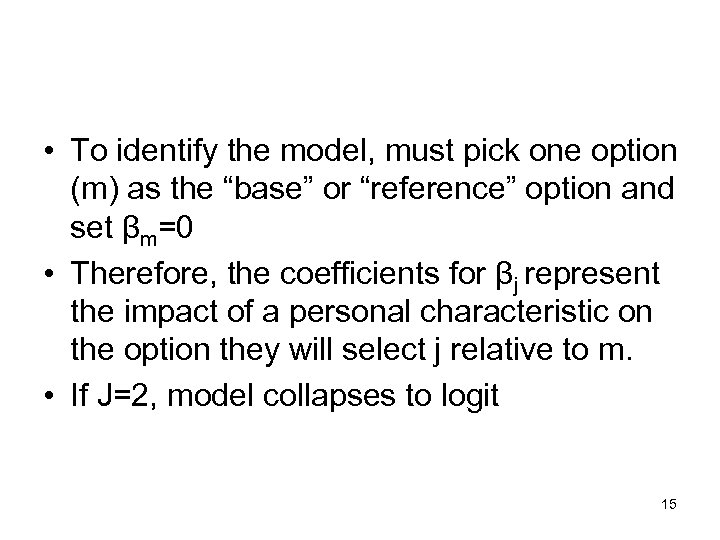 • To identify the model, must pick one option (m) as the “base” or “reference” option and set βm=0 • Therefore, the coefficients for βj represent the impact of a personal characteristic on the option they will select j relative to m. • If J=2, model collapses to logit 15
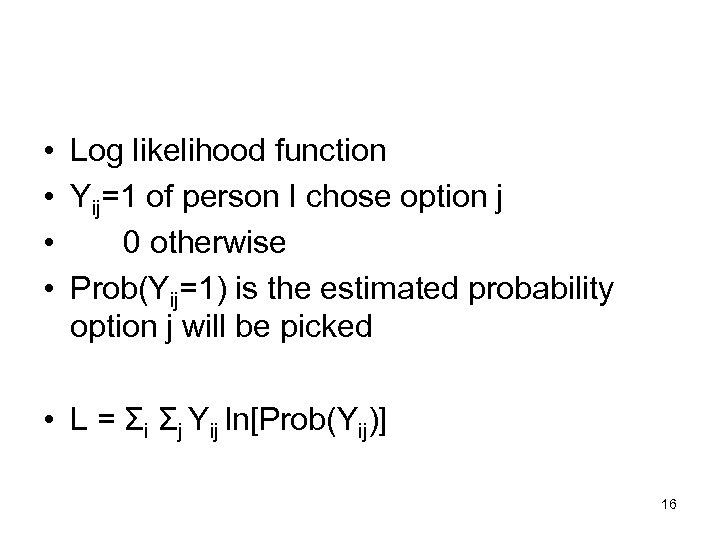 • Log likelihood function • Yij=1 of person I chose option j • 0 otherwise • Prob(Yij=1) is the estimated probability option j will be picked • L = Σi Σj Yij ln[Prob(Yij)] 16
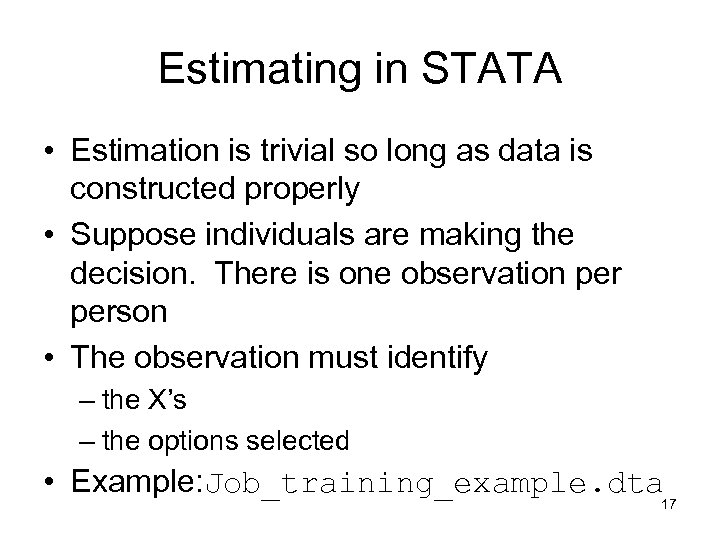 Estimating in STATA • Estimation is trivial so long as data is constructed properly • Suppose individuals are making the decision. There is one observation person • The observation must identify – the X’s – the options selected • Example: Job_training_example. dta 17
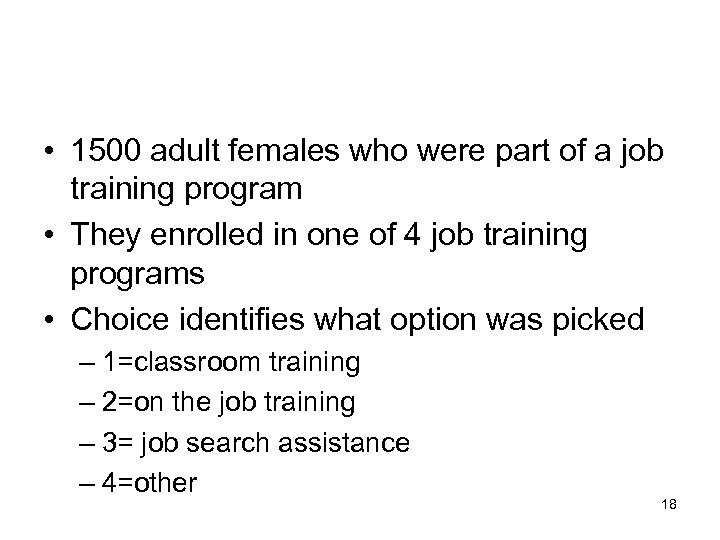 • 1500 adult females who were part of a job training program • They enrolled in one of 4 job training programs • Choice identifies what option was picked – 1=classroom training – 2=on the job training – 3= job search assistance – 4=other 18
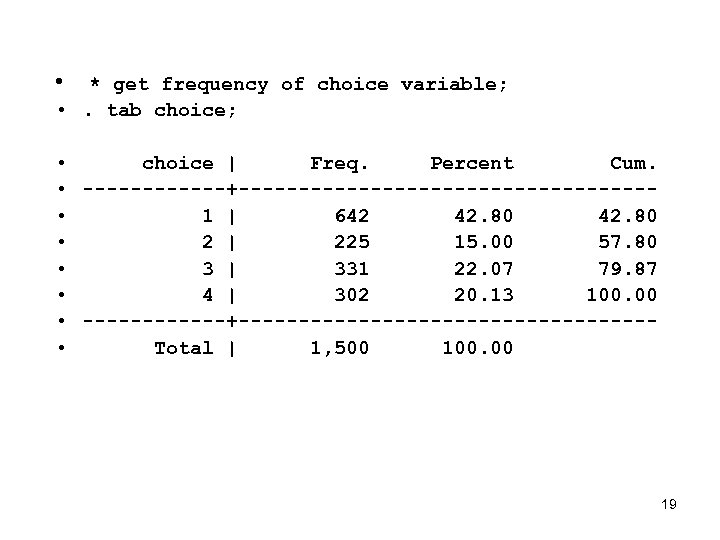 • * get frequency of choice variable; • . tab choice; • choice | Freq. Percent Cum. • ------+----------------- • 1 | 642 42. 80 • 2 | 225 15. 00 57. 80 • 3 | 331 22. 07 79. 87 • 4 | 302 20. 13 100. 00 • ------+----------------- • Total | 1, 500 100. 00 19
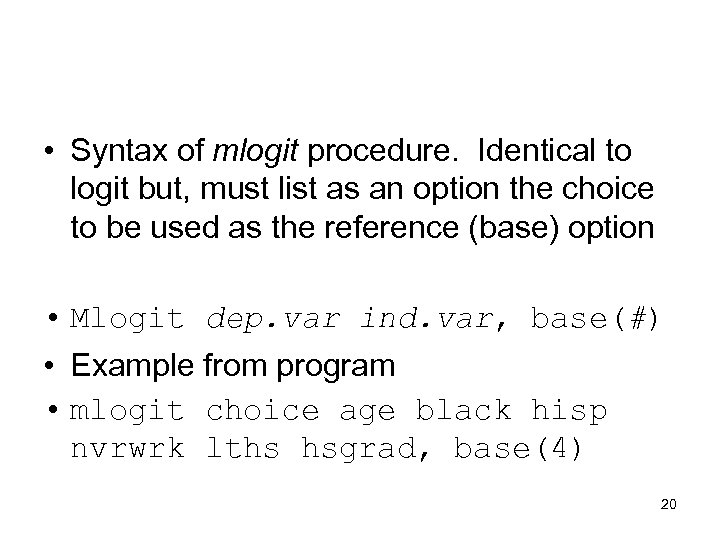 • Syntax of mlogit procedure. Identical to logit but, must list as an option the choice to be used as the reference (base) option • Mlogit dep. var ind. var, base(#) • Example from program • mlogit choice age black hisp nvrwrk lths hsgrad, base(4) 20
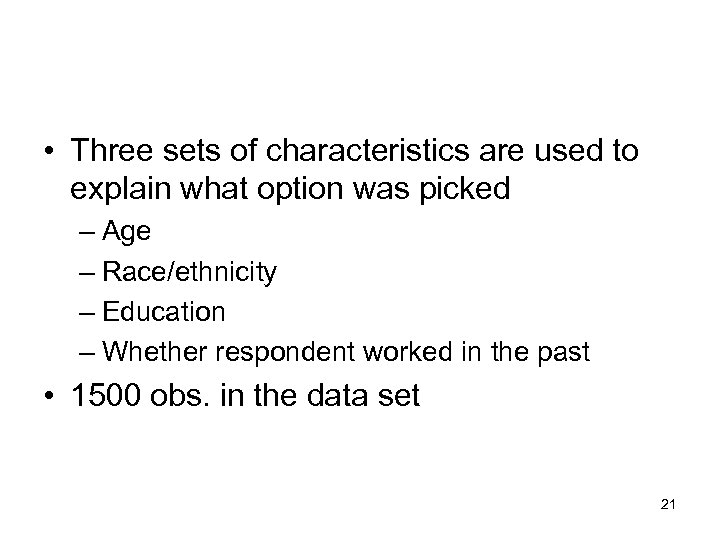 • Three sets of characteristics are used to explain what option was picked – Age – Race/ethnicity – Education – Whether respondent worked in the past • 1500 obs. in the data set 21
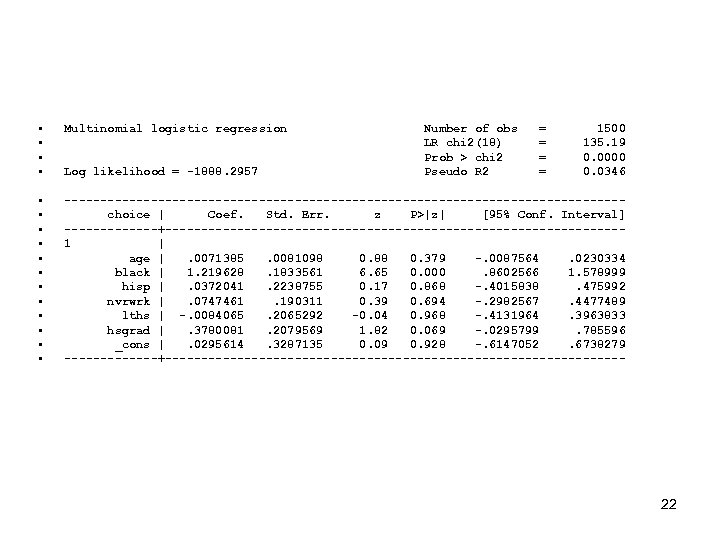 • • Multinomial logistic regression • • • ---------------------------------------choice | Coef. Std. Err. z P>|z| [95% Conf. Interval] -------+--------------------------------1 | age |. 0071385. 0081098 0. 88 0. 379 -. 0087564. 0230334 black | 1. 219628. 1833561 6. 65 0. 000. 8602566 1. 578999 hisp |. 0372041. 2238755 0. 17 0. 868 -. 4015838. 475992 nvrwrk |. 0747461. 190311 0. 39 0. 694 -. 2982567. 4477489 lths | -. 0084065. 2065292 -0. 04 0. 968 -. 4131964. 3963833 hsgrad |. 3780081. 2079569 1. 82 0. 069 -. 0295799. 785596 _cons |. 0295614. 3287135 0. 09 0. 928 -. 6147052. 6738279 -------+-------------------------------- Log likelihood = -1888. 2957 Number of obs LR chi 2(18) Prob > chi 2 Pseudo R 2 = = 1500 135. 19 0. 0000 0. 0346 22
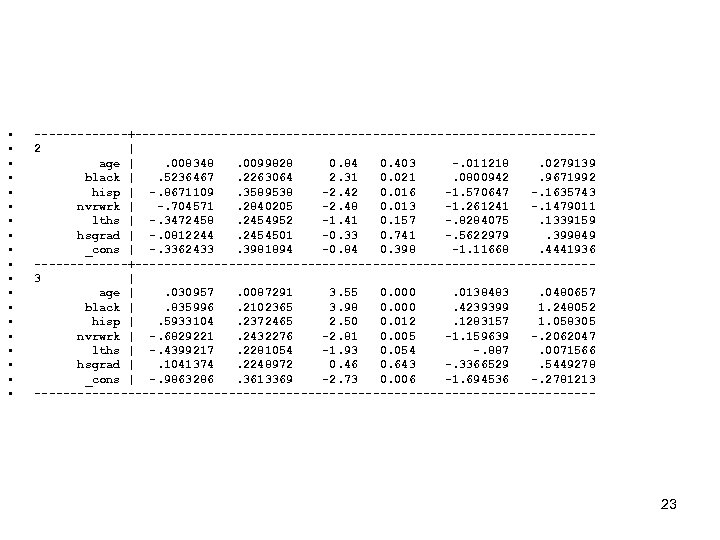 • • • • • -------+--------------------------------2 | age |. 008348. 0099828 0. 84 0. 403 -. 011218. 0279139 black |. 5236467. 2263064 2. 31 0. 021. 0800942. 9671992 hisp | -. 8671109. 3589538 -2. 42 0. 016 -1. 570647 -. 1635743 nvrwrk | -. 704571. 2840205 -2. 48 0. 013 -1. 261241 -. 1479011 lths | -. 3472458. 2454952 -1. 41 0. 157 -. 8284075. 1339159 hsgrad | -. 0812244. 2454501 -0. 33 0. 741 -. 5622979. 399849 _cons | -. 3362433. 3981894 -0. 84 0. 398 -1. 11668. 4441936 -------+--------------------------------3 | age |. 030957. 0087291 3. 55 0. 000. 0138483. 0480657 black |. 835996. 2102365 3. 98 0. 000. 4239399 1. 248052 hisp |. 5933104. 2372465 2. 50 0. 012. 1283157 1. 058305 nvrwrk | -. 6829221. 2432276 -2. 81 0. 005 -1. 159639 -. 2062047 lths | -. 4399217. 2281054 -1. 93 0. 054 -. 887. 0071566 hsgrad |. 1041374. 2248972 0. 46 0. 643 -. 3366529. 5449278 _cons | -. 9863286. 3613369 -2. 73 0. 006 -1. 694536 -. 2781213 --------------------------------------- 23
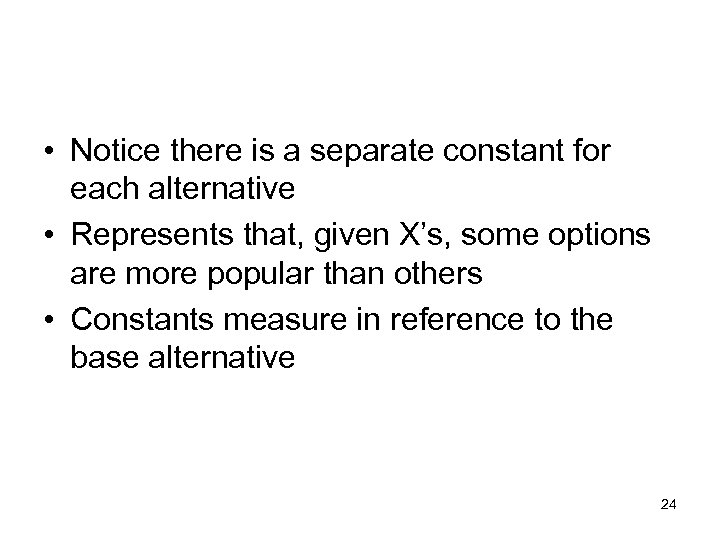 • Notice there is a separate constant for each alternative • Represents that, given X’s, some options are more popular than others • Constants measure in reference to the base alternative 24
 How to interpret parameters • Parameters in and of themselves not that informative • We want to know how the probabilities of picking one option will change if we change X • Two types of X’s – Continuous – dichotomous 25
![• Probability of choosing option j • Prob(Yij=1 |Xi) = exp(Xiβj)/Σk[exp(Xiβk)] • Xi=(Xi](https://present5.com/presentation/fedc3a88ecf0cdcd1da4bab0ef1e7f97/image-26.jpg "• Probability of choosing option j • Prob(Yij=1 |Xi) = exp(Xiβj)/Σk[exp(Xiβk)] • Xi=(Xi") • Probability of choosing option j • Prob(Yij=1 |Xi) = exp(Xiβj)/Σk[exp(Xiβk)] • Xi=(Xi 1, Xi 2, …. . Xik) • Suppose Xi 1 is continuous • d. Prob(Yij=1 | Xi)/d. Xi 1 = ? 26
• Probability of choosing option j • Prob(Yij=1 |Xi) = exp(Xiβj)/Σk[exp(Xiβk)] • Xi=(Xi 1, Xi 2, …. . Xik) • Suppose Xi 1 is continuous • d. Prob(Yij=1 | Xi)/d. Xi 1 = ? 26
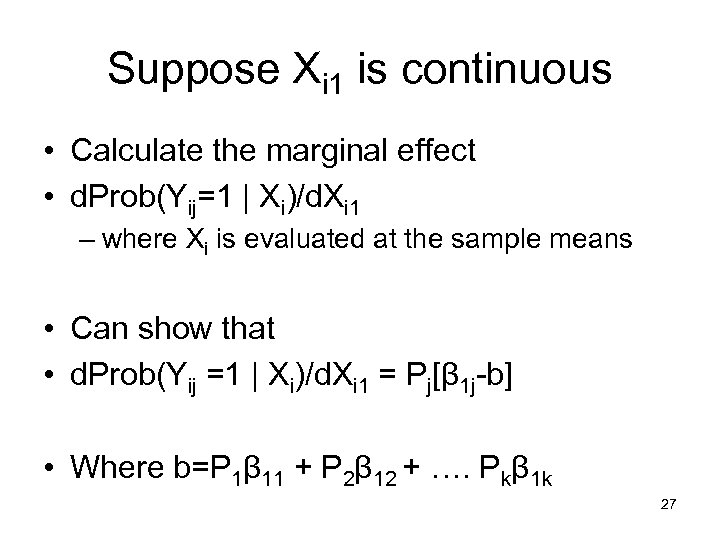 Suppose Xi 1 is continuous • Calculate the marginal effect • d. Prob(Yij=1 | Xi)/d. Xi 1 – where Xi is evaluated at the sample means • Can show that • d. Prob(Yij =1 | Xi)/d. Xi 1 = Pj[β 1 j-b] • Where b=P 1β 11 + P 2β 12 + …. Pkβ 1 k 27
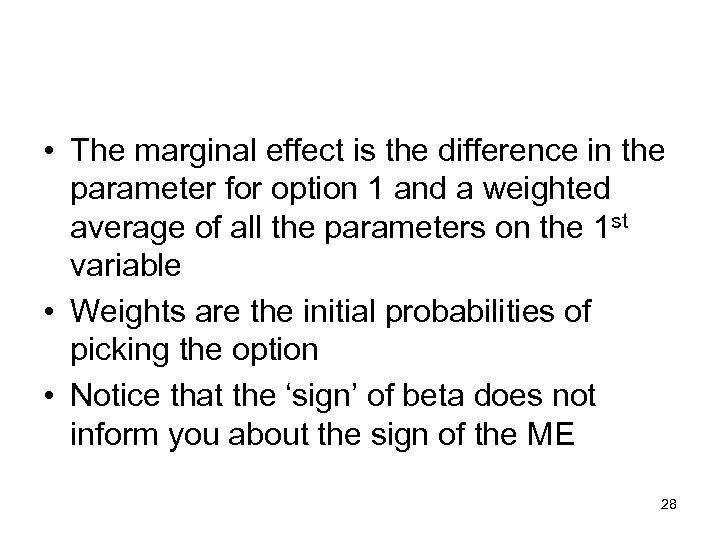 • The marginal effect is the difference in the parameter for option 1 and a weighted average of all the parameters on the 1 st variable • Weights are the initial probabilities of picking the option • Notice that the ‘sign’ of beta does not inform you about the sign of the ME 28
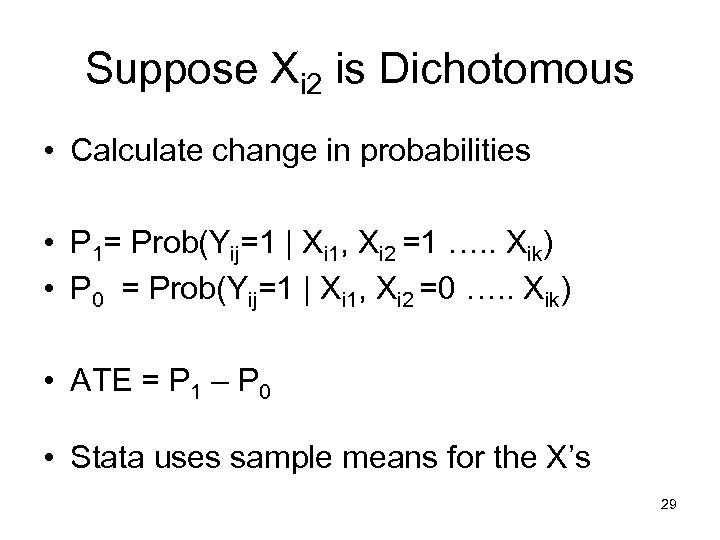 Suppose Xi 2 is Dichotomous • Calculate change in probabilities • P 1= Prob(Yij=1 | Xi 1, Xi 2 =1 …. . Xik) • P 0 = Prob(Yij=1 | Xi 1, Xi 2 =0 …. . Xik) • ATE = P 1 – P 0 • Stata uses sample means for the X’s 29
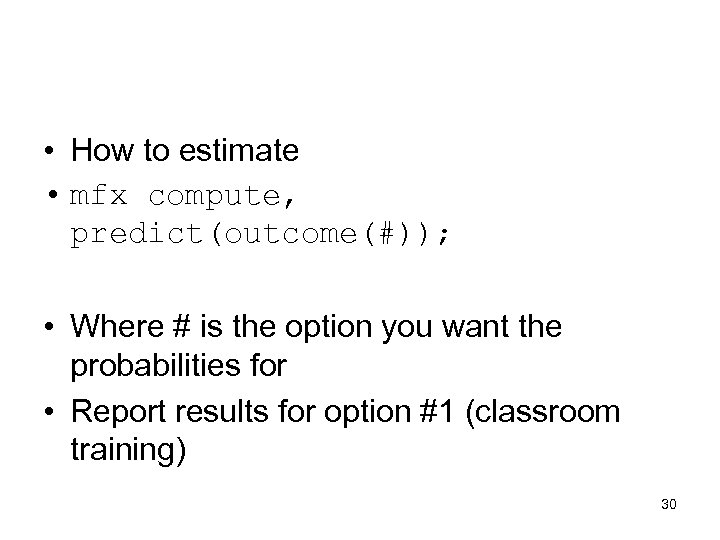 • How to estimate • mfx compute, predict(outcome(#)); • Where # is the option you want the probabilities for • Report results for option #1 (classroom training) 30
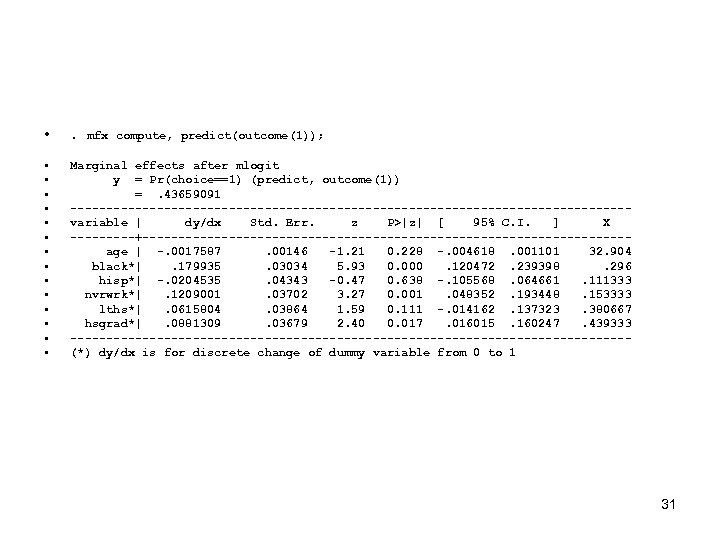 • . mfx compute, predict(outcome(1)); • • • • Marginal effects after mlogit y = Pr(choice==1) (predict, outcome(1)) =. 43659091 ---------------------------------------variable | dy/dx Std. Err. z P>|z| [ 95% C. I. ] X -----+----------------------------------age | -. 0017587. 00146 -1. 21 0. 228 -. 004618. 001101 32. 904 black*|. 179935. 03034 5. 93 0. 000. 120472. 239398. 296 hisp*| -. 0204535. 04343 -0. 47 0. 638 -. 105568. 064661. 111333 nvrwrk*|. 1209001. 03702 3. 27 0. 001. 048352. 193448. 153333 lths*|. 0615804. 03864 1. 59 0. 111 -. 014162. 137323. 380667 hsgrad*|. 0881309. 03679 2. 40 0. 017. 016015. 160247. 439333 ---------------------------------------(*) dy/dx is for discrete change of dummy variable from 0 to 1 31
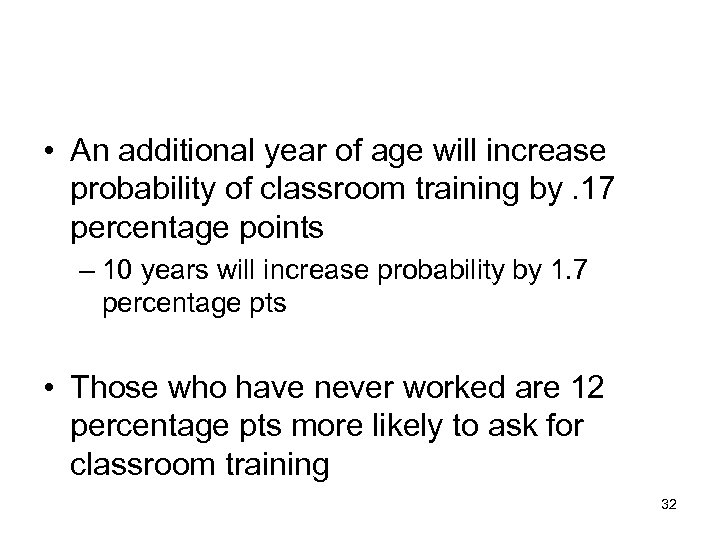 • An additional year of age will increase probability of classroom training by. 17 percentage points – 10 years will increase probability by 1. 7 percentage pts • Those who have never worked are 12 percentage pts more likely to ask for classroom training 32
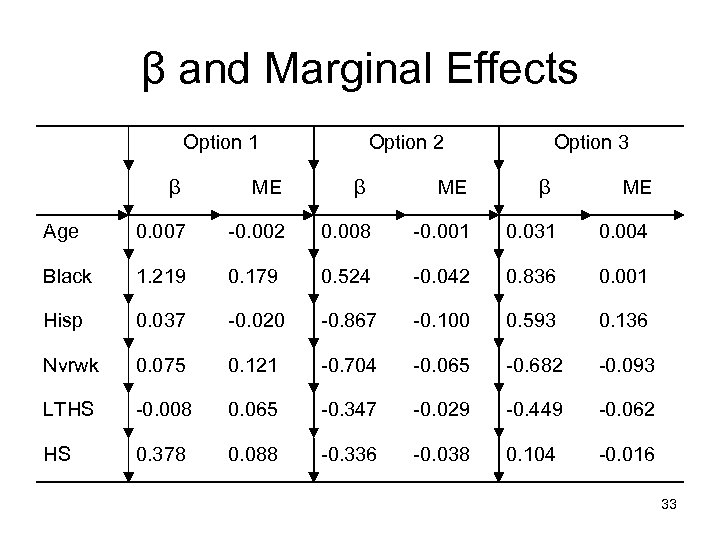 β and Marginal Effects Option 1 Option 2 Option 3 β ME Age 0. 007 -0. 002 0. 008 -0. 001 0. 031 0. 004 Black 1. 219 0. 179 0. 524 -0. 042 0. 836 0. 001 Hisp 0. 037 -0. 020 -0. 867 -0. 100 0. 593 0. 136 Nvrwk 0. 075 0. 121 -0. 704 -0. 065 -0. 682 -0. 093 LTHS -0. 008 0. 065 -0. 347 -0. 029 -0. 449 -0. 062 HS 0. 378 0. 088 -0. 336 -0. 038 0. 104 -0. 016 33
 • Notice that there is not a direct correspondence between sign of β and the sign of the marginal effect • Really need to calculate the ME’s to know what is going on 34
 Problem: IIA • Independent of Irrelevant alternatives or ‘red bus/blue bus’ problem • Suppose two options to get to work – Car (option c) – Blue bus (option b) • What are the odds of choosing option c over b? 35
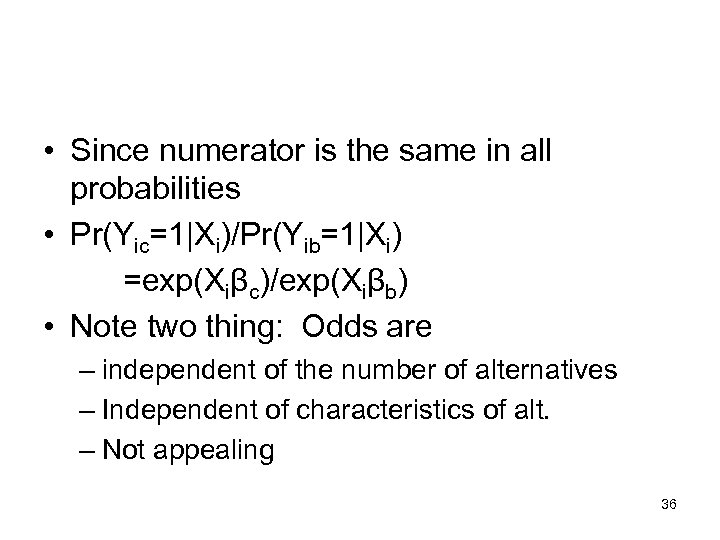 • Since numerator is the same in all probabilities • Pr(Yic=1|Xi)/Pr(Yib=1|Xi) =exp(Xiβc)/exp(Xiβb) • Note two thing: Odds are – independent of the number of alternatives – Independent of characteristics of alt. – Not appealing 36
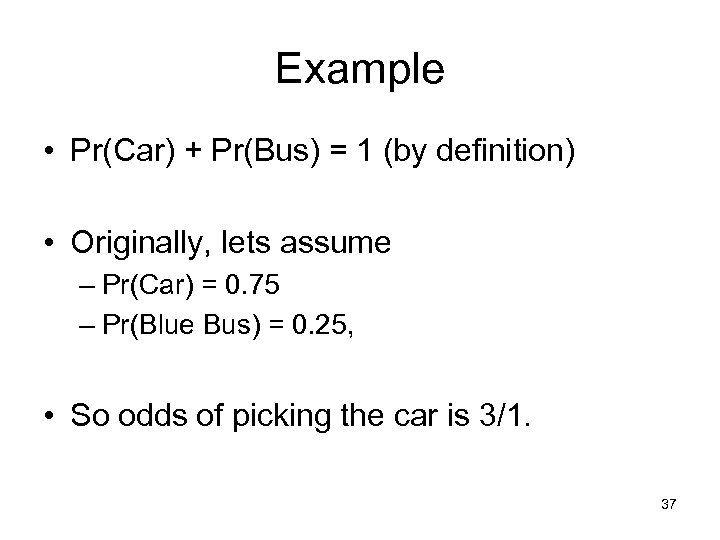 Example • Pr(Car) + Pr(Bus) = 1 (by definition) • Originally, lets assume – Pr(Car) = 0. 75 – Pr(Blue Bus) = 0. 25, • So odds of picking the car is 3/1. 37
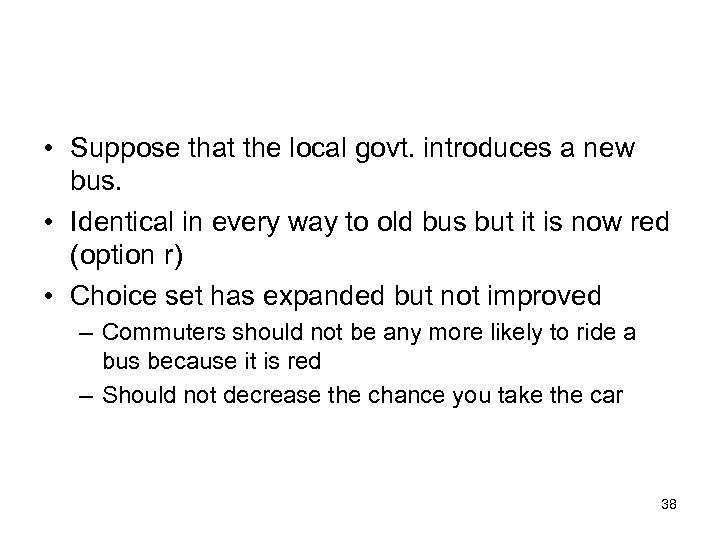 • Suppose that the local govt. introduces a new bus. • Identical in every way to old bus but it is now red (option r) • Choice set has expanded but not improved – Commuters should not be any more likely to ride a bus because it is red – Should not decrease the chance you take the car 38
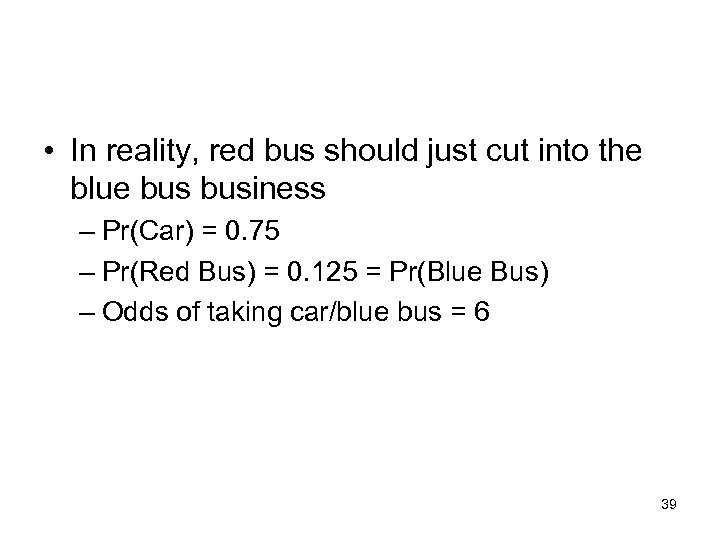 • In reality, red bus should just cut into the blue business – Pr(Car) = 0. 75 – Pr(Red Bus) = 0. 125 = Pr(Blue Bus) – Odds of taking car/blue bus = 6 39
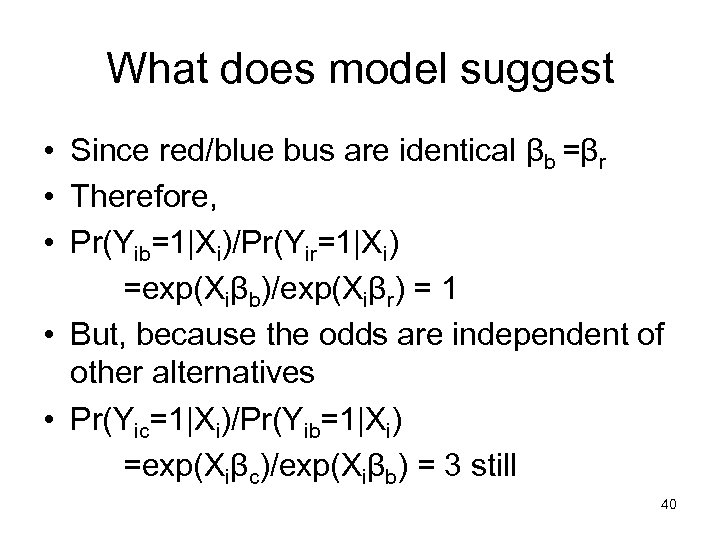 What does model suggest • Since red/blue bus are identical βb =βr • Therefore, • Pr(Yib=1|Xi)/Pr(Yir=1|Xi) =exp(Xiβb)/exp(Xiβr) = 1 • But, because the odds are independent of other alternatives • Pr(Yic=1|Xi)/Pr(Yib=1|Xi) =exp(Xiβc)/exp(Xiβb) = 3 still 40
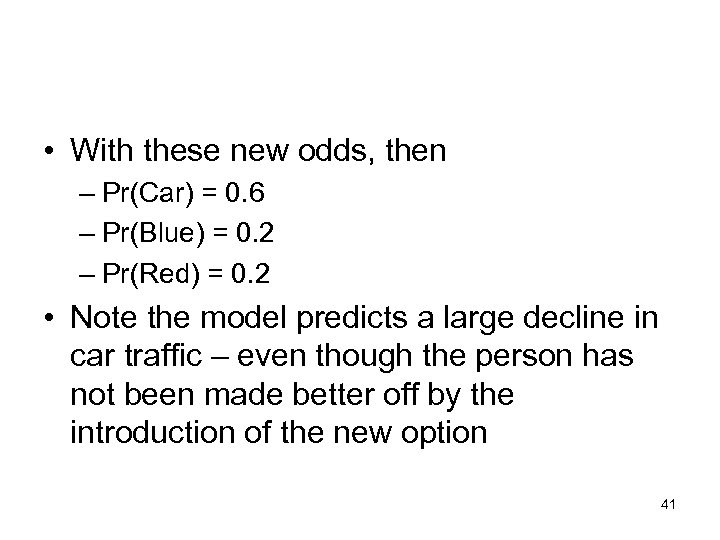 • With these new odds, then – Pr(Car) = 0. 6 – Pr(Blue) = 0. 2 – Pr(Red) = 0. 2 • Note the model predicts a large decline in car traffic – even though the person has not been made better off by the introduction of the new option 41
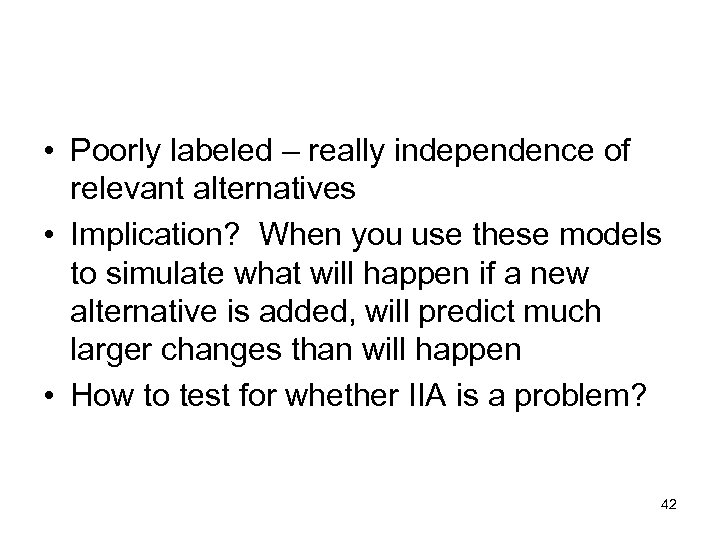 • Poorly labeled – really independence of relevant alternatives • Implication? When you use these models to simulate what will happen if a new alternative is added, will predict much larger changes than will happen • How to test for whether IIA is a problem? 42
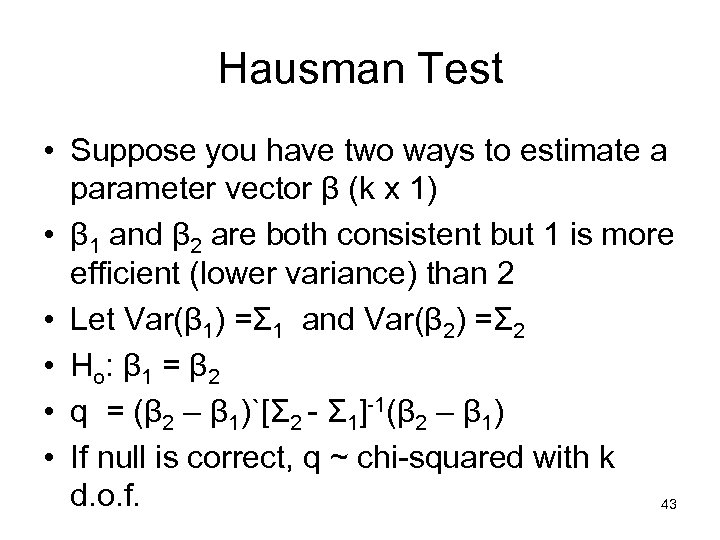 Hausman Test • Suppose you have two ways to estimate a parameter vector β (k x 1) • β 1 and β 2 are both consistent but 1 is more efficient (lower variance) than 2 • Let Var(β 1) =Σ 1 and Var(β 2) =Σ 2 • H o: β 1 = β 2 • q = (β 2 – β 1)`[Σ 2 - Σ 1]-1(β 2 – β 1) • If null is correct, q ~ chi-squared with k d. o. f. 43
 • Operationalize in this context • Suppose there are J alternatives and reference 1 is the base • If IIA is NOT a problem, then deleting one of the options should NOT change the parameter values • However, deleting an option should reduce the efficiency of the estimates – not using all the data 44
 • β 1 as more efficient (and consistent) unrestricted model • β 2 as inefficient (and consistent) restricted model • Conducting a Hausman test • Mlogtest, hausman • Null is that IIA is not a problem, so, will reject null if the test stat. is ‘large’ 45
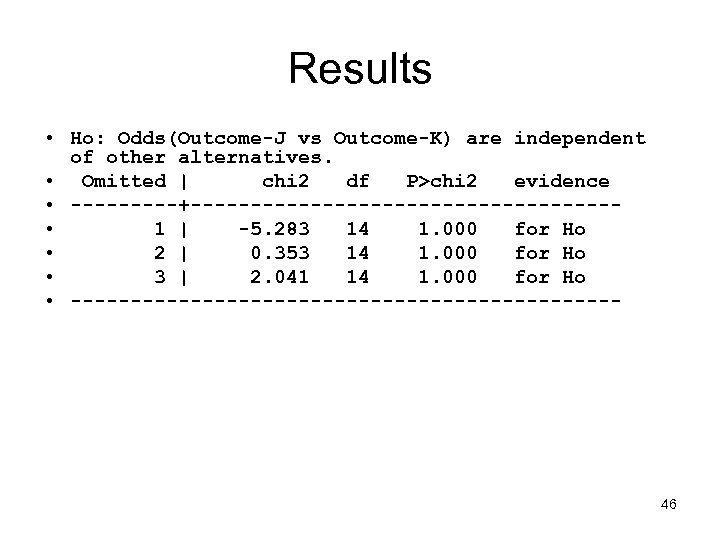 Results • Ho: Odds(Outcome-J vs Outcome-K) are independent of other alternatives. • Omitted | chi 2 df P>chi 2 evidence • -----+------------------ • 1 | -5. 283 14 1. 000 for Ho • 2 | 0. 353 14 1. 000 for Ho • 3 | 2. 041 14 1. 000 for Ho • ----------------------- 46
 • Not happy with this subroutine • Notice p-values are all 1 – wrong from the start • The 1 st test statistic is negative. Can be the case and is often the case, but, problematic. 47
 How to get around IIA? • Conditional probit models. – Allow for correlation in errors – Very complicated. – Not pre-programmed into any statistical package • Nested logit – Group choices into similar categories – IIA within category and between category 48
 • Example: Model of car choice – 4 options: Sedan, minivan, SUV, pickup truck • Could ‘nest the decision • First decide whether you want something on a car or truck platform • Then pick with the group – Car: sedan or minivan – Truck: pickup or SUV 49
 • IIA is imposed – within a nest: • Cars/minivans • Pickup and SUV – Between 1 st level decision • Truck and car platform 50
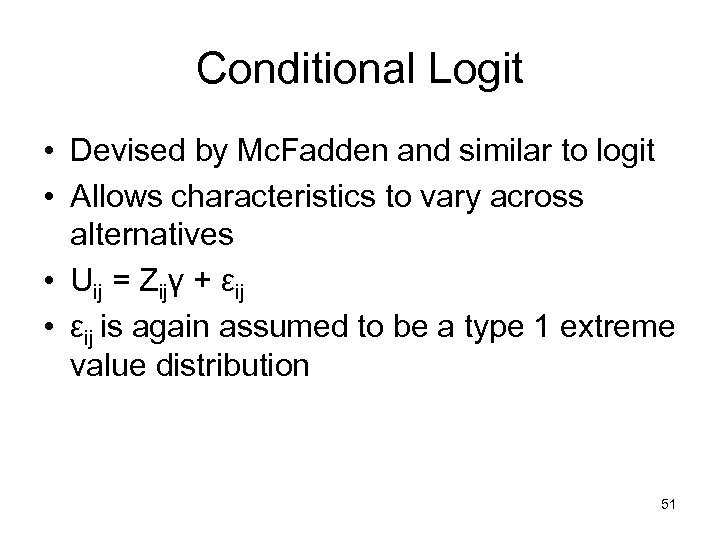 Conditional Logit • Devised by Mc. Fadden and similar to logit • Allows characteristics to vary across alternatives • Uij = Zijγ + εij • εij is again assumed to be a type 1 extreme value distribution 51
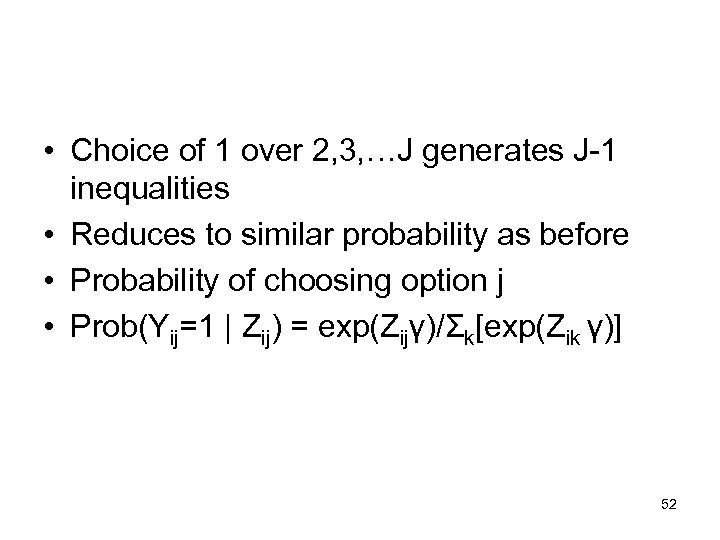 • Choice of 1 over 2, 3, …J generates J-1 inequalities • Reduces to similar probability as before • Probability of choosing option j • Prob(Yij=1 | Zij) = exp(Zijγ)/Σk[exp(Zik γ)] 52
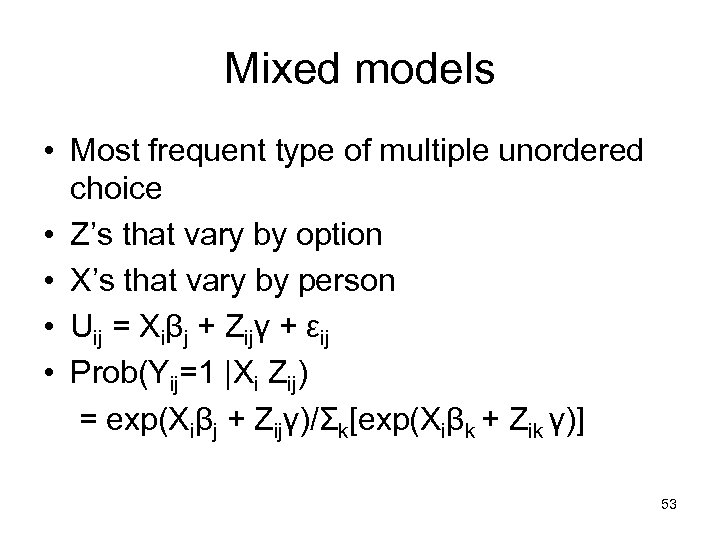 Mixed models • Most frequent type of multiple unordered choice • Z’s that vary by option • X’s that vary by person • Uij = Xiβj + Zijγ + εij • Prob(Yij=1 |Xi Zij) = exp(Xiβj + Zijγ)/Σk[exp(Xiβk + Zik γ)] 53
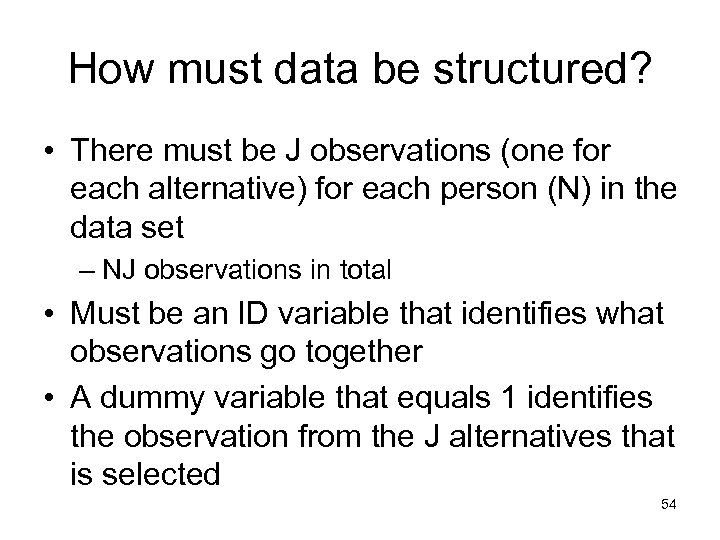 How must data be structured? • There must be J observations (one for each alternative) for each person (N) in the data set – NJ observations in total • Must be an ID variable that identifies what observations go together • A dummy variable that equals 1 identifies the observation from the J alternatives that is selected 54
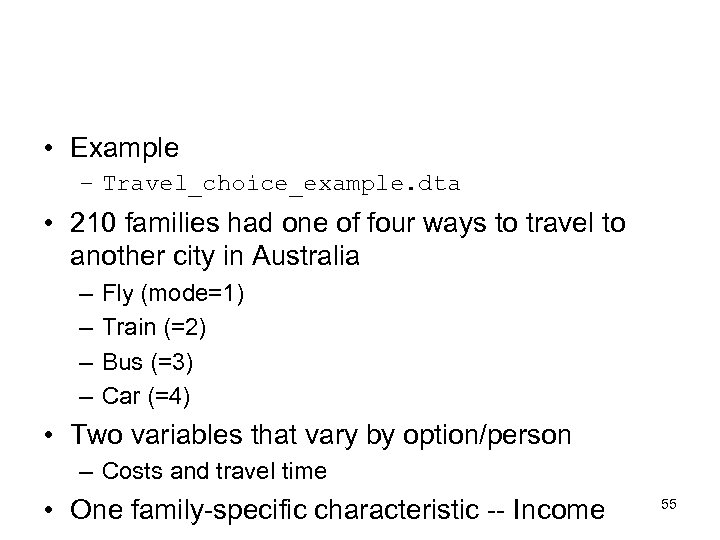 • Example – Travel_choice_example. dta • 210 families had one of four ways to travel to another city in Australia – – Fly (mode=1) Train (=2) Bus (=3) Car (=4) • Two variables that vary by option/person – Costs and travel time • One family-specific characteristic -- Income 55
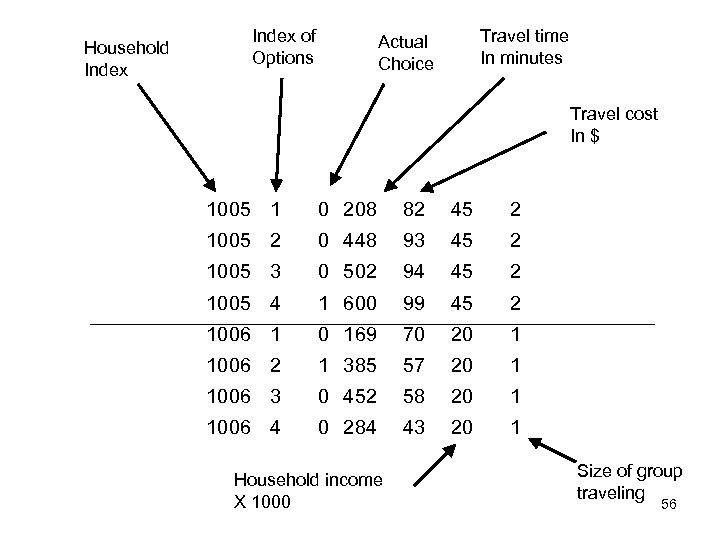 Household Index of Options Travel time In minutes Actual Choice Travel cost In $ 1005 1 0 208 82 45 2 1005 2 0 448 93 45 2 1005 3 0 502 94 45 2 1005 4 1 600 99 45 2 1006 1 0 169 70 20 1 1006 2 1 385 57 20 1 1006 3 0 452 58 20 1 1006 4 0 284 43 20 1 Household income X 1000 Size of group traveling 56
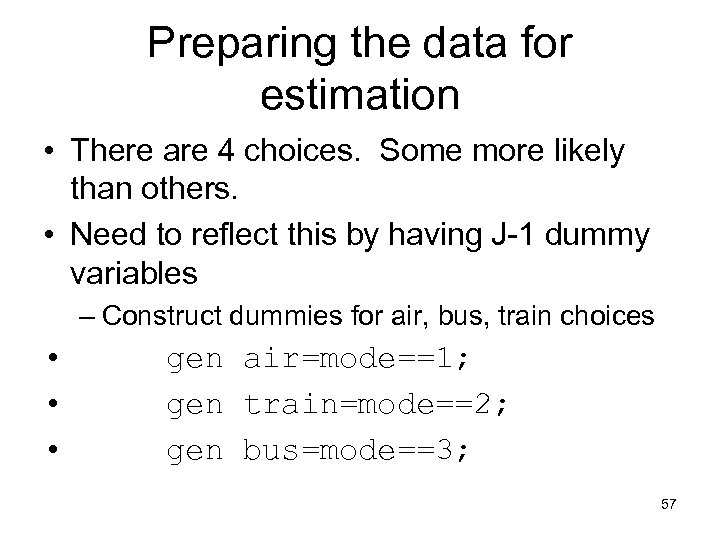 Preparing the data for estimation • There are 4 choices. Some more likely than others. • Need to reflect this by having J-1 dummy variables – Construct dummies for air, bus, train choices • • • gen air=mode==1; gen train=mode==2; gen bus=mode==3; 57
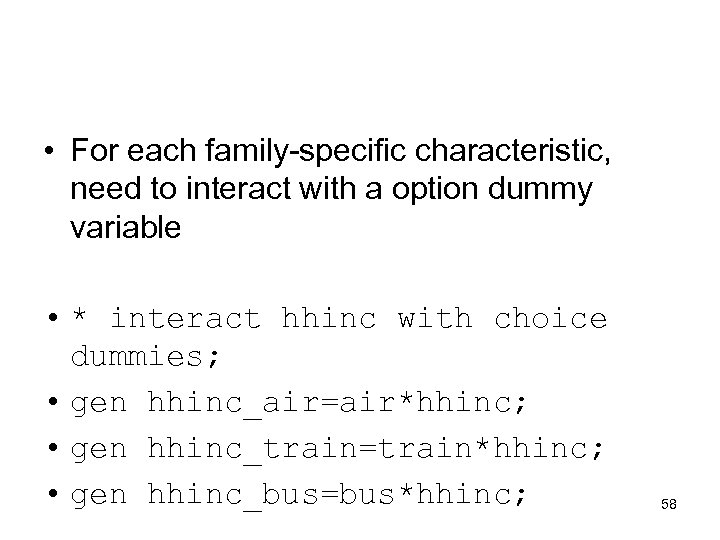 • For each family-specific characteristic, need to interact with a option dummy variable • * interact hhinc with choice dummies; • gen hhinc_air=air*hhinc; • gen hhinc_train=train*hhinc; • gen hhinc_bus=bus*hhinc; 58
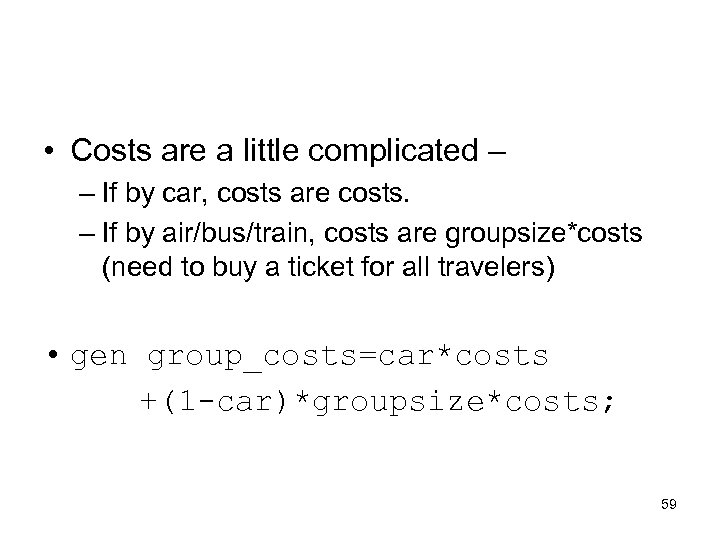 • Costs are a little complicated – – If by car, costs are costs. – If by air/bus/train, costs are groupsize*costs (need to buy a ticket for all travelers) • gen group_costs=car*costs +(1 -car)*groupsize*costs; 59
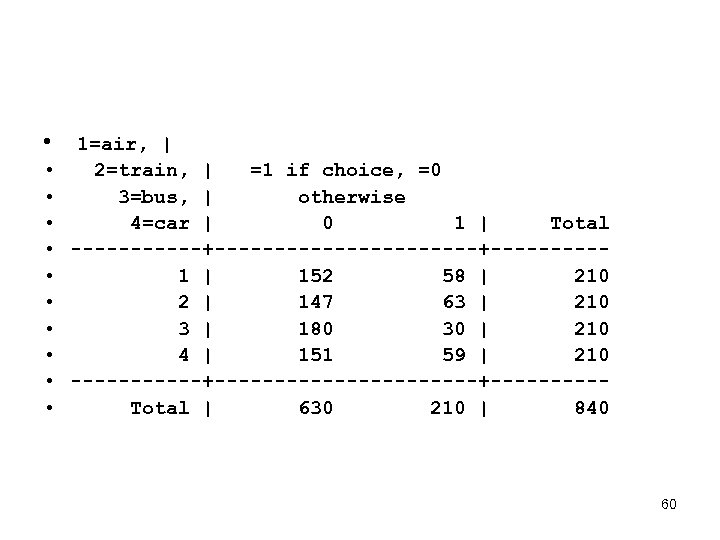 • • • 1=air, | 2=train, | =1 if choice, =0 3=bus, | otherwise 4=car | 0 1 | Total ------+-----------+-----1 | 152 58 | 210 2 | 147 63 | 210 3 | 180 30 | 210 4 | 151 59 | 210 ------+-----------+-----Total | 630 210 | 840 60
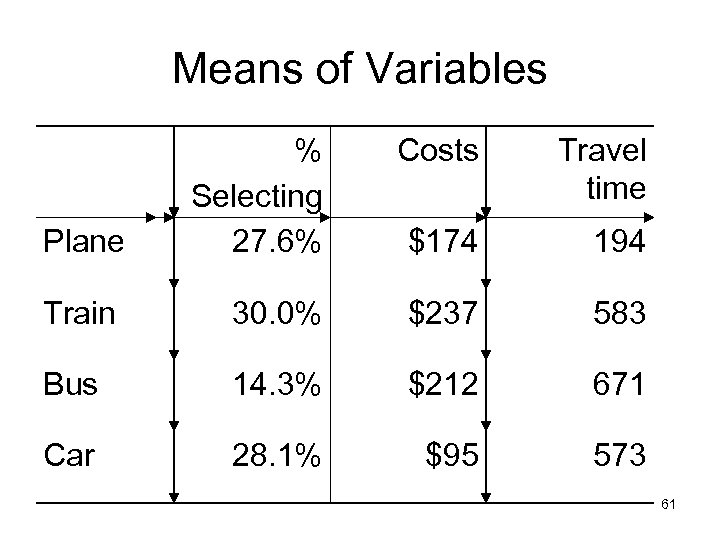 Means of Variables Costs Travel time Plane % Selecting 27. 6% $174 194 Train 30. 0% $237 583 Bus 14. 3% $212 671 Car 28. 1% $95 573 61
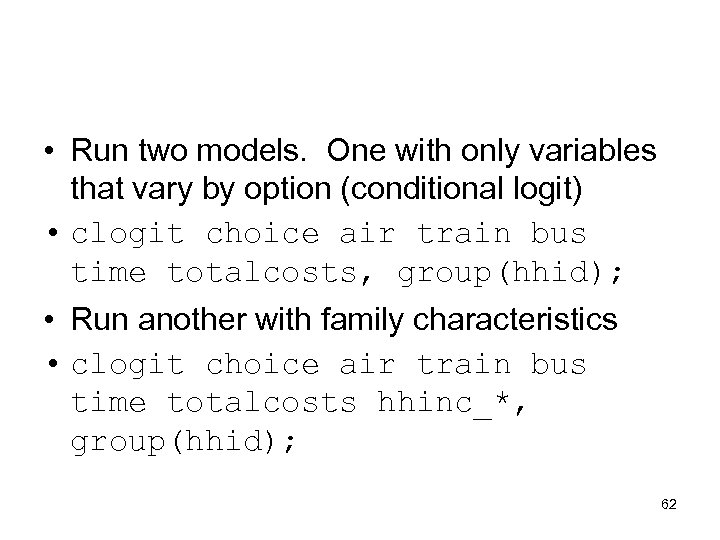 • Run two models. One with only variables that vary by option (conditional logit) • clogit choice air train bus time totalcosts, group(hhid); • Run another with family characteristics • clogit choice air train bus time totalcosts hhinc_*, group(hhid); 62
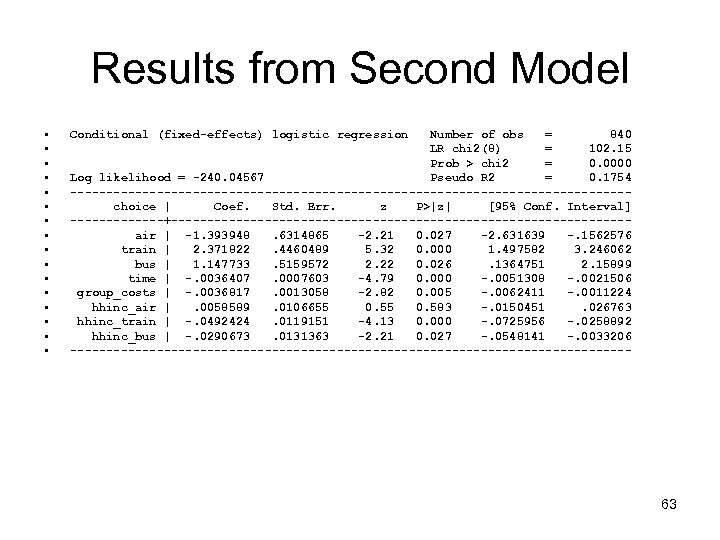 Results from Second Model • • • • Conditional (fixed-effects) logistic regression Number of obs = 840 LR chi 2(8) = 102. 15 Prob > chi 2 = 0. 0000 Log likelihood = -240. 04567 Pseudo R 2 = 0. 1754 ---------------------------------------choice | Coef. Std. Err. z P>|z| [95% Conf. Interval] -------+--------------------------------air | -1. 393948. 6314865 -2. 21 0. 027 -2. 631639 -. 1562576 train | 2. 371822. 4460489 5. 32 0. 000 1. 497582 3. 246062 bus | 1. 147733. 5159572 2. 22 0. 026. 1364751 2. 15899 time | -. 0036407. 0007603 -4. 79 0. 000 -. 0051308 -. 0021506 group_costs | -. 0036817. 0013058 -2. 82 0. 005 -. 0062411 -. 0011224 hhinc_air |. 0058589. 0106655 0. 583 -. 0150451. 026763 hhinc_train | -. 0492424. 0119151 -4. 13 0. 000 -. 0725956 -. 0258892 hhinc_bus | -. 0290673. 0131363 -2. 21 0. 027 -. 0548141 -. 0033206 --------------------------------------- 63
 Problem • The post-estimation subrountines like MFX have not been written for CLOGIT • Need to brute force the outcomes • On next slide, some code to estimate change in probabilities if travel time by car increases by 30 minutes 64
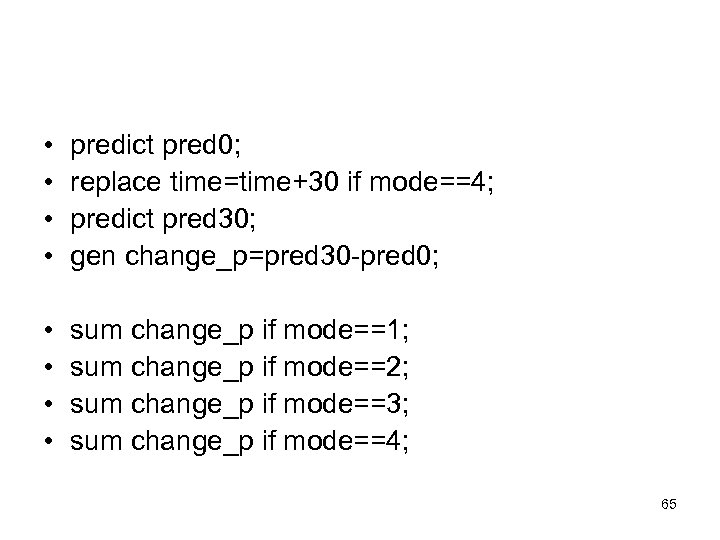 • • predict pred 0; replace time=time+30 if mode==4; predict pred 30; gen change_p=pred 30 -pred 0; • • sum change_p if mode==1; sum change_p if mode==2; sum change_p if mode==3; sum change_p if mode==4; 65
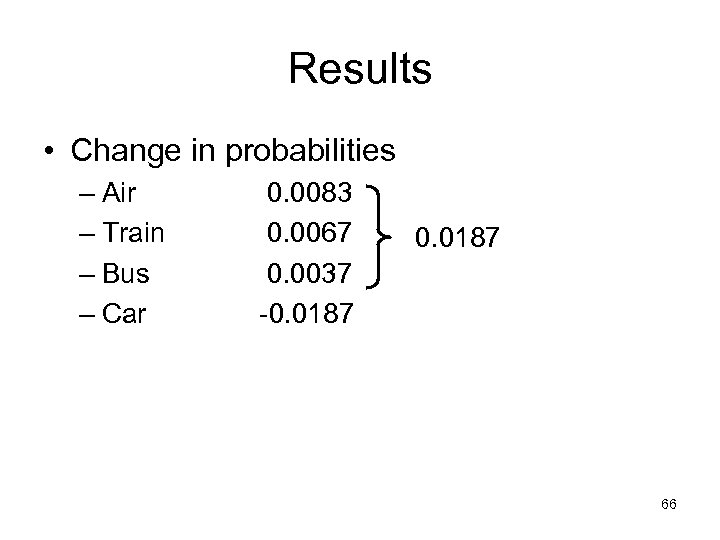 Results • Change in probabilities – Air – Train – Bus – Car 0. 0083 0. 0067 0. 0037 -0. 0187 66
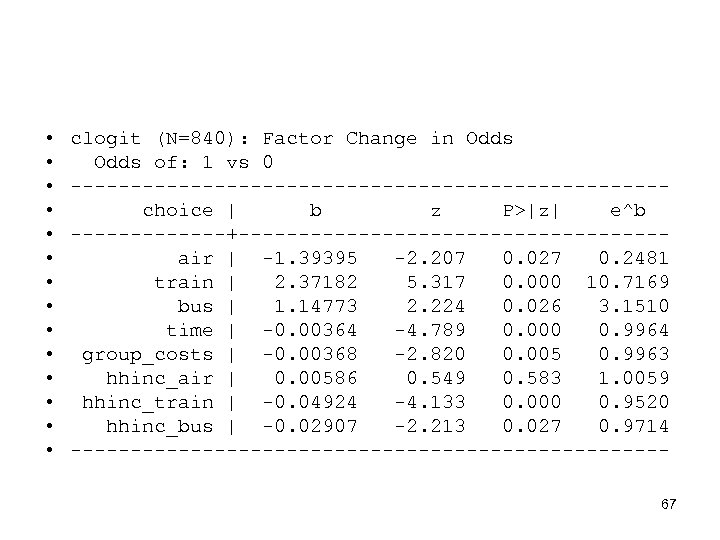 • • • • clogit (N=840): Factor Change in Odds of: 1 vs 0 -------------------------choice | b z P>|z| e^b -------+------------------air | -1. 39395 -2. 207 0. 027 0. 2481 train | 2. 37182 5. 317 0. 000 10. 7169 bus | 1. 14773 2. 224 0. 026 3. 1510 time | -0. 00364 -4. 789 0. 000 0. 9964 group_costs | -0. 00368 -2. 820 0. 005 0. 9963 hhinc_air | 0. 00586 0. 549 0. 583 1. 0059 hhinc_train | -0. 04924 -4. 133 0. 000 0. 9520 hhinc_bus | -0. 02907 -2. 213 0. 027 0. 9714 -------------------------67
 Gupta et al. • 33, 000 sites across US with hazardous waste • Contaminants Leak into soil, ground H 2 O • Cost nearly $300 Billion to clean them up (1990 estimates) • Decision of how to clean them up is made by the EPA • Comprehensive Emergency Response, Compensation Liability Act (CERCLA) 68
 • Hazardous waste sites scored on 0 -100 score, ascending in risk • Hazard Ranking Score • If HRS>28. 5, put on National Priority List • 1, 100 on NPL • Once on list, EPA conducts Remedial investigation/feasibility study 69
 • EPS must decide – Size of area to be treated – How to treat • In first decision, must protect health of residents • In second, can tradeoff costs of remediation vs. permanence of solution 70
 Example • 3 potential decisions – Cap the soil – Treat the soil (in situ) – Truck the dirt away for processing • Landfill somewhere else • Treat offsite • More permanent solutions are more expensive • Question for paper: How does EPA tradeoff permanence/cost 71
 • Collect data from 100 “Records of decision” – Ignore decision about the size of the site – Outlines alternatives – Explains decision • Two types of sites – Wood preservatives – PCB 72
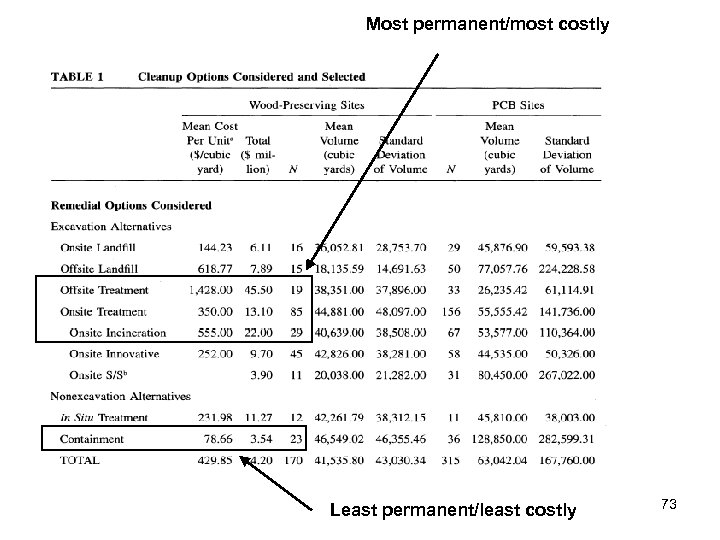 Most permanent/most costly Least permanent/least costly 73
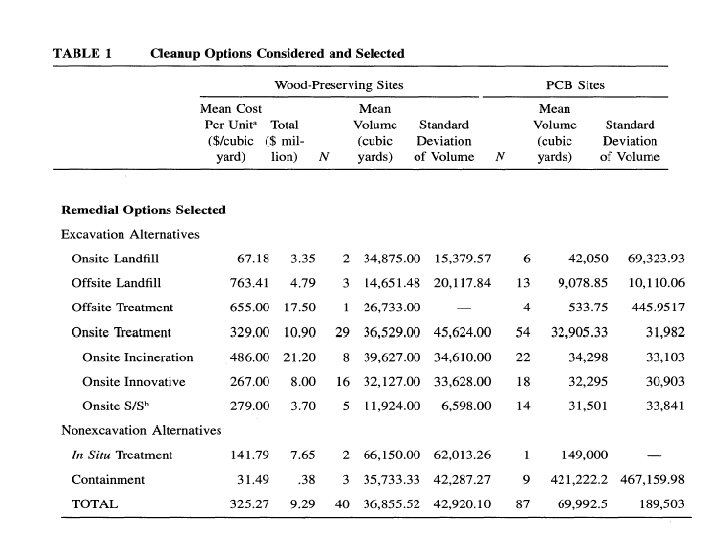 74
74
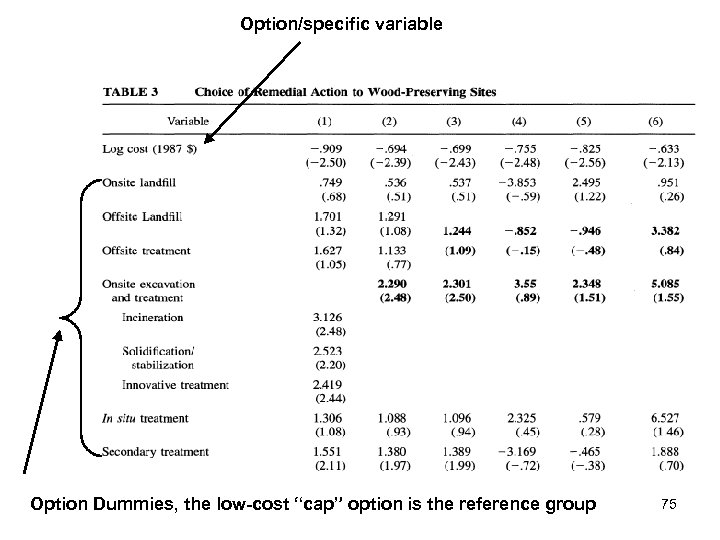 Option/specific variable Option Dummies, the low-cost “cap” option is the reference group 75
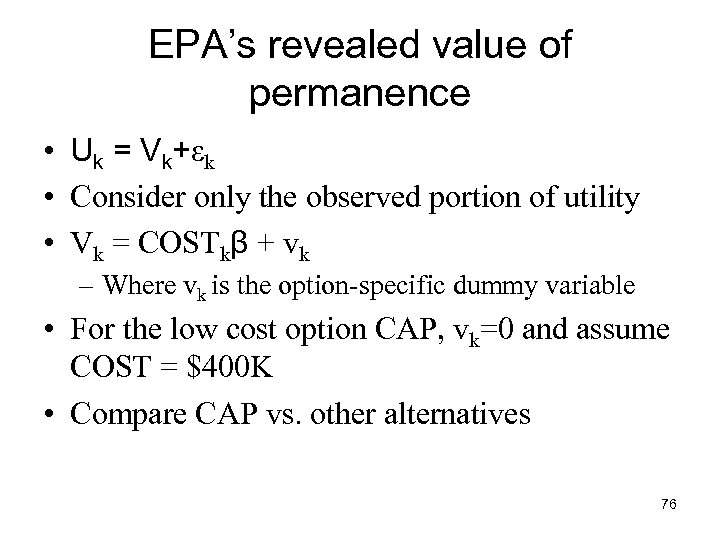 EPA’s revealed value of permanence • Uk = Vk+εk • Consider only the observed portion of utility • Vk = COSTkβ + vk – Where vk is the option-specific dummy variable • For the low cost option CAP, vk=0 and assume COST = $400 K • Compare CAP vs. other alternatives 76
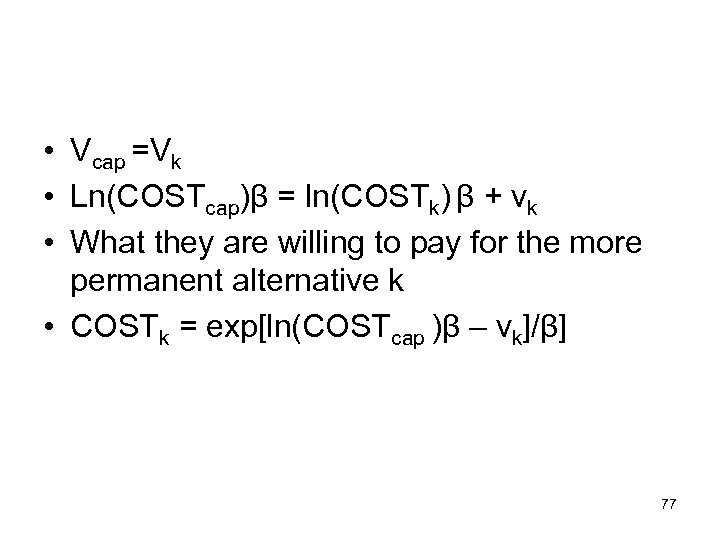 • Vcap =Vk • Ln(COSTcap)β = ln(COSTk) β + vk • What they are willing to pay for the more permanent alternative k • COSTk = exp[ln(COSTcap )β – vk]/β] 77