


 Скачать презентацию Multi-channel Cell Counter Utilizing The Aperture Impedance Technique
ee2a322bc16f06417fcbc715a9875e3a.ppt
- Количество слайдов: 28
 Multi-channel Cell Counter Utilizing The Aperture Impedance Technique Aaron Lee & Dr. Ash M. Parameswaran Simon Fraser University School of Engineering Sciences Burnaby, B. C. Canada V 5 A 1 S 6 Email: cleek@sfu. ca This work is sponsored by Brain Insights, California
 Overview 1. 2. 3. 4. 5. 6. 7. Introduction Centralized approach Clinical facts Techniques of cell counting Electrical and physical relationships Disposable unit design Conclusion
 Thesis Concentration Construction, modeling and testing of the disposable unit and the electronics
 Introduction l Most people have blood test at some point in their lives l Blood is the vital fluid of our body and the quality of blood is an indication of health l Measured in number of cells per cubic millimeter of blood
 Centralized approach l Most blood cell counting today is done by sending the blood samples to a centralized laboratory l Very complex system and required skilled personnel to operate l Long turn-around time l Patient has to visit another time
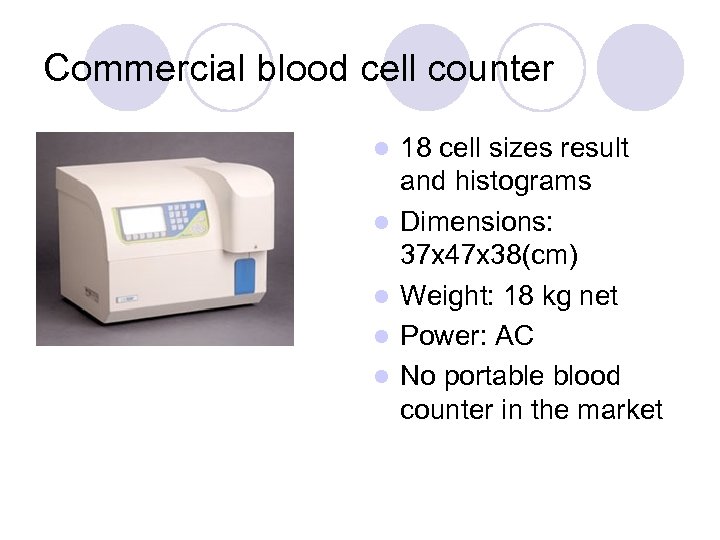 Commercial blood cell counter l l l 18 cell sizes result and histograms Dimensions: 37 x 47 x 38(cm) Weight: 18 kg net Power: AC No portable blood counter in the market
 Our challenges l Shortens the turn around time l Reduce the cost so clinics can afford to own the blood cell counter l Miniaturize the testing equipment l Maintain or improve accuracy
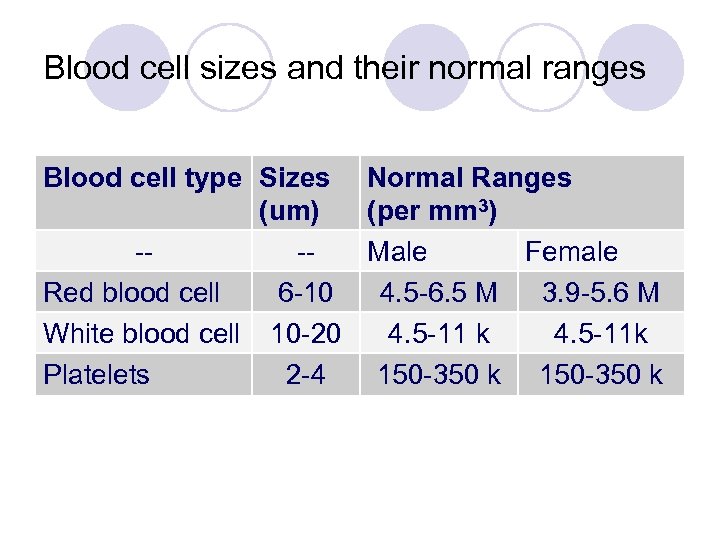 Blood cell sizes and their normal ranges Blood cell type Sizes Normal Ranges (um) (per mm 3) --Male Female Red blood cell 6 -10 4. 5 -6. 5 M 3. 9 -5. 6 M White blood cell 10 -20 4. 5 -11 k 4. 5 -11 k Platelets 2 -4 150 -350 k
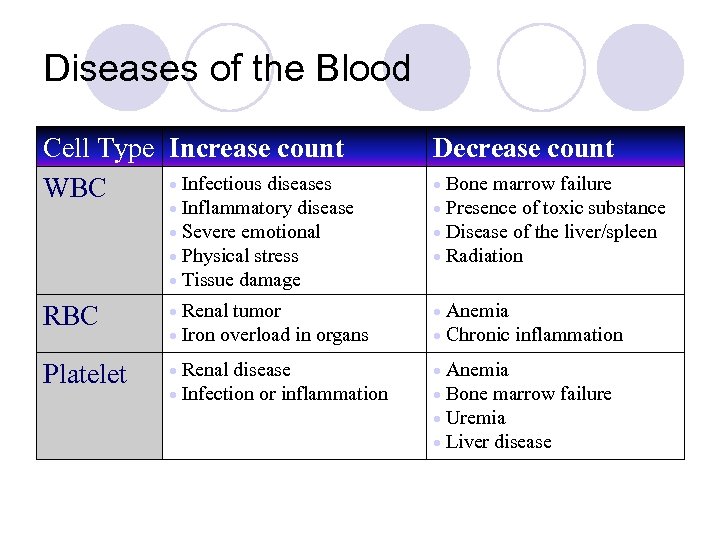 Diseases of the Blood Cell Type Increase count Infectious diseases WBC Decrease count Bone marrow failure Presence of toxic substance Disease of the liver/spleen Radiation Inflammatory disease Severe emotional Physical stress Tissue damage RBC Renal tumor Iron overload in organs Anemia Chronic inflammation Platelet Renal disease Infection or inflammation Anemia Bone marrow failure Uremia Liver disease
 Cell count techniques l Electrical l Optical
 Electrical Counting l Gain in precision and reproducibility l Lower coefficient of variation and complete a large number of determinations quickly l Cost of the electrical cell-counting equipments ($2500 to over $50, 000) l Samples has to be diluted before the count
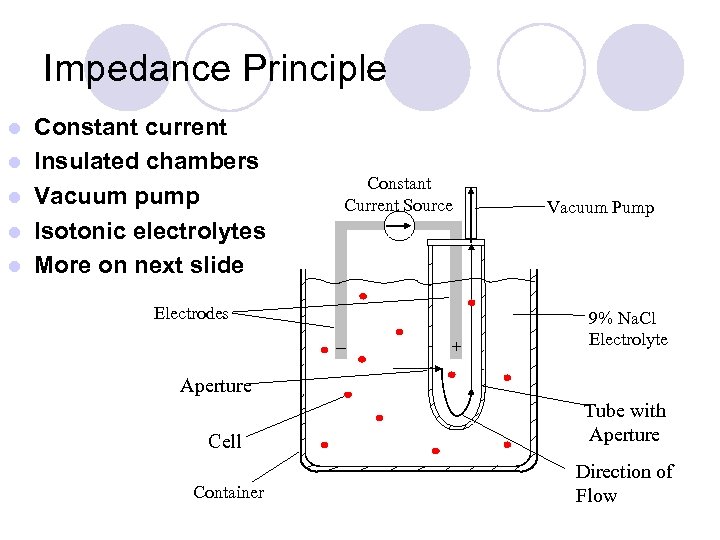 Impedance Principle l l l Constant current Insulated chambers Vacuum pump Isotonic electrolytes More on next slide Electrodes Constant Current Source Vacuum Pump 9% Na. Cl Electrolyte Aperture Cell Tube with Aperture Container Direction of Flow
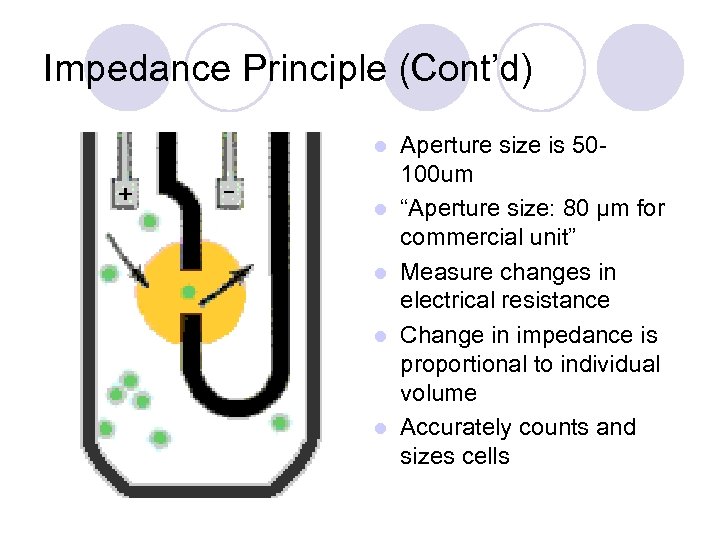 Impedance Principle (Cont’d) l l l Aperture size is 50100 um “Aperture size: 80 µm for commercial unit” Measure changes in electrical resistance Change in impedance is proportional to individual volume Accurately counts and sizes cells
 Capacitance Principle l Similar idea as the impedance method l Measured in the function of the change in capacitance l However, pulse amplitude generated is not proportional the cell size
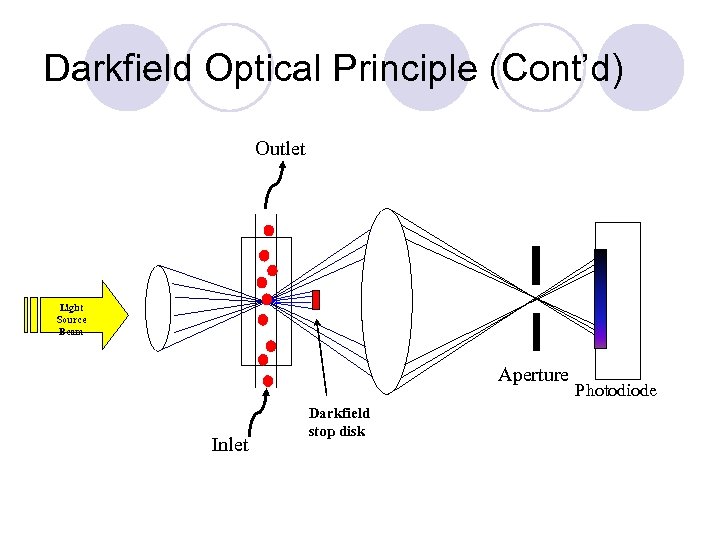 Darkfield Optical Principle (Cont’d) Outlet Light Source Beam Aperture Inlet Darkfield stop disk Photodiode
 Darkfield Optical Principle (Cont’d) l The pulse generated by the system is not proportional to the size of the cell l Optical detection is sensitive to size of the dark field stop disk, and the optical magnification l An offset of the parameters will greatly affect the amplitude of the signal
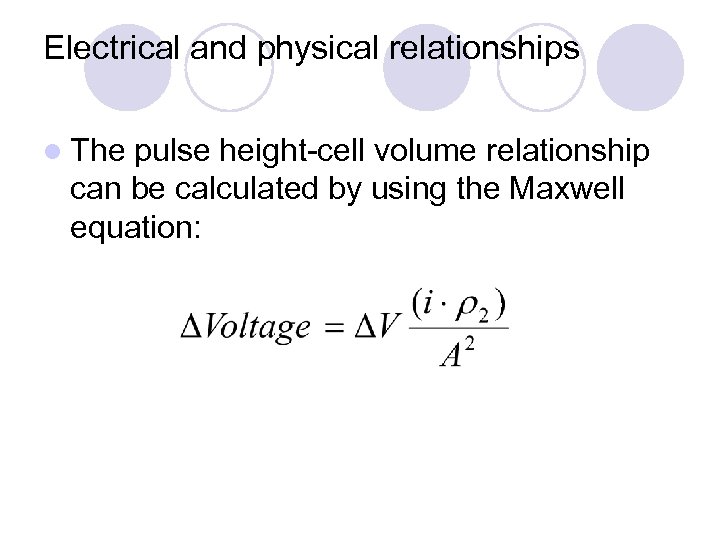 Electrical and physical relationships l The pulse height-cell volume relationship can be calculated by using the Maxwell equation:
 Resistivity of electrolyte l 0. 9% Na. Cl used as the electrolyte l Conductivity of aqueous solutions are usually expressed in Siemens Conductivity (S/cm) = Molarity (mol/L) x ion conductance (SL/cm/eq) x 1 eq/mol l Resistance of the 0. 9% Na. Cl solution is calculated to be 51 Ω/cm
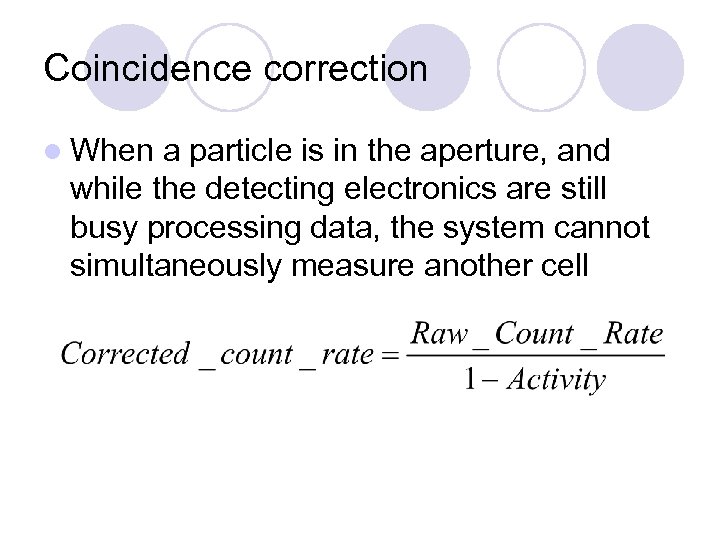 Coincidence correction l When a particle is in the aperture, and while the detecting electronics are still busy processing data, the system cannot simultaneously measure another cell
 Design requirements l Cell sizes that we are measuring vary from 2 μm to 20 μm in diameter l Aperture size of 50 -100 μm in diameter will be used l Design of a disposable unit and electronics that can be put in a portable cell counter
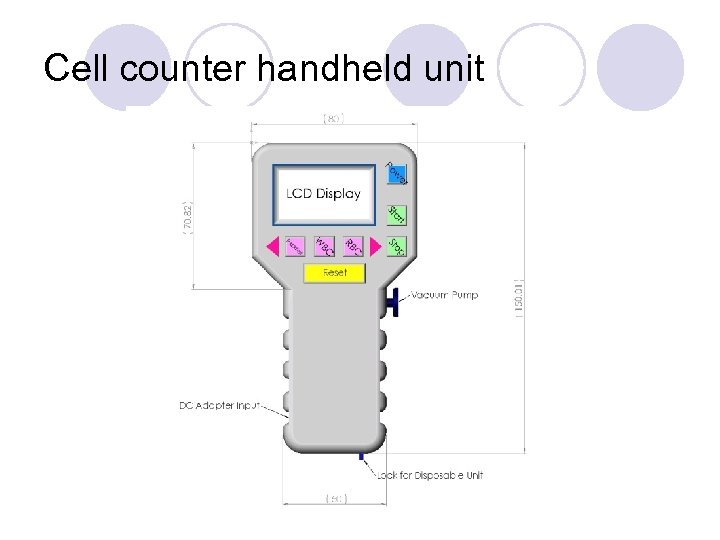 Cell counter handheld unit
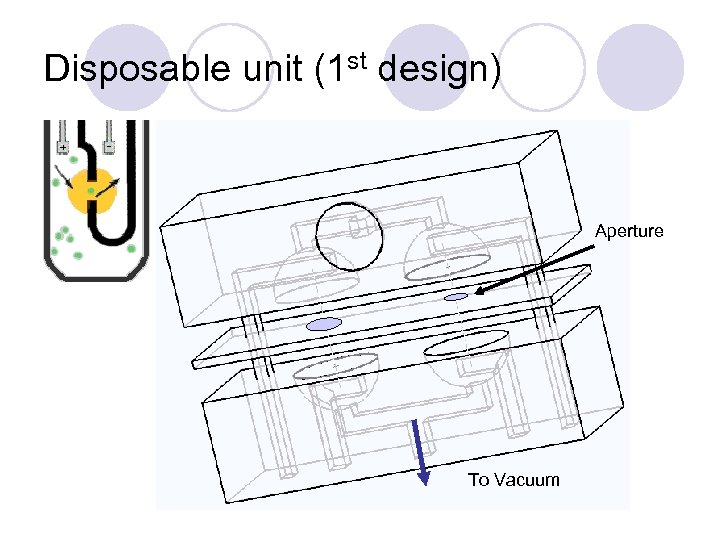 Disposable unit (1 st design) Aperture To Vacuum
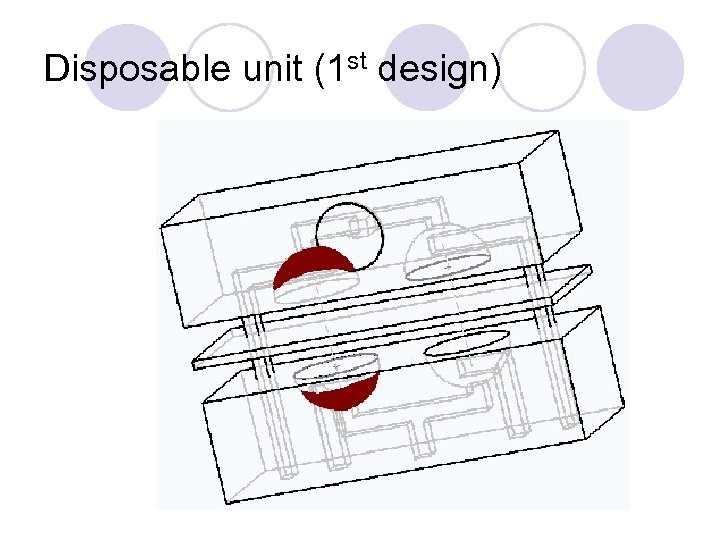 Disposable unit (1 st design)
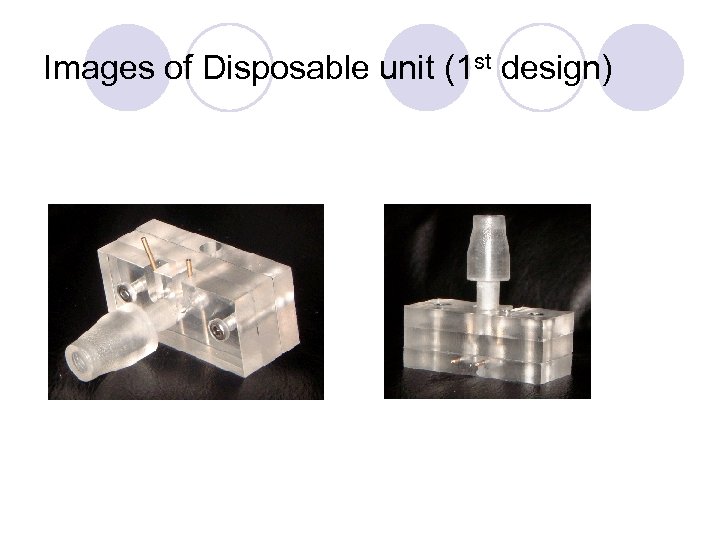 Images of Disposable unit (1 st design)
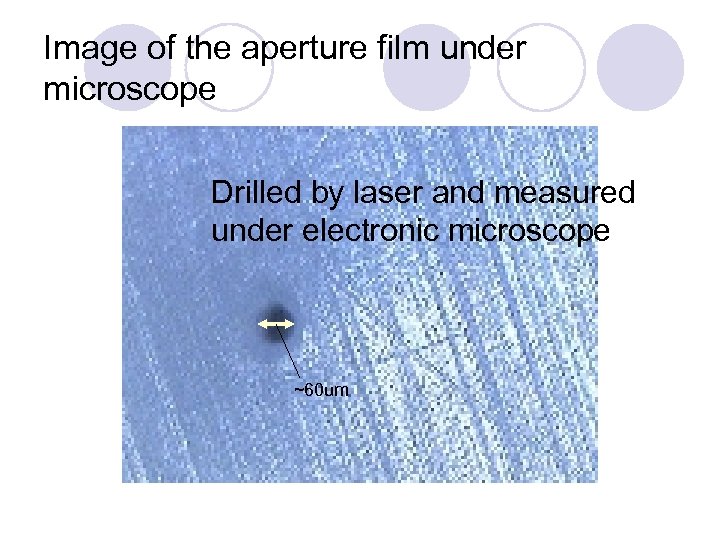 Image of the aperture film under microscope Drilled by laser and measured under electronic microscope ~60 um
 Conclusion l Theory of multi-channel cell counter utilizing the aperture impedance technique have been discussed l Highest resolution available in the industry for particle counting and size distribution l Color or refractive index does not affect results l More design on the disposable unit will be performed and more testing will be done
![References l l l l [1] Basic Principles in Biology by Y. K. To,](https://present5.com/presentation/ee2a322bc16f06417fcbc715a9875e3a/image-27.jpg "References l l l l [1] Basic Principles in Biology by Y. K. To,") References l l l l [1] Basic Principles in Biology by Y. K. To, Hung Fung Book Co. [2] Haematology, R. B. Thompson [3] Kubitschek HE: Counting and sizing micro-organisms with the Coulter counter, in Methods in Microbiology, ed DW Ribbons and JR Norris. London: Academic Press, 1969 [4] Coulter WH: High speed automatic blood cell counter and cell size analyzer. Presented at the National Electronics Conference, Chicago, October 1956 [5] Hayes TL: The scanning electron microscope: principles and applications in biology and medicine. Adv Biol Med Phys 12: 85, 1968 [6] Brightfield and darkfield: http: //www. wsu. edu/~omoto/papers/Fig 1. html [7] Mansberg HP: Optical techniques of particle counting, in Advances in Automated Analysis, Vol 1. Technicon International Congress. New York: Mediad, 1969 [8] Hematology; principles and practice. Edited by Charles E. Mengel, Emil Frei, III [and] Ralph Nachman. [9] http: //www. principalhealthnews. com/topic 100587682 [10] http: //www. utmem. edu/physpharm/. 010. html [11] Brecher G et al: Evaluation of an electronic red cell counter. Am J Clin Pathol 16: 1439, 1956 [12] Ionic reactions and equilibria. New York : Macmillan, [1967] [13] http: //www. colby. edu/chemistry/CH 141 B. Lab/CH 141 L 4 cond. Fall 2002. pdf [14] Practical guide to modern hematology analysers, warren Groner, Elkin Simson, john wiley and sons ltd, 1995
References l l l l [1] Basic Principles in Biology by Y. K. To, Hung Fung Book Co. [2] Haematology, R. B. Thompson [3] Kubitschek HE: Counting and sizing micro-organisms with the Coulter counter, in Methods in Microbiology, ed DW Ribbons and JR Norris. London: Academic Press, 1969 [4] Coulter WH: High speed automatic blood cell counter and cell size analyzer. Presented at the National Electronics Conference, Chicago, October 1956 [5] Hayes TL: The scanning electron microscope: principles and applications in biology and medicine. Adv Biol Med Phys 12: 85, 1968 [6] Brightfield and darkfield: http: //www. wsu. edu/~omoto/papers/Fig 1. html [7] Mansberg HP: Optical techniques of particle counting, in Advances in Automated Analysis, Vol 1. Technicon International Congress. New York: Mediad, 1969 [8] Hematology; principles and practice. Edited by Charles E. Mengel, Emil Frei, III [and] Ralph Nachman. [9] http: //www. principalhealthnews. com/topic 100587682 [10] http: //www. utmem. edu/physpharm/. 010. html [11] Brecher G et al: Evaluation of an electronic red cell counter. Am J Clin Pathol 16: 1439, 1956 [12] Ionic reactions and equilibria. New York : Macmillan, [1967] [13] http: //www. colby. edu/chemistry/CH 141 B. Lab/CH 141 L 4 cond. Fall 2002. pdf [14] Practical guide to modern hematology analysers, warren Groner, Elkin Simson, john wiley and sons ltd, 1995
 Questions