 Скачать презентацию Multi-Agent Systems University Politehnica of Bucarest Spring 2011
01f1c0b2a50df679985a833dace2da72.ppt
- Количество слайдов: 76




Multi-Agent Systems University “Politehnica” of Bucarest Spring 2011 Adina Magda Florea curs. cs. pub. ro
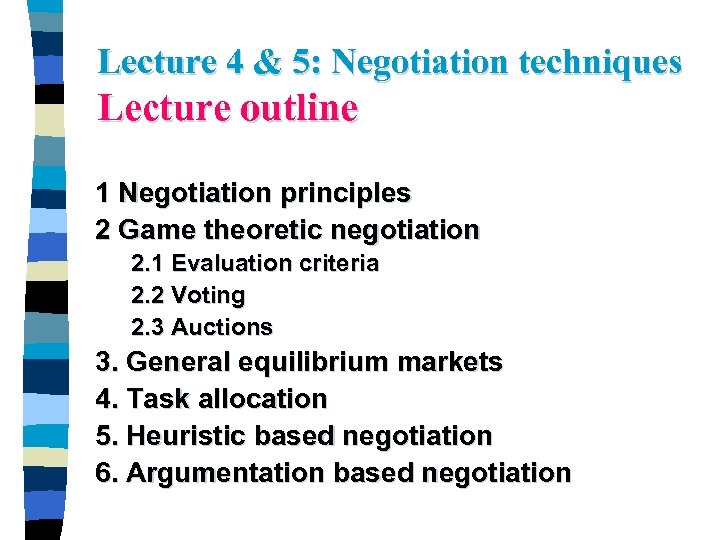
Lecture 4 & 5: Negotiation techniques Lecture outline 1 Negotiation principles 2 Game theoretic negotiation 2. 1 Evaluation criteria 2. 2 Voting 2. 3 Auctions 3. General equilibrium markets 4. Task allocation 5. Heuristic based negotiation 6. Argumentation based negotiation
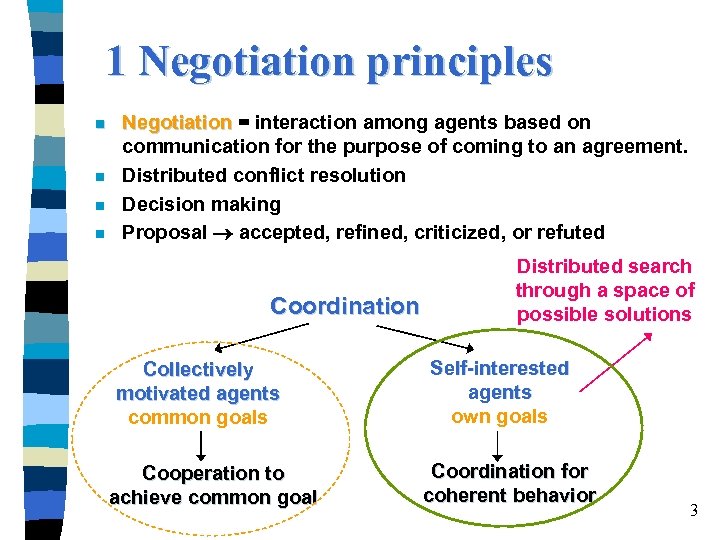
1 Negotiation principles Negotiation = interaction among agents based on communication for the purpose of coming to an agreement. Distributed conflict resolution Decision making Proposal accepted, refined, criticized, or refuted Coordination Collectively motivated agents common goals Cooperation to achieve common goal Distributed search through a space of possible solutions Self-interested agents own goals Coordination for coherent behavior 3
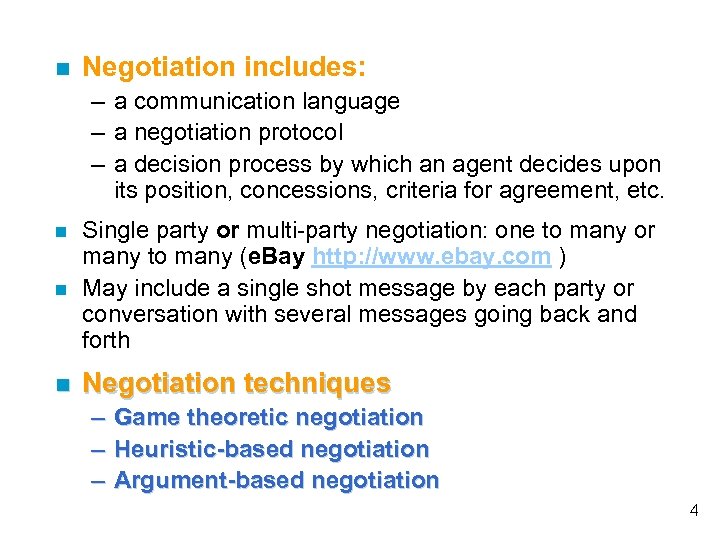
Negotiation includes: – a communication language – a negotiation protocol – a decision process by which an agent decides upon its position, concessions, criteria for agreement, etc. Single party or multi-party negotiation: one to many or many to many (e. Bay http: //www. ebay. com ) May include a single shot message by each party or conversation with several messages going back and forth Negotiation techniques – Game theoretic negotiation – Heuristic-based negotiation – Argument-based negotiation 4
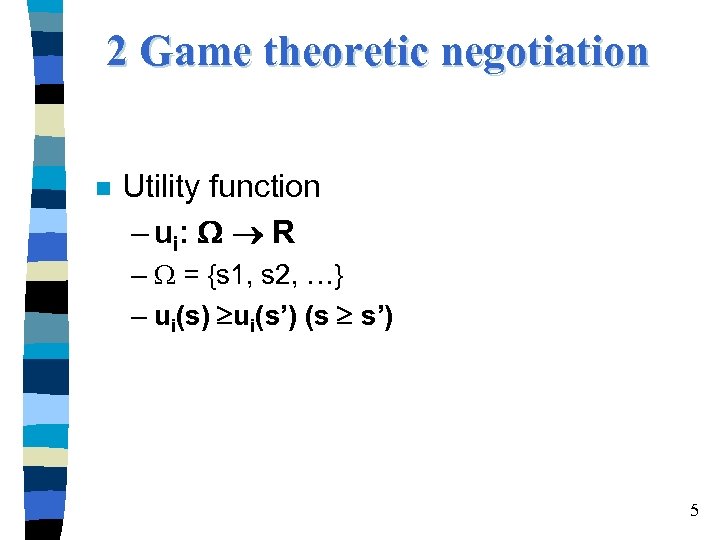
2 Game theoretic negotiation Utility function – u i: R – = {s 1, s 2, …} – ui(s) ui(s’) (s s’) 5
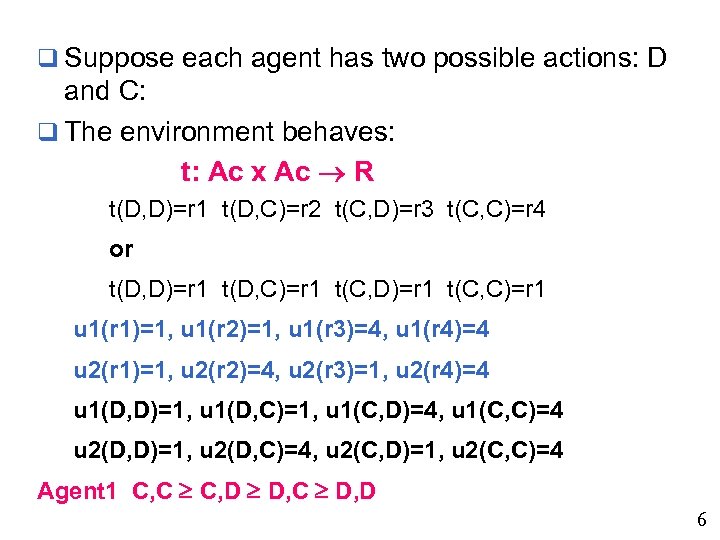
q Suppose each agent has two possible actions: D and C: q The environment behaves: t: Ac x Ac R t(D, D)=r 1 t(D, C)=r 2 t(C, D)=r 3 t(C, C)=r 4 or t(D, D)=r 1 t(D, C)=r 1 t(C, D)=r 1 t(C, C)=r 1 u 1(r 1)=1, u 1(r 2)=1, u 1(r 3)=4, u 1(r 4)=4 u 2(r 1)=1, u 2(r 2)=4, u 2(r 3)=1, u 2(r 4)=4 u 1(D, D)=1, u 1(D, C)=1, u 1(C, D)=4, u 1(C, C)=4 u 2(D, D)=1, u 2(D, C)=4, u 2(C, D)=1, u 2(C, C)=4 Agent 1 C, C C, D D, C D, D 6
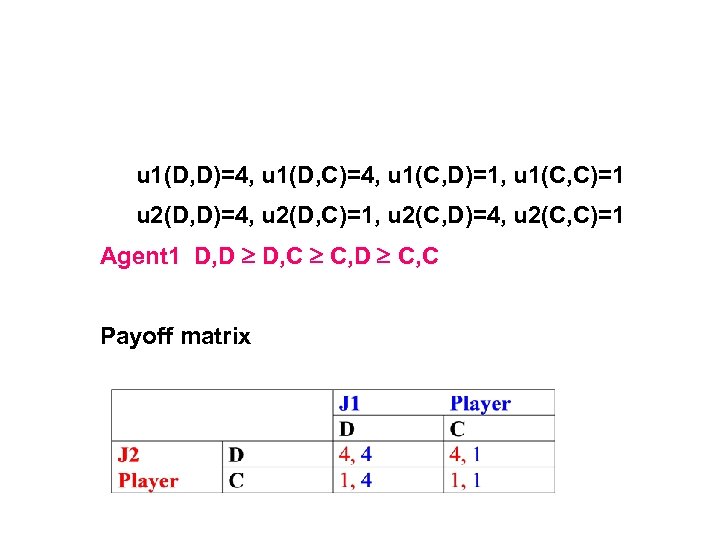
u 1(D, D)=4, u 1(D, C)=4, u 1(C, D)=1, u 1(C, C)=1 u 2(D, D)=4, u 2(D, C)=1, u 2(C, D)=4, u 2(C, C)=1 Agent 1 D, D D, C C, D C, C Payoff matrix
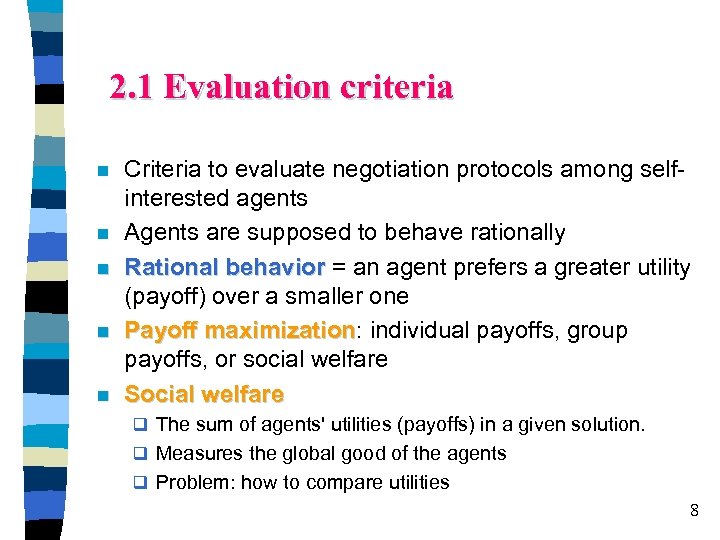
2. 1 Evaluation criteria Criteria to evaluate negotiation protocols among selfinterested agents Agents are supposed to behave rationally Rational behavior = an agent prefers a greater utility behavior (payoff) over a smaller one Payoff maximization: individual payoffs, group maximization payoffs, or social welfare Social welfare q The sum of agents' utilities (payoffs) in a given solution. q Measures the global good of the agents q Problem: how to compare utilities 8
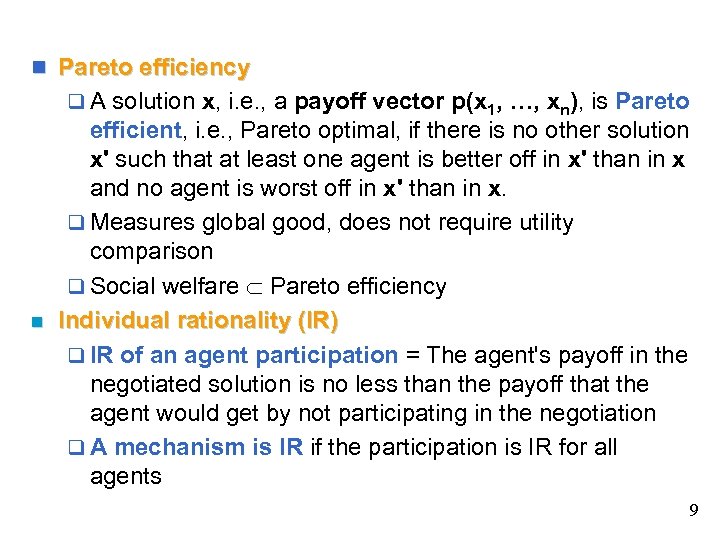
Pareto efficiency q A solution x, i. e. , a payoff vector p(x 1, …, xn), is Pareto efficient, i. e. , Pareto optimal, if there is no other solution x' such that at least one agent is better off in x' than in x and no agent is worst off in x' than in x. q Measures global good, does not require utility comparison q Social welfare Pareto efficiency Individual rationality (IR) q IR of an agent participation = The agent's payoff in the negotiated solution is no less than the payoff that the agent would get by not participating in the negotiation q A mechanism is IR if the participation is IR for all agents 9
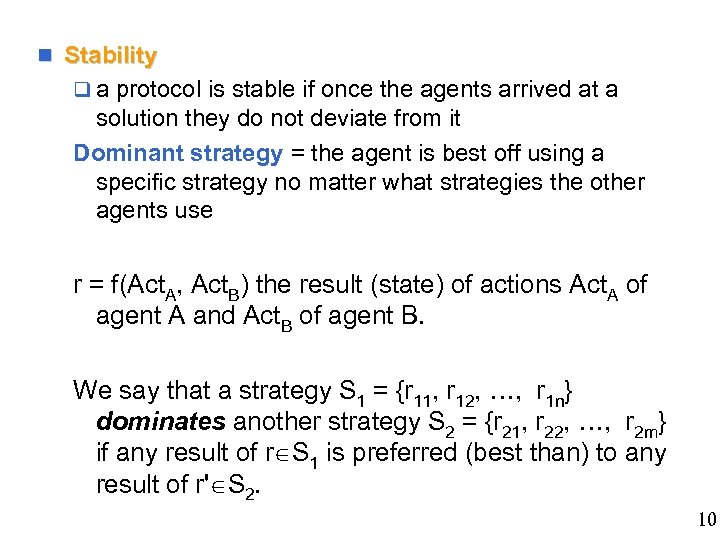
Stability q a protocol is stable if once the agents arrived at a solution they do not deviate from it Dominant strategy = the agent is best off using a specific strategy no matter what strategies the other agents use r = f(Act. A, Act. B) the result (state) of actions Act. A of agent A and Act. B of agent B. We say that a strategy S 1 = {r 11, r 12, …, r 1 n} dominates another strategy S 2 = {r 21, r 22, …, r 2 m} if any result of r S 1 is preferred (best than) to any result of r' S 2. 10
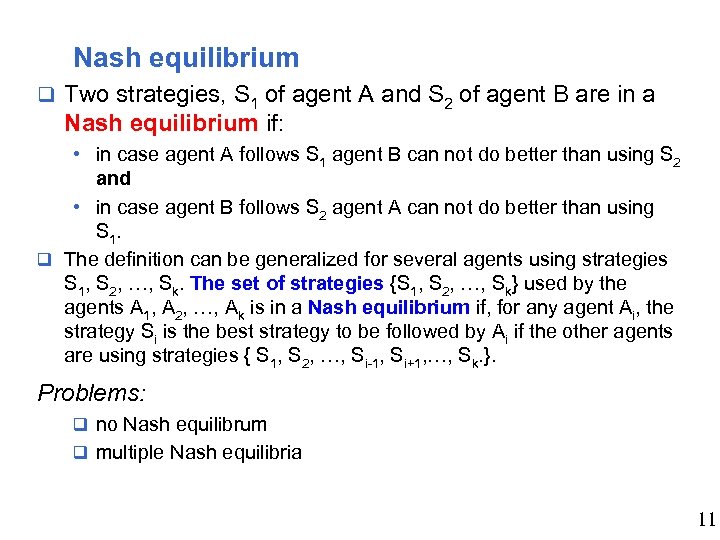
Nash equilibrium q Two strategies, S 1 of agent A and S 2 of agent B are in a Nash equilibrium if: • in case agent A follows S 1 agent B can not do better than using S 2 and • in case agent B follows S 2 agent A can not do better than using S 1. q The definition can be generalized for several agents using strategies S 1, S 2, …, Sk. The set of strategies {S 1, S 2, …, Sk} used by the agents A 1, A 2, …, Ak is in a Nash equilibrium if, for any agent Ai, the strategy Si is the best strategy to be followed by Ai if the other agents are using strategies { S 1, S 2, …, Si-1, Si+1, …, Sk. }. Problems: q no Nash equilibrum q multiple Nash equilibria 11
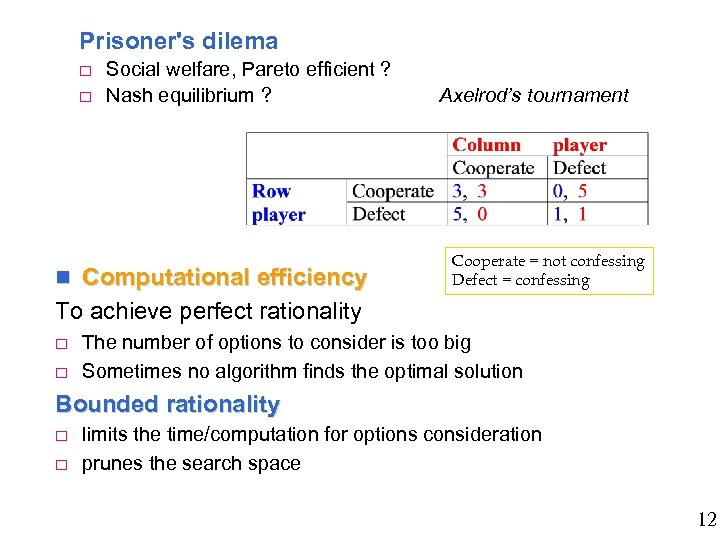
Prisoner's dilema o o Social welfare, Pareto efficient ? Nash equilibrium ? Computational efficiency Axelrod’s tournament Cooperate = not confessing Defect = confessing To achieve perfect rationality o o The number of options to consider is too big Sometimes no algorithm finds the optimal solution Bounded rationality o o limits the time/computation for options consideration prunes the search space 12
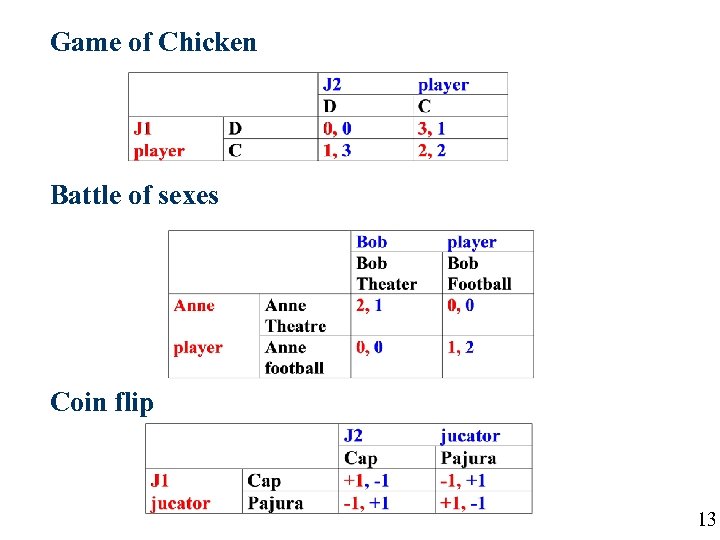
Game of Chicken Battle of sexes Coin flip 13
Axelrod Tournament Strategies ALL-D – D all the time RANDOM –C or D equal probability TIT-FOR-TAT – - C first round – - In t>1 what did opponent in t-1 TESTER – - D first round – - If opponent D then TIT-FOR-TAT – - then 2 rounds C and 1 round D JOSS – - TIT-FOR-TAT – but with 10% D 14
We have discussed about pure strategies A mixed strategy is an assignment of a probability to each pure strategy A mixed strategy pi of a player i is a probability distribution over actions Ai available to I A pure Nash equilibrium is a Nash equilibrium using pure strategies A mixed Nash equilibrium is a Nash equilibrium using mixed strategies A mixed Nash equilibrium is a set of mixed strategies, one for each player, so that no player has an incentive to unilaterally deviate from their assigned strategies 15
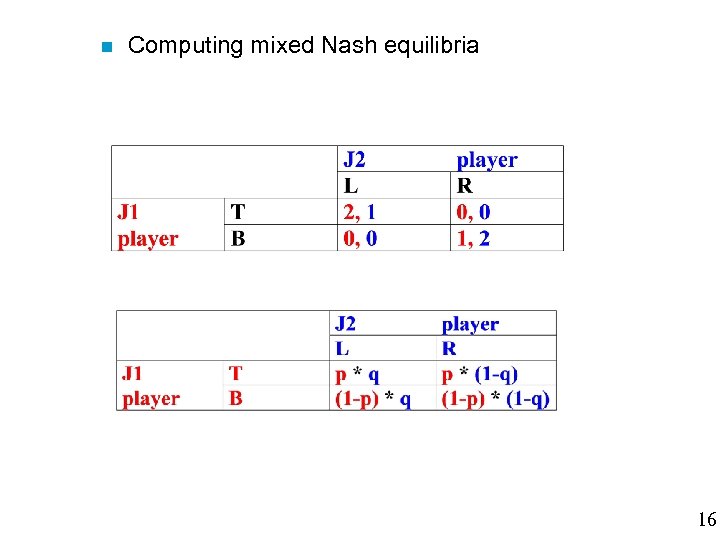
Computing mixed Nash equilibria 16
2. 2 Bragain o In a transaction when the seller and the buyer value a product differently, a surplus is created. A bargaining solution is then a way in which buyers and sellers agree to divide the surplus. o A – house 10, B – house 20 o Trade would result in the generation of surplus, whereas no surplus is created in case of notrade. o Bargaining Solution provides an acceptable way to divide the surplus among the two parties. 17
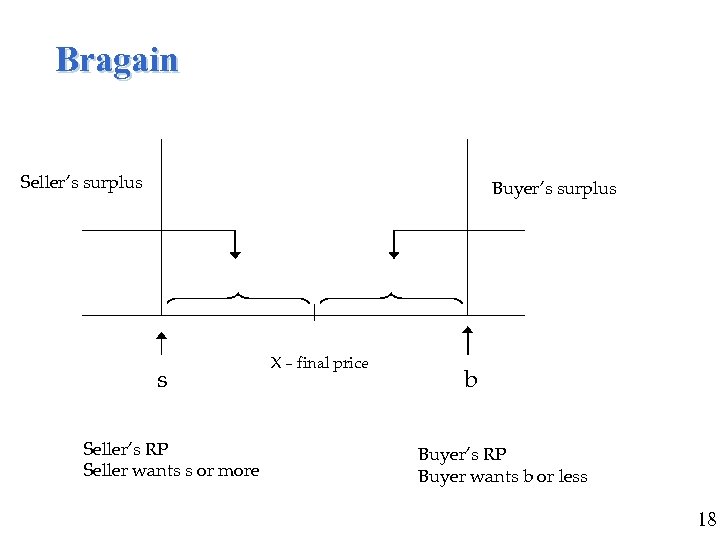
Bragain Seller’s surplus Buyer’s surplus s Seller’s RP Seller wants s or more X – final price b Buyer’s RP Buyer wants b or less 18
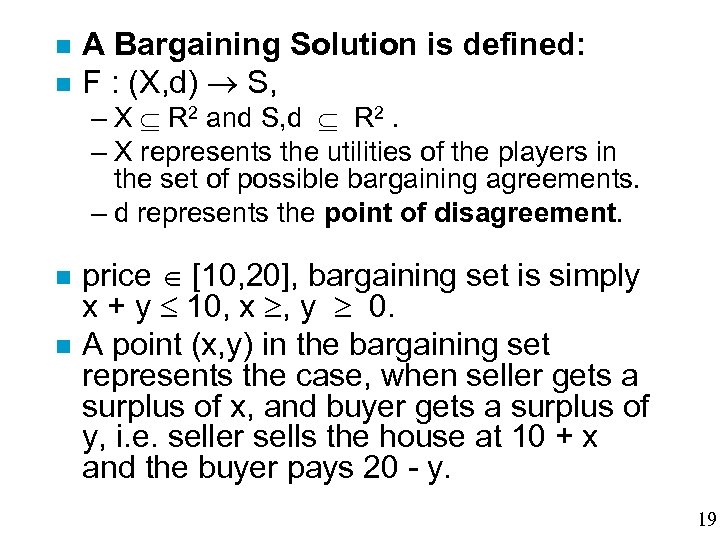
A Bargaining Solution is defined: F : (X, d) S, – X R 2 and S, d R 2. – X represents the utilities of the players in the set of possible bargaining agreements. – d represents the point of disagreement. price [10, 20], bargaining set is simply x + y 10, x , y 0. A point (x, y) in the bargaining set represents the case, when seller gets a surplus of x, and buyer gets a surplus of y, i. e. seller sells the house at 10 + x and the buyer pays 20 - y. 19
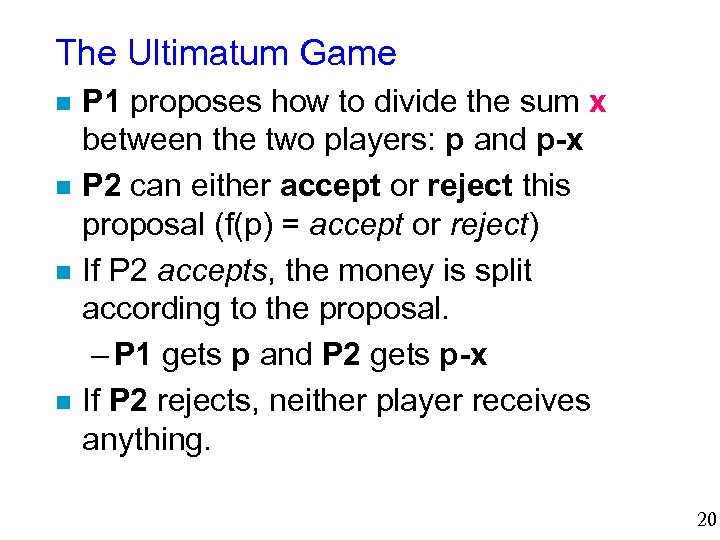
The Ultimatum Game P 1 proposes how to divide the sum x between the two players: p and p-x P 2 can either accept or reject this proposal (f(p) = accept or reject) If P 2 accepts, the money is split according to the proposal. – P 1 gets p and P 2 gets p-x If P 2 rejects, neither player receives anything. 20
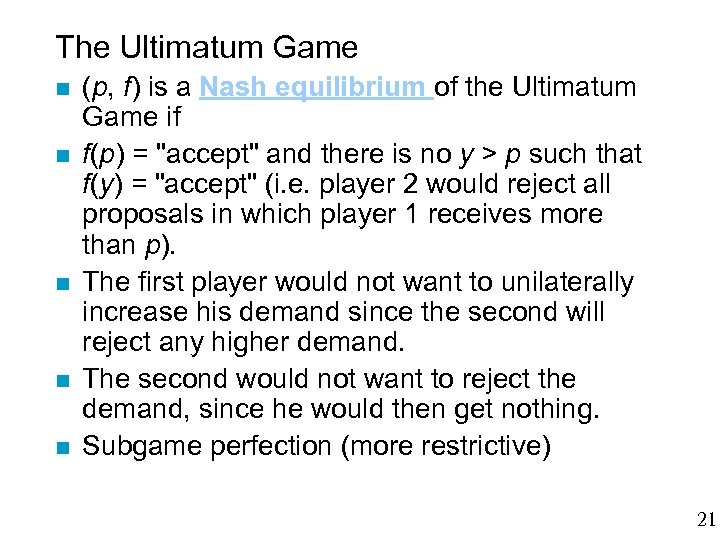
The Ultimatum Game (p, f) is a Nash equilibrium of the Ultimatum Game if f(p) = "accept" and there is no y > p such that f(y) = "accept" (i. e. player 2 would reject all proposals in which player 1 receives more than p). The first player would not want to unilaterally increase his demand since the second will reject any higher demand. The second would not want to reject the demand, since he would then get nothing. Subgame perfection (more restrictive) 21
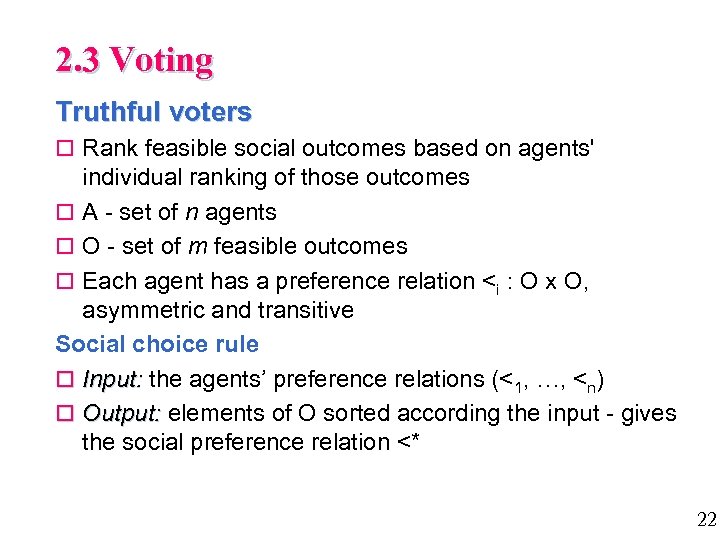
2. 3 Voting Truthful voters o Rank feasible social outcomes based on agents' individual ranking of those outcomes o A - set of n agents o O - set of m feasible outcomes o Each agent has a preference relation <i : O x O, asymmetric and transitive Social choice rule o Input: the agents’ preference relations (<1, …, <n) Input: o Output: elements of O sorted according the input - gives Output: the social preference relation <* 22
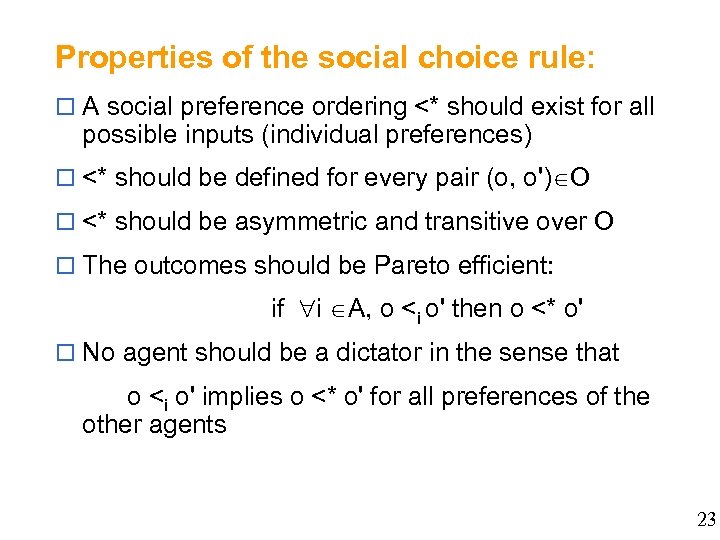
Properties of the social choice rule: o A social preference ordering <* should exist for all possible inputs (individual preferences) o <* should be defined for every pair (o, o') O o <* should be asymmetric and transitive over O o The outcomes should be Pareto efficient: if i A, o <i o' then o <* o' o No agent should be a dictator in the sense that o <i o' implies o <* o' for all preferences of the other agents 23
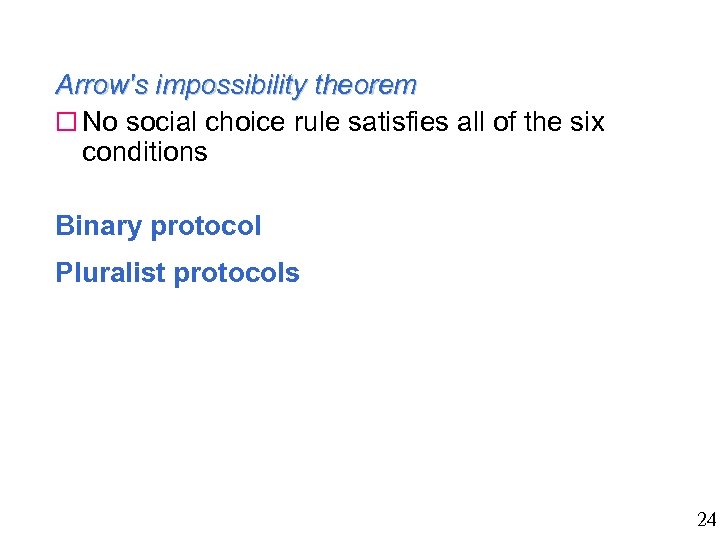
Arrow's impossibility theorem o No social choice rule satisfies all of the six conditions Binary protocol Pluralist protocols 24
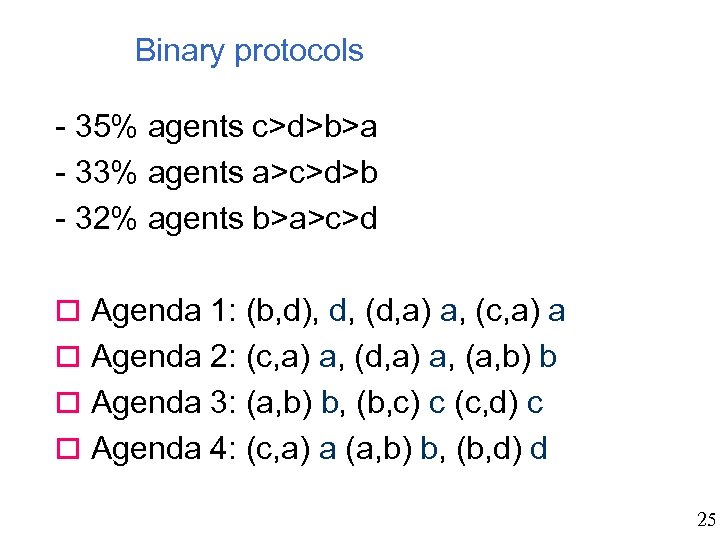
Binary protocols - 35% agents c>d>b>a - 33% agents a>c>d>b - 32% agents b>a>c>d o Agenda 1: (b, d), d, (d, a) a, (c, a) a o Agenda 2: (c, a) a, (d, a) a, (a, b) b o Agenda 3: (a, b) b, (b, c) c (c, d) c o Agenda 4: (c, a) a (a, b) b, (b, d) d 25
Pluralist protocols Borda protocol = assigns an alternative |O| points for the highest preference, |O|-1 points for the second, and so on § The counts are summed across the voters and the alternative with the highest count becomes the social choice 26
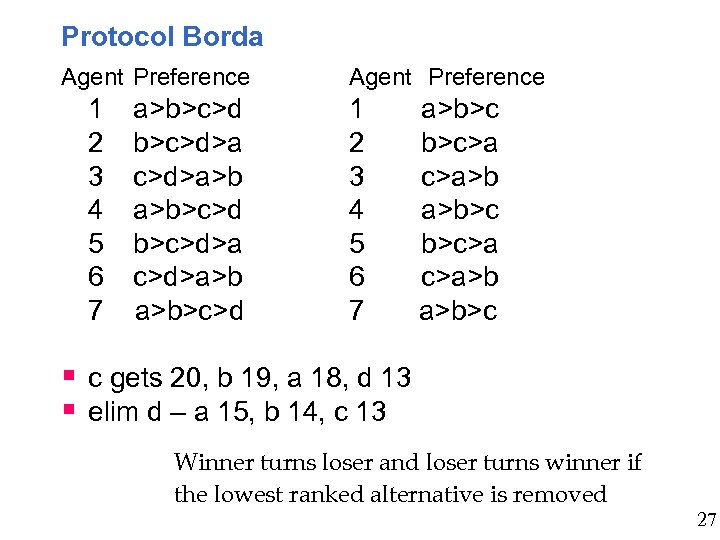
Protocol Borda Agent Preference 1 a>b>c>d 2 b>c>d>a 3 c>d>a>b 4 a>b>c>d 5 b>c>d>a 6 c>d>a>b 7 a>b>c>d Agent Preference 1 a>b>c 2 b>c>a 3 c>a>b 4 a>b>c 5 b>c>a 6 c>a>b 7 a>b>c § c gets 20, b 19, a 18, d 13 § elim d – a 15, b 14, c 13 Winner turns loser and loser turns winner if the lowest ranked alternative is removed 27
2. 4 Auctions (a) Auction theory = agents' protocols and strategies in auctions The auctioneer wants to sell an item at the highest possible payment and the bidders want to acquire the item at the lowest possible price A centralized protocol, includes one auctioneer and multiple bidders The auctioneer announces a good for sale. In some cases, the good may be a combination of other goods, or a good with multiple attributes The bidders make offers. This may be repeated for several times, depending on the auction type The auctioneer determines the winner 28
Auction characteristics: Simple protocols Centralized Allows collusion “behind the scenes” May favor the auctioneer (b) Auction settings Private value auctions: the value of a good to a bidder agent depends only on its private preferences. Assumed to be known exactly Common value auctions: the good’s value depends entirely on other agents’ valuation Correlated value auctions: the good’s value depends on internal and external valuations 29
(c) Auction protocols English (first-price open cry) auction - each bidder announces openly its bid; when no bidder is willing to raise anymore, the auction ends. The highest bidder wins the item at the price of its bid. Strategy: In private value auctions the dominant strategy is to always bid a small amount more than the current highest bid and stop when the private value is reached. In correlated value auctions the bidder increases the price at a constant rate or at a rate it thinks appropriate First-price sealed-bid auction - each bidder submits one bid without auction knowing the other's bids. The highest bidder wins the item and pays the amount of his bid. Strategy: No dominant strategy Bid less than its true valuation but it is dependent on other agents bids which are not known 30
Dutch (descending) auction - the auctioneer continuously lowers the price until one of the bidders takes the item at the current price. Strategy: Strategically equivalent to the first-price sealed-bid auction Efficient for real time Vickery (second-price sealed-bid) auction - each bidder submits one auction bid without knowing the other's bids. The highest bid wins but at the price of the second highest bid Strategy: The bidder dominant strategy is to bid its true valuation All-pay auctions - each participating bidder has to pay the amount of auctions his bid (or some other amount) to the auctioneer 31
(d) Problems with auction protocols They are not collusion proof Lying auctioneer Ø Problem in the Vickery auction Ø Problem in the English auction - use shills that bid in the auction to increase bidders’ valuation of the item Ø The auctioneer bids the highest second price to obtain its reservation price – may lead to the auctioneer keeping the item Ø Common value auctions suffers from the winner’s curse: agents should bid less than their valuation prices (as winning the auction means its valuation was too high) Ø Interrelated auctions – the bidder may lie about the value of an item to get a combination of items at its valuation price 32
3. General equilibrium market mechanisms General equilibrium theory = a microeconomic theory n commodity goods g, g = 1, n, amount unrestricted prices p=[p 1, …, pn], where pg R is the price of good g 2 types of agents: consumers and producers 33
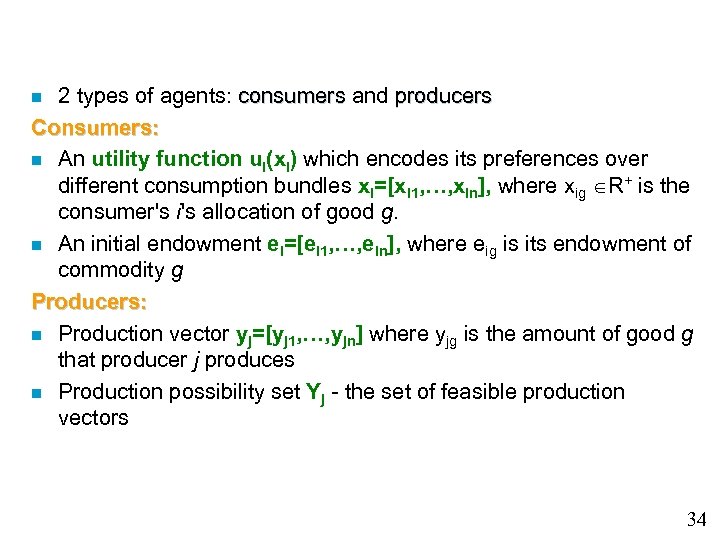
2 types of agents: consumers and producers consumers Consumers: An utility function ui(xi) which encodes its preferences over different consumption bundles xi=[xi 1, …, xin], where xig R+ is the consumer's i's allocation of good g. An initial endowment ei=[ei 1, …, ein], where eig is its endowment of commodity g Producers: Production vector yj=[yj 1, …, yjn] where yjg is the amount of good g that producer j produces Production possibility set Yj - the set of feasible production vectors 34
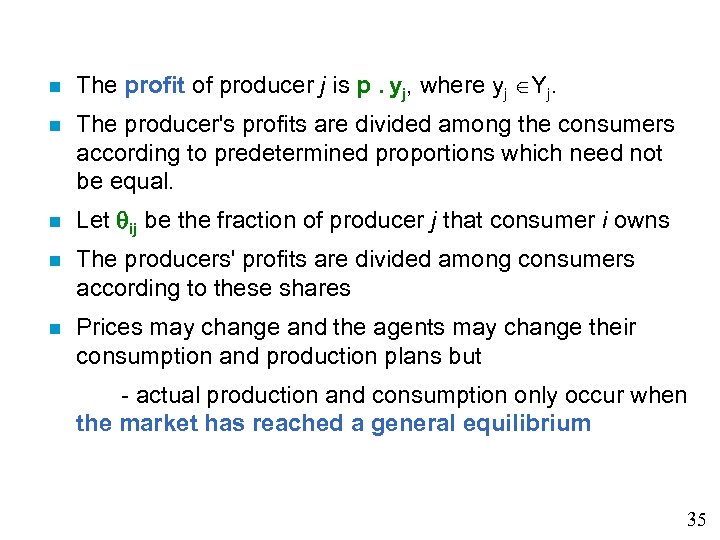
The profit of producer j is p. yj, where yj Yj. The producer's profits are divided among the consumers according to predetermined proportions which need not be equal. Let ij be the fraction of producer j that consumer i owns The producers' profits are divided among consumers according to these shares Prices may change and the agents may change their consumption and production plans but - actual production and consumption only occur when the market has reached a general equilibrium 35
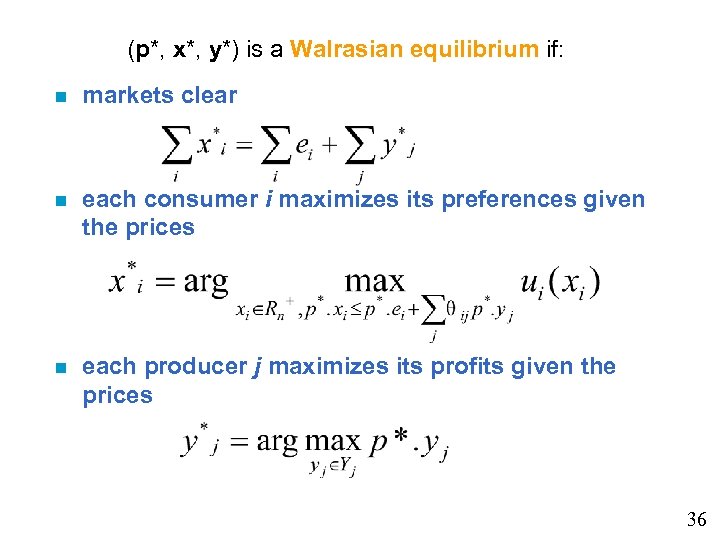
(p*, x*, y*) is a Walrasian equilibrium if: markets clear each consumer i maximizes its preferences given the prices each producer j maximizes its profits given the prices 36
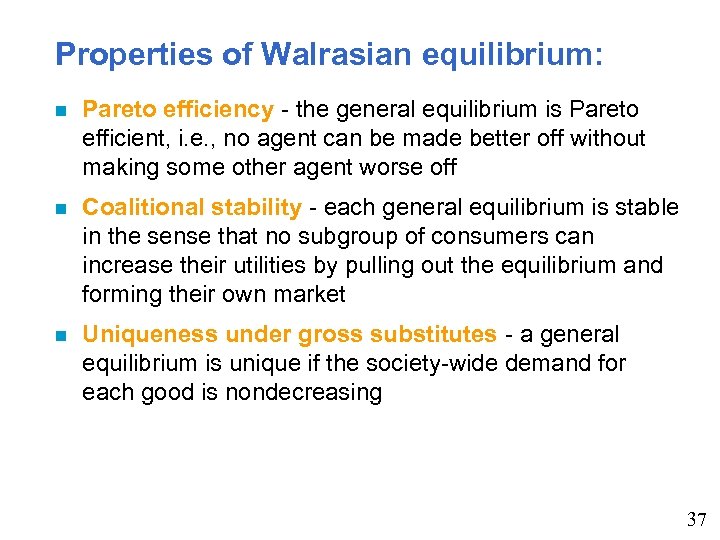
Properties of Walrasian equilibrium: Pareto efficiency - the general equilibrium is Pareto efficient, i. e. , no agent can be made better off without making some other agent worse off Coalitional stability - each general equilibrium is stable in the sense that no subgroup of consumers can increase their utilities by pulling out the equilibrium and forming their own market Uniqueness under gross substitutes - a general equilibrium is unique if the society-wide demand for each good is nondecreasing 37
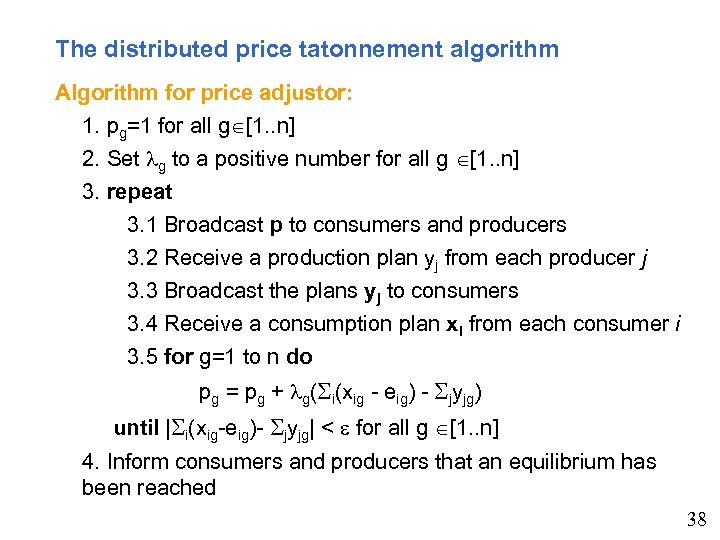
The distributed price tatonnement algorithm Algorithm for price adjustor: 1. pg=1 for all g [1. . n] 2. Set g to a positive number for all g [1. . n] 3. repeat 3. 1 Broadcast p to consumers and producers 3. 2 Receive a production plan yj from each producer j 3. 3 Broadcast the plans yj to consumers 3. 4 Receive a consumption plan xi from each consumer i 3. 5 for g=1 to n do pg = pg + g( i(xig - eig) - jyjg) until | i(xig-eig)- jyjg| < for all g [1. . n] 4. Inform consumers and producers that an equilibrium has been reached 38
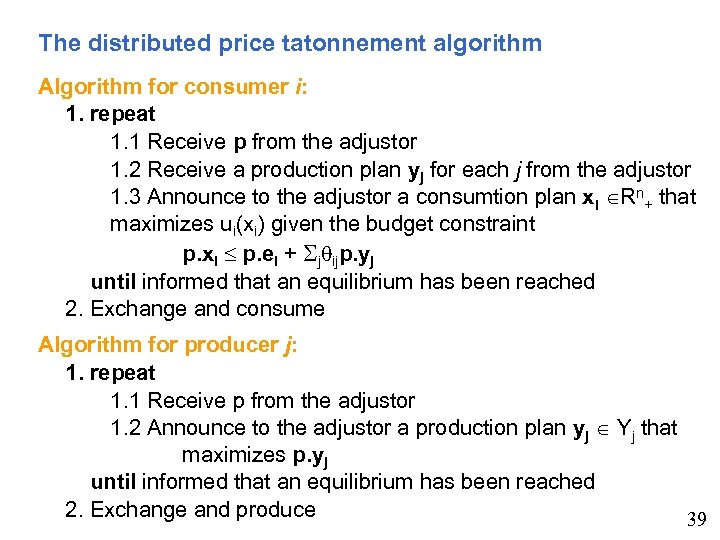
The distributed price tatonnement algorithm Algorithm for consumer i: 1. repeat 1. 1 Receive p from the adjustor 1. 2 Receive a production plan yj for each j from the adjustor 1. 3 Announce to the adjustor a consumtion plan xi Rn+ that maximizes ui(xi) given the budget constraint p. xi p. ei + j ijp. yj until informed that an equilibrium has been reached 2. Exchange and consume Algorithm for producer j: 1. repeat 1. 1 Receive p from the adjustor 1. 2 Announce to the adjustor a production plan yj Yj that maximizes p. yj until informed that an equilibrium has been reached 2. Exchange and produce 39
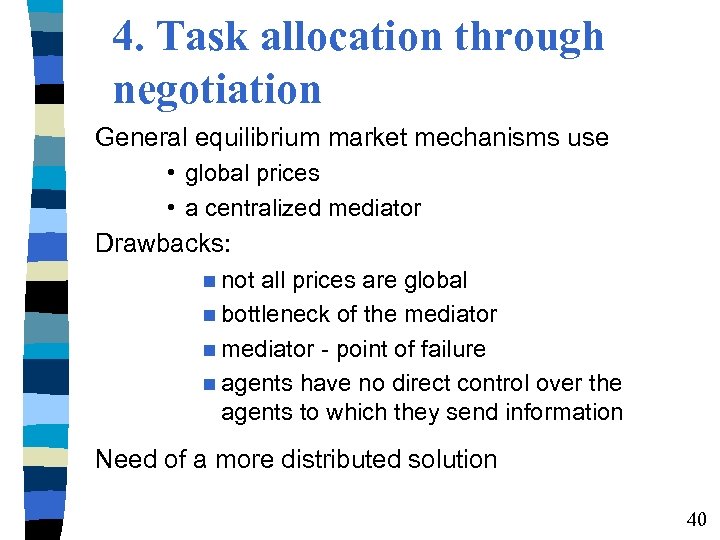
4. Task allocation through negotiation General equilibrium market mechanisms use • global prices • a centralized mediator Drawbacks: not all prices are global bottleneck of the mediator - point of failure agents have no direct control over the agents to which they send information Need of a more distributed solution 40
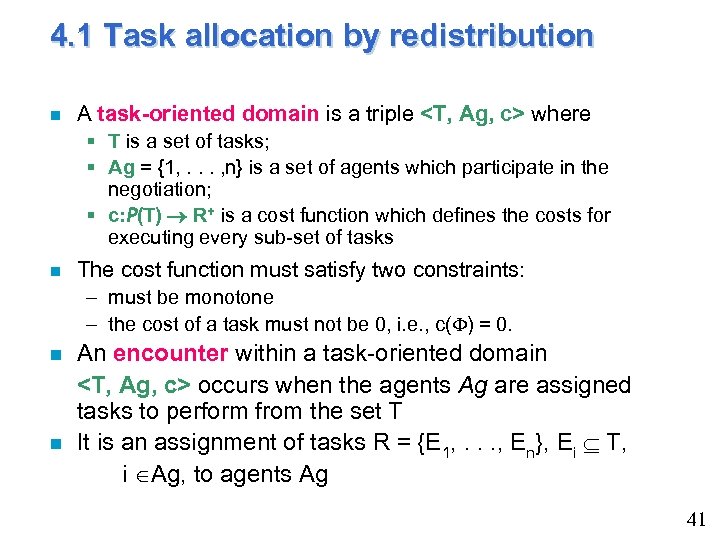
4. 1 Task allocation by redistribution A task-oriented domain is a triple <T, Ag, c> where § T is a set of tasks; § Ag = {1, . . . , n} is a set of agents which participate in the negotiation; § c: P(T) R+ is a cost function which defines the costs for executing every sub-set of tasks The cost function must satisfy two constraints: – must be monotone – the cost of a task must not be 0, i. e. , c( ) = 0. An encounter within a task-oriented domain <T, Ag, c> occurs when the agents Ag are assigned tasks to perform from the set T It is an assignment of tasks R = {E 1, . . . , En}, Ei T, i Ag, to agents Ag 41
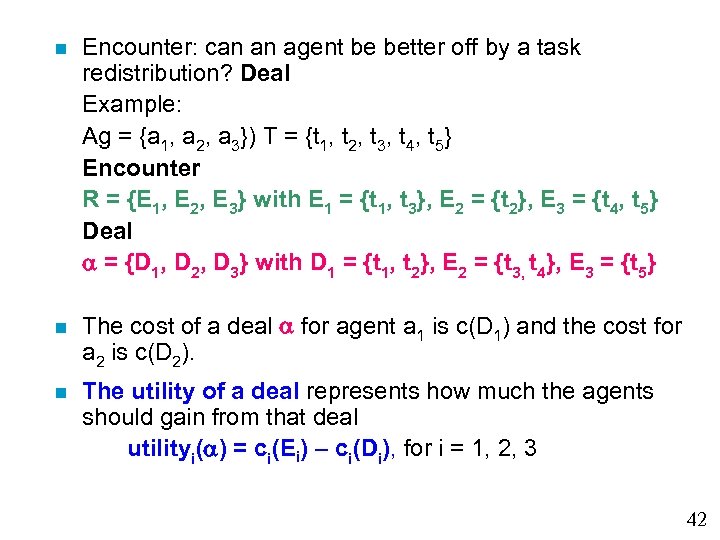
Encounter: can an agent be better off by a task redistribution? Deal Example: Ag = {a 1, a 2, a 3}) T = {t 1, t 2, t 3, t 4, t 5} Encounter R = {E 1, E 2, E 3} with E 1 = {t 1, t 3}, E 2 = {t 2}, E 3 = {t 4, t 5} Deal = {D 1, D 2, D 3} with D 1 = {t 1, t 2}, E 2 = {t 3, t 4}, E 3 = {t 5} The cost of a deal for agent a 1 is c(D 1) and the cost for a 2 is c(D 2). The utility of a deal represents how much the agents should gain from that deal utilityi( ) = ci(Ei) – ci(Di), for i = 1, 2, 3 42
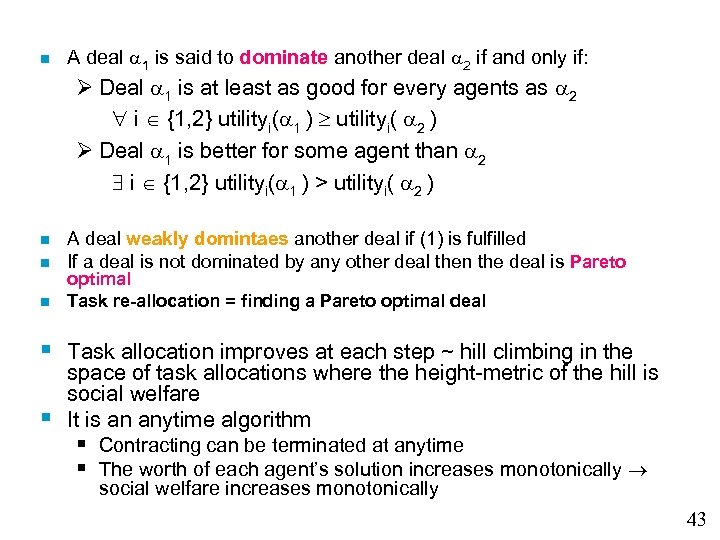
A deal 1 is said to dominate another deal 2 if and only if: Ø Deal 1 is at least as good for every agents as 2 i {1, 2} utilityi( 1 ) utilityi( 2 ) Ø Deal 1 is better for some agent than 2 i {1, 2} utilityi( 1 ) > utilityi( 2 ) A deal weakly domintaes another deal if (1) is fulfilled If a deal is not dominated by any other deal then the deal is Pareto optimal Task re-allocation = finding a Pareto optimal deal § Task allocation improves at each step ~ hill climbing in the § space of task allocations where the height-metric of the hill is social welfare It is an anytime algorithm § Contracting can be terminated at anytime § The worth of each agent’s solution increases monotonically social welfare increases monotonically 43
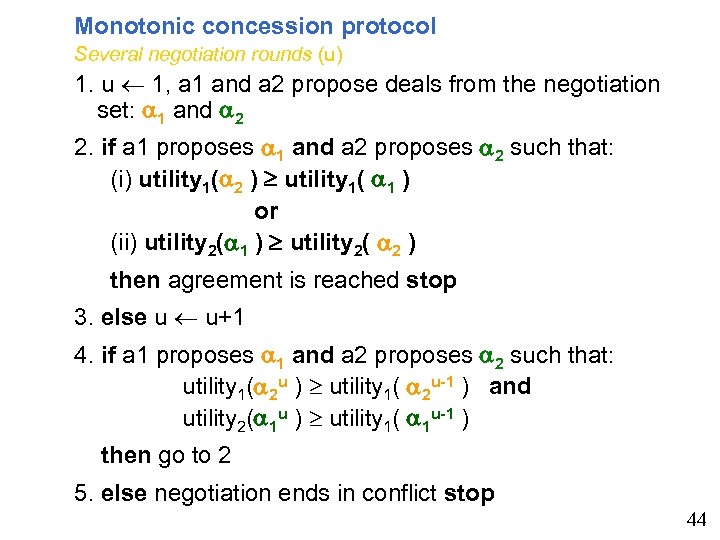
Monotonic concession protocol Several negotiation rounds (u) 1. u 1, a 1 and a 2 propose deals from the negotiation set: 1 and 2 2. if a 1 proposes 1 and a 2 proposes 2 such that: (i) utility 1( 2 ) utility 1( 1 ) or (ii) utility 2( 1 ) utility 2( 2 ) then agreement is reached stop 3. else u u+1 4. if a 1 proposes 1 and a 2 proposes 2 such that: utility 1( 2 u ) utility 1( 2 u-1 ) and utility 2( 1 u ) utility 1( 1 u-1 ) then go to 2 5. else negotiation ends in conflict stop 44
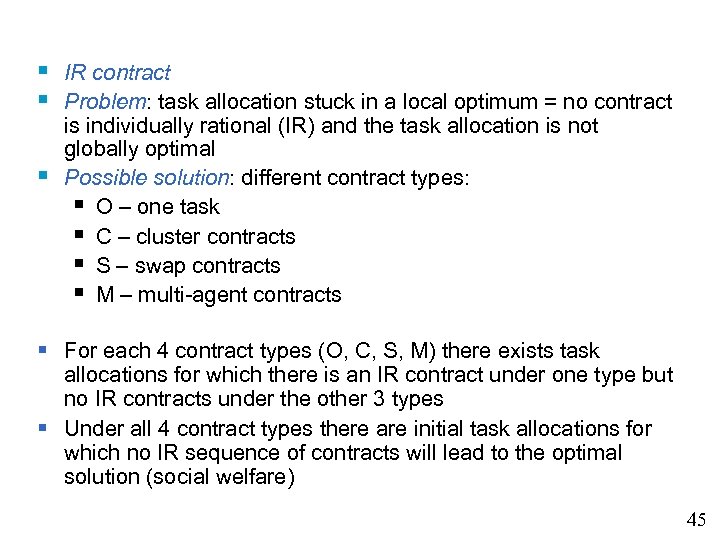
§ IR contract § Problem: task allocation stuck in a local optimum = no contract § is individually rational (IR) and the task allocation is not globally optimal Possible solution: different contract types: § O – one task § C – cluster contracts § S – swap contracts § M – multi-agent contracts § For each 4 contract types (O, C, S, M) there exists task allocations for which there is an IR contract under one type but no IR contracts under the other 3 types § Under all 4 contract types there are initial task allocations for which no IR sequence of contracts will lead to the optimal solution (social welfare) 45
Main differences as compared to game theoretic negotiation § An agent may reject an IR contract § An agent may accept a non-IR contract § The order of accepting IR contracts may lead to different pay offs § Each contract is made by evaluating just a single contract instead of doing lookahead in the future Un-truthful agents § An agent may lie about what tasks it has: § Hide tasks § Phantom tasks § Decoy tasks § Sometimes lying may be beneficial 46
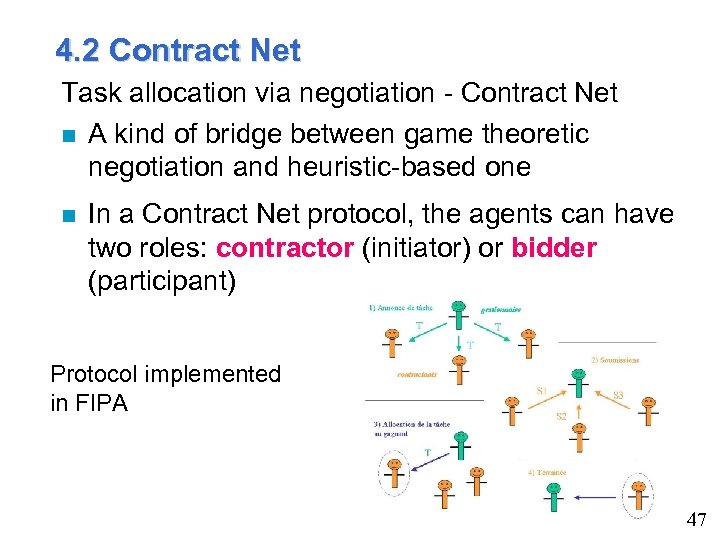
4. 2 Contract Net Task allocation via negotiation - Contract Net A kind of bridge between game theoretic negotiation and heuristic-based one In a Contract Net protocol, the agents can have two roles: contractor (initiator) or bidder (participant) Protocol implemented in FIPA 47
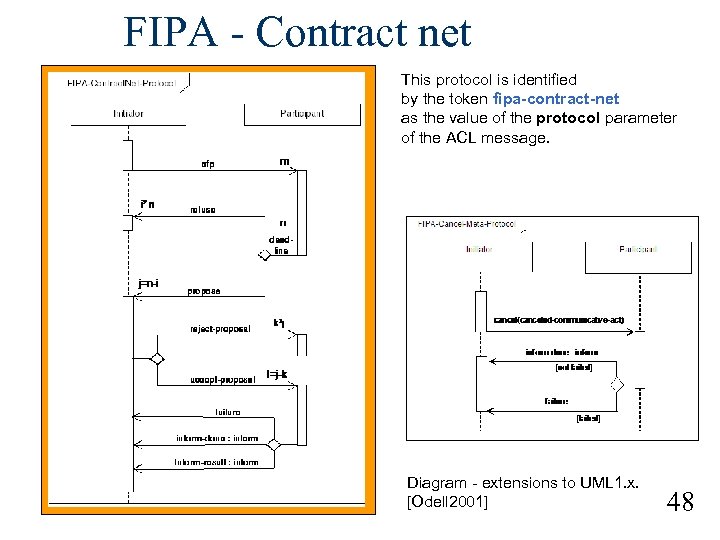
FIPA - Contract net This protocol is identified by the token fipa-contract-net as the value of the protocol parameter of the ACL message. Diagram - extensions to UML 1. x. [Odell 2001] 48
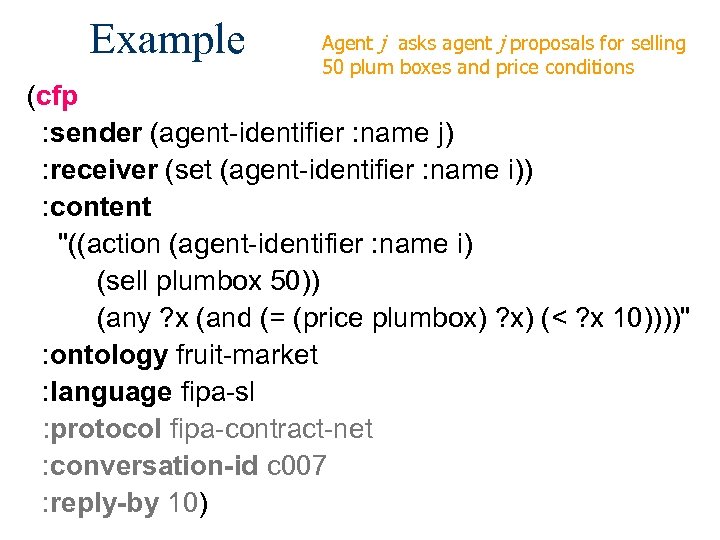
Example Agent j asks agent j proposals for selling 50 plum boxes and price conditions (cfp : sender (agent-identifier : name j) : receiver (set (agent-identifier : name i)) : content "((action (agent-identifier : name i) (sell plumbox 50)) (any ? x (and (= (price plumbox) ? x) (< ? x 10))))" : ontology fruit-market : language fipa-sl : protocol fipa-contract-net : conversation-id c 007 : reply-by 10)
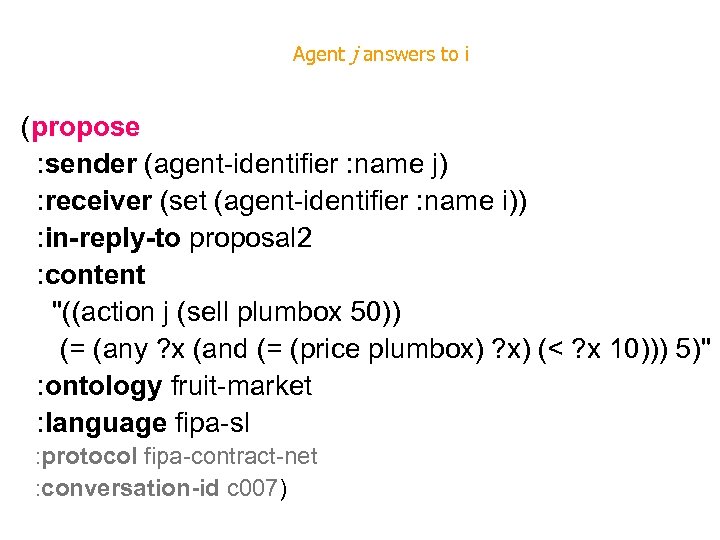
Agent j answers to i (propose : sender (agent-identifier : name j) : receiver (set (agent-identifier : name i)) : in-reply-to proposal 2 : content "((action j (sell plumbox 50)) (= (any ? x (and (= (price plumbox) ? x) (< ? x 10))) 5)" : ontology fruit-market : language fipa-sl : protocol fipa-contract-net : conversation-id c 007)
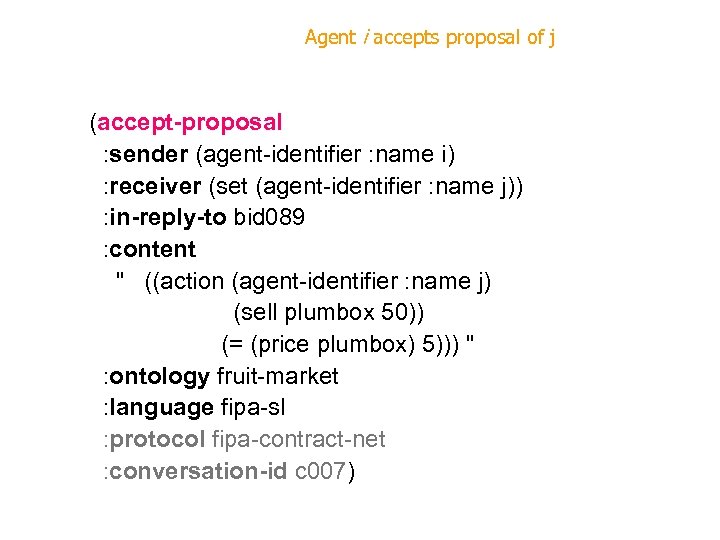
Agent i accepts proposal of j (accept-proposal : sender (agent-identifier : name i) : receiver (set (agent-identifier : name j)) : in-reply-to bid 089 : content " ((action (agent-identifier : name j) (sell plumbox 50)) (= (price plumbox) 5))) " : ontology fruit-market : language fipa-sl : protocol fipa-contract-net : conversation-id c 007)
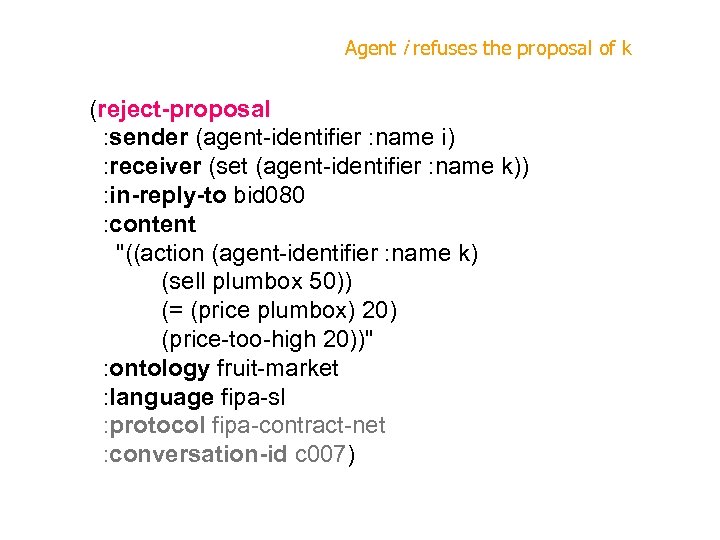
Agent i refuses the proposal of k (reject-proposal : sender (agent-identifier : name i) : receiver (set (agent-identifier : name k)) : in-reply-to bid 080 : content "((action (agent-identifier : name k) (sell plumbox 50)) (= (price plumbox) 20) (price-too-high 20))" : ontology fruit-market : language fipa-sl : protocol fipa-contract-net : conversation-id c 007)
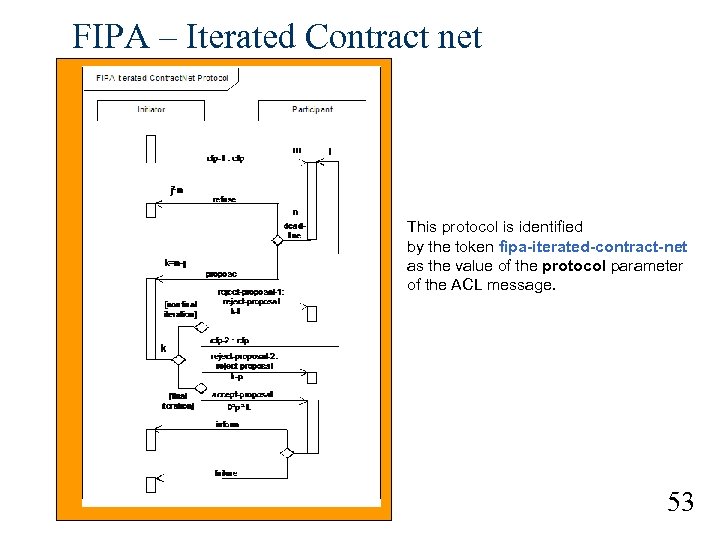
FIPA – Iterated Contract net This protocol is identified by the token fipa-iterated-contract-net as the value of the protocol parameter of the ACL message. 53
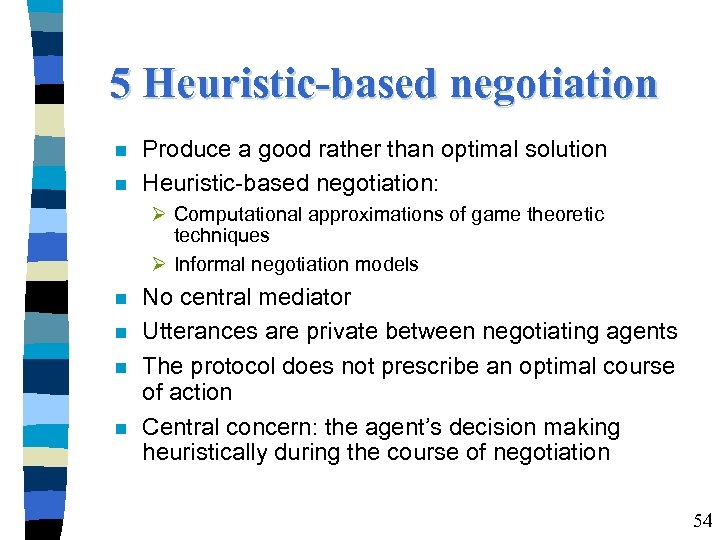
5 Heuristic-based negotiation Produce a good rather than optimal solution Heuristic-based negotiation: Ø Computational approximations of game theoretic techniques Ø Informal negotiation models No central mediator Utterances are private between negotiating agents The protocol does not prescribe an optimal course of action Central concern: the agent’s decision making heuristically during the course of negotiation 54
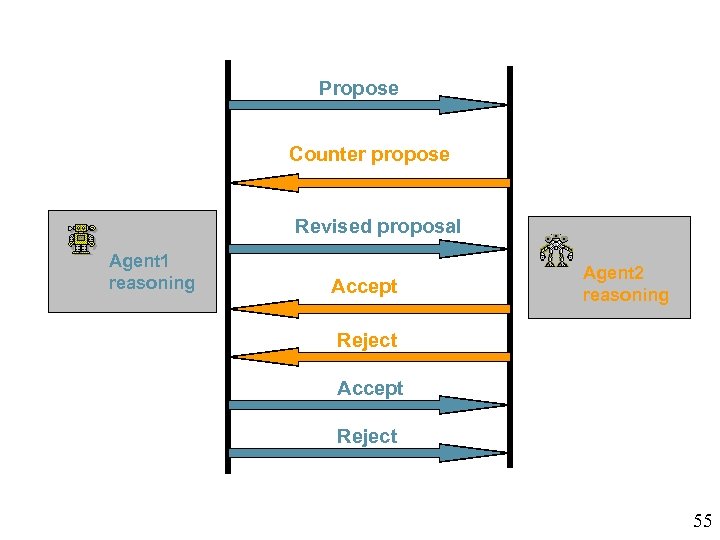
Propose Counter propose Revised proposal Agent 1 reasoning Accept Agent 2 reasoning Reject Accept Reject 55
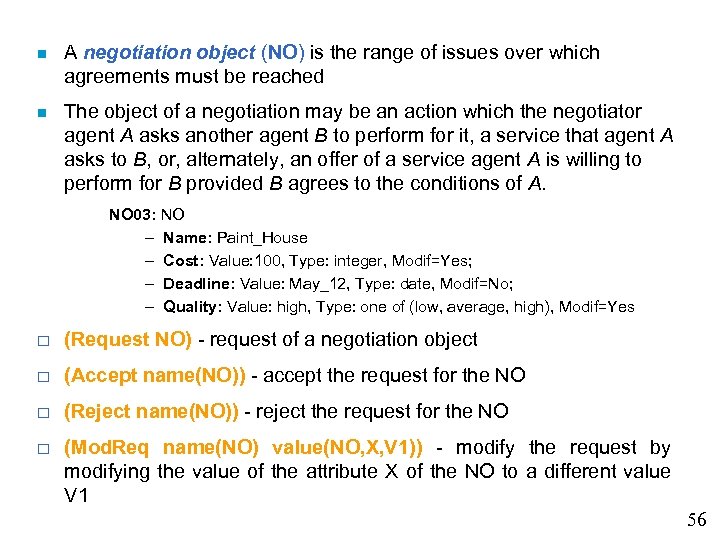
A negotiation object (NO) is the range of issues over which agreements must be reached The object of a negotiation may be an action which the negotiator agent A asks another agent B to perform for it, a service that agent A asks to B, or, alternately, an offer of a service agent A is willing to perform for B provided B agrees to the conditions of A. NO 03: NO – Name: Paint_House – Cost: Value: 100, Type: integer, Modif=Yes; – Deadline: Value: May_12, Type: date, Modif=No; – Quality: Value: high, Type: one of (low, average, high), Modif=Yes o (Request NO) - request of a negotiation object o (Accept name(NO)) - accept the request for the NO o (Reject name(NO)) - reject the request for the NO o (Mod. Req name(NO) value(NO, X, V 1)) - modify the request by modifying the value of the attribute X of the NO to a different value V 1 56
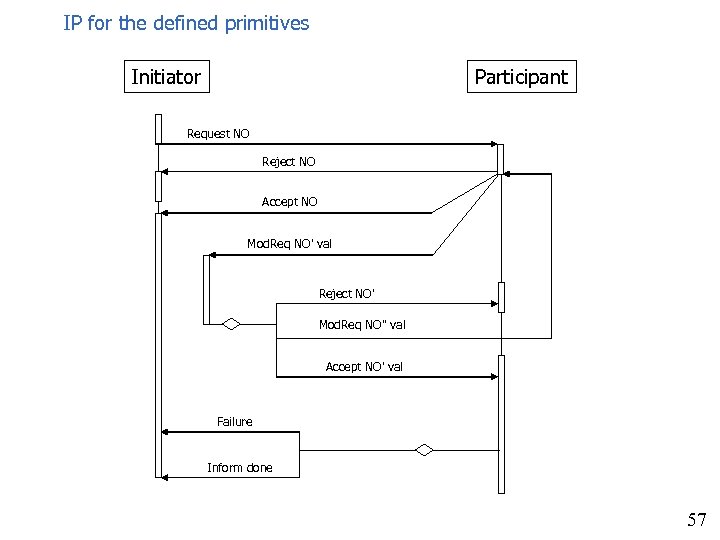
IP for the defined primitives Initiator Participant Request NO Reject NO Accept NO Mod. Req NO' val Reject NO' Mod. Req NO'' val Accept NO' val Failure Inform done 57
Example Model of a MAS with self-interested agents aiming to: achieve their own goals comply to obligations and norms obtain maximum gain establish good cooperation relationships in the society CSCS 12, 26 -28 May, 1999 Adina Magda Florea, "Politehnica" University 58
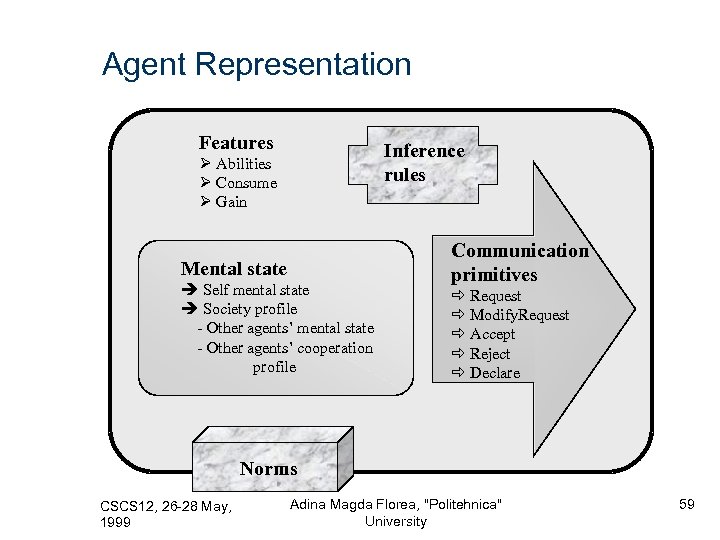
Agent Representation Features Inference rules Ø Abilities Ø Consume Ø Gain Mental state è Self mental state è Society profile - Other agents’ mental state - Other agents’ cooperation profile Communication primitives ð Request ð Modify. Request ð Accept ð Reject ð Declare Norms CSCS 12, 26 -28 May, 1999 Adina Magda Florea, "Politehnica" University 59
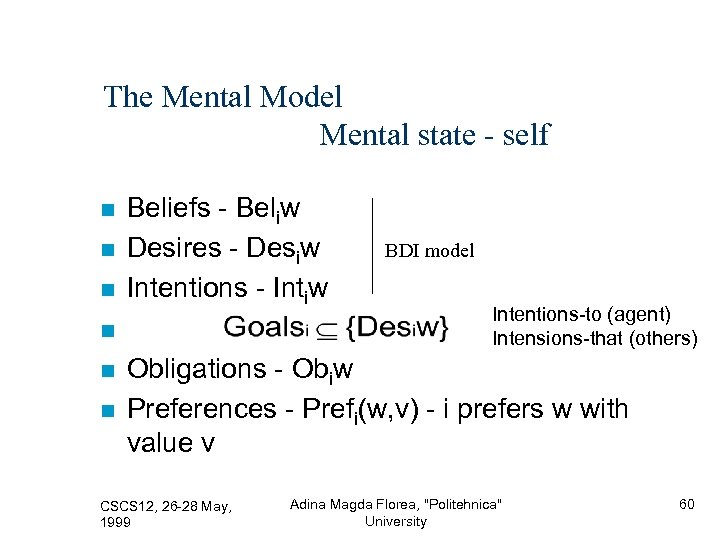
The Mental Model Mental state - self Beliefs - Beliw BDI model Desires - Desiw Intentions - Intiw Intentions-to (agent) Intensions-that (others) Obligations - Obiw Preferences - Prefi(w, v) - i prefers w with value v CSCS 12, 26 -28 May, 1999 Adina Magda Florea, "Politehnica" University 60
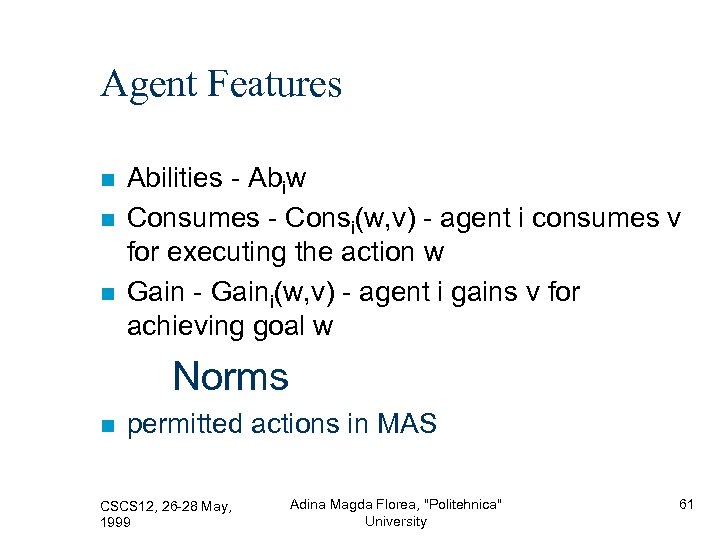
Agent Features Abilities - Abiw Consumes - Consi(w, v) - agent i consumes v for executing the action w Gain - Gaini(w, v) - agent i gains v for achieving goal w Norms permitted actions in MAS CSCS 12, 26 -28 May, 1999 Adina Magda Florea, "Politehnica" University 61
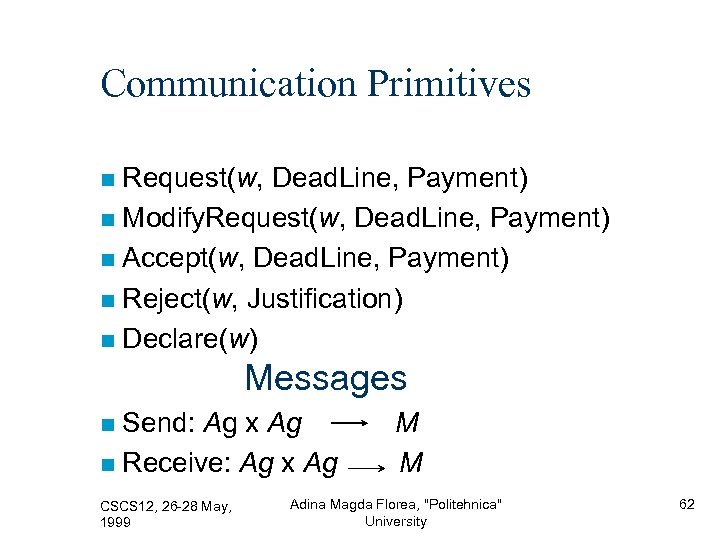
Communication Primitives Request(w, Dead. Line, Payment) Modify. Request(w, Dead. Line, Payment) Accept(w, Dead. Line, Payment) Reject(w, Justification) Declare(w) Messages Send: Ag x Ag M Receive: Ag x Ag M CSCS 12, 26 -28 May, 1999 Adina Magda Florea, "Politehnica" University 62
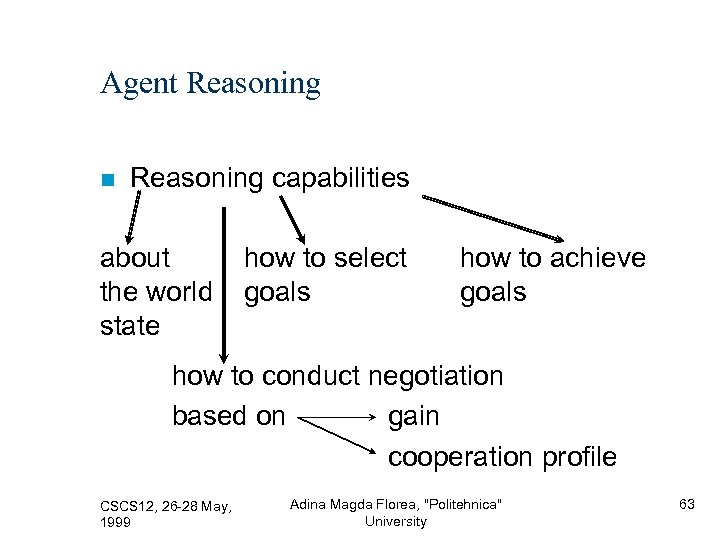
Agent Reasoning capabilities about the world state how to select goals how to achieve goals how to conduct negotiation based on gain cooperation profile CSCS 12, 26 -28 May, 1999 Adina Magda Florea, "Politehnica" University 63
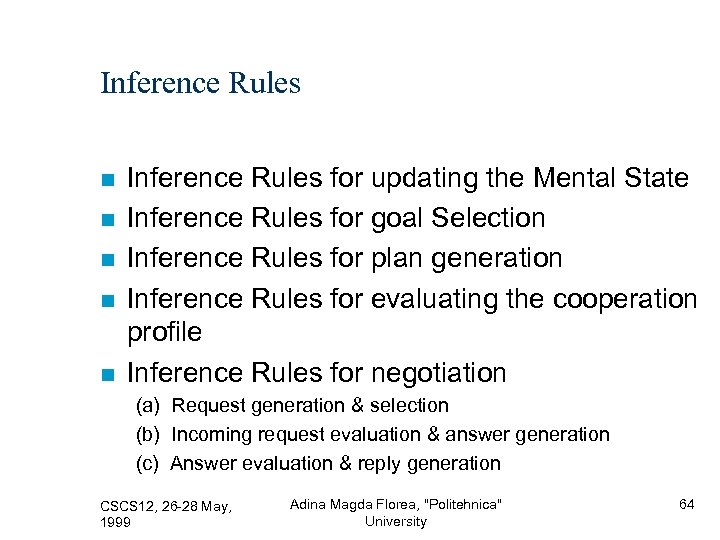
Inference Rules Inference Rules for updating the Mental State Inference Rules for goal Selection Inference Rules for plan generation Inference Rules for evaluating the cooperation profile Inference Rules for negotiation (a) Request generation & selection (b) Incoming request evaluation & answer generation (c) Answer evaluation & reply generation CSCS 12, 26 -28 May, 1999 Adina Magda Florea, "Politehnica" University 64
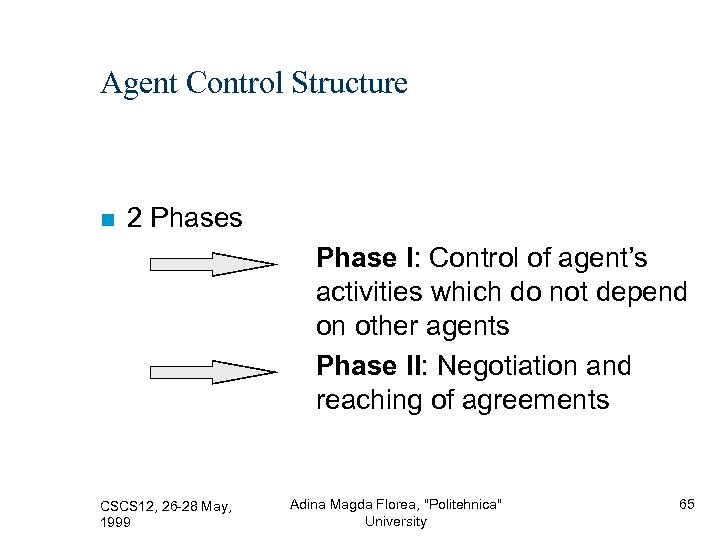
Agent Control Structure 2 Phases Phase I: Control of agent’s activities which do not depend on other agents Phase II: Negotiation and reaching of agreements CSCS 12, 26 -28 May, 1999 Adina Magda Florea, "Politehnica" University 65
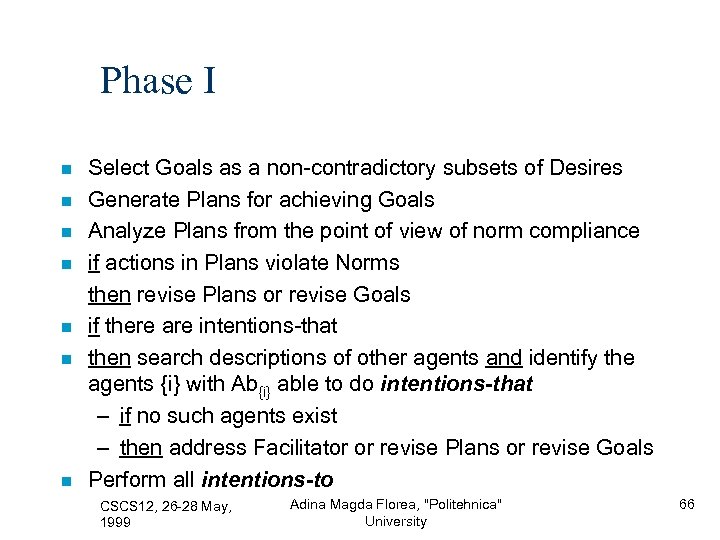
Phase I Select Goals as a non-contradictory subsets of Desires Generate Plans for achieving Goals Analyze Plans from the point of view of norm compliance if actions in Plans violate Norms then revise Plans or revise Goals if there are intentions-that then search descriptions of other agents and identify the agents {i} with Ab{i} able to do intentions-that – if no such agents exist – then address Facilitator or revise Plans or revise Goals Perform all intentions-to CSCS 12, 26 -28 May, 1999 Adina Magda Florea, "Politehnica" University 66
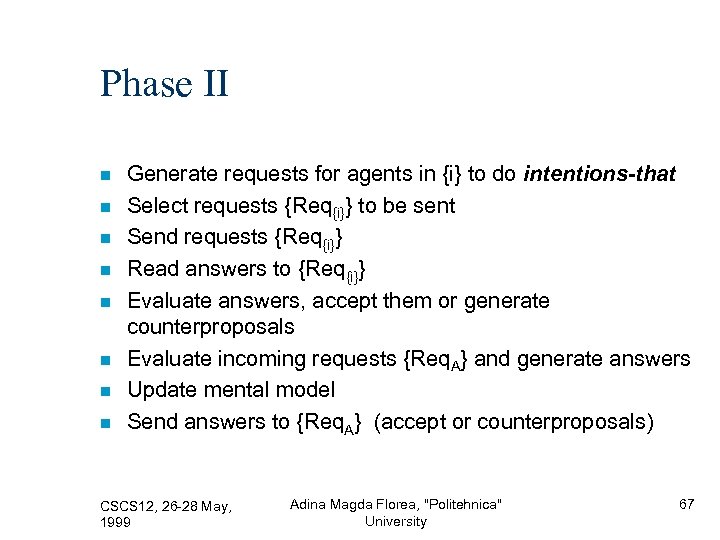
Phase II Generate requests for agents in {i} to do intentions-that Select requests {Req{i}} to be sent Send requests {Req{i}} Read answers to {Req{i}} Evaluate answers, accept them or generate counterproposals Evaluate incoming requests {Req. A} and generate answers Update mental model Send answers to {Req. A} (accept or counterproposals) CSCS 12, 26 -28 May, 1999 Adina Magda Florea, "Politehnica" University 67
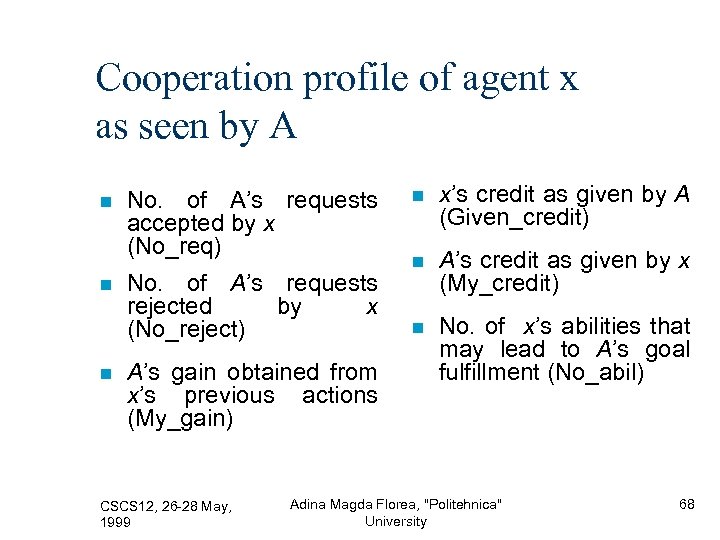
Cooperation profile of agent x as seen by A No. of A’s requests accepted by x (No_req) No. of A’s requests rejected by x (No_reject) A’s gain obtained from x’s previous actions (My_gain) CSCS 12, 26 -28 May, 1999 x’s credit as given by A (Given_credit) A’s credit as given by x (My_credit) No. of x’s abilities that may lead to A’s goal fulfillment (No_abil) Adina Magda Florea, "Politehnica" University 68
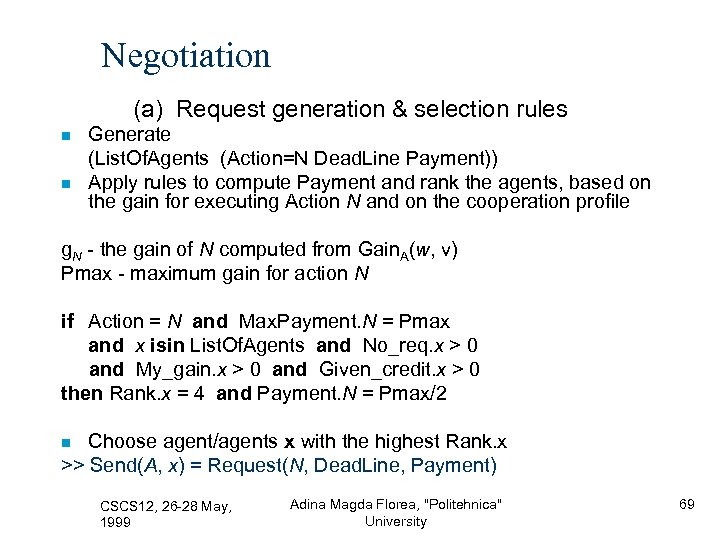
Negotiation (a) Request generation & selection rules Generate (List. Of. Agents (Action=N Dead. Line Payment)) Apply rules to compute Payment and rank the agents, based on the gain for executing Action N and on the cooperation profile g. N - the gain of N computed from Gain. A(w, v) Pmax - maximum gain for action N if Action = N and Max. Payment. N = Pmax and x isin List. Of. Agents and No_req. x > 0 and My_gain. x > 0 and Given_credit. x > 0 then Rank. x = 4 and Payment. N = Pmax/2 Choose agent/agents x with the highest Rank. x >> Send(A, x) = Request(N, Dead. Line, Payment) CSCS 12, 26 -28 May, 1999 Adina Magda Florea, "Politehnica" University 69
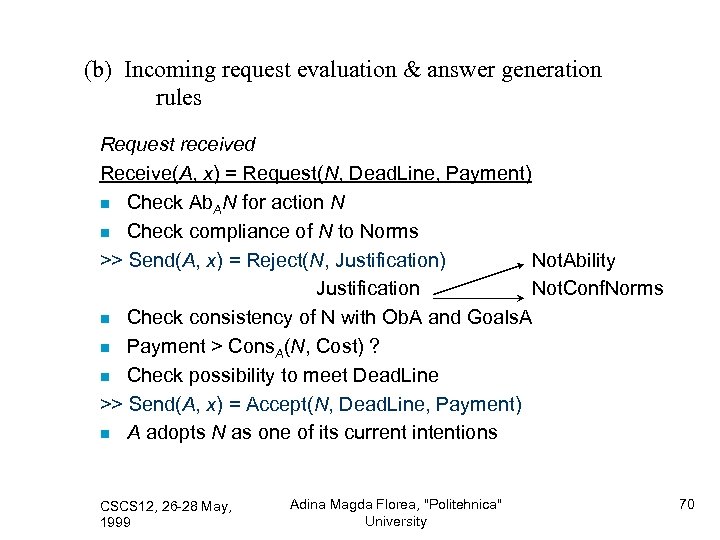
(b) Incoming request evaluation & answer generation rules Request received Receive(A, x) = Request(N, Dead. Line, Payment) Check Ab. AN for action N Check compliance of N to Norms >> Send(A, x) = Reject(N, Justification) Not. Ability Justification Not. Conf. Norms Check consistency of N with Ob. A and Goals. A Payment > Cons. A(N, Cost) ? Check possibility to meet Dead. Line >> Send(A, x) = Accept(N, Dead. Line, Payment) A adopts N as one of its current intentions CSCS 12, 26 -28 May, 1999 Adina Magda Florea, "Politehnica" University 70
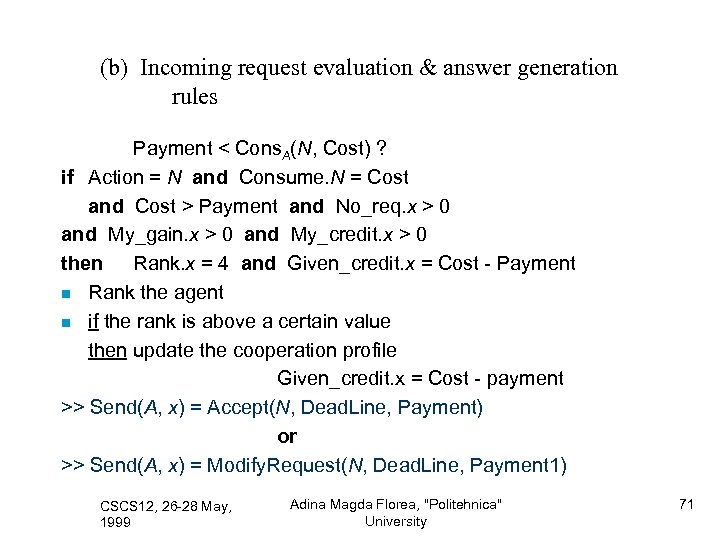
(b) Incoming request evaluation & answer generation rules Payment < Cons. A(N, Cost) ? if Action = N and Consume. N = Cost and Cost > Payment and No_req. x > 0 and My_gain. x > 0 and My_credit. x > 0 then Rank. x = 4 and Given_credit. x = Cost - Payment Rank the agent if the rank is above a certain value then update the cooperation profile Given_credit. x = Cost - payment >> Send(A, x) = Accept(N, Dead. Line, Payment) or >> Send(A, x) = Modify. Request(N, Dead. Line, Payment 1) CSCS 12, 26 -28 May, 1999 Adina Magda Florea, "Politehnica" University 71
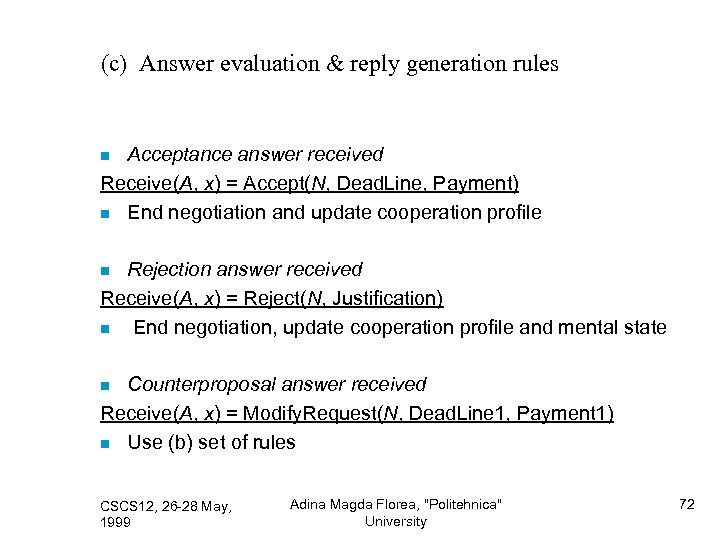
(c) Answer evaluation & reply generation rules Acceptance answer received Receive(A, x) = Accept(N, Dead. Line, Payment) End negotiation and update cooperation profile Rejection answer received Receive(A, x) = Reject(N, Justification) End negotiation, update cooperation profile and mental state Counterproposal answer received Receive(A, x) = Modify. Request(N, Dead. Line 1, Payment 1) Use (b) set of rules CSCS 12, 26 -28 May, 1999 Adina Magda Florea, "Politehnica" University 72
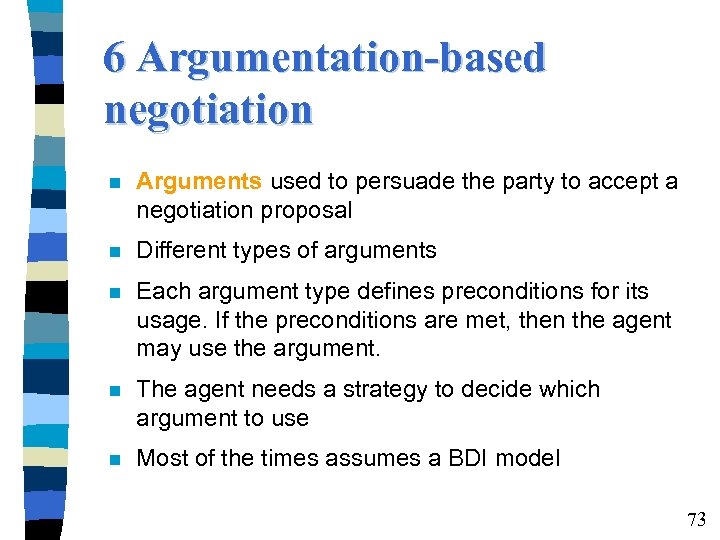
6 Argumentation-based negotiation Arguments used to persuade the party to accept a negotiation proposal Different types of arguments Each argument type defines preconditions for its usage. If the preconditions are met, then the agent may use the argument. The agent needs a strategy to decide which argument to use Most of the times assumes a BDI model 73
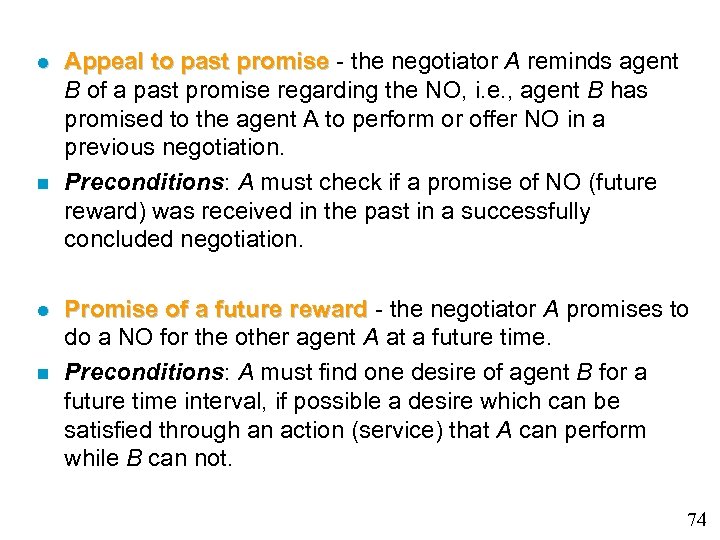
l l Appeal to past promise - the negotiator A reminds agent promise B of a past promise regarding the NO, i. e. , agent B has promised to the agent A to perform or offer NO in a previous negotiation. Preconditions: A must check if a promise of NO (future reward) was received in the past in a successfully concluded negotiation. Promise of a future reward - the negotiator A promises to do a NO for the other agent A at a future time. Preconditions: A must find one desire of agent B for a future time interval, if possible a desire which can be satisfied through an action (service) that A can perform while B can not. 74
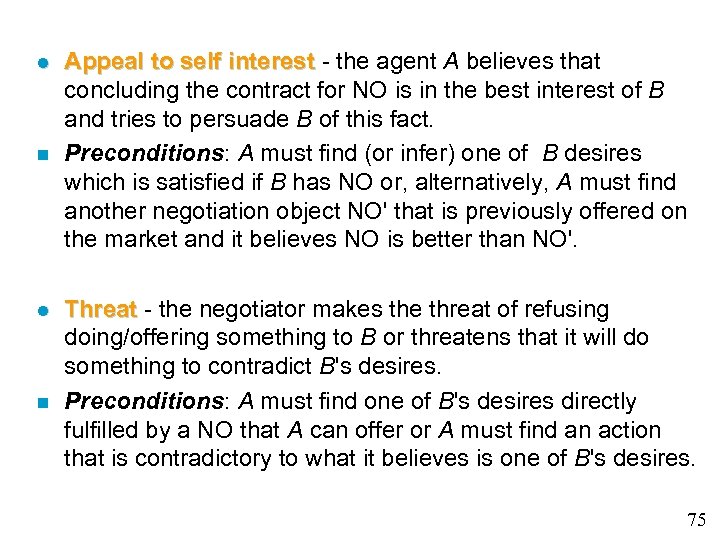
l l Appeal to self interest - the agent A believes that interest concluding the contract for NO is in the best interest of B and tries to persuade B of this fact. Preconditions: A must find (or infer) one of B desires which is satisfied if B has NO or, alternatively, A must find another negotiation object NO' that is previously offered on the market and it believes NO is better than NO'. Threat - the negotiator makes the threat of refusing Threat doing/offering something to B or threatens that it will do something to contradict B's desires. Preconditions: A must find one of B's desires directly fulfilled by a NO that A can offer or A must find an action that is contradictory to what it believes is one of B's desires. 75
References o o o o T. W. Sandholm. Distributed rational decision making. In Multiagent Systems - A Modern Approach to Distributed Artificial Intelligence, G. Weiss (Ed. ), The MIT Press, 2001, p. 201 -258. M. Wooldrige. An Introduction to Multi. Agent Systems, John Wiley & Sons, 2002. J. S. Rosenschein, G. Zlotkin. Designing conventions for automated negotiation. In Readings in Agents, M. Huhns & M. Singh (Eds. ), Morgan Kaufmann, 1998, p. 253 -370. M. P. Wellman. A market-oriented programming environment and its applications to distributed multicommodity flow problems. Journal of Artificial Intelligence Research, 1, 1993, p. 1 -23. N. R. Jennings, e. a. , Automated negotiation: prospects, methods, and challenges, Journal of Group Decision and Negotiation, 2000. S. Kraus, K. Sycara, A. Evenchik, Reaching agreements through arumentation: a logical model and implementation, Artificial Intelligence, Elsevier Science, 104, 1998, p. 1 -69. A. Florea, B. Panghe. Achieving Cooperation of Self-interested Agents Based on Cost”, In Proceedings of the 15 th European Meeting on Cybernetics and System Research, Session: From Agent Theories to Agent Implementation, Vienna, 2000, p. 591 -596. 76
Скачать презентацию Multi-Agent Systems University Politehnica of Bucarest Spring 2011
01f1c0b2a50df679985a833dace2da72.ppt