 Скачать презентацию Multi-Agent Planning Brad Clement Artificial Intelligence Group Jet
b59c2e306b1e3f3805d8d77c01d3ae3a.ppt
- Количество слайдов: 62



Multi-Agent Planning Brad Clement Artificial Intelligence Group Jet Propulsion Laboratory California Institute of Technology brad. clement@jpl. nasa. gov http: //ai. jpl. nasa. gov/ Thanks to Edmund Durfee, U. Michigan for contributions All rights reserved, California Institute of Technology © 2004
Outline • • What is multi-agent planning? Design Issues Applications Multi-agent planning problems and techniques All rights reserved, California Institute of Technology © 2004
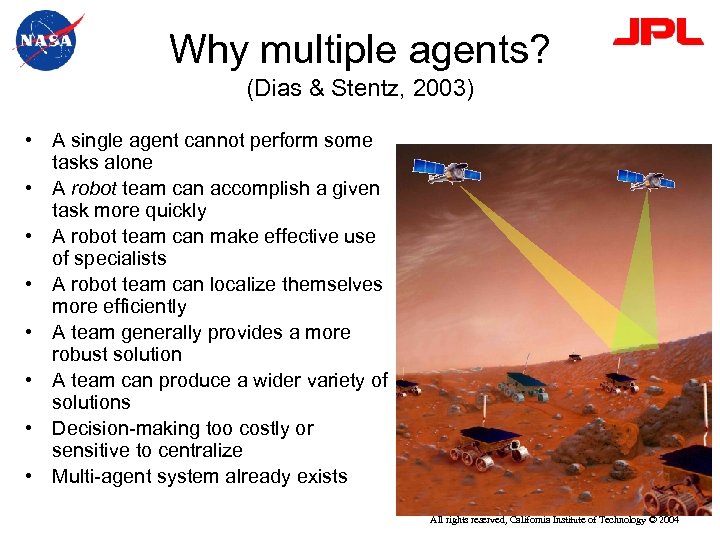
Why multiple agents? (Dias & Stentz, 2003) • A single agent cannot perform some tasks alone • A robot team can accomplish a given task more quickly • A robot team can make effective use of specialists • A robot team can localize themselves more efficiently • A team generally provides a more robust solution • A team can produce a wider variety of solutions • Decision-making too costly or sensitive to centralize • Multi-agent system already exists All rights reserved, California Institute of Technology © 2004
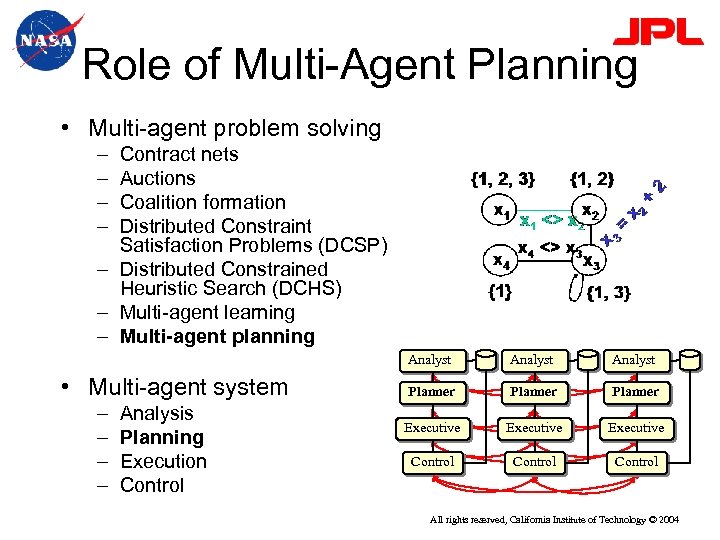
Role of Multi-Agent Planning • Multi-agent problem solving – – Contract nets Auctions Coalition formation Distributed Constraint Satisfaction Problems (DCSP) – Distributed Constrained Heuristic Search (DCHS) – Multi-agent learning – Multi-agent planning Analyst • Multi-agent system – – Analysis Planning Execution Control Analyst Planner Executive Control All rights reserved, California Institute of Technology © 2004
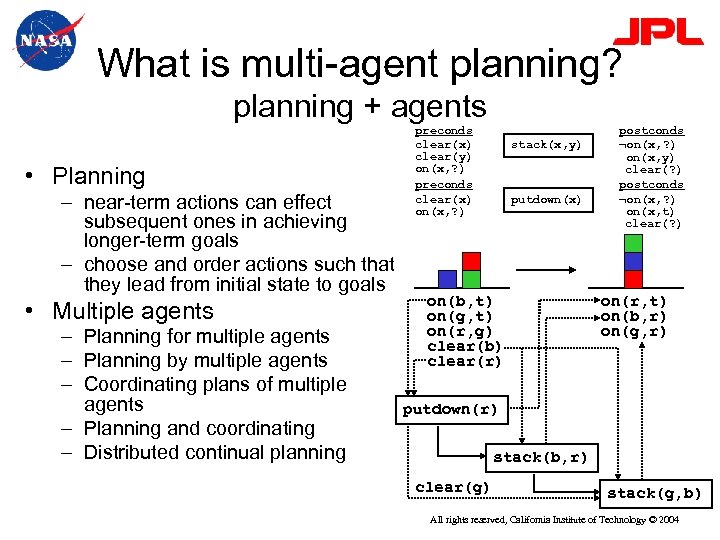
What is multi-agent planning? planning + agents • Planning – near-term actions can effect subsequent ones in achieving longer-term goals – choose and order actions such that they lead from initial state to goals • Multiple agents – Planning for multiple agents – Planning by multiple agents – Coordinating plans of multiple agents – Planning and coordinating – Distributed continual planning preconds clear(x) clear(y) on(x, ? ) preconds clear(x) on(x, ? ) stack(x, y) putdown(x) on(b, t) on(g, t) on(r, g) clear(b) clear(r) postconds ¬on(x, ? ) on(x, y) clear(? ) postconds ¬on(x, ? ) on(x, t) clear(? ) on(r, t) on(b, r) on(g, r) putdown(r) stack(b, r) clear(g) stack(g, b) All rights reserved, California Institute of Technology © 2004
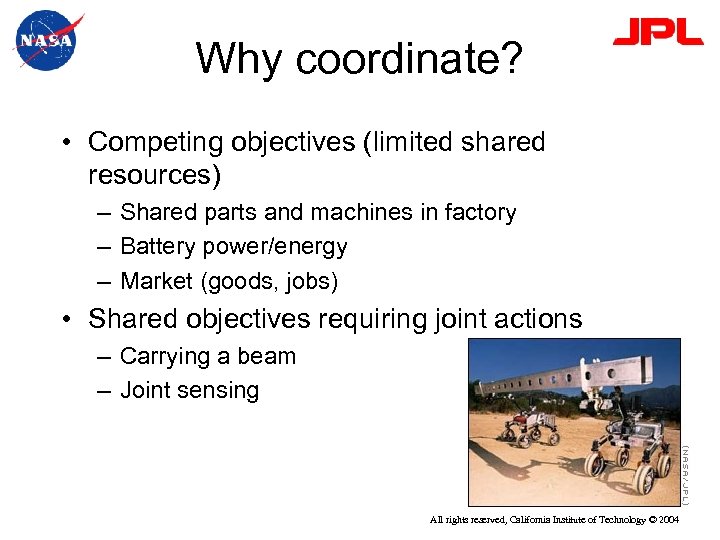
Why coordinate? • Competing objectives (limited shared resources) – Shared parts and machines in factory – Battery power/energy – Market (goods, jobs) • Shared objectives requiring joint actions – Carrying a beam – Joint sensing All rights reserved, California Institute of Technology © 2004
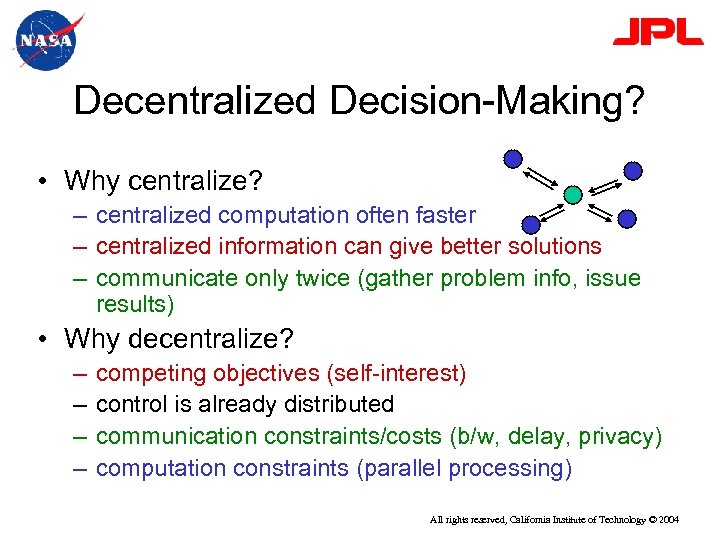
Decentralized Decision-Making? • Why centralize? – centralized computation often faster – centralized information can give better solutions – communicate only twice (gather problem info, issue results) • Why decentralize? – – competing objectives (self-interest) control is already distributed communication constraints/costs (b/w, delay, privacy) computation constraints (parallel processing) All rights reserved, California Institute of Technology © 2004
Criteria for Multi-Agent Planning • • • computation costs communication costs plan quality flexibility (commitment) robustness scalability All rights reserved, California Institute of Technology © 2004
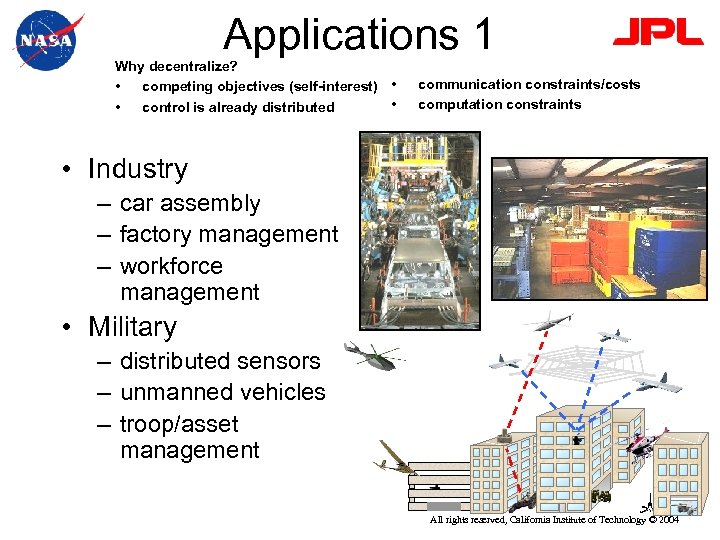
Applications 1 Why decentralize? • competing objectives (self-interest) • • • control is already distributed communication constraints/costs computation constraints • Industry – car assembly – factory management – workforce management • Military – distributed sensors – unmanned vehicles – troop/asset management All rights reserved, California Institute of Technology © 2004
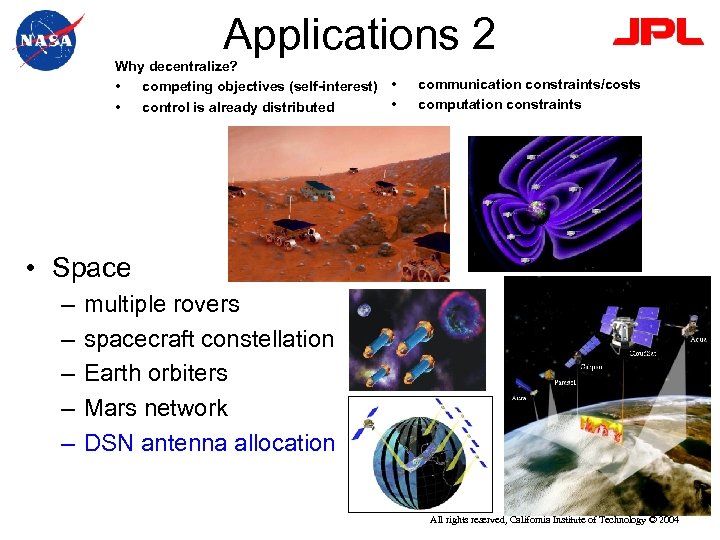
Applications 2 Why decentralize? • competing objectives (self-interest) • • • control is already distributed communication constraints/costs computation constraints • Space – – – multiple rovers spacecraft constellation Earth orbiters Mars network DSN antenna allocation All rights reserved, California Institute of Technology © 2004
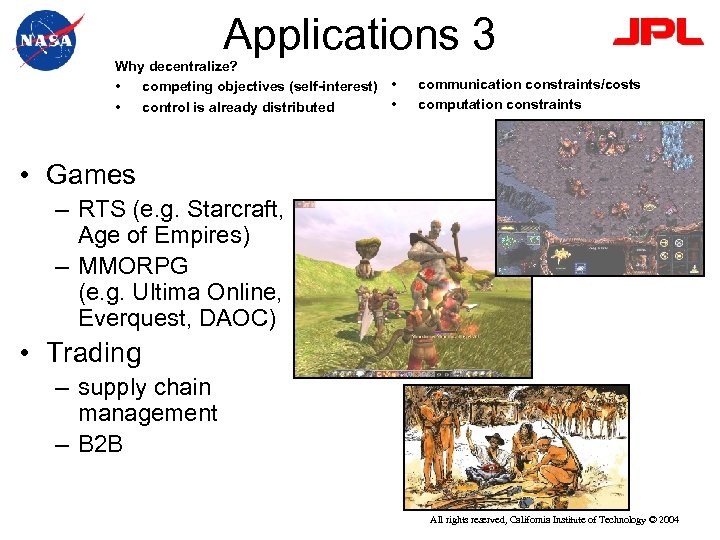
Applications 3 Why decentralize? • competing objectives (self-interest) • • • control is already distributed communication constraints/costs computation constraints • Games – RTS (e. g. Starcraft, Age of Empires) – MMORPG (e. g. Ultima Online, Everquest, DAOC) • Trading – supply chain management – B 2 B All rights reserved, California Institute of Technology © 2004
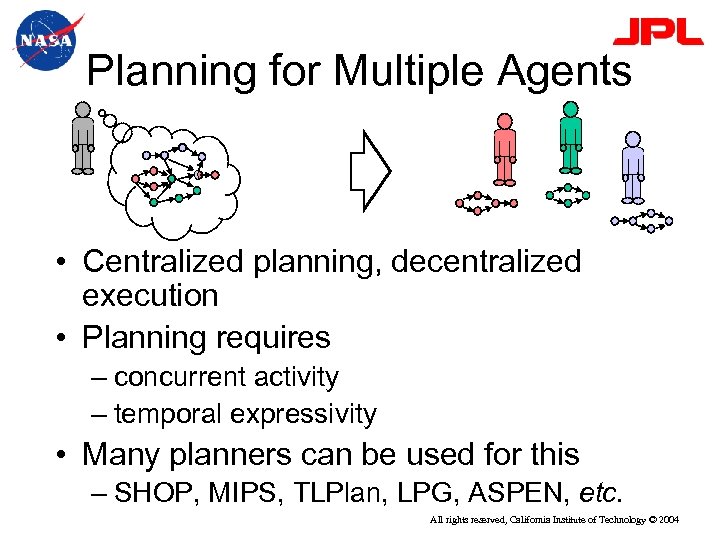
Planning for Multiple Agents • Centralized planning, decentralized execution • Planning requires – concurrent activity – temporal expressivity • Many planners can be used for this – SHOP, MIPS, TLPlan, LPG, ASPEN, etc. All rights reserved, California Institute of Technology © 2004
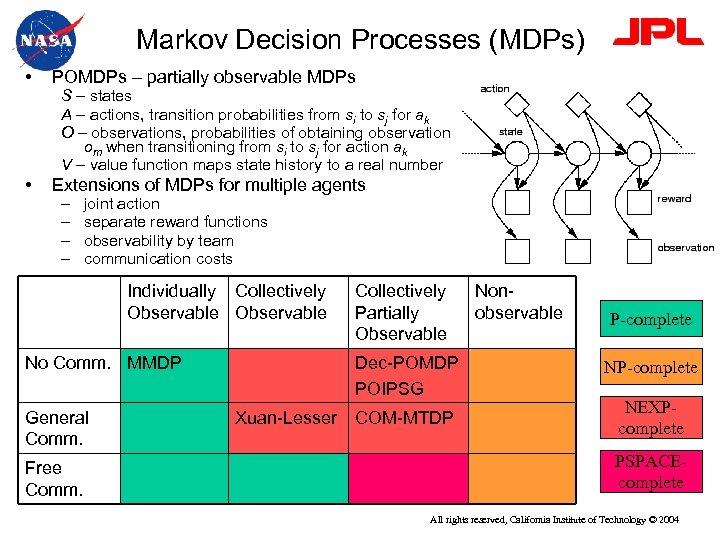
Markov Decision Processes (MDPs) • POMDPs – partially observable MDPs S – states A – actions, transition probabilities from si to sj for ak O – observations, probabilities of obtaining observation om when transitioning from si to sj for action ak V – value function maps state history to a real number • Extensions of MDPs for multiple agents – – joint action separate reward functions observability by team communication costs Individually Collectively Observable No Comm. MMDP General Comm. Free Comm. Collectively Partially Observable Dec-POMDP POIPSG Xuan-Lesser COM-MTDP Nonobservable P-complete NEXPcomplete PSPACEcomplete All rights reserved, California Institute of Technology © 2004
References – MDPs for Agents • • • MDPs – Boutilier, JAIR, 1999 MMDP – Boutilier, IJCAI ’ 99 Dec-POMDP – Bernstein et al. , UAI ’ 00 Xuan & Lesser, Agents ’ 01, AAMAS ’ 02 COM-MTDP, Pynadath & Tambe, AAMAS ‘ 02, JAIR ’ 02 POIPSG, Peshkin et al. , UAI ‘ 01 All rights reserved, California Institute of Technology © 2004
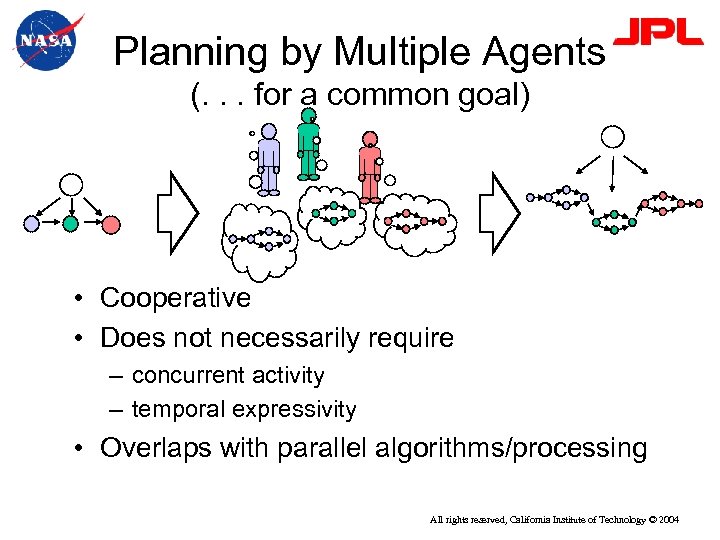
Planning by Multiple Agents (. . . for a common goal) • Cooperative • Does not necessarily require – concurrent activity – temporal expressivity • Overlaps with parallel algorithms/processing All rights reserved, California Institute of Technology © 2004
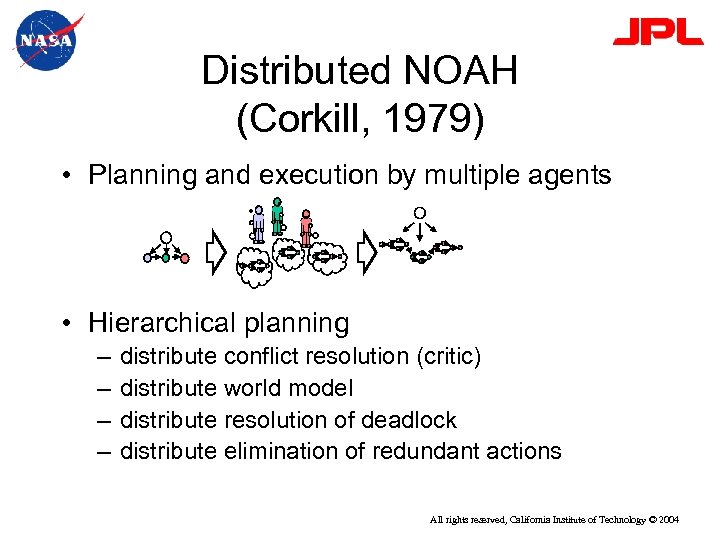
Distributed NOAH (Corkill, 1979) • Planning and execution by multiple agents • Hierarchical planning – – distribute conflict resolution (critic) distribute world model distribute resolution of deadlock distribute elimination of redundant actions All rights reserved, California Institute of Technology © 2004
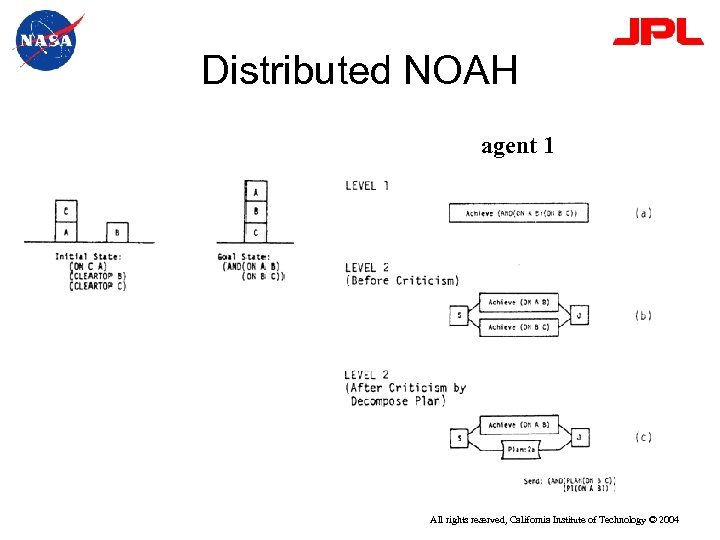
Distributed NOAH agent 1 All rights reserved, California Institute of Technology © 2004
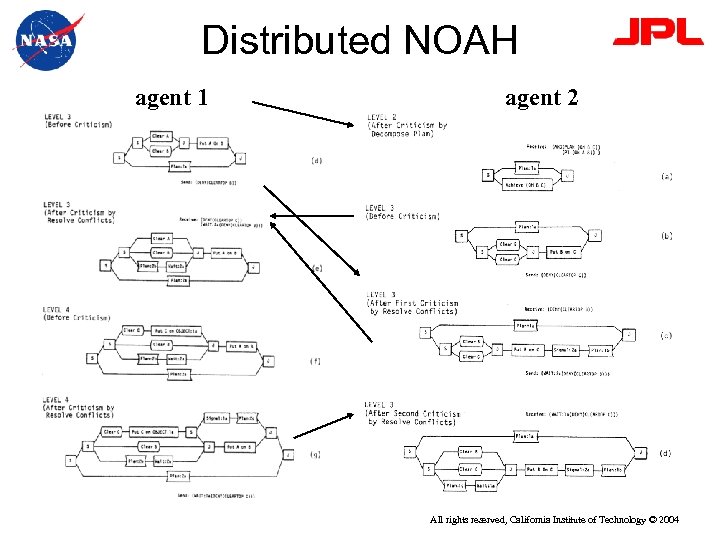
Distributed NOAH agent 1 agent 2 All rights reserved, California Institute of Technology © 2004
COLLAGE (Lansky, 1991) • Planning by multiple agents • Distribute planning by partitioning into sub-problems • Partially-ordered plan fragments with CSP-style binding constraints on actionparameter variables • Action decomposition • Planning as constraint satisfaction All rights reserved, California Institute of Technology © 2004
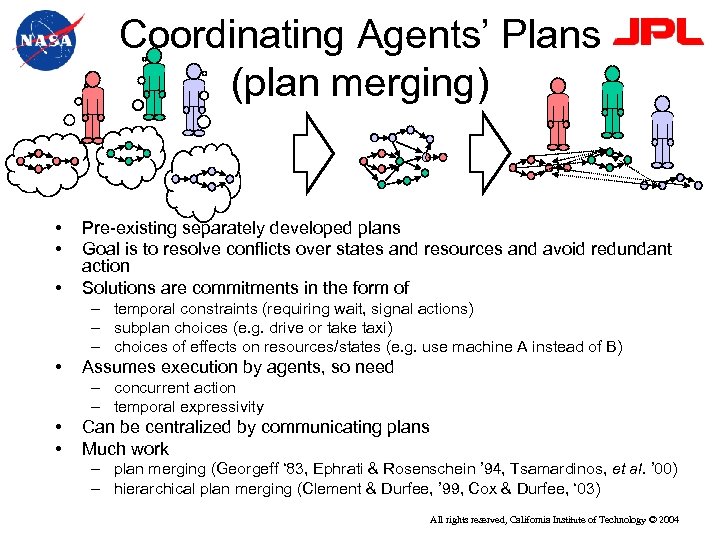
Coordinating Agents’ Plans (plan merging) • • • Pre-existing separately developed plans Goal is to resolve conflicts over states and resources and avoid redundant action Solutions are commitments in the form of – temporal constraints (requiring wait, signal actions) – subplan choices (e. g. drive or take taxi) – choices of effects on resources/states (e. g. use machine A instead of B) • Assumes execution by agents, so need – concurrent action – temporal expressivity • • Can be centralized by communicating plans Much work – plan merging (Georgeff ‘ 83, Ephrati & Rosenschein ’ 94, Tsamardinos, et al. ’ 00) – hierarchical plan merging (Clement & Durfee, ’ 99, Cox & Durfee, ‘ 03) All rights reserved, California Institute of Technology © 2004
Plan Merging Given the candidate plans of the agents, consider all possible combinations of plans, executed in all possible orderings (interleavings or even simultaneous) Generate all possible reachable sequences of states For any illegal (inconsistent or otherwise failure) states, insert constraints on which actions are taken or when to ensure that the actual execution cannot fail All rights reserved, California Institute of Technology © 2004
Plan Merging Algorithm-1 Each action has pre-conditions, post-conditions, and during-conditions (optional) • Compare an agent’s actions against each action of the other agents (O(n 2 a) comparisons) to detect contradictions between pre, post, and during conditions • If none, pair of actions commute and can be carried out in any order. • If some, determine if either can precede the other (post-conditions of one compatible with pre-conditions of other) • All simultaneous or ordered executions not safe are deemed “unsafe” All rights reserved, California Institute of Technology © 2004
Plan Merging Algorithm-2 Ignore actions that commute with all others Complete safety analysis by propagation • Beginning actions a and b is unsafe if either consequent situation (adding postconds of a to b, or b to a) leads to an unsafe ordering • Beginning a and ending b is unsafe if ending a and ending b is unsafe • Ending a and ending b is unsafe if both of the successor situations are unsafe All rights reserved, California Institute of Technology © 2004
Plan Merging Algorithm-3 In planning, assumption is that plan step interactions are exception Therefore, dropping commuting actions leaves very few remaining actions Examining possible orderings and inserting synchronization actions (messages or clock-times) therefore becomes tractable All rights reserved, California Institute of Technology © 2004
Iterative Plan Formation Sometimes, forming plans first and then coordinating them fails because of choices in initial plans formed Instead, iterate between formation and coordination to keep alternatives alive All rights reserved, California Institute of Technology © 2004
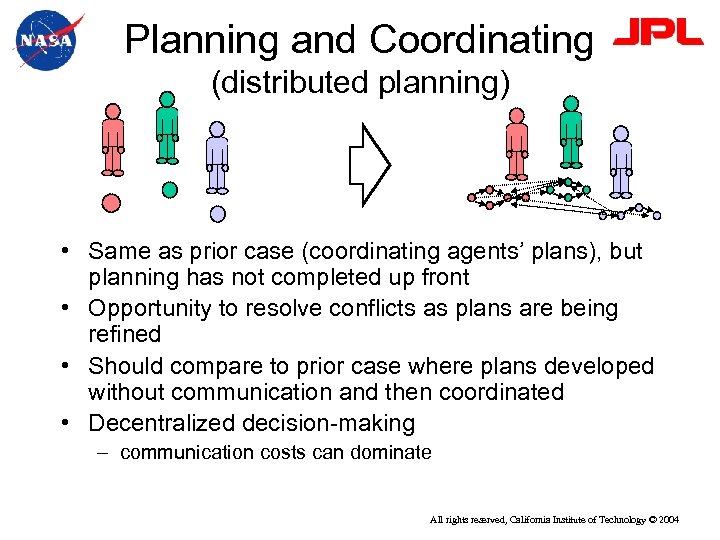
Planning and Coordinating (distributed planning) • Same as prior case (coordinating agents’ plans), but planning has not completed up front • Opportunity to resolve conflicts as plans are being refined • Should compare to prior case where plans developed without communication and then coordinated • Decentralized decision-making – communication costs can dominate All rights reserved, California Institute of Technology © 2004
Plan Combination Search Given initial propositions about the world 1. Agents form successor states by proposing changes to current propositions caused by one action (or no-op) 2. Successor states are ranked using A* heuristic by all agents, and best choice is found and further expanded Agents are simultaneously committing to a plan (corresponding to actions in solution path) and synchronizations (when actions are taken relative to each other) All rights reserved, California Institute of Technology © 2004
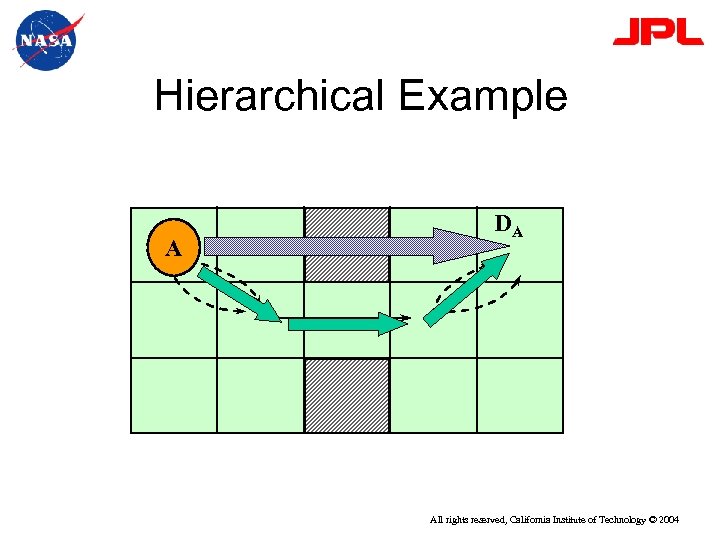
Hierarchical Example A DA All rights reserved, California Institute of Technology © 2004
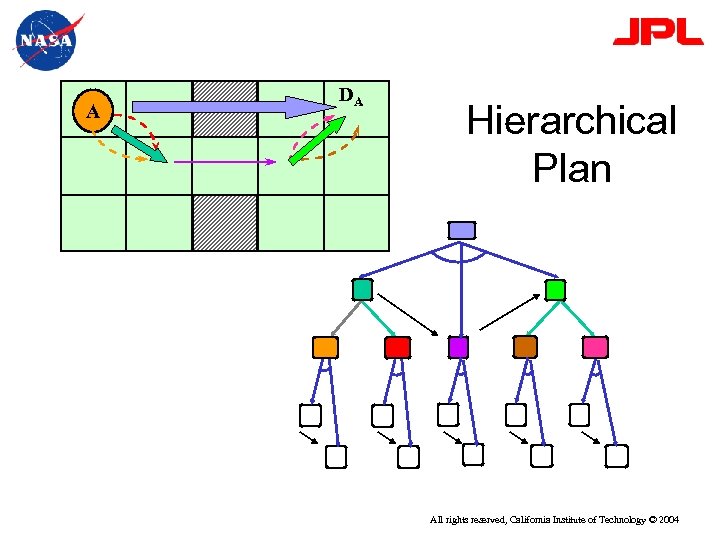
A DA Hierarchical Plan All rights reserved, California Institute of Technology © 2004
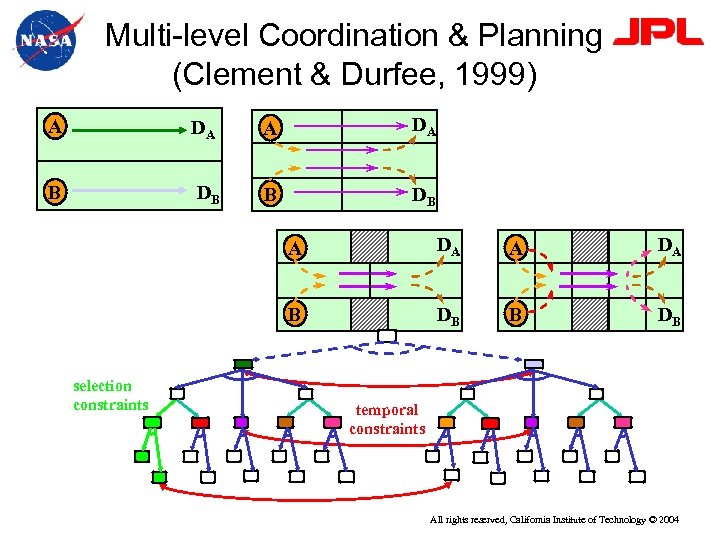
Multi-level Coordination & Planning (Clement & Durfee, 1999) A DA B DB A A DA B selection constraints DA DB B DB temporal constraints All rights reserved, California Institute of Technology © 2004
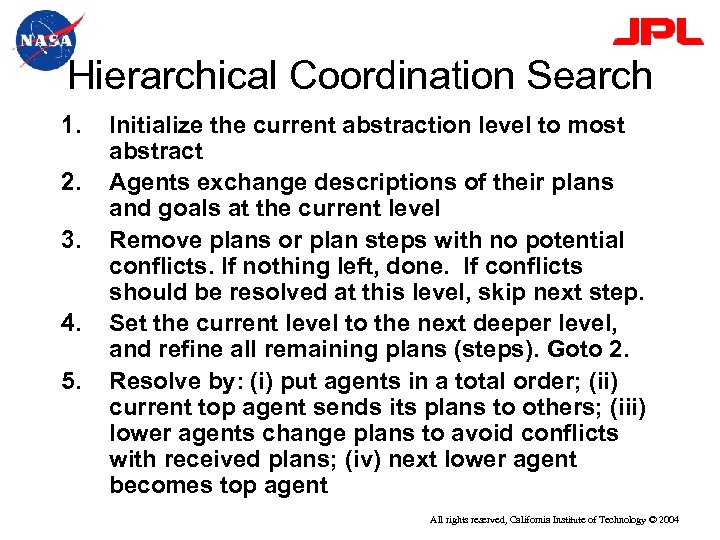
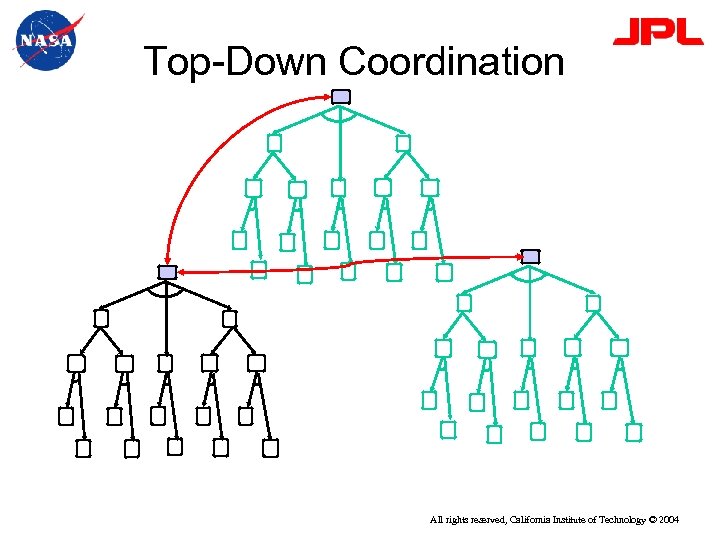
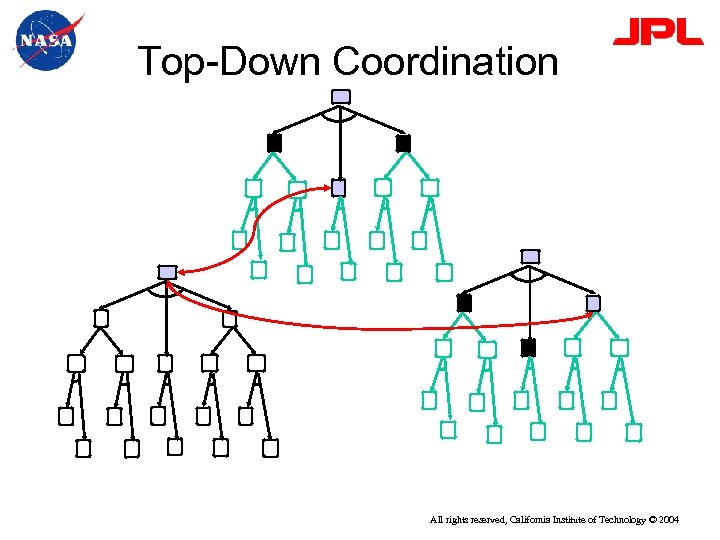
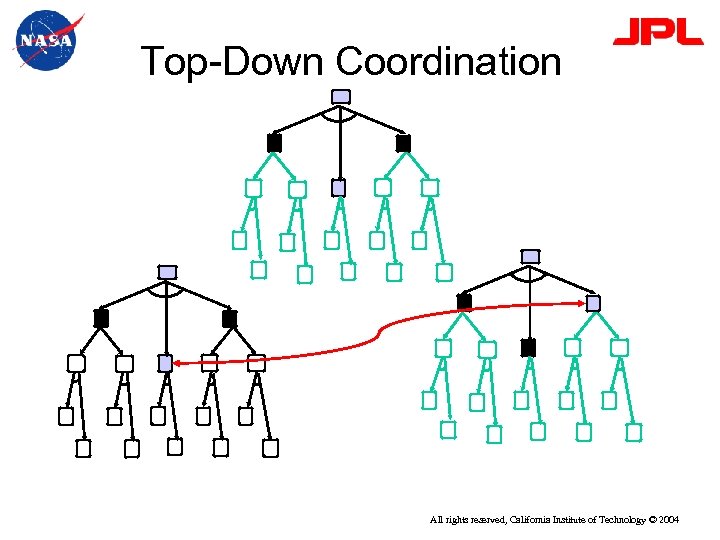
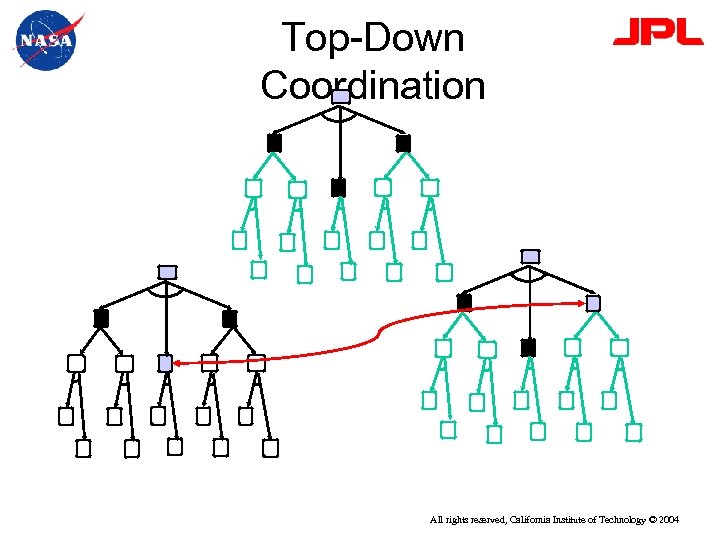
Hierarchical Coordination Search 1. 2. 3. 4. 5. Initialize the current abstraction level to most abstract Agents exchange descriptions of their plans and goals at the current level Remove plans or plan steps with no potential conflicts. If nothing left, done. If conflicts should be resolved at this level, skip next step. Set the current level to the next deeper level, and refine all remaining plans (steps). Goto 2. Resolve by: (i) put agents in a total order; (ii) current top agent sends its plans to others; (iii) lower agents change plans to avoid conflicts with received plans; (iv) next lower agent becomes top agent All rights reserved, California Institute of Technology © 2004
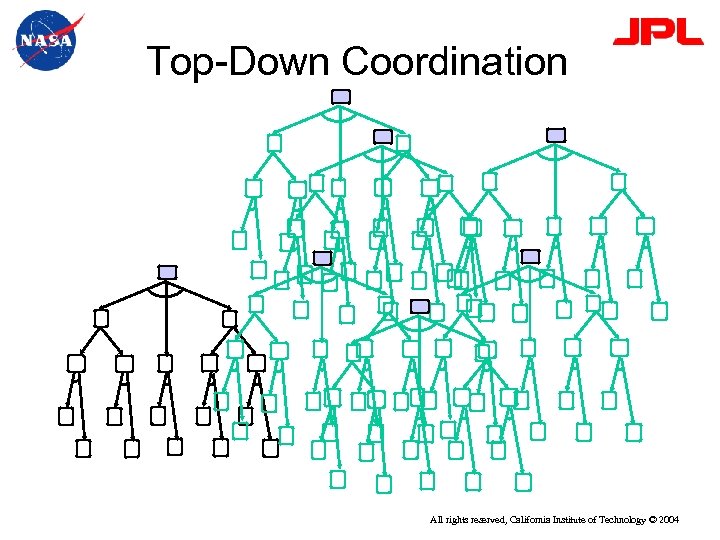
Top-Down Coordination All rights reserved, California Institute of Technology © 2004
Top-Down Coordination All rights reserved, California Institute of Technology © 2004
Top-Down Coordination All rights reserved, California Institute of Technology © 2004
Top-Down Coordination All rights reserved, California Institute of Technology © 2004
Top-Down Coordination All rights reserved, California Institute of Technology © 2004
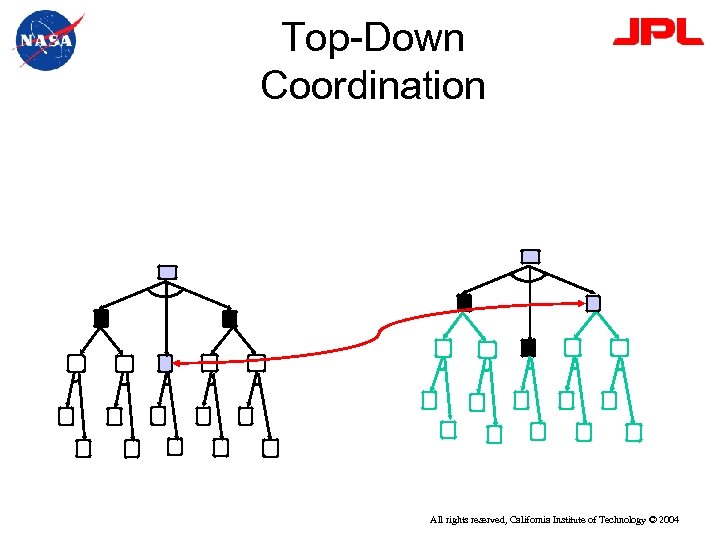
Top-Down Coordination All rights reserved, California Institute of Technology © 2004
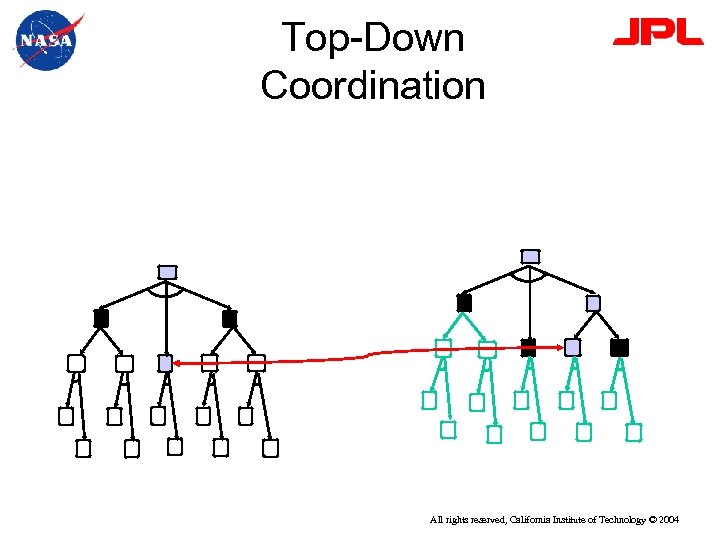
Top-Down Coordination All rights reserved, California Institute of Technology © 2004
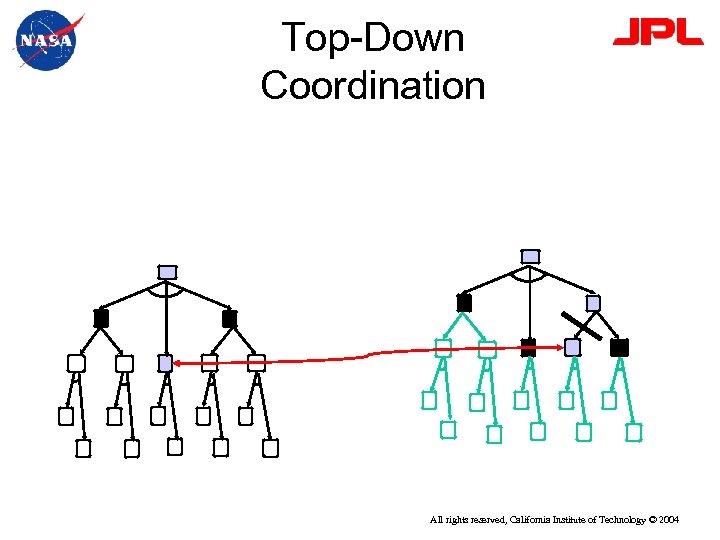
Top-Down Coordination All rights reserved, California Institute of Technology © 2004
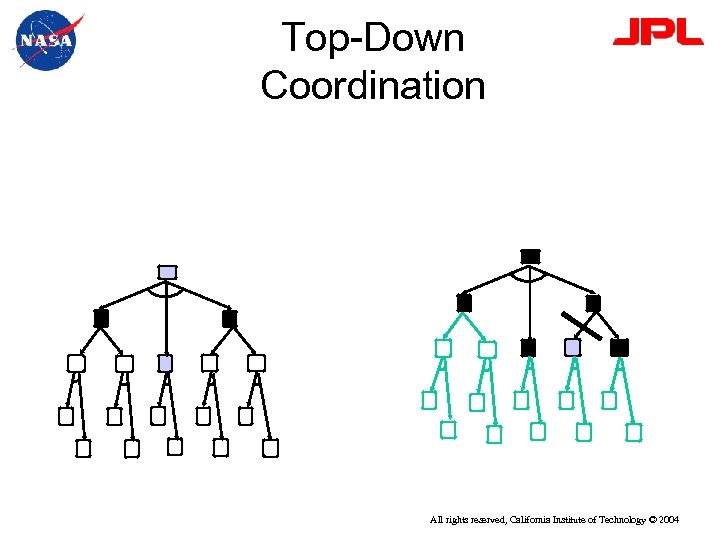
Top-Down Coordination All rights reserved, California Institute of Technology © 2004
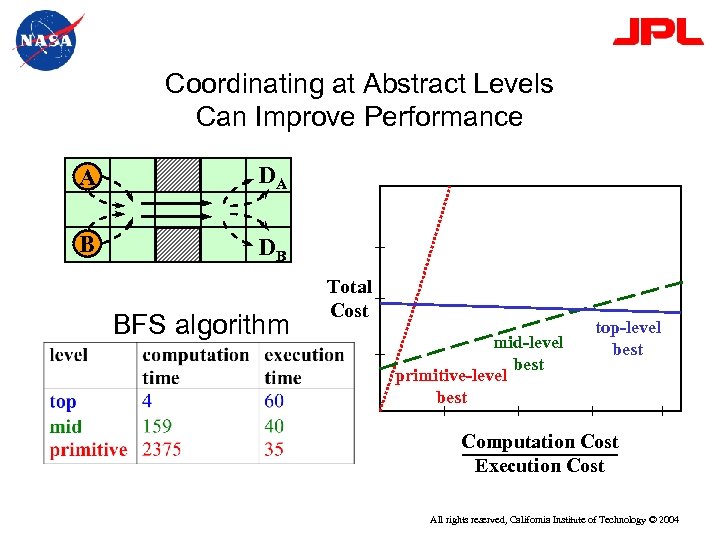
Coordinating at Abstract Levels Can Improve Performance A DA B DB BFS algorithm Total Cost mid-level best primitive-level best top-level best Computation Cost Execution Cost All rights reserved, California Institute of Technology © 2004
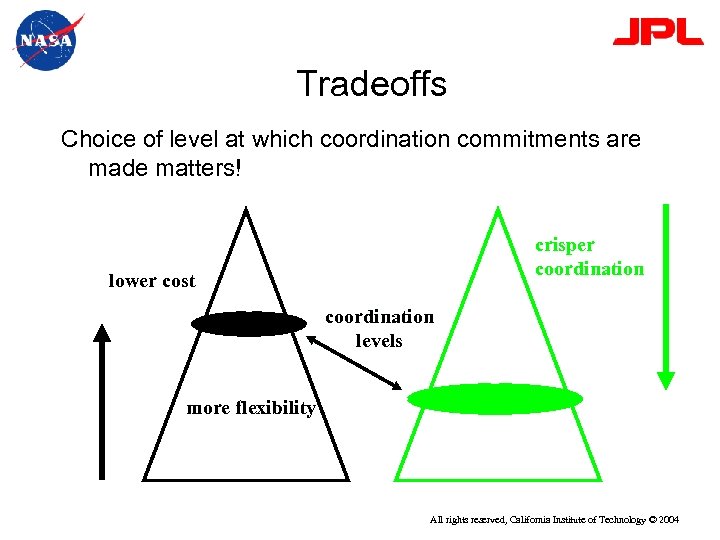
Tradeoffs Choice of level at which coordination commitments are made matters! crisper coordination lower cost coordination levels more flexibility All rights reserved, California Institute of Technology © 2004
Generalized Partial Global Planning (GPGP, Decker & Lesser, 1995) • Mechanisms to generalize PGP – – – updating non-local viewpoints communicating results handling redundancy of effort resolve conflicts (hard constraints) handle soft constraints (“optimize”) • Examines tradeoffs of using mechanisms according to – – communication overhead execution time plan quality missed deadlines All rights reserved, California Institute of Technology © 2004
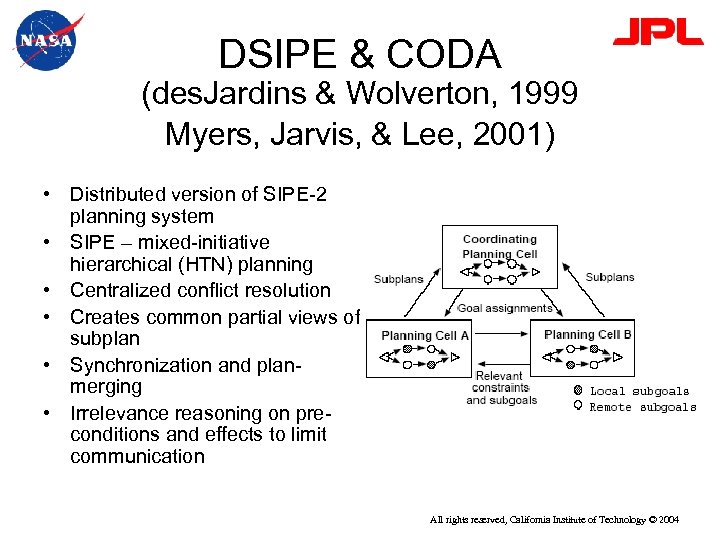
DSIPE & CODA (des. Jardins & Wolverton, 1999 Myers, Jarvis, & Lee, 2001) • Distributed version of SIPE-2 planning system • SIPE – mixed-initiative hierarchical (HTN) planning • Centralized conflict resolution • Creates common partial views of subplan • Synchronization and planmerging • Irrelevance reasoning on preconditions and effects to limit communication All rights reserved, California Institute of Technology © 2004
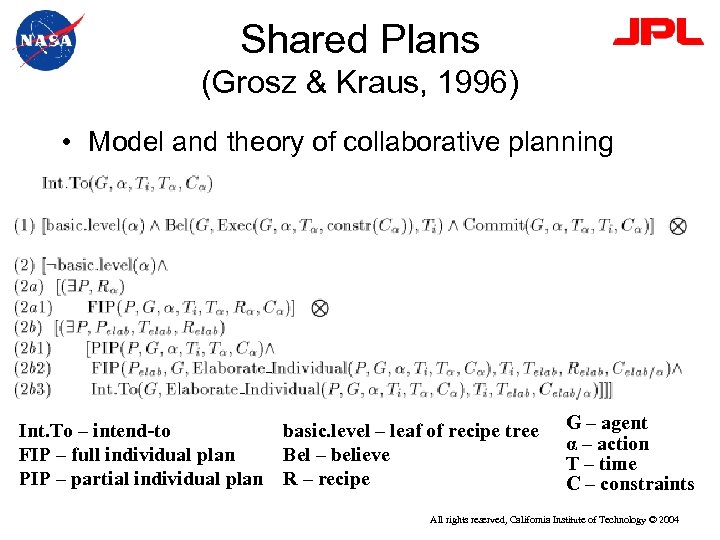
Shared Plans (Grosz & Kraus, 1996) • Model and theory of collaborative planning Int. To – intend-to basic. level – leaf of recipe tree FIP – full individual plan Bel – believe PIP – partial individual plan R – recipe G – agent α – action T – time C – constraints All rights reserved, California Institute of Technology © 2004
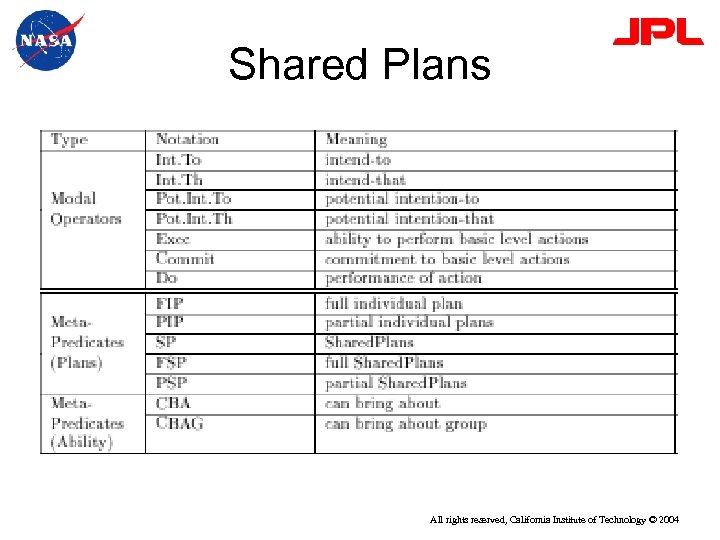
Shared Plans All rights reserved, California Institute of Technology © 2004
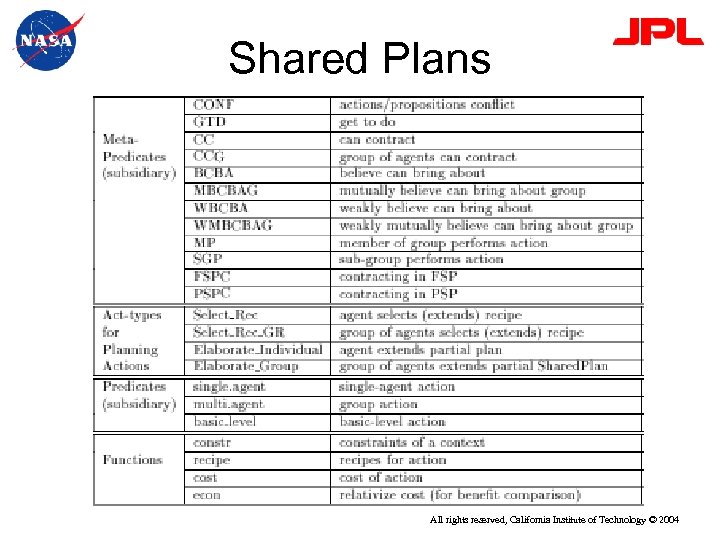
Shared Plans All rights reserved, California Institute of Technology © 2004
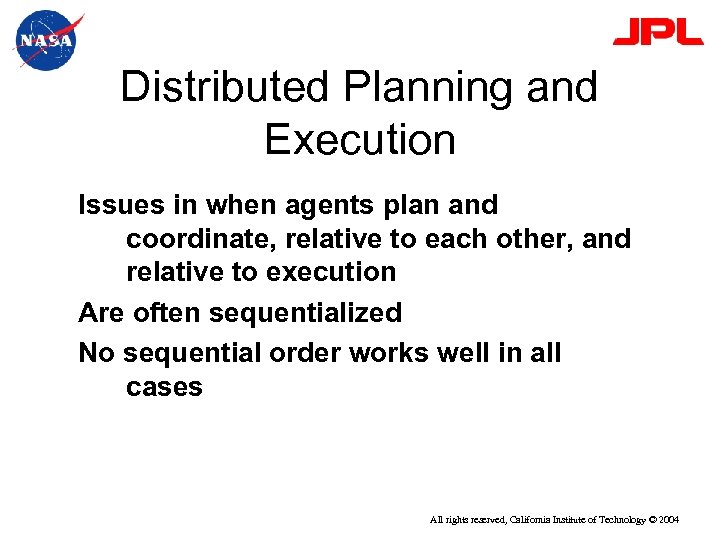
Distributed Planning and Execution Issues in when agents plan and coordinate, relative to each other, and relative to execution Are often sequentialized No sequential order works well in all cases All rights reserved, California Institute of Technology © 2004
Post-Planning Coordination Essentially, plan merging techniques Dealing with execution problems can involve: – Contingency preplanning: detecting multiagent contingency, and invoking already coordinated response – Monitoring/replanning: detecting deviation and restarting the planning/coordination process Obviously, localizing impacts minimizes fresh coordination; building a plan that permits localized adjustments can be important, but might be less efficient All rights reserved, California Institute of Technology © 2004
Pre-Planning Coordination Impose coordination constraints before planning is done; plans work within these Example: Set the boundaries; define the roles Social laws: Define what could be done and when, then leave it up to agents to plan within the legal limits Cooperative state changing rules: Force agents planning decisions into cooperative behaviors All rights reserved, California Institute of Technology © 2004
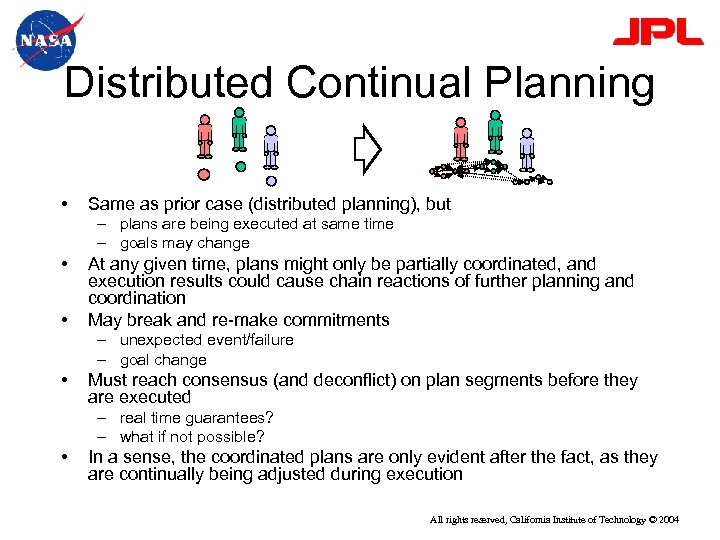
Distributed Continual Planning • Same as prior case (distributed planning), but – plans are being executed at same time – goals may change • • At any given time, plans might only be partially coordinated, and execution results could cause chain reactions of further planning and coordination May break and re-make commitments – unexpected event/failure – goal change • Must reach consensus (and deconflict) on plan segments before they are executed – real time guarantees? – what if not possible? • In a sense, the coordinated plans are only evident after the fact, as they are continually being adjusted during execution All rights reserved, California Institute of Technology © 2004
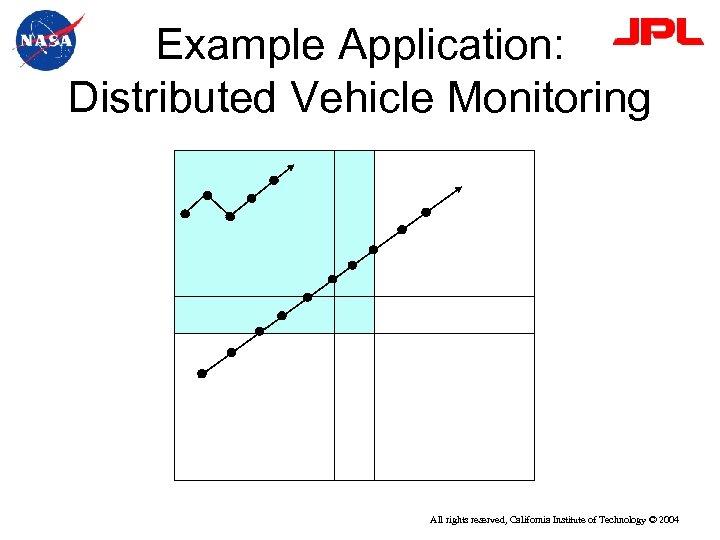
Example Application: Distributed Vehicle Monitoring All rights reserved, California Institute of Technology © 2004
Partial Global Planning (Durfee & Lesser, 1991) 1. Task allocation: inherent 2. Local plan formulation: sequence of interpretation problem solving activities 3. Local plan abstraction: major plan steps (such as for time-region processing) 4. Communication: Use meta-level organization to know who is responsible for what aspects of plan coordination All rights reserved, California Institute of Technology © 2004
Partial Global Planning (cont) 5. Partial global plan construction: Pieces of related plans (e. g. , potentially tracking the same vehicle) are aggregated 6. Partial global plan modification: redundant or inefficient schedules are adjusted to improve collaborative performance 7. Communication planning: identification of partial results that should be gainfully exchanged, and when All rights reserved, California Institute of Technology © 2004
Partial Global Planning (cont) 8. Mapping back to local plans: Partial global plan commitments are internalized 9. Local plan execution Cycle repeats as local plans change or new plans from other agents arrive. Always acting on local information means that there could be inconsistencies in global view, but these are tolerated All rights reserved, California Institute of Technology © 2004
Shared Activity Coordination (SHAC, Clement & Barrett, 2003) – distributed continual planning algorithm – framework for defining and implementing automated interactions between planning agents (a. k. a. coordination protocols/algorithms) – software • planner-independent interface • protocol class hierarchy • testbed for evaluating protocols All rights reserved, California Institute of Technology © 2004
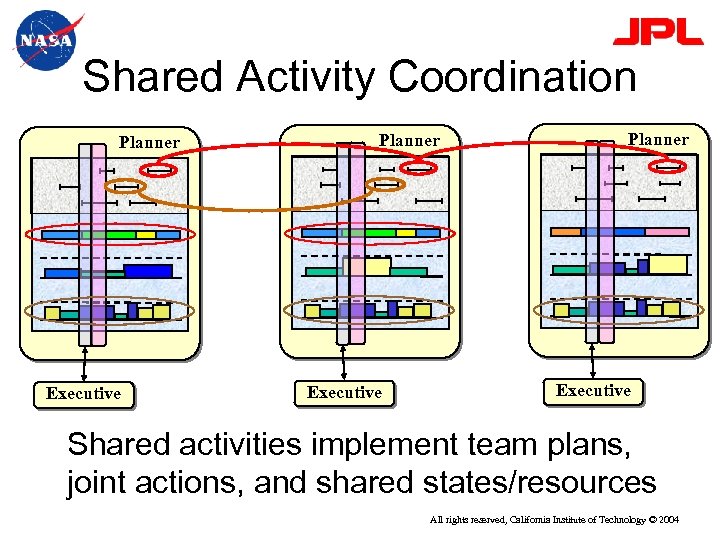
Shared Activity Coordination Planner Executive Shared activities implement team plans, joint actions, and shared states/resources All rights reserved, California Institute of Technology © 2004
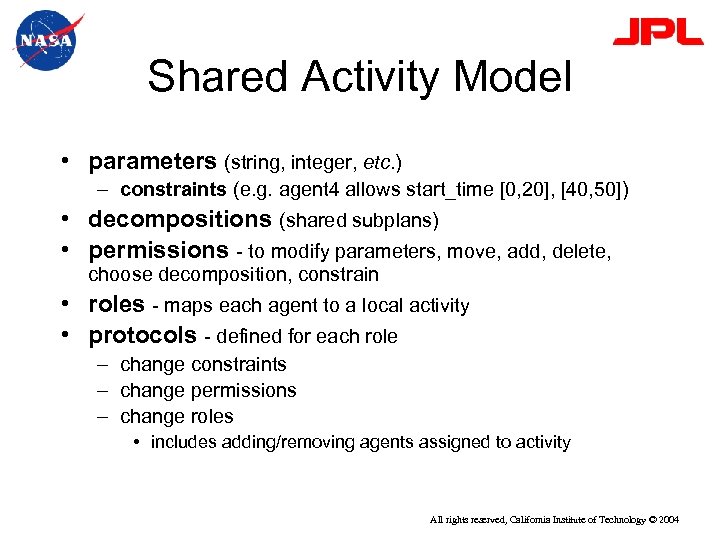
Shared Activity Model • parameters (string, integer, etc. ) – constraints (e. g. agent 4 allows start_time [0, 20], [40, 50]) • decompositions (shared subplans) • permissions - to modify parameters, move, add, delete, choose decomposition, constrain • roles - maps each agent to a local activity • protocols - defined for each role – change constraints – change permissions – change roles • includes adding/removing agents assigned to activity All rights reserved, California Institute of Technology © 2004
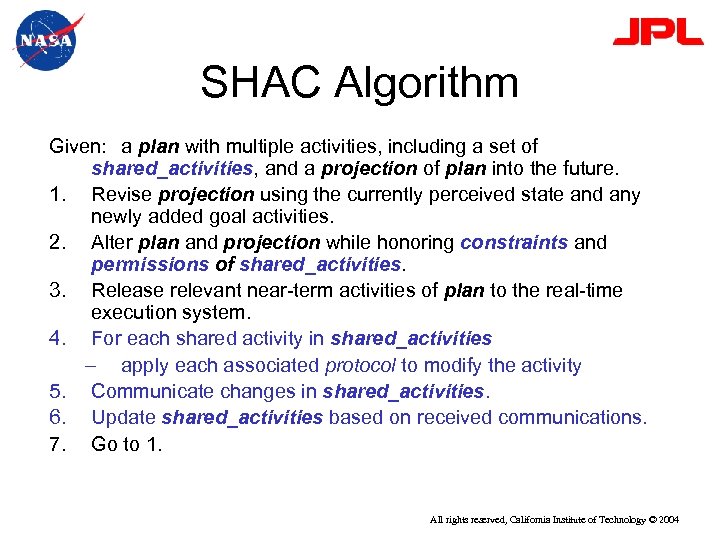
SHAC Algorithm Given: a plan with multiple activities, including a set of shared_activities, and a projection of plan into the future. 1. Revise projection using the currently perceived state and any newly added goal activities. 2. Alter plan and projection while honoring constraints and permissions of shared_activities. 3. Release relevant near-term activities of plan to the real-time execution system. 4. For each shared activity in shared_activities – apply each associated protocol to modify the activity 5. Communicate changes in shared_activities. 6. Update shared_activities based on received communications. 7. Go to 1. All rights reserved, California Institute of Technology © 2004
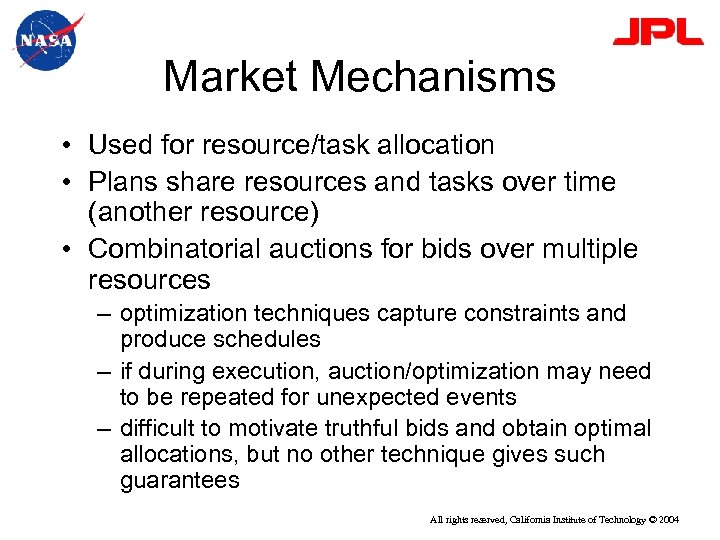
Market Mechanisms • Used for resource/task allocation • Plans share resources and tasks over time (another resource) • Combinatorial auctions for bids over multiple resources – optimization techniques capture constraints and produce schedules – if during execution, auction/optimization may need to be repeated for unexpected events – difficult to motivate truthful bids and obtain optimal allocations, but no other technique gives such guarantees All rights reserved, California Institute of Technology © 2004
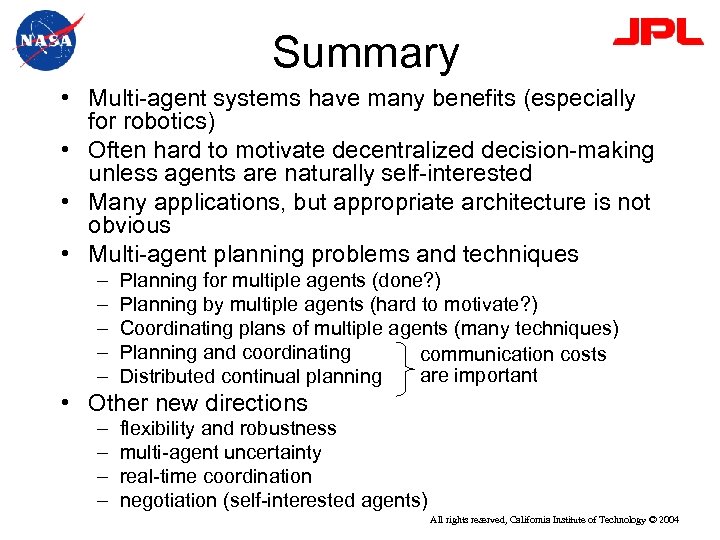
Summary • Multi-agent systems have many benefits (especially for robotics) • Often hard to motivate decentralized decision-making unless agents are naturally self-interested • Many applications, but appropriate architecture is not obvious • Multi-agent planning problems and techniques – – – Planning for multiple agents (done? ) Planning by multiple agents (hard to motivate? ) Coordinating plans of multiple agents (many techniques) Planning and coordinating communication costs are important Distributed continual planning • Other new directions – – flexibility and robustness multi-agent uncertainty real-time coordination negotiation (self-interested agents) All rights reserved, California Institute of Technology © 2004
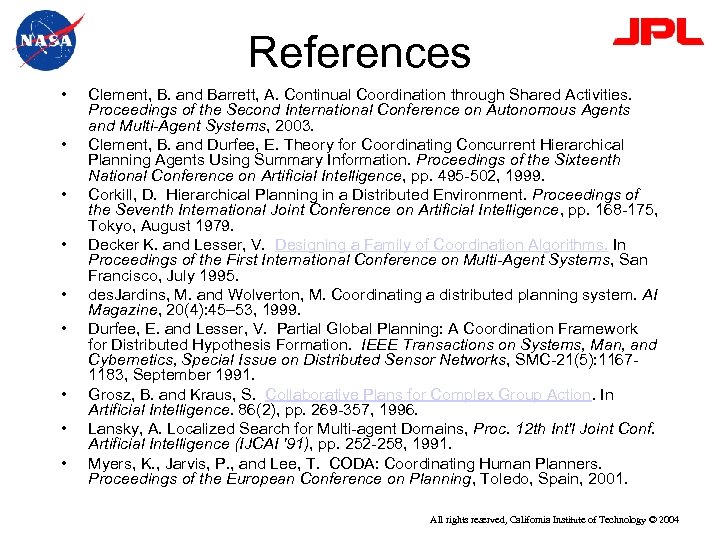
References • • • Clement, B. and Barrett, A. Continual Coordination through Shared Activities. Proceedings of the Second International Conference on Autonomous Agents and Multi-Agent Systems, 2003. Clement, B. and Durfee, E. Theory for Coordinating Concurrent Hierarchical Planning Agents Using Summary Information. Proceedings of the Sixteenth National Conference on Artificial Intelligence, pp. 495 -502, 1999. Corkill, D. Hierarchical Planning in a Distributed Environment. Proceedings of the Seventh International Joint Conference on Artificial Intelligence, pp. 168 -175, Tokyo, August 1979. Decker K. and Lesser, V. Designing a Family of Coordination Algorithms. In Proceedings of the First International Conference on Multi-Agent Systems, San Francisco, July 1995. des. Jardins, M. and Wolverton, M. Coordinating a distributed planning system. AI Magazine, 20(4): 45– 53, 1999. Durfee, E. and Lesser, V. Partial Global Planning: A Coordination Framework for Distributed Hypothesis Formation. IEEE Transactions on Systems, Man, and Cybernetics, Special Issue on Distributed Sensor Networks, SMC-21(5): 11671183, September 1991. Grosz, B. and Kraus, S. Collaborative Plans for Complex Group Action. In Artificial Intelligence. 86(2), pp. 269 -357, 1996. Lansky, A. Localized Search for Multi-agent Domains, Proc. 12 th Int'l Joint Conf. Artificial Intelligence (IJCAI '91), pp. 252 -258, 1991. Myers, K. , Jarvis, P. , and Lee, T. CODA: Coordinating Human Planners. Proceedings of the European Conference on Planning, Toledo, Spain, 2001. All rights reserved, California Institute of Technology © 2004
Скачать презентацию Multi-Agent Planning Brad Clement Artificial Intelligence Group Jet
b59c2e306b1e3f3805d8d77c01d3ae3a.ppt