


 Скачать презентацию Mugalova Galiya IR-244 It is necessary
Food security of Kazakhstan.pptx
- Количество слайдов: 22
 Mugalova Galiya IR-244
 It is necessary to understand such state of the economy of the country in case of which there is possible a providing at the expense of self-produced main types of the food of all population in case of an obligatory priority of the most vulnerable, its needy layers and on condition of physical and economic product availability of a food in such quantity and quality which are necessary for preserving and maintenance of life and the capacity to act of the person complete or the greatest possible independence of the state from external sources of the food as food security.
 The food safety of the country is ensured if in it about 80% of the consumed food, or in that case when the country specializes on production of this or that type of the food which export allows it to receive positive balance of the foreign trade balance on the food are made
 The food security is considered secure if, except production of necessary quantity of the food, its additional release in volume of filled safety stock at the level of world developed countries (60 days, or 17% of annual amount of consumption) is performed.
 In a case when certain types of the food aren't issued in the country, or their production is limited, food safety in them ensure purchase in other countries. Thus, it is important not to allow emergence of food, political or other dependence on exporting countries regarding the missing food
 The food safety of Kazakhstan can't be ensured without positive state impact on agrarian sector of national economy It is necessary to understand system of legislative, administrative and economic influence of the state as state regulation of agro-industrial production on production, conversion and sale of agricultural products, raw materials and the food.
 Tasks of state regulation of agrarian and industrial complex are: • - development of agro-industrial production; • - ensuring food security of the country; • - regulation of the markets of agricultural products, raw materials and food; • - improvement of food supply of the population; • - maintenance of economic parity between agricultural industry and other industries of economy; • - rapprochement of levels of the income of workers of agricultural industry and other industries; • - protection of domestic producers
 Need of state regulation of agro-industrial complex is caused: • - influence of the market of agricultural products, raw materials and the food on a macroeconomic country situation; • - inability of the market to provide economically equitable distribution of the income created in a production process, conversions and sales of products; • - the specifics of agricultural production determined by influence of natural factors on its productivity; • - support of agricultural industry as core activity of rural population and preserving the rural territories as the environment of its dwelling.
 The agro-industrial complex of Kazakhstan represents one of the primary reproduction branches of economy of the Republic. In it about a third of a national income is made. About availability at agrarian and industrial complex of the country of huge potential witness: • - the considerable amount of the agricultural holdings, which total area makes 223 million hectares, including, arable lands – 21 million hectares, or 1, 5 hectares per capita the Republic; • - considerable labor capacity of the village (in the rural zone lives about 45% of the population of the country); • - favorable climatic conditions for cultivation of grain and leguminous crops, potatoes, vegetables, etc. ; • - considerable potential of the territories of pastures for occupation by animal husbandry (84% from the total area of land grounds).
 In case of strategic planning of development of agro-industrial production it is necessary to consider a number of the factors which are negatively influencing efficiency of agricultural production, a labor productivity in which, according to the World bank, is 5 times lower, than in Eastern Europe: • - soils of Kazakhstan in the natural state possess low productive properties and constantly need improvement; • - desertification covered 66% of the territory of the Republic; • - arable lands lost about 1/3 humuses; • - the arable land loses in 240 times more nutrients, than receives as a result of introduction of mineral fertilizers; • - the contamination of fields a sowthistle and a wormwood sharply reduces quality of collected grain which according to the characteristics comes nearer to the fodder more and more.
 In 2005 in the Republic it was made products of agricultural industry on the amount of 753, 7 billion tenge, including, plant growing products – 421, 2 billion tenge, animal husbandry – 332, 5 billion tenge. In comparison with 2000, the production volume of agricultural products increased by 1, 8 times. The provided data witness that the agrarian sector of economy of the Republic left crisis and entered growth stage.
 At the same time, data of Agency of the Republic of Kazakhstan according to the statistics witness that this growth can't be considered steady as during the period from 2002 to 2005 decrease in production volumes of the main export culture of the Republic – grain (including, wheat) took place.
 After maximum in recent years gross collection grain in 2001 (15, 9 million t) and in 2002 (16 million t), exceeded threshold, from the point of view of ensuring food independence of the country, level of 1 ton of grain per capita (1072 and 1076 kg, respectively), in 2005 were collected only 12, 4 million t (824 kg).
 The structure of consumption by the population of Kazakhstan of foodstuff is irrational. The majority of the major food is consumed in much smaller quantities, than it is provided by scientifically reasonable regulations. So, fish and fish products it is consumed 2, 2 times less, than on regulation, eggs – by 2, 7 times, vegetables and melon cultures – by 1, 8 time, milk and dairy products – by 2, 1 time, meat and meat products – by 2, 2 time, sugar – by 1, 4 time, potatoes – by 1, 6 times. In case of the problem resolution of ensuring food security of a close attention questions of self-sufficiency of the country main types of food deserve.
 Self-sufficiency by the food means satisfaction of requirement for it, first of all, by internal deliveries in case of the minimum dependence on foreign trade. For achievement of self-reliance of the country by the food it is necessary to perform production of high-quality products in the amounts, allowing to meet the need requirement of the population for it at threshold level at the prices guaranteeing availability of the majority of products for all social national groups in all territory of the country. Thus, it is necessary to consider that statement of a question of self-reliance of the country the food at all doesn't mean a rate on an autarchy and isolation from the world market. The world practice developed a number of important and reliable approaches to the solution of the called problem, among them – flexible and effective protection of domestic producers, regulation of the ratios, the food allowing all import which possibilities of production in the country are extremely limited or in general are absent, to cover with export of such food which production is more effective.
 In 2004 level of self-sufficiency of the Republic constituted on grain 82, 4%, to meat - 59, 8%, to milk – 74, 3%, to eggs – 52, 7%, to potatoes – 137%, to vegetables and melon – 124%, to fruits, berries and grapes – 17, 7%. The highest level of self-reliance was reached on potatoes which actual production per capita for the fifteen-year period (19902004) by 13 times (except for 1997 and 1999) exceeded a consumption existing rule. Since 2001, in-house production of vegetables and melon cultures also exceeds the standard consumption level established in the Republic. At the same time, since 1992 the Republic from the self-providing turned in importing on milk.
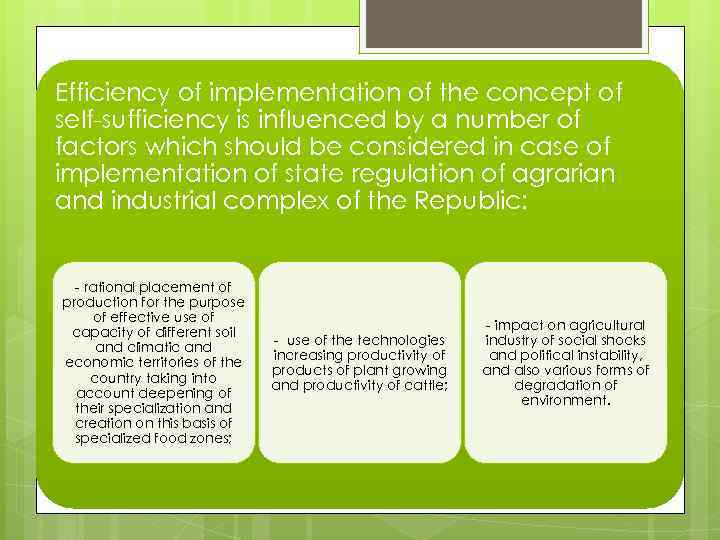 Efficiency of implementation of the concept of self-sufficiency is influenced by a number of factors which should be considered in case of implementation of state regulation of agrarian and industrial complex of the Republic: - rational placement of production for the purpose of effective use of capacity of different soil and climatic and economic territories of the country taking into account deepening of their specialization and creation on this basis of specialized food zones; - use of the technologies increasing productivity of products of plant growing and productivity of cattle; - impact on agricultural industry of social shocks and political instability, and also various forms of degradation of environment.
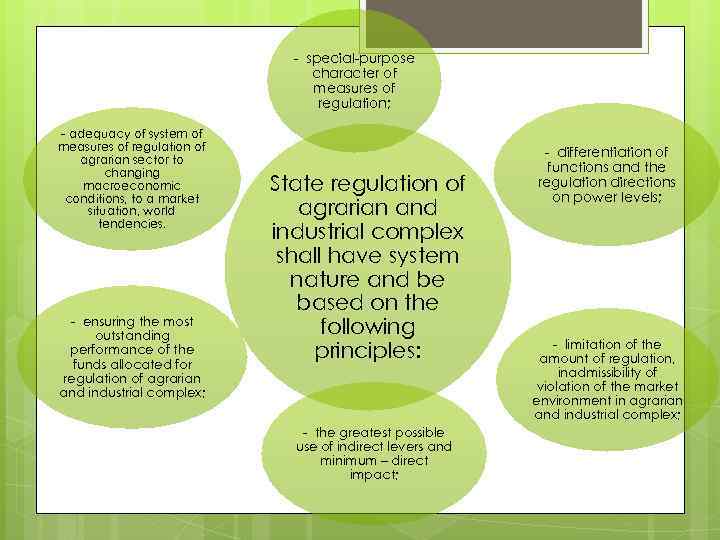 - special-purpose character of measures of regulation; - adequacy of system of measures of regulation of agrarian sector to changing macroeconomic conditions, to a market situation, world tendencies. - ensuring the most outstanding performance of the funds allocated for regulation of agrarian and industrial complex; State regulation of agrarian and industrial complex shall have system nature and be based on the following principles: - the greatest possible use of indirect levers and minimum – direct impact; - differentiation of functions and the regulation directions on power levels; - limitation of the amount of regulation, inadmissibility of violation of the market environment in agrarian and industrial complex;
 The following tools are applied to implementation of tasks of state regulation of agrarian and industrial complex: • - special tax regimes for subjects of the agrofood market; • - purchase, storage, conversion and sale of agricultural products and the food for the state needs; • - establishment of the target, estimated, pledge (guaranteed), intervention prices on agricultural products and the food; • - tariff and non-tariff regulation of import and agricultural export and food, agricultural export and food support; • - subsidies, subventions, guarantees and compensations to agricultural producers and other subjects of the agro food market; • - state investments; • - technical regulations, licenses and other types of restrictions; • - risk management in agricultural industry; • - stimulation of development of institutes and infrastructure of the agrofood market (including credit granting systems, including, mortgage, leasing, insurance, agro-industrial cooperation and integration); • - anti-monopoly regulation; • - elimination of administrative and technical barriers; • - program implementation of a sustainable development of the rural territories and preserving natural resources and natural landscape; • - information support and consulting servicing of subjects of agrofood sector; • - financial improvement of agricultural producers, including debt restructuring; • - stimulation of scientific and technical progress and innovative activities in agrofood sector.
 Based on results of the conducted research, we recommend the following system of measures of the state regulation promoting increase of efficiency of functioning of agrarian and industrial complex of the Republic: • - enhancement of system of the economic relations in the sphere of production, purchase, primary and deep conversion, storage, transportation and sale of agricultural products; • - stimulation of transition of small-scale productions of an agrofood complex in specialized average and krupnotovarny productions, and also transfer of production of animal husbandry and plant growing to an industrial basis; • - optimum combination of the state and market price regulation on agricultural products for the purpose of revival of solvent demand of the population and increase of competitiveness of the domestic food in the domestic and foreign market; • - upgrade and modernization of the entities of processing industry, implementation of advanced technologies and quality management systems (ISO 9000, ISO 14000); • - increase of investment appeal of agro-industrial complex, entering of tax and other privileges which will promote retrofitting of material base of agrarian and industrial complex, forming of an uninterrupted production system, collection and conversion of agricultural raw materials, its delivery to the processing entities and final consumers; • - rational placement on the territory of the country of the entities on conversion of raw materials and agricultural products with their maximum approach to production sites, expansion of practice of construction of the entities, shops and productions directly in farms; • - optimization of production capacities of the entities of processing industry; • - creation of conditions and activization of processes of an exit of the domestic food on the foreign markets, stimulation of export of grain and products of its conversion; • - protection of the population of the Republic against poor-quality products of a food by enhancement of work of services of standardization and certification of goods and development of state standards on main products of a food for the purpose of harmonization with system of international standards; • - stabilization of the food market by the organization of purchasing and commodity interventions; • - enhancement of infrastructure of the agrofood market, in particular, creation in the large cities of the Republic of the municipal wholesale food markets; • - creation of an extensive network of procurement points in rural settlements.
 From the provided list of the actions promoting increase of efficiency of functioning of agrarian and industrial complex and providing on this basis of food security of Kazakhstan, development of system of the wholesale food markets providing effective integration of all accounting entities of agrobusiness, from producers to consumers of agricultural products, raw materials and the food is priority.
 Thanks for attention!