


 Скачать презентацию MTSS Intensive Intervention Improving Reading Gains for
ac2b56e8043445285456d012bcf18d2c.ppt
- Количество слайдов: 101
 MTSS & Intensive Intervention: Improving Reading Gains for All Learners (by CSI Task Force Leaders) Mary Little, Ph. D. University of Central Florida
 To Meet this Goal to Improve Literacy Gains for Students…. We NEED CSI*! *Comprehensive Strategists and Interventionists
 What teachers do matters: - when they monitor their impact and use that information to inform instruction and intervention; -when they reject institutional practices that harm learning; and -and, best of all, when they make literacy learning visible to their students, so students can become their own teachers. • Fisher, Frey, & Hattie, 2016, p. 167
 Advance Organizer Discuss common language and understandings about policies and practices to meet needs of students with and without disabilities within the Multi-Tiered System of Support (MTSS) (formerly Response to Intervention-RTI); Describe and implement instruction and intensive interventions within classrooms and schools to teach students, including students with disabilities, to rigorous new standards; and Share and discuss strategies and resources.
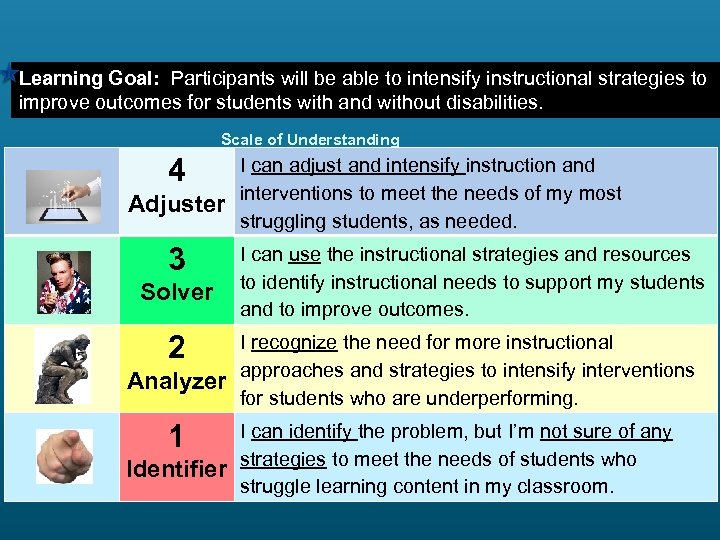 Learning Goal: Participants will be able to intensify instructional strategies to improve outcomes for students with and without disabilities. Scale of Understanding 4 Adjuster 3 Solver 2 Analyzer 1 Identifier I can adjust and intensify instruction and interventions to meet the needs of my most struggling students, as needed. I can use the instructional strategies and resources to identify instructional needs to support my students and to improve outcomes. I recognize the need for more instructional approaches and strategies to intensify interventions for students who are underperforming. I can identify the problem, but I’m not sure of any strategies to meet the needs of students who struggle learning content in my classroom.
 Meet Mrs. Locke… “I finished a whole group instruction lesson with my students and they were now working independently for more practice on identifying the important features of their reading. Some of my students worked diligently, while others seemed uninterested or disengaged. Seeing some students appear confused and unmotivated about the lesson made me think about the MTSS workshop I attended yesterday. The presenter talked about evidence-based core instruction, differentiated instructional practices, tiers, interventions, UDL, and progress monitoring and about what we were or were not doing in our classrooms to meet my students’ needs. ” “How do I begin? ”
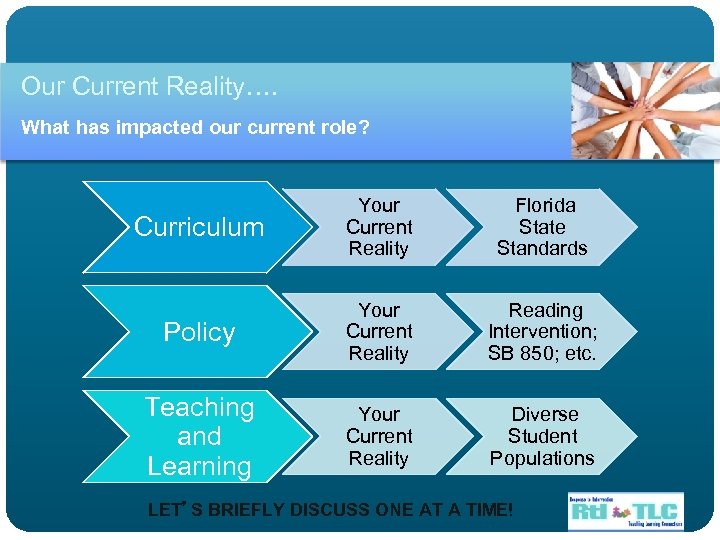 Our Current Reality…. What has impacted our current role? Curriculum Your Current Reality Florida State Standards Policy Your Current Reality Reading Intervention; SB 850; etc. Teaching and Learning Your Current Reality Diverse Student Populations LET’S BRIEFLY DISCUSS ONE AT A TIME!
 Florida Standards and Access Points (FDOE, 2014) Common Core State Standards: Designed to provide consistent, clear understanding of relevant and rigorous learning standards-National Governors Association (NGA) and Council of Chief State School Officers (CCSSO) Florida Standards: Replaced CCSS were replaced by the “Florida Standards” approved by the Florida State Board of Education on February 18, 2014 based on 4 public forums, with 19, 000 comments Access Points: Academic expectations for students with significant cognitive disabilities embedded in the FL. Standards with reduced levels of complexity and assessed with FL Alternate.
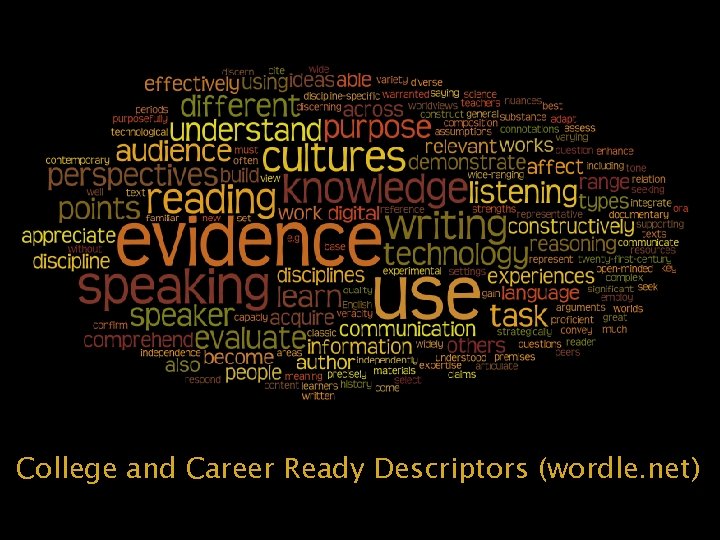 College and Career Ready Descriptors (wordle. net)
 Diversity of Student Population Allmanza, Schonewise & Klingner, 2015 With increased inclusion of students in classrooms, knowledge and skills must include: Specific content Collaborative skills Accommodations to general education curriculum (e. g. , Universal Design for Learning, technology, etc. ) Increased accountability for student outcomes Process of assessment and effective instruction and interventions (RTI; MTSS)
 Recent Related FDOE Policies 1. K-12 Student Reading Intervention Requirements 6 A-6. 054 – “Students who exhibit substantial deficiency in reading based upon locally administered assessments” HB 7069 amends earlier legislation 2. Senate Bill 850 Enacted 2014 “Early warning system” for students based on data 3. Specially Designed Instruction TAP Clarifies IDEA, 2004 related to instruction for SWDs Specialized instruction within MTSS tiers
 Overview of FDOE Policies CONTENT TO SUMMARIZE 1. K-12 Student Reading Intervention Requirements. REVISED-(HB 7069) 2. Senate Bill 850 3. Specially Designed Instruction-Technical Assistance Paper-TAP INSTRUCTIONAL STRATEGIES-READING Cooperative Learning-Jigsaw (Kagan, 2012) (Hattie, #28) EACH individual/group selects critical words from FL policy 1, 2 OR 3. Content Enhancement / Graphic Organizer (Deshler, 2010) (Hattie, #27) EACH individual/group organizes information visually.
 FDOE Policies – Reading Intervention 1. K-12 Student Reading Intervention Requirements 6 A-6. 054 – “Students who exhibits substantial deficiency in reading based upon locally administered assessments” Amends earlier legislation 2. Senate Bill 850 Recently enacted (2014) One section discusses “early warning system” for students based 3. Specially Designed Instruction TAP Clarifies IDEA, 2004 related to instruction for SWDs Specialized instruction within MTSS tiers.
 HB 7069: District Level Policy (10/17) District school boards shall prioritize allocation of remedial and supplemental instructional resources to K-3 students with a substantial deficiency in reading. Parents of students with a substantial deficiency in reading must be notified in writing that the student has a substantial deficiency in reading. The notification and plan must include: A description and explanation, in terms understandable to parents, of the exact nature of the student’s difficulty in learning and lack of achievement in reading Intensive interventions that will be provided A read-at-home plan that includes multisensory strategies must be provided, as well. The school district shall assist schools and teachers with the implementation of explicit, systematic and multisensory reading instruction and intervention strategies for students who receive a good cause exemption from retention.
 What do you know about Response to Intervention/ Multi-Tiered System of Support?
 Every Student Succeeds Act (ESSA, 2016) ESSA stated that to “increase the ability of teachers to effectively teach children with disabilities, including children with significant cognitive disabilities and English Learners (ELs), the use of multi-tier systems of support and positive behavioral intervention and supports” was necessary to help students “meet the challenging academic standards” (Section 2103(b)(3)(F)(ESSA).
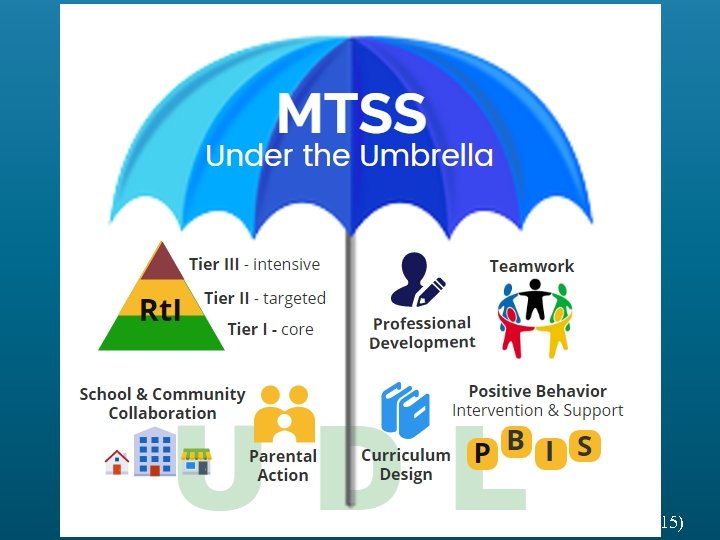 (CEEDAR Center, 2015)
 Federal Legislation The reauthorization of the Individuals with Disabilities Education Act (IDEA) in 2004 specifies: Special education means specially designed instruction, at no cost to the parents, to meet the unique needs of a child with a disability. Students with disabilities are to be considered first and foremost as general education students.
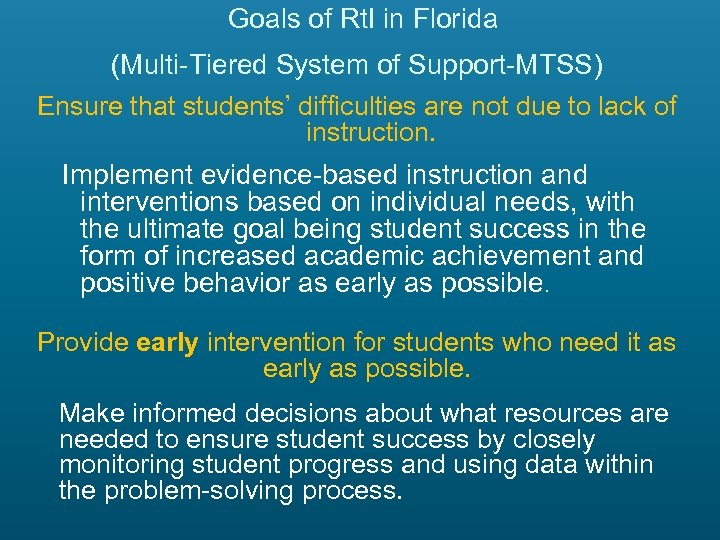 Goals of Rt. I in Florida (Multi-Tiered System of Support-MTSS) Ensure that students’ difficulties are not due to lack of instruction. Implement evidence-based instruction and interventions based on individual needs, with the ultimate goal being student success in the form of increased academic achievement and positive behavior as early as possible. Provide early intervention for students who need it as early as possible. Make informed decisions about what resources are needed to ensure student success by closely monitoring student progress and using data within the problem-solving process.
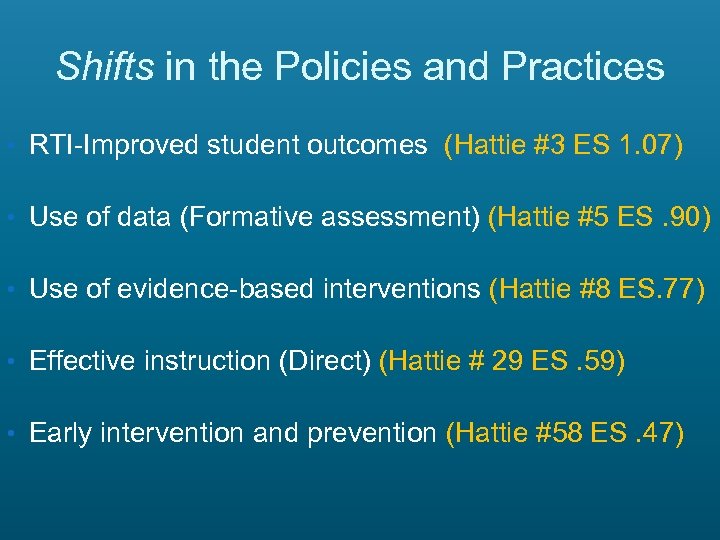 Shifts in the Policies and Practices • RTI-Improved student outcomes (Hattie #3 ES 1. 07) • Use of data (Formative assessment) (Hattie #5 ES. 90) • Use of evidence-based interventions (Hattie #8 ES. 77) • Effective instruction (Direct) (Hattie # 29 ES. 59) • Early intervention and prevention (Hattie #58 ES. 47)
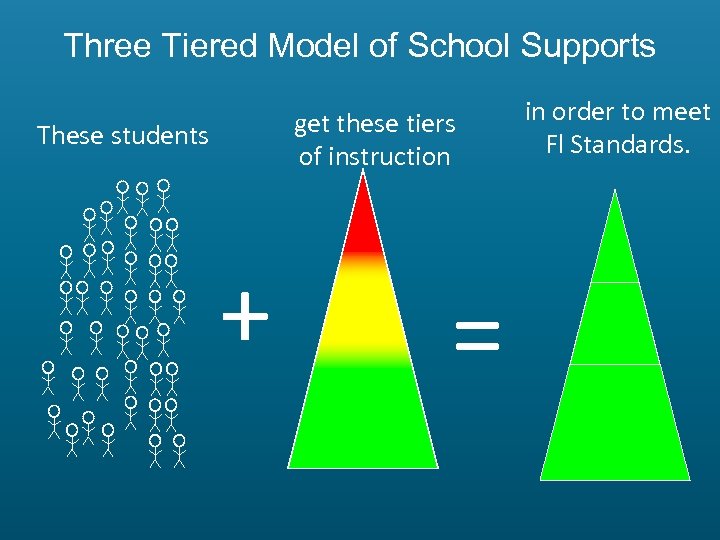 Three Tiered Model of School Supports get these tiers of instruction These students + = in order to meet Fl Standards.
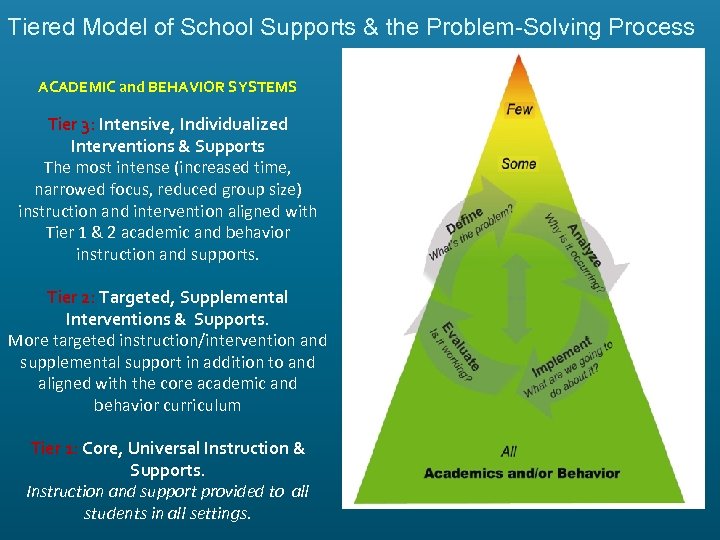 Tiered Model of School Supports & the Problem-Solving Process ACADEMIC and BEHAVIOR SYSTEMS Tier 3: Intensive, Individualized Interventions & Supports The most intense (increased time, narrowed focus, reduced group size) instruction and intervention aligned with Tier 1 & 2 academic and behavior instruction and supports. Tier 2: Targeted, Supplemental Interventions & Supports. More targeted instruction/intervention and supplemental support in addition to and aligned with the core academic and behavior curriculum Tier 1: Core, Universal Instruction & Supports. Instruction and support provided to all students in all settings.
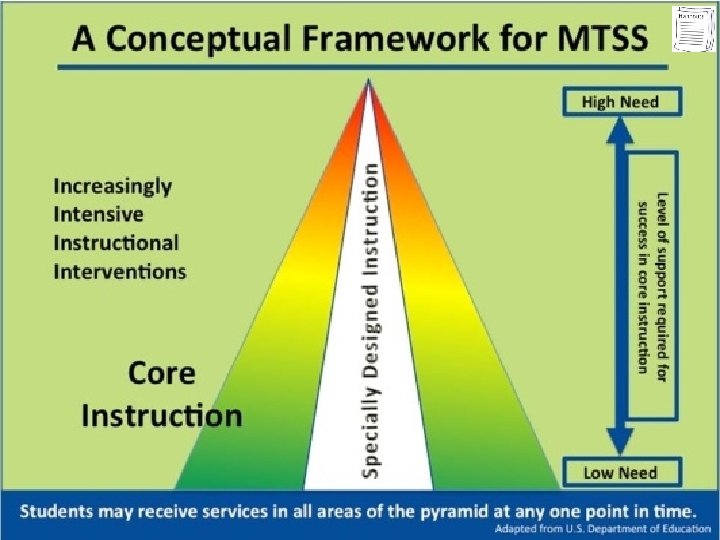
 Chat About it. . . What do you already KNOW about databased individualization and intensive intervention? What does this mean to you in your current role within MTSS?
 Video: Intensive Interventions https: //youtu. be/PXicrm. J 6 HB 4
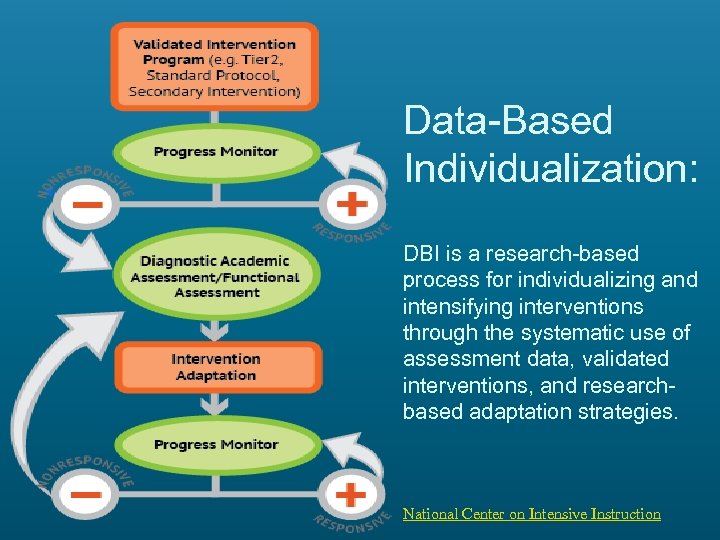 Data-Based Individualization: DBI is a research-based process for individualizing and intensifying interventions through the systematic use of assessment data, validated interventions, and researchbased adaptation strategies. National Center on Intensive Instruction
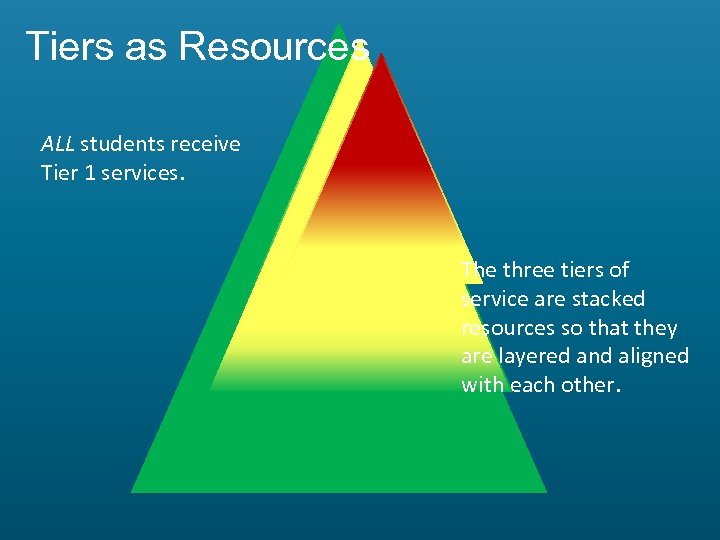 Tiers as Resources ALL students receive Tier 1 services. The three tiers of service are stacked resources so that they are layered and aligned with each other.
 Chat About it. . . What are components and examples of effective instruction within any of the tiers?
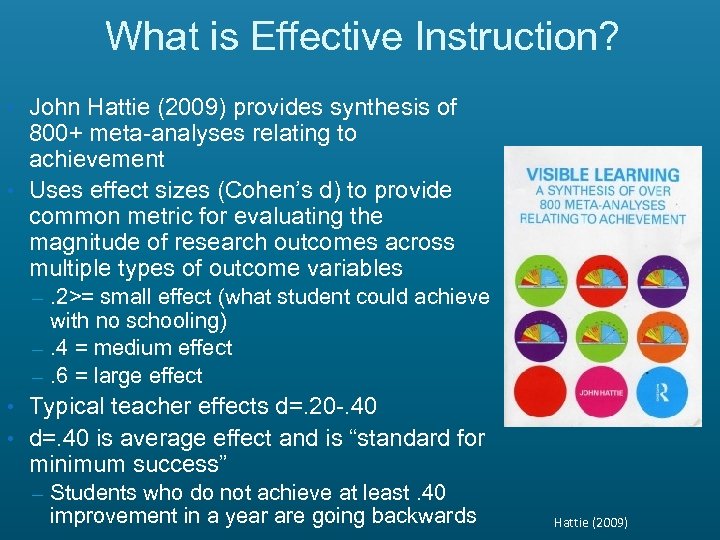 What is Effective Instruction? • John Hattie (2009) provides synthesis of 800+ meta-analyses relating to achievement • Uses effect sizes (Cohen’s d) to provide common metric for evaluating the magnitude of research outcomes across multiple types of outcome variables –. 2>= small effect (what student could achieve with no schooling) –. 4 = medium effect –. 6 = large effect • Typical teacher effects d=. 20 -. 40 • d=. 40 is average effect and is “standard for minimum success” – Students who do not achieve at least. 40 improvement in a year are going backwards Hattie (2009)
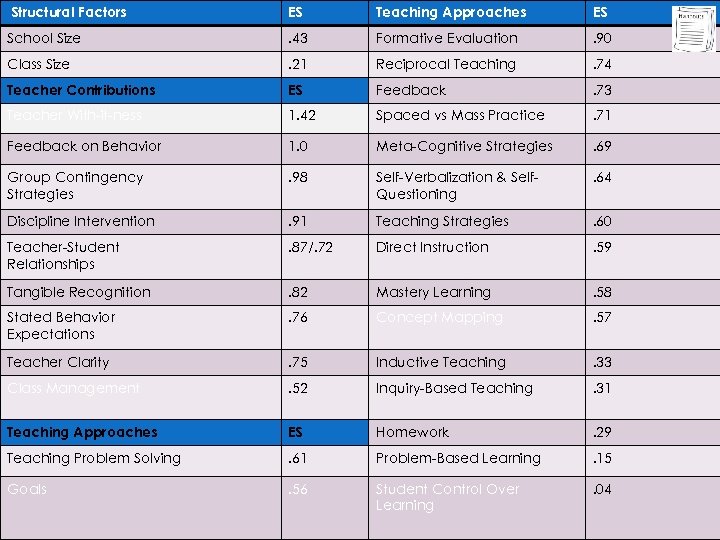 Structural Factors ES Teaching Approaches ES School Size . 43 Formative Evaluation . 90 Class Size . 21 Reciprocal Teaching . 74 Teacher Contributions ES Feedback . 73 Teacher With-it-ness 1. 42 Spaced vs Mass Practice . 71 Feedback on Behavior 1. 0 Meta-Cognitive Strategies . 69 Group Contingency Strategies . 98 Self-Verbalization & Self. Questioning . 64 Discipline Intervention . 91 Teaching Strategies . 60 Teacher-Student Relationships . 87/. 72 Direct Instruction . 59 Tangible Recognition . 82 Mastery Learning . 58 Stated Behavior Expectations . 76 Concept Mapping . 57 Teacher Clarity . 75 Inductive Teaching . 33 Class Management . 52 Inquiry-Based Teaching . 31 Teaching Approaches ES Homework . 29 Teaching Problem Solving . 61 Problem-Based Learning . 15 Goals . 56 Student Control Over Learning . 04
 Case Study Using Data To Make Decisions For Student Intervention Elementary Use the data provided to create an intensive intervention plan for your student.
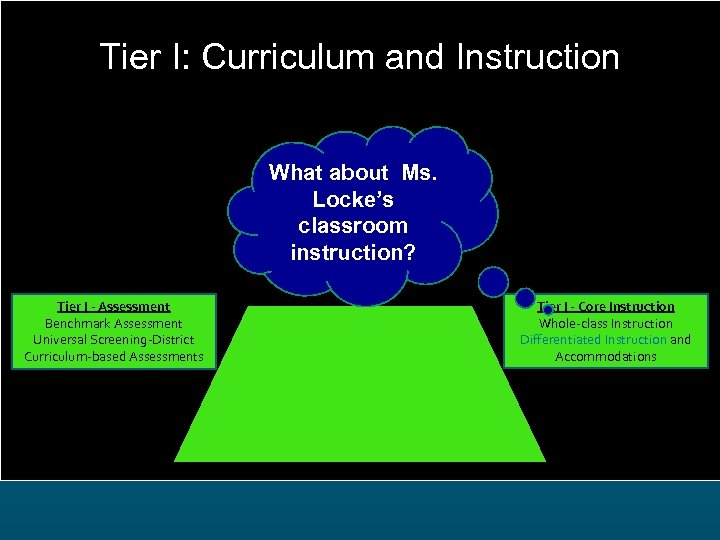 Tier I: Curriculum and Instruction What about Ms. Locke’s classroom instruction? Tier I - Assessment Benchmark Assessment Universal Screening-District Curriculum-based Assessments Tier I - Core Instruction Whole-class Instruction Differentiated Instruction and Accommodations 10 - 15%
 TIER I: Core, Universal Academic and Behavior GOAL: 100% of students achieve at high levels Tier I: Implementing well researched programs and practices demonstrated to produce outcomes for majority of students. Tier I: Effective if at least 80% are meeting benchmarks with access to Core/Universal Instruction. Tier I: Begins with clear goals: 1. What exactly do we expect all students to learn ? 2. How will we know if and when they’ve learned it? 3. How you we respond when some students don’t learn? 4. How will we respond when some students have already learned? Questions 1 and 2 help us ensure a guaranteed and visible literacy curriculum.
 Chat About it. . . Ms. Locke is meeting with the members of her school’s Problem Solving Team. Discuss the Questions. Share your ideas, resources, and knowledge to suggest to Ms. Locke.
 Effective Instruction in Reading Screen students for reading related skills at the beginning of the year and again in the middle of the year who display concerns. Regularly monitor the progress of students at risk at each grade level. Differentiate reading instruction.
 Differentiating Instruction The goal of a differentiated classroom are maximum growth and individual success. Customized to the way individual students learn and how each student is reliably assessed. The teacher adjusts content, process, and product in response to students’ readiness, interests, and learning profile. Students and teachers are collaborators. Flexibility is the hallmark of a differentiated classroom. Tomlinson, 2001
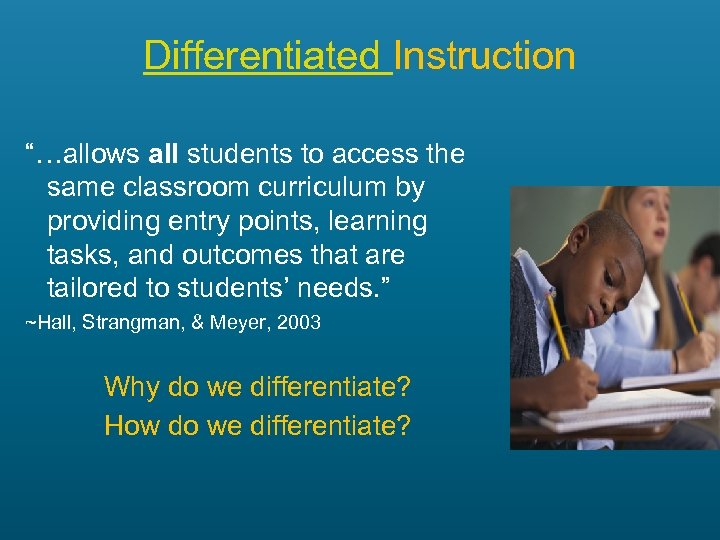 Differentiated Instruction “…allows all students to access the same classroom curriculum by providing entry points, learning tasks, and outcomes that are tailored to students’ needs. ” ~Hall, Strangman, & Meyer, 2003 Why do we differentiate? How do we differentiate?
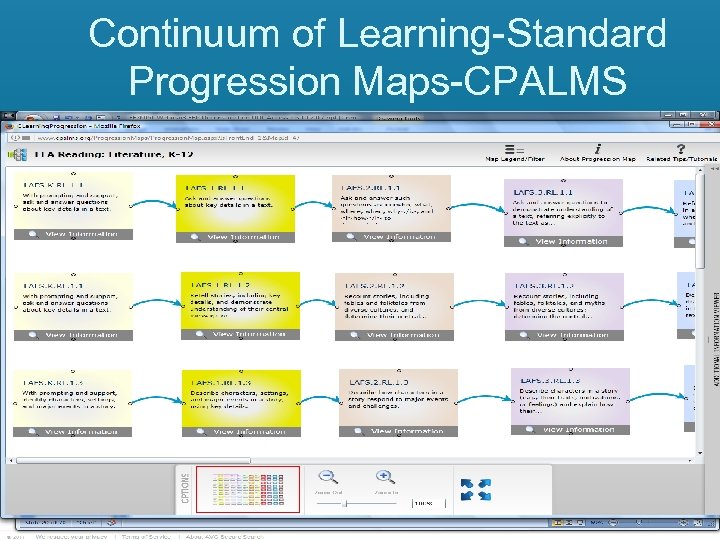 Continuum of Learning-Standard Progression Maps-CPALMS
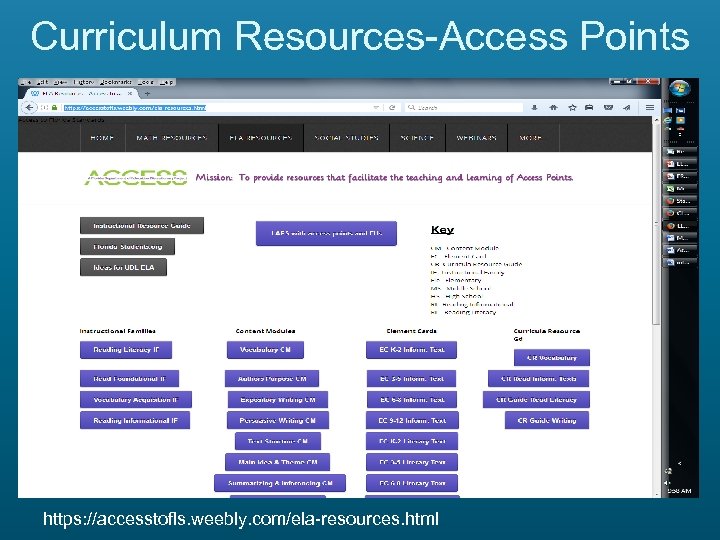 Curriculum Resources-Access Points https: //accesstofls. weebly. com/ela-resources. html
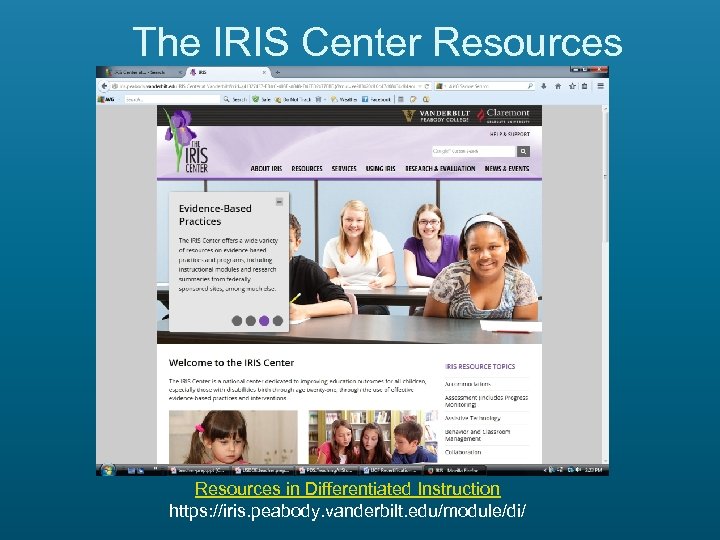 The IRIS Center Resources in Differentiated Instruction https: //iris. peabody. vanderbilt. edu/module/di/
 Universal Design for Learning-UDL
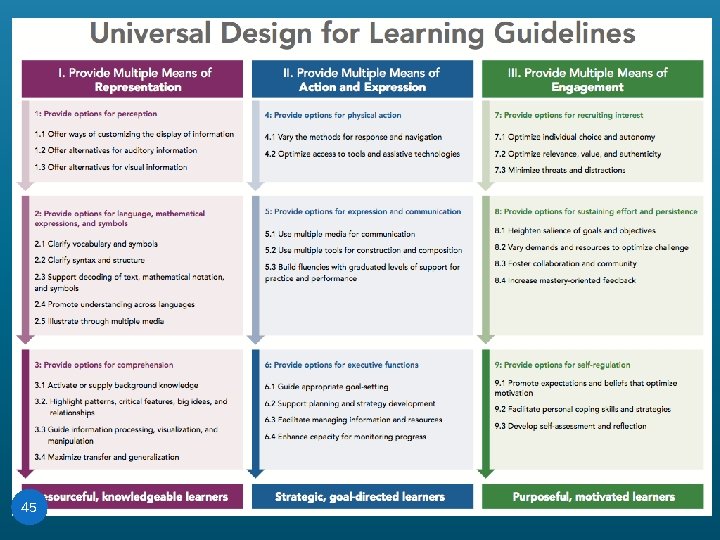
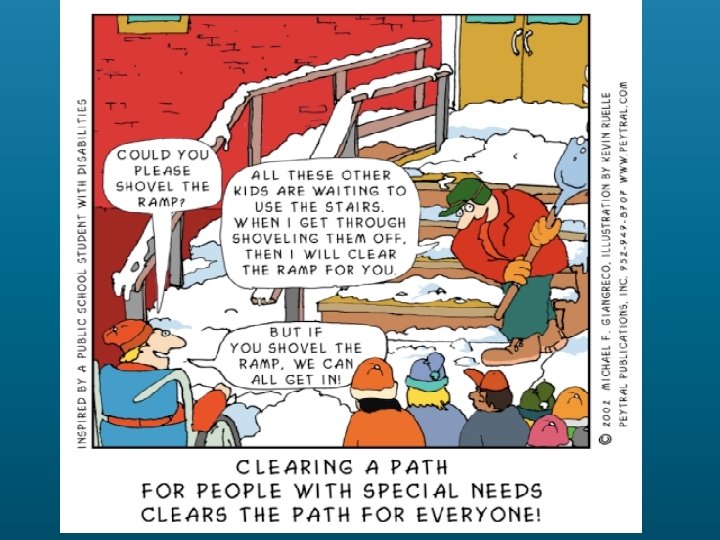
 Universal Design for Learning is an approach that honors neural diversity with principles that provide options for representation, action/expression and engagement when teaching or assessing students. The use of those principles help students become expert learners who are knowledgeable, resourceful, strategic, goal directed, purposeful and motivated.
 Universal Design for Learning UDL provides a blueprint for creating instructional goals, methods, materials, and assessments that are flexible approaches that can be customized and adjusted for individual needs by: - designing curriculum, - shaping instruction, - selecting instructional materials/technology, and - developing assessments that provide greater access to learning for all students. http: //www. cast. org/
 UDL Principles provide: Multiple means of Representation = Flexibility in the way information is presented = More Ways to Access Multiple means of Action and Expression = Flexibility in the away students demonstrate their understanding = More Way to Demonstrate Learning Multiple means of Engagement = Flexibility in the way students are engaged in what they are learning = More Ways to Participate Share our Ideas….
 45
45
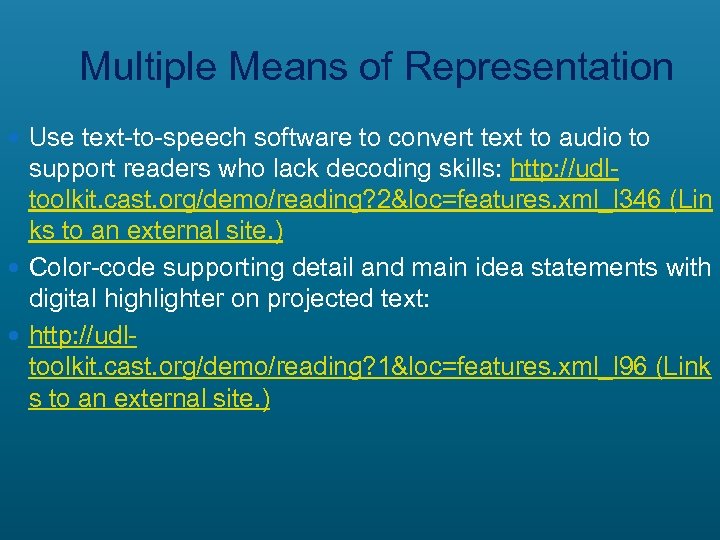 Multiple Means of Representation Use text-to-speech software to convert text to audio to support readers who lack decoding skills: http: //udltoolkit. cast. org/demo/reading? 2&loc=features. xml_l 346 (Lin ks to an external site. ) Color-code supporting detail and main idea statements with digital highlighter on projected text: http: //udltoolkit. cast. org/demo/reading? 1&loc=features. xml_l 96 (Link s to an external site. )
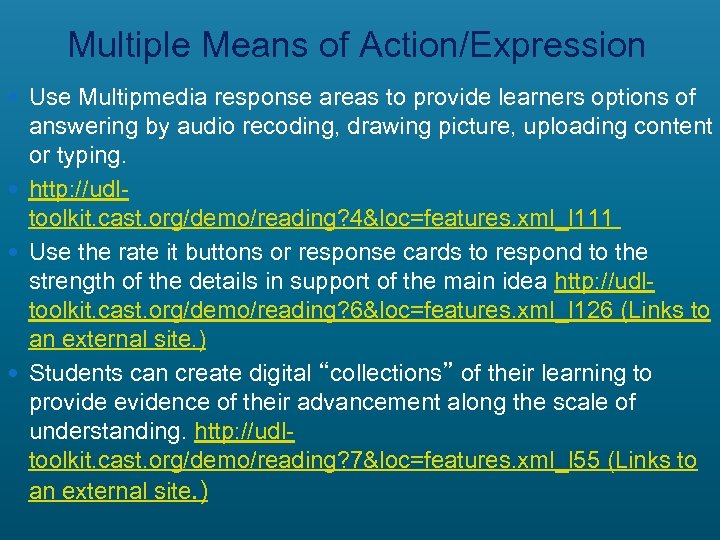 Multiple Means of Action/Expression Use Multipmedia response areas to provide learners options of answering by audio recoding, drawing picture, uploading content or typing. http: //udltoolkit. cast. org/demo/reading? 4&loc=features. xml_l 111 Use the rate it buttons or response cards to respond to the strength of the details in support of the main idea http: //udltoolkit. cast. org/demo/reading? 6&loc=features. xml_l 126 (Links to an external site. ) Students can create digital “collections” of their learning to provide evidence of their advancement along the scale of understanding. http: //udltoolkit. cast. org/demo/reading? 7&loc=features. xml_l 55 (Links to an external site. )
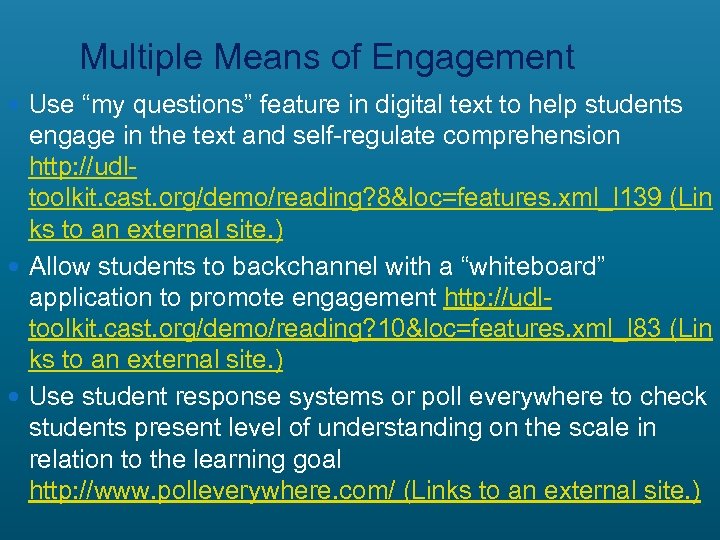 Multiple Means of Engagement Use “my questions” feature in digital text to help students engage in the text and self-regulate comprehension http: //udltoolkit. cast. org/demo/reading? 8&loc=features. xml_l 139 (Lin ks to an external site. ) Allow students to backchannel with a “whiteboard” application to promote engagement http: //udltoolkit. cast. org/demo/reading? 10&loc=features. xml_l 83 (Lin ks to an external site. ) Use student response systems or poll everywhere to check students present level of understanding on the scale in relation to the learning goal http: //www. polleverywhere. com/ (Links to an external site. )
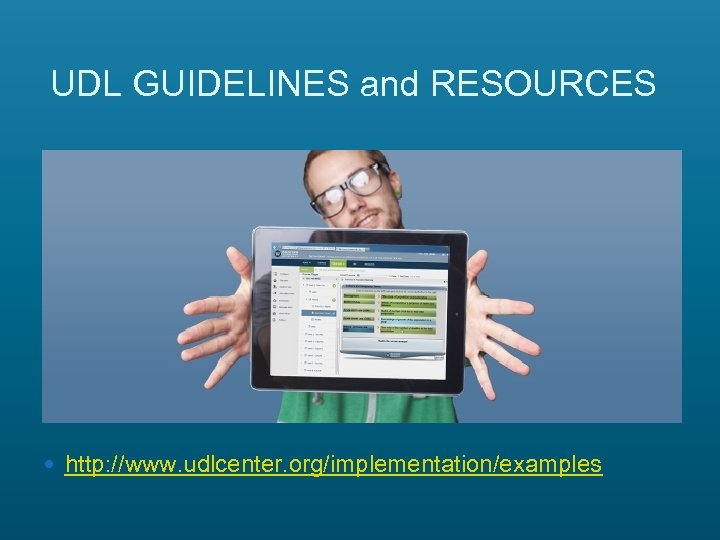 UDL GUIDELINES and RESOURCES http: //www. udlcenter. org/implementation/examples
 UDL and Lesson Planning Work Together Curriculum (goals, methods, materials, and assessments) designed using UDL puts an emphasis on creating effective, flexible goals. The Florida Standards provide an important framework for thinking about what goals should be taught. UDL Lesson Builder
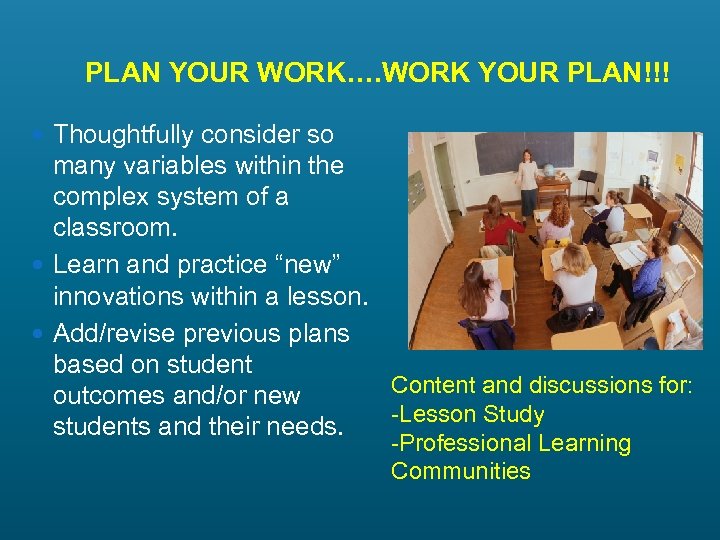 PLAN YOUR WORK…. WORK YOUR PLAN!!! Thoughtfully consider so many variables within the complex system of a classroom. Learn and practice “new” innovations within a lesson. Add/revise previous plans based on student Content and discussions for: outcomes and/or new -Lesson Study students and their needs. -Professional Learning Communities
 Resources-Evidence-based Practices Florida Center for Reading Research www. fcrr. org Center for Evidence-Based Practices http: //www. evidencebasedpractices. org International Literacy Association https: //www. literacyworldwide. org/get-resources Access Center www. k 8 accesscenter. org What Works Clearinghouse http: //www. w-w-c. org IRIS Center of Vanderbilt University www. iris. peabody. vanderbilt. edu/ Intensive Interventions Center www. intensiveintervention. org/ National Research Center for Learning Disabilities www. nrcld. org Visible Learning for Literacy https: //resources. corwin. com/VL-Literacy/student-resources/chapter-1
 Core Components of Curriculum and Instruction A continuum of instructional approaches and accommodations to differentiate to meet individual student needs within whole class to meet each student’s instructional needs to master the content. Instructional Approaches include: 1. Differentiated Instruction 2. Universal Design for Learning (UDL) 3. Progress Monitoring 4. Interventions, Accommodations, and Modifications
 Progress Monitoring
 Selection of Appropriate Data Directly related to academic or behavior goal Benchmark data related to grade level standards Discipline referrals related to academic engaged time Easily measured Collected frequently Sensitive to small changes in behavior Share our Ideas….
 Measure Response to Intervention • Determine a progress monitoring and support schedule. • Interpret and communicate results. • Decide if adjustments are needed if the intervention plan is not yielding the expected results.
 Sources of Data: Tier 1 Tier 2 and 3 State Assessments Benchmark Data Universal Screening Small Group and/or Benchmark Individual Student Diagnostic Assessments Progress Monitoring Data District-Wide Assessments Common Assessments http: //www. intensiveinter vention. org/chart/progre ss-monitoring
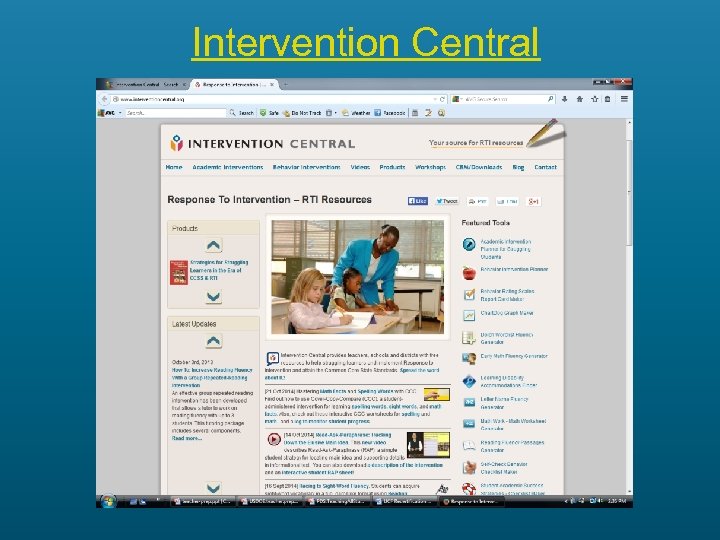 Intervention Central
 Chat About it. . . What is Ms. Locke already doing in her class/school that: 1. Actively engages students; 2. Differentiates based upon student data; 3. Uses technology and principles of UDL; and 3. Uses evidence-based interventional practices? TAKE 5 MINUTES! http: //players. brightcove. net/268012963001/default_default/index. html? video. Id= 4798355018001
 Case Study Using Data To Make Decisions For Student Intervention Elementary Use the data provided to create an intensive intervention plan for your student.
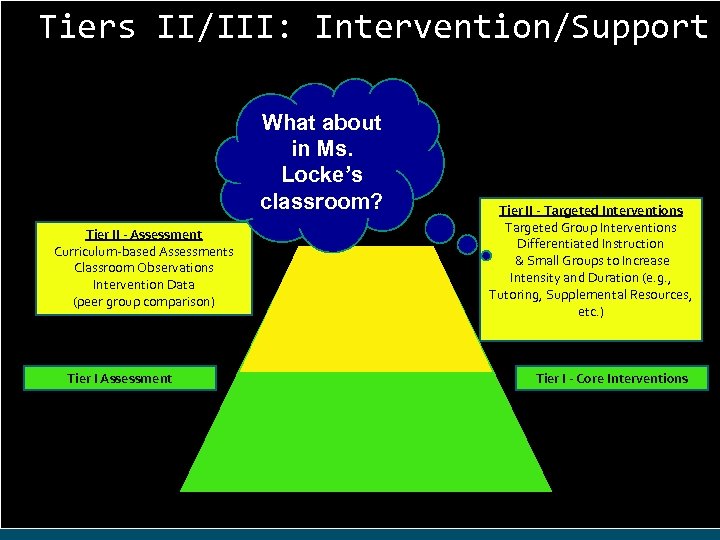 Tiers II/III: Intervention/Support What about in Ms. 1 - 5% Locke’s classroom? Tier II - Assessment Curriculum-based Assessments Classroom Observations Intervention Data (peer group comparison) 80 - 90% Tier I Assessment Tier II - Targeted Interventions Targeted Group Interventions Differentiated Instruction & Small Groups to Increase Intensity and Duration (e. g. , Tutoring, Supplemental Resources, etc. ) Tier I - Core Interventions 10 - 15%
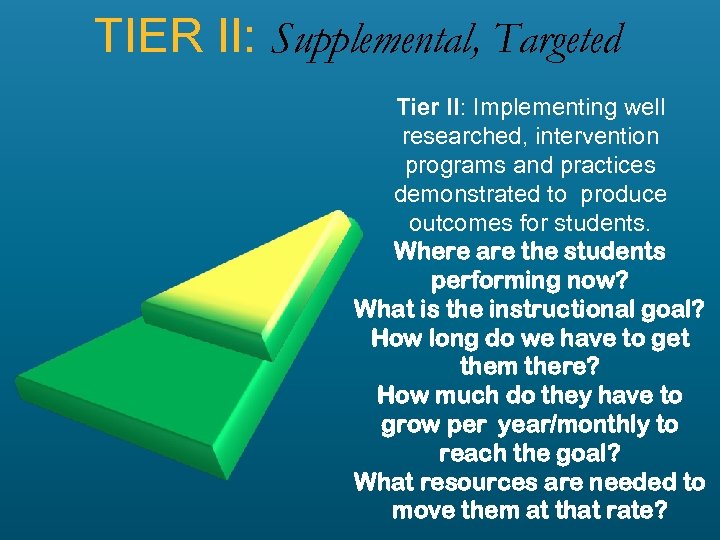 TIER II: Supplemental, Targeted Tier II: Implementing well researched, intervention programs and practices demonstrated to produce outcomes for students. Where are the students performing now? What is the instructional goal? How long do we have to get them there? How much do they have to grow per year/monthly to reach the goal? What resources are needed to move them at that rate?
 Chat About it. . . Ms. Locke is meeting with the members of her school’s Problem Solving Team. Discuss the Questions. Share your ideas, resources, and knowledge to suggest to Ms. Locke.
 Effective Instruction in Reading Tier 2 Provide up to 3 foundational reading skills to students who scored below benchmark on universal screening data. Instruction systematic, highly explicit and interactive on reading skills (phonemic awareness, decoding, fluency and vocabulary). Small group instruction in homogeneous groups for 20 -40 minutes for 3 to 5 days a week. Carefully monitor progress of students at least once a month. Ensure ongoing progress monitoring data to regroup students after six weeks.
 Intensify Instruction Additional Supports and Interventions Accommodations Modifications Resources and supports Interventions Share our Ideas…. Chat About it. . .
 HB 7069: District Level Policy Districts shall provide students who are retained a highly effective teacher, and, by July 1, 2020, retained students shall be provided with a teacher who is certified or endorsed in reading. School districts must establish at each school an intensive acceleration class for students retained in grade 3 or in earlier grades as well. These students must be provided: Uninterrupted reading instruction for majority of student contact time Small group instruction Reduced student teacher ratios The use of explicit, systematic, and multisensory reading interventions The use of a speech-language therapist if necessary Read-at-home plan. Districts must annually report to parents whose student is provided an intensive intervention the response to the intervention.
 Chat About it. . . What do you already KNOW about databased individualization and intensive intervention for Tier 2 and Tier 3? What resources are used within your school and district to intensify instruction?
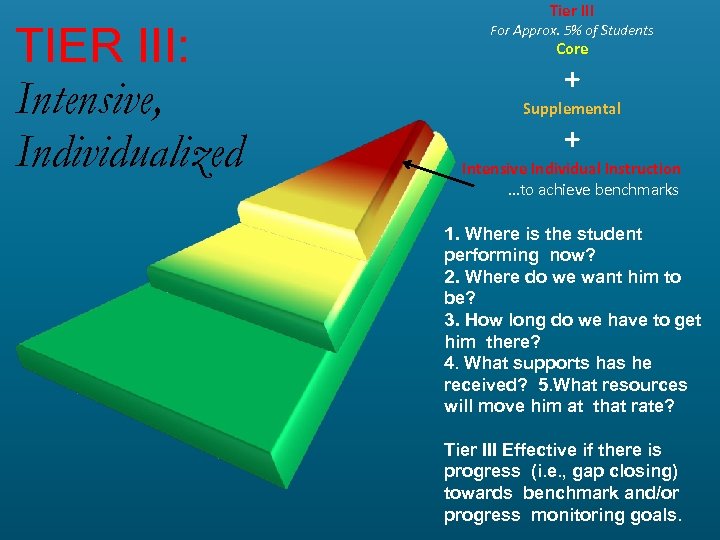 TIER III: Intensive, Individualized Tier III For Approx. 5% of Students Core + Supplemental + Intensive Individual Instruction …to achieve benchmarks 1. Where is the student performing now? 2. Where do we want him to be? 3. How long do we have to get him there? 4. What supports has he received? 5. What resources will move him at that rate? Tier III Effective if there is progress (i. e. , gap closing) towards benchmark and/or progress monitoring goals.
 Tier 3 Instruction Problem solving focus is on individual student Reduction/elimination of barriers If time IS NOT increased, there ARE NOT Tier 3 supports occurring Guided practice is an absolute Corrective feedback is vital Reduction of error rates through intense practice and pre-teaching Do students see the connection to core? Provide instruction so that inaccurate responses are not possible Reduce error rate in responding Neuro-chemical memory of incorrect response Need greater than 1: 1 response Automatize
 Intensify Instructional Delivery Model with clear and detailed explanations Concrete learning opportunities (pictures, graphics, manipulatives, think-alouds) Tasks broken down into small steps Instruction broken down into simple segments Step-by-step strategies Support reduced over a period of time Error correction with increased opportunities Center on Instruction, p. 20
 Tier III Interventions Provide daily intensive targeted reading instruction to few students (even one-on-one) Ensure feedback based on responses, teach to mastery, and plan instruction with instructional sequence Implemented concentrated instruction focused on a small, but targeted set of reading skills Schedule multiple and extended instructional sessions May require up to 30 more repetition as peers Include opportunities for extensive practice and high quality feedback Plan and individualize Tier 3 instruction using input from school based team Ensure mastery of reading skill or strategy prior to moving on From Center on Intensive Interventions, 2015
 Matching Resources to Need Most experience specialized experts who have strong technical skills. Experts in analyzing multiple forms of data and using those data to make accurate instructional decisions. Buy in to ensure effective resources are utilized for the small number of students. National Center on Intensive Intervention (October 2013) http: //www. intensiveintervention. org/intervention-adaptation
 Implications for Intensive Intervention • Students have the most persistent and severe learning and behavioral challenges. • Not a one-size-fits-all approach to learning. • For students who do not respond to traditional forms of instruction and intervention that are effective for the majority of peers. National Center on Intensive Intervention (October 2013)
 What Does It Look Like? Decisions made using a data-based, problem-solving process All problem-solving considers academic and behavior (student engagement) together in the context of universal design A school-based team is responsible for monitoring student performance to determine overall “health” of the school environment Parents are engaged in the problem-solving and instruction/intervention process
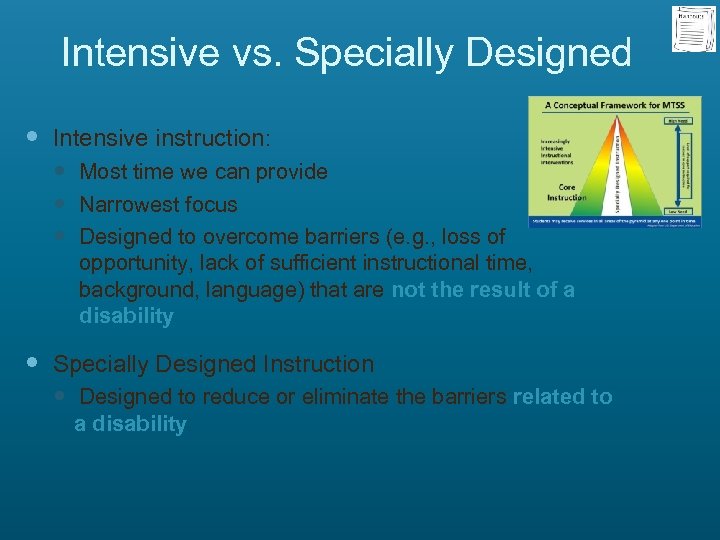 Intensive vs. Specially Designed Intensive instruction: Most time we can provide Narrowest focus Designed to overcome barriers (e. g. , loss of opportunity, lack of sufficient instructional time, background, language) that are not the result of a disability Specially Designed Instruction Designed to reduce or eliminate the barriers related to a disability
 Interventions, Accommodations, and Modifications
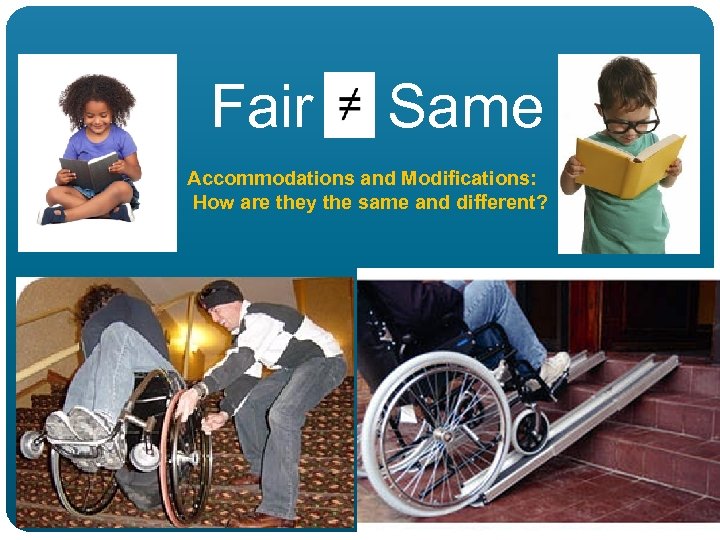 Fair Same Accommodations and Modifications: How are they the same and different?
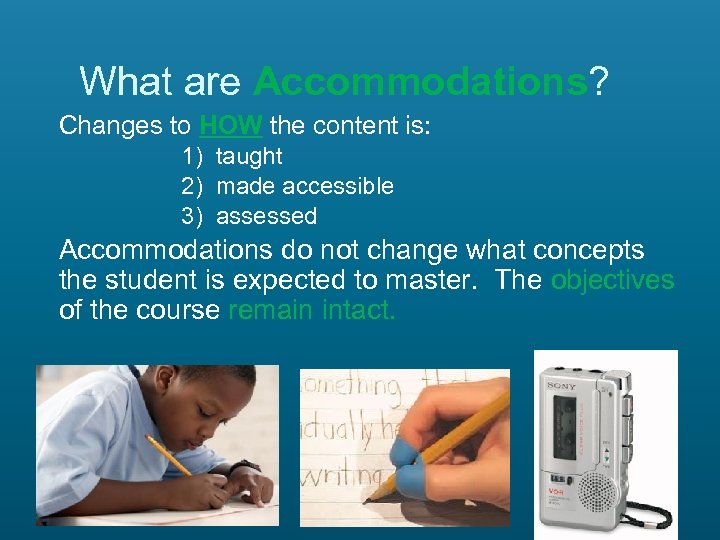 What are Accommodations? Changes to HOW the content is: 1) taught 2) made accessible 3) assessed Accommodations do not change what concepts the student is expected to master. The objectives of the course remain intact.
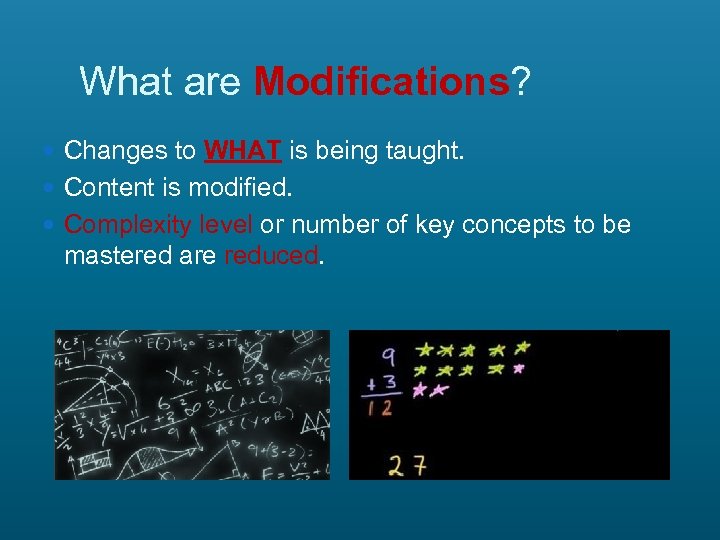 What are Modifications? Changes to WHAT is being taught. Content is modified. Complexity level or number of key concepts to be mastered are reduced.
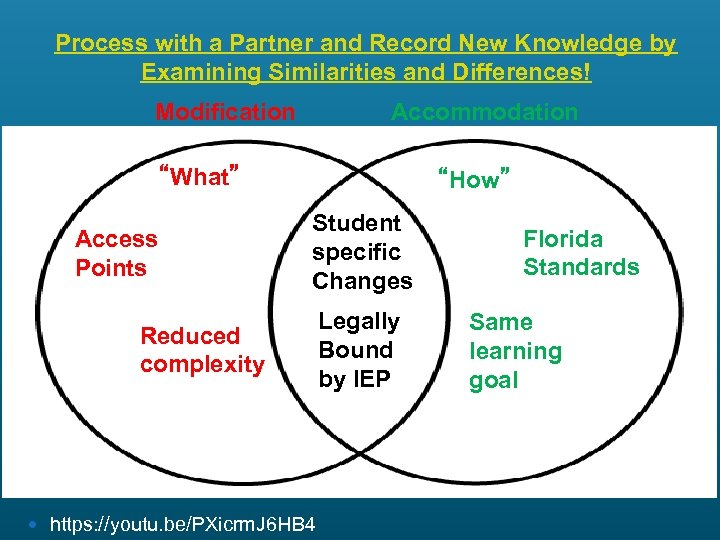 Process with a Partner and Record New Knowledge by Examining Similarities and Differences! Modification Accommodation “What” Access Points “How” Student specific Changes Reduced complexity https: //youtu. be/PXicrm. J 6 HB 4 Legally Bound by IEP Florida Standards Same learning goal
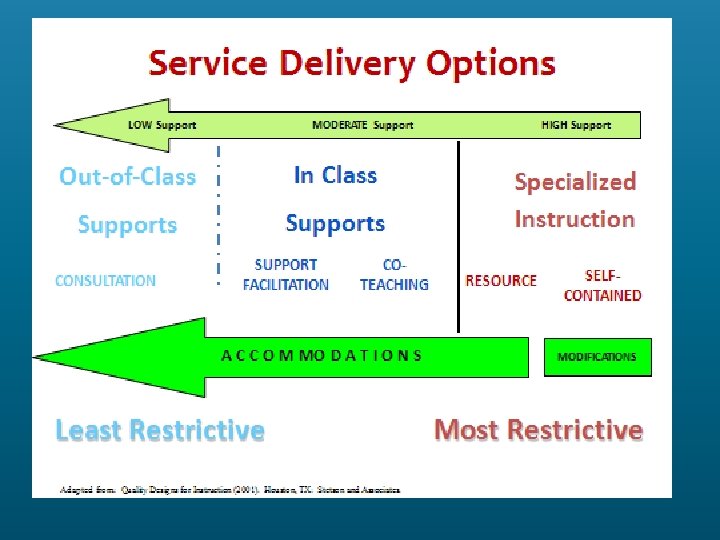
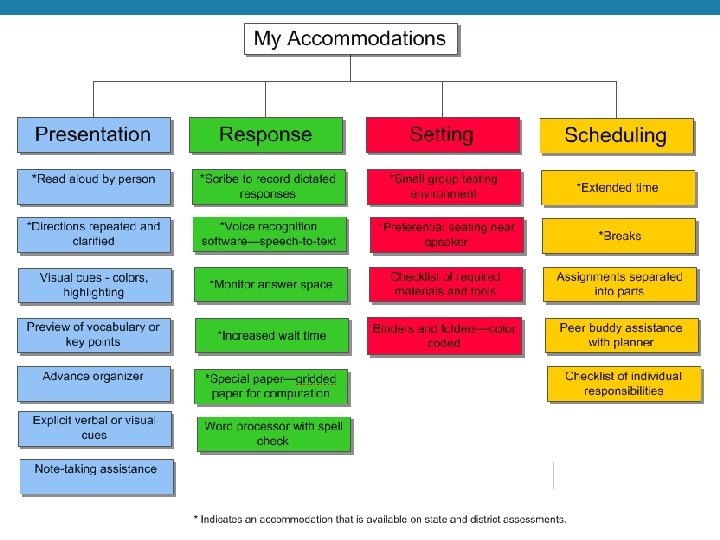
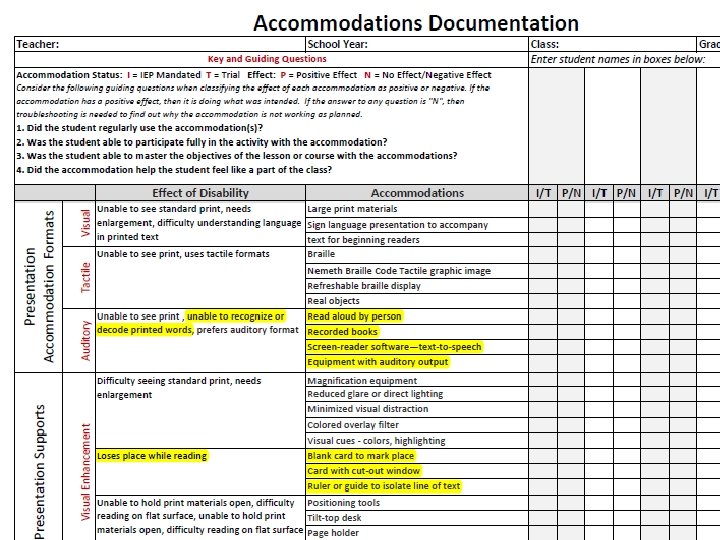
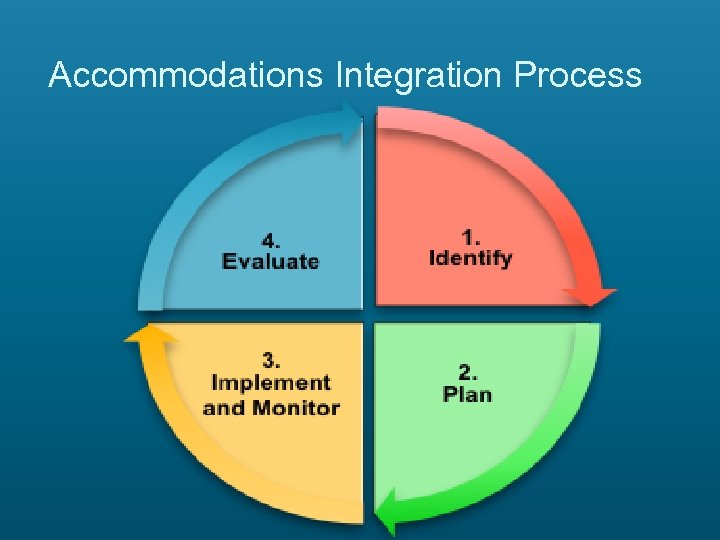 Accommodations Integration Process
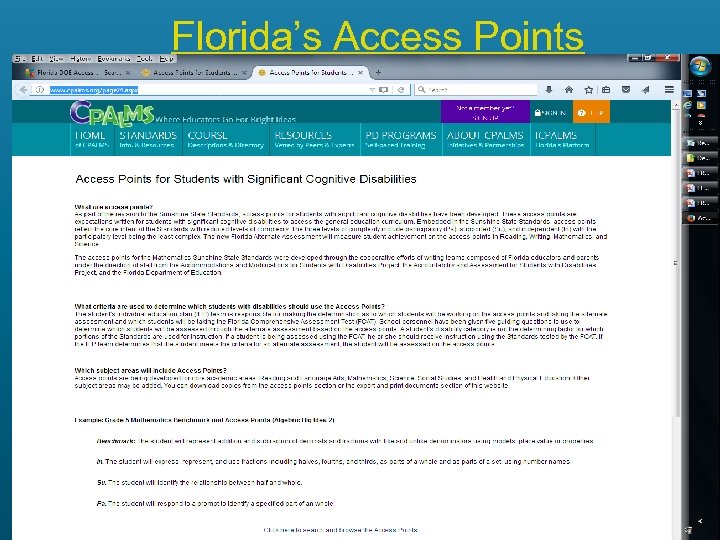 Florida’s Access Points
 Shifts in Thinking The central question is not: “What is causing the problem with the student learning and results? ” BUT “What about the interaction of the curriculum, instruction, environment and learners should be altered so that the students will learn? How do we positively impact teaching that results in improved student learning” This shift alters everything else!
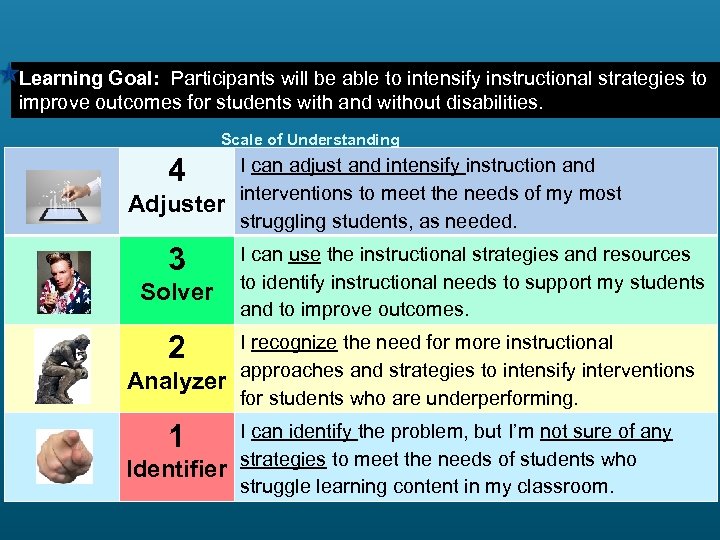 Learning Goal: Participants will be able to intensify instructional strategies to improve outcomes for students with and without disabilities. Scale of Understanding 4 Adjuster 3 Solver 2 Analyzer 1 Identifier I can adjust and intensify instruction and interventions to meet the needs of my most struggling students, as needed. I can use the instructional strategies and resources to identify instructional needs to support my students and to improve outcomes. I recognize the need for more instructional approaches and strategies to intensify interventions for students who are underperforming. I can identify the problem, but I’m not sure of any strategies to meet the needs of students who struggle learning content in my classroom.
 So, How Do We Continue this Journey, CSI? Comprehensive Strategists and Interventionists
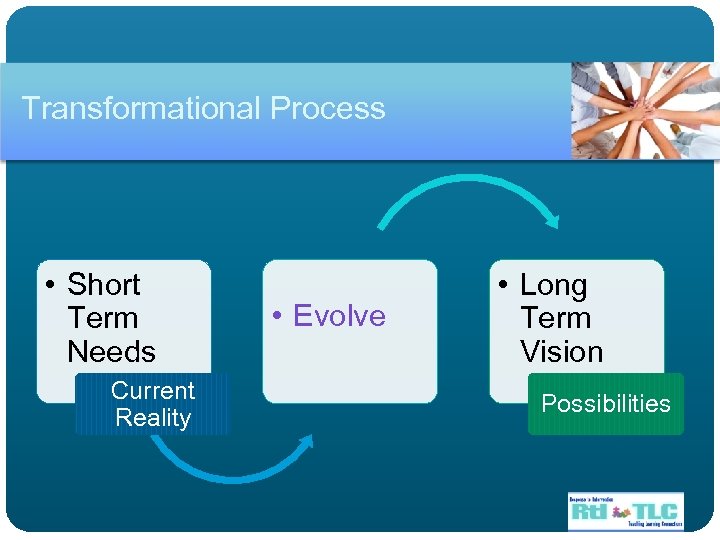 Transformational Process • Short Term Needs Current Reality • Evolve • Long Term Vision Possibilities
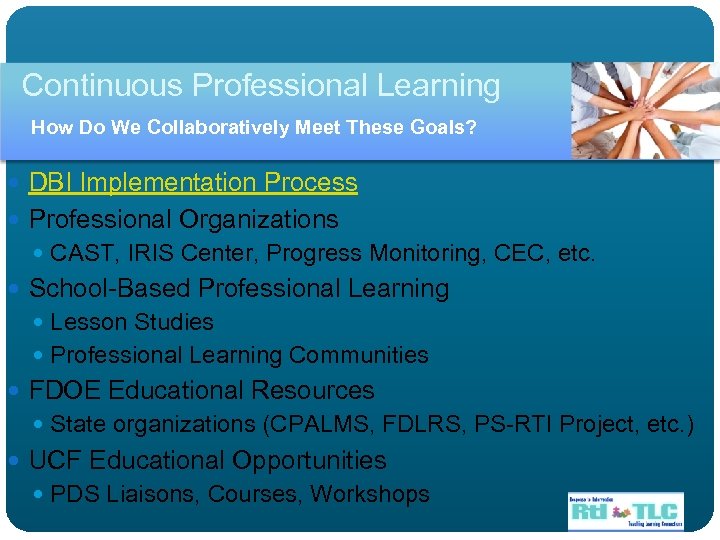 Continuous Professional Learning How Do We Collaboratively Meet These Goals? DBI Implementation Process Professional Organizations CAST, IRIS Center, Progress Monitoring, CEC, etc. School-Based Professional Learning Lesson Studies Professional Learning Communities FDOE Educational Resources State organizations (CPALMS, FDLRS, PS-RTI Project, etc. ) UCF Educational Opportunities PDS Liaisons, Courses, Workshops
 Resources for Teacher Knowledge Tuition-Free Endorsement Programs-UCF ESE Endorsements Tuition Support Program The University of Central Florida provides financial assistance to exceptional student education teachers who are teaching children with Pre-K disabilities, autism spectrum disorders (ASD), or severe/profound disabilities in a Florida public school. Additional information is available here: http: //www. education. ucf. edu
 Resources for Teacher Knowledge Tuition-Free Master’s Degree Programs-UCF Master’s Degree in ESE-Intervention Specialist Certificate The University of Central Florida provides financial assistance to exceptional student education teachers who desire to learn data-based decision-making knowledge and skills as an “Intervention Specialist” in a Florida public school. Additional information is available here: http: //www. education. ucf. edu
 Resources for Teacher Knowledge Tuition-Free Endorsement Programs-FDOE ESE Endorsements Tuition Support Program The Bureau of Exceptional Education and Student Services provides financial assistance to exceptional student education teachers who are teaching children with Pre-K disabilities, autism spectrum disorders (ASD), or severe/profound disabilities in a Florida public school. Additional information is available here: http: //www. floridaese. org/asdendorsement/
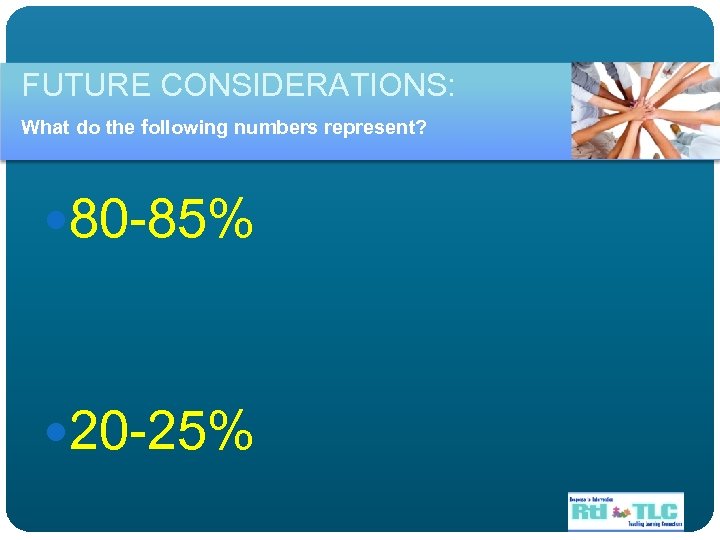 FUTURE CONSIDERATIONS: What do the following numbers represent? 80 -85% 20 -25%
 The greatest privilege is to invent our own future! (Australian Commission on the Future, 2013) Thanks for your continuing commitment to invent our future as educational leaders!
 Resources Rt. I State Web Site: http: //www. florida-rti. org/ Florida Rt. I Introductory Training Course http: //floridarti. usf. edu/intro_course Florida DOE Technical Assistance Paper: The Response to Intervention Model http: //www. fldoe. org/ese/pdf/y 2006 -8. pdf Problem Solving and Response to Intervention http: //floridarti. usf. edu/index. html Rt. I Action Network: A program of National Center for Learning Disabilities - http: //www. rtinetwork. org National Center on Response to Intervention - http: //www. rti 4 success. org Accommodations Overview On-Line Module http: //www. cpt. fsu. edu/ese/training. htm Accommodations Handbook http: //www. fldoe. org/ese/pdf/accomm-educator. pdf
 THANKS FOR A GREAT SESSION! You lift me, and I'll lift you, and we'll ascend together. ~Unknown
 Thanks for choosing to make a difference with each of our students by reading everyday! “Every student deserves a great teacher, not by chance, but by design. ” Check us out: http: //education. ucf. edu/ex ed/IPTPresources. cfm
 Contact Information Mary E. Little, Ph. D. Exceptional Student Education Email: mary. little@ucf. edu Consider a Masters Degree AND a UCF Certificate as an “Intervention Specialist”. WATCH FOR DETAILS!!! UCF Orlando 4000 Central Florida Blvd. Orlando, Florida 32816 -1250 Telephone: 407. 823. 3275