 Скачать презентацию MSc REM Reservoir Structure ½ Module Structure Families
Day5_Structural Families.ppt
- Количество слайдов: 28



MSc REM Reservoir Structure ½ Module Structure Families Sergei Parnachov Gary Couples
MSc REM Reservoir Structure ½ Module Geodynamics Settings l l l Salt Tectonics Fold and Thrust Belts Rifting and Passive Margins Strike-Slip Provinces Stable interior (epicontinental) basins Basement/Cover interactions 2
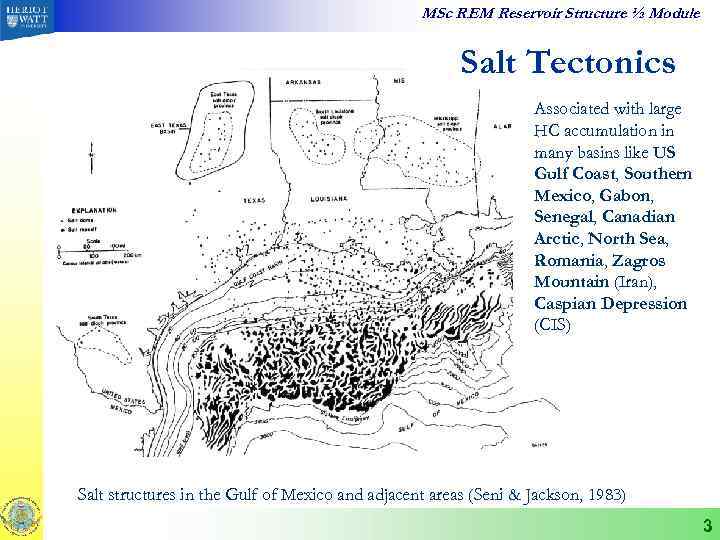
MSc REM Reservoir Structure ½ Module Salt Tectonics Associated with large HC accumulation in many basins like US Gulf Coast, Southern Mexico, Gabon, Senegal, Canadian Arctic, North Sea, Romania, Zagros Mountain (Iran), Caspian Depression (CIS) Salt structures in the Gulf of Mexico and adjacent areas (Seni & Jackson, 1983) 3
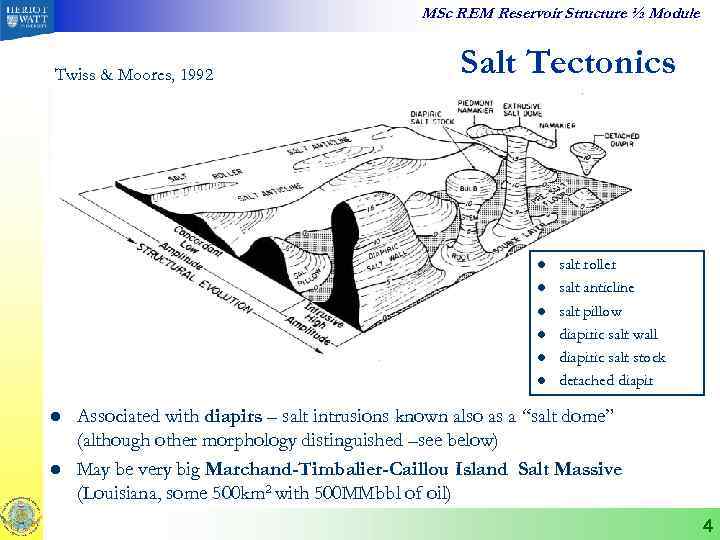
MSc REM Reservoir Structure ½ Module Twiss & Moores, 1992 Salt Tectonics l l l l salt roller salt anticline salt pillow diapiric salt wall diapiric salt stock detached diapir Associated with diapirs – salt intrusions known also as a “salt dome” (although other morphology distinguished –see below) May be very big Marchand-Timbalier-Caillou Island Salt Massive (Louisiana, some 500 km 2 with 500 MMbbl of oil) 4
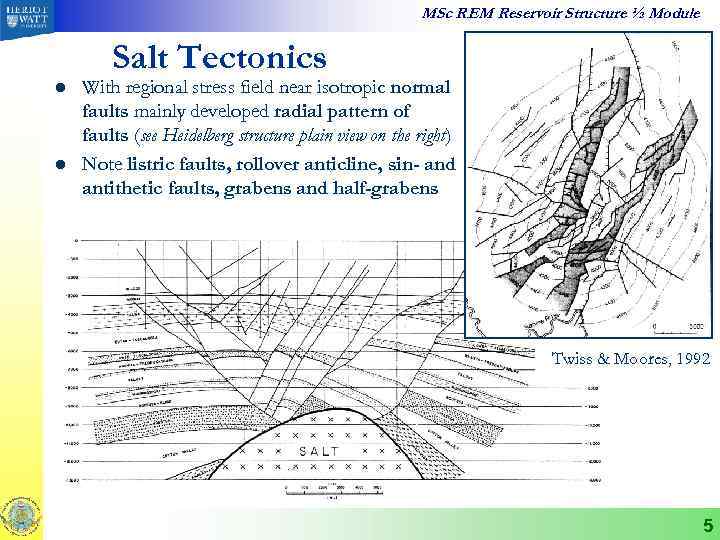
MSc REM Reservoir Structure ½ Module Salt Tectonics l l With regional stress field near isotropic normal faults mainly developed radial pattern of faults (see Heidelberg structure plain view on the right) Note listric faults, rollover anticline, sin- and antithetic faults, grabens and half-grabens Twiss & Moores, 1992 5
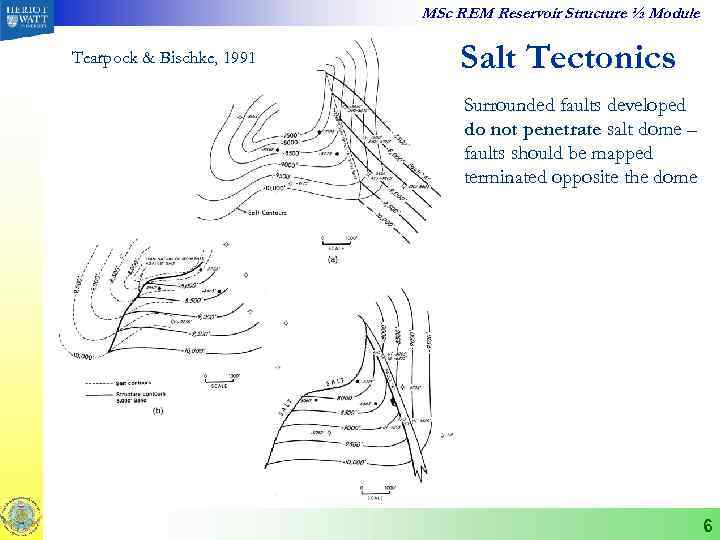
MSc REM Reservoir Structure ½ Module Tearpock & Bischke, 1991 Twiss & Moores, 1992 Salt Tectonics Surrounded faults developed do not penetrate salt dome – faults should be mapped terminated opposite the dome 6
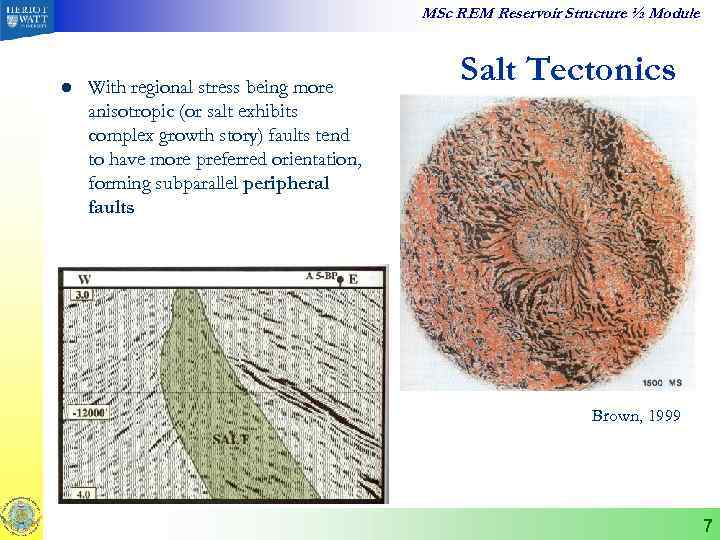
MSc REM Reservoir Structure ½ Module l With regional stress being more anisotropic (or salt exhibits complex growth story) faults tend to have more preferred orientation, forming subparallel peripheral faults Salt Tectonics Brown, 1999 7
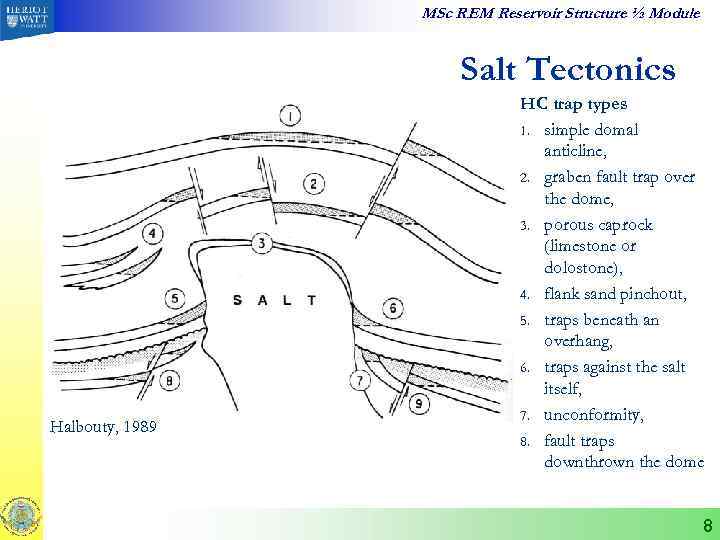
MSc REM Reservoir Structure ½ Module Salt Tectonics Halbouty, 1989 HC trap types 1. simple domal anticline, 2. graben fault trap over the dome, 3. porous caprock (limestone or dolostone), 4. flank sand pinchout, 5. traps beneath an overhang, 6. traps against the salt itself, 7. unconformity, 8. fault traps downthrown the dome 8
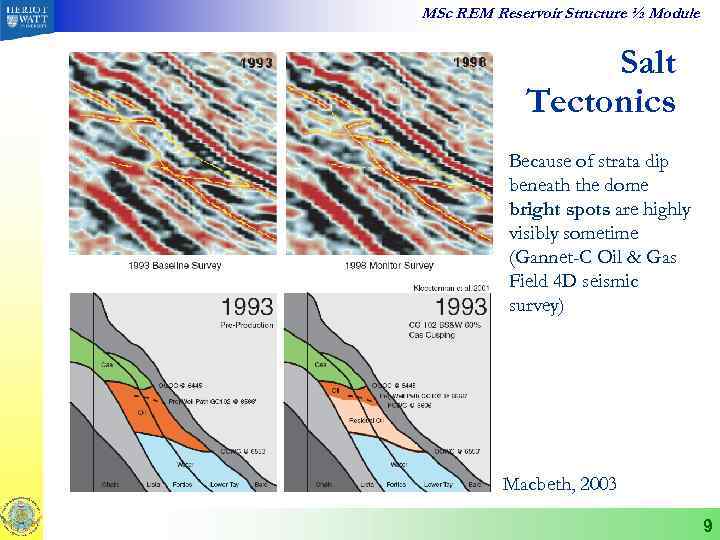
MSc REM Reservoir Structure ½ Module Salt Tectonics Because of strata dip beneath the dome bright spots are highly visibly sometime (Gannet-C Oil & Gas Field 4 D seismic survey) Macbeth, 2003 9
MSc REM Reservoir Structure ½ Module Fold and Thrust Belts Compressional tectonic settings: l l Reverse and thrust faults, forming within a forearc, backarc and collision belt (accretion prism), Anticlines in hanging wall – as a: – – – l fault propagated fold, fault bend folds and duplex structures Zagros collision belt in Iran accounted 75% of the world’s foldand-thrust belt HC production 10
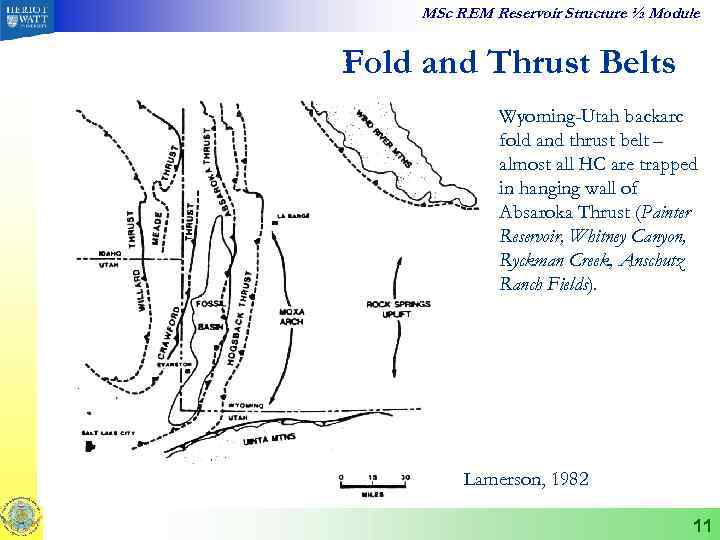
MSc REM Reservoir Structure ½ Module Fold and Thrust Belts Wyoming-Utah backarc fold and thrust belt – almost all HC are trapped in hanging wall of Absaroka Thrust (Painter Reservoir, Whitney Canyon, Ryckman Creek, Anschutz Ranch Fields). Lamerson, 1982 11
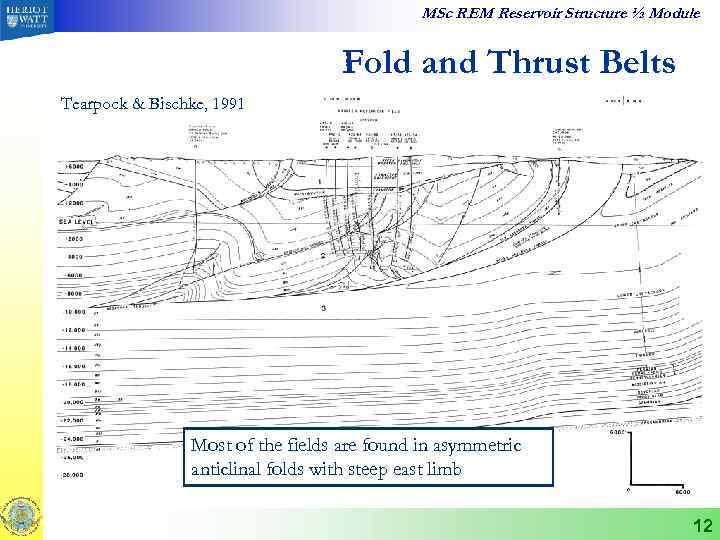
MSc REM Reservoir Structure ½ Module Fold and Thrust Belts Tearpock & Bischke, 1991 Most of the fields are found in asymmetric anticlinal folds with steep east limb Lamerson, 1982 12
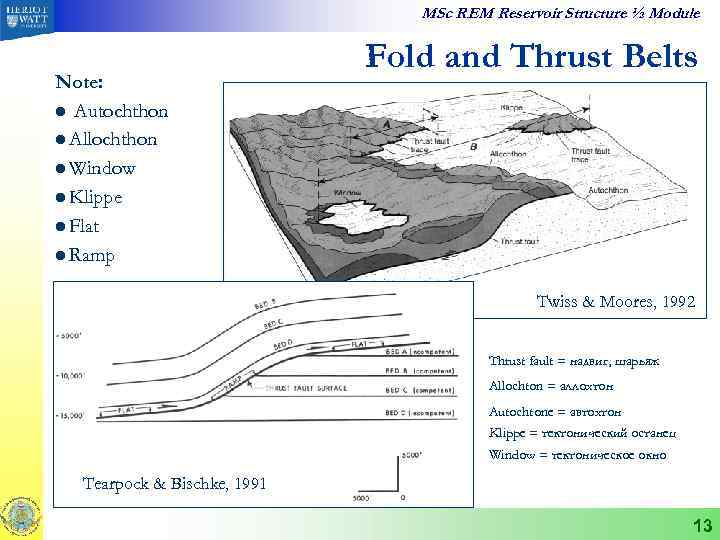
MSc REM Reservoir Structure ½ Module Note: l Autochthon l Allochthon l Window l Klippe l Flat l Ramp Fold and Thrust Belts Twiss & Moores, 1992 Thrust fault = надвиг, шарьяж Allochton = аллохтон Autochtone = автохтон Klippe = тектонический останец Window = тектоническое окно Tearpock & Bischke, 1991 13
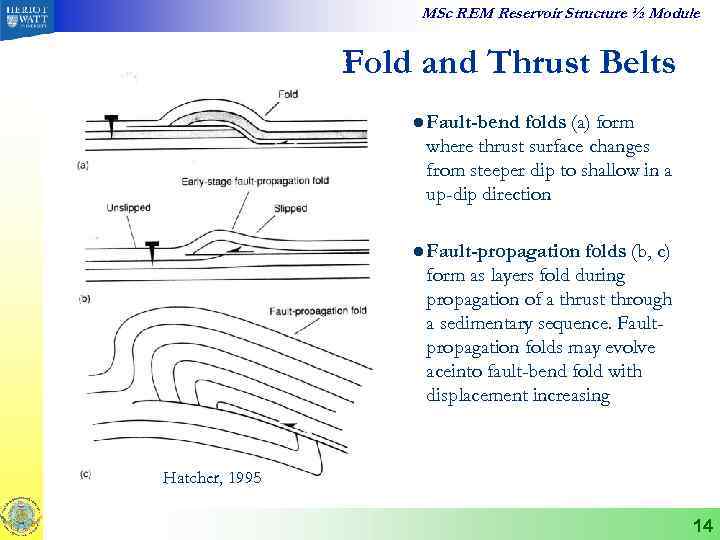
MSc REM Reservoir Structure ½ Module Fold and Thrust Belts l Fault-bend folds (a) form where thrust surface changes from steeper dip to shallow in a up-dip direction l Fault-propagation folds (b, c) form as layers fold during propagation of a thrust through a sedimentary sequence. Faultpropagation folds may evolve aceinto fault-bend fold with displacement increasing Hatcher, 1995 14
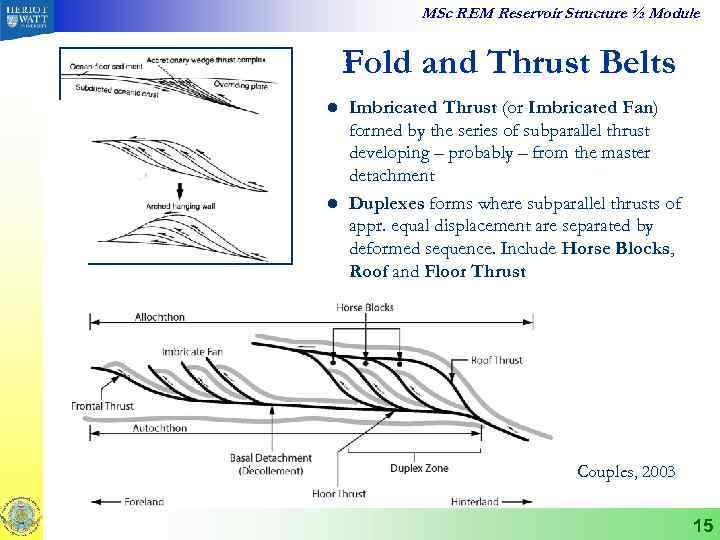
MSc REM Reservoir Structure ½ Module Fold and Thrust Belts l l Imbricated Thrust (or Imbricated Fan) formed by the series of subparallel thrust developing – probably – from the master detachment Duplexes forms where subparallel thrusts of appr. equal displacement are separated by deformed sequence. Include Horse Blocks, Roof and Floor Thrust Couples, 2003 15
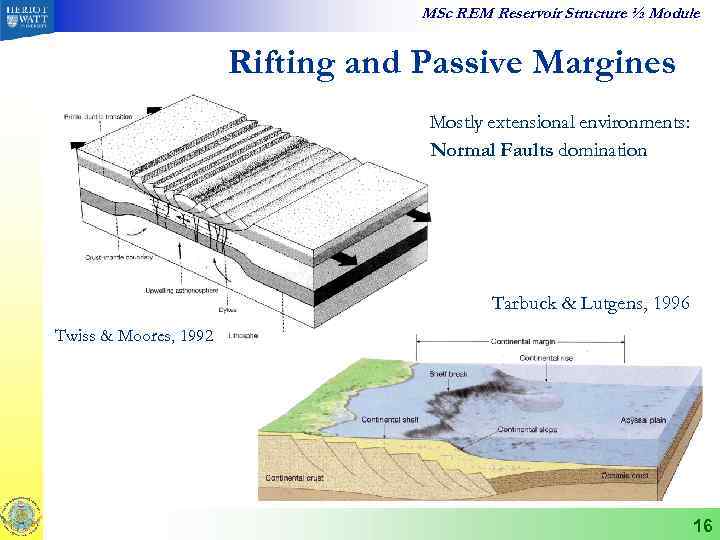
MSc REM Reservoir Structure ½ Module Rifting and Passive Margines Mostly extensional environments: Normal Faults domination Tarbuck & Lutgens, 1996 Twiss & Moores, 1992 16
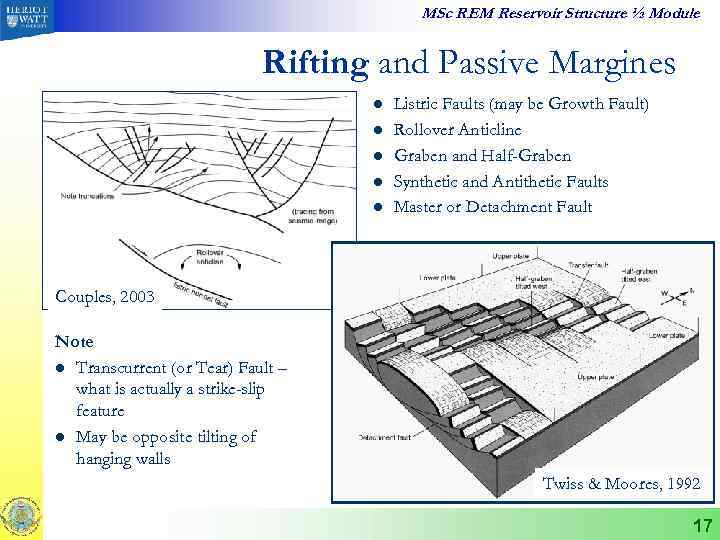
MSc REM Reservoir Structure ½ Module Rifting and Passive Margines l l l Listric Faults (may be Growth Fault) Rollover Anticline Graben and Half-Graben Synthetic and Antithetic Faults Master or Detachment Fault Couples, 2003 Note l Transcurrent (or Tear) Fault – what is actually a strike-slip feature l May be opposite tilting of hanging walls Twiss & Moores, 1992 17
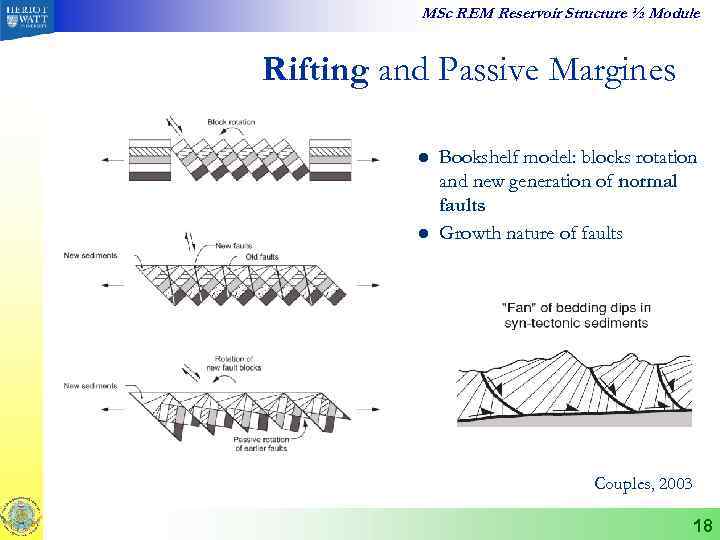
MSc REM Reservoir Structure ½ Module Rifting and Passive Margines l l Bookshelf model: blocks rotation and new generation of normal faults Growth nature of faults Couples, 2003 18
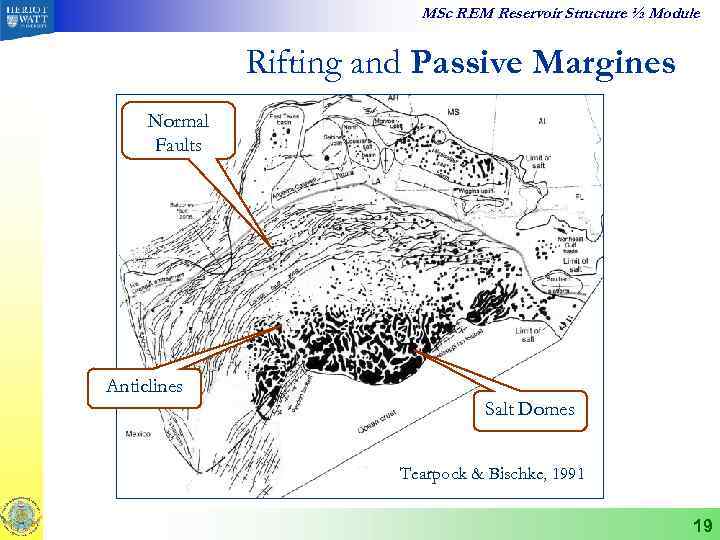
MSc REM Reservoir Structure ½ Module Rifting and Passive Margines Normal Faults Anticlines Salt Domes Tearpock & Bischke, 1991 19
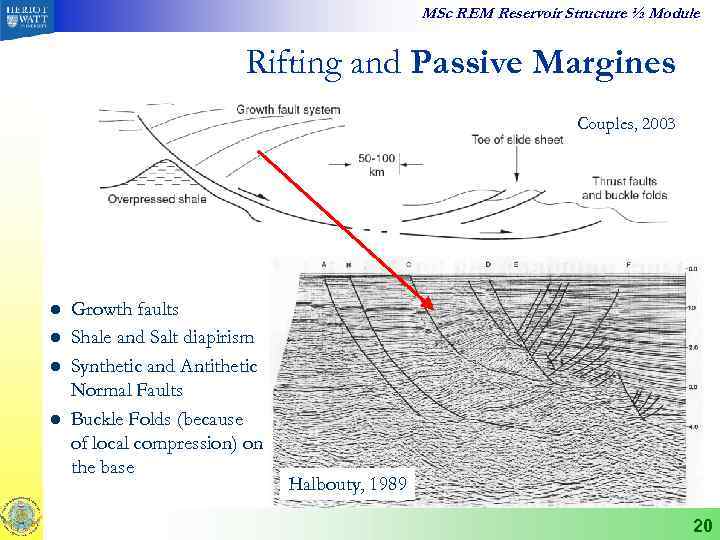
MSc REM Reservoir Structure ½ Module Rifting and Passive Margines Couples, 2003 l l Growth faults Shale and Salt diapirism Synthetic and Antithetic Normal Faults Buckle Folds (because of local compression) on the base Halbouty, 1989 20
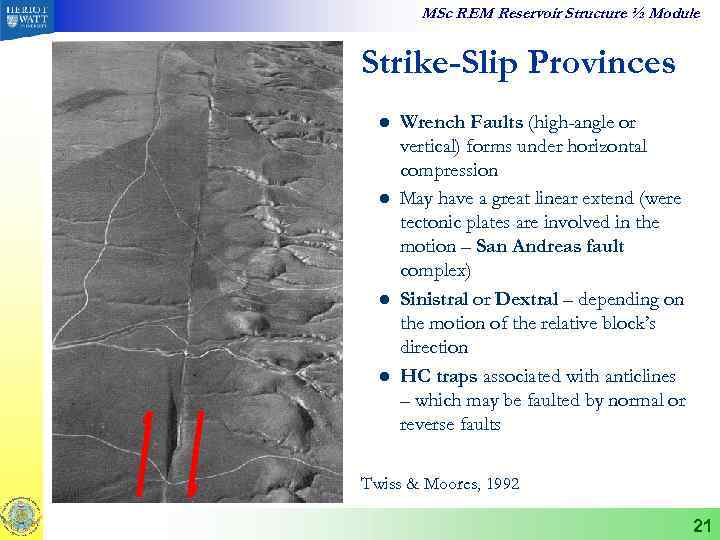
MSc REM Reservoir Structure ½ Module Strike-Slip Provinces l l Wrench Faults (high-angle or vertical) forms under horizontal compression May have a great linear extend (were tectonic plates are involved in the motion – San Andreas fault complex) Sinistral or Dextral – depending on the motion of the relative block’s direction HC traps associated with anticlines – which may be faulted by normal or reverse faults Twiss & Moores, 1992 21
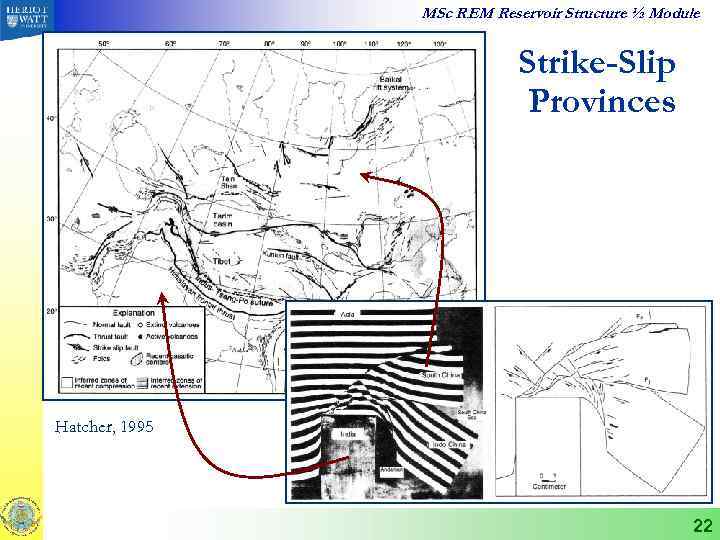
MSc REM Reservoir Structure ½ Module Strike-Slip Provinces Hatcher, 1995 22
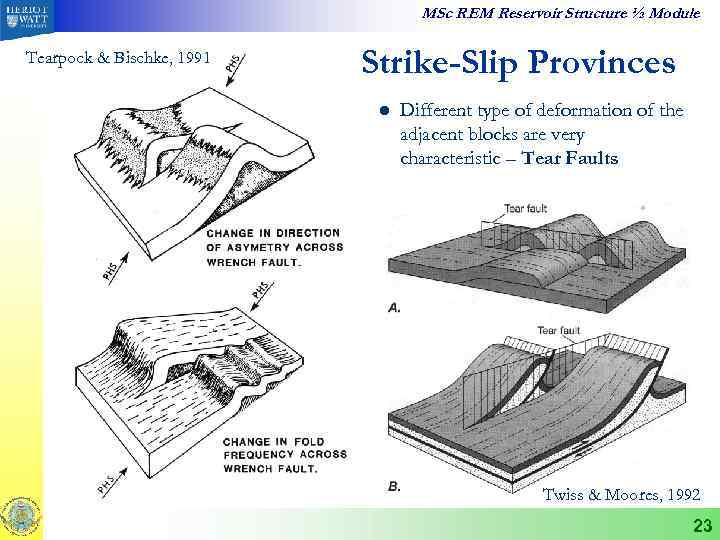
MSc REM Reservoir Structure ½ Module Tearpock & Bischke, 1991 Strike-Slip Provinces l Different type of deformation of the adjacent blocks are very characteristic – Tear Faults Twiss & Moores, 1992 23
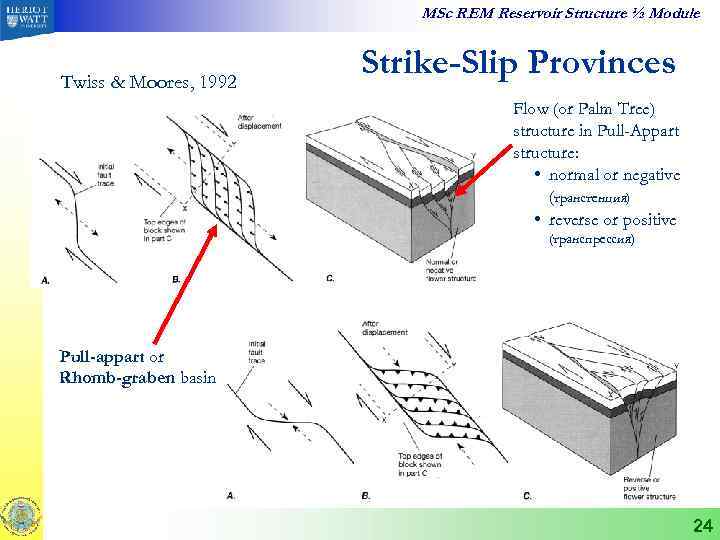
MSc REM Reservoir Structure ½ Module Twiss & Moores, 1992 Strike-Slip Provinces Flow (or Palm Tree) structure in Pull-Appart structure: • normal or negative (транстенция) • reverse or positive (транспрессия) Pull-appart or Rhomb-graben basin 24
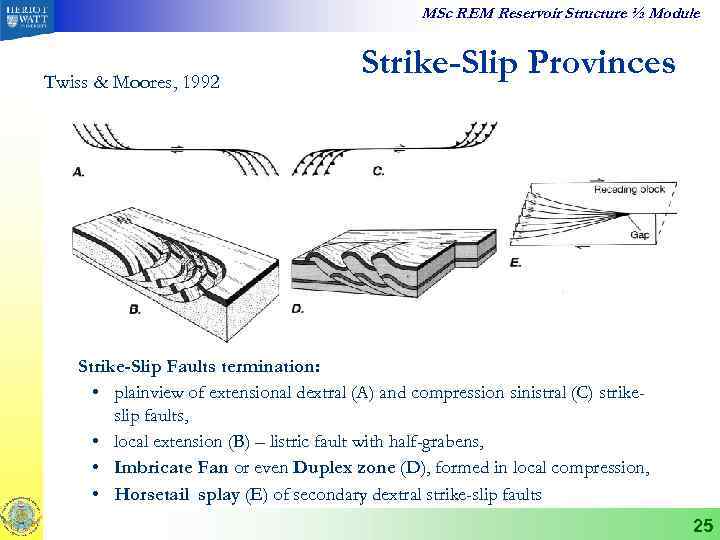
MSc REM Reservoir Structure ½ Module Twiss & Moores, 1992 Strike-Slip Provinces Strike-Slip Faults termination: • plainview of extensional dextral (A) and compression sinistral (C) strikeslip faults, • local extension (B) – listric fault with half-grabens, • Imbricate Fan or even Duplex zone (D), formed in local compression, • Horsetail splay (E) of secondary dextral strike-slip faults 25
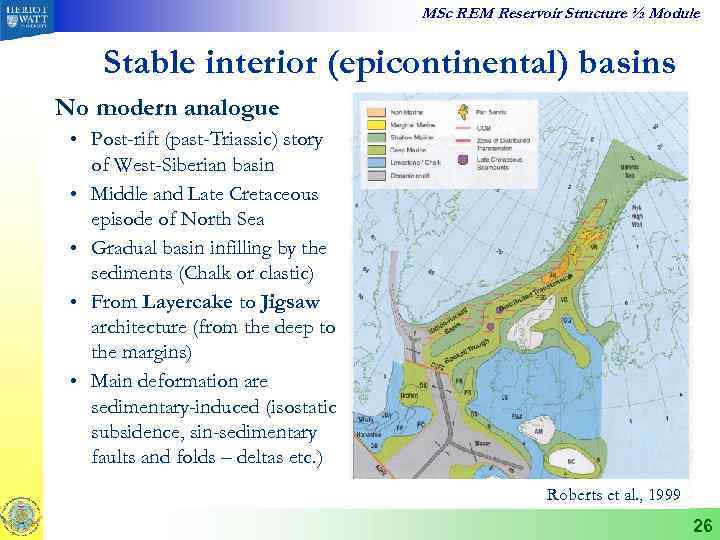
MSc REM Reservoir Structure ½ Module Stable interior (epicontinental) basins No modern analogue • Post-rift (past-Triassic) story of West-Siberian basin • Middle and Late Cretaceous episode of North Sea • Gradual basin infilling by the sediments (Chalk or clastic) • From Layercake to Jigsaw architecture (from the deep to the margins) • Main deformation are sedimentary-induced (isostatic subsidence, sin-sedimentary faults and folds – deltas etc. ) Roberts et al. , 1999 26
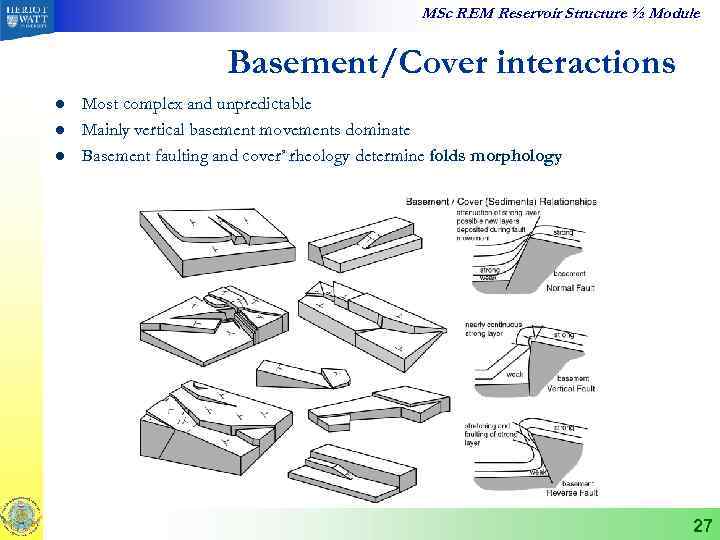
MSc REM Reservoir Structure ½ Module Basement/Cover interactions l l l Most complex and unpredictable Mainly vertical basement movements dominate Basement faulting and cover’ rheology determine folds morphology 27
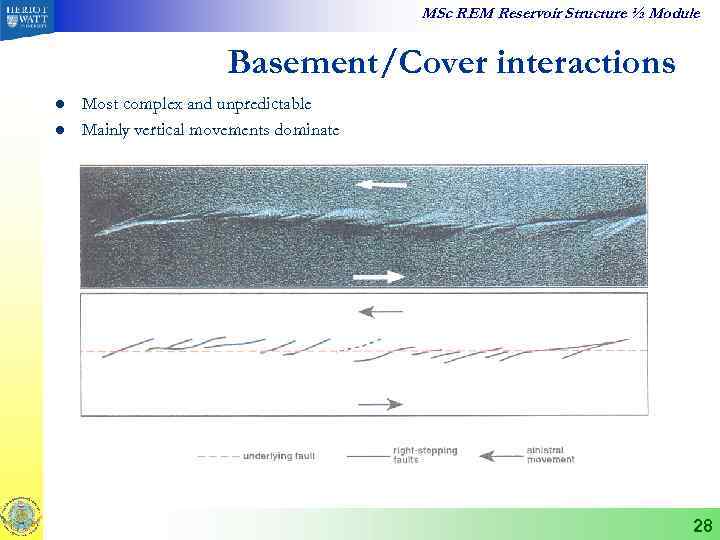
MSc REM Reservoir Structure ½ Module Basement/Cover interactions l l Most complex and unpredictable Mainly vertical movements dominate 28
Скачать презентацию MSc REM Reservoir Structure ½ Module Structure Families
Day5_Structural Families.ppt