 Скачать презентацию MSc REM INDIVIDUAL PROJECT Faults transmissibility assessment for
12_Final presentation_v1_Shpindler.pptx
- Количество слайдов: 34



MSc REM INDIVIDUAL PROJECT Faults transmissibility assessment for terrigenious reservoir of K oilfield Andrey Shpindler Supervisor from HW ASC Sergei Parnachev 1
Main aims: • Faults transmissibility calculation by different techniques. • Choosing the most applicable calculation technique for transmissibility assessment. • Recognizing dependences between fault geometry, reservoir basic properties and fault transmissibility for practical use. 2
Main objects: 1. Recognizing approved techniques for fault transmissibility assessment. 2. Fault throw calculation. 3. Geomodelling and transmissibility assessment by selected techniques. 4. Choosing the best techniques by history matching and fluids contact level analysis. 3
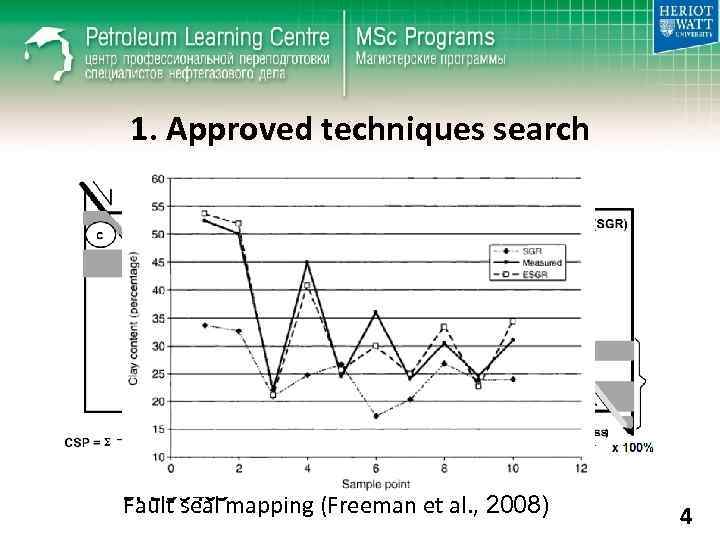
1. Approved techniques search SPE 59405 Fault seal mapping (Freeman et al. , 2008) 4
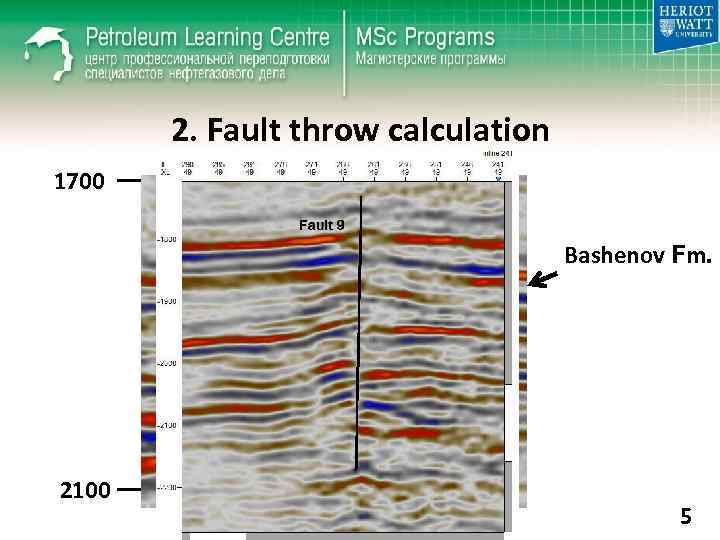
2. Fault throw calculation 1700 Fault 18 Bashenov Fm. 2100 Хline 128 5
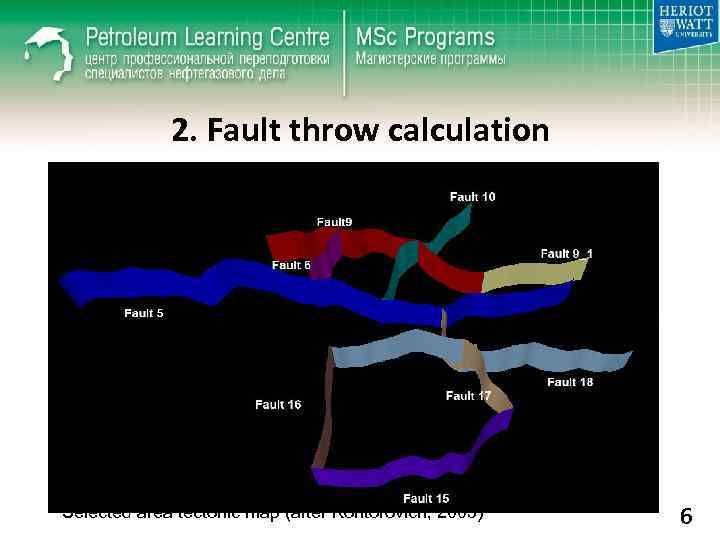
2. Fault throw calculation Selected area tectonic map (after Kontorovich, 2003) 6
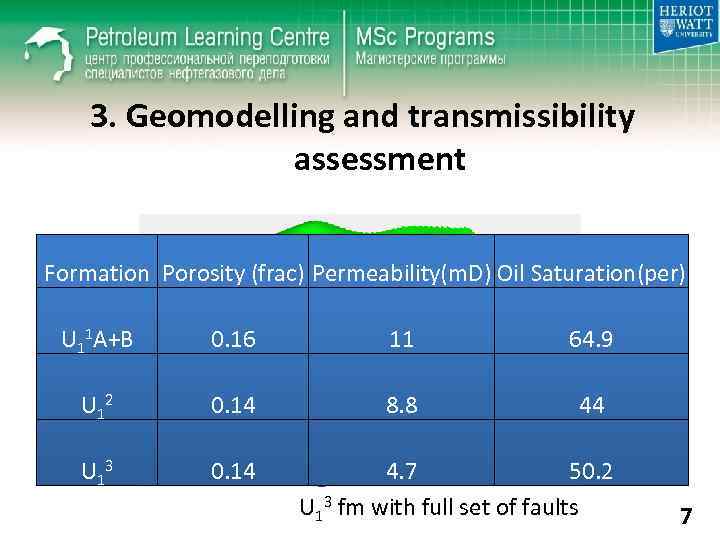
3. Geomodelling and transmissibility assessment Formation Porosity (frac) Permeability(m. D) Oil Saturation(per) U 11 A+B 0. 16 11 64. 9 U 12 0. 14 8. 8 44 U 13 0. 14 4. 7 50. 2 U 13 fm with full set of faults 7
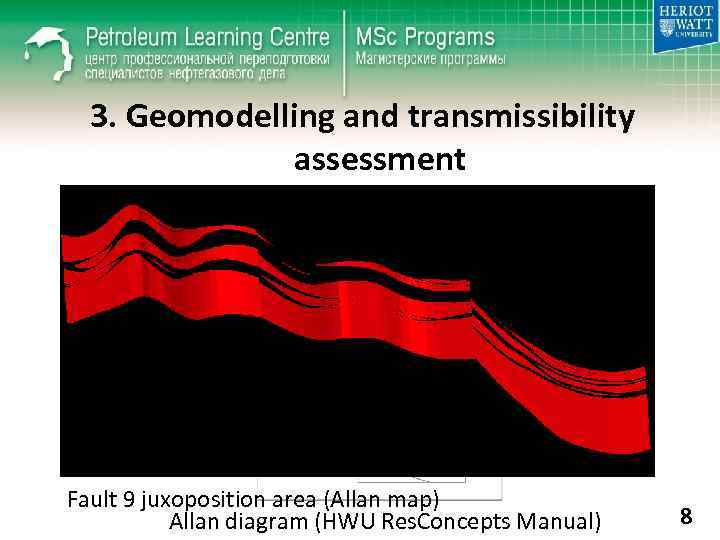
3. Geomodelling and transmissibility assessment Fault 9 juxoposition area (Allan map) Allan diagram (HWU Res. Concepts Manual) 8
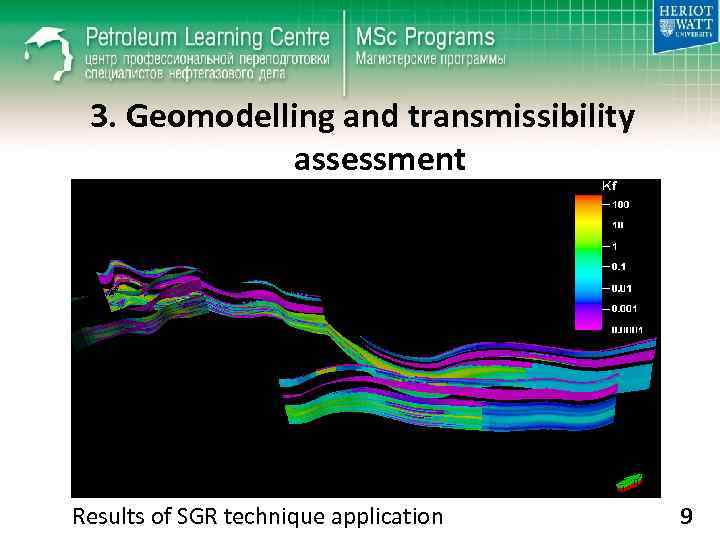
3. Geomodelling and transmissibility assessment Methods Mean Eff. K m. D SGR 0. 9 ESGR 0. 9 CSP 0. 16 MIX 0. 79 Results of SGR technique application 9
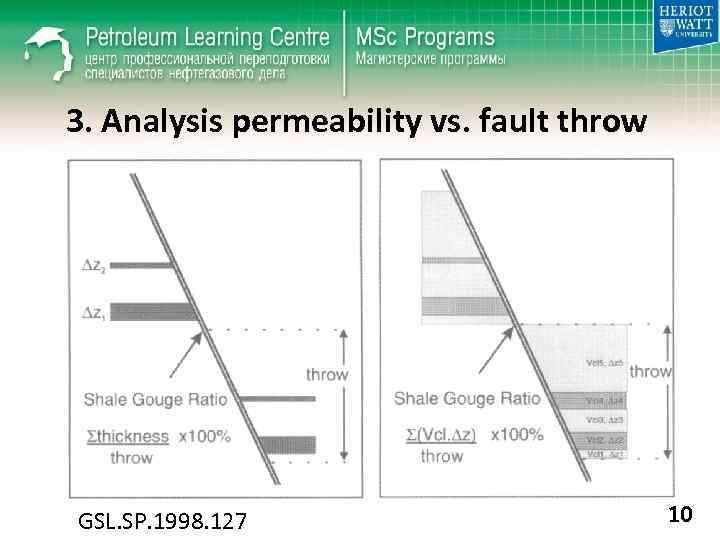
3. Analysis permeability vs. fault throw GSL. SP. 1998. 127 10
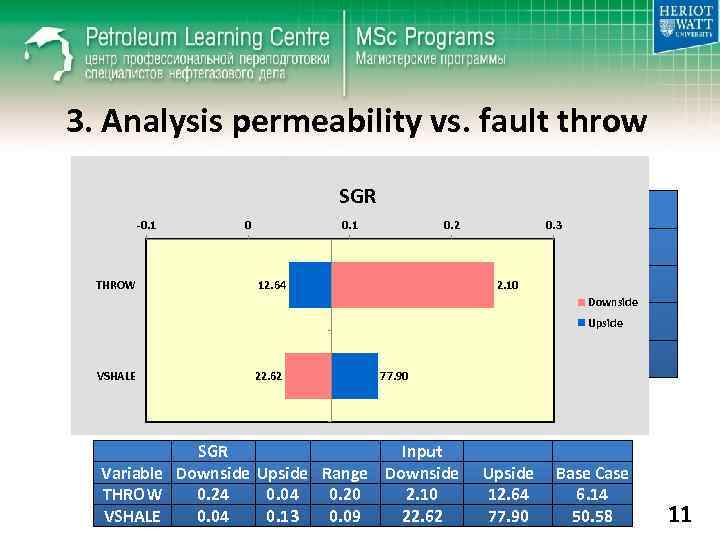
3. Analysis permeability vs. fault throw -0. 1 THROW VSHALE 0 MIN 0. 001 12. 64 0 SGR MOST 0. 2 2. 46 51. 16 0. 1 0. 3 2. 10 MAX 17. 89 100 Downside Upside VSHALE SGR 22. 62 77. 90 0. 208 SGR Input Variable Downside Upside Range Downside THROW 0. 24 0. 04 0. 20 2. 10 VSHALE 0. 04 0. 13 0. 09 22. 62 Upside 12. 64 77. 90 Base Case 6. 14 50. 58 11

3. Analysis permeability vs. fault throw Keff vs. SGR 160 Brief summary for K field 140 120 • Nonsealing fault with throw below 6. 14 m; R 2 = 0. 5131 100 Keff 80 • Fault is semipermeable (with great permeability 60 variation) if throw varies from 2. 1 m to 6. 14 m; 40 20 • Fault is highly permeable, if throw less than 2. 1 m. 0 -20 0 SPE 59405 0. 1 0. 2 0. 3 0. 4 0. 5 0. 6 0. 7 0. 8 0. 9 1 SGR 12

4. Choosing the best technique Fault 9 Fault 6 Part of simulation model U 12 13

4. Choosing the best technique 14

4. Choosing the best technique 15

4. Choosing the best technique Brief summary: • Selection of the best technique by history matching is not possible for present oilfield; • Fault permeability is not influence greatly on the oil production within 5 -7 years period (at least for Jurassic West Siberian pays); • Longer production history and larger oilfield are needed for effective choice of the best technique by history matching. 16

4. Choosing the best technique 17

4. Choosing the best technique DIFF vs Ksgr 25 25 R 2 = 0. 3334 R 2 = 0. 8297 DIFF. OWC 20 20 15 15 10 10 55 00 00 -5 0. 1 0. 2 0. 3 0. 4 Ksgr 0. 5 0. 6 0. 7 0. 8 18

4. Choosing the best technique DIFF. vs DISPL R 2 = 0. 9991 25 30 R 2 = 0. 7912 DIFF 25 20 20 15 15 10 10 5 5 0 0 2 4 6 6 DISPL 8 8 10 10 12 12 14 14 19

4. Choosing the best technique New diff. between OWC (m) SGR 0. 6 CSF 2. 25 MIX 1. 16 Displ 7. 7 Average 2. 92 Well test manual. HWU 20

4. Choosing the best technique DIFF. vs Kmix DIFF. vs Kcsf DIFF vs Ksgr 25 25 2 2 = 0. 9016 RR = 0. 7722 20 20 DIFF. OWC R 2 = 0. 8372 15 15 10 10 55 0 0 0. 1 0. 01 0. 2 0. 3 0. 4 0. 02 0. 03 0. 04 Kmix Ksgr Kcsf 0. 4 0. 5 0. 05 0. 50. 6 0. 06 0. 7 0. 07 0. 8 0. 08 21

Practical summary • Fault transmissibility along the fault plane is not unique value and may be effectively modelled in geomodel scale; • No sealing fault with throw less than 6. 14 m; • Fault permeability varies greatly if throw is between 2. 1 and 6. 14 m; • Fault is fully permeable if throw is less than 2. 1 m; • Fault permeability does not influence greatly on the production during 5 -7 years period or equivalent 40000 tonn (at least for West Siberian Jurassic oilfields); • The best technique of transmissibility assessment for oilfield K is integration of SGR & CSF. 22

Thank you for you attention! 23

Backslides 24

Suggestion for further work • Wider range of the oilfields should be investigated to choose main criteria and universal dependences for transmissibility for West Siberia; • High quality 3 D seismic is needed for high accuracy of transmissibility determination; • Cretaceous pays should be investigated for crossflow; • Special attention should be paid on pre-Mesozoic oilfield; • Additional investigations as repeat formation tester, good quality well test and tracer tests are needed; • Transmissibility assessment is needed to be checked by history matching process, but this method may be created only on large oilfield with long period of production. 25

Fragment of West Siberian tectonic map. Kontorovich 2003 26

Faults Maximum throw (m) Fault 5 26 Fault 6 ≈20 Fault 9_1 ≈20 Fault 10 50 Fault 15 43 Fault 16 ≈20 Fault 17 35 Fault 18 31 Maximum throw of each fault 27

28

Relative permeabilities for U 12+3 29

30

31

DIFF vs Ksgr R 2 = 0. 3334 25 R 2 = 0. 8297 DIFF. OWC 20 R 2 = 0. 8375 15 10 5 0 0 -5 0. 1 0. 2 0. 3 0. 4 0. 5 0. 6 0. 7 0. 8 Ksgr 32

DIFF. vs Kcsp R 2 = 0. 3351 25 R 2 = 0. 7463 DIFF. OWC 20 R 2 = 0. 7724 15 10 5 0 0 -5 0. 01 0. 02 0. 03 0. 04 0. 05 0. 06 0. 07 0. 08 Kcsp 33

DIFF. vs Kmix R 2 = 0. 4045 25 R 2 = 0. 8973 20 DIFF. OWC R 2 = 0. 9019 15 10 5 0 0 -5 0. 1 0. 2 0. 3 0. 4 0. 5 0. 6 0. 7 Kmix 34
Скачать презентацию MSc REM INDIVIDUAL PROJECT Faults transmissibility assessment for
12_Final presentation_v1_Shpindler.pptx