


 Скачать презентацию MS ISO 9001 2000 Executing agencies l
f67671b27ba166ce2f198e02c1a3a97f.ppt
- Количество слайдов: 43
 MS ISO 9001 : 2000 Executing agencies: l Forest Research Institute Malaysia (FRIM) l Timber Research and Technical Training Centre (TRTTC), Sarawak l Forest Research Center (FRC), Sabah Collaborating agency l Forestry and Forest Products Research Institute (FFPRI), Tsukuba, Japan IMPROVING UTILIZATION AND VALUE ADDING OF PLANTATION TIMBERS FROM SUSTAINABLE SOURCES IN MALAYSIA
 MS ISO 9001 : 2000 INTERNATIONAL TROPICAL TIMBER ORGANISATION (ITTO) PROJECT APPROVAL (2004); IMPLEMENTATION (Sept 06 – Sept 09) Paper presented at the IUFRO ALL DIV. 5 meeting @TAIPEI 2007 by: Y. E. TAN (FRIM) N. LIM (TRTTC) J. JOSUE (FRC) K. S. GAN (FRIM)
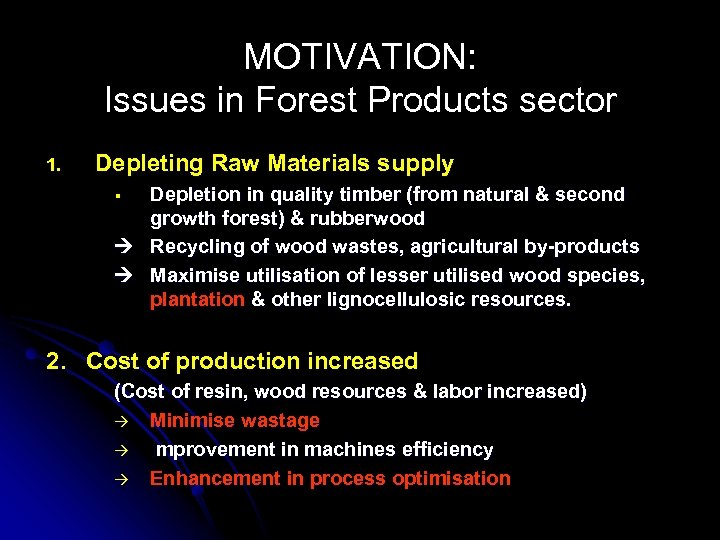 MOTIVATION: Issues in Forest Products sector 1. Depleting Raw Materials supply Depletion in quality timber (from natural & second growth forest) & rubberwood Recycling of wood wastes, agricultural by-products Maximise utilisation of lesser utilised wood species, plantation & other lignocellulosic resources. § 2. Cost of production increased (Cost of resin, wood resources & labor increased) Minimise wastage Improvement in machines efficiency Enhancement in process optimisation
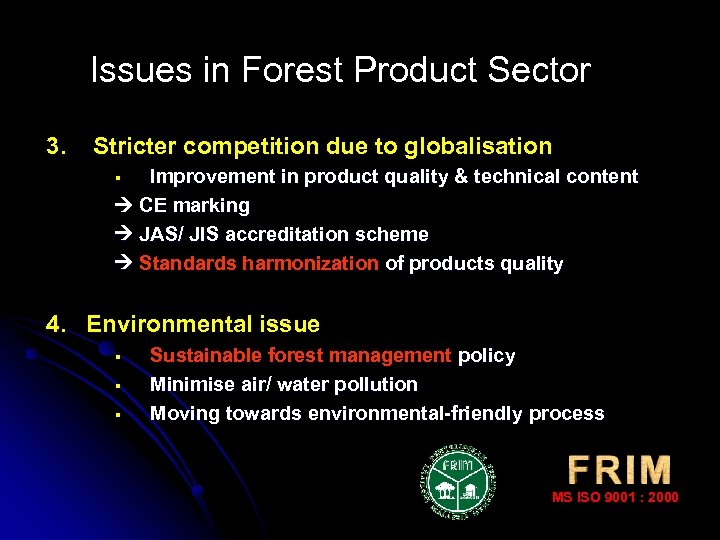 Issues in Forest Product Sector 3. Stricter competition due to globalisation Improvement in product quality & technical content CE marking JAS/ JIS accreditation scheme Standards harmonization of products quality § 4. Environmental issue § § § Sustainable forest management policy Minimise air/ water pollution Moving towards environmental-friendly process MS ISO 9001 : 2000
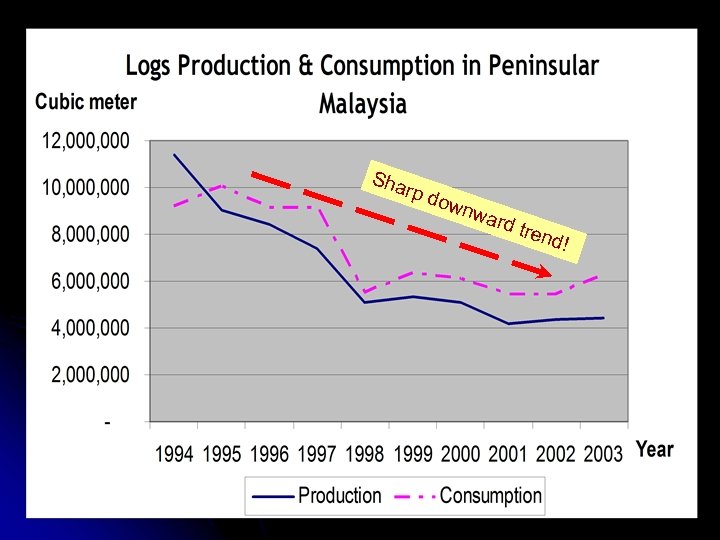 Sha rp d own war d tre nd!
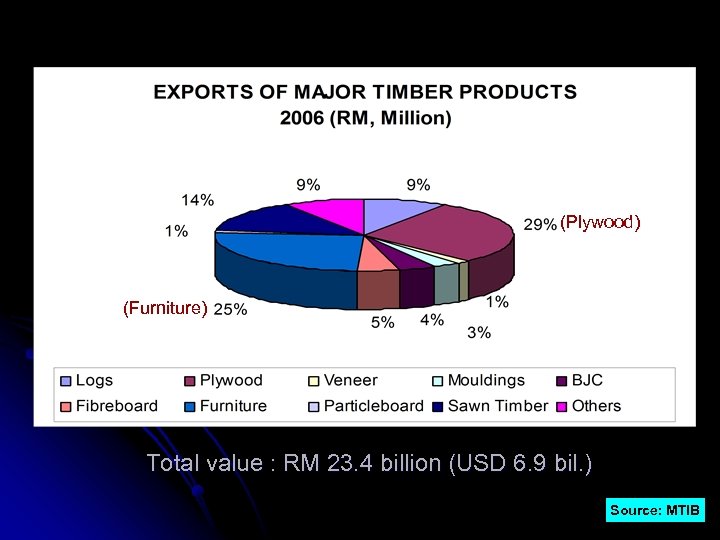 (Plywood) (Furniture) Total value : RM 23. 4 billion (USD 6. 9 bil. ) Source: MTIB
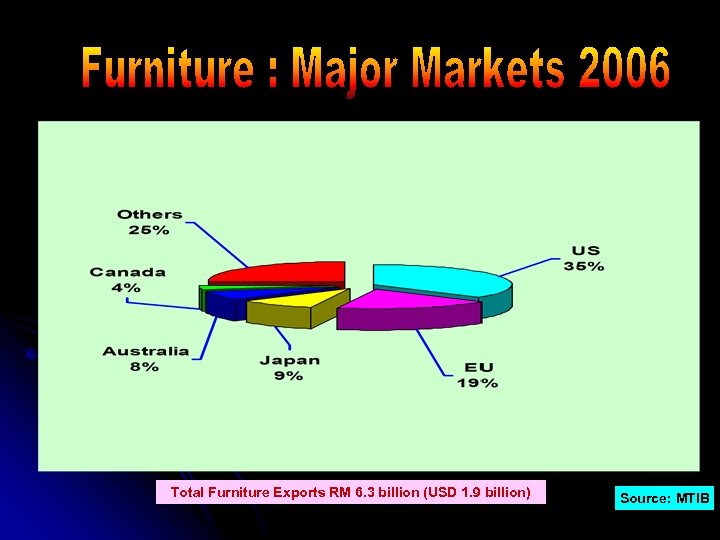 Total Furniture Exports RM 6. 3 billion (USD 1. 9 billion) Source: MTIB
 Hence, there is a room for plantation forests in Malaysia, of which the current level of area of plantation is low by any standards. to supplement current shortage of wood supply; l as raw materials for booming furniture industry in the country; l Other socio-ecological reasons. l
 DEVELOPMENT OBJECTIVE l to improve end-uses and valueadding of Malaysian forest plantation resources through systematic evaluation of their basic physical and mechanical properties in order to contribute to the development of the sustainable wood-based industries.
 SPECIFIC OBJECTIVES Objective 1: l To produce technical data on wood characteristics of selected plantation grown species from Malaysia based on harmonised set of procedures developed; and Benefits ö Permits comparison of results, essential for establishing effects of site, clones, silvicultural treatment, etc; Not just using rate of growth as the main criterion; Proposed approach to be adopted by all ITTO countries if possible
 SPECIFIC OBJECTIVES Objective 2: l To develop suitable techniques for production of value-added timber products from existing plantations and its technology transfer l Benefits ö Development of techniques taking into consideration the constraints of the juvenile stocks in hand. ö Carry out necessary economic studies before dissemination of information to relevant parties; Not a pure “academic” or “scientific” exercise. Commercial product development is one of the targets
 Expected Outputs 3. 1 Objective 1: To produce technical data using harmonised procedures developed Output 1. 1: Harmonised procedures for evaluation of basic properties of plantation species Output 1. 2: Output 1. 3: Output 1. 4: Output 1. 5: of Trained counterparts in new testing techniques Scientific data on anatomical, physical and mechanical properties of test timber species Technical data on sawing, machining, veneering, drying and bonding properties; Technical information on bio-deterioration and preservative treatment, and chemical properties wood, tannins and sugars in bark of test timber species
 Expected Outputs 3. 2 Objective 2: To develop suitable techniques for production of value-added timber products from existing plantations and technology transfer Output 2. 1: Output 2. 2: Output 2. 3: Output 2. 4: An assessment report on the suitability of plantation species for doors and windows, An assessment report on the suitability of plantation species for advanced particleboards; Technical evaluation on the production of sliced and peeled veneers. Website (containing project related materials including data, reports, manuals and personnel involved), training workshop/ project ending seminar.
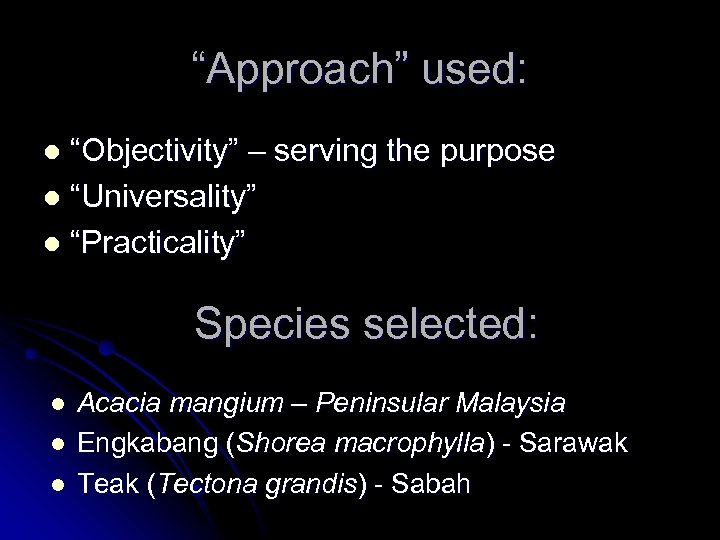 “Approach” used: “Objectivity” – serving the purpose l “Universality” l “Practicality” l Species selected: l l l Acacia mangium – Peninsular Malaysia Engkabang (Shorea macrophylla) - Sarawak Teak (Tectona grandis) - Sabah
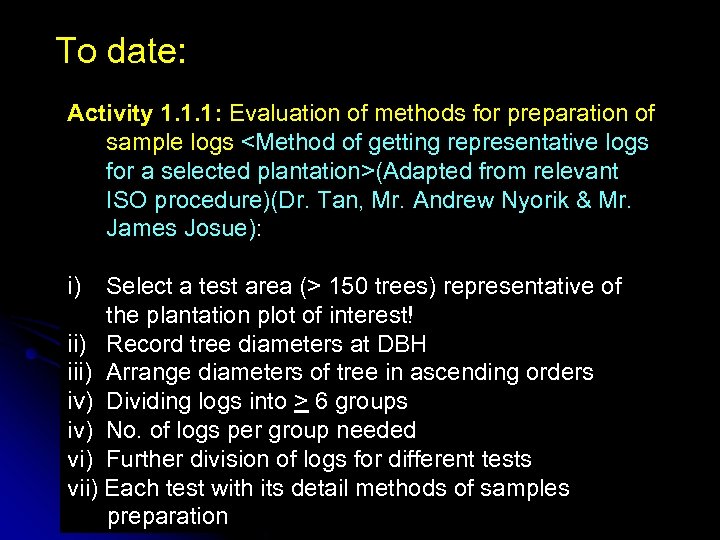 To date: Activity 1. 1. 1: Evaluation of methods for preparation of sample logs
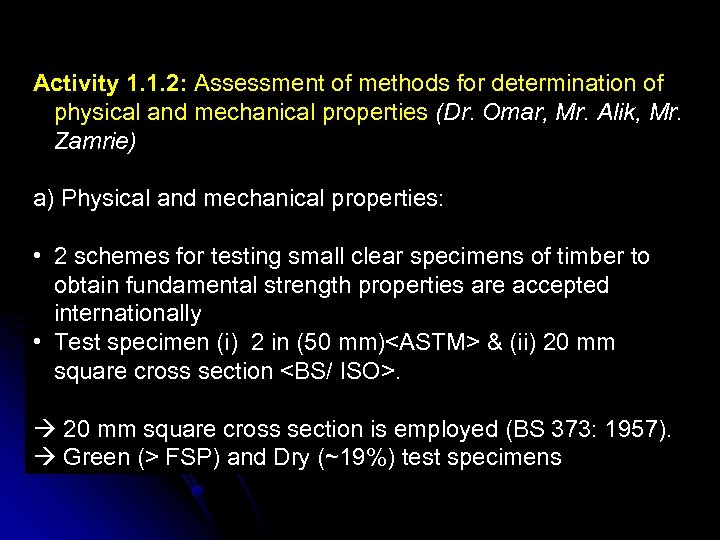 To date: Activity 1. 1. 2: Assessment of methods for determination of physical and mechanical properties (Dr. Omar, Mr. Alik, Mr. Zamrie) a) Physical and mechanical properties: • 2 schemes for testing small clear specimens of timber to obtain fundamental strength properties are accepted internationally • Test specimen (i) 2 in (50 mm)
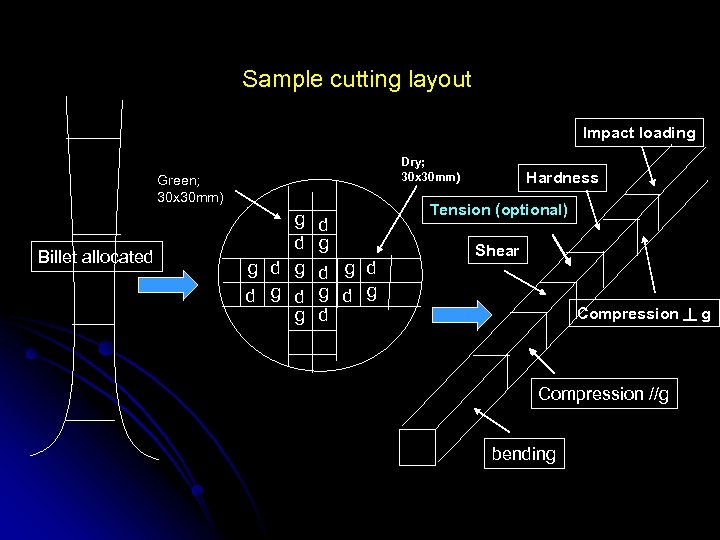 Sample cutting layout Impact loading Dry; 30 x 30 mm) Green; 30 x 30 mm) Billet allocated g d d g g d g d g g d Hardness Tension (optional) Shear Compression I g Compression //g bending
 b) date: To Anatomical study (Mr. Lim S. C. , Mr. Yang & Mr. James Josue): The method of evaluation selected made reference to international practices such as: • IAWA (1989) for microscopic features; • PROSEA Vol. 5(1), (2), (3); • Decamps (1973) for macroscopic and microscopic features; and • Anonymous (2004) for methods of study. For the microscopic study, all the 163 features as listed by International Association of Wood Anatomists (IAWA) were included in the form of a table to ensure that no important features of the timber are left out.
 To date: Activity 1. 1. 3: Evaluation of testing methodologies for assessment of processing properties (Mr. Wong T. C. (TRTTC) & Dr. Murata, FFPRI, Tsukuba) c) Sawing properties Using Japanese and Malaysian approaches. Items included: - • Basic sawing configuration - Saw and Saw-tooth, and other set-up, for 2 cutting patterns (“Live” sawing and cant sawing) Sawing yield - Volume and Value Recovery in relation to taperness of logs, types of cutting, quality of logs etc. ; and Power/ energy consumption.
 Major references (i) Testing Methods of Various Wood Properties of Fast Growing Tropical Timbers, Technical Report of the Product Development Committee No. 18, FFPRI, Japan (ii) Procedure of Sawing Yield Test, Sawmilling and Machining Laboratory, Forestry and Forest Products Research Institute, Japan (iii) ASTM D 1666 -87(2004) Standard Test Methods for Conducting Machining Tests of Wood and Wood-base Materials
 Activity 1. 1. 3: Evaluation of testing methodologies for To date: assessment of processing properties (Dr. Salmiah, Mr. Lai and Mr. Kandau) (d) Durability studies : • A few tests including lab. and grave yard tests could be conducted to determine the natural durability of wood. o o o Field stake test (FFPRI, ASTM D 1758) Fungus cellar Test (FFPRI, and a number of reports) Accelerated Laboratory Decay Test (FFPRI & ASTM D 2017 -2005) v Differences in the methods between different standard bodies are not significant
 2 Tests identified i) ii) Accelerated Laboratory Decay Test (Base reference used - ASTM D 2017 -2005) l Quick results could be obtained; l Test results may be reproduced irrespective of geographical locality, but the same loss of weight may have different interpretation on durability depending on climatic differences; l Testing timber against specific wood rotting fungi (more relevant to the country of “origin” of the standard); l Calculated mass loss of the timber specimens as an indicator to durability
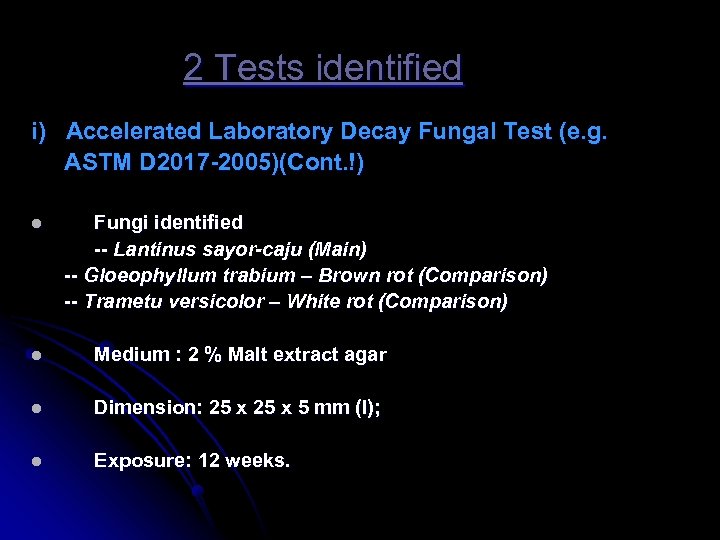 2 Tests identified i) Accelerated Laboratory Decay Fungal Test (e. g. ASTM D 2017 -2005)(Cont. !) l Fungi identified -- Lantinus sayor-caju (Main) -- Gloeophyllum trabium – Brown rot (Comparison) -- Trametu versicolor – White rot (Comparison) l Medium : 2 % Malt extract agar l Dimension: 25 x 5 mm (l); l Exposure: 12 weeks.
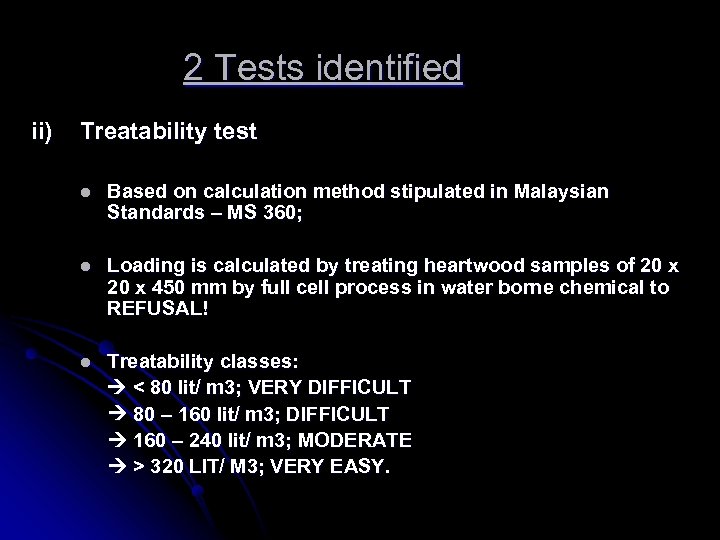 2 Tests identified ii) Treatability test l Based on calculation method stipulated in Malaysian Standards – MS 360; l Loading is calculated by treating heartwood samples of 20 x 450 mm by full cell process in water borne chemical to REFUSAL! l Treatability classes: < 80 lit/ m 3; VERY DIFFICULT 80 – 160 lit/ m 3; DIFFICULT 160 – 240 lit/ m 3; MODERATE > 320 LIT/ M 3; VERY EASY.
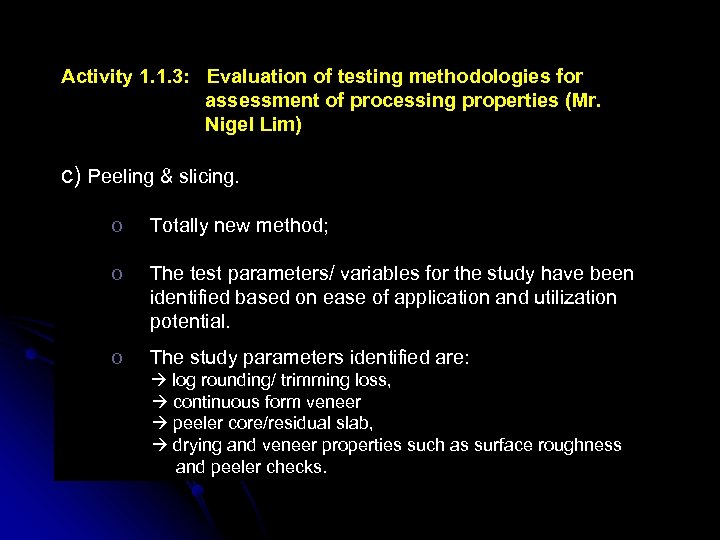 To date: Activity 1. 1. 3: Evaluation of testing methodologies for assessment of processing properties (Mr. Nigel Lim) c) Peeling & slicing. o Totally new method; o The test parameters/ variables for the study have been identified based on ease of application and utilization potential. o The study parameters identified are: log rounding/ trimming loss, continuous form veneer peeler core/residual slab, drying and veneer properties such as surface roughness and peeler checks.
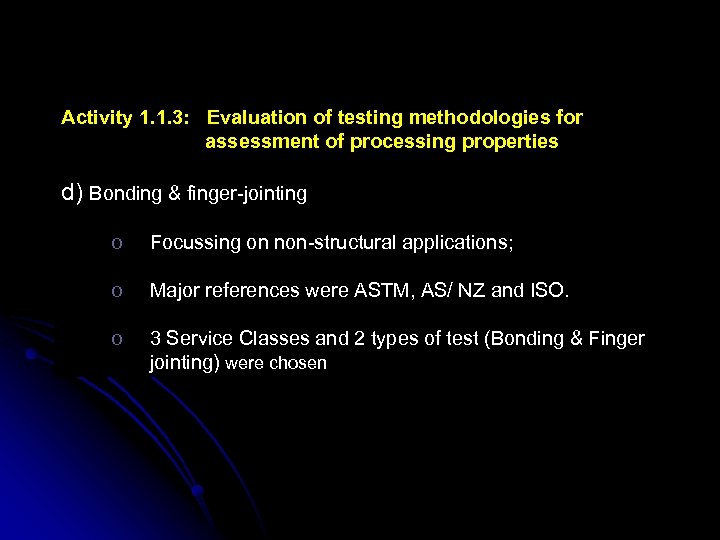 To date: Activity 1. 1. 3: Evaluation of testing methodologies for assessment of processing properties d) Bonding & finger-jointing o Focussing on non-structural applications; o Major references were ASTM, AS/ NZ and ISO. o 3 Service Classes and 2 types of test (Bonding & Finger jointing) were chosen
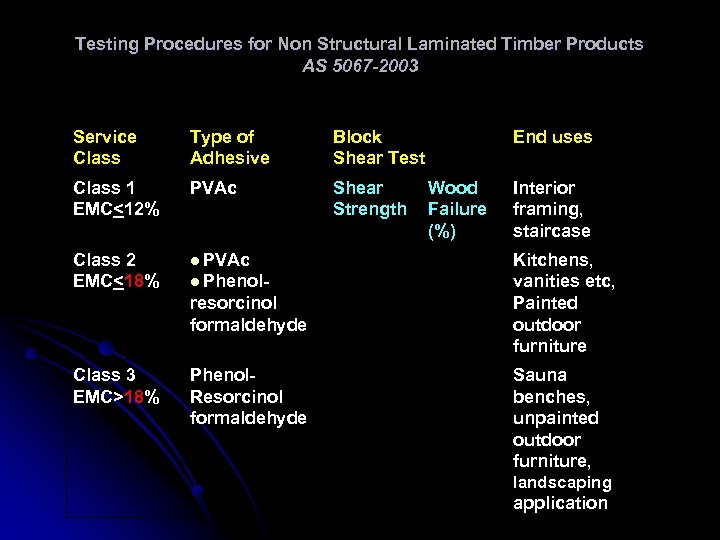 Testing Procedures for Non Structural Laminated Timber Products AS 5067 -2003 Service Class Type of Adhesive Block Shear Test Class 1 EMC<12% PVAc Shear Strength Class 2 EMC<18% l PVAc l Phenol- resorcinol formaldehyde Class 3 EMC>18% Phenol. Resorcinol formaldehyde End uses Wood Failure (%) Interior framing, staircase Kitchens, vanities etc, Painted outdoor furniture Sauna benches, unpainted outdoor furniture, landscaping application
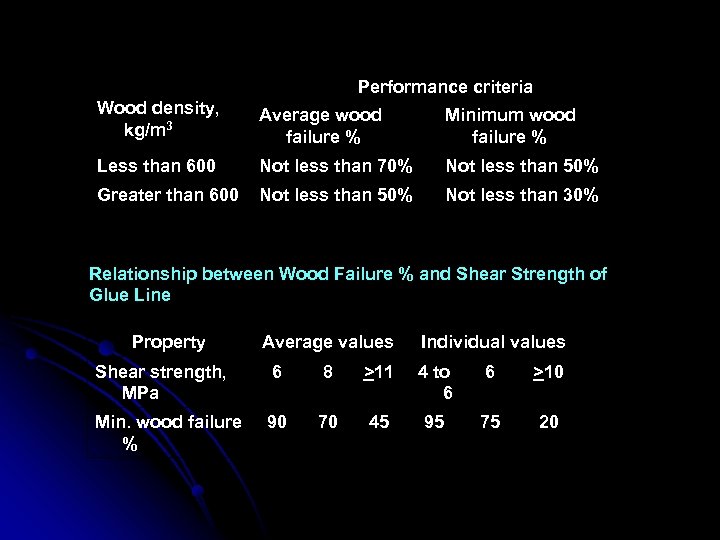 AS 5067 - 2003 Performance criteria Wood density, Performance Requirements for Glue-Lines - Block shear test Average wood Minimum wood kg/m 3 failure % Less than 600 Not less than 70% Not less than 50% Greater than 600 Not less than 50% Not less than 30% Relationship between Wood Failure % and Shear Strength of Glue Line Property Average values Individual values Shear strength, MPa 6 8 >11 4 to 6 6 >10 Min. wood failure % 90 70 45 95 75 20
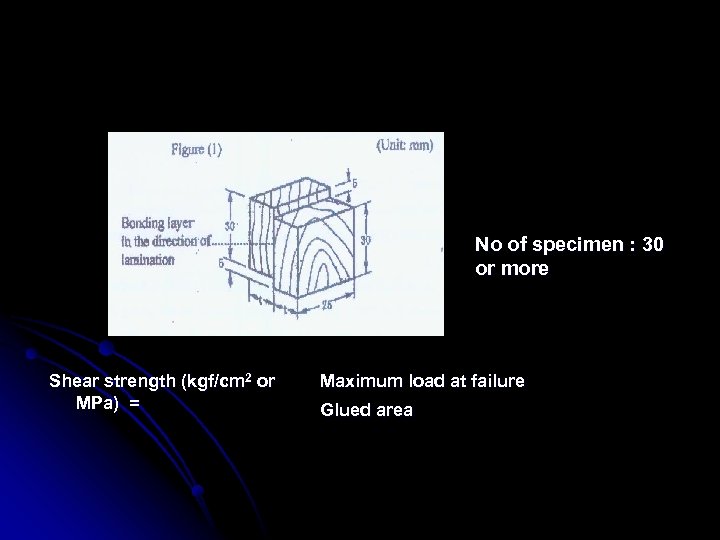 Block Shear Test No of specimen : 30 or more Shear strength (kgf/cm 2 or MPa) = Maximum load at failure Glued area
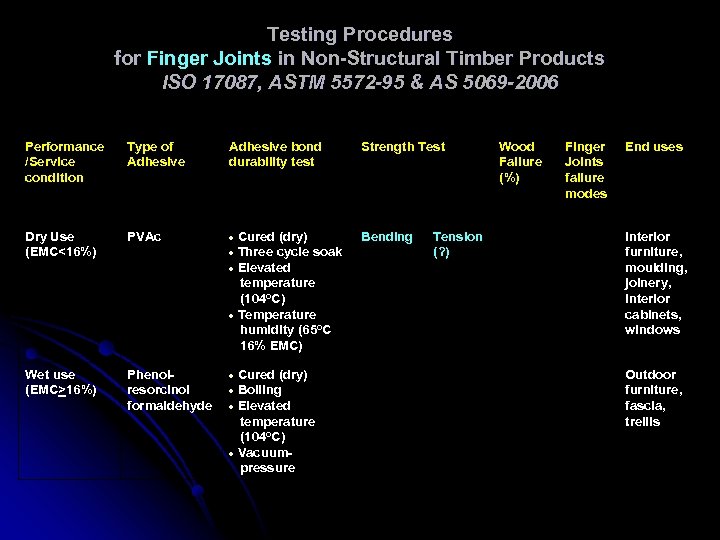 Testing Procedures for Finger Joints in Non-Structural Timber Products ISO 17087, ASTM 5572 -95 & AS 5069 -2006 Performance /Service condition Type of Adhesive bond durability test Strength Test Dry Use (EMC<16%) PVAc Cured (dry) Three cycle soak Elevated temperature (104 o. C) Temperature humidity (65 o. C 16% EMC) Bending Wet use (EMC>16%) Phenolresorcinol formaldehyde Cured (dry) Boiling Elevated temperature (104 o. C) Vacuumpressure Tension (? ) Wood Failure (%) Finger Joints failure modes End uses Interior furniture, moulding, joinery, interior cabinets, windows Outdoor furniture, fascia, trellis
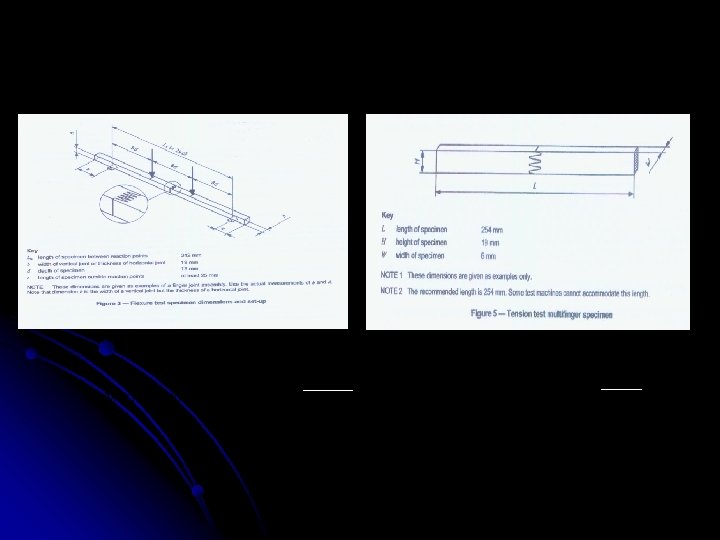 Strength Test Procedures (ISO 17087 & ASTM 5572 -95) Bending Tension PLs Modulus of Rupture (MPa), bd 2 R= p Tensile Strength (MPa), bd Ts= No of specimen : 30 or more
 Activity 1. 1. 3: Evaluation of testing methodologies for assessment of processing properties e) Drying properties (Dr. Gan) No “ISO” method available. l Four techniques were identified: Air drying Drying rate – establish rate of drying, K value; Quick drying assessment - establishing initial drying parameters; and Drying schedule development l l The methods will be based on the Japanese methods
 Conclusion Based on the principles of “Objectivity”, “Universality” and “Practicality” and with the intention of eventually used by the tropical countries: A set of harmonised techniques for the determination of various basic properties of plantation timber determination have been proposed; Actual testing of methods proposed will be conducted in Year II of project implementation while refinement will be made concurrently. To make it more “universally” accepted, inputs from all parties/ countries are welcome. A terminal seminar is expected to be held in 2009 in Malaysia.
 MS ISO 9001 : 2000

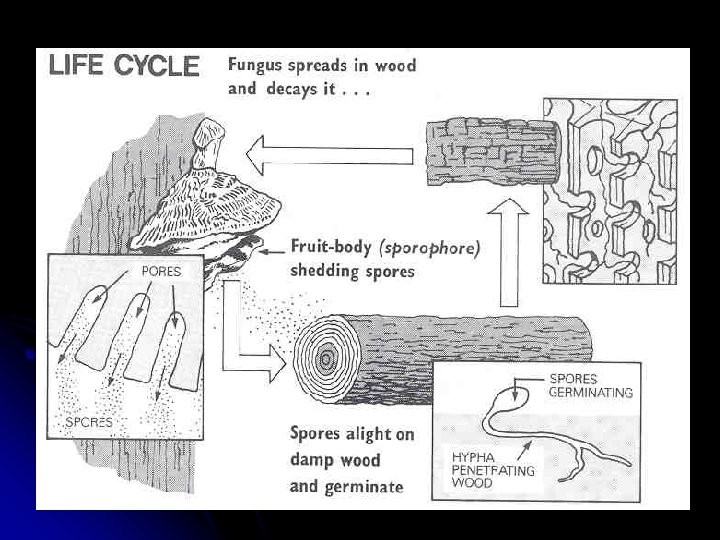
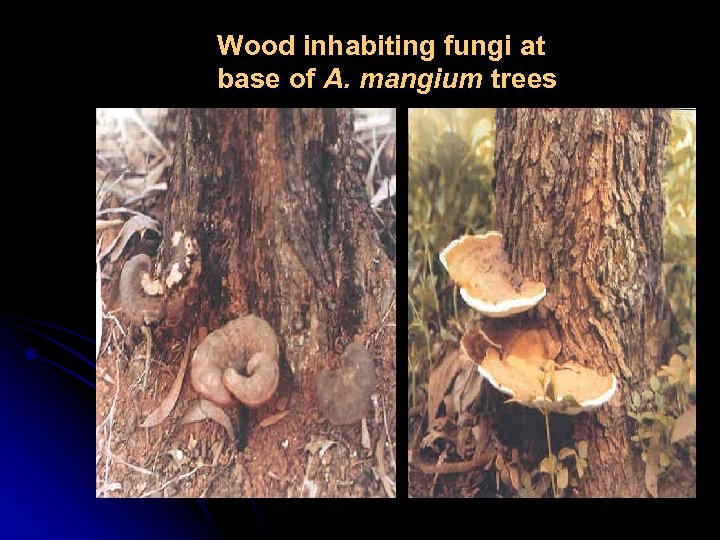 Wood inhabiting fungi at base of A. mangium trees
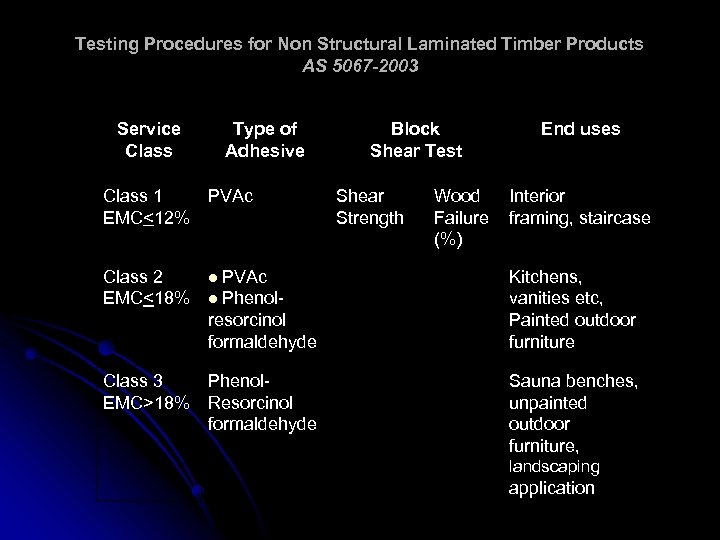 Testing Procedures for Non Structural Laminated Timber Products AS 5067 -2003 Service Class Type of Adhesive Class 1 EMC<12% PVAc Class 2 EMC<18% l PVAc l Phenol- resorcinol formaldehyde Class 3 EMC>18% Phenol. Resorcinol formaldehyde Block Shear Test Shear Strength Wood Failure (%) End uses Interior framing, staircase Kitchens, vanities etc, Painted outdoor furniture Sauna benches, unpainted outdoor furniture, landscaping application




 THANK YOU VERY MUCH