


 Скачать презентацию MRKG 2312 E-commerce 2006 Prentice Hall
be46eb606a2856bd143f29733ea53a85.ppt
- Количество слайдов: 33
 MRKG 2312: E-commerce © 2006 Prentice Hall
 Agenda • • Questions? Begin discussion on the e. Marketing Plan Assignment 1 Posted e. Marketing plan guidelines posted © 2006 Prentice Hall
 E-Marketing 4/E Judy Strauss, Adel I. El-Ansary, and Raymond Frost Chapter 3: The E-Marketing Plan © 2006 Prentice Hall 3 -1
 Chapter 3 Objectives • After reading Chapter 3 you will be able to: • Discuss the nature and importance of an emarketing plan and outline its 7 steps. • Show the form of an e-marketing objective and highlight the use of an objective-strategy matrix. • Describe the tasks that marketers complete as they create e-marketing strategies. • List some key revenues and costs identified during the budgeting step of the planning process. © 2006 Prentice Hall 3 -2
 The Playboy Story • CEO Christie Hefner revitalized the company in the 1990 s by adding multimedia content to the Playboy magazine format. • Playboy. com came online in 1994 with a marketing plan to generate revenues from • • Advertising E-commerce Online gaming Online events • They project online gaming will generate much of future revenue. Do you agree? © 2006 Prentice Hall 3 -3
 Overview of the E-Marketing Planning Process • The e-marketing plan is a blueprint for emarketing strategy formulation and implementation. • The plan serves as a road map to guide the firm, allocate resources, and make decisions. © 2006 Prentice Hall 3 -4
 Two common types of plans • Napkin plan • Dot-com entrepreneurs jotted down “strategic plan” on a napkin. • Just-do-it, activity-based, bottom-up plan • A comprehensive plan is necessary when entrepreneurs seek venture capital • Sources of funding • Debt • Sometimes bank loans • Debt financed (20% down) • Banks seek leverage • Equity • • Private funds Angel investors Venture capitalists (VCs) Go Public © 2006 Prentice Hall 3 -5
 The Venture Capital E-Marketing Plan • VCs look for a way to get their money and profits out of the venture within a few years: - The golden exit plan is to go public and issue stock in an initial public offering (IPO), - As soon as the stock price rises sufficiently, the VC cashes out and moves on to another investment. • All VCs’ investments are not successful. But if even one out of 20 is an Amazon. com, the risk was well worth the reward. © 2006 Prentice Hall
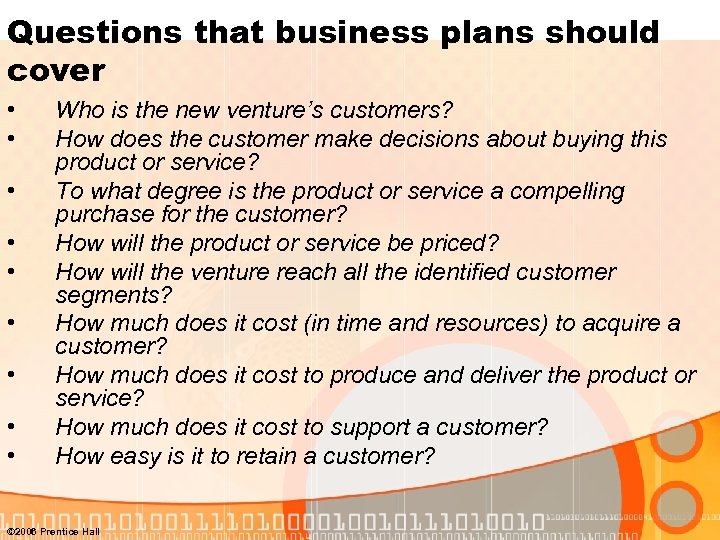 Questions that business plans should cover • • • Who is the new venture’s customers? How does the customer make decisions about buying this product or service? To what degree is the product or service a compelling purchase for the customer? How will the product or service be priced? How will the venture reach all the identified customer segments? How much does it cost (in time and resources) to acquire a customer? How much does it cost to produce and deliver the product or service? How much does it cost to support a customer? How easy is it to retain a customer? © 2006 Prentice Hall
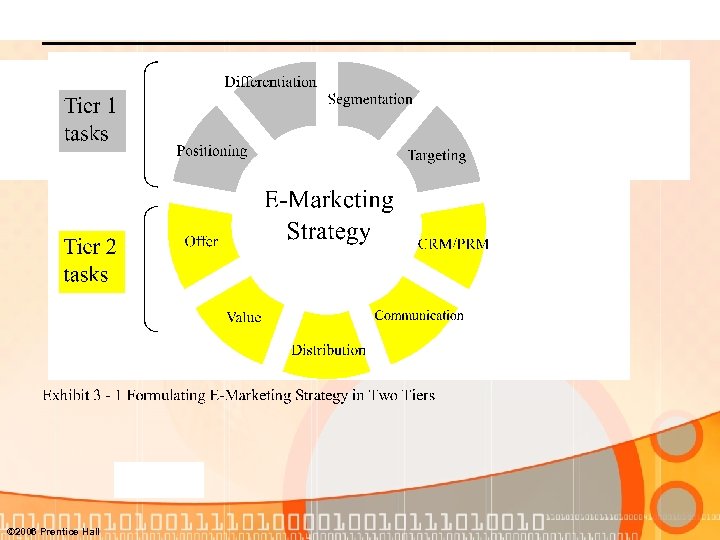
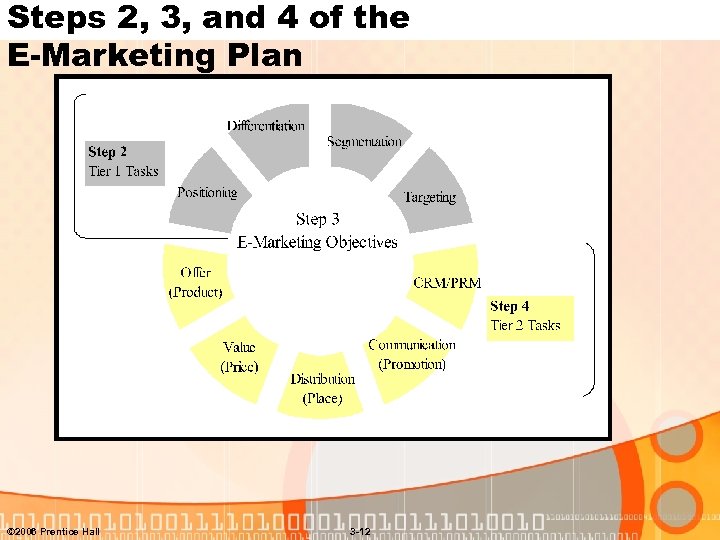
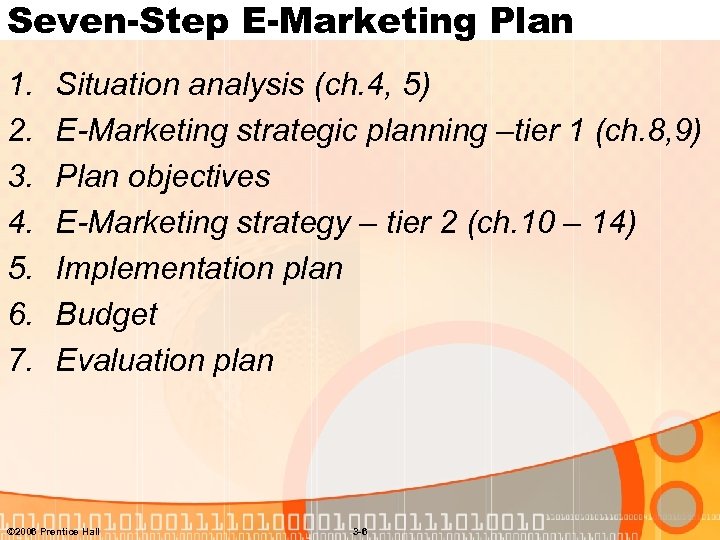 Seven-Step E-Marketing Plan 1. 2. 3. 4. 5. 6. 7. Situation analysis (ch. 4, 5) E-Marketing strategic planning –tier 1 (ch. 8, 9) Plan objectives E-Marketing strategy – tier 2 (ch. 10 – 14) Implementation plan Budget Evaluation plan © 2006 Prentice Hall 3 -6
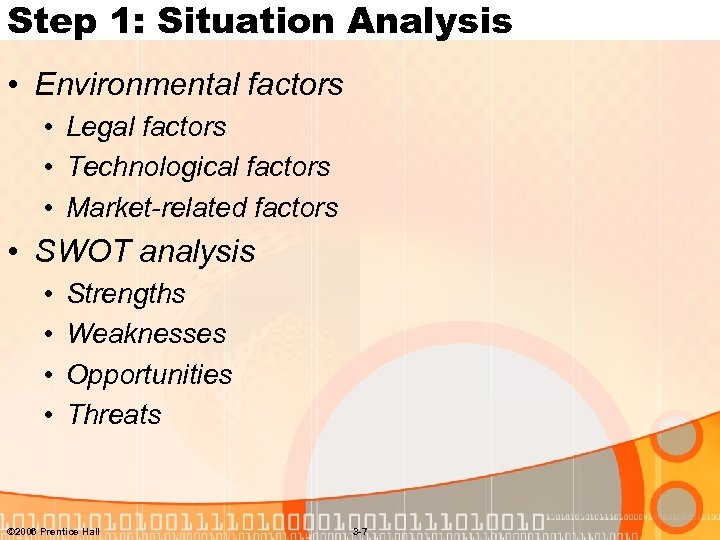 Step 1: Situation Analysis • Environmental factors • Legal factors • Technological factors • Market-related factors • SWOT analysis • • Strengths Weaknesses Opportunities Threats © 2006 Prentice Hall 3 -7
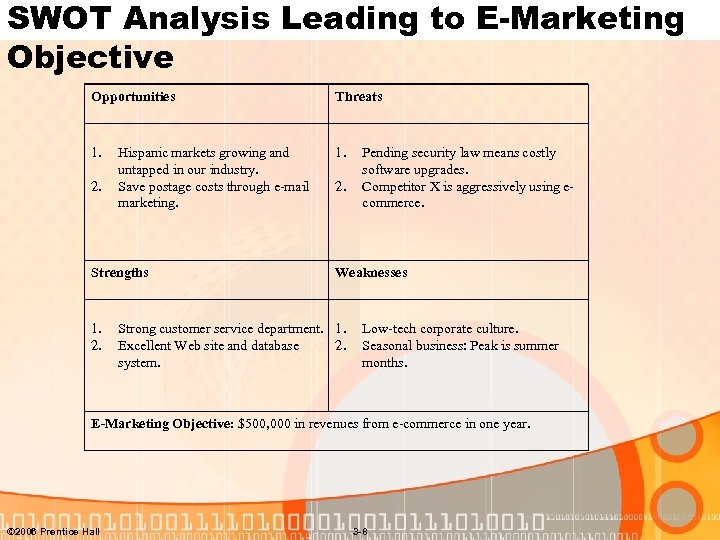 SWOT Analysis Leading to E-Marketing Objective Opportunities Threats 1. 2. Hispanic markets growing and untapped in our industry. Save postage costs through e-mail marketing. Strengths 1. 2. Pending security law means costly software upgrades. Competitor X is aggressively using ecommerce. Weaknesses Strong customer service department. 1. Excellent Web site and database 2. system. Low-tech corporate culture. Seasonal business: Peak is summer months. E-Marketing Objective: $500, 000 in revenues from e-commerce in one year. © 2006 Prentice Hall 3 -8
 Step 2: E-Marketing Strategic Planning • Market and product strategies, called Tier 1 tasks or strategies, are outcomes of strategic planning. • • Segmentation Targeting Differentiation Positioning • Marketers conduct analyses to determine strategies. • Market opportunity analysis • Demand analysis • Segment analysis • Supply analysis © 2006 Prentice Hall 3 -9
 © 2006 Prentice Hall
 E-Marketing Strategic Planning: Segmenting & targeting - Market opportunity analysis (MOA): - The demand analysis = market segmentation analyses to describe and evaluate the potential profitability, sustainability, accessibility, and size of various potential segments. - The segment analysis in the B 2 C market with demographic characteristics, geographic location, selected psychographic, and past behavior toward the descriptors help firms identify potentially attractive markets. ð Allows the company to select its target market and understand its characteristics, behavior, and desires in the firm’s product category. © 2006 Prentice Hall
 E-Marketing Strategic Planning: Segmenting & targeting Tools: - Traditional segmentation analyses. - Analyzes of customer bases using cookies, database analyses, and other techniques, - Supply analysis: forecasts segment profitability + finds competitive advantages, - Study of competition to find the company own performance advantages. : strengths and weaknesses, emarketing initiatives, … - Identify future industry changes. © 2006 Prentice Hall
 E-Marketing Strategic Planning: Identifying brand differentiation variables and positioning strategies • The understanding of the competition + the target(s) ð Differentiation of the products to provide benefits perceived as important by the target. • The positioning statement: the desired image for the brand relative to the competition. © 2006 Prentice Hall
 Step 3: Objectives • Objectives are typically related to task, measurable quantity and timeframe. • Most e-marketing plans seek to: • • Increase market share Increase sales revenue Reduce costs Achieve branding goals Improve databases Achieve customer relationship management goals Improve supply chain management © 2006 Prentice Hall 3 -10
 S. M. A. R. T. 1. Specific – Objectives should specify what they want to achieve. 2. Measurable – You should be able to measure whether you are meeting the objectives or not. 3. Achievable - Are the objectives you set achievable? 4. Realistic – Can you realistically achieve the objectives with the resources you have 5. Time – When do you want to achieve the set objectives? • An objective maybe to increase sales 10% from 2007 – 2008. © 2006 Prentice Hall
 Step 4: E-Marketing Strategies • Marketers craft strategies for the 4 P’s and relationship management to achieve plan objectives. • • • Product strategies Pricing strategies Distribution strategies Marketing communication strategies Relationship management strategies • These are referred to as Tier 2 tasks or strategies. © 2006 Prentice Hall 3 -11
 Steps 2, 3, and 4 of the E-Marketing Plan © 2006 Prentice Hall 3 -12
 The Offer: Product Strategies • The organization can: - Sell merchandise, services, or advertising on the Web site, Adopt an e-business model such as online auctions, Create new brands for the online market, Simply sell selected current or enhanced products in that channel. • A firm must decide how online product prices will compare with offline equivalents by considering the differing costs of sorting and delivering products to individuals through the online channel as well as competitive and market concerns. © 2006 Prentice Hall
 The Offer: Pricing Strategies • There are two online pricing trends are: • Dynamic pricing—this strategy applies different price levels for different customers or situations. The Internet allows firms to price items automatically and “on the fly” while users view pages. • Online bidding—this presents a way to optimize inventory management. • E. g. Priceline. com, e. Bay. com © 2006 Prentice Hall
 Distribution Strategies • Many firms use the Internet to distribute products or create efficiencies among supply chain members in the distribution channel. • Direct marketing—Many firms sell directly to customers, by-passing intermediaries in the traditional channel for some sales. • Agent e-business models—Firms such as e. Bay and E*Trade bring buyers and sellers together and earn a fee for the transaction. © 2006 Prentice Hall
 Marketing Communication Strategies • The Internet spawned a multitude of new marketing communication strategies, both to draw customers to a Web site and to interact with brick-and-mortar customers. • Firms use Web pages and e-mail to: - Communicate with their target markets and business partners, - Build brand images, - Create awareness of new products, - Position products using the Web and e-mail. © 2006 Prentice Hall
 Relationship Management Strategies • E-marketing communication strategies help build relationships with a firm’s partners, supply chain members, or customers using: - Customer relationship management (CRM) software to retain customers and increase average order values and lifetime value, - Partner relationship management (PRM) software to integrate customer communication and purchase behavior into a comprehensive database, - Extranets—two or more proprietary networks linked for better communication and more efficient transactions among firms (PRM). © 2006 Prentice Hall
 Step 5: Implementation Plan • Tactics are used to achieve plan objectives • • Marketing mix (4 P’s) tactics Relationship management tactics Marketing organization tactics Information-gathering tactics © 2006 Prentice Hall 3 -13
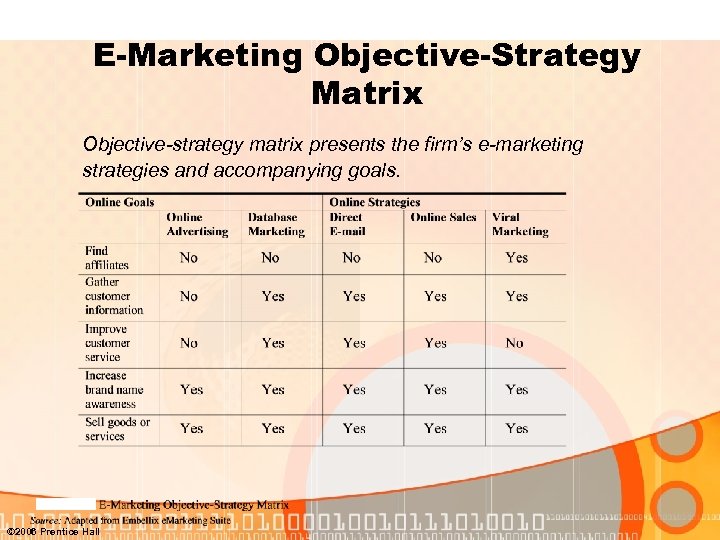 E-Marketing Objective-Strategy Matrix Objective-strategy matrix presents the firm’s e-marketing strategies and accompanying goals. © 2006 Prentice Hall
 Step 5: Design Implementation Plan to Meet the Objectives • Information technologies are especially adept at automating these processes, this is why the information gathering tactics are important: - Web site forms, feedback e-mail, and online surveys, - Web site log analysis software helps firms review user behavior at the site and make changes to better meet the needs of users, - Business intelligence uses the Internet for secondary research, assisting firms in understanding competitors and other market forces. © 2006 Prentice Hall
 Step 6: Budget • The plan must identify the expected return from marketing investments. • • Revenue forecast Intangible benefits, such as brand equity Cost savings E-Marketing costs • • • Technology Site design Salaries Other site development expenses Marketing communication © 2006 Prentice Hall 3 -14
 Revenue Forecast • The firm uses an established sales forecasting method for estimating the site revenues in the short, intermediate, and long term. • Inputs: The firm’s historical data, industry reports, and competitive actions. • An important part of forecasting is to estimate the level of Web site traffic over time. ð This number affects the amount of revenue a firm can expect to generate from its site. • Revenue streams: - Web site direct sales, - Subscription fees, - Sales at partner sites, fees. © 2006 Prentice Hall - Advertising sales, - Affiliate referrals, - Commissions, and other
 Step 7: Evaluation Plan • Marketing plan success depends on continuous evaluation. • E-marketers must have tracking systems in place to measure results. • Review the Balanced Scorecard for e-business in Chapter 2. • Today’s firms are ROI driven. © 2006 Prentice Hall 3 -15
 Preparing Your Marketing Plan • DUE April 25 th, 2008 • 10 weeks from today • Get started by developing an idea • Research on sample Marketing Plan © 2006 Prentice Hall