


 Скачать презентацию MR LIPMAN S APUS POWERPOINT CHAPTER 26 Changes to
2efdfb621641d73cdd712713af621e3a.ppt
- Количество слайдов: 35
 MR. LIPMAN’S APUS POWERPOINT CHAPTER 26 Changes to the Great West 1860 -1896
 Key Issues in the Chapter • Indians and what will become of them • Expansion of RR’s and Mining Operations • Population Growth out West and Expansion of Farming as a big business • Farmers and the 4 D’s – (Debt, Drought, Deflation, Depression) • Grange Movement • Populist Movement • Gold vs. Silver Movement
 • Indians and the reservation system – 1851 treaty at Fort Laramie – 1853 – treaty at Fort Atkinson • establishing boundaries for each tribe; attempted to put tribes in 2 great colonies (to north and south of a corridor of planned settlements for whites) – Problem is that “tribes” and “chiefs” making treaties with whites didn’t represent most Indians – Indians’ nomadic life could not be changed to reservation living
 • Warfare with Indians – Many Army troops were recent immigrants – 1/5 (20%) of US personnel were blacks • Called “Buffalo Soldiers” by Indians • Massacres and brutal attacks occurred between whites and Indians throughout the Indian wars by both sides but whites clearly killed more.
 The Massacres • Sand Creek Massacre : Colorado in 1864 – 400 Indians, who believed they had immunity, massacred by a militia led by Col. Chivington • 1866 massacre at Bozeman Trail in Wyoming – Indians attacked and killed 81 soldiers and civilians, mutilating the corpses – 1874 – Custer attacked 2, 500 entrenched Indians at Little Bighorn River (in Montana) who were led by Sitting Bull and all 264 soldiers killed • Sitting Bull escapes to Canada
 • 1877 – the Nez Percé rebelled – Led by Chief Joseph on 3 -month, 1, 700 mile march, attempting to reach Canada and join with Sitting Bull – Chief Joseph surrendered when he was told the Nez Percé would be able to return to ancestral lands in Idaho – Nez Percé then forced onto reservation in Kansas where 40% of them die from disease • Apache tribes in Arizona and New Mexico most difficult to conquer – Apaches led by Geronimo eventually pursued into Mexico to force a surrender
 – Battle (Massacre) of Wounded Knee (1890) • Over 200 Indians massacred by US soldiers • Last battle in effort to subdue the Indians • The debate over how to treat the Indians: – Reformers tried to persuade Indians to become like whites (assimilation) – Hard-liners insisted on forced containment and brutal punishment • Neither side was respectful of Indian culture
 • Late 1800 s, Indians ghettoized on reservations – Possible to maintain their cultural independence but In reality, they lived off gov’t charity • Important factors leading to Indian defeat: – Railroad brings more settlers and soldiers – Indians destroyed by white diseases and alcohol – Extinction of buffalo (on which Indians depended)
 The Buffalo Population, 1800 – 2000
 • 1887 – The Dawes Act {forced assimilation} – Severalty – ownership of land by individual only – Goal was to destroy tribes and Indian culture – Dissolved tribes as legal entities, ended tribal ownership of land, individual ownership only • All Indians finally gained citizenship in 1924 DAWES ACT ESSENTIALLY A FAILURE AND IN 1924 MOVE TO RESTORE TRIBAL BASIS TO THE INDIANS (INDIAN REORGANIZATION ACT)
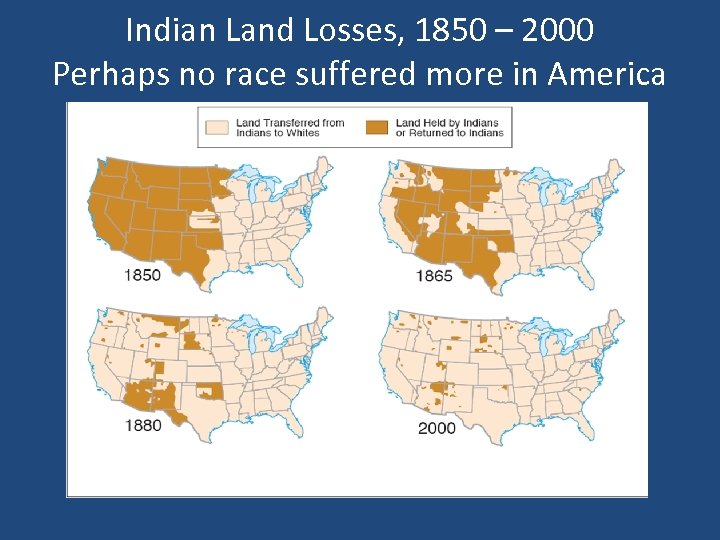 Indian Land Losses, 1850 – 2000 Perhaps no race suffered more in America
 • Mining in West: – Gold found in California in 1848 – 1858 – gold and silver found in Colorado Rockies – 1859 – Comstock Lode (Nevada): gold and silver – Boom towns would set up and then disappear and become ghost towns – Corp’s would replace individual prospectors and machines would replace human speculators
 • Impact of mining – Mining frontier attracted population – Women ran boardinghouses • and worked as prostitutes – Women vote much earlier in West – Gold & silver finance the Civil War & build railroads – Silver discoveries made silver issue in US politics a powerful issue
 R. R. ’s led to cowboys making the “Long Drive” – Cattle driven north to railroads, & shipped East from giant cattle yards in Kansas City and Chicago – Journey was about 1, 000 miles and Cattle grazed on open grass on the way north • The end of the independent cattle drives – Fenced off land with barbed wire (1874) – 1886 – 1887 – terrible cold winter left thousands of cattle frozen to death – Long Drives led to the myth of the Cowboy
 • Farmers settled the West in great numbers • 1862 – Homestead Act (Morrill Act) – Gave settlers 160 acres of land if they improved and worked the land for 5 years – Before C. W. land sold for money for by gov’t; now land given away to encourage settlement – Problem-land not productive enough and not enough water so most land ends up in Corp. hands after farmers abandon it. – Most settlers actually got land from RRs or real estate agents
 • Railroads helped bring people to West – Farmers ship crops east, opening up new markets – Advertised to immigrants in Europe to get them to buy land • Adapting to the dry climate and lack of rain water – “dry farming” technique (frequent shallow cultivation) used to adapt to dry environment; leads to Dust Bowl in 1930 s because ground lost all its nutrients
 • Land rush in Oklahoma (1889) – Federal government opens land for settlement – Some “sooners” go before being authorized to, and forcibly evicted by the government – 50, 000 settlers dashed for a claim in Oklahoma Territory and in 1907 Oklahoma made a state 1890 US census official determined the frontier was closed • Impact of the closing of the frontier – Americans recognized that land was not inexhaustible and Government began setting aside land for national parks
 • 1893 – Frederick Jackson Turner’s essay, “The Significance of the Frontier in American History” – Frontier acted as a “safety valve”, allowing immigrants and poor in cities to move west and prosper, instead of staying in cities and spreading discontent (strikes, socialism, rebellion, etc. ) as the poor did in Europe. • Not all historians accept this “safety value” theory
 The Farm Becomes a Factory • Post Civil War through 1870 s – high prices for farm commodities led farmers to expand into “cash” crops and production farming rather than subsistence farming – Money made from selling crops would be spent on goods at general store in town or through mail order
 • Large-scale farms become big business: – Worked with banks, railroads, manufacturers so incurred large debts – Had to buy expensive machinery to farm (that also greatly increased speed of harvesting) – Small farmers, driven off land • Frequently blamed railroads, banks, global markets and Gov’t instead of their lack of management skills
 • Many farmers became 1 -crop farmers (like wheat and corn) and heavily in debt – No longer independent; if prices declined on competitive world market, farmers would be hurt • 1880 s – 1890 s – farming prices fell because of foreign competition and over production • Deflation becomes a major problem as money supply gets tight but interest rates continue to rise and many farmers lose their land become merely tenant farmers
 • Farmers faced Environmental problems – Grasshoppers (in West) and boll weevils (in South) – Flooding and erosion took away fertile topsoil – Droughts in West in mid 1880 s • Farmers also faced Governmental problems – High taxes – Protective tariffs helped Eastern manufacturers but forced farmers to pay higher prices – Farmers had to sell goods on competitive, unprotected world market
 • Farmers faced Corporate problems – Large trusts that made things could raise prices to very high levels – Middlemen took large cut on needed goods – Grain operators who stored farm products before sale raised rates whenever they wanted – Railroad charged high rates to ship goods • Grange movement started to solve problems – Organized in 1867 by Oliver H. Kelley – Gave farmers sense of belonging & quickly became economic tool to combat monetary problems
 • Grangers get states to help them – State laws passed to regulate R. R. rates and fees from grain elevators and warehouses – State laws overturned by Supreme Court • Wabash v. Illinois (1886) – states had no power to regulate interstate commerce; only Congress could do that – Grange movement faded as laws stricken
 • Farmers’ Alliance – Organized late 1870 s to socialize and work together to fight R. R. and manufacturers – Failed when landless tenant farmers, sharecroppers, and farm workers; excluded blacks in South because of white racism – Failure leads to the Populist Movement
 • Populist (People’s) Party Platform: • Nationalize railroads, telephone, telegraph • Graduated Federal income tax • Government loan’s to farmers using crops stored in government-owned warehouses; crops held until prices rose • Free, unlimited coinage of silver • Weak in South (because of racial divide), but very strong in West • 1893 – panic and depression hurt farmers and workers, making their arguments even stronger
 • Crusaders for Populism – William Hope Harvey • advocating free silver – Ignatius Donnelly • Elected congressman from Minnesota – Mary Elizabeth (“Mary Yellin’”) Lease • Kansans should raise “less corn and more hell” 1894 – Jacob S. Coxey and his “army” marched from Ohio to Washington, DC demanding gov’t work programs
 • 1894 – Pullman Strike – Pullman Company (built luxury RR cars) cut wages by 1/3 but did not cut rent prices – R. R. workers, led by Eugene V. Debs, go on strike – Pres. Cleveland orders troops to break up strike because “interferes with delivery of U. S. mail”. – Debs does 6 months in jail and becomes socialist – Populists argue big business using courts to their advantage at expense of the “little guy”
 Mc. Kinley (gold) vs. Bryan (silver) • Election of 1896 centered on whether to maintain gold or silver as currency standard • Mark Hanna leads push to get Mc. Kinley the Republican nomination – Believes in “trickle down” theory and protective tariffs as well as gold standard Democrats refuse to nominate Cleveland at their convention – blame him for Panic of 1893
 • William Jennings Bryan’s Cross of Gold speech (fighting for silver to bring inflation) – Bryan nominated on platform of unlimited coinage of silver (16 to 1 ratio, instead of market 32 to 1) • Populists – Endorsed Bryan (because of his support for coinage of silver) so lose identity as 3 rd party
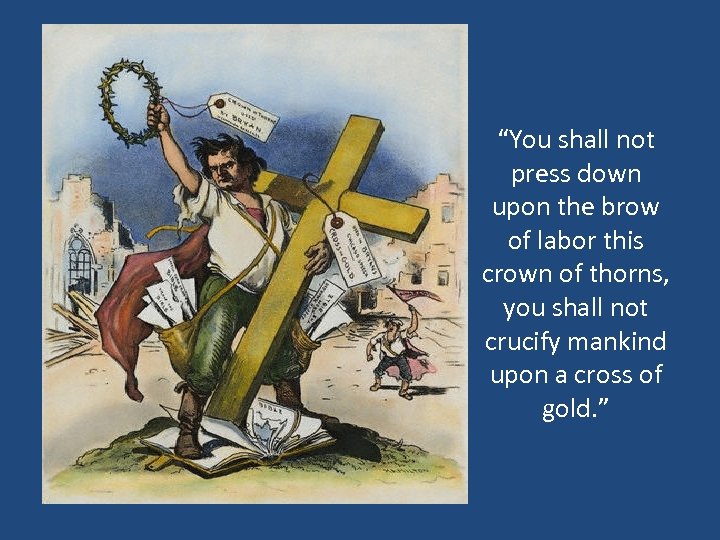 “You shall not press down upon the brow of labor this crown of thorns, you shall not crucify mankind upon a cross of gold. ”
 • Widespread fear of Bryan unites Republicans (savings would be devalued if silver coined) – Rich donate huge amounts to Mc. Kinley ($16 million total, to Bryan’s $1 million) – Fear and dirty tricks used: industrial workers told that orders, jobs, pay might be taken away if Bryan won – Mc. Kinley wins close popular vote with heavy majority in large East Coast cities
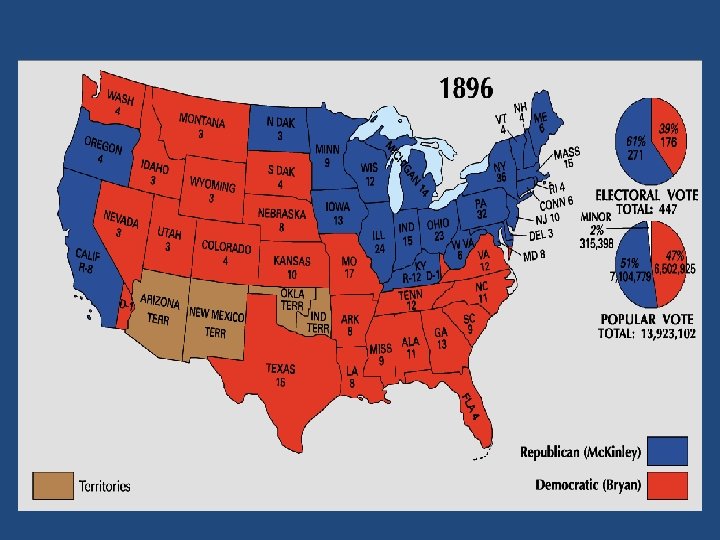
 • Importance of the 1896 election – Eastern workers did not unite with debtor farmers against big business – Big business, fiscal conservatives, middleclass values won – Political power shifted from rural areas to cities • Republicans dominated politics for next 36 years (except for 1912 – 1920) • Parties weakened, less voter participation in elections, regulation of industry and worker welfare became important issues
 • Mc. Kinley and the tariff issue – Business wants higher tariff because tariffs not high enough to cover gov’t expenses (want budget balanced) • Dingley Tariff Bill (1897) passed making average tariff rate over 40% • Prosperity returned to US erasing gold and silver issue – 1900 – Gold Standard Act passed • All paper money redeemable in gold – New gold discoveries and new processes put enough money into economy to introduce inflation and help debtors