


 Скачать презентацию mr cargile mission hills h s san
e5599ad5d6a505624763eae8e9a50418.ppt
- Количество слайдов: 180
 mr. cargile mission hills h. s. , san marcos ca
 california content standard 10. 3. 1
 Specific Objective: Analyze why England was the first country to industrialize
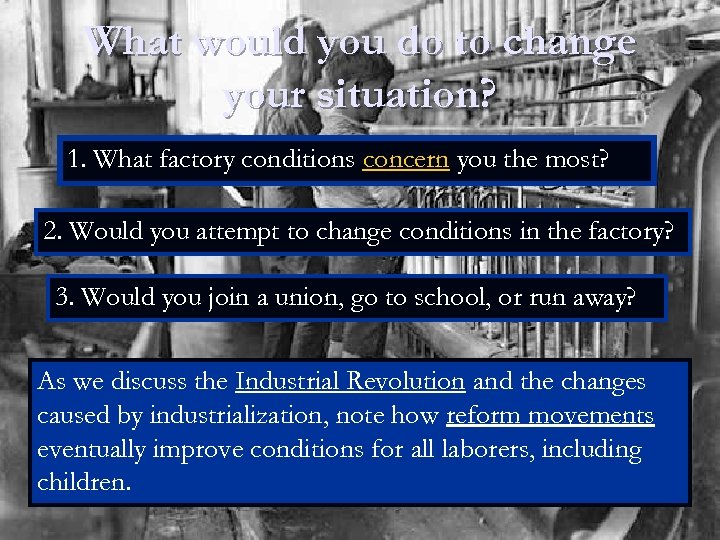 What would you do to change your situation? 1. What factory conditions concern you the most? 2. Would you attempt to change conditions in the factory? 3. Would you join a union, go to school, or run away? As we discuss the Industrial Revolution and the changes caused by industrialization, note how reform movements eventually improve conditions for all laborers, including children.
 The Industrial Revolution began in England in the mid-1700 s. In a century that followed, factories and machines transformed the nation and spread throughout Europe and North America. Instead of using hand tools to make household quantities, people came to rely on machinery to produce large amounts of goods to be sold in shops.
 That Nation of Shopkeepers! -- Napoleon Bonaparte
 A: Economic Strength ù During the 1600 s, overseas exploration had opened new markets for England, and led to a thriving economy base on money. ù British merchants invested money in new industries. ù New financial institutions such as banks offered business loans that helped spur industrial growth. The most famous was the powerful Bank of England, 1694.
 A: Geography & Natural Resources ù England’s rivers offered a dual advantage. Fast-flowing rivers were a source of water power to fuel machinery, and throughout the nation rivers provided inland transportation routes for industrial goods. ù In addition, England’s excellent natural harbors were a benefit to merchant ships.
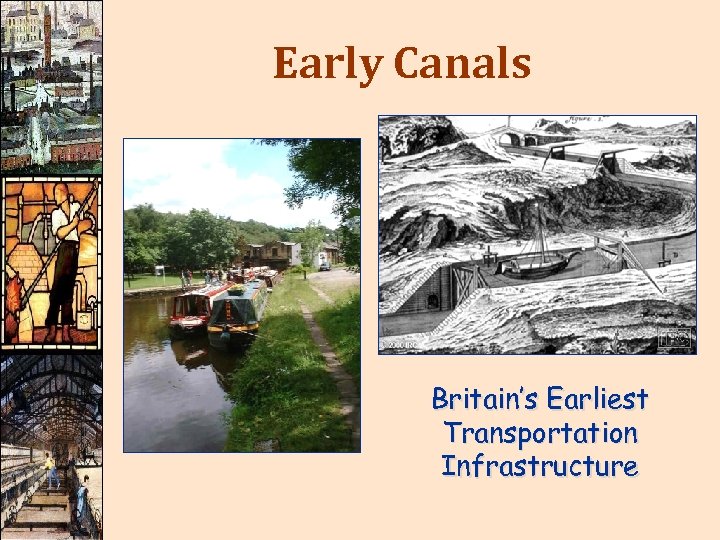 Early Canals Britain’s Earliest Transportation Infrastructure
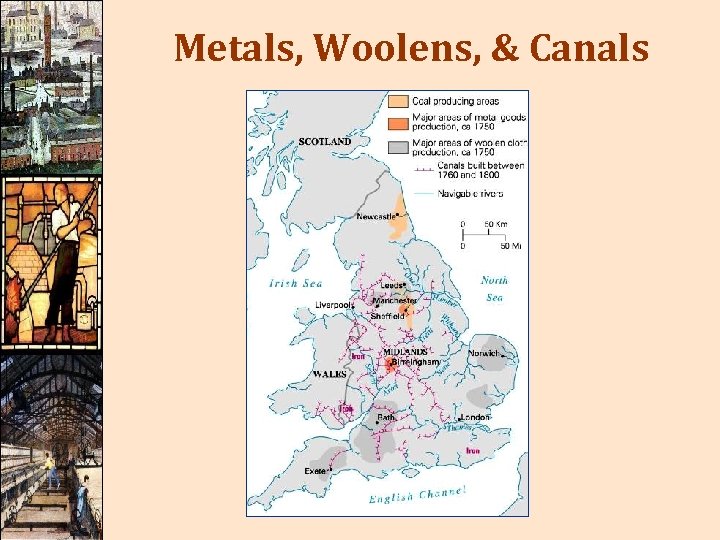 Metals, Woolens, & Canals
 Question : How did improvements in transportation promote industrialization in Britain? Answer Canals cut the cost of transporting materials; : improved roads fostered the movement of heavy wagons; railroads linked manufacturing cities with raw materials.
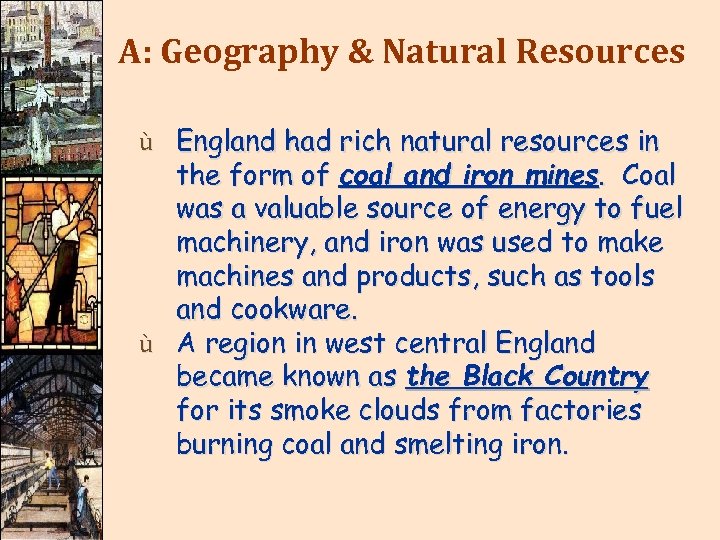 A: Geography & Natural Resources ù England had rich natural resources in the form of coal and iron mines. Coal was a valuable source of energy to fuel machinery, and iron was used to make machines and products, such as tools and cookware. ù A region in west central England became known as the Black Country for its smoke clouds from factories burning coal and smelting iron.
![Mine & Forge [1840 -1880] ù More powerful than water is coal. ù More](https://present5.com/presentation/e5599ad5d6a505624763eae8e9a50418/image-14.jpg "Mine & Forge [1840 -1880] ù More powerful than water is coal. ù More") Mine & Forge [1840 -1880] ù More powerful than water is coal. ù More powerful than wood is iron. ù Innovations make steel feasible. § “Puddling” [1820] – “pig iron. ” § “Hot blast” [1829] – cheaper, purer steel. § Bessemer process [1856] – strong, flexible steel.
Mine & Forge [1840 -1880] ù More powerful than water is coal. ù More powerful than wood is iron. ù Innovations make steel feasible. § “Puddling” [1820] – “pig iron. ” § “Hot blast” [1829] – cheaper, purer steel. § Bessemer process [1856] – strong, flexible steel.
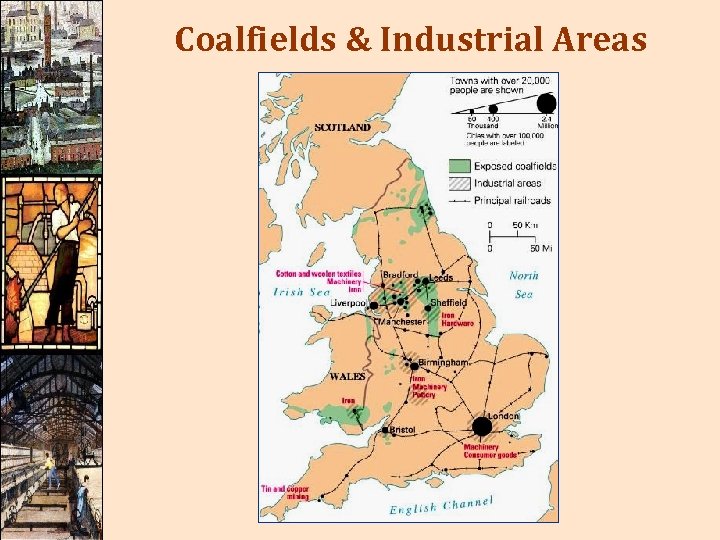 Coalfields & Industrial Areas
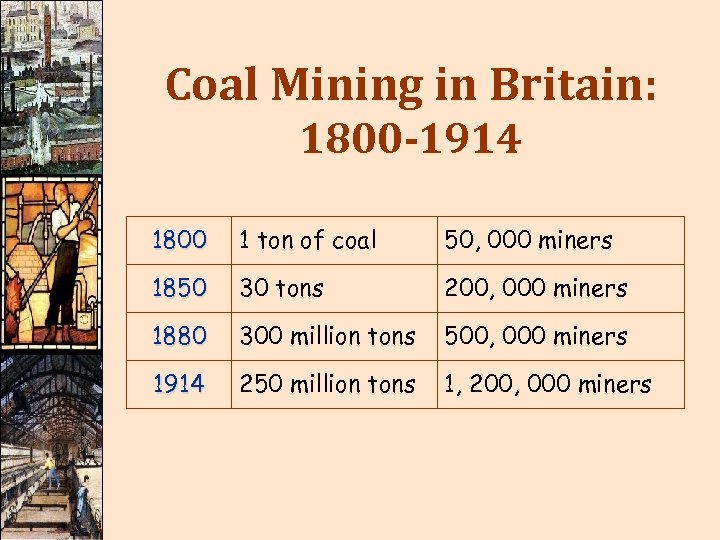 Coal Mining in Britain: 1800 -1914 1800 1 ton of coal 50, 000 miners 1850 30 tons 200, 000 miners 1880 300 million tons 500, 000 miners 1914 250 million tons 1, 200, 000 miners
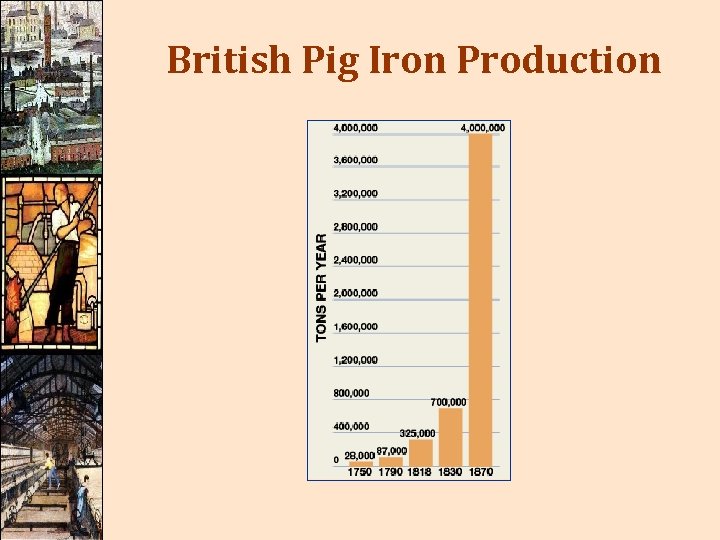 British Pig Iron Production
![A: Population Growth [I] ù Scientific improvements in farming during the 1700 s led](https://present5.com/presentation/e5599ad5d6a505624763eae8e9a50418/image-18.jpg "A: Population Growth [I] ù Scientific improvements in farming during the 1700 s led") A: Population Growth [I] ù Scientific improvements in farming during the 1700 s led to more crops and healthier livestock – an Agricultural Revolution that brought more food to the people
A: Population Growth [I] ù Scientific improvements in farming during the 1700 s led to more crops and healthier livestock – an Agricultural Revolution that brought more food to the people
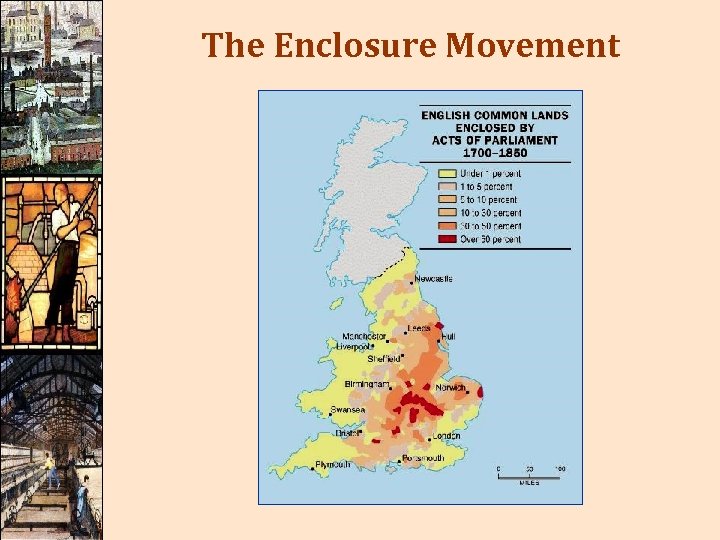 The Enclosure Movement
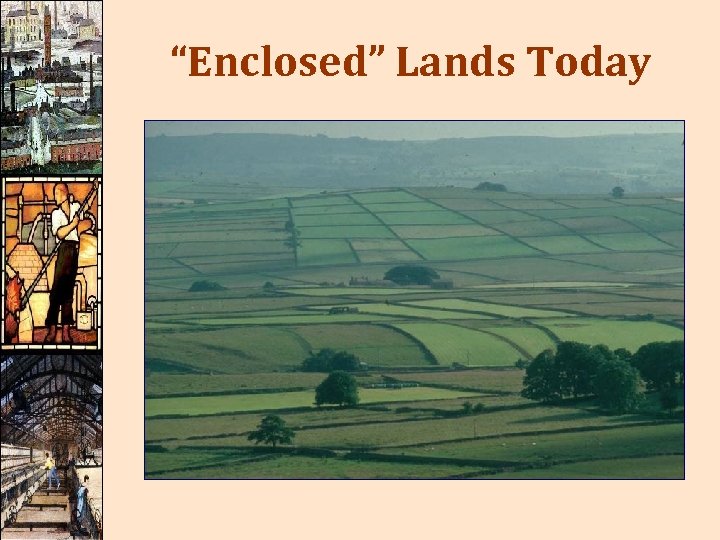 “Enclosed” Lands Today
![A: Population Growth [2] ù A larger population meant greater demand for goods and](https://present5.com/presentation/e5599ad5d6a505624763eae8e9a50418/image-21.jpg "A: Population Growth [2] ù A larger population meant greater demand for goods and") A: Population Growth [2] ù A larger population meant greater demand for goods and more available labor.
A: Population Growth [2] ù A larger population meant greater demand for goods and more available labor.
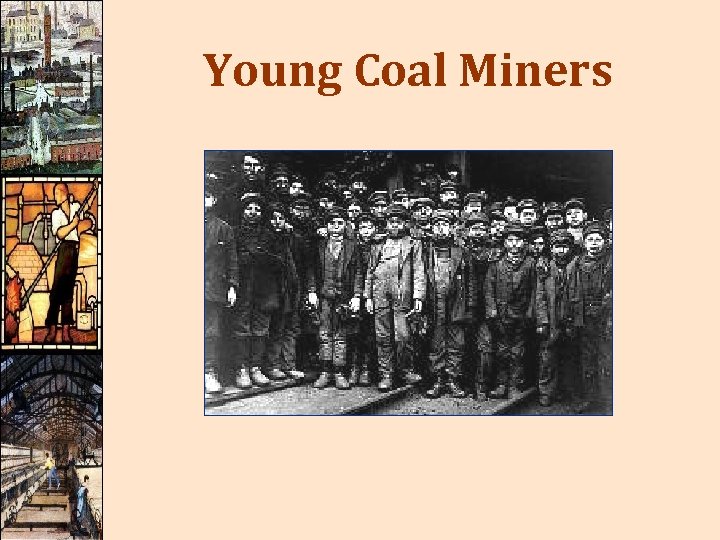 Young Coal Miners
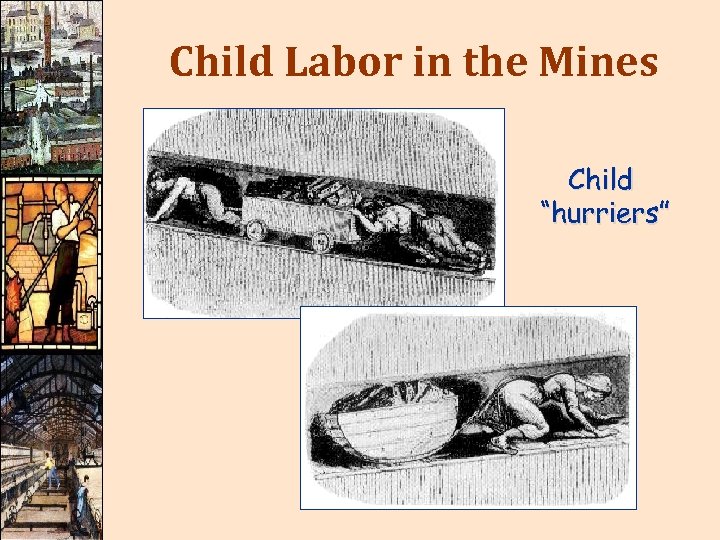 Child Labor in the Mines Child “hurriers”
 Question: What were some of the effects of enclosure and crop rotation? Possible Answer: enclosure resulted in experiments with new agricultural methods, and it caused many small farmers to move to the cities. crop rotation produced increased yields.
 A: Political Stability ù An isolated, island nation, England participated in European wars of the 18 th and early 19 th centuries, but never on home ground. ù England’s industrial growth was not interrupted by war.
 Let’s see how much you know 7/Q
 Question #1 What was a direct effect increased food of production during Europe’s Agricultural Revolution? a. New markets opened. b. Overseas trade increased. c. The population increased. d. Excess food wasted. 1/7
 Question #2 During the 1600 s, Europe developed a thriving economy based on a. Barter. b. Money. c. Banking. d. Factories. 2/7
 Question #3 A defining feature of Europe’s Industrial Revolution was that many commercial goods were a. Purchased in overseas markets. b. Manufactured in less developed countries. c. Sold without economic barriers such as tariffs. d. Made by machine rather than by hand. 3/7
 Question #4 A geographic advantage of England in the Industrial Revolution was its a. Natural harbors. b. National bank. c. Central location in Europe. d. Central mountain range. 4/7
 Question #5 The “Black Country” of England was known for its a. Forest fires. b. Smoke from coal. c. Fast-flowing rivers. d. Political stability. 5/7
 Question #6 What was one important power source for factories in 18 th-century England? a. Gas b. Electricity c. Oil d. water 6/7
 Question #7 Which of the following explains why England was the first country to industrialize? a. England was home to more scientists and inventors than any other nation. b. England was an island nation. c. England was a relatively free society with a vast overseas empire to buy its products. d. England’s population was more educated than populations in other parts of the world. 7/7
 Inventions and Social Change california content standard 10. 3. 2
 Specific Objective: examine how scientific and technological changes and new forms of energy brought about massive social, economic, and cultural change. california content standard 10. 3. 2
 Summary machinery made the industrial revolution possible. reliance on machinery defined the revolution from its earliest days, and technological innovation drove its development. california content standard 10. 3. 2

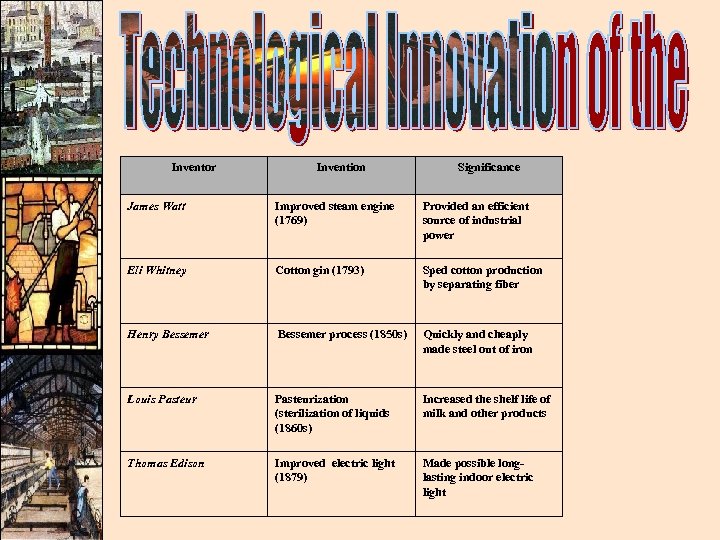 Inventor Invention Significance James Watt Improved steam engine (1769) Provided an efficient source of industrial power Eli Whitney Cotton gin (1793) Sped cotton production by separating fiber Henry Bessemer process (1850 s) Quickly and cheaply made steel out of iron Louis Pasteurization (sterilization of liquids (1860 s) Increased the shelf life of milk and other products Thomas Edison Improved electric light (1879) Made possible longlasting indoor electric light
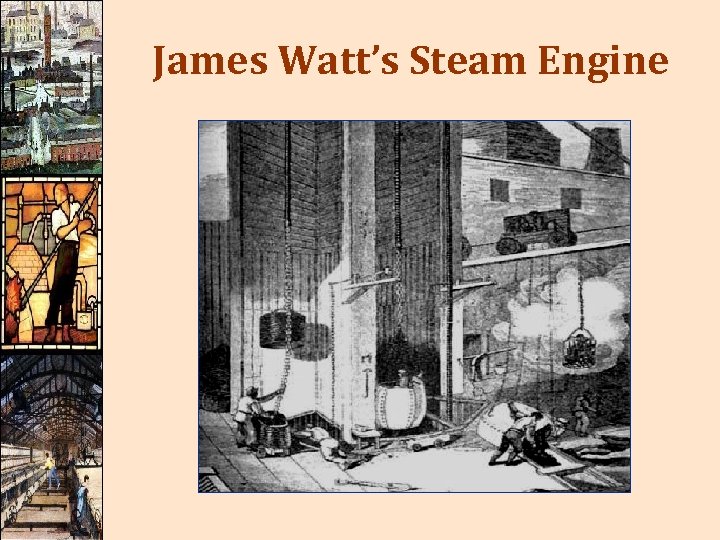 James Watt’s Steam Engine
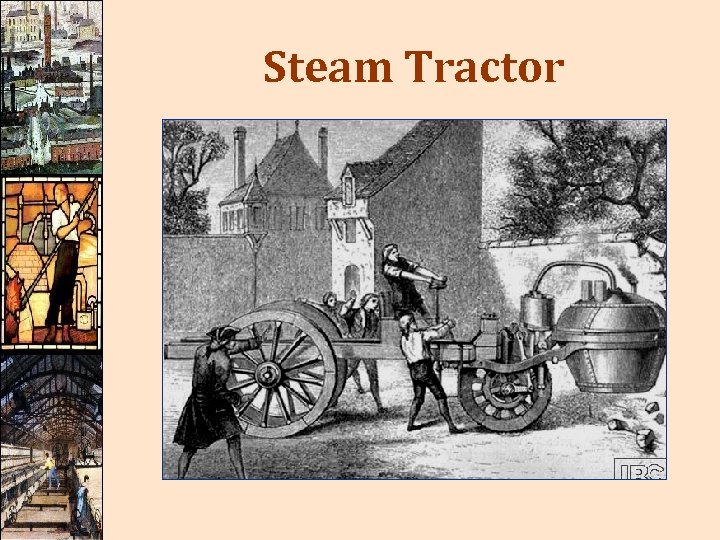 Steam Tractor
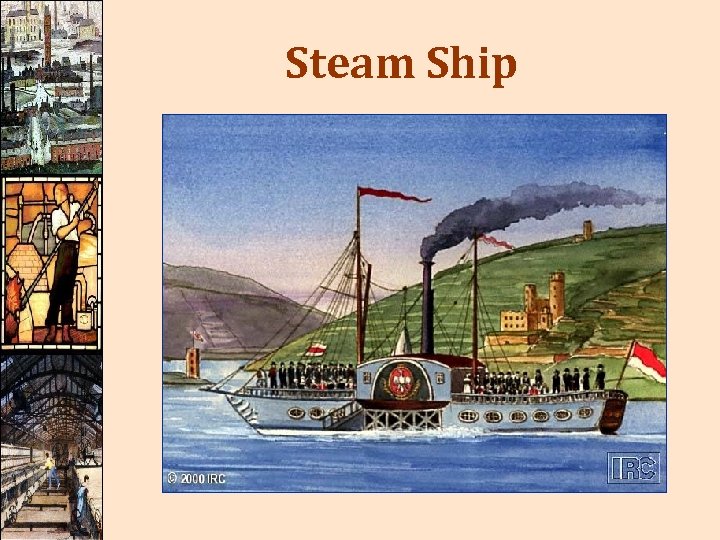 Steam Ship
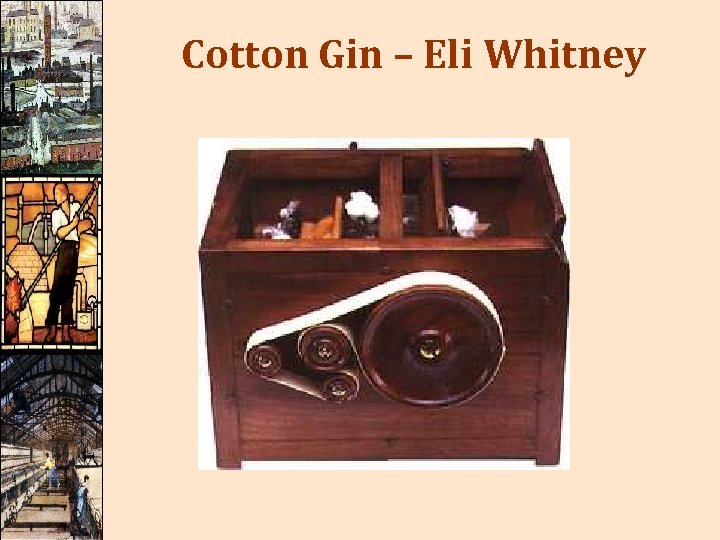 Cotton Gin – Eli Whitney
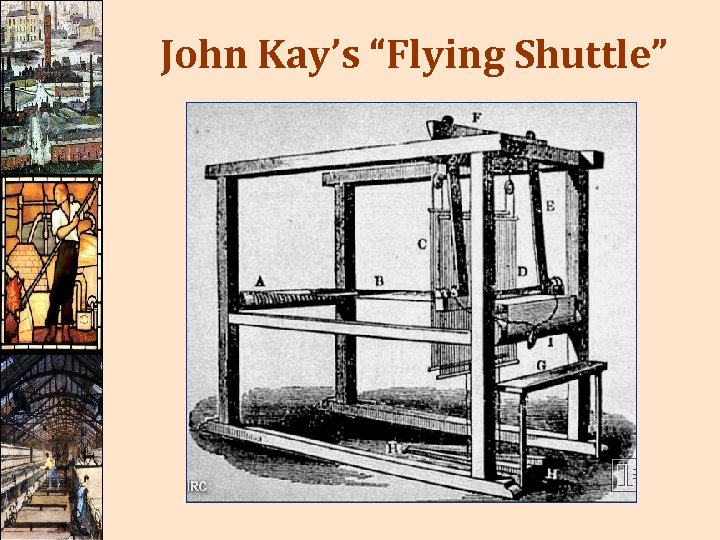 John Kay’s “Flying Shuttle”
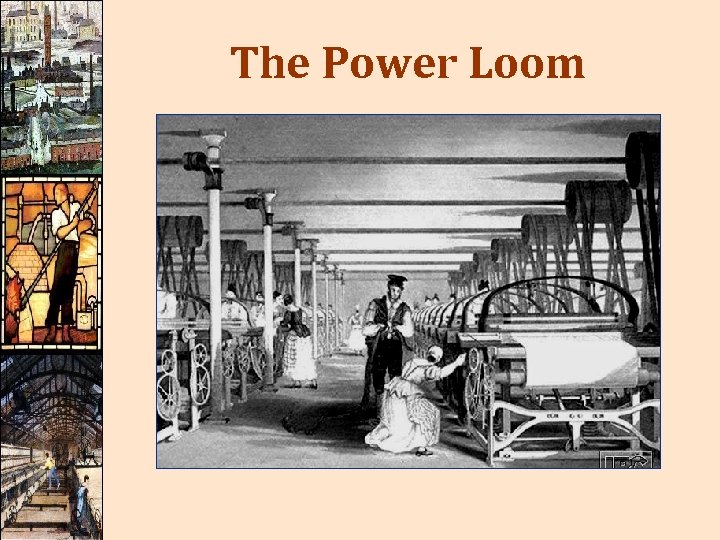 The Power Loom
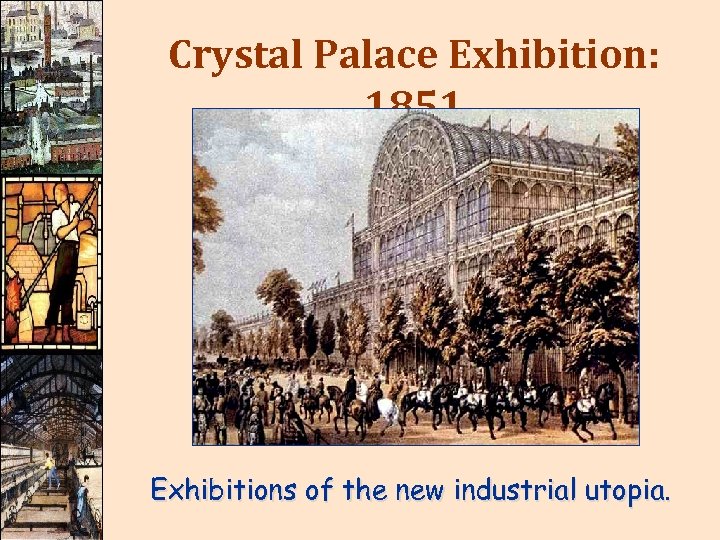 Crystal Palace Exhibition: 1851 Exhibitions of the new industrial utopia.
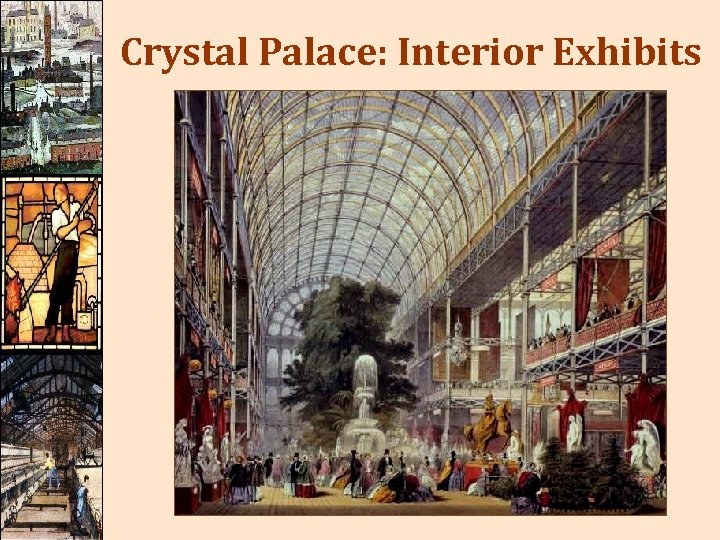 Crystal Palace: Interior Exhibits
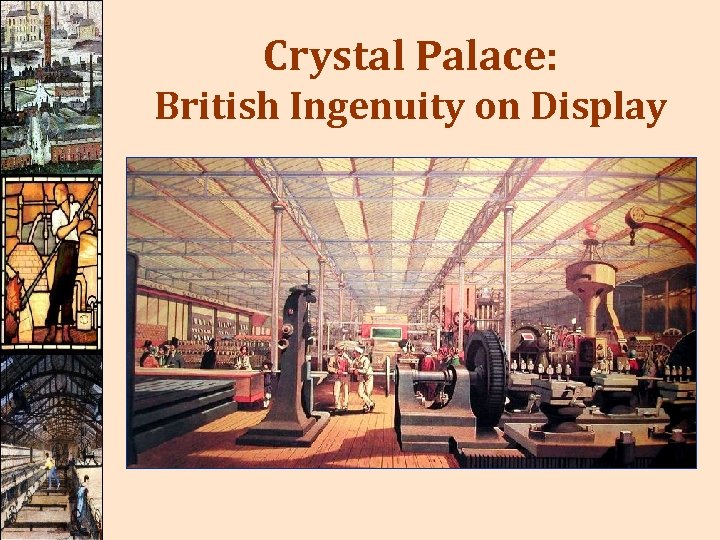 Crystal Palace: British Ingenuity on Display
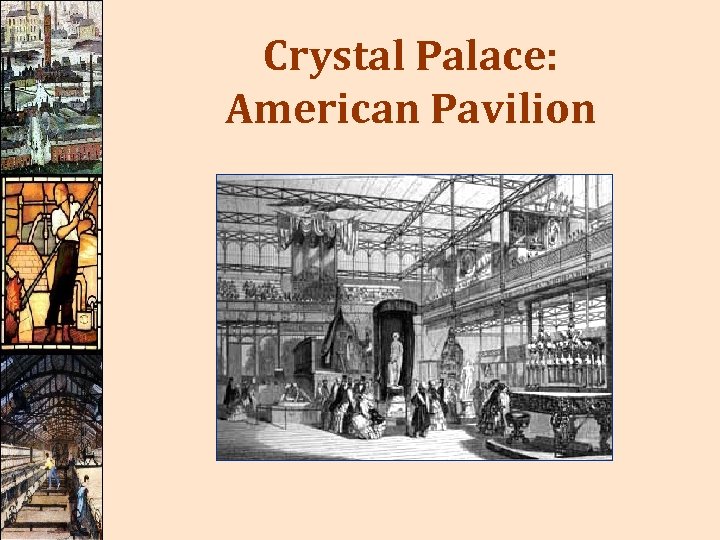 Crystal Palace: American Pavilion
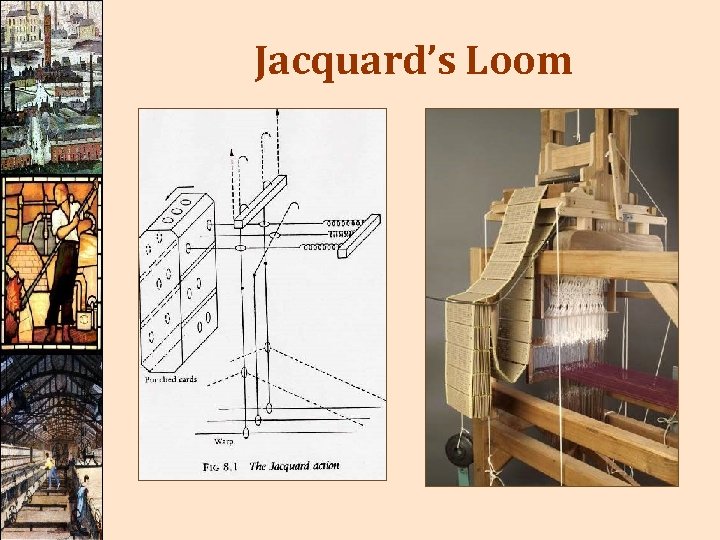 Jacquard’s Loom
![Spread of Technology [1] ) By the 1840 s, England had become a nation](https://present5.com/presentation/e5599ad5d6a505624763eae8e9a50418/image-50.jpg "Spread of Technology [1] ) By the 1840 s, England had become a nation") Spread of Technology [1] ) By the 1840 s, England had become a nation connected by railroads. Around the same time, the United States, Russia, and European nations, such as France and Germany, developed rail systems too. Railroads transported goods and linked commercial centers.
Spread of Technology [1] ) By the 1840 s, England had become a nation connected by railroads. Around the same time, the United States, Russia, and European nations, such as France and Germany, developed rail systems too. Railroads transported goods and linked commercial centers.
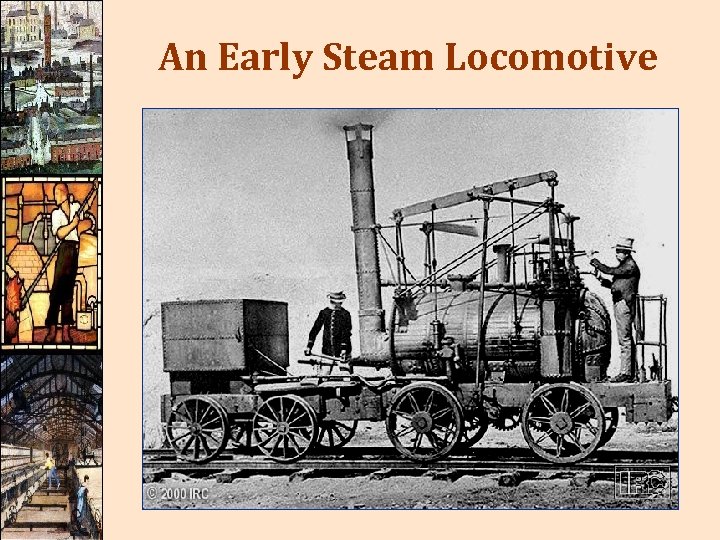 An Early Steam Locomotive
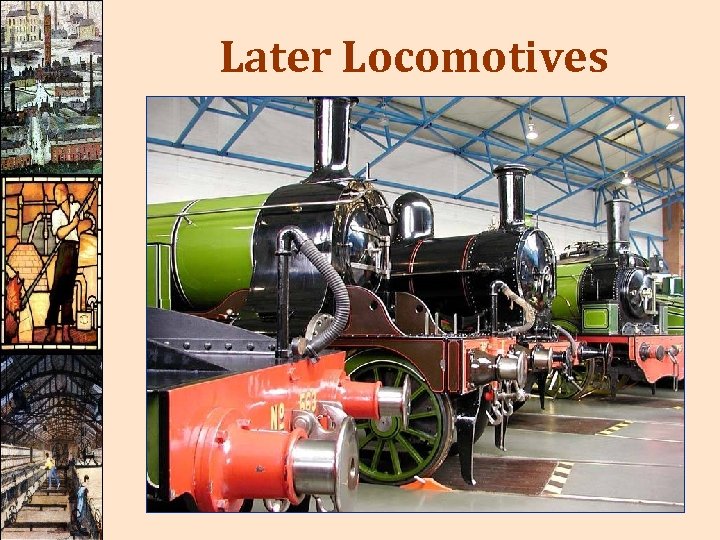 Later Locomotives
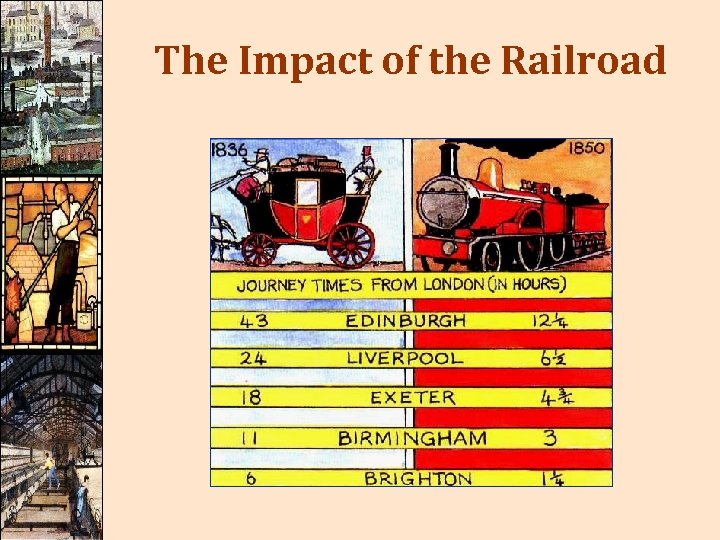 The Impact of the Railroad
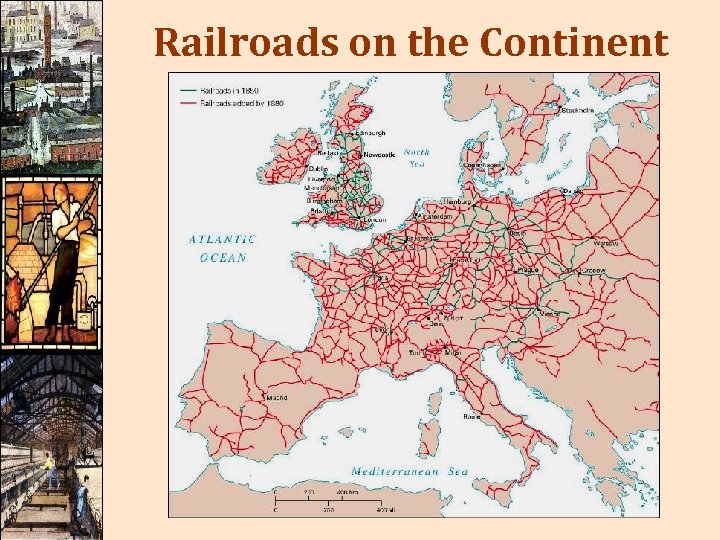 Railroads on the Continent
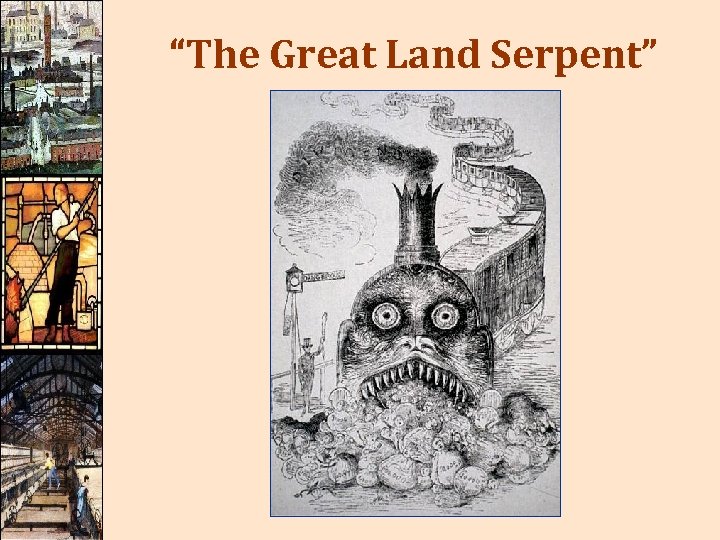 “The Great Land Serpent”
![Spread of Technology [2] ) Major advances in communication had occurred by the 1870](https://present5.com/presentation/e5599ad5d6a505624763eae8e9a50418/image-56.jpg "Spread of Technology [2] ) Major advances in communication had occurred by the 1870") Spread of Technology [2] ) Major advances in communication had occurred by the 1870 s. International mail service had been achieved; telegraph messages could be transmitted around the world in minutes; and, in 1876, the telephone was used for the first time (though it did not become widespread until the early 1900 s).
Spread of Technology [2] ) Major advances in communication had occurred by the 1870 s. International mail service had been achieved; telegraph messages could be transmitted around the world in minutes; and, in 1876, the telephone was used for the first time (though it did not become widespread until the early 1900 s).
 Effects on Society ) ) In agricultural life, the forces of weather and nature rule. In the new industrial culture, work could take place in any weather and more quickly than ever before. Railroads replaced horses, increasing loads and decreasing shipping and travel times. With the telegraph, it now took minutes rather than months for a message to reach a faraway destination. The pace of life had changed forever.
 Question: What were the major inventions in the textile industry? Describe. (You and your partner must come up with at least three) Answer Flying shuttle, spinning jenny; water : frame; spinning mule; factory
 Let’s see how much you know 7/Q
 Question #1 What impact did the steam engine have on the growth of industry? a. Permitted merchants to reach new markets b. Ended dependence on ocean transport c. Reduced pollution compared with coal d. Provided an efficient source of power 1/7
 Question #2 What technology did James Watt improve ? a. The steam engine b. Cotton processing c. Electric light d. The Bessemer process 2/7
 Question #3 Which process would be an example of pasteurization? a. Milk is sterilized. b. Milk is steamed. c. Coal is burned to make steam. d. Steel is made out of iron. 3/7
 Question #4 By the 1840 s, England was connected by a network of a. Craft guilds. b. Telephone lines. c. Railroads. d. Electric lines. 4/7
 Question #5 Which 20 th-century invention is most comparable to the telegraph in its impact? a. television b. e-mail and the Internet c. Airplanes d. The telephone 5/7
 Question #6 Which increased as a result of the Industrial Revolution? a. Prices for consumer goods b. Dependence on the weather c. The speed of transactions d. Isolation of commercial centers 6/7
 Question #7 Which of the following statements about the effects of scientific and technological changes during the Industrial Revolution is true ? a. They had little or no effect on how people lived outside of factory towns. b. They significantly altered how people worked, played, and maintained their health. c. They cheapened the quality of most products of daily life. d. They led to less democracy and a decline in literacy. 7/7
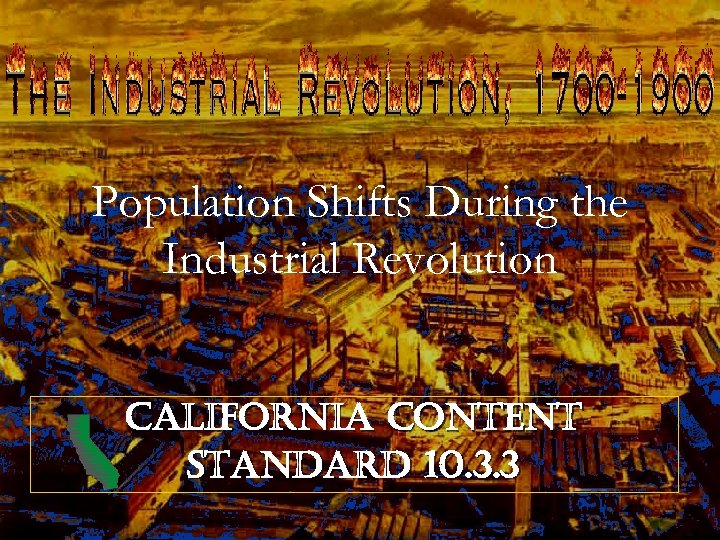 Population Shifts During the Industrial Revolution california content standard 10. 3. 3
 Specific Objective: Describe the growth of population, rural to urban migration, and growth of cities associated with the Industrial Revolution. california content standard 10. 3. 3
 Population Growth ) ) ) By the time of the Industrial Revolution, there were more people than ever before. A main reason for this was 18 th century agricultural improvements, which all but ended the periodic famines that had kept down European populations. From 1750 to 1850, the population of England alone nearly tripled.
 ) ) ) Rural to Urban Before Migration the Industrial Revolution, most Europeans – and most of the world – lived on small farms in rural areas. By the mid-1800 s, half the people in England lived in cities, and by 1900 this change had spread throughout much of Europe. Population migration from rural to urban settings is a defining feature of the Industrial Revolution.
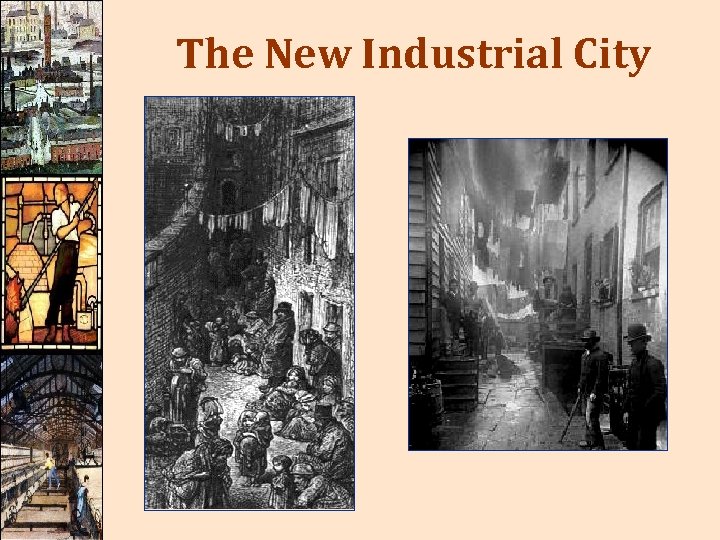 The New Industrial City
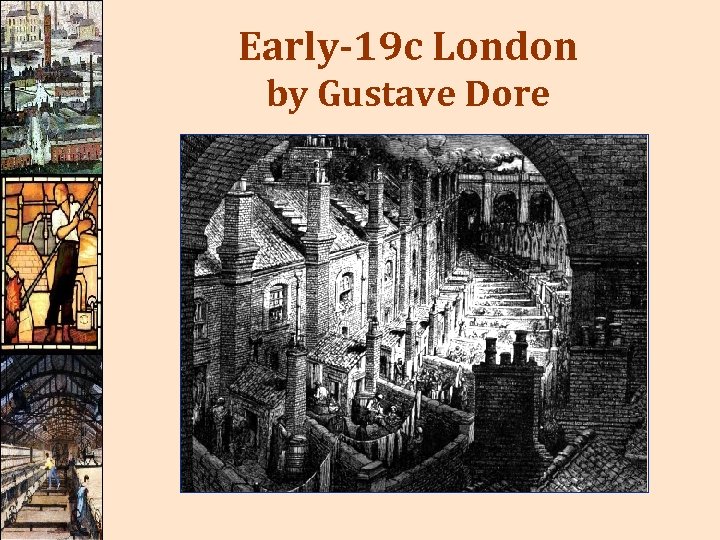 Early-19 c London by Gustave Dore
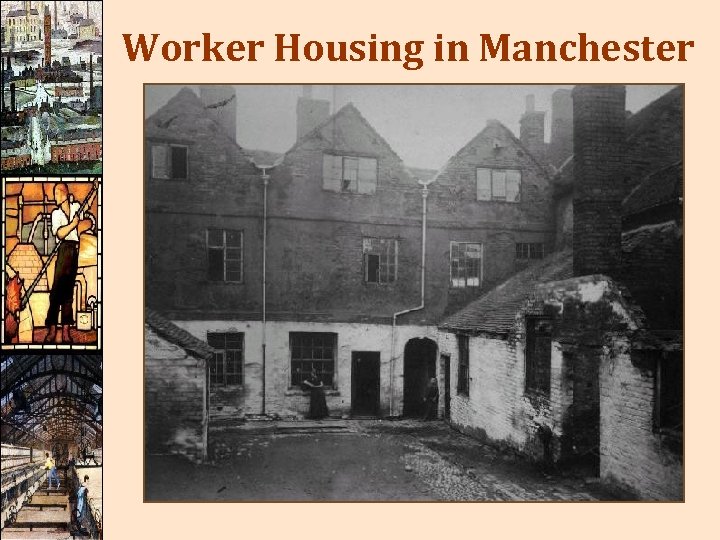 Worker Housing in Manchester
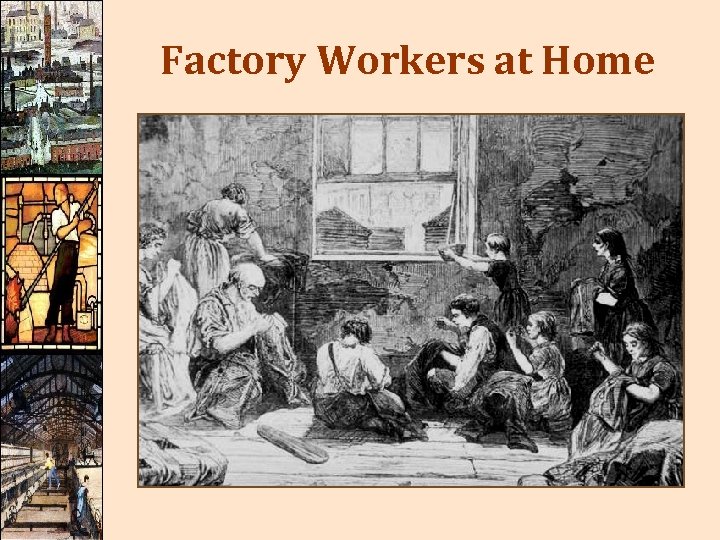 Factory Workers at Home
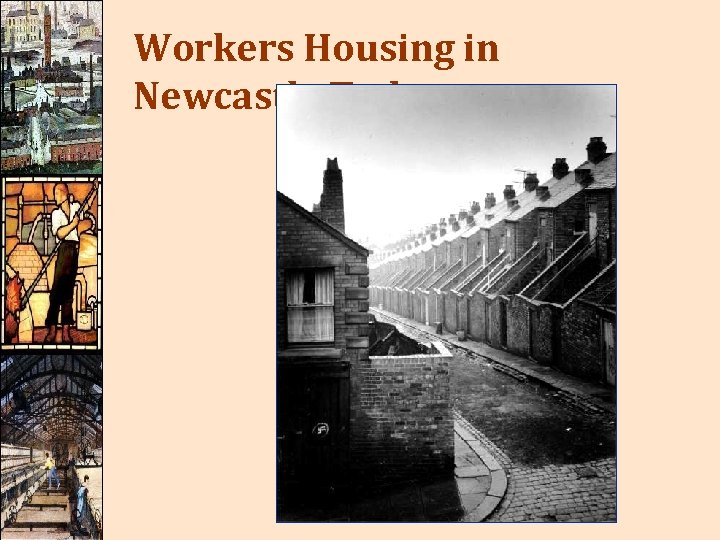 Workers Housing in Newcastle Today
 Why Cities? ) ) ) Factory work made it necessary for many workers to be in one place. New goods brought the need for new market centers. Often, these were located on waterways for ease of transportation. The emerging banking and commercial industries developed their own centers.
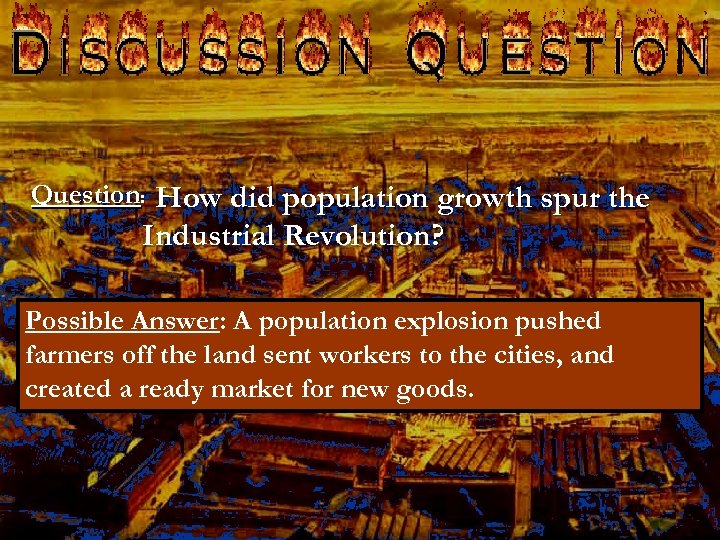 Question: How did population growth spur the Industrial Revolution? Possible Answer: A population explosion pushed farmers off the land sent workers to the cities, and created a ready market for new goods.
![Factory Production ) Concentrates production in one place [materials, labor]. ) Located near sources](https://present5.com/presentation/e5599ad5d6a505624763eae8e9a50418/image-78.jpg "Factory Production ) Concentrates production in one place [materials, labor]. ) Located near sources") Factory Production ) Concentrates production in one place [materials, labor]. ) Located near sources of power [rather than labor or markets]. ) Requires a lot of capital investment [factory, machines, etc. ] more than skilled labor. ) Only 10% of English industry in 1850.
Factory Production ) Concentrates production in one place [materials, labor]. ) Located near sources of power [rather than labor or markets]. ) Requires a lot of capital investment [factory, machines, etc. ] more than skilled labor. ) Only 10% of English industry in 1850.
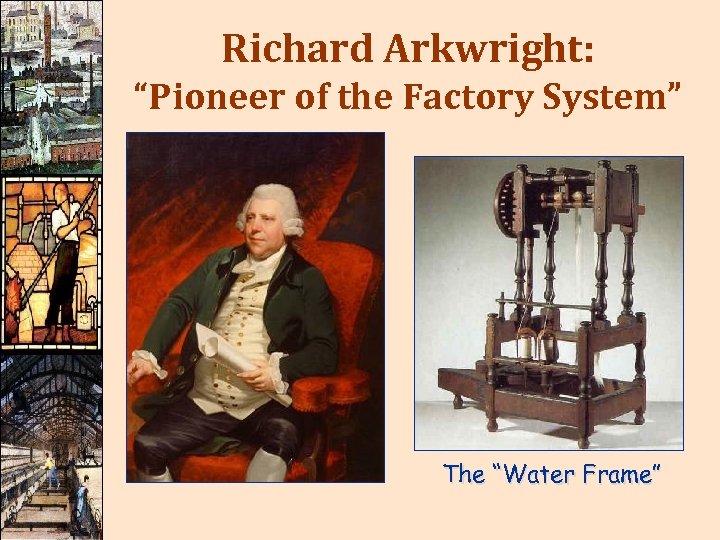 Richard Arkwright: “Pioneer of the Factory System” The “Water Frame”
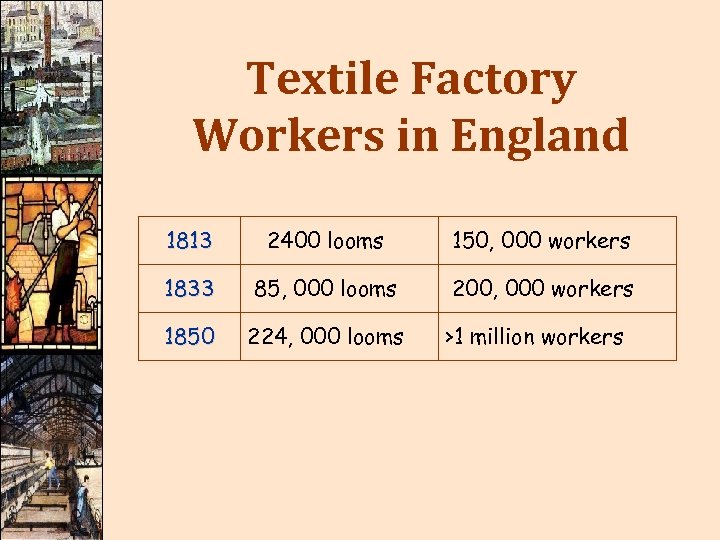 Textile Factory Workers in England 1813 2400 looms 150, 000 workers 1833 85, 000 looms 200, 000 workers 1850 224, 000 looms >1 million workers
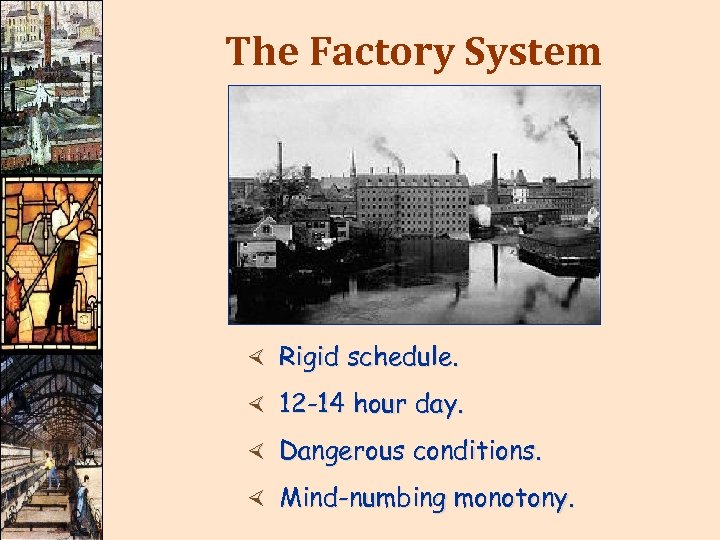 The Factory System × Rigid schedule. × 12 -14 hour day. × Dangerous conditions. × Mind-numbing monotony.
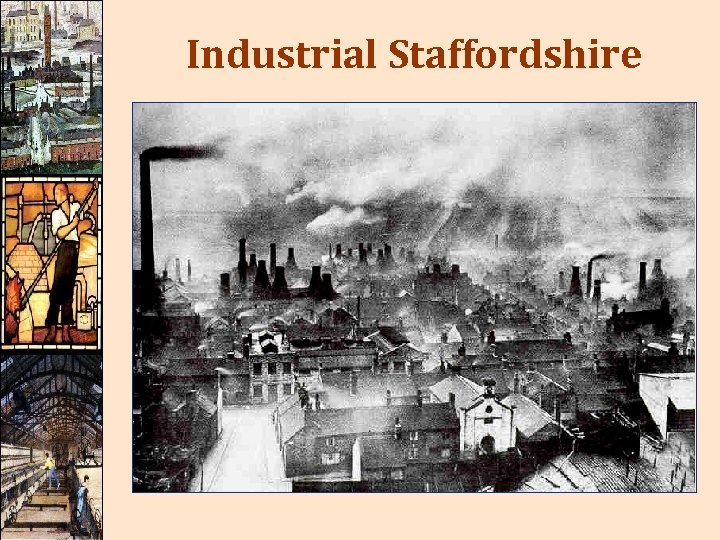 Industrial Staffordshire
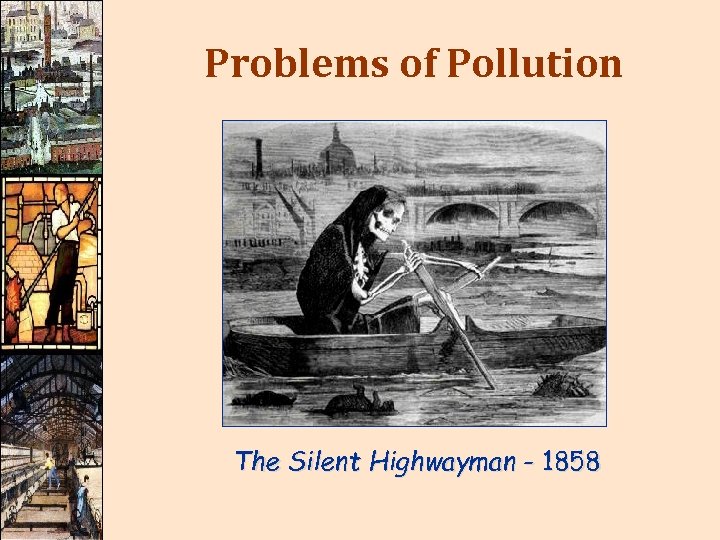 Problems of Pollution The Silent Highwayman - 1858
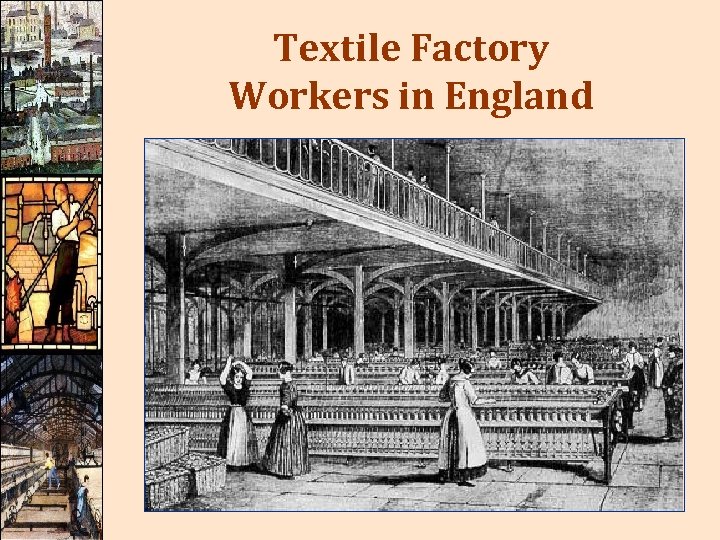 Textile Factory Workers in England
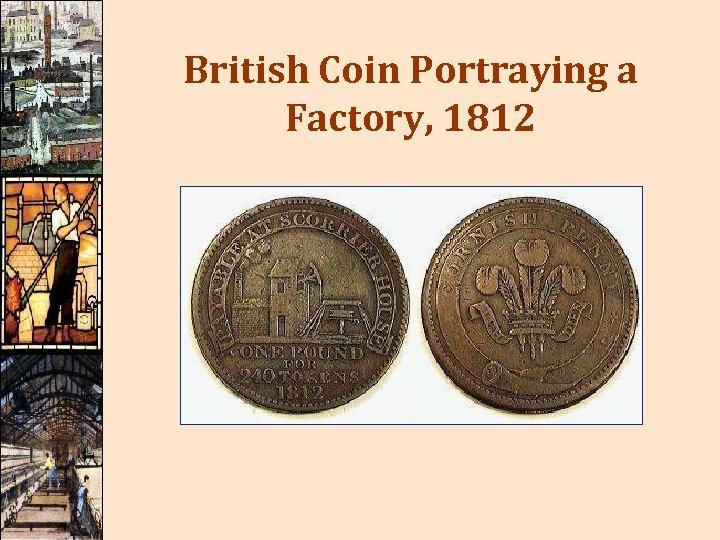 British Coin Portraying a Factory, 1812
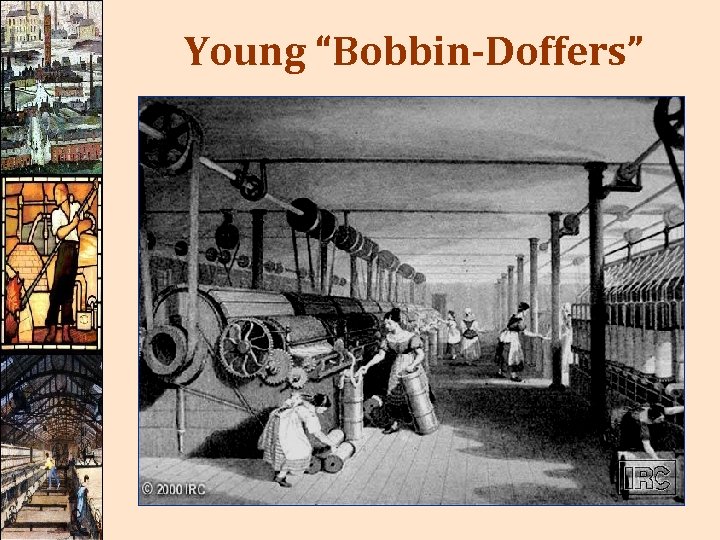 Young “Bobbin-Doffers”
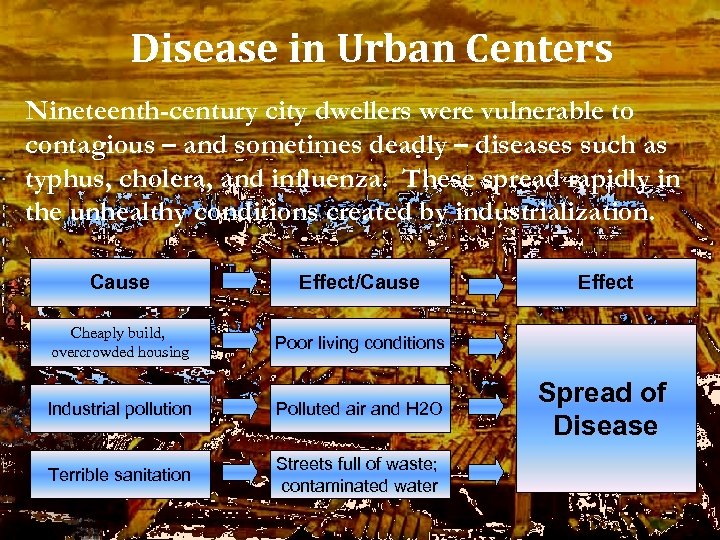 Disease in Urban Centers Nineteenth-century city dwellers were vulnerable to contagious – and sometimes deadly – diseases such as typhus, cholera, and influenza. These spread rapidly in Cause Effect/Cause Effect the unhealthy conditions created by industrialization. Cheaply build, overcrowded housing Cause Industrial pollution Cheaply build, overcrowded housing Poor living conditions Effect/Cause Effect Polluted air and H 2 O Poor living conditions Spread of Disease Terrible sanitation Industrial pollution Streets full of waste; contaminated water Polluted air and H 2 O Terrible sanitation Streets full of waste; contaminated water Spread of Disease
 Let’s see how much you know 3/Q
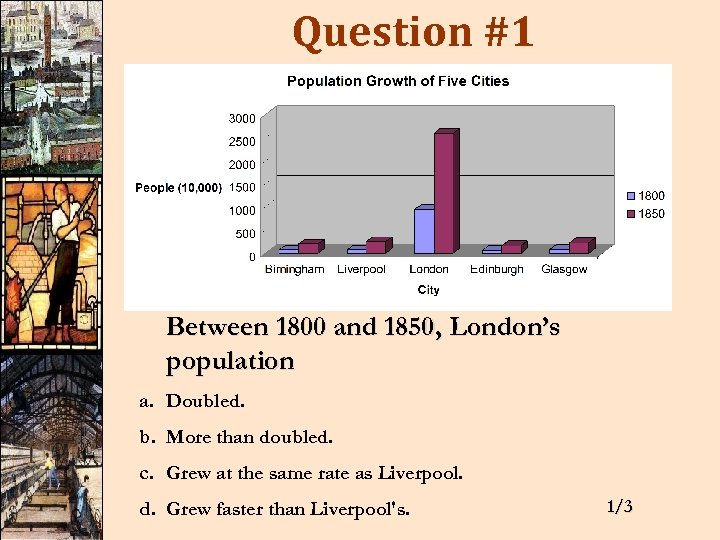 Question #1 Between 1800 and 1850, London’s population a. Doubled. b. More than doubled. c. Grew at the same rate as Liverpool. d. Grew faster than Liverpool's. 1/3
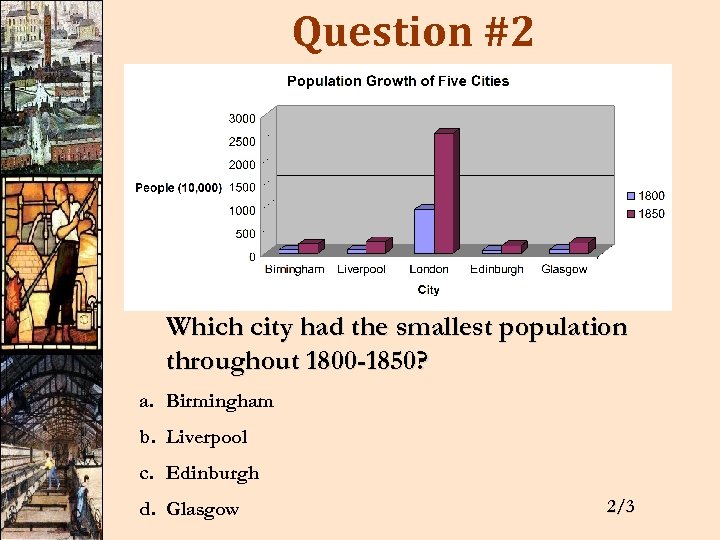 Question #2 Which city had the smallest population throughout 1800 -1850? a. Birmingham b. Liverpool c. Edinburgh d. Glasgow 2/3
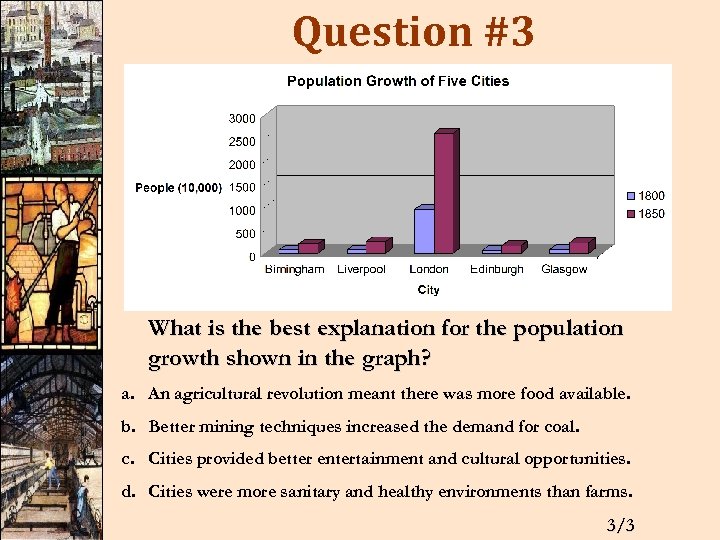 Question #3 What is the best explanation for the population growth shown in the graph? a. An agricultural revolution meant there was more food available. b. Better mining techniques increased the demand for coal. c. Cities provided better entertainment and cultural opportunities. d. Cities were more sanitary and healthy environments than farms. 3/3
 The Evolution of Work and Labor california content standard 10. 3. 4
 Specific Objective: trace the evolution of work and labor, including the demise of the slave trade and the effects of immigration, mining and manufacturing, division of labor, and the union movement. california content standard 10. 3. 4
 The Industrial Revolution quickened the pace of workers’ lives and shaped how they worked and where they lived. No longer did the vast majority work in agriculture. Millions were employed in mining and manufacturing – many working in a cash economy for the first time and in fastgrowing urban centers.
![The Demise of the Slave Trade [1] ) ) The industrial Revolution was financed](https://present5.com/presentation/e5599ad5d6a505624763eae8e9a50418/image-95.jpg "The Demise of the Slave Trade [1] ) ) The industrial Revolution was financed") The Demise of the Slave Trade [1] ) ) The industrial Revolution was financed in part by profits from the trans-Atlantic slave trade. But industry soon became more profitable than the slave trade. During the early 1800 s, the slave trade was abolished in England, the United States, and much of Europe.
The Demise of the Slave Trade [1] ) ) The industrial Revolution was financed in part by profits from the trans-Atlantic slave trade. But industry soon became more profitable than the slave trade. During the early 1800 s, the slave trade was abolished in England, the United States, and much of Europe.
![The Demise of the Slave Trade [2] ) ) Debates about the economic benefits](https://present5.com/presentation/e5599ad5d6a505624763eae8e9a50418/image-96.jpg "The Demise of the Slave Trade [2] ) ) Debates about the economic benefits") The Demise of the Slave Trade [2] ) ) Debates about the economic benefits of slavery developed alongside the obvious moral questions. Especially in the industrial northern United States, many people felt that free labor – not slave labor – was the only way to grow a strong industrial economy.
The Demise of the Slave Trade [2] ) ) Debates about the economic benefits of slavery developed alongside the obvious moral questions. Especially in the industrial northern United States, many people felt that free labor – not slave labor – was the only way to grow a strong industrial economy.
![Immigration [1] ) ) ) Immigration fueled the labor force, especially in North America.](https://present5.com/presentation/e5599ad5d6a505624763eae8e9a50418/image-97.jpg "Immigration [1] ) ) ) Immigration fueled the labor force, especially in North America.") Immigration [1] ) ) ) Immigration fueled the labor force, especially in North America. In the 19 th century, expanding industry in N. America drew millions of immigrants from Europe and Asia who sought new economic opportunities. By the 1870 s, they arrived at a rate of more than 2, 000 a day.
Immigration [1] ) ) ) Immigration fueled the labor force, especially in North America. In the 19 th century, expanding industry in N. America drew millions of immigrants from Europe and Asia who sought new economic opportunities. By the 1870 s, they arrived at a rate of more than 2, 000 a day.
![Immigration [2] ) Advances in transportation made this mass migration possible. Overseas transportation was](https://present5.com/presentation/e5599ad5d6a505624763eae8e9a50418/image-98.jpg "Immigration [2] ) Advances in transportation made this mass migration possible. Overseas transportation was") Immigration [2] ) Advances in transportation made this mass migration possible. Overseas transportation was safer and more available than ever before, and immigrants traveled within N. America by the new railway systems.
Immigration [2] ) Advances in transportation made this mass migration possible. Overseas transportation was safer and more available than ever before, and immigrants traveled within N. America by the new railway systems.
![Immigration [3]](https://present5.com/presentation/e5599ad5d6a505624763eae8e9a50418/image-99.jpg "Immigration [3]") Immigration [3]
Immigration [3]
 Division of Labor ) ) ) Increasingly divided social classes emerged during the Industrial Revolution. Very wealthy industrial owners and businessmen formed the upper class. The middle classes included a variety of professionals, such as teachers, lawyers, shopkeepers, and small businessmen. Factory workers and other dependent laborers made up the working class.

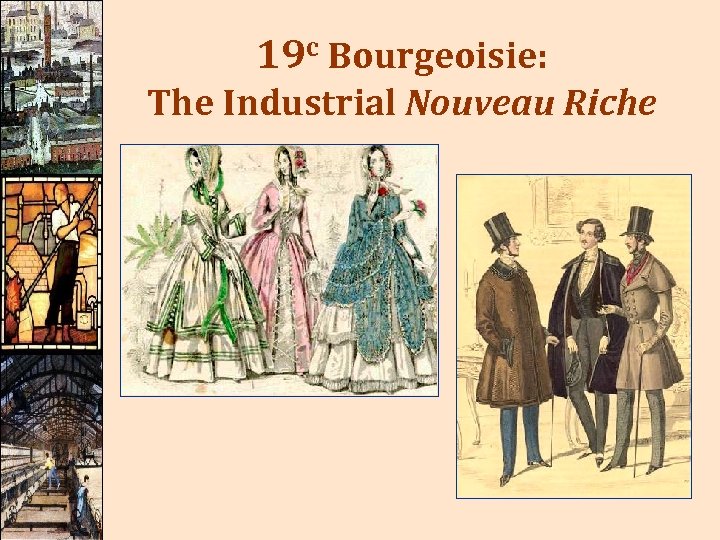 c 19 Bourgeoisie: The Industrial Nouveau Riche
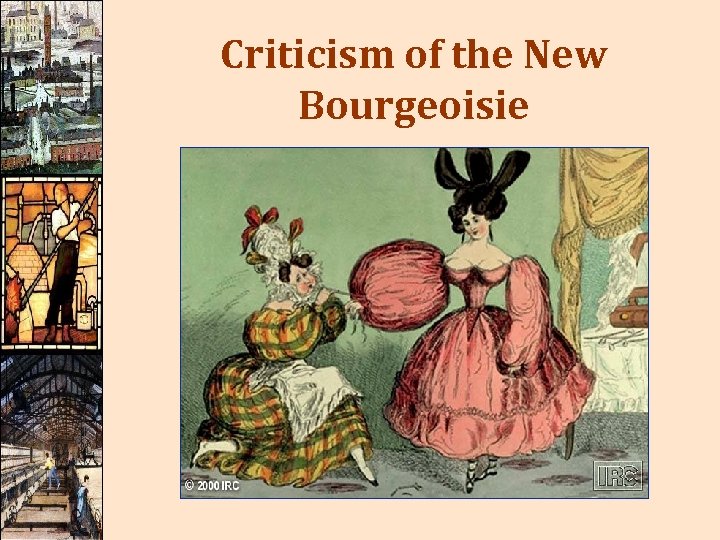 Criticism of the New Bourgeoisie
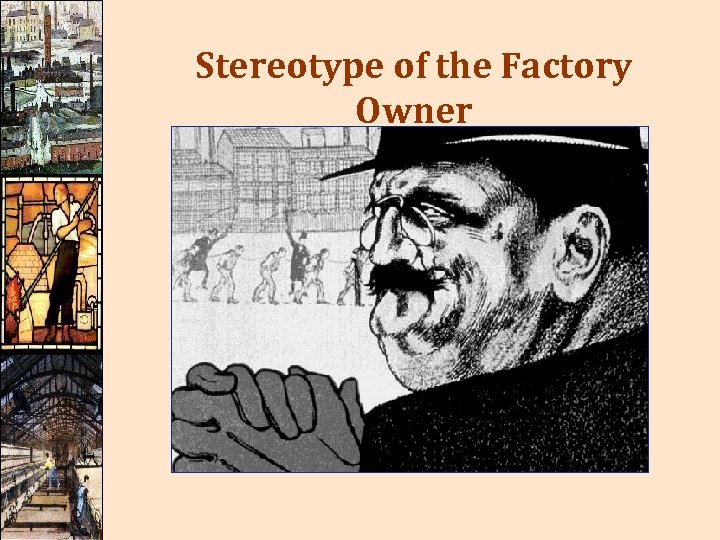 Stereotype of the Factory Owner
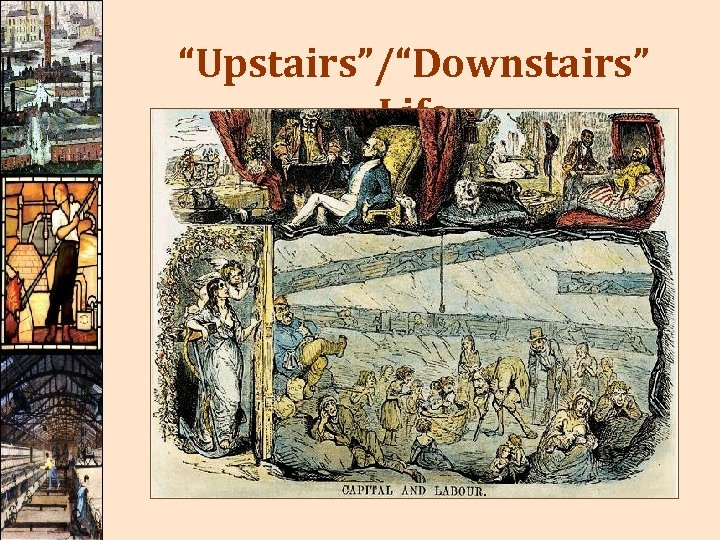 “Upstairs”/“Downstairs” Life

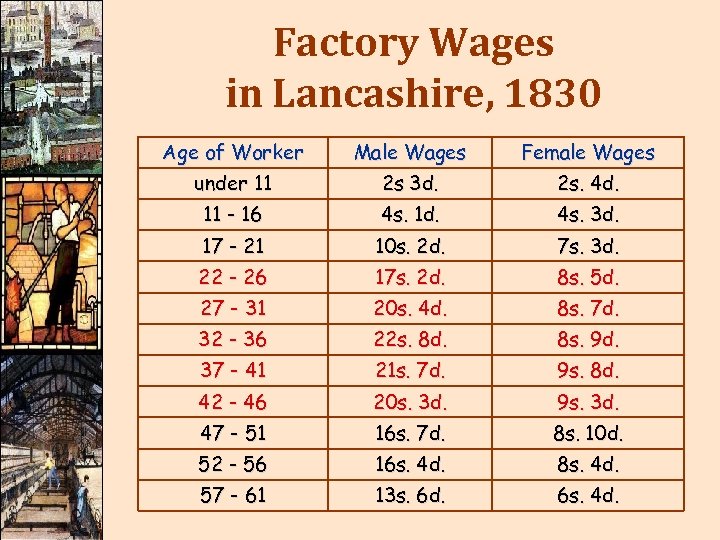 Factory Wages in Lancashire, 1830 Age of Worker Male Wages Female Wages under 11 2 s 3 d. 2 s. 4 d. 11 - 16 4 s. 1 d. 4 s. 3 d. 17 - 21 10 s. 2 d. 7 s. 3 d. 22 - 26 17 s. 2 d. 8 s. 5 d. 27 - 31 20 s. 4 d. 8 s. 7 d. 32 - 36 22 s. 8 d. 8 s. 9 d. 37 - 41 21 s. 7 d. 9 s. 8 d. 42 - 46 20 s. 3 d. 9 s. 3 d. 47 - 51 16 s. 7 d. 8 s. 10 d. 52 - 56 16 s. 4 d. 8 s. 4 d. 57 - 61 13 s. 6 d. 6 s. 4 d.
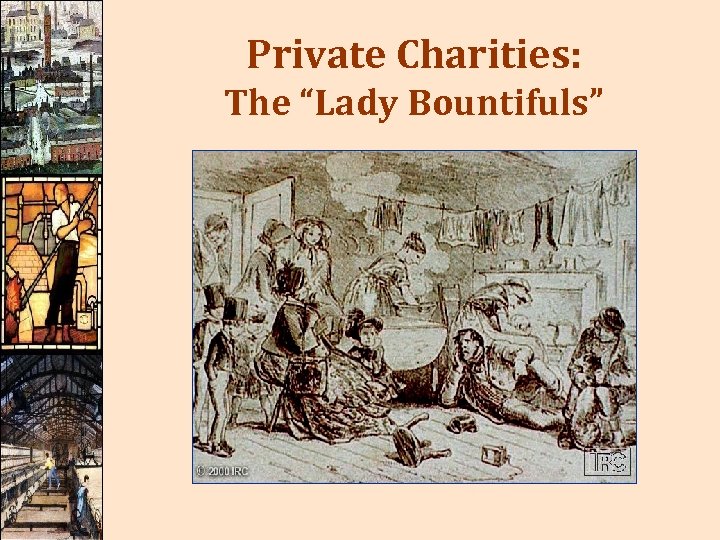 Private Charities: The “Lady Bountifuls”
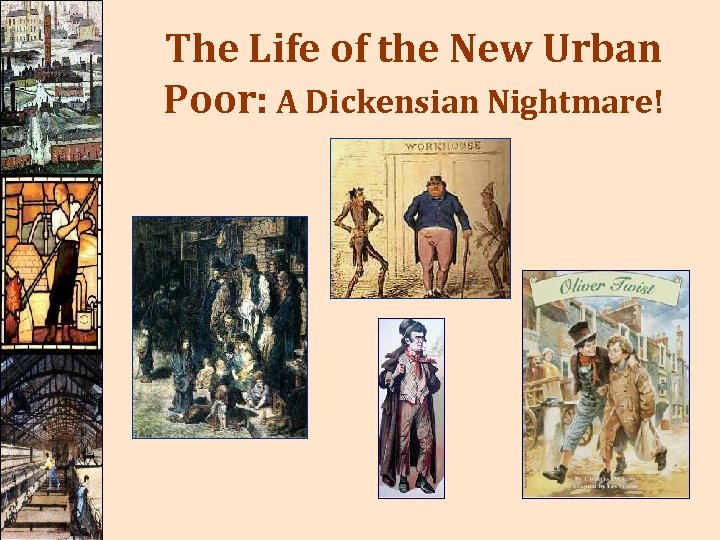 The Life of the New Urban Poor: A Dickensian Nightmare!
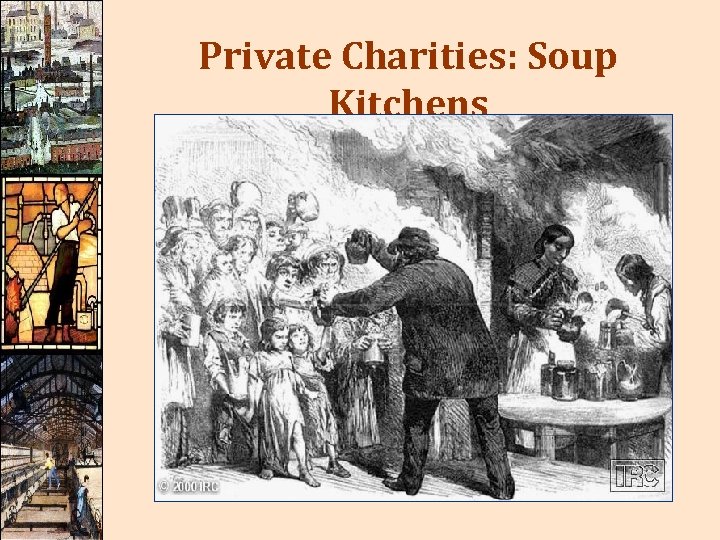 Private Charities: Soup Kitchens
![The Union Movement [1] ) ) The union movement arose to address the many](https://present5.com/presentation/e5599ad5d6a505624763eae8e9a50418/image-111.jpg "The Union Movement [1] ) ) The union movement arose to address the many") The Union Movement [1] ) ) The union movement arose to address the many problems faced by laborers. A union is an organization that speaks for the workers it represents.
The Union Movement [1] ) ) The union movement arose to address the many problems faced by laborers. A union is an organization that speaks for the workers it represents.
![The Union Movement [2] ) ) Its first effort to solve a problem is](https://present5.com/presentation/e5599ad5d6a505624763eae8e9a50418/image-112.jpg "The Union Movement [2] ) ) Its first effort to solve a problem is") The Union Movement [2] ) ) Its first effort to solve a problem is often collective bargaining – negotiations, led by the union, to resolve disputes between workers and employers. If this effort is unsuccessful, it may be followed by a strike, in which union members refuse to work until their demands are met.
The Union Movement [2] ) ) Its first effort to solve a problem is often collective bargaining – negotiations, led by the union, to resolve disputes between workers and employers. If this effort is unsuccessful, it may be followed by a strike, in which union members refuse to work until their demands are met.

![The Luddites: 1811 -1816 Attacks on the “frames” [power looms]. Ned Ludd [a mythical](https://present5.com/presentation/e5599ad5d6a505624763eae8e9a50418/image-114.jpg "The Luddites: 1811 -1816 Attacks on the “frames” [power looms]. Ned Ludd [a mythical") The Luddites: 1811 -1816 Attacks on the “frames” [power looms]. Ned Ludd [a mythical figure supposed to live in Sherwood Forest]
The Luddites: 1811 -1816 Attacks on the “frames” [power looms]. Ned Ludd [a mythical figure supposed to live in Sherwood Forest]
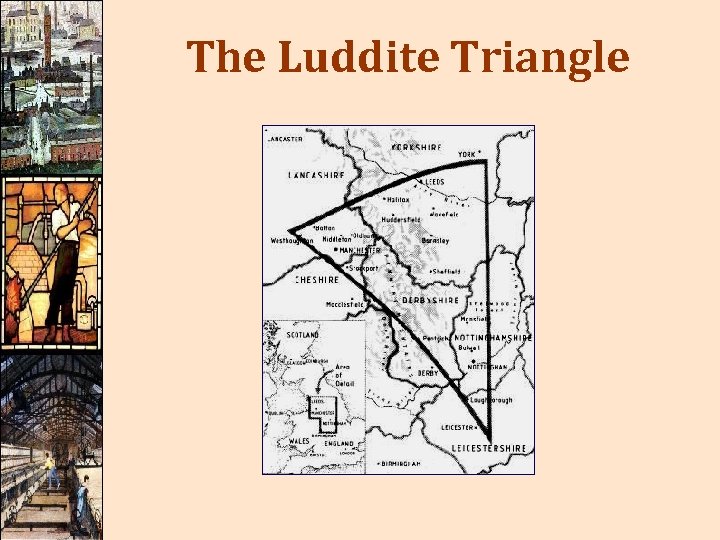 The Luddite Triangle
 The Luddites
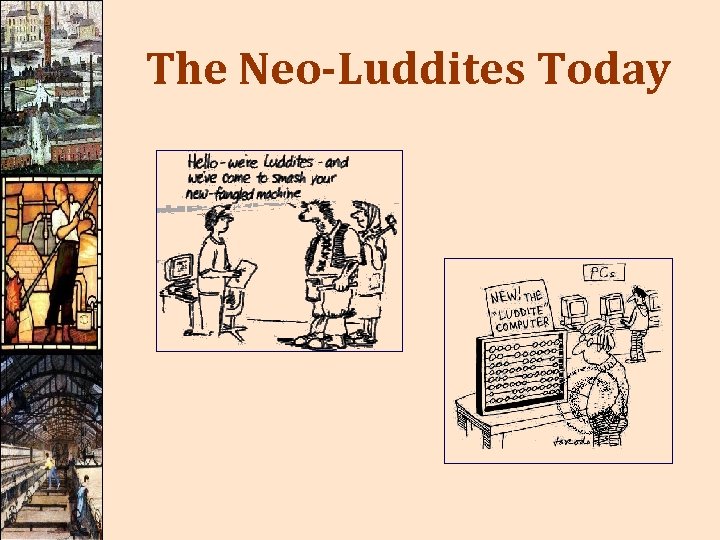 The Neo-Luddites Today
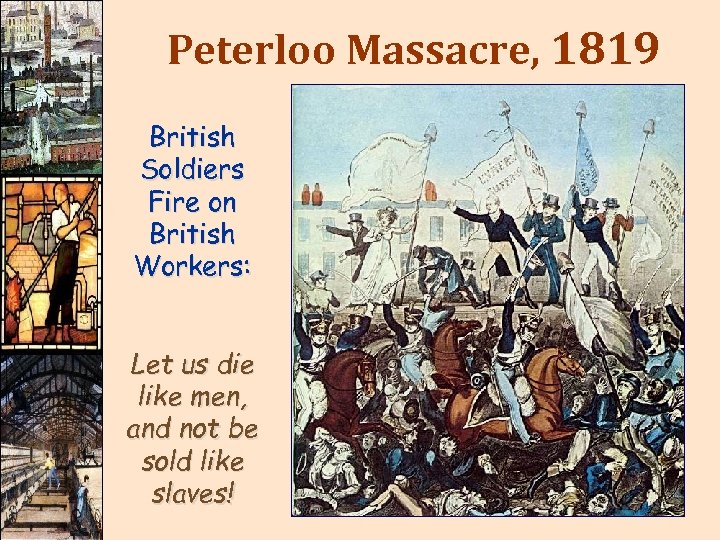 Peterloo Massacre, 1819 British Soldiers Fire on British Workers: Let us die like men, and not be sold like slaves!
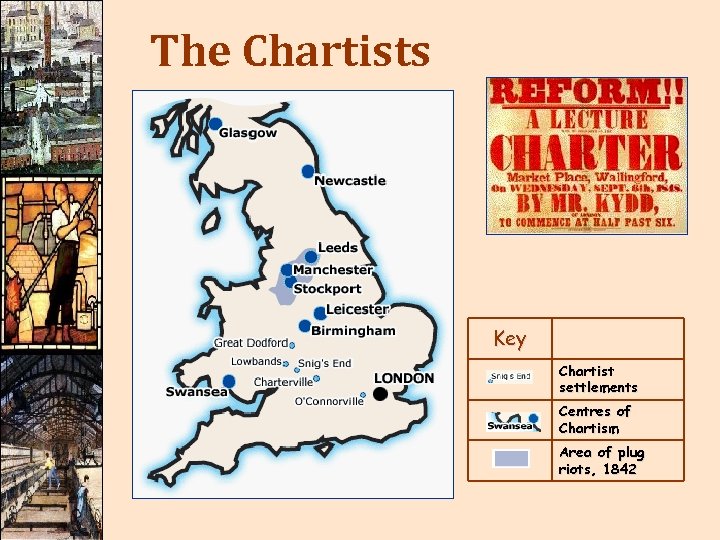 The Chartists Key Chartist settlements Centres of Chartism Area of plug riots, 1842
 The “Peoples’ Charter” V Drafted in 1838 by William Lovett. V Radical campaign for Parliamentary reform of the inequalities created by the Reform Bill of 1832. Votes for all men. Equal electoral districts. Abolition of the requirement that Members of Parliament [MPs] be property owners. × Payment for Members of Parliament. × Annual general elections. × The secret ballot. × × ×
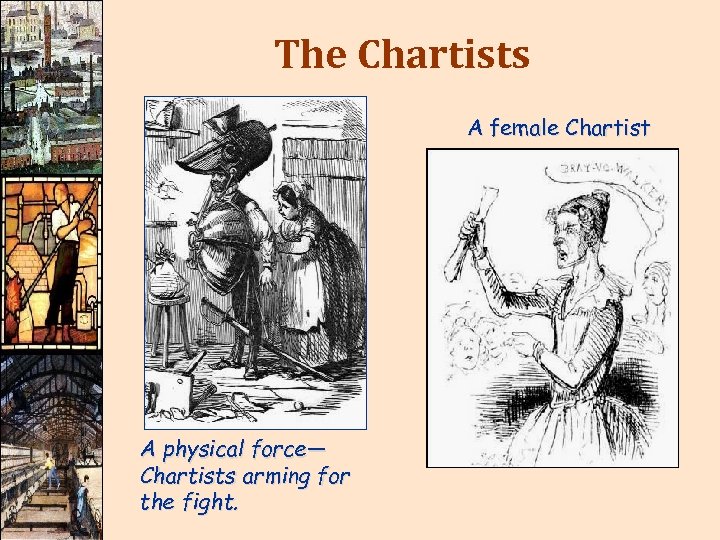 The Chartists A female Chartist A physical force— Chartists arming for the fight.
 Anti-Corn Law League, 1845 4 Give manufactures more outlets for 4 4 4 their products. Expand employment. Lower the price of bread. Make British agriculture more efficient and productive. Expose trade and agriculture to foreign competition. Promote international peace through trade contact.
 Let’s see how much you know 7/Q
 Question #1 Which would have been a common change life in England during the I. R. ? a. A farmer moves to an industrial area to work in a coal mine. b. A coal miner works his way up through the ranks to own the mine. c. A coal miner moves to the country to run his own farm. d. A lawyer loses his business and is forced to work in a coal mine. 1/7
 Question #2 In G. B. , the Factory Act of 1819 declared it illegal for children to work more than 12 hours a day. What does the act suggest about labor conditions at that time? a. Working conditions were worse in G. B. than in other nations. b. The government frequently intervened on behalf of workers. c. Some children spent more than half of each day working. d. Factories were unable to attract adult employess. 2/7
 Question #3 In the 19 th century, millions of people seeking work migrated a. From Asia to Europe. b. From North America to Europe. c. From North America to Europe and Asia. d. From Asia and Europe to North America. 3/7
 Question #4 Which statement is trueof social class during the I. R. ? a. People could move freely from one social class to another. b. Social classes became increasingly divided. c. The very idea of social classes became outdated. d. Europe was generally divided between an upper class and a working class. 4/7
 Question #5 Collective bargaining was a process of negotiation between a. Employers and workers. b. Employers and the government. c. Unions and the government. d. Workers and unions. 5/7
 Question #6 In 1902, Pennsylvania coal miners refused to work, returning to their jobs only when guaranteed a 10% pay increase an reduction of hours. The miners’ action is an example of a. Forming a union. b. Free labor. c. A strike. d. A picket. 6/7
 Question #7 Which of the following describes a major change in how people worked from pre. Industrial Revolution times to post-I. R. times? a. The vast majority of workers became more content with their jobs. b. Workers who were forced to work longer hours for lower wages fueled a strong movement to unionize. c. Workers rejected the idea of unionization in favor of more freedom to negotiate working conditions. d. Labor unions were formed by governments to help factory owners increase their productivity. 7/7
 Response to Capitalism california content standard 10. 3. 6
 Specific Objective: analyze the emergence of capitalism as a dominant economic pattern and the response to it, including utopianism, social democracy, socialism, and communism. california content standard 10. 3. 6
 Capitalism is an economic system that emphasizes profit and private ownership. In capitalism, the factors of production – such as land other natural resources – are owned privately, by wealthy business owners and investors. Critics of capitalism say that the system creates profit for owners and investors, but not for workers. During the I. R. , many workers labored in poverty and under dangerous conditions. New systems of thought arose in response to such problems…
 New systems of thought arose in response to such problems… Utopianism Socialism Communism Social Democracy
 Basic Idea: people live and work together, sharing goods and property. Utopianism communities were alternative societies based on cooperation and sharing. A number of these communities were founded in the U. S. In the early 1800 s. Most were formed by small groups of people in rural areas and did not alst for long. But a few, such as the Amana colonies in Iowa, were sizable and existed for more than a century.
 Basic Idea: factors of production are owned by the people, at least in part, and are used for the benefit of all. Many socialists believed that capitalism was a cause of moral and ethical problems, such as child labor and low wages. They thought people could work together to solve these problems and plan for a more fair economy. 19 th century socialists played important roles in the labor movement.
 Basic Idea: workers should take control of all the factors of production. Communism is a type of socialism that is often associated with revolution. The term “communism” became famous in the book Communist Manifesto by Karl Marx and Friedrich Engels, published in 1848. Marx and Engels emphasized revolutionary struggle as a means of achieving a society in which all people were economically equal.
 Basic Idea: government plays a role in managing production and provides certain social services. Social democrats believe that the government should play a role in the economy in order to make sure that the people receive certain benefits, such as health care and education. Social democracy developed in the 20 th century out of socialist ideas. It is the dominant system in many European nations today.

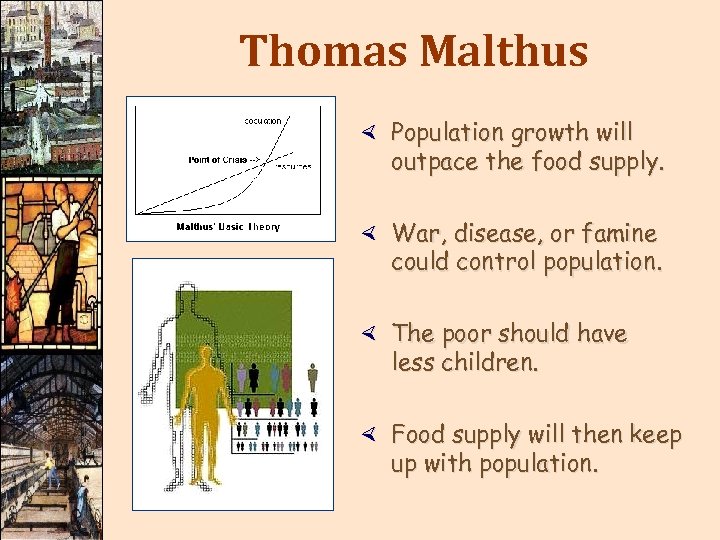 Thomas Malthus × Population growth will outpace the food supply. × War, disease, or famine could control population. × The poor should have less children. × Food supply will then keep up with population.
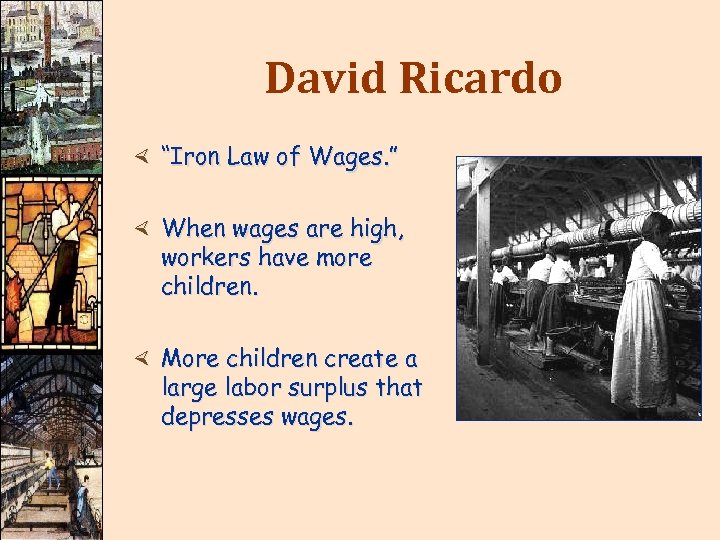 David Ricardo × “Iron Law of Wages. ” × When wages are high, workers have more children. × More children create a large labor surplus that depresses wages.
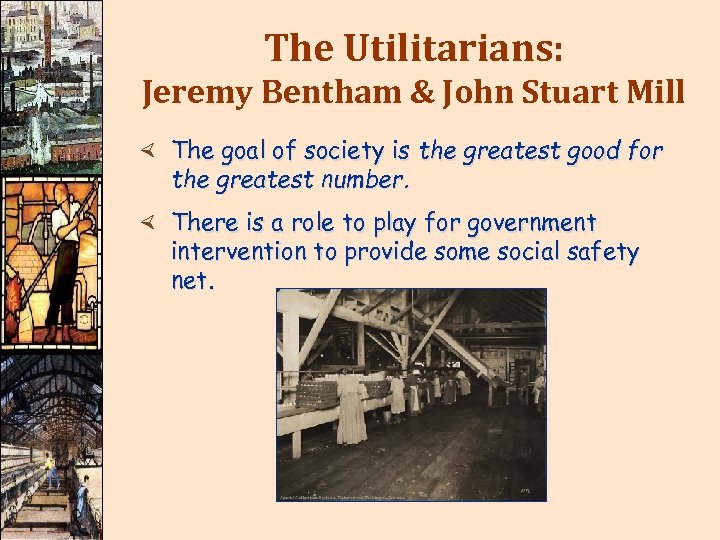 The Utilitarians: Jeremy Bentham & John Stuart Mill × The goal of society is the greatest good for the greatest number. × There is a role to play for government intervention to provide some social safety net.
 Jeremy Bentham
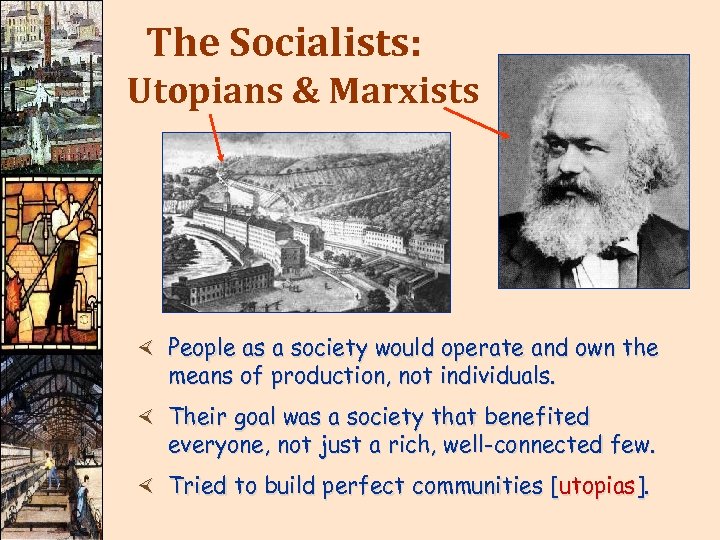 The Socialists: Utopians & Marxists × People as a society would operate and own the means of production, not individuals. × Their goal was a society that benefited everyone, not just a rich, well-connected few. × Tried to build perfect communities [utopias].

 Government Response k Abolition of slavery in the colonies in 1832 [to raise wages in Britain]. k Sadler Commission to look into working conditions § Factory Act [1833] – child labor. k New Poor Law [1834] – indoor relief. § Poor houses. k Reform Bill [1832] – broadens the vote for the cities.
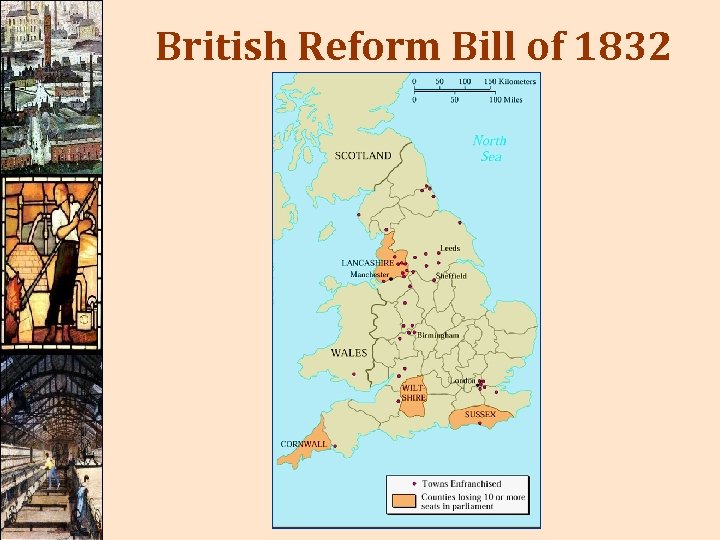 British Reform Bill of 1832
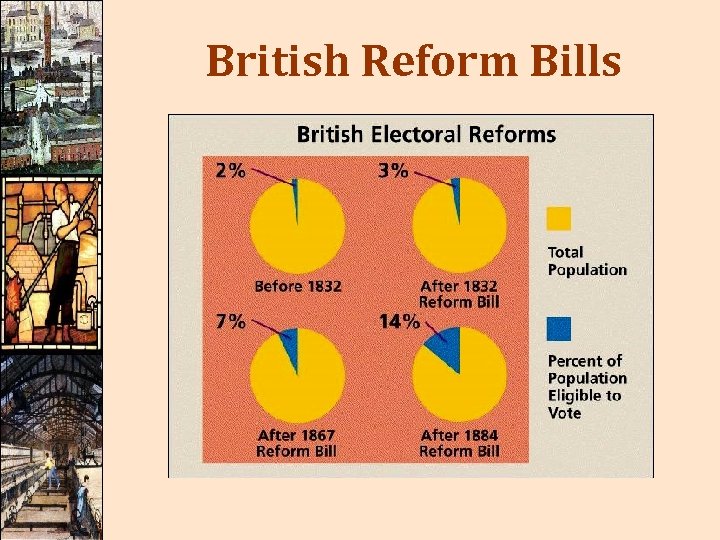 British Reform Bills
 By 1850: Zones of Industrialization on the European Continent ù ù ù Northeast France. Belgium. The Netherlands. Western German states. Northern Italy East Germany Saxony
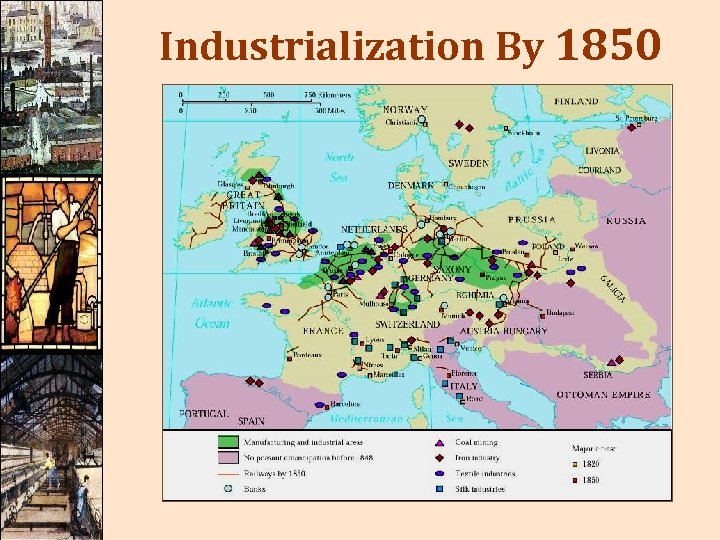 Industrialization By 1850
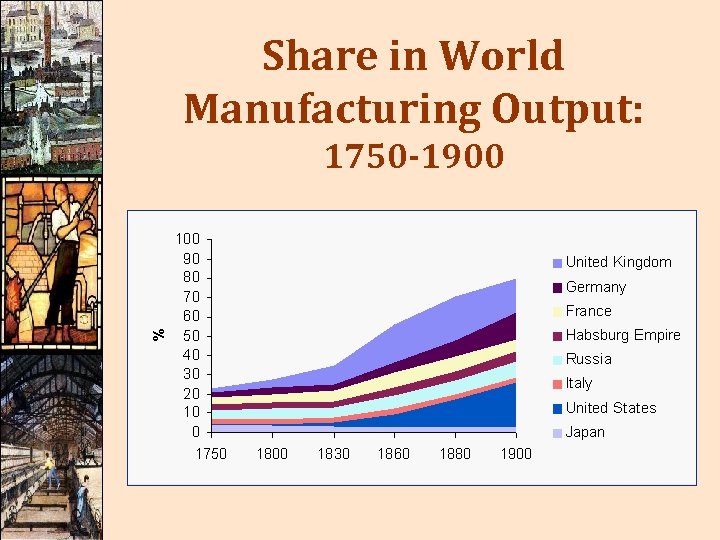 Share in World Manufacturing Output: 1750 -1900
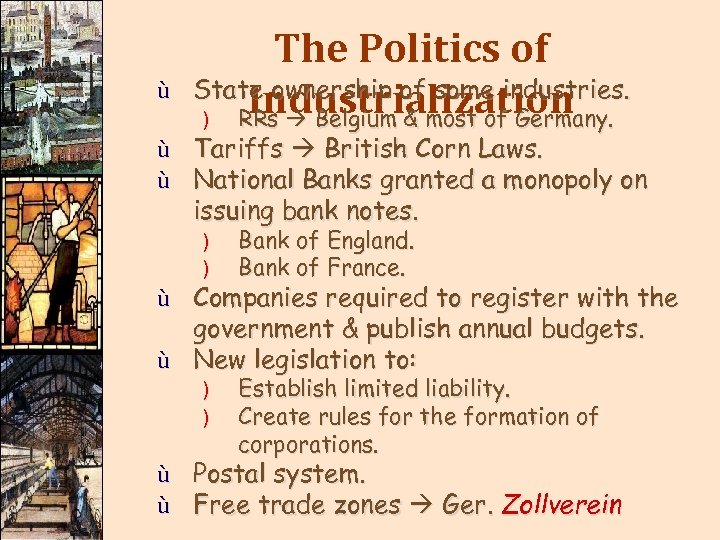 ù The Politics of State ownership of some industries. Industrialization ) RRs Belgium & most of Germany. ù Tariffs British Corn Laws. ù National Banks granted a monopoly on issuing bank notes. ) ) Bank of England. Bank of France. ù Companies required to register with the government & publish annual budgets. ù New legislation to: ) ) Establish limited liability. Create rules for the formation of corporations. ù Postal system. ù Free trade zones Ger. Zollverein
 Question: How might Britain’s advantages and early industrialization have affected its prosperity in the 19 th Century? Possible Answer: Britain’s advantages and early industrialization must have contributed to its general prosperity
 Let’s see how much you know 7/Q
 Question #1 Which statement would a critic of capitalism have most likely made during the I. R. ? a. “Rapid economic growth destroys our natural resources. ” b. “Most of our consumer goods are produced overseas. ” c. “Business owners get rich while workers remain poor. ” d. “The cost of machinery and new factories is too high. ” 1/7
 Question #2 Nineteenth-century socialists made significant gains in a. The United States Congress. b. The labor movement. c. Abolitionism. d. Halting the Industrial Revolution. 2/7
 Question #3 What was the relationship between work and property in a utopian community? a. Those who worked the most owned the most property. b. A few owned most of the property while others worked for them. c. People worked separately but shared their property. d. People worked together and shared their property. 3/7
 Question #4 With what economic idea is Karl Marx most closely associated? a. Capitalism b. Socialism c. Communism d. Social democracy 4/7
 Question #5 Citizens in a social democracy expect their government to a. Provide them with certain benefits. b. Leave the economy alone. c. Own all the factors of production. d. Engage in collective bargaining. 5/7
 Question #6 Which economic system emerged in Europe as a response to bothcapitalist and socialist ideals? a. Socialism b. Communism c. Trade unionism d. Social democracy 6/7
 Question #7 Why did Utopianism, Social Democracy, Socialism, and Communism emerge as response to capitalism? a. Some reformers wanted to increase competition among factory owners. b. Some reformers opposed the capitalist system because they felt it was destroying lives, disrupting families, ruining cities, and forcing people to work for nearly slave wages. c. Workers around the world, motivated by religious values, wanted to create new communities based on those values. d. Some reformers felt that factory owners should receive most of the wealth produced by their factories, because they contributed so much to the economy. 7/7
 Bibliographic Sources ) “Images of the Industrial Revolution. ” Mt. Holyoke College. http: //www. mtholyoke. edu/courses/rschwart /ind_rev/images-ind-era. html ) “The Peel Web: A Web of English History. ” http: //dspace. dial. pipex. com/mbloy/ceight/primary. htm
 California Content Standard 10. 3. 7
 Students will be able to describe the emergence of Romanticism in art and literature (e. g. , the poetry of William Blake and William Wadsworth), social criticism (e. g. , the novels of Charles Dickens), and the move away from Classicism in Europe.
 Nineteenth-century European art, music, and literature were dominated by two styles: classicism and romanticism. e Classicism sought to imitate the arts of ancient Greece. Tradition, reason, and symmetry were prized. e The forms of plays and musical compositions followed particular rules; painters and architects incorporated subjects and images from the ancient world.
 Nineteenth-century European art, music, and literature were dominated by two styles: classicism and romanticism. e Romanticism emphasized love of nature, emotional expression, individual experience, and the importance of ordinary people and folk traditions. e Often, romantics longed for a simpler, gentler past – a time when noble people lived in harmony with unspoiled nature a past that did not in fact exist. e Romanticism developed in the early 1800 s and became widely popular. In some ways, Romanticism reflected the spirit concerns of its time.
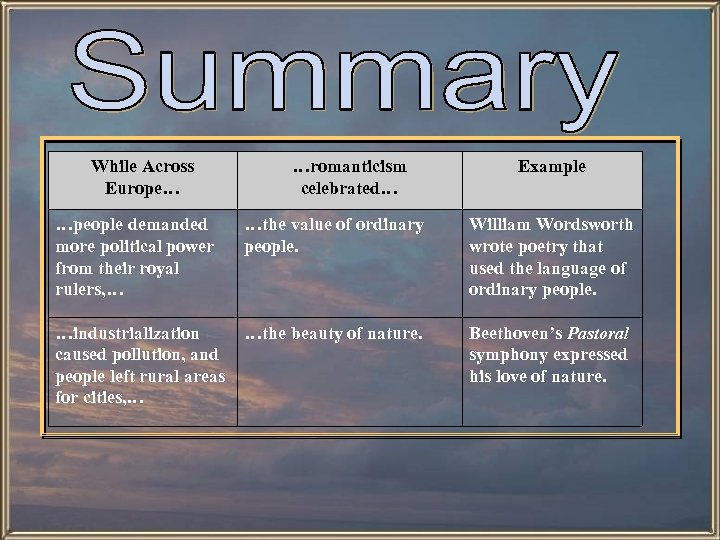 While Across Europe… …romanticism celebrated… Example …people demanded more political power from their royal rulers, … …the value of ordinary people. William Wordsworth wrote poetry that used the language of ordinary people. …industrialization caused pollution, and people left rural areas for cities, … …the beauty of nature. Beethoven’s Pastoral symphony expressed his love of nature.
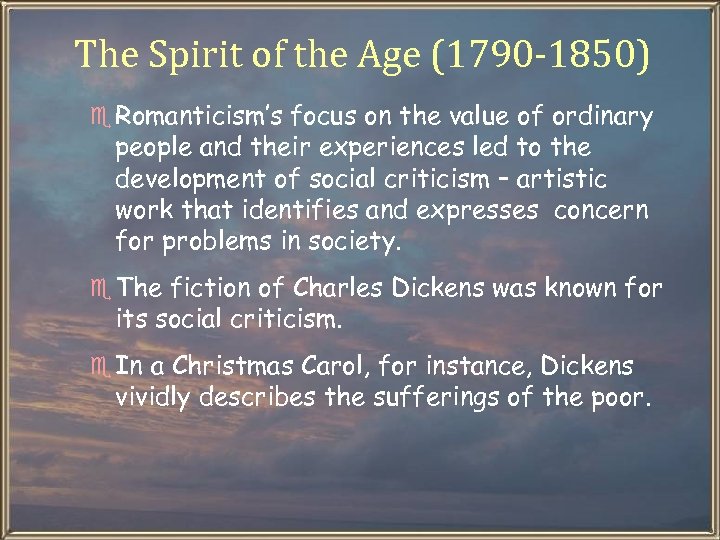 The Spirit of the Age (1790 -1850) e Romanticism’s focus on the value of ordinary people and their experiences led to the development of social criticism – artistic work that identifies and expresses concern for problems in society. e The fiction of Charles Dickens was known for its social criticism. e In a Christmas Carol, for instance, Dickens vividly describes the sufferings of the poor.
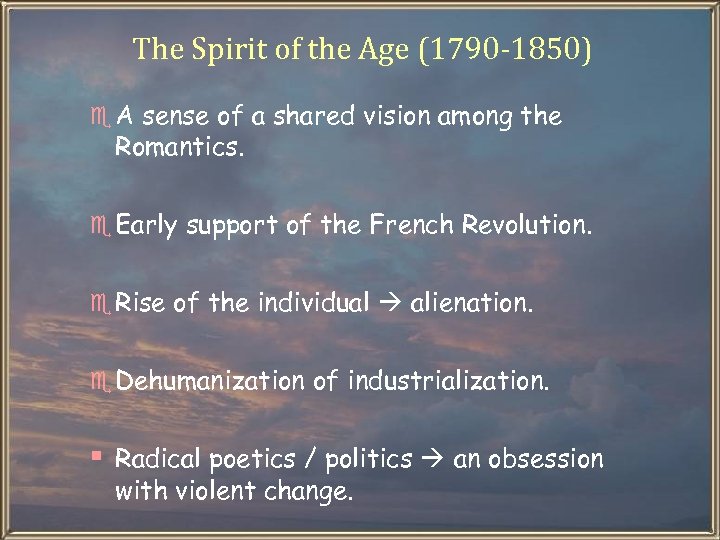 The Spirit of the Age (1790 -1850) e A sense of a shared vision among the Romantics. e Early support of the French Revolution. e Rise of the individual alienation. e Dehumanization of industrialization. § Radical poetics / politics an obsession with violent change.

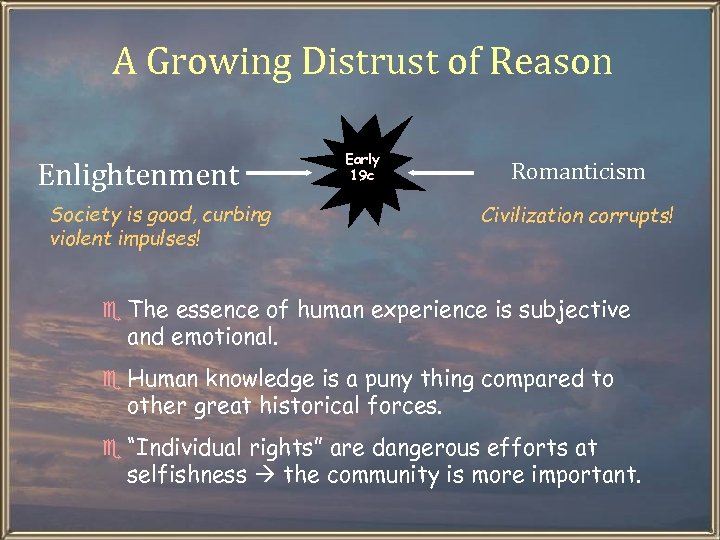 A Growing Distrust of Reason Enlightenment Early 19 c Society is good, curbing violent impulses! Romanticism Civilization corrupts! e The essence of human experience is subjective and emotional. e Human knowledge is a puny thing compared to other great historical forces. e “Individual rights” are dangerous efforts at selfishness the community is more important.
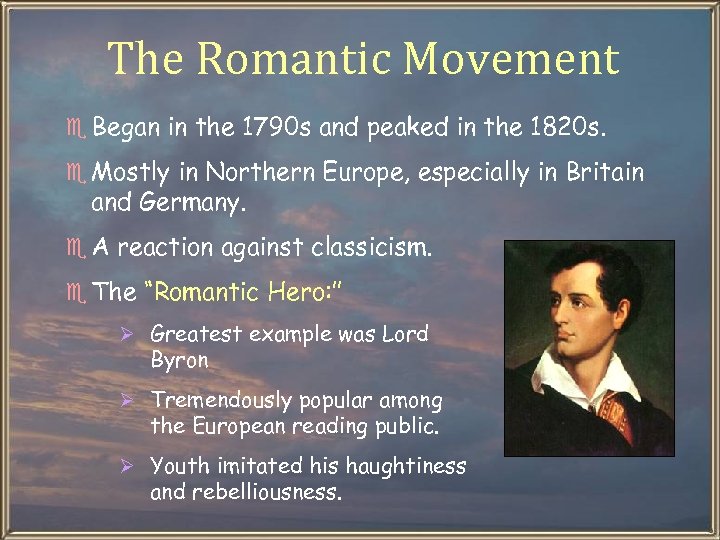 The Romantic Movement e Began in the 1790 s and peaked in the 1820 s. e Mostly in Northern Europe, especially in Britain and Germany. e A reaction against classicism. e The “Romantic Hero: ” Ø Greatest example was Lord Byron Ø Tremendously popular among the European reading public. Ø Youth imitated his haughtiness and rebelliousness.
 6/Q
6/Q
 “How glad I am to be able to roam in wood and thicket, among the trees and flowers and rocks” -Ludwig van Beethoven What Romantic value is expressed in Beethoven’s words about nature? a. Scientific knowledge b. Personal experience c. The ability to travel d. The diversity of life
 Which would have been the most likely subject for a classical painter? a. A farmer milking a cow b. Folk dancing c. Ancient Greek philosophers d. A sunset over magnificent mountains
 Nineteenth-century European Romantics tended to view the past as a a. Time of ignorance. b. Time best forgotten. c. More stimulating time. d. Gentler time.
 European Romanticism celebrated the beauty of nature at a time when a. People were traveling to remote areas for the first time. b. Industrialization was polluting the land. c. Agriculture was undergoing a revival. d. Outdoor recreation had gained in popularity.
 European Romantics celebrated ordinary people at a time when they a. Lived in democracies. b. Showed little interest in politics. c. Demanded their rights. d. Idealized the nobility.
 A 19 th-Century novel that attempted “social criticism” might have shown how a young hero or heroine was affected by a. A week at the seashore. b. Growing up in a loving family. c. Being educated in the arts. d. Industrial pollution.