


 Скачать презентацию Moving towards improved real-time forecast models of the
d1deb533d0ddce71f975d41cf156bc96.ppt
- Количество слайдов: 46
 Moving towards improved real-time forecast models of the NW European shelf seas Pat Hyder, Martin Holt, Sarah Wakelin, Jason Holt, John Siddorn, Jeff Osborne and Enda O’Dea JONSMOD, June 26 th 2006 www. ncof. gov. uk
 Outline • Introduction to NCOF and the Met Office Ocean Forecasting group. • Operational shelf seas models • Model performance evaluation (a) Pressure gradients over steep bathymetry (b) Turbulence (c) Other remaining issues • Conclusions. www. ncof. gov. uk
 What is NCOF – National Centre for Ocean Forecasting? It is a strategic partnership between… • Our mission is to establish ocean forecasting as part of the national infrastructure, based on world-class research and development. Improved communication www. ncof. gov. uk
 Operational Modelling at the Met Office • The Met Office runs weather, climate and ocean models on supercomputers divided into 2 independent halls for operational resilience. • The operations suite comprises many (>40) operational weather and ocean models run up to 4 times daily. www. ncof. gov. uk
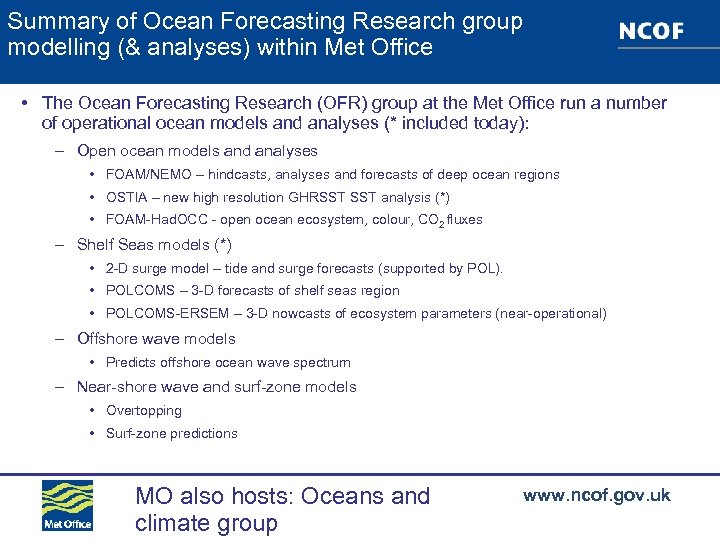 Summary of Ocean Forecasting Research group modelling (& analyses) within Met Office • The Ocean Forecasting Research (OFR) group at the Met Office run a number of operational ocean models and analyses (* included today): – Open ocean models and analyses • FOAM/NEMO – hindcasts, analyses and forecasts of deep ocean regions • OSTIA – new high resolution GHRSST analysis (*) • FOAM-Had. OCC - open ocean ecosystem, colour, CO 2 fluxes – Shelf Seas models (*) • 2 -D surge model – tide and surge forecasts (supported by POL). • POLCOMS – 3 -D forecasts of shelf seas region • POLCOMS-ERSEM – 3 -D nowcasts of ecosystem parameters (near-operational) – Offshore wave models • Predicts offshore ocean wave spectrum – Near-shore wave and surf-zone models • Overtopping • Surf-zone predictions MO also hosts: Oceans and climate group www. ncof. gov. uk
 Shelf seas modelling (POLCOMS and POLCOMS-ERSEM) www. metoffice. com/research/ncof/shelf/ www. ncof. gov. uk
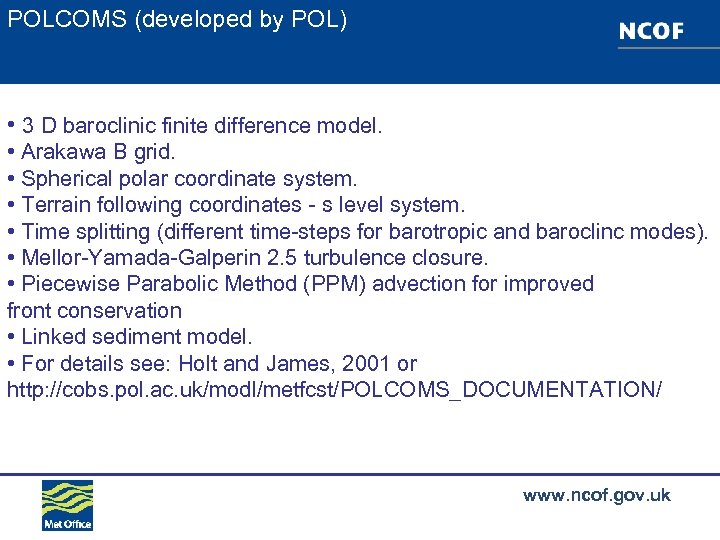 POLCOMS (developed by POL) • 3 D baroclinic finite difference model. • Arakawa B grid. • Spherical polar coordinate system. • Terrain following coordinates - s level system. • Time splitting (different time-steps for barotropic and baroclinc modes). • Mellor-Yamada-Galperin 2. 5 turbulence closure. • Piecewise Parabolic Method (PPM) advection for improved front conservation • Linked sediment model. • For details see: Holt and James, 2001 or http: //cobs. pol. ac. uk/modl/metfcst/POLCOMS_DOCUMENTATION/ www. ncof. gov. uk
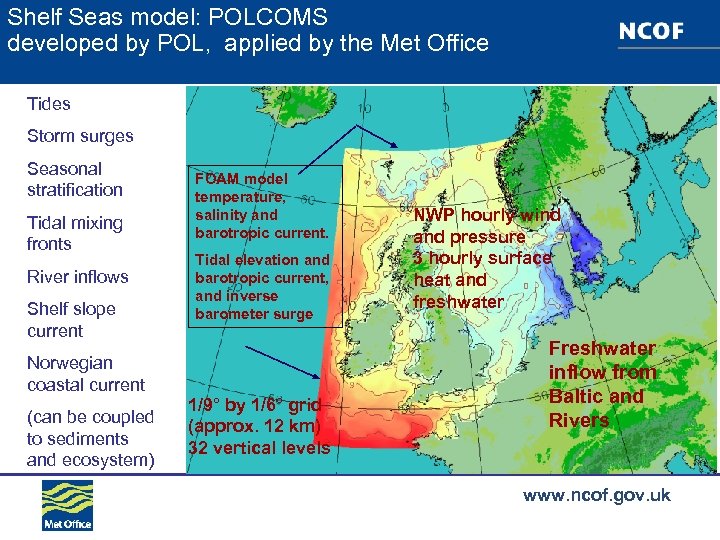 Shelf Seas model: POLCOMS developed by POL, applied by the Met Office Tides Storm surges Seasonal stratification Tidal mixing fronts River inflows Shelf slope current FOAM model temperature, salinity and barotropic current. Tidal elevation and barotropic current, and inverse barometer surge Norwegian coastal current (can be coupled to sediments and ecosystem) 1/9° by 1/6° grid (approx. 12 km) 32 vertical levels NWP hourly wind and pressure 3 hourly surface heat and freshwater Freshwater inflow from Baltic and Rivers www. ncof. gov. uk
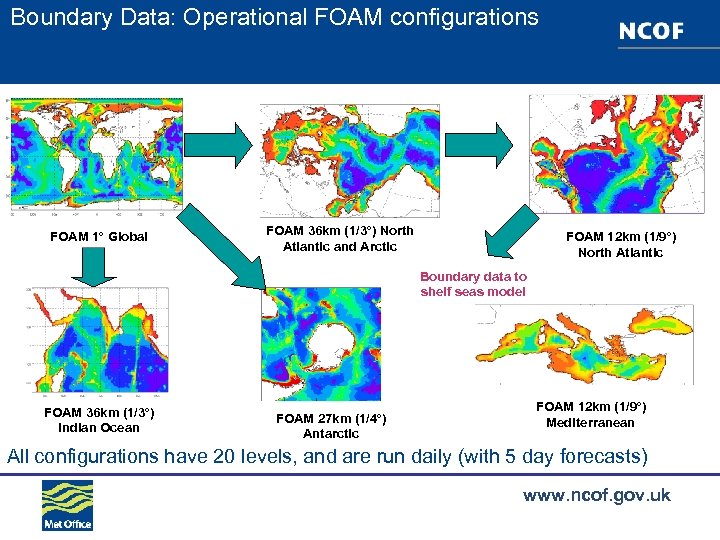 Boundary Data: Operational FOAM configurations FOAM 1º Global FOAM 36 km (1/3º) North Atlantic and Arctic FOAM 12 km (1/9º) North Atlantic Boundary data to shelf seas model FOAM 36 km (1/3º) Indian Ocean FOAM 27 km (1/4º) Antarctic FOAM 12 km (1/9º) Mediterranean All configurations have 20 levels, and are run daily (with 5 day forecasts) www. ncof. gov. uk
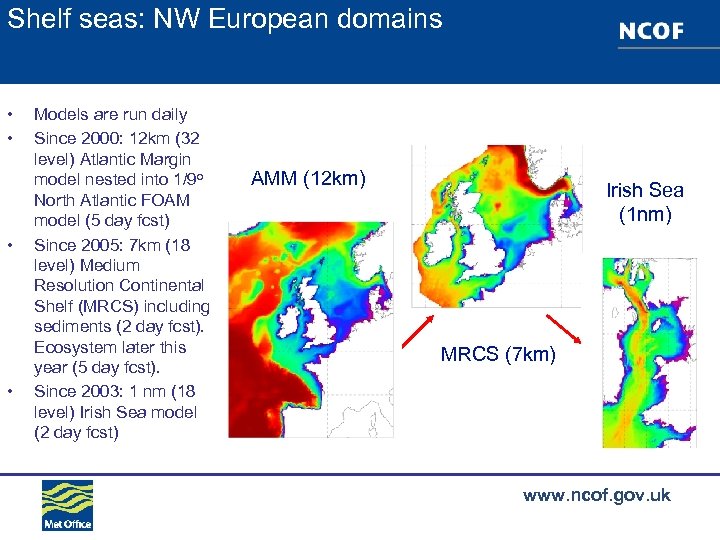 Shelf seas: NW European domains • • Models are run daily Since 2000: 12 km (32 level) Atlantic Margin model nested into 1/9 o North Atlantic FOAM model (5 day fcst) Since 2005: 7 km (18 level) Medium Resolution Continental Shelf (MRCS) including sediments (2 day fcst). Ecosystem later this year (5 day fcst). Since 2003: 1 nm (18 level) Irish Sea model (2 day fcst) AMM (12 km) Irish Sea (1 nm) MRCS (7 km) www. ncof. gov. uk
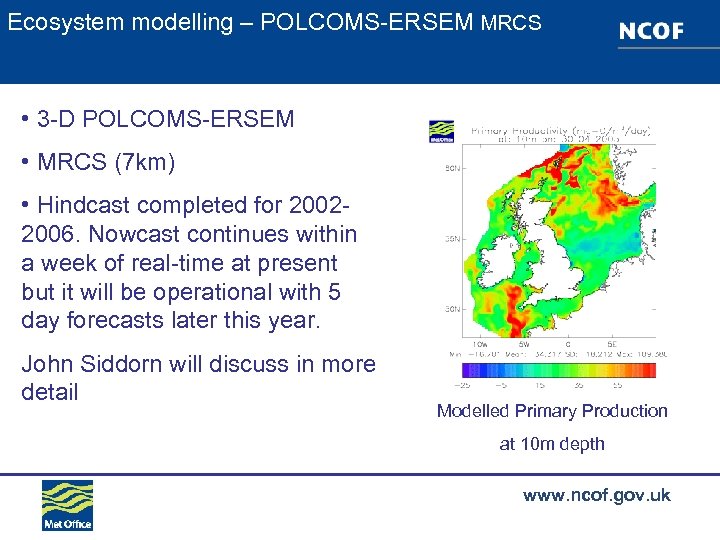 Ecosystem modelling – POLCOMS-ERSEM MRCS • 3 -D POLCOMS-ERSEM • MRCS (7 km) • Hindcast completed for 20022006. Nowcast continues within a week of real-time at present but it will be operational with 5 day forecasts later this year. John Siddorn will discuss in more detail Modelled Primary Production at 10 m depth www. ncof. gov. uk
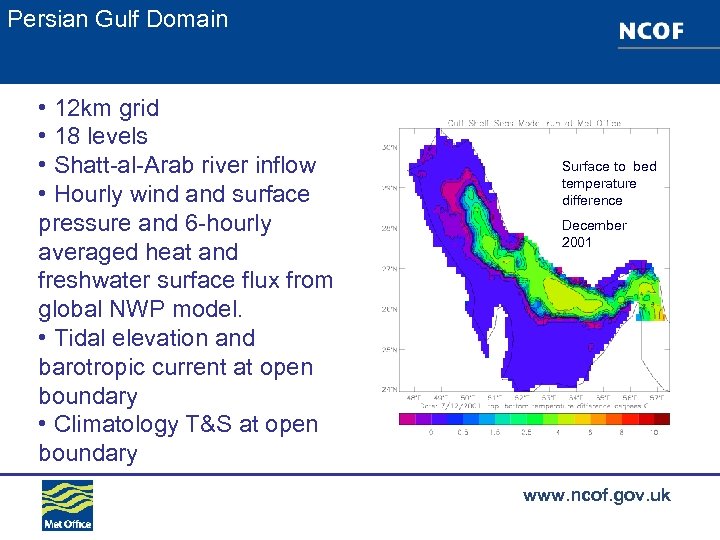 Persian Gulf Domain • 12 km grid • 18 levels • Shatt-al-Arab river inflow • Hourly wind and surface pressure and 6 -hourly averaged heat and freshwater surface flux from global NWP model. • Tidal elevation and barotropic current at open boundary • Climatology T&S at open boundary Surface to bed temperature difference December 2001 www. ncof. gov. uk
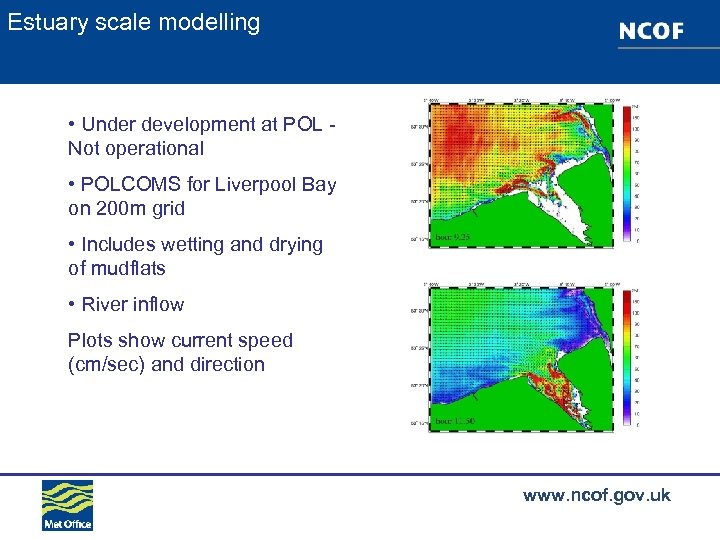 Estuary scale modelling • Under development at POL Not operational • POLCOMS for Liverpool Bay on 200 m grid • Includes wetting and drying of mudflats • River inflow Plots show current speed (cm/sec) and direction www. ncof. gov. uk
 Shelf Seas: Relocatable Model • POLCOMS quasi-barotropic (constant density) applied to any region of the worlds oceans with tidal boundary (FES 99) and wind/pressure forcing. • Series of nested models from large scale (12 km) nested to 4 km nested to 1 nm (and, if required, nested to 200 m) with several vertical levels. • Applied for military exercises (e. g. Northern Light 03, JV 04). www. ncof. gov. uk
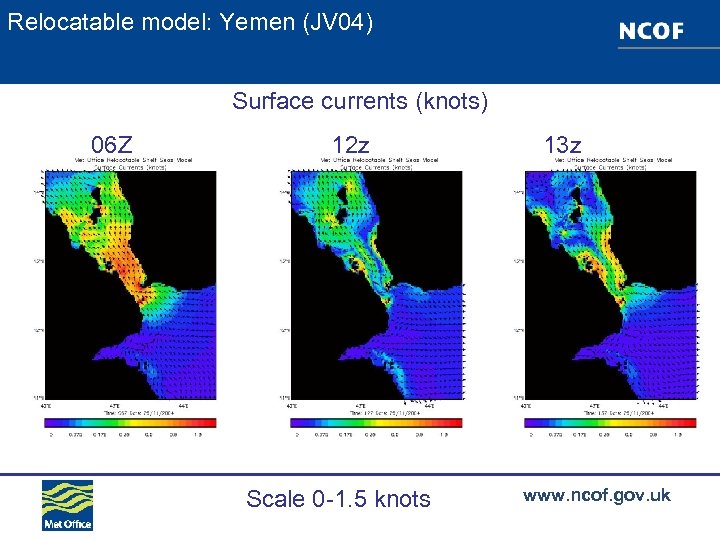 Relocatable model: Yemen (JV 04) Surface currents (knots) 06 Z 12 z Scale 0 -1. 5 knots 13 z www. ncof. gov. uk
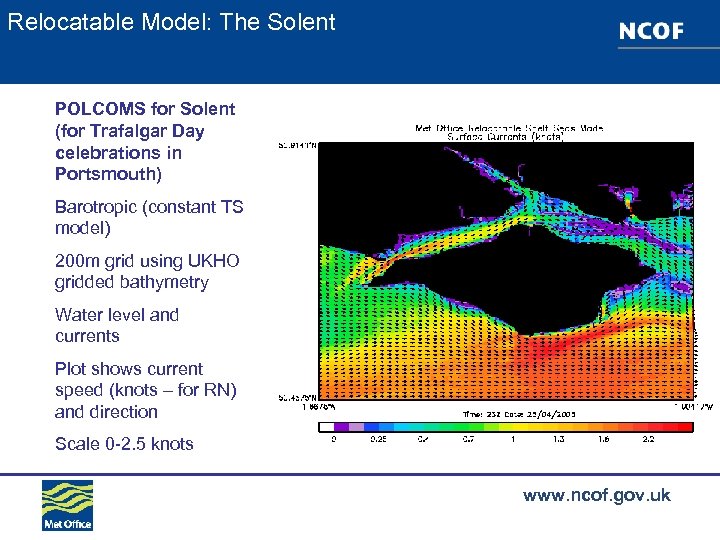 Relocatable Model: The Solent POLCOMS for Solent (for Trafalgar Day celebrations in Portsmouth) Barotropic (constant TS model) 200 m grid using UKHO gridded bathymetry Water level and currents Plot shows current speed (knots – for RN) and direction Scale 0 -2. 5 knots www. ncof. gov. uk
 Model performance evaluation www. ncof. gov. uk
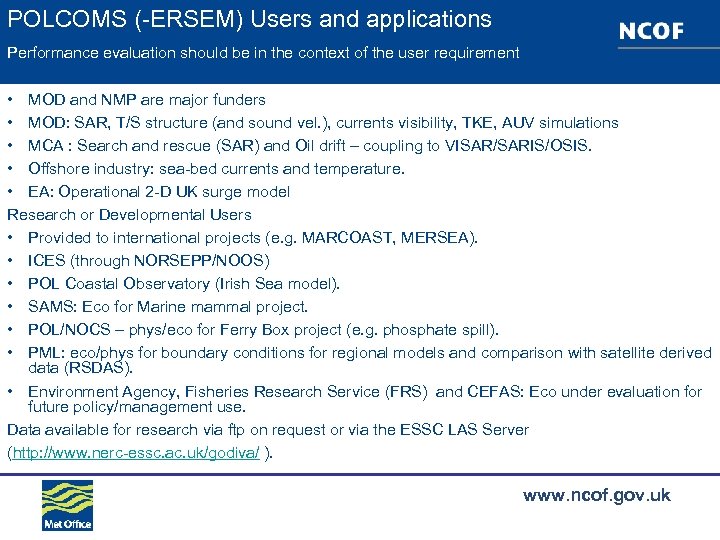 POLCOMS (-ERSEM) Users and applications Performance evaluation should be in the context of the user requirement • MOD and NMP are major funders • MOD: SAR, T/S structure (and sound vel. ), currents visibility, TKE, AUV simulations • MCA : Search and rescue (SAR) and Oil drift – coupling to VISAR/SARIS/OSIS. • Offshore industry: sea-bed currents and temperature. • EA: Operational 2 -D UK surge model Research or Developmental Users • Provided to international projects (e. g. MARCOAST, MERSEA). • ICES (through NORSEPP/NOOS) • POL Coastal Observatory (Irish Sea model). • SAMS: Eco for Marine mammal project. • POL/NOCS – phys/eco for Ferry Box project (e. g. phosphate spill). • PML: eco/phys for boundary conditions for regional models and comparison with satellite derived data (RSDAS). • Environment Agency, Fisheries Research Service (FRS) and CEFAS: Eco under evaluation for future policy/management use. Data available for research via ftp on request or via the ESSC LAS Server (http: //www. nerc-essc. ac. uk/godiva/ ). www. ncof. gov. uk
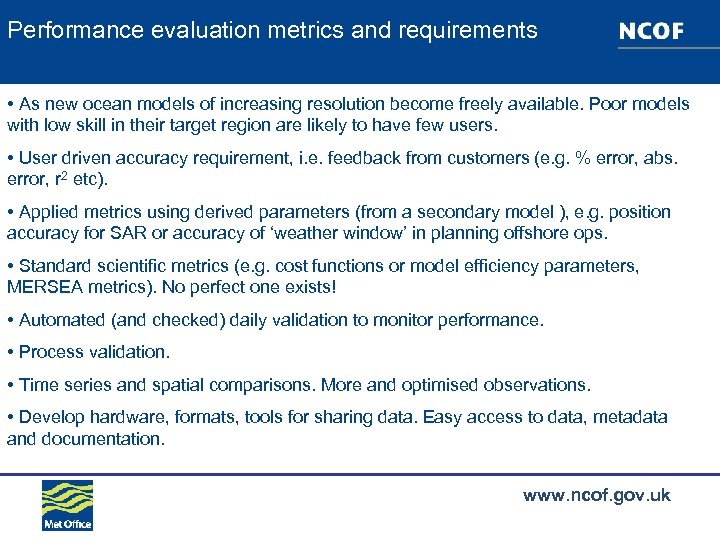 Performance evaluation metrics and requirements • As new ocean models of increasing resolution become freely available. Poor models with low skill in their target region are likely to have few users. • User driven accuracy requirement, i. e. feedback from customers (e. g. % error, abs. error, r 2 etc). • Applied metrics using derived parameters (from a secondary model ), e. g. position accuracy for SAR or accuracy of ‘weather window’ in planning offshore ops. • Standard scientific metrics (e. g. cost functions or model efficiency parameters, MERSEA metrics). No perfect one exists! • Automated (and checked) daily validation to monitor performance. • Process validation. • Time series and spatial comparisons. More and optimised observations. • Develop hardware, formats, tools for sharing data. Easy access to data, metadata and documentation. www. ncof. gov. uk
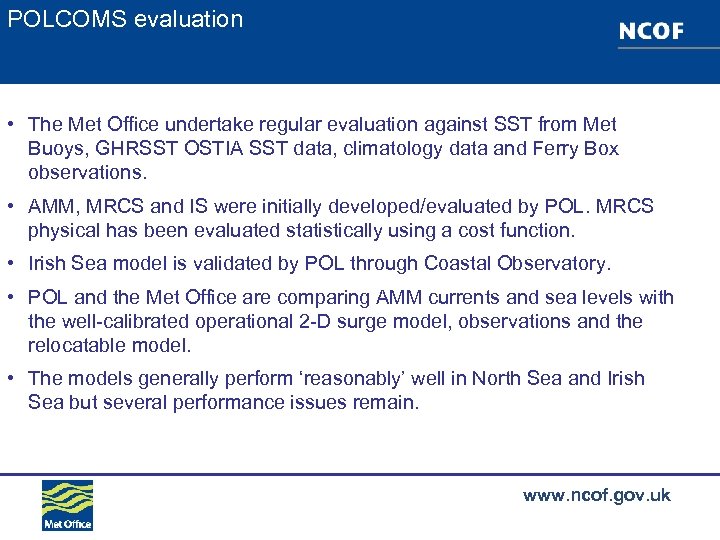 POLCOMS evaluation • The Met Office undertake regular evaluation against SST from Met Buoys, GHRSST OSTIA SST data, climatology data and Ferry Box observations. • AMM, MRCS and IS were initially developed/evaluated by POL. MRCS physical has been evaluated statistically using a cost function. • Irish Sea model is validated by POL through Coastal Observatory. • POL and the Met Office are comparing AMM currents and sea levels with the well-calibrated operational 2 -D surge model, observations and the relocatable model. • The models generally perform ‘reasonably’ well in North Sea and Irish Sea but several performance issues remain. www. ncof. gov. uk
 POLCOMS-ERSEM evaluation • Physical performance is pre-requisite • Met Office regularly evaluate simulations against CEFAS SMART buoy data and against Ferry Box data. • POLCOMS-ERSEM MRCS evaluation is undertaken at PML using the 1988 -89 data from North Sea project (extensive data set). Statistical validation using a ‘model efficiency’ parameter (1 - (cost function)2)* to asses skill. It is a tough test as small time lags result in no skill. • Met Office provide chlorophyll, SST and attenuation/visibility data to PML for comparison with satellite derived parameters (RSDAS system). www. ncof. gov. uk
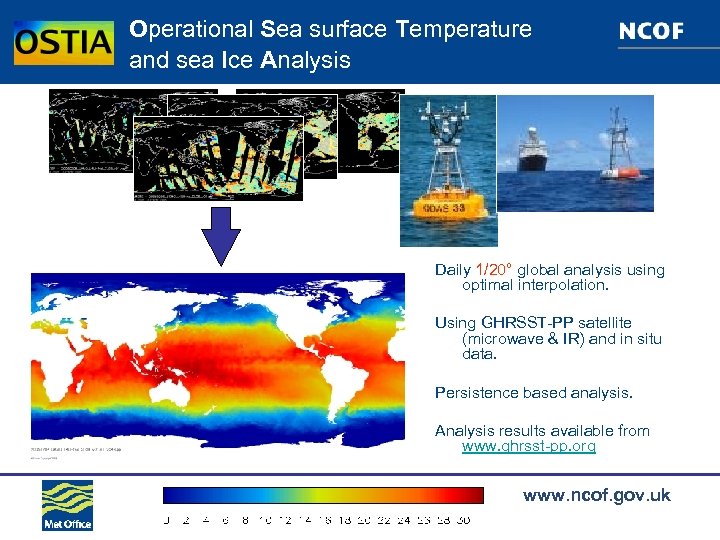 Operational Sea surface Temperature and sea Ice Analysis Daily 1/20° global analysis using optimal interpolation. Using GHRSST-PP satellite (microwave & IR) and in situ data. Persistence based analysis. Analysis results available from www. ghrsst-pp. org www. ncof. gov. uk
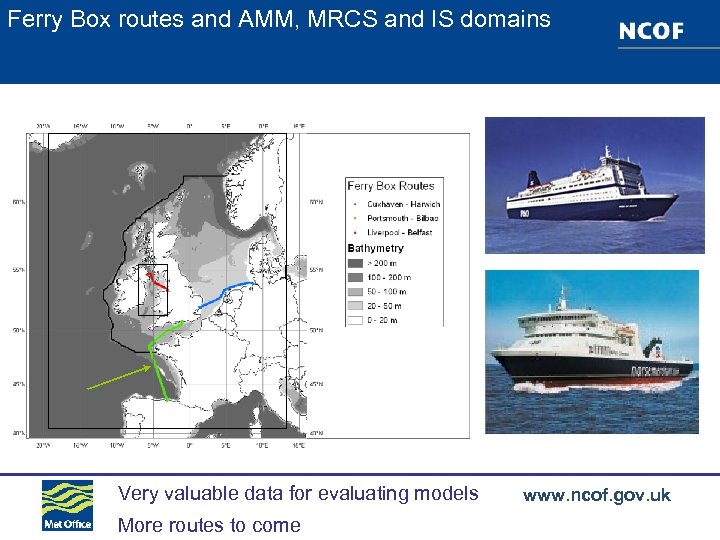 Ferry Box routes and AMM, MRCS and IS domains Very valuable data for evaluating models More routes to come www. ncof. gov. uk
 (a) Pressure gradients over steep bathymetry (b)(in sigma/s coord. models) www. ncof. gov. uk
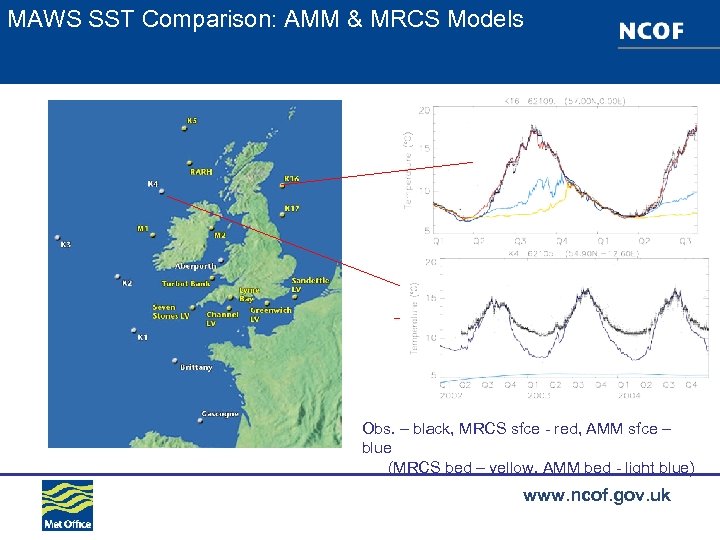 MAWS SST Comparison: AMM & MRCS Models Obs. – black, MRCS sfce - red, AMM sfce – blue (MRCS bed – yellow, AMM bed - light blue) www. ncof. gov. uk
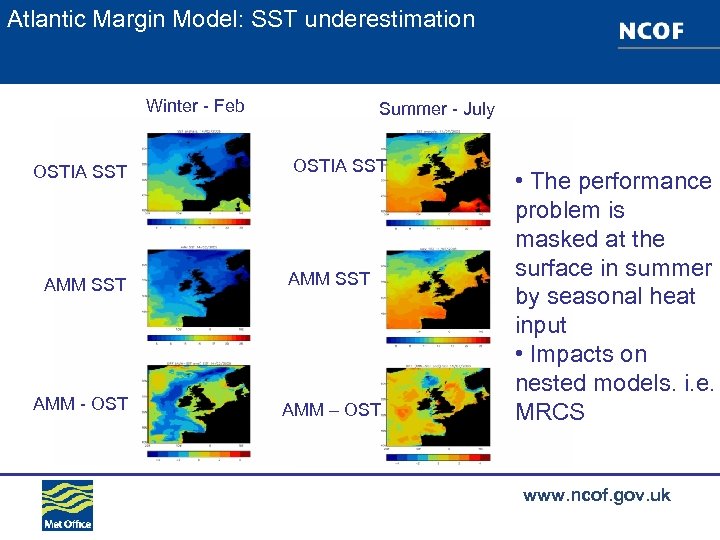 Atlantic Margin Model: SST underestimation Winter - Feb OSTIA SST Summer - July OSTIA SST AMM - OST AMM – OST • The performance problem is masked at the surface in summer by seasonal heat input • Impacts on nested models. i. e. MRCS www. ncof. gov. uk
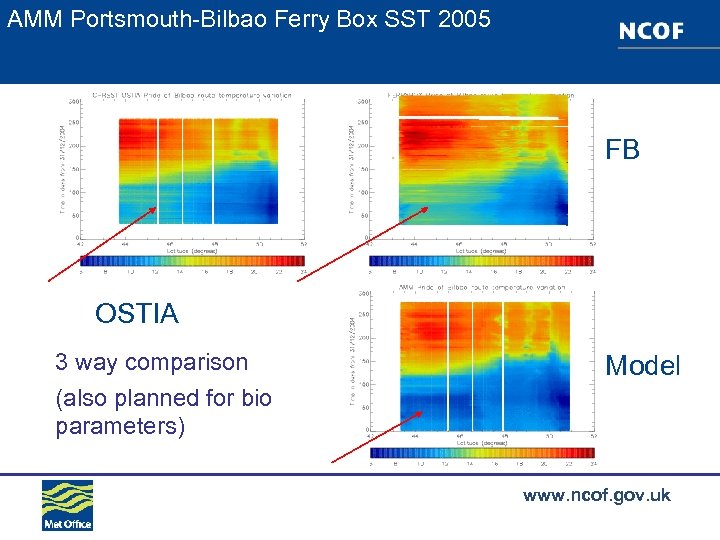 AMM Portsmouth-Bilbao Ferry Box SST 2005 FB OSTIA 3 way comparison Model (also planned for bio parameters) www. ncof. gov. uk
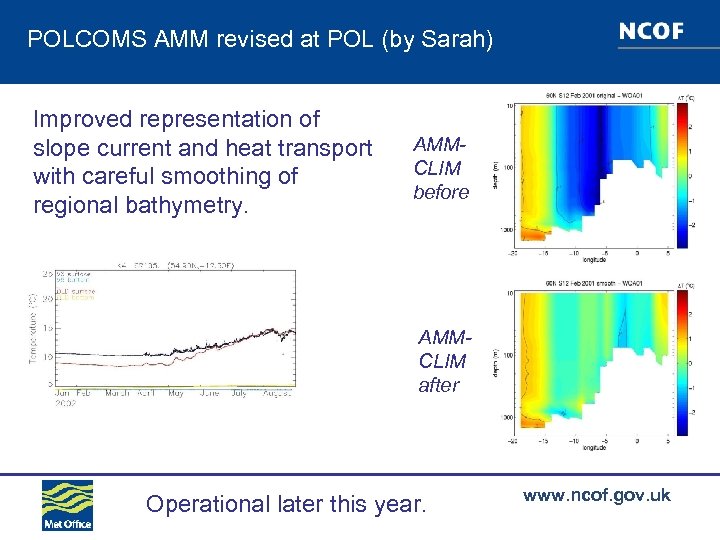 POLCOMS AMM revised at POL (by Sarah) Improved representation of slope current and heat transport with careful smoothing of regional bathymetry. AMMCLIM before AMMCLIM after Operational later this year. www. ncof. gov. uk
 (b) Turbulence model performance and its impact www. ncof. gov. uk
 Turbulence model performance 1 -D model experiments (e. g Simpson/Burchard et al. ) suggest: • In general, the models get the boundary layer dissipation correct (as the rate of production of TKE by shear is well represented in the boundary layer). • The models fail to correctly simulate the stratified mid water values (because local production in this region includes sources of shear which are not accurately represented by the models e. g. internal waves/tide). • To include the effects of local production in this region various simple 'parameterisations' are used (e. g. minimum TKE, viscosity, diffusivity), although none of these are physically satisfactory. www. ncof. gov. uk
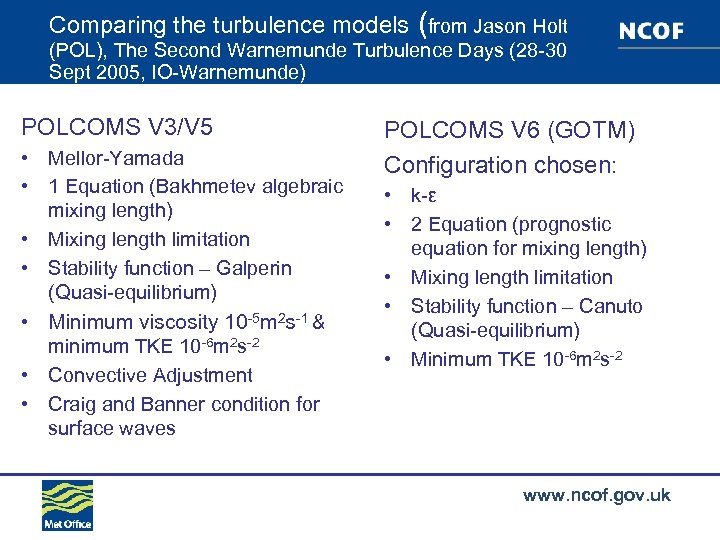 Comparing the turbulence models (from Jason Holt (POL), The Second Warnemunde Turbulence Days (28 -30 Sept 2005, IO-Warnemunde) POLCOMS V 3/V 5 • Mellor-Yamada • 1 Equation (Bakhmetev algebraic mixing length) • Mixing length limitation • Stability function – Galperin (Quasi-equilibrium) • Minimum viscosity 10 -5 m 2 s-1 & minimum TKE 10 -6 m 2 s-2 • Convective Adjustment • Craig and Banner condition for surface waves POLCOMS V 6 (GOTM) Configuration chosen: • k-ε • 2 Equation (prognostic equation for mixing length) • Mixing length limitation • Stability function – Canuto (Quasi-equilibrium) • Minimum TKE 10 -6 m 2 s-2 www. ncof. gov. uk
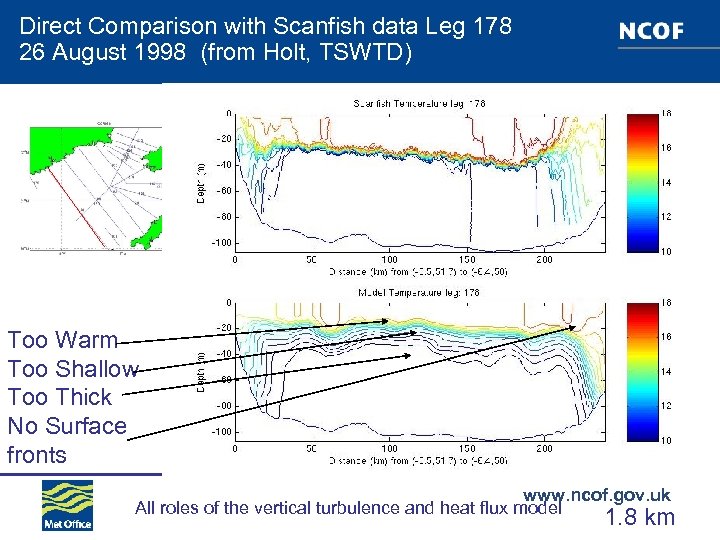 Direct Comparison with Scanfish data Leg 178 26 August 1998 (from Holt, TSWTD) Too Warm Too Shallow Too Thick No Surface fronts www. ncof. gov. uk All roles of the vertical turbulence and heat flux model 1. 8 km
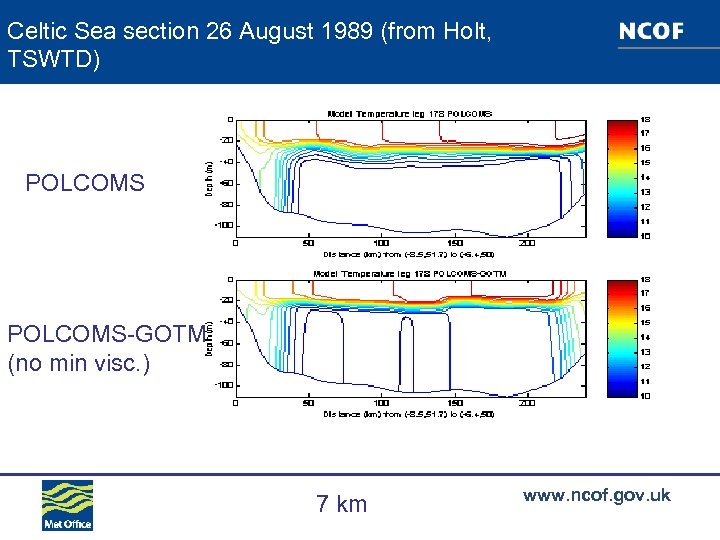 Celtic Sea section 26 August 1989 (from Holt, TSWTD) POLCOMS-GOTM (no min visc. ) 7 km www. ncof. gov. uk
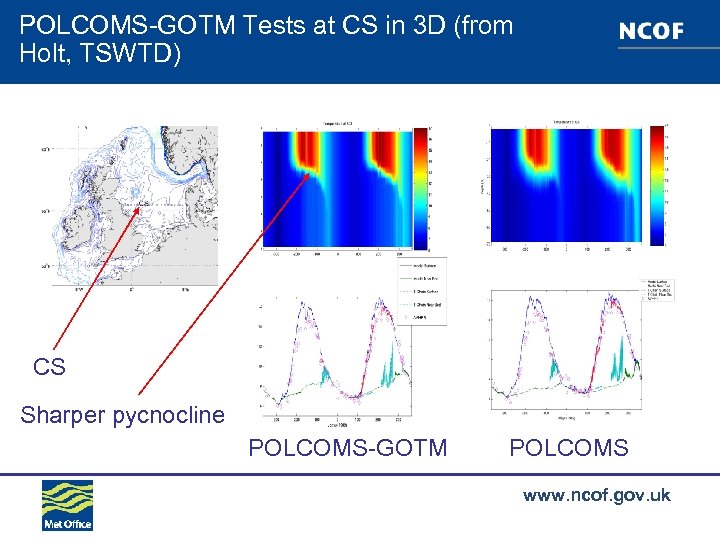 POLCOMS-GOTM Tests at CS in 3 D (from Holt, TSWTD) CS Sharper pycnocline POLCOMS-GOTM POLCOMS www. ncof. gov. uk
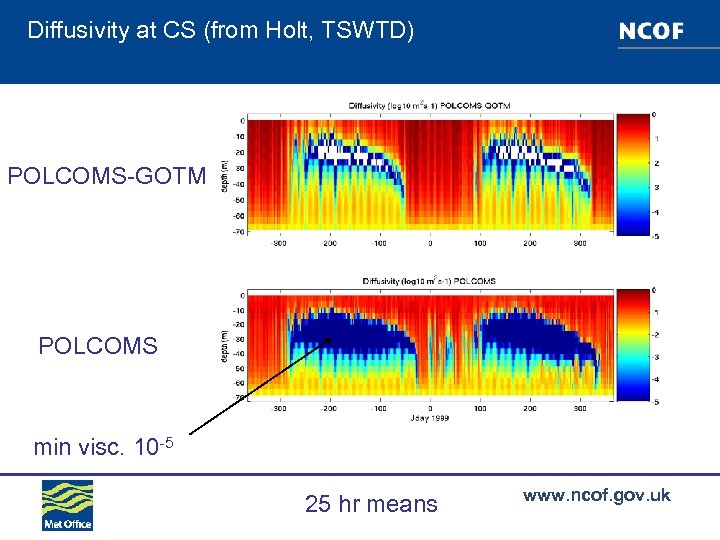 Diffusivity at CS (from Holt, TSWTD) POLCOMS-GOTM POLCOMS min visc. 10 -5 25 hr means www. ncof. gov. uk
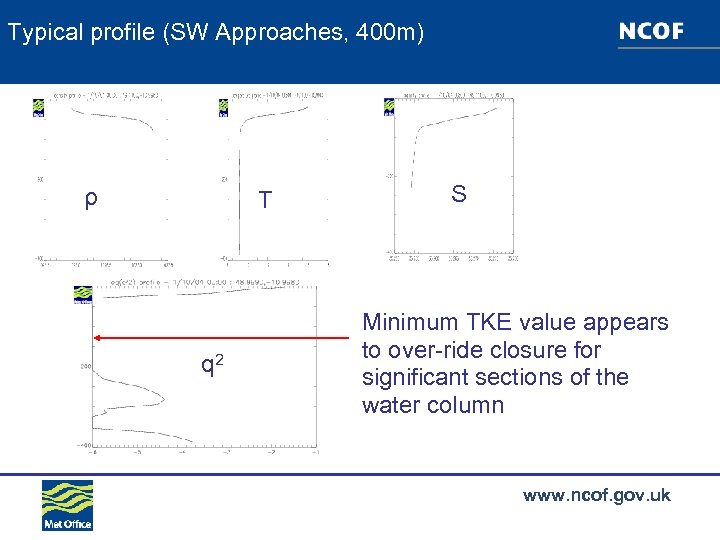 Typical profile (SW Approaches, 400 m) ρ T q 2 S Minimum TKE value appears to over-ride closure for significant sections of the water column www. ncof. gov. uk
 Impact of turbulence errors PHYSICS Pycnocline is (1) too shallow (and therefore warm) and (2) too diffuse. Can be sharpened by changing closure scheme and in particular background diffusivity but remains too shallow – candidates for additional surface turbulent sources are langmuir circulation, convective mixing and poorly represented wind/wave mixing. SEDIMENTS Re-suspension is a balance between turbulence and settling velocity – impact of errors needs investigation. BIOLOGY 1) Many complex interactions associated with turbulence. 2) Turbulence is a control on production (Huisman, 1999). The timing of spring bloom can be shifted by several weeks by changing the background diffusivity and closure scheme (see John’s talk). www. ncof. gov. uk
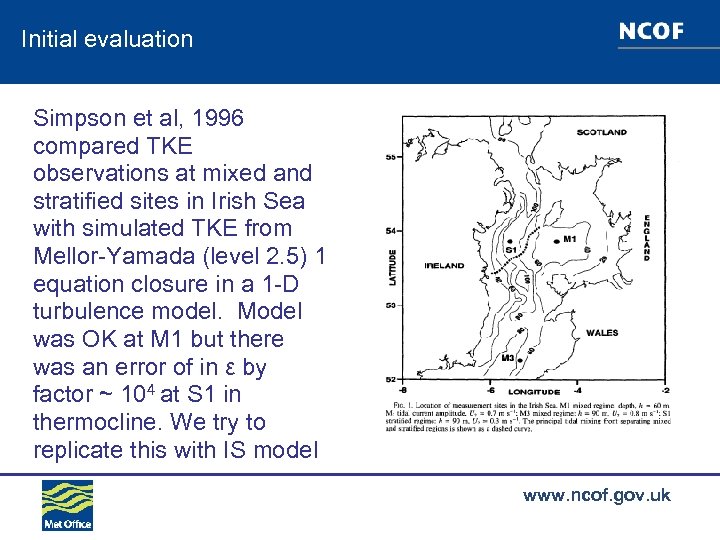 Initial evaluation Simpson et al, 1996 compared TKE observations at mixed and stratified sites in Irish Sea with simulated TKE from Mellor-Yamada (level 2. 5) 1 equation closure in a 1 -D turbulence model. Model was OK at M 1 but there was an error of in ε by factor ~ 104 at S 1 in thermocline. We try to replicate this with IS model www. ncof. gov. uk
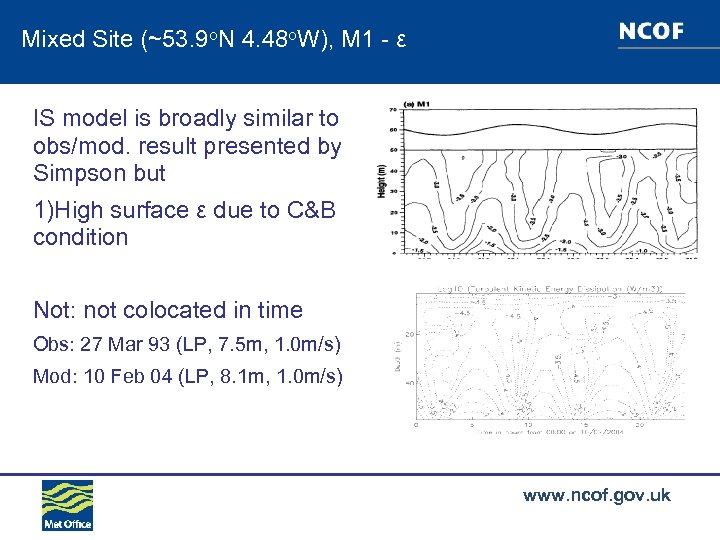 Mixed Site (~53. 9 o. N 4. 48 o. W), M 1 - ε IS model is broadly similar to obs/mod. result presented by Simpson but 1)High surface ε due to C&B condition Not: not colocated in time Obs: 27 Mar 93 (LP, 7. 5 m, 1. 0 m/s) Mod: 10 Feb 04 (LP, 8. 1 m, 1. 0 m/s) www. ncof. gov. uk
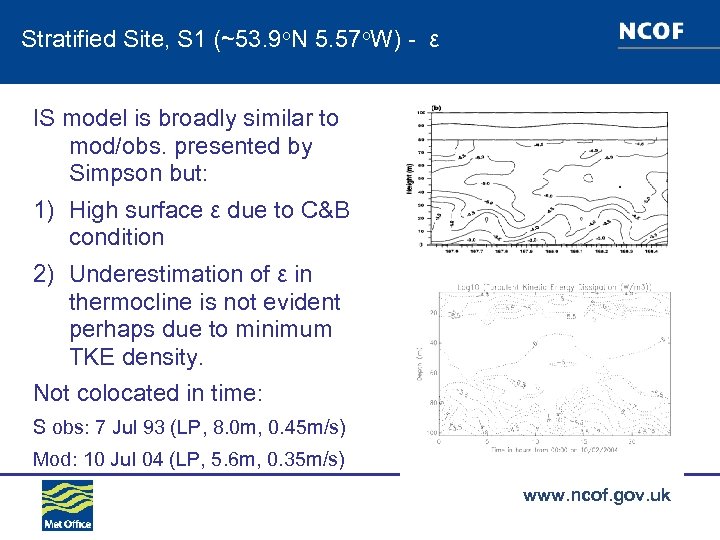 Stratified Site, S 1 (~53. 9 o. N 5. 57 o. W) - ε IS model is broadly similar to mod/obs. presented by Simpson but: 1) High surface ε due to C&B condition 2) Underestimation of ε in thermocline is not evident perhaps due to minimum TKE density. Not colocated in time: S obs: 7 Jul 93 (LP, 8. 0 m, 0. 45 m/s) Mod: 10 Jul 04 (LP, 5. 6 m, 0. 35 m/s) www. ncof. gov. uk
 Planned future work • More evaluation with co-located observations is required to estimate uncertainty/error. This is relevant to both to model performance and direct TKE applications. • Provision of model TKE data to DSTL for comparison with observations (some undertaken and more planned). • Comparison with AUTOSUB TKE observations in the Irish Sea to be undertaken in July ’ 06. • A project to compare historical TKE observations/simulations and estimate the direct errors and impact on error in diffusion/viscosity/sediment re-suspension and cross-pycnocline fluxes (collaboration with POL/UWB/MO – J Holt, T Rippeth, J Sharples). www. ncof. gov. uk
 (c) Other remaining model performance issues www. ncof. gov. uk
 Other remaining model performance issues 1) River inputs - real-time/forecast river flow estimates are required (persistence/routing models? ). Also sediment and nutrient loads. 2) Observations to understand initial/boundary/forcing conditions - particularly sub-surface, in remote regions and for ecosystem parameters (e. g. atmos. nutrient sources) and sediments (bed load, types, size, settling vel. , cohesion, coastal erosion sources, etc. ) 4) Optics – improved optical model (and underlying sediments) or forcing by satellite derived attenuation. 4) Larger domains - Advection into/out of domain is problem for sed/eco models (e. g. nutrient from Gironde/Loire river into MRCS or sediment loss from MRSC domain). 5) Improved model formulations (difficult to determine requirement without better initial conditions & forcing). www. ncof. gov. uk
 Conclusions www. ncof. gov. uk
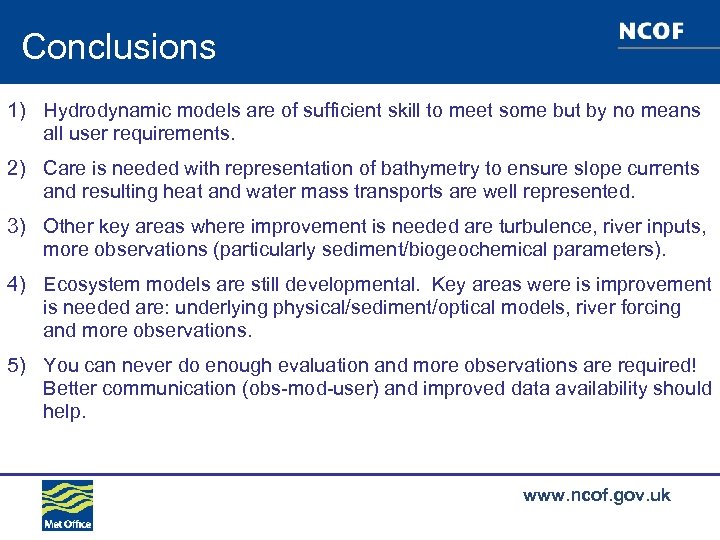 Conclusions 1) Hydrodynamic models are of sufficient skill to meet some but by no means all user requirements. 2) Care is needed with representation of bathymetry to ensure slope currents and resulting heat and water mass transports are well represented. 3) Other key areas where improvement is needed are turbulence, river inputs, more observations (particularly sediment/biogeochemical parameters). 4) Ecosystem models are still developmental. Key areas were is improvement is needed are: underlying physical/sediment/optical models, river forcing and more observations. 5) You can never do enough evaluation and more observations are required! Better communication (obs-mod-user) and improved data availability should help. www. ncof. gov. uk
 Questions? www. ncof. gov. uk