


 Скачать презентацию Moving from an ITRS to Enterprise Surveys for
36690b60d4164e0187224516f7d3e9db.ppt
- Количество слайдов: 32
 Moving from an ITRS to Enterprise Surveys for collecting trade in services statistics 3 rd WPTGS, Paris 7 -9 november 2011 Simonetta Zappa and Emanuele Breda Banca d’Italia Statistics Collection and Processing Department Economic and Financial Statistics Department
 Outline of the presentation ü The new system: basic principles and project timetable ü Business Register and Sampling Techniques ü Data sources: the Direct Reporting system and the other sources ü Main results page 1
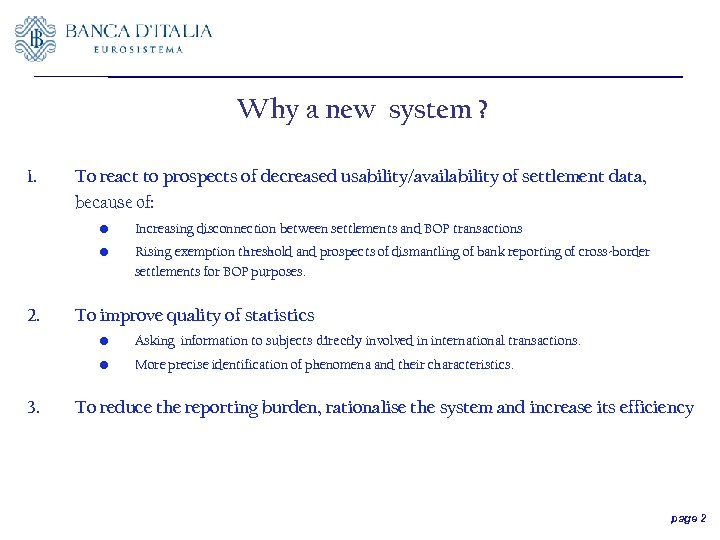 Why a new system ? 1. To react to prospects of decreased usability/availability of settlement data, because of: • • 2. Increasing disconnection between settlements and BOP transactions Rising exemption threshold and prospects of dismantling of bank reporting of cross-border settlements for BOP purposes. To improve quality of statistics • • 3. Asking information to subjects directly involved in international transactions. More precise identification of phenomena and their characteristics. To reduce the reporting burden, rationalise the system and increase its efficiency page 2
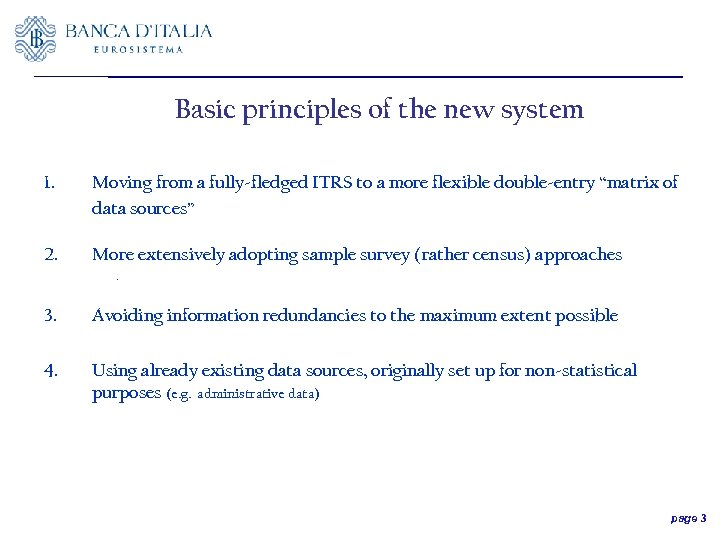 Basic principles of the new system 1. Moving from a fully-fledged ITRS to a more flexible double-entry “matrix of data sources” 2. More extensively adopting sample survey (rather census) approaches. 3. Avoiding information redundancies to the maximum extent possible 4. Using already existing data sources, originally set up for non-statistical purposes (e. g. administrative data) page 3
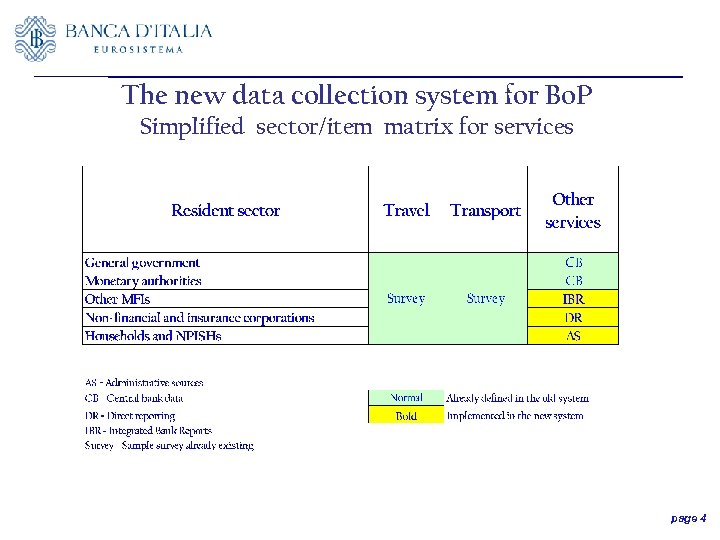 The new data collection system for Bo. P Simplified sector/item matrix for services page 4
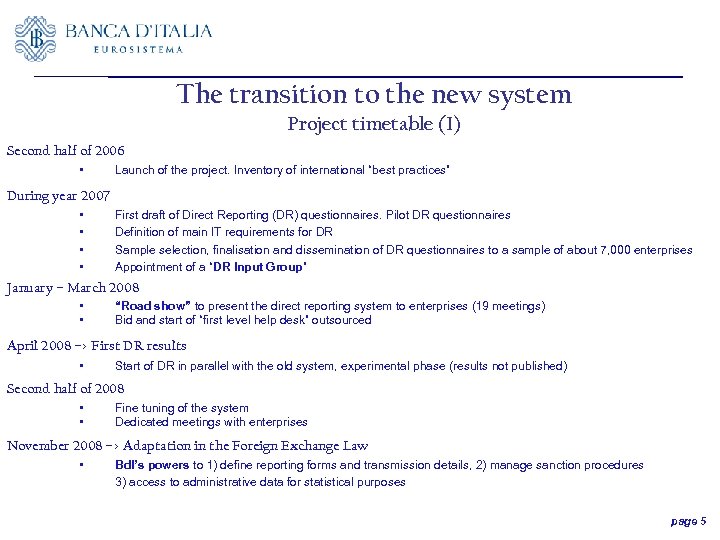 The transition to the new system Project timetable (I) Second half of 2006 • Launch of the project. Inventory of international “best practices” During year 2007 • • First draft of Direct Reporting (DR) questionnaires. Pilot DR questionnaires Definition of main IT requirements for DR Sample selection, finalisation and dissemination of DR questionnaires to a sample of about 7, 000 enterprises Appointment of a “DR Input Group” January – March 2008 • • “Road show” to present the direct reporting system to enterprises (19 meetings) Bid and start of “first level help desk” outsourced April 2008 –> First DR results • Start of DR in parallel with the old system, experimental phase (results not published) Second half of 2008 • • Fine tuning of the system Dedicated meetings with enterprises November 2008 –> Adaptation in the Foreign Exchange Law • Bd. I’s powers to 1) define reporting forms and transmission details, 2) manage sanction procedures 3) access to administrative data for statistical purposes page 5
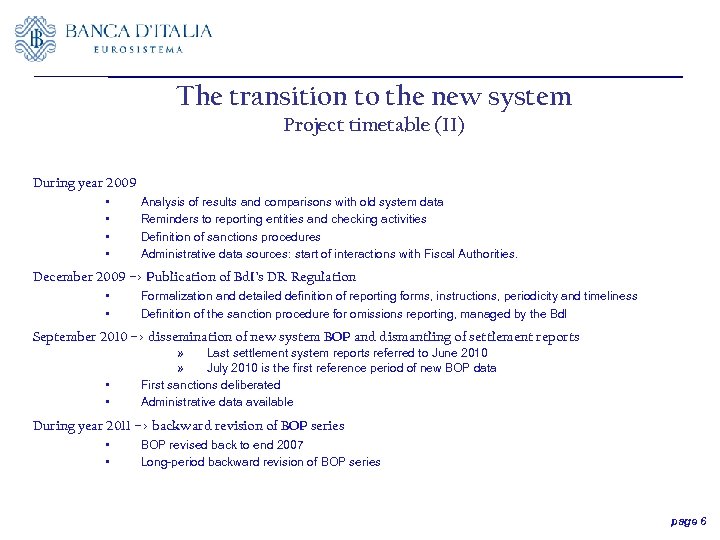 The transition to the new system Project timetable (II) During year 2009 • • Analysis of results and comparisons with old system data Reminders to reporting entities and checking activities Definition of sanctions procedures Administrative data sources: start of interactions with Fiscal Authorities. December 2009 –> Publication of Bd. I’s DR Regulation • • Formalization and detailed definition of reporting forms, instructions, periodicity and timeliness Definition of the sanction procedure for omissions reporting, managed by the Bd. I September 2010 –> dissemination of new system BOP and dismantling of settlement reports • • » Last settlement system reports referred to June 2010 » July 2010 is the first reference period of new BOP data First sanctions deliberated Administrative data available During year 2011 –> backward revision of BOP series • • BOP revised back to end 2007 Long-period backward revision of BOP series page 6
 Outline of the presentation ü The new system: basic principles and project timetable ü Business Register and Sampling Techniques ü Data sources: the Direct Reporting system and the other sources ü Main results page 7
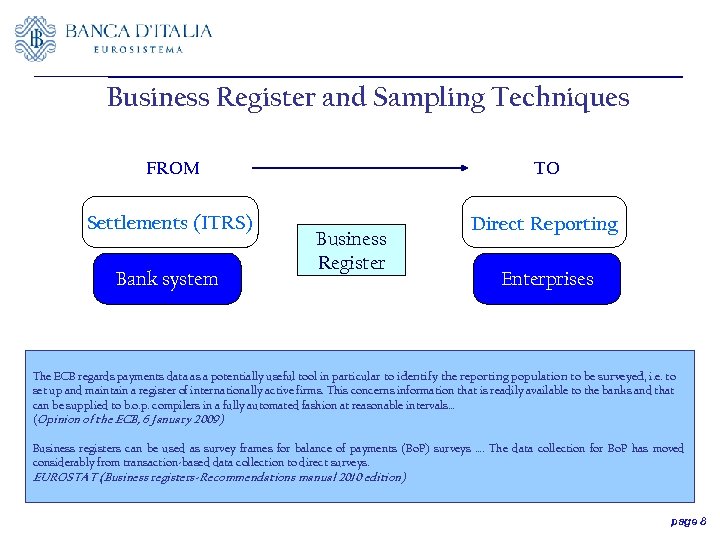 Business Register and Sampling Techniques FROM TO Settlements (ITRS) Direct Reporting Bank system Business Register Enterprises The ECB regards payments data as a potentially useful tool in particular to identify the reporting population to be surveyed, i. e. to set up and maintain a register of internationally active firms. This concerns information that is readily available to the banks and that can be supplied to b. o. p. compilers in a fully automated fashion at reasonable intervals… (Opinion of the ECB, 6 January 2009) Business registers can be used as survey frames for balance of payments (Bo. P) surveys …. The data collection for Bo. P has moved considerably from transaction-based data collection to direct surveys. EUROSTAT (Business registers-Recommendations manual 2010 edition) page 8
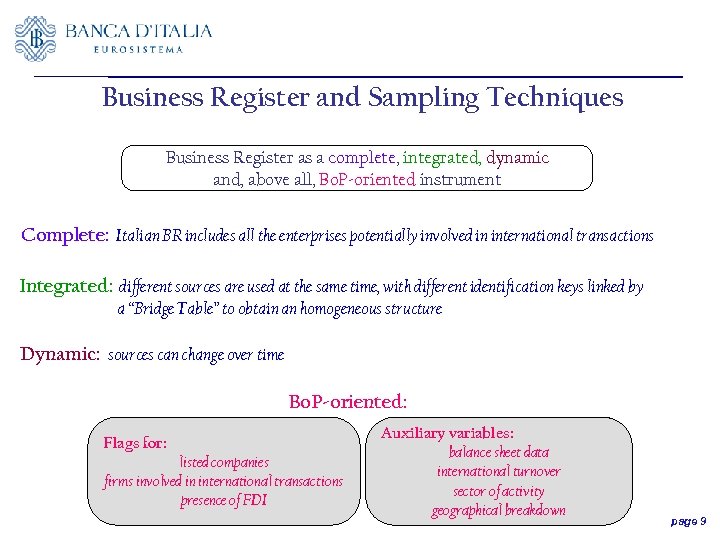 Business Register and Sampling Techniques Business Register as a complete, integrated, dynamic and, above all, Bo. P-oriented instrument Complete: Italian BR includes all the enterprises potentially involved in international transactions Integrated: different sources are used at the same time, with different identification keys linked by a “Bridge Table” to obtain an homogeneous structure Dynamic: sources can change over time Bo. P-oriented: Flags for: listed companies firms involved in international transactions presence of FDI Auxiliary variables: balance sheet data international turnover sector of activity geographical breakdown page 9
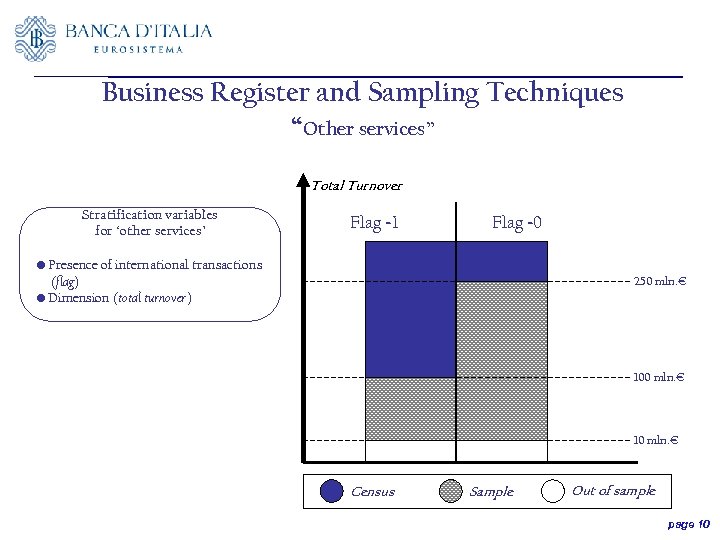 Business Register and Sampling Techniques “Other services” Total Turnover Stratification variables for ‘other services’ Flag =1 Flag =0 • Presence of international transactions (flag) • Dimension (total turnover) 250 mln. € 10 mln. € Census Sample Out of sample page 10
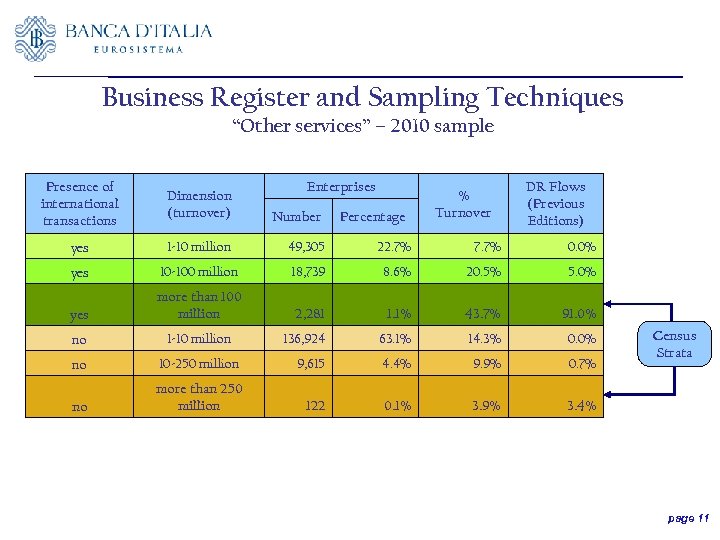 Business Register and Sampling Techniques “Other services” – 2010 sample Enterprises Presence of international transactions Dimension (turnover) Number yes 1 -10 million 49, 305 22. 7% 7. 7% 0. 0% yes 10 -100 million 18, 739 8. 6% 20. 5% 5. 0% yes more than 100 million 2, 281 1. 1% 43. 7% 91. 0% no 1 -10 million 136, 924 63. 1% 14. 3% 0. 0% no 10 -250 million 9, 615 4. 4% 9. 9% 0. 7% no more than 250 million 122 0. 1% 3. 9% 3. 4% Percentage % Turnover DR Flows (Previous Editions) Census Strata page 11
 Outline of the presentation ü The new system: basic principles and project timetable ü Business Register and Sampling Techniques ü Data sources: the Direct Reporting system and the other sources ü Main results page 12
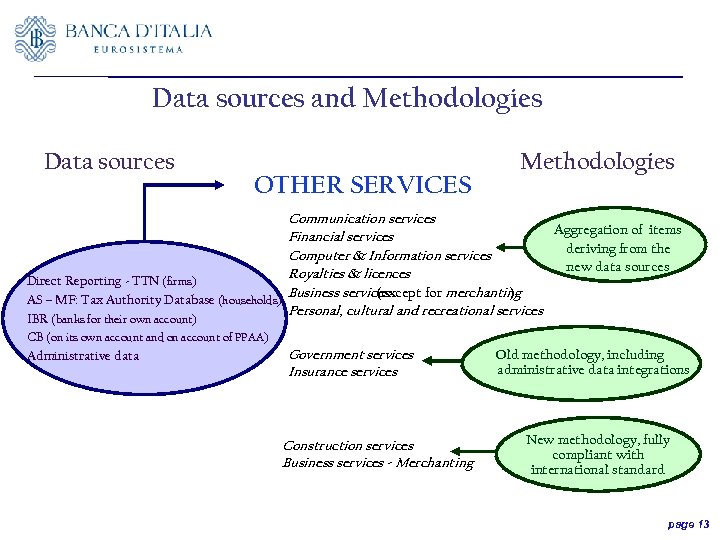 Data sources and Methodologies Data sources OTHER SERVICES Methodologies Communication services Aggregation of items Financial services deriving from the Computer & Information services new data sources Royalties & licences Direct Reporting - TTN (firms) Business services (except for merchanting ) AS – MF: Tax Authority Database (households) Personal, cultural and recreational services IBR (banks for their own account) CB (on its own account and on account of PPAA) Administrative data Government services Insurance services Construction services Business services - Merchanting Old methodology, including administrative data integrations New methodology, fully compliant with international standard page 13
 Data sources’ contributions (I) For some sub-items Direct Reporting share is around 100% of the total: Ø Communication services Ø Computer & Information services Ø Royalties & licences Ø Construction services page 14
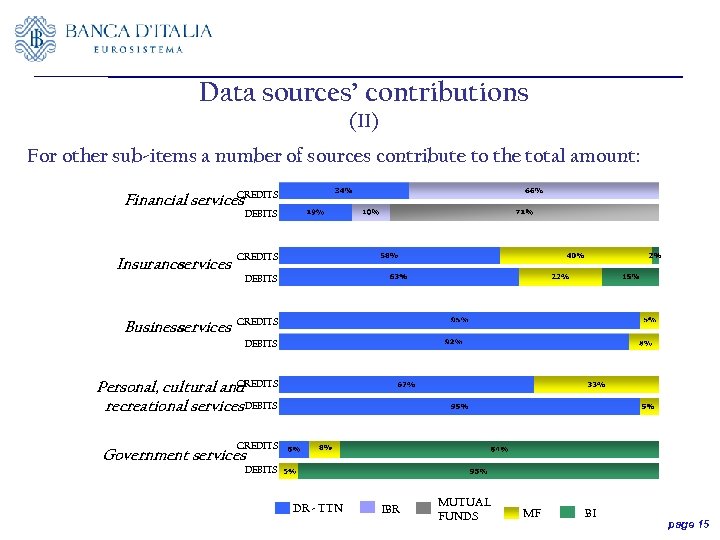 Data sources’ contributions (II) For other sub-items a number of sources contribute to the total amount: CREDITS Financial services DEBITS Insurance services CREDITS Business services CREDITS DEBITS CREDITS Personal, cultural and recreational services DEBITS CREDITS Government services DEBITS DR- TTN IBR MUTUAL FUNDS MF BI page 15
 Data sources • Direct Reporting - TTN (firms) • MF - Tax Authority Database (households) • IBR (banks for their own account) • BI (on its own account and on account of PPAA) • Administrative data page 16
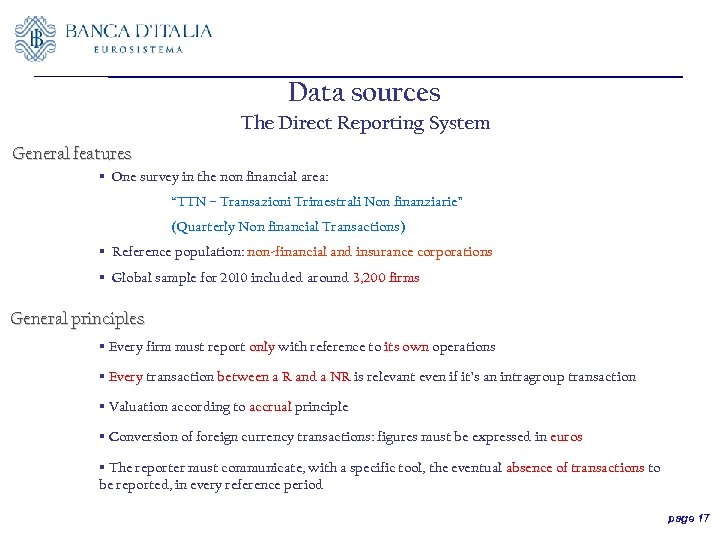 Data sources The Direct Reporting System General features § One survey in the non financial area: “TTN – Transazioni Trimestrali Non finanziarie” (Quarterly Non financial Transactions) § Reference population: non-financial and insurance corporations § Global sample for 2010 included around 3, 200 firms General principles § Every firm must report only with reference to its own operations § Every transaction between a R and a NR is relevant even if it’s an intragroup transaction § Valuation according to accrual principle § Conversion of foreign currency transactions: figures must be expressed in euros § The reporter must communicate, with a specific tool, the eventual absence of transactions to be reported, in every reference period page 17
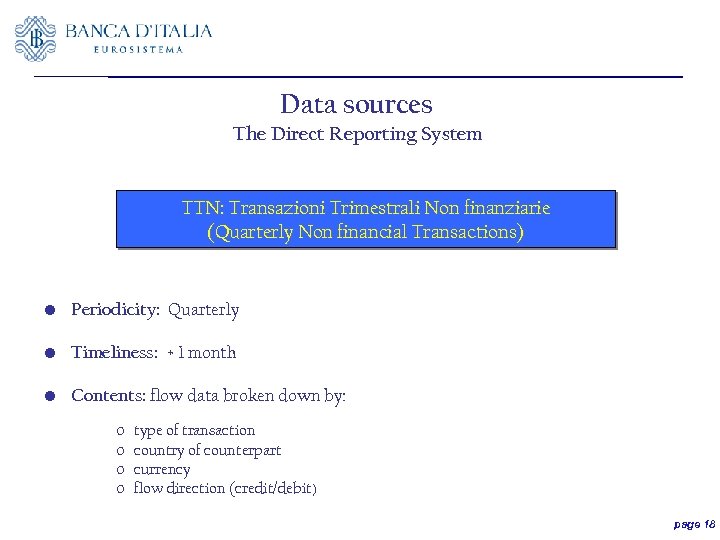 Data sources The Direct Reporting System TTN: Transazioni Trimestrali Non finanziarie (Quarterly Non financial Transactions) • Periodicity: Quarterly • Timeliness: + 1 month • Contents: flow data broken down by: o o type of transaction country of counterpart currency flow direction (credit/debit) page 18
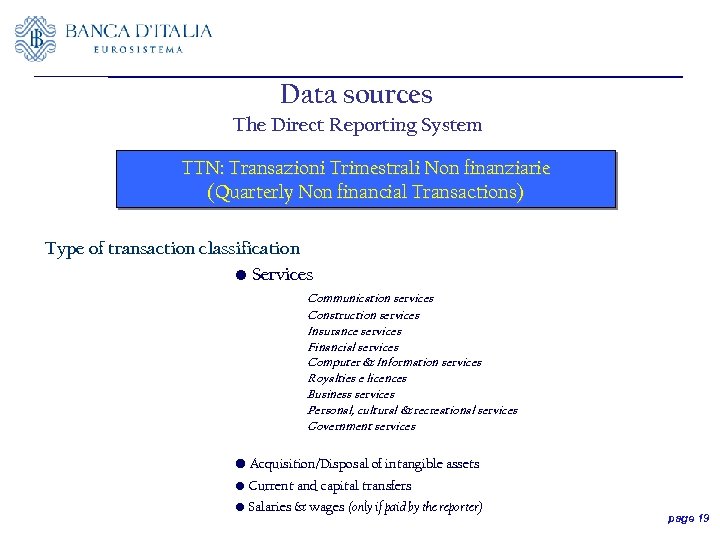 Data sources The Direct Reporting System TTN: Transazioni Trimestrali Non finanziarie (Quarterly Non financial Transactions) Type of transaction classification • Services Communication services Construction services Insurance services Financial services Computer & Information services Royalties e licences Business services Personal, cultural & recreational services Government services • Acquisition/Disposal of intangible assets • Current and capital transfers • Salaries & wages (only if paid by the reporter) page 19
 Data sources • Direct Reporting - TTN (firms) • MF - Tax Authority Database (households) • IBR (banks for their own account) • BI (on its own account and on account of PPAA) • Administrative data page 20
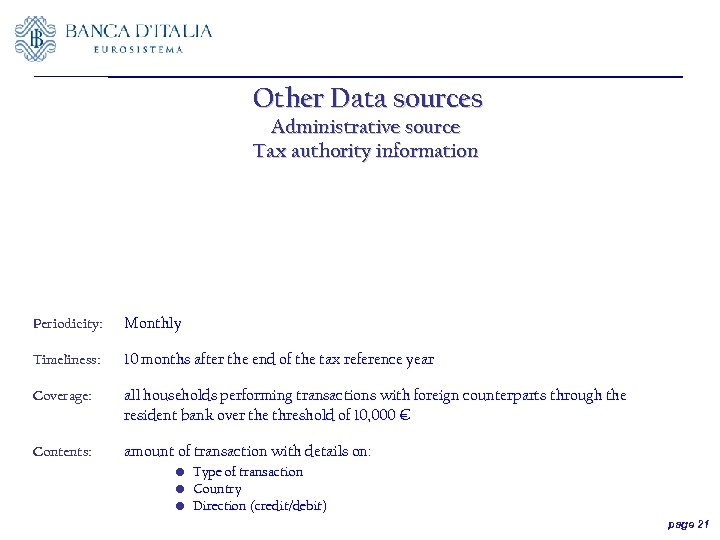 Other Data sources Administrative source Tax authority information The Periodicity: Monthly Timeliness: 10 months after the end of the tax reference year Coverage: all households performing transactions with foreign counterparts through the resident bank over the threshold of 10, 000 € Contents: amount of transaction with details on: • Type of transaction • Country • Direction (credit/debit) page 21
 Outline of the presentation ü The new system: basic principles and project timetable ü Business Register and Sampling Techniques ü Data sources: the Direct Reporting system and the other sources ü Main results page 22
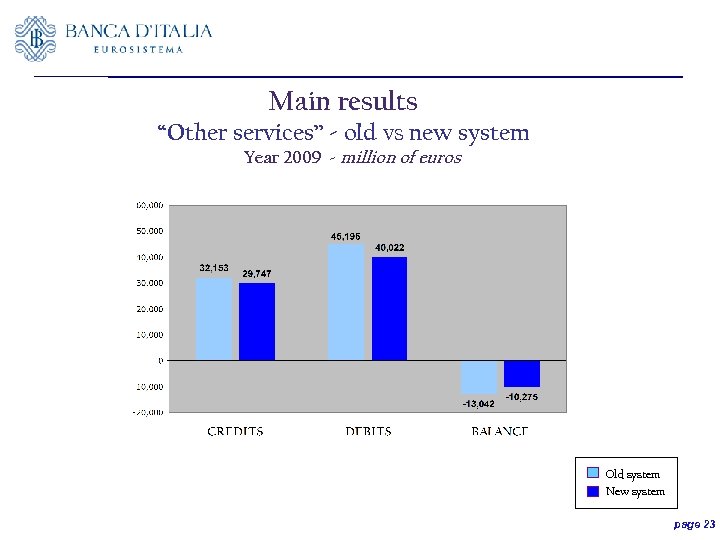 Main results “Other services” - old vs new system Year 2009 - million of euros Old system New system page 23
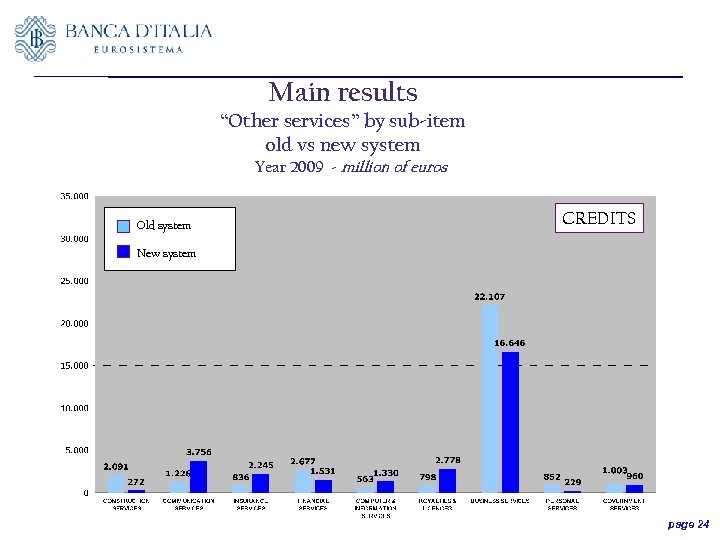 Main results “Other services” by sub-item old vs new system Year 2009 - million of euros Old system CREDITS New system page 24
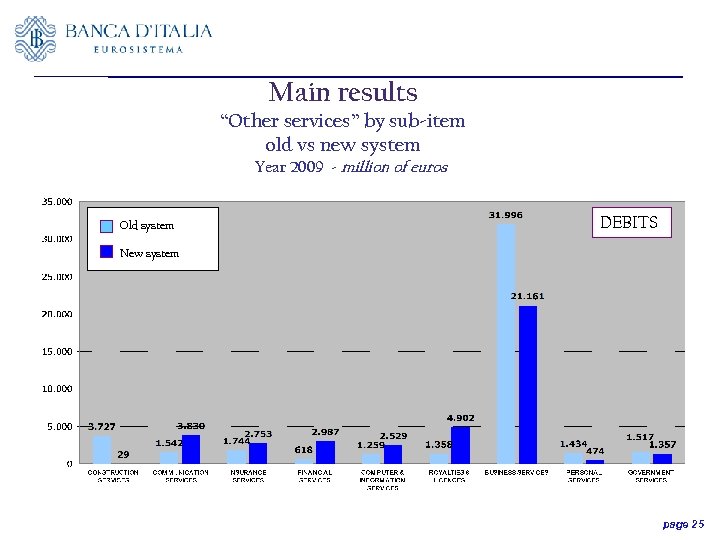 Main results “Other services” by sub-item old vs new system Year 2009 - million of euros Old system DEBITS New system page 25
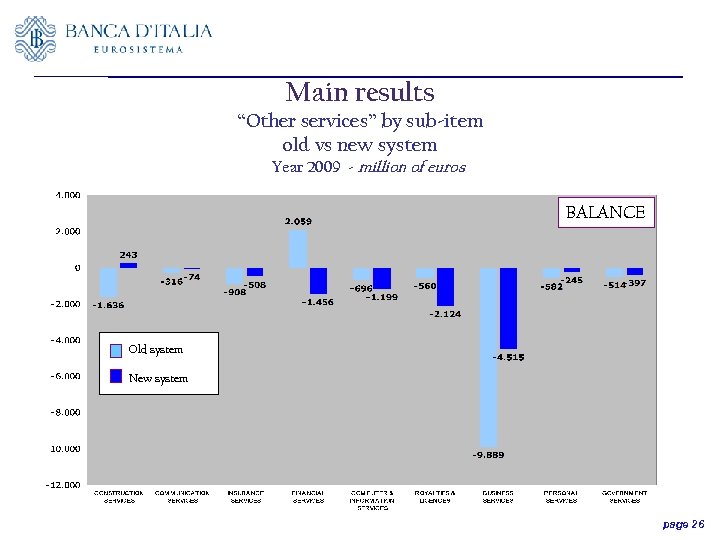 Main results “Other services” by sub-item old vs new system Year 2009 - million of euros BALANCE Old system New system page 26
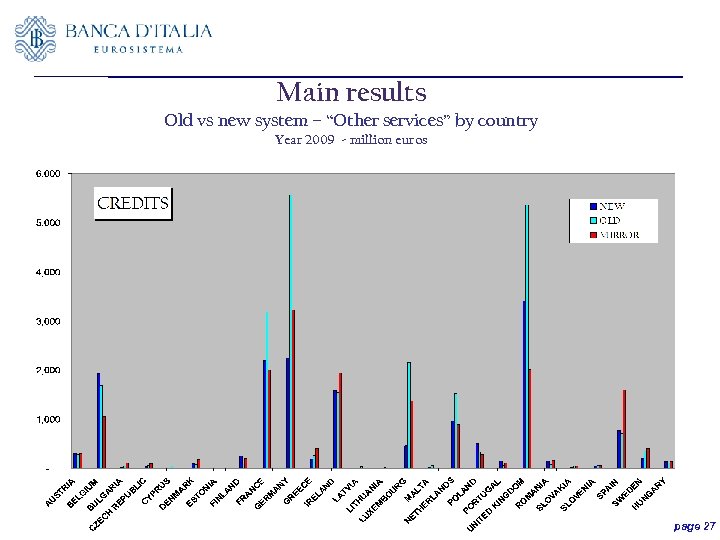 Main results Old vs new system – “Other services” by country Year 2009 - million euros page 27
 The reconstruction of pre-2008 balance of payments data (1) üAfter the publication of the new system data for 2008 -10, back-data have been revised: üthe main items of current account and capital account have been reconstructed backwards up to 1970 (before 1991 revisions are negligible); üthe main items of the financial account have been reconstructed backwards up to 1997. page 28
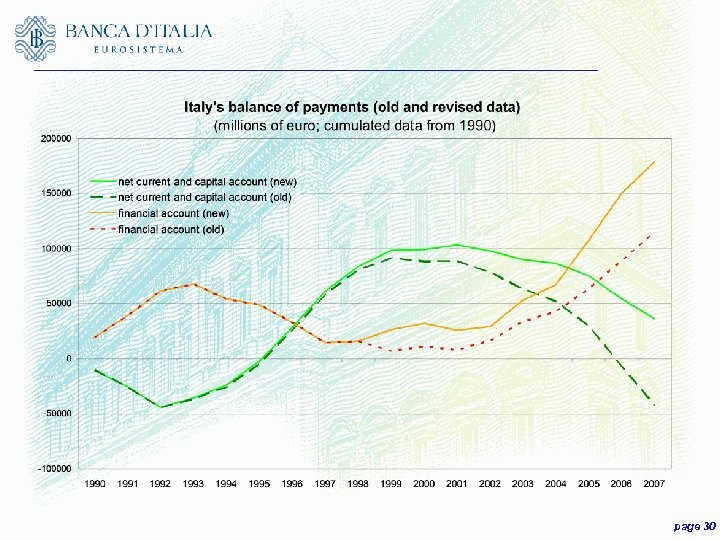
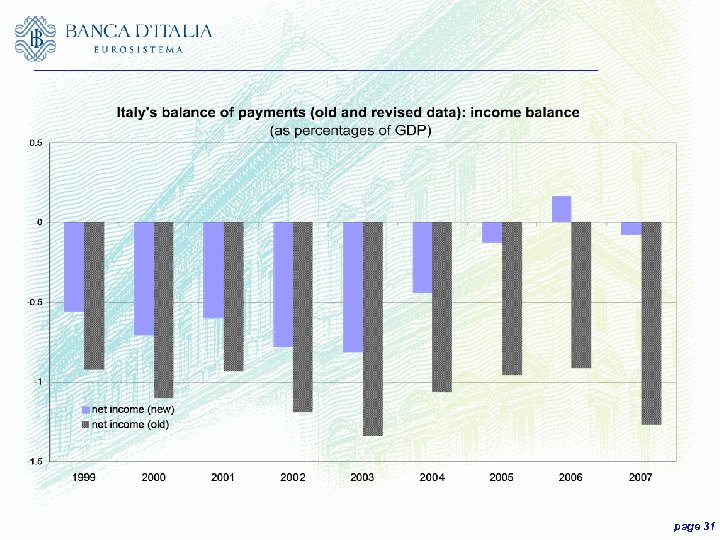
 The reconstruction of pre-2008 balance of payments data (2) üThe current account balance has been revised upwards (around 75 billions of euros between 1999 and 2007, in cumulated terms), mainly because of an upward revision of capital income balance (data from the old system did not include non-distributed income of capital accumulation funds); üthe increased debtor position in 2007 -10 stocks determined an upward revision of capital inflows for the previous years; üthese diverging patterns between current account and financial account balances determined a significant increase in negative cumulated errors and omissions. page 29
 page 30
 page 31