


 Скачать презентацию Moving Forward Using Tools and Technical Assistance Part
4d1305f431e9bed9ed1d689e1f1d6e8c.ppt
- Количество слайдов: 41
 Moving Forward: Using Tools and Technical Assistance Part One of the Webinar Series Being Successful: Meaningful Collaboration to Improve Outcomes for Families with Substance Use Disorders Presented by the National Resource Center for Organization Improvement and the National Center on Substance Abuse and Child Welfare April 24, 2008
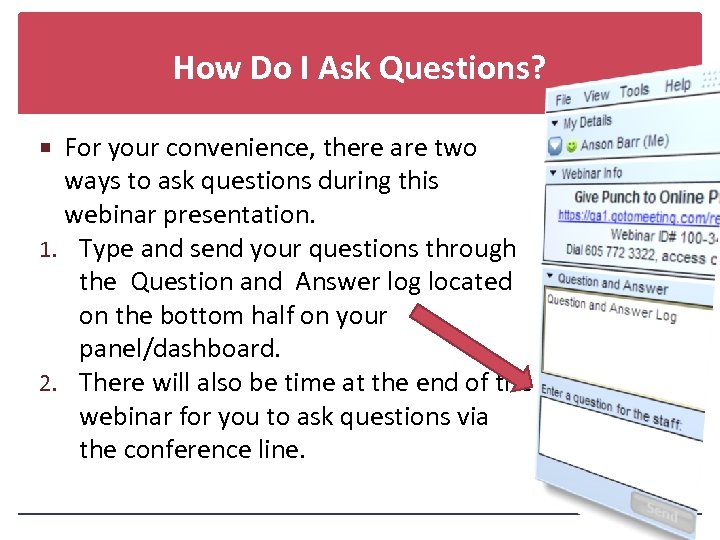
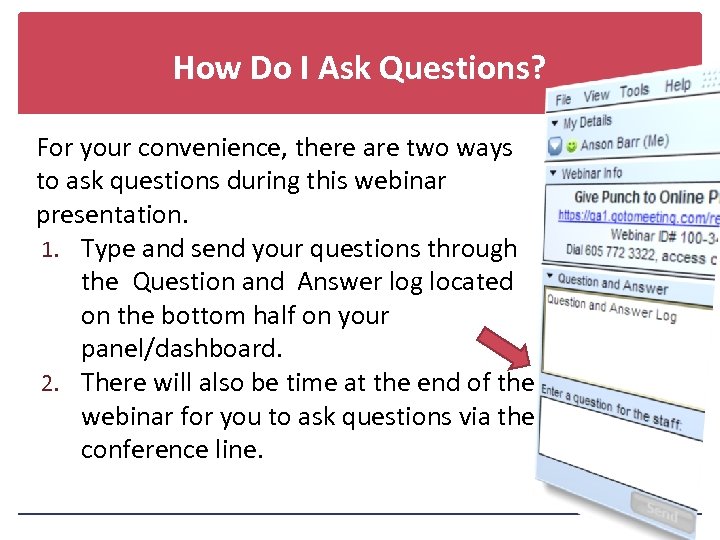 How Do I Ask Questions? For your convenience, there are two ways to ask questions during this webinar presentation. 1. Type and send your questions through the Question and Answer log located on the bottom half on your panel/dashboard. 2. There will also be time at the end of the webinar for you to ask questions via the conference line.
 Today’s Topics Introduction to the National Center on Substance Abuse and Child Welfare (NCSACW) Why Collaborate? The “How To” of Collaboration The 10 Elements of System Linkages and Models of Collaboration Technical Assistance Resources: Types of TA Available Technical Assistance Resources: Products in the Elements of System Linkages Question and Answer Wrap-up
 A Program of the Substance Abuse and Mental Health Services Administration Center for Substance Abuse Treatment and the Administration on Children, Youth and Families Children’s Bureau Office on Child Abuse and Neglect
 Mission: Developing knowledge and providing technical assistance to Federal, State, local agencies and Tribes to improve outcomes for families with substance use disorders in the child welfare and family court systems
 The “Why” of Collaboration
 Child Welfare and Substance Use: What Is the Relationship? It is not solely the use of a specific substance that affects the child welfare system; it is a complex relationship including: The substance use pattern Variations across States and local jurisdictions regarding policies and practices Knowledge and skills of workers Access to appropriate health and social supports for families
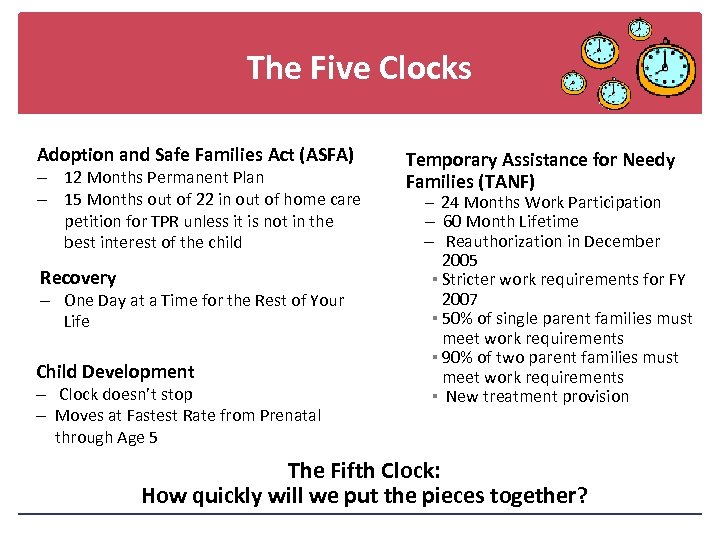 The Five Clocks Adoption and Safe Families Act (ASFA) – 12 Months Permanent Plan – 15 Months out of 22 in out of home care petition for TPR unless it is not in the best interest of the child Recovery – One Day at a Time for the Rest of Your Life Child Development – Clock doesn’t stop – Moves at Fastest Rate from Prenatal through Age 5 Temporary Assistance for Needy Families (TANF) – 24 Months Work Participation – 60 Month Lifetime – Reauthorization in December 2005 ▪ Stricter work requirements for FY 2007 ▪ 50% of single parent families must meet work requirements ▪ 90% of two parent families must meet work requirements ▪ New treatment provision The Fifth Clock: How quickly will we put the pieces together?
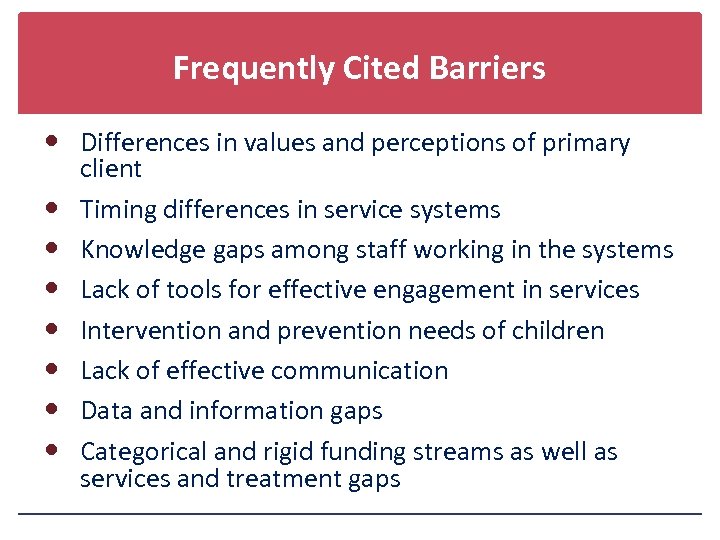 Frequently Cited Barriers Differences in values and perceptions of primary client Timing differences in service systems Knowledge gaps among staff working in the systems Lack of tools for effective engagement in services Intervention and prevention needs of children Lack of effective communication Data and information gaps Categorical and rigid funding streams as well as services and treatment gaps
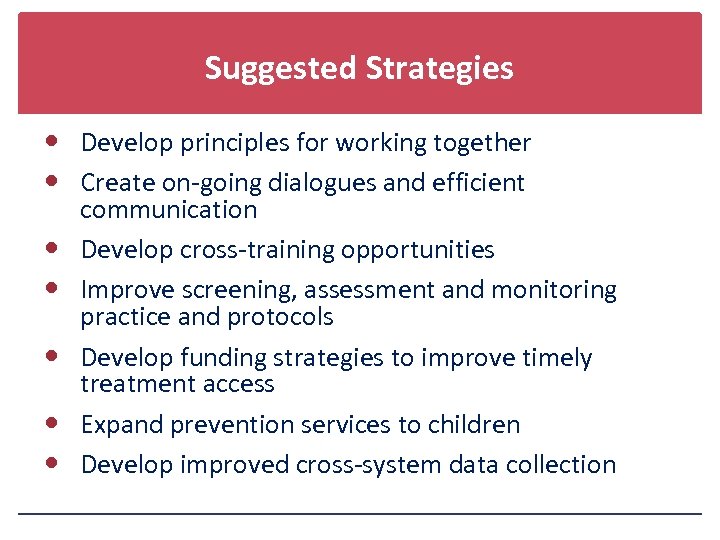 Suggested Strategies Develop principles for working together Create on-going dialogues and efficient communication Develop cross-training opportunities Improve screening, assessment and monitoring practice and protocols Develop funding strategies to improve timely treatment access Expand prevention services to children Develop improved cross-system data collection
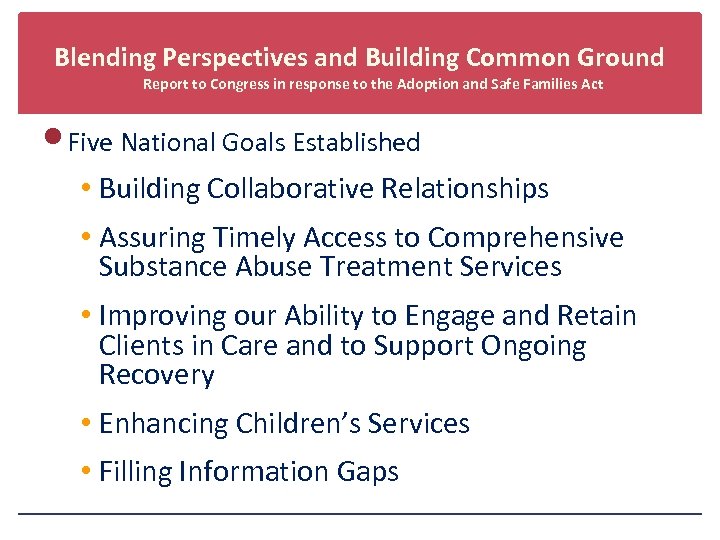 Blending Perspectives and Building Common Ground Report to Congress in response to the Adoption and Safe Families Act Five National Goals Established • Building Collaborative Relationships • Assuring Timely Access to Comprehensive Substance Abuse Treatment Services • Improving our Ability to Engage and Retain Clients in Care and to Support Ongoing Recovery • Enhancing Children’s Services • Filling Information Gaps
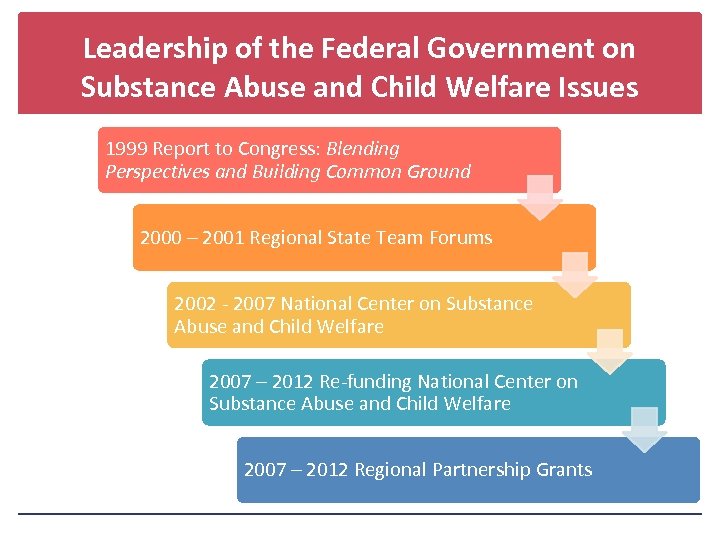 Leadership of the Federal Government on Substance Abuse and Child Welfare Issues 1999 Report to Congress: Blending Perspectives and Building Common Ground 2000 – 2001 Regional State Team Forums 2002 - 2007 National Center on Substance Abuse and Child Welfare 2007 – 2012 Re-funding National Center on Substance Abuse and Child Welfare 2007 – 2012 Regional Partnership Grants
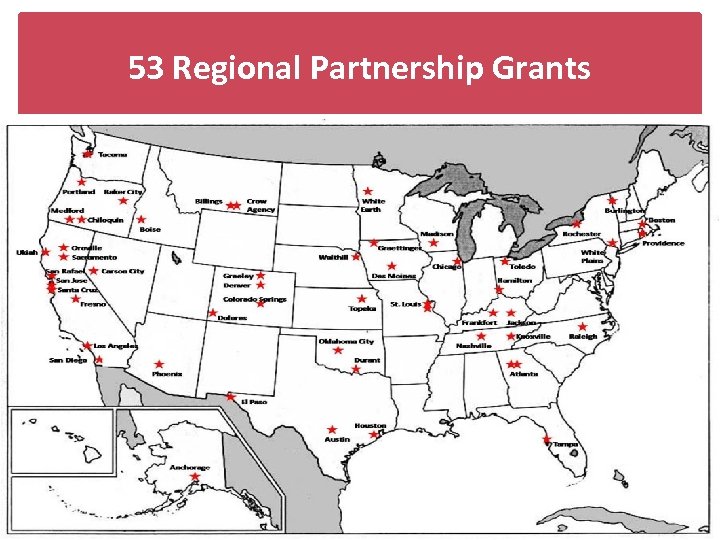 53 Regional Partnership Grants
 The “How To” of Collaboration The 10 Elements of System Linkages and Models of Collaboration
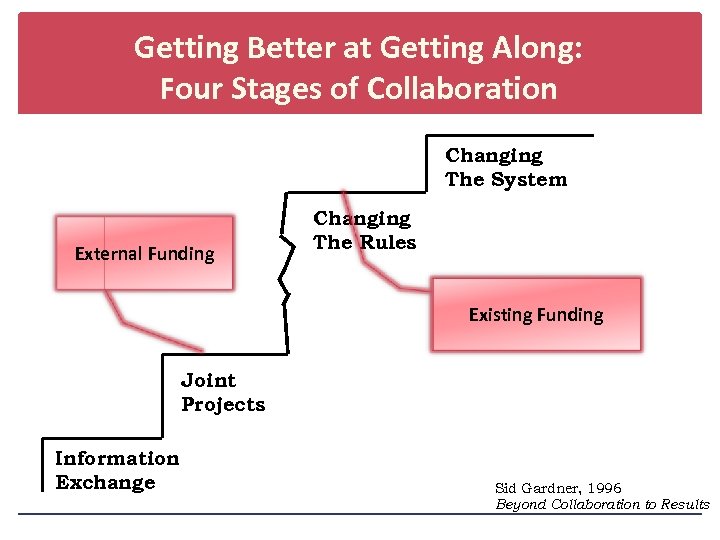 Getting Better at Getting Along: Four Stages of Collaboration Changing The System External Funding Changing The Rules Existing Funding Joint Projects Information Exchange Sid Gardner, 1996 Beyond Collaboration to Results
 Navigating the Pathways Published by CSAT A framework for defining elements of collaboration • To define linkage points across systems: where are the most important bridges we need to build? Methods to assess effectiveness of collaborative work • To assess differing values • To assist sites in measuring their implementation
 Collaborative Practice and Policy Tools Ten Element Framework Collaborative Values Inventory Collaborative Capacity Instrument Matrix of Progress in System Linkages Screening and Assessment for Family Engagement, Retention and Recovery — SAFERR
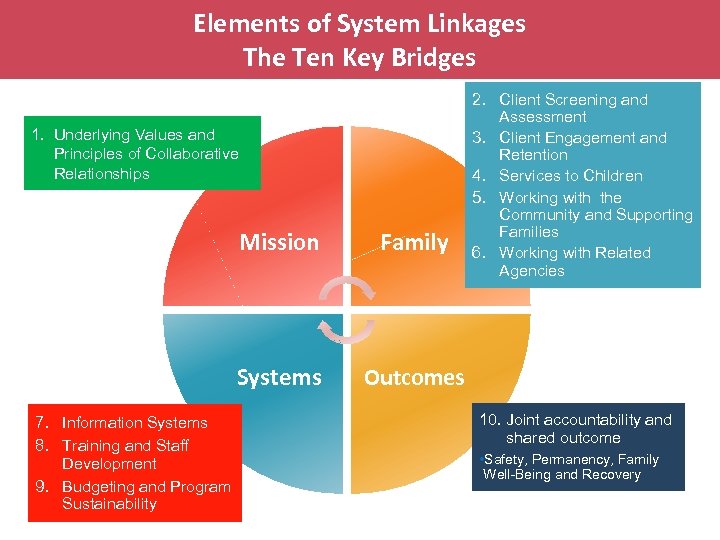 Elements of System Linkages The Ten Key Bridges 1. Underlying Values and Principles of Collaborative Relationships Mission Systems 7. Information Systems 8. Training and Staff Development 9. Budgeting and Program Sustainability Family 2. Client Screening and Assessment 3. Client Engagement and Retention 4. Services to Children 5. Working with the Community and Supporting Families 6. Working with Related Agencies Outcomes 10. Joint accountability and shared outcome • Safety, Permanency, Family Well-Being and Recovery
 Technical Assistance Resources: Types of TA Available
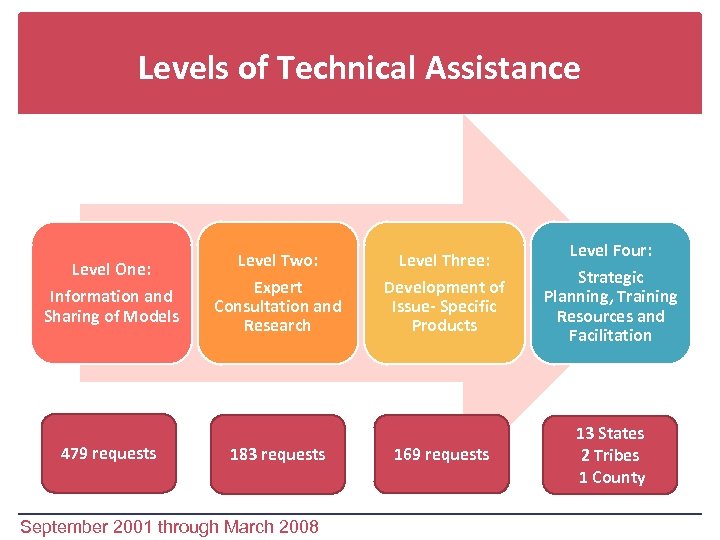 Levels of Technical Assistance Level One: Information and Sharing of Models 479 requests Level Two: Expert Consultation and Research 183 requests September 2001 through March 2008 Level Three: Development of Issue- Specific Products Level Four: Strategic Planning, Training Resources and Facilitation 169 requests 13 States 2 Tribes 1 County
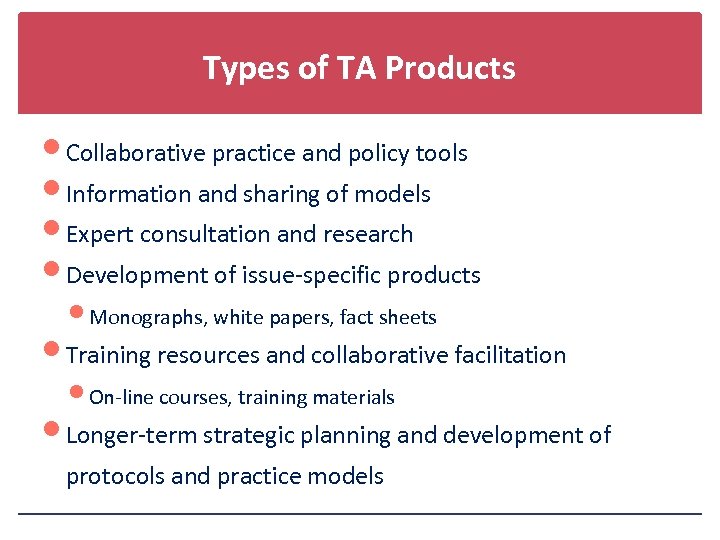 Types of TA Products Collaborative practice and policy tools Information and sharing of models Expert consultation and research Development of issue-specific products Monographs, white papers, fact sheets Training resources and collaborative facilitation On-line courses, training materials Longer-term strategic planning and development of protocols and practice models
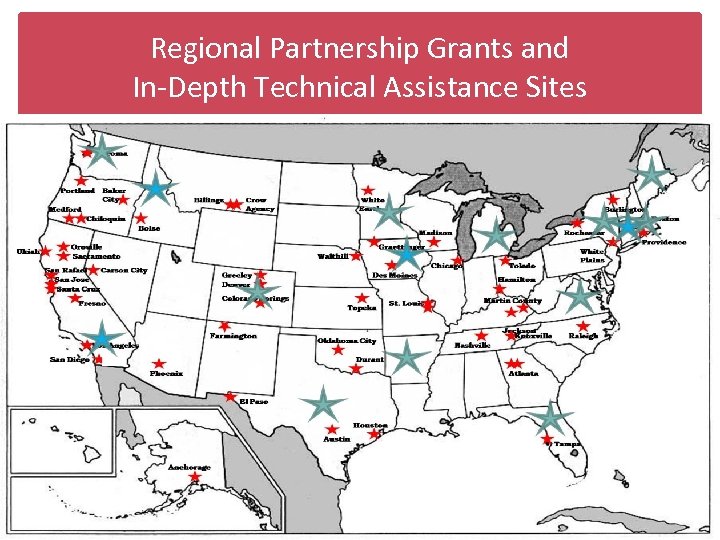 Regional Partnership Grants and In-Depth Technical Assistance Sites
 Technical Assistance Resources: Products in the Elements of System Linkages
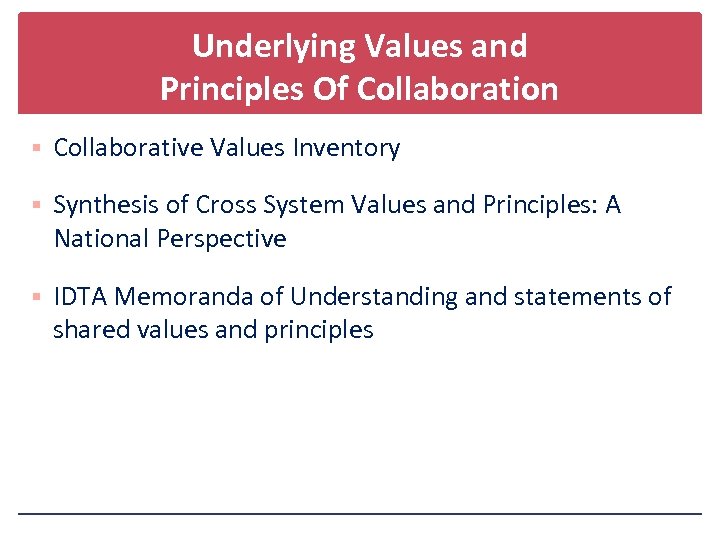 Underlying Values and Principles Of Collaboration § Collaborative Values Inventory § Synthesis of Cross System Values and Principles: A National Perspective § IDTA Memoranda of Understanding and statements of shared values and principles
 Screening, Assessment, Engagement and Retention Screening and Assessment for Family Engagement, Retention and Recovery (SAFERR) IDTA protocols & engagement resources Substance Abuse Specialists in Child Welfare Agencies and Dependency Courts: Considerations for Program Designers and Evaluators (in development) Utilizing Drug Testing in the Context of Child Welfare (in development)
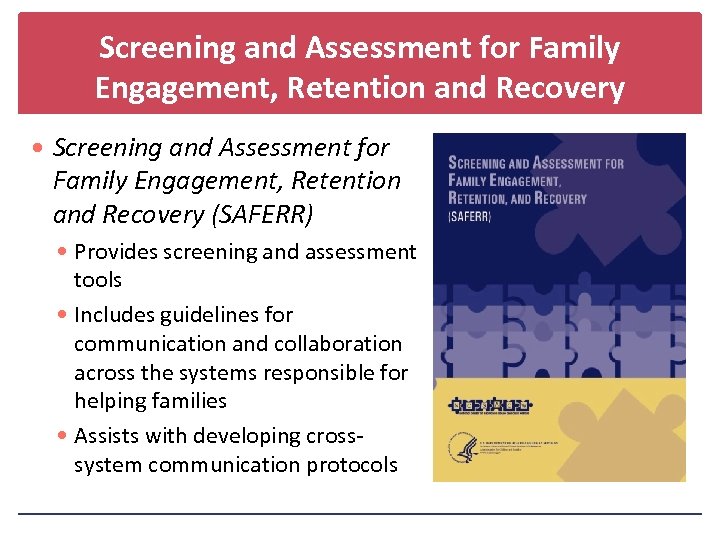 Screening and Assessment for Family Engagement, Retention and Recovery (SAFERR) Provides screening and assessment tools Includes guidelines for communication and collaboration across the systems responsible for helping families Assists with developing crosssystem communication protocols
 Services to Children, Working with Related Agencies and Building Community Supports § Substance Exposed Infants: State Responses § SAFERR Appendix on screening and assessment tools for children and youth § IDTA Parent Partner program materials
 Services to Children Multiple Opportunities for Intervention Commonly noted consequences for children Fetal Alcohol Syndrome (FAS) Alcohol-related neuro-developmental disorders (ARND) • Physical health consequences • Lack of secure attachment • Psychopathology • Behavioral problems • Poor social relations/skills • Deficits in motor skills • Cognition and learning disabilities
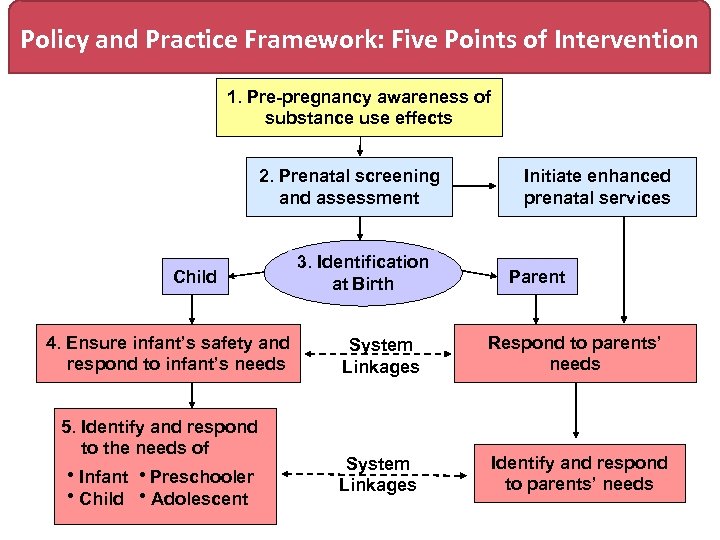 Policy and Practice Framework: Five Points of Intervention 1. Pre-pregnancy awareness of substance use effects 2. Prenatal screening and assessment Child 4. Ensure infant’s safety and respond to infant’s needs 5. Identify and respond to the needs of Infant ● Child ● ● Preschooler ● Adolescent 3. Identification at Birth Initiate enhanced prenatal services Parent System Linkages Respond to parents’ needs System Linkages Identify and respond to parents’ needs
 Training and Staff Development NCSACW online tutorials Participant workbooks and supervisor handbooks IDTA State examples of training initiatives The Child Welfare-Substance Abuse Connection: A Compendium of Training Curricula and Resources
 Training and Staff Development Understanding Substance Abuse and Facilitating Recovery: A Guide for Child Welfare Workers Understanding Child Welfare and the Dependency Court: A Guide for Substance Abuse Treatment Professionals Understanding Substance Use Disorders, Treatment and Family Recovery: A Guide for Legal Professionals (in final stages) Participant workbooks and supervisor handbooks developed by the State of Utah
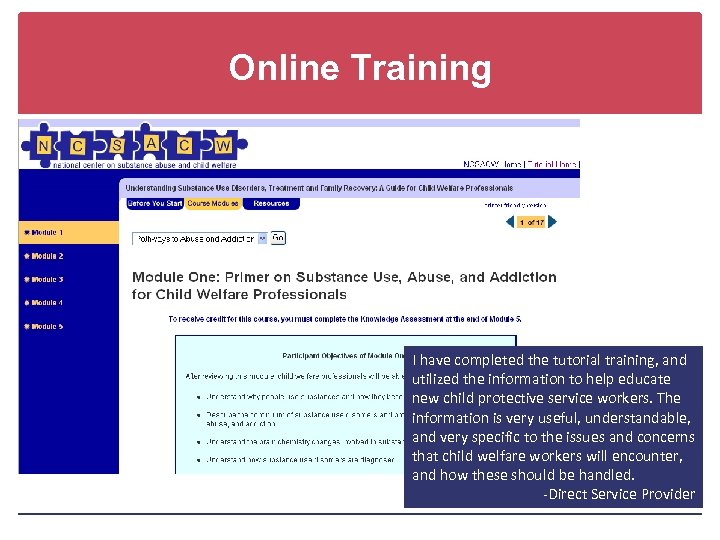 Online Training I have completed the tutorial training, and utilized the information to help educate new child protective service workers. The information is very useful, understandable, and very specific to the issues and concerns that child welfare workers will encounter, and how these should be handled. -Direct Service Provider
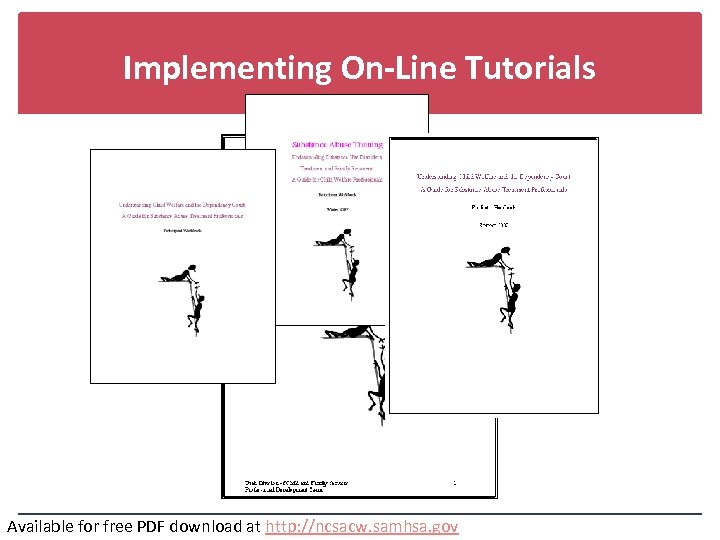 Implementing On-Line Tutorials Available for free PDF download at http: //ncsacw. samhsa. gov
 NCSACW Training and Related Products On-Line Training Available at no cost Upon completion of the tutorial: • Certificate awarded • CEUs are available Visit http: //ncsacw. samhsa. gov Understanding Child Welfare and the Dependency Court: A Guide for Substance Abuse Treatment Professionals Understanding Substance Use Disorders, Treatment and Family Recovery: A Guide for Child Welfare Professionals
 Budgeting and Program Sustainability White Paper on Funding Comprehensive Services for Families with Substance Use Disorders in Child Welfare and Dependency Courts Funding Family-Centered Treatment for Women With Substance Use Disorders (in development) IDTA State strategic plans for continued efforts
 Joint Accountability, Shared Outcomes and Information Systems SAFERR communication protocols IDTA State communication protocols and examples of data system improvements A Review of Alcohol and Drug Issues in the States' Child and Family Service Reviews and Program Improvement Plans
 Joint Accountability, Shared Outcomes and Information Systems Guide to Cross-System Data Sources for State and Tribal Child Welfare, Substance Abuse Treatment, and Court Systems (In Development) Webinar on May 16 th on models of cross-system data linkages RPG report on cross-system indicators and data sources
 National Center on Substance Abuse and Child Welfare How do I access technical assistance? Visit the NCSACW website for resources and products at http: //ncsacw. samhsa. gov Complete the contact form on the website Email us at ncsacw@cffutures. org
 Question and Answer
 How Do I Ask Questions? For your convenience, there are two ways to ask questions during this webinar presentation. 1. Type and send your questions through the Question and Answer log located on the bottom half on your panel/dashboard. 2. There will also be time at the end of the webinar for you to ask questions via the conference line.
 Moving Forward: Using Tools and Technical Assistance Part One of the Webinar Series Being Successful: Meaningful Collaboration to Improve Outcomes for Families with Substance Use Disorders Presented by the National Resource Center for Organization Improvement and the National Center on Substance Abuse and Child Welfare April 24, 2008